



Abstract
Although it is clear that early adolescents pursue and establish romantic relationships, less is known about the hallmarks of these pairings, even though they are linked to current and future close relationships. Based on adolescent identity formation and identity theory, we used theoretical concepts of roles, role expectations, and role enactments to inform our study. We conducted a series of same-sex and same-age focus groups with sixth and eighth graders and analyzed their responses using a grounded theory approach. We found that early adolescent romantic role enactments could be aggregated into two broad types of experiences. On the one hand, some youth were uncomfortable with interacting with a romantic partner. They often relied on texting as opposed to face-to-face interactions with partners. On the other hand, other early adolescents were more at ease engaging in romantic roles. They spent time interacting with their partners, shared personal information with each other, were physically affectionate, and created boundaries that defined their romantic relationships as different from other close relationships. The findings support our assertion that when early adolescents enact the new role of “romantic partner,” and develop a personal set of role expectations for this role, it requires learning, direct experience, and maturation before they can successfully engage in this role.
Adolescence is a life stage during which youth experiment with romantic pairings (Collins, Welsh, & Furman, 2009; Meir & Allen, 2009). This begins in early adolescence when many youth first pursue romantic interests and form romantic relationships—relationships that they characterize as special and different from other close relationships in their lives (Carver, Joyner, & Udry, 2003; Christopher, McKenney, & Poulsen, 2015). The emergence of these romantic interests coincides with a transition from adolescents spending the majority of their time in same-sex groups to spending more of their time in mixed-sex peer groups (Connolly, Craig, Goldberg, & Pepler, 2004). Spending more time in mixed-sex groups, in turn, increases the likelihood of entering into heterosexual romantic relationships (Connolly, Furman, & Konarski, 2000).
These early romantic experiences are tied to changes in other close relationships and have a developmental reach. For example, as adolescents spend time with romantic partners, they spend less time with their friends and parents (Tardash, Connolly, Pepler, Craig, & Costa, 2001). The relationship experiences at this age are also linked to later relationship quality and development in emerging adulthood (Madsen & Collins, 2011; Meir & Allen, 2009). Given this initial evidence of the importance of adolescent ventures into romantic pairings, it is noteworthy that relationship scholars have not focused a great deal of attention on adolescent relationship experiences. Additionally, previous investigations of adolescents’ romantic experiences have frequently suffered from shortcomings. Many investigators have focused on status variables such as whether or how frequently adolescents are dating (Collins et al., 2009). Thus, little is known about the interior of adolescents’ romantic relationships. Further, most of the investigations of adolescents have sampled middle and later adolescents even though differences emerge when comparing early with late adolescent relational experiences. For instance, Carlson and Rose (2012) report that fifth graders are less likely to go to movies, visit a partner’s house, and go to dances than eleventh and eighth graders. The question of how early adolescents experience romantic pairings, therefore, is not well addressed. Finally, although researchers have begun to acknowledge developmental dimensions to adolescents’ relational experiences (e.g., Christopher et al., 2015), the importance of adolescents’ romantic role experiences, with their potential links to adolescents' developing self-identity, have not been a part of many investigations of adolescent relationships.
The primary purpose of our study, therefore, was to address these lacunas. We did this in three ways. First, we used Erikson’s (1968, 1980) concept of adolescent identity formation, as well as identity theory (Stryker & Burke, 2000; Stryker & Vryan, 2006) to inform our investigation of early adolescents’ romantic role experiences. Second, we sampled two groups of early adolescents—sixth and eighth graders. We chose these grades because they represented transition points within the stage of early adolescence while still being relatively close in age and development. Sixth graders typically turn 12 years near or during the school year, likely experience the onset of puberty, and are just entering adolescence. Eighth graders typically turn 14 years, potentially have had more romantic encounters, and are at the cusp of entering into mid-adolescence by school years’ end. At the same time, both groups have not transitioned into high school so their social environment and level of personal freedom are more apt to be similarly restricted largely to their schools. Thus, sampling from these two groups seemed an ideal way to capture early and formative adolescent romantic experiences while still potentially revealing developmental differences across the two groups. Finally, we took a qualitative approach in gathering data by using focus groups. This rich-data approach allowed early adolescent voices to describe their initial romantic pairings, thereby providing us with a more complete picture of the interior of their romantic relationships.
Early adolescence and identity theory
Erikson (1968, 1980) postulated that forming one’s identity was a critical developmental task of adolescence. Investigations testing this hypothesis have focused on different dimensions of adolescent identity formation. For instance, Meeus, van de Schoot, Schwartz, and Branje (2010) examined the progression of identity formation across adolescence using a longitudinal approach and found that early adolescence was a time of intensive exploration of newly acquired identities while actively considering alternative identities. In another approach, McLean, Breen, and Fournier (2010) showed that adolescents’ interactions in close relationships, including romantic pairings, allowed adolescents to create meaning for new experiences, meanings that eventually became integrated into their identity. Moreover, as adolescents developed and their interactions in close relationships increased in frequency, the frequency of integrating new meanings into their identities also increased. These findings support the theoretical advances of Pittman, Keiley, Kerpelman, and Vaughn (2011) who postulate that identity formation during adolescence has a social construction dimension. Pittman and colleagues hypothesize that relationships with significant others, and especially romantic partners, help adolescents integrate relational experiences into roles that in turn become part of adolescents’ self-identities.
We capitalized on Pittman et al.’s (2011) theoretical advances using identity theory, with its foundation in social structure theory and its emphasis on roles to inform our investigation. Identity theory posits that social groups are communities built from a network of interpersonal relationships (Stryker & Burke, 2000; Stryker & Vryan, 2006). Social positions, the genesis of specific roles for group members, emerge from the community. Positions often come in complimentary pairs, such as boyfriend and girlfriend, and include norms or expectations formed in part by the group and in part from dyadic interactions. Applying this to early adolescent romantic relationships, there is evidence that the position of “romantic partner” is integrated into early adolescents’ peer communities. Youth’s romantic pairings frequently emerge from their participation in mixed-sex groups either because they date other members of the group or friends from the group introduce them to potential partners outside of the group (Connolly et al., 2000, 2004). Further, early adolescents experience both peer pressure to enter into romantic relationships and an increase in status within their social group once in a relationship (Christopher et al., 2015). These findings demonstrate that early adolescents’ peer groups support the existence of and encourage youth to enter into the role of romantic partner. Still, specifically how early adolescents enter into a romantic role, a role that is relatively new to them, remains unclear. Our first research question, therefore, is:
According to identity theory, once individuals adopt a position, they actively construct the role for that position by developing a set of role expectations, enacting the role, and eventually integrating the role into their self-identity (Stryker & Burke, 2000; Stryker & Vryan, 2006). Although group members can influence this process, the development of role expectations primarily occurs as two individuals interact in corresponding roles. For instance, as two early adolescents decide to become boyfriend and girlfriend, they engage in role making as they negotiate how best to resolve differing role expectations. Successful resolution of differences leads to a shared set of role expectations, satisfying role enactments, and eventual integration of the roles into the partner’s self-identities.
In terms of adolescent romantic experiences, there is evidence that being in a romantic partner role is central to adolescents’ self-identity. They place a high value on being a romantic partner (Furman & Collins, 2009; Furman & Shaffer, 2003), and talking about their romantic relationships dominates their daily conversations (Eder, 1993; Thompson, 1994). Adolescents also value spending time with their partner to the exclusion of others (Laursen & Williams, 1997; Roth & Parker, 2001). Moreover, adolescents frequently think about their partner when that partner is not present (Richards, Crow, Larson, & Swarr, 1998). Although these findings do not directly measure adolescent identity, they provide evidence that romantic pairings are a significant part of adolescents’ lives. Adolescents’ thoughts, daily focus, and how they structure their social interactions revolve around their romantic partners once they enter into a relationship.
There is also research that provides insight into adolescents’ role expectations and enactments for romantic pairings. Adolescents, for example, see an ideal romantic partner as intelligent, physically appealing, interpersonally skilled, similar to themselves, and popular (Regan & Joshi, 2003). They also see romantic relationships as different than other interpersonal relationships. When asked to compare romantic and cross-sex friendships, early adolescents perceived romantic relationships as more characterized by passion and commitment (Connolly, Craig, Goldberg, & Pepler, 1999). These findings demonstrate that adolescents view romantic pairings as unique and different from other relationships they experience, and they provide some insight into how adolescents engage in their romantic roles. Nonetheless, the hallmarks of these roles remain unclear. Moreover, this literature is based on adolescent samples without focusing specifically on the formative experiences of early adolescents. Our second research question, therefore, is:
From an identity theory perspective, romantic partners can choose to end their romantic pairing if the role expectations of the partners differ too much, if partners lack the skills necessary to resolve role conflict, or if partners’ role expectations are not met. This applies to adolescent romantic relationships, which vary a great deal in length and often end because adolescents self-initiate a breakup (Carver et al., 2003). Adolescents give a number of reasons for ending their romantic pairings, but unmet personal needs in general, and unmet relational needs more specifically, are common reasons for adolescents breaking up. Additionally, a high number of adolescents cite infidelity as the reason for ending their relationships (Connolly & McIsaac, 2009). There are differences across adolescents of different ages. Early adolescents experience more frequent breakups than older adolescents (Connolly & McIsaac, 2009). Although these investigations provide some insight into why adolescents end their romantic pairings, they do not address the processes involved in ending these relationships, nor do they focus on early adolescents as a unique group. In order to gain greater insight into why and how early adolescents end their romantic pairings, we explored a third research question:
Early adolescence and learning new roles
One of the developmental steps of adolescence is learning to engage in new roles that will eventually become integrated into their self-identity. As can be seen from the literature reviewed, this includes learning to navigate the role of romantic partner for most contemporary adolescents. However, identity theory does not directly address the processes involved in learning new roles (Stryker & Burke, 2000; Stryker & Vryan, 2006). Nonetheless, we posit that certain assumptions are evident. For instance, new positions do not always carry clear role expectations, and integrating them into one’s identity takes time (e.g., Collier & Callero, 2005). In other words, developing a personal set of role expectations for the role of romantic partner involves learning from direct experience in that role. Further, to successfully engage in creating new roles, individuals need to understand their partner’s point of view, a process known as role taking (Christopher, 2001; Lynch, 2007).
Early adolescents potentially face a number of challenges when developing their expectations for engaging in a romantic role. Some may lack self-confidence about enacting these roles. This is more true of adolescent boys than girls, possibly because of social expectations for boys to initiate a romantic pairing at a time when they have little experience with this role and possibly because prior same-sex peer interactions leave them unprepared to fulfill this role expectation (Giordano, Longmore, & Manning, 2006). It may also be unclear to early adolescents whether relational behaviors commonly displayed in older adolescent couples are acceptable for them, given their younger age (e.g., Adams, Laursen, & Wilder, 2001; Carlson & Rose, 2012). Moreover, role making with a partner requires an understanding of the partner’s role expectations (Christopher, 2001; Lynch, 2007). Understanding a partner’s point of view, however, may be challenging if adolescents have not fully developed the cognitive and/or emotional ability to take another’s view, if partners lack the communication skills needed to convey their expectations, or if either partner does not have clear role expectations because of a lack of experience. In other words, some early adolescents may lack the experience and developmental maturity to fully engage in a romantic pairing.
From this perspective, it is not surprising that there are differences between early and later adolescents in their romantic experiences. Comparing the romantic partner interactions for younger and older adolescents shows that early adolescents spend less time in daily interactions with their romantic partners, share fewer activities, and the activities they engage in are less diverse and characterized by less reciprocity (Adams et al., 2001). For example, early adolescents, as compared to middle and later adolescents, spend less time going to movies, to dances, and to the mall with their partners (Carlson & Rose, 2012). Older adolescents are also more apt to be involved in longer term steady relationships that are dyadic and intimate in nature, whereas early adolescents are more apt to move in and out of relationships that vary from high to low intensity (Meir & Allen, 2009). What remains unclear from these findings is whether differences exist between younger (i.e., 12 year olds) and older (i.e., 14 year olds) early adolescents. Differences may exist even within early adolescence, given the potentially greater romantic relational experience of eighth graders as opposed to sixth graders. To investigate whether such differences exist, we also explored a fourth research question:
Method
Data collection procedures
The data were gathered during the winter and spring of 2013 using focus groups conducted in a semi-structured interview format. We believed that focus groups were the best way to explore the research questions, as they created a social environment for verbal exchanges similar to what these adolescents experience daily within their own peer group discussions of romantic relationships. To investigate variations in role expectations within early adolescence, only early adolescents in the sixth and eighth grade were recruited for participation. Participants were recruited through two elementary schools and two middle schools, as well as a local Boys and Girls club. For those participants recruited through the school system, school district approval was obtained, and then school principals were contacted. Principals who consented to participation selected classrooms and consent forms were distributed by the teachers of those classrooms to their students. Students were instructed to take the consent forms to their parents and return them in a timely manner. Those participants recruited through the Boys and Girls club were given consent forms by a regional director. In all cases, parents were informed through the consent forms that their adolescent would receive a monetary incentive of US$10 for their participation. Parents whose adolescent returned consent forms were also asked to fill out a brief demographic survey.
A total of 52 consent forms were returned. Shortly thereafter, parents were contacted and focus groups were scheduled. Due to scheduling difficulties, and the need to balance time constraints with the necessity of having multiple viewpoints, we decided that focus groups would be limited to three to six participants. This resulted in a final sample of 44 participants (8 participants could not be scheduled due to time conflicts).
Upon arrival to the focus group sessions, participants were assigned a number and were instructed to read and sign assent forms. To ensure confidentiality, they were informed that they needed to use their assigned numbers rather than names during the discussion and that they should introduce themselves using this number whenever they contributed to the discussion (for the audio recordings). They were also told not to use any names of specific individuals but to speak generally (e.g., “a girl I know”). Finally, they were instructed that anything said in the focus group was to remain confidential, and they were asked not to discuss any sexual behaviors above and beyond hugging and kissing. This last instruction was given due to an assurance provided to schools that discussions would not include talking about sex. The actual focus group began after giving these instructions.
Focus groups were conducted using a semi-structured interview format using questions that prompted adolescents to share personal or observed experiences. Initial questions sought to understand how participants defined a boyfriend or girlfriend relationship as distinct from a friendship and how relationships were initiated. From there, questions focused on the youth’s experiences within romantic relationships, how partners communicated, what activities they engaged in together, and how long their relationships lasted. This was followed by a series of questions asking why and how the adolescents ended their relationships. Within each focus group, participants were free to develop the conversation within the parameters created by these questions.
Participants
The final sample consisted of 44 participants spread across six focus groups. Focus group configurations were as follows: two groups of six, four groups of five, one group of four, and three groups of three. In total, there were 21 sixth graders (10 female, 11 male; M age = 11.80 years, SD = .41) and 23 eighth graders (10 female, 13 male; M age = 13.74 years; SD = .62). Twenty-three participants were identified by their parents as White, 13 as Latino/Latina, 7 as African American, and one individual as Native American. Roughly half of the youth (47%) lived in a household where parents reported being married and never divorced. Fewer (16%) lived with a single-never married mother, and 23% were from a divorced or separated single parent household. Eight percent were from a divorced but remarried household, 3% (1 individual) from a divorced living with partner household, and 3% (1 individual) from a single-parent widowed household. A total of 36% of participants’ parents reported household income over US$100,000, 30% reported household income between US$60,000 and US$100,000, 31% reported household income between US$20,000, and US$50,000, and 3% (1 individual) reported household income below US$20,000.
Data analysis
The focus group discussions were transcribed, and the transcriptions were checked for accuracy. Coding the transcriptions was done using the Web-based qualitative research tool Dedoose (Dedoose, 2013). A grounded theory approach set forth by Corbin and Strauss (2008) guided the coding process. Each individual participant’s transcript was coded separately. The initial coding structure was developed by the lead author. This was done by reading individual transcripts of the early adolescents as they participated in the focus groups. Primary codes were derived when similar meanings emerged from the responses of a given adolescent as reflected in frequency and/or intensity. The transcript was reviewed again to see whether secondary codes emerged from the responses captured by the primary codes. After this process was complete for the first transcript, it was applied to the second transcript. When new codes emerged from the second or subsequent transcripts, previous transcripts were reexamined to see whether these new codes were present. The coding structure, and the process that allowed new codes to emerge from the data, was then applied by the second and third authors.
Throughout this process, any new codes that emerged and questions about applying existing codes were discussed among the three coders. All three authors applied new codes to previously reviewed transcripts. This iterative process allowed the voices of the early adolescents to emerge from the data. For the 44 respondents, 1,026 excerpts were isolated and coded. To measure inter-rater reliability, participants who were coded by one coder were randomly selected. The responses from these participants were then coded by a second coder until the second coder had coded 10% of the first coder’s excerpts. The κ values were then calculated across the pairs of coders and ranged from .88 to .91.
Results
The focus group discussions allowed insight into how youth transitioned into being a boyfriend/girlfriend, and their experiences with engaging in romantic roles. Youth also provided us with descriptions of how partners communicated and what activities they engaged in as a couple. Finally, we were able to explore how their romantic relationships ended. Differences between sixth and eighth graders are described below as they emerged within a given theme.
How do early adolescents transition into the role of romantic partners?
When we asked how soon-to-be couples transitioned into Going Out, early adolescents’ common term for the boyfriend/girlfriend role position, it was obvious that Going Out was triggered by boys asking the girl out, and the girls reciprocating (n = 25; see Table 1 for the frequency of all of the codes). As Luke (11 years old) related, “The guy usually has to do something otherwise it won’t make it to the boyfriend and girlfriend stage.” Shelly (14 years old) described a similar process:
Yeah, well, they’ll [boys] like … they’ll ask you out like either in person or in text or something. And then like if you say, ‘Yes’, then like you’ll tell all your friends, ‘Oh, guess who asked me out and I said yes?’ … And then you can change your Facebook status and be like, ‘Oh, I’m in a relationship with so-and-so’.
Codes and frequency.
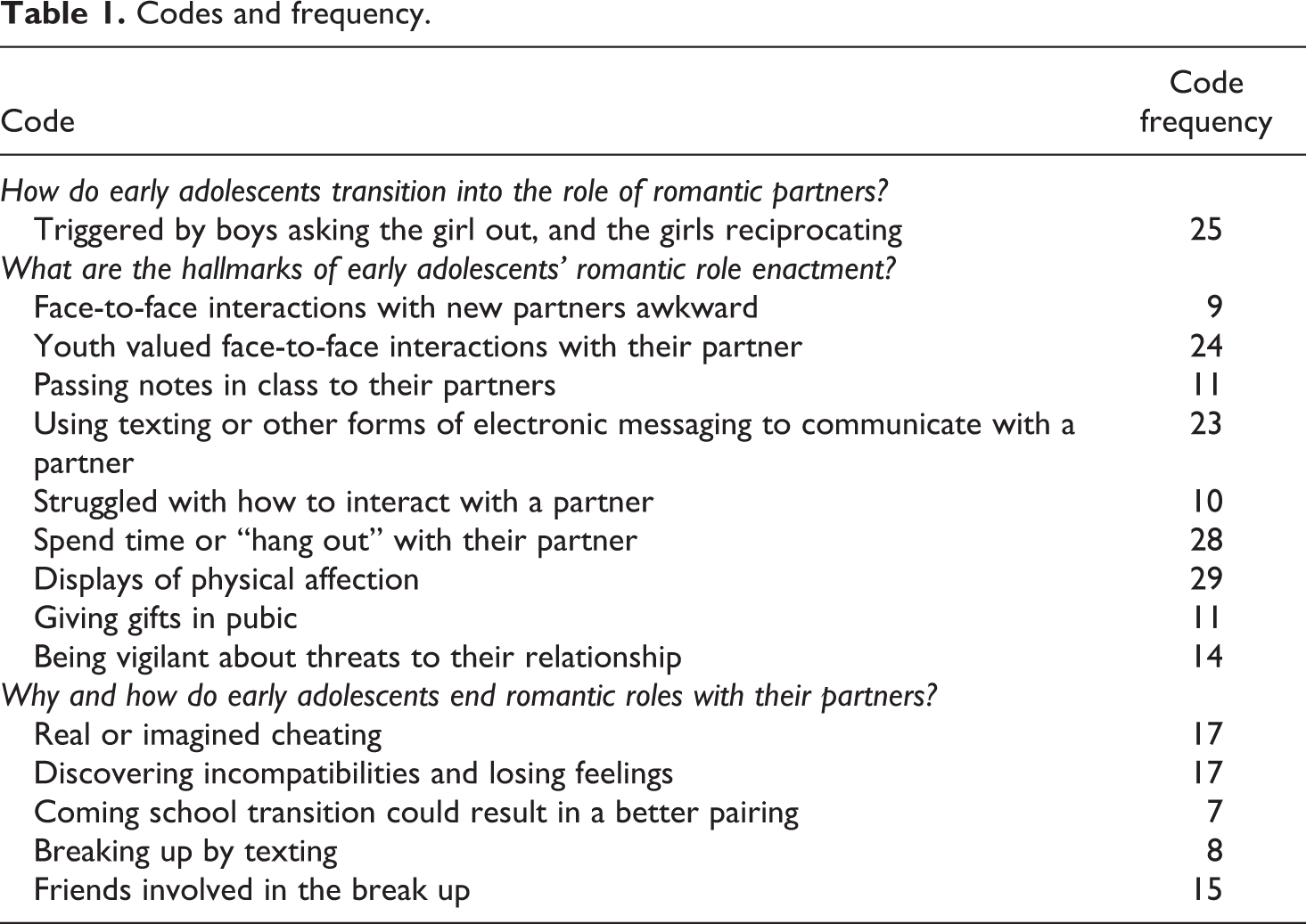
As Shelly’s description indicates, announcing that they were a couple provided the youth with a new status within their group. Further, these responses showed that the transition into forming a relationship is gender bound.
What are the hallmarks of early adolescents’ romantic role enactment?
Contrary to what one might expect, some youth who were going out found face-to-face interactions with new partners awkward. This was especially evident among sixth as compared to eighth graders (n = 9 total sample; n = 6—25% of sixth graders; n = 3—12.5% of eighth graders). Cami (12 years old) describes such an interaction, “Well it’s like … normally girls would just be like, ‘What’s up?’ And then if you like them [the boy], then they’d [the girl] just be like blushing and being shy, and trying not to look at them or something.” Natalia (12 years old) tells of her own experience, “And when they’re your boyfriend, he might like sit next to you [during recess] and it gets really awkward. And they try to hug you and … yeah … REALLY awkward (laughs).” Natalia’s experience suggests that some of the awkwardness she experienced was due to the public demonstration that they were a couple when the boy sat next to her at school and then again when he attempted to show affection.
Nonetheless, far more youth valued face-to-face interactions with their partner as part of going out (n = 24). Cindy (12 years old): If you are like one of the shy people then it’s kind of less [talking] … But if you’re more like kind of like me, I’m open and stuff, like it’s kind of like you’ll talk to them more … because I guess you want to keep it going. You don’t want to bore them to make them break up with you. Like, they’ll kind of hold hands and giggle a lot. And then to start a conversation usually the guy will like let her sit on his lap, and they’ll start talking about like what happened the night before, or what happened today during … between classes or whatever … it can be private. … the last thing you want to have while you are just talking privately and, like, dishing out your secrets to her because you trust her with all of your life, … all of the sudden your friend walks by and he’s like ‘Yo, bro, seriously?’ and he calls your group over. And here you are just surrounded by guys and there’s one girl, just you and your girl, and that’s the worst case scenario that you can have.
Communicating in other ways was also part of early adolescents’ romantic role enactment. A small number told of passing notes in class (n = 11) to their partners. Cindy (12 years old), “about the note thing … girls usually are the ones that write more notes. But last year when I was in that relationship, he would write me notes sometimes.” Kate, an eighth grader, told of similar activities, “if they’re in class together they might pass notes, or like write notes in class and then give it to them after.”
Texting or using other forms of electronic messaging to communicate with one’s partner, however, was more common than passing notes (n = 23). For some, it took the place of face-to-face conversation as evident in this exchange between two sixth graders. Cindy (12 years old), “Like Hannah has a crush on this one guy and … and they have never even had a conversation with each other.” Hannah (12 years old), “We text, we text!” The reliance on texting was also evident among the eighth graders. Dillon (14 years old), “They’ll go out and then they don’t even talk to each other. Like, they’ll text each other.” In fact as Mia (13 years old) relates, texting can become a consuming activity: I think that having a boyfriend affects you in certain aspects of … like how late you stay up. Like I know a lot of people who text a lot, and they don’t want to be … like they don’t want to fall asleep while they’re texting so they stay up late.
As indicated, we posed questions that focused on what partners did together once they were a couple. This allowed insight into how these early adolescents engaged in the role of romantic partner. In response to our questions, some youth, and sixth graders in particular, often struggled with how to interact with a partner (n = 10 total sample; n = 7–33% of sixth graders; n = 3–12.5% of eighth graders). Kira (12 years old), “then you’re finally like dating them, and you’re kind of like, ‘What do I do?’ … we really don’t do much when we’re dating.” Mark (12 years old) offered a similar description: They [couples] don’t really do very much … Sometimes it might be awkward, like an awkward silence, sitting around staring at each other for a weird point of time, and then one of them usually says ‘I got to get home’ or something like that, just to stop that awkward moment. If they said yes [to going out] then their relationship in elementary school would be really awkward, like they wouldn’t hang out anymore, they’d be very distance [sic], and then in middle school you tell them that you like them then you go out, then you are very close. It changes a lot.
Another marker of relationship engagement was displays of physical affection (n = 29). Deon (11 years old), “Some people kiss, hang out with each other, hold hands, (laughs).” Maria (13 years old): I think friends are just like really cool next to each other, there’s nothing like going on. But if its boyfriend/girlfriend there’s like PDA [Public Display of Affection], like you’re hugging, and you might be kissing by your next class, or you’re holding hands during lunch. They’re kind of inseparable. Like, for example like on Valentine’s day I had this one friend, for his girlfriend … for her first start of class, he was in the classroom waiting for her and had a ginormous stuffed animal, Hershey’s kisses, Reese’s peanut butter cups, and like this ginormous like three-foot tall card … and he had roses for her and everything. … you can tell if somebody’s going out because … the boyfriend gifts or girlfriend gifts [are] normally a LOT bigger. It’s like … candy, teddy bears, the whole nine yards. Whereas just friends it might be just like a chocolate bar, or Hershey’s kiss.
Why and how do early adolescents end romantic roles with their partners?
In fact, cheating, real or imagined, was a frequent reason for breaking up (n = 17). Dion (11 years old): I think because people may think they cheat or something [and they break up]. And … sometimes their friend will kinda say like, ‘Oh my God, this person is—they with that girl.’ And then they get mad and break up with you …
Less frequent but noteworthy were youth who broke up because they believed that an upcoming school transition could result in a better pairing (n = 7). Kate (14 years old), “But then at the end of the year, especially for us eighth graders, like we’re all going to different high schools and there’s maybe more cuter guys or cuter girls in high school for like you to explore.” Collectively, these reasons and their frequency suggest that pairings at this age can be relatively unstable. This was quite true for some youth. When asked how long relationships last, youth’s reports (n = 27) clustered around saying relationships began and ended relatively quickly, between 1 and 4 weeks (n = 13), to lasting a few months (n = 11). Very rare were those who experienced or knew someone who had experienced a relationship for a year or longer (n = 3).
How youth broke up was also notable. A limited number broke up via text (n = 8). Danielle (14 years old), “Like most of the guys they do it over text nowadays. They text you like, ‘Oh I don’t feel the same way anymore, it’s just over’.” More frequently, however, friends were involved in the break up (n = 15). As Cindy (12 years old) told, they can directly deliver the breakup message, “usually guys and girls will get their friends [to] do it. Like they’ll be like, ‘Hey tell them I want to break up’ … yeah that’s happened to me before … ” At other times, friends’ input about the worthiness of a partner resulted in a breakup. James (14 years old), “they’re … like drama queens. And when someone tells the drama queens they don’t look good with who they are dating, they will breakup and ask the other people who they think they would look good with.” Friends also played a protective role in the middle of a breakup. Kate (14 years old): If it’s the guy breaking up with the girl over text, it usually causes tons of drama at school. Like the girl will tell her friends, and her friends will try to be very protective and will start yelling at him in front of his friends. And then he’ll start getting angry at the girl and then it’ll kind of just cause major drama.
Discussion
The purpose of our study was to address lacunas in the current research on adolescent romantic relationships. Specifically, we attempted to move beyond dating status variables and offer insight into the interior of early adolescent relationships. In addition, we used the concepts of position, role expectations, and role enactments, with their theoretical ties to adolescent identity formation, to bring a developmental framework to our investigation (Pittman et al., 2011; Stryker & Burke, 2000). To this purpose, we posed four research questions that focused on (a) early adolescents’ transition into the role of romantic partner, (b) the hallmarks of their romantic role enactments, (c) why and how early adolescents end their romantic roles, and (d) differences in the relational role experiences of sixth and eighth graders. We consider each research question separately below while integrating our discussion of the fourth question into the discussion of the other three.
How do early adolescents transition into the role of romantic partners?
The early adolescents in the present study clearly stated that the transition into the status of being a couple, or Going Out, was triggered by a male adolescent asking a female adolescent if she wanted to be his romantic partner, followed by the female adolescent accepting his offer. This pattern follows traditional stereotypes of men initiating relational contact and formation. Giordano, Longmore, and Manning’s (2006) work can help explain why early adolescents follow prescribed stereotypes for this transition. Giordano and colleagues show that adolescent boys involved in romantic relationships, when compared to those not in these relationships, have lower self-confidence about their ability to navigate relational interactions, possibly because they lack relational experience with girls. If early adolescents, and especially boys, lack such self-confidence, then relying on the clear role expectations provided by stereotypical gender roles may make it easier to transition into becoming a couple. Furthermore, if the larger group accepts these stereotypes, this then adds clarity to how early adolescents can move into relational roles when they lack specific information about the romantic role expectations of a potential partner.
It is important to note that this transition point in forming early adolescent relationships is not a discrete event unrelated to other young adolescents’ social and relational experiences (see Christopher et al., 2015). When these youth are first romantically interested in someone, they take steps to be noticed by that individual. Girls accentuate their looks with makeup, while boys plan how to walk through their school to ensure they encounter girls they are pursuing. In addition, early adolescents will frequently use friends to evaluate the fit of a potential partner and to see whether romantic interests are reciprocated. Sometimes friends will try to pair two individuals simply because one of them stated that he or she found someone attractive. Thus, our finding that the transition point of forming a relationship begins when a young male adolescent asks a girl to be his girlfriend is preceded by a number of steps aimed at increasing the likelihood that his romantic overture will be positively received. Moreover, the fact that friends play an active role in helping early adolescents transition into the role position of romantic partner supports the hypothesis of identity theory that role positions emerge from one’s community.
What are the hallmarks of early adolescents’ romantic role enactment?
Romantic roles
Collectively, our findings regarding early adolescents’ romantic role enactments can be aggregated into two broad types of role experiences. Some of the findings paint a picture of young adolescents who are uncomfortable with or unsure about how to engage in a romantic role. Even though these youth achieved the status of being a relationship partner, they found face-to-face interactions with their partners awkward and struggled with how to interact. Moreover, when they did interact face to face, any public affection their partners attempted increased their feelings of awkwardness. For those who avoided direct interactions, it was easier to send a text than it was to engage in an actual conversation with one’s partner. It is noteworthy that two of these experiences, finding face-to-face interactions awkward and struggling with interacting with a partner, were more characteristic of the sixth graders than the eighth graders.
In comparison, the findings also revealed that other early adolescents were more at ease engaging in a romantic role. These youth spent time alone with their partners at school during lunch time and recess, at parks, or going to movies thereby creating shared private time. These direct interactions with a partner were valued. They allowed early adolescents to share personal information with their partner and created boundaries around the couple that defined these relationships as different from other close relationships. Not surprisingly, these youth were also physically affectionate with their partners, and they hugged, held hands, and kissed. After spending time together, they continued to interact with their partners via texting, sometimes late into the night. To punctuate the importance of the relationship, they gave their partners gifts on holidays and anniversaries.
While these two types of experiences stand in contrast with one another, they most likely represent a range of possible role experiences for these youth. More specifically, early adolescents are apt to have both awkward and easy romantic role experiences. We speculate that the variations in role enactment experiences in our findings reflect differences in levels in early adolescents’ knowledge of and familiarity with romantic roles. We offer that early adolescents’ romantic relational skills increase with experience and learning as they actively pursue relational pairings. For example, the findings that more sixth graders as compared to eighth graders found face-to-face interactions awkward, were more apt to text, and struggled with how to interact reflected less experience with relationships and an underdeveloped relational skill set
At the same time, it is important to point out that there were variations in how awkward relational role experiences were for any given early adolescent. We believe that although many relational skills developed in one relationship will transfer to and be built upon in the next pairing, this may not always the case. Two youth who partner together will likely differ in their levels and types of experiences, thereby potentially bringing new role expectations and behaviors. Previously learned skills may not always work in this interaction, while developing new skills would be needed. Thus, although we expect relational skills to increase with development and maturation, this increase may not always be linear. Nonetheless, existing research suggests that relational learning does occur and extends into mid and later adolescence. When compared to early adolescents, mid and older adolescents experience romantic pairings that involve a greater range and depth of activities, and are more stable, dyadic, and intimate (Adams et al., 2001; Carlson & Rose, 2012; Meir & Allen, 2009). Considered together, the present and prior findings suggest that early adolescent initial forays into romantic relationship roles offer them the opportunity to begin to develop skills that will carry over into later relationships.
Peer groups
Identity theory asserts that role positions emerge from and are supported by one’s group (Stryker & Burke, 2000; Stryker & Vryan, 2006). The fact that romantic partners gave gifts in a public setting, and that these gifts were of a size that required the partners to publicly display their gifts after class, supports this assertion. Such public displays likely signify the specialness of the romantic relationship to the partner. Concurrently, they make a statement to the larger peer group that these two individuals have adapted the positions of romantic partners and have integrated these positions into their identities. Our findings demonstrate that peers saw such gifts as symbolic of this status. Thus, gift giving may carry an expectation that the larger group recognize and support this status.
This is not to say that that early adolescents do not at times experience intrapersonal conflict between their role as a romantic partner and their role as a friend. Recall that Diego experienced such conflict when he was talking to his partner and his friends approached them. In this instance, a role tension emerged within Diego around sharing private information with a partner in the presence of friends. Tensions may also arise when youth spend more time with partners as opposed to friends (Roth & Parker, 2001). This does not mean that romantic role positions are not supported by the group. Role tensions may, however, reflect differences in the role expectations of peers as opposed to expectations that develop within early adolescents’ romantic relationships.
Why and how do early adolescents end romantic roles with their partners?
The early adolescents in the study related that their romantic relationships were frequently transient, reportedly lasting from one to several weeks. This is similar to previous findings showing that early adolescents’ relationships do not last as long as older adolescents (Connolly & McIsaac, 2009). The early adolescents in the present study offered different reasons for ending their romantic roles. Cheating, real or imagined, was a commonly given reason. This not only replicates previous findings (Connolly & McIsaac, 2009) but may also reflect developmental processes involved in establishing early adolescents’ self-identity. Meeus et al. (2010) found that while early adolescents intensively explore new identities, they actively consider alternatives. Considering alternative romantic role partners was evident in the early adolescents who reported that they ended their romantic pairings because they would be entering a new school in the fall where they would likely find better partners. Moreover, we offer that early adolescents’ vigilance for and experiences with infidelity reflect normal exploration of alternative roles that are a part of forming their self-identity (Meeus et al., 2010). These varied experiences allow them to develop their own romantic role expectations as well as better relational skills that will be needed to eventually build more stable and satisfying relationships.
This reasoning is consistent with our finding that early adolescents also reported that they ended their pairings because they were incompatible with or lost their feelings toward their partner. This finding is similar to Connolly and McIsaac’s (2009) who found that adolescents broke up with a romantic partner because their relational needs were not being met. Entering into relationships, only to find that one’s role expectations are not being met, provides early adolescents an opportunity to consider what romantic role expectations are important to them. Moreover, negotiating outcomes when partner incompatibilities are experienced potentially helps these youth develop relational skills that they can bring to their next pairing.
Our findings identified two ways that the early adolescents ended their relationships. Some texted their breakup messages. This is not surprising, given that adolescents will choose texting over conversing if the message they are communicating is emotionally laden (Blair, Fletcher, & Gaskin, 2013). This would be the case with a message ending a romantic pairing. At the same time, it is important to note that texting has become a normative form of communication for contemporary adolescents (Ling, Bertel, & Sundsøy, 2011), and the interplay of texting and romantic relationships for adolescents has not been explored in depth.
Other early adolescents had their friends convey the message. There may be a number of reasons for involving friends. Adolescents’ friends likely help each other process the reasons for the breakups thereby giving meaning to and possibly offering new insights into why the breakup occurred (Connolly & McIsaac, 2011). In addition, using friends to convey breakup messages allows the larger peer group to become aware of the early adolescents’ transition in relational status. Given that friends can be involved in early adolescents’ initiation of relationships (Christopher et al., 2015), and that relationships emerge out of participation in mixed-sex groups (Connolly et al., 2000), alerting the peer group that one of their members is available potentially facilitates early adolescents' entry into new romantic relationships.
Limitations
There are a number of potential limitations to our study. We attempted to create a setting where early adolescents would be comfortable with discussing their experiences with romantic relationships. Although it seemed that youth were open to sharing, it is possible that they did not discuss certain experiences because they were too personal. In addition, we put restrictions on sharing information about sexual experiences beyond public affection because of working with a public school system. This restriction also precluded asking about sexual orientation. This may have inadvertently sent a message about restricting other types of relational experiences and may have kept nonheterosexual adolescents from talking about their experiences. It should also be recognized that even though the adolescents were ethnically mixed and came from different household structures, they all attended the same school system or were members of a Boys and Girls Club from an adjoining community. Hence, this may have resulted in a degree of homogeneity in their discussions.
Future directions and conclusions
Our investigation adds to the growing body of literature focused on adolescent relationships and the findings can inform future research. For instance, our findings revealed that early adolescents’ relational experiences vary from being awkward with their partners to being well integrated into their lives. We have speculated that these differences reflect different relational skill levels that develop through early adolescents’ romantic experiences. These findings can help inform scholars’ investigations into romantic competence in adolescence (Davila et al., 2009; Shulman, Davilia, & Shachar-Shapira, 2011). Findings to date suggest that adolescent increases in relational skills are linked to increases in their relational competence. However, it remains unclear whether certain types of role experiences, or outcomes from these experiences, are more apt to increase early adolescents’ relational skills and competence later in their development.
We have also posited that early adolescents’ experience of moving in and out of relationships is a normal part of developing their self-identity and that these experiences help refine romantic role expectations in a way that increases the eventual likelihood of establishing more stable and satisfying relationships. Testing this proposition potentially provides fertile grounds for future scholars who want to explore this using a longitudinal perspective.
Our findings additionally identified ways that early adolescents use texting in their relational experiences. Thus, our work joins a small but growing body of literature identifying ways that electronic communications are a part of adolescent relationships (Blair et al., 2013; Christopher et al., 2015). Given that electronic communication has become normative in teen’s lives (Ling et al., 2011), more empirical work is needed to better understand how this form of communication has been integrated into youth’s romantic roles.
Finally, previous research has established that peers play an active role when early adolescents pursue romantic interest (Christopher et al., 2015), and the findings from our study show that peers are frequently involved in early adolescents’ breakups. This raises the question of whether peers play a role during other critical relational turning points. This could include times when early adolescents are attempting to make their interactions with their partners less awkward or are trying to resolve differences in relationship role expectations with their partner. These turning points potentially represent a time when early adolescents are searching for new meanings for their partners’ interactions and thereby developing new role expectations.
In conclusion, our study has provided a richer description of the interior of early adolescent romantic pairings and has offered new developmental insights into early adolescents’ romantic role expectations and experiences. It has identified ways early adolescents move into and out of romantic relationships and identified important hallmarks of their relationship roles. Moreover, our findings provide a rich foundation for future research in this area.
Footnotes
Authors’ note
The authors would also like to thank the teachers and principals from the Gilbert School District and the Chandler Boys and Girls Club who helped with this project.
Funding
The author(s) disclosed receipt of the following financial support for the research, authorship, and/or publication of this article: This project was supported by a Seed Funding grant from the College of Liberal Arts and Sciences and from the T. Denny Sanford School of Social and Family Dynamics at Arizona State University.