



Abstract
Although the objectification of women is pervasive, it has not been studied extensively in the context of romantic relationships. This is a curious oversight, given that physical appearance is considered a prominent factor in romantic attraction and conceptualizations of objectification tend to involve an exaggerated emphasis on physical appearance. Thus, objectification theory may have interesting implications for romantic relationships. Women who enjoy sexualization may be more likely to have a partner who objectifies them, which could have negative implications for the relationship, as objectification research has generally found that the experience of objectification has negative consequences for women. Across three studies of heterosexual women in relationships (N = 114, N = 196, and N = 208), results showed that those who enjoyed sexualization tended to feel more objectified by their partner, which in turn related to lowered relationship satisfaction. These findings persisted even when controlling for perceptions of partner’s sexual desire, self-objectification, and objectification from strangers. Furthermore, Study 3 provides preliminary evidence that self-objectification may be a precursor to this mediation in that self-objectification was associated with higher enjoyment of sexualization, which was associated with higher partner-objectification, which in turn was associated with lower relationship satisfaction. This research sheds light on how the objectification of women operates within the context of a heterosexual romantic relationship.
Objectification is ubiquitous in the U.S. Objectification describes the treatment of a human being as a “thing,” disregarding his/her personality, autonomy, and sentience. Women are very often subjected to objectification, which can occur in many aspects of their lives, such as work, school, and private life (Nussbaum, 1999). The empirical literature on the objectification of women has repeatedly shown that it has a host of negative consequences, ranging from increased appearance concerns (Calogero, 2004) to withdrawing from social interactions (Saguy, Quinn, Dovidio, & Pratto, 2010) to lowered math performance (Gervais, Vescio, & Allen, 2011). Furthermore, objectification theory postulates that women internalize an observer’s perspective as their primary view of their physical selves, a phenomenon known as self-objectification (Fredrickson & Roberts, 1997). In other words, women consider and value their own bodies’ physical attributes and appearance (from a third-person perspective) more than their nonobservable body attributes (which require a first-person perspective), such as intellect, motivation, and stamina. Self-objectification has been further related to negative consequences, such as excessive body surveillance, negative eating attitudes, low self-esteem, and depressive symptomology (for a review, see Moradi & Huang, 2008).
Persistent objectification conveys a message to girls and women that their value is primarily based on their beauty and sexiness (e.g., Conley & Ramsey, 2011; Harper & Tiggemann, 2008; Morry & Staska, 2001; Starr & Ferguson, 2012). Women are indeed rewarded when they approach the idealized versions of beauty in American culture. One study showed that women were evaluated and rated as being significantly more attractive and competent when wearing makeup, both at first glance and after longer inspection (Etcoff, Stock, Haley, Vickery, & House, 2011). These findings are consistent with research on the long-established “what is beautiful is good” stereotype, which occurs when individuals attribute other positive traits and qualities to a physically attractive person beyond their physical appearance (Dion, Berscheid, & Walster, 1972). Therefore, it is not surprising that some women report enjoying being sexualized (Liss, Erchull, & Ramsey, 2011) and seem to behave in ways to garner such sexualized attention (Hall, West, & McIntyre, 2012; Nowatzki & Morry, 2009). Although some have suggested that this kind of self-sexualization is empowering (e.g., Baumgardner & Richards, 2004), enjoying sexualization has actually been associated with more sexist attitudes, and it can exacerbate the negative consequences of self-objectification (Liss et al., 2011). In other words, the cultural emphasis on women’s beauty puts them in a double bind; they are rewarded for attending to their appearance and striving to reach an unattainable beauty standard, yet they experience numerous negative consequences for doing so.
This tension between desiring to be perceived as physically attractive yet experiencing negative consequences from objectification is demonstrated in a recent study that experimentally examined the consequences of the objectifying gaze (Gervais et al., 2011). Men and women were placed in either an objectification condition, wherein they participated in an interview with a confederate of the other sex trained to objectify the participants by visually scanning their bodies and commenting on their appearance, or a control condition, wherein the confederate interacted with them normally. The findings revealed that women (but not men) in the objectification condition then performed worse on a math test, but they were actually more interested in interacting with the confederate again compared with the control condition. In other words, even while experiencing a negative consequence of objectification, women were seemingly drawn to the objectifier.
The conundrum of desiring appearance-based attention yet experiencing negative consequences of objectification becomes especially interesting when considering romantic relationships. While objectification in the media and the consequences of self-objectification have been extensively researched (for reviews, see American Psychological Association Task Force on the Sexualization of Girls, 2007; Calogero, Tantleff-Dunn, & Thompson, 2011; Moradi & Huang, 2008), relatively little research has focused on objectification in the context of romantic relationships. This is a curious oversight, given that physical appearance is considered a prominent factor in romantic attraction (Feingold, 1990), and conceptualizations of objectification tend to involve an exaggerated emphasis on physical appearance (e.g., Gervais et al., 2011; Strelan & Hargreaves, 2005; Zurbriggen, Ramsey, & Jaworski, 2011). Indeed, one study found that single women who were primed with words related to relationships showed higher levels of self-objectification than those primed with neutral words (Sanchez & Broccoli, 2008), empirically demonstrating the automatic link between romantic relationships and self-objectification. It may be the case that the line can blur between receiving desirable attention surrounding physical attractiveness and feeling objectified in romantic relationships. On the one hand, previous research has found that many women do report enjoying being sexualized by men (Liss et al., 2011), and one might expect that this enjoyment increases when that sexualization comes from a partner in a consensual relationship. Nussbaum (1999) even suggests that romantic relationships are the one site where objectification can be safe and enjoyable.
On the other hand, it is difficult to imagine that the variety of negative consequences of objectification can produce positive outcomes for romantic relationships. Previous research has demonstrated that women’s self-objectification is associated with lowered self-esteem, body shame, mental health problems, and difficulty with sexual functioning (for a review, see Moradi & Huang, 2008), all of which could interfere with relationship satisfaction. For example, Stewart and Szymanski (2012) found that both self-esteem and sexual satisfaction were positively correlated with relationship quality, suggesting that having low self-esteem and low sexual satisfaction would negatively influence relationship satisfaction. Objectification from a partner could have similar effects. Furthermore, previous research has provided evidence for the theoretical ties between objectification and dehumanization (Heflick & Goldenberg, 2009; Puvia & Vaes, 2013); for example, one study demonstrated that focusing on a woman’s appearance leads to perceiving her as less competent, warm, and moral (i.e., less human; Heflick, Goldenberg, Cooper, & Puvia, 2011). Within the context of romantic relationships, this suggests that partner-objectification (i.e., perceiving one’s romantic partner as an object) could lead to a variety of negative consequences ranging from difficulty forming emotional connections with the objectified person to intimate partner violence.
Although few previous research studies have examined objectification in romantic relationships, the current literature supports the claim that objectification is associated with negative consequences in the context of romantic relationships. One study has shown that the extent to which heterosexual men value their partner’s body is related to lowered relationship satisfaction, unless he also values other nonphysical attributes (Meltzer & McNulty, 2014). Another demonstrated that heterosexual men who objectify their romantic partners are more likely to sexually coerce and pressure them, an effect that is mediated by the amount of shame men feel about their partners’ bodies (Ramsey & Hoyt, 2015). This echoes research outside of romantic relationships demonstrating connections between the objectification of women, body shame, and violence against women (e.g., Donnerstein, 1980; Mescher & Rudman, 2014; Rudman & Mescher, 2012).
Given these findings, it seems likely that partner-objectification would be negatively associated with relationship satisfaction. Indeed, in a sample of college students, Zurbriggen, Ramsey, and Jaworski (2011) found that objectifying one’s partner was associated with lowered relationship satisfaction, for both men and women. If objectification leads to dehumanization and its corresponding negative consequences, it seems quite likely that feeling objectified (as opposed to doing the objectification, as was assessed in Zurbriggen et al., 2011) would also relate to lowered relationship satisfaction. The present research examines partner-objectification in relationships from the perspective of the person feeling objectified (termed “perceived partner-objectification”), and it is the first known study to directly test the hypothesis that perceived partner-objectification is related to lowered relationship satisfaction.
Previous research has also failed to explore how women’s enjoyment of sexualization is related to partner-objectification or relationship satisfaction. The double bind that women experience by pursuing an idealized image, as described above, could be echoed in their enjoyment of sexualization. While women may enjoy sexualized attention from men, it may also lead women to seek and/or attract a partner who will objectify them. Therefore, another hypothesis tested in the present research is that the enjoyment of sexualization will be positively associated with perceived partner-objectification. We further expect that partner-objectification will mediate a negative association between the enjoyment of sexualization and relationship satisfaction. In other words, women who enjoy sexualization will be more likely to perceive their partner as objectifying them, which in turn will be related to lowered relationship satisfaction. This hypothesis has important implications for the literature on romantic relationships, because previous research has generally shown that when someone fulfills the wishes of their romantic partner, relationship satisfaction increases (for a review, see Eastwick, Luchies, Finkel, & Hunt, 2014). However, this previous research has generally examined positive or neutral traits (e.g., warmth/trustworthiness, masculinity/femininity, etc.), and it tends to ignore the social context of these preferences, instead exclusively focusing on the individual. The wider social context may indeed be quite important, given that the societal norms and expectations for relationships and desirable partners could influence an individual’s preferences (e.g., Eagly & Wood, 1999). In examining objectification in romantic relationships, the societal emphasis on the importance of women’s physical attractiveness may infuse itself in an individual woman’s feelings about receiving sexualized attention. Furthermore, some partner characteristics may be a double-edged sword, meaning that while the characteristic is envisioned positively, it comes with more negative side effects as well. Relevant to the present research, objectification may involve receiving seemingly positive attention from a partner regarding one’s physical appearance, which is understandably desirable, but it may also involve an inability to view one’s partner as a whole, complete person, which could in turn make difficult the emotional connections that are often required for a fully satisfying relationship. Finally, there is precedent for individuals desiring relationships and romantic experiences that are associated with negative outcomes, such as the appeal of “bad boys” (Rebellon & Manasse, 2004) and, in a more extreme sense, rape fantasies (Bivona & Critelli, 2009). Thus, while it is often the case that having a partner who meets one’s desires is associated with positive relationship outcomes, it is important to recognize the critical exceptions to that pattern to more deeply understand relationship dynamics.
In summary, the present research tests the following hypotheses across three studies:
Length of relationship was included as a covariate in the test of H3, because partner preferences have been shown to have stronger predictive validity for long-term relationships compared to short-term relationships (Eastwick et al., 2014); however, the pattern of results did not change when including this covariate in any of the studies, and so the more parsimonious models are reported below. The first two studies use online samples from the general population, while the third study uses a student sample.
Study 1
Method
Participants
Participants included 156 women in heterosexual relationships recruited using Amazon’s Mechanical Turk (Mason & Suri, 2012), an online site that distributes task requests (e.g., surveys) to people throughout the U.S. Participants were compensated 20 cents to complete the survey. Participants who did not answer at least two of the three attention questions (e.g., “If you are reading this question, please select ‘strongly disagree’.”) correctly or did not complete the majority of the survey items (n = 18) were excluded from the sample. An additional 24 participants did not answer the specific questions relevant to the analyses reported below, which left a total of 114 women in the sample.
Participants ranged in age from 18 to 63 (M = 29.39, SD = 11.55). Most of the sample identified as working class (47.4%) or middle class (37.7%), though smaller portions identified as being in poverty (2.6%), upper middle class (8.8%), or wealthy (1.8%), with 1.8% not disclosing their socioeconomic status. The majority identified as being White/Caucasian (78.1%), although 9.6% identified as Asian/Pacific Islander, 5.3% as African American, 2.6% as Latina, 2.6% as multiracial, and 1.8% did not wish to disclose their racial/ethnic identity. The women identified as being very liberal (11.4%), liberal (37.7%), moderate (35.1%), or conservative (15.8%). For relationship status, 9.6% responded that they are dating, 28.9% have a steady partner, 8.8% are engaged, 16.7% are living with their partner, and 36.0% are married. The length of participants’ romantic relationships ranged from less than a month to over 43 years (M = 73.41 months, SD = 88.82).
Measures
The following measures were completed online in the context of a larger survey entitled Romantic Relationships Survey.
Enjoyment of sexualization
The Enjoyment of Sexualization Scale (ESS) is a measure that assesses the extent to which women report enjoying sexualized attention (Liss et al., 2011). Participants responded to 8 items (e.g., “I want men to look at me.”) on a scale ranging from 1 (disagree strongly) to 6 (agree strongly). Cronbach’s α reported by Liss et al. (2011) was .85 and was .86 in the present study.
Perceived partner-objectification
Zurbriggen et al. (2011) measured how much a person objectifies his/her partner by modifying the surveillance subscale of the Objectified Body Consciousness Scale (McKinley & Hyde, 1996). We further modified the items to measure how much a person feels his/her partner objectifies him/her. For example, “I rarely think about how my partner looks” in the Zurbriggen scale was modified as “My partner rarely thinks about how I look” (reverse scored) for the present study. Participants responded to 8 items (α = .71) on a scale from 1 (disagree strongly) to 7 (agree strongly). A complete list of items can be found in Appendix 1.
Relationship satisfaction
The Relationship Assessment Scale was used to measure participants’ satisfaction in their current romantic relationships (Hendrick, 1988). Participants responded to 7 items (e.g., “How well does your partner meet your needs?” and “How good is your relationship compared to most?”) on a 5-point scale with anchors that varied depending on the question (e.g., not at all to completely and much worse to much better for the two examples given above, respectively), where lower scores indicated lower relationship satisfaction. Cronbach’s α reported by Hendrick (1988) was .86 and was .90 in the present study.
Results
Table 1 presents descriptive statistics and bivariate correlations. Participants showed moderate levels of enjoyment of sexualization and perceived partner-objectification, and relatively high relationship satisfaction, with reasonable variability across all measures. As hypothesized, increased enjoyment of sexualization was associated with increased perceived partner-objectification, while both increased enjoyment of sexualization and increased perceived partner-objectification were associated with decreased relationship satisfaction.
Descriptive statistics and correlations for Studies 1 and 2.
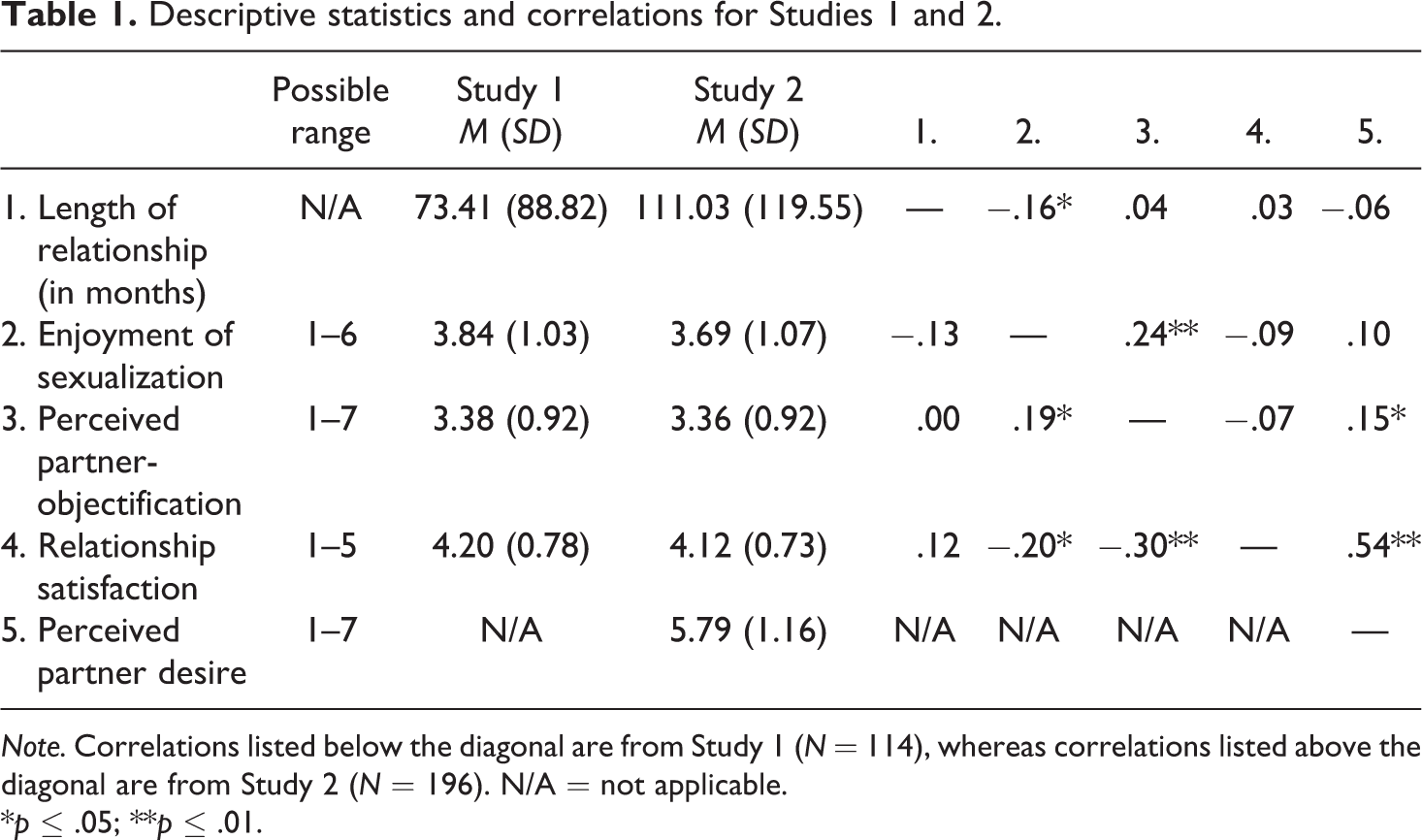
Note. Correlations listed below the diagonal are from Study 1 (N = 114), whereas correlations listed above the diagonal are from Study 2 (N = 196). N/A = not applicable.
*p ≤ .05; **p ≤ .01.
We next tested whether perceived partner-objectification mediated the relationship between enjoyment of sexualization and relationship satisfaction. Following procedures recommended by Hayes (2012) for testing indirect effects with covariates, we used a bias-corrected and accelerated bootstrapping for indirect effects which revealed a significant indirect effect of −.04 (SE = .03), as indicated by a 95% confidence interval (CI) that did not include 0, based on 1,000 bootstrap samples [−.113, −.005]. The effect size was κ2 = .05 with bootstrap 95% CI [.007, .133], indicating a small to medium effect size (Preacher & Kelley, 2011). See Figure 1 for path coefficients. The overall model was statistically significant, F(2, 111) = 6.86, p = .002, explaining 11% of the variance of relationship satisfaction (R 2 = .11). These results suggest that perceived partner-objectification mediates the relationship between enjoyment of sexualization and relationship satisfaction.
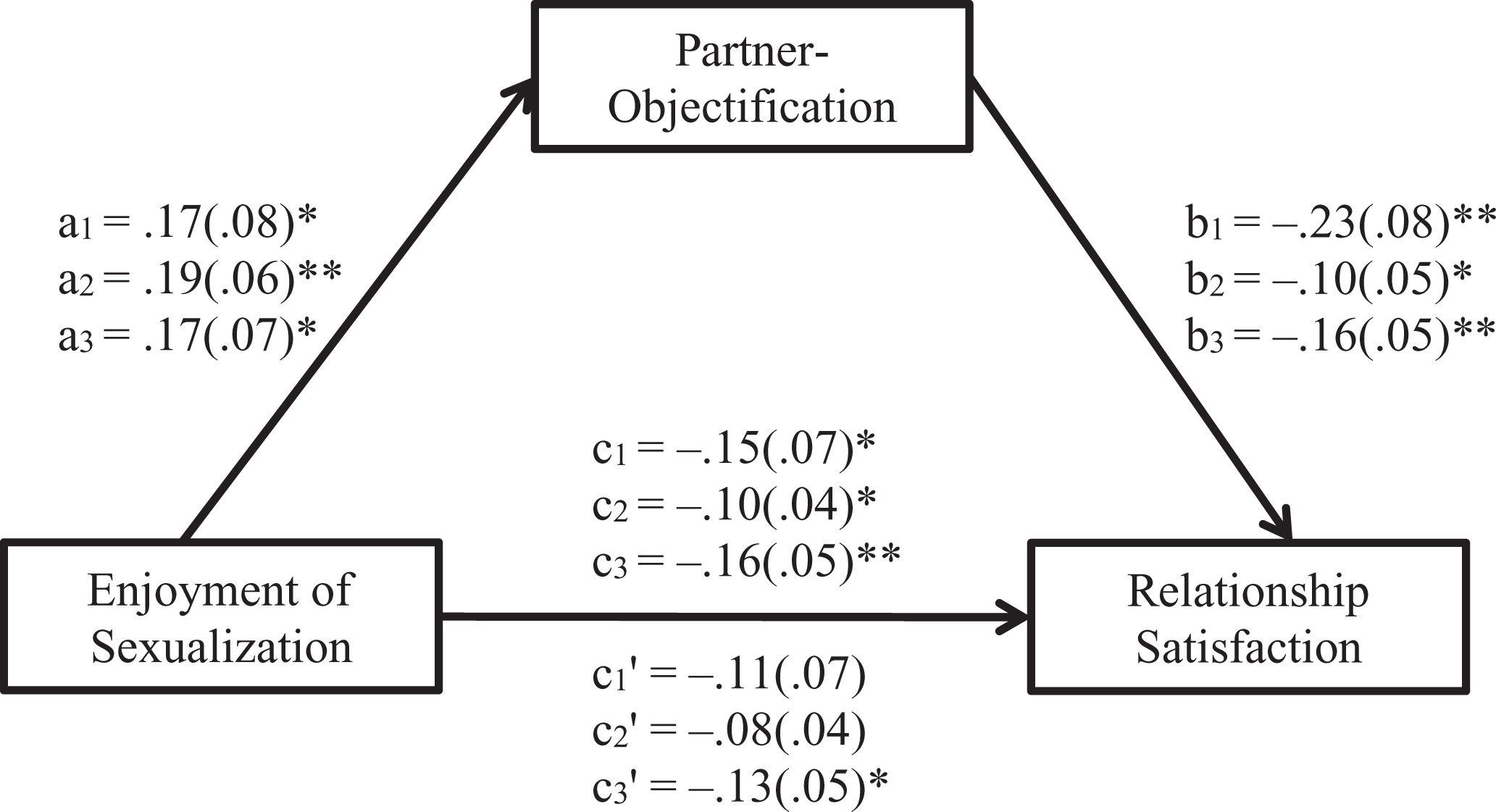
Path coefficients (and standard errors) for mediation model; subscripts indicate Study 1 versus Study 2 versus Study 3. Study 2 controlled for perceptions of partner’s desire, and Study 3 controlled for self-objectification and objectification from a stranger. *p ≤ .05; **p ≤ .01.
Because the variables in the mediation model were measured simultaneously, an alternative mediation model was tested to investigate whether confidence in the proposed model is warranted, as recommended by MacKinnon, Fairchild, and Fritz (2007). Using the same procedures as before, we tested whether relationship satisfaction mediated the relationship between perceived partner-objectification and enjoyment of sexualization. The indirect effect was .05 (SE = .04), with a 95% CI that did include 0 [−.009, .138], indicating that the indirect effect in this alternative model was not statistically significant. This analysis provides additional support for the model where perceived partner-objectification mediates the relationship between enjoyment of sexualization and relationship satisfaction.
Discussion
This study explored how enjoyment of sexualization and perceived partner-objectification related to relationship satisfaction in a sample of heterosexual women currently in relationships. Supporting our hypotheses, results showed that (1) women who enjoy sexualization were more likely to feel objectified by their romantic partner, (2) women who felt objectified by their partner had lower relationship satisfaction, and (3) women who enjoy sexualization had lower relationship satisfaction because they were more likely to feel that their partner objectifies them. This study is the first to demonstrate these connections.
This finding suggests that the tension between wanting to feel sexualized and feeling objectified could contribute to less relationship satisfaction for women in relationships. However, this tension could be explored further by differentiating between feeling objectified by one’s partner and feeling desired by one’s partner. Therefore, Study 2 utilized a measure of perceived partner desire to test the discriminant validity of the perceived partner-objectification measure. Additionally, Study 2 aimed to replicate the results of Study 1, including perceived partner desire as a covariate in the analyses.
Study 2
Method
Participants
A total of 212 women in heterosexual relationships were recruited to participate in this study using Amazon’s Mechanical Turk. Participants were compensated 75 cents to complete the survey. Participants who did not answer at least two of the three attention questions (e.g., “If you are reading this question, please select ‘strongly disagree’.”) correctly or did not complete the majority of the survey items (n = 16) were excluded from the sample. This left a total of 196 women in the sample.
Participants ranged in age from 19 to 74 (M = 35.43, SD = 11.66). Most of the sample identified as working class (40.3%) or middle class (50.5%), although smaller portions identified as in poverty (2.6%) or upper middle class (6.1%), and one person did not disclose their socioeconomic status. The majority identified as being White/Caucasian (80.1%), although 3.1% identified as Asian/Pacific Islander, 6.1% as African American, 6.6% as Latina, .5% as American Indian, and 3.6% as multiracial. The women identified as being very liberal (12.2%), liberal (35.2%), moderate (28.1%), conservative (19.4%), or very conservative (3.6%), though 1.5% did not respond to the political ideology question. For relationship status, 6.1% responded that they are dating, 20.4% have a steady partner, 4.6% are engaged, 13.8% are living with their partner, and 55.1% are married. The length of participants’ romantic relationships ranged from 1 month to 55 years (M = 111.03 months, SD = 119.55).
Measures
Participants completed all measures via an online survey that was titled Romantic Relationships Survey. The three measures used in Study 1 were included in Study 2. The reliability coefficients for enjoyment of sexualization, perceived partner-objectification, and relationship satisfaction were .90, .71, and .91, respectively.
Perceived partner desire
In order to assess the degree to which the participants felt sexually desired by their partners, they indicated the extent of their agreement on a scale from 1 (disagree strongly) to 7 (agree strongly) to two statements: “My partner finds me sexy” and “My partner makes me feel sexy.” These items were very strongly correlated (r = .77, p < .001), and so the mean of the items was used as a variable in the analyses.
Results
See Table 1 for descriptive statistics and bivariate correlations. Of particular note, perceived partner desire was not correlated with enjoyment of sexualization and showed only a small correlation with perceived partner-objectification. As expected, perceived partner desire was correlated with increased relationship satisfaction, and enjoyment of sexualization was correlated with increased perceived partner-objectification. However, unlike in Study 1, neither enjoyment of sexualization nor perceived partner-objectification was significantly correlated with relationship satisfaction.
We next tested whether there was an indirect effect of enjoyment of sexualization and relationship satisfaction through perceived partner-objectification, including perceived partner desire as a covariate. Following procedures recommended by Hayes (2012) for testing indirect effects with covariates, we used a bias-corrected and accelerated bootstrapping for indirect effects which revealed a significant indirect effect of −.02 (SE = .01), as indicated by a 95% CI that did not include 0, based on 1,000 bootstrap samples [−.056, −.003]. The standardized indirect effect was −.03 with bootstrap 95% CI [−.092, −.004], indicating a small effect (Preacher & Hayes, 2008). See Figure 1 for path coefficients. Perceived partner desire had coefficients ranging from .10 (p = .06) to .36 (p < .001) throughout the regression analyses. These results suggest that perceived partner-objectification mediates the relationship between enjoyment of sexualization and relationship satisfaction, even when controlling for perceived partner desire.
Discussion
Study 2 replicated the findings of Study 1 in that enjoyment of sexualization was positively associated with increased perceived partner-objectification, which in turn was associated with lowered relationship satisfaction. Furthermore, Study 2 provided additional insight into the perceived partner-objectification construct, given that it had only a small correlation with perceived partner desire. In other words, feeling objectified by one’s partner is not the same as feeling sexually desired by one’s partner. In fact, they appear to operate quite differently in romantic relationships; the latter seems to be related to greater relationship satisfaction, while the former is related to lower relationship satisfaction.
Although the pattern of mediation replicated the findings in Study 1, enjoyment of sexualization and perceived partner-objectification were not significantly correlated with relationship satisfaction in this study, which is inconsistent with Study 1, though the correlations are at least in the same direction as in Study 1. It is unclear why these correlations did not emerge, especially because both samples were recruited from Amazon’s Mechanical Turk and represent a wide range of relationships, though the average length of relationship in Study 2 was longer than in Study 1. Given that the length of relationship was negatively correlated with enjoyment of sexualization in Study 2, it could be the case that length of relationship is related to the inconsistency in the findings. However, including length of relationship as a covariate in the analysis did not alter the pattern of results, so it does not seem like a sufficient explanation. Testing these relationships in an additional study may help to clarify these findings.
It seems to be the case that women who enjoy sexualization are more likely to feel objectified by their partner, which in turn relates to lowered relationship satisfaction. However, a couple of alternative explanations should be considered. First, it may be the case that women who enjoy sexualization are more likely to self-objectify (as was found by Liss et al., 2011), and self-objectification could lead her to assume that others around her (such as her partner) are objectifying her as well. In other words, perhaps self-objectification propagates an objectification mind-set. This interpretation would be consistent with the findings from Strelan and Hargreaves (2005), showing that women’s self-objectification is positively correlated with their objectification of others. Previous research has demonstrated that women’s self-objectification is associated with lowered self-esteem, body shame, mental health problems, and difficulty with sexual functioning (for a review, see Moradi & Huang, 2008), all of which could interfere with relationship satisfaction. It is worth noting that the one study that directly tested whether self-objectification correlated with relationship satisfaction did not find that to be the case (Downs, James, & Cowan, 2006). However, it is still possible that self-objectification is actually driving the associations between enjoyment of sexualization, perceived partner-objectification, and relationship satisfaction, and thus it is important to examine this alternative explanation.
It is also possible that self-objectification serves as a precursor to enjoyment of sexualization, as they have been correlated in previous research (Liss et al., 2011). This conceptualization could offer a fuller understanding of the process under study. For example, when women internalize the message that their beauty and appearance are the most important parts of who they are (as is the case in self-objectification), they may understandably report enjoying sexualization, even though the objectification that may follow is not actually beneficial for the relationship. By including self-objectification as a variable in Study 3, we can test this fuller model.
Another alternative explanation for the findings in Study 1 centers on the enjoyment of sexualization measure. This relatively new measure has been empirically shown to be reliable and valid in several different samples (Erchull & Liss, 2013; Liss et al., 2011; Visser, Sultani, Choma, & Pozzebon, 2014), and thus it is currently the best assessment of this construct. However, an important consideration in the interpretation of this finding is that the ESS is a measure about women receiving sexualized attention from men in general, as opposed to specifically from their romantic partner. It may be the case that women who enjoy sexualization are more likely to be objectified by strangers as well as their partner, which could spark feelings of jealousy in their partner and strife in the relationship. Therefore, it is possible that objectification from strangers is actually underlying the associations between enjoyment of sexualization, perceived partner-objectification, and relationship satisfaction.
Study 3 addresses both of these alternative explanations by measuring self-objectification and perceived stranger-objectification along with the main variables of interest, in order to include them as covariates in the analyses testing the hypotheses. Study 3 also tests a larger serial mediation model where self-objectification is associated with increased enjoyment of sexualization, which is associated with increased perceived partner-objectification, which is then associated with decreased relationship satisfaction. Additionally, Study 3 utilizes a student sample to see whether these findings can be generalized to a younger sample that is likely involved in more short-term relationships.
Study 3
Method
Participants
Study 3 included 208 women currently in heterosexual relationships recruited using a psychology department subject pool. Participants ranged in age from 18 to 55 (M = 21.52, SD = 5.94). Most of the sample identified as working class (28.4%) or middle class (60.1%), although 1.9% identified as being in poverty and 9.6% identified as being upper middle class. The majority identified as being White/Caucasian (87.0%), although 4.3% identified as Latina, 3.4% as African American, 2.4% as multiracial, and 2.9% did not wish to disclose their racial/ethnic identity. The women identified as being very liberal (6.7%), liberal (23.6%), moderate (58.7%), conservative (7.7%), or very conservative (1.9%). For relationship status, 34.1% responded that they are dating, 54.8% have a steady partner, 2.9% are engaged, 4.8% are living with their partner, and 3.4% are married. The length of participants’ romantic relationships ranged from less than a month to 28 years (M = 27.14 months, SD = 42.90).
Measures
Participants completed all measures via an online survey entitled Romantic Relationships Survey, in addition to other measures not relevant to the hypotheses in this study. 1 The same measures used in Study 1 were included in Study 3. The reliability coefficients for enjoyment of sexualization, perceived partner-objectification, and relationship satisfaction were .85, .72, and .87, respectively.
Self-objectification
The self-surveillance subscale of the Objectified Body Consciousness Scale (McKinley & Hyde, 1996) is a measure commonly used to assess self-objectification. Participants responded to 8 items (e.g., “I think more about how my body feels than how my body looks,” reverse scored) on a scale ranging from 1 (disagree strongly) to 6 (agree strongly). Cronbach’s α reported by McKinley and Hyde (1996) was .89 and was .81 in the present study.
Perceived stranger-objectification
The body evaluation subscale of the Interpersonal Sexual Objectification Scale (Kozee, Tylka, Augustus-Horvath, & Denchik, 2007) assesses the extent to which respondents receive sexualized attention toward their body from strangers. Participants responded to 11 items (e.g., “How often have you felt that someone was staring at your body?) on a scale ranging from 1 (never) to 7 (daily). Cronbach’s α reported by Kozee, Tylka, Augustus-Horvath, and Denchik (2007) was .91 and was .92 in the present study.
Results
Table 2 presents descriptive statistics and bivariate correlations. Participants showed similar levels of enjoyment of sexualization, perceived partner-objectification, and relationship satisfaction as those in Study 1 and Study 2. Moderate levels of self-objectification and perceived stranger-objectification were also reported. The correlations revealed that increased enjoyment of sexualization was associated with increased perceived partner-objectification, while both increased enjoyment of sexualization and increased perceived partner-objectification were associated with decreased relationship satisfaction. Additionally, enjoyment of sexualization was associated with increased self-objectification and increased perceived stranger-objectification, and perceived partner-objectification was associated with self-objectification. Interestingly, perceived partner-objectification and perceived stranger-objectification were not correlated. Furthermore, relationship satisfaction was neither correlated with self-objectification nor perceived stranger-objectification, and self-objectification and perceived stranger-objectification were not correlated with each other.
Descriptive statistics and correlations for Study 3.

Note. N = 208. N/A = not applicable.
*p ≤ .05; **p ≤ .01.
We next tested whether partner-objectification mediated the relationship between enjoyment of sexualization and relationship satisfaction, including both self-objectification and perceived stranger-objectification as covariates. Following procedures recommended by Hayes (2012) for testing indirect effects with covariates, we used a bias-corrected and accelerated bootstrapping for indirect effects which revealed a significant indirect effect of −.03 (SE = .01), as indicated by a 95% CI that did not include 0, based on 1,000 bootstrap samples [−.064, −.006]. The standardized indirect effect was −.03 with bootstrap 95% CI [−.082, −.007], indicating a small effect (Preacher & Hayes, 2008). See Figure 1 for path coefficients. The effect of self-objectification was significant in the regression predicting partner-objectification (coefficient [coeff.]: .23, p = .01) and the full regression predicting relationship satisfaction (coeff.: .13, p = .03), but not the total effect model (coeff.: .09, p = .12). Stranger-objectification was not statistically significant in any of the regression analyses, with coefficients ranging from −.02 (p = .65) to −.01 (p = .87). As in Study 1 and Study 2, these results suggest that perceived partner-objectification mediates the relationship between enjoyment of sexualization and relationship satisfaction.
In addition to replicating the primary finding of the previous two studies, Study 3 aimed to expand the model by including self-objectification as a precursor to enjoyment of sexualization. Specifically, we tested the hypothesis that self-objectification leads to increased enjoyment of sexualization, which leads to increased perceived partner-objectification, which leads to lower relationship satisfaction. Following procedures recommended by Hayes (2012) for testing indirect effects with serial mediators, we used a bias-corrected and accelerated bootstrapping to estimate the indirect effect. The indirect effect was statistically significant, as indicated by 95% CIs that did not include 0, based on 10,000 bootstrap samples. The indirect effect of self-objectification predicting relationship satisfaction through both enjoyment of sexualization and perceived partner-objectification was −.01 (SE = .01; CI [−.029,−.003]), with a standardized indirect effect of −.01 (SE = .01; CI [−.035,−.003]), indicating a small effect size. See Figure 2 for the path coefficients. These results suggest that self-objectification is associated with increased enjoyment of sexualization, which in turn is associated with increased perceived partner-objectification, which is associated with decreased relationship satisfaction.

Path coefficients (and standard errors) for serial mediation model tested in Study 3. *p ≤ .05. **p ≤ .01.
Because this study was the first to include self-objectification in the mediation model, and the variables were all measured simultaneously, two alternative mediation models were tested to investigate whether confidence in the proposed model is warranted, as recommended by MacKinnon et al. (2007). Using the same procedures as before, we tested whether self-objectification was the second or third variable in the mediation sequence rather than the first variable as hypothesized and as tested above. The indirect effects ranged from −.01 to .01, all of which had a 95% CI that included 0, indicating that the indirect effects in these alternative models were not statistically significant. These analyses provide additional support for the mediation model where self-objectification is associated with enjoyment of sexualization, which in turn is associated with perceived partner-objectification, which in turn is associated with lower relationship satisfaction.
Discussion
Study 3 results replicated the results of Study 1 and Study 2, strengthening the evidence that heterosexual women who enjoy sexualization are likely to feel objectified by their partner, which in turn is associated with lowered relationship satisfaction. Importantly, Study 3 analyses controlled for both self-objectification and perceived stranger-objectification, thus ruling out the possibility that other forms of objectification are actually driving the mediation relationship. Study 3 also provided preliminary evidence that self-objectification may be a precursor to the model analyzed across all three studies. In other words, internalizing objectification was associated with enjoyment of sexualization, which then was associated with feeling objectified by one’s romantic partner, which then was associated with lowered relationship satisfaction. Additionally, Study 3 found that women who enjoy being sexualized are more likely to self-objectify and are more likely to report experiencing objectification from strangers, as has been found in previous research (Liss et al., 2011). This seems to suggest that enjoying sexualization may actually be problematic for women, given that self-objectification and experiencing objectification from strangers are both associated with a wide range of negative outcomes (Moradi & Huang, 2008).
Study 3 offered an opportunity to assess how three different sources of objectification relate to one another. Women who reported experiencing objectification from their partner tended to self-objectify, as was also found in previous research (Ramsey & Hoyt, 2015). It may be the case that women internalize the objectification from their partner or that seeing oneself as an object makes it more likely that one will assume that their partner sees them that way too. It is also possible that this correlation is due to the similarity in the wording of the items, given that the perceived partner-objectification measure was a modified version of the self-objectification measure. Future research may need to develop a distinct measure of perceived partner-objectification to better test its relationship with self-objectification. Interestingly, perceived stranger-objectification was not related to either perceived partner-objectification or self-objectification, suggesting that it is not the case that some participants just have an objectification mind-set and see objectification everywhere. It is somewhat surprising that perceived stranger-objectification was not related to self-objectification, given that this is an important link in objectification theory (Fredrickson & Roberts, 1997) which has been supported by previous research (Moradi & Huang, 2008). Future research that continues to distinguish between various sources of objectification could make an important contribution to the literature.
General discussion
The goal of this research was to explore how objectification operates in the context of heterosexual romantic relationships by examining enjoyment of sexualization, perceived partner-objectification, and relationship satisfaction. Together, these three studies provide support for the notion that enjoyment of sexualization is related to increased perceived partner-objectification, which is related to lowered relationship satisfaction. The mediation effects were small but consistent. We can be confident that these associations are not an artifact of perceived partner desire, self-objectification, or perceived stranger-objectification because these variables were controlled for in Studies 2 and 3. By utilizing a different sampling method in Study 3, this research provides evidence that this pattern of results generalizes to both a general U.S. sample and a student sample, representing a range of relationship types, relationship lengths, geographic locations, and ages.
Women who enjoy sexualization may be more likely to feel objectified by their romantic partner for a number of reasons. A woman who enjoys sexualization may seek out a mate who objectifies her so she can receive sexualized attention within the relationship. The reverse may also be true; enjoyment of sexualization may be a particularly attractive quality to men who tend to objectify women. This association appears to have negative consequences for heterosexual women in relationships because those who feel objectified by their partner tend to be less satisfied in their relationship. A partner’s objectification may come at a cost to the emotional intimacy of the relationship, given that objects do not have emotions and feelings. Brooks (1995) proposed a similar idea in his work on the “centerfold syndrome,” wherein heterosexual men’s sexuality is influenced by exposure to the objectification of women in the media, resulting in a disruption of their ability to form emotionally intimate relationships with women. The lack of emotional connection could lower relationship satisfaction for both partners. Similarly, if a woman perceives that her romantic partner is objectifying her, she may sense an inequality within the relationship, leading to lowered relationship satisfaction. On the other hand, it may also be the case that people who are dissatisfied with their relationship are more likely to objectify their partner; objectification may (consciously or unconsciously) be used as a tool to distance oneself from one’s partner when a relationship is dissolving. Our interpretations of the present research are limited by the use of cross-sectional data. Future research should test these potential explanations and explore additional mediators; the use of experiments and/or longitudinal studies would be particularly beneficial to determine the direction of causality among these variables. A longitudinal design could also provide a more sophisticated method of studying the role of length of relationship, which did not emerge as a significant covariate in the analyses presented here but may be an interesting direction for future research.
The mediation analyses revealed support for the idea that the enjoyment of sexualization is related to lowered relationship satisfaction because of its association with partner-objectification. This analysis helps to explain a somewhat counterintuitive finding—that the enjoyment of sexualization is actually related to lowered relationship satisfaction, even though sexualized attention is part of most romantic relationships and so the enjoyment of that attention might be presumed to enhance one’s experience of a relationship. Granted, in the present study, the data do not include the degree or type of sexualized attention in one’s relationship. However, the consideration of partner-objectification reveals that it may be a key link between enjoyment of sexualization and lowered relationship satisfaction. Thus, while some women may feel like they enjoy sexualization, it may actually have negative consequences for their relationship, mirroring other research revealing the negative consequences of the enjoyment of sexualization (Liss et al., 2011). This necessarily complicates the idea that romantic relationships are most successful when a partner’s wishes are met (Eastwick et al., 2014). This could be a case where having one’s wishes met has unintended consequences, although future research exploring this idea may wish to utilize a measure of enjoyment of sexualization that is specifically focused on sexualization from a partner rather than from men in general. The present research offers a first step in this area of research by exploring the associations between heterosexual women’s enjoyment of sexualization, partner-objectification, and relationship satisfaction; future research should further determine the causes and implications of these associations.
Limitations
Several limitations to this study should be noted. One limitation is that this research incorporates only self-reported data, which raises the possibility of a social desirability bias; participants may be hesitant to reveal personal aspects of their relationship in an online survey, particularly if they view their relationship unfavorably. Additionally, partner-objectification was measured as whether women perceived being objectified by their partners. It is not clear whether the participants were actually being objectified, because these studies did not collect any data from their partners. This distinction may not actually be important, given that perceptions seem to hold more importance than reality in romantic relationships (Murray, Holmes, & Griffin, 1996). Nevertheless, future research could build upon these findings by including data from both partners and behavioral observations relevant to objectification in relationships in order to better differentiate between perceptions of objectification and actual instances of objectification.
The samples used in these studies offer evidence for the generalizability of these findings in that they include two broad Internet samples from across the U.S. as well as a student sample from a single university. However, it is worth noting that in all three samples, the majority of the participants were White. Previous research has found that self-objectification may be experienced differently by women of color. For example, Grabe and Jackson (2009) found that self-objectification and depressive symptomology were linked in a sample of White women but not Asian American women, and Watson, Ancis, White, and Nazari (2013) found that a strong racial identity can buffer African American women from experiences of self-objectification. Therefore, it should be a priority in future research to explore whether objectification in romantic relationships operates differently for women of color compared to White women. Also, this research was limited to heterosexual women, so future research should investigate these variables among lesbian and bisexual women, as well as men. Finally, cross-cultural research that compares societies with varying norms and beliefs regarding objectification could be quite interesting.
Conclusion
This research sheds light upon how the objectification of women operates within the context of a romantic relationship. The cultural emphasis on women’s sexuality encourages women to embrace their objectification, yet enjoying that sexualization may actually be associated with negative outcomes in one’s romantic relationship and perhaps beyond. Furthermore, while some may expect objectification in the context of a relationship to be neutral or even positive, given the priority of physical attractiveness in romantic relationships, this study suggests that feeling objectified is related to lowered relationship satisfaction. Objectification theory offers insights that can enhance our understanding of romantic relationships, so future research should continue to further explore the connections between the enjoyment of sexualization, partner-objectification, and relationship satisfaction.
Footnotes
Appendix 1
Funding
The author(s) disclosed receipt of the following financial support for the research, authorship, and/or publication of this article: This research was supported in part by an Undergraduate Summer Research Grant from the Adrian Tinsley Program at Bridgewater State University.