



Abstract
Dominant behavior has been related to lower quality romantic relationships. The present study examined two processes through which dominant behavior affects the quality of romantic relationships: (1) the extent to which the partner’s dominance increases the person’s negative affect by thwarting the person’s sense of autonomy and (2) the degree to which the person’s negative affect in reaction to the partner’s dominant behavior affects relationship satisfaction. Using an event-contingent recording (ECR) methodology, 92 cohabiting couples reported their dominant behavior, negative affect, and autonomy in interactions with each other during 20 days. Relationship satisfaction was measured at the end of the ECR period. The results indicated that when a partner engages in dominant behavior, the person experiences greater negative affect in part due to a sense of thwarted autonomy and that greater negative affective reaction in association with the partner’s dominant behavior is related to lower relationship satisfaction in the person.
Keywords
Behavioral models of close relationships assert that the outcome of a romantic relationship can be traced to the quality of the interaction patterns between partners (Gottman, 1990). Prior cross-sectional and longitudinal research using self-report measures and observational measures has identified patterns of behavioral exchanges between partners that are related to relationship outcomes. Specifically, lower levels of positive behavior, higher levels of negative behavior, less reciprocation of positive behavior with positive behavior, and stronger reciprocation of negative behavior with negative behavior have been linked cross-sectionally to lower relationship satisfaction and prospectively to greater decline in relationship satisfaction and lower relationship stability (e.g., Bradbury, Campbell, & Fincham, 1995; Gottman, Coan, Carrere, & Swanson, 1998; Heavey, Christensen, & Malamuth, 1995; Karney & Bradbury, 1997).
Cognitive–behavioral models emphasize the cognitive and affective processes triggered by these behavioral patterns as the mechanisms through which behavioral exchanges influence relationship outcomes (Bradbury & Fincham, 1991; Sanford, 2010). These models propose that a person’s ongoing appraisal of the partner’s behavior with regard to its valence (i.e., positive vs. negative), predictability (expected vs. unexpected), and personal significance (i.e., low vs. high) determines an emotional response, which in turn defines the person’s range of possible behavioral responses to the partner’s behavior in a given situation. Such an appraisal may also influence the person’s expectations of their future interactions with the partner, thereby affecting the outcome of subsequent interactions. Over time, romantic partners determine on the basis of their interactions and the appraisals that follow whether their relationship is satisfying (Bradbury & Fincham, 1991).
The present study focused on processes linking dominant behavior and relationship satisfaction in romantic relationships. Dominant behavior is generally disliked by others (Wanic & Kulik, 2011; Williams & Tiedens, 2015). Although research on close relationships has documented a link between dominant behavior and lower relationship satisfaction (Cundiff, Smith, Butner, Critchfield, & Nealey-Moore, 2015), the processes implicated in this link have not been directly examined. Using an interpersonal theory perspective (Horowitz et al., 2006; Pincus & Ansell, 2003; Wiggins, 1991) and intensive repeated measures in naturalistic setting methodology (Moskowitz, Russell, Sadikaj, & Sutton, 2009), the present study examined whether the perception of thwarted autonomy associated with the partner’s dominant behavior mediated between the partner’s dominant behavior and the person’s negative affect and whether the strength of the association between the person’s negative affect and the partner’s dominant behavior was related to the person’s relationship satisfaction.
Processes involving dominant behavior in romantic relationships
Interpersonal theory with its characterization of dominant behavior and its motivational underpinnings (Horowitz et al., 2006) provides a vantage point for identifying some of the processes linking dominant behavior and romantic relationship quality. According to the theory, dominant behaviors are strivings for establishing control, influence, and power over the other (Wiggins, 1991). A person who behaves dominantly is perceived as assertive, self-confident, forceful, and competent (Wiggins, 1979). Dominant behavior represents one pole of the agentic dimension, with submissive behavior representing the other pole. As the opposite of dominant behaviors, submissive behaviors are conceptualized as behaviors that relinquish control and delegate power to the other. A person who behaves submissively is seen as self-doubting, powerless, and incompetent (Wiggins, 1979).
According to Pincus and Ansell (2003), a partner’s interpersonal behavior is in part motivated by the need to confirm and reinforce his or her self-representation with respect to agency and communion. To the extent that the person engages in reciprocal behavioral patterns such that the person acts submissively in response to the partner’s dominant behavior (Carson, 1969; Kiesler, 1983), the partner’s agentic needs are more likely to be met, the interpersonal situation will be more satisfactorily resolved, and the relationship will be perceived as more rewarding by the partner (Pincus & Ansell, 2003). A partner who is behaving dominantly is making a bid for the person to submit, that is, to relinquish control and power in the situation. However, dominant behavior by the partner may frustrate the person’s agentic motives, which can be broadly conceptualized as desires, goals, or needs to feel autonomous and different from others and to be in control over oneself, other people, and the environment (Horowitz et al., 2006). Frustration of these motives is thought to trigger negative affect and efforts by the person to reestablish control and power in the situation (Horowitz et al., 2006; Sanford, 2010). Thus, it is proposed that a partner’s dominant behavior may frustrate the person’s autonomy and trigger negative affect. Over time, the person’s interpersonal experience characterized by feelings of thwarted autonomy and negative affect in response to the partner’s dominant behavior may account for the person’s dissatisfaction with the relationship.
Research on dominant behavior and relationship satisfaction
Studies using various methodologies and different measures of dominant behavior are consistent in finding that dominant behavior contributes to relationship dissatisfaction. Studies using observational measurements of romantic couples’ interactions in laboratory situations have examined the relation of power distribution between partners and relationship quality. Power is similar to dominance as it has typically been defined as the ability to influence or control the other’s behavior. Power has been measured both with respect to specific kinds of behaviors, such as talk time, interruptions, and directive statements and in terms of the power to decide the outcome of problem solving, conflict resolution, or decision-making task (Gray-Little & Burks, 1983). The pattern of findings from these studies suggests that egalitarian couples are most satisfied and wife-dominant couples are least satisfied (Filsinger & Thoma, 1988; Gray-Little, 1982; Gray-Little, Baucom, & Hamby, 1996; Whisman & Jocobson, 1990). This research has not generally examined the processes through which power imbalance influences relationship outcomes. Moreover, the studies have limitations with respect to the number and kind of situations examined. Observational measures were based on one or a few interactions, typically limited to problem solving, conflict resolution, or decision-making tasks. Lastly, the behavioral measures of power, such as the amount of talk time or number of interruptions, generally lacked a basis in theory.
Studies using semi-structured interviewing methodology have also found that dominance, as reflected in greater control, was associated with dissatisfaction in relationships (Ehrensaft, Langhinrichsen-Rohling, Heyman, O’Leary, & Lawrence, 1999; Lawrence et al., 2011). For example, Ehrensaft, Langhinrichsen-Rohling, Heyman, O’Leary, and Lawrence (1999) explored the prevalence of partner control, defined as attempts to direct and constrain the person’s actions, thoughts, or emotions which were experienced as aversive by the person, among couples categorized as happy, distressed nonaggressive, and distressed aggressive. Participants were asked to indicate their partner’s level of control in four domains: decision-making, interpersonal relationships, activities, and self-worth. Happy couples scored the lowest on the control measure relative to the two other groups of couples. However, these studies also have limitations. The semi-structured measure of control or power can suffer from biases related to perception of the partner’s behavior, memory processes, and social desirability. As with the observational studies, these studies have not explored the processes through which power or control behaviors influence relationship quality.
Overview of the present study
We used an event-contingent recording (ECR) method to examine the within-person processes linking the partner’s dominant behavior with the person’s relationship satisfaction in naturally occurring social interactions among romantic partners. We assessed both partners’ negative affect, experience of autonomy, and dominant behavior in social interactions occurring over a 20-day period and measured relationship satisfaction at the end of this period. Based on extensions of interpersonal theory emphasizing motivational underpinnings of interpersonal behavior (Horowitz et al., 2006), it was proposed that the partner’s dominant behavior would elicit negative affect in the person in part due to thwarted autonomy in the person (Hypothesis 1). It was further expected that individuals with greater negative affective reactivity to the partner’s dominant behavior would report lower relationship satisfaction (Hypothesis 2). We expected that these effects would be specific to dominance and would remain significant when statistically controlling for other kinds of partner’s potentially negative behaviors such as quarrelsome behavior.
Method
Participants
Cohabiting heterosexual couples from the community were recruited through advertisements in local newspapers, a wedding planning event organized by vendors, and free online classifieds (e.g., Craigslist.ca). To participate in the study, couples were required to have been cohabiting for at least 6 months, to have no children living in their household, and to hold at least a part-time job. In all, 92 (69%) of 133 couples who agreed to participate in the study completed the ECR procedure and mailed their forms daily, thereby providing usable data. Dropouts did not differ from individuals who completed the ECR procedure with regard to age, b = −2.06, z = −1.68, p = .10, or length of cohabitation, b = −1.91, z = −.19, p = .85. The sample was heterogeneous with regard to age, education, ethnicity, first language, relationship length, and cohabitation length (see Table 1). 1
Sample characteristics.

Note. N = 92 couples, 184 participants.
aInformation was missing for 1 participant.
bInformation was missing for 5 participants.
Procedure
Participants were invited for a meeting during which they learned about the study procedures, gave their consent to participate, and completed a set of questionnaires (not used in the present study). Participants were asked to complete up to 10 ECR forms following social interactions of at least 5-min duration on each day for the next 20 days. Participants were instructed to complete the ECR forms for interactions involving different kinds of partners (e.g., friend, coworker) and were requested to report at least 2–3 daily interactions involving their romantic partner. Participants were advised to complete the forms in private and to avoid discussing the study with their partner. To ensure compliance with the ECR procedure, participants were asked to mail the forms on the day following their completion. Forms were examined upon their arrival to ensure that they were completed correctly and mailed in a timely fashion. At the end of the ECR procedure, participants came for a second meeting in which they completed a measure of relationship satisfaction (and other questionnaires not used in the present study), were debriefed, and received their compensation ($160).
Measures
Event-contingent recording (ECR)
The ECR form requested information about the time and place of the interaction, the participant’s interpersonal behavior, affect, and perception of others’ behavior. On average, participants reported about 56 (SD = 18.52, range = 10–127) interactions involving their romantic partner; they reported jointly on about 30 (SD = 16.15, range = 3–66) interactions with one another. Only data from jointly reported events were used in the present study. The mean number of reported events was unrelated to couples’ relationship length and cohabitation.
Dominant and quarrelsome behavior
The social behavior inventory (SBI; Moskowitz, 1994) was used to measure interpersonal behavior based on the interpersonal circumplex model (Wiggins, 1991). The SBI consists of 12 items measuring each of the four poles (i.e., agreeableness, quarrelsomeness, submissiveness, and dominance) of the interpersonal circle. Participants were asked to indicate the behaviors they had engaged in during each interaction. To guard against the possibility of participants adopting a response set, four forms were used in a daily rotation; each dimension of behavior was represented by 3 items on each of the four forms. Scores representing each pole of the interpersonal circle were constructed for each event. First, frequencies (0–3) of item endorsement for each behavior scale were calculated. Second, mean frequency (frequency/3) scores were calculated for each behavior scale. Third, ipsatized scores were constructed by subtracting the mean frequency for all behaviors across all four scales (frequency/12) from each behavior scale score (mean frequency behavior scale − mean frequency of all behaviors). An ipsatized behavior score reflects the frequency with which behaviors corresponding to the scale are checked after adjusting for a participant’s general rate of responding (see Horowitz, Rosenberg, Baer, Ureño, & Villaseñor, 1988).
The dominance and quarrelsomeness scores were used in the present study. Dominance was measured by items such as “I asked the other to do something,” “I set goals for the other(s) or for us,” and “I assigned someone to a task.” Quarrelsome behaviors were represented by items such as “I made a sarcastic comment,” “I ignored the other(s) comments,” and “I criticized the other.” Quarrelsome behavior scores were generally negative as the participant’s rate of quarrelsome behavior during an event was lower than the participant’s general rate of endorsing all behaviors during that interpersonal event.
Event-level dominant behavior was correlated between partners as was event-level quarrelsome behavior (see Table 2). Dominant behavior was negatively correlated with quarrelsome behavior within a partner; between-partners, the correlation of dominance and quarrelsomeness was not significant. Mean dominance, constructed by aggregating the event-level scores across all interactions, was not correlated between-partners. Similarly, mean quarrelsomeness was not correlated between-partners. Mean dominance and quarrelsomeness were not correlated within- and between-partners (see Table 2).
Within-partner and cross-partner correlations among the study variables.
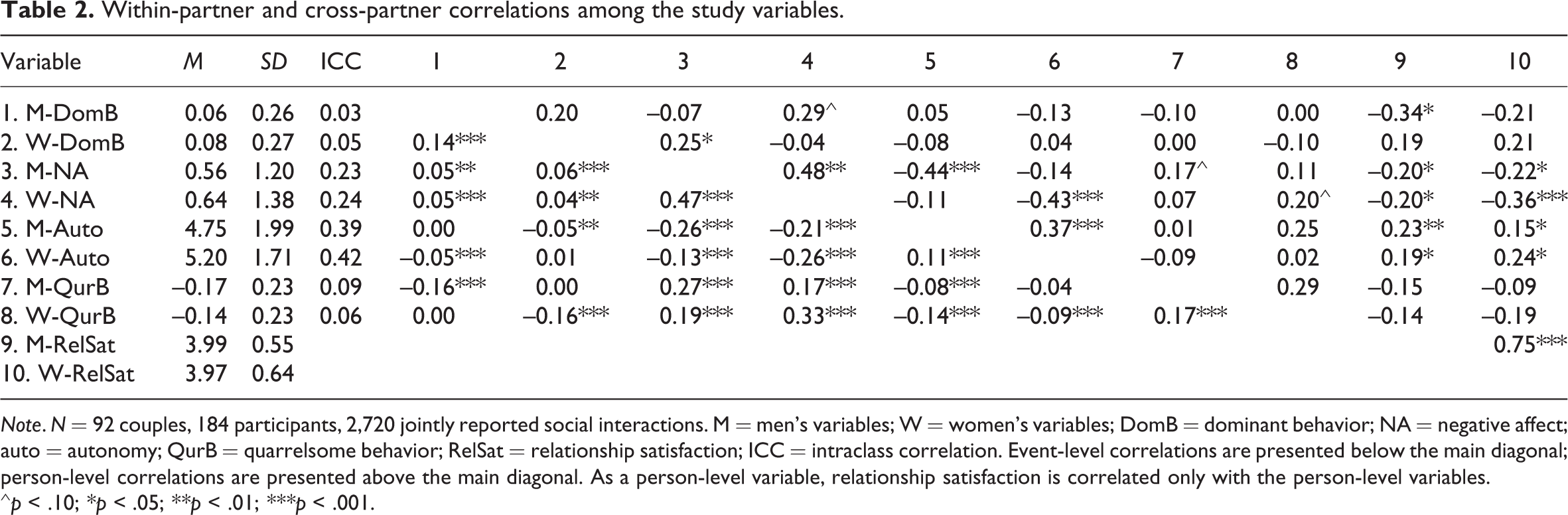
Note. N = 92 couples, 184 participants, 2,720 jointly reported social interactions. M = men’s variables; W = women’s variables; DomB = dominant behavior; NA = negative affect; auto = autonomy; QurB = quarrelsome behavior; RelSat = relationship satisfaction; ICC = intraclass correlation. Event-level correlations are presented below the main diagonal; person-level correlations are presented above the main diagonal. As a person-level variable, relationship satisfaction is correlated only with the person-level variables.
⁁ p < .10; *p < .05; **p < .01; ***p < .001.
Autonomy
Participants were asked to indicate the extent to which their behavior reflected their own choices and values versus internal and external pressures during each interaction. Originally intended to measure the construct of “autonomous motivation” within self-determination theory ([SDT] Deci & Ryan, 2000), the item was reconceptualized as a measure of experienced autonomy versus thwarted autonomy within interpersonal theory. The item was rated on a 7-point scale, with higher scores reflecting lower autonomy. To simplify the interpretation of the findings, in the subsequent analyses we reversed the scoring for this item such that higher scores indicate higher autonomy versus thwarted autonomy in the situation. Reversed scores are presented in Table 2. Partners’ autonomy scores were significantly correlated both at the event-level and at the between-person level (see Table 2).
Negative Affect
Participants rated their affect on a scale ranging from 0 (not at all) to 6 (extremely). Five items indicated negative affect: worried/anxious, frustrated, angry/hostile, unhappy, and depressed/blue. These items represent the negative affect dimension on circumplex models of emotion (Larsen & Diener, 1992; James, 1980).
Event-level scores for negative affect were constructed for each interaction by computing the mean of the negative item ratings. We calculated McDonald’s (1999) omega, which is an index of the proportion of the item variance that is accounted for by the common factor relative to total variance in scores (Geldhof, Preacher, & Zyphur, 2013), to assess the reliability of the negative affect scores. Reliability estimates were high at both the event-level and between-person level: .87 and .95, respectively. Partners’ negative affect scores were correlated using the event-level scores and the between-person mean scores (see Table 2).
Relationship satisfaction
The Dyadic Adjustment Scale (DAS; Spanier, 1976) was administered at the end of the ECR period. We used the satisfaction subscale in our analyses; it consists of 10 items that measure perceived stability of and satisfaction with the romantic relationship. The results subsequently presented did not change when the full DAS scores were used.
Participants were instructed to rate their agreement with each of the statements using a mixture of response scales. Sample items are “How often do you discuss or have considered divorce, separation, or terminating your relationship?” “In general, how often do you think things between you and your partner are going well?” and “How often do you and your mate quarrel?” The mean of item scores was used as the subscale score, with higher scores indicating higher levels of satisfaction. Omega was high for both men and women: men = .87; women = .92. Partners’ relationship satisfaction was highly correlated (see Table 2).
Results
Descriptive statistics
Descriptive statistics are presented in Table 2. No gender differences were found in mean negative affect, mean dominant behavior, and relationship satisfaction. Women reported higher mean autonomy and quarrelsome behavior than men. Within-partner and cross-partner correlations at the event-level and between-person levels were produced by utilizing Mplus’ (Version 7.2; Muthen & Muthen, 1998–2014) implicit decomposition of reported event scores into two latent parts: the event-level (within-person; i.e., the deviation from the mean score across all event scores) and person-level (between-person; i.e., the mean across all event scores) scores. Gender differences in these correlations were examined by comparing the fit of a model in which a correlation estimate was permitted to differ between genders with the fit of a model in which the estimate was restricted to be equal in both genders. Model comparison was conducted using the rescaled −2 log-likelihood difference test, which is distributed as chi-square with degrees of freedom equal to the rescaled difference in the number of parameters between models (Satorra & Bentler, 2010). A nonsignificant chi-square test value at α = .05 indicated no gender difference in the correlation estimate examined. No gender differences were found in the within-partner and the cross-partner correlations involving dominant behavior (see Table 2).
Autonomy as a mediator of the partner’s dominant behavior on the person’s negative affect
Analytic strategy
Given the nested structure of the data (i.e., events nested within partners, partners nested within dyad), we used an actor–partner interdependence model (Kenny, Kashy, & Cook, 2006) to examine Hypothesis 1, that autonomy would account for the effect of the partner’s dominant behavior on the person’s negative affect (see Model A in Figure 1). Analyses were conducted in Mplus (Muthén & Muthén, 1998–2014) using the full information maximum likelihood estimator with standard errors and chi-square test statistics that are robust to nonnormality and nonindependence of observations.
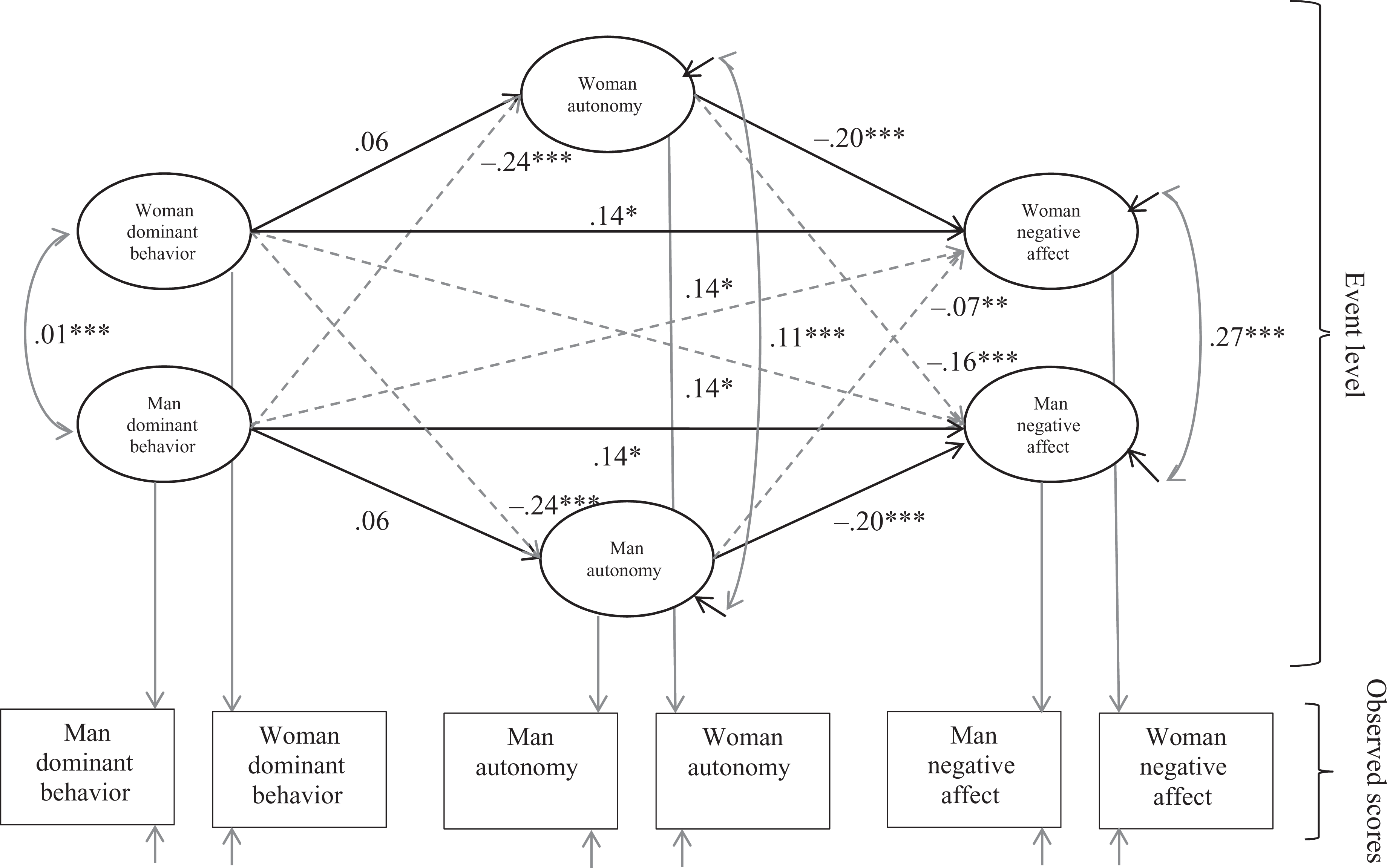
Model A—Results of the event-level model of the effect of partner’s dominant behavior on person’s negative affect via autonomy. *p < .05; **p < .01; ***p < .001. Unstandardized estimates are shown. Within-partner paths are represented by solid black lines. Cross-partner paths are represented by gray dotted lines. The covariances among the independent variables, residuals of the mediator, and dependent variables are presented by double-headed arrows. Squares at the bottom of the figure represent the observed scores of the independent, mediator, and dependent variables. The ovals in the upper part of the figure represent the event-level scores of the independent, mediator, and dependent variables after the implicit decomposition performed by Mplus (Version 7.2) of the observed scores into latent event-level and person-level components (not presented here).
Both partners’ dominant behavior (i.e., independent variable), autonomy (i.e., mediator), and negative affect (i.e., dependent variable) were entered at both the event-level and person-level. Implicit decomposition of event scores into latent event-level and person-level scores was performed by Mplus. The following model was fitted simultaneously at both levels. The results of the event-level part of the model are presented as these results represent the processes that were the focus of the current investigation. Within-partner and cross-partner regression paths were included from (1) the person’s and the partner’s dominant behavior to the person’s autonomy and (2) the person’s and the partner’s autonomy to the person’s negative affect. These paths represented the cross-partner and within-partner indirect effects of dominant behavior on negative affect via autonomy. The within-partner and cross-partner direct effects of the person’s and the partner’s dominant behavior on the person’s negative affect were examined by including regression paths between these variables. Person’s and partner’s dominant behavior scores were permitted to covary. The residuals for men and women’s autonomy were allowed to covary, as were the residuals for men and women’s negative affect. Given the complexity of the model, we restricted the estimates of each of the regression paths to have a variance of zero at the between-person level (i.e., no random slopes). However, the pattern of results remained unchanged when we conducted a series of analyses in which we examined each path of the indirect effect separately and allowed the path estimate to vary across participants.
We were specifically interested in the following cross-partner indirect effect: partner’s dominant behavior → person’s autonomy → person’s negative affect (i.e., Hypothesis 1). To compare the cross-partner with the within-partner indirect effect, we also examined the within-partner indirect effect: person’s dominant behavior → person’s autonomy → person’s negative affect. To examine the significance of these indirect effects, the confidence interval (CI) of each effect was estimated using the Bayes estimator with the bootstrap confidence interval option in Mplus. The indirect effect was considered significant if the CI did not include 0. Gender differences were examined as previously described.
Results
Findings suggested that both the person’s and partner’s dominant behavior were directly associated with the partner’s negative affect to the same extent in both genders (cross-partner: b = .14, SE = .06, z = 2.42, p < .05; within-partner: b = .14, SE = .06, z = 2.34, p < .05; see Table 3 and Figure 1). Reports of greater dominant behavior than usual by both the person and partner were directly associated with the partner’s reports of greater negative affect than usual.
Results of the multilevel model of the within-partner and cross-partner indirect effects of dominant behavior on negative affect via autonomy.

Note. N = 92 couples (184 participants) and 2,720 events. DomB = dominant behavior; NA = negative affect; Auto = autonomy; unstnd = unstandardized. Significant effects are in boldface. *p < .05; **p < .01; ***p < .001. The second column presents the pooled effects across men and women when there were no statistically significant gender differences.
In addition, and consistent with Hypothesis 1, the person’s greater negative affect in association with the partner’s greater dominant behavior was partly accounted for by the shared variance between person’s reported lower autonomy and partner’s greater dominance. The 95% CI of the cross-partner indirect effect of interest did not include 0, indicating that the indirect association of partner’s dominant behavior with the person’s negative affect via person’s autonomy was significant, cross-partner indirect effect = .05, 95% CI [.022, .072]. There was no gender difference in this indirect effect. The person’s own dominant behavior was not associated with negative affect indirectly via autonomy in either gender, within-partner indirect effect = −.01, 95% CI [−.035, .013]. In summary, these findings suggest that a person’s higher-than-usual negative affect was associated with the partner’s greater dominant behavior than usual, and this positive association between person’s negative affect and partner’s dominant behavior is partially accounted for by the person’s lower than usual reported autonomy.
Controlling for quarrelsome behavior
We expanded Model A to include the within-partner and cross-partner, direct and indirect effects of quarrelsome behavior on negative affect via autonomy. The pattern of results involving dominant behavior remained the same as that previously reported (direct effects of dominant behavior on negative affect: cross-partner: b = .19, SE = .07, z = 2.87, p < .01; within-partner: b = .29, SE = .06, z = 4.94, p < .001; indirect effects of dominant behavior on negative affect via autonomy: cross-partner indirect effect = .05, 95% CI [.028, .073]; within-partner indirect effect = −.00, 95% CI[−.024, .019]). These results suggest that the within-partner and cross-partner, direct and indirect associations of dominant behavior and negative affect via autonomy were independent of the within-partner and cross-partner effects of quarrelsome behavior on autonomy and negative affect.
Negative affective reactivity to partner’s dominant behavior as a predictor of relationship satisfaction
Analytic strategy
To examine Hypothesis 2, a new multilevel model was constructed (see Model B in Figure 2) in which the event level was composed of both partners’ negative affect (i.e., dependent variable) and event-level, within-person centered dominant behavior (i.e., independent variable) and the person-level consisted of both partner’s relationship satisfaction (i.e., dependent variable). The upper part of Figure 2 presents the model estimated at the event-level. The person’s negative affective reactivity to the partner’s dominant behavior (PDOM) was represented by the strength of the association between the partner’s report of dominant behavior and the person’s negative affect. The person’s negative affective reactivity to their own dominant behavior (ODOM) was indicated by the strength of the relation between the person’s report of their own dominant behavior with their own negative affect. In this model, the intercept represents the estimated mean of negative affect across all interactions and all participants adjusted for both the partner’s and the person’s own dominant behavior (i.e., when both partner’s dominant behavior and person’s own dominant behavior equal their respective means). The estimates of the regression coefficients associated with PDOM and ODOM represent the average negative affective reactivity to partner’s dominant behavior and own dominant behavior, respectively, when averaged across all interactions and all participants. The intercept and regression coefficients for negative affective reactivity to both ODOM and PDOM were treated as random effects, which are represented by the small filled dots in Figure 2; that is, they were allowed to vary across participants such that each participant had an estimated mean negative affect, negative affective reactivity to PDOM, and negative affective reactivity to ODOM. These random effects, which represent person-level variables of negative affect, negative affective reactivity to PDOM, and negative affective to ODOM, were then entered as within-partner and cross-partner predictors of relationship satisfaction at the person-level (see bottom part of Figure 2). We estimated the cross-partner associations between these variables on relationship satisfaction and all the cross-partner covariances among these variables. The covariance between the partners’ estimated mean negative affect was significant. We did not find cross-partner effects of the estimated mean negative affect, negative affective reactivity to ODOM, or negative affective reactivity to PDOM on relationship satisfaction. To simplify the model, we removed all the nonsignificant cross-partner regression paths and covariances. Finally, we tested for gender differences in each of the model parameters as previously described.

Model B—Model of negative affective reactivity to partner’s and own dominant behavior as predictors of relationship satisfaction. *p < .05; **p < .01; ***p < .001. Unstandardized estimates are shown. Within-partner paths are represented by solid black lines. Cross-partner paths are represented by gray dotted lines. The covariances among the independent variables and residuals of the dependent variables are presented by double-headed arrows. The little gray (partner’s dominant behavior → person’s negative affect) and black (person’s dominant behavior → person’s negative affect) filled dots in the event-level model (upper part of the diagram) indicate that the intercepts and respective regression paths are permitted to vary across participants. These dots become predictor variables in the person-level model (lower part of the diagram). “Neg Affect Reactivity to PDOM”—Negative affective reactivity to partner’s dominant behavior; “Neg Affect Reactivity to ODOM”—Negative affective reactivity to own dominant behavior.
Results
As reported in the model in which autonomy was examined as a mediator of the cross-partner effect of dominant behavior on negative affect, participants reported greater negative affect than usual when they indicated they had behaved more dominantly than usual (i.e., negative affective reactivity to ODOM: b = .17, SE = .06, z = 2.89, p < .01), and when their partner reported engaging in greater dominant behavior than usual (i.e., negative affective reactivity to PDOM: b = .20, SE = .06, z = 3.22, p < .001). The discrepancies in these estimates and those reported in the previous model are due to the inclusion of autonomy as a mediator and setting to zero the between-person variance of the regression coefficients representing negative affective reactivity to PDOM and ODOM.
We next examined whether the person’s estimated mean negative affect and negative affective reactivity to PDOM and to ODOM were associated with relationship satisfaction (see Table 4 and bottom part of Figure 2). Estimated mean negative affect was negatively related to relationship satisfaction among women, bwomen = −.27, SE = .10, z = −2.69, p < .01, but not men, bmen = −.04, SE = .11, z = −.34, ns. Women who reported greater overall negative affect in interactions with the partner also indicated lower relationship satisfaction than women who reported lower negative affect.
Results of the multilevel model of the within-partner effects of mean negative affect and negative affect reactivity to partner’s and own dominant behavior on relationship satisfaction.
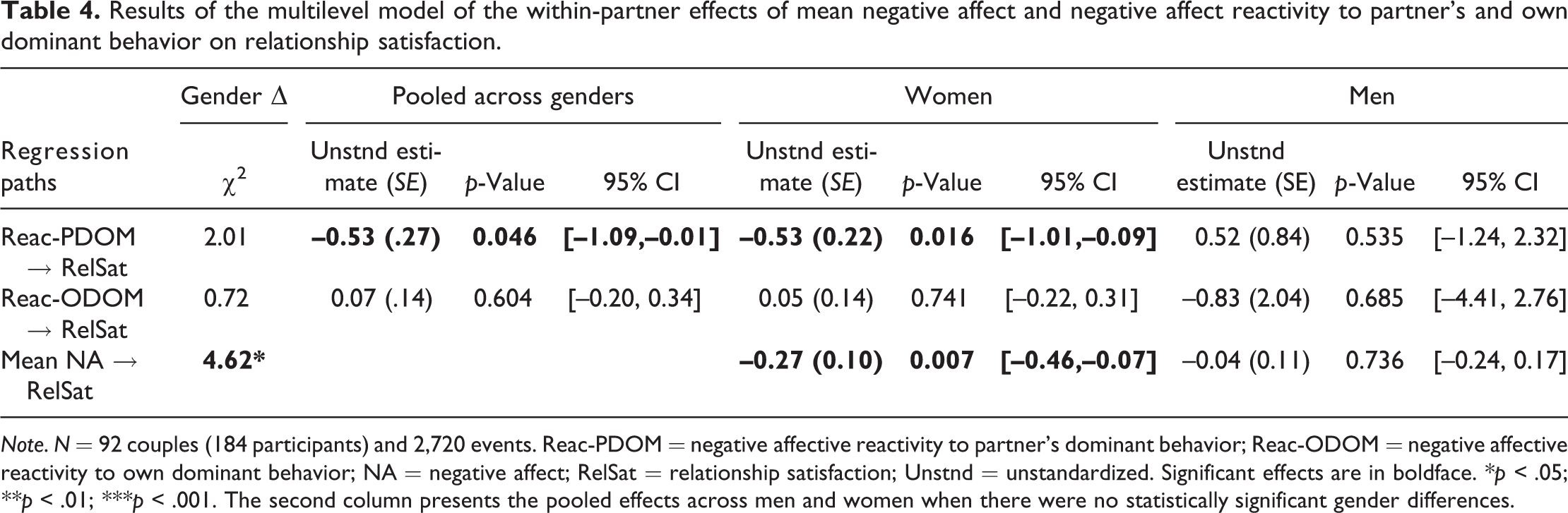
Note. N = 92 couples (184 participants) and 2,720 events. Reac-PDOM = negative affective reactivity to partner’s dominant behavior; Reac-ODOM = negative affective reactivity to own dominant behavior; NA = negative affect; RelSat = relationship satisfaction; Unstnd = unstandardized. Significant effects are in boldface. *p < .05; **p < .01; ***p < .001. The second column presents the pooled effects across men and women when there were no statistically significant gender differences.
Consistent with Hypothesis 2, a person’s stronger association between negative affect and PDOM was negatively related to the person’s relationship satisfaction, b = −.53, SE = .27, z = −2.00, p < .05. Participants who had higher negative affective reactivity to PDOM reported lower relationship satisfaction than participants with lower negative affective reactivity to PDOM. No gender difference was found in this association. The association between the person’s negative affect and ODOM was unrelated to relationship satisfaction in either gender, b = .07, SE = .14, z = .52, ns.
Controlling for the effect of negative affective reactivity to partner’s quarrelsome behavior
We added negative affective reactivity to own quarrelsome behavior (OQUR) and to partner’s quarrelsome behavior (PQUR) as predictors of relationship satisfaction. Specifically, relationship satisfaction was regressed on estimated mean negative affect, negative affective reactivity to ODOM and to PDOM, and negative affective reactivity to OQUR and to PQUR. Findings with regard to mean negative affect and negative affective reactivity to partner’s dominant behavior were consistent with the results from Model B (mean negative affect predicting relationship satisfaction among women, bwomen = −.24, SE = .09, z = −2.55, p < .05, but not men, bmen = .02, SE = .11, z = .13, ns; PDOM predicting relationship satisfaction, b = −.42, SE = .20, z = −2.11, p < .05; ODOM predicting relationship satisfaction, b = .11, SE = .18, z = .62, ns). In summary, findings from this model suggest that the effect of negative affective reactivity to PDOM on relationship satisfaction was independent of the effect of negative affective reactivity to OQUR and PQUR.
Discussion
We used an ECR method to examine processes through which dominant behavior influences romantic relationship satisfaction. Building on extensions of interpersonal theory emphasizing the motivational underpinnings of interpersonal behavior (Horowitz et al., 2006), it was hypothesized that a partner’s dominant behavior would frustrate the person’s autonomy motive, which in turn would elicit negative affect. Over time, a pattern of stronger negative affective response to the partner’s dominant behavior would be associated with lower relationship satisfaction. Findings provided support for these hypotheses. Partner’s report of greater dominant behavior than usual corresponded with the person’s reporting higher negative affect than on average in part because of the person’s decrease in autonomy in the situation. Relative to individuals with weaker negative affective reaction to their partner’s dominant behavior, those with stronger negative affective reaction reported lower relationship satisfaction. Together, these findings suggest that the effect of negative affective reactivity to the partner’s dominant behavior on relationship satisfaction was in part driven by the person’s frustrated autonomy associated with their partner’s dominant behavior. With one exception, no gender differences emerged in the examined effects, suggesting generalizability across both men and women of the examined processes through which dominant behavior influences relationship satisfaction.
In line with prior findings (Cundiff et al., 2015; Wanic & Kulik, 2011; Williams & Tiedens, 2015), dominant behavior by the partner was experienced as aversive by the person as reflected in thwarted autonomy and increased negative affect. Interpersonal theory (Horowitz et al., 2006; Wiggins, 1991) suggests that by engaging in dominant acts, the partner is striving to exert power and control over the person, inviting the person to delegate his or her agency to the partner. A pattern of such interpersonal transactions is unfavorable to a romantic relationship, in which a normative value is promoting interdependence and equality of power and status shared between romantic partners (Ting-Toomey, 1984). Consequently, the partner’s dominant behavior is likely to be experienced by the person as frustrating his or her agentic motives, including the desire to feel autonomous. In turn, the frustration of these motives results in increased negative affect in the person. Over time, a pattern of increased negative affect reactivity to partner’s dominant behavior would serve to erode the person’s satisfaction with the relationship. These findings identify decreases in autonomy and increases in negative affect as two processes through which the partner’s dominant behavior influences the person’s relationship satisfaction, thereby extending prior findings on the relation between dominance and power in romantic relationships (Ehrensaft et al., 1999; Filsinger & Thoma, 1988; Gray-Little, 1982; Gray-Little et al., 1996; Lawrence et al., 2011; Whisman & Jacobson, 1990). Further, the findings with respect to autonomy and negative affect can be used to enrich cognitive–behavioral models of romantic relationships (Bradbury & Fincham, 1991) by identifying processes linking partner’s behavior with the person’s needs and affective reactions, thereby accounting for the influence of behaviors between romantic partners on the quality of the romantic relationship.
The results involving the effects of the partner’s dominant behavior on the person’s autonomy and negative affect were found even when controlling for the person’s own dominant behavior. The extent to which participants reported feeling satisfied with their relationship was associated with their negative affective reaction to partner’s dominant behavior but not with their negative affective reaction to their own dominant behavior. Together, these findings highlight the role of processes within the person which are set in motion in response to partner’s dominant behavior as distinct from processes associated with person’s own dominant behavior. Dominant behavior by the partner was associated with a decrease of autonomy and an increase of negative affect in the person independently of the associations shared by the partner’s quarrelsome behavior with the person’s autonomy and negative affect. Furthermore, the effect of the person’s negative affective reactivity to the partner’s dominant behavior on the person’s relationship satisfaction was independent of the influence of negative affective reactivity to the partner’s quarrelsome behavior on relationship satisfaction within the person. These findings provide evidence for the role of the partner’s dominant behavior as a specific behavior that influences processes involved in modulating the person’s evaluation of the romantic relationship. Results are consistent with prior findings in romantic relationship research suggesting lower relationship satisfaction among couples characterized by higher levels of dominance and hostility (Gray-Little & Burks, 1983; Sanford, 2010; Snyder, Heyman, & Haynes, 2005).
Although not directly tested, findings from this study are consistent with contemporary extensions of interpersonal theory which suggest that to understand behavioral exchanges between two interaction partners one has to examine the interpersonal motives that drive these exchanges (Horowitz et al., 2006). Furthermore, they suggest that the theoretically predicted reciprocal behavioral response to partner’s dominant behavior, that is submissive behavior, may not necessarily lead to positive outcomes in the context of a romantic relationship but rather may lead to greater negative affect and subsequently to relationship dissatisfaction (see also Cundiff et al., 2015). It has been asserted that interaction partners reciprocate each other in terms of agency (Carson, 1969; Kiesler, 1983) such that dominant behavior by one partner is reciprocated with submissive behavior by the other. However, research investigating reciprocity has produced mixed results (Orford, 1986). Findings for the present study suggest one possible explanation for these mixed findings. The absence of established hierarchies and the nature of interpersonal interactions (i.e., less structured and less task-oriented) in romantic relationships provide a context that reinforces the importance of partners’ satisfaction of interpersonal motives such as agentic and communion motives. A partner behavior that frustrates these motives would trigger negative affect in the person and facilitate behaviors that would seek to satisfy the frustrated motives such that a partner’s dominant behavior is less likely to be reciprocated with submissive behavior by the romantic partner.
The current research also contributes to the exploration of SDT (Deci & Ryan, 2000) in the context of romantic relationships. SDT makes predictions about the negative influence of controlling environments on a person’s basic needs, which include the need for autonomy, defined as a person’s “desire to self-organize experience and behavior and to have activity be concordant with one’s integrated sense of self” (Deci & Ryan, 2000, p. 231). Frustration of a person’s basic needs including the need for autonomy accounts for the negative effects of controlling environments on the person’s psychological and relationship adjustment. Findings from the present research identify a specific contextual variable—the partner’s dominant behavior—that is associated with thwarted autonomy in the person. Furthermore, findings suggest that the frustration of autonomy because of the partner’s dominant behavior contributes to the person’s greater negative affect in a given interpersonal interaction and, when repeated, lower relationship satisfaction.
With one exception (i.e., the effect of mean negative affect on relationship satisfaction), the processes explored in the current research operated similarly in both men and women. Prior research on the effect of power on romantic relationship outcomes has produced mixed results with regard to gender differences (Gray-Little, 1982). A recent meta-analysis found that dominance was more disliked when displayed by women than by men, in particular when dominance was explicit rather than implicit (Williams & Tiedens, 2015). However, this meta-analysis did not include research involving close relationships. Findings from the present research suggest that relationship context may diminish gender differences in the effects of dominant behavior on others such that dominance exhibited in romantic relationships affects men and women similarly.
Limitations and future research
This study has several strengths such as the use of a community sample of established couples and the employment of the ECR methodology to sample naturally occurring social interactions between romantic partners. This methodology overcomes some of the limitations of prior research on the effects of dominance on romantic relationship outcomes including the sampling of a large number of interactions which were representative of a community couple’s daily interactions, the measurement of both partners’ dominant behavior, and a measure of dominance grounded in the rich theoretical tradition of interpersonal theory. Statistical analyses examined concurrently the within-partner and cross-partner effects, thereby addressing the interdependence inherent in dyadic relationships.
Although the findings were independent of the length of the relationship, the heterogeneity of the sample with respect to marital status raises question about the generalizability of the findings to other populations of couples representing various marital statuses (i.e., dating vs. common-law vs. married). Engaging in gender-prescribed behaviors may be more common at the beginning of the relationship as dating partners are getting to know one another. As partners evaluate the prospect of their relationship, they may be more concerned about evaluating whether the relationship satisfies their needs and less concerned about complying with gender-prescribed behavioral norms. Furthermore, as partners’ behavioral exchanges crystallize in patterns that satisfy both partners’ needs, deviations from these patterns such as when a partner behaves more dominantly than usual may be experienced as more aversive at the later stages than at the beginning of the relationship. Therefore, a partner’s dominant behavior may be experienced differently at different stages of the relationship. Future studies should examine whether marital status moderates the effects of dominant behavior on relationship processes and outcomes.
Although we consider it likely that the processes examined in the present study operate across many kinds of interactions, future studies might examine whether the nature of an interaction between romantic partners moderates these processes. For example, task-focused interactions, which may be less consequential for the person’s agency (e.g., running a day’s errands), may minimize the influence of dominant behavior on the person’s autonomy and negative affect, and negative affect experienced during these interactions may have less bearing on relationship outcomes. By contrast, interactions focused on a couple’s goal setting or conflicting values may be characterized by more negative affect and the greater influence of dominant behavior on relationship processes and outcomes.
The measure of autonomy was based on SDT (Deci & Ryan, 2000). The conceptualization of autonomous motivation in SDT differs somewhat from that offered by interpersonal theory (Horowitz et al., 2006). According to interpersonal theory, autonomous motivation, as a kind of agentic motive, focuses on the desire for independence and definition of the self as distinct from others. Autonomous motivation in SDT represents the person’s desire to self-organize behavior and experience in a way that is concordant with the person’s integrated sense of self (Deci & Ryan, 2000). The measure used in the present research assesses experiences that characterize autonomous motivation according to both these theoretical traditions, that is, the experience of the self as being free to determine one’s course of actions, unconstrained by external or internalized influences. In this regard, the measure of autonomous motivation can be considered to correspond to interpersonal theory. Nonetheless, future research based on the interpersonal theory framework might gain greater power from using measures developed specifically to assess the construct of autonomous motivation as defined in interpersonal theory.
The concurrent recording of both partners’ behavior, autonomy, and affective experience in the present study poses a potential threat to the assumption of the directionality of the processes examined. Thus, it is possible that the person’s negative affect contributes to the experience of thwarted autonomous motivation in the person or that the person’s negative affect precedes the partner’s dominant behavior. A model in which the partner’s behavior initiates the cascade of affective, cognitive, and behavioral reactions in the person is consistent with person by situation interaction models. In addition, the hypothesized effect of thwarted autonomy on negative affect accords with models of emotions in which impediments toward need satisfaction are met with negative emotions. Nonetheless, future laboratory research that can track the temporal unfolding of the processes identified in the present study will be needed to ascertain whether the partner’s dominant behavior truly sets in motion the motivational and affective responses in the person. In a similar vein, as relationship satisfaction was measured only on one occasion, longitudinal studies measuring relationship satisfaction on several occasions are needed to establish that a person’s higher negative affective reactivity to partner’s dominant behavior truly precedes the decline in relationship satisfaction.
Conclusion
By relying on the rich theoretical tradition of interpersonal theory and by employing measurement methods that permitted repeated assessments of motivation, affect, and dominant behavior in interpersonal situations with a romantic partner, the present study extends our understanding of the processes through which dominant behavior influences relationship satisfaction. Findings suggest that a partner’s dominant behavior is related to the person’s negative affect to the extent that this behavior is associated with the person’s autonomous motivation, and that persons characterized by a stronger link between their negative affect and their partner’s dominant behavior are also characterized by lower relationship satisfaction. Further, the present findings provide support for contemporary extensions of interpersonal theory by highlighting the importance of interpersonal motive and affect as important variables for understanding interpersonal behavior in close relationships.
Footnotes
Author’s note
Some of the results reported in this article were previously presented at the annual meeting of the Society for Interpersonal Theory and Research in Toronto, Canada (May 2015).
Funding
The author(s) disclosed receipt of the following financial support for the research, authorship, and/or publication of this article: This research was supported by a post-doctoral fellowship from the Social Sciences and Humanities Research Council (SSHRC 753-2013-0499-A14) to the first author, and a grant from SSHRC (410-2010-1168) to the second author.
Note
References
Supplementary Material
Please find the following supplemental material available below.
For Open Access articles published under a Creative Commons License, all supplemental material carries the same license as the article it is associated with.
For non-Open Access articles published, all supplemental material carries a non-exclusive license, and permission requests for re-use of supplemental material or any part of supplemental material shall be sent directly to the copyright owner as specified in the copyright notice associated with the article.
