



Abstract
Three studies examined whether contemplating the usefulness that non-close and close others may provide for one’s personal goals would promote or hinder interpersonal closeness. The results consistently demonstrated that such instrumental deliberation increased people’s closeness with distant others (Studies 1–3); and the effect lasted until the next day (Study 2). For close others, however, the evidence was weaker. Moreover, perceived instrumentality, as a product of such elaboration, was more strongly related to the increase in closeness with non-close than with close others. Study 3 further showed that instrumental deliberation enhanced humanness perceptions of non-close others and reduced unethical behavior towards them. We discussed the potential implications of these findings for the understanding of instrumentality, objectification and interpersonal relationships.
Introduction
People are constantly pursuing various personal goals, from trivial ones such as having a delicious meal to consequential ones such as pursuing a certain career. To achieve these goals, people endeavor to mobilize resources, both from within themselves (i.e., self-control; Jia et al., 2019; Kokkoris & Stavrova, 2021) and from those around them (Aron et al., 2004; Fitzsimons & Finkel, 2011; Netzer et al., 2015). They may naturally and automatically think about, or sometimes, ponder on others’ instrumental values for their goals (e.g., activating a process of social capitalization, the endeavor to cultivate social ties, Milardo et al., 2014; hereafter referred to as instrumental deliberation). For instance, a job candidate may elaborate on how an experienced professional in the field she happens to know may help her to get a certain job. In fact, people seek and provide instrumental value in interpersonal relationships, to the extent that our interpersonal network may be seen as a web with the nodes “people-as-means” (Orehek et al., 2018; Orehek & Weaverling, 2017). Instrumental deliberation can have interpersonal consequences; and in the current studies, we examine whether it would enhance or reduce relationship closeness, especially with non-close others, as well as the role of perceived instrumentality as a product of such mental processes.
We concern about instrumental deliberation of non-close others for two reasons. First, our social cognition is goal-oriented (Fiske, 1992). Compared with close others who share long-lasting emotional bonds with us (i.e., strong ties), our perceptions of non-close others (i.e., weak ties) are more likely to be shaped by instrumental considerations (Milardo et al., 2014). Hence, instrumental deliberation may be a vital process underlying the initiation and maintanence of weak ties. Second, the implication of such a process is unclear. It may bring people together by opening the door to reciprocal services and the discovery of mutual interests and goals; yet, it may also give impetus to one-sided and exploitative relationships, as what may be suggested by the objectification theory (Nussbaum, 1999).
Istrumental deliberation and relationship closeness
A number of previous studies have shown that, for significant others, closeness varies as a function of instrumentality they provide for one’s goals (e.g., Fitzsimons & Shah, 2008; Orehek et al., 2018). Instead of focusing on the relationship between instrumentality and closeness, the primary concern of the current investigation lies in how the process of deliberating on goal instrumentality would affect closeness. On the one hand, contemplating others’ utility for one’s own goals can be seen as an intial step of instrumentality, one of the seven properties mentioned in Nussbaum’s (1999) description of objectification, and may have negative implications for our relationships with the social targets, especially for non-close others. On the other hand, however, instrumental delibration may discover and highlight the usefulness of non-close others for our goals, thus drawing us closer to them.
Objectification (i.e., seeing and using people as objects) is generally considered negative and immoral (Chen et al., 2013; Fredrickson & Roberts, 1997; Gervais et al., 2014). The most investigated form of objectification may be sexual objectification of women, which implies separating sexual parts and functions from women’s entire beings and emphasizing their bodies while ignoring other characteristics as human (Bartky, 1990; Moradi & Huang, 2008; Szymanski et al., 2011; Vaes et al., 2014). However, it is not unusual to objectify other social targets, such as treating online friends, subordinates or colleagues in workplaces as mere instruments (Baldissarri et al., 2022; Belmi & Schroeder, 2021; Gruenfeld et al., 2008; Ozimek et al., 2017).
From the perspective of objectification theory, instrumental deliberation may violate the principle of mutual respect and entail dehumanization (Belmi & Schroeder, 2021; Frei & Shaver, 2002; Vaes et al., 2011). Moreover, this problem may be more severe with non-close than close others. For instance, sexual and physical valuation, which is often perceived as sexual objectification, has been found to be beneficial to women’s self-esteem in romantic relationships (Meltzer, 2020). Analogically, instrumental deliberation may have more negative implications for relationships with non-close than close others. Without an established affective bond and sufficient concerns for others’ welfare, instrumental deliberation of non-close others may potentially imply objectification, reducing such social targets to merely tools for one’s goals while ignoring their full existence as human beings. A related piece of evidence is that, although not without controversy, building instrumental ties with non-close others may be perceived as inauthentic or even dirty (Casciaro et al., 2014; Gino et al., 2020; Ziani-Franclet, 2022).
However, although we are aware of the potential dark side of “using” non-close others to achieve our goals, we still believe that in most cases instrumental deliberation would function to increase relationship closeness with them. Our attention, perception and emotion revolve around our active goals (Aarts et al., 2001; Shah et al., 2002). We may hardly have the motivation to approach a distant other without any consideration of their utility for our goals. Indeed, different from close relationships which imply an affective connection, social networks with non-close others (i.e., weak ties) often serve purely instrumental purposes (Canary et al., 1993; Kafetsios & Nezlek, 2002; Son & Lin, 2012). It is possible that we would be drawn closer to non-close others because their utility for our goals is highlighted in the process of instrumental deliberation, and such mental experience may serve as the first step of approaching non-close others and developing a meaningful relationship with them. In other words, instrumental deliberation may provide us an opportunity to explore non-close others’ value and merits as human beings, who otherwise may fall out of our attention and interpersonal realm.
Ancillary evidence again comes from the line of research on weak ties. Beyond facilitating our personal goals, weak ties increase our life quality and well-being by securing resources and opportunities that may not be available within one’s immediate, close networks (Fingerman, 2009; Granovetter, 1973; Sandstrom & Dunn, 2014; Weng et al., 2018). For instance, recent large-scale, randomized experiments showed that weak ties, rather than strong ties, significantly increased job mobility (Rajkumar et al., 2022). Importantly, being involved in instrumental relationships is not necessarily negative for the instrumentalized target as well, especially when it is perceived as voluntary rather than coercive (e.g., superiors and subordinates in a reciprocal relationship, Orehek et al., 2018; Orehek & Weaverling, 2017). Moreover, unlike being objectified, providing instrumental value to others is associated with greater senses of social connectedness and self-worth (Aknin et al., 2013; Inagaki & Eisenberger, 2012; Krause, 2016), and opens up the possibility of potential intimacy attainment (Hirsch & Clark, 2019; Sprecher, 2022). These findings imply that even instrumental deliberation of non-close others may not automatically lead to objectification, and can have positive implications for oneself, the instrumentalized social targets, and the relationship.
In sum, if instrumental deliberation strengthens the usefulness of non-close others for our goals, it would draw us closer to them. However, if it leads to objectification and dehumanization of the social targets being used, it would have no or even negative effects on relationship closeness. In addition, even if closeness is enhanced in this case, it may not reflect authentic closeness with another human being, but rather similar to the connection with a tool one uses. Although instrumental deliberation may engender exploitation or objectification, based on the evidence reviewed above, we believe that it is more likely to increase relationship closeness with non-close and close others alike.
Goal instrumentality and relationship closeness
Instrumental deliberation reveals to us the extent to which a social target is useful for our goals. Leveraging a goal-instrumentality measure where participants nominate significant others who are either instrumental or noninstrumental for an array of personal goals, previous studies show that people evaluate those who provide instrumental (vs. non-instrumental) value to their active goals more positively and feel closer to them (Fitzsimons & Shah, 2008; Gomillion & Murray, 2014). Moreover, the fluctuating levels of instrumental value provided by significant others in the process of goal attainment can lead to dynamic changes in relationship closeness (Fitzsimons & Fishbach, 2010). It suggests that individuals are acutely attuned to the instrumental value of their social connections, underscoring the importance of goal instrumentality as a crucial parameter for the evaluation of closeness.
We believe that the positive effect of goal instrumentality on closeness also applies to non-close others. In fact, we contend that closeness with non-close others may be more contingent on their instrumental value than closeness with close others. Close relationships such as family and friendships are maintained based on emotional ties and generally last for a long time (Meeus et al., 2007; Small et al., 2015). We implement communal norms in these relationships which emphasize the partners’ and mutual interests (Clark & Mills, 1979). Hence, they would remain stable even when close others fail to facilitate a temporary goal one is pursuing (Hui et al., 2020; Rusbult & Buunk, 1993; Shea et al., 2013). However, relationships with non-close others often run in an exchange mode that stresses one’s own interests and the partners’ instrumental values, such that partners are expected to reciprocate the benefits they have received in a timely and comparable way (Clark, 1983; Clark & Mills, 1979, 2011). As such, in exchange relationships, people may be more inclined to evaluate others on the basis of their instrumental value. Accordingly, we further presume that closeness with non-close others would be more contingent on their usefulness for our goals than that with close others.
The present research
We devised three studies to examine the two hypotheses. First, instrumental deliberation (i.e., deliberating on a social target’s usefulness for one’s goals) would enhance the closeness of close and non-close others alike (H1). Second, the enhancement in closeness of non-close others would be more contingent on perceived usefulness than that of close others (H2). Study 1 compared the changes in closeness, and the associations between usefulness and closeness of close and non-close others after participants engaged in instrumental delibration. Study 2 added a control condition where participants thought about potential interactions with close versus non-close others, and employed a delayed measure of closeness, while Study 3 compared the outcome of instrumental delibration with contemplating the usefulness of one’s own acts and included measures of dehumanization and immoral tendency. The studies all involved Chinese samples and were delivered online through the platform Qualtrics. Study materials and datasets of all the studies are available on OSF (https://osf.io/sw5kq/).
Study 1
Study 1 adopted a 2 (type of relationship: close vs. non-close) by 2 (test: pre- vs. post-test) mixed design. All participants went through a goal instrumentality task and reported the perceived usefulness of the social target. Relationshp closeness was assessed both prior to and after the task.
Method
Participants
We planned to recruit around 300 participants as to detect a small main effect of test and a small-to-medium interaction effect between usefulness and type of relationship. A total of 321 university students were enrolled in this study. We removed those who failed the attention check (i.e., “Please select ‘somewhat agree’.”), leaving a final sample of 308 (78 men, 230 women; Mage = 22.07, SD = 3.31, Mdn = 22, ranged from 16 to 50 years old). A small effect size of partial R2 = .025 (α = 0.05) could be detected with 80% power based on this sample size as estimated using the software G*Power (Faul et al., 2007). Each participant received CNY 5 (approximately USD 0.72) for their participation. For all the studies, informed consent was obtained from all participants.
Procedure
Participants were randomly assigned to a close or non-close condition. Participants in the close condition were instructed to put down the name or initials of “a close friend of your own age and gender, who has frequent interactions and a strong emotional bond with you,” whereas those in the non-close condition were asked to nominate “an acquaintance of your own age and gender, who has frequent interactions but only a weak or no emotional bond with you.” After the nomination, all participants evaluated their closeness with the person they nominated (the pre-test of closeness). Then, participants performed the goal instrumentality task, and proceeded to complete measures of perceived usefulness, the post-test of closeness and demographics.
Goal instrumentality task
Participants were first asked to list five personal goals, and then to elaborate on the nominated person’s instrumentality for each goal (e.g., a participant listed the goal to pass an exam, and wrote that the nominated person might help her review the course materials). The same paradigm has been used in previous studies to activate instrumentality (Zhang et al., 2014); and compared to other goal instrumentality task (e.g., Fitzsimons & Shah, 2008), the paradigm emphasized the process of comtempating how others may be useful for one goals.
Measures
Pre- and post- tests of closeness
Closeness was pre-tested with the Inclusion of Other in the Self (IOS) Scale (Aron et al., 1992). The scale contains seven pairs of circles with different degrees of overlap. Participants were asked to select the pair of circles most represented their closeness with the nominated person. The post-test of closeness was a modified version of the Subjective Closeness Inventory (SCI; Berscheid et al., 1989, as used in Fitzsimons & Shah, 2008). Specifically, participants were asked to rate two items: “Relative to your other relationships, how close are you and [the nominated person]?” and “Relative to what you know about other people’s relationships, how close are you with [the nominated person]?” (r(306) = .86). Responses were made on a 7-point scale (1 = not at all close; 7 = extremely close). 1
Perceived usefulness
Following the goal instrumentality task, two items “In general, how much can [the nominated person] help you to attain your goals?” and “In general, how useful is [the nominated person] for your goals?” were used to measure the nominated target’s usefulness (r(306) = .76; Teng et al., 2016). Participants rated these questions on a 7-point Likert scale (1 = not at all; 7 = extremely).
Results and discussion
The effect of instrumental deliberation on closeness
Descriptive statistics and correlations among the main variables by condition, Study 1.
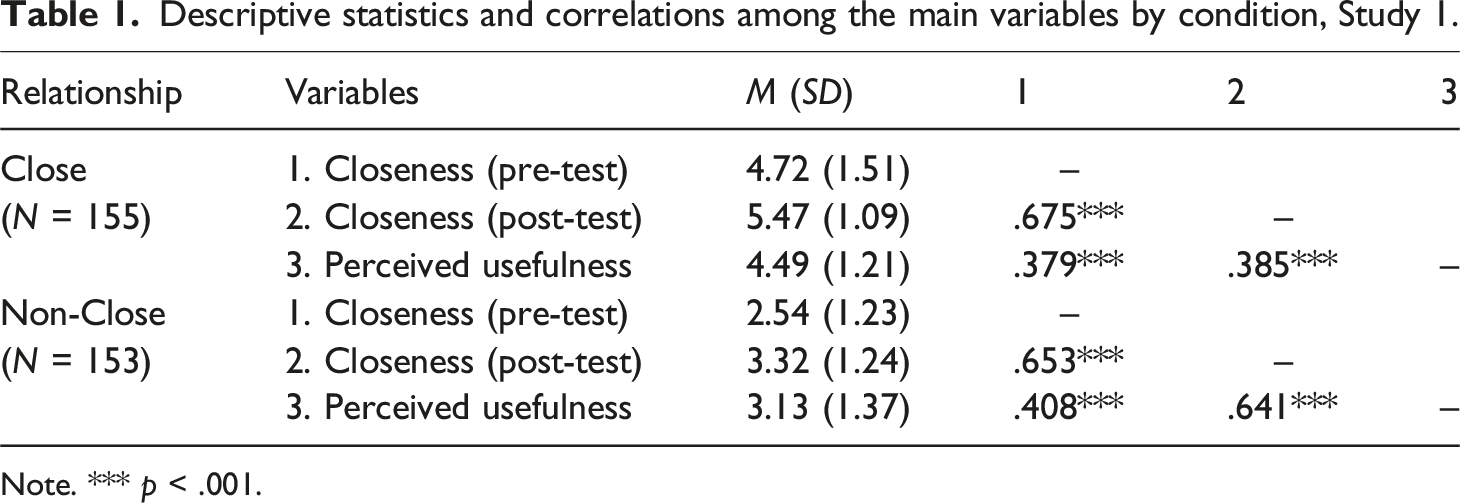
Note. *** p < .001.
Perceived usefulness and closeness
Perceived usefulness was significantly higher in the close group than in the non-close group, t(306) = 9.25, p < .001, d = 1.055, 95% CI [0.8149, 1.2919], suggesting that close others are generally more useful than non-close others for promoting one’s goals.
We conducted a hierarchical regression to predict the post-test of closeness with type of relationship (dummy code: zero = non-close, 1 = close), perceived usefulness, and their interaction as independent variables. Both main effects of type of relationship (β = 0.48, t(304) = 11.97, p < .001, 95% CI [0.4004, 0.5579]) and perceived usefulness (β = 0.43, t(304) = 10.57, p < .001, 95% CI [0.3465, 0.5050]) were significant. Moreover, the interaction effect was also significant, β = −0.10, t(304) = −2.70, p = .007, 95% CI [-0.1662, −0.0261] (see Figure 1); and it remained significant after adding pre-test closeness into the model, β = −0.12, t(303) = −4.03, p < .001, 95% CI [-0.1728, −0.0595]. Simple slope analyses showed that, as hypothesized, post-test closeness of non-close others was more contingent on usefulness than that of close others, β = 0.54, t(304) = 10.63, p < .001, 95% CI [0.4367, 0.6342] for the slope of the non-close group; β = 0.32, t(304) = 4.89, p < .001, 95% CI [0.1908, 0.4458] for the slope of the close group.
2
The interactions between type of relationship and perceived usefulness on post-test closeness, Studies 1–3. Note. Perceived usefulness has been standardized. Low/High usefulness was set to M ± 1 SD.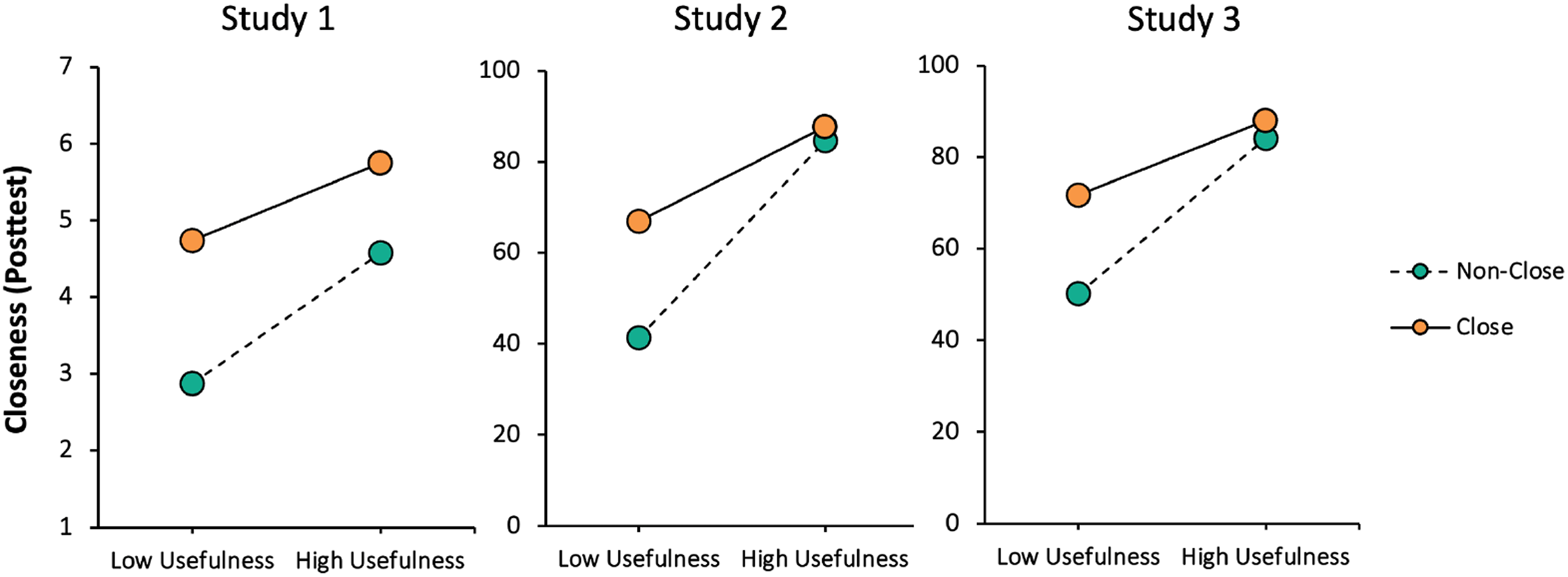
Study 2
Study 1 confirmed both H1 that the closeness of both close and non-close others increased after instrumental deliberation, and H2 that closeness of non-close (vs. close) others depended more strongly on their perceived usefulness. However, different pre- and post-test closeness items were used in Study 1, which might have biased the results. Study 2 aimed to replicate and expand on these initial findings, with the use of same items to assess closeness prior to and after the experimental manipulation, the addition of a comparison group and a delayed measure of closeness.
Method
Participants
In Studies 2 and 3, we aimed for at least 400 participants in each study. Study 2 included only university students. Five hundred and twenty-four participants were retained after removing 27 who failed the attention check, among whom 447 (197 men, 250 women; Mage = 21.92, SD = 2.40, Mdn = 22, ranged from 17 to 49 years old) completed the follow-up measure and comprised the final sample. No significant difference was found in the main variables between the retained and dropped participants, ts < 1.21, p > .23. Sensitivity analyses via G*Power (Faul et al., 2007) indicated that this sample size afforded 80% power to detect a small effect size of partial ηp2 = .017, and the sample size in the instrumentality condition (N = 226) allowed us to detect a small effect size of partial R2 = .034 (α = 0.05) with 80% power. Each participant received CNY 3 (approximately USD 0.43) for their participation.
Procedure and measures
The study involved two between-subjects factors, type of relationship (close vs non-close) and instrumental deliberation (instrumentalization vs control), and participants were randomly assigned to one of the four experimental conditions. As in Study 1, participants were asked to nominate either a close or a non-close other. Participants in the instrumental condition performed the goal instrumentality task as in Study 1 to elicit instrumental deliberation, except that they were asked to list only three personal goals. They rated the overall usefulness of the nominated person afterwards, with the same two items as in Study 1 (r(224) = .83). Those in the control condition were instead asked to elaborate on three future interactions with the nominated person. 3 Relationship closeness was measured three times: after the nomination (pre-test), after the goal instrumentality or future interactions task (post-test), and 24 hours later (delayed-test), all with the same three items: the two items from SCI as used in Study 1 (Fitzsimons & Shah, 2008), plus one item asking directly how close was “the relationship between [the nominated person] and I”. To avoid memory effect, the items were rated on 100-point scales (1 = not at all close; 100 = extremely close; Cronbach’s α = .96).
Results
The effect of instrumental deliberation on closeness
Descriptive statistics and correlations among the main variables by condition, Study 2.

Note. ** p < .01, *** p < .001.

The interaction among test of closeness, type of relationship and instrumental deliberation on closeness, Study 2.
Perceived usefulness and closeness
In the instrumental condition, again, close others were rated as higher on usefulness than non-close others, t(224) = 5.32, p < .001, d = 0.708, 95% CI [0.4382, 0.9759]. When using type of relationship, perceived usefulness and their interaction to predict post-test closeness, we again found significant main effects of both type of relationship (β = 0.29, t(222) = 8.22, p < .001, 95% CI [0.2182, 0.3559]) and perceived usefulness (β = 0.64, t(222) = 16.87, p < .001, 95% CI [0.5639, 0.7130]). Moreover, the interaction effect was also significant, β = −0.21, t(222) = −5.99, p < .001, 95% CI [−0.2840, −0.1434] (see Figure 1). It remained significant with pre-test of closeness being controlled for, β = −0.11, t(221) = −3.86, p < .001, 95% CI [−0.1693, −0.0549]. Simple slopes analyses indicated that post-test closeness of non-close others was more contingent on usefulness than that of friends, β = 0.87, t(222) = 20.97, p < .001, 95% CI [0.7855, 0.9475] for the slope of the non-close group; β = 0.41, t(222) = 6.93, p < .001, 95% CI [0.2908, 0.5381] for the slope of the close group. Therefore, our H2 was confirmed. The same analyses on delayed-test closeness yielded similar results.
Discussion
Using the same measures, we still found that closeness with non-close others increased after instrumental deliberation and the effect lasted for one day. However, unlike Study 1, relationship closeness was not enhanced among close others. In addition, we did not find any evidence that instrumental deliberation promoted closeness more than imagined future interactions, presumably because imagined and anticipated interactions could also enhance relationship closeness (Crisp & Turner, 2009; Darley & Berscheid, 1967). We conducted Study 3 with a more neutral control group to further examine these issues.
Study 3
Study 2 confirmed H2 such that more weight was put on usefulness when evaluating the closeness of non-close than close others. Yet, it only provided partial support to H1 as instrumental deliberation enhanced the closeness with non-close but not close others. We further examined these hypotheses in Study 3. Besides the introduction of a new control condition (to be elaborated later), Study 3 explored more consequences of instrumental deliberation by measuring perceived humanness of the instrumentalized targets and unethical behavior towards them. These variables were added because objectification was linked to dehumanization (Calogero, 2013; Loughnan et al., 2010). Given that instrumental deliberation improves closeness with non-close others, we wondered whether people would also view them as more human and treat them more ethically.
Method
Participants
A community sample of 432 adults were recruited online. The final sample size was 410 (211 men, 199 women; Mage = 24.95, SD = 3.80, Mdn = 24, ranged from 18 to 48 years old) after excluding those who failed the attention check. Sensitivity analyses via G*Power (Faul et al., 2007) indicated that this sample size allowed us to detect a small effect size of partial ηp2 = .019 with 80% power, and the sample size in the instrumental condition (N = 213) provided 80% power to detect a small effect size of partial R2 = .036 (α = 0.05). Each participant received CNY 3 (approximately USD 0.43) for their participation.
Procedure
The study again included two between-subjects factors, type of relationship (close vs. non-close) and instrumental deliberation (instrumentalization vs control). We used the same manipulation of type of relationship as in Studies 1 and 2. Participants in the instrumental group underwent the same procedure as in Study 2, whereas those in the control condition were asked also to list three personal goals but to elaborate on the instrumentality of their own acts to achieve each goal. Relationship closeness was assessed both after the nomination and after the goal task. At the end of the experiment, participants completed measures of humanness and unethical behavior.
Measures
Pre- and post- tests of closeness
Since the three items used in Study 2 were highly consistent, to avoid being repetitive, we selected one from the three, “The relationship between [the nominated person] and I is” (0 = not at all close; 100 = extremely close), to assess closeness both before and after the goal instrumentality task. 4
Perceived usefulness
The same two items as in Studies 1 and 2 were used in the instrumental condition to assess perceived usefulness of the nominated person (r(211) = .74).
Humanness
Humanness of the nominated target was assessed with eight items adapted from Bastian and colleagues (2013). Specifically, participants rated the nominated target on four items assessing Human Nature (i.e., attributes distinguishing people from inanimate object; e.g., “I felt like [the nominated person] was open minded, like she/he could think clearly about things”; Cronbach’s α = .74), and four items on Human Uniqueness (i.e., attributes distinguishing people from lower animals; e.g., “I felt like [the nominated person] was refined and cultured”; Cronbach’s α = .74). Responses were made on a 7-point scale (1 = not at all; 7 = very much so). The combination of the two dimensions indexed overall humanness (Cronbach’s α = .84).
Unethical behavior
Participants were presented with four hypothetical scenarios adapted from Clifford et al. (2015) and were asked to rate how likely they would engage in the unethical behavior (e.g., “When working with [the nominated person], you take credit for their work”; 1 = not at all likely; 7 = highly likely; Cronbach’s α = .68).
Results and discussion
The effect of instrumental deliberation on closeness
Descriptive statistics and correlations among the main variables by condition, Study 3.
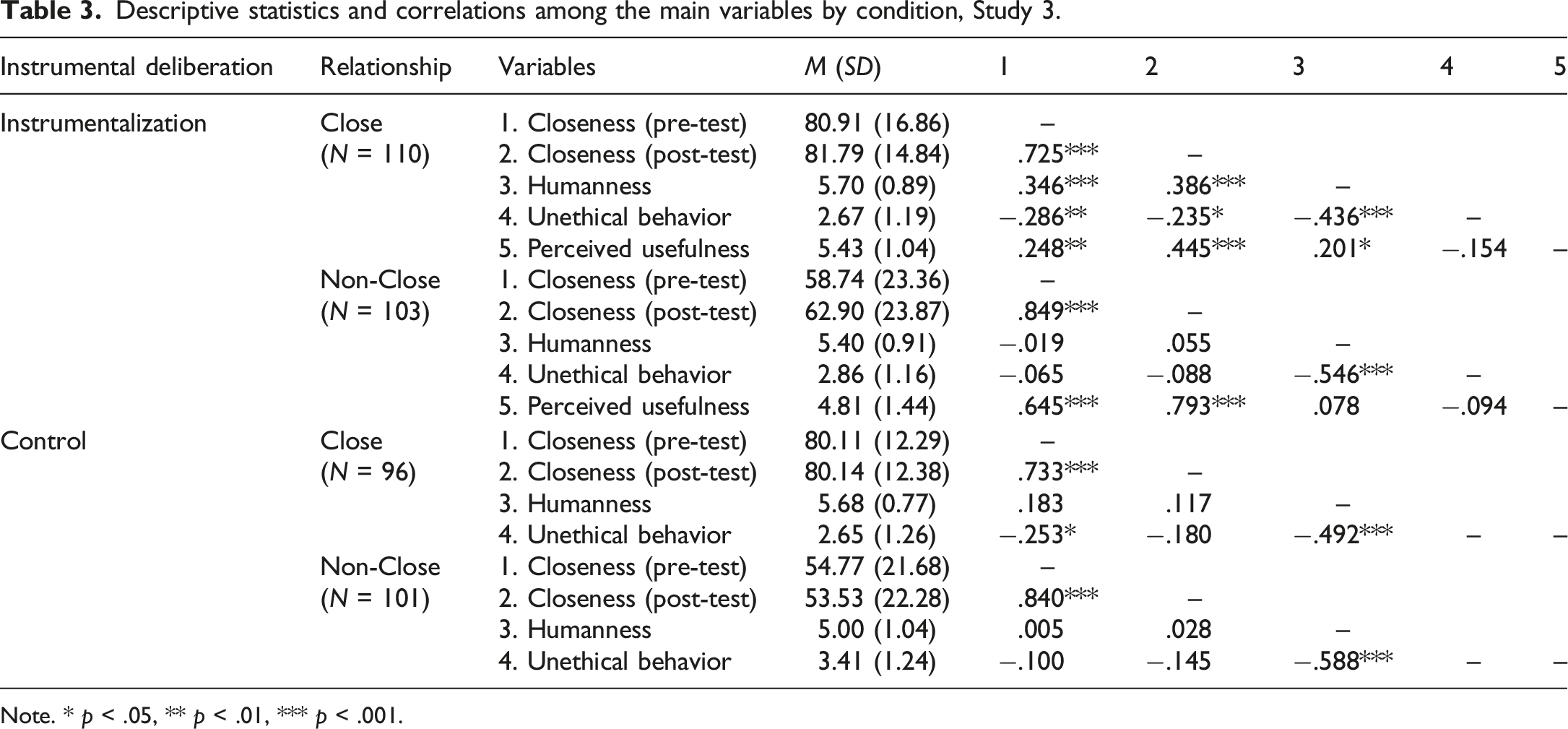
Note. * p < .05, ** p < .01, *** p < .001.
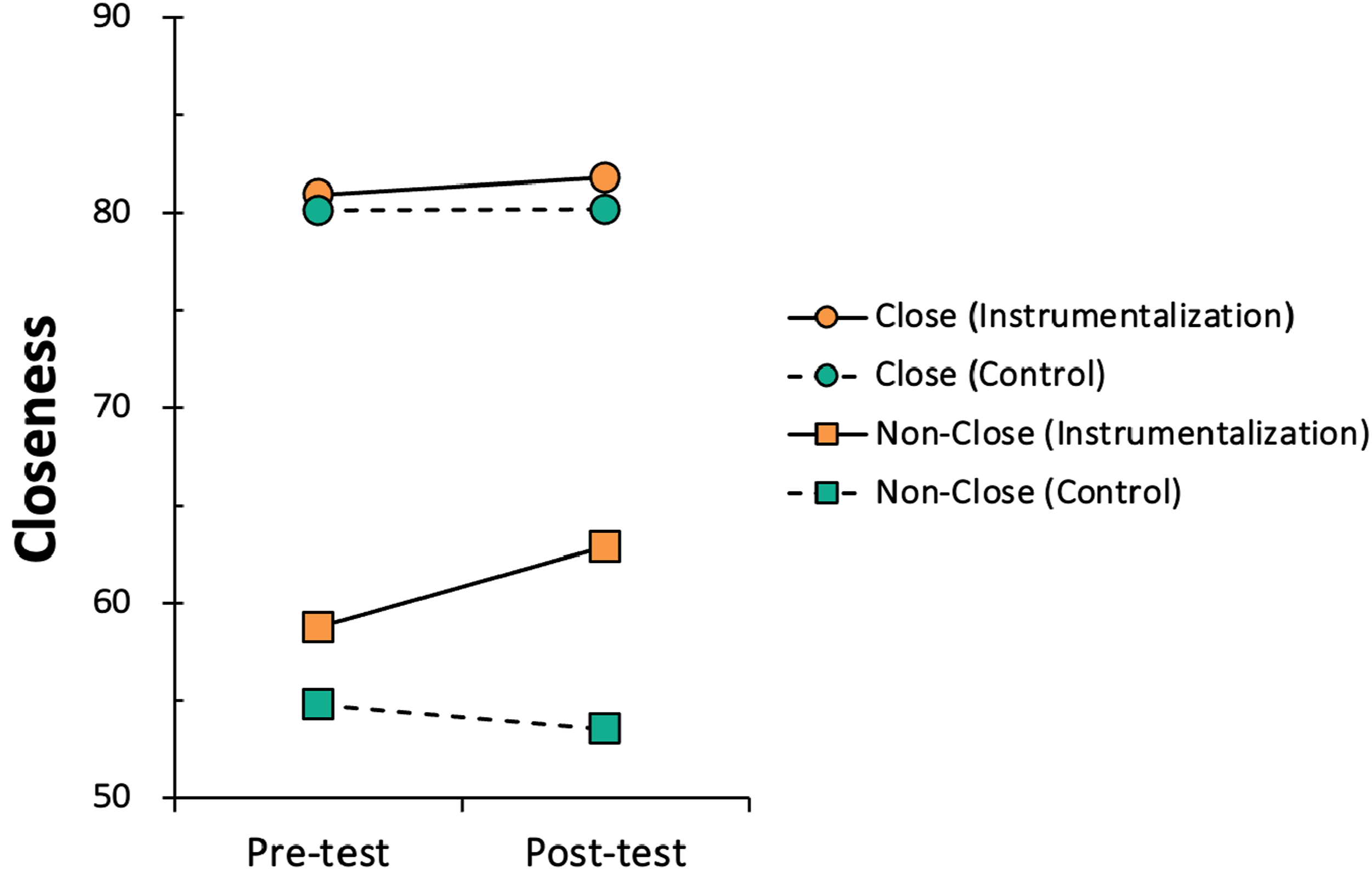
The interaction among test of closeness, type of relationship and instrumental deliberation on closeness, Study 3.
Perceived usefulness and closeness
Close others were again rated as higher on usefulness than non-close others, t(211) = 3.66, p < .001, d = 0.501. A multiple regression with type of relationship, perceived usefulness and their interaction to predict post-test closeness revealed significant main effects of both type of relationship (β = 0.29, t(209) = 6.42, p < .001, 95% CI [0.2021, 0.3811]) and perceived usefulness (β = 0.57, t(209) = 11.90, p < .001, 95% CI [0.4732, 0.6612]). Moreover, the interaction effect was also significant, β = −0.20, t(209) = −4.26, p < .001, 95% CI [−0.2883, −0.1060] (see Figure 1); and it remained significant after controlling for pre-test closeness, β = −0.09, t(208) = −2.67, p = .008, 95% CI [−0.1534, −0.0230]. Simple slope analyses indicated that post-test closeness of non-close others was more contingent on usefulness than that of close others, β = 0.78, t(209) = 13.69, p < .001, 95% CI [0.6641, 0.8861] for the slope of the non-close group; β = 0.37, t(209) = 4.93, p < .001, 95% CI [0.2244, 0.5207] for the slope of the close group.
Humanness and unethical behavior
We conducted 2 (type of relationship: close vs. non-close) × 2 (instrumental deliberation: instrumentalization vs control) between-subjects ANOVAs on humanness and unethical behavior respectively (Figure 4). The main effects of type of relationship and instrumental deliberation on humanness (Fs(1, 406) = 29.33 and 5.54, p < .001 and p = .019, ηp2s = .067 and .013, 90% CIs [0.0330, 0.1091] and [0.0012, 0.0376]) and unethical behavior (Fs(1, 406) = 16.15 and 4.90, p < .001 and p = .027, ηp2s = .038 and .012, 90% CIs [0.0133, 0.0729] and [0.0007, 0.0351]) were all significant. Moreover, significant interactions were found on both humanness (F(1, 406) = 4.35, p = .038, ηp2 = .011, 90% CI [0.0003, 0.0329]) and unethical behavior (F(1, 406) = 5.66, p = .018, ηp2 = .014, 90% CI [0.0013, 0.0381]). Simple effect analyses showed that the discrepancies in humanness and unethical behavior between close and non-close others were smaller in the instrumental than the control condition (for humanness, F(1, 406) = 6.03, p = .014, ηp2 = .015, 90% CI [0.0015, 0.0395] in the instrumentality condition, and F(1, 406) = 27.54, p < .001, ηp2 = .064, 90% CI [0.0302, 0.1045] in the control condition; for unethical behavior, F(1, 406) = 1.52, p = .218, ηp2 = .004, 90% CI [0.0000, 0.0198] in the instrumentality condition, and F(1, 406) = 20.07, p < .001, ηp2 = .047, 90% CI [0.0189, 0.0843] in the control condition.
5
Taken together, we found evidence contrary to the objectification theory (Fredrickson & Roberts, 1997; Gervais et al., 2014; Loughnan et al., 2010). For non-close others, instrumental deliberation not only facilitated individuals’ closeness with them, but also enhanced perceptions of their humanness and reduced unethical behavior towards them. The interaction between type of relationship and instrumental deliberation on humanness and unethical behavior, Study 3. Note. *** p < .001. Error bars represent ± 1 SE.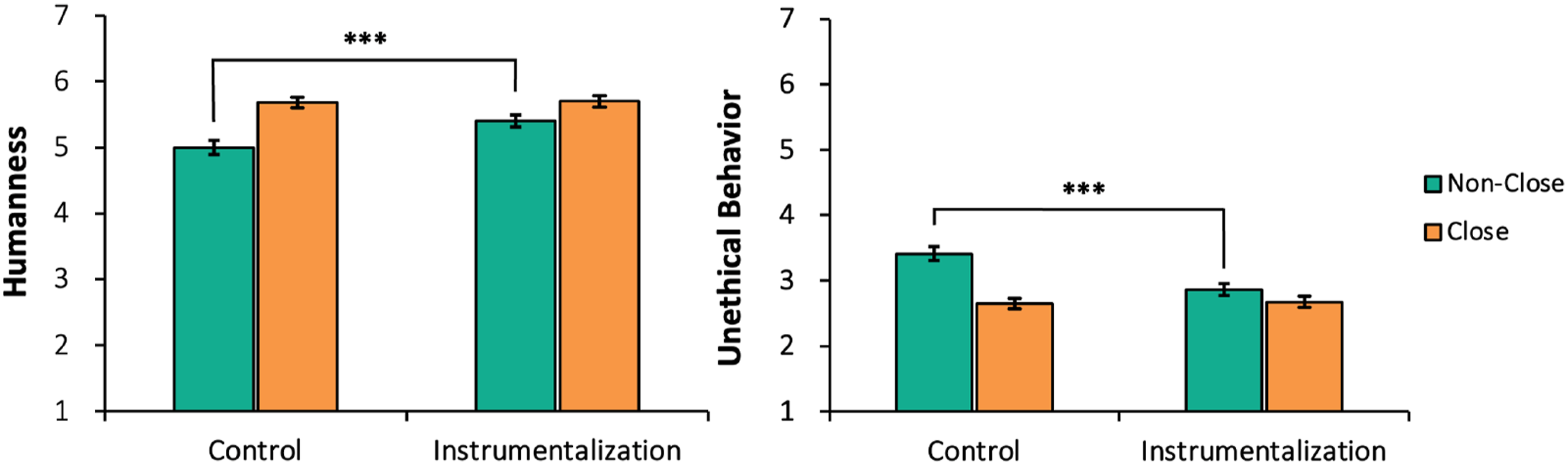
General discussion
The current studies examined the effect of instrumental deliberation, i.e., deliberating on others’ usefulness for one’s goals, on relationship closeness of close and non-close others. We showed that instrumental deliberation increased closeness of non-close others, though its impact on close others seemed inconsistent. In Study 2, for instance, we found that the effect of instrumental deliberation on closeness with non-close others was comparable to that of a priming of future interations, and it lasted until the next day. In Study 3, we also found that instrumental deliberation increased humanness perceptions of non-close others, and reduced unethical behavior towards them, more strongly than it affected our behavior towards close others. In addition, all three studies demonstrated a stronger association between perceived usefulness and closeness among non-close than close relationships.
Although previous studies showed that people felt closer to significant others who provided instrumental values for their goals (e.g., Cappuzzello & Gere, 2018; Fitzsimons & Fishbach, 2010; Fitzsimons & Shah, 2008), our studies found that contemplating the instrumental value of close others does not consistently enhance our closeness with them, which might partially account for the unstable interaction between relationship type and instrumental deliberation. We believe that there may be several explanations. First, people are already very intimate with close others, and thus the result was constrained by a ceiling effect. This ceiling effect, plus the varing measures and experimental conditions of each study, might result in the inconsistent findings regarding close others. Second, being deeply intertwined in each other’s lives, people might have already constantly thought about close others’ utility for their goals. Therefore, the manipulation of instrumental deliberation could not always further enhance the salience of their instrumentality. By contrast, it is more likely for individuals to discover novel instrumentality of non-close social targets who are less involved in our lives, and to feel closer to them. The current findings thus support the positive effects of instrumental deliberation on interpersonal relationships. It does not necessarily result in objectification or has negative implications (Fredrickson & Roberts, 1997; Nussbaum, 1995); rather, it draws closer people peripheral to our social network and makes us treat them more nicely.
Meanwhile, usefulness played an important role in enhancing the closeness of non-close others. While we follow communal rules in close relationships which emphasize the partners’ needs and welfare, we may categorize relationships with non-close others as exchange relationships and prioritize our own interests in these relationships (Clark et al., 1986; Clark & Mills, 1979, 2011). Therefore, although close others are extremely useful to us, whether they can provide utility for a specific goal is not crucial for maintaining our relationships with them (Orehek et al., 2012; Zhang et al., 2007). In comparison, we pay less attention to non-close others, maintain a larger distance from them (Haslam, 2022; Mashek et al., 2003), and are more indifferent to their interests and needs (Zhang et al., 2022) and less likely to forgive their transgressions (Karremans & Aarts, 2007). Therefore, usefulness may be a valuable key to initiating and maintaining relationships with non-close others (Chandler et al., 2023; Hui et al., 2020); it may provide us the opportunity to approach and care for those who otherwise would not play an important role in our lives.
Nevertheless, since that our closeness with non-close others depends on their utility, there seems to be a boundary condition for the effect of instrumental deliberation: deliberating on non-close others’ usefulness enhances our closeness with them as long as they do provide instrumental value for us. Given the consistent increase in closeness after instrumental deliberation, however, we believe that people generally find non-close others can, to some extent, be helpful.
We have two concerns about the increase in closeness with non-close others as a result of instrumental deliberation. First, how long can it last? Second, is it “genuine” closeness or reflecting mere tool utilization, as what is observed in sexual objectification of women (Szymanski et al., 2011)? That is, our closeness to the instrumentalized target is not the closeness between people, but is like the bond to the tools we use. Although we are not sure whether it can last longer, we observed that the effect persisted until the following day (Study 2), suggesting that it is not very transient. For the second question, results from our Study 3 are encouraging. Visualizing the instrumentality of non-close others did not result in dehumanization, but instead enhanced perceptions of their humanness and reduced unethical tendencies towards them. Therefore, we don’t think instrumental deliberation represents mere tool utilization. We believe that this is because when thinking about non-close others’ usefulness for our various goals, we inspect them in a more holistic and concrete way, which enables us to recognize their distinctiveness and complexity as human beings. In this sense, contrary to what would be expected by the objectification theory (Nussbaum, 1995), instrumental deliberation may indeed offer us a positive perspective to look at those outside our close social networks, and to approach them with benevolence.
It should be noted that we examined only subjective usefulness of close and non-close individuals for personal goals. This is reasonable because we are concerned with the process and outcomes of examining others’ usefulness. Yet, it is open to question whether the results can be extended to actual usefulness. We believe that actual usefulness may also enhance closeness, and that the discrepancy in expected and actual usefulness may bring about significant consequences. For instance, the disappointment arising from non-close others not being as useful as one has expected may drive them even farther away. Another limitation of our research is that we did not track the long-term change in closenss. As the establishment of close relationships depends on continuously providing usefulness and being mutually useful (Orehek et al., 2018), it warrants further research the role of instrumental deliberation in the development of new close relationships in real-life settings. Third, we did not control intial usefulness of close and non-close others and it turned out that close others were rated as far more useful than non-close others. Although this may reflect what we observe in real life situations, it nonetheless might bias the association between perceived usefulness and closeness. Future research may control initial usefulness between close and non-close others, and examine whether the results still hold. Fourth, we failed to show that instrumental deliberation had a larger effect on closeness than imagined future interactions, or any other forms of non-instrumental, other-focused deliberation. However, although it may be true that other forms of deliberation may also help to bring social targets closer (e.g., the mere exposure effect), it is still valuable to show that instrumental deliberation, which has the potential to enact objectification and dehumanization, facilitates relationship closeness instead.
Finally, an additional limitation of the present research is that we omitted some demographic information (e.g., sexual orientation, disability) and we included only Chinese samples. Nevertherless, based on previous work from other cultures (e.g., Fitzsimons & Fishbach, 2010), we believe that what we have found may be generalizable to people with different backgrounds. To depend on each other is a universal aspect of human relationships, and mutual usefulness may be important for relationship formation and maintenance in most societies (Fitzsimons & Shah, 2008; Gomillion & Murray, 2014; Orehek et al., 2018). Therefore, we believe that as a first step of approaching non-close others, instrumental deliberation may help to bring distant people together, and to see each other as full human beings in most situations. This said, we suspect that certain individual differences may attenuate or even negate the positive effect of instrumental deliberation on closeness. For instance, people who are high in the Dark Triad Traits (i.e., narcissism, psychopathy, and Machiavellianism) and the objectification tendency may be apathetic to others and are more likely to treat them as mere tools (e.g., Gruenfeld et al., 2008; Jonason et al., 2012). For those people, instrumental deliberation may not facilitate interpersonal relationships, and can even lead to exploitation and dehumanization.
Conclusion
Forming new relationships are important in this ever changing world. Our research suggests that instead of reducing people into mere tools, instrumental deliberation enhances our closeness with others, especially with those distant to us, thus may serve as the first step to approach non-close others. Moreover, the more non-close others are useful for our goals, the more close we feel with them after instrumental deliberation. It enriches our understanding of the mechanisms and dynamics of interpersonal relationships, and provides avenues for the exploration of relationship development.
Footnotes
Declaration of Conflicting Interests
The author(s) declared no potential conflicts of interest with respect to the research, authorship, and/or publication of this article.
Funding
The author(s) disclosed receipt of the following financial support for the research, authorship, and/or publication of this article: This research was supported by grant from the National Social Science Foundation of China allocated to the corresponding author (Grant No. 19BSH129).
Open research statement
As part of IARR’s encouragement of open research practices, the authors have provided the following information: This research was not pre-registered. The data used in the research can be publicly posted. The data can be obtained at:  . The materials used in the research can be publicly posted. The materials can be obtained at: https://osf.io/rchbd/?view_only=7270b10c974c49d49231eebca2a909c7.