



Abstract
Casual sexual relationships (CSRs) are common among young adults. Although it is a widely discussed topic in the popular media, little empirical work has examined the expectations related to communication within these relationships. Moreover, few studies have made comparative examinations across various relationship types. Through two studies, we first identified the differences in communication, satisfaction, and commitment across relationship types. Then we examined communication frequency as a regulator of satisfaction and commitment across relationship types. In Study 1, participants responded to a hypothetical relationship scenario depicting either a committed relationship (CR), friends with benefits (FWB), or a booty call/fuck buddy relationship (BC/FB); they indicated how committed and satisfied they would feel as well as how frequently they would communicate with the partner. Participants in Study 2 reported on these variables in their most recently terminated relationship. Overall, we found the highest frequencies of commitment and communication in CRs; BCs/FBs and other similar CSRs had the lowest. FWBs often fell between the other two categories. Satisfaction did not differ reliably across relationship types. A serial mediational analysis revealed that the more a relationship was considered to be a CR, the more partners communicated, which was associated with more satisfaction and, in turn, commitment. Our findings highlight the distinctions between expectations within FWB relationships, compared to other relationships types, suggesting that they fall somewhere between CRs and other CSRs on commitment and relational expectations. In addition, the results support the idea that individuals intentionally regulate their communication to maintain the expected level of commitment within a relationship.
Keywords
Casual sexual relationships (CSRs) are quite common; the frequency of individuals engaging in CSRs within a year is nearly equal to those engaging in serious romantic relationships (Jonason, Hatfield, & Boler, 2015). Given their regularity, it is not surprising that CSR relationships are a popular topic among college students and the media (Bisson & Levine, 2009; Hughes, Morrison, & Asada, 2005). Of particular interest recently among the popular press are the various “rules” and appropriate behaviors associated with maintaining these types of relationships (Arneson, 2017; Burton, 2017). However, these reports have been supported by limited, if any, scientific evidence, highlighting the need for more systematic investigations (Jonason, Li, & Richardson, 2011). The current project sought to provide an empirical examination of the expectations related to various relationship types and the relational outcomes associated with them.
CSRs can vary in a number of ways, such as the degree of friendship between the partners and the extent to which the partners communicate (e.g., Wentland & Reissing, 2011, 2014). Within committed relationships (CRs), communication frequency predicts greater intimacy, satisfaction, commitment, and longevity (Morey, Gentzler, Creasy, Oberhauser, & Westerman, 2013; Parks & Adelman, 1983). However, little is known about the role of communication within CSRs and how it relates to relational outcomes. Previous work (Bergdall et al., 2012; Knight, 2014) has suggested that individuals in CSRs may establish rules that intentionally limit or suppress communication. This has been suggested to serve as a relationship maintenance strategy, aimed at maintaining the relationship with its corresponding low level of commitment (Bisson & Levine, 2009; Knight, 2014). While previous researchers have hypothesized about the relational outcomes associated with communication within CSRs, few have directly tested these assumptions. In the current project, we seek to address this gap in the literature through the examination of communication frequency as a regulator of satisfaction and commitment within CSRs and CRs.
Committed versus CSR types
Sexual relationships are often classified in two broad categories: committed and casual (Epstein, Calzo, Smiler, & Ward, 2009; Wentland & Reissing, 2011, 2014). Traditional, CRs typically involve high levels of commitment as well as social and sexual monogamy (Jonason, 2013; Jonason et al., 2015). Individuals engaged in CRs typically expect more socioemotional support and intimacy (Jonason, 2013; Jonason et al., 2015). CSRs can include anything from a one-time sexual encounter to an ongoing sexual relationship (Claxton & van Dulmen, 2013; Epstein et al., 2009; Wentland & Reissing, 2011). Here, we will focus on the subtypes that are ongoing (i.e., not just a single encounter).
Several subtypes of ongoing CSRs have been discussed by scholars, such as friends with benefits (FWB) and booty calls (BCs; Claxton & van Dulmen, 2013; Wentland & Reissing, 2011, 2014). FWB relationships are considered to be distinct from other types of CSRs (Furman & Shaffer, 2011). They often involve a deeper interpersonal connection, with partners engaging in social and sexual activities; however, they typically lack any explicit commitment (Bisson & Levine, 2009; Epstein et al., 2009; Wentland & Reissing, 2011). There is a great deal of variability within FWB relationships; they can range from just sex (i.e., only engaging in sexual activity with little to no nonsexual relationship) and successful/unintended transitions into CRs (Mongeau, Knight, Williams, Eden, & Shaw, 2013). There is much less consistency in distinguishing other CSR subtypes (e.g., fuck buddy [FB], BC), the definitions of which are often indistinguishable across studies or are context-dependent (e.g., a partner being intoxicated; Jonason et al., 2015; Wentland & Reissing, 2011, 2014). Moreover, Mongeau et al.’s just sex FWB subtype has been suggested to be more similar to other CSRs than the prototypical FWB, as it does not involve friendship (Mongeau et al., 2013; Wentland & Reissing, 2014). Therefore, while the prototypical FWB relationship appears to be distinct from other CSRs and CRs, there does not seem to be consistent differences between FBs, BCs, and just sex FWBs. To clarify the defining characteristics of relationships subtypes, we created hypothetical relationship scenarios and examined the following research question (RQ) and hypothesis (H):
Relational commitment and its predictors across relationship types
Relational commitment can be conceptualized as one’s long-term orientation toward maintaining a relationship (Arriaga & Agnew, 2001; Rusbult, 1980, 1983). Rusbult’s (1980, 1983) Investment Model has been used for decades to predict individuals’ commitment to a variety of relationship types including romantic, friendship, and business relationships (for a review, see Le & Agnew, 2003). According to the Investment Model, higher levels of commitment are determined by (a) satisfaction derived from the relationship, (b) greater investment in the relationship, and (c) the absence of alternative relational partners (Rusbult, 1980, 1983; Segal & Fraley, 2016).
The applicability of the Investment Model to CRs has been examined extensively; some work has also focused on the Investment Model variables within CSRs, although to a lesser extent (Hendrick, Hendrick, & Adler, 1988; Le & Agnew, 2003; VanderDrift, Lehmiller, & Kelly, 2012). VanderDrift, Lehmiller, and Kelly (2012) found that the Investment Model successfully predicts commitment within FWB relationships. In addition, their findings highlighted the Investment Model’s specific applicability to more generalized commitment to the relationship itself, rather than commitment to specific aspects of the relationship (i.e., commitment to the sexual relationship). To our knowledge, no extant work has specifically focused on commitment and its predictors in other CSR subtypes (e.g., BC). In the current study, we focused on predicting general commitment within various relationship types.
While degrees of commitment can be inferred across the different relationship subtypes, comparative examinations have been limited. Both CRs and BCs/FBs are partially defined by their associated degrees of commitment, with CRs being associated with long-term orientations and BCs/FBs lacking this (Jonason, Li, & Cason, 2009; Wentland & Reissing, 2011, 2014). However, even though individuals often enter into CSRs as a way of avoiding relational commitment (Hughes et al., 2005), these relationships are often characterized by moderate levels of commitment (VanderDrift et al., 2012). This commitment may be due to various approach or avoidance motives, such as the desire to continue receiving the benefits associated with the relationship (e.g., sexual pleasure) or avoid costs associated with ending it (e.g., loss of friendship; VanderDrift et al., 2012).
FWBs are partially characterized by their lack of explicit commitment (Hughes et al., 2005; Knight, 2014), they also have, by definition, more to lose than BC/FB relationships (i.e., sexual relationship and friendship; VanderDrift et al., 2012). Therefore, FWB relationships should be characterized by higher levels of commitment compared to BCs/FBs. With this, we predict that relationships can be characterized as existing on a continuum of commitment; specifically, we developed the following hypotheses:
Within both CRs and CSRs, individuals vary in their relative levels of the predictors of commitment: satisfaction, investments, and quality of alternatives (Le & Agnew, 2003; VanderDrift et al., 2012). However, to our knowledge, there have been no explorations of how these antecedents of commitment differ between relationship types. Le and Agnew’s (2003) meta-analysis of the Investment Model identified that, while the associations between commitment, investments, and alternatives vary depending on relationship type, the link between satisfaction and commitment is least affected by the exclusivity of the relationship. Therefore, in this project, we focused on examining satisfaction across relationship types and its association with commitment in these relationships, which led us to the following question:
Communication across relationship types
Communication quality and quantity are directly associated with satisfaction and intimacy, which are well-known predictors of relational commitment and longevity (Emmers-Sommer, 2004; Rusbult, 1980, 1983). However, the development of intimacy is not always the goal of communication within relationships (Parks, 1982). Communication rules are used to achieve different relational goals, the adherence to these rules directly predicts satisfaction within a relationship (Baym, Zhang, Kunkel, Lin, & Ledbetter, 2007; Hughes et al., 2005; Miller-Ott, Kelly, & Duran, 2012).
Communication rules may involve the acceptable frequency of phone calls/texts, usage of cell phones when together, and the degree to which the relationship can be discussed with others (Hughes et al., 2005; Miller-Ott et al., 2012). CRs are characterized by frequent communication via text messaging or phone calls; they also involve public communication about the relationship through social media (Fox & Warber, 2013, 2014; Wentland & Reissing, 2011). Individuals in CRs communicate for a variety of reasons including making plans and building intimacy (Bergdall et al., 2012; Pettigrew, 2009; Wentland & Reissing, 2011).
Most CSR subtypes (e.g., BCs) involve communication that is primarily for logistical reasons, such as to arrange meetings (Bergdall et al., 2012; Jonason et al., 2009; Wentland & Reissing, 2011). However, FWBs are often characterized by unique communication rules, potentially due to the dual nature of the relationship (i.e., friends and sexual partners; Bisson & Levine, 2009). For example, while CRs typically involve more communication than FWBs, FWBs are more likely to discuss certain aspects of the relationship (e.g., extradyadic sexual experiences; Lehmiller, VanderDrift, & Kelly, 2014). Similarly, discussing the relationship with other friends seems to be relatively common in FWB relationships (Hughes et al., 2005). Therefore, we developed the following hypotheses:
Bergdall et al. (2012) suggested that differences in communication across relationship types are often deliberate; individuals manage their levels of emotional closeness through their use of different communication methods and frequency of communication. Thus, communication rules seem to be developed strategically to regulate commitment across relationship types. In CRs, partners use frequent communication to maintain closeness (Jin & Peña, 2010). In CSRs, communication rules are developed to avoid intimacy using infrequent and impersonal methods (e.g., texting; Drouin & Landgraff, 2012). Therefore, we hypothesize the following:
We examined these variables and the relationships between them using a multi-method approach across two studies. In Study 1, we used hypothetical relationship scenarios to experimentally examine differences between relationship types. Study 2 examined these same associations in participants’ most recent relationships.
Study 1
Method
Participants
Participants were recruited from a variety of courses at a southeastern university, as well as through student-wide emails, social media, and community posting websites. Participants were invited to complete a survey online (through a link to a secure survey website), all participation was voluntary and some participants (64%) received course credit for their participation. We obtained a community sample of 123 individuals (73% female; 18–54 years old, Mdn = 21). The majority of our sample was college-aged; 70% were between 18 and 22 years old. Of the individuals reporting demographic information, 1 the majority of participants were White/Caucasian (70%), 17% were Black/African-American, and the remaining participants reported a variety of racial/ethnic backgrounds. Most participants were heterosexual (85%) and 11% reported a nonheterosexual orientation, the remaining participants did not provide clear responses to the question inquiring about sexual orientation (e.g., “female”).
Materials
Relationship scenarios
Since no consistent distinctions have been made between FBs, BCs, and the just sex FWB subtype, we combined the qualities of these relationships into a single scenario, which reflected their common characteristics (e.g., Mongeau et al., 2013; Wentland & Reissing, 2011, 2014). However, to avoid confusion, we will refer to this scenario condition as the BC/FB scenario and will reflect on its relationship to the just sex FWB subtype in our discussion of the results. Relationship scenarios were created by the researchers to represent the three relationship types of primary interest: CRs, FWBs, and BCs/FBs. Scenarios were developed based on the definitions of specific relationship types provided by previous researchers (e.g., Jonason et al., 2015; Wentland & Reissing, 2014). To maintain consistency, we used a similar structure across conditions, changing only what we believed to be the primary, consistently supported, distinctions across relationship types. Specifically, to manipulate relationship type we varied (a) who the relationship was with, (b) whether it was casual or exclusive, and (c) the activities the partners engaged in. The example scenario below represents the FWB condition, with the manipulated words underlined, followed by the words used in the other scenarios, italicized in parentheses (BC/FB and CR, respectively). Emphasis (i.e., underline and italics) is added here for clarity but was not present in the scenario prompts. Please read the scenario below and imagine how you would feel, regardless of whether you have had the experience or not. Imagine that for a couple of months you and
Manipulation check: Relationship type label
Four questions were used as manipulation checks to ensure that the researcher-created scenarios were perceived by participants to be explaining the intended relationship types. Participants were asked how well the scenario described each of the relationship types: CR type, FWB type, BC type, and FB type. Participants indicated the extent to which the scenario they read described each type of relationship on a 7-point Likert-type scale, ranging from 1 (very poorly) to 7 (very well).
Communication frequency
A total of four questions measured communication frequency. Three assessed communication with the partner through phone calls, text messaging, and social media. For example, participants were asked to respond to this item: “How frequently do you think you would text message the person described in the scenario?” These three items were rated on a 7-point Likert-type scale ranging from 1 (never) to 7 (frequently).
In line with Hughes, Morrison, and Asada’s (2005) findings regarding the importance of communicating about a relationship with one’s friends, the forth question addressed communication with others about the relationship. Participants were asked “How likely would you be to tell your friends about the relationship described in the scenario,” they responded using a 7-point Likert-type scale ranging from 1 (extremely unlikely) to 7 (extremely likely).
Relationship factors
Two questions examined participants’ perceptions of how satisfied and committed they would be in the relationship described in the scenario. One item was: “How satisfied do you think you would be with the relationship described in the scenario?” Participants responded on a 7-point Likert-type scale ranging from 1 (not at all satisfied) to 7 (very satisfied). Participants indicated how committed they would be by responding to the following item, using a 7-point Likert-type scale ranging from 1 (not at all committed) to 7 (very committed): “How committed do you think you would feel in the relationship described in the scenario?”
Procedure
After providing informed consent, participants were randomly assigned to read one of three relationship scenarios: CR (n = 41), FWB (n = 42), or BC (n = 40). The participants answered the manipulation check items, followed by the communication questions, relationship factors items, and ended the survey by answering open-ended demographic questions. After completion of the survey, participants were provided with a debriefing page explaining the purpose of the study. No personally identifiable information was collected from participants. This survey took approximately 10–15 minutes to complete.
Results
Manipulation checks
RQ1
First, we examined the participants’ assignments of relationship labels to each of the hypothetical scenarios using a 4 × 3 mixed-design analysis of variance (ANOVA), with relationship type labels as our within-subjects variable (CR type, FWB type, BC type, and FB type) and the relationship scenario condition as the between-subjects variable (CR, FWB, or BC/FB). The ANOVA revealed significant main effects for both relationship type label and the scenario condition, Fs = 80.05 and 59.9, respectively, ps < .001. These main effects were qualified by a relationship label × scenario interaction, F(2, 120) = 140.09, p < .001. To probe this interaction, we ran three separate repeated measure ANOVAs, one for each of the scenario conditions, with the relationship type labels as the within-subjects variable (see rows in Table 1). This analysis confirmed our expectations regarding the labeling of each of the relationships described in the scenarios. Specifically, the CR scenario was best described as a CR type, the FWB scenario was described as a FWB type, and the BC/FB scenario was described as FB and BC types. We also examined the use of each relationship type label across the three scenario conditions through four separate one-way between-subjects ANOVAs (see columns in Table 1). The use of each label was most likely with its corresponding scenario.
Study 1: ANOVAs examining the use of relationship type labels across and within relationship scenario conditions.

Note. Standard deviations appear in parentheses following means. Means with differing letter subscripts in the same row and different numbers in the same column are different at p < .05, based on post hoc test of the pairwise comparisons. CR = committed relationship, FWB = friends with benefits, BC = booty call, FB = fuck buddy; ANOVA = analysis of variance.
***p < .001.
H1
We predicted that the characteristics described in the BC/FB scenario, which reflected the defining characteristics of FBs, BCs, and the just sex FWB subtype, would be more likely to be labeled by participants as a FB and BC compared to FWB. This hypothesis was supported as participants were significantly more likely to assign the FB and BC labels to this scenario than they were to assign the FWB label (see Table 1).
Together, these results support the utility of these hypothetical scenarios in describing CR, FWB, and BC/FB relationship types. They also support the idea that FB and BC are terms that may be used interchangeably to refer to similar types of relationships. Aside from the similarities found between the FB and BC types, the remaining relationship types all appear to be distinct from one another.
Differences across relationship types
H2a, H2b, and H2c: Commitment
A one-way between-subjects ANOVA was conducted to examine differences in commitment across the hypothetical relationship scenarios (CR, FWB, or BC/FB; see Table 2). In H2a, we predicted that scenarios with CR characteristics would be associated with the highest levels of commitment, BC/FB would have the lowest and FWBs would fall between the two; this hypothesis was supported. The degree of commitment that participants believed they would feel was significantly higher for the participants in the CR scenario condition, followed by FWB, and BC/FB was the lowest.
Study 1: ANOVAs examining the use of communication methods and relationship factors across relationship scenario conditions.

Note. Standard deviations appear in parentheses following means. Means with differing subscripts in the same row are different at p < .05, based on a Scheffé post hoc test of the pairwise comparisons. Degrees of freedom differ slightly across analyses due to missing data on single-item measures. CR = committed relationship, FWB = friends with benefits, BC = booty call, FB = fuck buddy; ANOVA = analysis of variance.
***p < .001.
+The assumption of homogeneity of the variances was not met; therefore, we used the Welch’s adjusted F-ratio and Dunnett’s T3 post hoc tests.
We predicted that the label used to describe the relationship would predict anticipated commitment to the relationship. Specifically, the CR label would be a positive predictor (H2b) and the FB and BC labels would be negative predictors (H2c) of commitment. We used linear regression to determine whether participants’ interpretations of the relationship type (CR type, FWB type, BC type, and FB type) depicted in the scenarios predicted their anticipated commitment. The overall regression predicting commitment was significant, F(4,113) = 105.46, p < .001, R 2 = .79. Our hypotheses were partially supported as CR type (β = .65, p < .001) and BC type (β = −.23, p = .02) were significant predictors, FWB type and FB type were not (βs = −.07 and .00, respectively).
RQ2: Satisfaction
Due to the lack of extant research related to differences in the antecedents of commitment (e.g., satisfaction) across relationship types, the goal of RQ2 was to explore such differences. A one-way between-subjects ANOVA was conducted to examine differences in satisfaction across the hypothetical relationship scenarios (CR, FWB, or BC/FB; see Table 2). Participants responding to the CR scenario believed that they would have significantly more satisfaction than the participants responding to both the FWB and BC/FB scenarios, who did not significantly differ.
H3 and H4: Communication frequency
We predicted that participants responding to the CR scenario would indicate the highest communication frequencies, followed by FWB, and those responding to the BC/FB scenario would indicate the lowest (H3). The multivariate analysis of variance (MANOVA) examining differences between the three scenarios (CR, FWB, or BC/FB) on the four measures of communication frequency (i.e., texting, calling, social media, and telling friends about the relationship) was significant, Wilk’s Λ = .41, F(8, 224) = 15.55, p < .001. Follow-up univariate between-subjects ANOVAs were significant for all of the communication methods (see Table 2). Similar patterns of mean differences were found in the univariate analyses examining the likelihoods of communicating with the hypothetical partner via text messaging, calling, and social media. Specifically, individuals responding to the CR scenario indicated the highest frequency of communication, followed by the individuals responding to the FWB scenario, and the individuals responding to the BC/FB scenario indicated the lowest frequency.
Our prediction that individuals imagining CRs would be most likely to discuss the relationship with friends, followed by FWB, with BC/FB being least likely was partially supported (H4). The univariate ANOVA examining the differences between the scenarios on the likelihood of telling one’s friends about the relationship was also significant showing that participants in the CR scenario condition would be more likely to tell their friends about the relationship than the participants in the FWB and BC/FB conditions, who did not significantly differ from one another.
H5: The serial indirect effect of relationship type on commitment through communication and satisfaction
To examine the hypothesized indirect effects, we first created a composite score representing overall communication by computing the mean of the four communication items (text, call, social media, and telling friends), these four items demonstrated good reliability with Cronbach’s α = .89. Based on the aforementioned significant linear direct effect relationships predicting commitment, we examined the indirect effects of CR type and BC type on commitment through the serial mediators of communication and satisfaction using two mediational models (one for each relationship type). Through the use of the PROCESS macro (Hayes, 2013; Model 6), we identified that the classification of the relationship as a CR type indirectly predicts commitment through communication and satisfaction with none of the bias-corrected bootstrap (N = 10,000) 95% confidence intervals containing zero. In other words, all three of the possible indirect effects in the model were significant: communication [.03, .33], satisfaction [.03, .18], and the two in serial order [.01, .17; see Figure 1]. In line with our hypothesis, classifying the relationship as a CR led to more communication, which increased satisfaction, resulting in higher levels of commitment.
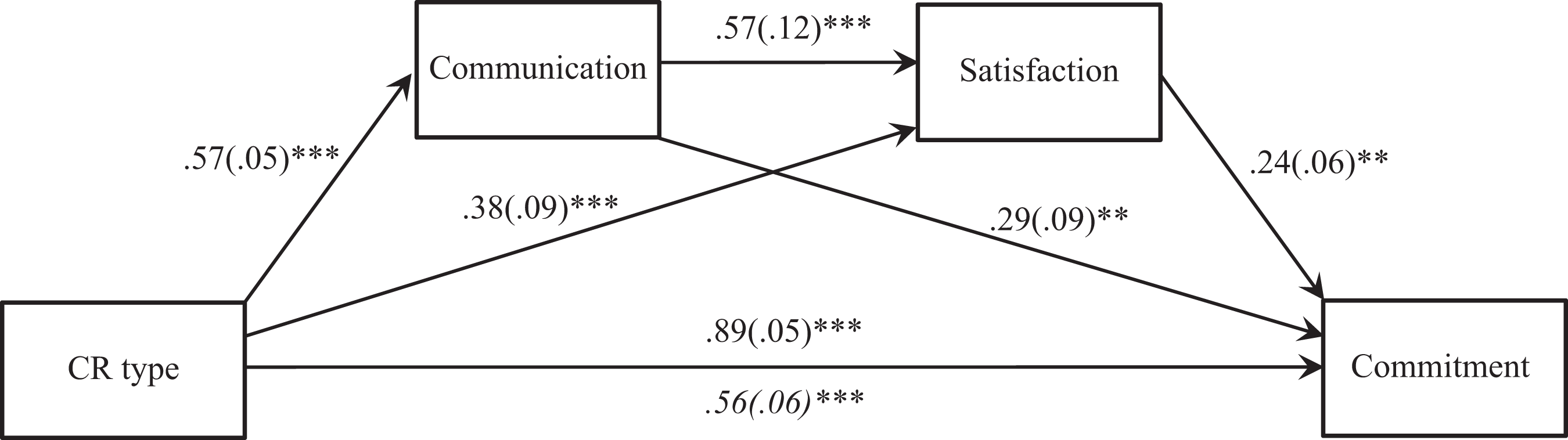
Study 1: Indirect effect of the degree to which a relationship is perceived to be a CR (CR type) on commitment through communication and satisfaction. Italicized values represent the direct effect of CR type on commitment (c′). **p < .01; ***p < .001. CR = committed relationship.
Similarly, classification of the relationship as a BC type indirectly predicted commitment through communication and satisfaction, with none of the bias-corrected bootstrap (N = 10,000) 95% confidence intervals containing zero: communication [−.40, −.13], satisfaction [−.19. −.04], and both as serial mediators [−.21, −.05; see Figure 2]. As expected, the more the relationship was considered to be a BC type relationship, the less the individuals believed that they would communicate, which was associated with lower satisfaction and ultimately commitment.
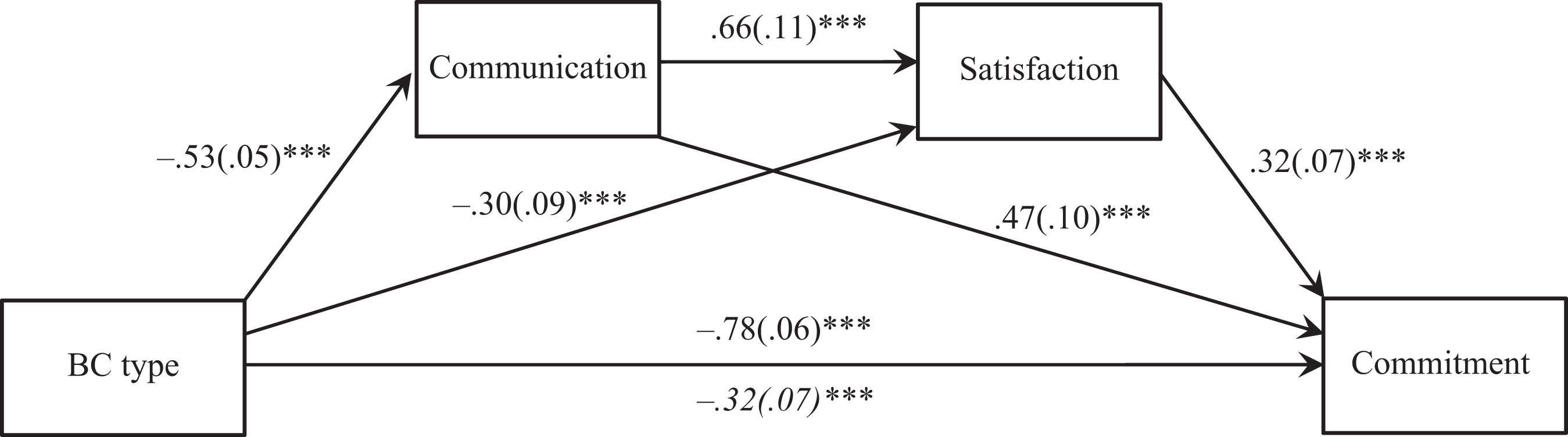
Study 1: Indirect effect of the degree to which a relationship is perceived to be a BC relationship (BC type) on commitment through communication and satisfaction. Italicized values represent the direct effect of BC type on commitment (c′). ***p < .001. BC = booty call.
Conclusion and discussion
One goal of Study 1 was to identify the differences in levels of commitment, communication, and satisfaction across relationship types. Overall, participants reported the highest levels of commitment in CRs, followed by FWB, and BC/FBs had the lowest. Similar patterns were identified between the relationship types on communication frequency and satisfaction levels, with CRs having the highest, BC/FBs being the lowest, and FWBs falling between the two. A second goal of this study was to examine communication frequency and satisfaction as potential regulators (i.e., mediators) of the levels of commitment across relationship types. Classification of the relationship as a CR type was related to more communication, leading to increased perceived satisfaction, and ultimately more anticipated commitment. The inverse was found for relationships classified as a BC type, which had less communication, resulting in lower satisfaction, and commitment. Overall, these findings suggest that there are distinctions between the general nature and expectations for these three relationship types, especially as it relates to commitment, communication frequency, and satisfaction.
Study 1 also supported the utility of the hypothetical relationship scenarios created by the authors. Through these scenarios, we were able to exercise some degree of control and suggest a link between relationship type, communication, satisfaction, and commitment
Study 2
In Study 1, we were able to identify individuals’ expectations related to communication frequency in various relationship types and found that communication frequency predicted the anticipated levels of satisfaction with and commitment to the relationship. However, the use of hypothetical scenarios limits our ability to generalize these findings to actual relationships. In general, people are consistently inaccurate in their predictions of how they will feel following certain events (Wilson & Gilbert, 2003). Compared to how they actually feel, individuals tend to predict that they will be more satisfied in their relationships after positive events (e.g., marriage; Lavner, Karney, & Bradbury, 2013) and that they will feel worse following negative events (e.g., a partner being emotionally distant; Green et al., 2013). To address these cognitive biases, in Study 2, we sought to replicate the findings from Study 1 through the examination of participants’ most recent relationships.
Method
In Study 2, we used methods nearly identical to Study 1, replacing the hypothetical scenario with instructions asking participants to think about their most recent sexual and/or romantic relationship that has ended. We chose this approach for a number of reasons: (a) to reduce biases associated with participants’ reports of current versus previous relationships (Geher et al., 2005), (b) to examine the prevalence of each relationship type at a particular time point, rather than a time frame (e.g., Jonason et al., 2015), (c) to minimize the length of time between the relationship itself and the recall of its characteristics, and (d) to reduce participants’ likelihood of choosing to report about a prototypical relationship (i.e., CR), rather than one that is less traditional (e.g., FWB).
Participants
We distributed our survey link through various websites (e.g., community posting websites, social media) and email distributions (sent to introductory level courses and through student-wide distributions) to recruit participants. Prior to participation, we asked filter questions to ensure that participants met the qualifications for the study. Participants were required to have had at least one previous sexual and/or romantic relationship (i.e., one that has ended) that lasted for 2 weeks or longer. If participants did not meet the criteria, they were directed to a different study. One hundred forty-six individuals (77% were female) ultimately participated in this study. Two participants were excluded from analysis due to inconsistencies in their responses. The remaining 144 participants were between 18 and 48 years old (Mdn = 21), most were recruited from a southeastern university or were within the age range of traditional college students (85% were aged 18–22). Some participants (54%) received course credit for their participation; all participation was voluntary. Of those reporting, 1 the majority of participants either identified their race/ethnicity as White/Caucasian (77%) or Black/African-American (17%), the remaining participants reported a variety of racial/ethnic backgrounds. Most participants were heterosexual (84%) and 14% reported a nonheterosexual orientation, the remaining participants did not provide clear responses to this question.
Materials and procedure
After providing informed consent, participants were presented with a prompt prior to questions about their recent relationship, the prompt read: Think of your most recent sexual and/or romantic relationship that lasted for at least a couple of weeks, but has ended. This can be anything ranging from an ongoing casual relationship (e.g. booty call, friends with benefits) to a serious, committed relationship.
Results
Coding for and evaluating frequencies of relationship type
Prior to data analysis, the participants’ previous relationships were categorized into types by examining participants’ responses to the relationship type Likert-type questions and their open-ended responses. Few participants indicated that their previous relationship was either a BC type (n = 5) or FB type (n = 5). Due to the low frequency of these types, we decided to combine them, as well as include any other casual relationships that were not CRs or FWB, into a single category labeled “CSRs.” The authors independently coded participants’ responses into one of the three relationship types (CR, FWB, or CSR), based on the previously described definitions. For example, the following response was coded as a FWB relationship: “The relationship was just a friendship and having sex. We talked about a lot of stuff. We were not serious.” This response was categorized as a CSR: “Purely sexual.” The following was categorized as a CR: “Serious committed relationship.” The inter-rater reliability was high with 89.29% agreement and Cohen’s κ = .85, indicating exceptional agreement. All initial disagreements were resolved through discussion. Ultimately, 85 participants’ past relationships were classified as CRs, 29 were categorized as FWBs, and 29 were determined to be in the CSR category. One participant did not respond to either the open-ended or the Likert-type questions and was, therefore, excluded from categorization and analyses.
Therefore, we found that the most recent relationship type for around 59% of participants in our sample was a CR, approximately 20% of the participants were most recently involved in a FWB relationship, and the remaining 20% were most recently involved in some other type of CSR. The relative frequencies of BC and FB relationships, specifically, were too low (approximately 3.5% each) to examine independently in a sample of this size.
Differences across relationship types
H2a, H2b, and H2c: Commitment
A one-way between-subjects ANOVA was used to examine H2a, which predicted differences in commitment between previous relationship types (CR, FWB, and CSR; see Table 3). Our hypothesis was partially supported. Specifically, the participants who were describing a CR reported significantly more commitment compared to participants in FWBs and CSRs; however, FWBs and CSRs did not significantly differ from one another.
Study 2: ANOVAs examining the use of communication methods and relationship factors across previous relationship types.

Note. Standard deviations appear in parentheses following means. Means with differing subscripts across rows are different at p < .05, based on a Scheffé post hoc test of the pairwise comparisons. Degrees of freedom differ slightly across analyses due to missing data on specific items. CR = committed relationship, FWB = friends with benefits, CSR = casual sexual relationship; ANOVA = analysis of variance.
*p < .05; **p < .01; ***p < .001.
+The assumption of homogeneity of the variances was not met; therefore, we used the Welch’s adjusted F-ratio and Dunnett’s T3 post hoc tests.
To examine H2b and H2c, we used multiple linear regression with the four relationship type label variables (CR type, FB type, BC type, and FB type) as predictors of commitment. The overall regression was significant, F(4,137) = 36.82, p < .001, R 2 = .52. However, only CR type (β = .70, p < .001) was a significant predictor, FWB type, BC type, and FB type were not, βs = |.00–.08|. Therefore, the findings from Study 1 were partially confirmed, with CR type emerging again as a significant positive predictor of commitment (H2b). However, the prediction based on the finding from Study 1, which indicated the BC type label as a negative predictor of commitment, was not supported. Therefore, we did not examine the serial indirect effect of BC type on commitment through communication and satisfaction, as this direct effect was not significant.
RQ2: Satisfaction
To examine the hypothesized differences in satisfaction between relationship types (CR, FWB, and CSR), we conducted a one-way between-subjects ANOVA. Contrary to our predictions and the findings from Study 1, participants’ levels of satisfaction did not significantly differ across relationship types (see Table 3).
H3 and H4: Communication frequency
To test our hypotheses predicting more communication in CRs, followed by FWB, with CSRs having the least (H3 and H4), we first conducted a MANOVA examining differences between the three relationship types (CR, FWB, or CSR) on the four measures of communication frequency (i.e., texting, calling, social media, and telling friends about the relationship). The MANOVA was significant, Wilk’s Λ = .84, F(8, 272) = 3.04, p = .003. Follow-up univariate between-subjects ANOVAs were used to examine the differences in the use of various communication methods within participants’ past relationships: texting, calling, social media (H3), and telling friends about the relationship (H4). The relationship type (CR, FWB, or CSR) was the between-subjects factor and communication method was the dependent variable for each individual ANOVA. We found patterns of mean differences that were similar to those identified in Study 1. Specifically, CRs typically had more communication than CSRs, via texting, calling, social media, and telling friends about the relationship (see Table 3). Interestingly, FWB relationships were not as distinct from the other relationship types as individuals in Study 1 believed they would be. FWB relationships did not typically involve significantly different levels of communication compared to the other relationship types. Therefore, while communication frequency in FWBs did fall between the levels observed in CRs and other CSRs, it did not significantly differ from either of the two relationship types.
H5: The serial indirect effect of relationship type on commitment through communication and satisfaction
We again created a composite score representing overall communication by calculating the mean of the four communication items (Cronbach’s α = .72). We examined the serial indirect effect of CR type on commitment through communication and satisfaction, using the PROCESS macro (Hayes, 2013, Model 6). Classification of the relationship as a CR type indirectly predicted commitment through satisfaction, the bias-corrected bootstrap (N = 10,000) 95% confidence interval did not contain zero [.005, .11; see Figure 3]. The indirect effect of CR type on commitment through communication was not significant [−.01, .15]. However, in line with our predictions and Study 1, the serial indirect effect of CR type on commitment through communication and satisfaction was significant [.01, .07].

Study 2: Indirect effect of the degree to which a relationship is perceived to be a CR (CR type) on commitment through communication and satisfaction. Italicized values represent the direct effect of CR type on commitment (c′). + p < .10; ***p < .001. CR = committed relationship.
Conclusion and discussion
The primary goal of Study 2 was to replicate the findings from Study 1 using participants’ past relationships. Overall, most of the findings were at least partially replicated. In general, levels of commitment and communication frequency were highest in CRs, lowest in non-FWB CSRs, and between the two for FWB. Levels of satisfaction were not significantly different between any of the relationship types, we explore this discrepancy across studies in the “General discussion” section. This study confirmed one of the serial mediations identified in Study 1, finding that the more a relationship was considered to be a CR, the higher the frequency of communication, which was associated with more satisfaction and commitment. The findings related to the BC type label from Study 1 were not replicated, and we explore this discrepancy in the “General discussion” section.
Study 2 also examined the relative frequencies of each relationship subtype, finding that CRs were the most common, FWBs, were less frequent, but still relatively common; BCs and FBs were relatively low in frequency compared to the other relationship types. These data can inform future research in terms of the minimum sample sizes needed to adequately compare these different relationship categories when examining participants’ most recent relationships.
General discussion
One of the primary goals of this project was to identify the central defining characteristics of various relationship types. Consistent with our hypotheses, we found commitment to be an important factor in distinguishing between relationship types, finding that CRs consistently had the highest levels of commitment, BCs/FBs had the lowest level, and FWBs fell between the two. We also hypothesized that relationship types would differ in terms of communication frequency and satisfaction levels and that these differences would explain the observed differences in commitment. Communication was generally most frequent in CRs, followed by FWBs, and then BCs/FBs. We did not identify consistent differences in satisfaction across these relationship types. However, we did find that the extent to which a relationship was considered to be a CR indirectly influenced relationship commitment via communication frequency and relationship satisfaction.
Theoretical implications
Our findings help to elucidate the distinctions between certain relationship types. Jonason, Li, and Richardson (2011) suggested that relationship types exist on a continuum between the polar extremes of one-night stands and CRs, adding that BC relationships fall somewhere between the two. We believe that our findings can add to this “rainbow of human sexuality” (Jonason et al., 2011, p. 494), by placing FWBs on this spectrum, between BCs and CRs. Our findings related to relationship commitment support this conclusion. This proposed location on the spectrum is in line with VanderDrift et al.’s (2012) finding that FWBs involve commitment to both the friendship and the sexual relationship, which provides more motivation to maintain it. Moreover, these findings call into question the categorization of FWB as a CSR, in general. We identified multiple differences between FWB relationships, compared to other CSRs; on some variables, FWBs did not differ from CRs. Thus, previous research related to FWB relationships (e.g., VanderDrift et al., 2012) may only be applicable to this specific relationship type, rather than CSRs in general.
We also found that certain CSR subtypes may lack consistent defining characteristics. When developing the hypothetical scenarios, we were unable to find consistent distinctions between FBs, BCs, and the just sex FWB subtype (Mongeau et al., 2013), and therefore created a single scenario that was in line with the previous definitions of these three relationship types (Jonason et al., 2015; Wentland & Reissing, 2011, 2014). Indeed, participants found the scenario we created to equally explain BC and FB relationships; they found it to be less descriptive of FWBs and CRs. This supports the proposition made by Wentland and Reissing (2014) that the just sex subtype is more distinct from FWB than similar.
Along with the observed differences in commitment, we had anticipated similar differences in one of its predictors, satisfaction (Hendrick et al., 1988). Participants anticipated being more satisfied with hypothetical CRs, but this difference was not observed when participants reported on actual relationships. This inconsistency between studies may be due to cognitive biases related to affective forecasting, such that participants assume that they will be more satisfied in more CRs, but that is not actually the case (e.g., Lavner et al., 2013). Additionally, satisfaction is a relative judgment (i.e., in comparison to one’s expectations); therefore, it may be the case that this variable is conceptualized very differently across relationship types (Rusbult, 1980, 1983). Different relationship types involve different rules, thus, satisfaction may be dependent on the degree to which the rules are being followed (Hughes et al., 2005). Our study provides preliminary evidence that satisfaction may function differently in certain CSR subtypes, in that it may not always be a strong predictor of commitment.
The findings from our hypothetical relationship study support the idea that individuals are intentionally regulating their frequency of communication in relationships, which serves to maintain the desired levels of satisfaction and commitment within relationships. The associations between these variables were also found in participants’ actual relationships. While previous researchers had suggested communication as a regulator of relationships, none, to our knowledge, tested this idea directly (Bergdall et al. 2012; Jonason et al., 2009; Knight, 2014). These findings are also consistent with the idea that intimacy is not always the goal of romantic relationships (Knight, 2014; Parks, 1982). Individuals in CSRs strategically communicate less in order to maintain low levels of commitment.
Strengths, limitations, and future directions
One of the greatest strengths of our work—the multi-method approach—also resulted in some limitations. Mixed methodologies, and replication in general, can make us more confident in results that are consistent across studies; however, it is also difficult to know whether differences across studies are due to the different methodologies or statistical error. One example of how this may have biased the results is the fact that some people intentionally choose to not have certain types of relationships (e.g., CSRs). Therefore, some participants responding to the hypothetical scenarios may have reported lower satisfaction with relationship types that they would be unwilling to engage in in the first place (e.g., BCs/FBs). In addition, in Study 2, participants’ reports of satisfaction and commitment may have been affected by the fact that they were reporting on a terminated relationship. Future research should focus on examining some of the possible explanations for the inconsistencies found across methodologies.
We used hypothetical scenarios to imply a degree of causality in the effects of relationship types. However, we must still be cautious in inferring any causal links. For example, we cannot be sure that participants were not thinking about their most recent or most similar relationship when responding to the hypothetical scenarios, which reduces the amount of control in our methodology. Additionally, when creating the scenarios, we maintained consistency across conditions by omitting contextual information. Some researchers have suggested that these contextual characteristics are essential aspects of CSR subtypes (e.g., the method of communication; Wentland & Reissing, 2014). More research is required to identify whether the unexamined differences are essential characteristics of these relationship types. However, despite the limited information provided in the scenarios, we found them to adequately represent CR, FWB, and BC/FB relationships; these scenarios can be used and adapted in future research examining these relationship types.
The causal order of these variables has also recently been called into question. Lavner, Karney, and Bradbury (2016) found that while the direction of the relationships specified in the current work is supported (e.g., communication predicting satisfaction), the reverse direction is also significant, suggesting a bidirectional relationship between these variables. Future research should examine the directionality of the associations found in the current project.
Although we had some diversity in our sample in terms of race/ethnicity and sexual orientation, our sample was primarily comprised of White/Caucasian college-aged heterosexual women. Wentland and Reissing (2014) found that men often likened FBs to FWB relationships, whereas our participants equated BCs and FBs. Our sample was composed primarily of women, which may help to explain the differences between Wentland and Reissing’s findings and ours. Our findings, along with Wentland and Reissing’s, also present the possibility that this relationship type may be conceptualized differently by men and women. It is possible that men may see FBs and FWB as the same relationship type, while women equate FBs and BCs. While we did not identify any gender differences in the use of the FB label, we were limited in the complexity of the gender differences that we were able to explore due to our sample limitations. More research is needed to understand these differences and whether or not gender plays a role in the use of relationship labels. Examinations of these relationship types within more diverse samples or within specific groups (e.g., nonheterosexual individuals) are also needed.
We were also limited in our measurements of some of the variables across studies, often using single-item measures to examine constructs. However, we believe that the replication of many of our effects across methodologies helps to address some concerns associated with single-item measures. Future research can seek to further replicate these findings, potentially through the use of more robust multiple-item measures. Additionally, we only focused on communication and satisfaction as mediators of the association between relationship type and commitment. Future research should examine the additional impact, if any, of other antecedents of commitment.
An additional limitation of this work was the relatively low frequency of participants who labeled their most recently terminated relationships as BCs or FBs, requiring us to create an “other” category (i.e., CSR) in Study 2. This limited our ability to replicate many of the findings from Study 1 related to the BC relationship type. Previous research also identified low frequencies for BC relationships when participants were asked about a limited time frame (Jonason et al., 2009, 2015). Future work should explicitly recruit individuals who have engaged in this type of relationship to provide further support for the associations identified in Study 1.
Conclusion and practical implications
CSRs (e.g., FWB) are quite common and are widely discussed by the popular media (Hughes et al., 2005). A particular recent focus within the press has involved specifying the rules that one must follow to successfully engage in these relationships; often these rules are related to communication within the relationship (Arneson, 2017; Burton, 2017). However, empirical evidence related to the rules reported by the popular media is extremely limited. The current studies address this public demand for a better understanding of the characteristics of different categories of CSRs, how they compare to CRs, and the expectations of individuals within these relationships.
In general, these studies provide compelling evidence that relationships exist on a spectrum that can be understood through their differing levels of commitment. In general, CRs have the highest levels of commitment, followed by FWBs, then BC/FB, and one-night stands have the lowest (Jonason et al., 2011). Expectations related to communication frequency within these relationships follow the same general pattern with CRs involving the most frequent communication, BCs/FBs the least, and FWBs are expected to have moderate levels. Moreover, through this project we identified that individuals intentionally regulate their communication within a relationship in order to maintain the desired levels of satisfaction and commitment. This can help individuals involved in these relationships better understand the expectations related to communication frequency in various CSR subtypes as well as the outcomes associated with communication. Expectations within a relationship are known to impact behavior and relational outcomes (e.g., Downey, Freitas, Michaelis, & Khouri, 1998). The current project helps to clarify the expectations typically associated within different types of relationships, allowing individuals them to have a more informed understanding of the relationships they may become involved in.
Footnotes
Acknowledgement
The authors would like to thank Priscilla Hall for her assistance with this project.
Funding
The author(s) received no financial support for the research, authorship, and/or publication of this article.