



Abstract
Most research investigating relationships during emerging adulthood has focused on the quality of friendships and romantic relationships while devoting little attention to family relationships. The present study considered the quality of attachment to both parents in a sample of 253 emerging adults, aged 20–31 (M = 24.32; SD = 2.22), examining how these could influence the quality of sibling relationships and analyzing the link of these family relationships with the level of life satisfaction. Results showed that the attachment to both the mother and the father was linked to the quality of sibling relationships. Moreover, parental attachment to both parents and sibling relationships affected the level of perceived life satisfaction during emerging adulthood. Limitations, strengths, and theoretical and clinical implications are discussed.
Introduction
Emerging adulthood is a developmental life stage that encompasses the years between late adolescence, ending at about age 18, and young adulthood, beginning at about age 25 (Arnett, 2000), although other authors have extended this until age 30 (Cote, 2006). In this period, individuals are not adolescents anymore, but they are not yet fully adults.
Emerging adulthood is a life stage of considerable opportunities and challenges, and it is characterized by important experimentation, identity exploration, and tasks that will define adulthood, such as taking on responsibility, making autonomous decisions, completing education, and establishing financial and residential independence. The total achievement of independence and autonomy in adulthood passes through a phase of transition (emerging adulthood) that concerns all the areas described above (residential, economic, and work). It should be highlighted that transitions in this stage of life, especially multiple transitions, can disrupt the individual’s routines, causing stress and potential distress. It is precisely during the emerging adulthood that the quality of the parent–child relationship and parental support to autonomy can favor the offspring’s emancipation from the family context, promoting a more mature sense of identity (Pace, Cacioppo, Lo Cascio, Guzzo, & Passanisi, 2016).
In particular, emerging adults are expected to negotiate their parental relationships in order to obtain greater autonomy from their caregivers while maintaining high levels of closeness and intimacy, to expand their relationship network and to explore the various aspects of identity (Erikson, 1968; Grotevant & Cooper, 1986; Scabini, 2000). A warm, supportive, and positive parenting relationship can reduce the potentially stressful impact of evolutionary changes by improving the quality of life and producing better life satisfaction. In other words, when approaching adulthood, the family continues to function as a base for the emerging adults.
The quality of parental bond is also related with the quality of sibling relationship. Regarding this, not only do both parental and sibling relationships tend to be strictly linked with the psychological outcomes of young people (Lanz & Tagliabue, 2007; Milevsky, 2005) but an affective sibling relationship can also compensate for a low-supportive parental bond with positive effects both on psychological health and on life satisfaction of emerging adults (Milevsky, 2005).
Considering the relevance that the family continues to have during emerging adulthood, when many new life transitions take place (i.e., leaving home, gaining economic independence, entering romantic relationships, etc.), in the present study, we analyzed the influence of family relationships on the level of psychological well-being of emerging adults. Specifically, we studied the influence of the parental attachment bonds and sibling relationships on perceived life satisfaction, understood as “a global assessment of a person’s quality of life according to his chosen criteria” (Shin & Johnson 1978, p. 478), which is considered an important aspect of subjective well-being (Diener, Suh, Lucas, & Smith, 1999).
Parental attachment bond
The attachment bond is an enduring affective tie in an individual’s life. As Bowlby speculated, the attachment bond affects the functioning of an individual’s personality from “cradle to grave” (Bowlby, 1982, p. 172). According to the attachment theory, the quality of the bond that individuals establish with parents during childhood influences the behavioral patterns that people tend to enact in their close relationships (Bowlby, 1982; Hazan & Shaver, 1987). In fact, children develop internal relational representations, that is, internal working models (IWMs), of the self and of their caregivers, based on interactive patterns that characterize their relationships with caregivers. Bowlby proposed that these IWMs reflect the extent to which individuals believe themselves worthy of love and attention and that others are available to respond to them in a supportive way (Henderson, Bartholomew, Trinke, & Kwong, 2005). Therefore, the IWM developed during early repetitive interaction with parents leads individuals to repeat the same psychological dynamics that they learned in the context of early relationships, also in the context of other close relationships. Positive IWMs are associated with secure attachment and allow the development of healthy relationships. On the contrary, negative IWMs are linked to insecure attachment, which then fosters insecure relationships (Berlin, Cassidy, & Appleyard, 2008; Scharf, Mayseless, & Kivenson-Baron, 2004; Volling & Belsky, 1992).
Until recently, most research has been focused on the mother–child attachment bond during early childhood. However, over the past decade, increasing attention has also been directed to the study of the mother–child relationship during middle childhood (Boldt, Kochanska, Grekin, & Brock, 2016; Kerns, 2008) and adolescence (De Vries, Hove, Stams, & Asscher, 2016; Freeman & Brown, 2001). Despite this, late adolescence and emerging adulthood remains a period of life that has received little attention regarding the mother–child relationship, calling for further research. Indeed, Rice and colleagues documented that positive IWMs facilitate adolescents’ successful transition to adulthood (Rice, FitzGerald, Whaley, & Gibbs, 1995), and Fraley and Davis (1997) showed that the quality of parental attachment is positively associated with the quality of close relationships during adulthood. Also, data from longitudinal studies support the relevance of the quality of parental attachment from infancy to adulthood (Grossmann, Grossmann, & Waters, 2005). Regarding the parental attachment bond during adolescence and emerging adulthood, some studies have found significant gender differences, with female gender tending to report a higher level of secure attachment bond with mothers and fathers (Buist, Deković, Meeus, & van Aken, 2002; Choi, Hutchison, Lemberger, & Pope, 2012).
Another limitation of previous studies concerns the fact that the attachment bonds that adolescents have to the mother and father have been analyzed as a single unit (Kerns & Stevens, 1996). However, attachment bonds are specific relationships (Ainsworth, 1982; Main & Weston, 1981). Although some authors found no significant differences between attachment to the mother and the father (Lapsley, Rice, & FitzGerald, 1990; McCormick & Kennedy 1994), others showed relevant differences between the quality of these two attachment bonds. Particularly, the attachment bond with the mother tends to be of higher quality compared to the attachment bond with the father (Buist et al., 2002; Guarnieri, Ponti, & Tani, 2010; Paterson, Field, & Pryor, 1994). For this reason, it seems important to study the attachment bond to the mother and the father separately. Therefore, in the present study, we examined the relationship between the parental attachment bond during emerging adulthood both with the mother and the father, considering them as distinct attachment relationships. In addition, we also examined the quality of sibling relationships during this critical period of life.
Sibling relationships
Among an individual’s close relationships, the attachment bond to parents seems to play a significant influence on the development of sibling relationships (Fortuna, Roisman, Haydon, Groh, & Holland, 2011; Sroufe & Fleeson 1986). Sibling relationships are one of the most enduring relationships in an individual’s life. This close bond has a significant influence on human development throughout the entire life span (Cicirelli, 1995), despite being underestimated by clinicians and studies (Connidis, 2001; Feinberg, Solmeyer, & McHale, 2012).
Positive sibling relationships, characterized by warmth, affection, and emotional and instrumental support, are linked to an individual’s well-being. On the contrary, conflicted sibling relationships are related to negative psychological adjustment, such as internalizing and externalizing behaviors (Stormshak, Bullock, & Falkenstein, 2009; Waite, Shanahan, Calkins, Keane, & O’Brien, 2011). Also, during late adolescence and emerging adulthood, the bond with siblings continues to represent an important source of support (Conger, Bryant, & Brennom, 2004; D’Amico & Fromme 1997). Indeed, the quality of this relationship is linked to the perceived level of self-esteem, the development of empathic ability, and academic achievement (Volling, 2003).
Studies on the gender differences in sibling relationships have been particularly focused on the gender composition of the dyad. Less research has been conducted on the different perceptions of the quality of sibling relationships by gender. Regarding this, a study has found that women tend to report higher closeness with their siblings than men (Spitze & Trent, 2006).
Moreover, as Cicirelli (1995) noted, most research on sibling relationships has been focused on infancy and adulthood, whereas less attention has been addressed to emerging adulthood. The limited research conducted on this period of life has shown that emerging adults, who perceived their sibling relationships as characterized by positive aspects, reported lower levels of internalizing problems and higher levels of life satisfaction than those who perceived a lower quality of their sibling relationships (Milevsky, 2005). Given this evidence, in the present research, we studied whether the dimensions of warmth and conflict of the sibling relationship were associated with life satisfaction in emerging adults.
The present study
To summarize, the quality of attachment bonds to parents is strictly related to an individual’s well-being during the entire life span. Moreover, these relationships affect the quality of other close relationships, such as sibling bonds. The quality of sibling relationships has been found to be correlated with an individual’s well-being. Despite the relevance of the influence of these relationships during the entire life of individuals, there is a dearth of research on parental attachment and quality of sibling relationships on emerging adulthood. For this reason, the present study intended to expand the limited body of research existing on emerging adulthood. Specifically, the theoretical model shown in Figure 1 was tested, examining how attachment to mother and father could be associated with the quality of sibling relationships, and how these relate to satisfaction of life during emerging adulthood. Moreover, gender differences in influencing the complex relations among these variables were also explored.
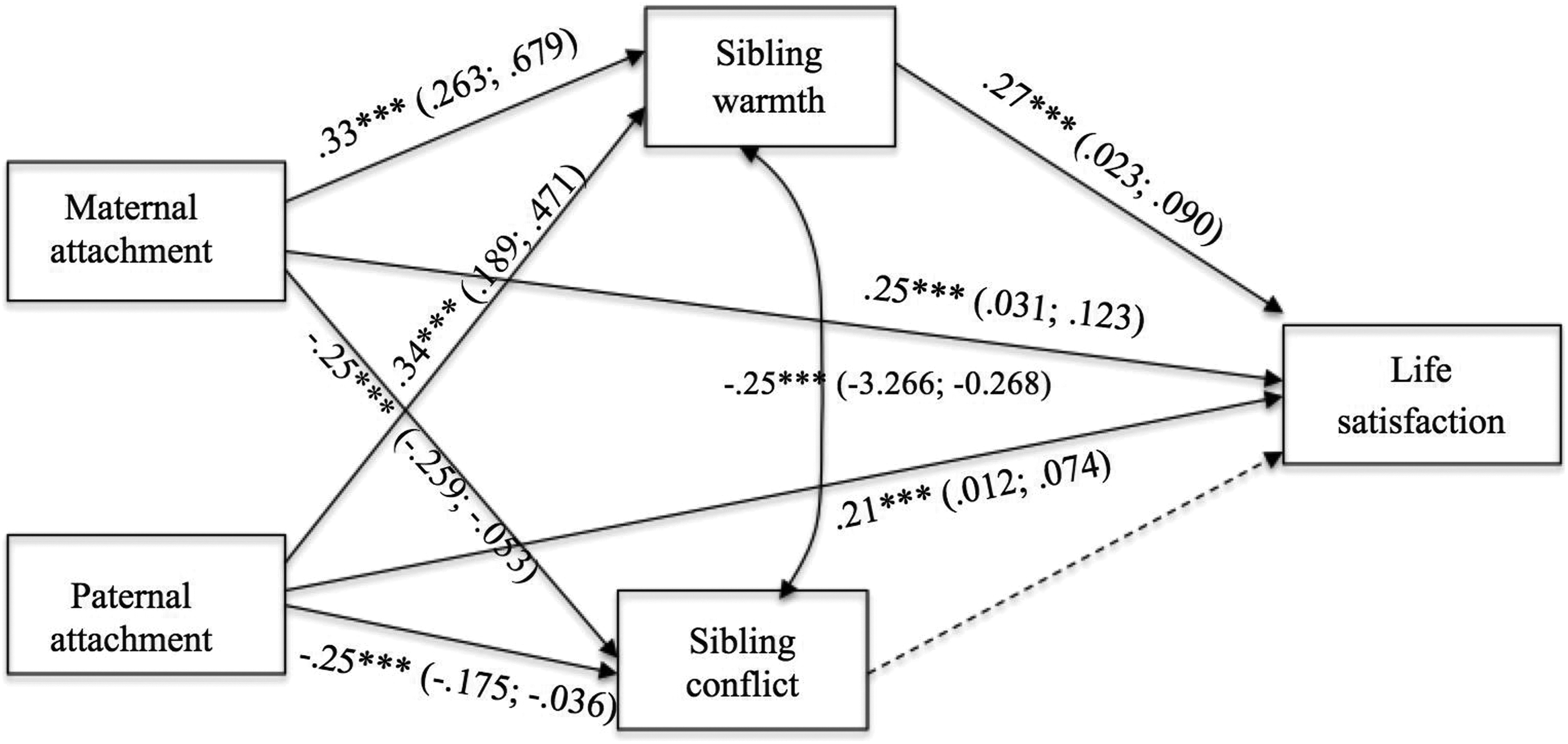
The standardized solution of the hypothesized model. Note. In parentheses are shown the 95% confidence intervals.
Attachment to the parents was hypothesized to predict the quality of sibling relationships, which in turn would influence the degree of life satisfaction. In particular, attachment to the mother and father was hypothesized to be linked both directly and indirectly to the level of life satisfaction. The direct path would suggest that the security of the attachment bond, both with the mother and the father, is linked positively to positive characteristics, such as the level of warmth, and negatively to negative characteristics of sibling relationships, such as the level of conflict. In addition, we hypothesized the security of these attachment bonds to have indirect influences on the level of satisfaction of life through the qualitative characteristics (warmth and conflict) of sibling relationships. In particular, we propose that positive characteristics of sibling relationships promote higher levels of life satisfaction, while negative characteristics of this relationship, which in turn, negatively influence the perceived satisfaction.
Method
Participants
A convenience sample of 253 emerging adults aged 20–31 years (M = 24.32; SD = 2.22), matched for gender (120 male and 136 female), was recruited among university students (School of Psychology, Political Science and Law) in Florence, a metropolitan area of Tuscany, a region in the center of Italy. Seventy-eight percent of the participants were of Caucasian origin and came from the center of Italy; specifically, most participants came from the city of Florence and the surrounding area. Participants came from families of middle or high socioeconomic status (SES), with more than 66% of the parents having a high school diploma or university degree.
Procedure
The study was conducted in compliance with the ethical principles of research published by the American Psychological Association. All subjects were fully informed about the aims of the research and told that their participation was voluntary, and they could withdraw at any time without incurring in any consequences. The inclusion criterion to participate in the survey was to have at least one brother or sister. Participants with more than one sibling were asked to indicate the brother or sister with the closest age gap. All participants indicated that the sister/brother about whom they had chosen to respond was a biological sibling. Written informed consent was obtained before data collection. Consent was given by 100% of the participants. Two trained researchers recruited participants. Specifically, they waited until the end of a university course and asked students to participate in a study. Students who accepted were invited to a meeting room at the university in groups of 15 to complete the questionnaires. After signing the informed consent form, participants anonymously completed a battery of questionnaires designed to gather information about personal and demographic data and to measure their attachment bonds with their mothers and fathers, the quality of their sibling relationships, and their satisfaction of life. The order of the questions was randomized in order to control possible bias related to tiredness. No monetary reward was given for participation.
Measures
The Italian version of the Inventory of Parent and Peer Attachment (Armsden & Greenberg, 1987; Guarnieri et al., 2010) was used to assess attachment to mother and father. This scale consists of two parallel versions of 24 items each, rated on a 5-point Likert-type scale from 1 (almost never or never) to 5 (almost always or always), which measure the three main dimensions of attachment: Trust, which refers to the trust that the parent understands and respects the child’s own needs and desires (example of item “My (mother/father) respects my feelings”); Communication, which reflects the perception of the parents’ sensibility to and participation in the child’s emotional states, referring to the quality of involvement and communication with them (example of item “I like to get my (mother/father)’s point of view on things I’m concerned about”); and Alienation, which refers to feelings of isolation, anger, and indifference experienced in the relationship with the parents (example of item “I feel angry with my (mother/father)”). The scale allows us to calculate a global score regarding security of attachment by adding up the scores of the three dimensions (after reversing the Alienation score). The internal consistency of each dimension, measured with Cronbach’s , was .91 for the security of attachment to the mother and .95 for the security of attachment to the father.
To assess the quality of sibling relationships, the Italian version of the Adult Sibling Relationship Questionnaire (Stocker, Lanthier, & Furman, 1997; Tani, Guarnieri, & Ingoglia, 2013) was used. The scale is a self-report measure and consists of 37 items. Participants were asked to read every statement and indicate how each characterizes his/her sibling relationship on a 5-point Likert-type scale from 1 (nothing) to 5 (very much). It includes 12 subscales regarding the quality of sibling relationships, which can be grouped in two macro-dimensions labeled as Warmth (examples of item “How much do you and this sibling try to cheer each other up when one of you is feeling down?”, “How much do you and this sibling think of each other as good friends?”), which includes all the subscales referring to positive characteristics (intimacy, affection, emotional support, instrumental support, knowledge, similarity, admiration, and acceptance), and Conflict (examples of item “How much do you and this sibling argue with each other?”, “How much do you and this sibling irritate each other?”), which refers to negative emotional characteristics of sibling relationships (dominance, competition, antagonisms, and quarrelling). In the present study, the α coefficients were .96 and .93 for Warmth and Conflict dimensions, respectively.
Finally, participants’ satisfaction of life was assessed using the cluster referring to satisfaction of life of the multidimensional questionnaire Psychological Treatment Inventory (Gori, Giannini, & Schuldberg, 2015). This cluster consists of 6 items rated on a 5-point Likert-type scale from 1 = not at all to 5 = very much. Examples of items are “I find satisfaction and happiness in what I do” and “I’m happy with how I occupy my free time”. In our sample, the Cronbach’s α value was .75.
Data analysis
First, descriptive analysis and bivariate correlations among the variables were conducted. Then, to examine gender differences with regard to parental attachment bonds, the quality of sibling relationships and the quality of satisfaction of life, a series of multivariate analyses of variance (MANOVAs) were employed. A follow-up univariate analysis of variance (ANOVA) was carried out when the MANOVA results were significant. In order to test the hypothesized model, the technique of path analysis was used, with the MPLUS statistical program (Muthén & Muthén, 1998–2012). To evaluate the model, several indices were reported, including the χ2, the comparative fit index (CFI, Bentler, 1990), the Tucker–Lewis index (TLI, Tucker & Lewis, 1973), the root mean square error of approximation (RMSEA; Browne & Cudeck, 1993), and the standardized root mean square residual (SRMR; Bentler, 1995). It is generally assumed that to support model fit, a consensus among the following is needed: CFI ≥ .90, TLI ≥ .90, RMSEA ≤ .05, and SRMR ≤ .05 (Blunch, 2008). In order to examine the indirect effects, the bootstrapping method and bias-corrected 95% confidence intervals were used, with 2,000 bootstrap samples.
Finally, to test the invariance of the theoretical model, a multigroup analysis was performed. The unconstrained structural path was tested first, to obtain a baseline χ2 value, which does not assume any equality constraint for the parameters in the two subsamples (male and female). Next, the structural paths of the tested model were constrained across sex. The χ2 value obtained from this analysis was then tested against the baseline value to examine statistically significant differences (Meredith, 1993).
Results
Descriptive and bivariate correlations data
Table 1 shows the descriptive data on the variables and the bivariate correlations among the variables. Bivariate correlations revealed a significant correlation between the attachment to the mother and father. Participants who reported a secure attachment with the mother also reported a secure attachment with the father. Attachment security with both parents was also related to the quality of sibling relationship and life satisfaction. Emerging adults who reported secure attachment to parents reported high levels of life satisfaction and warmth and low levels of conflict in their sibling relationships. Furthermore, emerging adults who reported high levels of life satisfaction also reported high levels of warmth and low levels of conflict in their sibling relationships. Finally, the level of warmth was significantly and negatively correlated with conflict in sibling relationships.
Descriptive statistics and bivariate relations among the attachment, the quality of sibling relationship, and the level of life satisfaction.
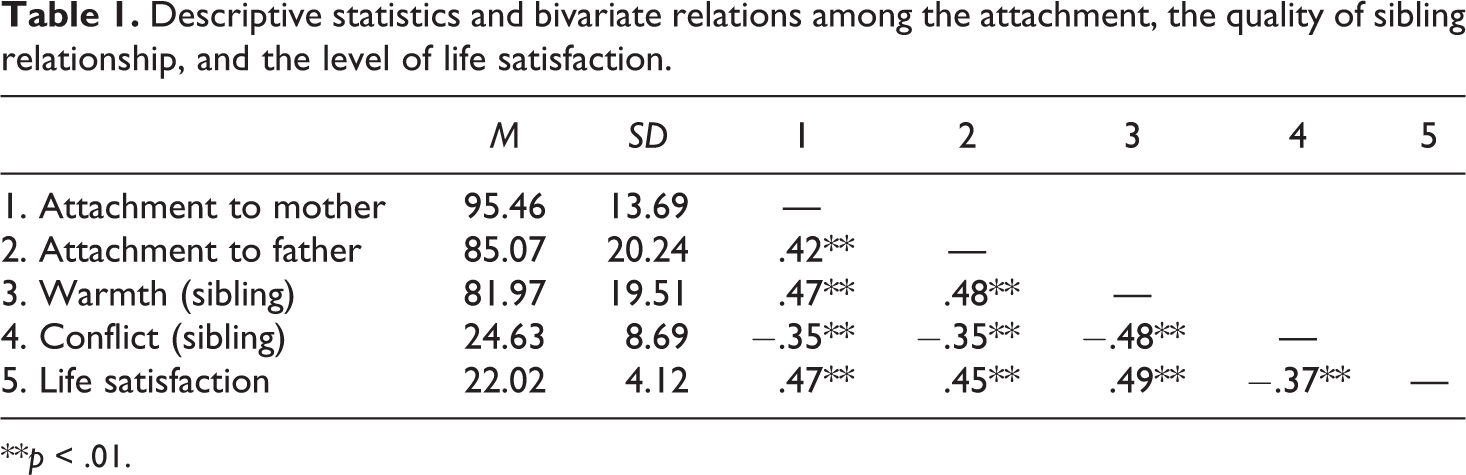
**p < .01.
Gender differences
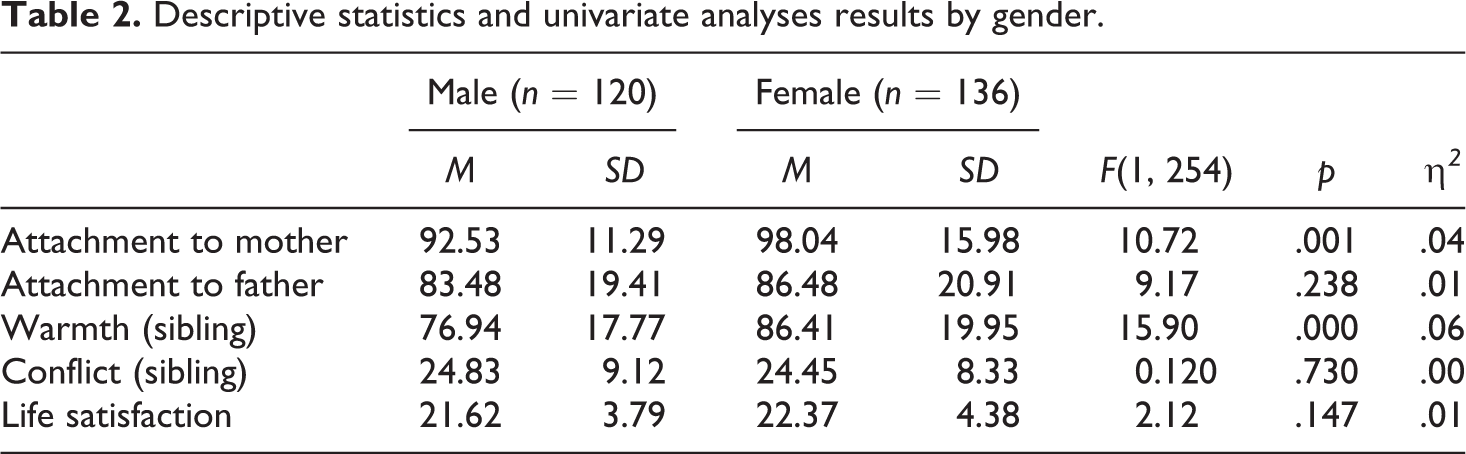
Table 2 reports the mean and standard deviations of the variables under study, and the results of the univariate comparisons obtained with ANOVAs. Female gender reported higher levels of secure attachment to the mother than male. On the contrary, male and female gender did not differ regarding attachment to the father. Moreover, female reported higher levels of warmth with their siblings. There were no gender differences in the level of conflict in sibling relationship and no differences in life satisfaction.
Descriptive statistics and univariate analyses results by gender.
Model testing
The hypothesized model showed a nonsignificant sibling conflict to satisfaction of life path coefficient (β = −.10, p = .09). The indirect link between maternal and paternal attachment and life satisfaction through sibling conflict were not significant (for maternal attachment: β = .02, p = .117; for paternal attachment: β = .03, p = .117). Contrary to the hypothesis, sibling conflict failed to contribute to the level of life satisfaction, both directly and indirectly. The proposed model was thus revised, and the nonsignificant path was omitted. The revised model showed a good fit index (χ2 = 2.89, df = 2; p = .089; CFI = .99, TLI = .94; RMSEA = .08; SRMR = .02). The findings revealed significant effects of maternal and paternal attachment on the quality of sibling relationship. A secure attachment bond with both parents was positively linked to warmth and negatively to conflict with siblings. These attachment bonds were also positively linked to life satisfaction. Regarding sibling relationship dimensions, only warmth was linked to the level of life satisfaction. Finally, life satisfaction was also predicted in an indirect way by the attachment bond to the mother (β = .09, p <. 001) and father (β = .09, p <. 001), through sibling warmth.
Squared multiple correlation coefficients from the revised model indicated that 32% of the variance in warmth, 17% of the variance in conflict, and 35% of the variance in life satisfaction were accounted for. In Figure 1, all statistical coefficients of direct effect are reported.
Invariance across gender
Finally, we examined the causal model for each sex. The invariance test across the male and female sample resulted in a statistically nonsignificant change in χ2 value, showing that the revised hypothesized model was invariant in males and females. Results of the invariance analysis are shown in Table 3.
Results of the invariance tests and their goodness of fit indices.

Note. CFI: comparative fit index; TLI: Tucker–Lewis index; RMSEA: root mean square error of approximation; SRMR: standardized root mean square residual.
Overall, for the warmth dimension, the variance explained by the links of the model reached R 2 of .29 for male and .31 for female. Regarding the conflict dimension, we obtained R 2 of .13 for male and .21 for female. Finally, the explained variance of life satisfaction dimension was R 2 = .32 for male and .35 for female.
Discussion
The main aim of this study was to examine both direct and indirect associations of maternal and paternal attachment bond with life satisfaction and to analyze the potential mediating role of the quality of sibling relationships during emerging adulthood.
Most literature found a significant relationship between the parental attachment bond and the subsequent development of individuals’ close relationships and well-being. However, to our knowledge, few studies have investigated the role of parental attachment to the mother and the father separately, the quality of sibling relationships, and the level of general life satisfaction during emerging adulthood.
Therefore, the present study extends the current literature, implementing a path analysis model to test a complex theoretical model regarding the link between the attachment bonds with the mother and father separately, the quality of sibling relationships, and the level of life satisfaction during emerging adulthood. Moreover, the role of the gender differences was also explored.
Overall, the results indicated that attachments to both the mother and the father were directly and indirectly linked to the life satisfaction of emerging adults. Despite the level of security of attachment bond to mother was greater than to father (Buist et al., 2002; Guarnieri et al., 2010; Paterson et al., 1994), our data have shown that both parents have a positive and significant influence on the well-being of emerging adults. Specifically, in the direct path, the feelings about emerging adults’ overall life satisfaction were closely and positively associated to the level of secure attachment to both parents. Although beta weights indicated that attachment to mother is a slightly stronger predictor than attachment to father (maternal β = .25 vs. paternal β = .20), the difference between maternal and paternal attachment bond as predictor of life satisfaction is not particularly noteworthy. Given the difference between the levels of maternal and paternal attachment, with maternal attachment registering a higher score than paternal attachment, and in the light of previous studies that have found that the attachment bond to mother was the most important predictor of life satisfaction (Ma & Huebner, 2008), we could have expected a stronger influence of maternal attachment on the outcome. However, a possible explanation of this result could be that other close relationships, not investigated in this study, have a significant influence on emerging adults’ life satisfaction. Regarding this, the literature has highlighted the role of romantic attachment, which achieves a relevant position during this developmental age (Guarnieri, Smorti, & Tani, 2015; Seiffge-Krenke, 2003). Therefore, it is possible that the latter close relationship affects the level of life satisfaction of our sample (La Guardia, Ryan, Couchman, & Deci, 2000; Ling, Jiang, & Xia, 2008; Wei, Liao, Ku, & Shaffer, 2011).
In any case, our results are consistent with previous studies, which highlighted that secure parental attachment predicts greater life satisfaction (Bradford & Lyddon, 1993; Jiang, Huebner, & Hills, 2013). Considered within the theoretical framework of attachment theory, these data support the influences of parental attachment bonds on the general well-being of emerging adults. Our study suggests that a parent–child relationship characterized by warmth, support of autonomy, and emotional closeness can favor children to develop feelings of personal well-being in terms of greater life satisfaction. This, in turn, could be reflected in a better adaptation to the development tasks that the emerging adult must sustain toward a more adult identity status.
Results also showed that parental attachment bonds were closely related to the quality of sibling relationships. Specifically, a secure attachment bond, with both the mother and the father, was associated with a high level of warmth and a low level of conflict in the sibling relationship. In agreement with previous studies, these data highlight that a secure attachment to both the mother and father positively affects the quality of sibling relationships (Fortuna et al., 2011). A history of parental sensitivity and responsiveness provides a secure base from which individuals are able to develop trust of self and others and interpersonal skills necessary to establish and maintain affiliative relationships with siblings.
Confirming our hypothesis, the results also showed that parental attachment bonds play a significant indirect influence on the level of life satisfaction, through the perceived level of sibling warmth. This result is in line with the results of previous studies highlighting that sibling warmth and support can foster well-being (Waite et al., 2011), such as general mental health, self-esteem (Kim, McHale, Crouter, & Osgood, 2007), self-disclosure ability (Howe, Aquan-Assee, Bukowski, Lehoux, & Rinaldi, 2001), stress resilience (Luthar, Cicchetti, & Becker 2000), and life satisfaction (Conger & Little, 2010; Milevsky, 2005).
However, contrary to our hypothesis, we did not find support for sibling conflict being negatively linked to emerging adults’ life satisfaction. The reason for this finding is unclear, but sibling conflict could be less marked when individuals grow up. Compared to childhood and adolescence, during emerging adulthood, siblings have more possibility to choose when and how much to see each other. Therefore, individuals in conflictual sibling relationships can choose to have little contact with each other, reducing, in that case, the level of perceived conflict. Nevertheless, this finding seems to suggest that the influence of siblings on life satisfaction in emerging adulthood might prevalently depend on the positive characteristics of the sibling relationship. Clearly, further studies are needed to better understand the role of different qualitative aspects of sibling relationships on emerging adults’ well-being.
Finally, the model tested was invariant between male and female gender. Although we found gender differences on the level of the security of attachment to the mother and sibling warmth, with female reporting higher levels than male, the relations among parental attachment, sibling relationship, and life satisfaction were uniform between genders.
There are some limitations to the present study. First, the study relied only on self-report measures. Despite the limitations of a self-report questionnaire and the need to confirm the pattern of relations with other study designs, the individuals’ perception of their close relationships and feelings represents an important source of information that should not be neglected (Cunningham & Barbee, 2000). Second, given the cross-sectional study design, it is impossible to infer casual relations and determine the direction of the observed effects. Although it is theoretically plausible that the parental attachment bond affects subsequent relationships, such as sibling relationships, and perceived well-being, the relationship between sibling relationships and life satisfaction is more doubtful. Indeed, it seems equally plausible for life satisfaction to influence the quality of sibling relationships or for the relationship between the two to be bidirectional. For this reason, more rigorous designs, especially longitudinal studies, appear to be needed. Third, we investigated only parental attachment and sibling relationships. It would be interesting to explore the role that other close relationships, such as friendship and romantic relationships, might play in influencing the level of life satisfaction in adulthood. Another limitation is the convenience sample used in this study. Future research should extend the recruitment to a stratified sample (e.g. stratified SES, provenience, and culture).
However, despite these limitations, this study has important theoretical and clinical implications. From a theoretical point of view, the authors have postulated two conflicting theories about the role of the child–parent relationship on the quality of sibling relationships: the compensation hypothesis and the congruence hypothesis (Boer, Goedhart, & Treffers, 1992; Jenkins, 1992; Voorpostel & Blieszner, 2008; Whitemann, McHale, & Soli, 2011). According to the former, siblings can serve as compensatory attachment figures in the presence of negative relationships with parents (Voorpostel & Blieszner, 2008; Whiteman et al., 2011). On the contrary, according to the congruence perspective, behaviors from the parent–child relationship are replicated in the sibling relationship (Derkman, Engels, Kuntsche, van der Vorst, & Scholte, 2011; Noller, 2005; Whiteman et al., 2011). In the present study, the data provide support for the congruence hypothesis. Also, Derkman, Engels, Kuntsche, van der Vorst, and Scholte (2011) have found a positive association between positive parent–child relationships and positive sibling relationships. Similarly, negative parent–child relationships have been linked to negative sibling relationships (Noller, 2005; Pike, Coldwell, & Dunn, 2005). In this regard, the attachment theory gives a significant contribution to understanding how the parental attachment bond can affect the quality of sibling relationships. It postulates that, based on the experience with caregivers, children develop specific IWMs, which operate as filters regulating information processing and play a significant role in influencing the development and nature of subsequent close relationships (Bowlby, 1973; Volling & Belsky, 1992).
Although during emerging adulthood the dependence on the family of origin decreases while the dependence on other figures, such as peers and romantic partners, becomes more important (Laible, Carlo, & Raffaelli, 2000), our data show that both parental attachment bonds and positive quality of sibling relationships are predictive of the psychological outcome of emerging adults. The good quality of family relationships and a higher well-being can favor the transition toward adulthood, supporting the emerging adults in their development tasks linked to the achievement of residential, economic, and work aspects (Pace et al., 2016). This is especially in Italy, where emerging adults tend to live with their parents longer than in other European countries (Sestito & Sica, 2014). In fact, previous research on Italian emerging adults has shown that an insecure attachment characterized by low emotional autonomy from parents and poor emancipation from patterns of parent–child relationships results in a less advanced (adult) identity status (foreclosure, moratorium) and less life satisfaction (Pace et al., 2016). According to Scabini (2000): The slowdown of the transition to adulthood highlights the importance of the family of origin: in fact, this last one represents the warm nest in which to recover one’s strengths and to assemble a better equipment in order to face the uncertain and complex adult world. (p. 23–24)
