



Abstract
Given the crucial role that grandparents play in the upbringing and well-being of their grandchildren, research regarding the perceived importance of grandparents for their emerging adult grandchildren is of particular relevance. This study examined the relations between perceived grandparents’ roles and family and life satisfaction in Portuguese emerging adults. Participants (N = 387), aged 18–25, completed a structured self-report questionnaire. Findings of structural equation modeling showed that emerging adults’ perceptions of grandparental roles of counselor, enjoying the relationship, and indulgence are positively related to their family and life satisfaction. The mediation analysis showed that family satisfaction mediated the relation between perceptions of grandparents acting as counselors and the life satisfaction of emerging adult grandchildren. Implications of family relationships and grandparenting in the context of emerging adulthood are discussed.
Keywords
As virtually many countries in the world are experiencing population aging, the changing demographic structure has facilitated the opportunity for more significant multigenerational bonds and also for “longer years of shared lives” (Bengtson, 2001, p. 1). Although moving away from the hometown may add geographic distance between today’s generations as compared to past generations, today’s increased life expectancy and decreased children’s premature death have brought greater possibilities for grandchildren and grandparents to enjoy sustained intergenerational relationships over longer periods of life (Di Gessa et al., 2016; Dunifon & Near, 2018). As a result, opportunities emerge for grandparents to play increasingly influential roles in their grandchildren’s lives. The recognition of this effect, coupled with the recognition that the present demographic structure enables longer intergenerational interactions, has prompted an interest in the study of grandparenthood (Coall & Hertwig, 2011; Danielsbacka & Tanskanen, 2012; Swartz, 2009). Contributing to this line of research, the present study examines the relations between grandparental roles and life satisfaction of emerging adults, and tests the mediating role of family satisfaction in such a relationship.
Grandparent-grandchild relationships: A life course perspective
Grandparents are key figures in the development of their grandchildren’s social life throughout childhood and adolescence (Attar-Schwartz et al., 2009; Suldo et al., 2014). They are often a source of emotional and financial support, company, and advice (Bengtson 2001; Huo et al., 2017). Although grandparental childcare can assume different intensities and interactional patterns (Zamberletti et al., 2018), grandparents play many roles in their grandchildren’s lives and usually invest a considerable amount of time in providing care to their grandchildren (Di Gessa et al., 2016; Dunifon & Near, 2018; Hayslip et al., 2017; Swartz, 2009). Although the functions of grandparent roles are actually quite ambiguous and multi-faceted (Bangerter & Waldron, 2014), attempts have been made to yield the principal aspects of grandparenting, which produced several distinctions of grandparental roles (e.g., Neugarten & Weinstein, 1964; Thiele & Wheelan, 2006). Van Ranst et al.’s (1995) approach, which is followed in the empirical section of the present paper, identified 11 dimensions of grandparental meaning, namely as sources of emotional and financial support, reassurance of worth, reliable allies, mentors and role-models, links to the past, acquaintance with aging, substitute caregivers, kinkeepers, mediators between adolescents and parents, and distant figures.
Better and more frequent connections between grandparents and grandchildren are related to higher levels of emotional closeness, importance, and respect for grandparents’ opinions (Attar-Schwartz et al., 2009; Geurts et al., 2012; Huo et al., 2017). The grandparent-grandchild relationships can be beneficial for both generations, with grandchildren seeing grandparents as important role models they respect and trust, and grandparents reporting high levels of emotional closeness to grandchildren and general feelings of well-being and sense of belonging (Attar-Schwartz et al., 2009; Swartz, 2009). Also, grandparents are an important security network during challenging moments of their grandchildren’s lives (Albertini & Tosi, 2018).
Although grandparental involvement has been largely studied during childhood and adolescence, studies of the perceived importance of grandparents for emerging adults need further development. Grandparenthood should not be taken as a static concept, but rather a fluid, dynamic, and multidimensional process affected by contextual factors, such as grandchildren’s development. As activities grandchildren share with their grandparents change as they grow older, the influence of grandparents on grandchildren’s lives is also expected to change (Triadó et al., 2005). Additionally, more frequent opportunities exist for grandparents to interact with their grandchildren as they transition into adulthood, due to longer longevity (Di Gessa et al., 2016; Swartz 2009). However, apart from some exceptions (e.g., Ruiz & Silverstein, 2007), literature has not yet provided robust data on grandparents’ importance for the well-being of emerging adult grandchildren (Geurts et al., 2012; Huo et al., 2017).
To better understand grandparent–grandchild relations, a life-course perspective has been suggested to monitor its dynamics across time, enabling not only to accurately assess individuals’ grandparent status at a certain point in time, but also the timing of transitions to and the duration of grandparenthood (Hank et al., 2018). Emerging adulthood, being a period of high exploration and change before adult commitments are made (Arnett, 2000; Crocetti & Meeus, 2014), may also involve changes in the grandchild-grandparent relationship. Emerging adults, especially those who enrol in higher education, are financially dependent on their families and not constrained by adult life responsibilities, such as full-time employment, household bills, marriage, and raising children. However, their transition into adulthood is lived in parallel with stress related to their adaptation as higher education students, despite the very high expectations for such an experience (Araújo et al., 2019; Credé & Niehorster, 2012; Páramo-Fernández et al., 2017). In Southern European countries, such as Italy, Portugal, and Spain, emerging adults and traditional higher education students develop their autonomy in the context of strong family loyalties and patterns of co-residence with older family members, resulting in closer intergenerational ties. Indeed, late home leaving has become particularly pronounced in Portugal: in 2016, 62.8% of young adults aged 18–34 still lived with their parents (Eurostat, 2018). Therefore, unlike other cultural backgrounds where a reduced perception of grandparents as providers exists (e.g., MaloneBeach et al., 2018), Portuguese emerging adults develop within a cultural context where delayed home departure has become a normative pattern and where grandparents’ roles as providers—perhaps, loaning money, paying tuition, or providing their grandchildren with some “fun-money”—can be interpreted as an outcome of the additional constraints experienced by emerging adults moving away from the family’s household. Additionally, in family-oriented cultures, such as the Portuguese, emerging adults are socially expected to look for family guidance and support when transitioning into adulthood. In this case, the need for independence might translate into the renegotiation of family relationships (Mendonça & Fontaine, 2013; Parra et al., 2015), with the transition from hierarchical to more symmetrical relationships between adults and interactional patterns characterized by mutual respect, mature communication, intimacy, and more egalitarian expectations (Shehan & Petrovic, 2008). Adult grandchildren view the transition in the grandchild–grandparent relationship in three positive ways (Sciplino & Kinshott, 2019): i) childhood practical support being replaced by financial support in early adulthood; ii) contact becoming less frequent and more telephone or internet based in adulthood; iii) grandchildren’s feelings of excitement being replaced with appreciation and respect.
Research also suggests that grandparents provide emotional support while simultaneously acting as advisors and “listeners” to their adult grandchildren’s needs (Geurts et al. 2012; Huo et al. 2017), and that grandparental roles are important predictors of perceived grandparenting quality among emerging adult grandchildren (MaloneBeach et al., 2018). Additionally, intense grandparent-grandchildren relationship during childhood promotes the continuity of the relationship into adulthood (Geurts et al., 2012; Hakoyama & MaloneBeach, 2013).
Grandparenthood, family satisfaction, and life satisfaction in emerging adulthood
Grandparents are key figures in the family and, therefore, can be important in analyzing emerging adults’ life outcomes according to family system theories (e.g., Minuchin, 2002). As grandchildren move into adulthood, the experience of emotional closeness with their grandparents may bring balance to the family and also aid grandchildren’s mental health and well-being (Shehan & Petrovic, 2008). Grandparental affection has shown to prompt grandchildren’s social, relational, and psychological health, including lower levels of depression and stress (Mansson, 2013; Mansson & Booth-Butterfield, 2011).
Life satisfaction, which is the global evaluation of the quality of one’s life, is a cognitive component commonly used as an indicator of subjective well-being (SWB; Diener et al., 1999). As a psychological protective factor for healthy adjustment against the negative impacts of adversity, interrelations have been found between life satisfaction and other markers of positive behavioral, social, and emotional adjustment (Gilman & Huebner, 2003). Maintaining positive levels of well-being is not only normative, but vital to adaptation, as it facilitates social and personal advancement, exploration, and reliable coping mechanisms (Diener et al., 1999). Among the range of factors associated with life satisfaction, studies have identified the influence of perceived support within the family context (Edwards & Lopez, 2006; Huang et al., 2015). Among emerging adults, determinants of life satisfaction include identity development, the endorsement of adulthood-related duties and roles, perceived social support, social skills, and a sense of competence (Gallagher & Vella-Brodrick, 2008; Gerson, 2018; Piumatti, 2017). Also, studies have shown how supportive social and family relationships are positively related to well-being, namely life satisfaction and satisfaction with the family (Crocetti & Meeus, 2014; Curran & Yoshimura, 2016; Diener & Diener, 1995; Jewell & Kambhampati, 2015).
The current study
Existing studies on the relationship between grandparents and adult grandchildren are limited in several ways. First, there is a generalized conclusion that most grandparent-grandchildren relations are characterized by emotional proximity (Shehan & Petrovic, 2008), without however ascertaining the quality of such a relation and how it is perceived by emerging adults. Second, measures of grandchildren’s outcomes are restricted. With some exceptions (e.g., Li et al., 2018; Wise, 2010), prior work has centered on mental health indicators (e.g., Moorman & Stokes, 2016) and underexamined the impact of grandparents’ roles on their adult grandchildren’s perceived adjustment and well-being. A need to study positive indices of subjective well-being, such as life satisfaction, in the context of grandparents-grandchildren relations remains. Third, research has not considered in due account how the perceived relationship between grandparents and adult grandchildren might be related to grandchildren’s overall perceptions of their family. As suggested, grandparents may influence grandchildren’s well-being either directly—e.g. through their interactions with grandchildren—, or indirectly—e.g. through grandparents’ interactions with parents or their influence on grandchildren’s family perceptions (Dunifon, 2013; Mansson et al., 2017).
To address some of these gaps in the literature, the present study aims to explore how the different emerging adults’ perceptions of grandparental roles (GpR) are linked to emerging adults’ family satisfaction (FS) and life satisfaction (LS). We expect emerging adults’ perceptions of their grandparents’ roles to be associated with their family satisfaction, which in turn relates to life satisfaction, as follows: GpR → FS → LS. While examining the relations of emerging adults’ perceptions of grandparents’ roles with overall life satisfaction, via family satisfaction, we will test the following hypotheses: (H1) perceptions of grandparents’ roles of caregiving, counselors, enjoying the relationship, and indulgent are significantly and positively related to life satisfaction; (H2) perceptions of grandparents’ roles of caregiving, counselor, enjoying the relationship, and indulgent are significantly and positively related to family satisfaction; and (H3) family satisfaction mediates the relationships between perceptions of grandparents’ roles and life satisfaction. Since geographic proximity has shown to prompt more contact and better relationship quality between grandparents and their adult grandchildren (Hakoyama & MaloneBeach, 2013), the influence of geographic relocation, indicated by whether emerging adult grandchildren had to move away from their family’s home to study at university or not (i.e., “Did entering Higher Education involve changing your place of residence?”), will be controlled in the current study.
Method
Participants
A total of 387 emerging adults (72.4% females) participated in this study. Participants’ age ranged from 18 to 25 years old (Mage = 20.45, SDage = 1.83). All participants were higher education students, and the sample follows the majority of women (54.14%) enrolled in Portuguese higher education institutions (PORDATA, 2019). No restrictions on educational institutions and/or courses were imposed. Students were enrolled in undergraduate degrees in science and non-science subject areas, as follows: medicine (.5%), subjects allied to medicine (8.0%), biological sciences (1.6%), engineering and technology (1.0%), social sciences (35.2%), law (17.6%), economics, business and administrative studies (32.6%), mass communication and documentation (.8%), historical and philosophical studies (.5%), education (1.8%), and languages (.5%).
All students were single. Although most were living with their families, 34% relocated to another city to pursue their studies. Out of these, 87% visited their families for weekends and holidays, at least once a month. Student’s t-tests showed no significant differences in female and male’s ages, t(385) = 1.72, p = .086, nor in the ages of students who moved away to study at university or who stayed in their family’s households, t(385) = .69, p = .490. In addition, there was no significant association between students’ sex and whether or not they moved away from their family’s house in order to study at university, χ2(1) = 3.49, p = .062.
Measures
Family satisfaction
Family satisfaction was assessed with the Family Satisfaction Scale (FSS; Olson, 1995, 2011; Portuguese adaptation from Gomes et al., 2019), which evaluates family members’ degree of satisfaction with the family’s functioning. Participants answered the 10 items using a 5-point Likert scale ranging from 1 (very dissatisfied) to 5 (extremely satisfied). Higher scores indicate higher family satisfaction. Internal consistency for the current sample was very satisfactory (Cronbach’s α = .92). A confirmatory factor analysis showed that the one-factor solution for the 10 items provided satisfactory fit to the data, χ2(35) = 137.249, p < .001; CFI = .93, TLI = .92, RMSEA = .09, 90% CI = [.07–.10]; SRMR = .04 (Bentler, 1990; Byrne, 2012; MacCallum et al., 1996). Item standardized loadings were all high, ranging from .65 to .84.
Life satisfaction
Subjective well-being was assessed with the Portuguese version (Neto, 1993; Silva et al., 2015) of the Satisfaction with Life Scale (SWLS; Diener et al., 1985). Participants answered the five items (e.g., “In most ways my life is close to my ideal”) using a 5-point Likert scale ranging from 1 (totally disagree) to 5 (totally agree). In the present study, the SWLS demonstrated adequate internal consistency reliability (Cronbach’s α = .84). A confirmatory factor analysis showed that the one-factor solution for the five items provided an acceptable fit to the data, χ2(5) = 16.760, p < .01; CFI = .98, TLI = .96, RMSEA = .08, 90% CI = [.04–.12]; SRMR = .03 (Bentler, 1990; Byrne, 2012; Hu & Bentler, 1999). Standardized loadings were high, ranging from .47 to .82.
Perceptions of grandparents’ roles
Four perceived grandparental roles—enjoying the relationship, indulgent, counselor, and caregiver—were assessed using items from the Meanings of Grandparenthood Scale—Grandchildren’s Version (Van Ranst et al., 1995). The original scale included 82 items which taped into 11 dimensions of meanings of grandparents for grandchildren in Belgium: reliable alliance, emotional support, reassurance of worth, financial support, link with the past, acquaintance with aging, mentor and role-model, kinkeeper, mediator child-parents, substitute caregiver, and distant figure (Van Ranst et al., 1995). Based on this study, and on preliminary data with Spanish adolescents (Triadó & Villar, 2000), Triadó et al. (2005) developed a shorter scale with 33 items, which identified seven meanings of the grandparent roles: mutual trust, fun-seeking, link with the past, caregiver, distant, indulgent, and mediator. In the present study, we used 13 items from a reduced version of the scale, tested with a sample of Portuguese grandchildren (Peixoto, 2015), and of satisfactory reliability and validity. Items were deemed relevant for emerging adults (see items in Appendix A), and assessed four dimensions of grandparents’ roles: caregiving (3 items; e.g. “My grandfather/grandmother keeps me company when I’m alone”), counselor (2 items; e.g. “When I have to make an important decision, I ask my grandfather/grandmother for his/her opinion”), enjoying the relationship (5 items; e.g. “I appreciate the time I spend with my grandfather/grandmother”), and indulgent (3 items; e.g. “My grandfather/grandmother gives me money”). Participants answered the items using a 5-point Likert scale, ranging from 1 (never) to 5 (always). In the present study, subscales presented adequate reliability, with Cronbach alpha coefficients of .87 for the caregiving subscale, .84 for counselor, .91 for enjoying the relationship, and .81 for indulgent (Indulgent, e.g. “My grandfather/grandmother gives me money”). A confirmatory factor analysis showed that the four-factor solution for the 13 items provided fair fit to the data, χ2(59) = 339.850, p < .001; CFI = .91, TLI = .88, RMSEA = .11, 90% CI = [.10–.12]; SRMR = .06 (Bentler, 1990; Byrne, 2012; Hu & Bentler, 1999; MacCallum et al., 1996). All items had high standardized factor loadings, ranging from .78 to .88 in the caregiving subscale, of .86 in the counselor subscale, ranging from .75 to .90 in the enjoying the relationship subscale, and from .72 to .86 in the indulgent subscale.
Procedures
Data collection procedures
Data were gathered in higher educational settings (universities and polytechnic institutions) by individual administration. Participants were informed about the aims of the study, the voluntary nature of their participation and their right to withdraw participation at any given time, and anonymity and confidentiality were guaranteed. In accordance with the ethical principles for research with human subjects from the Declaration of Helsinki and the Portuguese Psychologists’ Code of Ethics, all participants provided appropriate authorization through an informed consent. Participants received no compensation upon the completion of the surveys.
Statistical analysis procedures
Data were first explored through descriptive, correlational, and multivariate analyses of variance (MANOVA), using IBM-SPSS 22.0. Pearson correlations were computed to explore the associations between age, perceptions of grandparents’ roles, family satisfaction, and life satisfaction. We performed MANOVA with the four grandparents’ roles as dependent variables and sex (0 = male, 1 = female) and relocating from the family’s household to study at university (0 = yes, 1 = no) as independent variables, in order to explore group differences in perceptions of grandparents’ roles, which were the main focus of this study. MANOVA were used to decrease the chance of Type I error associated to multiple significance testing with correlated outcome variables. Identified differences were further explored with univariate tests. Effect size calculations and post-hoc power analyses (given a level of α = .05) were conducted using the software package GPower (Faul et al., 2007).
Prior to the exploration of the relations between grandparents’ roles, family satisfaction, and life satisfaction, multicollinearity diagnoses were conducted in order to examine whether a given predictor (in this case, each of the four studied grandparents’ roles) may be too highly correlated with other predictors to be entered in the regression model. Tolerance levels of above 0.2 and variance inflation factors (VIF) lower than 4 indicated no multicollinearity (Tabachnick & Fidell, 2007), and therefore that the predictor could be entered into the model. Path analysis was used to assess the relations of perceptions of grandparents’ roles, family satisfaction, and life satisfaction. Structural equation model (SEM) analyses were conducted using MPlus 7.0 (Muthén & Muthén, 1998–2012) with maximum likelihood estimation in order to examine these pathways. After the identification of age and geographic relocation effects on emerging adults’ perceptions of grandparents’ roles, these independent variables were controlled in the mediation model, which was tested as follows: life satisfaction was regressed on family satisfaction, which was regressed on perceptions of grandparents’ roles (i.e., caregiving, counselor, enjoying the relationship, and indulgent). The structural model was evaluated by observing the following goodness-of-fit indexes: Chi-square, Comparative Fit Index (CFI), Tucker-Lewis Fit Index (TLI), Root Mean Square Error of Approximation (RMSEA), and the Standardized Root Mean Square Residual (SRMR). Acceptable values of CFI and TLI range from .90 or higher (Bentler, 1990) to .95 or higher (Byrne, 2012; Hu & Bentler, 1999). RMSEA values of .08 or less (Hu & Bentler, 1999) are deemed acceptable and up to .10 are considered fair (MacCallum et al., 1996). Acceptable values for the SRMR range from .05 or less (Bentler, 1990; Byrne, 2012) to .08 or less (Hu & Bentler, 1999).
To test the magnitude and significance of the mediating effects of family satisfaction on the relations between emerging adults’ perceptions of grandparents’ roles and life satisfaction, mediation analyses were performed using the built-in delta method in MPlus 7.0. Following recommendations by MacKinnon et al. (2004), we employed a bias-corrected bootstrap technique using 1000 iterations to identify a 95% confidence interval (CI) of the indirect effects being tested. The indirect effect is considered statistically significant at the .05 level if the CI does not include zero (Cheung & Lau, 2008).
Results
Preliminary analysis: Descriptive, correlational and differential analyses
Table 1 presents the means, standard deviations, and intercorrelations of the measured variables. Data were normally distributed, with acceptable skewness (<1.0) and kurtosis (<3.0) values for all variables. Emerging adults in this sample valued enjoying the relationship the most among the assessed grandparental roles, as this role is the one with the highest average score. Participants showed close to average levels of satisfaction with their family relations and life satisfaction. As expected, family satisfaction and life satisfaction were highly related but yet distinct constructs. The different perceptions of grandparents’ roles of caregiving, counselor, enjoying the relationship, and indulgent were all positively correlated, with correlations ranging between .62 and .72, p < .001.
Descriptive statistics and correlations between age, perceptions of grandparents’ roles, family satisfaction, and life satisfaction.
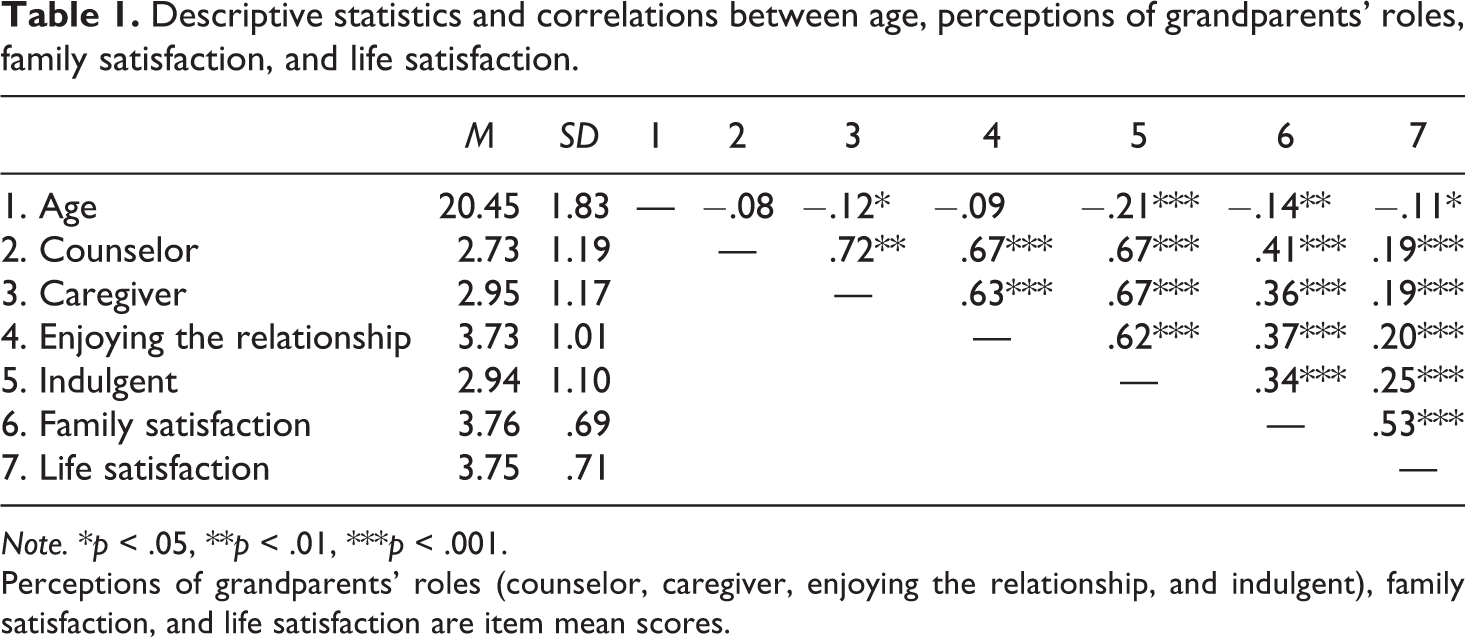
Note. *p < .05, **p < .01, ***p < .001.
Perceptions of grandparents’ roles (counselor, caregiver, enjoying the relationship, and indulgent), family satisfaction, and life satisfaction are item mean scores.
The perceptions of grandparents’ roles were all positively related both to family satisfaction and to life satisfaction, although correlations for family satisfaction were higher than for life satisfaction, which may suggest the mediating role that family satisfaction is playing in the relation between emerging adults’ perceptions of grandparents’ roles and life satisfaction.
MANOVA showed there was no interaction effect of sex and geographic relocation on perceptions of grandparents’ roles, Pillai’s trace F(4, 380) = .67, p = .612, η2 = 0.02, observed power = .99. In addition, no main effect was found for sex, Pillai’s trace F(4, 380) = .08, p = .989, η2 = 0.01, observed power = .31 . However, the MANOVA identified a small main effect of relocation (moving away from the family’s household in order to study at university vs. remaining within the family’s house) on meanings of grandparenthood, Pillai’s trace F(4, 380) = 1.96, p = .045, η2 = 0.02, observed power = .59. ANOVA analyses for each of the grandparents’ roles showed that there was only an overall significant difference between means in the indulgent role, F(1, 383) = 3.67, p = .046, η2 = 0.11, observed power = .70, with no other significant effects of mobility for the remaining roles: FCaregiving(1, 383) = .10, p = .758, η2 = 0.04, observed power = .13; FCounselor(1, 383) = .04, p = .845, η2 = 0.02, observed power = .08; FEnjoying the relationship(1, 383) = .336, p = .563, η2 = 0.04, observed power = .14. Students who relocated from their family’s homes in order to study at university reported lower levels of perceptions of indulgence (M = 2.75, SD = 1.10) compared to those who stayed within their family’s household (M = 3.04, SD = 1.08).
Finally, age was negatively correlated with caregiving (r = −.12, p = .02) and indulgence (r = −.21, p < .001), but not significantly related to the counselor (r = −.08, p = .129) and enjoying the relationship (r = −.09, p = .080) dimensions. Therefore, older emerging adults showed less appreciation of these perceptions of grandparents’ roles of caregiving and indulgence.
Structural relations between emerging adults’ perceptions of grandparents’ roles, family satisfaction, and life satisfaction
A structural equation model (SEM) was produced in order to further examine the relationships between emerging adults’ perceptions of grandparents’ roles, family satisfaction, and life satisfaction. In the tested model, the direct effect of perceptions of grandparents’ roles (counselor, caregiver, enjoying the relationship, and indulgent) was examined on life satisfaction, and the indirect effect via family satisfaction. Covariance between the four studied perceptions of grandparents’ roles were added. Because preliminary analyses showed an effect of relocating to study at university on indulgence and age on caregiving and indulgence, we controlled for these effects in the mediation model. Multicollinearity diagnosis of the four meanings of grandparents as independent variables was also performed based on tolerance scores. Tolerance levels ranged from .38 (counselor) to .49 (enjoying the relationship) and VIF values ranged from 2.060 (enjoying the relationship) to 2.662 (counselor), when examining the contribution of perceptions of the four grandparents’ roles on the prediction of family satisfaction and life satisfaction, indicating that there were no multicollinearity problems.
The model produced satisfactory fit indices, χ2(4) = 13.578, p = .009, CFI = .99, TLI = .94, RMSEA = 0.08, 95% CI = [0.04–0.13], SRMR = .03. No modifications indices were suggested to improve the model. The results of the path analysis with the standardized coefficients for the model illustrating the relations between grandparental roles, family satisfaction, and life satisfaction are represented in Figure 1 (only significant paths are represented). Results demonstrated that family satisfaction had, as expected, a positive and significant effect on life satisfaction (β = .53, p < .001). When considering the simultaneous effects of grandparents’ roles as independent variables, enjoying the relationship (β = .14, p = .027) and the counselor role (β = .22, p = .003) had a positive significant effect on family satisfaction; however this effect was not significant for the indulgent role (β = .05, p = .485) nor for the caregiving role (β = .08, p = .245). Grandparents’ indulgence had a positive effect on emerging adults’ life satisfaction (β = .17, p = .006), while this effect was marginal for the role of counselor (β = .14, p = .05), and not significant for the roles of enjoying the relationship (β = .001, p = .993) and caregiving (β = .02, p = .761). Age was negatively related to indulgence (β = −.20, p < .001) and caregiving (β = −.12, p = .019) (and not to other roles; counselor: β = −.08, p = .130; enjoying the relationship: β = −.09, p = .082), meaning that older students placed lower importance on these grandparental roles. Relocating to study at university was positively related to the importance given to the grandparental role of indulgence (β = .12, p = .014), but not to the other grandparental roles (caregiver: β = .04, p = .443; counselor: β = −.02, p = .649; enjoying the relationship: β = .04, p = .422). Finally, the four assessed perceptions of grandparents’ roles (counselor, caregiver, enjoying the relationship, and indulgence) were positively related (.61 ≤ r ≤ .71, p < .001). This model accounted for 30.0% of the variance in life satisfaction and 18.8% in family satisfaction.
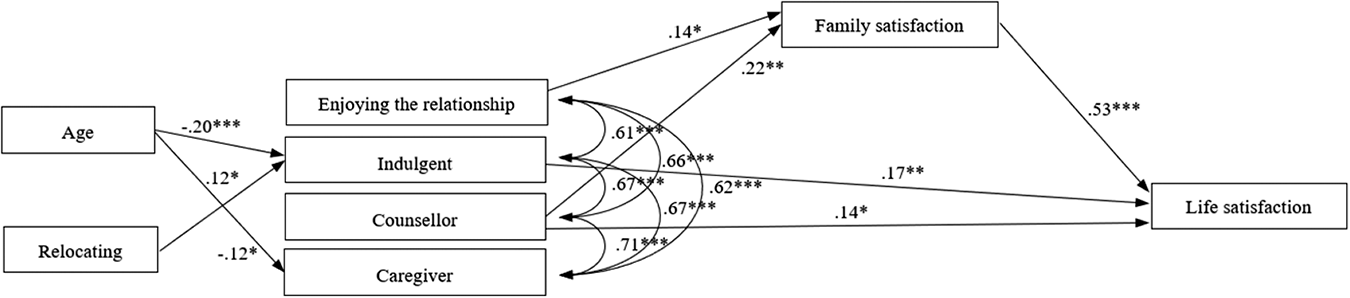
Structural equation modeling of the relations between emerging adults’ perceptions of grandparental roles, family satisfaction, and life satisfaction. Note. *p < .05, **p < .01, ***p < .001. Values are standardized coefficients. Non-significant paths have been omitted for clarity.
Testing of indirect effects aimed to determine whether family satisfaction mediated the relationship between emerging adults’ perceived grandparental roles of counselor and life satisfaction. The counselor role had a significant indirect effect on life satisfaction via family satisfaction (β = .12, z = 2.84, p = .005, 95% CI [.04, .19]). The inspection of CI for the estimates of indirect effects deemed that the effect of enjoying the relationship on life satisfaction via family satisfaction was not significant (β = .08, z = 2.17, p = .03, 95% CI [−.02, .18]).
Discussion
Due to the current extended life expectancy, multigenerational family bonds—namely grandparent-grandchildren relationships—are becoming increasingly important. Although many theoretical orientations (e.g., Bronfenbrenner, 1977) emphasize the importance of family for child and adolescent development and abundant evidence shows the positive effects of good quality grandparent-child/adolescent relationships (Attar-Schwartz et al., 2009; Attar-Schwartz & Buchanan, 2018; Heerden & Wild, 2017), fewer studies have examined these links beyond childhood and adolescence. The goal of the current study was to contribute to this line of research, by investigating associations between perceptions of grandparents’ roles and the experience of family and life satisfaction, in Portuguese emerging adults.
Overall, life satisfaction seemed to be directly related to the grandparental roles of indulgence and counselor, thus providing partial empirical support to H1. Although there were positive relations between all the four assessed grandparental roles and life satisfaction, when we included family satisfaction in the model, only grandparents’ roles of indulgence and counselor were directly related to life satisfaction. Enjoying the relationship and counselor roles were the only grandparental roles directly related to family satisfaction, which provides partial support to H2. Finally, life satisfaction was indirectly related, via family satisfaction, to the counselor role, which provides partial empirical support to H3. Age was negatively associated to variations in grandparenthood indulgence and caregiving, and relocating to another city to study at university was positively related to grandparents’ indulgence.
Specifically, our data interestingly showed the differential associations that the four assessed grandparental roles showed in the grandparent-emerging adult grandchildren relationship. While enjoying the relationship, counselor, and indulgence seemed to be the roles most related to family and life satisfaction, caregiving seemed to not have such an association. Furthermore, the fact that our data showed that age was negatively associated with caregiving and indulgence suggests, perhaps, an accentuated depreciation of caregiving and the need of financial provision in the transition into adulthood. Although caregiving by grandparents has shown to influence the perceived relarionship quality between grandparents and their emerging adult grandchildren (Brown, 2003), previous studies have identified that caregiving is not the most prevalent grandparental role when grandchildren reach emerging adulthood, when the most prevailing grandparental roles are those of supporter, advisor, and friend (MaloneBeach et al., 2018), and a transition of caregiving in childhood to other forms of support—e.g. emotional support—is positively welcomed (Sciplino & Kinshott, 2019).
While no developmental tendencies or causality can be inferred due to the cross-sectional nature of our study, our findings suggest that the meanings of grandparental care may be different in emerging adulthood, than in childhood or adolescence. This result is consistent with prior research, showing that, as with other family members, especially with parents (Parra et al., 2015), a transformation exists in the grandparent-grandchild relationship over time (Triadó et al., 2005). In the current study, the perceived importance of grandparental roles may be linked to the set of changes that these emerging adults experience, while adapting to the many academic, social, personal, and emotional challenges related to being a higher education student (Credé & Niehorster, 2012; Páramo-Fernández et al., 2017). Although in this phase grandparents may not be so influential as caregivers, they can still play a beneficial role in their grandchildren’s adaptation in university, manifold: by providing a sense of enjoyment in the relationship and therefore promoting well-being and reducing university related stress; by listening to their grandchildren’s struggles and providing sound advice on how to overcome their difficulties; and by providing instrumental support, including financial aid, which may buffer against financial stress and enhance grandchildren’s opportunities for new experiences at university, by providing an increase in their spending money.
Geographical relocation to study at university was positively related to participants’ perceptions of grandparents’ indulgence. Research has shown that parents and grandparents continue to assist emerging adults, even when they move away from their parents’ home (Amati et al., 2015; Billari et al., 2008; Galambos et al., 2018). In such arrangements, emerging adults live semi-independently, but do not have the full responsibilities of independent adult life, including paying themselves for bills or meeting professional demands. Yet, the present data suggest that, although supported, moving away from the family’s city may present a major challenge for these emerging adults. In Southern European countries, emerging adults tend to live within the family of origin, as it usually assumes a major instrumental supportive role. However, emerging adults’ financial dependence from the family of origin might introduce ambivalence and further challenges for their individuation process, during which relations with grandparents are seen as safe emotional bonds and an important source of support for adjustment to developmental tasks. Such a fact is suggested by the data of the present study, showing the positive impact of grandparents’ indulgence in emerging adults’ overall life satisfaction.
Notwithstanding the association of external factors with the perceived role of indulgence, data from the present study suggest that emerging adults’ life satisfaction was more related to intrinsic elements of the bond with their grandparents. The perception of grandparents as counselors was associated, both directly and indirectly—via the mediating effect of family satisfaction—with emerging adults’ overall life satisfaction. Additionally, life satisfaction was positively predicted by family satisfaction. Family satisfaction was positively associated with enjoying the relationship and grandparents’ counselor role. Therefore, findings suggest the functional importance of grandparents for family’s equilibrium and emerging adults’ well-being, both directly through their instrumental support, or indirectly through their emotional closeness and supportive relationship (Dunifon, 2013; Mansson et al., 2017).
Implications for practice
Findings of the present study revealed that higher levels of life satisfaction among emerging adults can be directly explained by grandparents’ indulgence and counselor role, and indirectly by family satisfaction. These results carry important practical implications for promoting emerging adults’ adaptation and well-being. Specifically, results are important for educators, mental health professionals, grandparental caregivers, policy-makers, and others interested in improving population’s quality of life and developing overall life satisfaction. First is the suggestion that grandparents’ involvement can have a positive impact on life satisfaction during emerging adulthood, either through forms of practical and/or financial support—e.g. indulgence—or emotional closeness—e.g. counseling. Therefore, constructive grandparents-grandchildren interactions should be facilitated to promote emerging adults’ well-being and adjustment to adulthood. For example, grandparental involvement was positively associated with young adults’ cognitive and social well-being (Li et al., 2018), including feelings of connectedness and familial belonging (Shehan & Petrovic, 2008). Second, grandparents’ involvement in emerging adults’ lives can also influence relationships grandchildren have with other family members (Mansson et al., 2017) and influence overall levels of family satisfaction. As family satisfaction plays an important role in shaping the trajectories conducing to overall life satisfaction, a direction on how to intervene and promote life satisfaction in emerging adults can be indicated. For example, the consistency of findings calls for efforts to craft interventions aimed at reinforcing skills within families. To the extent that family relationships have significant benefits for individuals, even contributing with small improvements in family satisfaction can pay long-term dividends in emerging adults’ wellness, psychosocial adjustment, and relational stability. Third, positive relationships with grandparents can improve emerging adults’ negative attitudes toward aging and older adults, which may translate into important behavioral outcomes (Levy & Leifheit-Limson, 2009; Meisner, 2012), enhance esteem for grandparents, and reinforce grandparental family involvement.
Strengths, limitations and suggestions for future research
This study has a number of strengths. First, it sheds light on factors related to subjective well-being of Portuguese emerging adults. As this area of research deserves more attention, a piece of evidence was provided on the factors conducing to emerging adults’ life satisfaction. Second, results of this study not only indicated associations between perceptions of grandparents’ roles and emerging adults’ life satisfaction but add to the literature on emerging adults’ well-being by documenting indirect effects through family satisfaction. Third, as results suggest that grandparental roles influence life satisfaction through family satisfaction, the role of several theoretically important constructs intervening in emerging adults’ well-being is highlighted.
Notwithstanding, this study also presents some limitations. First, its cross-sectional design does not allow to examine changes in the relationship between grandparents and grandchildren over time, nor causal links between grandparental roles and emerging adults’ family and life satisfaction. Therefore, future studies could longitudinally map relationships with grandparents in Portuguese emerging adults. Longitudinal research would also enable to better understand the direction of effects between grandparental roles, family satisfaction, and life satisfaction.
Moreover, this study relied solely on emerging adults’ self-reported measures. This methodology can lead to shared method variance and reporting bias. Therefore, observational or qualitative methods should be used in future research to strengthen our understanding of the relational interactions and perceptions of grandparental roles in the Portuguese cultural context. Furthermore, future studies could include grandparents’ perceptions of their roles in their grandchildren’s lives. First of all, this would enable a multiperspective overview of family relations across different family members and generations. Second, dyadic analysis of the relational dynamics between grandparents and their emerging adult grandchildren could provide a more realistic vision of this intergenerational relationship, of how it is negotiated, and how both generations adapt to family and individual developmental changes. Third, a clarification of the effects of family dynamics on psychological adjustment and well-being for both family generations could also be studied.
Based on the study’s findings, future studies could explore the impact of emerging adults’ geographic relocation (to study in Higher Education or other life transitions) on the transformation of relationships between emerging adults and their grandparents. Such studies could focus on the influence of geographic proximity or distancing (i.e., a relocation could involve more or less geographic proximity from the grandparents), on the frequency and quality of contacts and interactions between emerging adults and their grandparents, compare these perceptions and experiences before and after enrolment in Higher Education, and analyse the impact of such perceptions on family and life satisfaction.
Finally, the current study focused only on four grandparents’ roles: caregiving, counselor, enjoying the relationship, and indulgent. Prior research has provided a description of other roles, such as reassurance of worth, link with the past, kinkeeper, mediator, mentor and role-model (Triadó & Villar, 2000; Van Ranst et al., 1995), which were not assessed in our study. In addition, the measurement of grandparents’ roles was based on a reduced version of longer and more comprehensive instruments, with 82 (Van Ranst et al., 1995) and 33 items (Triadó & Villar, 2000) of the Meanings of Grandparenthood Scale (Triadó & Villar, 2000). Therefore, the findings’ interpretation should take into consideration that the content validity of the assessment of grandparental roles may be limited, as other grandparental roles could play an additional influence on emerging adults’ family and life satisfaction, and that the meanings of grandparental roles can be indicated by other characteristics that could have been left out due to the reduced version of the instrument that was used in the current study. Aiming to deepen our understanding of the grandparent-emerging adult grandchildren relationships, future studies should consider including the assessment of other perceived grandparents’ roles. More specifically, this line of research could seek to provide an adapted version of the instrument assessing emerging adults, one which could more closely depict the type and quality of relationships that they maintain with their grandparents. Furthermore, as research has varied in the number of assessed grandparental roles (e.g., Huo et al., 2017; MaloneBeach et al., 2018), the development of an adapted version of the instrument could provide a more consensual theoretical and empirical framework to study emerging adults’ representations about the roles their grandparents play in their lives. Research can also explore the influence of other variables, including grandparents’ individual characteristics (e.g., age, education, sex, health, place of residence), characteristics of the emerging adults’ family (e.g., communication patterns, cohesion, flexibility), and characteristics of the grandparents-grandchildren relationship itself (e.g., emotional closeness, proximity, and frequency of contact).
Conclusion
The current study contributed to the literature by addressing the relations of perceived grandparental roles with family and life satisfaction, in Portuguese emerging adults. An appreciation of grandparents as counselors had a direct and indirect effect on life satisfaction, via family satisfaction, and enjoying the relationship and indulgence were important roles for family and life satisfaction, respectively. Given the scarcity of studies addressing such topics within such a specific sample and cultural context, the present study is a relevant empirical advancement in the study of intergenerational relationships and how they associate to quality of life. Results highlight the need to conduct further research to gain insights on how to improve the long-term well-being of both emerging adults and their grandparents.
Footnotes
Appendix
Selected item list, sorted by subscales
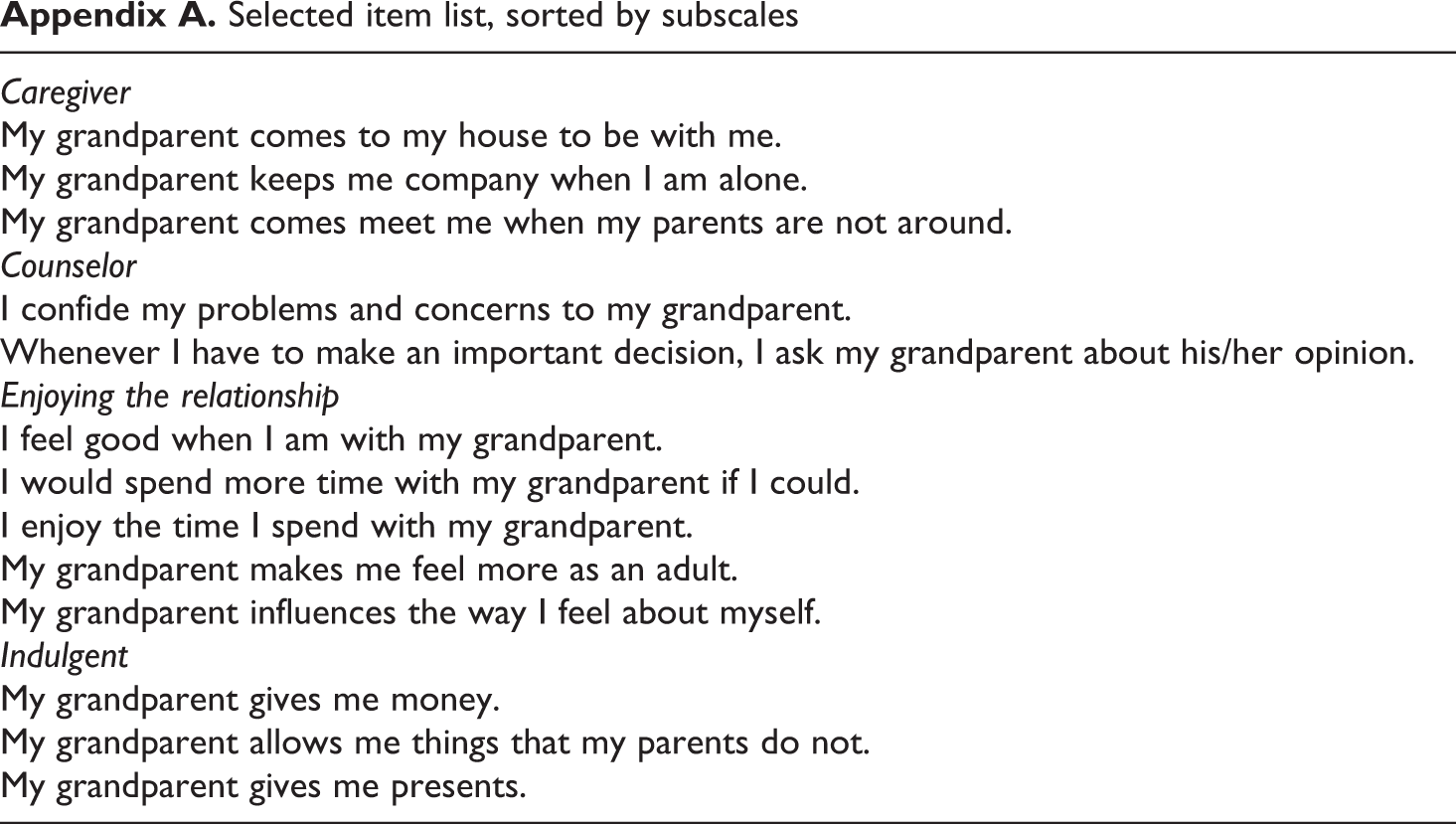
| Caregiver |
| My grandparent comes to my house to be with me. |
| My grandparent keeps me company when I am alone. |
| My grandparent comes meet me when my parents are not around. |
| Counselor |
| I confide my problems and concerns to my grandparent. |
| Whenever I have to make an important decision, I ask my grandparent about his/her opinion. |
| Enjoying the relationship |
| I feel good when I am with my grandparent. |
| I would spend more time with my grandparent if I could. |
| I enjoy the time I spend with my grandparent. |
| My grandparent makes me feel more as an adult. |
| My grandparent influences the way I feel about myself. |
| Indulgent |
| My grandparent gives me money. |
| My grandparent allows me things that my parents do not. |
| My grandparent gives me presents. |
Funding
The author(s) received no financial support for the research, authorship, and/or publication of this article.

Open research statement
As part of IARR’s encouragement of open research practices, the authors have provided the following information: This research was not pre-registered. The data used in the research are available. The data can be obtained by emailing: