




Abstract
Socially anxious people report less closeness to others, but very little research has examined how social anxiety is related to closeness in real-time social interactions. The present study investigated social anxiety, closeness, and cortisol reactivity in zero-acquaintance interactions between 84 same-sex dyads (168 participants). Dyads engaged in either a high or low self-disclosure discussion task and completed self-report measures of closeness and desired closeness post-task. Salivary cortisol was collected before, during, and after the self-disclosure task. Multilevel models indicated that in the high self-disclosure condition, individuals higher in social anxiety displayed flatter declines in cortisol than those lower in social anxiety; cortisol declines were not significantly related to social anxiety in the low self-disclosure condition. Further, across both conditions, individual’s social anxiety was associated with decreased levels of closeness and desired closeness, particularly when individuals were paired with partners higher in social anxiety. These findings are discussed in relation to previous work on hypothalamic–pituitary–adrenal function, social anxiety, and interpersonal closeness.
Close social ties are essential to our physical and psychological well-being. The strength of our social relationships is linked with reduced risk of mortality (Holt-Lunstad, Smith, & Layton, 2010; see Seeman & Crimmins, 2001, for a review), increased protection against mental illnesses (Fratiglioni, Hui-Xin, Ericsson, Maytan, & Winblad, 2000), and improved immune function (e.g., Jaremka et al., 2013; Pressman et al., 2005). Given the importance of social relationships to our health and well-being, researchers are seeking to identify potential physiological pathways through which social functioning might influence health.
A growing body of research implicates the hypothalamic–pituitary–adrenal (HPA) axis and its production of the steroid hormone cortisol as a link between social functioning and health outcomes (Cohen et al., 2006; Ozbay et al., 2007; Rosal, King, Ma, & Reed, 2004). Dysregulated HPA reactivity is linked both with mood disorders and with poorer health outcomes, even in healthy populations. Stressful social interactions and settings can trigger acute increases in cortisol (Kirschbaum, Pirke, & Hellhammer, 1993) and even chronic elevations in cortisol over time (Adam & Gunnar, 2001; Saxbe, Repetti, & Nishina, 2008; Sjögren, Leanderson, & Kristenson, 2006). For example, healthy women with heightened cortisol reactivity to a social-evaluative threat showed increased oxidative stress, a process linked with accelerated biological aging (Aschbacher et al., 2013). However, supportive and validating social interactions have been linked to greater decreases in cortisol across time (Ditzen et al., 2009; Heinrichs, Baumgartner, Kirschbaum, & Ehlert, 2003; Slatcher, Selcuk, & Ong, 2015), and by extension, lower physiological stress and greater well-being. For example, high-quality friendships may have a positive effect on immune response and HPA functioning. In one study, children with a higher number and higher quality of friendships showed lower basal cortisol and sharper declines in cortisol throughout the day (Peters, Riksen-Walraven, Cillessen, & de Weerth, 2011). In another study, college students’ loneliness, but not social network size, contributed to reduced immune response and elevated cortisol levels (Pressman et al., 2005). These findings suggest that even a small, high-quality social network may buffer against loneliness and its potential detrimental health outcomes.
Social anxiety, interactions, and HPA function
The potential stress-buffering effects of friendship may be particularly important for those who are prone to stress and anxiety. Yet, these individuals may actually experience heightened stress and HPA reactivity when meeting potential new friends. Individuals with high social anxiety experience feelings of distress during real or imagined social interactions (Mattick & Clarke, 1998), and fear and expectation of negative evaluation is a key feature of social anxiety (Clark & Wells, 1995; Hofmann, 2007; Leary, Haupt, Strausser, & Chokel, 1998).
Because of these negative expectations, people with social anxiety enter social interactions with an exaggerated perception of risk, displaying increased attention and anxious reactivity (Klumpp & Amir, 2010). These distressful feelings are particularly relevant when making an impression (Leary, Landel, & Patton, 1996), such as when forming new relationships. In everyday interactions, people with social anxiety disorder display increased sensitivity to social stress and react more strongly to social stressors (Farmer & Kashdan, 2015). Bonding during friendship formation is rewarding for most, yet socially anxious people may experience this context as stressful. In turn, this may result in the failure to form close social ties. However, not all groups benefit from close social connections. For example, it was recently shown that social proximity is associated with both benefits and costs for certain personality disorders (Gadassi, Snir, Berenson, Downey, & Rafaeli, 2014) and for those with depression or anxiety (Smith, 2015).
For those with high social anxiety, social interactions can provoke greater physiological stress and dysregulated HPA response. Although individuals with social anxiety disorder display normal levels of basal cortisol (Potts, Davidson, Krishnan, Doraiswamy, & Ritchie, 1991; Uhde, Tancer, Gelernter, & Vittone, 1994), many studies have found that social anxiety is associated with heightened HPA-axis reactivity during psychosocial stressors (Furlan, DeMartinis, Schweizer, Rickels, & Lucki, 2001; van West, Claes, Sulon, & Deboutte, 2008) and upon waking (Adam et al., 2014; Ellenbogen, Hodgins, Walker, Couture, & Adam, 2006). In fact, researchers posit that a hyperactive HPA-axis response may be linked to the development of social anxiety (Faravelli et al., 2010; Vreeburg et al., 2010). Other studies have found either no evidence of elevated cortisol reactivity in social anxiety (Krämer et al., 2012) or lowered cortisol reactivity to social stress (Crişan, Vulturar, Miclea, & Miu, 2016). These studies indicate that individuals with social anxiety appear to experience dysregulated cortisol reactivity to social stressors.
Even subclinical levels of social anxiety can affect stress reactivity. Recent research indicates that people with subclinical levels of social anxiety self-report heightened reactivity to social stress (Crişan et al., 2016). The increased susceptibility to stress in socially anxious individuals has been implicated as a risk factor for vulnerability to psychological disorders (Connor-Smith & Compas, 2002). Thus, a greater understanding of how social anxiety in the general population is associated with cortisol reactivity to friendly social interactions could illuminate the impact of social anxiety disorder on functioning in relationships.
Social anxiety and friendship formation
Social anxiety also appears to hinder friendship development and limit sources of social support (Davidson, Hughes, George, & Blazer, 1993). Youths higher in social anxiety have problems establishing friendships in new social contexts (Vernberg, Abwender, Ewell, & Beery, 1992). Further, a social network analysis revealed that socially anxious youths were less popular, chose fewer friends in a network, and tended to choose more socially anxious friends (Van Zalk, Van Zalk, Kerr, & Stattin, 2011). These results indicate a deleterious effect of social anxiety on friendship overall, yet also suggest that matching levels of social anxiety may be a positive factor in relationship initiation.
Studies have linked social anxiety with, paradoxically, both avoidance of intimacy and increased interpersonal dependency, with over-reliance on others mediating the relationship between social anxiety and interpersonal stress (Darcy, Davila, & Beck, 2005; Davila & Beck, 2002; Grant, Beck, Farrow, & Davila, 2007). This indicates that level of self-disclosure—a driver of intimacy—may serve to determine whether socially anxious individuals show avoidant or dependent strategies in close relationships. For example, level of self-disclosure may be linked with the emotional impact of a social interaction on individuals with social anxiety. Among those higher in social anxiety, rumination following a social interaction was associated with increases in negative affect after a higher self-disclosure interaction and decreases in negative affect after a lower self-disclosure, small-talk interaction (Kashdan & Roberts, 2007). Given that people with social anxiety tend to hide aspects of themselves (Potoczniak, Aldea, & DeBlaere, 2007; Rodebaugh, 2009), it is worth investigating whether social anxiety is linked with different outcomes in high or low self-disclosure contexts.
Research has only recently begun to explore social anxiety in the context of close relationships. For example, people with higher levels of social anxiety show lower levels of self-disclosure with their romantic partners (Cuming & Rapee, 2010; Sparrevohn & Rapee, 2009; Wenzel, 2002), along with decreased closeness to their romantic partners during mutual expressions of pain or distress (Kashdan, Volkmann, Breen, & Han, 2007). However, it is not clear why people with elevated social anxiety might be less close. One possibility is that socially anxious people might desire to be less close to others, but no research to our knowledge has investigated this possibility.
In studying social interactions of the socially anxious, it is critical to examine the role of intradyadic processes. A core tenet of the actor partner interdependence model (e.g., Cook & Kenny, 2005) holds that both partners in a dyadic interaction have bidirectional influences on each other. This approach highlights the role of “actor effects” (e.g., one’s own social anxiety predicting one’s own closeness), “partner effects” (e.g., a partner’s social anxiety predicting one’s own closeness), and interactions between actor and partner effects (e.g., both one’s own and a partner’s social anxiety jointly predicting closeness). Research on closeness and social anxiety pursuing this approach has found that while social anxiety typically inhibits relationships, people higher in social anxiety may become closer to those with similar levels of social anxiety (Kashdan & Wenzel, 2005). This finding, taken with previous research indicating that socially anxious people tend to choose more socially anxious friends in a network (Van Zalk et al., 2011), highlights the importance of considering the social anxiety of the self and others when understanding how social anxiety is linked to closeness. These two studies suggest that socially anxious people may feel close only to others who are also socially anxious. In contrast, the social surrogate hypothesis (Bradshaw, 1998) suggests that a social surrogate may offer support in anxiety-provoking situations, suggesting that those high in social anxiety may best pair with someone low in social anxiety who may serve as a social surrogate. This phenomenon may play out within a close relationship, such as with college roommates (Boucher & Cummings, 2017). Therefore, it remains unclear whether matching levels of social anxiety hinder or foster closeness and whether partner effects impact the earliest stages of friendship formation.
Initial research suggests that social anxiety and attachment anxiety—more common in the socially anxious (Darcy et al., 2005)—may have similar implications for interpersonal interactions. For example, McClure and Lydon (2014) investigated dynamics in early-stage relationship formation. For those with attachment anxiety, state social anxiety predicted negative interpersonal outcomes, evident within minutes of an initial interaction. Further, attachment may play a role in the etiology of social anxiety (Aderka, Weisman, Shahar, & Gilboa-Schechtman, 2009). Those high in attachment anxiety tend to display an increased desire for closeness (Brennan, Clark, & Shaver, 1998) yet expect to be rejected during interpersonal interactions (Downey & Feldman, 1996). Within romantic relationships, socially anxious people often perceive a discrepancy between actual and desired closeness with partners (Kashdan et al., 2007). Thus, it is important to discern the extent to which the socially anxious desire closeness in social interactions.
We have examined attachment anxiety, closeness, and cortisol responses in previous research (Ketay & Beck, 2017). Given that attachment anxiety and social anxiety are unique constructs, the current research focuses on potential links among social anxiety, closeness, and cortisol responses. Social anxiety symptoms are activated during social-evaluative situations, such as social interactions and performances (Clark & Wells, 1995; Rapee & Heimberg, 1997) where attentional bias to threats, fear of social evaluation, and embarrassment come into play. Symptoms may be activated even in social contexts that would not typically be deemed threatening, such as the beginning of a new friendship. Therefore, it is important to explore the cortisol reactivity and closeness outcomes of socially anxious people in a typically friendly context. This may shed light on how socially anxious people fail to build close relationships. Understanding the physiological response to friendship formation in the socially anxious may also have implications for mental and physical well-being.
The present study
Even in friendly social interactions, social anxiety can pose a twofold burden: Social anxiety may not only prevent close and supportive interactions from being close or supportive in the first place, but it also may lead to heightened physiological stress (i.e., elevated cortisol levels). Investigating this topic can move theory forward by revealing how social anxiety affects closeness and physiological stress responses during social interactions, as well as shed light on the interpersonal processes that link social anxiety to health outcomes.
With these goals in mind, the present study investigated how social anxiety may impact cortisol reactivity and feelings of closeness and desired closeness during a dyadic social interaction with a potential new friend. We predicted that individuals with elevated social anxiety would experience flatter declines in cortisol across the interaction, or perhaps even increases in cortisol. Further, more socially anxious people may desire less closeness or feel less closeness during social interactions, yet may feel close to others who match their level of social anxiety (e.g., Kashdan & Wenzel, 2005). In light of the potential overlap between social anxiety and attachment anxiety, analyses controlling for attachment anxiety also were performed (see Supplementary Material). We examined these possibilities by measuring salivary cortisol before, during, and after a high and low self-disclosure activity with a same-sex stranger.
Methods
Participants
One-hundred sixty-eight participants (84 dyads) were recruited through the Introductory Psychology subject pool at a private university in the Northeastern U.S. Participants were paired with a same-sex stranger and received course credit for participation. Six dyads were excluded from analyses because participants knew one another prior to the study or had insufficient cortisol samples, leaving 156 participants (78 dyads; 80.77% female; Mage = 19.99, SDage = 2.06; 51.3% Caucasian). The first group of participants completed a high self-disclosure task (46 dyads, N = 92). A second group of participants was added as a comparison group after data collection was complete. This group (32 dyads, N = 64) completed a low self-disclosure task. Because we did not randomly assign participants to conditions, we tested for differences in gender and age as a function of condition. The two conditions did not differ in terms of gender (b = −.09, SE = .29, Wald Z = .11, p = .74). We found a significant difference in age (b = .39, SE = .19, t(80.027) = 2.102, p = .039) that was not meaningfully different: 19.49 in the low self-disclosure condition and 20.25 in the high self-disclosure condition.
We previously investigated links among testosterone, cortisol, and closeness (Ketay, Welker, & Slatcher, 2017) for dyads with both testosterone and cortisol samples, which were collected at two timepoints. Building on that sample, the current data included additional dyads for which cortisol was assayed at two additional timepoints, for a total of four cortisol samples.
Procedure
In order to control for the diurnal rhythm of cortisol, where cortisol is generally highest near waking and declines throughout the day, all experimental sessions were conducted between 12 pm and 5 pm (Granger, Schwartz, Booth, & Arentz, 1999; Schultheiss & Stanton, 2009). Participants arrived at the laboratory having refrained from eating for 1 hr prior to the experimental session to facilitate a clean saliva sample and because some foods may affect cortisol levels. In addition, upon providing informed consent, participants drank a few sips of water prior to providing saliva samples. Participants privately completed questionnaires related to demographics and social interaction anxiety and engaged in a conversation with a same-sex stranger during a high or low self-disclosure task. Saliva samples were collected at four timepoints to assess cortisol levels throughout the task (Table 1).
Timing of cortisol samples.
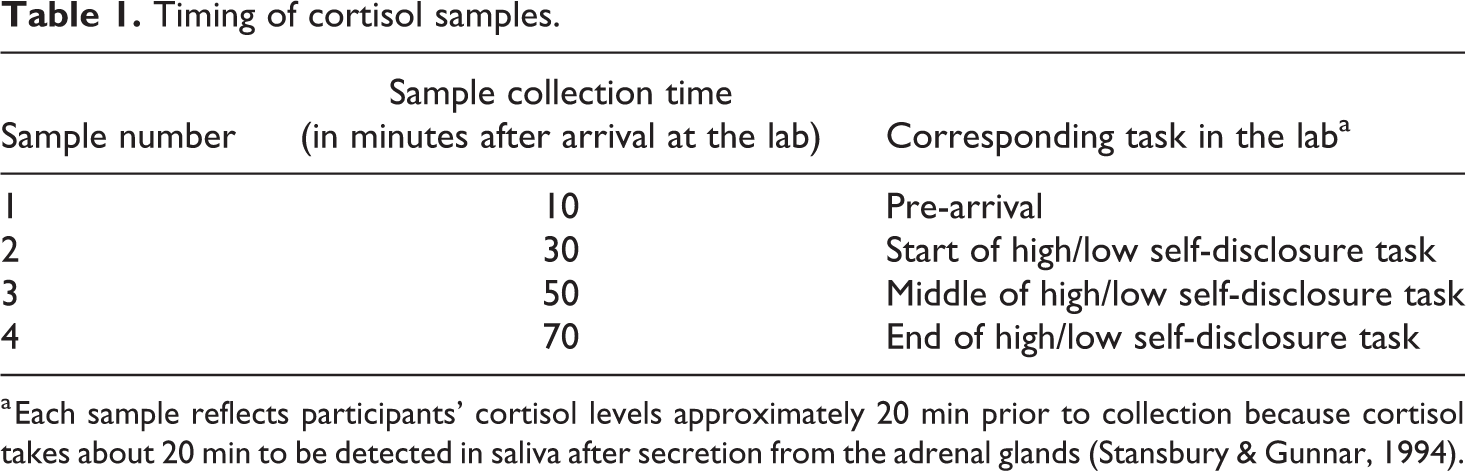
a Each sample reflects participants’ cortisol levels approximately 20 min prior to collection because cortisol takes about 20 min to be detected in saliva after secretion from the adrenal glands (Stansbury & Gunnar, 1994).
Measures
Salivary cortisol
Participants’ salivary cortisol was collected by placing Salimetrics Oral Swab (Salimetrics, LLC, Carlsbad, CA) under the tongue for 90 s. Samples were stored in a −20°C freezer in sealed cryogenic vials. All samples were shipped on dry ice and analyzed for cortisol concentrations using Salimetrics assay kits (Granger et al., 1999; Granger, Shirtcliff, Booth, Kivlighan, & Schwartz, 2004). The high self-disclosure samples were analyzed at Salimetrics Inc. (Carlsbad, CA). Intra-assay and inter-assay Coefficients of Variability (CVs) were low (Avg CVs = 4.9% and 6.9%, respectively). The low self-disclosure samples were analyzed at the University of Trier (Trier, Germany). Intra-assay and inter-assay CVs were low (Avg CVs = 9.3% and 6.0%, respectively). All samples were assayed in duplicate.
High self-disclosure condition
Dyads in the high self-disclosure condition completed the “Fast Friends” procedure, developed by Aron, Melinat, Aron, Vallone, and Bator (1997). Partners took turns answering 36 questions that progressively increased in levels of self-disclosure. Questions toward the beginning of this 40-min task facilitated relatively low levels of self-disclosure (e.g., “Would you like to be famous? In what way?”). Questions toward the end of this task facilitated relatively high levels of self-disclosure (e.g., “When did you last cry in front of another person? By yourself?”). Completion of this task reliably leads to high levels of closeness between partners (Aron, Melinat, Aron, Vallone, & Bator, 1997).
Low self-disclosure condition
The low self-disclosure condition was designed to keep self-disclosure at minimal levels to provide a control condition for the high self-disclosure condition. Dyads completed a 40-min series of tasks adapted from Steele (1999). These tasks involved partners being asked to give directions to varying points around campus. Partners reported which directions were easiest and hardest for them, and how they felt their partner was at giving directions. Next, partners took turns thinking of geographical places that began with the same first letter in the alphabet. Finally, partners read a passage aloud and jointly answered questions related to reading comprehension.
Social anxiety
Social anxiety was measured via the Social Interaction Anxiety Scale (Mattick & Clarke, 1998). This 20-item questionnaire is designed to assess anxiety in social interactions, defined by Mattick and Clarke (1998) as distress when meeting and talking to people. Internal consistency, measured via Cronbach’s α, ranges from .88 to .93 (Heimberg, Mueller, Holt, Hope, & Liebowitz, 1992; Mattick & Clarke, 1998). Participants rated the extent to which a series of statements (e.g., “I find it difficult to mix comfortably with the people I work with”) were true of them on a 5-point Likert scale ranging from 0 (Not at all characteristic or true of me) to 4 (Extremely characteristic or true of me).
Closeness and desired closeness
Closeness and desired closeness were measured via the Inclusion of Other in the Self scale (IOS; Aron, Aron, & Smollan, 1992). The IOS scale is a 7-point Likert scale that depicts two increasingly overlapping circles, with greater overlap representing higher levels of closeness. Following the high or low self-disclosure task, participants reported how close they felt to their partner and how close they desired to feel to their partner by circling the picture that best represented their relationship.
Results
Analytic strategy
Because the cortisol data are dyadic and measured over time, we estimated two-level crossed models to account for non-independence in dyad members’ cortisol responses at the same timepoints. This model is appropriate because dyad members have provided cortisol data at the same timepoints so one can estimate the correlation of errors within timepoints for the two dyad members. Thus, the level of repeated measure is the same for both dyad members, and repeated measure and person are crossed (not nested; see Kenny, Kashy, & Cook, 2006, for details). As dyad members cannot be distinguished based on a meaningful theoretical factor that is dichotomous (i.e., they are both in the same experimental condition), we treated dyads as indistinguishable in terms of the random effects (see Kenny et al., 2006). The random effects in the cortisol models were thus constrained to be the same across both dyad members (see Supplementary Material). Degrees of freedom were estimated using the Satterthwaite method and can be fractional (see Fitzmaurice, Laird, & Ware, 2004, and Kenny et al., 2006). We use the term “actor” to denote predictor variables for one person that affect the same person’s outcome variable. We use the term “partner” to denote predictor variables from a partner. When exploring interactions with condition, in our simple effects tests, we recoded the condition of interest to be zero in the analysis so that other effects in the model refer to that condition (see Aiken & West, 1991). To account for skewness, cortisol was natural log transformed for analyses.
Given recently published work involving attachment anxiety using this same data set (Ketay & Beck, 2017), we replicated our analyses controlling for attachment anxiety (see Supplementary Material). Unless otherwise specified, doing so did not alter the direction or significance of any reported findings. Furthermore, given concerns that all four saliva samples might not follow a linear trajectory (particularly, for the fourth and final sample), we conducted cortisol analyses without the fourth and final sample to examine whether the effects were altered by removing this sample (see Supplementary Material). We also conducted analyses including gender and interactions between gender and all predictors (see Supplementary Material). Unless otherwise specified, we found no main effects of gender or interactions with gender. Finally, we conducted analyses controlling for age (see Supplementary Material). We found no main effects of age, nor did controlling for age change the direction or significance of any other main effects or interactions.
Preliminary analyses and tests of interdependence
We computed intra-class correlation coefficients (ICCs) for social anxiety, closeness, desired closeness, and cortisol. Interdependence was moderate for felt closeness (ICC = .37) and small for desired closeness (ICC = .14), social anxiety (ICC = .13), and cortisol (ICC = .09). Participants’ basal cortisol levels were not associated with their social anxiety (r = −.01, p = .87). We initially modeled time as a quadratic effect. It was not significant in Model 1, which is reported below (p = .39), whereas the linear effect of time was (p < .0001). We also included main effects of quadratic time in Models 2 and 3 (reported below), but, again, these were not significant (ps > .38). Thus, we modeled time as linear in all models reported below.
Self-disclosure, social anxiety, and cortisol
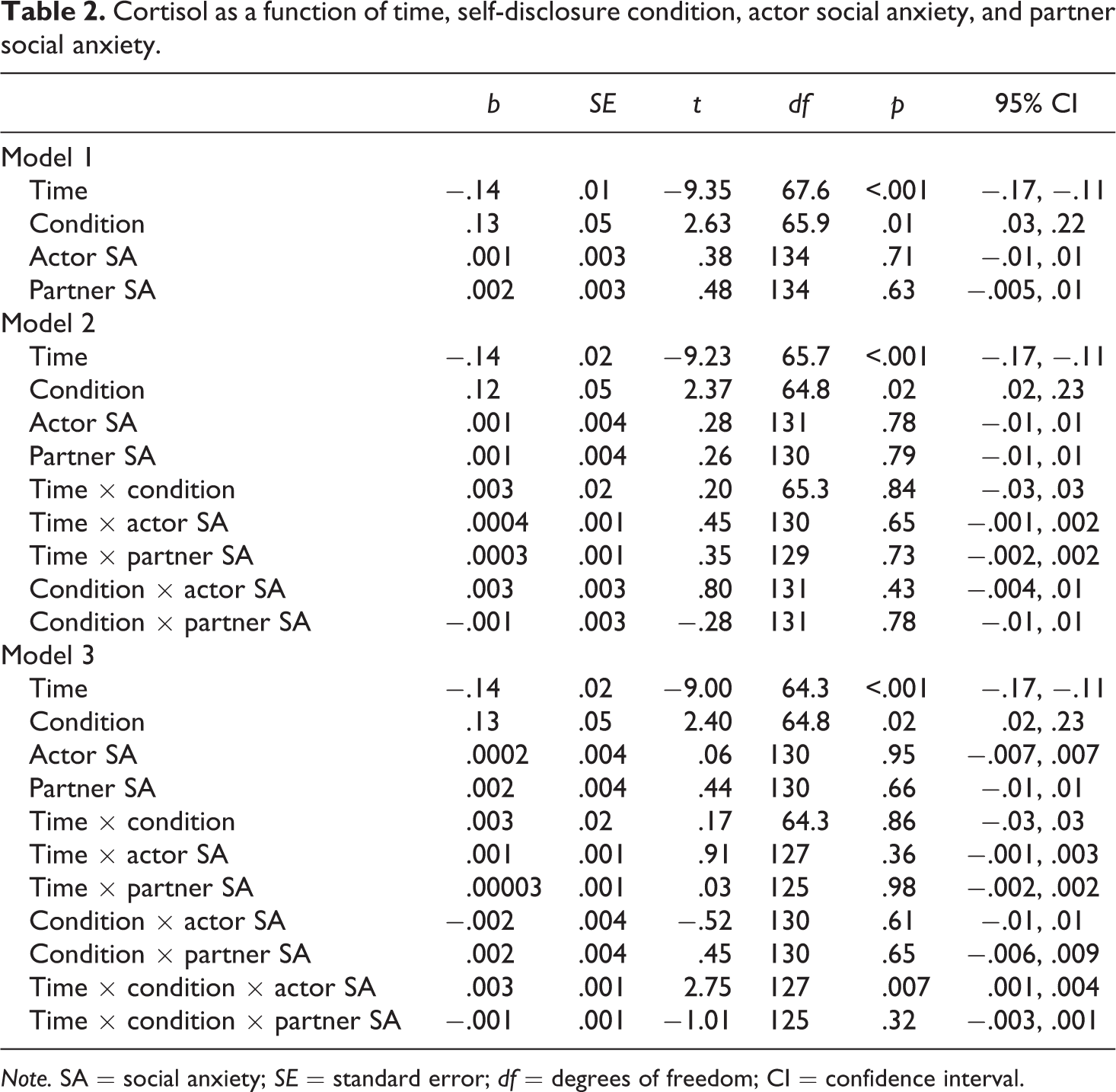
To examine whether social anxiety and self-disclosure interacted to predict changes in cortisol over time, we conducted a two-level crossed model regressing cortisol concentrations on time (linear and centered at Time 1), actor social anxiety (grand-mean-centered), partner social anxiety (grand-mean-centered), self-disclosure condition (effect-coded as 1 = high self-disclosure and −1 = low self-disclosure), and the appropriate two- and three-way interaction terms (see Table 2, Model 3; Supplementary Material for random effects from this model). The time × condition × actor social anxiety interaction term was significant, F(1, 127) = 7.55, p = .007 (see Figure 1). Follow-up analyses revealed that the two-way interaction between time and actor social anxiety was significant in the high self-disclosure condition, F(1, 129) = 5.95, p = .016, but not in the low self-disclosure condition, F(1, 123) = 1.92, p = .17. In the high self-disclosure condition, people high (+1 SD from the mean) in social anxiety experienced a significant decline in cortisol, b = −.08, SE = .03, t(90.2) = −2.73, p = .008, 95% CI [−.15, −.02], but the cortisol decline was even stronger for those low (−1 SD from the mean) in social anxiety, b = −.18, SE = .03, t(105) = −6.48, p < .001, 95% CI [−.24, −.13]. We observed no significant main effects or interactions involving partner social anxiety (ps > .31), suggesting that partner social anxiety did not affect cortisol.
Cortisol as a function of time, self-disclosure condition, actor social anxiety, and partner social anxiety.
Note. SA = social anxiety; SE = standard error; df = degrees of freedom; CI = confidence interval.

Cortisol as a function of time, self-disclosure condition, and actor social anxiety. SA = social anxiety, HSD = high self-disclosure condition, LSD = low self-disclosure condition.
Overall, these patterns suggest that people higher in social anxiety experience less of a decline in HPA-axis stress (as indexed by cortisol levels) when having highly self-disclosing conversations with unacquainted others. We also supplemented these analyses by examining models with only the main effects (see Table 2, Model 1) and two-way interaction terms (see Table 2, Model 2). In all models, there were significant negative effects of time, reflecting the tendency for cortisol to decline over the course of the interaction.
Self-disclosure, social anxiety, and closeness
We conducted multivariate multilevel models to examine the effects of self-disclosure condition and social anxiety on closeness. The two outcome variables were felt closeness (i.e., how close participants felt to their partners in the task) and desired closeness (i.e., how close participants desired to feel to their partners in the task). We conducted two-level crossed models, where we estimated the correlation between dyad members’ responses on the same closeness variable (i.e., felt or desired closeness). To examine whether any of the effects differed as a function of the type of closeness variable, we included the main effect of a variable differentiating between the two types (“type”; coded as −1 = felt closeness, 1 = desired closeness), as well as interactions between each of the predictors and type.
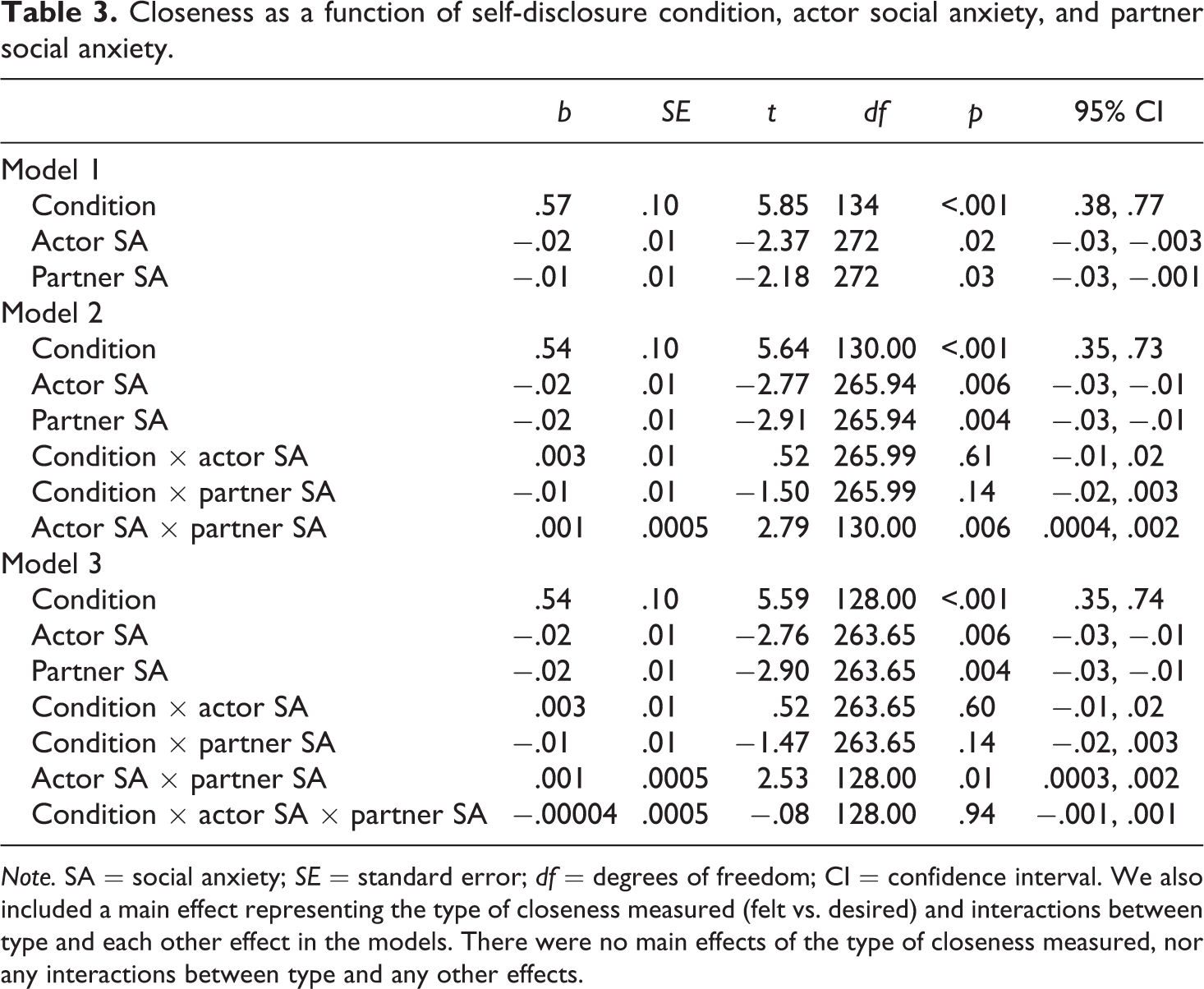
To test whether social anxiety was related to closeness, we first tested whether the main effects of self-disclosure condition, actor social anxiety, and partner social anxiety predicted closeness, along with the main effect of closeness type and interactions with each predictor and closeness type (see Table 3, Model 1). There was a pronounced increase in closeness in the high self-disclosure condition compared to the low self-disclosure condition (p < .001). There were significant negative effects of both actor and partner social anxiety (ps < .03), suggesting that higher social anxiety predicted less closeness. 1 None of these effects were moderated by the type of closeness measured (felt vs. desired, ps > .18).
Closeness as a function of self-disclosure condition, actor social anxiety, and partner social anxiety.
Note. SA = social anxiety; SE = standard error; df = degrees of freedom; CI = confidence interval. We also included a main effect representing the type of closeness measured (felt vs. desired) and interactions between type and each other effect in the models. There were no main effects of the type of closeness measured, nor any interactions between type and any other effects.
Second, we tested whether the main effects of condition, actor social anxiety, and partner social anxiety, and the two-way interaction terms of condition × actor social anxiety, condition × partner social anxiety, and actor social anxiety × partner social anxiety predicted closeness (along with the main effect of closeness type and interactions with each predictor and closeness type; see Table 3, Model 2). We found that neither actor social anxiety nor partner social anxiety interacted with condition to predict closeness (ps > .13). There was a significant actor social anxiety × partner social anxiety interaction (p = .006). Follow-up analyses showed that the highest levels of closeness were found in dyads where both partners were low in social anxiety (see Figure 2). People low in social anxiety reported significantly more closeness if their partners were also low in social anxiety compared to high in social anxiety, b = −.04, SE = .01, t(193.43) = −3.67, p < .001, 95% CI [−.06, −.02]. In contrast, the closeness reported by people high in social anxiety did not differ as a function of their partner’s social anxiety, b = −.00, SE = .01, t(228.84) = −.05, p = .96, 95% CI [−.02, .02]. Furthermore, people who had partners low in social anxiety reported significantly more closeness the less social anxiety they themselves had, b = −.04, SE = .01, t(193.43) = −3.58, p < .001, 95% CI [−.06, −.02]. For people who had partners high in social anxiety, there was no relationship between their own social anxiety and the closeness they reported, b = .00, SE = .01, t(228.84) = .06, p = .95, 95% CI [−.02, .02]. In sum, although the results of Kashdan and Wenzel (2005) suggested that closeness is highest when dyad members match on social anxiety, the present data suggest that dyad members are closest when both members are low in social anxiety. None of the effects in this model were moderated by the type of closeness measured (felt vs. desired, ps > .16).
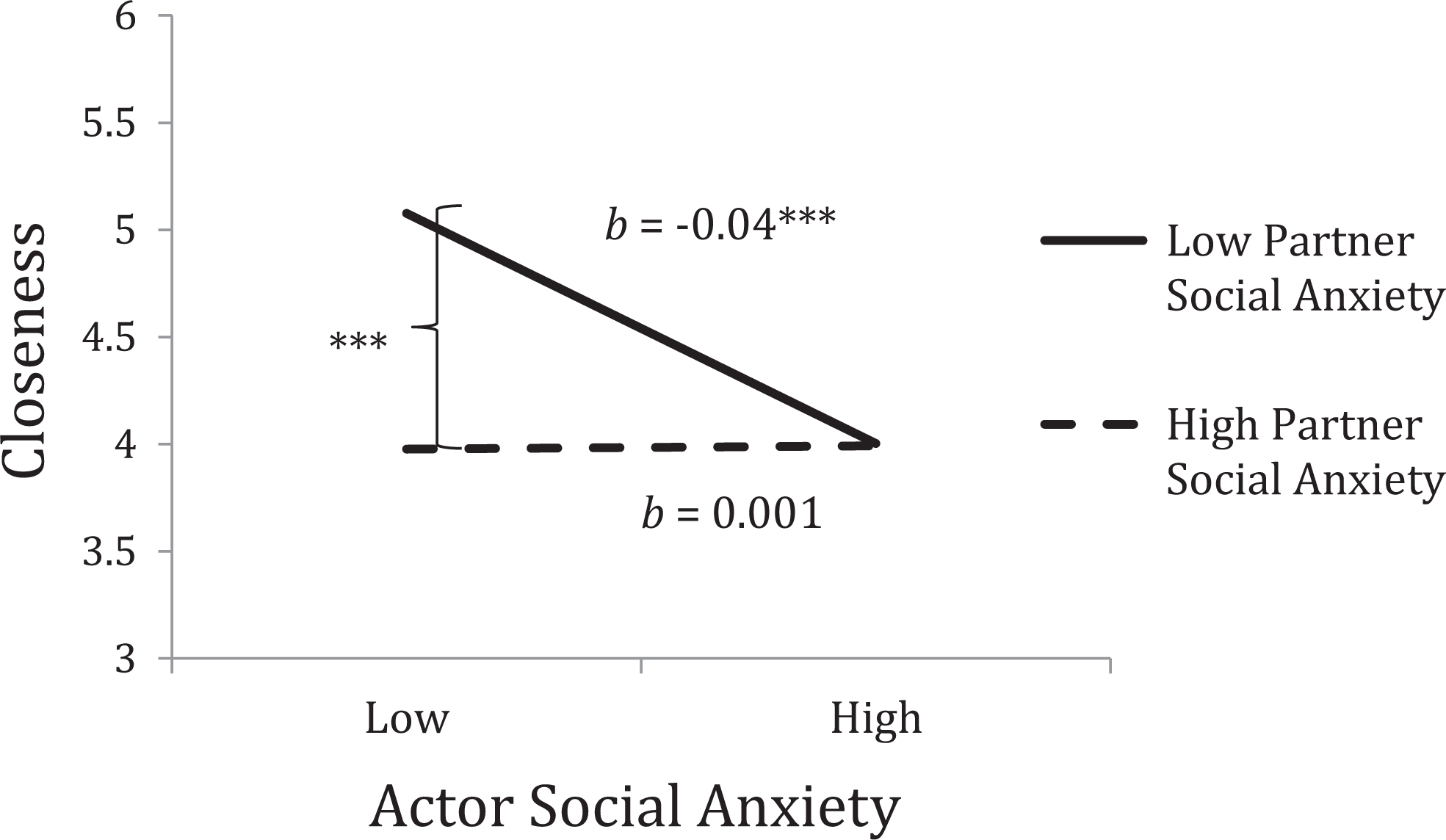
Closeness as a function of actor social anxiety and partner social anxiety. Predicted values are presented at ± 1 SD from the mean for actor and partner social anxiety. ***p < .001.
Finally, to examine whether the actor social anxiety × partner social anxiety interaction from Model 2 was moderated by condition, we added the three-way interaction term of condition × actor social anxiety × partner social anxiety to the model (along with a main effect of closeness type and interactions with each predictor and closeness type; see Table 3, Model 3). We did this in an effort to conceptually replicate the findings of Kashdan and Wenzel (2005), who found that a match between partners’ social anxiety predicted increased closeness under the condition of high self-disclosure, but not under the condition of low self-disclosure. In contrast to findings reported by Kashdan and Wenzel (2005), there was no three-way interaction among condition, actor social anxiety, and partner social anxiety (p = .94). None of the effects in this model were moderated by the type of closeness measured (felt vs. desired, ps > .13).
Discussion
Close friendships are essential to our well-being. New friendships represent an important source of social support and offer stress-buffering effects. Ironically, those who are prone to stress and anxiety, who may benefit the most from these relationships, may be less likely to develop new friendships. Rather, the opportunity to form new relationships may be met with dysregulated cortisol reactivity and result in lower levels of closeness. The present study examined cortisol response to friendly social interactions in those with social anxiety. It also explored potential links between social anxiety and closeness and desired closeness. Lastly, it investigated intradyadic processes by looking at matches in social anxiety via actor and partner effects.
The present study suggests that people higher in social anxiety experienced differential cortisol reactivity in a high self-disclosure context, by showing less of a decline in cortisol when self-disclosing compared to people lower in social anxiety. Our results further suggest that social anxiety is associated with decreased felt closeness and desired closeness during friendship formation. The current study supports the importance of examining levels of social anxiety in both dyad members to explore whether matched or mismatched levels of social anxiety affect closeness outcomes. Indeed, higher levels of closeness were found when both dyad members were lower in social anxiety. Given the documented link between social ties and physical and psychological well-being—particularly for those with social anxiety—this work is critical because it sheds light on barriers that disrupt socially anxious people from finding close, supportive relationships.
Cortisol response, social anxiety, and self-disclosure
The present results support previous findings that highlight the role of HPA-reactivity in differentiating those with high or low social anxiety. Consistent with our findings, previous work suggests that social anxiety is unrelated to basal cortisol (e.g., Potts et al., 1991; Uhde et al., 1994). Instead, cortisol responses to a psychosocial stressor are more elevated in socially anxious people (Furlan et al., 2001; van West et al., 2008). Our results are in line with the idea that those higher in social anxiety showed differential cortisol patterns than those lower in social anxiety. This difference is apparent in self-disclosing interactions with a potential new friend. Moreover, although all participants generally declined in cortisol, more socially anxious people showed smaller declines in cortisol over time than less socially anxious people. This effect suggests that more intimate social interactions—compared to less intimate ones—may be particularly stressful for individuals with social anxiety. The differential cortisol response in socially anxious people may be part of the response to the challenge of social interactions in these individuals. This is consistent with the ideas presented in self-presentation theory, which suggest that social anxiety arises when people wish to make a good impression but lack confidence in their ability to do so (Leary & Kowalski, 1995). Lastly, the differences in cortisol reactivity in those with higher social anxiety were due primarily to actor effects, suggesting that one’s own social anxiety, rather than the partner’s social anxiety, was driving the cortisol response. Of note, the social interactions in the present study are not typically especially stressful, compared to more stressful tasks used to induce a cortisol increase such as the Trier Social Stress Test. Furthermore, our task involved a friendly conversation between two strangers, whereas tasks in stress response studies have much more stressful circumstances, such as performing an impromptu speech and math task in front of an intimidating audience (i.e., Trier Social Stress Test). Therefore, it is not surprising that there is no pronounced cortisol increase from this task. Yet, the flattening of the typical cortisol decline suggests to us that the normal pattern of decline across the day may be disrupted.
Potentially, in contrast to previous findings that individuals with social anxiety self-disclose less in romantic relationships (Cuming & Rapee, 2010; Sparrevohn & Rapee, 2009; Wenzel, 2002), recent research suggests that context may play an important role in how social anxiety affects social functioning (Tian, 2013). The present study’s findings support the idea that the impact of social anxiety on social functioning may depend on context. Our results suggest that in a high self-disclosure context, individuals higher in social anxiety may experience less of a decline in cortisol. However, in a low self-disclosure context, these individuals may show less cortisol response over time.
Extrapolating our laboratory findings to daily life, it is possible that socially anxious people’s elevated HPA reactivity to close interactions may result in a flattened diurnal cortisol profile and increased cortisol output across the day when social interactions occur frequently. When more chronic, these elevations in cortisol are associated with a number of poor health outcomes, such as inflammation (e.g., DeSantis et al., 2012), diabetes (Schoorlemmer, Peeters, van Schoor, & Lips, 2009), and cardiovascular disease (Matthews, Schwartz, Cohen, & Seeman, 2006). However, this may not be the case as research suggests positive social relationships can help prevent HPA dysregulation (e.g., Slatcher et al., 2015; Slatcher, 2014).
Overall, these findings emphasize the importance of social context and levels of self-disclosure in considering the role of social anxiety in interpersonal processes. Further, while most friendships are associated with positive adjustment and well-being, this is not always the case. For instance, increased cortisol levels are seen in female friends who engage in co-rumination or talk excessively about problems (Byrd-Craven, Geary, Rose, & Ponzi, 2008). Lastly, exploring differential cortisol reactivity when meeting potential friends may illuminate factors that contribute to daily stress, theoretically impacting the mental and physical health of individuals with social anxiety.
Self-disclosure, social anxiety, and closeness
The current research suggests that one’s own social anxiety and the social anxiety of others dampens the experience of, and desire for, closeness in face-to-face interactions. However, more work is needed to connect these results with established findings relating to social anxiety and relationships. The current data on lowered desired closeness in the socially anxious seem to conflict with self-presentation theory (Leary & Kowalski, 1995) at surface level. However, people with high social anxiety may have a decreased desire for being close to strangers, whose evaluative responses to them are less predictable, and the results of our study may have differed if the dyadic interaction was conducted with partners that participants already knew and liked. Future work is needed to test this possibility, observing the relationship between social anxiety and dyadic closeness when desire for closeness and impression management motivations are high.
Matches on social anxiety and closeness
The present study suggests that both actor and partner effects are important in the association between social anxiety and closeness. Using a sample of 90 participants, Kashdan and Wenzel (2005) found that in zero-acquaintance high self-disclosure interactions, people felt the closest when both partners had high levels of social anxiety. However, in low self-disclosure interactions, people felt the closest when both partners had low levels of social anxiety. Data from the present study (N = 168) suggest a different pattern. Instead, the highest levels of closeness were found when both partners were low in social anxiety, and this pattern was not moderated by the level of self-disclosure. These results, while not replicating findings of Kashdan and Wenzel (2005), are in line with previous studies suggesting that those with social anxiety experience impairments and distress in close interpersonal social functioning (Davila & Beck, 2002; La Greca & Lopez, 1998; Wenzel, Graff-Dolezal, Macho, & Brendle, 2005). However, it is important to note that Kashdan and Wenzel (2005) studied opposite-sex pairings, whereas the present study included only same-sex dyads. Future research is needed to replicate the pattern of our results and those of Kashdan and Wenzel (2005), differentiating between interactions within same-sex and opposite-sex dyads.
In addition to examining social anxiety and closeness in opposite-sex interactions and when the desire for closeness is high, there are additional ways that future work can build on the limitations of the current research. First, our sample was largely college-aged females and caution should be used before extending findings to the general population. Social anxiety may present differently in males and females, and further research considering potential gender differences in social anxiety and friendship initiation is warranted. Another potential limitation of the present study is the use of IOS as a one-item outcome measure, although this measure does correlate highly with other closeness measures (Gächter, Starmer, & Tufano, 2015) and has excellent construct validity. Further, IOS has been used as a single-item outcome measure in previous research (e.g., Kashdan & Roberts, 2007). Still, future studies may expand on the single-item measure by including multi-item measures of closeness. Another limitation of the current study is that participants were not randomly assigned to the high or low self-disclosure condition. Our results are also correlational in nature so a causal link among social anxiety, differential levels of physiological stress, and closeness cannot be determined. Lastly, our interpretations of the data rely on the assumption that cortisol reactivity is a marker of physiological stress. A potential alternate interpretation could be warranted, as in addition to physiological stress, cortisol reactivity may also be due to arousal.
Conclusion
Overall, our findings lend support for the idea that social anxiety impairs functioning in the formation of close relationships, and that this impact can be seen in cortisol levels, as well as in felt and desired closeness levels. It is well known that social anxiety is associated with an aversion to social interactions and the potential development of closeness. The current study adds to these findings by showing that when socially anxious individuals have the opportunity to develop closeness through a friendly social interaction, they do not show the decreases in physiological stress (i.e., cortisol reactivity) that others show, and they also do not become as close to others during the interaction.
Supplemental material
Supplemental Material, jspr-supplementary - Social anxiety, cortisol, and early-stage friendship
Supplemental Material, jspr-supplementary for Social anxiety, cortisol, and early-stage friendship by Sarah Ketay, Keith M. Welker, Lindsey A. Beck, Katherine R. Thorson and Richard B. Slatcher in Journal of Social and Personal Relationships
Footnotes
Funding
The author(s) received no financial support for the research, authorship, and/or publication of this article.
Supplemental material
Supplemental material for this article is available online.
Note
References
Supplementary Material
Please find the following supplemental material available below.
For Open Access articles published under a Creative Commons License, all supplemental material carries the same license as the article it is associated with.
For non-Open Access articles published, all supplemental material carries a non-exclusive license, and permission requests for re-use of supplemental material or any part of supplemental material shall be sent directly to the copyright owner as specified in the copyright notice associated with the article.
