




Abstract
The aim of this study is to investigate the longitudinal influence of self-esteem on romantic and coparental relationship quality. The data were drawn from the German Family Panel, pairfam. Parents (n couples = 2,364) were assessed three times over 4 years. The results indicated that romantic and coparental quality decreased over time, while self-esteem remained stable. The self-esteem of both parents predicted initial romantic and coparental quality. Additionally, mothers’ self-esteem reduced the decline in romantic quality. Finally, romantic quality mediated the relationship between parents’ self-esteem and coparental quality. These results suggest that self-esteem might be a resource for the parental couple and even for the family unit, as romantic and coparental quality are key elements for the well-being of both parent and child.
It’s surprising how many persons go through life without ever recognizing that their feelings toward other people are largely determined by their feelings toward themselves, and if you’re not comfortable within yourself, you can’t be comfortable with others
One of the aspects that characterize a couple is whether partners have children or not. Becoming a parent has significant and enduring effects on individuals and on the couple (Doss & Rhoades, 2017; Jokela, Kivimäki, Elovainio, & Keltikangas-Järvinen, 2009). For example, parents display a less positive trajectory of romantic satisfaction, compared to nonparents (e.g., Keizer & Schenk, 2012). Furthermore, parenthood is accompanied by the emergence of a new relationship—the coparental one—which refers to the way partners function together in their parental role (McHale & Irace, 2011). Due to these differences, the effect of self-esteem on romantic quality might not be the same for partners that are also parents. Surprisingly, few studies on self-esteem have focused on the parental couple, which is at the very heart of the family system and has a crucial role in the well-being of both parents and children. It is therefore valuable to verify whether or not HSE has beneficial effects on this specific population.
In the present research, we use longitudinal data of parents to analyze change at the couple level, through common fate growth models (CFGMs; Ledermann & Macho, 2014). Our aim is to test for the resource potential that self-esteem can represent for the quality of the romantic and coparental relationships. We also analyze the paths through which self-esteem can affect parental couple relationships by testing for mediation effects.
The parental couple relationships
Parental couples are simultaneously involved in two types of relationships, the romantic and the coparental. The romantic relationship is dyadic, and only concerns the adults. Its quality is based on the level of agreement shared by the partners in areas such as love, sex, or housekeeping (Schoppe-Sullivan, Mangelsdorf, Frosch, & McHale, 2004). The coparental relationship is, on the other hand, triadic as it always includes the child. It refers to the collaboration (or disparagement) established between parents while pursuing the upbringing of their child (McHale, 2007) and concerns aspects such as setting educational rules or deciding who takes the child to school.
The separation between these two constructs goes back to family systems theory, which highlights the importance of distinguishing between these subsystems in order to have a more accurate view of family dynamics (Minuchin, 1974). Since then, empirical studies have confirmed that romantic and coparental relationships are two distinct constructs (Van Egeren, 2004) and that coparenting can be supportive even when the couple is facing marital distress (McHale, Kuersten-Hogan, Lauretti, & Rasmussen, 2000).
The quality of parental couple relationships appears to have multiple repercussions for the well-being of each family member. For example, low-quality romantic relationships are associated with symptoms of depression in the parents (Kersh, Hedvat, Hauser-Cram, & Warfield, 2006). Furthermore, changes in the level of marital distress (increase or decrease) are shown to predict corresponding changes in adolescents’ psychological adjustment (Cui, Conger, & Lorenz, 2005). As for the coparental relationship, it appears to represent a safe place for parents (Schoppe-Sullivan et al., 2004) and was repeatedly associated with the child’s positive development (Teubert & Pinquart, 2010). Noticeably, coparenting appears to have a more proximal effect on child adjustment, compared to romantic quality (Teubert & Pinquart, 2010).
Accordingly, romantic and coparental quality have distinct—yet equally important—roles for family members’ well-being. It is therefore important to consider them both when studying family.
Development of the romantic and coparental relationships
Literature shows that couples generally undergo a decline in romantic satisfaction over time (Orth, Robins, & Widaman, 2012; VanLaningham, Johnson, & Amato, 2001). For parents, this decline may be steeper. Indeed, couples without children have a higher quality of romantic relationship compared to parents (Meyer, Robinson, Cohn, Gildenblatt, & Barkley, 2016), and the transition to parenthood is linked to a decrease in the quality of the romantic relationship (Keizer & Schenk, 2012; Kluwer, 2010; Twenge, Campbell, & Foster, 2003). This population therefore appears to be at greater risk of experiencing the negative consequences of a low-quality romantic relationship.
Studies investigating the development of the coparental relationship have focused on parents of young children (pregnancy to preschool age). Their results indicate that coparental quality is moderately stable (Laxman et al., 2013; Le, McDaniel, Leavitt, & Feinberg, 2016; Schoppe-Sullivan et al., 2004; Van Egeren, 2004). Only one related study on older children was found (Riina & McHale, 2013). Its results showed that the child’s age moderated the trajectory of the coparental relationship. Among couples with children between 8 years and 11.5 years of age, coparental satisfaction appeared to be stable, while among couples with children between 11.5 years and 15 years of age, coparental quality followed an inverse U-curve. Accordingly, the age of the child could affect the trajectory of the coparental relationship.
Self-esteem, as a resource for the romantic and coparental relationships
Several theories help understand why self-esteem could be a resource for the parental couple. According to Rosenberg (1965), the way we perceive ourselves shapes the way we perceive our partner and more generally, our environment. Therefore, the optimism of HSE individuals is expected to facilitate the development of fulfilling romantic and coparental relationships. The sociometer theory highlights that this optimism comes from the fact that HSE individuals have experienced more acceptance from others whose opinions they value (Leary & Baumeister, 2000), which allows them to approach social situations with more serenity (Stinson et al., 2009). Conversely, low self-esteem (LSE) individuals have experienced more dismissal from others whose opinions they value and therefore presume rejection more readily. The risk regulation model adds that this feeling of acceptance or rejection is crucial because it determines the adoption of different goals: HSE individuals tend to adopt relationship-oriented goals, while LSE individuals prioritize self-protection (Murray, Derrick, Leder, & Holmes, 2008; Murray, Holmes, & Collins, 2006). For example, when facing an uncomfortable situation, HSE individuals will balance the felt negativity by reporting a more positive perception of their partner and of their romantic relationship, while LSE individuals will react by increasing the distance with their partner (Murray, Holmes, MacDonald, & Ellsworth, 1998). The goal of this reaction is to prevent further pain in case their partner acts dismissively toward them.
Therefore, HSE versus LSE individuals appear to go through different life experiences leading to more positive or negative expectations regarding their acceptance by others. These expectations and the trust they denote in their partner’s love imply different behaviors, impeding or promoting the quality of the romantic relationship.
Although there is limited research that has examined the link between self-esteem and the coparental relationship, similar processes can be expected. Parents with LSE may also adopt self-protective goals regarding their children and try to keep them for themselves instead of promoting the coparental relationship (Gaunt, 2008). Accordingly, parents with LSE adopt more negative coparenting behaviors such as attracting the child’s attention while she/he is playing with the other parent (Frosch, Mangelsdorf, & McHale, 1998; Lindsey, Caldera, & Colwell, 2005). Conversely, HSE parents engage more frequently in supportive coparenting (Frosch et al., 1998; Lindsey et al., 2005).
In line with these findings, one could expect self-esteem to be a predictor of romantic and coparental relationship quality. Noticeably, our aim is to take a step further and understand the path through which self-esteem affects those relationships. To that end, the association between the romantic and coparental relationship should be considered.
As family subsystems are highly interdependent (Cox & Paley, 1997) and as the romantic relationship usually appears first, one could expect it to represent the basis on which the quality of the coparental relationship develops. In other words, one could expect the quality of the former to spillover into the latter (Erel & Burman, 1995). Accordingly, longitudinal data show that romantic satisfaction pre-parenthood later affects the quality of the coparental relationship (Christopher, Umemura, Mann, Jacobvitz, & Hazen, 2015; McHale, Kazali, et al., 2004). Similar results were found when measuring romantic satisfaction after the birth of the child (Bonds & Gondoli, 2007; Pedro, Ribeiro, & Shelton, 2012) and when using experimental designs (Kitzmann, 2000). However, some authors reported different findings. Schoppe-Sullivan et al. (2004) found that coparental behaviors affected the romantic satisfaction 2.5 years later but not vice versa, and the study of Ippolito Morrill, Hines, Mahmood, and Cordova (2010) indicated that both causal directions were supported.
In conclusion, theoretical and empirical findings allow us to expect self-esteem to affect the relationships of the parental couple. HSE may represent an asset for the romantic and coparental relationships by enhancing trust in the partner’s love and acceptance, which in turn may increase the propensity to adopt relationship-oriented goals. Furthermore, a romantic relationship based on trust could represent the solid background needed to start and develop a strong coparental relationship. Taken together, these elements suggest a potential mediation link between self-esteem and coparenting through the quality of romantic relationship. However, as the direction of the causal link between romantic and coparental quality is still debated and no meta-analysis has yet confirmed these links, the mediating effect of coparenting quality should also be considered.
Objectives and hypotheses
We investigated the longitudinal influence of self-esteem on the quality of the romantic and coparental relationships. To that end, we adopted an innovative method using structural equation modeling, which allows us to evaluate change at the couple level (Ledermann & Macho, 2014). Our first goal was to reproduce previous results on the romantic relationship (Erol & Orth, 2014), with a sample exclusively composed of parents. We expected that mothers’ and fathers’ self-esteem would predict both the initial romantic quality and its development (i.e., its intercept and slope; H1). Second, we wanted to expand these assumptions to the coparental relationship. As the data available showed that HSE enhances coparental quality (Frosch et al., 1998; Lindsey et al., 2005), we expected that mothers’ and fathers’ self-esteem would predict both initial coparental quality and its development (H2). Finally, we sought to explore the links between self-esteem, romantic and coparental quality by investigating two models that included the three variables. In the first model, the romantic quality was set as a predictor of the coparental quality, while the opposite causal direction was used in the second model. Given the current state of research, we expected the first model to be a better fit. We hypothesized that the self-esteem of mothers and fathers would predict initial romantic and coparental quality, along with their development (reproduction of H1 and H2). We also expected that romantic quality would predict the initial level of coparental quality and its development (H3).
The effect of time on self-esteem, romantic and coparental quality was controlled as previous literature showed it affected self-esteem and romantic quality (e.g., Orth et al., 2010; VanLaningham et al., 2001). Regarding coparental quality, little is known and while some authors show moderate stability, others indicate that coparental quality evolves over time. Furthermore, the moderating effect of the child’s age was controlled for, as it was found to affect the development of coparental quality (Riina & McHale, 2013).
To our knowledge, only one longitudinal study has examined the effect of self-esteem on romantic quality in a specific population of parents. Don and Mickelson (2014) analyzed the patterns of change of the romantic relationship following the transition to parenthood and showed that self-esteem predicted subgroup membership. However, they did not report on the direct effect of self-esteem on change in the trajectory of romantic quality. Furthermore, longitudinal studies on the coparental relationship are still scarce, and none yet have analyzed the role of self-esteem in the development of coparental quality. Through this study, we expand the knowledge of the links between a dispositional variable and relational variables.
Method
Participants
The sample consisted of 2,364 couples. The data came from the German Family Panel, release 6.0 (Brüderl et al., 2015), which is described in the work of Huinink et al. (2011). This data set is freely accessible for the scientific community. Details (such as codebooks) can be found on the PAIRFAM website (http://www.pairfam.de/en/data/). For the present study, data from waves 2, 4, and 6 were explored, as coparental measures were not available in the other waves. Wave 2 was collected between 2009 and 2010 and the three measurement points were separated by 2 years each. The selected participants were heterosexual, had the same partner in at least two of the three waves and had at least one child (with the current partner) who lived with them. At wave 1, mothers’ age ranged from 17 years to 47 years (M years = 33.33, SD years = 5.03), and fathers’ age ranged from 17 years to 69 years (M years = 36.17, SD years = 5.73). The length of the relationship ranged from 10 months to 36.4 years (M years = 11.50, SD years = 5.64), and 60.5% of the partners were married. The age of the youngest child ranged from <1 month to 19.5 years (M years = 4.67, SD years = 3.70). The household’s net income per month ranged from 125 € to 30,000 € (M = 2,928, SD = 1.40). However, most families earned less than 6,000 € per month and the median was of 2,750€.
Measures
Self-esteem was evaluated for each partner with 3 items based on the Rosenberg scale (1965). The content was similar, but the wording had been simplified in two of them. The items were “Sometimes I believe that I am worthless”; “I like myself just the way I am”; and “All in all, I am pleased with myself.” Responses were measured using a 5-point Likert-type scale (1 = not at all, 5 = absolutely). The results of the negative item were reverse-scored; thus, a higher score indicated higher self-esteem. For women, the α reliability ranged from .74 to .77 between the waves, and for men, it ranged from .70 to .74. For the analyses, the mean score of the 3 items was calculated for each partner.
The quality of romantic relationship was evaluated for each partner with the Network of Relationships Inventory (adapted version; Furman & Buhrmester, 1985). Each of the subscales was composed of 2 items, and participants were asked to respond considering their relationship with their current partner. Four subscales were evaluated: intimacy (e.g., frequency of “Telling partner what you are thinking”), esteem (e.g., frequency of “Partner expresses recognition for what you’ve done”), dominance (e.g., frequency of “Partner makes you do things his/her way”), and conflict (e.g., frequency of being “Annoyed or angry with each other”). Responses were measured using a 5-point Likert-type scale (1 = never, 5 = always). For women, the α reliability ranged from .76 to .78 between waves, and for men, it ranged from .72 to .74. The negative items were reverse-scored; thus, for each partner, a higher score indicated a higher quality couple relationship. For the analyses, the mean score of the 8 items was calculated for each partner.
The quality of coparental relationship was evaluated for each partner with a 3-item questionnaire based on the Parent Problem Checklist (Dadds & Powell, 1991). Using a 5-point Likert-type scale (1 = never, 5 = very often), the participants reported how frequently they had “Differences of opinion regarding caring and parenting issues,” how often “Discussions regarding caring and parenting issues end in fights,” and how often “One parent disregards rules set by the other.” For women, the α reliability ranged from .81 to .83 between waves, and for men, it ranged from .79 to .80. All of the items were reverse-scored, which means a higher score indicated higher coparental quality. For the analyses, the mean score of the 3 items was calculated for each partner.
Analyses
The statistical analyses were conducted using version 3.3.0 of the open source R (R Development Core Team, 2014). To address the missing data, multiple imputations with principal component analysis were performed using the add-on package missMDA (Josse & Husson, 2012). This method has the advantage of estimating a missing value and calculating the variability for the imputation. For each variable and at each wave, imputations were performed only if the subject had answered at least one of the items. The structural equation models were estimated using the lavaan package (Rosseel, 2011).
Model fit was assessed using the χ2 test, the Tucker–Lewis index (TLI), the comparative fit index (CFI), and the root mean square error of approximation (RMSEA). If the χ2 was not significant, the model was considered to have a good fit. If it was significant, the model was considered to fit the data if the TLI and CFI values were greater than, or equal to .95 and the RMSEA value was below or equal to .06 (Hu & Bentler, 1999).
Before testing our hypotheses, a set of preliminary analyses were conducted. These analyses were divided into four stages and are detailed in the supplementary file. The first stage concerned the control variables. Using a principal component analysis, we tested whether a single variable could be used to control for the effect of time (instead of controlling for each parent’s age and for the duration of the relationship). As the variance in age of the child was large, we also verified whether it affected the model fits. In the second stage, we confirmed that the romantic and coparental quality were different constructs using the heterotrait-monotrait ratio of correlations (HTMT; Henseler, Ringle, & Sarstedt, 2015). In the third stage, we controlled that partners of a same couple had a similar vision of their romantic and coparental quality, using common fate models (CFMs; Figure 1; Ledermann & Kenny, 2012).
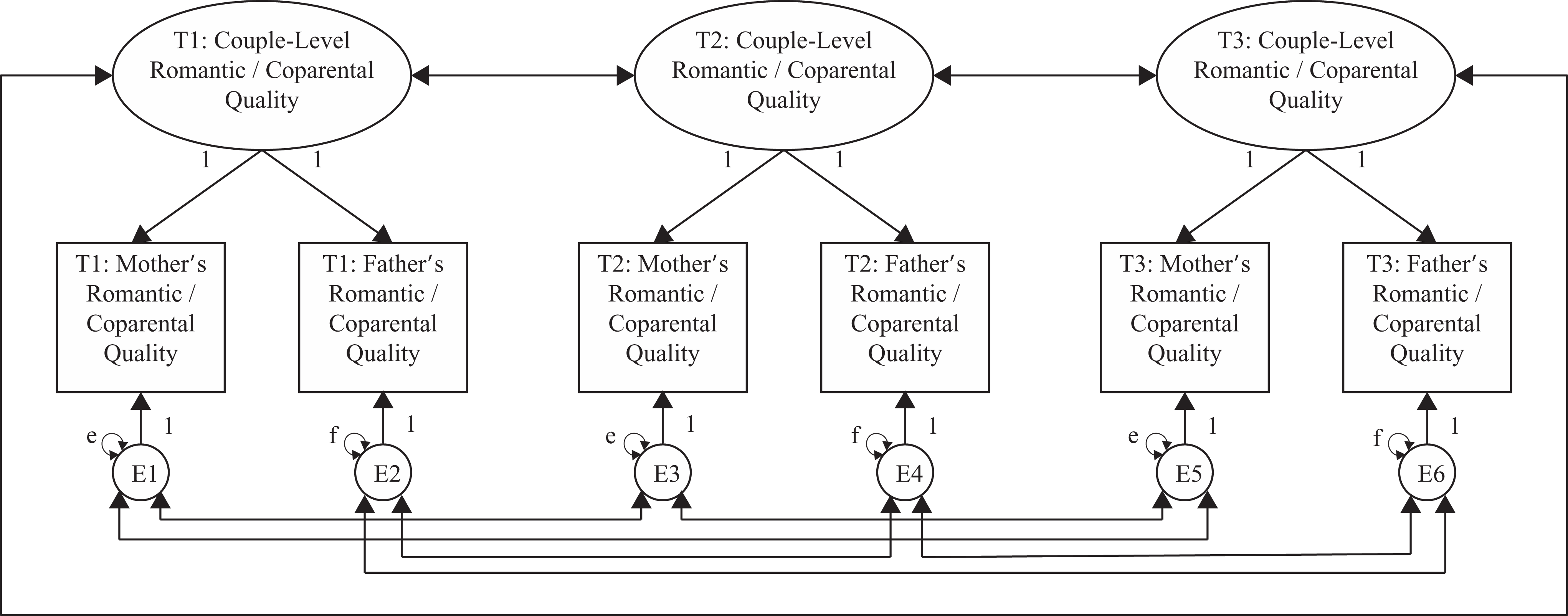
Common fate model of romantic/coparental quality. All loadings of the latent factors were fixed to 1. For mothers, the means were fixed to 0. For fathers, they were constrained to be equal. Due to individual variance, the model included covariances among the three indicators of mothers and among the three indicators of fathers. The error variances were constrained to be equal according to gender (“e” for women, “f” for men).
In the fourth stage, the development of mothers’ and fathers’ self-esteem was investigated through linear growth curved models (Bollen & Curran, 2006), while the development of romantic and coparental quality was analyzed using linear common fate growth models (CFGMs; Figure 2; Ledermann & Macho, 2014).
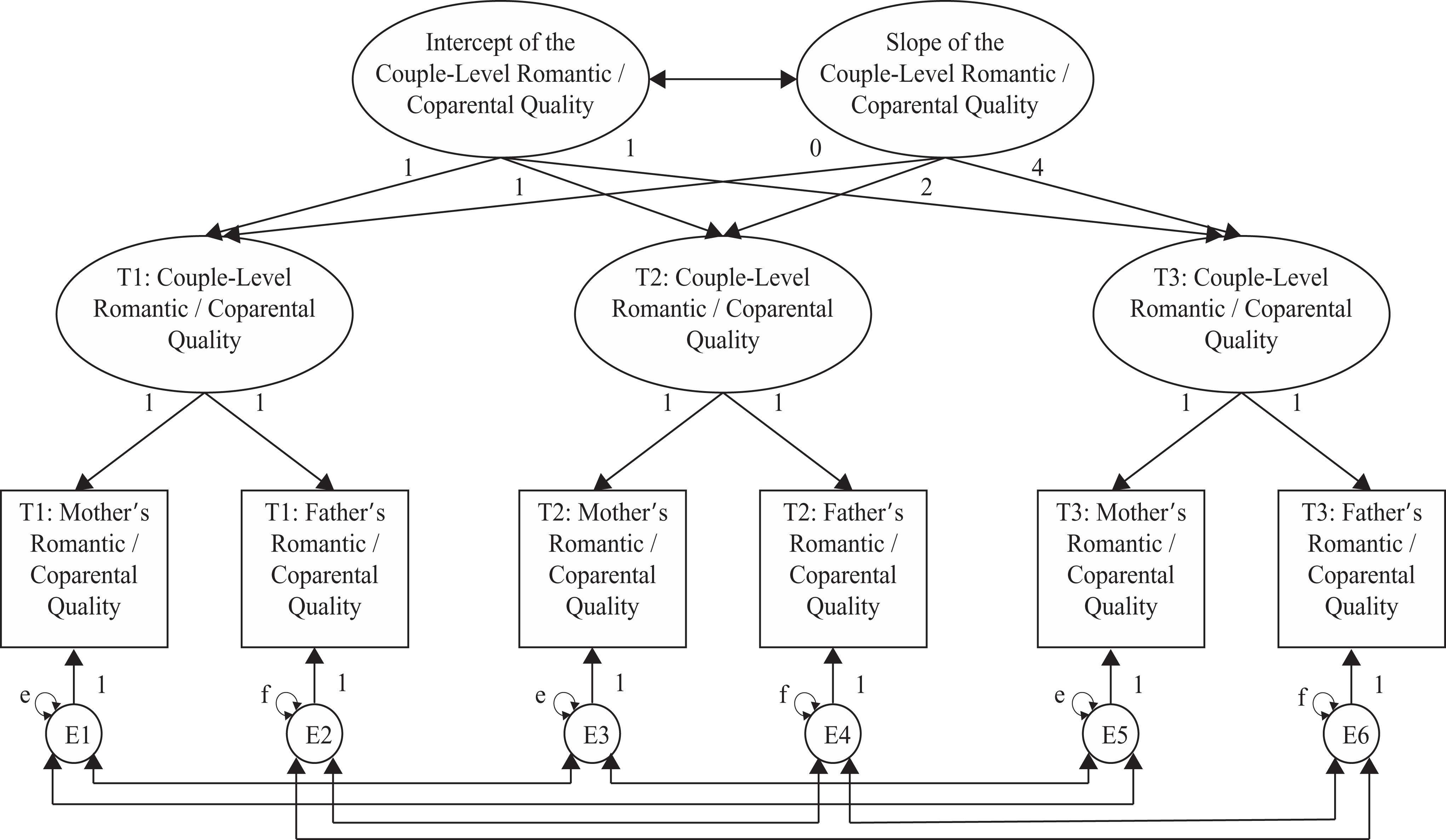
Common fate growth model of romantic/coparental quality. For the latent growth factors, intercept loadings were set to 1, and slope loadings were set to 0, 2, and 4 (because each wave was separated by 2 years).
To test our hypotheses, the self-esteem growth models were combined with the romantic quality CFGM (H1) and to the coparental quality CFGM (H2). For the last hypothesis, the three growth models were integrated.
The R scripts of the models are accessible through the following link: osf.io/rxqtf.
Results
Preliminary analyses
The preliminary analyses showed first that the effect of time could be controlled through the effect of mothers’ age and that the child’s age group did not moderate the results. Thus, families functioned in a similar way whether their child was younger than 5, between 5 years and 11.5 years or older than 11.5 years. Second, it confirmed that romantic and coparental quality are different constructs (for mothers HTMT = .63; for fathers HTMT = .61). Moreover, it established that the romantic quality could be modeled as a shared construct. Indeed, the fit of the related CFM was good, χ2(9) = 4.97, p = .84, TLI = 1.00, CFI = 1.00, RMSEA = .00, meaning that the ways of reporting this construct is interrelated between parents of a same family. The CFM of the coparental quality revealed a good fit as well, χ2(9) = 13.02, p = .16, TLI = 0.99, CFI = 0.99, RMSEA = .01, indicating that it is also a shared construct. Finally, regarding the development of the variables, mothers’ and fathers’ self-esteem appeared to be stable across the three waves. Conversely, a significant decrease was found regarding romantic (β = −.27, p < .001) and coparental quality (β = −.57, p < .001).
Influence of self-esteem on romantic quality
Self-esteem growth factors were set to predict the romantic growth factors (Figure 3). The results indicated a good fit of the model, χ2(57) = 135.16, p < .001, TLI = 0.99, CFI = 0.99, RMSEA = .02, and both mothers’ and fathers’ self-esteem predicted the intercept of romantic quality with a medium effect size (for mothers β = .38, p < .001 and for fathers β = .36, p < .001). Additionally, mothers’ self-esteem predicted the slope of romantic quality, with a small effect size (β = .12 p = .042). Fathers’ self-esteem did not affect the slope of romantic quality (β = .00 p = .985). These results indicate that a higher initial level of self-esteem predicted a higher initial romantic quality for the couple (and thus a higher intercept). Mothers’ self-esteem had a particularly important role, as it also predicted a smaller decline in romantic relationship quality (and thus a more horizontal slope).

Effects of self-esteem on romantic relationship quality. Standardized estimates are reported *p ≤ .05.
Time did not affect mothers’ or fathers’ self-esteem (for mothers β = .01, p = .779 and for fathers β = −.05, p = .085). However, it had a negative effect on the intercept (β = −.14 p < .001) and a positive effect on the slope (β = .19 p < .001) of romantic quality. These results are consistent with the fact that romantic quality declines over time and indicate that the degree of this decline becomes shallower as time increases.
Influence of self-esteem on coparental quality
Similarly, the self-esteem growth factors were set to predict the coparental growth factors (Figure 4). The model’s fit was good, χ2(57) = 94.66, p = .001; TLI = 0.99; CFI = 0.99; RMSEA = .02. Mothers’ and fathers’ self-esteem predicted the initial level of coparental quality, with a small to medium effect size (for mothers β = .28, p < .001 and for fathers β = .25, p < .001), which indicated that parents with high initial self-esteem displayed a higher initial coparental quality. Self-esteem did not influence the development of the coparental relationship (for mothers β = .02, p = .743 and for fathers β = .05, p = .424).

Effects of self-esteem on coparental relationship quality. Standardized estimates are reported *p ≤ .05.
Time did not affect parents’ self-esteem (for mothers β = .01, p = .644 and for fathers β = −.05, p = .080) but had a negative effect on the intercept (β = −.07 p = .013) and a positive effect on the slope (β = .14 p = .002) of coparental quality. Therefore, as time passes, the quality of the coparental relationship continues to decrease but the degree of the decline becomes less steep.
Links between self-esteem, romantic and coparental quality
Based on the above results, two models including the three variables were analyzed. In the first one, romantic quality was set to predict coparental quality. In the second one, the opposite causal directionality was tested: Coparental quality was set to predict romantic quality.
The first model (Figure 5) had an acceptable fit, χ2(128) = 395.39, p < .001; TLI = 0.97; CFI = 0.98; RMSEA = .03. The results indicated that mothers’ and fathers’ self-esteem predicted the initial romantic quality (for mothers β = .37, p < .001 and for fathers β = .35, p < .001). Mothers’ self-esteem also predicted the development of romantic quality (β = .11, p = .037). Regarding coparental quality, its intercept was only predicted by the intercept (β = .75, p < .001) of romantic quality. Similarly, its slope was only predicted by the slope of romantic quality (β = .51, p < .001). Accordingly, a complete mediation was found. These results indicate that both parents’ HSE predicted a higher initial quality of the romantic relationship, which in turn predicted a higher initial quality of the coparental relationship. Mothers’ HSE was also particularly beneficial because it buffered the decrease in romantic quality, which in turn buffered the decrease in coparental quality.
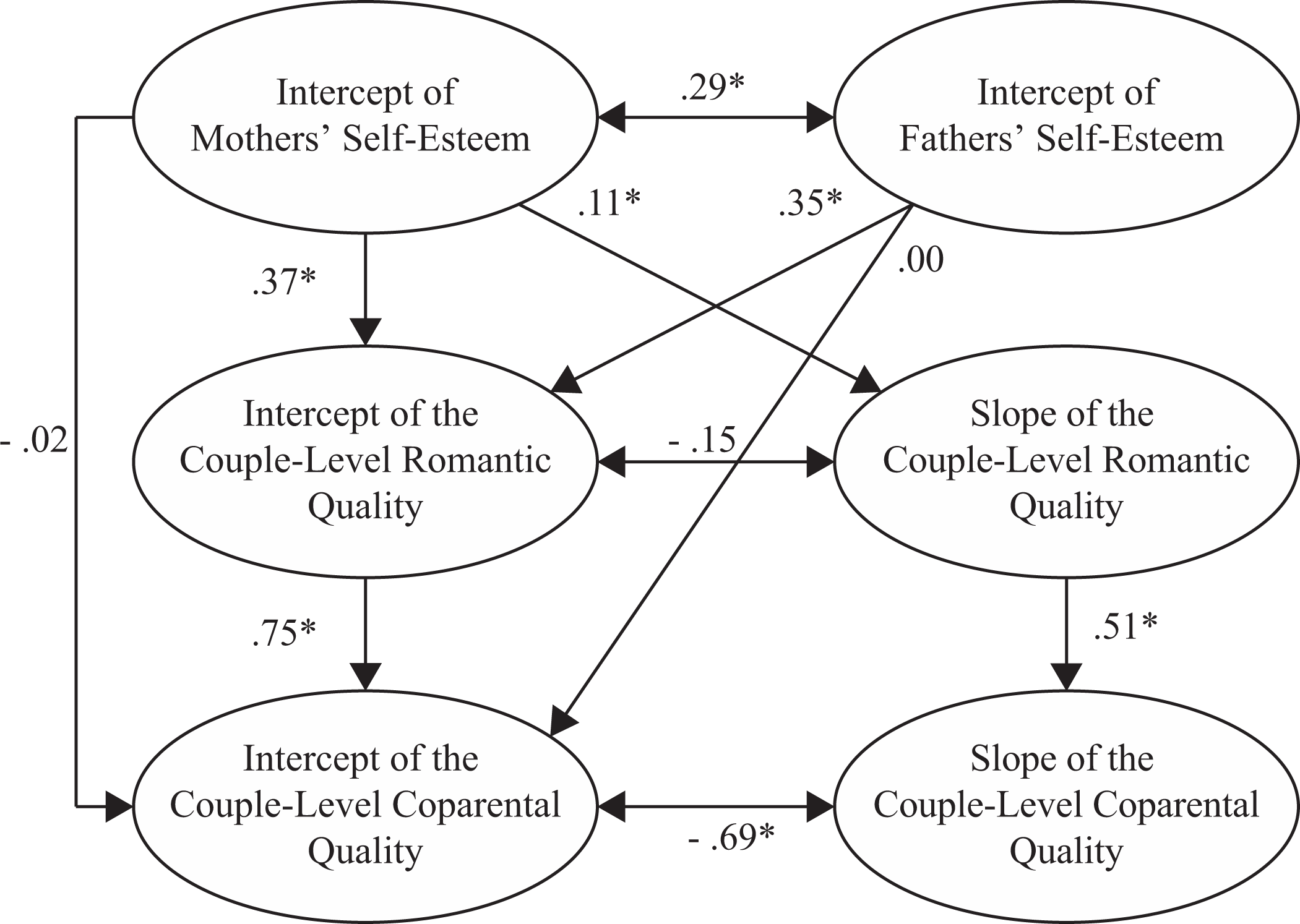
Effects of self-esteem on romantic and coparental relationship quality, model 1. Standardized estimates are reported *p ≤ .05.
Time did not affect parents’ self-esteem (for mothers β = .01, p = .814 and for fathers β = −.05, p = .082); it had a negative effect on the intercept of the romantic quality (β = −.14, p < .001) and a positive effect on its slope (β = .19, p < .001); and it no longer affected coparental quality (for the intercept β = .03, p = .365 and for the slope β = .05, p = .338).
In the second model (Figure 6), coparental quality was set to predict romantic quality, which also led to an acceptable fit, χ2(128) = 407.68, p < .001; TLI = 0.97; CFI = 0.98; RMSEA = .03. In this model, mothers’ and fathers’ self-esteem predicted the initial coparental quality (for mothers β = .31, p < .001 and for fathers β = .28, p < .001) as well as the initial romantic quality (for mothers β = .15, p < .001 and for fathers β = .15, p < .001). Mothers’ self-esteem also predicted the slope of the romantic quality (β = .11, p = .040). The intercept of coparental quality predicted the intercept of the romantic quality (β = .70, p < .05). However, there was no association between their slopes (β = .87, p = .056).

Effects of self-esteem on romantic and coparental relationship quality, model 2. Standardized estimates are reported *p ≤ .05.
Time did not affect parents’ self-esteem (for mothers β = .01, p = .808 and for fathers β = −.05, p = .083). It had a negative effect on the intercepts of coparental (β = −.08, p = .007) and romantic quality (β = −.08, p = .006). Finally, it had a positive effect on the coparental quality slope (β = .23, p = .001) but did not affect the romantic quality slope (β = −.03, p = .835).
Both models were statistically acceptable, meaning that both causal relationships might be adequate. However, when comparing the models through the Akaike’s Information Criteria (AIC) and the Bayesian Information Criteria (BIC), it appeared that the first model fit the data better (model 1: AIC = 61,914; BIC = 62,370; model 2: AIC = 61,927; BIC = 62,382). Therefore, in our sample, romantic quality was a better predictor of coparental quality than vice versa.
Discussion
The aim of this study was to focus on the parental couple and explore the longitudinal links between self-esteem and the development of romantic and coparental quality.
In line with previous findings, self-esteem appeared to be stable (e.g., Trzesniewski et al., 2003) and romantic quality decreased across time (e.g., VanLaningham et al., 2001). However, coparental quality also decreased significantly, which challenges previous findings (Laxman et al., 2013). The difference might be a consequence of the methodology; in the current study, we used a self-reporting questionnaire to assess coparental quality, whereas previous studies have mainly used observational tasks (Laxman et al., 2013; Schoppe-Sullivan et al., 2004; Van Egeren, 2004). Additionally, we evaluated coparental quality through the frequency of disagreements between parents, whereas former studies have focused on supportive and undermining behaviors.
As expected, mothers’ and fathers’ self-esteem predicted the initial level of romantic and coparental quality. These results are consistent with earlier studies showing that HSE represents an advantage for romantic satisfaction (Erol & Orth, 2014) and for the quality of coparental interactions (Lindsey et al., 2005). As discussed in the introduction, a theoretical explanation for these results is that having HSE is linked to greater self-confidence but also greater confidence in one’s partner (Leary & Baumeister, 2000; Murray et al., 2006; Rosenberg, 1965). In the risk regulation model, Murray, Holmes, and Collins (2006) indicate that this is the key to fulfilling relationships because it allows the adoption of relationship-oriented goals. More precisely, feeling secure about the partner’s engagement and love would encourage HSE individuals to fully invest in their couple relationships, while investment by LSE individuals would be held back by fears of rejection (Rill, Baiocchi, Hopper, Denker, & Olson, 2009). Furthermore, in case of external strains, HSE individuals will use their romantic relationship as a self-affirmation resource, which not only helps repair the pain felt but also promotes the quality of the relationship (Murray et al., 1998). LSE individuals’ lack of confidence does not allow such a reaction. Instead, external strain incites them to preventively withdraw from the relationship.
In the coparental relationship, the complexity of the dynamics is enhanced because the relationship is, in essence, triadic (or polyadic if the couple has more than one child). Individuals may need to be secure about their partner’s love but also about their child’s love. Both of these are problematic for LSE individuals (DeHart, Murray, Pelham, & Rose, 2003; Murray, Holmes, Griffin, Bellavia, & Rose, 2001) and might have multiple consequences for the coparental relationship. For example, parents with LSE may fear that their child prefers the other parent, which could encourage them to disregard the agreed rules in order to become the preferred parent. This may explain why LSE parents engage in a higher number of coparental conflicts and dismissive behavior. It also corroborates previous findings showing increased competition between parents with LSE (Gaunt, 2008).
We expected self-esteem to affect the trajectories of the romantic and coparental quality. The results indicated that mothers have a unique role: their self-esteem has a direct effect on the former and an indirect effect on the latter. Indeed, in the complete model retained, dyads in which mothers had HSE presented a lower decline in romantic quality, which in turn reduced the decline in coparental quality. Accordingly, mothers’ self-esteem buffered the negative development of romantic and coparental quality. These results are consistent with other findings showing that mothers’ psychological well-being is particularly important for healthy family interactions (Korja et al., 2015). The importance of mothers’ self-esteem may have evolutionary and/or social reasons. As human children are born immature and need high maternal investment, women may have specialized in family care (Paquette, 2004). Another possibility is that the education given to girls emphasizes sociability and adaptation to others (Loscocco & Walzer, 2013), therefore reinforcing the active role of women in relationships (Erickson, 2005). When women experience low psychological well-being (such as LSE) it may impede this tendency (Shackelford, 2001; Wood, Heimpel, Manwell, & Whittington, 2009) and could have important consequences for family relationships.
Finally, in the complete models, the causal direction between the two outcomes was investigated. The results indicated that romantic quality was a better predictor of coparental quality than vice versa, and the effect of self-esteem on coparental quality appeared to be indirect: it passed through romantic quality. Thus, our results show that HSE parents report more positive behaviors in their romantic relationship (such as supporting and trusting their partner), which in turn reduces the negative behaviors associated with the coparental relationship. Conversely, LSE individuals (who may be more sensitive to negative cues) reporte lower romantic quality, which in turn impede the coparental relationship.
If we refer to the risk regulation model (Murray et al., 2006), having HSE should lead to a greater feeling of security in the romantic relationship and this security may represent a strong base which supports the positive development of the coparental relationship. For LSE individuals, this base may have already been eroded, which could complicate the emergence of trustworthy coparental interactions. Noticeably, although the first model better described the data, the second one still had an acceptable fit, indicating the probable presence of bidirectional links between romantic and coparental quality as described by Le, McDaniel, Leavitt, and Feinberg (2016). For example, one could expect the direction of the link to be reversed if parents experience the transition to parenthood (or another life stage) as a crisis, and hard to overcome: in the long run, the difficulties encountered in the coparental relationship might in turn endanger romantic quality (Belsky & Hsieh, 1998).
Limitations and future directions
This study has some limitations. First, self-esteem is measured with only 3 items based on the Rosenberg scale instead of the complete measure (Rosenberg, 1965). Consequently, the reliability is smaller (Robins, Hendin, & Trzesniewski, 2001). However, according to a study on the structure of the Rosenberg scale, it can be shortened without altering its validity (Gray-Little, Williams, & Hancock, 1997).
Similarly, coparental quality is measured with only 3 items, all of which concern negative aspects of the relationship. Theory and empirical results indicate that coparental conflict and coparental support are two different dimensions, rather than two ends of the same scale (Forehand, Parent, Golub, & Reid, 2015; McHale, Kuersten-Hogan, & Rao, 2004). Thus, future research should explore the longitudinal effect of self-esteem on positive coparenting. Expanding the knowledge of supportive coparenting could help us understand the mechanisms through which self-esteem can have an influence: Does HSE inhibit only negative coparenting, or does it also enhance the frequency of positive coparenting? Is it the same for mothers and fathers? Parents may not coparent in the same way: for example, a cross-sectional study found that HSE among mothers was associated with more supportive coparenting but not with less intrusive coparental behaviors, while the opposite relationship was found for fathers (Lindsey et al., 2005).
The sample included families with children of very different ages. Although the statistical controls indicate that a single pattern of links between the variables suited all families, (no matter the child’s age) it would be necessary to verify whether similar results are retrieved with more homogeneous samples. Accordingly, the present study represents a first attempt to understand the longitudinal effects of self-esteem on parental couple relationships. Future studies could use cross-lagged panel models. This would increase our understanding of the causal relationships between the variables.
Furthermore, the analyses used allow the extracting of models that fit the whole sample. However, all families may not function the same way. Previous findings using cluster analyses indicate that some couples stay stable throughout time and do not experience a decrease in romantic quality (Belsky & Hsieh, 1998; Kamp Dush, Taylor, & Kroeger, 2008). This stability may also affect the development of coparental quality. Future studies should investigate the existence of different developmental patterns in order to have an in-depth understanding of the link between self-esteem and the parental couple relationships. Additionally, studies focusing on specific populations could help us understand if self-esteem continues to be a significant resource for families with heightened challenges (for example, in the presence of disabilities). Previous findings seem consistent with this perspective. For example, Trute, Hiebert-Murphy, and Levine (2007) showed that in families with a disabled child, parents’ self-esteem was associated with long-term family adjustment. However, this type of research is still rare and further effort should be given to understand the role of parental self-esteem in families facing hardships.
Implications for practice
Several studies have shown that interventions focusing on improving self-esteem are useful for individual outcomes (Pack & Condren, 2014; Staring et al., 2016). Future interventions should take a step further and consider the effect of self-esteem regarding family outcomes. According to the present results, taking self-esteem into consideration could be relevant for prevention programs and for therapeutic treatments developed to help families facing romantic and coparental difficulties (Feinberg, Jones, Kan, & Goslin, 2010; Ireland, Sanders, & Markie-Dodds, 2003). One of the goals of these family interventions would be to acknowledge the difficulties associated with LSE and to work on them when needed. It also appears that further attention should be given to mother’s self-esteem, given the central role that it seems to have for the positive development of the parental couple.
Helping LSE parents to acknowledge the love and positive regard of their partner and child could inhibit self-protective goals, which adversely impact the couple relationships (Murray et al., 2006). For example, previous findings showed that a reframing intervention wherein low-self-esteem individuals are asked to explain why their partner admires them had beneficial effects. Indeed, it promoted the positive perception of the romantic relationship (Marigold, Holmes, & Ross, 2007) and decreased the negative behaviors displayed by the partners (Marigold, Holmes, & Ross, 2010). These results indicate that the weaknesses of LSE individuals can be overcome, which is promising and should be expanded to the coparental relationship. Furthermore, this type of intervention can be conducted individually and should be adjusted for families with deeply rooted issues, where partners are no longer able to communicate without conflict.
Conclusion
Self-esteem is a resource for the parental couple as mothers and fathers with HSE report higher romantic and coparental quality. Furthermore, the effect of self-esteem on coparenting appears to pass through the romantic relationship as mediating effects were found. Finally, mothers’ HSE has a crucial role, as it reduced the decline of romantic quality, which in turn fostered the positive development of coparenting quality.
Supplemental material
Supplemental_material - Is self-esteem a resource for the parental couple? A longitudinal study on the quality of the romantic and coparental relationships
Supplemental_material for Is self-esteem a resource for the parental couple? A longitudinal study on the quality of the romantic and coparental relationships by Nahema El Ghaziri, Joëlle Darwiche and Jean-Philippe Antonietti in Journal of Social and Personal Relationships
Footnotes
Funding
The author(s) received no financial support for the research, authorship, and/or publication of this article.
Open research statement
As part of IARR’s encouragement of open research practices, the authors have provided the following information: This research was not pre-registered. The data used in the research are available. The data can be obtained at:  or by emailing:
Supplemental material
Supplemental material for this article is available online.
References
Supplementary Material
Please find the following supplemental material available below.
For Open Access articles published under a Creative Commons License, all supplemental material carries the same license as the article it is associated with.
For non-Open Access articles published, all supplemental material carries a non-exclusive license, and permission requests for re-use of supplemental material or any part of supplemental material shall be sent directly to the copyright owner as specified in the copyright notice associated with the article.
