




Abstract
The theory of resilience and relational load was used to examine the impact of voting patterns in the 2016 U.S. presidential election on individuals’ romantic relationships. Married/cohabitating individuals (N = 961) completed online surveys at three time points during the transition to the Trump Presidency. The results supported our emotional capital hypothesis in that ongoing relationship maintenance in one’s relationship predicted less stress about the Trump presidency, less conflict, less relational load, greater communal orientation, and greater relational resilience. The positive effect of ongoing relationship maintenance on these relational outcomes occurred regardless of how the partners voted. At the same time, voting differently than one’s partner was still stressful and negatively influenced these outcomes. The results also supported our relational load model, which found that differences in voting negatively affected individuals’ communal orientation and the degree to which they maintained their relationships, which fueled conflict and stress. This conflict and stress was associated with an increase in relational load and a decrease in relational resilience.
Keywords
Romantic partners are more likely to be satisfied and committed to their relationship when they have similar core values and beliefs (Davis & Rusbult, 2001; Schul & Vinokur, 2000). One context in which these core values and beliefs are challenged, and with increasing frequency, is politics. Given the political polarization surrounding the 2016 presidential election, couples who voted along different party lines likely experienced a significant amount of conflict during that election. In fact, Wakefield (2017) found that 11% of couples ended their relationship after the 2016 presidential election due to deep political disagreements, with that rate rising to 22% among millennials.
Few theories, however, can explain why differing political views foster stress and conflict in romantic relationships and why some romantic partners are able to ward off stress and conflict and even thrive in their relationship despite having vastly different political views. Having dramatically different political affiliations likely makes some romantic partners feel less emotionally connected and unified, which should affect the degree to which they want to invest in their relationships or maintain them. As political conflict has increased in the U.S., political groups have spent less time interacting with one another, which is critical to disrupting prejudice (Mason, 2015). Similar emotional distancing behaviors could be occurring within romantic relationships when partners have different political affiliations. Although research has found an increase in affective polarization and subsequent negative effects for the public (e.g., Iyengar, Sood, & Lelkes, 2012), much less research has focused on how political differences impact romantic relationships. Yet, effectively addressing differences in core values and beliefs, like political differences, in romantic relationships is crucial for the relationships to thrive.
Using the theory of resilience and relational load (TRRL) (Afifi, Merrill, & Davis, 2016) as a framework, the current study examines the impact of voting patterns in the 2016 presidential election on individuals’ romantic relationships at three time points during the transition to the Trump presidency: 2 weeks before the presidential inauguration, a day after the inauguration and 1 month after the inauguration. Specifically, we test two competing models. In the relational load hypothesis, we contend that romantic partners who voted differently in the 2016 presidential election felt less unified or communally oriented with their partners, making them less likely to invest in their relationships over time. Not maintaining their relationships probably then fostered a deeper emotional disconnect, fueling stress and conflict in their relationships and ultimately affecting relational resilience and relational load (i.e., the wear and tear on romantic relationships as a result of chronic stress and conflict in the relationship).
Yet, based upon what researchers know about resilience (e.g., Patterson, 2002), it is equally possible that some relational partners are resilient no matter what stressors they face, including voting for different political parties. As such, we present a competing emotional capital hypothesis that argues that ongoing, proactive relationship maintenance can help individuals in romantic relationships view events, like the 2016 presidential election, as less stressful in the first place. Ongoing relationship maintenance likely enables these individuals to sustain strong relationships over time, irrespective of voting differences. These relationships are likely already strong and have built resilience through relationship maintenance over time, protecting them from any stressors that come their way. In this sense, the hardiness and positivity that is created in these relationships through ongoing relationships maintenance shields them from stress and begets further positivity.
Political ideology and romantic relationships
According to a recent Gallup poll, 77% of Americans believe the country is severely divided (Jones, 2016). To make matters worse, the typical election season in the U.S. is approximately 19 months and generally dominates the news during that time (Parlapiano, 2015), making it almost impossible for relational partners with differing political ideologies to avoid political discussions. Political ideology refers to a system of beliefs, propagating a connection to others who share that same system of beliefs (Converse, 2006). Individuals are more likely to be attracted to others who share the same political ideology (Kofoed, 2008; McDermott, Tingley, & Hatemi, 2014), although many are willing to enter into a relationship with differing political ideologies based on other factors (Kofoed, 2008). Further, voter turnout is generally highly related to the shared political ideology of spouses (Hersh & Ghitza, 2016). Stoker and Jennings (1995) contend that this increased voter turnout is an outcome of one relational partner being less interested in politics than the other partner, making them more likely to simply follow the party identification of their partner. If this argument is correct, it stands to reason that romantic partners who vote differently highly identify with their chosen political ideology.
Even though we are not focusing on political identity in the current investigation, it is important to understand the role of political identity in shaping couples’ emotional reactions to different voting patterns. Partisanship is a voluntary group membership, but it functions as a stable social identity (Green, Palmquist, & Schickler, 2004) and can be understood as an emotional attachment to a political party (Campbell, Converse, Miller, & Donald, 1960). Given this attachment, individuals could feel polarized and harbor negative emotions and distrust toward the political outgroup (Munro, Lasane, & Leary, 2010; Warner & Villamil, 2017), even if the “outgroup” is their romantic partner. Ideological identity takes into account the uniquely social connection that politics may provide to partisans (Mason, 2015). This includes strongly identifying as either a “liberal” or a “conservative,” measured by examining an individual’s psychological attachment to the partisan group. This might be conceptualized as the connection to a social network or community. Conversely, issue-based identity considers the social attachment that partisans may feel to one another with regard to a particular issue (McGarty, Bliuc, Thomas, & Bongiorno, 2009). This identity is developed upon particular policies that have personal value to the individual.
The 2016 presidential election presented couples with unprecedented levels of division nationally, locally, and interpersonally. For couples who voted differently, the election may have had relational effects by prompting conflict and stress. Even though little research has examined the relational consequences of the 2016 presidential election, research shows that stress may either have a positive or negative effect on couples depending on individuals’ willingness to show respect and empathy toward their partner (De Wied, Branje, & Meeus, 2007). For example, Porter and Schumann (2017) found that when dyads approached a political disagreement with a growth mindset, they were more open to hearing their partner’s opposing argument. Understanding how couples can better manage conflict and stress through strategies such as relationship maintenance and feelings of communal orientation could be a critical step for couples who are struggling to manage the stress created from a contentious political climate, promoting resilience. Ongoing relationship maintenance could also help relational partners build positivity that allows them to deflect the political stress, even if they voted for presidential candidates from different political parties. The relationship maintenance might make it so that their voting differences no longer matter.
The TRRL
Despite the stress and conflict that may have been sparked by the 2016 presidential election, some couples likely managed the stress better than others. The TRRL (Afifi et al., 2016) provides an explanation for differences in the way couples managed potential stress and conflict produced by the election. Rooted in the theory of emotional capital (Feeney & Lemay, 2012; see also Driver & Gottman, 2004), the TRRL states that relational partners (and family members) who maintain their relationships on a regular basis through prosocial verbal and nonverbal behaviors and actions build emotional reserves or emotional capital that they can then draw upon when they are stressed. Examples of these behaviors include hugging or kissing, verbal validation, such as saying “I love you,” expressing gratitude, doing something nice for the other person, and spending quality time together (Canary, Stafford, Hause, & Wallace, 1993; Merolla, 2010, 2017). These “investments” help protect the relationship during stress and foster resilience. Even though the TRRL can be used to explain individual and relational/family resilience, given our emphasis on romantic relationships, we focus on relationship resilience or individuals’ beliefs that their relationship can overcome, control, and positively adapt to life’s challenges.
The TRRL also outlines who is likely to effectively maintain their relationships in the first place. Specifically, the TRRL argues that when couples are communally oriented or perceive of themselves as a team in combatting their stressor and life’s challenges in general, they want to invest in their relationships (Afifi et al., 2016). This relationship is reciprocal, however, because when people invest in their relationships, it makes them feel more unified. The TRRL suggests that when couples actively maintain their relationship and have a communal orientation, it helps them perceive events as less stressful in the first place and when something stressful does occur, it helps them manage it. Instead of viewing problems individually, couples with a communal orientation view themselves as a team in their ability to combat them (Afifi et al., 2016). In times of need, individuals who are more communally oriented feel less alone, more emotionally supported, and have greater coping efficacy (Agnew & Etcheverry, 2006; Finkel & Rusbult, 2008). This communal orientation cultivates a sense of similarity, bonding, and trust, which encourages partners to invest in their relationships by maintaining them. The increased maintenance builds emotional capital and a stronger communal orientation (Afifi et al., 2016).
The combination of communal orientation and relationship maintenance impacts how couples communicate when they are stressed, as well as how they appraise stressors (Afifi et al., 2016, 2018). When couples do not feel emotionally connected or take the time to invest in their relationships, their primary motivation is to protect themselves when they are stressed rather than their partner or their relationship; they see their partner as a “threat” rather than a source of “security” during stressful and conflict-inducing situations. When couples maintain their relationships and feel communally oriented, they are more likely to turn toward each other rather than away from each other during conflict (see also Driver & Gottman, 2004; Feeney & Lemay, 2012; Gottman, Swanson, & Swanson, 2002). Research shows that when couples are highly stressed and dissatisfied in their relationships, they tend to engage in attributional errors and blame their partner for their stress rather than external forces (Sillars, Roberts, Leonard, & Dun, 2000) and are more likely to communicate a lack of respect toward their partner (e.g., criticism, contempt, defensiveness) (Driver & Gottman, 2004). On the other hand, couples who have invested in their relationships and feel unified are more likely to validate, uplift, and protect their partner and their relationship during conflict and blame outside sources for their stress (Afifi et al., 2018). When couples have accrued emotional reserves, they are more likely to appraise their stress from a positive, broader mindset (see also broaden and build theory; Fredrickson, 2001) and communicate with their partner in ways that exude this positivity. These secure appraisals and communication patterns build relational resilience.
The TRRL states that resilience is a predictor and an outcome, but it is primarily a process of calibration. Couples must continually gather feedback from each other about their stress, how they are adapting to it, and how they can improve their communication to manage it (Afifi et al., 2016). Investing in one’s relationship through relationship maintenance is a primary way couples manage stress and create resilience. According to the TRRL, relationships require consistent and conscious effort to thrive. When couples take time to invest in their relationship on a regular basis, they begin to perceive and experience stress differently. Events that are overwhelming when approached alone begin to feel less stressful for couples who invest in each other and approach their stressors together. Couples also enter into stressful experiences with varying degrees of resilience, which is created through the communicative management of prior stressors. Each stressful situation couples face can develop and refine their resilience by helping them learn the best way to approach and perceive certain stressful events (Patterson, 2002). Because resilience is socially constructed, couples can take steps to reinvigorate their relationship as a way to proactively adapt to stress, as long as they are motivated to do so.
Chronic conflict and stress, however, can slowly wear away at the relationship over time and produce relational load if partners do not invest in their relationships. If stress and negative conflict patterns continue for long periods of time, it can slowly wear away at the relationship, creating relational burnout (Afifi et al., 2016). Constant stress and conflict deplete one’s relational, cognitive, and emotional resources, ultimately harming one’s personal and relational health and propensity for resilience and thriving. Similar to the notion of allostatic load, or the influence of chronic stress on the body’s physiological stress response systems (see McEwen, 1998, 2001), relationships can also become fatigued and experience burnout from being exposed to chronic stress and conflict.
Applying the TRRL to politics
According to the TRRL (Afifi et al., 2016), couples who voted differently in the 2016 presidential election might have had a difficult time sustaining a strong communal orientation and a willingness to invest in one’s relationship without a large bank of emotional reserves to rely upon. The “stressor” is not typically included in the TRRL as a predictor of relationship maintenance or communal orientation because it is usually the “thing” that couples or family members are attempting to manage. However, the stressor in this case is voting differently in the 2016 presidential election than one’s partner, which, given the polarizing political environment at the time of the election, likely affected partners’ perceptions of communal orientation. Their voting patterns probably reminded them of the fact that they are dissimilar or similar from each other on fundamental issues. In today’s climate of political polarization, it might have felt as if they lacked communal orientation because the voting differences were indicative of a lack of unity in core values and beliefs, prompting them to invest less in their relationship than couples who voted similarly. As a result, similarity/differences in voting patterns within romantic relationships is included as a predictor in our “relational load” model depicted below.
Strong connections to political identities like “liberal” and “conservative” often generate hostile feelings toward the opposing group (Iyengar & Westwood, 2015). Thus, managing different political ideologies can complicate feelings of communal orientation. When a romantic partner is part of an opposing group, the relationship can experience strain over time. Recurring stress and conflict because of the political differences with one’s partner and lack of relationship maintenance could deplete one’s relational, psychological, and emotional resources, placing burden on the relationship. Partners must continually invest in their relationships to prevent relational load and invigorate their relationship.
When there is a lack of communal orientation and relationship maintenance, it might signal to romantic partners that they are not supported by their partner emotionally, prompting them to begin to think negatively about the relationship as a whole and communicate in ways that project those perceptions (Agnew & Etcheverry, 2006; Finkel & Rusbult, 2008). For some couples, this might mean avoiding the topic of politics to sustain their relationship. Topics such as politics are often avoided because of their tendency to generate conflict (Dailey & Palomares, 2004). Avoidance of political discussions, however, might be a reason why couples who voted differently felt less communally oriented, threatening their ability to communicate effectively with one another. Because relational partners might have avoided talking about politics if their partner voted differently than them in the 2016 election, we do not focus on conflict specifically about the election in this manuscript. We instead focus on election-related stress and general conflict patterns because even if relational partners avoided talking about politics, negative emotions related to the election probably revealed themselves indirectly in other conflicts.
During conflict, couples must find a way to communicate with one another in a way that signals respect and empathy. Porter and Schumann (2017) found that when individuals with strong political perspectives were willing to recognize the limits of their knowledge and showed appreciation for their opposition’s position, they were better able to engage in constructive conflict. This intellectual humility can be fostered by cultivating a growth mindset, which includes a willingness to be influenced by one’s partner (Gottman, Coan, Carrere, & Swanson, 1998). When partners are able to approach major disagreements with intellectual humility, they are more likely to resolve the conflict and feel higher levels of closeness (Porter & Schumann, 2017). It is well established that communicating appreciation and respect during conflict, rather than communicating behaviors like criticism, contempt, and defensiveness, have the ability to promote resilient relationships (Gottman et al., 1998). The ability to successfully manage conflict may be difficult in the face of major political differences, especially during the transition to the Trump presidency when people were highly polarized.
With the TRRL (Afifi et al., 2016) in mind, we present two competing hypotheses in the current study: (1) the emotional capital hypothesis and (2) the relational load hypothesis. The emotional capital hypothesis suggests that the degree to which individuals give and receive maintenance behaviors and actions over time affects how they perceive stress and adapt to it. Specifically, we contend that individuals who better maintain their romantic relationships leading up to, and throughout, the transition to the Trump presidency will experience (a) less stress related to the election and new presidency, (b) less conflict, (c) less relational load, and (d) greater relational resilience. In this sense, relationship maintenance, both given and received, acts as a main effect for perceptions of stress and resilience because relational partners’ emotional capital helps them perceive events as less stressful and more manageable than relational partners who have less emotional capital. Even though voting differently than one’s partner is likely to be stressful and potentially conflict inducing, investing in one’s relationship should minimize these effects and safeguard the relationship regardless of voting differences. The positivity and “hardiness” created in the relationships from ongoing maintenance should make it so that these couples are relatively stable over time; voting differences should no longer matter. Therefore, the main effect for relationship maintenance (given or received) should hold true regardless of how relational partners voted. When this relationship maintenance continues to occur over time, it should further “ward off” stress related to the election and keep the relationship strong. As a result, for this hypothesized model, we examine the associations among relationship maintenance and the outcomes at all three time points (with relationship maintenance at Time 1 measured as the 30 days prior).
In contrast, the relational load hypothesized model specifies the ways in which voting for a different political party could break down the processes that otherwise build resilience. As it is presented in Figure 1, this model suggests that couples who voted differently from each other in the 2016 presidential election (T1) may have struggled to understand one another and felt less communally oriented as a result (T1), decreasing their motivation to invest in their relationships by maintaining them (or giving less maintenance to one’s partner), which fueled stress and conflict (T2 and T3). For this reason, we focus on relationship maintenance given to one’s partner only rather than received in this model. Investing less in their relationships also likely made them feel less communally oriented (T3). Ultimately, increased stress related to the election and general conflict (T3) likely contributed to relational load over time (T3). Conversely, individuals who voted similarly probably felt more communally oriented toward one another and better maintained their relationships as a result, further strengthening their sense of unity (T3). Their higher levels of communal orientation and relationship maintenance should, in turn, predict less stress related to the election and less conflict, fostering relationship resilience and minimizing relational load (T3). Nevertheless, it is possible that feeling communally oriented toward one’s partner and actively maintaining one’s relationship makes people feel resilient, regardless of the levels of stress and conflict (still allowing for the possibility of direct associations with resilience). Finally, even though relationship maintenance is typically the focal point of the TRRL, the primary mediating variable in the hypothesized model is communal orientation. The similarity in one’s core values and beliefs is challenged with different voting patterns, making communal orientation the defining construct underlying the relational load model.
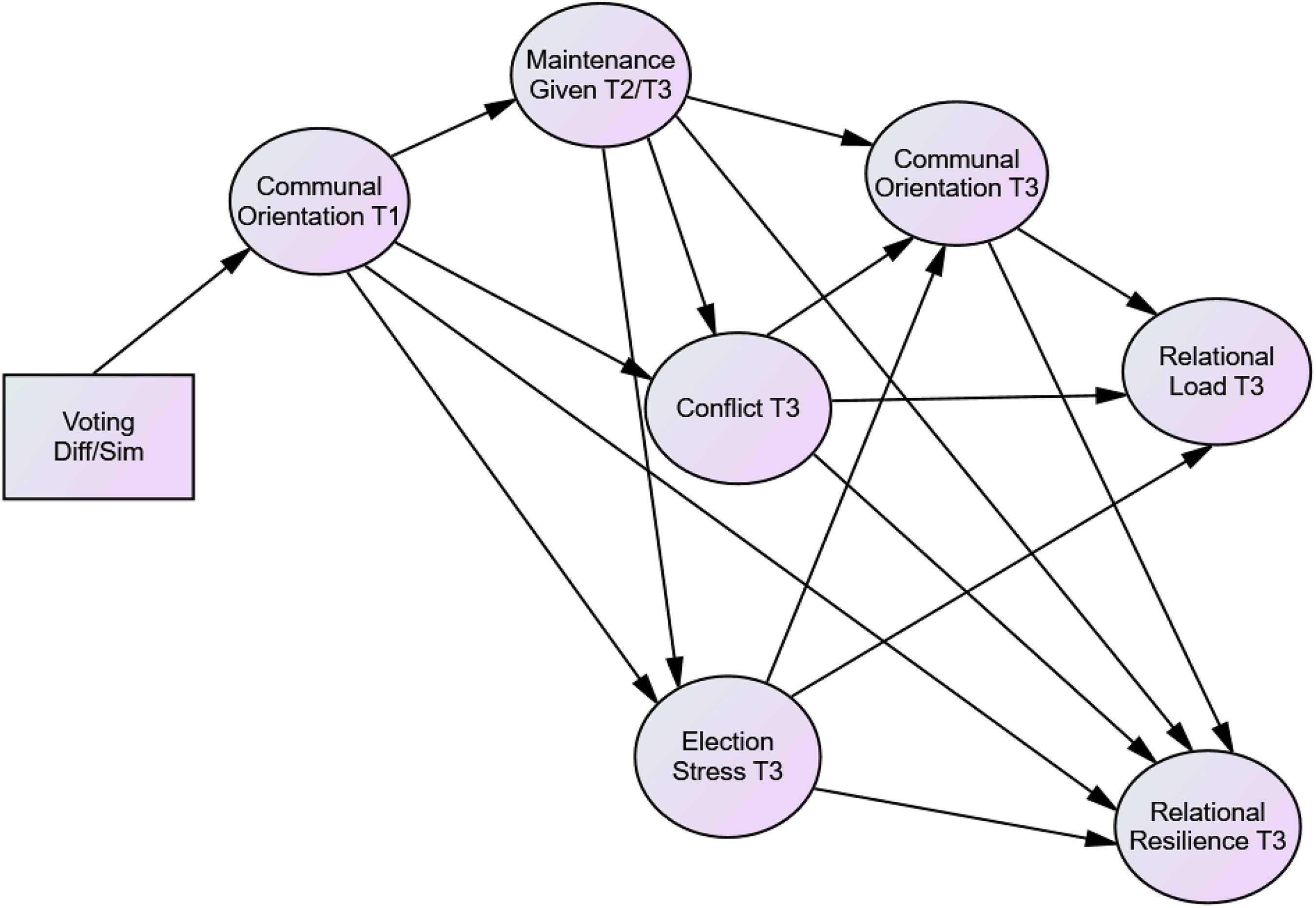
Relational load hypothesized model.
Method
This study used a longitudinal panel of married and cohabitating individuals. Participants completed surveys on all of the variables at three time points during the presidential transition: 2 weeks before the inauguration of President Trump (January 7, 2017), the day after the inauguration (January 21, 2017), and 1 month into the presidency (February 21, 2017).
Participants
The sample consisted of 961 married or cohabitating individuals from across the U.S. The participants ranged in age from 19 years to 74 years (M age = 36). The majority of them were female (N = 652; 68%), in a heterosexual relationship (n = 922 or 96% were in heterosexual relationships; n = 39 or 4% were in same-sex relationships) and White (N = 724, 75%), but 8% identified as Black, 6% as Asian, 5% as Hispanic or Latino, and 5% as Multiethnic. The largest proportion of participants resided in the southern U.S. (39%), followed by the Midwest (24%), Northeast (18%), and West (17%). Many were college educated (37%), had a master’s degree or a doctorate (PhD, JD, MD; 19%), some college (21%), an associate’s degree (12%), or a high school degree (11%). Romantically, more than half of the individuals reported being married (n = 506; 53%), while the rest were cohabitating but not married (n = 455, 47%). The average relationship length was 9 years (range = 1 month to 50 years).
Politically, the majority of participants reported identifying with the Democratic party (43%), followed by Independent (27%) and Republication (26%) parties. Voting patterns differed slightly from this political identification: 42% reported voting for Hillary Clinton (the Democratic candidate), 32% reported voting for Donald Trump (the Republican candidate), and the remainder voted for third parties—Gary Johnson (7%) or Jill Stein (2%)—or did not vote (11%). In addition, 34% self-identified as “liberals,” 32% self-identified as moderates, and 31% self-identified as conservatives. The sample thus reflects the spectrum of political identities and includes a relatively equal representation of perspectives.
The majority of the individuals reported that their partner voted for the same candidate as them (n = 628; 65%), with the majority voting for Clinton (n = 302; 32%) or Trump (n = 228; 24%). The most polarized voting behaviors (e.g., voting for Trump and Clinton) was observed in only 8% (n = 73) of the sample. The rest of the sample included individuals who voted for Trump or Clinton with a partner who did not vote (10%; n = 94), an individual who voted for Trump or Clinton but had a partner who voted for a third-party candidate (e.g., Jill Stein or Gary Johnson; 6%; n = 57), or neither the participant nor the partner voted (n = 64; 7%). Over the three waves, there was only 11% attrition (n = 106). In this manuscript, we only include the 855 participants who completed wave 1 and at least one of the other waves. To enhance validity, the final N reported here also only includes participants who spent enough time completing the surveys, whose demographic questions aligned with each other and the screening questions, and who correctly answered open and closed-ended, attention-checking questions.
Procedures
The participants were recruited through Amazon’s Mechanical Turk (mTurk) via TurkPrime. The study was posted as one examining the 2016 presidential election. Participants were screened using three criteria (1) currently being in a cohabitating or marital relationship, (2) having knowledge of their partner’s voting behavior (i.e., their partners told them how they voted or that they did not vote), and (3) they currently lived in the U.S. If participants met these requirements, they were contacted to complete the study. The first wave of survey items was worded to refer to their perceptions and behaviors since the election on November 8. In the second wave, items were tailored to include the inauguration and the events surrounding the inauguration and their perceptions and behaviors since the last survey. The third wave asked participants to reflect on the first 30 days of Trump’s Presidency. Participants were paid US$5.
Measures
Voting differences
Voting differences were examined in two ways. As a more liberal estimate voting similarities and differences, we first grouped together participants into the “voted different” category (n = 192 or 23%; dummy coded as 0) if they voted for Trump and their partner voted for Clinton and vice versa, they voted for Trump or Clinton and their partner voted for someone from a different political party, or they voted for a candidate and their partner did not vote. Participants were grouped into the “voted similarly” category (n = 662 or 77%; dummy coded as 1) if they voted for the same presidential candidate or they voted for Trump or Clinton and their partner voted for a candidate from a similar political party. We then tested our hypotheses using a more conservative approach in which we categorized participants as different if they voted for Trump and their partner voted for Clinton and vice versa compared to participants and their partners who voted exactly the same. The analyses yielded the same results. Consequently, we decided to use the more liberal estimate with a greater number of participants in all of the analyses to preserve power.
Relationship maintenance
Relationship maintenance was measured with a revised version of Feeney and Lemay’s (2012) chronic emotional capital scale. The original measure asked participants about the degree to which their partners engaged in a variety of positive behaviors and actions with them over the past month with 11 items (e.g., complimented me, told me he/she loves me, hugged me, kissed me, made me laugh, said “thank you,” held my hand). Eight items were added to this scale that assessed additional maintenance actions and behaviors (e.g., was affectionate with me, did something thoughtful for me, had dinner with me). In addition to maintenance received, we also reworded this scale to reference the amount of maintenance the participants gave to their partner. The items were used to measure chronic maintenance over the past month (given and received) in Survey 1. Surveys 2 and 3 used the same scales, but asked about the amount of chronic maintenance given and received since the last survey. The Likert-type scale ranged from 1 “not at all” to 7 “a great deal.” The items were averaged to create scales for maintenance received (T1 α = .96; T2 α = .96; T3 α = .97) and maintenance given (T1 α = .96; T2 α = .95; T3 α = .96), with higher numbers indicating a greater degree of maintenance. The correlations between maintenance given and received at time points 1–3 ranged from .58 to .85.
Communal orientation
Eleven items from Afifi, Merrill, and Davis’s (2016) communal orientation scale were used to measure communal orientation at all three time points. The items asked participants about the extent to which they currently felt like their partner was unified with them against their stress and life in general, that they were a team, and that their partner looked out for their welfare (e.g., “My partner and I approach life in general as a team,” “My partner and I will always get through our stress together,” “My partner and I are a team when it comes to how we approach stress that affects our relationship”). The Likert-type items ranged from 1 to 7, with 1 being “strongly disagree” and 7 being “strongly agree.” The items were averaged, with higher numbers indicating greater communal orientation (T1 α = .96; T2 α = .97; T3 α = .97).
Election-related stress
Perceived stress related to the election and transition to the Trump presidency was measured using an adapted version of Cohen, Kamarck, and Mermelstein’s (1983) perceived stress scale. Four items were revised to focus on stress related to the recent 2016 election and upcoming Trump presidency. Survey 1 asked them to focus on their stress since the election (e.g., “Since November 8th, how often have you felt that you were unable to control things in your life because of the election and upcoming presidency?”) and Surveys 2 and 3 asked them to reflect on their stress over the last week (e.g., “Over the past seven days, how often have you felt nervous and stressed because of the new presidency?”). Responses ranged from 1 (“never”) to 5 (“very often”). The items were averaged, with higher numbers indicating greater stress (T1 α = .77; T2 α = .79; T3 α = .77).
Conflict
The participants’ perceptions of their conflict with their romantic partner were measured at all three time points with 7 items adapted from Gottman’s (1999) conflict scales. Participants were asked to indicate how often they currently felt criticized, blamed, disrespected, unappreciated, and had to defend themselves. The 7 Likert-type items ranged from 1 (“strongly disagree”) to 5 (“strongly agree”) and were averaged. Higher numbers indicated greater perceived conflict (T1 α = .91; T2 α = .92; T3 α = .92).
Relational resilience
Relational resilience was assessed with a 10-item scale by Murray and Holmes’ (1997) relationship efficacy scale at all three time points. The items focus on individuals’ beliefs that they and their partner can create their ideal relationship, overcome obstacles, control their fate, and communicate in ways where they can successfully resolve any differences that come their way (e.g., “My partner and I can successfully work through any incompatibilities between our needs,” “We possess the communication and problem-solving skills necessary to successfully resolve all of our differences,” and “My partner and I are in complete control of the events, both positive and negative, that happen in our relationship”). Participants indicated the degree to which each statement characterized their relationship from 1 (strongly disagree) to 5 (strongly agree). Responses were averaged, with higher numbers indicating greater resilience (T1 α = .91; T2 α = .94; T3 α = .94).
Relational load
Relational load was assessed at all three time points with 9 items adapted from Maslach and Jackson’s (1981) measure of experienced burnout in organizations. The items were revised to reflect participants’ feelings of burnout in their romantic relationship along a 5-point Likert-type scale (1 = strongly disagree to 5 = strongly agree; e.g., “I feel emotionally drained from my romantic relationship,” “I feel burned out from my romantic relationship,” “I worry that my romantic relationship is hardening me emotionally,” “I have become insensitive or uncaring toward my romantic partner”). The items were averaged, with higher numbers reflecting greater relational load (T1 α = .95; T2 α = .95; T3 α = .87).
Results
The mean, standard deviations, and correlations for the variables in this study are provided in Tables 1 and 2. Independent sample t-tests were also computed to compare the individuals who voted similarly and the individuals who voted differently on these variables (see Table 2). On average, participants reported moderate levels of stress about the election, moderate levels of conflict, lower levels of relational load, moderate levels of relationship maintenance received and given, and moderately high levels of communal orientation and relational resilience. However, individuals who voted similarly to their relational partners reported significantly less election stress, less conflict, less relational load, greater communal orientation, and greater relational resilience than individuals who voting differently than their partner.
Descriptive statistics and correlations for the variables in the structural equation models.
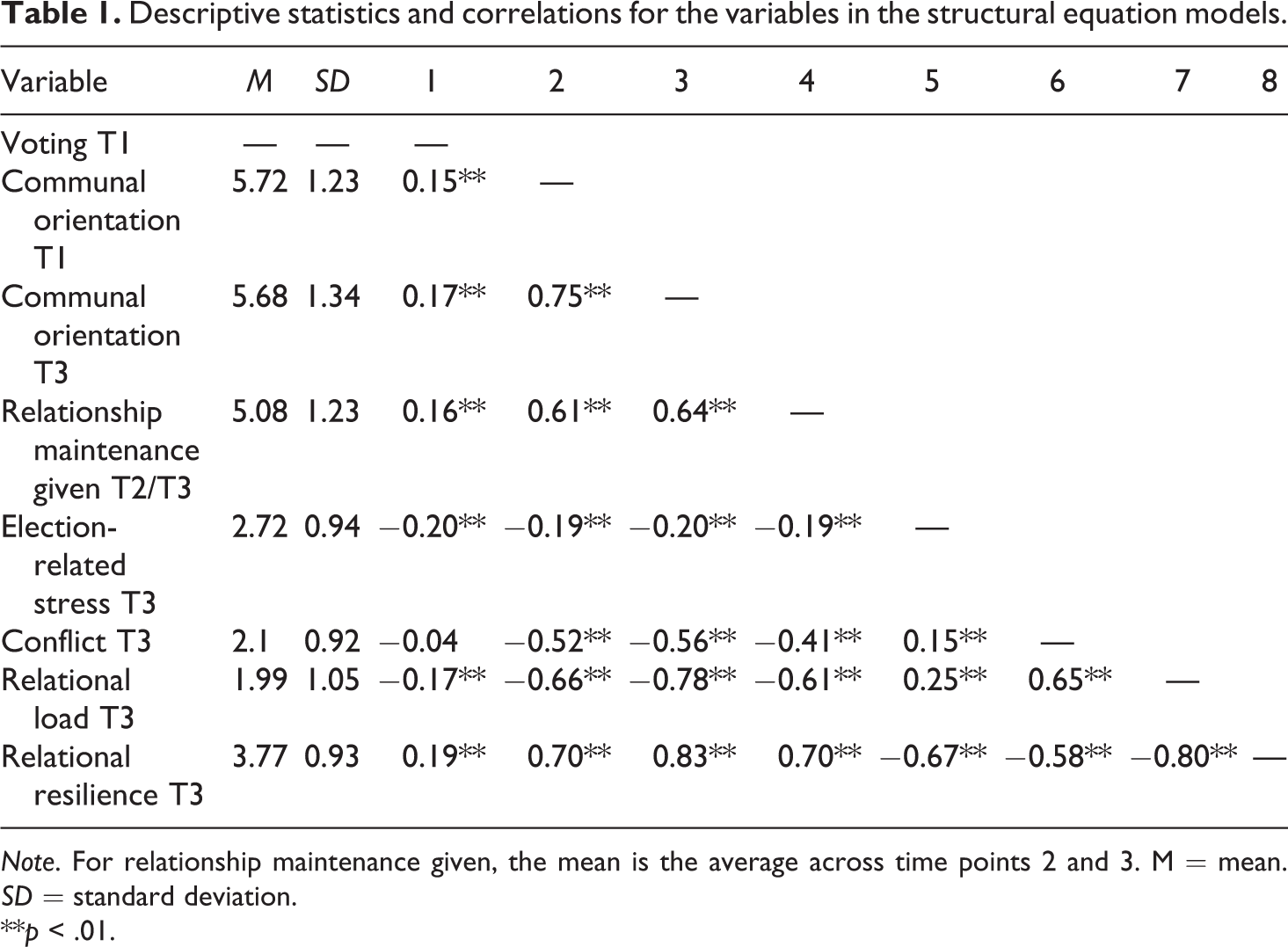
Note. For relationship maintenance given, the mean is the average across time points 2 and 3. M = mean. SD = standard deviation.
**p < .01.
Mean comparisons between individuals who voted differently than their romantic partner and individuals who voted similarly to their romantic partner.
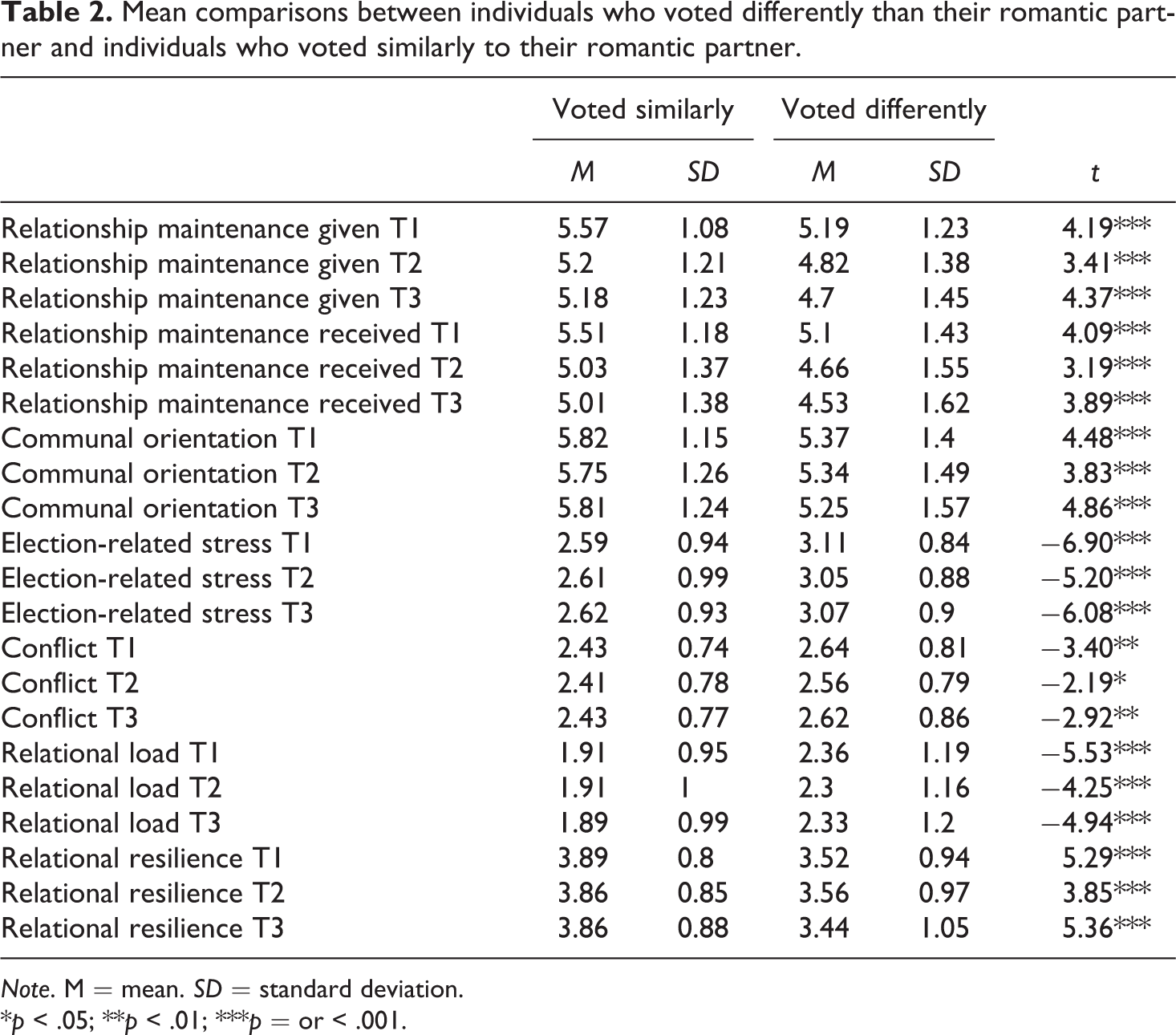
Note. M = mean. SD = standard deviation.
*p < .05; **p < .01; ***p = or < .001.
Emotional capital hypothesis
Growth curve modeling (using SPSS Mixed) was used to examine the main effects of relationship maintenance on election stress, conflict, communal orientation, relational load, and relational resilience. Growth curve modeling allows researchers to measure change in individuals’ data over time. Different models were computed to determine the impact of maintenance received by one’s partner and given to one’s partner on each of the outcomes. The time one maintenance items used in this analysis asked participants to reflect on their relationship maintenance (given and received) over the past month before the study began (T1), as well as their maintenance throughout the study (T2 and T3). Individuals’ measures of all of the variables of interest at all three time points represented the repeated measures at Level 1, which were nested within the individual at Level 2. We first tested unconditional models to ensure there was significant variance in the outcome variables. We then proceeded by adding in voting as a control variable (0 = voted differently; 1 = voted similarly), followed by time, relationship maintenance, and the interaction between maintenance and time. Given that each participant had multiple time points, any missing data were dropped only for those particular cases and the remaining cases for that participant were used to calculate his/her growth curve.
The first set of models were computed for the impact of relationship maintenance given to one’s partner on election stress, conflict, communal orientation, relational load, and relational resilience. Across all of the outcomes, there was a significant main effect for the amount of relationship maintenance given to one’s partner at baseline, controlling for voting differences (see Table 3). There was not, however, a significant change in the outcomes over time as a function of relationship maintenance. The results suggest that providing ongoing relationship maintenance behaviors and actions to one’s romantic partner was predictive of significantly less perceived stress about the Trump presidency, less general levels of conflict, less relational load, greater communal orientation, and greater relational resilience at the beginning of the study. These effects were stable across the three time points, which are evidenced by nonsignificance of the time variable in each of the models. There were, however, also significant main effects for voting across all of the variables, except for conflict (p = .07). Voting differently than one’s partner predicted significantly greater perceived stress about the Trump presidency, greater relational load, less communal orientation, and less relational resilience.
Multi-level models of fixed and random effects for maintenance given to one’s romantic partner.

Note. SE = standard error.
The second set of models was computed for the impact of relationship maintenance received from one’s partner on election stress, conflict, communal orientation, relational load, and relational resilience. The results were comparable to those for relationship maintenance given (see Table 4). Across all of the outcomes, there was a significant main effect for the amount of relationship maintenance received from one’s partner at baseline, controlling for voting differences. There was not a significant effect for time and maintenance received. The results suggest that receiving ongoing relationship maintenance behaviors and actions from one’s romantic partner was predictive of significantly less perceived stress about the Trump presidency, less general levels of conflict, less relational load, greater communal orientation, and greater relational resilience at the beginning of the study. These effects were stable across the three time points. There were also significant main effects for voting across all of the variables, except for conflict (which was approaching significance at p = .07). Voting differently than one’s partner predicted significantly greater perceived stress about the Trump presidency, greater relational load, less communal orientation, and less relational resilience.
Multi-level models of fixed and random effects for maintenance received from one’s romantic partner.

Note. SE = standard error.
In a separate set of follow-up analyses, we also examined whether maintenance (given and received) interacted with voting patterns to have an effect on the aforementioned outcomes. In all of the models, however, there were no significant moderating effects for maintenance and voting patterns. Instead, there were significant main effects that mirrored the results above.
Relational load hypothesized model
Structural equation modeling (AMOS, version 24.0) with maximum likelihood estimation was then used to test the relational load model in Figure 1. Individual items loaded highly onto their latent constructs, allowing us to form single composite indicators for the latent variables (see Holbert & Stephenson, 2003). The error variance of the indicators for all of the latent constructs was fixed to (1 − α)* the variance of the indicator to help control for measurement error and fit the model. For each of the models, the indicators loaded highly onto their latent constructs (range = .80–.98). The error terms for communal coping (T1 and T3), as well as the error terms for relational load (T3) and relational resilience (T3), were allowed to correlate. In the current model, we used time points for each measure that best represented the ordering effects in our hypothesized model. Voting (T1) was predictive of communal orientation at Time 1, which was expected to influence individuals’ investments in their relationship at Times 2/3 (which represented the average of the maintenance given to one’s partner throughout the study itself). The maintenance given, in turn, should predict communal orientation at Time 3. Communal orientation and maintenance given at Time 2 should predict the amount of perceived election stress and conflict at Time 2, which ultimately should affect relational load and relational resilience at Time 3. It was also expected that communal orientation and maintenance given would be directly and positively associated with resilience.
The hypothesized model was a relatively good fit to the data, χ2 (8, N = 855) = 64.90, p = .001, CFI = .99, NFI = .98, IFI = .98, RMSEA = .08. With larger samples, it is common for the χ2 to be significant but the model still be a good fit to the data. Instead, fit is determined by CFI, TLI, and IFI scores of .95 and greater and an RMSEA ≤ .06 (Hu & Bentler, 1999). All of the paths in the model were significant, except for the direct path from maintenance given to relational resilience. To improve the fit of the model, this path was removed. The path from maintenance to stress was also marginally significant (p = .08), but removing it did not improve the model. Therefore, this path was kept in the model. However, we also added a direct path from voting to election-related stress. This modified model was an excellent fit to the data, χ2 (8, N = 855) = 38.32, p = .001, CFI = .99, NFI = .98, IFI = .99, RMSEA = .06.
The results of the modified model indicated that voting similarly to one’s romantic partner was associated with greater communal orientation, which predicted an increase in maintenance given to one’s partner (see Figure 2 for the results of the modified model). This maintenance given (T2 and T3 combined) then predicted greater communal orientation at Time 3. At the same time, voting similarly was significantly associated with less election-related stress (T3). Therefore, communal orientation (T1) did not mediate the association between voting and election-related stress (T3). However, greater communal orientation (T1) was associated with less election-related stress (T3) and less conflict (T3). Communal orientation (T1) was a significant mediator between voting and conflict (T3). The bootstrap confidence interval method articulated by Preacher and Hayes (2004, 2008) revealed that communal orientation (T1) significantly mediated the association between voting and conflict (T3; 5,000 bootstraps, B = −0.17, SE = 0.05, p = .001, 95% bias corrected confidence interval: −0.27, .07). There were no other significant mediating paths in the model. Maintenance given to one’s partner (T2 and T3 combined) was directly associated with a decrease in conflict (T3). Conflict (T3) and election-related stress (T3) were positively associated with relational load (T3) and negatively associated with communal orientation (T3) and relational resilience (T3).
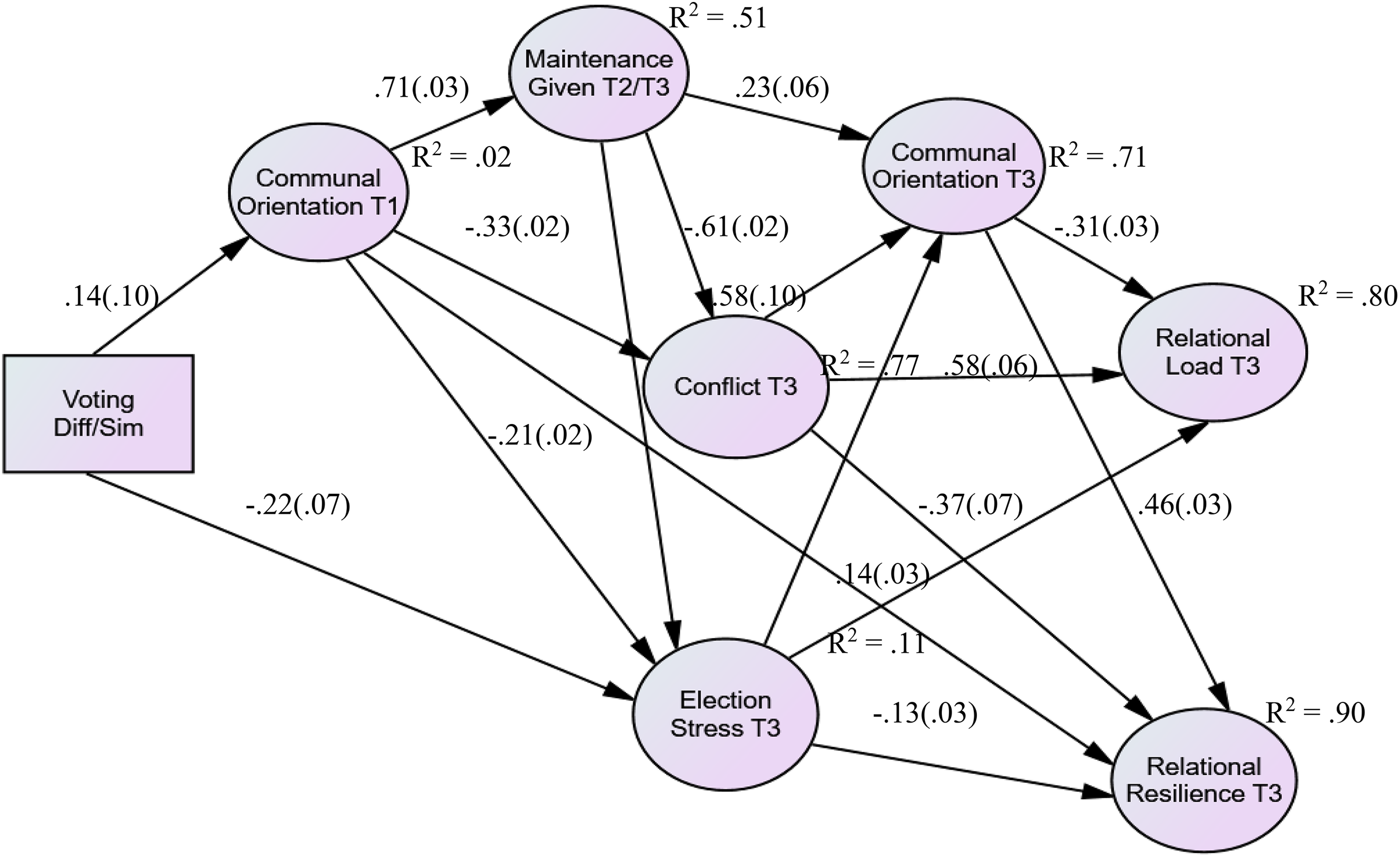
Results for final model for maintenance given. Note. All estimates are standardized and p < .001. The numbers in parenthesis are standard errors. Relational resilience and relational load were allowed to correlate (r = −.29, p < .001), as were conflict (T3) and stress (T3; r = .22, p < 001), and communal orientation T1 and T3 (r = .75, p < 001).
Discussion
The TRRL (Afifi et al., 2016) was used to examine the impact of voting patterns in the 2016 U.S. presidential election on individuals’ romantic relationships. Cohabiting and married individuals completed online questionnaires about their relationships at three time points during the transition to the Trump presidency. Overall, the results supported both hypothesized models and the underlying assumptions of the TRRL. Specifically, our emotional capital hypothesis demonstrated that ongoing relationship maintenance in one’s romantic relationship (giving and receiving) predicted less perceived stress about the Trump presidency, less conflict, less relational load, greater communal orientation, and greater relational resilience. These effects were stable across the three time points. The emotional capital hypothesis showed that some relational partners entered into the presidential transition more resilient than others because of the extent to which they maintained their relationship. The positive effect of ongoing relationship maintenance on these relational outcomes did not depend on how the partners voted. At the same time, voting differently than one’s partner was still stressful and negatively influenced these outcomes.
The results also support our relational load model, which showed that differences in voting patterns negatively affected individuals’ communal orientation, which significantly lessened the degree to which they maintained their relationships. Their diminished communal orientation and relationship maintenance predicted conflict and election-related stress. This conflict and stress was associated with an increase in relational load and a decrease in relational resilience. Voting differently in the 2016 presidential election from one’s romantic partner, however, was still directly associated with increased stress related to the election.
The emotional capital hypothesis
An underlying assumption of the TRRL (Afifi et al., 2016) is that when couples enter into a stressful situation with a foundation of emotional capital already established through ongoing relationship maintenance, they will experience it as less stressful than they otherwise would. This finding held true in the current investigation. Although voting for different candidates was still somewhat stressful for relational partners, the effects of the stress were minimized when they took the time to maintain their relationships. Prolonged use of relationship maintenance (the month before the study began and during the study itself) was associated less election-related stress, less conflict, less relational load, greater communal orientation, and greater relational resilience.
The results of the emotional capital hypothesis contribute to a growing body of literature showing that greater maintenance is linked to less stress in a variety of contexts, including chronic illness (Afifi et al., 2018) and fast-paced families (Afifi, Harrison, Zamanzadeh, & Acevedo Callejas, 2019). It also compliments research that has found that positive relational maintenance behaviors are associated with lower levels of conflict (Driver & Gottman, 2004; Goodboy, Dainton, Borzea, & Goldman, 2017; Merolla, 2017). Individuals can experience the same stressful event and view it through different perceptual lenses, depending on the level of maintenance they have established with their relational partner. In this sense, relationship maintenance acts as a “main effect” for their perceptions of stress and resilience entering into a stressful situation. Even though an event might still be stressful, it can be made less stressful through relational investments. The positive mindset that is created through relationship maintenance likely creates hardy relationships where partners are able to manage whatever stress comes their way, even voting for different political parties in a time in history characterized by political polarization.
The relational load hypothesized model
The relational load hypothesis examined whether voting differently negatively affects processes that build relational resilience. This model was also supported in the current study. In the 2016 Presidential Election, polarized political identities could have introduced doubts about the degree to which partners were similar in terms of their core attitudes, beliefs, and values, and thus the extent to which they were on the same “team.” Voting differently than one’s relational partner diminished individuals’ sense of communal orientation or their feelings of unity with one’s partner. When they felt less communally oriented, they then engaged in fewer behaviors and actions that demonstrate their love, validation, and appreciation for one another. When individuals felt less communally oriented toward their partner and invested less in their relationship, it predicted greater election-related stress and general levels of conflict. Ultimately, the stress and conflict predicted greater relational load and less relational resilience by the end of the study. The findings of the current study support the TRRL’s assertion that stress and conflict can accumulate and slowly “wear and tear” on the relationship over time (Afifi et al., 2016).
Individuals with less communal orientation might also struggle to cooperate and problem solve together in the face of other stressors that are not related to their current challenges (Reid, Dalton, Laderoute, Doell, & Nguyen, 2006). The processes and resources that support relational resilience can begin to fade with chronic conflict and stress, unless partners proactively engage in behaviors and actions that better maintain their relationship and facilitate a sense of togetherness (Afifi et al., 2016). Partners likely felt less satisfied and committed to their partners and less likely to take each other’s perspectives, which can result in disagreements that reinforce divisions (Beck, 2016; Fergus & Skerett, 2015). Thus, the effect that voting differently had on communal orientation and relational maintenance, and subsequently stress and conflict, could eventually influence other aspects of their relationship. This issue remains to be tested in future research.
Limitations and future directions
The TRRL provides important practical and theoretical implications for political communication and other areas of relationship research. While these findings relate to the context of the 2016 election, the same idea should apply to couples who differ on other core aspects of their identity, such as religious values or cultural backgrounds. Yet it is important to note that there is hope for couples who are feeling the effects of political polarization. The current study corresponds with previous research that suggests that interventions targeted at increasing relational maintenance could decrease the perceived stress and conflict these partners are experiencing and reduce relational load (Afifi et al., 2018). While this has important implications for individual and relational health, it might also have political and societal implications. Huber and Malhotra (2017) argue that political homogeneity found in romantic relationships, which fosters the homogeneous development of households and social networks, likely plays a role in amplifying polarization. In reversing this logic, it is possible then that if politically heterogeneous relationships are able to become resilient or engage in processes that promote resilience, it could have indirect, positive effects on the political divide within the U.S. Finally, the TRRL provides an important theoretical framework for understanding why political differences might foster stress and conflict and why some relational partners, despite having vastly different political beliefs, are able to flourish because of their relational investments.
The important theoretical and practical implications of this investigation must be set within its limitations. Our sample consisted primarily of middle-class, educated, White women and thus might not reflect the full range of stress levels experienced by various groups. While the election and its outcomes were probably stressful for many individuals in the U.S., vulnerable groups and those specifically targeted by president Trump (e.g., immigrants) would probably have higher levels of stress than other individuals. It is also important to note that the participants in the current sample did not report high levels of stress related to the new presidency. Nevertheless, there were important differences across all of the outcomes for voting differences and the paths in the model accounted for a sizeable amount of variance. Consequently, the current sample likely provides a conservative estimate of the larger U.S. population, especially if one were to examine marginalized individuals. In addition, even though we had voting differences predicting communal orientation, it is possible that relational partners who are less communally oriented engage in behaviors, like voting for different political parties, that could have negative consequences for their relationship. Additional research is necessary that can untangle the causal direction of this association. The data were also provided by one rather than both partners. Dyadic data describing both partners’ perspectives could provide additional insight into important relational dynamics. Finally, given that the media coverage plays a significant role in the polarization of the current political environment (Prior, 2013), future research could address this key issue. Exposure to partisan media might have an impact on stress and conflict, particularly for those who voted differently, and thus could play a role in relational maintenance behaviors and relational health.
Footnotes
Authors’ note
Tamara D. Afifi is a Professor in the Department of Communication at the University of California Santa Barbara. Nicole Zamanzadeh, Kathryn Harrison, and Debora Perez Torrez are doctoral students in the same department.
Acknowledgements
The authors would like to thank the editor and anonymous reviewers for their suggestions on this manuscript.
Funding
The author(s) received no financial support for the research, authorship, and/or publication of this article.

Open research statement
As part of IARR’s encouragement of open research practices, the authors have provided the following information: This research was not pre-registered. The data used in the research are available. The data can be obtained by emailing