




Abstract
The current studies investigated the extent that sense of purpose is associated with desirable relationship variables, such as relationship satisfaction, relationship commitment, perceived quality of alternatives, and investment size. Data were collected from two online surveys of 1,001 and 1,594 participants in relationships (Study 1: M = 46.68, SD = 15.77, range = 18–86; Study 2: M = 52.52, SD = 16.05, range = 18–91). Study 1 found that sense of purpose was positively associated with relationship satisfaction, commitment, and negatively associated with the perception that one’s partner was preferable to alternatives. When controlling for affective well-being and the Big Five personality traits, sense of purpose was still associated with relationship commitment and the perception that one’s partner was preferable to alternatives. Study 2 found that sense of purpose was positively associated with relationship satisfaction, commitment, and investment size (which was exclusively assessed in Study 2), but it was not significantly associated with perceived quality of alternatives. These associations held when controlling for affective well-being and the Big Five personality traits. Across both studies, age did not consistently moderate the associations between sense of purpose and relationship satisfaction, commitment, and perceived quality of alternatives. These studies suggest that sense of purpose and aspects of relationship quality are positively associated across adulthood. Findings are discussed with respect to how purpose may be considered in future close relationship research.
Keywords
Research has suggested that personality dispositions are consistently associated with romantic relationship outcomes. For instance, previous research has demonstrated that high neuroticism and low agreeableness predict relationship dissatisfaction, conflict, and dissolution, whereas high conscientiousness predicts greater relationship quality (Karney & Bradbury, 1995; Noftle & Shaver, 2006; Schaffhuser et al., 2014). In addition, meta-analytic work suggests that personality traits even predict risk for divorce (Roberts et al., 2007). However, much of this work has focused on relatively broad dispositional characteristics, such as the Big Five personality trait taxonomy, rather than on more specific or “narrow” individual differences. With this in mind, the current research considered a well-studied disposition, sense of purpose, in a currently understudied context, how it is associated with romantic relationship quality.
Sense of purpose, a dispositional characteristic distinct from the Big Five (Hill & Burrow, 2012; Schmutte & Ryff, 1997) can be understood as the extent to which someone feels that they have personally meaningful goals and aims guiding them through life (McKnight & Kashdan, 2009; Ryff, 1989). Research has found that people who report a higher sense of purpose report greater well-being (Ryff, 1989; Sumner et al., 2015), greater general cognitive performance (Lewis et al., 2017), making more money (Hill et al., 2016), and living longer (Hill & Turiano, 2014). Within social contexts, more purposeful people report lower levels of loneliness (Bondevik & Skogstad, 2008), a greater sense of connectedness and belongingness (Lambert et al., 2013; Stavrova & Luhmann, 2015), and higher levels of general social well-being (Ryff & Keyes, 1995). Unfortunately, little research has considered sense of purpose in the context of romantic relationships.
Based on work from other fields, we predict that sense of purpose will be positively associated with romantic relationship quality, which, from this point forward, will be simply referred to as relationship quality. To explain the theoretical foundation and the underlying mechanisms for these predicted associations, we can turn to personality theory. Dispositions, like sense of purpose, are thought to be comprised of three main components (Roberts, 2009): (1) thoughts, (2) feelings, and (3) behaviors. To understand why an individual’s sense of purpose might enhance relationship quality, all three components are worth considering. Regarding thoughts or cognitions, sense of purpose is positively related to hope (Bronk et al., 2009), which involves both the perception that individuals can find opportunities and pathways around obstacles, and the motivation or agency to take action to achieve their goals (Snyder et al., 2005). As such, purposeful individuals may perceive greater ability to get around relationship obstacles. When considering feelings, or affect, across several studies, purposeful people report greater positive affect and less negative affect (Scheier et al., 2006; Sumner et al., 2015). Moreover, individuals with a greater sense of purpose tend to report less affective reactivity to daily stressors (Hill et al., 2018). Thus, it may be easier to be in a relationship with a purposeful partner, who is generally happier and handles the stressors that arise within and outside of the context of romantic relationships better. Lastly, regarding behaviors, purposeful individuals may be better at organizing their daily and long-term activities (McKnight & Kashdan, 2009); thus, being purposeful may be associated with more relationship-promoting behaviors such as remembering important dates and keeping promises.
Though these literatures suggest a positive association between sense of purpose and markers of relationship quality, the magnitude of these associations may differ across the life span. The process of developing one’s purpose typically begins in earnest during adolescence and emerging adulthood (Bronk, 2012; Burrow, Hill, Ratner, & Sumner, 2018), and studies show that sense of purpose tends to increase and become more stable in middle adulthood (Ryff & Keyes, 1995; Springer et al., 2011). It is worth noting then that a similar developmental trajectory often occurs for relationships, insofar that adolescence and emerging adulthood are periods when individuals are finding what they want in a relationship, while adulthood often is marked more by relationship maintenance. Accordingly, it is of interest to consider whether having a sense of purpose may be more valuable during developmental periods when it is less common, and when relationships are more in flux relative to later periods in the life span.
The current studies are among the first to investigate sense of purpose in the context of romantic relationships. Romantic relationship quality is evaluated with respect to three main components: (1) relationship satisfaction, or how satisfied and content one is with their romantic relationship; (2) relationship commitment, or how committed one is to their romantic relationship in the long term; and (3) perceived quality of alternatives, or one’s preference for alternative partners over their own (Rusbult et al., 1998). For both studies, we predicted that sense of purpose levels will be positively associated with relationship satisfaction and commitment, and negatively associated with perceived quality of alternatives. Furthermore, we predicted that age will moderate these associations with stronger relationships between sense of purpose and the relationships variables for younger adults. We also conducted two sets of exploratory analyses in Study 1. First, we calculated partial correlations between sense of purpose and the relationship quality variables in three ways: (1) controlling for affective well-being, (2) controlling for the Big Five, and (3) controlling for affective well-being and the Big Five. Second, we tested whether gender moderated the associations between sense of purpose and the relationship quality variables to determine whether the associations between sense of purpose and relationship quality differ for self-identified men and women.
For Study 2, we collected additional data and included new variables to further understand the associations between sense of purpose and relationship quality: investment size, socioeconomic status (SES), and sense of coherence. Investment size, or the extent to which an individual feels that they have invested a lot into their relationship, was used as another relationship quality indicator (Rusbult et al., 1998). SES was viewed as a demographic variable that could account for some of the variance in these associations. Finally, some scholars have suggested that sense of coherence, or the perception that one’s experiences make sense (Costin & Vignoles, 2019), may function as the cognitive underpinning for sense of purpose (Reker & Wong, 2012; Steger, 2012). Accordingly, we investigated whether the association between sense of purpose and romantic relationship quality was explained by an underlying sense of coherence.
With respect to these new variables, we predicted that sense of purpose would be positively associated with investment size, but to a smaller magnitude than with the other relationship variables, and that sense of purpose would correlate with the relationship quality variables when accounting for sense of coherence. We predicted that age would moderate these associations with stronger relationships between sense of purpose and the relationship variables for younger adults. For our exploratory analyses, we once again evaluated the associations between sense of purpose and the relationship variables controlling for affective well-being, the Big Five personality traits, and both. However, we also evaluated these associations when controlling for SES, then controlling for sense of coherence. We made no predictions as to what extent SES would explain these associations given that these analyses were exploratory.
Study 1
Method
Participants and procedures
Participants (N = 1,552) were collected through Qualtrics Panels to complete a single, online survey. Those who reported being in a serious relationship (e.g., “in a serious relationship,” “living together,” “married”) were asked to respond to additional relationship quality measures (n = 1,001). Ages ranged from 18 years to 86 years, with an average age of 46.68 years. With respect to gender, 29.1% identified as male, 70.4% as female, 0.3% as transgender male, and 0.2% preferred not to say. The participants predominantly identified as White—81.8% White or Caucasian, 5.9% African or African American, 3.9% Hispanic or Latin American, 6.5% Asian or Asian American, 0.1% Middle Eastern, and 1.7% identified as another group. Most of the participants were no longer in school, as only 9.5% reported either part- or full-time student status. Data analytic plan and hypotheses were preregistered on OSF (https://osf.io/nprkh/?view_only=6e8aab987adb4291b483445fe37d1239).
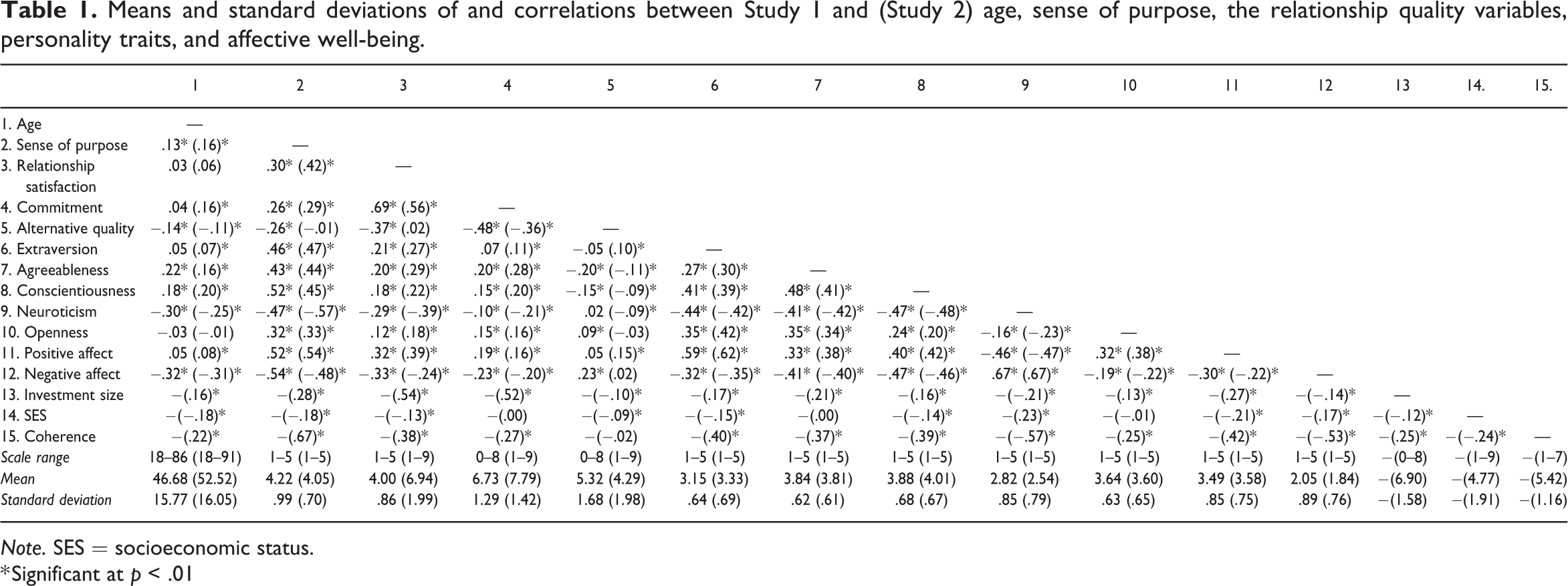
Participants completed an online survey that assessed demographics, sense of purpose, relationship satisfaction, relationship commitment, perceived quality of alternative partners, the Big Five personality traits (i.e., conscientiousness, agreeableness, extraversion, neuroticism, openness), and affective well-being (both positive and negative affect). The means and standard deviations for each scale are presented in Table 1.
Means and standard deviations of and correlations between Study 1 and (Study 2) age, sense of purpose, the relationship quality variables, personality traits, and affective well-being.
Note. SES = socioeconomic status.
* Significant at p < .01
Measures
Sense of purpose
The Purpose in Life subscale from the Psychological Well-being Scale (Ryff, 1989) was used to evaluate sense of direction and goals for life. Participants were indicated their level of agreement to nine statements using a 6-point Likert-type scale, where 1 = “strongly disagree” and 6 = “strongly agree,” with higher scores indicating a greater sense of purpose. This subscale includes statements such as “Some people wander through life aimlessly, but I am not one of them.” In the current sample, this measure had good reliability with α = .84.
Relationship satisfaction
The Relationship Assessment Scale was used to evaluate relationship satisfaction. Participants indicated their level of agreement with seven statements using a 5-point Likert-type scale, where 0 = “not at all” and 5 = “completely,” with higher scores representing greater relationship satisfaction. This measure includes questions such as “How well does your partner meet your needs?” and “How good is your relationship compared to most?” This measure had good reliability with α = .91.
Relationship commitment
The Commitment subscale from the Investment Model Scale (Rusbult et al., 1998) was used to evaluate the level of commitment participants felt toward their romantic partner. Participants indicated their level of agreement with seven statements using a 9-point Likert-type scale, where 0 = “do not agree at all” and 8 = “agree completely,” with higher scores representing greater commitment to their partner. This measure includes statements such as “I want our relationship to last for a very long time.” This measure had good reliability with α = .85.
Perceived quality of alternatives
The Quality of Alternatives subscale of the Investment Model Scale (Rusbult et al., 1998) was used to capture whether an individual had positive or negative evaluations of potential alternative romantic partners. Participants indicated their level of agreement with five statements using a 9-point Likert-type scale, where 0 = “do not agree at all” and 8 = “agree completely.” Higher scores indicated a greater likelihood to view alternatives as acceptable replacements for a current romantic partner. This measure includes statements such as “my needs for intimacy, companionship, etc. could be fulfilled in alternative relationships.” This measure had good reliability with α = .88.
Personality traits
The Big Five personality traits were measured using the Big Five Inventory—2 (Soto & John, 2017). Participants indicated their agreement to 60 statements (12 for each trait) on a 5-point Likert-type scale, where 1 = “strongly disagree” and 5 = “strongly agree.” This measure included items such as “I see myself as someone who is full of energy” (example item for extraversion). All personality subscales had good reliabilities (extraversion: α = .78; agreeableness: α = .83; conscientiousness: α = .87; neuroticism: α = .90; openness: α = .80).
Affective well-being
Affective well-being was measured using the Positive and Negative Affect Schedule (Watson et al., 1988) to assess general experiences of positive and negative emotions. Participants responded to two 10-item scales to assess how commonly they felt certain positive and negative emotions using a 5-point Likert-type scale, where 1 = “very slightly or not at all” and 5 = “extremely,” with higher scores marking more experiences of that affective type. This measure included emotions such as interested and enthusiastic for positive affect and upset and guilty for negative affect. These subscales showed good reliability (positive affect: α = .92; negative affect: α = .93).
Results
Primary analyses
Bivariate correlations
For all analyses across studies, we maintained a more conservative alpha level of .01 due to the large sample sizes. Pearson correlations were calculated between all variables of interest. Sense of purpose was positively correlated with each of the relationship quality variables: relationship satisfaction, r(1,000) = .30, p < .001; relationship commitment, r(999) = .26, p < .001; and perceived quality of alternatives r(1,000) = −.25, p < .001. All associations between sense of purpose, the relationship variables, and individual differences are shown in Table 1.
Moderation by age
Moderation analyses with bootstrapping (n = 1,000 samples) were conducted to examine whether the associations between sense of purpose and relationship quality variables differed by age. Sense of purpose predicted relationship satisfaction (B = 0.25, SE = .08, p = .002), commitment (B = 0.51, SE = .13, p < .001), and perceived quality of alternatives (B = −0.85, SE = .19, p < .001). Age did not moderate the association between sense of purpose and relationship satisfaction or commitment (B = 0.00, SE = .01, p = .890; B = 0.02, SE = .01, p = .145), but it did moderate the association between sense of purpose and perceived quality of alternatives (B = −0.05, SE = .02, p = .005), wherein sense of purpose was more strongly negatively associated with perceived quality of alternatives for older participants than younger ones. As such, sense of purpose appears similarly associated with concurrent relationship quality variables across adulthood, except with regard to perceived quality of alternatives where sense of purpose seemed to display a stronger association among those who were younger.
Exploratory analyses
Controlling for affective well-being
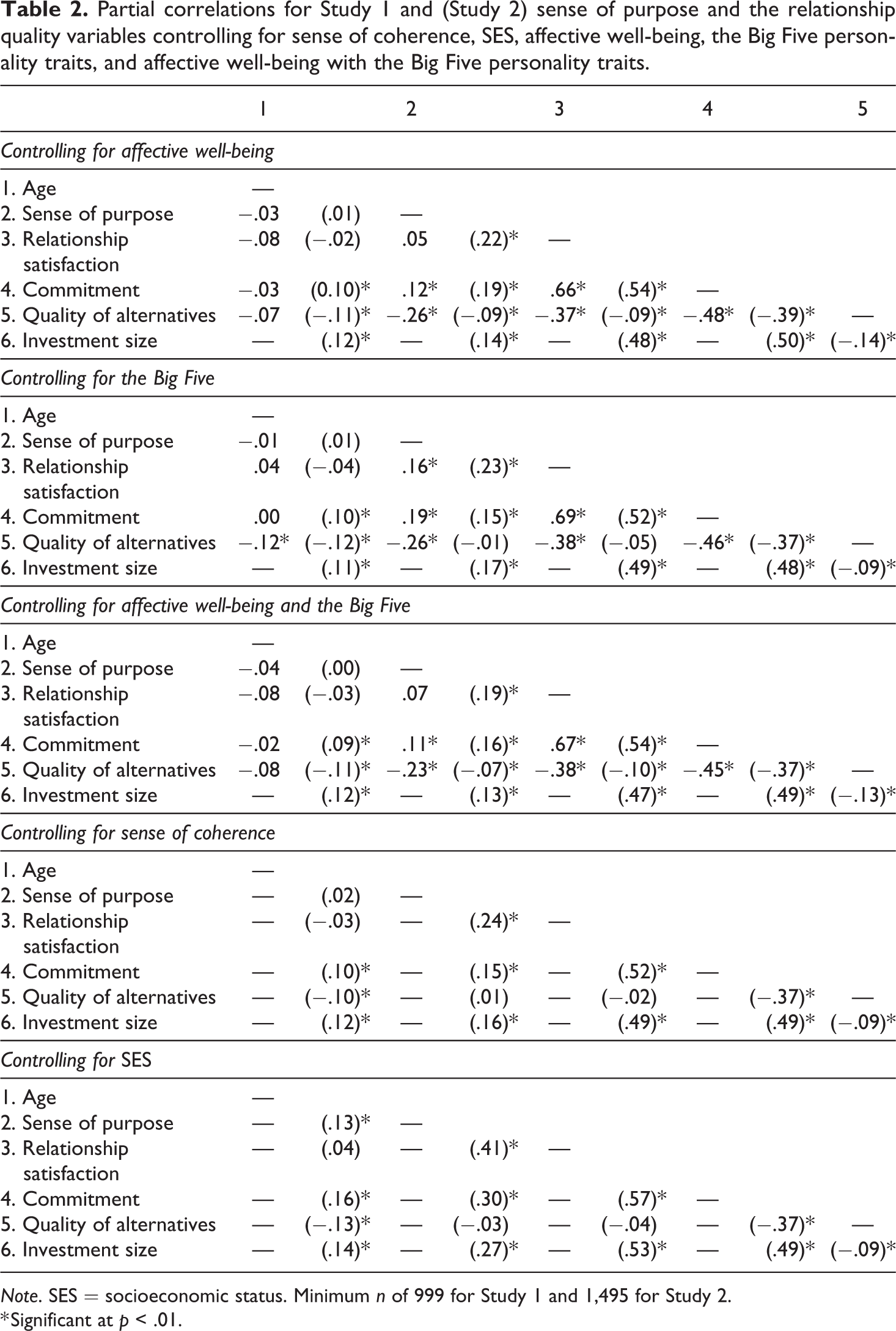
The results from each partial correlation are shown in Table 2. We conducted partial correlations to consider whether affective well-being helped explain the associations between sense of purpose and relationship quality variables. When controlling for positive and negative affect, sense of purpose was no longer significantly associated with relationship satisfaction, r(995) = .05, p = .100, and the association decreased in magnitude with commitment r(995) = .12, p < .001. However, it remained relatively the same for perceived quality of alternatives, r(995) = −.26, p < .001.
Partial correlations for Study 1 and (Study 2) sense of purpose and the relationship quality variables controlling for sense of coherence, SES, affective well-being, the Big Five personality traits, and affective well-being with the Big Five personality traits.
Note. SES = socioeconomic status. Minimum n of 999 for Study 1 and 1,495 for Study 2.
* Significant at p < .01.
Controlling for the Big Five personality traits
We conducted a partial correlation to consider whether the Big Five personality traits explained some of the variance for the associations between sense of purpose and the relationship quality variables. When controlling for the Big Five, sense of purpose was still associated with each of the relationship quality variables. The magnitudes of the association between sense of purpose and relationship satisfaction, r(992) = .16, p < .001, and commitment, r(992) = .19, p < .001, decreased, but the association between sense of purpose and perceived quality of alternatives remained relatively the same, r(992) = −.26, p < .001.
Controlling for affective well-being and the Big Five personality traits
Finally, we conducted partial correlations controlling for both affective well-being and personality. Again, the association between sense of purpose and relationship satisfaction was greatly reduced, r(990) = .07, p = .036. Sense of purpose still had a small association with commitment and a moderate association with perceived quality of alternatives, r(990) = .11, p < .001; r(990) = −.23, p < .001.
Moderation by gender
Moderation analyses with bootstrapping (n = 1,000) were conducted to examine whether the associations between sense of purpose and the relationship quality variables differed as a function of gender. In these models, sense of purpose uniquely predicted relationship satisfaction (B = 0.35, SE = .09, p < .001), relationship commitment (B = 0.40, SE = .14, p = .005), and perceived quality of alternatives (B = −1.06, SE = .22, p < .001). Gender did not moderate the associations between sense of purpose and relationship satisfaction or commitment (B = 0.09, SE = .22, p = .670 and B = 0.34, SE = .34, p = .312, respectively). Gender did, however, moderate the association between sense of purpose and perceived quality of alternatives (B = −1.98, SE = .51, p < .001), with the association between sense of purpose and perceived quality of alternatives stronger for men than women.
Study 1: Discussion
This study was novel in considering sense of purpose within the domain of romantic relationships. In a large sample with a wide age range, the current study found that sense of purpose was positively related to greater relationship quality, assessed by relationship high levels of satisfaction and relationship commitment, as well as lower levels of perceived quality of alternative partners. When controlling for affective well-being, the magnitude of the association between sense of purpose and relationship satisfaction was reduced, pointing to affect as a potential pathway linking these constructs. While the association between sense of purpose and commitment also was reduced when controlling for affective well-being, a small association remained suggesting that these covariates may only partially explain why sense of purpose is associated with higher commitment. Lastly, controlling for affective well-being made relatively no difference in the effect size for sense of purpose and perceived quality of alternatives. The associations between purpose and relationship outcomes largely remained consistent when controlling for personality traits that are associated with both relationship quality and sense of purpose.
No evidence was found for moderation effects by age or gender in relationship satisfaction or commitment, suggesting sense of purpose holds similar positive associations with desirable outcomes across adulthood and for men and women. Age displayed a small moderating effect on the association between sense of purpose and perceived quality of alternatives, with those who are younger showing a stronger association. Gender also only moderated the association between sense of purpose and perceived quality of alternatives, with the association stronger for men than women.
Study 2
Study 2 was developed alongside the action editor and the reviewers for Study 1, which was initially submitted as a standalone manuscript. Based on the recommendations of the reviewers, the current study was developed to address some of the limitations of Study 1 as well as to replicate the original findings. Toward this end, a registered report was drafted alongside the edits of the original study. The registered report was given provisional acceptance, wherein, regardless of the results, as long as the hypotheses, methodology, and analytic plan for Study 2 were followed.
Study 2 sought to replicate and extend Study 1 in three main ways. First, it attempted to replicate the previous associations between sense of purpose and the relationship quality variables in a new, larger sample with different purpose measures. Second, it extended this work by examining the associations between sense of purpose and another component of relationship quality, relationship investment size. Third, it expanded upon our previous findings by considering alternative explanations for the associations between sense of purpose and the relationship quality variables, such as SES and sense of coherence.
Method
Participants and procedures
Participants (N = 2,243) were collected through Qualtrics Panels to complete a single, online survey. Those who reported being in a serious relationship were asked to respond to additional relationship quality measures (n = 1,594; 76.3% married). Participants’ ages ranged from 18 years to 91 years, with an average age of 52.52 years. With regard to gender, 56.52% identified as male; 42.98% as female; and the eight participants identified as gender queer, transgender male, other, or preferred not to say. The participants predominantly identified as White—80.3% White and/or European American, 4.7% African-American and/or Black, 3.4% Latinx-American and/or Hispanic, 5.2% Asian-American and/or Asian, and 6.3% identified as another group. Most participants were no longer in school, as only 9.3% reported part- or full-time student status.
Participants completed an online survey that included assessments for demographics, sense of purpose, sense of coherence, the Big Five personality traits, affective well-being, and four indicators of relationship quality from the Investment Model (Rusbult et al., 1998), among other measures that were unrelated to the current study. The means and standard deviations for each scale are presented in parenthesis in Table 1. Demographic information included questions about their gender, age, race/ethnicity, education, sexual orientation, and relationship status. Prior to analyses of our data, we preregistered our hypotheses and analytic plan on OSF: https://osf.io/nprkh/?view_only=6e8aab987adb4291b483445fe37d1239.
Measures
All Study 1 measures were used in Study 2, with the exception of Ryff’s Purpose in Life subscale. Each previous scale displayed good reliability within this sample as well (commitment: α = .92; perceived quality of alternatives: α = .83; extraversion: α = .84; agreeableness: α = .82; conscientiousness: α = .87; neuroticism: α = .90; openness: α = .82; positive affect: α = .91; negative affect: α = .92). Measures that were not used in Study 1 are discussed below.
Socioeconomic status
SES was assessed using the ladder of SES, a subjective measure that accounts for perception of one’s own income, education, and occupations compared to others in the United States (Adler et al., 2000). Participants were asked to place themselves on one of nine rungs of a ladder, with lower placement representing perceptions that they are below average and higher placements representing they are above average. Rungs were coded on a 9-point Likert-type scale, with higher scores indicating greater perceived SES.
Sense of purpose
We assessed sense of purpose using two different measures. First, sense of purpose was measured using the Life Engagement Test (Scheier et al., 2006) to assess the extent to which individuals reported having a sense of purpose and worthwhile activities for engagement. Participants indicated their agreement to six statements on a 5-point Likert-type scale, where 1 = strongly disagree and 7 = strongly agree. The measure included items such as “There is not enough purpose in my life” (reverse scored). Higher scores indicated a greater sense of purpose, and this measure had good reliability (α = .83).
Sense of purpose was also measured using a purpose scale developed to avoid conflation with related constructs such as coherence (Costin & Vignoles, 2019). Participants indicated their agreement to four statements on a 7-point Likert-type scale, where 1 = strongly disagree and 7 = strongly agree. This measure included items such as “I have certain goals that compel me to keep going.” Higher scores indicated a greater sense of purpose, and this measure displayed good reliability (α = .83). The two measures were strongly associated with one another, r(1,591) = .72, p < .001, and all of the associations between the relationship quality variables and the two sense of purpose measures were within |.01| to |.04| of each other in magnitude. For parsimony, then, we present below the findings with respect only to the Life Engagement Test, given that it is a more frequently employed measure.
Sense of coherence
Sense of coherence was measured using a scale again developed to avoid conflation with related constructs such as purpose (Costin & Vignoles, 2019) and assesses the extent to which one is able to comprehend their experiences and the world around them. Participants indicated their agreement to four statements on a 7-point Likert-type scale, where 1 = strongly disagree and 7 = strongly agree. This measure included items such as “I can make sense of the things that happen in my life.” Higher scores indicated a greater sense of coherence, and this measure displayed good reliability (α = .81).
Relationship satisfaction
While Study 1 used the Relationship Assessment Scale, Study 2 participants completed the Relationship Satisfaction subscale of the Investment Model Scale (Rusbult et al., 1998) to evaluate participants’ relationship satisfaction. Participants indicated their level of agreement with five statements using a 9-point Likert-type scale, where 0 = “do not agree at all” and 8 = “agree completely.” This measure included statements such as “I feel satisfied with our relationship.” Higher scores indicated greater relationship satisfaction, and this measure displayed good reliability (α = .95).
Investment size
Participants completed the Investment Size subscale of the Investment Model Scale (Rusbult et al., 1998) to assess the extent to which an individual felt like they had invested in their relationship to the point that if they were to lose it, they would lose more than just the relationship itself. Participants responded with their agreement to five statements using a 9-point Likert-type scale, where 0 = “do not agree at all” and 8 = “agree completely.” This measure included statements such as “I have put a great deal in our relationship that I would lose if the relationship were to end.” Higher scores indicate greater investment size, and this measure displayed good reliability (α = .78).
Results
Primary analyses
Bivariate correlations
Because the two sense of purpose measures were strongly associated with each other, r(1,591) = .72, p < .001, sense of purpose was reported throughout these results using the Scheier and colleagues’ (2006) measure. All associations between sense of purpose, the relationship variables, and individual differences are shown in Table 1. Sense of purpose was positively correlated with three of the relationship quality variables: relationship satisfaction, r(1,544) = .42, p < .001; relationship commitment, r(1,527) = .29, p < .001; and investment size, r(1,541) = .28, p < .001, but was not associated with perceived quality of alternatives, r(1,543) = −.01, p = .733.
Moderation by age
Moderation analyses were conducted to examine whether the associations between sense of purpose and the relationship quality variables differed by age. Sense of purpose predicted relationship satisfaction (B = 0.65, SE = .22, p = .004) and commitment (B = 0.63, SE = .17, p < .001), but not investment size (B = −0.15, SE = .19, p = .430) or perceived quality of alternatives (B = −0.804, SE = .24, p = .857). Age predicted relationship satisfaction (B = −0.05, SE = .02, p = .009) and investment size (B = −0.05, SE = .01, p < .001), but it did not predict commitment (B = 0.01, SE = .01, p = .241) or perceived quality of alternatives (B = −0.02, SE = .02, p = .319). Age moderated the association between sense of purpose and relationship satisfaction (B = 0.01, SE = .00, p = .010) as well as investment size (B = 0.01, SE = .00, p < .001), wherein the associations were stronger for older adults than younger adults, but it did not moderate the association between sense of purpose and commitment (B = −0.001, SE = .00, p = .643) or perceived quality of alternatives (B = 0.00, SE = .00, p = .763).
Controlling for affective well-being
Results of all partial correlation analyses are shown in Table 2. When controlling for positive and negative affect, though the magnitude decreased, sense of purpose was still significantly associated with relationship satisfaction, r(1,537) = .22, p < .001; commitment, r(1,520) = .19, p < .001; and investment size, r(1,520) = .19, p < .001. It increased slightly for perceived quality of alternatives, r(1,536) = −.09, p < .001.
Controlling for the Big Five
The magnitudes of the association between sense of purpose and relationship satisfaction, r(1,513) = .22, p < .001; commitment, r(1,498) = .17, p < .001; and investment size, r(1,510) = .16, p < .001, decreased but remained significant. The association between sense of purpose and perceived quality of alternatives remained relatively the same, r(992) = −.04, p = .132.
Controlling for affective well-being and the Big Five
When controlling for the Big Five traits, the associations for sense of purpose with relationship satisfaction, r(1,509) = .19, p < .001; investment size, r(1,506) = .13, p < .001; and commitment, r(1,495) = .16, p < .001 decreased in magnitude but remained significant. The association between sense of purpose and perceived quality of alternatives remained relatively the same, r(1,508) = −.07, p = .007.
Exploratory analyses
Controlling for sense of coherence
When accounting for sense of coherence, the association between sense of purpose and relationship satisfaction, r(1,544) = .24, p < .001; commitment, r(1,526) = .15, p < .001; and investment size, r(1,541) = .16, p < .001, was reduced, but the associations remained positive and significant. The association between sense of purpose and perceived quality of alternatives remained relatively the same, r(1,543) = .01, p = .670.
Controlling for SES
When accounting for SES, the associations with the relationship quality variables remained relatively unchanged when controlling for SES. Sense of purpose was positively correlated with relationship satisfaction, r(1,544) = .41, p < .001; commitment, r(1,526) =.30, p < .001; and investment size, r(1,541) = .27, p < .001, and was not significantly correlated with perceived quality of alternatives, r(1,543) = −.03, p = .318.
Moderation by gender
Moderation analyses were conducted to examine whether the associations between sense of purpose and the relationship quality variables differed as a function of gender. In these models, sense of purpose uniquely predicted relationship satisfaction (B = 1.11, SE = .10, p < .001), commitment (B = 0.51, SE = .07, p < .001), and investment size (B = 0.50, SE = .08, p < .001), but it did not predict perceived quality of alternatives (B = 0.16, SE = .11, p = .131). Gender only predicted perceived quality of alternatives (B = 1.89, SE = .60, p = .002). Gender did not moderate the associations between sense of purpose and relationship satisfaction (B = 0.12, SE = .13, p = .386), commitment (B = 0.16, SE = .10, p = .119), perceived quality of alternatives (B = −0.36, SE = .15, p = .013), or investment size (B = −0.23, SE = .11, p = .038).
Discussion
This investigation is one of the first to formally build a bridge between the purpose literature and romantic relationship literature. While research on sense of purpose has consistently found it to promote desirable outcomes throughout the life span, ranging from physical health to well-being (Hill et al., 2017; Scheier et al., 2006), work has not yet considered what purpose could mean in the context of a romantic relationship. Furthermore, while research has demonstrated the value of studying personality for relationship outcomes (Roberts et al., 2007), sense of purpose had yet to be a disposition of interest. The current studies have set the stage for sense of purpose to be recognized as a worthy construct for future consideration. Adults who reported a greater sense of purpose also reported having greater relationship satisfaction, commitment, and investment size. Even when controlling for constructs that have previously been associated with relationship quality, such as the Big Five and affective well-being, sense of purpose still predicted relationship quality across the sample. Furthermore, sense of purpose still predicted desirable relationship quality when controlling for sense of coherence and SES. Lastly, based on the moderation analyses, sense of purpose remained predictive of relationship outcomes across genders and ages, though the magnitudes for some of these associations varied modestly. Overall, sense of purpose was directly associated with positive relationship quality across two large cross-sectional studies using two different purpose measures and controlling for potential covariates.
With initial evidence providing support that sense of purpose and romantic relationship quality are positively associated with each other, these findings point to two primary additions to the literature. First, if sense of purpose promotes romantic relationship quality, this trait provides another tool for close relationship researchers to utilize when understanding why a relationship may not be functioning the way that other indicators might suggest. Second, if romantic relationship quality is enhancing sense of purpose, this finding further supports the importance of social relationships, particularly romantic ones, in potentially developing and/or maintaining a sense of purpose. For the current discussion, we will be focus on the former in describing potential reasons for the results as well as recommend future research endeavors, primarily in efforts to introduce sense of purpose as a construct relevant to the relationships field.
Before doing so, it is worth noting and contextualizing two findings that differed between studies. First, sense of purpose was negatively associated with perceived quality of alternatives in Study 1 but was not associated with perceived quality of alternatives in Study 2. Though these findings were inconsistent between studies, insights come from previous work that has shown that perceived quality of alternatives is sometimes only associated with commitment when evaluating various relationship quality indicators (Impett et al., 2001). Indeed, in Study 2, perceived quality of alternatives was not associated with relationship satisfaction or investment size, suggesting that this variable may not be as prominent of a relationship quality indicator as the other variables we used. Second, there were inconsistent findings with the moderation analyses for both age and gender. Age moderated the association with perceived quality of alternatives in Study 1 and relationship satisfaction and investment size in Study 2, while gender moderated the association with perceived quality of alternatives in Study 1 but did not moderate any of the associations in Study 2. Given the inconsistencies in any moderation effects, it appears that the primary message is that sense of purpose is a fairly reliable correlate of relationship quality across the demographic groups investigated here.
Additional work is needed to understand when and for whom purpose matters in relationship contexts, particularly given the lack of age moderation effects in the current study. Previous scholars have theorized that the way a trait influences relationship quality could be dependent on the kind of life event one is experiencing, with more non-normative experiences potentially strengthening the effect a trait may have (Neyer et al., 2013). As such, gaining better understanding of one’s current life experiences or transitions could better clarify when sense of purpose might be most important for a romantic relationship. Furthermore, research has suggested that the predictive value of certain traits for relationship quality may depend on the relationship type and length (Holland & Roisman, 2008). Accordingly, future research should look into relationship duration as a moderator for sense of purpose and relationship outcomes. While age and relationship duration are typically correlated, it may be important to consider sense of purpose earlier in the relationship, before partners have developed skills for supporting one another.
Another moderator of interest is whether partners have similar or disparate levels of sense of purpose. Some longitudinal studies have found that partners with more similar personality profiles experience greater relationship well-being later on in their relationships (van Scheppingen et al., 2018). Other work has shown that, while personality trait similarity does not play a large role in relationship quality, each partner’s personality traits show additive effects in relationship quality overall (Robins et al., 2000). If similarity matters, these findings could suggest that perhaps if one partner has a lower sense of purpose, it may be better for their partner to have a low one as well based on trait similarity. Alternatively, based on an additive model, it could be better for their partner to have a higher one based on the additive effects of partnership traits. A dyadic perspective is necessary to evaluate the ways in which similar or dissimilar sense of purpose levels may predict relationship outcomes.
Some limitations of the current studies also provide directions for future research. First, the current samples were mainly comprised of married participants, limiting our ability to consider whether the value of sense of purpose differs depending on the stage in which the relationship is. Second, the current study was cross-sectional in nature. Though cross-sectional studies provide a necessary first step by identifying important variables to consider, it would be valuable to supplement the current findings with longitudinal research to capture whether sense of purpose predicts relationship success over time, as well as any bidirectional associations between these constructs. Finally, the current studies did not assess participants’ stated purposes for life, and thus it would be of interest to consider whether the benefits associated with sense of purpose differ based on whether that life direction is more or less family-focused.
This work was novel in considering sense of purpose as a construct within the relationship domain. In two cross-sectional studies using large samples with a wide age ranges, we found that sense of purpose was positively associated with relationship satisfaction and commitment, even when controlling for affective well-being and the Big Five personality traits. Future research should evaluate why it is that these constructs relate and directionality of their associations. By understanding the mechanisms through which sense of purpose influences partnerships, we can harness the value of this construct in romantic relationships.
Footnotes
Funding
The author(s) received no financial support for the research, authorship, and/or publication of this article.
Open research statement
As part of IARR’s encouragement of open research practices, the authors have provided the following information: This research was submitted to review for the preregistration challenge on August 27, 2018. Open Science Framework reviewers requested a clarification to the design plan section, which was corrected and resubmitted on August 29, 2018. While the OSF reviewers accepted the second draft of the preregistration, it was not automatically published as the authors thought. Because of this, the authors recently resubmitted the same preregistration from August for review once more on October 25, and it was reviewed and published on October 26. The researchers followed the plan that was initially approved on August 29. The aspects of the research that were preregistered were the research questions, hypotheses, measured variables, indices, design plan, statistical models, and exclusionary criteria. The registration was submitted to: https://osf.io/yf2jn/. Through the revision process, a second study was also conducted. The research questions, hypotheses, measured variables, indices, design plan, statistical models, and exclusionary criteria were preregistered prior to data analysis:  . The data and the materials used in the research are available by emailing: