



Abstract
Narcissism is associated with a wide array of interpersonal problems. The present studies examined the connections between narcissistic personality features and the experience of friendship. We were interested in the possibility that narcissistic admiration (an agentic form of narcissism characterized by assertive self-enhancement and self-promotion) and narcissistic rivalry (an antagonistic form of narcissism characterized by self-protection and self-defense) may have divergent associations with various aspects of friendship. Study 1 found that narcissistic admiration and narcissistic rivalry had divergent associations with maximizing selectivity and negative friendship attributions that were mediated by the agentic and communal orientations toward friendship. Study 2 found that narcissistic admiration and narcissistic rivalry had divergent associations with friendship commitment that were again mediated by agentic and communal orientations toward friendship. These results demonstrate the similarities and differences between narcissistic admiration and narcissistic rivalry in the context of friendship as well as the important roles that agentic and communal orientations toward friendship play in the connections that narcissistic personality features have with outcomes concerning friendship.
Narcissism is characterized by exaggerated feelings of grandiosity, vanity, self-absorption, and entitlement (e.g., Morf & Rhodewalt, 2001). The characteristics that accompany narcissistic personality features are believed to be intimately connected with attempts to maintain their grandiose self-views through a dynamic interplay of intrapersonal mechanisms (e.g., positive illusions about their abilities) and interpersonal behaviors (e.g., willingness to derogate others; see Morf & Rhodewalt, 2001, for a review). Narcissistic personality features often involve the use of relationships to satisfy self-regulatory goals such as the desire to feel respected or admired (see Zeigler-Hill et al., 2018, for a review). However, the interpersonal behaviors that characterize narcissism—such as the tendency to brag about accomplishments (e.g., Palmer et al., 2016) and lack of empathy for others (e.g., Watson et al., 1984)—often lead to problems in relationships. The present research considered the possibility that agentic and communal orientations may play vital roles in the associations that narcissistic personality features have with aspects of friendship. We were interested in the possibility that narcissistic personality features may be associated with certain aspects of friendship (e.g., low commitment) because narcissistic personality features may be associated with the tendency to adopt an especially agentic orientation toward friendship. It is important to note that the present research focuses on narcissistic personality features which are normally distributed aspects of personality features that occur in the general population rather than focusing on the clinical manifestation of narcissism (see Weiss & Miller, 2018, for an extended discussion of this distinction).
Narcissism has been found to be associated with a wide variety of problems in long-term romantic relationships (e.g., lack of romantic commitment) despite its association with romantic attraction in short-term contexts (e.g., Campbell et al., 2006; Foster & Brunell, 2018; Wurst et al., 2017). One potential explanation for the connection between narcissistic personality features and poor romantic relationship functioning is that narcissism may promote a focus on agentic qualities (i.e., the tendency to display power, mastery, and self-assertion) while reducing the focus on communal qualities (i.e., the tendency to engage in behaviors connected with intimacy, union, and solidarity (Campbell, 1999; Campbell et al., 2006; Foster et al., 2006; Gebauer & Sedikides, 2018). This narcissistic focus on agentic qualities (i.e., an agentic orientation)—and relative lack of concern for communal qualities (i.e., a communal orientation)—may contribute to the interpersonal difficulties that are associated with narcissism (e.g., lack of intimacy in relationships).
Agency and communion appear to serve as the basic foundations for conceptualizing interpersonal relationships (e.g., Bakan, 1966; Leary, 1957; see Abele & Wojciszke, 2013, for a review), and healthy interpersonal functioning often requires a blend of agentic and communal orientations (e.g., Helgeson, 1994). An agentic orientation toward relationships indicates a tendency to consider those relationships through the lens of agentic motivations (e.g., the extent to which individuals desire power or influence) or agentic characteristics (e.g., the extent to which interaction partners possess power or influence). In contrast, a communal orientation toward relationships indicates a tendency to view relationships in terms of communal motivations (e.g., the extent to which individuals desire closeness or intimacy) or communal characteristics (e.g., the extent to which interaction partners are capable of closeness or intimacy).
The tendency to adopt an exclusively agentic or communal orientation often leads to negative social outcomes. For example, an extreme focus on agency tends to be associated with relatively poor social relationships because individuals consistently prioritize their own needs over those of their interaction partners (e.g., Helgeson & Fritz, 2000). This is important, given that narcissistic personality features are associated with a strong focus on agentic concerns and a distinct lack of interest in communal concerns (e.g., Foster et al., 2006; Gebauer & Sedikides, 2018). This asymmetry in agentic and communal concerns may provide insights into the connections that narcissistic personality features have with various aspects of friendship. The connections that narcissism has with a range of social outcomes including romantic relationship functioning (e.g., Foster & Brunell, 2018), aggression (e.g., Bushman & Baumeister, 1998), and bullying (e.g., Reijntjes et al., 2016) have received considerable attention, but the potential implications that narcissism may have for friendships have received considerably less empirical attention (e.g., Foster et al., 2009; Jonason & Schmitt, 2012; Maaß et al., 2016; see Maass et al., 2018, for a review).
Friendship has traditionally been conceptualized and defined as a social relationship that implies mutual enjoyment, interest, or usefulness—although each of these elements may not be present in equal measure or during a particular phase of a friendship (e.g., friendship initiation, friendship maintenance; Blieszner & Adams, 1992). For example, factors such as friendship selection or relationship attributions may be particularly important during friendship initiation. Friendship selection encompasses the process by which individuals decide with whom they should form friendships (e.g., Newman et al., 2018). We decided to focus on attitudes toward potential friends using the broader framework of decision maximization (e.g., Schwartz, 2000; Schwartz et al., 2002) which has been shown to be informative for understanding the lack of romantic commitment that often accompanies narcissistic personality features (e.g., Zeigler-Hill et al., 2020). Relationship attributions encompass the processes whereby individuals may allocate blame in a relationship which may be a key factor in understanding the ongoing health of friendships (e.g., Fincham & Bradbury, 1992). In the maintenance phase, other issues associated with general relationship functioning may be more relevant. For example, satisfaction (e.g., “Am I happy with this friendship?”), investment (e.g., “Do I spend a lot of time with this friend?”), and quality of alternatives (e.g., “Is there someone else who might be a better friend?”) may influence someone’s commitment to a friendship (e.g., Rusbult, 1980).
Friends offer benefits in social groups, often serving as allies who promise support in future conflicts both within groups and between groups (e.g., Lewis et al., 2015; Massen et al., 2010). Friends provide a form of social capital by acting as an assurance of an individual’s worth in a social setting (Felmlee & Muraco, 2009). As such, the desire to have the “right” friends who display an appropriate amount of “friend value” may be a goal associated with narcissistic personality features, given the important connections between narcissism and issues surrounding the attainment of status (e.g., Zeigler-Hill et al., 2019)—to the best of our knowledge, this idea of “trophy friends” has not been tested in the context of narcissism, but other work has shown that individuals with elevated levels of grandiose narcissism may seek “trophy mates” (e.g., Campbell, 1999) and it may be possible to draw some parallels. To be specific, this evidence that individuals with elevated levels of narcissistic personality traits choose romantic partners who are attractive or accomplished may be evidence for an agentic orientation toward romantic relationships, and this orientation may then be conceptually applied to platonic friendships. The purpose of the present studies was to examine the connections that narcissistic personality features have with various aspects of friendship and consider whether agentic and communal orientations toward friendship may play important roles in the connections that narcissistic personality features have with these aspects of friendships.
Overview and predictions
The present studies were intended to explore the associations between narcissism and various aspects of friendship. We used the narcissistic admiration and rivalry concept (NARC; Back et al., 2013) model as an organizing framework because it provides a two-dimensional conceptualization of grandiose narcissism that distinguishes between narcissistic admiration (an agentic form of narcissism characterized by assertive self-enhancement and self-promotion) and narcissistic rivalry (an antagonistic form of narcissism characterized by self-protection and self-defense). The NARC model has proved to be useful for resolving some of the inconsistencies in the narcissism literature because these two social strategies for maintaining grandiose self-views tend to diverge in their associations with a wide array of outcomes. For example, narcissistic admiration has been shown to be associated with an agentic interpersonal style, whereas narcissistic rivalry is characterized by a blend of agency and interpersonal hostility (e.g., Grove et al., 2019).
We anticipated that narcissistic admiration and narcissistic rivalry would have similar positive associations with an agentic orientation toward friendship (i.e., the tendency to think about friendship in terms of power and dominance), whereas narcissistic rivalry—but not narcissistic admiration—would be negatively associated with a communal orientation toward friendship (i.e., the tendency to think about friendship in terms of interpersonal closeness and community). These predictions are derived from recent findings showing that narcissistic admiration is positively associated with agency, whereas narcissistic rivalry is negatively associated with communion (e.g., Grove et al., 2019). The divergent interpersonal orientations of narcissistic admiration and narcissistic rivalry may have important implications for the formation and maintenance of various interpersonal relationships, including friendships.
The present studies were intended to examine how narcissistic personality features were associated with various aspects of friendship. Study 1 examined whether narcissistic admiration and narcissistic rivalry had indirect associations with maximizing selectivity and negative friendship attributions as well as whether these associations were mediated by agentic and communal orientations toward friendship. Study 2 attempted to extend the results of Study 1 by examining whether narcissistic admiration and narcissistic rivalry had indirect associations with indicators of friendship functioning (e.g., commitment) through agentic and communal orientations toward friendship. Study 1 addressed issues that may be particularly important or relevant during friendship initiation (e.g., friendship selection), whereas Study 2 addressed issues associated with the maintenance of more established friendships (e.g., commitment). These studies were not preregistered, but the data files and other materials for both studies are available on the Open Science Framework at https://osf.io/krv9q.
Study 1
Study 1 was intended to examine whether the associations that narcissistic admiration and narcissistic rivalry had with aspects of friendship would be mediated by the agentic and communal orientations toward friendship. We decided to focus on aspects of friendship that would likely be particularly important during early friendship formation and development. As a result, we examined maximizing selectivity which is important during the formation of friendships and negative friendship attributions which are important following negative events that involve friends (i.e., how friends handle conflict may set the tone for the friendship as a whole). We expected narcissistic admiration and narcissistic rivalry to have similar indirect associations with aspects of friendship cognition through the agentic orientation toward friendship, whereas we expected narcissistic rivalry—but not narcissistic admiration—to have indirect associations with aspects of friendship cognition through the communal orientation toward friendship. As our predictions are not overly specific in nature, our analyses may be considered somewhat exploratory.
Participants and procedure
Participants were 429 community adults from the U.S. who were recruited through Amazon’s Mechanical Turk. We decided that the sample size for this study should include at least 250 participants. This decision was based on suggested guidelines for reducing estimation error in social-personality psychology (N
Measures
Narcissism
Narcissism was assessed using the Narcissistic Admiration and Rivalry Questionnaire (NARQ; Back et al., 2013). The NARQ includes 18 items that capture two basic dimensions of narcissism: narcissistic admiration (9 items; e.g., “I am great” [α = .88]) and narcissistic rivalry (9 items; e.g., “I take pleasure in the failure of my rivals” [α = .91]). Participants were asked to rate how well each statement described them using scales ranging from 1 (not agree at all) to 6 (agree completely).
Orientations toward friendship
Orientations toward friendship were assessed with a modified version of the Conceptions of Sex scale (Foster et al., 2006) that was altered to reflect platonic friendships. We used the descriptors included in the Conceptions of Sex scale as the basis for capturing how respondents view friendship. This “Conceptions of Friendship” scale is a 14-item measure that assessed both the agentic orientation toward friendship (7 items; e.g., “Power is important to my view of friendship” [α = .94]) and the communal orientation toward friendship (7 items; e.g., “Honesty is important to my view of friendship” [α = .82]). Participants were asked to rate their level of agreement with each item using scales ranging from 1 (strongly disagree) to 9 (strongly agree).
Maximizing friendship selection
Friendship selectivity was assessed using the Maximizing Tendency in Friendship Selection Scale (Newman et al., 2018) which is a 16-item instrument that assesses the motivation to choose the most desirable friend from a given set of choices (e.g., “Finding friends is difficult because I want to choose the perfect friends for me” [α = .93]). Participants were asked to rate how well each statement described them using scales ranging from 1 (completely disagree) to 7 (completely agree).
Negative friendship attributions
Negative friendship attributions were assessed using a modified version of the Relationship Attribution Measure (Fincham & Bradbury, 1992). This measure was modified by replacing “spouse” with “close friend” in each item. This modified instrument consisted of four hypothetical scenarios (e.g., “Your close friend criticizes something you say”) that were followed by items that assessed the attributions made in the scenario (6 items per scenario; e.g., “My close friend’s behavior was due to something about him/her” [α = .95]). Participants were asked to rate their level of agreement with each statement using scales ranging from 1 (strongly disagree) to 6 (strongly agree).
Results
Descriptive statistics and zero-order correlations are presented in Table 1. Narcissistic admiration was positively correlated with narcissistic rivalry, but the strength of this correlation was considerably stronger than the moderate correlation that is usually found in college student samples (r ≈ .30; e.g., Back, 2018), and it is not unusual for community samples to show stronger associations between these aspects of narcissism (e.g., Mayer et al., 2020). Narcissistic admiration was positively correlated with the agentic orientation toward friendship, maximizing selectivity, and negative friendship attributions. Narcissistic rivalry was positively correlated with the agentic orientation toward friendship, maximizing selectivity, and negative friendship attributions, but it was negatively correlated with the communal orientation toward friendship.
Study 1: Intercorrelations and descriptive statistics.
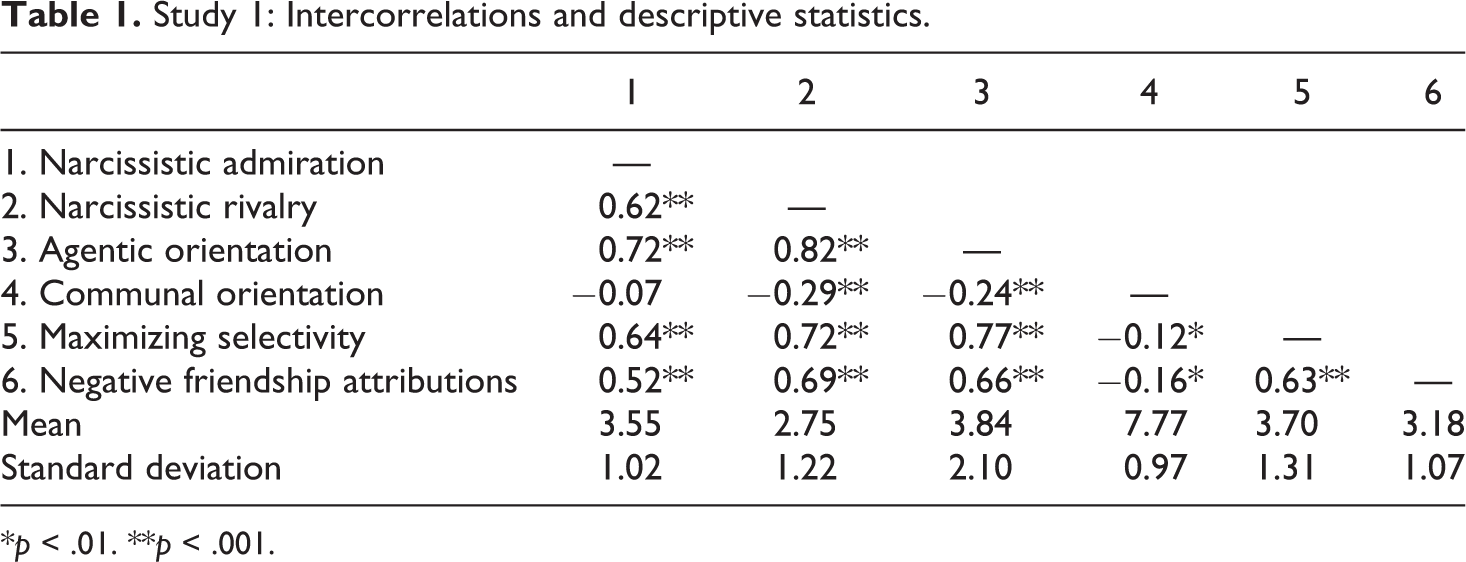
*p < .01. **p < .001.
We employed two parallel multiple mediation analyses using model four of the PROCESS macro developed by Hayes (2018) to determine whether narcissistic admiration and narcissistic rivalry had indirect associations with maximizing selectivity and negative friendship attributions through the agentic and communal orientations toward friendship. 1 PROCESS uses a bootstrap resampling process that was repeated 10,000 times to generate a 95% percentile confidence interval (CI). Indirect effects were considered to be significant if the CIs did not contain zero. Narcissistic admiration and narcissistic rivalry were examined in separate analyses due to concerns associated with including highly correlated predictors in the same analysis (see Lynam et al., 2006 for an extended discussion of this “perils of partialling” issue).
The results of the parallel multiple mediation analyses for narcissistic admiration are depicted in Figure 1. Narcissistic admiration had a large positive association with the agentic orientation toward friendship, but it was not associated with the communal orientation toward friendship. Narcissistic admiration explained 52% of the variability in the agentic orientation toward friendship but only 1% of the variability in the communal orientation toward friendship. In turn, the agentic orientation toward friendship had a large positive association with maximizing selectivity and a medium positive association with negative friendship attributions, whereas the communal orientation toward friendship was not associated with either maximizing selectivity or negative friendship attributions. Narcissistic admiration had a positive indirect association with maximizing selectivity through the agentic orientation toward friendship (a1b1 = .46, SE = .04, z = 10.53, p < .001, 95% CI [.37, .55], PM = 0.72) but not through the communal orientation toward friendship (a2b3 = .00, SE = .00, z = −0.86, p = .39, 95% CI [−.01, .00], PM = 0.02). There was a positive total association between narcissistic admiration and maximizing selectivity when the mediators were not included in the model (c1 = .63, SE = .04, t = 15.52, p < .001, 95% CI [.55, .71], f2 = .71) and the direct association persisted even when the mediators were included in the model (
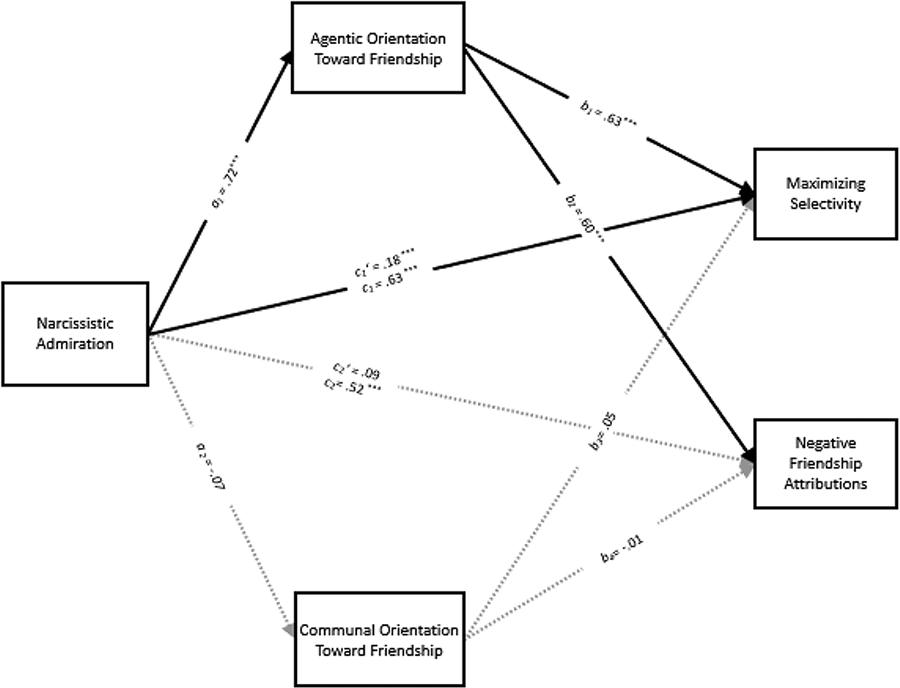
Study 1: The results of the parallel multiple mediation analyses with the agentic orientation and the communal orientation mediating the associations that narcissistic admiration had with maximizing selectivity and negative friendship attributions. The significant positive associations are indicated by solid black arrows. The significant negative associations are indicated by dashed black arrows. The dotted grey lines represent nonsignificant associations. ***p < .001.
Narcissistic admiration had a positive indirect association with negative friendship attributions through the agentic orientation toward friendship (a1b2 = .43, SE = .05, z = 8.74, p < .001, 95% CI [.33, .54], PM = 0.83) but not through the communal orientation toward friendship (a2b4 = .00, SE = .00, z = 0.22, p = .83, 95% CI [−.01, .01], PM = 0.01). There was a positive total association between narcissistic admiration and negative friendship attributions when the mediators were not included in the model (c2 = .52, SE = .05, t = 11.33, p < .001, 95% CI [.43, .61], f2 = .38), but the direct association did not persist when the mediators were included in the model (
The results of the parallel multiple mediation analysis for narcissistic rivalry are depicted in Figure 2. Narcissistic rivalry had a large positive association with the agentic orientation toward friendship as well as a small negative association with the communal orientation toward friendship. Narcissistic rivalry explained 66% of the variability in the agentic orientation toward friendship but only 8% of the variability in the communal orientation toward friendship. In turn, the agentic orientation toward friendship had a large positive association with maximizing selectivity and a small positive association with negative friendship attributions, whereas the communal orientation toward friendship had a small positive association with maximizing selectivity, but it was not associated with negative friendship attributions. Narcissistic rivalry had a positive indirect association with maximizing selectivity through the agentic orientation toward friendship (a1b1 = .43, SE = .05, z = 8.72, p < .001, 95% CI [.32, .52], PM = 0.59) and a negative indirect association through the communal orientation toward friendship (a2b3 = −.03, SE = .01, z = −2.46, p = .01, 95% CI [−.05, −.01], PM = 0.11). There was a positive total association between narcissistic rivalry and maximizing selectivity when the mediators were not included in the model (c1 = .70, SE = .04, t = 19.14, p < .001, 95% CI [.63, .77], f2 = .85) and the direct association persisted even when the mediators were included in the model (
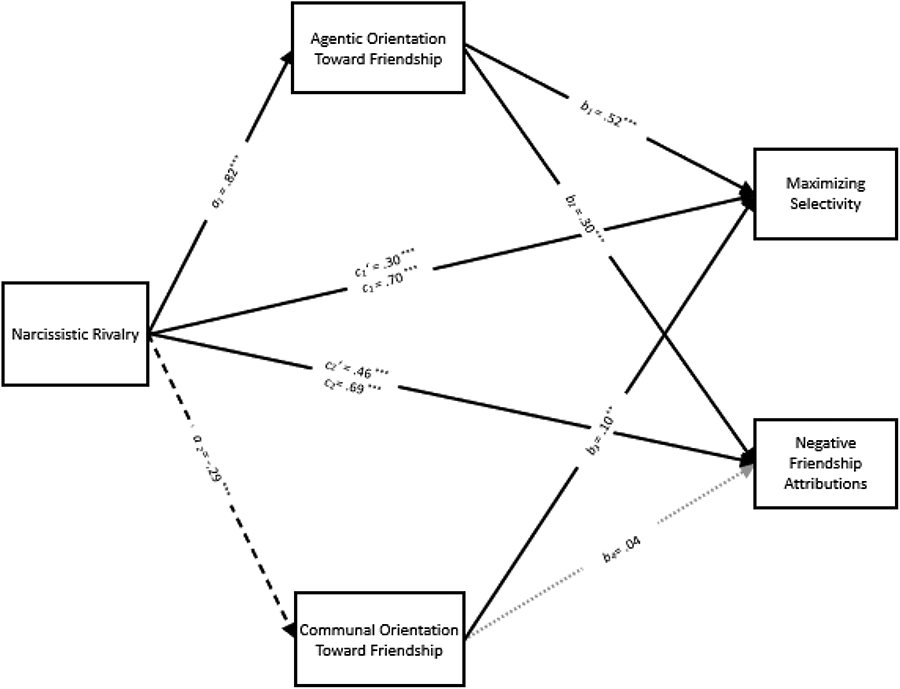
Study 1: The results of the parallel multiple mediation analyses with the agentic orientation and the communal orientation mediating the associations that narcissistic rivalry had with maximizing selectivity and negative friendship attributions. The significant positive associations are indicated by solid black arrows. The significant negative associations are indicated by dashed black arrows. The dotted grey lines represent nonsignificant associations. **p < .01. ***p < .001.
Narcissistic rivalry had an indirect association with negative friendship attributions through the agentic orientation (a1b2 = .25, SE = .05, z = 4.52, p < .001, 95% CI [.12, .37], PM = 0.35) but no indirect association with negative friendship attributions through the communal orientation (a2b4 = −.01, SE = .01, z = −.99, p = .32, 95% CI [−.03, .01], PM = 0.03). There was a positive total association between narcissistic rivalry and negative friendship attributions when the mediators were not included in the model (c2 = .69, SE = .04, t = 17.75, p < .001, 95% CI [.62, .77], f2 = .78) and the direct association persisted even when the mediators were included in the model (
Discussion
Consistent with our predictions, narcissistic admiration and narcissistic rivalry had similar associations with the agentic orientation toward friendship but divergent associations with the communal orientation toward friendship. More specifically, although narcissistic admiration and narcissistic rivalry are similar in their agentic orientation toward friendship, only narcissistic rivalry was associated with an antagonistic (low communal) orientation toward friendship. This agentic orientation may facilitate narcissistic efforts to elicit positive feedback from friends. However, the negative association that narcissistic rivalry had with the communal orientation suggests that this antagonistic perspective may interfere with attempts to gain respect and admiration from friends.
Narcissistic admiration and narcissistic rivalry had similar indirect associations with maximizing selectivity and negative friendship attributions through the agentic orientation toward friendship. The agentic orientation toward friendship provided at least a partial explanation for the connections that narcissistic admiration and narcissistic rivalry had with the tendency to be highly selective when considering potential friends and attribute negative events in their friendships to their friends rather than to themselves. However, narcissistic rivalry had a negative indirect association with maximizing selectivity through the communal orientation toward friendship, whereas narcissistic admiration did not have significant indirect associations with either maximizing selectivity or negative friendship attributions through the communal orientation toward friendship.
Study 2
Our goal for Study 2 was to examine whether narcissistic admiration and narcissistic rivalry had indirect associations with friendship commitment (i.e., an aspect of relationships that is present in developed friendships) through agentic and communal orientations toward friendship as well as the friendship maintenance mechanisms of satisfaction with the friendship, investment in the friendship, and quality of alternative friends outlined by the investment model (e.g., Rusbult, 1980). We expected that narcissistic rivalry would have a negative association with commitment that would be explained, at least in part, by the tendency to adopt an antagonistic view of friendship (i.e., low communal) which, in turn, would have implications for relationship satisfaction, investment, and quality of alternatives. This prediction is consistent with the results of previous studies showing that narcissistic rivalry tends to be associated with relatively negative interpersonal outcomes (e.g., Wurst et al., 2017; Zeigler-Hill et al., 2020). We were uncertain about our prediction for the association that narcissistic admiration would have with friendship commitment because previous research has found inconsistent associations between narcissistic admiration and commitment to romantic relationships (e.g., Zeigler-Hill et al., 2020) but we examined this association for exploratory purposes. As with Study 1, our analyses may be considered to be somewhat exploratory in nature.
Participants and procedure
Participants were 457 undergraduate students recruited from a large university in the Midwestern region of the U.S. who participated in exchange for partial completion of their research participation requirement. As in Study 1, we decided that we should have at least 250 participants in this study based on suggested guidelines for reducing estimation error (Schönbrodt & Perugini, 2013) in conjunction with a power analysis for the average effect size in social-personality psychology (Richard et al., 2003). More specifically, we used a time-based stopping rule for data collection such that we collected data from as many participants as possible during the course of a single academic semester. Participants completed measures of narcissism, agentic and communal orientations toward friendship, and friendship functioning—along with other instruments that are not relevant to the present study (e.g., spitefulness)—via a secure website. Data were excluded for 26 participants who failed to successfully complete two or more of the directed response items that were included in the instruments to identify inattentive responding (e.g., “Answer this item with ‘Strongly Disagree’”), 4 participants for being univariate outliers, 5 participants for being multivariate outliers as assessed by Mahalanobis distance (De Maesschalck et al., 2000), and 56 participants for having invariant response patterns as assessed by long-string analysis (Huang et al., 2012). The final sample consisted of 366 participants (65 men and 301 women). The mean age of the participants was 19.88 years (SD = 3.18), and their racial/ethnic composition was 78% White, 9% Black, 6% Asian, 3% Hispanic, and 4% Other.
Measures
Narcissism
Narcissistic admiration (α = .85) and narcissistic rivalry (α = .83) were measured using the NARQ as in Study 1.
Conceptions of friendship
The agentic orientation toward friendship (α = .82) and the communal orientation toward friendship (α = .87) were assessed using the Conceptions of Friendship Scale from Study 1.
Friendship functioning
Friendship functioning was measured using a modified version of the Investment Model Scale (Rusbult et al., 1998). This instrument was modified by replacing the word “relationship” with “friendship” across each of the items. This instrument focused on the following dimensions of friendship functioning: relationship satisfaction (5 items; e.g., “This friendship makes me very happy” [α = .91]), investment (5 items; e.g., “I have put a great deal into this friendship that I would lose if this friendship were to end” [α = .77]), quality of alternative partners (5 items; e.g., “My alternatives to this friendship are attractive to me” [α = .80]), and commitment (7 items; e.g., “I want this friendship to last a very long time” [α = .73]). Participants were asked to rate their level of agreement with each item on scales ranging from 0 (do not agree at all) to 8 (agree completely).
Results
Descriptive statistics and zero-order correlations are presented in Table 2. Narcissistic admiration was positively correlated with narcissistic rivalry. The strength of this zero-order correlation (r = .24) was considerably weaker than what was observed in Study 1, but it was similar in magnitude to what is typically found in college student samples (r ≈ .30; e.g., Back, 2018). Narcissistic admiration was positively associated with the agentic orientation toward friendship, relationship satisfaction, investment, and quality of alternatives. Narcissistic rivalry was positively correlated with the agentic orientation toward friendship but negatively correlated with the communal orientation toward friendship, relationship satisfaction, and commitment.
Study 2: Intercorrelations and descriptive statistics.
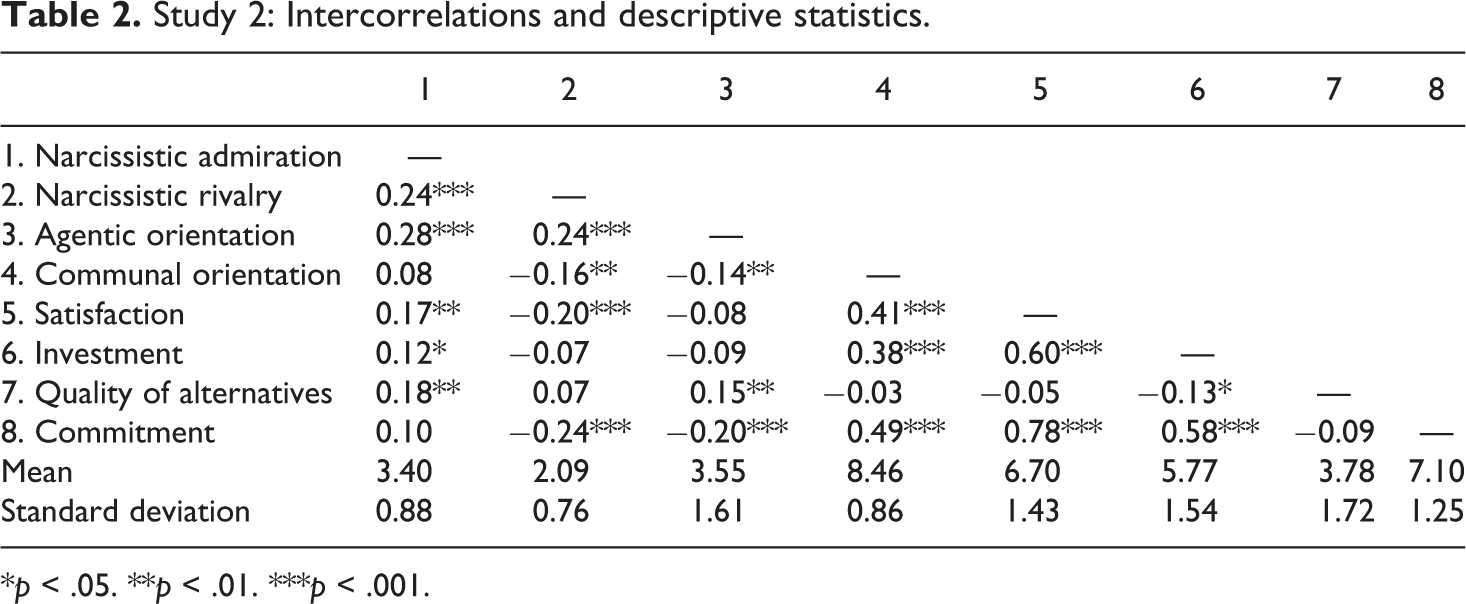
*p < .05. **p < .01. ***p < .001.
We conducted two serial multiple mediation analyses using a customized version of model 81 of the PROCESS macro developed by Hayes (2018) to examine whether narcissistic admiration and narcissistic rivalry had indirect associations with commitment through the agentic and communal orientations toward friendship, relationship satisfaction, investment, and quality of alternatives. As in Study 1, narcissistic admiration and narcissistic rivalry were examined in separate analyses due to concerns associated with including highly correlated predictors in the same analysis. The results of the serial multiple mediation analysis for narcissistic admiration are depicted in Figure 3, and the results of the analysis for narcissistic rivalry are depicted in Figure 4.
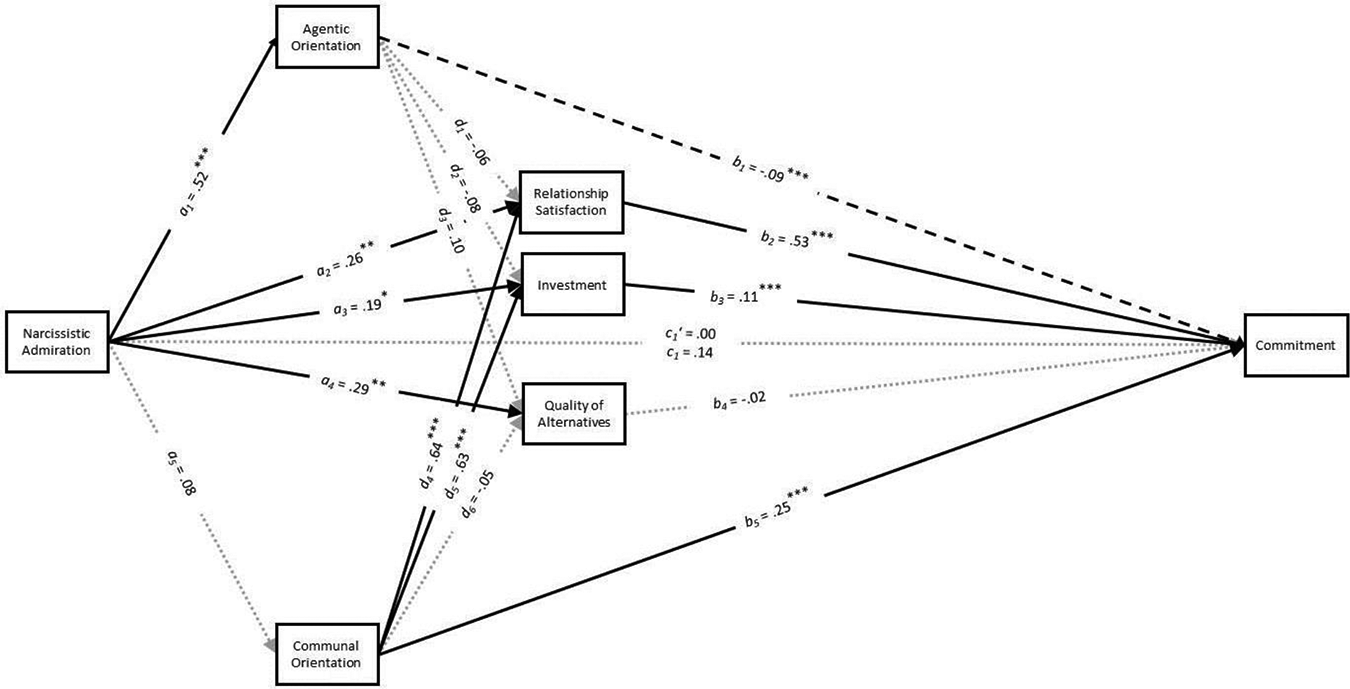
Study 2: The results of the sequential multiple mediation analysis with the agentic orientation toward friendship, the communal orientation toward friendship, relationship satisfaction, investment, and quality of alternatives mediating the association that narcissistic admiration had with commitment. The significant positive associations are indicated by solid black arrows. The significant negative associations are indicated by dashed black arrows. The dotted grey lines represent nonsignificant associations. *p < .05. **p < .01. ***p < .001.
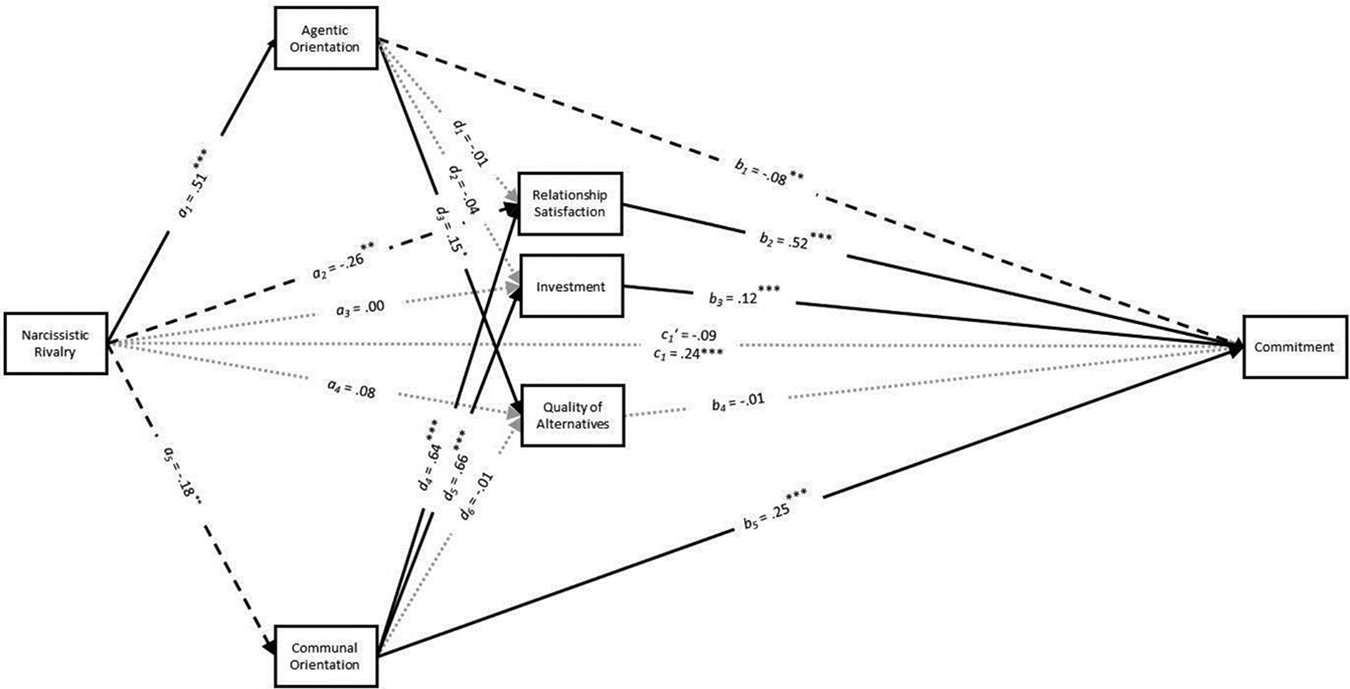
Study 2: The results of the sequential multiple mediation analysis with the agentic orientation toward friendship, the communal orientation toward friendship, relationship satisfaction, investment, and quality of alternatives mediating the association that narcissistic rivalry had with commitment. The significant positive associations are indicated by solid black arrows. The significant negative associations are indicated by dashed black arrows. The dotted grey lines represent nonsignificant associations. *p < .05. **p < .01. ***p < .001.
These results showed that narcissistic admiration had small positive associations with the agentic orientation toward friendship, relationship satisfaction, investment, and quality of alternatives. In turn, the agentic orientation toward friendship had a small negative association with commitment, but it was not associated with relationship satisfaction, investment, or quality of alternatives, whereas the communal orientation toward friendship had medium positive associations with relationship satisfaction and investment as well as a small positive association with commitment, but it was not associated with quality of alternatives. Relationship satisfaction had a large positive association with commitment and investment had a small positive association with commitment, whereas quality of alternatives was not associated with commitment. This analysis explained 8% of the variability in the agentic orientation toward friendship, 1% of the variability in the communal orientation toward friendship, 19% of the variability in relationship satisfaction, 15% of the variability in investment, and 4% of the variability in quality of alternatives.
Tests of mediation showed that narcissistic admiration had a negative indirect association with commitment through the agentic orientation toward friendship (a1b1 = −.05, SE = .02, 95% CI [−.08, −.02], PM = 1.00) and a positive indirect association with commitment through relationship satisfaction (a2b2 = .14, SE = .05, 95% CI [.05, .23], PM = 1.00). Tests of serial mediation did not reveal any associations for narcissistic admiration. Narcissistic admiration did not have a significant total association with commitment when the mediators were not included in the model (c1 = .14, SE = .07, t = 1.87, p = .06, 95% CI [−.01, .29], f2 = .01) nor did it have a significant direct association with commitment when the mediators were included in the model (
Narcissistic rivalry had a small positive association with the agentic orientation toward friendship as well as small negative associations with the communal orientation toward friendship and relationship satisfaction. In turn, the agentic orientation toward friendship had a small positive association with quality of alternatives and a small negative association with commitment, but it was not associated with relationship satisfaction or investment. The communal orientation toward friendship had medium positive associations with relationship satisfaction and investment as well as a small positive association with commitment, but it was not associated with quality of alternatives. Relationship satisfaction had a large positive association with commitment and investment had a small positive association with commitment, whereas quality of alternatives was not associated with commitment. This analysis explained 6% of the variability in the agentic orientation toward friendship, 3% of the variability in the communal orientation toward friendship, 19% of the variability in relationship satisfaction, 14% of the variability in investment, and 2% of the variability in quality of alternatives.
Narcissistic rivalry had negative indirect associations with commitment through the agentic orientation toward friendship (a1b1 = −.04, SE = .02, 95% CI [−.08, −.01], PM = 0.31), relationship satisfaction (a2b2 = −.14, SE = .05, 95% CI [−.25, −.04], PM = 0.60), and the communal orientation toward friendship (a5b5 = −.05, SE = .02, 95% CI [−.08, −.01], PM = 0.33). Tests of serial mediation showed that narcissistic rivalry had negative indirect associations with commitment through the communal orientation toward friendship via relationship satisfaction (a5d4b2 = −.06, SE = .03, 95% CI [−.12, −.02], PM = 0.40) and investment (a5d5b3 = −.02, SE = .01, 95% CI [−.03, −.01], PM = 0.14). Narcissistic rivalry had a small negative total association with commitment when the mediators were not included in the model (c2 = −.40, SE = .08, t = −4.77, p < .001, 95% CI [−.56, −.23], f2 = .06), but the direct association between narcissistic rivalry and commitment did not emerge when the mediators were included in the analysis (
Discussion
Although our analyses may be considered to be somewhat exploratory in nature, the results of Study 2 were consistent with our predictions and the results of Study 1 such that both narcissistic admiration and narcissistic rivalry were positively associated with the agentic orientation toward friendship, whereas only narcissistic rivalry was negatively associated with the communal orientation toward friendship. It should be noted that the magnitude of these associations was rather small. Narcissistic admiration and narcissistic rivalry had similar negative indirect associations with commitment through the agentic orientation toward friendship. The agentic orientation toward friendship provided at least a partial explanation for narcissistic admiration and narcissistic rivalry being associated with a lack of commitment. However, narcissistic admiration also had positive indirect associations with commitment through relationship satisfaction and investment which suggests that it has complex connections with commitment. In contrast to narcissistic admiration, narcissistic rivalry also had negative indirect associations with commitment through the communal orientation toward friendship. Taken together, the results for narcissistic rivalry were more straightforward than those for narcissistic admiration because they revealed that narcissistic rivalry was negatively associated with commitment through agentic and antagonistic (i.e., low communal) orientations toward friendship.
General discussion
The purpose of the present studies was to examine the connections that narcissistic admiration and narcissistic rivalry had with agentic and communal orientations toward friendship as well as the possibility that these orientations toward friendship may explain the associations that these expressions of narcissism had with friendship experiences. The similar associations that narcissistic admiration and narcissistic rivalry had with the agentic orientation toward friendship suggest the possibility of a general narcissistic tendency to focus on the agentic aspects of friendships such as the power dynamics that exist within these relationships. This is consistent with previous research emphasizing the important role that agency plays in the connections between narcissistic personality features and interpersonal relationships (e.g., Campbell et al., 2006) as well as recent suggestions that issues surrounding the navigation of status hierarchies may be essential for a deeper understanding of narcissistic personality dynamics (e.g., Back, 2018; Zeigler-Hill et al., 2019).
Narcissistic admiration and narcissistic rivalry had similar indirect associations with perceptions of friendship through the agentic orientation toward friendship in both studies. Broadly speaking, the agentic focus was associated with relatively negative views of friendship (e.g., less commitment to friendships). This pattern is consistent with the results of previous studies showing that attunement to agentic concerns is often associated with difficulties in interpersonal relationships due to a tendency for the prioritization of one’s own desires (e.g., Helgeson & Fritz, 2000). These agentic concerns may be helpful for promoting and maintaining grandiose self-views, but this focus on agency does not seem to facilitate the development of close, intimate friendships. The lack of commitment to friendships that appears to characterize narcissistic admiration and narcissistic rivalry is similar in many respects to the relative lack of romantic commitment that has been found to be associated with narcissism in previous studies that have utilized the NARQ (e.g., Zeigler-Hill et al., 2020) or other measures of narcissism such as the Narcissistic Personality Inventory (e.g., Campbell & Foster, 2002).
Across the present studies, narcissistic rivalry had the expected negative association with the communal orientation toward friendship which suggests that this aspect of narcissism is characterized by somewhat negative or antagonistic views of friendship. One possible explanation for this pattern is that the antagonistic tendencies that characterize narcissistic rivalry may make it more difficult to establish friendships that are characterized by warmth and intimacy. Another possibility is that the negative perceptions of friendship that characterize narcissistic rivalry may be due to the failure of past friendships to provide the status that seems to be so entwined with narcissistic personality features (e.g., Zeigler-Hill et al., 2018). This antagonistic (i.e., low communal) orientation toward friendship provides at least a partial explanation for the negative associations that narcissistic rivalry had with perceptions of friendship across the present studies (e.g., lower levels of satisfaction with friendship). Future research should examine whether the connection that narcissistic rivalry has with antagonistic views of interpersonal relationships extends to other types of relationships (e.g., romantic relationships). Narcissistic admiration was not associated with the communal orientation toward friendship in both studies. It appears that narcissistic admiration is not especially associated with the communal orientation toward friendships, and as such, this orientation does not appear to have much of an impact on the association that narcissistic admiration has with aspects of friendship cognition.
Narcissistic rivalry had relatively simple and consistent associations with indicators of poor friendship functioning across the present studies (e.g., less satisfaction with friendships), whereas narcissistic admiration had more complex associations with these outcomes (e.g., negative views of friendship through the agentic orientation toward friendship but not the communal orientation toward friendship). This pattern is consistent with the argument that narcissistic admiration may reflect something akin to a “mixed blessing” for interpersonal relationships (e.g., Zeigler-Hill et al., 2020). The results of the present studies provide additional support for the importance of distinguishing between the relatively agentic aspects of narcissism that are captured by narcissistic admiration and the antagonistic aspects of narcissism that are captured by narcissistic rivalry. This distinction allowed for a more nuanced understanding of the connections that narcissism has with various aspects of friendship.
Although the present studies had a number of strengths (e.g., a multidimensional view of narcissism), it is important to acknowledge some of their potential limitations. The first limitation is that the direction of causality between narcissism, orientations toward friendship, and perceptions of friendships cannot be determined due to the correlational nature of these studies (see Maxwell & Cole, 2007, for the limitations of cross-sectional mediational analyses). The underlying process model for the present studies was that narcissism would influence agentic and communal orientations toward friendship that, in turn, would influence perceptions of the friendship. However, other causal patterns could exist between these variables (e.g., orientations toward friendship may precede the development of narcissism). Future research should attempt to gain a better understanding of the causal links between narcissism, orientations toward friendship, and perceptions of friendships using experimental designs or longitudinal studies. The second limitation is that the present studies relied exclusively on self-report measures which makes it possible that socially desirable responding may have impacted our results. Future research would benefit from utilizing strategies that are designed to capture these variables without being completely reliant on self-reports (e.g., include ratings from actual friends).
The third limitation of the present studies concerns the phase of their friendship that participants may have been considering when completing the instruments. Although Study 1 was intended to address issues that would be most important during the earlier stages of friendship (e.g., maximizing selectivity) and Study 2 was focused on issues that would be most relevant to existing friendships (e.g., friendship commitment), participants were instructed to focus on a close friend, and not a particular phase of their friendship. It may be informative for future studies in this area to examine the connections that narcissistic personality features have with experiences during particular phases of friendships. For example, do narcissistic admiration and narcissistic rivalry have particularly strong associations with agentic orientations toward friendship during the initiation phase of friendships?
The fourth limitation is that the present studies adopted a multidimensional view of narcissism, but we did not include some aspects of narcissism that may have implications for friendships such as vulnerable narcissism (a form of narcissism characterized by negative affectivity; e.g., Krizan & Herlache, 2018) and communal narcissism (a form of narcissism in which superiority over others is demonstrated by exaggerating communal characteristics; e.g., Gebauer et al., 2012). Future studies concerning the connections between narcissism and friendship may benefit from including these aspects of narcissism. Despite these limitations, the results of the present studies expand the current understanding of how narcissistic personality features are linked with various aspects of friendship.
Conclusion
The present studies investigated whether agentic and communal orientations toward friendship play a significant role in the associations that narcissistic admiration and narcissistic rivalry had with various perceptions of friendship. Our results showed that narcissistic admiration and narcissistic rivalry had similar associations with the agentic orientation toward friendship but divergent associations with the communal orientation toward friendship. Further, the agentic and communal orientations toward friendship played important roles in understanding the associations that narcissistic admiration and narcissistic rivalry had with various aspects of friendship.
Footnotes
Funding
The author(s) received no financial support for the research, authorship, and/or publication of this article.

Open research statement
As part of IARR’s encouragement of open research practices, the authors have provided the following information: This research was not pre-registered. The data used in the research are available. The data can be obtained by emailing: