




Abstract
The present studies examined the possibility that narcissistic admiration (assertive self-enhancement and self-promotion) and narcissistic rivalry (self-protection and self-defense) would have divergent associations with benefit-provisioning and cost-inflicting mate retention behaviors. Study 1 (N = 625) revealed that narcissistic admiration was associated with benefit-provisioning behaviors, whereas narcissistic rivalry was associated with cost-inflicting behaviors. Study 2 (N = 349) showed that narcissistic admiration was positively associated with cost-inflicting behaviors when levels of suspicious jealousy were relatively high. Study 3 (N = 373) revealed that both narcissistic admiration and narcissistic rivalry had positive indirect associations with cost-inflicting behaviors through the dominance-based orientation toward status. However, these aspects of narcissism had divergent indirect associations with cost-inflicting behaviors through the prestige-based orientation such that this indirect association was negative for narcissistic admiration but positive for narcissistic rivalry. These results demonstrate the similarities and important differences between narcissistic admiration and narcissistic rivalry with regard to the use of particular mate retention behaviors.
The personality construct of narcissism refers to an exaggerated sense of grandiosity, vanity, self-absorption, feelings of entitlement, a lack of empathy, and a willingness to exploit others (e.g., Krizan & Herlache, 2018). Individuals with narcissistic personality features may experience a wide array of interpersonal difficulties due to their use of particular intrapersonal mechanisms (e.g., the tendency to believe one’s own contributions to joint tasks are especially important; Campbell et al., 2000) and interpersonal behaviors (e.g., the frequent derogation of others; Morf & Rhodewalt, 1993). The purpose of the present studies was to examine the associations that narcissistic personality features had with the strategies that are employed to retain romantic partners.
Narcissism and romantic relationships
The various interpersonal problems that characterize narcissism clearly extend to romantic relationships. Narcissism has been found to be associated with romantic appeal during the earliest stages of relationships (e.g., Dufner et al., 2013; Wurst et al., 2017), which is consistent with the possibility that the evolutionary function of narcissism may be linked with the facilitation of short-term mating (e.g., Holtzman & Strube, 2011). However, there is a considerable body of research showing that narcissism is associated with a wide range of problems in the long-term romantic relationships (e.g., lack of commitment; see Foster & Brunell, 2018, for a review). For example, narcissism is linked with a tendency to use romantic relationships to establish, maintain, and enhance social status and positive self-views rather than focusing on the development of closeness and intimacy with romantic partners (e.g., Campbell et al., 2006).
Despite its associations with various indicators of poor romantic relationship functioning, narcissism may also be linked with at least some behaviors that are intended to maintain romantic relationships. The strategies used to reduce the likelihood of defection or infidelity by current romantic partners are known as mate retention behaviors (Buss, 1988). There are two basic approaches to mate retention that are referred to as benefit-provisioning behaviors and cost-inflicting behaviors (e.g., Miner et al., 2009). Benefit-provisioning behaviors refer to relatively positive strategies that involve fairly innocuous acts that highlight the positive aspects of the relationship for the partner (e.g., buying expensive gifts for the partner). In essence, benefit-provisioning behaviors provide incentives for the partner to remain involved in the relationship. For example, a man may shower his wife with attention and affection if he is worried that she may be thinking about divorcing him. In contrast, cost-inflicting behaviors are relatively negative strategies in which aversive consequences are imposed on the partner – or at least threatened – if they decide to leave the relationship or engage in infidelity (e.g., behaving violently toward the partner). For example, a man may attempt to prevent his wife from divorcing him by threatening to kill her if she ever tried to leave him.
Narcissism has been found to be associated with various cost-inflicting behaviors including jealousy induction, intrasexual threats, punishment of infidelity threats, and violence against potential rivals (Jonason et al., 2010). Narcissism has also been found to be associated with the tendency to induce jealousy in romantic partners (Tortoriello et al., 2017) and the use of aversive or manipulative strategies to satisfy one’s goals in romantic relationships (e.g., Sauls et al., 2019). It is possible that these aversive behaviors are actually somewhat misguided and selfish attempts to maintain these relationships rather than indicating a lack of interest or concern about these relationships.
Narcissistic admiration and narcissistic rivalry
Although previous studies have examined the connections that narcissism has with mate retention behaviors (e.g., Jonason et al., 2010), these studies have often conceptualized narcissism as a unidimensional construct despite a great deal of evidence showing that it is actually multidimensional (e.g., Miller et al., 2016). To address this limitation in the existing literature, we used the Narcissistic Admiration and Rivalry Concept (NARC; Back et al., 2013) to provide a more nuanced account of the connections that narcissistic personality features have with mate retention behaviors. The NARC model was developed with the goal of clarifying some of the conflicting and paradoxical patterns that often characterize narcissism (e.g., being perceived as charming but aggressive). The NARC model accomplishes this by distinguishing between narcissistic admiration (an agentic aspect of narcissism that is characterized by assertive self-enhancement and self-promotion) and narcissistic rivalry (an antagonistic aspect of narcissism that is characterized by self-protection and self-defense). Narcissistic admiration and narcissistic rivalry represent two different strategies for maintaining grandiose self-views. The self-promotional strategies that characterize narcissistic admiration are often at least somewhat effective because they tend to result in ego-boosts from the social environment that help to support and maintain grandiose self-views. In contrast, narcissistic rivalry is characterized by the adoption of antagonistic and self-protective strategies that are intended to bolster grandiose self-views but often lead to social conflict which may have the unintended consequence of making it even more difficult to support these grandiose self-views.
The NARC model is certainly not the only model to offer a multidimensional conceptualization of narcissism, but it has been particularly useful for clarifying some of the confusion and inconsistencies concerning the connections that narcissistic behaviors and motivations have with various romantic outcomes. For example, narcissistic admiration and narcissistic rivalry have both been found to have similar positive associations with attitudes toward alternative romantic partners as well as similar negative indirect associations with romantic commitment through attitudes toward alternative romantic partners (Zeigler-Hill et al., 2020). Despite these similarities, these two aspects of narcissism have also been found to have divergent associations with a range of romantic outcomes. Narcissistic admiration has been found to have somewhat complex associations with various aspects of romantic relationships. For example, narcissistic admiration is associated with the tendency to use manipulative influence strategies with romantic partners (Sauls et al., 2019)—which is similar to narcissistic rivalry—but it has also been found to be associated with relatively positive outcomes including short-term romantic appeal (Wurst et al., 2017), perceptions of power (Vrabel et al., 2020), and high levels of relationship satisfaction (e.g., Zeigler-Hill et al., 2020). In contrast, narcissistic rivalry has generally been found to have relatively simple and consistent associations with various indicators of poor romantic relationship functioning including low levels of relationship satisfaction (e.g., Wurst et al., 2017; Zeigler-Hill et al., 2020), perceptions of disrespect from romantic partners (Vrabel et al., in press), and the use of aversive influence strategies (e.g., bullying, manipulation) with romantic partners (Sauls et al., 2019). Taken together, these results suggest that it is important to distinguish between these two dimensions of narcissism because the agentic aspect of narcissism captured by narcissistic admiration seems to have both costs and benefits for romantic relationships, whereas the antagonistic aspect of narcissism captured by narcissistic rivalry appears to be almost exclusively problematic for relationships.
Overview and predictions
The purpose of the present studies was to gain a more complete understanding of the associations that narcissistic personality features have with mate retention behaviors. We expected narcissistic admiration to be positively associated with benefit-provisioning behaviors. The rationale for this prediction was that narcissistic admiration is characterized by the use of assertive self-enhancement and self-promotion to maintain their own grandiose self-views (e.g., resource display) so it seemed likely that this form of narcissism would be characterized by the use of similar strategies to maintain romantic relationships. In essence, we expected narcissistic admiration to be characterized by the use of mate retention strategies that were focused on demonstrating one’s value as a romantic partner. This prediction was also consistent with the results of previous studies showing narcissistic admiration to be associated with a range of positive romantic outcomes (e.g., relationship satisfaction; Zeigler-Hill et al., 2020) as well as the tendency to use strategies to persuade others rather than focusing on intimidation or coercion (e.g., strong associations with prestige-based strategies for gaining status; Zeigler-Hill et al., 2019).
We were uncertain about the connection that narcissistic admiration would have with cost-inflicting behaviors. The reason for our uncertainty was that narcissistic admiration has been shown to be associated with manipulative influence strategies in romantic relationships (e.g., Sauls et al., 2019) as well as the use of dominance-based strategies for pursuing status (Zeigler-Hill et al., 2019). These results suggest that narcissistic admiration may be characterized by a willingness to use aversive strategies to achieve interpersonal goals if other approaches are unlikely to be successful. However, narcissistic admiration is also associated with certain indicators of healthy romantic relationship functioning that do not seem to be consistent with reliance on cost-inflicting behaviors (e.g., Zeigler-Hill et al., 2020). As a result, we did not have a clear prediction concerning the association that narcissistic admiration would have with cost-inflicting behaviors but we examined this association for exploratory purposes.
We did not expect narcissistic rivalry to be associated with benefit-provisioning behaviors because the blend of antagonism and uncertainty that characterizes this form of narcissism makes it unlikely to be linked with the use of this strategy to maintain relationships. However, we did expect narcissistic rivalry to be positively associated with cost-inflicting behaviors. The rationale for this prediction was that narcissistic rivalry is characterized by antagonistic self-protection and self-defense, which seems to be consistent with the willingness to use aversive strategies to manipulate their romantic partners. That is, we expected narcissistic rivalry to be linked with the use of antagonistic strategies and coercion-based tactics to prevent romantic partners from committing infidelity or defecting from the relationship that are similar in some respects to the approaches that are adopted for managing their own feelings of grandiosity (e.g., derogating others). This prediction was also consistent with the results of previous studies showing that narcissistic rivalry is associated with a wide variety of negative romantic outcomes including unflattering perceptions of current relationship partners (e.g., Wurst et al., 2017; Zeigler-Hill et al., 2020) as well as the tendency to employ intimidation or coercion when attempting to influence their romantic partners (Sauls et al., 2019) or gain status in the broader social environment (Zeigler-Hill et al., 2019).
Across three studies, we examined the associations that narcissistic personality features had with mate retention behaviors. The purpose of Study 1 was to examine the unique associations that narcissistic admiration and narcissistic rivalry had with benefit-provisioning and cost-inflicting mate retention behaviors. Mate retention behaviors are often exacerbated by feelings of jealousy (e.g., Buss, 1988) so we examined whether jealousy would moderate the associations that narcissistic personality features had with mate retention behaviors in Study 2. Recent studies have shown that the strategies used to pursue status are associated with narcissism (Zeigler-Hill et al., 2019) and mate retention behaviors (Conlon, 2019) so Study 3 examined whether these strategies for pursuing status would mediate the associations that narcissistic personality features had with mate retention behaviors.
Study 1
The purpose of Study 1 was to explore the unique associations that narcissistic personality features had with mate retention behaviors. More specifically, we expected narcissistic admiration to be positively associated with benefit-provisioning behaviors, but we were uncertain about whether it would be associated with cost-inflicting behaviors. We did not expect narcissistic rivalry to be associated with benefit-provisioning behaviors, but we did expect it to be positively associated with cost-inflicting behaviors.
Method
Participants and procedure
Participants were 639 undergraduates at a university in the Midwestern region of the United States who were currently involved in a heterosexual romantic relationship for at least 3 months. Participants completed measures concerning narcissism and mate retention behaviors—along with other measures that were not relevant to the present study (e.g., self-esteem level)—via a secure website. Data were excluded for 14 participants who failed to successfully complete two or more of the directed response items that were included in the instruments to identify inattentive responding (e.g., “Answer this item with ‘strongly disagree’”). The final 625 participants (513 women, 112 men) had a mean age of 20.39 years (SD = 3.72) and the racial/ethnic composition was 82% White, 7% Black, 3% Hispanic, 3% Asian, and 5% other. The median relationship length was 1.83 years (SD = 2.38) and the romantic relationship composition of the sample was 85% dating, 7% cohabitating, 5% married, and 3% engaged.
Materials
Narcissism
Narcissism was assessed using the Narcissistic Admiration and Rivalry Questionnaire (NARQ; Back et al., 2013). The NARQ captures two aspects of narcissism: narcissistic admiration (9 items; e.g., “I manage to be the center of attention with my outstanding contributions” [α = .83]) and narcissistic rivalry (9 items; e.g., “I want my rivals to fail” [α = .86]). Participants were asked to rate how well each statement described them using scales that ranged from 1 (not agree at all) to 6 (agree completely).
Mate retention behaviors
Mate retention behaviors were measured using the Mate Retention Inventory-Short Form (MRI-SF; Buss et al., 2008). The MRI-SF assesses two forms of mate retention: benefit-provisioning behaviors (16 items; e.g. “Bought my partner an expensive gift” [α = .80]) and cost-inflicting behaviors (22 items; “Called to make sure my partner was where they said they would be” [α = .87]). Participants were asked to report how frequently they had engaged in each behavior using scales ranging from 0 (never performed this act) to 3 (often performed this act).
Results
The zero-order correlations that narcissistic admiration and narcissistic rivalry had with benefit-provisioning and cost-inflicting behaviors are presented in Table 1. Narcissistic admiration had small positive correlations with benefit-provisioning and cost-inflicting behaviors. In contrast, narcissistic rivalry was not correlated with benefit-provisioning behaviors, but it had a moderate correlation with cost-inflicting behaviors. Two multiple regression analyses were conducted to determine whether narcissistic admiration and narcissistic rivalry had unique associations with benefit-provisioning and cost-inflicting behaviors. The results of these analyses are presented in Table 1. The variance inflation factor (VIF) values for these analyses were less than 1.16, which suggests that multicollinearity was not an issue. 1
Study 1: Associations that narcissistic admiration and narcissistic rivalry had with mate retention behaviors.

*p < .01; **p < .001.
Benefit-provisioning behaviors
The results for benefit-provisioning behaviors revealed a small positive association for narcissistic admiration (β = .12, t = 2.78, p = .006, 95% confidence interval [CI] = [.04, .20], f 2 = .01) but no association for narcissistic rivalry (β = .01, t = 0.15, p = .88, 95% CI [−.08, .09], f 2 = .00).
Cost-inflicting behaviors
The results for cost-inflicting behaviors revealed no unique association for narcissistic admiration (β = .02, t = 0.56, p = .58, 95% CI [−.06, .10], f 2 = .00) but a positive association for narcissistic rivalry that had a medium effect size (β = .35, t = 8.77, p < .001, 95% CI [.27, .43], f 2 = .12).
Discussion
The results of Study 1 were largely consistent with our hypotheses. As expected, narcissistic admiration was positively associated with benefit-provisioning behaviors. This suggests that narcissistic admiration is characterized by the use of strategies for maintaining romantic relationships that are similar in some respects to the strategies used to maintain grandiose self-views (e.g., displaying resources to others). We did not have a clear prediction regarding the potential association between narcissistic admiration and cost-inflicting behaviors. The results showed that narcissistic admiration had a small positive correlation with cost-inflicting behaviors, but it is important to note that this association did not emerge when narcissistic rivalry was included in the same analysis. The changes in the association that narcissistic admiration had with cost-inflicting behaviors depending on whether narcissistic rivalry was included in the same analysis illustrates the difficulties that are involved with attempts to isolate the unique associations that correlated predictor variables have with the same outcome variable (see Lynam et al., 2006, for an extended discussion of this “perils of partialling” issue).
Narcissistic rivalry was not associated with benefit-provisioning behaviors, but it did have positive association with cost-inflicting behaviors that was consistent with our prediction and moderate in its magnitude. Narcissistic rivalry is characterized by the use of antagonistic strategies to manage grandiose self-views, so it is not surprising that this form of narcissism would promote a similar adversarial approach when attempting to force romantic partners to remain committed to the current relationship. In essence, this pattern suggests that narcissistic rivalry is associated with a willingness to impose costs on romantic partners in an effort to reduce the likelihood they will defect from the relationship or be unfaithful.
Study 2
The tendency to engage in mate retention behaviors appears to be activated by jealousy (e.g., Buss, 1988), which led us to examine whether the associations that narcissistic personality features had with mate retention behaviors would be moderated by feelings of jealousy. There are various approaches for conceptualizing jealousy but one model distinguishes between reactive jealousy and suspicious jealousy (Rydell & Bringle, 2007). Reactive jealousy is experienced when the romantic partner has engaged in actual transgressions that have violated aspects of the relationship (e.g., clearly flirting with someone else, committing infidelity), whereas suspicious jealousy involves the perception of minor or ambiguous events as being more threatening to the relationship than would normally be expected (e.g., interpreting polite exchanges between the romantic partner and an attractive co-worker as evidence of an affair in the absence of other information). We were especially interested in the possibility that suspicious jealousy may exacerbate the association that narcissistic admiration had with benefit-provisioning behaviors as well as the association that narcissistic rivalry had with cost-inflicting behaviors because this form of jealousy is more closely related to internal factors (e.g., feelings of insecurity) than reactive jealousy which occurs in response to events that may actually threaten the relationship (e.g., discovering that one’s romantic partner is having an affair; Rydell & Bringle, 2007). We did not have clear predictions regarding the role that reactive jealousy would play in the connections between narcissistic personality features and mate retention behaviors, but we included this form of jealousy in the analyses for exploratory purposes.
Participants and procedure
Participants were 409 undergraduates who were currently involved in a heterosexual romantic relationship for at least 3 months. Participants completed measures concerning narcissism, jealousy, and mate retention behaviors—along with other measures that were not relevant to the present study—via a secure website. Data were excluded for 60 participants due to careless or inattentive responding: 39 participants for failing to successfully complete two or more of the directed response items that were included in the instruments to identify inattentive responding and 21 participants for being univariate outliers. The final sample of 349 participants (296 women, 53 men) had a mean age of 20.47 years (SD = 3.67) and the racial/ethnic composition was 85% White, 5% Black, 4% Hispanic, 4% Asian, and 2% other. The median relationship length was 1.92 years (SD = 2.45) and the romantic relationship composition was 85% dating, 9% cohabitating, 3% engaged, and 3% married.
Materials
Narcissism
Narcissistic admiration (α = .78) and narcissistic rivalry (α = .83) were assessed using the NARQ as in Study 1.
Jealousy
The Multidimensional Jealousy Scale (Pfeiffer & Wong, 1989; Rydell & Bringle, 2007) was used to capture reactive jealousy (8 items; e.g., “X is flirting with someone of the opposite sex” [α = .80]) and suspicious jealousy (16 items; e.g., “I suspect that X may be attracted to someone else” [α = .88]). Participants were asked to respond to each item using 7-point scales with anchors that differed between the items (e.g., 1 [never] to 7 [always]).
Mate retention behaviors
Benefit-provisioning behaviors (α = .78) and cost-inflicting behaviors (α = .83) were measured using the MRI-SF as in Study 1.
Results
The zero-order correlations that narcissistic admiration and narcissistic rivalry had with jealousy and mate retention behaviors are presented in Table 2. Narcissistic admiration was positively correlated with narcissistic rivalry and benefit-provisioning behaviors, whereas narcissistic rivalry was positively correlated with suspicious jealousy and cost-inflicting behaviors. Reactive jealousy was positively correlated with cost-inflicting behaviors, whereas suspicious jealousy was positively correlated with both benefit-provisioning behaviors and cost-inflicting behaviors.
Study 2: Intercorrelations between narcissism, jealousy, and mate retention behaviors.

*p < .05; **p < .01; ***p < .001.
Two hierarchical moderated multiple regression analyses were conducted to determine whether reactive jealousy and suspicious jealousy moderated the associations that narcissistic admiration and narcissistic rivalry had with benefit-provisioning and cost-inflicting mate retention behaviors. For both of the analyses, the main effects of narcissistic admiration, narcissistic rivalry, reactive jealousy, and suspicious jealousy were entered on Step 1 with the following two-way interactions entered on Step 2: Narcissistic Admiration × Reactive Jealousy, Narcissistic Admiration × Suspicious Jealousy, Narcissistic Rivalry × Reactive Jealousy, and Narcissistic Rivalry × Suspicious Jealousy. The VIF values for these analyses were less than 1.20, which suggests that multicollinearity was not an issue. These analyses were followed by simple slopes tests to examine interactions between continuous variables. These simple slopes tests were conducted using values that were one standard deviation above and below their respective means (e.g., low levels of narcissistic admiration were represented by a value that was one standard deviation below the mean for narcissistic admiration, whereas high levels of narcissistic admiration were represented by a value that was one standard deviation above the mean for narcissistic admiration).
Benefit-provisioning behaviors
The results for benefit-provisioning behaviors revealed unique positive associations for narcissistic admiration (β = .17, t = 3.07, p = .002, 95% CI [.06, .27], f 2 = .03) and suspicious jealousy (β = .22, t = 4.05, p < .001, 95% CI [.11, .32], f 2 = .05). No other main effects or interactions emerged from this analysis.
Cost-inflicting behaviors
The results for cost-inflicting behaviors revealed positive associations for narcissistic rivalry (β = .16, t = 3.69, p < .001, 95% CI [.08, .24], f 2 = .04), reactive jealousy (β = .09, t = 2.20, p = .03, 95% CI [.01, .17], f 2 = .02), and suspicious jealousy (β = .60, t = 14.30, p < .001, 95% CI [.51, .68], f 2 = .60). Although narcissistic admiration did not have a unique association with cost-inflicting behaviors, the two-way interaction of Narcissistic Admiration × Suspicious Jealousy emerged (β = .09, t = 2.19, p = .03, 95% CI [.01, .17], f 2 = .02). The predicted values for this interaction are depicted in Figure 1. Simple slopes tests found that the association between narcissistic admiration and cost-inflicting behaviors was significant when levels of suspicious jealousy were relatively high (β = .13, t = 2.21, p = .03, 95% CI [.01, .25], f 2 = .02) but not when they were relatively low (β = −.04, t = −0.75, p = .46, 95% CI [−.16, .07], f 2 = .00). Taken together, this pattern shows that narcissistic admiration had a small positive association with cost-inflicting behaviors but only when experiencing suspicious jealousy. 2
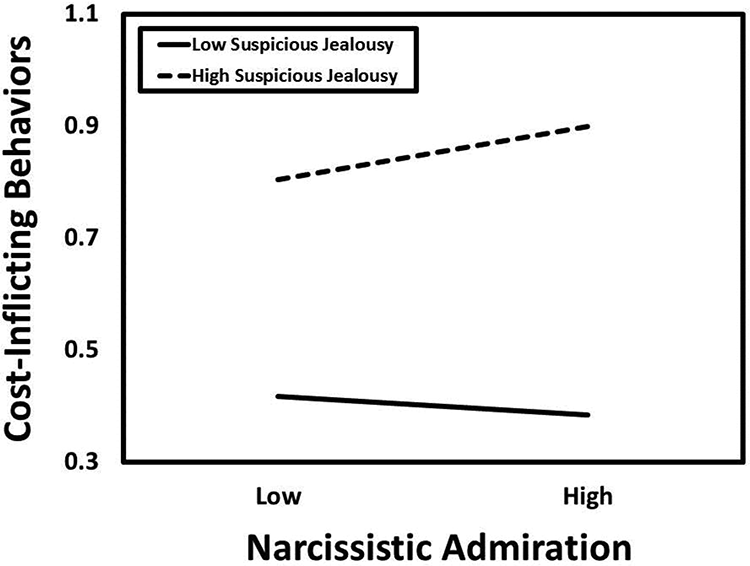
Study 2: Predicted values for cost-inflicting mate retention behaviors illustrating the interaction of narcissistic admiration and suspicious jealousy at values that are one standard deviation above and below their respective means.
Discussion
The results of Study 2 were largely consistent with our hypotheses. As expected, narcissistic admiration was positively associated with benefit-provisioning behaviors. In addition, suspicious jealousy was positively associated with benefit-provisioning and cost-inflicting behaviors. The associations that suspicious jealousy had with mate retention behaviors are consistent with the idea that this aspect of jealousy—which has its origin in feelings of insecurity—may motivate efforts to maintain romantic relationships. Further, narcissistic admiration was found to be positively associated with cost-inflicting behaviors, but this association only emerged when feelings of suspicious jealousy were relatively high. This pattern is consistent with the results of previous studies showing that narcissistic admiration is associated with a willingness to resort to the use of aversive strategies if doing so is believed to be necessary for the achievement of interpersonal goals (e.g., Sauls et al., 2019; Zeigler-Hill et al., 2019). The experience of a romantic partner dissolving a relationship or being unfaithful may be so damaging for grandiose self-views that potential cues related to these possibilities—including the experience of suspicious jealousy and the insecurity that is associated with this form of jealousy—may activate a willingness to engage in cost-inflicting behaviors to avoid these potential outcomes.
As observed in Study 1, narcissistic rivalry was positively associated with cost-inflicting behaviors. However, it is interesting to note that the strength of the association that narcissistic rivalry had with cost-inflicting behaviors was not moderated by jealousy. That is, the positive association between narcissistic rivalry and cost-inflicting behaviors was not altered by the experience of reactive jealousy or suspicious jealousy despite both forms of jealousy being positively associated with cost-inflicting behaviors.
Study 3
It has recently been argued that the pursuit of social status may play an even more fundamental role in the understanding of narcissism than had been previously recognized (Grapsas et al., 2020; Zeigler-Hill et al., 2018 , 2019). As a result, it is important to consider how narcissistic personality features may shape the strategies that are employed to attain status and whether these strategies may have implications for the behaviors that are used to maintain romantic relationships. Two basic approaches for pursuing status have been identified (e.g., Cheng et al., 2010). One approach is a dominance-based orientation that relies on the use of conflict to acquire status (e.g., intimidating others or using fear in an attempt to force others to grant status), whereas the other approach is a prestige-based orientation that emphasizes displays of competence to gain status (e.g., demonstrating valuable skills in an effort to persuade others to voluntarily confer status). Narcissistic admiration and narcissistic rivalry have been found to have relatively similar positive associations with the dominance-based orientation but divergent associations with the prestige-based orientation such that narcissistic admiration was positively associated with this approach to gaining status but narcissistic rivalry was negatively associated with this approach (Zeigler-Hill et al., 2019). These results suggest that narcissistic admiration is characterized by a willingness to employ either dominance-based or prestige-based strategies to gain status, whereas narcissistic rivalry is characterized by an exclusive reliance on dominance-based strategies coupled with an avoidance of prestige-based strategies. This is important for the present research because the orientations that individuals use to pursue status in their broader social environments have been shown to be associated with the mate retention behaviors they employ in their romantic relationships (Conlon, 2019). That is, the dominance-based orientation is associated with the use of cost-inflicting behaviors, whereas the prestige-based orientation is associated with the use of benefit-provisioning behaviors (Conlon, 2019). Our goal for Study 3 was to examine whether narcissistic admiration and narcissistic rivalry would have indirect associations with benefit-provisioning and cost-inflicting behaviors in romantic relationships through the strategies that are used to pursue status in broader social environments. More specifically, we expected the positive association between narcissistic admiration and benefit-provisioning behaviors to be mediated by the prestige-based orientation, whereas we expected the dominance-based orientation to mediate the positive association that narcissistic rivalry had with cost-inflicting behaviors.
Participants and procedure
Participants were 430 undergraduates at a university in the Midwestern region of the United States who were currently involved in a heterosexual romantic relationship for at least 3 months. Participants completed measures concerning narcissism, status orientation, and mate retention behaviors—along with other measures that were not relevant to the present study (e.g., self-esteem level)—via a secure website. Data were excluded for 57 participants due to careless or inattentive responding: 37 participants for failing to successfully complete two or more of the directed response items that were included in the instruments to identify inattentive responding (e.g., “Answer this item with ‘strongly disagree’”) and 20 participants for being univariate outliers. The final sample of 373 participants (315 women, 58 men) had a mean age of 20.36 years (SD = 3.76) and the racial/ethnic composition was 84% White, 5% Black, 5% Asian, 4% Hispanic, and 2% other. The median relationship length was 1.75 years (SD = 2.40) and the romantic relationship composition was 86% dating, 8% cohabitating, 5% married, and 1% engaged.
Materials
Narcissism
Narcissistic admiration (α = .79) and narcissistic rivalry (α = .83) was assessed using the NARQ as in the previous studies.
Dominance and prestige
The Dominance–Prestige Scales (Cheng et al., 2010) were used to capture the dominance-based orientation (8 items; e.g., “I am willing to use aggressive tactics to get my way” [α = .79]) and the prestige-based orientation (9 items; e.g., “I am considered an expert on some matters by others” [α = .74]). Participants were asked to rate their level of agreement with each statement using scales ranging from 1 (not at all) to 7 (very much).
Mate retention behaviors
Benefit-provisioning (α = .79) and cost-inflicting (α = .84) were measured using the MRI-SF as in the previous studies.
Results
The zero-order correlations that narcissistic admiration and narcissistic rivalry had with status orientations and mate retention behaviors are presented in Table 3. Narcissistic admiration was positively correlated with narcissistic rivalry, the dominance-based orientation, the prestige-based orientation, and benefit-provisioning behaviors, whereas narcissistic rivalry was positively correlated with the dominance-based orientation and cost-inflicting behaviors. The dominance-based orientation was positively correlated with benefit-provisioning behaviors and cost-inflicting behaviors, whereas the prestige-based orientation was negatively correlated with cost-inflicting behaviors.
Study 3: Intercorrelations between narcissism, status orientation, and mate retention behaviors.
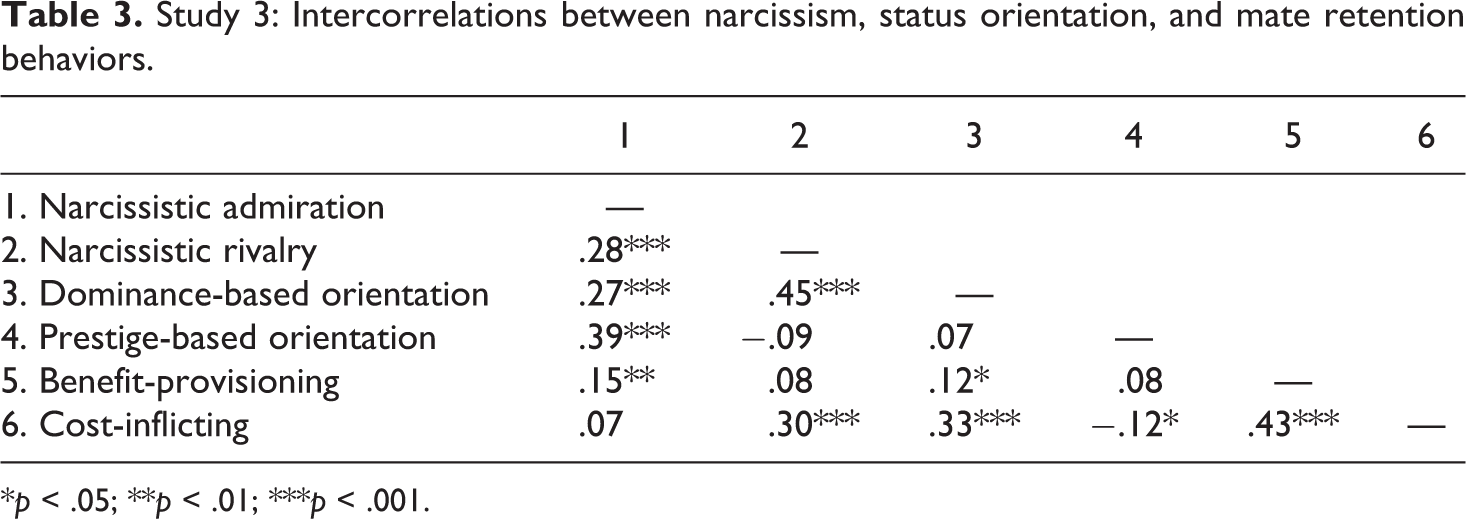
*p < .05; **p < .01; ***p < .001.
We conducted parallel multiple mediation analyses to examine the possibility that narcissistic admiration and narcissistic rivalry had indirect associations with benefit-provisioning and cost-inflicting behaviors through the dominance-based orientation and the prestige-based orientation using model four of the PROCESS macro developed by Hayes (2018) for SPSS. The PROCESS macro generated 95% bias-corrected CIs using a bootstrap resampling process that was repeated 10,000 times. The results of these parallel multiple mediation analyses are presented together in Figure 2. Narcissistic admiration and narcissistic rivalry both had positive associations with the dominance-based orientation, whereas these forms of narcissism diverged in their associations with the prestige-based orientation such that the association was positive for narcissistic admiration but negative for narcissistic rivalry. In turn, the dominance-based orientation was positively associated with cost-inflicting behaviors, but it was not associated with benefit-provisioning behaviors, whereas the prestige-based orientation was negatively associated with cost-inflicting behaviors, but it was not associated with benefit-provisioning behaviors.
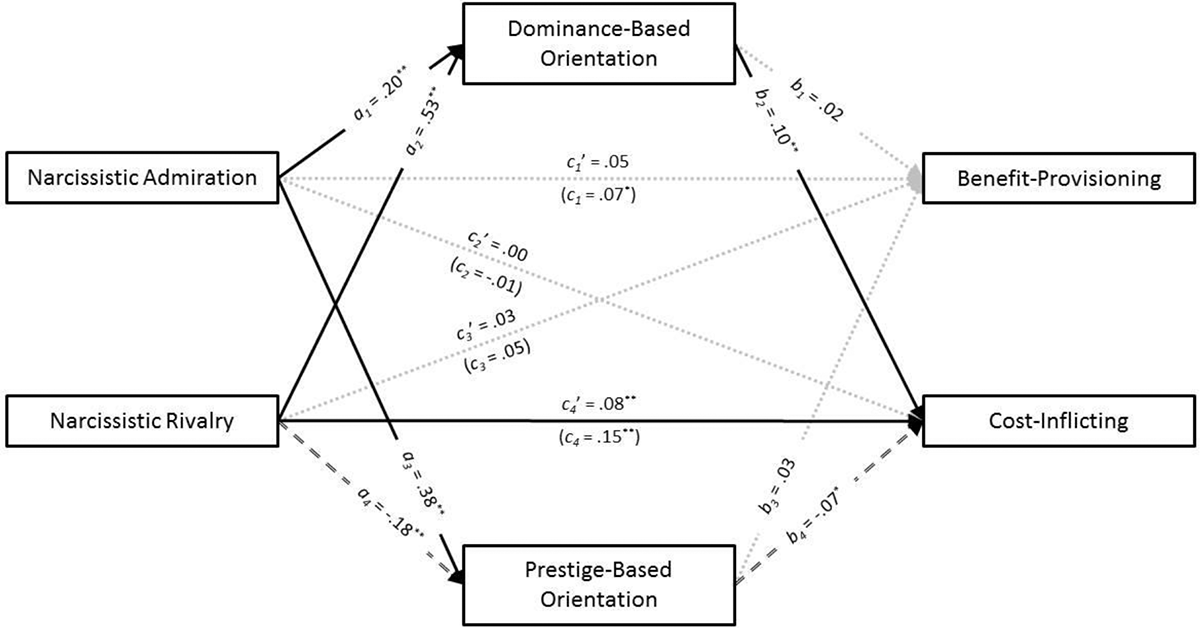
Study 3: The results of parallel multiple mediation analyses with the dominance-based orientation and the prestige-based orientation mediating the associations that narcissistic admiration and narcissistic rivalry had with benefit-provisioning behaviors and cost-inflicting behaviors. Note. The solid black arrows represent significant positive associations. The dashed black arrows represent significant negative associations. The dotted grey lines represent nonsignificant associations. *p < .05; **p < .001.
Tests of mediation found that narcissistic admiration (a1b2 = .02, SE = .01, z = 2.68, p = .007, 95% CI [.01, .04], f 2 = .06) and narcissistic rivalry (a2b2 = .05, SE = .01, z = 4.15, p < .001, 95% CI [.03, .08], f 2 = .14) had similar positive indirect associations with cost-inflicting behaviors through the dominance-based orientation. However, these aspects of narcissism had divergent indirect associations with cost-inflicting behaviors through the prestige-based orientation such that this indirect association was negative for narcissistic admiration (a3b4 = −.03, SE = .01, z = −2.29, p = .02, 95% CI [−.05, −.01], f 2 = .05) but positive for narcissistic rivalry (a4b4 = .01, SE = .01, z = 2.04, p = .04, 95% CI [.01, .03], f 2 = .02). Neither narcissistic admiration nor narcissistic rivalry had indirect associations with benefit-provisioning behaviors through either the dominance-based or prestige-based orientations. Taken together, these results show that the dominance-based orientation and the prestige-based orientation provided at least a partial explanation for the associations that narcissistic admiration and narcissistic rivalry had with cost-inflicting behaviors but not with benefit-provisioning behaviors. 3
Discussion
The results of Study 3 were somewhat consistent with our hypotheses. As expected, narcissistic admiration was positively associated with benefit-provisioning behaviors and narcissistic rivalry was positively associated with cost-inflicting behaviors. In contrast to our prediction, the prestige-based orientation did not mediate the association that narcissistic admiration had with benefit-provisioning behaviors. Although narcissistic admiration had the expected positive association with the prestige-based orientation, the prestige-based orientation did not have the positive association with benefit-provisioning behaviors that it did in Conlon (2019).
Narcissistic admiration and narcissistic rivalry had similar positive indirect associations with cost-inflicting behaviors through the dominance-based orientation. This suggests that the connections that both aspects of narcissism have with cost-inflicting behaviors may be due to a more general tendency to rely on conflict to achieve interpersonal goals. However, it is important to note that these aspects of narcissism had divergent indirect associations with cost-inflicting behaviors through the prestige-based orientation such that the indirect association for narcissistic admiration was negative, whereas the indirect association for narcissistic rivalry was positive. Taken together, these results suggest that narcissistic admiration may have a somewhat complex connection with cost-inflicting behaviors due to its positive associations with both the dominance-based orientation (which would support the use of cost-inflicting behaviors) and the prestige-based orientation (which would contradict the use of cost-inflicting behaviors). This suggests that the absence of a zero-order correlation between narcissistic admiration and cost-inflicting behaviors may actually be explained, at least in part, by the opposing indirect associations that narcissistic admiration had with cost-inflicting behaviors through the dominance-based orientation and the prestige-based orientation. In contrast, narcissistic rivalry appears to have a relatively straightforward association with cost-inflicting behaviors which is explained, at least in part, by the tendency to employ dominance-based strategies and avoid prestige-based strategies.
It is important to note that a limitation of Study 3 is that the correlational nature of this study precludes us from determining the direction of causality between narcissism, strategies for pursuing status, and mate retention behaviors (see Maxwell & Cole, 2007, or Maxwell et al., 2011, for extended discussions of the limitations associated with mediational analyses that rely on cross-sectional data). The underlying process model for this study was that narcissistic personality features would influence the strategies that are adopted to pursue status in the broader social environment which, in turn, would have implications for the behaviors that are employed in romantic relationships to reduce the likelihood of partners dissolving the relationship or being unfaithful. However, it is certainly possible that other causal patterns could exist between these variables. For example, it is possible that the dominance-based orientation may actually contribute to the development of narcissistic personality features rather than being a consequence of narcissism. Future research should attempt to gain a better understanding of the causal links between narcissistic personality features, strategies for pursuing status, and mate retention behaviors using experimental designs or longitudinal studies.
General discussion
The purpose of the present studies was to examine the connections that narcissistic personality features had with mate retention behaviors. The meta-analyzed unique associations that narcissistic admiration and narcissistic rivalry had with benefit-provisioning and cost-inflicting mate retention behaviors across the present studies are shown in Figure 3. As expected, there was consistent evidence for a positive association between narcissistic admiration and benefit-provisioning behaviors across the present studies. However, it is important to note that this association was not particularly large for any of the studies and the meta-analyzed association was small in magnitude. The expected association between narcissistic rivalry and cost-inflicting behaviors also emerged in each of the present studies. The association between narcissistic rivalry and cost-inflicting behaviors was consistently of a small-to-medium effect size and the meta-analyzed association was moderate in magnitude. Taken together, these results suggest a general alignment between narcissistic personality features and mate retention behaviors such that the strategies used to retain mates are similar in many respects to the strategies used to maintain grandiose self-views. More specifically, narcissistic admiration is characterized by a focus on persuading romantic partners to remain committed to the relationship by emphasizing one’s own value as a romantic partner, whereas narcissistic rivalry is characterized by a reliance on aversive tactics (e.g., intimidation, coercion) to keep partners committed to the relationship. The results of the present studies provide additional support for the importance of distinguishing between narcissistic admiration and narcissistic rivalry because doing so has allowed for a more nuanced understanding of the connections that narcissism has with a wide range of outcomes including mate retention behaviors.
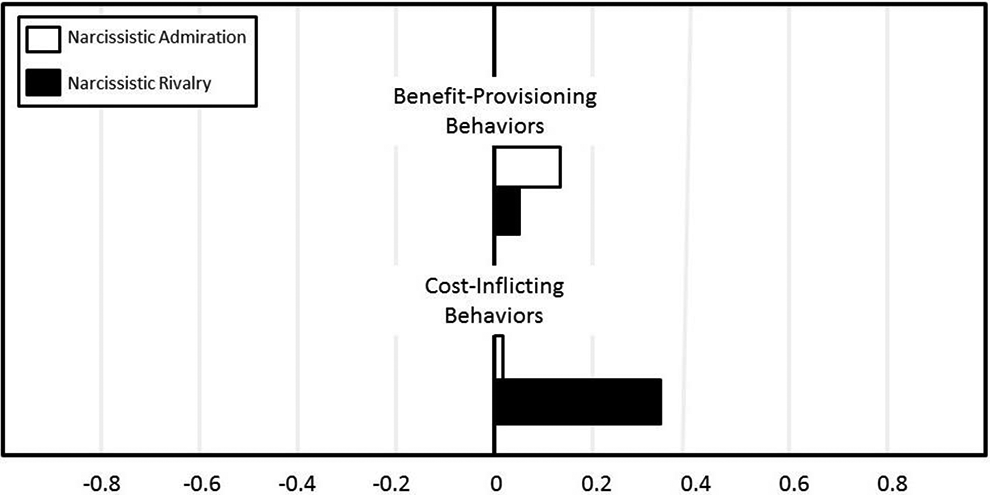
Meta-analyzed associations that narcissistic admiration and narcissistic rivalry had with benefit-provisioning and cost-inflicting behaviors across the present studies.
The pattern that emerged from these studies for narcissistic admiration is somewhat complex. It appears that narcissistic admiration is characterized by a general preference for utilizing benefit-provisioning strategies to maintain the commitment of romantic partners. That is, narcissistic admiration is associated with a tendency to invest time, effort, and resources to demonstrate the benefits that are associated with having oneself as a romantic partner. This is consistent with the characterization of narcissistic admiration as being an exclusively grandiose expression of narcissism that is characterized by self-enhancement and self-promotion. However, it is important to recognize that narcissistic admiration is also characterized by a willingness to employ cost-inflicting strategies under at least some conditions such as when experiencing high levels of suspicious jealousy. This suggests that cost-inflicting behaviors may serve as something akin to a strategy of last resort for narcissistic admiration. The pattern that emerged from these studies is consistent with the argument that narcissistic admiration may often be something akin to a “mixed blessing” for romantic relationships because the use of benefit-provisioning behaviors would generally be desirable to romantic partners, whereas the willingness to resort to the use of cost-inflicting behaviors would be highly aversive to most romantic partners. This pattern is conceptually similar to the results of previous research showing that narcissistic admiration appears to be characterized by a preference for using prestige-based strategies to gain status and only resorting to the use of dominance-based strategies when prestige-based efforts were unlikely to be successful (Zeigler-Hill et al., 2019). Additional research will be necessary to clarify the conditions that influence the connection between narcissistic admiration and the willingness to engage in cost-inflicting behaviors.
The results for narcissistic rivalry were relatively simple. Narcissistic rivalry was characterized by a tendency to engage in cost-inflicting behaviors across each of the present studies. That is, narcissistic rivalry was connected with the use of an array of aversive strategies including intimidation, coercion, and physical force in an effort to reduce the likelihood that current romantic partners would defect from the relationship or be unfaithful. These results are consistent with the view that narcissistic rivalry is actually a blend of the grandiose and vulnerable expressions narcissism. Further, this pattern is consistent with the results of previous studies that have consistently shown narcissistic rivalry to be associated with a tendency to rely on aversive interpersonal strategies to influence romantic partners (Sauls et al., 2019) or pursue status in the broader social environment (Zeigler-Hill et al., 2019). Taken together, these results suggest that narcissistic rivalry may be linked with an array of indicators of poor relationship functioning.
The present studies had a number of strengths (e.g., a multidimensional view of narcissism, large samples), but they also had various limitations. The first limitation is that the present studies had little information regarding the contexts in which mate retention behaviors were employed. This is an important limitation because cost-inflicting behaviors involve significant risk (e.g., attempts to use physical force to coerce a romantic partner to remain committed to a relationship may cause the partner to immediately dissolve the relationship or may even have legal repercussions) so it appears that individuals will often use other strategies to maintain their relationships before resorting to cost-inflicting behaviors (e.g., Miner et al., 2009). The second limitation is that we focused exclusively on narcissistic admiration and narcissistic rivalry, but there are other aspects of narcissism that may also have connections with mate retention behaviors such as vulnerable/neurotic narcissism (which is characterized by negative affectivity and distress; e.g., Miller et al., 2016) and communal narcissism (which is characterized by attempts to emphasize superiority over others through the exaggeration of communal characteristics; e.g., Gebauer et al., 2012). For example, it is possible that communal narcissism—which is linked with a desire to cultivate the appearance of prosociality—may have strong associations with the use of benefit-provisioning mate retention behaviors. Future studies concerning the connections between narcissism and mate retention behaviors may benefit from including these other aspects of narcissism. The third limitation concerns the relative lack of diversity in our samples. Each of our samples consisted of heterosexual college students from the Midwestern region of the United States. Further, our samples consisted predominantly of women (e.g., women constituted more than 80% of the participants in each of the present studies) and White individuals (more than 82% of the participants across each of the present studies were White). Future research concerning the connections between narcissism and mate retention would benefit from utilizing more diverse samples. Despite these limitations, the present studies extend what is known about the connections between narcissistic personality features and mate retention behaviors.
Conclusion
The present studies examined the associations that narcissistic admiration and narcissistic rivalry had with benefit-provisioning and cost-inflicting mate retention behaviors. Our results revealed that narcissistic admiration was associated with a tendency to engage in benefit-provisioning behaviors, but it also had complex associations with cost-inflicting behaviors. For example, narcissistic admiration was positively associated with cost-inflicting behaviors in Study 2 but only when levels of suspicious jealousy were relatively high. In contrast, the pattern that emerged for narcissistic rivalry was relatively simple because it was found to be positively associated with cost-inflicting behaviors across all of the studies.
Footnotes
Funding
The author(s) received no financial support for the research, authorship, and/or publication of this article.
