



Abstract
Objectives:
Recent research findings suggest the prevalence of loneliness is increasing in middle-aged adults parenting children, challenging the notion this demographic is typically at low risk of loneliness.
Method:
The current study applied the cognitive discrepancy model as theoretical foundation to investigate the variance of individual and situational variables contributing to perceived closeness and support and consequently loneliness. Structural equation modeling was employed to identify multivariate contributors associated with parental loneliness in 323 parents with an average age of 37.69 (SD = 5.96) years.
Results:
Results support the theoretical proposition that individual factors, rather than situational, contribute to a greater variance of a perceived gap in relationship closeness and support. It was found that emotional competence, ability to forgive, emotional stability, extraversion, and lower mood levels are significant contributors to a small cognitive gap in perceived relationship closeness and protective against parental loneliness. Relationship status contributed a weak direct effect over perceived relationship closeness and support. Situational factors, including number of children and household income, were non-significant risks for loneliness. Overall, the model accounted for 65% of perceived relationship closeness and support and 85% of loneliness. The limitation of small number of male participants is discussed with regard to the existing research gap investigating male loneliness.
Conclusion:
A Pathway to Loneliness Risk Model is proposed, demonstrating that through increasing an individual’s intrapersonal and interpersonal resources and challenging negative cognitive biases and maladaptive schemas regarding an individual’s perception of their relationships, may lead to a reduction in the individual’s risk for loneliness.
Keywords
Introduction
The prevalence of loneliness in developed nations is reported to be rapidly increasing, leading some to refer to it as the “global epidemic of our times” (Brittain et al., 2017; Cacioppo & Cacioppo, 2018). According to a 2016 survey, 60% of Australian adults who reside with a partner and/or children report experiencing frequent loneliness (Lifeline, 2016), challenging the traditional view that loneliness is quite low in early- to mid-adulthood. The antecedents to loneliness vary across an individual’s developmental life span in response to changing situational demands and personal resources (Böger & Huxhold, 2018; Luhmann & Hawkley, 2016). It is often argued that adults aged 30–50 years (middle adulthood) are at relatively lower risk of loneliness as the prevalence of loneliness decreases in middle adulthood (Hawkley & Cacioppo, 2010). This phase of adulthood is considered to be a period of life when social support is strong as adults reside with spouses/partners, are employed, and are raising children. However, the nature of roles and responsibilities in middle adulthood has changed considerably over recent decades with an increase in the proportions of dual-income families, single-parent single-income households, and workforce participation rates for women (Allen & Martin, 2017; Christensen & Schneider, 2015). Additionally, cross-sectional and longitudinal evidence demonstrates that the demands of work–family conflict are impacting parental mental health with consequential negative effects on marital relationships and parent–child interaction (Amstad et al., 2011; Dinh et al., 2017). With the changing topography of loneliness paralleling the changing topography of parental demands, there is a need to re-examine predictors for loneliness specifically in parents and in doing so to assist practitioners in identifying those at risk and provide targeted interventions for families. Additionally, with loneliness becoming increasingly recognized as a public health epidemic (Lim, 2018), there is a need to identify needs of this subgroup of the population to develop targeted clinical and health interventions.
Adverse effects of parental loneliness
Loneliness in middle adulthood is associated with reduced sleep quality (Cacioppo et al., 2002), poor executive control and tendency to overeat (Baumeister et al., 2005), and higher levels of depressive symptoms and attention to pain (Goosby et al., 2013). Prolonged loneliness is associated with a significantly increased risk of suicidal ideation and greater risk of suicide attempts (Stravynski & Boyer, 2001). Although the effects of parental loneliness on children have not been investigated, poor psychosocial health (depression, anxiety, self-efficacy, social connectedness) in parents is well established as a predictor of maladaptive parenting and child functioning, including children’s poor dietary health, reduced parent–child nurturance, higher levels of family conflict, and child behavior problems (Poppert et al., 2019; Webb et al., 2018).
Research also confirms a spillover effect associated with the demands of parenting and work and the consequential effects of relationship satisfaction and parenting self-efficacy. Previous research examining the links between loneliness, stress, and burnout indicates that loneliness is positively associated with personal and work-related burnout in a seemingly dose-dependent relationship (Rogers et al., 2016; Shapiro et al., 2015). Emergent research reveals that, not only do parents face the stresses of work–family conflict, up to 14% of parents experience parental burnout that is characterized by physical and emotional exhaustion, emotional distancing from their children, and the belief they are inept in their role as parent (Mikolajczak et al., 2018; Roskam et al., 2017). A recent qualitative study investigating the experiences of maternal burnout and exhaustion highlighted that mothers feeling burdened by parenting also expressed a perceived lack of support and relational satisfaction, along with a sense of loneliness (Hubert & Aujoulat, 2018). Additionally, a recent Cochrane review revealed that interventions aimed at increasing parental psychosocial health demonstrated significant secondary outcomes of increased relational satisfaction, signifying a positive relationship exists between parental mental health and perceived interpersonal closeness (Trivedi, 2017). Further to that, it has been demonstrated that the most effective interventions in reducing loneliness are those that target maladaptive social cognition (Masi et al., 2011). Thus, understanding how parental psychosocial health and situational factors directly influence perceived relationship closeness (i.e., an individual’s subjective belief that their actual relationships socially and emotionally satisfy their desired need for connection) will further help target interventions to reduce loneliness.
Theoretical framework for parental loneliness
There are several theoretical frameworks that could be applied to social and emotional loneliness in parents. Social loneliness derives from deficits in a network of social connections where one shares common interests and activities with others (Weiss, 1973). Emotional loneliness results from deficits in intimate relationships where one lacks the desired close, intimate attachment to another individual that provides affection and security (Weiss, 1973).
The cognitive discrepancy model posits that loneliness is a consequence of negative perceptions and attributions individuals make regarding their social and emotional relationships (Peplau & Perlman, 1982). According to this view, each person sets an individual benchmark against which they subjectively measure their interpersonal relationships. If their social and emotional relationships meet or exceed this benchmark, a person feels content. If they judge their relationships as failing to meet the benchmark, the result is a perceived interpersonal deficit, and consequently, loneliness. Russell et al. (2012) tested this model in a sample of high school students, demonstrating that the least lonely students were those who reported a match between their desired closeness and actual close friendships, while lonely students reported a discrepancy between actual and desired close friendships.
Emerging theoretical frameworks around the effect of stress on individuals and relationships could also parallel the induction theory of loneliness, particularly emotional loneliness. Recent theory now posits that stress is a dyadic phenomenon where romantic partners have a strong mutual influence on each other such that when stress is experienced, it has a spillover effect leading to negative perceptions and attributions with adverse outcomes (Randall & Bodenmann, 2017). These adverse outcomes include reduced time spent together, ineffective levels of communication, and behavioral reactions such as hostility, control, anxiety, and withdrawal (Randall & Bodenmann, 2017).
Loneliness is posited to function in a similar way via the induction hypothesis whereby loneliness can be transmitted from one individual to another through the convergence of emotions and consequences of perceived interpersonal communication and behavior (Cacioppo et al., 2009). Lonely individuals are more likely to exhibit socially undesirable behaviors (hostile, shy, anxious, less trusting, withdrawn) with adverse outcomes within their social and emotional environments. This can lead to a spillover effect with decreased satisfaction in relationships, reduced time and communication in relationships, and the induction or spillover of loneliness in others. Parents who interact together through the nature of their role as a parent (i.e., dropping children off at day care, school, their children’s sport and social activities) can influence each other through their facial expression, vocalization, posture, and movement, leading to a convergence of emotions and perceived inferences from behavior (Cacioppo et al., 2009).
Assumptions and rationale for the current study
In support of the induction hypothesis, evidence indicates that lonely individuals tend to develop clusters (Cacioppo et al., 2009). Thus, the rise in loneliness in parents could hypothetically be explained by similar individual and situational variables among this population that lead to cognitive discrepancies between desired and actual relationships. The pathway for parental loneliness could be resultant of an interaction between a parent’s combined individual and situational variables leading to negative cognitions and a perceived relational discrepancy, resulting in loneliness.
Emotional loneliness is the outcome of perceived discrepancies in close, intimate relationships, while social loneliness results from perceived deficits in social relationships (Weiss, 1973). The induction hypothesis would extend this model whereby emotional loneliness is also the outcome of a relational dyadic phenomenon. Hereby the nature of mutual influence within a relationship results in a spillover effect with adverse behavioral outcomes and an induction of loneliness in the other person.
On a larger social network scale, the induction theory suggests the pathway to parental loneliness works in a similar way, whereby deficits in parental psychosocial factors result in negative cognitions and attributions and a perceived discrepancy in their social relationships, resulting in loneliness. Induction of loneliness would spread through a parent network and their adverse behaviors lead to decreased social communication and reduced satisfaction in social relationships such that emotional contagion emerges to create a cluster of lonely parents.
The aim of this study is to examine the individual and situational variables that would influence cognitive perceptions and attributions of perceived interpersonal closeness and support and consequently, result in loneliness. The variables chosen to be tested have been previously shown to be predictors of loneliness in other populations. Lonely individuals are more likely to be low on extraversion and high on neuroticism (Abdellaoui et al., 2018; Atak, 2009), have lower levels of emotional intelligence (EI) or emotional competence (EC) (Wols et al., 2015; Zou, 2014), have higher levels of anxiety and depression (Fung et al., 2017; Peerenboom et al., 2015), and a lower ability to forgive (Bishop et al., 2014; Day & Maltby, 2005). Situational predictors of loneliness include unemployment (Lauder et al., 2004; Yan et al., 2014), low education (Cohen-Mansfield & Parpura-Gill, 2007; Hector-Taylor & Adams, 1996), low income (Beutel et al., 2017; Cohen-Mansfield & Parpura-Gill, 2007), and marital status (Pinquart & Sorensen, 2001).
Although there have been no recent studies examining the influence of the number of children and age of children a parent has in relation to loneliness, research on parental psychological well-being reports that parents of younger children exhibit less depression, higher self-esteem, and higher relationship quality with their children than parents of older children (Nomaguchi, 2012). Therefore, examining the age and number of children that a parent has may exhibit important effects of parental loneliness.
The hypothesized relationships between the variables are shown in Figure 1. In testing the proposed model, there are two hypotheses: (1) that as loneliness is a subjective perception with an internal cognitive and emotional experience, individual variables will contribute a greater proportion of variance in loneliness than situational variables; and (2) that individual and situational variables will influence perceived relationship closeness and support and create a pathway to loneliness.
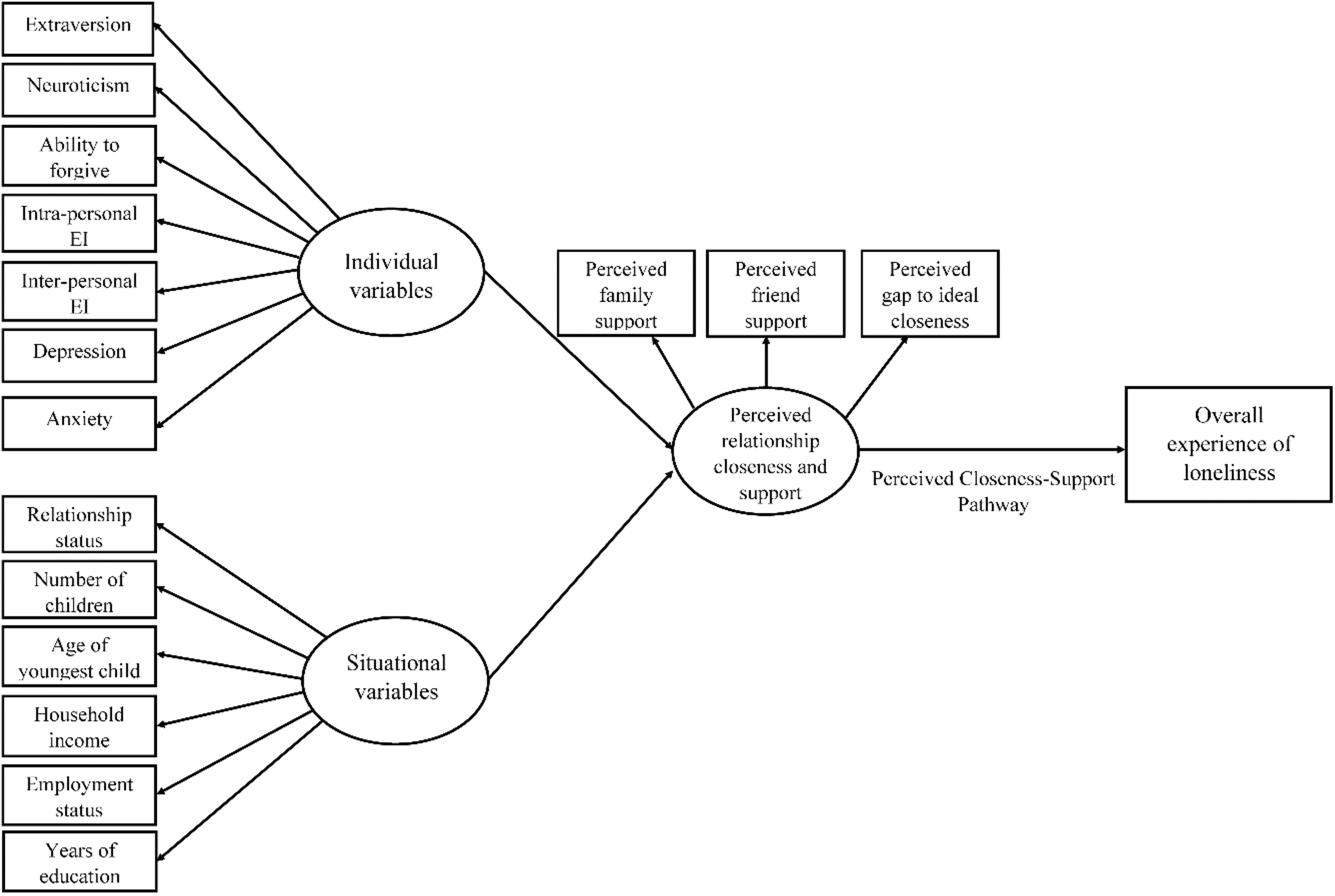
Hypothesized model of parental loneliness with perceived closeness–support pathway.
Method
Participants
A sample of 573 adults commenced the survey, with 58% completing the full survey. Data from fully completed surveys were retained for analysis, resulting in a final sample of 323 participants. Participants were aged between 25 and 58 (M = 37.69, SD = 5.96) years. The average total of children in the household was 2.16 (SD = 1.02). Demographic characteristics of the sample are displayed in Table 1.
Demographic information for sample.

Materials
Situational variables
The following demographic data were collected from each participant: age; gender; education (years of formal education); level of employment (full-time, part-time, unemployed looking for work, unemployed and not looking for work, disabled and unable to work); annual household level of income based on Australian 2016 Household Census income categories (Australian Bureau of Statistics, 2017); relationship status; number and ages of children (<18 years of age) within the household, age of youngest child living at home.
Individual variables
Eysenck Personality Questionnaire Revised–Abbreviated. The Eysenck Personality Questionnaire Revised–Abbreviated (Francis et al., 1992) was restricted to three sub-measures, each of 12 items for extraversion, neuroticism, and the lie scale. Each item response is to a dichotomous Yes (1)/No (0) scale. Cronbach’s α = .882 (extraversion), .762 (neuroticism), and .684 (lie scale).
Hospital Anxiety and Depression Scale. The Hospital Anxiety and Depression Scale (HADS) is a screening tool that is validated for the assessment of anxiety and depression in the general population as well as somatic, psychiatric, and primary care patients (Bjelland et al., 2002). The HADS comprises 14 items, 7 items for depression symptoms and 7 items for anxiety symptoms, with higher scores indicating increased symptomatology. Cronbach’s α = .830 (anxiety) and .758 (depression).
The Profile of Emotional Competence. The Profile of Emotional Competence is a 20-item scale designed to examine intrapersonal EC and interpersonal EC, also known as EI (Brasseur et al., 2013). Participants indicate agreement with each of the 20 statements on a 5-point Likert-type scale with higher scores indicating higher levels of EC. Cronbach’s α = .884 (intrapersonal) and .880 (interpersonal).
Heartland Forgiveness Scale. The Heartland Forgiveness Scale is an 18-item self-report measure of dispositional forgiveness (with subscales to assess forgiveness of self, others, and situations) (Thompson et al., 2005). Each item is scored on a 7-point Likert-type scale with higher total scores indicating higher levels of dispositional forgiveness. Cronbach’s α = .870 (self), .876 (others), and .868 (situations).
Scale of Perceived Interpersonal Closeness. The Scale of Perceived Interpersonal Closeness (PICS) assesses quality of relationships (Popovic et al., 2003) by asking respondents to position others with whom they have relationships in a circular “target”-space with reference to closeness they feel to the target, both actual and ideal (to enable ordinal mapping of perceived relationship closeness). For the purpose of the present study the PICS was adapted so that participants would indicate closeness proximity on a 6-point Likert-type scale from 1 = distant to 6 = fully close, for a range of familial and nonfamilial relationships (e.g., partner, mother, colleague). The discrepancy between actual and ideal scores was used as a measure of deficits in perceived relationship closeness. Cronbach’s α = .931 (actual) and .870 (ideal).
Revised Lubben Social Network Scale-6. The Revised Lubben Social Network Scale-6 assesses social integration and social isolation (Lubben et al., 2006) by assessing quantity and quality of relationships on separate subscales for family and friends. Each subscale contains 5 items, rated on a 6-point Likert-type scale, with higher total scale scores indicating higher level of social engagement. Cronbach’s α = .825 (family) and .872 (friends).
University of California Los Angeles Loneliness Scale. The University of California Los Angeles Loneliness Scale is a 20-item scale used to assess level of loneliness (Russell et al., 1980). Each of the 20 items are rated by the participant using a 4-point Likert-type scale. The 20 statements relate to interpersonal relationship satisfaction, perceived social isolation, and overall experience of loneliness, with high total scores indicating greater loneliness. Cronbach’s α = .953.
Procedure
This study was approved by the University of the Sunshine Coast Human Research Ethics Committee (S/17/1113—Predictive factors for parental loneliness: A structural equation modeling approach to identify multivariate risk and protective factors for loneliness in adults with children) in accordance with the ethical guidelines of the National Health and Medical Research Council of Australia. Parents with children under the age of 18 were recruited using radio interviews and newspaper articles along with a snowball sampling technique beginning with family, friends, and social media connections of the investigator. Participants were asked to complete an anonymous online survey with an option of completing a hard copy version also being available. Informed consent was granted on the basis of participant’s completing the survey. After deletion of incomplete data sets, remaining missing data points (which were minimal) were dealt with by allocating the middle value of each respective scale or randomly allotting a 1 or 2 in cases of dichotomous variables.
Data analysis
The hypothesized model was tested via a two-stage approach. First, a confirmatory factor analysis was undertaken to establish if the observed variables load on each of the latent variables and thus are valid measures (Anderson & Gerbing, 1988). Secondly, the structural equation model (SEM) was conducted. The hypothesized SEM model was evaluated for goodness of fit and parsimony using the normed χ2 (χ2/df), the comparative fit index (CFI), and root mean square error of approximation (RMSEA). If the model returns a normed χ2 between one and three and the CFI is ≥.9, a good fitting model has been achieved (McDonald & Ho, 2002). RMSEA, which also measures model fit and is unaffected by sample size is interpreted through observing its adjacent confidence intervals (CIs) whereby good fit is revealed through a CI of <.05 lower bound and a reasonable fit is revealed by CI < .08 upper bound (Byrne, 2010; Hair et al., 1998). A CI greater than .10 is a poor and unsatisfactory fit (Byrne, 2010). Additionally, a tight range between the RMSEA CIs indicates less error in the RMSEA (Byrne, 2010). SEM output of the model paths indicate effect size and are determined as strong (β > .50), moderately strong (β = .30–.50), mild (β = .20–.30), and weak (β < .20) (Holmes-Smith et al., 2006; McDonald & Ho, 2002). The final model was also evaluated using the goodness-of-fit index (GFI), a measure representing overall degree of model fit (Hair et al., 1998), with values greater than .9 indicating acceptable goodness of fit (Byrne, 2010). Squared multiple correlations indicating variance explained in latent factors is determined as small (R2 = .02), medium (R2 = .15), or large (R2 = .35) (Cohen, 1992).
Results
The means, standard deviations, and correlations between variables are displayed in Table 2. Age of parent, gender, and parenting demands measured by age of youngest child were not significantly associated with loneliness. Situational variables that significantly correlated with higher levels of loneliness included having fewer children, lower levels of household income, fewer years of education, and being without a partner. Individual variables associated with higher levels of loneliness included low extraversion, high neuroticism, low levels of both intrapersonal and interpersonal EC, higher levels of anxiety and depression, and lower levels of forgiveness. Lower levels of perceived social support from family and friends along with greater discrepancy between actual and ideal perceived closeness in relationships were also significantly associated with higher levels of loneliness.
Means, standard deviations, and correlations between the variables in the parental loneliness model.

General Note. UCLA = University of California Los Angeles Loneliness Score; EC = Emotional Competence; PICS = Perceived Interpersonal Closeness Score; PRCS (Family) = Perceived Relationship Closeness Support for Family; PRCS (Friends) = Perceived Relationship Closeness and Support for Friends.
*p < .05. **p < .01.
A series of one-way analyses of variance (ANOVAs) were conducted to identify differences in loneliness score between gender groups, relationship status groups, or employment status groups (Table 3). Assumptions for ANOVAs (e.g., Levene’s test of homogeneity of variance, normal distribution of scores) were tested and met for each analysis. Despite differences in sample sizes in the gender group and relationship status groups, homogeneity was not breached, and the analysis could be completed. Loneliness scores were normally distributed (i.e., not skewed), and the sample size was sufficient to be robust to the slight degree of kurtosis.
ANOVAs that compared the loneliness of groups of participants, based on their gender, relationship status, and employment status (N = 323).

General Note. ANOVA = analysis of variance; CI = confidence interval.
As shown in Table 3, there were no differences in loneliness experienced by males and females in the current sample, however, people who were without a partner were significantly lonelier than those participants with a partner. Interestingly, participants who were employed were slightly, but not significantly, less lonely than people who were not currently working. As shown by
The initial a priori hypothesized model (Figure 1) was nonrecursive and unidentified, therefore was not a satisfactory model of the data. In order to attain model identification, the model was adjusted by replacing the path from situational variables to perceived relationship closeness and support, to including be a direct path from situational variables to loneliness. Employment status was also removed from the model based on previous research findings and the non-significant one way ANOVA (Neto, 2014). While the model was now recursive, the fit was still poor, χ2/df = 3.64, χ2(102) = 371.1; CFI = .824; RMSEA = .091; 90% CI: .081, .101.
Further examination of the output suggested that two factors better represented the individual variables rather than one, as hypothesized. The first factor comprised of Intrapersonal Resources (forgiveness, neuroticism (negative score), anxiety (negative score), depression (negative score), and intrapersonal EC). The second factor comprised Interpersonal Resources (interpersonal EC and extraversion). Additionally, relationship status was moved to become a direct exogenous variable affecting perceived relationship closeness and support. Using these two latent variables, the model was again tested, although the fit was still poor, χ2/df = 4.245, χ2(102) = 428.77; CFI = .786; RMSEA = .100; 90% CI: .091, .110.
Modification indices were then used to find how the model fit could be improved (Busch & Kapusta, 2017; Ge et al., 2017; Schutte et al., 2001). Paths were added between intrapersonal EC and interpersonal EC, intrapersonal resources and interpersonal resources, relationship status and depression, and depression and social support. The additional paths significantly improved the fit of the model (Figure 2), χ2/df = 2.307, χ2(97) = 223.74; GFI = .923; CFI = .917; RMSEA = .064; 90% CI: .053, .075. The model explained 65.4% of perceived relationship closeness and support and 85% of overall experience of loneliness, each considered large effects (Cohen, 1992). Strong direct effects (β > .50; Holmes-Smith et al., 2006) were shown from Perceived Relationship Closeness to Loneliness and Intrapersonal Resources to Perceived Relationship Closeness. A moderately strong direct effect (β = .30–.50) was shown for Interpersonal Resources to Perceived Relationship Closeness. A weak direct effect (β < .20) occurred between Relationship Status and Perceived Relationship Closeness and Situational Demands to Loneliness. Indirect effects were calculated with a strong indirect effect from Intrapersonal Resources to Loneliness (β = −.52) and a weak to slightly moderate indirect effect from Interpersonal Resources to Loneliness (β = −.28) and Relationship Status to Loneliness (β = −.16).
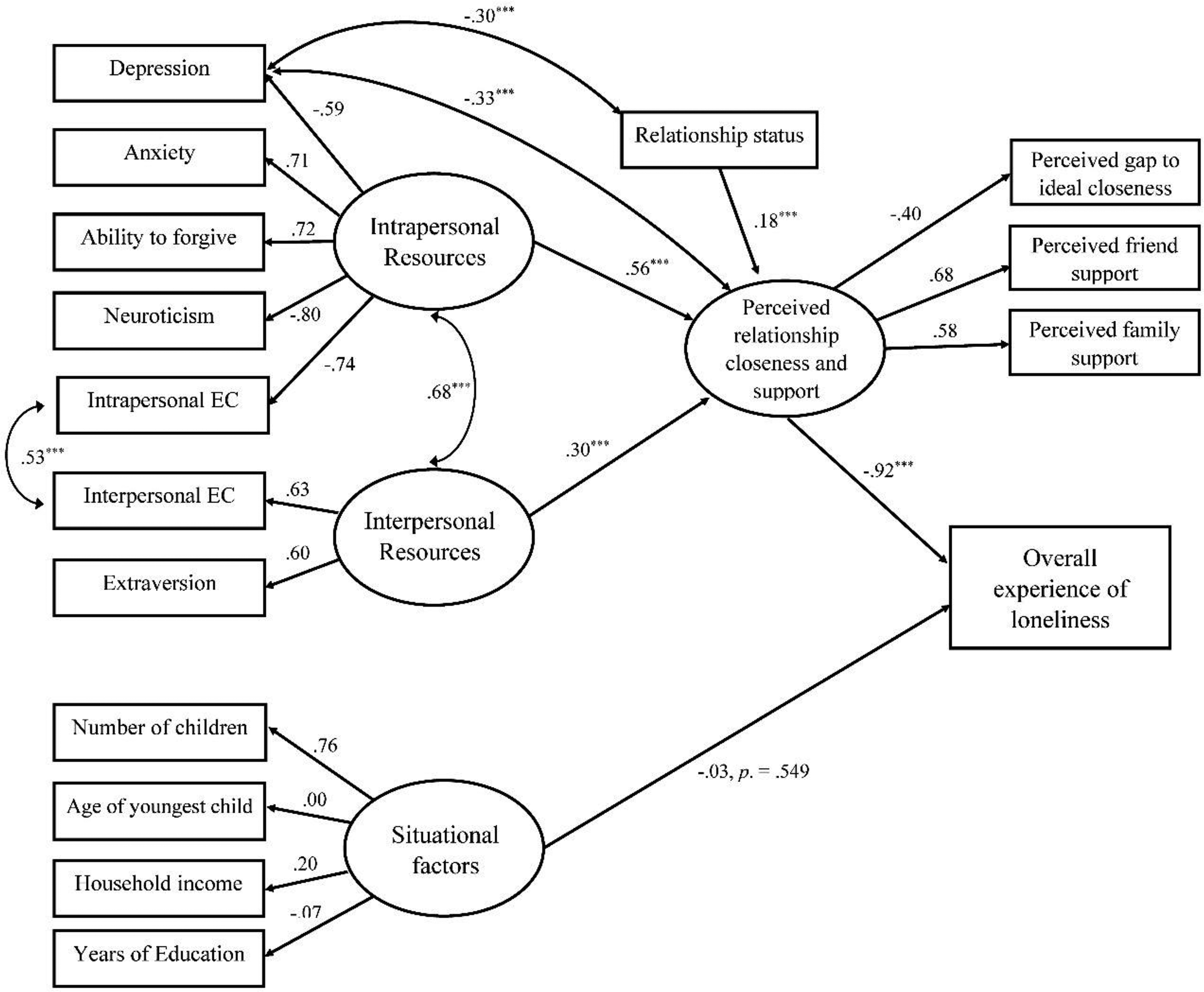
Final model of intrapersonal and interpersonal resources and situational factors with perceived closeness–support pathway to parental loneliness. Note. χ2(97) = 223.74; GFI = .923; CFI = .917; RMSEA = .064; 90% CI: .053, .075. Squared multiple correlations for the endogenous variables were perceived relationship closeness and support (.654) and overall experience of loneliness (.847). General Note. CI = confidence interval; RMSEA = root mean square error of approximation; CFI = comparative fit index; GFI: goodness-of-fit index. **p < .05. ***p < .001.
Discussion
The present study examined the proportion of variance that individual and situational variables contribute to perceived relationship closeness and support and corresponding loneliness in parents of children under 18 years of age. The results indicate that intrapersonal and interpersonal resources were stronger predictors of overall parental loneliness than situational demands of parenting. The results indicate that parental loneliness emerges as a consequence of the discrepancy between desired and perceived actual closeness within both social and emotional relationships. The initial a priori model was modified to include a direct path from situational variables to loneliness, rather than the indirect influence on loneliness through perceived relationship closeness. As the discrepancy between actual and ideal increases, the greater the loneliness experienced. The results of the present study give support to the cognitive discrepancy model of loneliness and demonstrate that a lonely parent is one whose interpersonal and intrapersonal resources influence perceptions they make regarding their social and emotional relationships.
The results show support for the suppositions given by the cognitive discrepancy model via the significant negative relationship identified in the perceived closeness–support pathway to loneliness (Figure 2). In accordance with the theory, loneliness can emerge when the discrepancy between a parent’s desired and actual level of relationship closeness is combined with their perception that these relationships are of poor quality with low levels of closeness and intimacy. In these results, a parent’s perception of relationship quality was found to be the strongest significant predictor for loneliness, confirming the hypothesis that the characteristic feature of a lonely parent is the belief of being engaged in low quality relationships with low levels of intimacy and closeness, rather than the presence of life stressors such as number or age of children, level of income, or level of education.
Relationships can be protective against parental loneliness when a narrow discrepancy exists between actual and ideal perceived relationship intimacy alongside high perceived levels of support from family and friends, with friends having slightly more influence than family. This finding that friendship networks emerge more important than familial networks supports previous research findings (Ben-Ari & Lavee, 2007; Pinquart & Sorensen, 2001). Friendship consists of mutual patterns of interdependence, trust, mutual respect, support, empathy, and commitment which are valued higher within relationships (Ben-Ari & Lavee, 2007). Familial relationships can create an underlying feeling of obligation whereas friendships are characterized by freedom of choice within the mutual connection.
Recent evidence shows that married people are not immune to experiencing high levels of loneliness (Rashid et al., 2016), and the results from this study demonstrate that the protectiveness of a spousal relationship is less a function of being in a relationship as opposed to the perceived quality of the spousal relationship. Married couples who also express their spouse as their best friend have higher life satisfaction and relationship quality, significantly reducing their risk for loneliness (Grover & Helliwell, 2019). The closeness of an intimate relationship is evident through expressions of affection, spatial proximity, physical contact, and time spent together in joint activities (Ben-Ari & Lavee, 2007). However, the individual’s perception of closeness is a subjective assessment as to whether the individual’s needs and satisfaction for closeness are being met. Hence, while relationship status is not protective against loneliness, the level of satisfaction with closeness within the relationship directly impacts on the experience of loneliness.
The present study associated high levels of neuroticism with increased risk for loneliness in parents whereas intrapersonal EC emerges as protective against parental loneliness. Individuals high in neuroticism tend to be highly dependent on people with a strong need for belonging which suggests that the discrepancy between actual and desired relationship closeness and support may be greater than individuals lower in neuroticism. Individuals high in neuroticism also tend also to be hypervigilant and over-reactive to negative social stimuli and highly sensitive to rejection (Amichai-Hamburger & Ben-Artzi, 2003), creating a potential barrier to achieving closeness with others. Further, individuals high in neuroticism tend to exhibit poor emotional coping through avoidance in relationships which exacerbates poor perceptions of closeness and support (Hawkley & Capitanio, 2015). This aligns with the protective influence of intrapersonal EC identified, as higher levels of EC are associated with increased insight and self-awareness (Cacioppo & Hawkley, 2009). Recent research investigating intrapersonal EC in predicting marital and co-parenting quality indicated that wives who were higher in intra-EC expressed higher levels of marital and co-parenting quality interactions (Jessee et al., 2018). Lower levels of social and emotional self-regulation and reflective functioning adversely impact perception of marital and co-parenting quality interactions as well as social integration and social acceptance (Cacioppo & Hawkley, 2009; Jessee et al., 2018; Mijuskovic, 1986). Higher levels of intrapersonal EC may also lead to increased capacity for forgiveness, with forgiveness involving a pro-social multidimensional motivational change denoting it a reflective and protective intrapersonal resource (McCullough, 2001).
The current model indicates forgiveness is associated with the cognitive discrepancy model of loneliness, in that a tendency to forgive correlates with perceived relational closeness and support. These results enhance recent research emphasizing the negative association between forgiveness and loneliness (Leon-Moreno et al., 2019). Forgiveness is defined as a predisposition involving cognitive, emotional, and behavioral processes whereby an individual replaces negative thoughts, behaviors, and emotions, such as anger, hostility, avoidance, and distrust, for more adaptive, positive emotions and cognitions, such as empathy and compassion (Quintana-Orts & Rey, 2018). Forgiveness is associated with interpersonal approach behaviors such as trust, conflict resolution, and reduced hostility which are qualities non-lonely individuals demonstrate. Forgiveness can also convey the desire to re-establish interpersonal relationships and enhance positive interpersonal resources. In contrast, the tendency for one to refrain from forgiving another’s transgressions is associated with negative attributions and perceptions of relationships, withdrawal from social relationships, and emotional and social loneliness (Day & Maltby, 2005). These findings demonstrate the important function forgiveness has in reducing loneliness by promoting the pro-social cognitions, emotions, and behaviors which build relationship closeness.
The current model (Figure 2) indicates that mood (depression and anxiety) influences intrapersonal resources, with depression also associated with relationship status and perceived relationship closeness. Recent evidence associating anxious individuals and perceptions of closeness confirms anxiety influences relational quality through the perception of low intimacy in relationships, which is further exacerbated by anxious individuals requiring more time, affection, and self-disclosure to denote a relationship as “close” (Hudson & Fraley, 2017). The implication is that anxious individuals are more likely to exhibit behaviors that make it hard for others to draw close and build connections and thus can reinforce maladaptive cognitions of anxious individuals.
Depression has a multidimensional impact on social and emotional relationships with depressed individuals exhibiting social skills deficits, difficulty in being socially assertive and intimate, and less enjoyment of interpersonal interactions (Huprich et al., 2016; McEvoy et al., 2013). A decline in self-esteem and “loss of self” associated with depression may create maladaptive schemas regarding an individual’s feelings of whether they are worthy of love, intimacy, and friendship leading to withdrawal from interpersonal relationships (Triscoli et al., 2019). Further, social withdrawal is a consequence of depressive symptoms creating a reciprocal loop of low perceived support (Hawkley & Capitanio, 2015). This reciprocal loop between social connectedness and depressive symptoms leads to withdrawal, poorer interpersonal interaction, and low mood (Cacioppo & Hawkley, 2009). It may be the case that the presence of a close spousal relationship can provide a protective shield for one’s overall sense of self-esteem, emotional coping, and perceived discrepancy of relational closeness.
Although intrapersonal resources contributed greater variance to perceived relationship closeness, interpersonal resources were also significantly associated with relationship closeness. Specifically, extraversion and interpersonal EC are protective against the pathway to loneliness. Individuals high on extraversion tend to be sociable, talkative, assertive, and excitable. They report higher levels of perceived social support and relationship closeness. However, it is argued that extraverts are only high on likeability when they also exhibit interpersonal EC (Szczygiel & Mikolajczak, 2018). Individuals high in extraversion and high in interpersonal EC have the capacity to both engage in effective communication and cooperatively participate in social situations as well as display empathic responses to other people’s emotions, increasing their likeability among peers (Schutte et al., 2001; Szczygiel & Mikolajczak, 2018). The discrepancy between actual and desired relationship closeness is greater in individuals lacking interpersonal resources, suggesting that loneliness could result from poor effective communication, deficient emotion regulation, and lack of a demonstrative display of empathy and understanding within their relationships.
While situational variables were not found to significantly contribute to parental loneliness, several protective factors contributed to shared variance. These protective factors for parents included having a larger number of children and a higher level of household income. The potential protective effect of these factors may be due to secondary influences on an increased opportunity for interpersonal engagement within the home as well opportunity to develop a wider social network in the community through engagement in the child’s friendship networks and extracurricular activities. Previous research indicates that low household income is associated with a reduction and narrowing of social networks (Antonucci et al., 1999). Hence, higher levels of income may be protective by enabling parents to engage in social activities that further foster interpersonal relationships.
The results of the present study contradict findings from previous studies that situational variables significantly influence loneliness within other population samples (Hawthorne, 2008). The present study indicates that for mid-adulthood parents there is no significant direct influence of situational factors on loneliness. Parental level of education, parental employment status, and age of youngest child were not found to have a direct effect on level of parental loneliness. It is possible that situational variables may exert an indirect effect on parental loneliness by activating avoidant coping mechanisms within the parent, whereby in order to cope with significant situational stressors the parent withdraws and distances themselves from relational support (Schibalski et al., 2017). The possible indirect effect of situational factors was not examined in the present study, with interpersonal and intrapersonal factors being found to directly influence parental perception of relationship closeness and loneliness. This study showed the effect of the situational variables was not mediated by the person’s level of social support, rather acting directly on loneliness. However, future research could investigate whether these situational variables could act as moderators, although given the non-significance of the pathway between situational variables and loneliness, this may be unlikely to occur.
The lack of male participants who took part in this study not only reduces the generalizability of the model but a disparity in loneliness research remains. There is a notable gap in understanding the gendered pathway into loneliness particularly in middle-aged fathers. We suggest future studies build on the findings from the current study by making concerted efforts to look for gendered effects because research indicates that a large proportion of Australian middle-aged men are susceptible to protracted and serious episodes of loneliness (Franklin et al., 2019). Empirical evidence also suggests that what males experience as loneliness may in fact be thwarted belongingness (Rashid et al., 2016) and thus would require a different pathway model altogether. Limitations in gendered loneliness research may be a product of men’s reluctance to discuss their experiences of loneliness. Indeed, Franklin and Tranter (2011) emphasize the inverse relationship between men’s openness regarding loneliness and the worsening state of their loneliness, such that the loneliest men are the least likely to open up about it.
Subsequently, the results from this research and the current model are more valid and generalizable as a model of maternal loneliness. The relevance of this is significant to loneliness research with empirical findings demonstrating several characteristic features of loneliness specific to females. As previously discussed, intrapersonal EC impacts a mother’s perception of marital quality and co-parenting interactions, with no associations found for fathers (Jessee et al., 2018). Additionally, the induction of loneliness has been found to be greater for women than men and spreads through friendships and perceived social connections (Cacioppo et al., 2009).
The findings of this study can parallel the stress spillover model. An exhausted and stressed parent tends to either withdraw from others with no energy to engage in relational communication or tends to act more hostile. These behaviors can facilitate negative attributions and perceptions in social connections and relationships, such that loneliness can spread. What is important is to target an individual’s tendency to make such maladaptive social cognitions so that they do not attribute behaviors to relational quality and a perceived discrepancy in their social and emotional relationships. The current study highlights specific interpersonal and intrapersonal resources to target in interventions such that parents learn how to protect themselves from the tendency to make maladaptive cognitive attributions to their relationships.
The current study supports the cognitive discrepancy model and extends this to parents with children demonstrating that parental loneliness is influenced by intrapersonal and interpersonal resources that affect perceived relationship closeness and support. The Pathway to Loneliness Risk Model indicates that loneliness results from the interaction between interpersonal resources, intrapersonal resources, and perceived closeness in relationships (Figure 3). This interaction leads to a perceived closeness–support pathway which in turn influences levels of loneliness. In order to reduce risk and narrow the pathway that leads to loneliness, approaches that increase intrapersonal and interpersonal resources through challenging cognitive biases and maladaptive schemas and increasing EC and ability to forgive may be beneficial.
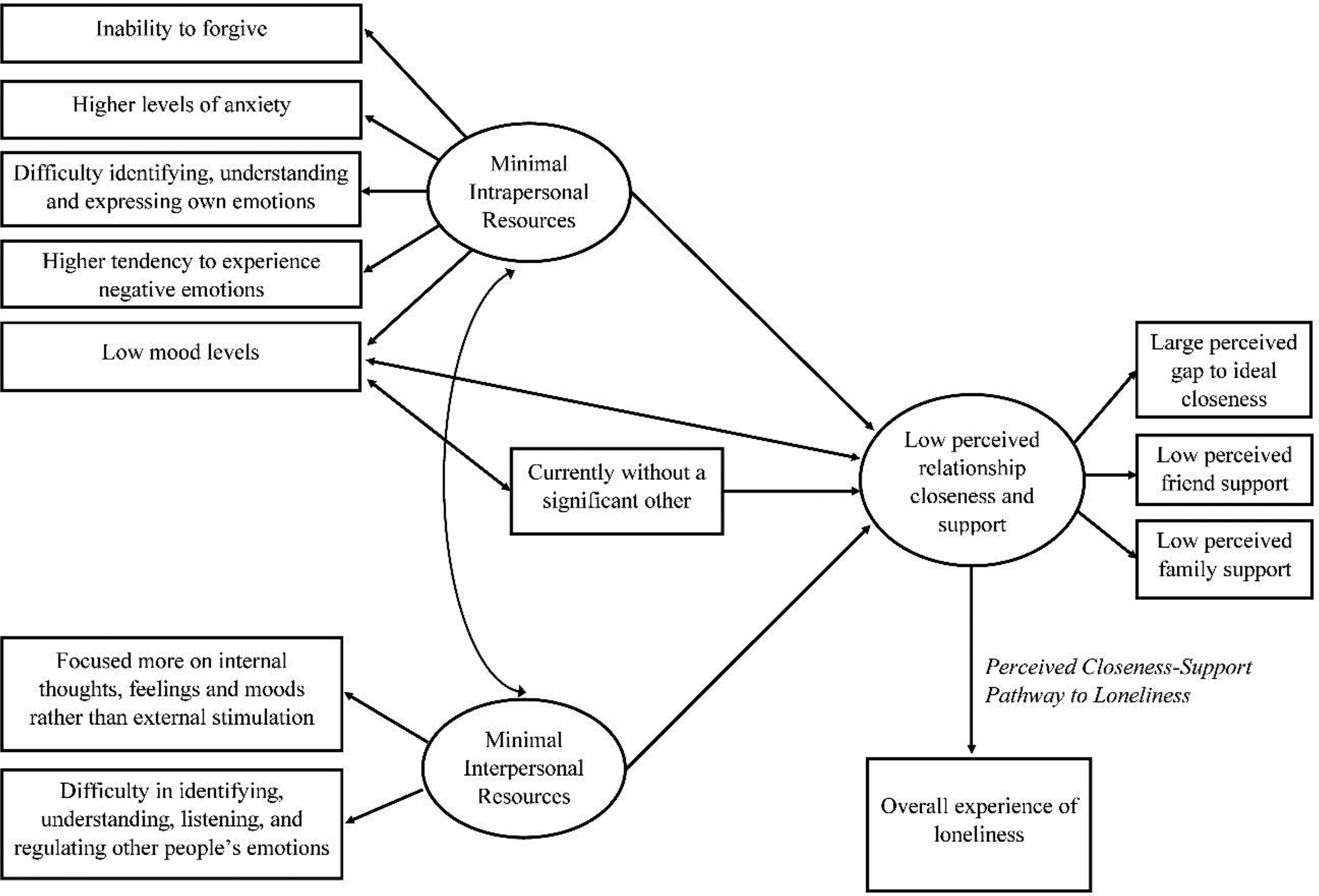
Pathway to Loneliness Risk Model.
The changing topography of loneliness within mid-adulthood cannot be attributed to the changing topography of parenting demands over the last few decades. Nor can loneliness be described as the inverse of adequate social support. Social support is instrumental in reducing loneliness, but the picture of loneliness encompasses more than a lack of social support. A lonely parent is someone whose own perceptions of themselves, others, and the world around them result in a vulnerability where they feel a sense of privation and detachment. The mere presence of relationships, whether intimate, familial, or friend, is not sufficiently protective against this vulnerable state that leads to a perceptual poverty of closeness. Future research is needed to confirm this cross-sectional model. Additionally, targeted research on fathers is needed to determine if the current model can be applied or whether they have a different gendered pathway to loneliness.
Footnotes
Funding
The author(s) received no financial support for the research, authorship, and/or publication of this article.

Open research statement
As part of IARR’s encouragement of open research practices, the author(s) have provided the following information: This research was not pre-registered. The data used in the research are available. The data can be obtained by emailing