



Abstract
Using family stress and coping theory, the current study assessed dyadic influences of specific facets of mindfulness (nonreactivity, acting with awareness, and nonjudgment), accounting for stress levels, on relationship quality and sexual satisfaction in an ethnically and economically diverse sample of 847 married and unmarried heterosexual couples. Results from actor–partner interdependence models indicated a positive association between one’s own report and partners’ report of nonreactivity and one’s own reports of relationship quality for both men and women. Men’s and women’s acting with awareness was associated with women’s sexual satisfaction. Nonjudgment was not uniquely associated with one’s own or one’s partner’s relationship quality or sexual satisfaction. Since the majority of research on mindfulness and relationship quality uses broad global measures of mindfulness, this study provides novel information on the comparative strength of dimensions of mindfulness on distinct areas of couple functioning using a dyadic approach. Suggestions for future work and implications for research and practice are discussed.
Introduction
Broadly, mindfulness is conceptualized as “the awareness that emerges through paying attention on purpose, in the present moment, and non-judgmentally to the unfolding experience moment by moment” (Kabat-Zinn, 2003, p. 145). Based on this definition, there are multiple components involved in mindfulness and its practice. Baer and colleagues (2006) delineated five mindfulness facets—nonreactivity to inner experience, observing thoughts/feelings, acting with awareness, describing with words, and nonjudging of experience. This opened the door to the possibility of exploring the relative influence of specific facets of mindfulness on individual and relational functioning.
Mindfulness research has historically focused on individual benefits (e.g., Brown & Ryan, 2003) and indicates positive benefits for individual mental and physical health (e.g., Grossman et al., 2004). More recently, research has considered relational outcomes influenced by mindfulness, such as romantic relationship quality (e.g., Karremans et al., 2017). Specifically, a systematic review of the literature (Kozlowski, 2013) and a recent meta-analysis (McGill et al., 2016) indicate that higher levels of overall mindfulness are associated with higher ratings of relationship satisfaction. Further, a growing number of mindfulness studies have considered other indicators linked to relationship health, such as sexual satisfaction (e.g., Khaddouma et al., 2015, 2017; Silverstein et al., 2011).
These studies indicate that mindfulness training can assist couples in experiencing more sexual satisfaction in their relationship (Khaddouma et al., 2017). Specifically, the increased awareness developed through mindfulness training improved females’ sexual functioning and physiological response (Silverstein et al., 2011). Another study found that sexual satisfaction fully mediated the association between two facets of mindfulness (observing and nonjudging of inner experience) and relationship satisfaction in a sample of young adults (Khaddouma et al., 2015).
Another area of growth in the study of mindfulness and relationships are the recent studies that consider the dyadic influence of mindfulness on relationships. Findings are mixed, however, with some studies finding some support for partner effects of mindfulness (Lenger et al., 2017; Williams & Cano, 2014; Zamir et al., 2017) and other studies finding no support for the influence of partner (Barnes et al., 2007; Pakenham & Samios, 2013; Schellekens et al., 2016). Most of these studies did not include an emphasis on specific dimensions of mindfulness and used more global assessments.
One exception was Lenger and colleagues’ (2007) dyadic study of the influence of five mindfulness facets on relationship quality. They found that only nonreactivity was uniquely important to one’s spouse’s relationship satisfaction—indicating the value of distinguishing aspects of mindfulness for greater clarity in patterns. Because their study used a homogenous sample of 164 White, high-resource, long-term married couples, replication with more diverse samples of couples, like in the current study, will add to a better understanding and greater ability to generalize findings.
Most prior research on couple relationships and mindfulness lacked explicit descriptions of theoretical underpinnings; however, there is an encouraging trend toward utilizing theory in this area of research. Karremans et al. (2017) present a theoretical framework, built on empirical literature, of the influence of mindfulness on romantic relationship processes and, ultimately, relationship satisfaction. Specifically, they suggest that mindfulness is linked with emotional skills, which in turn are linked to relationship-specific behavioral responses, which in turn are linked to one’s own and one’s partner’s relationship satisfaction.
In addition to utilizing the dyadic aspects of Karremans et al.’s (2017) framework, we incorporated principles from family stress and coping theory (FSCT; Patterson, 2002) in the current study. Family stress and coping theorists take a systemic approach and emphasize strengths and skills that are essential for successful family adaptation in the context of stress. Mindfulness is considered an individual resource, skill, or characteristic that has the ability to positively influence one’s own relationship functioning in the context of stress (McGill & Adler-Baeder, 2019). Empirical evidence supports these assumptions. For example, a recent study found that mindfulness enhances individuals’ use of positive emotion regulation skills in the face of stressful situations (Dixon & Overall, 2016), and another study found that mindfulness buffers against the effects of anxious attachment in a relationship (Saavedra et al., 2010).
Current study
In the current study, we built upon the one previous study assessing dyadic influences of mindfulness facets on relationship quality (Lenger et al., 2017). We utilized a larger, more racially and economically diverse sample of married and unmarried couples; we explicate an FSCT approach and considered the confounding influence of stress on relationship functioning; and we included assessment of both relationship quality and sexual satisfaction as relational outcomes. Our research questions center on testing in the same model the intraindividual and cross-partner associations (i.e., actor–partner interdependence model [APIM]) between indicators of relationship functioning, stress, and three mindfulness facets. We expected to uncover the relative importance of distinct mindfulness facets, accounting for stress levels, on self and partner for both relationship quality and sexual satisfaction.
Method
Procedures and participants
Couples from across a southeastern state were recruited as part of a randomized control trial (RCT) examining the efficacy of couple relationship education programs. Couples were eligible for the RCT if both partners were 19 years or older and were in a committed (self-defined) couple relationship. The current study used baseline data only to examine concurrent links among variables. Procedures were guided by a research protocol approved by a university IRB for Human Subjects.
The original sample was composed of 929 couples in which one or both completed the baseline survey. Due to the dyadic nature of the current study, the analytic sample consisted the 847 heterosexual couples that enrolled in the RCT and provided complete data sets (i.e., both individuals in the couple completed a baseline survey). Same-sex couples (N = 15) also were not included because the method utilized in the current study requires distinguishable groups. The racial background reported was 61% White, 34% Black, and 5% other races. The average age of respondents was 37 years. The sample reported a wide range of household income: 31% reported less than US$25,000; 44% reported between US$25,000 and US$74,999; and 25% reported above US$75,000. The majority (69%) were married, and the remaining 31% were in a committed relationship.
Measures
Mindfulness
Three facet subscales—nonreactivity, acting with awareness, and nonjudging—from the Five Facets of Mindfulness Questionnaire (FFMQ; Baer et al., 2006) were used to assess participants’ level of mindfulness. The survey included items only for these three, since they were directly related to concepts taught in the relationship education programs. This is in line with suggestions from Baer (2011), the creator of the FFMQ, who notes that the observing subscale may be confusing to non-meditating participants and the describing subscale may not be relevant to certain mindfulness training approaches. This suggestion is especially important considering our community-based sample, on the whole, likely did not have a meditation background or had not received mindfulness training. Five items were used for each of the subscales. Responses ranged from 1 (never or very rarely true) to 5 (very often or always true). For easier interpretability, items were reverse coded so that higher scores indicate higher levels of each mindful facet. Reliability was good for all three: nonreactivity (α = .74), acting with awareness (α = .83), and nonjudging (α = .78). In our sample, significant correlations among the three facets range from .07 to .53, indicating facets represent related but distinct constructs.
Stress
A global item, “How would you rate your overall level of stress?,” was used to assess perception of stress. Responses ranged from 1 (no stress) to 7 (high stress), thus higher scores indicate higher perceptions of stress.
Relationship quality
Three items from the Quality of Marriage Index (Norton, 1983) were used to assess respondents’ reports of relationship quality. The 3 items were, “We have a good relationship,” “Our relationship is strong,” and “My relationship makes me happy.” Response options formed a 7-point Likert-type scale ranging from very strongly disagree (1) to very strongly agree (7); mean scores were computed and higher scores indicate higher relationship quality. The α coefficient for internal consistency indicated excellent reliability (α = .95).
Sexual satisfaction
Three items from the Sexual Function Index (Rosen et al., 2000) were used to assess respondents’ reports of sexual satisfaction. The 3 items focused on how satisfied respondents were with, “the amount of emotional closeness during sexual activity,” “the sexual relationship with your partner,” and “your overall sexual life.” Response options formed a 5-point Likert-type scale ranging from very dissatisfied (1) to very satisfied (5); mean scores were computed and higher scores indicate higher ratings of sexual satisfaction. The α coefficient for internal consistency indicated excellent reliability (α = .89).
Results
IBM SPSS Amos 25 was used to test a series of APIMs to examine whether individuals’ reports of three mindfulness facets were linked to relationship quality and sexual satisfaction for themselves and for their partners, accounting for reported level of global stress. Before testing the models, variables were analyzed for normal distribution of data for both men and women. Each variable was normally distributed and did not require transformation (George & Mallery, 2010). Bivariate correlations were also assessed to understand basic associations among study variables. Results indicated small to moderate significant correlations (r = |.12–.53|) between predictors and outcome measures for both men and women. Because men’s and women’s nonreactivity, acting with awareness, and nonjudgment were not significantly correlated (r = −.01 to .13) with one another, we did not include these covariances in the final models.
Relationship quality
The goodness of fit indices for the APIM assessing the baseline associations among nonreactivity, acting with awareness, nonjudgment, stress, and relationship quality indicated an acceptable fit of data to the model (χ2 = 76.97, df = 15, p = .000; CFI = .96; RMSEA = .07, p = .02). The model (see Figure 1) predicted 11% and 14% of the variance in men’s and women’s relationship quality, respectively.
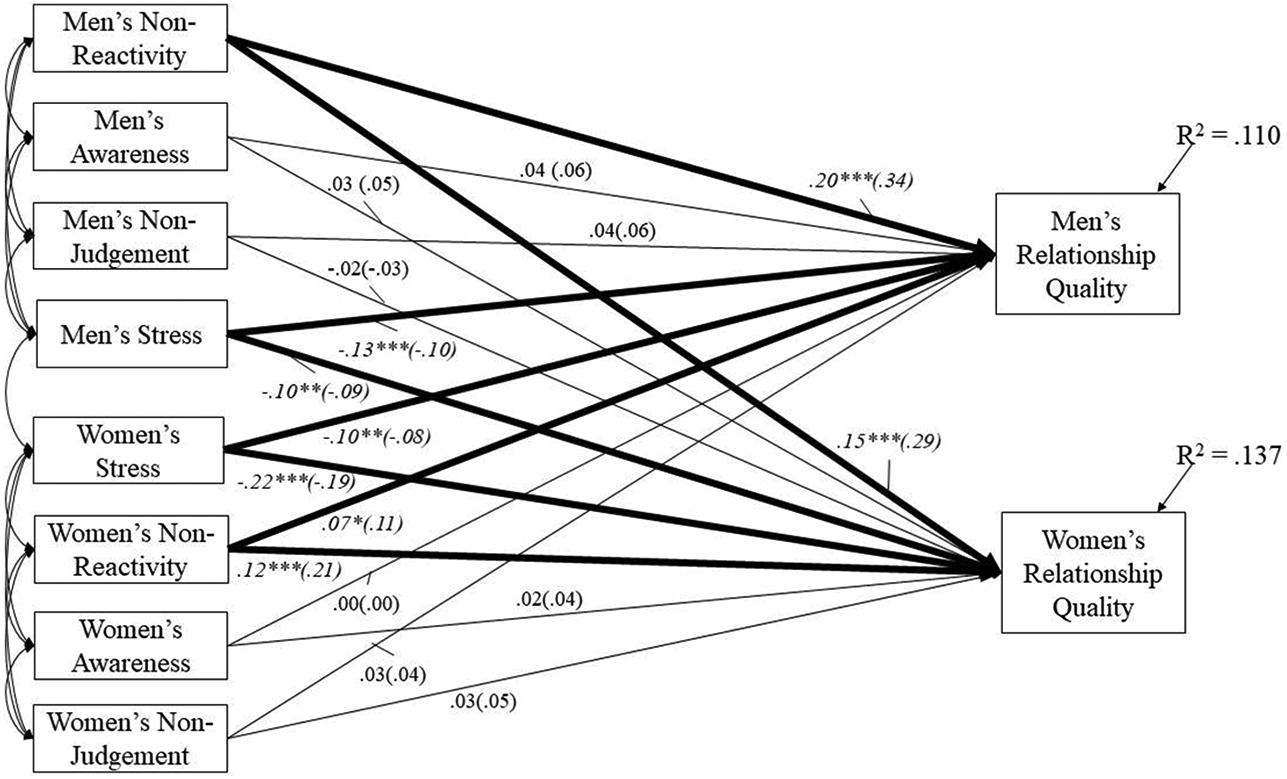
Results from APIMs assessing the association between mindfulness and relationship quality. χ2 = 76.97, df = 15, p < .001; CFI = .96. APIM = actor–partner interdependence model.
Accounting for all other variables in the model, men’s and women’s reports of nonreactivity were the most closely related to their own reports of relationship quality (men: β = .20; p < .001; women: β = .12; p < .001). There were no unique actor effects for acting with awareness or nonjudgment for men or women on relationship quality.
In addition, both men’s and women’s reports of nonreactivity were positively and significantly associated with partners’ reports of relationship quality (β = .15; p < .001; β = .11; p = .050). There are no unique partner effects evident for acting with awareness or nonjudgment for men or women on relationship quality.
Sexual satisfaction
The goodness of fit indices for the APIM assessing the baseline associations among nonreactivity, acting with awareness, nonjudgment, stress, and sexual satisfaction indicated an acceptable fit of data to the model (χ2 = 76.76, df = 15, p < .001; CFI = .95; RMSEA = .07, p = .02). The model (see Figure 2) predicted 12% and 11% of the variance in men’s and women’s sexual satisfaction, respectively.
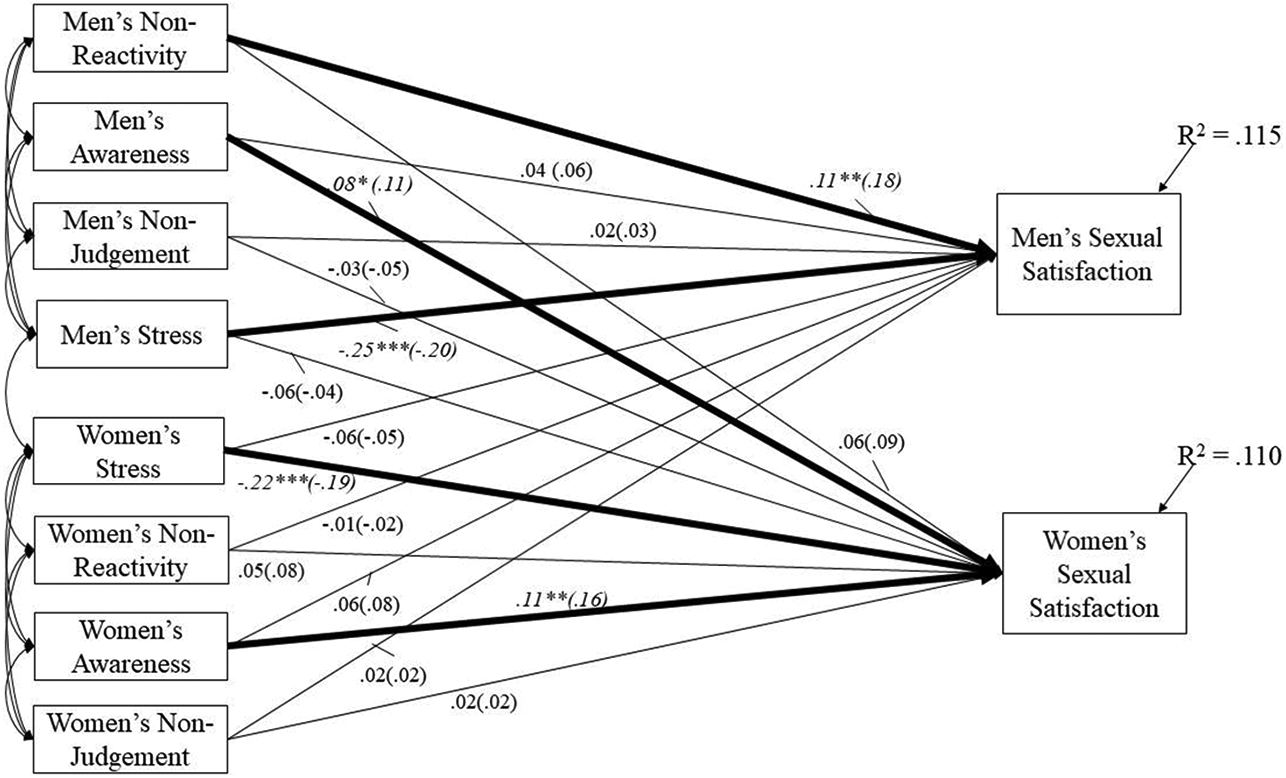
Results from APIMs assessing the association between mindfulness and sexual satisfaction. χ2 = 76.76, df = 15, p < .001; CFI = .95. APIM = actor–partner interdependence model.
Accounting for all other variables in the model, actor effects were evident for reports of men’s nonreactivity (β = .11; p = .002) and women’s acting with awareness (β = .11; p = .006) on sexual satisfaction. Sexual satisfaction was most closely and positively related to acting with awareness for women and to nonreactivity for men. There were no unique actor effects for nonjudgment on sexual satisfaction for men or women.
In addition, men’s reports of acting with awareness (β = .08; p = .048) were positively and significantly associated with their partner’s reports of sexual satisfaction. There were no unique partner effects for nonreactivity or nonjudgment of experience on sexual satisfaction for men or women.
Discussion
The current study adds to the dyadic research centered on mindfulness and romantic relationships and provides new insight into the facets of mindfulness and their relative value for two aspects of relationship well-being. We built upon Lenger and colleagues’ (2017) study by utilizing a more racially diverse sample of married and unmarried couples, by considering level of stress, and by considering both sexual satisfaction and relationship quality. The current study demonstrates the importance of nonreactivity for one’s own and one’s partner’s reports of relational quality, as well as women’s own and their partners’ acting with awareness for women’s reports of sexual satisfaction across a diverse population of couples. In the context of these two dimensions of mindfulness and stress, nonjudgment practices were not uniquely associated with either one’s own or one’s partner’s relational outcomes. These findings are framed within a family stress and coping theoretical framework and highlight specific strengths that can be targeted for interventions focused on maintaining and improving couple relational health and overall family functioning.
Overall, nonreactivity—the ability to notice feelings or thoughts and not immediately react to them—was an especially important facet, above and beyond other facets for assessments of relationship quality. Lenger and colleagues (2017) also found that nonreactivity was important for one’s partner’s report of relationship satisfaction. This facet, requiring skills in noticing and self-regulation of potentially negative reactivity/defensiveness, is a key element of healthy relationships functioning, particularly interactions during conflict and stress (Levenson & Gottman, 1985). Overall, a body of research confirms that when one or both partners can listen without reacting negatively, arguments may have less negative overtones, which is linked to higher quality relationships.
Acting with awareness, or turning off one’s automatic pilot or distractions and behaving purposefully, was the facet of mindfulness most strongly related to sexual satisfaction. Our findings provide an intersection between studies of mindfulness and studies of sexual health for couples. An especially novel finding was that the more important mindfulness dimension for women’s reports of their sexual satisfaction was their own as well as their partner’s report of acting with awareness. This is noteworthy because no unique partner effect for acting with awareness was found for relationship quality, indicating that dimensions of mindfulness may be more or less important, depending on the aspect of relationship functioning of interest.
Our finding is in line with previous research on women’s sexual satisfaction that also indicated women’s ability to act with awareness may be particularly important for their own reports of sexual functioning (Silverstein et al., 2011). The findings of our study add the information that women’s partners’ ability to act with awareness also uniquely predicts women’s reports of sexual satisfaction. This mindful practice conveys attunement to self and other and mindful engagement. We interpret this finding to mean that it is the combination of one’s own and one’s partner’s ability to act with awareness that may be particularly meaningful for women in the context of intimate experiences with their partners.
There were no unique and significant paths between relational outcomes and nonjudgment, the ability to be an impartial witness to each moment, when considering the other facets of mindfulness in the model, and accounting for stress. This is counter to Lenger and colleagues’ (2017) findings that nonjudgment was the only significant predictor of one’s own relationship quality while simultaneously considering the other four facets. This discrepancy may be a reflection of the differing characteristics of the samples and suggests that replication of our findings in other diverse samples is necessary. It may also reflect a measurement issue. The nonjudging items in the measure used in this study are individually focused (e.g., “I make judgements about whether my thoughts are good or bad.”) and do not capture judgment of partner in the couple relationship. For future studies of mindfulness and couple functioning, we recommend adaptation of items to better capture the dynamic processes of interactions in relationships.
The findings of this study advance our understanding of point-in-time relationships among specific elements of mindfulness and elements of relationship functioning within a couple dyad. We encourage future work that assesses relationships across time to provide a more accurate picture of both normative influences between relationship functioning and mindfulness practices and the value of targeting mindfulness elements in intervention. Based on the novel partner effects found, we encourage future research to continue consideration of dyadic influences.
The total variance in relationship quality predicted in the model was 11–14%, which is comparable to other studies assessing the relationship between mindfulness and relationship quality (11–18%; Kappen et al., 2018; Wachs & Cordova, 2007). Clearly, other unmeasured predictors of relationship quality account for additional variance. We do note that our more diverse sample of participants both makes it more challenging to find strong associations and allows us to assert greater generalizability of our findings to a more diverse group of couples. Finally, we encourage future explorations of the diversity that may validate both differences and similarities in these patterns of associations between subgroups of couples.
Finally, based on the findings of the current study, we encourage those working with couples in prevention and intervention settings to integrate mindfulness-based practices. There is a growing trend of incorporating mindfulness activities and training into therapy and educational programs for couples (e.g., Bihari & Mullan, 2014; Carson et al., 2004); however, limited studies exist exploring particular areas and practices of mindfulness that are more salient predictors of relationship quality than others which can inform program content. Because the current study examined specific dimensions of mindfulness and their influence on relationship functioning, we can suggest that emphasizing practices in nonreactivity (e.g., learning and using body scan techniques) and acting with awareness (e.g., practicing mindful conversations that include “mindful pause and plan” responses) may be especially valuable in cultivating positive couple relationships.
Conclusions
This study represents an advancement in the study of couple dyadic processes and combines mindfulness, relationship quality, and couple sexual functioning literature. We incorporated a theoretical framework that includes family stress and considers mindfulness practices as a strength related to individuals’ and their partners’ relationship well-being. We found evidence of dyadic influences and the comparative saliency of nonreactivity for relationship quality and acting with awareness in sexual satisfaction. Because distinct dimensions of mindfulness were associated with these relationship outcomes, we encourage continued efforts to explore the distinct role of different facets of mindfulness in relationship functioning and testing of increasingly complex models to further our empirical base for practice and policy.
Footnotes
Authors’ note
A previous version of this manuscript was presented at the National Council on Family Relations Annual Conference in 2018.
Funding
The author(s) disclosed receipt of the following financial support for the research, authorship, and/or publication of this article: This research was supported by the United States Department of Health and Human Services, Administration of Children and Families under Grant #90FM0082.

Open research statement
As part of IARR’s encouragement of open research practices, the author(s) have provided the following information: This research was not pre-registered. The data and materials used in the research are available. The data and materials can be obtained by emailing: