



Abstract
Recent studies have indicated that activation of the sexual system fosters relationship initiation. In three studies, we expand on this work to investigate whether sexual activation encourages initiating relationship with prospective partners by biasing the way they are perceived. In all studies, participants encountered a potential partner and rated this partner’s attractiveness and romantic interest following sexual activation. Participants’ interest in the partner was self-reported or evaluated by raters. Study 1 revealed that sexual activation led participants to perceive potential partners as more attractive and interested in oneself. Study 2 added to these findings, providing a test of sexual priming rather than more general closeness priming. Mediational analyses in Study 3 indicated that heightened romantic interest mediated the link between sexual activation and perceiving potential partners as more interested in oneself. These findings suggest that sexual activation facilitates relationship initiation by motivating projection of one’s desires onto prospective partners.
The sexual behavioral system evolved to facilitate reproduction by arousing sexual urges that motivate the pursuit of mating partners (Birnbaum et al., 2014; Buss & Kenrick, 1998). The success of this pursuit depends on targeting potential partners who are not only perceived as desirable but also as partners who will reciprocate one’s advances. Indeed, people often refrain from courting desired prospective partners because of the fear of being rejected by them (Birnbaum et al., 2018). When a partner’s interest is ambiguous, however, people may rely on motivated biases—that is, biased perceptions of the targets’ level of interest in oneself—to instill the confidence they need to set aside these worries and pursue the desired partner (Haselton & Buss, 2000; Lemay & Wolf, 2016; Maner et al., 2005).
Recent studies have shown that activation of the sexual system fosters relationship initiation (Birnbaum et al., 2017, 2019). For example, prior research has indicated that sexual priming motivates people to conform to a potential partner’s preferences in order to make a favorable impression (Birnbaum et al., 2020). In the present research, we sought to expand on this prior work to investigate whether sexual activation biases the way that prospective partners are perceived, an important contributor to relationship initiation. In doing so, we relied on the theoretical principle that activation of the sexual system heightens the salience of relationship initiation and sexual fulfillment goals while decreasing the relative importance of other motivations, such as self-protection (Ariely & Loewenstein, 2006; Birnbaum et al., 2014). Focusing on this key step that precedes relationship initiation, we examined whether sexual priming would instigate desire for prospective partners, making them seem more romantically interested and potentially more receptive to one’s advances.
The relationship-initiating function of sex
The sexual behavioral system evolved to facilitate reproduction (Buss & Kenrick, 1998). As such, its basic functioning is not dependent on emotional bonding (Diamond, 2013). Nevertheless, selection pressures have been theorized to have fostered mechanisms that keep sexual partners bonded to each other so that they can jointly care for their offspring in the vulnerable period of infancy (Eastwick, 2009; Fletcher et al., 2015). Numerous characteristics of human sexuality imply that sexual desire and the resulting behaviors function as such mechanisms, cultivating extended intimate contact and enduring emotional bonding between sexual partners (Birnbaum, 2018; Birnbaum & Finkel, 2015; Birnbaum & Reis, 2019). Humans, for example, tend to engage in sex privately; prefer the “missionary” position that creates face-to-face contact; and cuddle after sex (Ford & Beach, 1951; Reinisch & Beasley, 1991).
Sexual desire attracts romantic partners and unites them throughout relationship development. Still, sexual desire should function as a particularly key relationship-promoter in earlier stages, when it is often the primary driving force behind relationship pursuit (Birnbaum, 2018; Poulsen et al., 2013). In these early stages, the sexual behavioral system facilitates contact by generating sexual desire that may manifest itself in approaching desirable partners and engaging in goal-directed behavioral tactics for initiating casual or serious dating relationships (Birnbaum et al., 2014; Buss & Kenrick, 1998).
In support of the proposed relationship-initiating role of sex, research has shown that people exhibit greater accessibility of intimacy-related thoughts (e.g., feeling very close to a partner) following subliminal exposure to sexual stimuli (vs. neutral stimuli; Gillath et al., 2008) and generally declare that they often use sex as a means of initiating romantic relationships with prospective partners (Birnbaum & Gillath, 2006). Beyond associating sex with relationship formation, people also act accordingly and tend to employ strategies that instill a sense of intimacy between newly acquainted partners following sexual priming. For example, activation of the sexual-behavioral system (e.g., exposure to sexual versus non-sexual stimuli) leads people to reveal more personal information as well as to provide more responsiveness and help to a prospective partner (Birnbaum et al., 2017, 2019). These findings suggest that sexual activation initiates a cascade of behaviors that allows people to become closer to potential partners and thereby helps set the stage for deepening emotional connections with them.
And yet, attempting to initiate a romantic relationship carries the risk of rejection and requires not only the desire to approach a potential partner but also the courage to pursue this desire and the conviction that one can successfully entice the desired partner. Because of these risks, people sometimes tend to self-protect by distancing themselves from potentially rejecting partners (Murray et al., 2006, 2008) and putting less effort into courting them (Birnbaum et al., 2018). An optimistic outlook on one’s courting prospects may thus play a key role in the process of encouraging people to initiate a potentially sexual relationship (Haselton & Buss, 2000; Maner et al., 2005). Such optimism often reflects motivated bias; that is, perceiving that a partner is more interested than is actually the case (Haselton & Galperin, 2013). Corroborating this view, a recent short-term prospective study demonstrated that projection of one’s desires onto the target of desire (i.e., believing that one’s affections were more reciprocated than was actually the case) predicted enactment of relationship initiating behaviors (Lemay & Wolf, 2016).
The present research
We propose that activation of the sexual system might underlie people’s motivation to take a leap of faith needed to pursue a romantic relationship. In the present research, we addressed this possibility by investigating the hypothesis that sexual priming would increase one’s interest in a potential partner and the perceptions of this partner’s attractiveness and interest in oneself. Past studies have demonstrated that activating the sexual system by exposing people to sexual cues, which are commonly associated with opportunities for copulation and sexual arousal, leads them to enact relationship-initiating behaviors that help nurture long-term bonding (Birnbaum et al., 2017, 2019). More intense sexual activation has been shown to induce the willingness to engage in sexually unsafe behaviors and to behave deceitfully toward potential partners in order to have sex (Ariely & Loewenstein, 2006).
Regardless of whether the individual wishes to form a meaningful relationship or merely desires to engage in casual sex, sexual activation may produce a type of tunnel vision that instills a sense of urgency for relationship/sexual initiation while marginalizing other concerns (Ariely & Loewenstein, 2006; Birnbaum et al., 2014). Building on this reasoning, we propose that this sense of urgency affects several essential components that underlie relationship initiation: Experiencing heightened romantic interest in a potential partner as well as perceiving this partner as desirable and interested in oneself (Bouffard & Miller, 2014; Choi & Hur, 2013). Accordingly, we manipulated sexual priming, examining the hypothesis that participants in the sexual priming condition would show greater interest in a potential partner and heightened perceptions of this partner’s attractiveness and interest in themselves as compared with participants in a control condition.
Three experiments examined this hypothesis. In all studies, participants encountered a potential partner and rated this partner’s attractiveness and romantic interest following sexual activation. Participants’ interest in the partner was self-reported or evaluated by raters. In Study 1, we activated the sexual system in an ecologically valid manner, investigating how sexual stimuli (vs. neutral stimuli) affect other perceptions (e.g., another person’s sexual attractiveness and interest in oneself) and immediacy behaviors (e.g., maintaining eye contact, smiling) enacted when potential partners actually meet and introduce themselves to each other. Immediacy behaviors have been demonstrated to convey contact readiness and interest in initiating romantic relationships (Andersen, 1985; Eibl-Eibesfeldt, 1989; Leck & Simpson, 1999). Accordingly, coded immediacy behavior served as an index of participants’ interest in the partner.
Study 2 provided a test of the specific influence of sexual priming per se rather than more general (non-sexual) closeness priming in a more controlled setting than that of Study 1. For this purpose, we added a third condition, such that participants were exposed to either a sexual, a non-sexual but still intimate, or a neutral prime. Then, all participants watched the same video introduction of a potential opposite-sex partner and were asked to introduce themselves to this partner while being videotaped. These videotapes were then coded for expressions of impression management efforts, such as self-promotion, exhibited confidence, and friendliness (Goffman, 1959; Leary & Kowalski, 1990). Such expressions are typically exhibited in a dating context and are aimed at attracting desired partners (Bleske-Rechek & Buss, 2006; Buss, 1988) and thus served as an index of participants’ interest in the partner.
In Study 3, we investigated the process by which sexual activation affects perceptions of others’ romantic interest in oneself. To provide clearer evidence for our proposed mechanism, we used a subliminal priming technique, which bypasses conscious evaluation of sexual stimuli and is therefore less likely to arouse sexuality-related defenses when participants interact with a potential partner (Gillath et al., 2008). Following this subliminal activation, participants interacted online with an opposite-sex confederate in a “get to know each other” conversation. All three studies were approved by the local ethics institutional review board (IRB). All data were collected before any analyses were conducted; all data exclusions, manipulations, and variables analyzed are reported.
Study 1
In Study 1, we sought to examine whether activation of the sexual system in an ecologically valid manner affected participants’ immediacy behaviors (nonverbal expressions of contact readiness, such as smiling and leaning forward) and their perceptions of a stranger’s attractiveness and interest in them. For this purpose, we first assigned unacquainted opposite-sex participants to either (a) a condition in which we exposed them to an affectionate prime that, in the context of an interaction between young, opposite-sex strangers, might induce sexual interest by asking them to hug each other or (b) a control condition in which they faced each other closely while reading a neutral article. Then, participants were asked to introduce themselves to each other while being videotaped. After the introduction, participants rated the other participant’s attractiveness and interest in them. The videotaped introductions were coded for non-verbal expressions of immediacy behavior. We hypothesized that participants in the sexual condition would exhibit more immediacy behavior and perceive the other participant as more attractive and interested in them than participants in the control condition.
Method
Participants
One hundred and twelve students (56 women, 56 men) from a university in central Israel participated in this study in exchange for 50 NIS (about US$14). Sample size was estimated via a priori power analysis using G*Power software package (Faul et al., 2009) to ensure 80% power to detect an effect size, d, of 0.50 at p < .05. This hypothesized effect size was based on previous research examining the effect of sexual priming on another relationship-initiation behavior (self-disclosure; Birnbaum et al., 2017). Participants ranged from 20 to 32 years of age (M = 24.44, SD = 2.17) and were not currently involved in a romantic relationship. Given that comparisons based on sexual orientation would have been limited due to a small sample size, only heterosexual participants were recruited.
Measures and procedure
Participants were invited to take part in a study of expressions of intimacy in initial encounters. Participants who wished to participate were randomly paired with an unacquainted opposite-sex participant and scheduled to attend a single half-hour laboratory session. Prior to each session, participants were randomly assigned to one of two conditions: (a) A sexual condition in which participants hugged each other and (b) a control condition in which participants read a neutral article while facing each other. Upon arrival, the two previously unacquainted participants were introduced to each other and were instructed to closely face each other while standing on pre-marked lines. Participants in the sexual condition were instructed to hug each other. Participants in the control condition were instructed to read a short article about problem-based learning. Participants in both conditions were asked to perform the task for 30 seconds without talking to each other and were informed that a research assistant would knock on the door when time was up.
Following this procedure, participants completed 3 items assessing their sexual arousal (Birnbaum et al., 2017; e.g. “To what extent are you experiencing sexual thoughts now?”; “To what extent are you sexually aroused now?”; “To what extent do you desire to have sex now?”; α = .84). These items were intermixed with 3 filler items assessing interest in neutral activities (e.g., “To what extent would you be interested in talking to a friend now?”; “To what extent would you be interested in exercising now?”; “To what extent would you be interested in watching a documentary movie now?”) to mask our interest in sexual arousal. Ratings were made on a 5-point scale ranging from 1 (not at all) to 5 (very much so).
Then, participants were instructed to introduce themselves to each other for 3 min by talking about their hobbies, positive traits, and future career plans while being videotaped. Following this introduction, participants evaluated the other participant’s sexual attractiveness on five adjectives used by Birnbaum et al. (2011): sexually desirable, sensual, “hot,” attractive, and sexually exciting (e.g., “To what extent do you think that the other participant is hot?”; α = .93). Participants also evaluated the other participant’s non-sexual attractiveness on four adjectives: intelligent, knowledgeable, helpful, and a good parent (e.g., “To what extent do you think that the other participant might be a good parent?”; α = .72), which were adapted from Hoffman et al. (2014).
In addition, participants completed 3 items assessing the other participant’s romantic interest in them (Birnbaum et al., 2018; “To what extent do you think that the other participant is romantically interested in you?”; “To what extent do you think that the other participant is interested in dating you?”; “To what extent do you think that the other participant is interested in a long-term relationship with you?”; α = .88) and a single item assessing the other participant’s sexual interest in them (“To what extent do you think that the other participant is interested in a sexual relationship with you?”). Ratings were made on a 5-point scale ranging from not at all (1) to very much (5). Finally, participants provided demographic information (e.g., age, number of past romantic relationships) and were carefully debriefed.
Coding immediacy behaviors
The video-recorded get-acquainted conversations were coded by two trained independent judges (psychology students) who were blind to the hypotheses and the experimental condition. Each judge watched the videotaped interactions and rated each participant’s overt nonverbal expressions of contact readiness (i.e., behaviors that signal warmth and immediacy: close physical proximity, frequent eye contact, flashing smiles; Andersen, 1985; Eibl-Eibesfeldt, 1989; Leck & Simpson, 1999) in a single overall coding of displays of immediacy behavior. Ratings were made on a 5-point scale ranging from 1 (not at all) to 5 (very much). The intraclass correlation coefficient (ICC) for immediacy behavior was 0.82. Hence, judges’ ratings were averaged for each participant. Coded immediacy behavior served as an index of participants’ interest in the partner.
Results and discussion
Manipulation check
Because participants were nested within dyads, we used a two-intercept, two-level hierarchical model to examine the effect of sexual activation on sexual arousal while controlling for interdependencies in partners’ arousal. The two-intercept approach simultaneously estimates unique intercepts and slopes for both male and female partners (Kenny et al., 2006). The model included one predictor at level 1 (gender) and three level 2 predictors (the condition, the dyad, and the condition × gender interaction). The sexual priming condition was coded as 1 and the control as −1. Women were coded as 1 and men as −1. As shown in Table 1, sexual arousal was higher in the sexual priming condition than in the neutral condition.
Means, standard deviations, statistics, and effect sizes of coded immediacy behavior and perceived partner’s attractiveness and interest for the experimental conditions (Study 1).

Note. N = 112. * p < .05, ** p < .01, *** p < .001. All measures were rated on a 5-point Likert scale; Standard deviations are presented in parentheses.
Also as expected, a multilevel analysis on the average of the 3 filler items did not yield a significant effect, such that interest in neutral activities was not significantly different in the sexual activation and neutral conditions, suggesting that the manipulation did not affect interest in non-sexual activities. Given that watching a documentary and exercising are behaviors in which some people never engage and that do not necessarily reflect interpersonal interest, we conducted an additional multilevel analysis on the only filler item that signified non-sexual interpersonal interest (i.e., interest in talking to a friend). This analysis also did not yield a significant effect, β = .16, SE = .09, t = 1.60, p = .114, 95% CI [−.02, .34], supporting our belief that the manipulation encouraged sexual rather than interpersonal motivation.
Sexual activation and its effects on coded immediacy behavior and perceptions of others’ attractiveness and interest
Multilevel analysis on coded immediacy behavior and perceptions of others’ attractiveness and interest revealed that, in line with our hypothesis, participants in the sexual condition exhibited more immediacy behavior and perceived the other participant as more attractive as well as more romantically and sexually interested in them than participants in the control condition (see Table 1). There were gender differences in perceptions of others’ sexual attractiveness and interest, such that men perceived the potential partner as more sexually attractive, β = .32, SE = .09, t = 3.47, p < .001, 95% CI [.13, .50], as well as more sexually, β = .24, SE = .07, t = 3.35, p < .001, 95% CI [.09, .38], and romantically interested in them, β = .36, SE = .08, t = 4.34, p < .001, 95% CI [.19, .53], than women did. However, no significant effect was found for the sexual activation by gender interaction in predicting coded immediacy behavior as well as perceptions of others’ attractiveness and interest.
These findings support our hypothesis that activation of the sexual system increases interest in a potential partner (as manifested in greater likelihood of exhibiting immediacy behavior toward this person) as well as the tendency to perceive him or her as more attractive and interested in oneself. Activation of the sexual system apparently encourages people to initiate a relationship with prospective partners by increasing the desire for them and motivating projection of one’s desires onto these partners. And yet, because hugging is not necessarily sexual, it could better be termed “an affectionate prime,” which under certain circumstances (e.g., an interaction between young, opposite-sex strangers) might inspire sexual interest. Accordingly, Study 1 does not allow us to rule out the possibility that a hug primes romantic (non-sexual) interest, security, or comfort rather than sexual schemas per se.
Indeed, prior research has indicated that receiving a hug buffers against the negative implications of distress and thereby fosters well-being (e.g., Murphy et al., 2018). Somewhat similarly, interpersonal touch has been found to instill a sense of attachment security and intimacy (Debrot et al., 2013; Jakubiak & Feeney, 2016), which may have been responsible for our results. Furthermore, the control condition might not have been experienced as neutral as we intended it. Rather, closely facing a stranger while reading an article might actually be experienced as awkward, in which case the differences between the experimental and control conditions might not necessarily reflect the positive influence of hugging but the negative influence of being actively ignored by this person. Study 2 set out to address these limitations.
Study 2
In Study 2, we wished to demonstrate that the effects found in Study 1 could be attributed to priming of sexual schemas per se rather than to priming of general intimacy schemas. In addition, Study 2 offered a better control of the experimental setting. Specifically, in Study 2, a third condition was included, such that participants were exposed to either a sexual, a non-sexual but still intimate, or a neutral prime. Then, unlike Study 1, in which participants interacted with another participant whose attractiveness and reactions could not be controlled, in Study 2, all participants watched the same prerecorded video introduction of a potential opposite-sex partner and then introduced themselves to this partner while being videotaped. After the introduction, participants rated the other participant’s attractiveness and interest in them. Independent judges coded these videotapes for expressions of attempts to induce a favorable impression (e.g., flashing smiles and presenting oneself as a valued partner). We hypothesized that participants in the sexual condition would exhibit heightened impression management efforts and perceive the other participant as more attractive as well as more interested in romantic and sexual relationships than participants in the two control conditions.
Method
Participants
One hundred and fifty students (74 women, 76 men) from a university in central Israel participated in this study in exchange for 50 NIS (about US$14). Sample size was estimated via a priori power analysis using the G*Power software package (Faul et al., 2009) to ensure 80% power to detect a medium effect size, f, of 0.25 at p < .05. All participants were heterosexual and were not currently involved in a romantic relationship. Participants ranged from 19 to 30 years of age (M = 24.23, SD = 1.91).
Measures and procedure
Participants who agreed to take part in a study of preferences and decision-making in the dating scene were individually scheduled to attend a single half-hour laboratory session. Prior to each session, participants were randomly assigned to one of three conditions in which they were supraliminally exposed to: (a) a sexual prime that involved watching erotic (but not pornographic) videos, depicting a couple making out; (b) a non-sexual but still intimate prime that involved watching non-sexual videos, depicting a romantic couple engaging in a non-conflictual, lively, and intimate but non-sexual conversation; or (c) a neutral prime that involved watching non-affectual videos, depicting truck driving, plants growing, and fish swimming. By adding a non-sexual but still intimate prime, we sought to provide a test of priming sexuality rather than more general closeness, ruling out the possibility that watching other couples interact intimately might encourage participants to seek intimacy in their subsequent experiences.
Specifically, the session used a supraliminal activation of the sexual system computerized task, following Birnbaum et al.’s (2017) Study 3 and employed multiple stimuli. Participants were told that they were about to watch three short videos and then should indicate which one they would have wished to watch before going on a first date. All three videos were in line with the experimental assignment, such that they were either erotic, or non-sexual but still intimate, or neutral (participants watched all three videos). Each video was 2 min long or less. Right after watching the videos, participants completed the same scale assessing sexual arousal (α = .89) and the filler items, as described in Study 1.
Next, participants were informed that they would watch a video of another participant who had been recently videotaped for the lab’s dating pool. Participants watched a video of an attractive opposite-sex stranger who introduced himself or herself as a potential partner, talking about his or her characteristics, hobbies, and future career plans. Right after watching the video, participants completed measures of perception of this potential partner’s sexual attractiveness (α = .91) and non-sexual attractiveness (α = .80), which were described in the Study 1. Participants also completed an item assessing this potential partner’s interest in finding a long-term partner (“To what extent do you think that the person in the video is interested in finding a long-term partner?”) and a sexual partner (“To what extent do you think that the person in the video is interested in casual sex?”).
Participants then were informed that they would be videotaped while introducing themselves to the participant they had just watched and that their video would be shown to him or her. Participants were instructed to talk about their hobbies, characteristics, and future career plans for 2 min while being videotaped. Finally, participants were asked to provide demographic information and then fully debriefed. We made sure that they felt good about their participation in the study before leaving.
Coding impression management efforts
The video-recorded introductions were coded by two trained independent judges (psychology students) who were blind to the hypotheses and the experimental condition. Each judge watched the videotaped introductions and rated each participant’s overt verbal and nonverbal attempts to induce a favorable impression (i.e., expressions of self-promotion, such as describing positive traits and presenting oneself as a valued partner; expressions of confidence, such as maintaining an assertive posture and eye contact with the camera; expressions of friendliness, such as flashing smiles; Goffman, 1959; Leary & Kowalski, 1990) in a single overall coding of impression management efforts. Ratings were made on a 5-point scale ranging from 1 (not at all) to 5 (very much). The ICC for impression management efforts was 0.80. Hence, judges’ ratings were averaged for each participant. Coded impression management efforts served as an index of participants’ interest in the partner.
Results and discussion
Manipulation check
To determine whether differences existed between conditions (sexual, intimate, and neutral) in sexual arousal, a one-way analysis of variance (ANOVA) was performed. As expected, the analysis indicated a significant effect for condition, such that sexual activation led to higher levels of sexual arousal than the other two conditions. The intimate condition led to higher levels of sexual arousal than the neutral condition. In addition, as expected, a one-way ANOVA for experimental conditions on the average of the 3 filler items did not yield a significant effect, such that interest in neutral activities was not significantly different in the sexual, intimate, and neutral conditions, suggesting that the manipulation did not affect interest in non-sexual activities (see Table 2 for relevant statistics).
Means, standard deviations, statistics, and effect sizes of coded impression management efforts and perceived partner’s attractiveness and interest for the experimental conditions (Study 2).

Note. N = 150. * p < .05, ** p < .01, *** p < .001. All measures were rated on a 5-point Likert scale. Standard deviations are presented in parentheses. Different superscripts indicate groups that significantly differ from each other within each row (p < .05).
Sexual activation and its effects on coded impression management efforts and perceptions of others’ attractiveness and interest
To determine whether differences existed between experimental conditions (sexual, intimate, and neutral) in coded impression management efforts and perceptions of others’ sexual and non-sexual attractiveness as well as romantic and sexual interest, a one-way multivariate analysis of variance (MANOVA) for experimental conditions was performed on these five measures. This MANOVA yielded a significant difference between conditions, Wilks’ Lambda = .79, F(10, 276) = 3.46, p < .001, η2 = .11, 95% CI for η2 [.03, .15].
Univariate analyses indicated that this effect was significant for all measures, except for perceived partner’s sexual attractiveness. As expected, sexual activation led to perceiving the potential partner as more non-sexually attractive and as more interested in a romantic relationship than the other two conditions. Unexpectedly, the intimate condition led participants to perceive the potential partner as more interested in casual sex than the sexual condition, which is difficult to explain and might reflect a chance finding. The intimate condition also led to more intense impression management efforts than the neutral condition (see Table 2 for relevant statistics). There were gender differences in perceptions of others’ sexual attractiveness, such that men perceived the potential partner as more sexually attractive, F(1, 144) = 11.40, p < .001, ηp 2 = .07, than women did. However, no significant effect was found for the condition by gender interaction in predicting coded impression management efforts as well as perceptions of others’ attractiveness and interest.
Overall, Study 2 addressed Study 1’s limitations, indicating that activation of the sexual system (rather than the more general intimacy priming) motivates people to perceive potential partners as more attractive (in non-sexual dimensions) as well as more interested in a romantic relationship. This pattern of results suggests that sexual priming drives people to see potential partners as more generally attractive and interested in a romantic relationship and thus as potentially more willing to respond positively to their future advances. Unexpectedly, the sexual condition did not lead to significantly greater impression management efforts than the other conditions. These nonsignificant differences could stem either from the non-distinguishable effect of sexual and intimacy priming on impression management efforts or from Study 2’s methodology. In particular, in Study 2, unlike Study 1, participants did not actually interact with prospective partners but merely watched their videotaped introduction. Accordingly, participants might have assumed that under the current circumstances, their prospects for future interactions with potential partners were lower and were therefore less motivated to try to impress them.
Study 3
In Study 3, we sought to address the caveats of Studies 1 and 2 and extend their findings. To do so, we added a measure of participants’ romantic interest in the other participant, which served as a potential mediator and enabled us to explore the process by which sexual activation influences perceptions of others’ romantic interest in oneself. To offer more compelling evidence for the hypothesized mechanism, we employed a subliminal priming methodology that is less likely to elicit sexuality-related defenses when participants interact with prospective partners as it circumvents deliberate evaluations of sexual stimuli (Gillath et al., 2008). Similar manipulations have been used successfully in previous studies, showing that subliminal sexual primes led to higher accessibility of sex-related thoughts in both men and women (Gillath et al., 2007).
Following this subliminal activation, participants interacted online with an opposite-sex confederate in a “get to know each other” conversation and then rated the other participant’s attractiveness and interest in them. By using the communication medium of instant messaging, we wished to provide better experimental control than in Study 1 (which involved uncontrolled nonverbal cues typical of face-to-face interactions) while still, unlike Study 2, sustaining a lively, engaging interaction between prospective partners. We hypothesized that sexual priming would lead to greater romantic interest in the potential partner, which, in turn, would be associated with perceiving this potential partner as more romantically interested in oneself.
Method
Participants
One hundred and twenty students (59 women, 61 men) from a university in central Israel participated in this study in exchange for 50 NIS (about US$14). Sample size was estimated via a priori power analysis using the G*Power software package (Faul et al., 2009) to ensure 80% power to detect an effect size, d, of 0.50 at p < .05. All participants were heterosexual and were not currently involved in a romantic relationship. Participants ranged from 21 to 31 years of age (M = 24.06, SD = 2.32).
Measures and procedure
Participants who agreed to take part in a study of preferences and perceptions in initial encounters were individually scheduled to attend a single half-hour laboratory session. Prior to each session, participants were randomly assigned to either of two conditions: subliminal exposure to a sexual or a neutral prime. When participants arrived at the laboratory, they were greeted by a research assistant and were led to believe that they would be participating in an online chat with an opposite-sex participant who was located in a different room, and who, like themselves, was single. The research assistant took the participants’ picture and told them that it would be shown to the other participant (a confederate).
The session then followed the subliminal activation of the sexual system computerized task, which was used previously by Birnbaum et al.’s (2017, Study 1). Participants were asked to indicate their preferences across seven categories by picking out one of two options from each category (three pairs of options represented each category): pets (e.g., cats, dogs), season (e.g., summer, winter), recreation (e.g., party, pub), food (e.g., Italian, Thai), drinks (e.g., alcoholic, non-alcoholic), color (e.g., red, blue), and music (e.g., pop, rock). Before each pair of options, participants were subliminally exposed to either a sexual or a neutral prime for 30 milliseconds (ms). As is standard in subliminal priming, a mask presented for 500 ms (a visual “noise” pattern that erased the prime’s image on the retina) and a pair of two options (e.g., Italian – Thai) followed the presentation of the prime. The sexual or neutral primes were overall presented 21 times; once before each of the 21 pairs of options.
The sexual primes were erotic but not pornographic photos (an attractive naked, reclining man shown from the groin up for female participants; an attractive, naked, kneeling woman photographed from behind for male participants). These photos were used in previous studies (e.g., Birnbaum et al., 2020; Gillath et al., 2008) and were chosen following a series of pretests in which a different sample rated the sexually arousing qualities of pictures while making sure the pictures were generally viewed as sexually arousing but not disturbing to people from the participant population. The chosen pictures were those that received the highest sexual arousal rating among opposite-sex participants. Neutral primes were landscapes.
Following this procedure, participants were asked to view the other participant’s photo. In reality, all participants were presented with the same photo of an opposite-sex individual, previously used by Birnbaum and Reis (2012), which had been pilot tested to verify that the male and female versions were moderately and similarly attractive. Participants were then instructed to get acquainted by communicating with the confederate/partner over Instant Messenger for a couple of minutes. To ensure consistency across experimental conditions, participants were instructed to ask (and reply) specific questions within the chat (e.g., “What is your name and what do you study?”; “What do you do on the weekends?; “What are your future plans?”; “What qualities do you look for in a potential partner?”). These questions enabled the confederate to use the following fixed chat script, used by Birnbaum et al.’s (2018, Study 3): “Hi my name is Dan, and I am a student in the business school. What’s your name and what are you studying? Nice! What do you do in your free time? I’m usually out with friends socializing. I also read a lot and definitely watch a lot of movies when I have the time. Usually I make time to play sport every week, mostly swimming or biking. My plans are to have my own business, but to be honest, I really don’t have a clear direction yet. What about you? Sounds interesting! Things I look for in a potential partner would be someone that makes me laugh, someone who is caring, fun to be around and of course attractive, what do you look for?”
Results and discussion
To determine whether differences existed between the sexual and neutral primes in participant’s romantic interest in the confederate and perceptions of the confederate’s sexual and non-sexual attractiveness as well as romantic interest, a one-way multivariate analysis of variance (MANOVA) for experimental conditions was performed on these four measures. This MANOVA yielded a significant difference between conditions, Hotelling’s Trace = .22, F(4, 115) = 6.37, p < .001, η2 = .18, 95% CI for η2 [.05, .28]. Univariate analyses indicated that this effect was significant for all measures. As expected, sexual activation led to expressing more romantic interest in the confederate as well as to perceiving the confederate as more attractive and as more romantically interested in the participant than the control condition (see Table 3 for relevant statistics). There were gender differences in participants’ romantic interest as well as perceptions of others’ sexual attractiveness and romantic interest, such that men expressed more romantic interest in the confederate, F(1, 116) = 8.90, p = .003, ηp 2 = .07, and perceived the confederate as more sexually attractive, F(1, 116) = 8.80, p = .004, ηp 2 = .07, and romantically interested in them, F(1, 116) = 5.82, p = .017, ηp 2 = .05, than women did. However, no significant effect was found for the condition by gender interaction in predicting participants’ romantic interest as well as perceptions of others’ attractiveness and interest.
Means, standard deviations, statistics, and effect sizes of perceived partner’s attractiveness and responsiveness, and participants’ interest for the experimental conditions (Study 3).
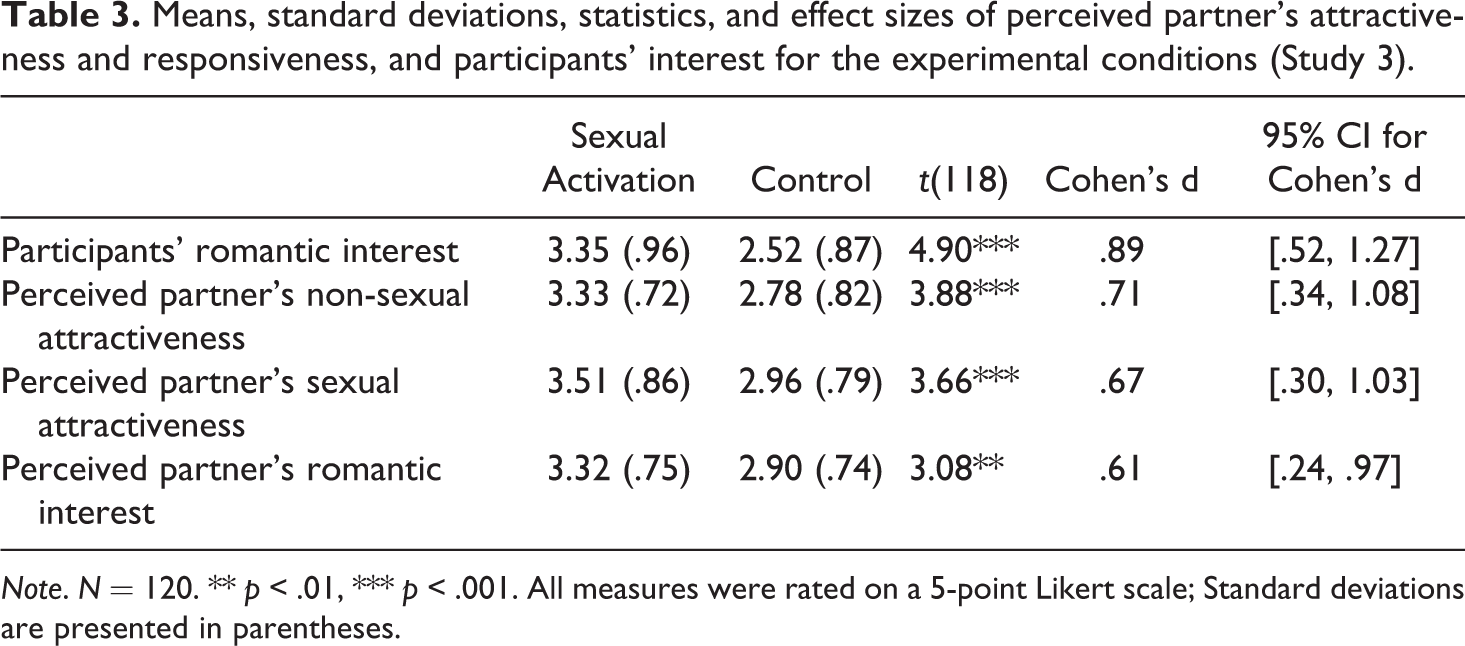
Note. N = 120. ** p < .01, *** p < .001. All measures were rated on a 5-point Likert scale; Standard deviations are presented in parentheses.
To examine whether the effect of sexual activation on perceptions of the confederate’s romantic interest was mediated by participants’ romantic interest in the confederate, we used PROCESS (Hayes, 2013, model 4), in which subliminal sexual activation was the predictor, perception of the confederate’s romantic interest was the outcome measure, and participants’ romantic interest was the mediator. Figure 1 shows the final model. This analysis revealed a significant effect of sexual activation on participants’ romantic interest (b = .83, SE = .17, t = 4.90, p < .001, β = .41, 95% CI [.25, .57]), and a significant effect of participants’ romantic interest on perception of the confederate’s romantic interest (b = .47, SE = .06, t = 8.33, p < .001, β = .61, 95% CI [.47, .75]).
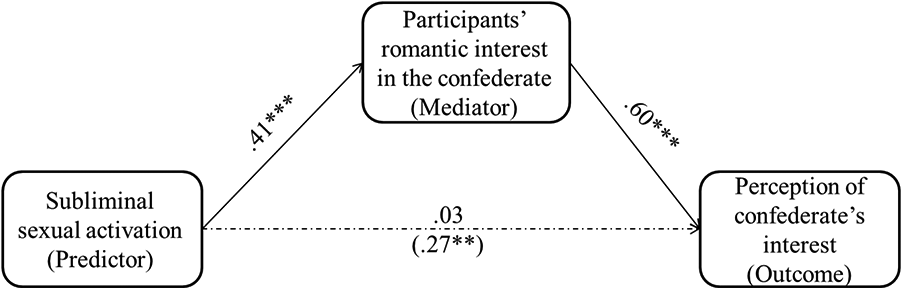
Mediation model showing that participants’ romantic interest in the confederate mediated the association between subliminal sexual activation and perception of the confederate’s romantic interest in them in Study 3. Note. Path coefficients are standardized. The value in parentheses is from the analysis of the effect without participants’ romantic interest in the equation. ** p < .01, *** p < .001.
Also, participants’ romantic interest was uniquely associated with perception of the confederate’s romantic interest after controlling for sexual activation (b = .46, SE = .06, t = 7.42, p < .001, β = .60, 95% CI [.44, .76]). More importantly, results indicated that the 95% CI of the indirect effect for sexual activation as a predictor of perception of the confederate’s romantic interest through participants’ romantic interest did not include zero and thus is considered significant (b = .38, SE = .09, β = .25, 95% CI [.13, .37], 5,000 bootstrapped samples). In sum, the analyses supported the proposed mediational pathway, such that sexual activation led to greater romantic interest in the confederate/partner, which, in turn, predicted greater perceived partner romantic interest. Importantly, an alternative model, which posits that the effect of sexual activation on participants’ romantic interest in the confederate is mediated by perceptions of the confederate’s romantic interest, was not significant (b = .04, SE = .06, β = .02, 95% CI [−.03, .08], 5,000 bootstrapped samples).
Together, these findings add to the findings of Studies 1 and 2, showing that romantic interest in a prospective partner helps to explain the effect of subliminal activation of the sexual system on perceptions of this partner’s romantic interest in oneself. Our findings indicate that merely having active sexual thoughts, even without being aware of them, may arouse romantic interest in a prospective partner and thereby encourage the adoption of an optimistic outlook on one’s courting prospects with this partner. In this way, activation of the sexual system may help people overcome their initial rejection concerns and motivate them to strive to become closer to a desirable new acquaintance.
General discussion
Sexual desire plays a major role in attracting potential partners to each other and driving the development of their relationships (Birnbaum, 2014, 2018; Birnbaum & Finkel, 2015). Recent studies have corroborated this view, indicating that following sexual activation, people tend to behave in ways that are designed to help them become close to a stranger (e.g., disclosing personal information, being responsive; Birnbaum et al., 2017, 2019). The present research adds to this research by focusing on the step that precedes relationship initiation, demonstrating how sexual activation influences the psychological circumstances that heighten the tendency to approach a prospective partner.
In three experiments, we show that activation of the sexual system increases people’s romantic interest in potential partners and encourages them to project their desires onto these partners, rendering them appealing and seemingly romantically interested in them. Study 1 revealed that exposure to a sexual stimulus (vs. a neutral stimulus) in a setting with high experimental realism led participants to exhibit more immediacy behavior toward a potential partner during face-to-face interactions and to perceive this partner as more attractive and interested in them. Study 2 replicated and extended these findings in a more controlled setting, providing evidence for the effect of sexual priming rather than more general closeness priming. Study 3 indicated that subliminal sexual priming increased participants’ romantic interest in potential partners, which, in turn, predicted perceiving them as more interested in oneself, offering support for the mechanism underlying the sexual activation-projection linkage.
Previous studies have found that people tend to project their romantic interests onto their opposite-sex friends, assuming that their friends reciprocate their interest (Lemay & Wolf, 2016). The present research points to a circumstance that amplifies this tendency. Specifically, our research indicated that participants tended to project their desires onto potential partners when sexually aroused. These findings suggest that activation of the sexual system motivates human beings to connect; it does so by inspiring interest in potential partners, which, in turn, biases the perceptions of partners’ interest in oneself. This cascade of reactions may help allay rejection fears and thereby reduce the costly likelihood of missing desirable mating opportunities (Choi & Hur, 2013; Lemay & Wolf, 2016). Indeed, when a potential partner is perceived as attractive, people tend to overperceive the desired partner’s sexual interest (Koenig et al., 2007).
Our findings revealed that sexual activation increased not only perceptions of others’ sexual attractiveness but also perceptions of non-sexual aspects of their mate value, such as their helpfulness and intelligence, as well as participants’ interest in a long-term relationship. This pattern supports the notion that in addition to its reproduction-facilitating role, the sexual system has been coopted by selection pressures to facilitate enduring bonds between sexual partners (Birnbaum, 2018; Eastwick & Finkel, 2012). To be sure, both short-term goals of sexual gratification and long-term goals of relationship formation may be elicited by sexual activation, if only because people themselves may not be able to differentiate between these goals in the early phases of an emerging relationship (Eastwick et al., 2018). In other words, the fate of a relationship may be determined only after it progresses beyond the initial stages and other aspects of the relationship (e.g., interdependence, commitment) emerge or fail to do so. The fact that sexual interest precedes the emergence of these latter relational aspects highlights the importance of better understanding the role of sexual interest and activity in relationship formation.
Although our findings point to the circumstances that enhance potential partners’ perceived desirability, it is unclear whether sexual arousal creates a state of urgency for relationship/sexual initiation or induces a sense of confidence in one’s ability to entice a valued partner (or both). Future studies should tease apart the mechanisms that heighten people’s perceptions of a prospective partner’s mate value while being sexually aroused. Another limitation of the present research that merits future attention is the need to determine whether the proposed dynamics enhance actual relationship-initiating efforts. In addition, our studies did not assess rejection concerns, so that the data cannot speak to whether sexual activation reduces concerns about rejection. Finally, we did not assess the target’s sexual interest in the participants and therefore cannot draw firm conclusions about whether sexual activation leads people to overperceive a target’s interest in them. These limitations notwithstanding, our research demonstrates how the sexual system prepares the ground for relationship formation, biasing interpersonal perceptions in a way that may help perceivers satisfy their relationship-based goals.
Footnotes
Authors’ note
The article is dedicated to the memory of Ronit Hematian, our beloved friend and colleague. Her hug will stay with us forever. We would like to thank Gil Schagrin, May Barbi, Maya Davidovich, Omer Nisenboym, Oded Lichtenstein, Tiferet Aloni, Daria Bareket, Natali Beylin, and Shir Licht for their assistance in the collection of the data and Kobi Zholtack, Amit Ben-Zvi, Eve Dan, and Maayan Nagar for their assistance in conducting the research.
Funding
The author(s) disclosed receipt of the following financial support for the research, authorship, and/or publication of this article: This research was supported by the Israel Science Foundation (Grants 86/10 and 1210/16 awarded to Gurit E. Birnbaum) and by the Binational Science Foundation (Grants #2011381 and #2016405 awarded to Gurit E. Birnbaum and Harry T. Reis).

Open research statement
As part of IARR’s encouragement of open research practices, the authors have provided the following information: This research was not pre-registered. The data used in the research are available. The data can be obtained by emailing: