



Abstract
Research suggests that touch promotes relationship well-being but has failed to consider motives for touch. We assessed general (Study 1) and daily (Study 2) approach and avoidance motives for touch and tested their precursors and consequences. Controlling for relationship quality and the other motive, greater attachment avoidance predicted lower approach and greater avoidance motives for touch in general but did not predict motives in daily life. Greater attachment anxiety simultaneously predicted greater approach and avoidance motives for touch in both studies suggesting anxiously attached people have ambivalent motives for touch. Critically, one’s own and one’s partner’s approach motives for touch predicted greater daily relationship well-being, whereas own and partner avoidance motives predicted poorer daily relationship well-being. We observed indirect effects linking attachment insecurity to relationship well-being through daily motives for touch. These results underscore the importance of attending to touch motives in future work, including future intervention work.
Touch is a central interpersonal experience throughout the lifespan (e.g., Field, 2010; Jakubiak & Feeney, 2017). In early life, touch fosters the infant-caregiver bond and contributes to the development of attachment security (Ainsworth et al., 1978; Anisfeld et al., 1990). In adulthood, people commonly touch in their close—especially romantic—relationships, which fosters and maintains intimacy (e.g., Debrot et al., 2013). In general, more frequent touch is associated with more positive relationship well-being (e.g., satisfaction, commitment) in adulthood (e.g., Gulledge et al., 2003; Muise et al., 2014; for review, see Jakubiak & Feeney, 2017). Experimental studies corroborate these correlational findings and document that touch promotes relationship security, constructive conflict behavior, and relationship satisfaction (Floyd et al., 2009; Jakubiak & Feeney, 2016a, 2016b, 2019).
Although touch typically indicates affection and intimacy, people differ in the motives that drive their touch behavior (Gaine & La Guardia, 2009). Of particular relevance to this investigation, people may touch to approach a desired outcome (e.g., to feel good or to make their partner feel good) or to avoid a negative outcome (e.g., to avoid feeling lonely or to avoid upsetting their partner). These approach and avoidance motives may be a function of attachment orientations and have important implications for the consequences of touch. The current research investigated attachment-related predictors of approach and avoidance motives for touch as well as the relational consequences of engaging in touch for approach and avoidance motives in daily life.
Approach and avoidance motives
There is a rich history of distinguishing between approach and avoidance motives for interpersonal behaviors (Carver & White, 1994; Gable, 2006; Gray, 1972; see also Gable & Impett, 2012, for a review). Approach motives—motives to move toward desired end-states—focus on gaining rewards, whereas avoidance motives—motives to avoid undesired end-states—focus on avoiding punishment (Gable, 2006). These motives are not mutually exclusive; people can pursue approach and avoidance motives simultaneously (Nikitin & Freund, 2010). Moreover, motives can be categorized as self- or other-focused as people engage in behaviors to feel good about themselves (self-focused approach motive), to make their partner happy (partner-focused approach motive), to avoid feeling guilty (self-focused avoidance motive), and to prevent their partner from becoming upset (partner-focused avoidance motive; see Impett & Gordon, 2010).
Critically, motives shape the consequences of behaviors (Gable & Gosnell, 2013; Gable & Impett, 2012). People who pursue social relationships with greater approach motives are more satisfied with their relationships and behave more responsively during discussions and conflict, while the reverse is true for avoidance motives (Bernecker et al., 2018; Elliot et al., 2006; Gable, 2006; Impett et al., 2008, 2010). In experimental work, manipulated approach motives similarly led to more responsive behavior than manipulated avoidance motives, supporting a causal link between motives and responsiveness (Nikitin & Freund, 2019). Approach motives may facilitate responsiveness because they encourage people to consider others’ needs, whereas avoidance motives focus attention on personal threats (Nikitin & Freund, 2019).
The same pattern of results has been observed for motives for two specific relational behaviors: sacrifice and sex. People reported greater relationship well-being on days when they sacrificed or had sex for approach motives and reported poorer relationship well-being on days when they sacrificed or had sex for avoidance motives (Impett et al., 2005, 2013; Muise et al., 2013). In experimental work using hypothetical scenarios, people who imagined sacrificing for their partner for an approach (versus avoidance) motive reported more positive feelings and greater relationship well-being (Impett et al., 2013). In related dyadic work, approach and avoidance motives to sacrifice predicted relationship outcomes correspondingly (Impett et al., 2014).
We aim to extend research on behavioral motives to a novel domain: interpersonal touch. Touch has been touted as beneficial for relationships (Jakubiak & Feeney, 2017), but the underlying motives for touch have not been considered and could alter its consequences. Although touch is a common relational behavior, like sex and sacrifice, touch is a distinct behavior that warrants its own study. Sacrifice entails a personal cost that is absent in touch, and although sex necessarily entails touch, touch need not lead to sex. Additionally, people touch for many reasons that are non-sexual (e.g., to provide support, to communicate appreciation, as part of greeting and departing rituals; Jones & Yarbrough, 1985). Even intimate touch and sex are distinct as they are based in separate neurobiological systems, and people do not typically expect touch to lead to sex (van Anders et al., 2013). Moreover, although touch and sex both lead to increased relationship well-being, they do so through different pathways (e.g. Burleson et al., 2007). Hence, in developing a more refined understanding of touch in close relationships, we differentiate approach and avoidance motives for touch, consider who endorses each type of motive, and investigate the consequences of approach- and avoidance-motivated touch.
Attachment and motives for touch
One individual difference relevant to the study of touch and touch motives is attachment orientation. Touch facilitates attachment formation, and touch preferences are linked to attachment orientations (i.e., attachment anxiety and avoidance) in adult relationships (e.g., Ainsworth et al., 1978; Anisfeld et al., 1990; Brennan et al., 1998b). Attachment avoidance reflects the extent to which a person is uncomfortable with closeness and motivated to maintain relational distance, whereas attachment anxiety reflects the extent to which a person is concerned about being abandoned or rejected (e.g., Mikulincer & Shaver, 2003). These attachment orientations are related to preferences for touch and reported experiences with “cuddling,” a form of affectionate touch. Greater attachment avoidance predicts greater aversion to touch and less positive feelings about cuddling, consistent with the defining characteristic of attachment avoidance as a desire to limit closeness (Brennan et al., 1998a; Chopik et al., 2014). In contrast, greater attachment anxiety is associated with a desire for more touch (Brennan et al., 1998a), consistent with anxiously attached individuals’ prototypical desire for closeness. In past work, attachment anxiety was unrelated to feelings about cuddling, perhaps because anxiously attached individuals’ concerns about rejection hinder their ability to enjoy the touch experiences they desire (Chopik et al., 2014).
Building on past work linking attachment orientation and preferences for touch, we aimed to evaluate whether attachment orientation predicts who will endorse different motives for touch. Indeed, identifying reliable links between attachment and motives for touch can help inform who will ultimately benefit from increasing touch in their relationships. In general, past research indicates that people high in attachment avoidance engage in relationship-enhancing behaviors to avoid negative outcomes rather than to approach positive outcomes, whereas people high in attachment anxiety engage in these behaviors both to avoid negative outcomes and to achieve positive outcomes (e.g., Feeney & Collins, 2003; Impett et al., 2008; Impett & Gordon, 2010). For instance, Impett and Gordon (2010) found that greater attachment avoidance predicted greater avoidance motives and lower approach motives to sacrifice, whereas greater attachment anxiety predicted greater approach and avoidance motives to sacrifice.
Regarding touch in particular, because avoidantly attached individuals avoid closeness, they may be less likely to endorse touching to approach positive outcomes (e.g., to feel good) than less avoidant individuals. Instead, when they touch, they may do so primarily to avoid negative consequences. Therefore, we predicted that greater attachment avoidance will predict lower approach motives for touch and greater avoidance motives for touch (H1). Anxiously attached individuals are especially concerned with preventing relationship threats so they may touch to avoid the negative consequences they fear more than people with lower attachment anxiety. Simultaneously, attachment anxiety is characterized by a strong desire for closeness, so people with high attachment anxiety may also be more motivated than people lower in attachment anxiety to touch to attain the reward of intimacy. Therefore, we predicted that greater attachment anxiety will predict greater approach motives for touch as well as greater avoidance motives for touch (H2).
Although our central hypotheses concerned general approach and avoidance motives for touch, we also tested exploratory links between attachment and the more specific self-focused and partner-focused motives for touch. Attachment insecurity predicts self- and partner-focused motives for sacrifice differently (Impett & Gordon, 2010), so we explored that possibility for touch. We also tested whether one’s partner’s attachment uniquely predicts motives for touch in an exploratory manner. Partners of anxiously attached people may be particularly motivated to touch to make their partners feel good and to avoid conflict (partner-focused approach and avoidance), consistent with research showing that partners of anxiously attached individuals exaggerate their affection (Lemay & Dudley, 2011). Alternatively, people with avoidantly attached partners might be aware that their partners prefer emotional distance and may therefore touch to make themselves feel good (self-focused approach) and to avoid personal distress and conflict (self-focused and partner focused avoidance) rather than to make their partners feel good (partner-focused approach).
Consequences of approach and avoidance motives for touch
The consequences of approach-motivated and avoidance-motivated touch also remain open questions worthy of consideration. When people touch, their motives may predict their own, as well as their partner’s, relationship outcomes. Approach-motivated touch may be more beneficial for the touch-provider because it may feel authentic and therefore may be a more enjoyable and relationship-enhancing experience (Impett et al., 2013). Additionally, approach-motivated touch may benefit the touch-recipient (the partner) because the touch may be enacted more responsively (Impett et al., 2010; Nikitin & Freund, 2019). As with other behaviors (like sex or sacrifice; Impett et al., 2005, 2013), motives for touch likely vary from day to day, and within-person changes in motives for touch may contribute to changes in relationship evaluations. We predicted that greater daily approach motives for touch will be associated with higher daily relationship well-being for oneself and one’s partner on the same day (H3).
Alternatively, the extent to which a person endorses avoidance motives for touch may predict poorer relational outcomes. Avoidance motives lead people to focus on threat, and avoidance-motivated behaviors feel inauthentic and are enacted less responsively (e.g., Impett et al., 2010, 2013; Nikitin & Freund, 2019). We predicted that greater daily avoidance motives for touch will be associated with lower daily relationship well-being for oneself and one’s partner on the same day (H4).
Finally, given that we predicted both precursors and consequences of motives for touch, we tested possible indirect effects linking attachment orientations to daily relationship well-being through daily touch motives. We expected greater attachment avoidance to predict poorer daily relationship quality through both lower daily approach motives for touch and greater daily avoidance motives for touch (H5). We posited that greater attachment anxiety would be linked with greater approach and avoidance motives for touch, but that approach motives would be positively—and avoidance motives negatively—linked with relationship well-being. Based on this, we expected greater attachment anxiety to predict both enhanced relationship quality through greater daily approach motives and poorer relationship quality through greater daily avoidance motives (H6). These positive and negative outcomes, respectively, are consistent with past findings that anxiously attached individuals experience ambivalence in relationships due to hyperactivating strategies of approaching close others while simultaneously remaining vigilant for rejection (e.g., Joel et al., 2011; MacDonald et al., 2013; Mikulincer & Shaver, 2003).
Current research
We tested these hypotheses in two studies. Study 1 was a large-scale cross-sectional survey in which we examined whether attachment predicts approach and avoidance motives for touch (H1, H2). In Study 2, we recruited couples, and both partners completed a 28-day daily diary. We tested whether participants’ own attachment and their partners’ attachment predicted their motives for touch in daily life (H1, H2). Additionally, we assessed daily relationship quality to test whether approach and avoidance motives for daily touch predict relationship outcomes on the same day (H3, H4), and we tested indirect effects linking precursors and consequences of motives for touch (H5, H6).
Study 1
Method
Procedure and participants
We recruited participants who were at least 21 years old, in a romantic relationship for at least 6 months, and located in the United States through Amazon’s Mechanical Turk. 1 Of the 2,101 participants who completed the questionnaire, we excluded 497 participants who did not pass (105 participants) or skipped (392 participants) at least one attention check. The final sample included 1,604 participants (801 men; 798 women; three transgender individuals; two people who preferred not to identify). Sample size was determined by a power analysis to test a three-way interaction for another research question. Participants received $1.30 for completing the 30-min survey.
Participants were diverse with regard to age (Range = 21–73; M = 35.4, SD = 10.5) and relationship length (Range = 6 mo.–40 years; M = 7.9 years, SD = 8.2 years) and reported the following ethnic backgrounds: 79% White, 8% Latino, 8% Native American, 7% African American, 6% Asian. Most participants were married, engaged or cohabitating (74.9%) and identified as heterosexual (88.4%).
Measures
Attachment style
Participants completed a 20-item version of the Experiences in Close Relationships Scale (Brennan et al., 1998a) on a 7-point scale (1 = disagree strongly to 7 = agree strongly). This measure contains subscales for attachment anxiety (e.g., “I need a lot of reassurance that I am loved by my partner”; a = .92) and attachment avoidance (e.g., “I am nervous when partners get too close to me”; a = .92). See Table 1 for descriptive information for all measures.
Study 1 descriptives and zero-order correlations.
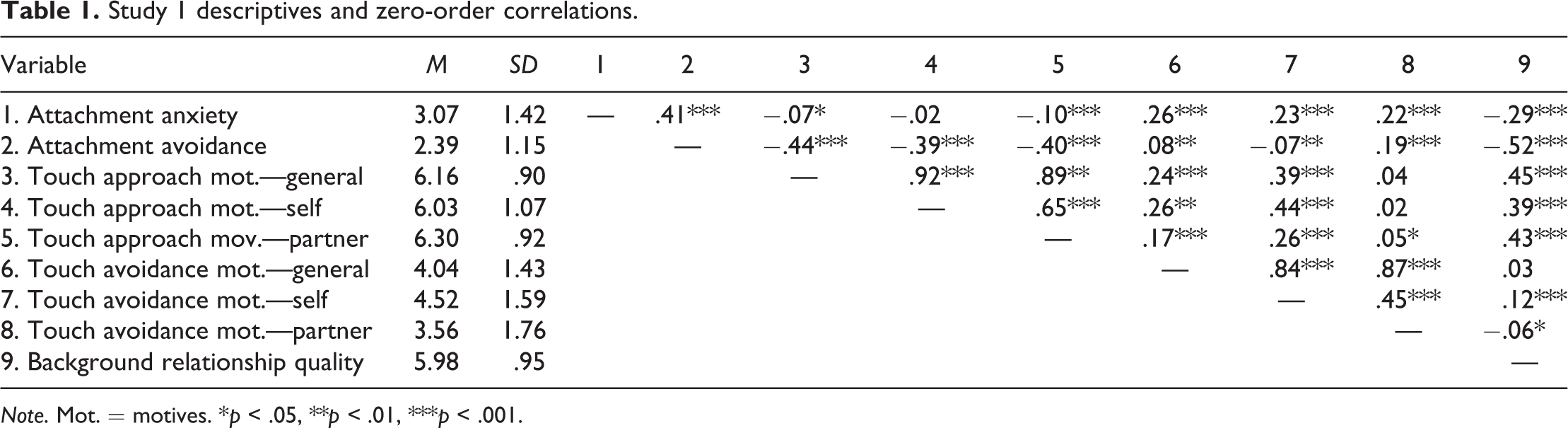
Note. Mot. = motives. *p < .05, **p < .01, ***p < .001.
Touch motives
Participants answered 8 items assessing approach and avoidance motives for touch on a 7-point scale (1 = does not apply at all to 7 = applies very much). Four items measured approach motives [In general, I touch my partner because I want to 1) feel good (happy, relaxed or pleased), 2) feel comforted or taken care of, 3) show my partner that I am there for them, and 4) make my partner feel good (happy, relaxed, or pleased); a = .84]. Of these, the first two measured self-focused approach motives (r = .61, p < .001), whereas the latter two measured partner-focused approach motives (r = .68, p < .001). Similarly, the items for avoidance motives were: […] 1) avoid feeling bad or stressed, 2) avoid feeling lonely, 3) avoid my partner becoming upset, and 4) avoid conflict with my partner (a = .76), with 2 items for self-focused (r = .51, p < .001) and partner-focused avoidance (r = .67, p < .001), respectively. The scale items were selected based on a pilot study (see Supplemental Material G).
Relationship quality
We assessed relationship quality with the Perceived Relationship Quality Component Inventory (PRQC; Fletcher et al., 2000). The PRQC assesses satisfaction, commitment, intimacy, trust, passion, and love on a 7-point scale (1 = not at all to 7 = extremely), a = .96.
Data analytic strategy
We tested whether attachment anxiety and avoidance predict approach and avoidance motives for touch using multiple regression linear models that included attachment anxiety and avoidance simultaneously. We controlled for avoidance motives in models predicting approach motives, and vice versa, to predict unique variance in one motive for touch rather than overall motivation to touch. Additionally, we included relationship quality as a covariate because it has been associated with both attachment insecurity and approach-avoidance motives. 2
Results and discussion
All results are shown in Table 2. Supporting hypothesis 1, greater attachment avoidance predicted lower overall approach motives for touch (as well as self-focused and partner-focused approach motives) and greater overall avoidance motives for touch (as well as partner-focused avoidance motives). These findings suggest that avoidantly attached people are especially motivated to touch to avoid negative outcomes (particularly for their partner; e.g. to avoid the partner becoming upset) and are particularly unmotivated to touch to approach positive outcomes. These results are in line with avoidant individuals’ goals to maintain relational distance and avoid intimacy (Mikulincer & Shaver, 2003) and dovetail with findings by Impett et al. (2008) that avoidantly attached individuals sacrifice to avoid upsetting or angering their partners.
Predictors of touch motives.
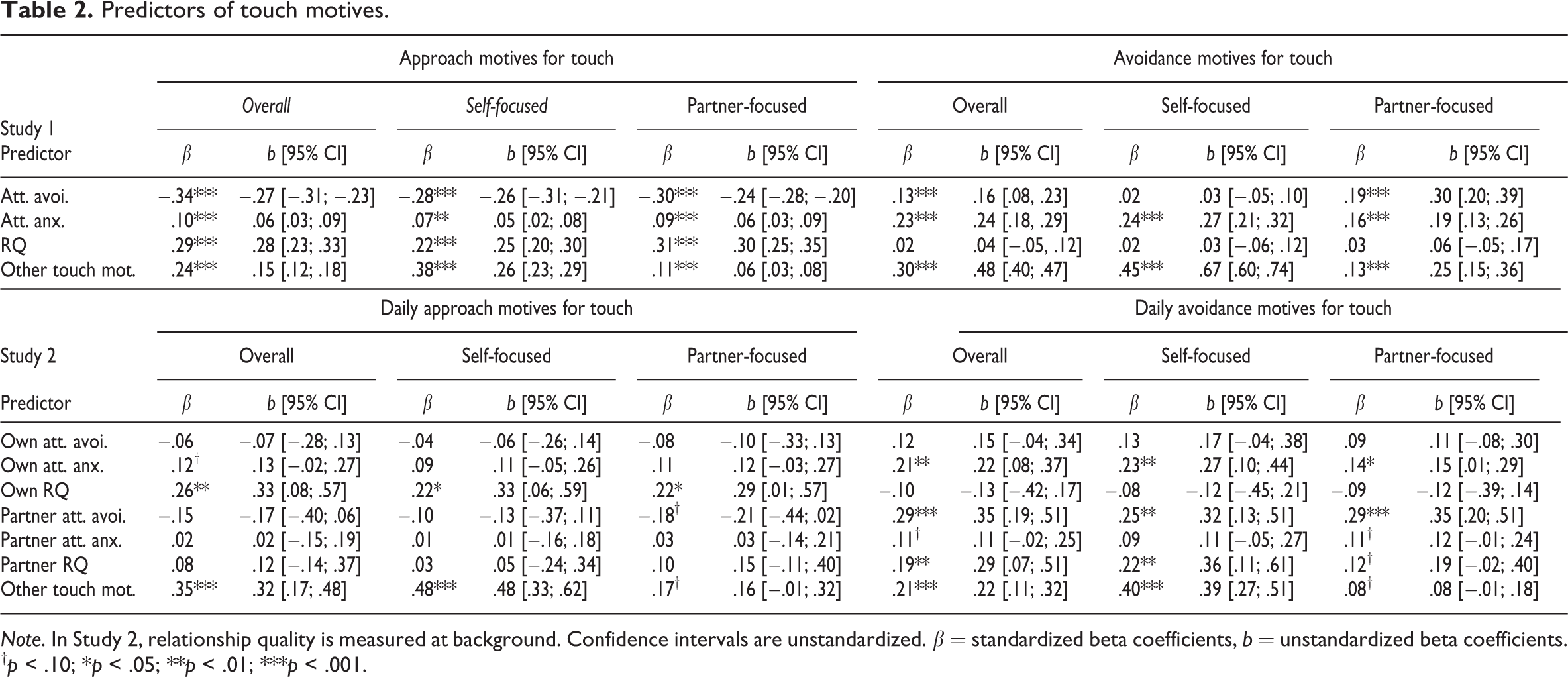
Note. In Study 2, relationship quality is measured at background. Confidence intervals are unstandardized. β = standardized beta coefficients, b = unstandardized beta coefficients.
† p < .10; *p < .05; **p < .01; ***p < .001.
Consistent with hypothesis 2, greater attachment anxiety predicted greater approach and avoidance motives for touch, and self-focused and partner-focused approach motives followed the same pattern. These results suggest that anxiously attached individuals touch both to approach benefits and to avoid costs, consistent with research showing that attachment anxiety is associated with simultaneously expecting high reward and high threat in relationships (MacDonald et al., 2013). People with high attachment anxiety touch to enhance closeness and receive reassurance that they are cared for as well as to avoid feeling bad and to prevent relationship threats (Mikulincer & Shaver, 2003).
Study 2
We next sought to expand upon these results to test our hypotheses at the within-person level in an ecologically valid, 28-day experience sampling study. Moreover, to capture the interpersonal nature of touch interactions, we tested for both actor effects (e.g., a person’s attachment predicting their own motives) and partner effects (e.g., a person’s attachment predicting their partner’s motives). We tested the same-day consequences of approach and avoidance motivated touch for relationship well-being, and we tested mediation models linking attachment and relationship well-being through touch motives.
Method
Procedure and participants
Couples were invited to participate through ads posted on Kijiji.ca. Couples were eligible if they were cohabitating, had been together for at least 2 years, and were at least 18 years old. Each participant first completed an online survey in which they provided demographic information and completed a series of questionnaires. The next day, participants began the 28-day survey. They were instructed to complete the daily questionnaires every evening, to not discuss the survey with their partner, and to leave a survey blank if they missed a day. Participants completed 24.7 (out of 28) daily surveys on average. Each participant received up to $65 in gift cards for participation.
One hundred and four couples (N = 208 participants) took part in the study. We excluded six couples because one or both partners did not complete the initial survey. The final sample included 98 couples, which is consistent with sampling recommendations to detect small to medium effects (Finkel et al., 2015). Participants were mostly Caucasian (65%); the remaining were East Asian (10%), South American (7%), South Asian (6%), African (4%), Native American (3%), and/or “other” (9%). Participants’ age ranged from 21 to 61 (M = 33 years, SD = 8 years) and had been in the relationship between 2 and 25 years (M = 8 years, SD = 5 years).
Baseline measures
Attachment style
Participants completed the Experiences in Close Relationships Short (ECR-S) questionnaire (Wei et al., 2007) with 6 items assessing attachment anxiety (a = .76) and 6 items assessing attachment avoidance (a = .79), rated on a 7-point scale (1 = disagree strongly to 7 = agree strongly). See Table 3 for descriptive information for all measures.
Study 2 descriptives and zero-order correlations.

Note. Mot. = motives for touch. † p < .10; *p < .05, **p < .01, ***p < .001.
Relationship quality
As in Study 1, relationship quality was assessed with the PRQC (Fletcher et al., 2000; a = .95).
Daily measures
Touch motives
Each evening, if participants indicated having touched their partner, 3 they were asked the following question on a 7-point scale (1 = not at all to 7 = a lot): “There can be several reasons why you would like to touch your partner. Please indicate which of the following apply to your touch behavior. Today, I touched my partner because I wanted to….” They then responded to items reflecting approach motives for touch: “feel good (happy, relaxed, or pleased),” “feel comforted or taken care of,” “show my partner that I am there for them,” and “make my partner feel good (happy, relaxed, or pleased)” (ω = .66). As in Study 1, the first 2 items for approach motives focused on the self (level-1 r = .37, p < .001), whereas the latter two measured partner-focused approach motives (level-1 r = .48, p < .001). Four items reflected avoidance motives for touch: “avoid feeling bad or stressed,” “avoid feeling lonely,” “avoid conflict with my partner,” and “avoid my partner becoming upset,” (ω = .64), with 2 items for self-focused (level-1 r = .39, p < .001) and partner-focused avoidance motives (level-1 r = .54, p < .001), respectively.
Relationship quality
Each evening, participants rated how they felt regarding their relationship on that day. We adapted the items to reflect the six dimensions of the PRQC (Fletcher et al., 2000), namely satisfied, committed, connected, passionate, love for my partner, and I could count on my partner (ω = .91). Participants answered these questions on a 7-point scale (1 = not at all to 7 = a lot).
Data analytic strategy
We tested our hypotheses using Mplus, v.7.3 (Muthén, & Muthén, 1998–2012). We tested the first set of hypotheses (H1, H2) in single-level Actor-Partner Interdependence Models (Fitzpatrick et al., 2016; Kenny & Kashy, 2011) using a robust maximum likelihood estimation. We controlled for the other motive for touch to isolate one motive, and we controlled for actor and partner relationship quality. The second set of hypotheses (H3, H4) was tested using a multilevel model for dyadic diary data with two levels of random variation. The lower level represents variability due to within-person repeated measures for both partners, and the upper level represents between-couple variability across the partners (Bolger & Laurenceau, 2013). Intercepts were allowed to vary randomly across couples and diaries, and residual terms were correlated between partners at levels 1 and 2. We also controlled for the interdependence of both partners’ predictors and outcomes at the within-person level. To avoid confounding within- and between-person effects, we partitioned the daily predictors into their within- and between-variance components, which were person-mean centered and grand-mean centered, respectively (Bolger & Laurenceau, 2013). Thus, the analyses account for between-person differences in touch motives. Elapsed time in days was controlled for, after having been centered on the middle of the time span (day 14.5), to assess possible differences over the assessment period (Bolger & Laurenceau, 2013). The slopes at the within-person level were treated as random. Moreover, we adjusted for the score of the dependent variable from the prior report, so that the outcome represents residualized change that occurred since the preceding day.
Finally, to test our mediation predictions (H5, H6), we estimated an Actor-Partner multilevel mediation model with fixed slopes that included four predictors (both attachment dimensions for both partners), four mediators (approach and avoidance touch motives for both partners) and both partners’ daily relationship quality as outcomes. To test for the indirect effects resulting from this model, we computed the product of the a and b paths (Preacher et al., 2011).
Results and discussion
As in Study 1, people endorsed greater approach motives than avoidance motives for touch in daily life (see Table 3), t(194) = 27.23, p < .001.
Attachment predicting motives
We tested whether actor and partner attachment avoidance and anxiety predicted daily touch motives, controlling for actor and partner relationship quality (assessed at baseline) and the other motive. All results are shown in Table 2. Contrary to hypothesis 1, one’s own attachment avoidance did not significantly predict daily approach or avoidance motives for touch though the direction of results was consistent with Study 1 whereby people higher in attachment avoidance reported lower approach motives for touch as well as greater avoidance motives for touch.
Despite the null actor effects, our dyadic design allowed us to observe that greater partner attachment avoidance predicted a person’s greater daily avoidance motives for touch (overall, self-focused, and partner-focused) and marginally lower partner-focused approach motives for touch. It seems that partners of avoidantly attached people touch to avoid negative outcomes (to avoid feeling badly; to avoid upsetting the partner) and are perhaps less motivated to benefit their partner than people whose partners are less avoidantly attached. These results suggest that one’s partner’s attachment avoidance may shape motives for touch in daily life more than one’s own attachment avoidance.
Regarding attachment anxiety, one’s own greater attachment anxiety marginally predicted greater daily overall approach motives for touch and significantly predicted greater overall, self-focused, and partner-focused avoidance motives for touch. 4 This pattern of results is consistent with (though weaker than) the results from Study 1 and provides additional support for hypothesis 2. One’s partner’s attachment anxiety was also marginally related to greater daily avoidance motives for touch (overall and partner-focused). These results suggest that people who are high in attachment anxiety are motivated to touch both to approach positive outcomes and to avoid negative outcomes, and partner’s attachment anxiety potentially plays a minor role in enhancing avoidance motives for touch as well.
Touch motives predicting relationship well-being
We tested whether daily motives for touch predict own (actor) and partner daily relationship quality (see Table 4). 5 Here, we found that on days when individuals reported greater approach motives for touch, both they and their partners reported higher daily relationship quality (consistent with H3). In contrast, on days when people reported greater avoidance motives for touch, both they and their partners reported lower daily relationship quality (consistent with H4). These within-person associations were significant above the effect of previous day’s relationship quality and the between-person actor and partner effects. These findings demonstrate that past work on motives for sacrifice and sex (Impett et al., 2005, 2013) extend to a novel touch context. Being motivated to touch to approach positive outcomes on a particular day predicted enhanced relationship quality on that day, whereas being motivated to touch to avoid negative outcomes predicted lower same-day relationship quality.
Daily relationship quality as a function of daily motives for touch.

Note. Coefficients are unstandardized. † p < .10; *p < .05; **p < .01; ***p < .001.
Mediation models
Finally, we tested whether touch motives mediate the association between insecure attachment dimensions and daily relationship well-being. Multiple mediation paths were significant (see Table 5 and Supplementary Materials). Consistent with Hypothesis 5, the links between attachment avoidance and lower actor and partner daily relationship quality were mediated by lower actor daily approach motives for touch (Table 5, indirect effects 1 and 2). However, these links were not consistently mediated by higher actor daily avoidance motives for touch (only marginally for actor relationship quality; Table 5, indirect effects 3 and 4). The links between an individual’s attachment avoidance and daily relationship quality (their own and their partner’s) were not mediated by their partner’s approach or avoidance motives for touch (see indirect effects 5–8, Table 5).
Study 2 actor-partner multilevel mediation model predicting daily relationship quality.

Note. Indirect effects are numbered so they can be referenced. RQ = relationship quality.
† p < .10; *p < .05; **p < .01; ***p < .001.
The link between attachment anxiety and relationship quality was also mediated by touch motives, consistent with Hypothesis 6. Specifically, attachment anxiety predicted one’s own (actor) greater approach motives for touch, which predicted both higher actor and partner daily relationship quality (Table 5, indirect effects 9 and 10). However, attachment anxiety was also simultaneously associated with higher actor daily touch avoidance motives, which predicted lower actor and partner daily relationship quality (Table 5, indirect effects 11 and 12). The association between attachment anxiety and daily relationship quality was not mediated by partner approach nor avoidance motives for touch (Table 5, indirect effects 13 through 16).
These mediation results suggest that people with greater attachment avoidance and their partners may experience poorer relationship quality partly because of their lower approach motives for touch (e.g., Candel & Turliuc, 2019). When people with greater attachment avoidance and their partners touch, they may do so more to avoid negative outcomes than to approach positive outcomes, and they may therefore miss the benefits that are normatively associated with touch (e.g., Jakubiak & Feeney, 2017). These mediation results are also consistent with past work showing that attachment anxiety is associated with ambivalence and produces variable relationship outcomes (e.g., Chopik et al., 2014; Joel et al., 2011; Mikulincer & Shaver, 2003). Attachment anxiety predicted both tendencies to touch to approach positive outcomes and to avoid negative outcomes, which seemed to exert countervailing forces on relationship outcomes.
General discussion
In two studies, we applied an approach-avoidance motivational framework to investigate predictors and consequences of motives for touch in romantic relationships. We expected that attachment orientation would predict motives for touch, and that motives for daily touch would predict daily relationship well-being. Our results supported these predictions and suggest that motives for touch are an important aspect to consider when weighing the potential relationship benefits of touch. These results also demonstrate that attachment is one factor that predicts people’s general and daily motives for touch.
Attachment predicts motives for touch
Consistent with predictions, participants with greater attachment avoidance reported lower approach motives for touch and greater avoidance motives for touch in general than participants with lower attachment avoidance (Study 1). These associations controlled for relationship quality and the other motive so that they are not accounted for by lower relationship quality or an overall motivation to touch in relationships. In daily life (Study 2), one’s own attachment avoidance was not associated with their motives for touch, though the pattern of results was in the same direction as Study 1. These results suggest that, on a daily basis, avoidantly attached people may be less averse to approach-motivated touch and less focused on avoidance-motivated touch than they report in general. Avoidantly attached individuals are generally less comfortable with intimacy (e.g., Mikulincer et al., 2003), but they may touch to gain rewards rather than to avoid costs in specific contexts that are non-threatening or in which their partners are unambiguously available (Girme et al., 2015; Stanton et al., 2017). This discrepancy between general reports and daily life underlines the importance of assessing motives for touch—and other relational behaviors—in daily life to obtain reports that avoid response bias.
Interestingly, although one’s own attachment avoidance did not predict their daily avoidance motives for touch, partner attachment avoidance did predict greater daily avoidance motives for touch and marginally less partner-focused approach motives for touch. These partner effects demonstrate the importance of considering motives for touch in the dyadic context since partners may adapt their motives based on one another’s traits and preferences. Because avoidantly attached people desire to avoid closeness, their partners may touch more to avoid feeling badly themselves and to prevent their partner from being upset rather than to approach partner rewards that are unlikely to accrue.
Also consistent with hypotheses, participants with greater attachment anxiety reported greater approach and avoidance motives for touch in general than those with lower anxiety (Study 1). Greater attachment anxiety also predicted marginally greater approach motives and significantly greater avoidance motives for touch in daily life (Study 2). These results are consistent with theoretical depictions of anxiously attached individuals as motivated to maintain closeness and simultaneously motivated by an intense fear of rejection and unworthiness (e.g., Mikulincer et al., 2003). People with high attachment anxiety simultaneously touch to enjoy its personal and relational benefits and to avoid the risks of not touching. In line with a model of interpersonal insecurity compensation (Lemay & Dudley, 2011), we also observed that partners of anxiously attached individuals used touch to avoid costs and specifically to prevent their anxiously attached partner from becoming upset, though these links were marginally significant.
Implications for relationship well-being
We also assessed whether the motives underlying touch matter for relationship well-being. Consistent with past work in the domains of sex and sacrifice (Impett et al., 2005, 2013), participants reported greater daily relationship quality on days when they and their partners reported greater approach motives and lower avoidance motives for touch. Although the daily diary design does not allow for causal interpretation, these links could indicate that touch is only beneficial for the relationship when it is enacted to approach a positive outcome (perhaps because approach-motivated touch feels more authentic or is enacted more responsively; Impett et al., 2010, 2013; Nikitin & Freund, 2019). Future research should replicate these associations and expand to test whether the links between motives for touch and relationship well-being depend on characteristics of the relationship, such as the level of commitment between partners. If, indeed, people and their partners only benefit when touch is approach-motivated, interventions will need to be framed to communicate the benefits of touch rather than to warn people about the costs of neglecting touch.
The precursors and consequences of touch motives, considered together, suggest that relationship problems associated with insecure attachment may be explained—at least in part—by non-optimal motives (Candel & Turliuc, 2019). Indeed, attachment avoidance indirectly predicted poorer well-being through greater avoidance motives and lower approach motives for touch. These results help to clarify inconsistent past work testing whether attachment avoidance moderates the positive links between touch and well-being. Jakubiak and Feeney (2016a) found that avoidantly attached individuals benefited less from a brief affectionate touch intervention, whereas Debrot et al. (2020) found that people high in attachment avoidance benefited as much as people low in attachment avoidance when they received and provided touch in daily life. The current research suggests that avoidantly attached people may benefit from touch when they are motivated to approach positive outcomes for themselves or their partners (which they may be when they choose to touch in daily life) but may not benefit from touch interventions in which their motives are less likely to be approach-focused.
People high in attachment anxiety, who report greater approach and avoidance motives for touch than others, may simultaneously accrue relational benefits from approach-motivated touch and experience costs of avoidance-motivated touch. We observed this pattern of results in our mediation model, though we could not test causality. Overall then, attachment anxiety may not moderate effects of touch unless motives are considered.
Strengths, limitations and future directions
To our knowledge, this is the first research to sub-type touch based on motives. As such, this work extends theory on touch that has previously only differentiated between type of touch (e.g., affectionate versus practical; Jakubiak & Feeney, 2017), context (e.g., stress versus neutral; Jakubiak & Feeney, 2016a, 2016b), and personal characteristics of touch-providers (e.g., gender, culture; Andersen, 2011; Dibiase & Gunnoe, 2004). Additionally, this work adds to the literature on approach-avoidance motives by demonstrating that touch is another behavior (like sex and sacrifice) for which motives predict relationship outcomes (Gable & Impett, 2012; Impett et al., 2005, 2013). Because touch is governed by a different neurobiological system than sex (van Anders et al., 2013), this work establishes that approach/avoidance motives are important across a broad array of behaviors. We also confirmed that the links we observed between attachment orientation and motives for touch remain controlling for sexual frequency (Studies 1 and 2) and that the daily links we observed between motives for touch and relational well-being remain controlling for sexual activity (Study 2) to ensure that our findings are not driven solely by sexual motives (see Supplemental Material F). The current research is also methodologically strong because it assesses motives for touch both generally and in daily life, where retrospective bias is less likely.
The primary limitation of this work is the correlational design of both studies. Given this, we cannot conclude that motives for touch, rather than another confounding factor, promote relationship quality day-to-day. It is also possible that daily relationship quality leads to touch motives rather than the reverse. However, because we controlled for the previous day’s relationship quality, we can infer that motives for touch are followed by a change in relationship quality (Bolger & Laurenceau, 2013). We hope that future research will evaluate these possibilities experimentally. We are also limited by reliance on self-report measures of motives for touch, as it is always possible that may misremember or actively misreport their motives.
Future research should extend beyond relationship outcomes to assess whether motives for touch predict individual well-being. Touch is theorized to promote both relationship and individual well-being (Jakubiak & Feeney, 2017), and research shows that touch buffers stress (e.g., Ditzen et al., 2007; Jakubiak & Feeney, 2016b) and is associated with positive mood and increases in subjective well-being over time (Debrot et al., 2013). Future research could also investigate whether perceptions of a partner’s motives for touch matter, beyond one’s partner’s actual motives. For example, believing that a partner has approach motives rather than avoidance motives for touch may lead to better consequences of touch receipt. Recent research shows that there is both accuracy and bias in detecting a partner’s motives (LaBuda et al., 2019); inaccuracies may be particularly informative in future research.
Supplemental material
Touch_motives_supplemental_material_final - Approach and avoidance motives for touch are predicted by attachment and predict daily relationship well-being
Touch_motives_supplemental_material_final for Approach and avoidance motives for touch are predicted by attachment and predict daily relationship well-being by Brett K. Jakubiak, Anik Debrot, James Kim and Emily A. Impett in Journal of Social and Personal Relationships
Footnotes
Funding
The author(s) disclosed receipt of the following financial support for the research, authorship, and/or publication of this article: Study 1 was supported by a grant from the Swiss National Science Foundation to Anik Debrot (#P2FRP1-161722). Study 2 was supported by a grant from the Social Sciences and Humanities Research Council to Emily A. Impett (SSHRC IG #435-2014-0645).

Open research statement
As part of IARR’s encouragement of open research practices, the author(s) have provided the following information: This research was not pre-registered. The data used in the research are available. The data can be obtained by emailing:
Notes
Supplemental material
Supplemental material for this article is available online.
References
Supplementary Material
Please find the following supplemental material available below.
For Open Access articles published under a Creative Commons License, all supplemental material carries the same license as the article it is associated with.
For non-Open Access articles published, all supplemental material carries a non-exclusive license, and permission requests for re-use of supplemental material or any part of supplemental material shall be sent directly to the copyright owner as specified in the copyright notice associated with the article.
