




Abstract
The current research examined how intimate partners’ affect is related, on a moment-to-moment basis, to their level of empathic accuracy during conflict interactions. To this end, we analyzed data from two laboratory-based studies (n = 155 and n = 172 couples) in which couples participated in a conflict interaction task, followed immediately by a video-review task during which they reported on their own feelings and thoughts and inferred those of their partner at different moments in the interaction. We found that the partners’ affective similarity—for both positive (Studies 1 and 2) and negative affect (Study 2)—was related to greater perceiver empathic accuracy for both the partner’s feelings (Studies 1 and 2) and the partner’s thoughts (Study 2). The data from Study 2 also revealed a complementary effect: lower levels of empathic accuracy for feelings at moments of affective dissimilarity between the partners (i.e., when a perceiver was feeling positive while his/her partner was feeling negative).
Introduction
Accurately understanding one’s partner’s feelings and thoughts during ongoing interactions (i.e., empathic accuracy; Ickes et al., 1990) is assumed to play an important role in how conflict or differences of opinion are dealt with within couples’ interactions (Sillars et al., 2000). More specifically, higher levels of empathic accuracy in couples during conflict tend to foster adequate problem-solving and accommodative behavior (Kilpatrick et al., 2002; Sened et al., 2020).
However, the task of accurately inferring the continuous stream of feelings and thoughts of one’s partner when discussing a relational stressor can be challenging, as conflict episodes between partners are often quite emotionally charged (Berscheid & Ammazzalorso, 2001; Schoebi & Randall, 2015). Because affect 1 is known to influence cognitions in multiple ways (for a review, see Forgas & Eich, 2013), empathic inferences will probably be influenced by the partners’ affective states. Indeed, in some studies affect has already been found to be associated with empathic accuracy (e.g., Atzil-Slonim et al., 2019; Devlin et al., 2014; Howland & Rafaeli, 2010). Despite the promising nature of these findings, existing studies have, for the most part, been conducted outside the context of relationship conflict in intimate relationships, and they do not fully capture the dyadic interdependence and the ongoing temporal dynamics of affect and empathic accuracy.
Additional research is therefore needed to determine the role of the partners’ affect in empathic accuracy during conflict. In examining this association, it is important to bear in mind that empathic accuracy is an interpersonal process (Ickes et al., 1990) involving the affect of both partners in the interaction. Consequently, the perceiver’s affect, the target’s affect (the person whose feelings and thoughts are inferred), and their interaction could potentially influence the perceivers’ empathic accuracy.
Accordingly, the current study sought to clarify how a person’s own affect (perceiver affect) as well as their partner’s affect (target affect) and the interaction between their affect is associated with their level of empathic accuracy from moment to moment during conflict interactions. In what follows, we provide some background on these major features of the current investigation.
The perceiver’s affect and empathic accuracy
First, many studies have supported the idea that there is an affect-congruent influence on cognition, meaning that the content and valence of one’s cognitions are likely to match one’s current affective state (for a review, see Forgas & Eich, 2013). This phenomenon implies that there could be an affect-congruent influence on empathic inferences (e.g., the perceiver’s negative affect leading the perceiver to making more negative inferences), which could either promote or inhibit empathic accuracy depending on the affect of the target.
Affect can also influence how people process information (Fiedler, 2001; Forgas & Eich, 2013) and therefore impact their performance on certain tasks (Matovic & Forgas, 2018). In tasks relying mainly on automatic processing (Bargh, 1994), positive affect has been related to increased accuracy (Ambady & Gray, 2002), whereas in tasks that require more detailed processing, negative affect seems to be more beneficial (e.g., Forgas & East, 2008). Because research has demonstrated that systematic thought, rather than intuition, produces greater accuracy (Ma-Kellams & Lerner, 2016), one might predict that negative affect could foster greater empathic accuracy in couples.
Another theoretical view, the empathy-amplification hypothesis, states that positive affect should be associated with greater levels of empathy (Devlin et al., 2014). Because empathic accuracy can be viewed as a specific (cognitive) form of empathy (Verhofstadt et al., 2016), one might predict that positive affect would be related to heightened empathic accuracy in intimate relationships.
There are also reasons to believe that negative affect might harm empathic accuracy during couples’ conflict interactions. Negative affect might point to the presence of (relationship) threat in the interaction, which has been found to lead to empathic inaccuracy (Simpson et al., 1995). Although the empathic accuracy model (Ickes & Simpson, 1997, 2001) is based on this assumption, there is some evidence that does not support this hypothesis (Hinnekens et al., 2018).
The competing predictions noted above do not allow us to derive unequivocal predictions about the associations between a perceiver’s affect and his or her empathic accuracy. In addition, there are few studies of empathic accuracy (both in general and for conflict episodes) that can inform our predictions. Important exceptions are studies by Ickes and colleagues (1990) and Devlin and colleagues (2014). The first authors found that the frequency with which a perceiver smiles (a sign of positive affect) while interacting with a stranger is tied to greater empathic accuracy. Devlin and colleagues (2014), however, found no association between a perceiver’s positive state emotion and empathic accuracy. They did find a perceiver’s trait positive emotion to be associated with less overall empathic accuracy toward a high-intensity negative target and positively related to detecting emotion upshifts in positive targets. The latter finding clearly points at the role of another important player in the interpersonal process of empathic accuracy: the target, that is, the partner, in intimate relationships.
The target’s affect and the perceiver’s empathic accuracy
Within the emotion literature, it is suggested that the target’s negative emotions are easier to accurately infer than the target’s positive emotions (Atzil-Slonim et al., 2019; Howland & Rafaeli, 2010). Not only are negative stimuli in general more thoroughly processed than positive stimuli (see Baumeister et al., 2001), negative emotions serve a powerful communicative function, signaling that something is wrong and must be attended to (Fischer & Manstead, 2008). Indeed, several (couple) studies document greater accuracy regarding the negative emotions of one’s interaction partner when compared to the partner’s positive or neutral emotions (Atzil-Slonim et al., 2019; Gaelick et al., 1985; Howland & Rafaeli, 2010). We might therefore expect that during conflict, a perceiver’s empathic accuracy for his/her partner’s negative emotions might be greater than for that same partner’s neutral emotions.
Does the (mis)match of the partners’ affective valence predict empathic accuracy?
As mentioned before, the affect-congruent influence on inferences might promote or inhibit accuracy depending on the affect of the target. Specifically, when the valence of the target’s feelings and thoughts matches that of the perceiver (i.e. affective similarity; Davis, 1994), affect-congruent inferences will indeed be more accurate, thereby increasing empathic accuracy rather than reducing it (Devlin et al., 2014). 2
A specific process by which affective similarity should result in increased empathic accuracy explicitly invokes the concept of assumed similarity. In the empathic accuracy literature, there is a consensus that two pathways can lead to accurate mindreading (Sened et al., 2017): a direct pathway that involves inferring the target’s feelings based on an analysis of his or her verbal and nonverbal cues, and an indirect pathway (which is used more in the context of relationship conflict) that pertains to cases in which perceivers (correctly) assume that a target’s emotional experiences are similar to their own (Atzil-Slonim et al., 2019; Clark et al., 2017; Kouros & Papp, 2019; Wilhelm & Perrez, 2004). In other words, actual affective similarity between the perceiver and the target can lead, through assumed similarity (often called projection; see Nickerson et al., 2009), to the perceiver achieving a higher empathic accuracy score.
The empirical evidence on this point is mixed. A study by Verhofstadt et al. (2008) reported that emotional similarity was not associated with empathic accuracy, whereas Levenson and Ruef (1992) found that when persons evidenced higher levels of emotional matching, empathic accuracy for negative affect was higher. The most common finding suggests that the association between real affective similarity and empathic accuracy is partially mediated by assumed similarity (Atzil-Slonim et al., 2019; Clark et al., 2017; Kouros & Papp, 2019; Wilhelm & Perrez, 2004). It appears that people do indeed use their own feelings (and, although not examined, potentially also their thoughts) as one—but not the only—basis for inferring the feelings and thoughts of others.
To summarize, it seems likely that affective similarity between partners would be associated with greater empathic accuracy during conflict interactions.
Current studies
The previous overview of theory and research reveals a gap in our understanding of the role of affect in intimate partners’ empathic accuracy in general, and during conflict interactions in particular. Besides theoretical work offering conflicting predictions, empirical research on the affect-empathic accuracy link reveals somewhat inconsistent findings, especially regarding the role of the perceiver’s affect. In addition, existing studies have some important limitations that should be noted (Atzil-Slonim et al., 2019; Devlin et al., 2014; Howland & Rafaeli, 2010; Ickes et al., 1990; Levenson & Ruef, 1992; Verhofstadt et al., 2008).
First, because measures of affect and empathic accuracy were assessed in these studies either at one point in time, or from 1 day or session to the next, their methods did not capture the natural variation in affect and empathic accuracy that occurs from moment-to-moment within an individual during an interaction. Second, these studies neglected to test (except for Atzil-Slonim et al., 2019 and Verhofstadt et al., 2008) how the similarity/dissimilarity in the affect of the perceiver and the target at specific time points was related to the perceiver’s empathic accuracy. Third, these studies focused mostly on empathic accuracy for feelings, while leaving out empathic accuracy for thoughts. However, affect might be differentially associated with these two forms of empathic accuracy, given the evidence that feelings and thoughts have distinctive characteristics (Ickes & Cheng, 2011).
Accordingly, the aim of the present studies is to complement and extend existing research by investigating empathic accuracy in couples who are involved in a conflict interaction. Specifically, we sought to determine (1) if the valence of the perceiver’s own affect is related to his or her empathic accuracy for the partner’s feelings and thoughts from moment to moment, and if so, in what way; (2) if the valence of the partner’s affect is related to the perceiver’s empathic accuracy from moment to moment, and again, in what way; and (3) if the similarity/dissimilarity of the two partners’ affective valence at each time point is also related to the perceiver’s empathic accuracy.
Given the conflicting predictions in the literature with regard to the first research question (i.e., positive and negative affect experienced by the perceiver could either improve or impair a perceiver’s empathic accuracy), we had no specific expectations about how the perceiver’s positive and negative affect experienced during conflict interactions are related to his or her empathic accuracy during these conflict episodes. With regard to the second research question, we hypothesized, based on the literature showing that negative emotions are easier to accurately infer than the target’s neutral emotions, that perceivers would display greater empathic accuracy for their partners’ negative affect than for their partners’ neutral affect, during these conflict interactions. With regard to the third research question, we predicted that the perceiver’s empathic accuracy would be greater at moments when the perceiver and the target were experiencing a similar, rather than a dissimilar, affective valence, given the evidence that real affective similarity leads, through assumed similarity, to greater empathic accuracy.
To investigate these questions, we analyzed the moment-to-moment empathic accuracy data obtained in two methodologically similar studies of couples’ conflict interactions using an adapted version of the dyadic interaction paradigm (Ickes et al., 1990). Study 2 aimed to replicate our Study 1 findings and was modified to deal with some of the Study 1 limitations.
Method
Ethics statement
Both studies were approved by the ethics committee of the Faculty of Psychology and Educational Sciences of Ghent University, Belgium.
Participants
Educational level and occupational status of the participants in Studies 1 and 2.

Procedure
Upon providing their informed consent, both partners independently completed an online questionnaire, not relevant to the current study. Subsequently, an appointment was scheduled for an observational session, either at the laboratory of the university or at the couple’s home (only an option in Study 1). 7 In this observational session, we used an adapted version of the dyadic interaction paradigm (DIP; Ickes et al., 1990), similar to that used in previous studies of empathic accuracy (e.g., Verhofstadt et al., 2016). Specifically, the couples participated in a videotaped conflict interaction task and a video-review task. Each couple received a monetary compensation of €40 for completing both the questionnaire and the observational session.
Conflict interaction task
When the observational session took place at the laboratory (n = 125 in Study 1, n = 172 in Study 2), the couples were led into a simulated living room that was equipped with a video camera. In those cases in which the couple chose to participate at their home (n = 30), the partners were seated in a quiet room where a small video camera was installed. In both settings, the interaction was recorded with the partners’ prior knowledge and consent.
Before starting the discussion, the partners were asked to separately identify a problem in their relationship from a list of common conflict topics in intimate relationships (e.g., finances, affection, and division of household tasks; Kurdek, 1994). In Study 1, either the wife’s or the husband’s selected topic (determined randomly) was then discussed for 11 minutes. In Study 2, a mutually agreed upon topic was chosen and discussed for 10 minutes. 8
Video-review task
Immediately after the interaction task, the partners were asked to independently complete a video-review task in separate rooms. This task consisted of watching the video of their interaction while answering questions about their feelings and thoughts at several different points during the interaction. Using specialized software (Berlamont & Verhofstadt, 2019; Hinnekens & Kimpe, 2014), the video was stopped every 90 seconds in Study 1 (resulting in seven stop points) and every 37.5 seconds in Study 2 (resulting in 16 stop points). This modification not only enabled a more powerful and sensitive analysis of longitudinal effects but also increased the chances that the participants would report each valence of affect (see below) at least once, and in most cases more often than that. At each of these stop points, each partner was asked to answer several questions, among which were items used to measure empathic accuracy and the valence of the participant’s current affect.
Measures
Empathic accuracy
At each stop point during the video-review task, each partner was asked to write down what s/he had felt and thought at that moment of the interaction, by completing the open-ended phrases “I felt…” and “I thought…” Next, they were instructed to infer and write down the presumed feelings or thoughts of their partner at that same moment in the interaction, by completing the open-ended phrases “My partner felt…” and “My partner thought….” In Study 1, the instructions clearly stated that the questions applied to the 10 s segment of the interaction right before the video paused. However, this methodology makes it difficult for participants to recall any important feelings or thoughts that do not clearly coincide with the 10-s thought-point “window.” Study 2 addressed this limitation by allowing the participants to report any feelings and thoughts they had experienced during the entire 30-s segment that occurred since the last stop point. This change also resulted in a less constrained and more inclusive method of data-collection.
Later, four independent judges rated the degree of similarity between the actual feelings and thoughts of one (target) partner and the corresponding inferred feelings and thoughts reported by the other (perceiver) partner at each of the 7 (Study 1) or 16 (Study 2) stop points. In Study 1, a 3-point rating scale was used that ranged from 0 (= different content from the actual feeling or thought), through 1 (= similar but not the same content as the actual feeling or thought) and 2 (= essentially the same content as the actual feeling or thought) (Ickes et al., 1990). The interrater reliability was acceptable, though moderate, for both empathic accuracy for feelings (ICCMen = .70; ICCWomen = .74) and thoughts (ICCMen = .67; ICCWomen = .67). 9
In Study 2, four independent judges used Lewis et al.’s (2012) modification of the original coding system developed by Ickes et al. (1990). The main difference between these systems is that Ickes et al. (1990) used a 3-point scale, whereas Lewis et al. (2012) used a 4-point scale that allows more variation in the “middle range” of rated empathic accuracy scores, with 0 = the inferred content and the actual content are not the same, 1 = the inferred content is somewhat correct, but something notable is missing or incorrect, 2 = the inferred content is mostly correct, but some small element is missing or is incorrect, and 3 = the inferred content captures the gist of the actual content—all elements of the feeling/thought are there, and nothing is incorrect. The interrater reliability was high for empathic accuracy for feelings (ICCMen = .91; ICCWomen = .90), and thoughts (ICCMen = .85; ICCWomen = .87) 9 . In both studies, the scores for each stop were averaged across the four raters, which resulted in seven or 16 empathic accuracy scores for feelings and seven or 16 for thoughts.
Valence of affect
At each stop point during the video-review task, each partner indicated whether the valence of each of their own reported feelings was negative, neutral, or positive.
Summary of methodological differences between Studies 1 and 2
In sum, Study 2 differed methodologically from Study 1 in the following respects: (1) the sample size was larger; (2) the participants did not need to be married or cohabiting, but were all required to be at least 21 years old; (3) there was no longer an option to conduct the observational session at the couple’s home; (4) a mutually agreed upon topic was selected for the interaction, instead of either the husband’s or the wife’s topic; (5) the number of stop points during the video-review task was more than doubled; (6) participants were allowed to report their feelings and thoughts during a 30-s segment of the interaction instead of a 10-s segment; and (7) the rating scale used to code empathic accuracy was a 4-point scale instead of a 3-point scale.
Results
Descriptive statistics
Descriptive statistics for key variables.
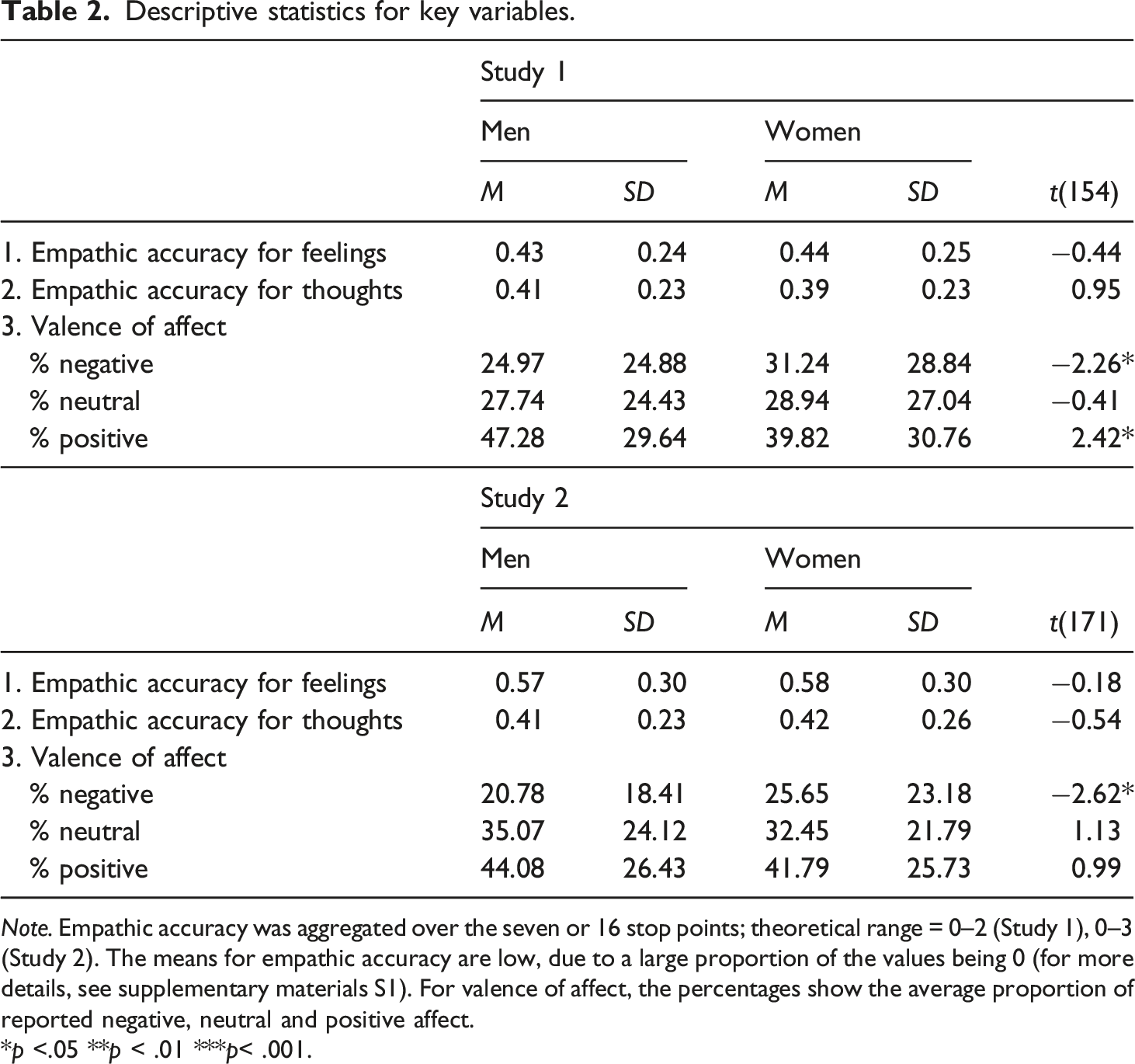
Note. Empathic accuracy was aggregated over the seven or 16 stop points; theoretical range = 0–2 (Study 1), 0–3 (Study 2). The means for empathic accuracy are low, due to a large proportion of the values being 0 (for more details, see supplementary materials S1). For valence of affect, the percentages show the average proportion of reported negative, neutral and positive affect.
*p <.05 **p < .01 ***p< .001.
With regard to the valence of affect, the percentages in Table 2 show the average proportion of reported negative, neutral and positive affect. It is notable that the men on average reported experiencing less negative affect (Studies 1 and 2) and more positive affect than the women did (Study 1), although there was no significant between-gender difference for neutral affect (Studies 1 and 2).
Data-analytic strategy
To answer each of our three research questions, we analyzed the data using a longitudinal (i.e., data collected at seven or 16 stop points) version of the actor–partner interdependence model (APIM), which takes into account the fact that observations are nested within the partners of a couple (Bolger & Laurenceau, 2013; Kenny et al., 2006). Empathic accuracy was predicted by the self-reported affective valence of the perceiver and target and the interaction thereof. Two separate models were fitted to the data: one for empathic accuracy for feelings, and one for empathic accuracy for thoughts. Furthermore, two dummy variables were created, one for positive affect and one for negative affect, making neutral affect the reference category.
Both the actor (perceiver) and partner (target) effects of positive and negative affect as well as the actor × partner (perceiver × target) interactions (for both similar and opposite valence of affect) were included as predictors in the model
10
(see Figure 1). We also allowed separate random intercepts for the male and female participants, and for the correlation between these terms (using an unstructured error structure; Bolger & Laurenceau, 2013). Finally, we allowed observations to be correlated across time (using a first-order autoregressive error structure; Bolger & Laurenceau, 2013). Actor–partner interdependence model used to assess the association between affect and empathic accuracy.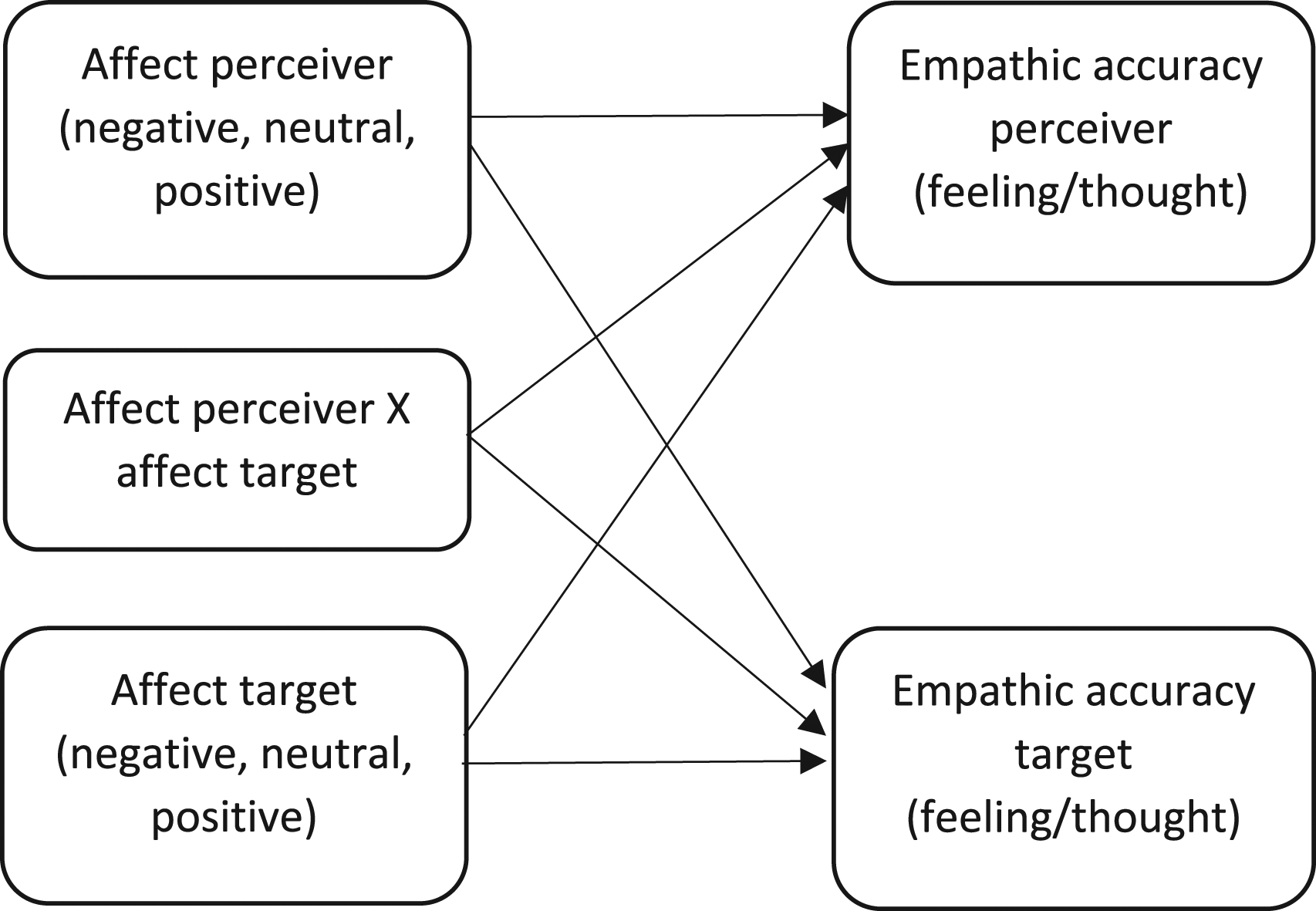
In preliminary analyses, we tested potential effects of time, gender, and interactions with gender, the average positive and negative affect of both the perceiver and the target, and the interactions between these averages (Bolger & Laurenceau, 2013). The results of these analyses showed that only one variable had a significant effect: the average negative affect of the target. However, including this variable did not alter the main results. Furthermore, assessing changes in the AIC/BIC values showed that the models without this variable provided a better fit (see Supplementary Materials, S3). Therefore, and for parsimony, we decided not to include any of these variables in the final model, and to pool the fixed effects across gender.
Empathic accuracy for feelings
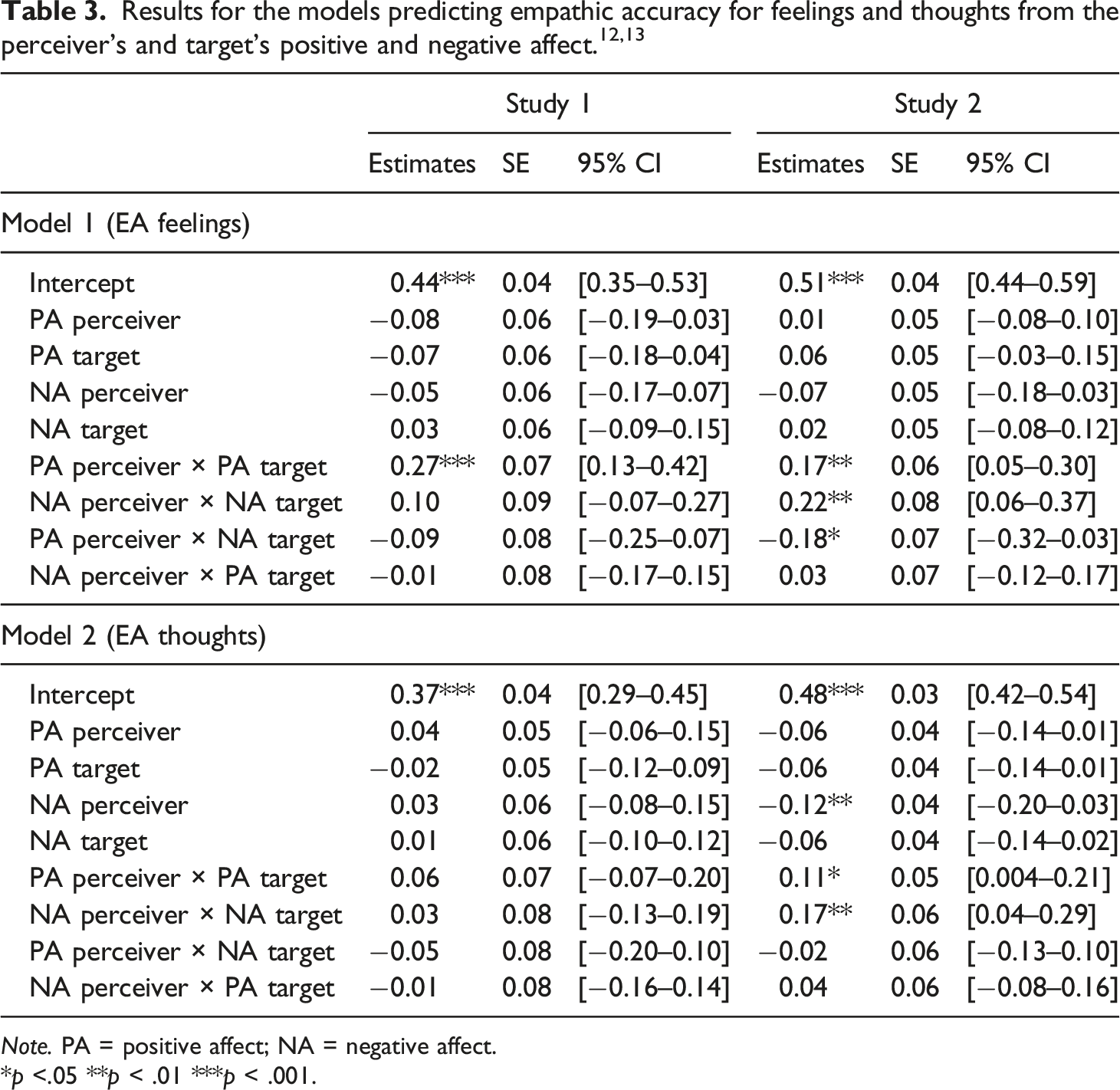
Note. PA = positive affect; NA = negative affect.
*p <.05 **p < .01 ***p < .001.
Contrary to our expectation, in both studies the target’s negative affect (as compared to neutral affect) did not predict the perceiver’s empathic accuracy (B S1 = 0.03, p S1 = .618; B S2 = 0.02, p S2 = .678), nor did the target’s positive affect (B S1 = −0.07, p S1 = .226; B S2 = 0.06, p S2 = .173).
Instead, the results of both studies revealed a significant interaction between the perceiver’s positive affect and the target’s positive affect (B
S1
= 0.27, p
S1
< .001; B
S2
= 0.17, p
S2
= .007). To interpret this interaction effect, post hoc pairwise tests (with Bonferroni correction for multiple testing, adjusted α = 0.008) were conducted.
11
The results of these tests showed that at moments when the perceiver and the target both experienced positive affect, the perceiver scored significantly higher on empathic accuracy (M
S1
= 0.57, SD
S1
= 0.03; M
S2
= 0.76, SD
S2
= 0.03) than when the target experienced neutral affect (M
S1
= 0.36, SD
S1
= 0.04, p < .001; M
S2
= 0.52, SD
S2
= 0.04, p < .001). When a perceiver experienced neutral affect, the perceiver’s empathic accuracy did not depend on the affective valence (positive or neutral) reported by the target (Figure 2a and 2b). Visualization of significant interaction effects between perceiver and target affect. 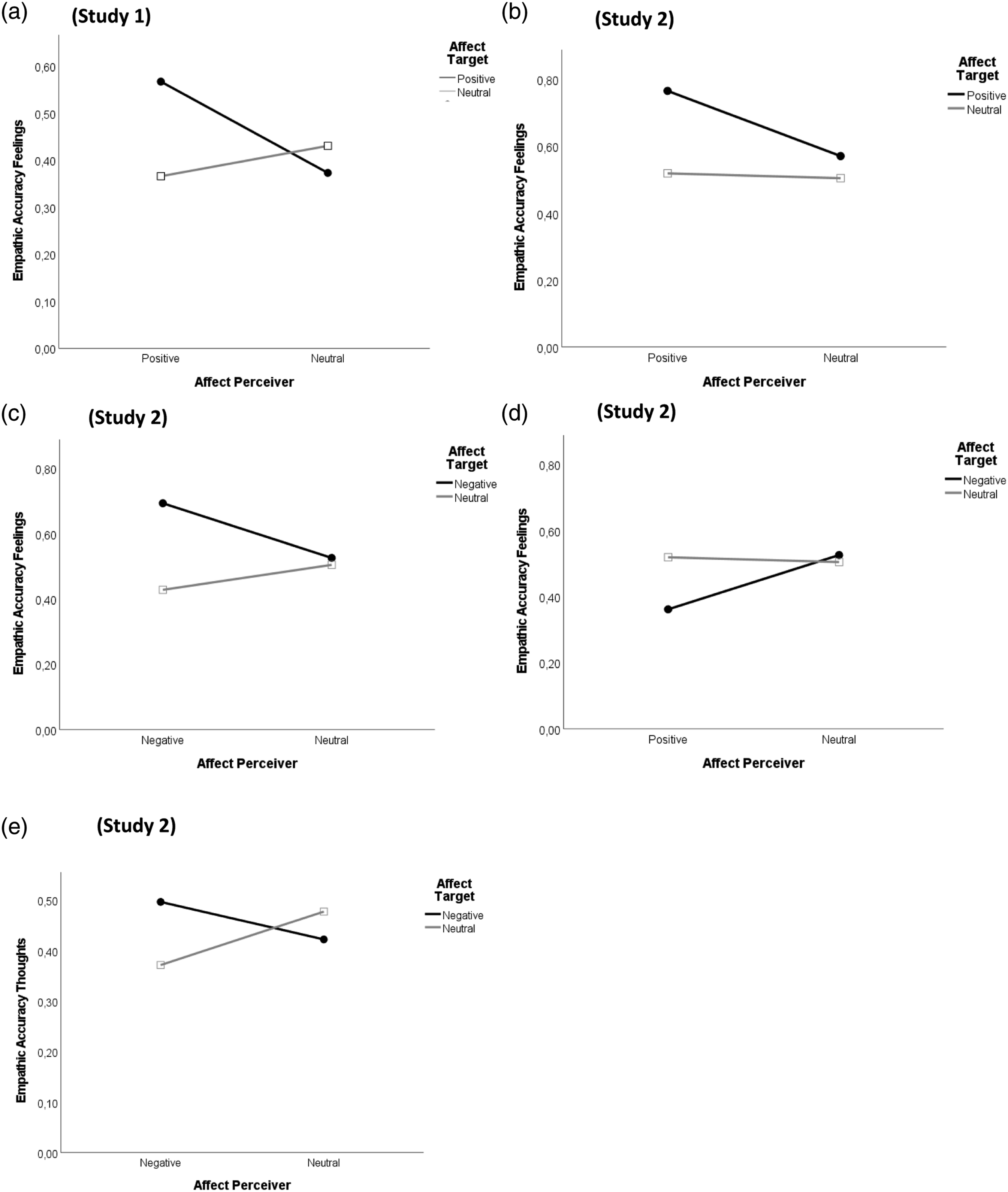
In addition, in Study 2, the analysis revealed a significant interaction between the negative affect of the perceiver and the negative affect of the target (B = 0.22, p = .007). Post hoc pairwise tests showed that at moments when both the perceiver and the target reported experiencing negative affect, the perceiver’s empathic accuracy for the target’s feelings was higher (M = 0.68, SD = 0.05) than when the target was experiencing neutral affect (M = 0.44, SD = 0.04, p < .001). Once again, however, when a perceiver experienced neutral affect, empathic accuracy did not depend on the affective valence (negative or neutral) reported by the target (Figure 2c).
Finally, a significant interaction between the perceiver’s positive affect and the target’s negative affect (B = −0.18, p = .016) was found in Study 2. The results of the post hoc pairwise tests indicated that at moments when a perceiver experienced positive affect and the target experienced negative affect, the perceiver was less accurate in inferring the target’s feelings (M = 0.37, SD = 0.05) than when the target experienced neutral affect (M = 0.52, SD = 0.04, p = .006). Again, however, when the perceiver experienced neutral affect, empathic accuracy did not depend on the affective valence (negative or neutral) reported by the target (Figure 2d). The interaction between the perceiver’s negative affect and the target’s positive affect was not significant in either of the studies (B S1 = −.01; p S1 = .862; B S2 = .03; p S2 = .722).
Empathic accuracy for thoughts
The model estimates for empathic accuracy for thoughts can be found in Table 3 (Model 2). With regard to the perceiver’s affect, the results of both studies showed that the perceiver’s positive affect (B S1 = 0.04, p S1 = .412; B S2 = −0.06, p S2 = .099), as compared to neutral affect, did not predict his or her empathic accuracy. In Study 2 (but not in Study 1; B = 0.03, p = .556), the perceiver’s negative affect predicted the perceiver’s empathic accuracy for the target’s thoughts (B = −0.12, p = .007), such that negative affect (as compared to neutral affect) was associated with lower empathic accuracy for the target’s thoughts.
No significant associations were found between the target’s affect (positive: B S1 = −0.02, p S1 = .742; B S2 = −0.06, p S2 = .105; negative: B S1 = 0.01, p S1 = .877; B S2 = −0.06, p S2 = .168) and the perceiver’s empathic accuracy for the target’s thoughts.
Finally, no interaction effects between perceiver and target affect were found to be significant in Study 1 (p values ranging between .357 and .869). In Study 2, results revealed significant interactions between the perceiver’s positive affect and the target’s positive affect (B = 0.11, p = .041) and between the perceiver’s negative affect and the target’s negative affect (B = 0.17, p = .009). Post hoc pairwise tests showed that at moments when both the perceiver and the target experienced negative affect, the perceiver’s empathic accuracy for the target’s thoughts was higher (M = 0.47, SD = 0.04) than when the target experienced neutral affect (M = 0.36, SD = 0.04, p = .043). When a perceiver experienced neutral affect, empathic accuracy did not depend on the affective valence (negative or neutral) reported by the target (Figure 2e).
It is notable that this interaction effect nuances the observed main effect of negative affect of the perceiver. A perceiver experiencing negative affect (as compared to neutral affect) is only less empathically accurate when the target experiences neutral affect. When the target experiences negative affect, it does not harm the perceiver’s empathic accuracy.
With regard to the positive affect interaction, the more rigorous post hoc pairwise tests did not confirm this effect. Moreover, none of the remaining interaction effects in Study 2 was significant (p values of .781 and .549, respectively).
General discussion
The perceiver’s affect and empathic accuracy
We did not find any main effect of the perceiver’s affect on his/her empathic accuracy, except for one finding in Study 2. This finding showed that at moments when a perceiver experienced negative affect during conflict (as compared to neutral affect), the perceiver was less accurate in inferring the thoughts, but not the feelings, of his or her partner. Although we did not find this association in Study 1, these results are in line with existing research by Devlin and colleagues (2014) which suggest that experiencing negative affect hinders being empathically accurate. These findings are not in line, however, with the view that negative affect should elicit more systematic information processing and therefore enhance empathic accuracy (Fiedler, 2001; Forgas & Eich, 2013; Ma-Kellams & Lerner, 2016).
An investigation of interaction effects involving both the perceiver’s and the target’s affect helps to clarify things by revealing a crucial difference: the adverse effect of negative affect of the perceiver on empathic accuracy for thoughts was only found when the partner experienced neutral affect. When the partner also experienced negative affect, the perceiver’s inferences were more, rather than less, accurate. This latter result is consistent with the theoretical view which holds that actual affective similarity leads to assumed similarity, which in turn results in greater empathic accuracy.
The target’s affect and the perceiver’s empathic accuracy
Contrary to our expectation, we did not find evidence in either Study 1 or Study 2 for the assumed association between the partner’s (i.e., target’s) negative affect and the perceiver’s empathic accuracy. In addition, the partner’s positive affect (as compared to neutral affect) did not have a significant effect on the perceiver’s empathic accuracy. These findings do not line up with the results of previous studies suggesting that negative affect of the target was associated with increased empathic accuracy of the perceiver (Atzil-Slonim et al., 2019; Gaelick et al., 1985; Howland & Rafaeli, 2010). This unexpected result may be due, at least in part, to differences in the methodology and the data analytical strategy used in the previous studies. For example, two of these studies were diary studies and relied on a difference in numerical reports of emotions to asses EA, whereas our measure of empathic accuracy is based on the difference in content between the reported and inferred feelings and thoughts (Atzil-Slonim et al., 2019; Howland & Rafaeli, 2010).
(Mis)Match of the partners’ affective valence and empathic accuracy
Perhaps the most interesting and replicable findings in the present investigation are the ones indicating that empathic accuracy in conflict interactions tends to be greater at the specific moments when both partners are simultaneously experiencing either positive or negative affect (i.e., affective similarity). In both studies, we found that when the partners experienced positive affect at the same time, they were better at reading each other’s feelings (but not thoughts). In addition, the Study 2 findings revealed that feeling negative when one’s partner feels negative was associated with more accurate inferences about both the feelings and the thoughts of one’s partner.
Can we interpret this pattern of findings using the concept of projection (i.e., assumed similarity) as the simplest and most parsimonious explanation? This explanation would hold that perceivers in conflict interactions simply assume that their partners are feeling and thinking whatever they themselves are currently feeling and thinking. Nickerson and colleagues (2009) have proposed that the ability to empathize and to be empathically accurate is based, at least in part, on people’s tendency to project their own feelings and thoughts onto others.
As mentioned before, previous studies have shown that projection can result in greater empathic accuracy (Atzil-Slonim et al., 2019; Clark et al., 2017; Kouros & Papp, 2019; Wilhelm & Perrez, 2004). These studies have shown that the association between actual affective similarity and empathic accuracy is partially mediated by assumed similarity. In other words, when partners feel the same way, they achieve higher accuracy because of (correctly) assuming their partner’s emotions are similar to theirs. Our findings confirm and even extend this explanation, by showing that negative affective similarity might benefit accuracy for thoughts as well.
Three additional points should be noted. First, greater accuracy can also result from the perception of clear-cut evidence regarding the partner’s similar affect or from so-called shared experience at a particular moment during the interaction (e.g., Levavi-Francy et al., 2020). For example, if both partners laugh when discussing the same funny incident, or if both partners express anger when talking about an abusive neighbor, empathic accuracy can reflect the direct perception of the partner’s emotion even more than the perceiver’s assumption of affective similarity. Second, as Nickerson et al. (2009) have emphasized, projection can also result in lower empathic accuracy when the perceiver’s assumption of affective similarity is unwarranted. This is in line with specific findings of Study 2: when the perceiver experienced positive affect while the partner experienced negative affect, the perceiver’s empathic accuracy for the partner’s feelings was impaired. Likewise, we found that when the perceiver experienced negative affect while the partner experienced neutral affect, the perceiver’s empathic accuracy for the partner’s thoughts was impaired. Third, although the general pattern of findings suggests that the assumption of affective similarity (i.e., projection) might have played a major role in our results, it should be noted that our findings were not fully consistent within and between studies, and that we were unable to explicitly test this indirect pathway to empathic accuracy because we did not assess assumed similarity within the current studies.
Nonetheless, it remains unclear why we found more significant results pertaining to the target-perceiver interaction (1) for empathic accuracy for feelings and (2) for positive affect. The first outcome may be understood in light of the fact that emotional (dis)similarity probably has more impact on inferring the feelings of a partner than on inferring his/her thoughts. Indeed, using your own feelings to guide your inferences is more likely to influence inferences about a partner’s feelings rather than thoughts (Nickerson et al., 2009). The second outcome might be due to the fact that people simply reported more positive affect at different moments of the interaction in both studies, making it easier to find results concerning positive affect. Finally, the fact that the results of our studies do not fully parallel one another might be due to differences in statistical power between Study 1 (7 stop points) and Study 2 (16 stop points).
Limitations
Several limitations of the current study should be acknowledged. First, our correlational findings do not permit causal inferences to be drawn. Second, the assessment of affect was limited in the present studies. We measured only the positive, neutral, or negative valence of the participants’ self-reported emotions, but did not discriminate between specific types of positive (e.g., joy and pride) or negative emotions (e.g., anger and sadness). Future studies can extend our findings by incorporating measures of different kinds of emotions, such as anger versus sadness, that have proved important in previous research (Bodenhausen et al., 1994; Sanford, 2007; Verhofstadt et al., 2020) and that might have different associations with empathic accuracy during discussions (e.g., anger might drive partners apart, whereas sadness might connect partners).
Relatedly, an interesting avenue for future research would be to take into account the intensity of emotions. As Crenshaw et al. (2019) have shown, arousal impacts empathic accuracy, and thus, regardless of the valence of affect, the intensity of the emotions might influence empathic accuracy. An additional limitation of the measurements is that most of the perceivers in our study displayed relatively low empathic accuracy and reported experiencing positive affect at most of the stop points, thereby contributing to non-normal distributions of the empathic accuracy and valence-of-affect data. The assessment of affect in our study also relied on partners’ subjective reports about their affect, a method that comes with known disadvantages (Paulhus & Vazire, 2007). Further, we did not assess the participants’ sexual orientations in Study 1, nor did we assess race/ethnicity and disability in Studies 1 and 2. Future researchers might be advised to examine these characteristics, although a recent review showed inconsistent associations of sexual orientation and race/ethnicity with empathic accuracy (Hinnekens et al., 2021). A final limitation of Study 1 is the comparatively lower interrater reliability for empathic accuracy, whereas the interrater reliability in Study 2 is high, due to the methodological improvements we introduced.
Future research directions
Three directions for future research are suggested by the present findings. First, our findings highlight the need to study both affect and empathic accuracy as they unfold and vary over time (Kuppens, 2015). The fact that both of these variables were measured on a moment-to-moment basis within couples’ conflict interactions led to evidence partially contradicting results of previous studies is intriguing, and it suggests the importance of critically re-evaluating the documented association between affect and empathic accuracy.
A second implication for future research stresses the importance of not only studying between-person predictors of empathic accuracy, but within-person predictors as well. Not only has the search for consistent individual-difference predictors of empathic accuracy proved to be difficult (for a review, see Hodges et al., 2015), but empathic accuracy has also been found to vary within a person depending on the specific relational context in which people, including partners, interact (Ickes, 2011; Smith et al., 2011). Our study also showed that there is a lot of within-person variance during a particular interaction, although we were able to explain only a small part of that variance. Future studies should therefore focus more on time-varying predictors, such as affect, that might explain the variations of empathic accuracy within an individual.
Third, future studies of empathic accuracy in existing relationships should, whenever possible, always test for actor effects, partner effects, and actor × partner interaction effects. In the present studies, we found that the affect of the perceiver influenced empathic accuracy differently than the affect of the target, and we also found an interesting interaction between the affect of both partners. It should be clear we are dealing with interpersonal processes and that we should therefore analyze them as such.
Supplemental Material
sj-pdf-1-spr-10.1177_02654075221076453 – Supplemental Material for Associations between affect and empathic accuracy during conflict interactions in couples
Supplemental Material, sj-pdf-1-spr-10.1177_02654075221076453 for Associations between affect and empathic accuracy during conflict interactions in couples by Liesbet Berlamont, Laura Sels, William Ickes, Eva Ceulemans, Céline Hinnekens, and Lesley Verhofstadt in Journal of Social and Personal Relationships
Footnotes
Declaration of conflicting interests
The author(s) declared no potential conflicts of interest with respect to the research, authorship, and/or publication of this article.
Funding
The author(s) disclosed receipt of the following financial support for the research, authorship, and/or publication of this article: Both studies were funded by Fonds Wetenschappelijk Onderzoek; grant number Study 1: 11Q9516N; grant number Study 2: 3G016018.
Author’s note
This article was presented at the annual meeting of the Belgian Association for Psychological Sciences in May 2021.
Open research statement
As part of IARR’s encouragement of open research practices, the authors have provided the following information: This research was not pre-registered. The data used in the research cannot be publicly shared but are available upon request. The data can be obtained emailing:

Supplemental material
Supplemental material for this article is available online.
Notes
References
Supplementary Material
Please find the following supplemental material available below.
For Open Access articles published under a Creative Commons License, all supplemental material carries the same license as the article it is associated with.
For non-Open Access articles published, all supplemental material carries a non-exclusive license, and permission requests for re-use of supplemental material or any part of supplemental material shall be sent directly to the copyright owner as specified in the copyright notice associated with the article.
