




Abstract
Siblings are ubiquitous in the lives of youth, but sibling conflict is linked to adjustment problems and risky behaviors. To advance understanding of older and younger siblings’ unique and shared perspectives of conflict in Mexican-origin families, our study addressed two goals. First, using Multitrait-Multimethod Confirmatory Factor Analysis (MTMM-CFA; Kenny & Kashy, 1992), we estimated the variance accounted for by older and younger siblings’ unique and shared experiences of the frequency of their conflict. A shared viewpoint indicates commonality in siblings’ reported experiences, whereas a unique perspective encompasses each sibling’s distinct perceptions of their conflict. Second, we examined links between older and younger siblings’ unique and shared conflict factors and each sibling’s depressive symptoms and risky behavior. Participants were two siblings (Mage = 15.48 years for older and Mage = 12.55 years for younger siblings) from 246 Mexican-origin families who were interviewed in their homes. Results indicated that the shared conflict factor accounted for most of the variance in older siblings’ reports of conflict frequency, whereas the unique factor accounted for the largest portion of the variance in younger siblings’ reports. Further, for older siblings, the shared conflict factor was linked to their individual adjustment, whereas for younger siblings, the unique factor predicted their adjustment. Parsing siblings’ reports of the frequency of their relational conflict, specifically the extent to which perspectives overlap versus are distinctive, provides novel insights about the role of siblings’ conflict experiences in youth adjustment. Additionally, it offers directions for future research and has the potential to inform existing sibling conflict programs.
Introduction
Sibling relationships have both positive and negative features that have been linked to internalizing and externalizing problems (Buist et al., 2013). Focusing largely on European and European American samples, prior research has highlighted the impact of negative sibling experiences and shown that sibling conflict-adjustment linkages are stronger—that is, are characterized by larger effect sizes--than sibling warmth-adjustment linkages (Buist et al., 2013). We know less, however, about such sibling dynamics in ethnic and racial minoritized groups (Updegraff et al., 2011), including Latinxs (Perez‐Brena et al., 2022). A growing literature on the characteristics of Mexican-origin families has identified cultural values, beliefs, and practices that promote close family relationships and discourage conflict (Cauce & Domenech-Rodriguez, 2002; Peterson & Bush, 2013; Updegraff et al., 2005). Indeed, Mexican-origin siblings spend an average of 17 hours together across 7 days, highlighting the centrality of siblings in the everyday lives of youth (Updegraff et al., 2005). Because of siblings’ extensive daily companionship due to these values that anchor Mexican culture, sibling relationships within Mexican-origin families may be a particularly important context for youth development.
Social construction theory (SCT; Hoffman, 1990; Paikoff, 1991) posits the existence of multiple realities within families due to family member differences in personal narratives, roles, and qualities. These include siblings’ nonshared family experiences (Dunn & Plomin, 1990), which help to shape interpretations and meanings of family interactions. From this perspective, members of the same sibling dyad will experience their shared relationship in distinct ways. Consistent with SCT, research suggests that individual characteristics help to shape each sibling’s experience of their relationship (Buist et al., 2013). Indeed, Buhrmester and Furman (1990) documented that older and younger siblings were significantly different in their reports of sibling relationship experiences, especially with respect to sibling conflict. Accordingly, like other relationship researchers, sibling researchers have argued for the importance of assessing the perspectives of both relationship partners to obtain a more comprehensive picture of these key family relationships (Campione-Barr et al., 2013; Gallagher et al., 2018; Kim et al., 2007). Indeed, two siblings’ accounts may provide valuable, and perhaps different, information about their conflict.
Building on theory and this prior literature, the present study examined two aspects of Mexican-origin siblings’ conflicts, shared and unique perspectives, drawing from older and younger siblings’ reports of their relationship perspectives. In the context of sibling conflict, a predominantly shared perspective refers to a collective interpretation or understanding of conflict episodes held by both siblings involved. This shared perspective signifies a convergence in their perceptions, acknowledging a commonality in the reported experiences of the conflict. A shared perspective further indicates that a sibling can incorporate both their own and their sibling’s experiences in their perspective of conflict in the sibling dyad (Cook & Goldstein, 1993; Cox & Paley, 1997, 2003; Horwitz et al., 2010; Minuchin, 1988). Conversely, a unique perspective entails an individualistic interpretation of the conflict, wherein each sibling maintains distinct perceptions and evaluations of the encountered conflict episodes (Hoffman, 1990; Paikoff, 1991). Consistent with SCT and a nonshared family perspective, Jager et al. (2012; 2014; 2016), has highlighted unique components in parents’ and adolescents’ reports of marital and parent-adolescent relationships and how they relate to overall family functioning. We extend this approach to study siblings to determine which siblings’ perspectives are captured by their unique versus shared components, which may have implications for future research, including how to best assess their experiences (i.e., individual reports, reports by both members of the dyad) and corresponding targets for intervention.
SCT maintains that family members’ unique and shared perspectives of their relationships may be associated with the health and well-being of families and their members (Paikoff, 1991). Thus, we also tested whether the shared and unique components of siblings’ relationship perspectives were associated with their individual adjustment, specifically, siblings’ reports of depressive symptoms and risky behaviors. Determining whether and how unique and shared perspectives of sibling conflict are linked to youth adjustment may provide novel insights and needed specificity about the role of those experiences in youth adjustment. In addressing these goals, we focused on adolescent-aged sibling dyads in Mexican-origin families-- whose study is a growing priority given U.S. demographic trends (Knight et al., 2018; U.S. Census Bureau, 2018). Specifically, we used a Multitrait-Multimethod Confirmatory Factor Analytic approach (MTMM-CFA; Jager et al., 2012; Kenny & Kashy, 1992) to parse the variance in siblings’ perspectives of their relational conflict into two components—the component(s) that were unique to each sibling and the component that overlapped, or was shared, by older and younger siblings.
Unique and shared perspectives of sibling conflict
Consistent with SCT and a nonshared family perspective, Jager and colleagues (2012; 2014; 2016), using MTMM-CFA, documented unique components in parents’ and adolescents’ reports of marital and parent-adolescent relationships and overall family functioning. We extend this approach to study siblings. SCT leads us to expect that, in addition to their personal characteristics (e.g., gender, personality), siblings’ roles in a larger family system may mean that siblings see and interpret the “same” interactions differently. When thinking about the frequency of sibling conflicts, the focus of the current study, the concept of arguing inherently implies a dyadic interaction, where individuals engage in a shared conflict episode. Although each person may have distinct perceptions of the conflict, the nature of the event necessitates the participation of both individuals, precluding a scenario where one is arguing without the other. It is not to say that there are two separate conflicts, but rather, separate perceptions of those conflicts.
Previous research assessing children’s and adolescents’ perceptions of their sibling relationships is consistent with this idea in showing that younger siblings report more quarreling and antagonism (Buhrmester & Furman, 1990) and conflict and betrayal (Cole & Kerns, 2001) than older siblings. Other studies of sibling dyads document that siblings describe their relationships very differently (Dunn & Plomin, 1990) and rarely mention the same issues surrounding their disagreements, including who initiates conflict (McGuire et al., 2000). Along these lines, Campione-Barr and Smetana (2010) found that older and younger siblings reported different frequency and content though not intensity of their disputes, suggesting differences in siblings’ views of their experiences as a function of birth order, although it is important to note that this study did not directly test for age differences. In short, there is a range of evidence to suggest that siblings often have unique perspectives of their conflict, and that birth order may be a factor. Siblings’ differences in conflict experiences may also be attributed to age-related factors. Age differences contribute to distinct developmental stages, power dynamics, and nonfamily experiences, shaping how siblings perceive and navigate conflicts. Age disparities between older and younger siblings can influence their cognitive, emotional, and social responses to conflict, potentially leading to variations in conflict experiences. Evolving power dynamics influenced by age-related changes in autonomy and responsibility may further contribute to differences. Nonfamily experiences, such as those in school contexts, may also shape individual perspectives on conflict. Additionally, siblings’ views of conflict may differ based on gender and gender composition of the dyad due to gender socialization processes (e.g., how boys and girls are taught to express and perceive conflict), roles, and power dynamics. All these factors shape how conflicts are approached and understood within sibling relationships, highlighting the influence of gender-related dynamics on diverse perceptions of conflict experiences.
Other research focused on individual differences shows, however, that siblings’ relationship reports are correlated (Deković & Buist, 2005), including their reports of the frequency (Furman et al., 1989) and intensity of conflict (Campione-Barr & Smetana, 2010). That is, extant literature also provides reasons to expect that siblings’ relationship perspectives are, to some extent, shared. In the current study we took the novel step of applying MTMM-CFA to measure the proportions of shared and unique variance in siblings’ reports of conflict frequency as indicators of shared and unique experiences. In other words, with MTMM-CFAs, the quantity or size of shared and unique perspectives is determined by the size of the standardized factor loadings of the shared and unique perspectives. Thus, we ask both members of the sibling dyad about conflict. Each dyad member has a perspective about conflict, the variance of which can be carved into two components– shared and unique. However, how the two components are carved is not necessarily the same for both siblings. As a hypothetical example, factor loadings for older siblings could be larger for the shared perspective, leading to a larger proportion of variance in reports of conflict being allocated to the shared perspective for older siblings, whereas factor loadings for younger siblings could be larger for the unique perspective, leading to a larger proportion of variance in reports of conflict being allocated to the unique perspective for younger siblings. Although not focused on sibling dyads, prior work using MTMM-CFAs has found that the size of unique and shared perspectives of the family system (family dysfunction; Jager et al., 2012) and adolescent-parent subsystems (acceptance-rejection; Jager et al., 2016) does differ across mothers, fathers, and adolescents.
Shared and Unique Perspectives of Sibling Conflict and individual adjustment
Including because some studies focus on just one member of a dyad (Buist et al., 2013), previous research on sibling conflict-adjustment linkages has examined whether and how each sibling’s self-reported sibling conflict predicts his/her own adjustment (as depicted in Figure 1(a)). For instance, across a number of studies, youth who reported more sibling conflict also reported more internalizing (Buist & Vermande, 2014; Richmond et al., 2005) and externalizing problems (Natsuaki et al., 2009; Stocker et al., 2002). A notable exception is research using an actor-partner interdependence modeling approach (APIM) to examine the associations between both youth’s and their siblings’ reports of conflict and their reports of adjustment (Campione-Barr et al., 2013). A family systems framework may shed light on the underlying processes that explain siblings’ mutual influence on one another (Minuchin, 1974). For instance, siblings’ emotional and behavioral responses to conflictual interactions with siblings may induce negative emotions in other family members. Siblings’ responses or reactions reverberate through the family and thus, are interdependent. Indeed, Campione-Barr and colleagues (2013) showed that youth’s and siblings’ reports of conflict regarding equality and fairness were positively associated with their own and their siblings’ depressive symptoms. In terms of conflict related to invasion of the personal domain, only older siblings’ reports of personal domain conflicts positively predicted their own and their siblings’ anxiety, while younger siblings’ reports of equality and fairness conflicts only predicted older sisters’ anxiety. Based on these findings, Campione-Barr et al. (2013) argued that siblings’ relative standing in the broader family system plays a role in both their perceptions of conflict and their implications for adjustment, consistent with SCT (Hoffman, 1990); however, as the authors noted, in this study, as in most sibling research, birth order was confounded with age. Conceptual Model for Sibling Shared and Unique Perspectives of Sibling Conflict Predicting Individual Adjustment. Note. (a) Depicts how each sibling’s self-reported sibling conflict predicts his or her own adjustment; (b) depicts how the unique components of older and younger siblings’ conflict reports and the shared component of siblings’ conflict reports are linked to youth adjustment.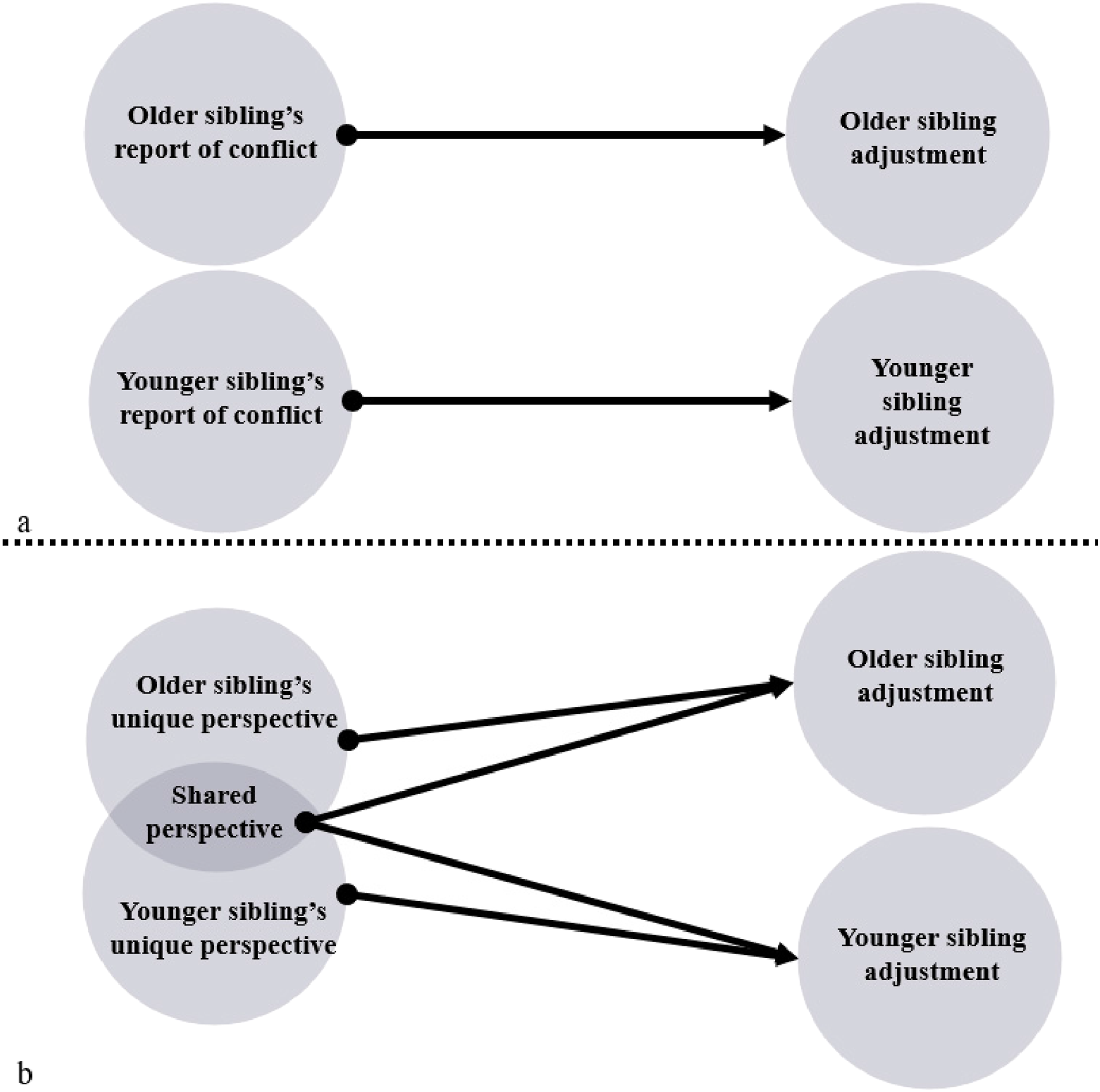
In the current study we addressed complementary questions of whether and how the unique and shared components of older and younger siblings’ conflict reports were linked to their adjustment (Figure 1(b)). Our approach implies that two siblings are similar to one another due to the influence of a shared or dyadic latent variable (i.e., shared perspective of sibling conflict), whereas the previously discussed APIM highlights the interdependence of sibling’s (partner) and each sibling’s own (actor) reports of conflict and their impact on individual adjustment. However, since APIM does not distinguish between shared and unique perspectives like MTMM-CFA does, it was not appropriate for addressing the research question in the current study. Given that youth are attuned to the meanings of their siblings’ behaviors and interpret them within the context of the relationship as a whole (Buhrmester & Furman, 1990), such perceptions may have implications for the ways in which they react to siblings’ behaviors and in turn, their adjustment. Thus, we expected that both the quality of siblings’ unique as well as the quality of their shared perspectives of sibling conflict frequency would be negatively associated with their adjustment. Such findings would contribute to SCT and the nonshared environment framework (Dunn & Plomin, 1990), and also may have implications for future research, such as how best to measure sibling relationships, and for practice, such as identifying targets for existing sibling conflict interventions.
The current study
In sum, to advance understanding of siblings’ unique and shared perspectives of sibling conflict in Mexican-origin families as well as the associations between these components of siblings’ conflict reports and their individual adjustment, our study addressed two goals. First, using MTMM-CFA (Jager et al., 2012; Kenny & Kashy, 1992), we assessed the relative size of unique and shared variance accounted for by older and younger siblings’ reports of the frequency of their conflict and whether there were birth order differences in either component. Due to the cross-sectional nature of our data, it is not possible to disentangle birth order from age/developmental differences, which requires careful consideration in interpreting our results. Second, we tested whether these measures of unique and shared variance were linked to each sibling’s depressive symptoms and risky behaviors.
Method
Participants
The data came from the first phase of a longitudinal study of 246, two-parent Mexican-origin families (author citation). Our focus on early to middle adolescence (Phase 1) is driven by the recognition of this developmental stage’s importance for studying sibling conflict, providing targeted insights and facilitating specific interpretations within this chosen developmental context. Participating families were recruited through schools in a southwestern metropolitan area (Phoenix, AZ, USA). Given the goals of the larger study, the criteria for participation were that: (a) family membership included a seventh grader, at least one older adolescent sibling (age 13 to under 21), a biological mother and a biological or adoptive father figure (all non-biological father figures had lived with the target children for at least 10 years), all living together; (b) mothers were of Mexican origin (93% of fathers also were of Mexican origin, although this was not a study criterion); and (c) fathers were employed for pay for at least 20 hours/week. Data for the present study came from the first wave of the study (conducted in 2002-2003).
To recruit families, letters in English and Spanish were sent to families, and follow-up telephone calls were made by bilingual staff to determine eligibility and interest in participation. Families’ names were obtained from five school districts and five parochial schools. Schools were selected to represent a range of socioeconomic situations, with the proportion of students receiving free or reduced lunch varying from 8% to 82% across schools. Families represented a range of education and income levels. The percentage of families that met federal poverty guidelines was 18.3%, a figure similar to the 18.6% of two-parent Mexican-origin families living in poverty in the county from which the sample was drawn (U.S. Census Bureau, 2000). The median family income was $41,000 (SD = $45,381; range = $3,000 to over $250,000). Mothers and fathers had completed an average of 10 years of education (M = 10.34, SD = 3.74; M = 9.88, SD = 4.37, respectively). Older siblings were 15.48 (SD = 1.57; median = 15; range = 13–21) years old, on average, and younger siblings were 12.55 (SD = 0.60; median = 13 range = 11–15) years of age, on average. Most older siblings were students (n = 231; 93.8%) and all younger siblings were 7th grade students, further, 5 older siblings and 5 younger siblings were in special education programs either full- or part-time.
Procedures
Data were collected via individual in-home interviews with each family member after obtaining informed consent and assent (for siblings under age 18). Siblings’ interviews lasted an average of 2 hours. Bilingual interviewers read questions aloud to all participants in their preferred language and entered their response into laptop computers. Families received $100 for in-home interviews. The University’s Institutional Review Board approved all procedures (protocol number and title blinded for review).
Measures
Sibling conflict was measured with five items using the Sibling Relationship Inventory (Stocker & McHale, 1992). The sibling conflict items were rated on a 5-point scale (1 = not at all to 5 = very much) such that higher scores indicated more conflict. The items were used as indicators for the MTMM-CFAs: Upset (“How much do you and (sibling’s name) get upset or mad at each other?”), Nerves (“How much do you and (sibling’s name) get on each other’s nerves?”), Disagree (“How much do you and (sibling’s name) disagree and quarrel?”), Argue (“How much do you and (sibling’s name) argue with each other?”), and Annoyed (“How often do you and (siblings’ name) get annoyed with each other?”). Cronbach’s α ranged from .89 to .92.
Youth’s depressive symptoms were assessed using the 20-item Center for Epidemiological Studies Depression Scale (CESD; Radloff, 1977). Items were rated on a 4-point rating scale (0 = rarely or none of the time to 3 = all of the time) to describe the frequency of experiences (e.g., “I had crying spells, I felt sad”.) over the past month. Items were summed, with higher scores reflecting more depressive symptoms. Cronbach’s α ranged from .85 to .86.
Youth’s risky behavior was assessed using a 23-item measure developed for the Michigan Study of Adolescent Transitions (Eccles & Barber, 1990). Youth used a 4-point rating scale (1 = never to 4 = more than 10 times) to describe the frequency of their engagement in different activities (e.g., “stole something worth less than $50”). Items were averaged to create the overall risky behavior score, with higher scores reflecting more risky behavior during the past year. Cronbach’s α ranged from .90 to .91.
Covariates included gender (0 = girl; 1 = boy) and sibling dyad gender constellation (0 = same-gender dyad; 1 = mixed-gender dyad), which were dummy coded. Age and age gap were included as covariates to isolate the effect of birth order and age was computed by subtracting each sibling’s birthdate from their interview date and the gap was computed by subtracting younger siblings’ age from older siblings’. Additional controls included family size (coded as the number of children) and family socioeconomic status (SES). Family SES was a composite of household income and mothers’ and fathers’ highest education levels, which were standardized and averaged after transforming household income to correct for skewness.
Results
Preliminary analyses
Correlations, means, and standard deviations (SD) for study variables (N = 246).
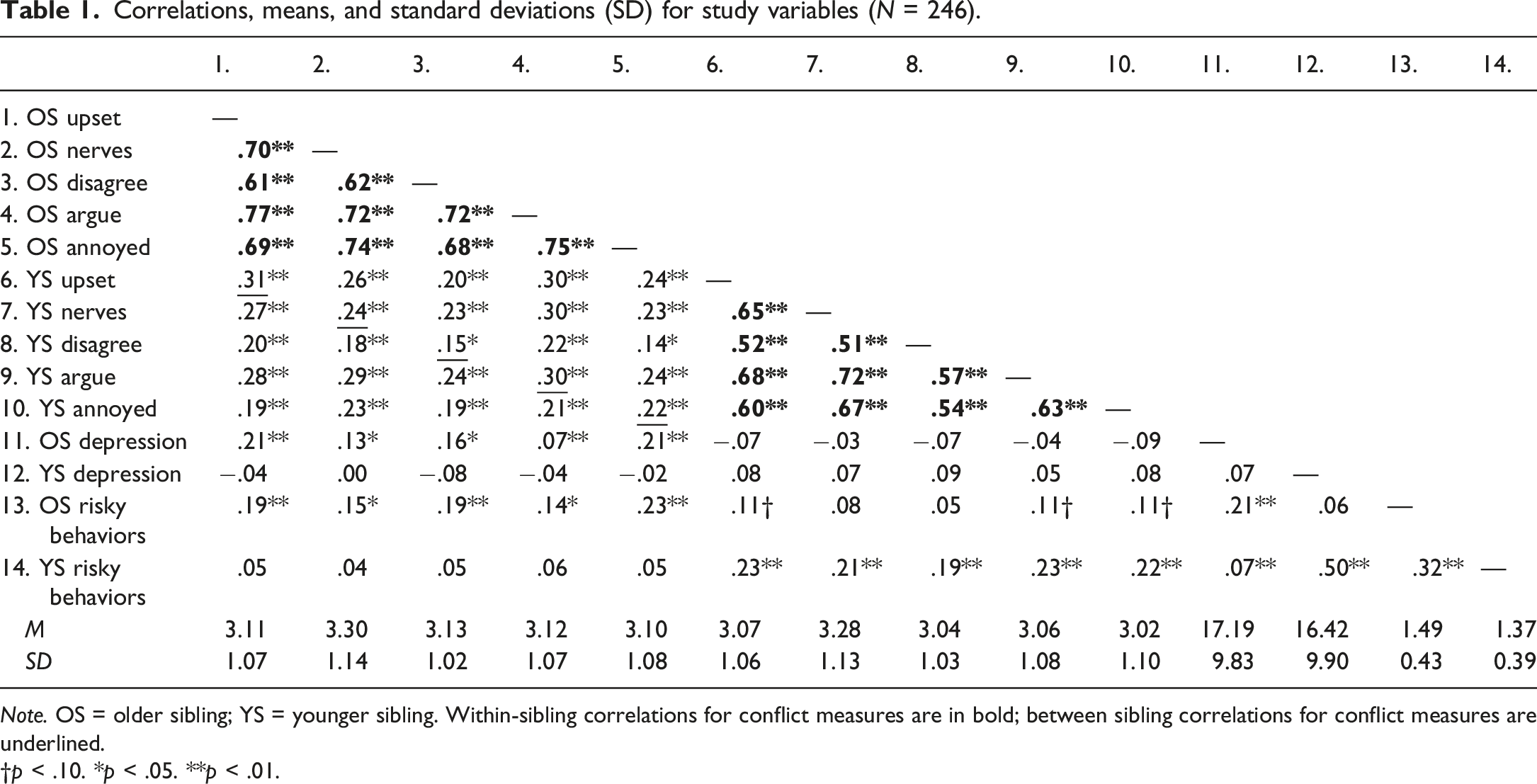
Note. OS = older sibling; YS = younger sibling. Within-sibling correlations for conflict measures are in bold; between sibling correlations for conflict measures are underlined.
†p < .10. *p < .05. **p < .01.
Capturing the unique and shared perspectives of sibling conflict
The aim of MTMM-CFA is to isolate trait variance from method variance because method variance is often sizable but not theoretically or substantively important. Jager et al. (2012) adapted this approach to examine shared and unique family member perspectives of family systems and subsystems. Using this approach, we interpret trait variance as shared variance across older and younger siblings and method variance as variance that is specific to siblings of each birth order. Conventional CFAs are designed to capture either unique or shared perspectives whereas our goal here is to capture unique and shared perspectives.
As depicted in Figure 2, we employed this MTMM-CFA approach to identify a shared (dyad) perspective and two unique perspectives (i.e., one for each sibling) of the frequency of sibling conflict. Specifically, we extracted a shared perspective by loading older and younger siblings’ reports of conflict onto a single factor (i.e., shared perspective factor, Figure 2) that represents commonality, or shared variance, between older and younger siblings’ reports. Doing so isolated the common variance across both siblings. Thus, shared variance refers to the portion of older and younger siblings’ perspectives that overlap with one another. After extracting variance common across both siblings, the nonshared variance remaining for each observed variable is a combination of variance specific to the individual sibling (i.e., their unique perspective) plus random measurement error. In order to distinguish variance specific to each sibling from random measurement error and thereby capture each sibling’s unique perspective, we loaded the reports of a given sibling onto a single factor, isolating the variance idiosyncratic to the individual. After parsing out unique and shared factors, what remains is error. Multitrait-Multimethod Confirmatory Factory Analysis. Note. Black circle is shared perspective; white circles are unique perspectives. O = older sibling; Y = younger sibling. 1 = upset; 2 = nerves; 3 = disagree; 4 = argue; 5 = annoyed.
Identification of optimal Multitrait-Multimethod Confirmatory Factor Analysis
All analyses were conducted with Mplus Version 7.4 (Muthen & Muthen, 2015); we used a maximum likelihood estimator that is robust to non-normality and Kline’s (2023) guidelines to assess model fit, which specify that comparative fit index (CFI) values >.95 and root mean square error of approximation (RMSEA) values <.05 constitute a good fit. Our first goal was to identify whether there were unique and/or shared perspectives of sibling conflict using MTMM-CFAs as well as their relative size. Details regarding common forms of misidentification are outlined elsewhere (Jager et al., 2012). Aside from indications of misidentification, other indicators of over-factoring are (a) poor discriminant validity (i.e., high correlations between latent factors) and (b) poor convergent validity (i.e., a sizable proportion of the loadings for a particular factor are small and non-significant). Given these susceptibilities, we identified the optimal MTMM-CFA model by maximizing model fit while eliminating all indications of model misidentification and misspecification. We used the following criteria to determine the optimal MTMM-CFA: (a) fit indices and change of model fit (e.g., χ2, CFI, RMSEA) from nested models; (b) indications of model misidentification; and (c) the degree of convergent and discriminant validity.
First, we estimated a model (Model 1) that included one shared dyad factor (loading all conflict indicators reported by each sibling onto a single factor); model fit statistics indicated a poor fit (χ2 (35) = 517.31, p < .05, CFI = .61, RMSEA = .24). Next, we estimated a model that added two unique factors (a factor for each sibling), in addition to the preexisting shared dyad factor (Model 2). This model provided a good fit (χ2 (25) = 25.42, p = .4390, CFI = 1.00, RMSEA = .008) and better fit than Model 1, ∆χ2(10) = 491.89, p < .001. However, Model 2 displayed poor convergent validity for older siblings (i.e., only three of the five factor loadings were statistically significant at p < .05). We then estimated an empirically driven model that had only one unique factor for younger siblings (no unique factor for older siblings), in addition to the preexisting shared dyad factor (Model 3). Model 3 provided a good (χ2 (30) = 36.819, p = .182, CFI = .99, RMSEA = .03) and better fit than Model 1, i.e., the shared dyad factor only model, ∆χ2(5) = 11.39, p < .05. Additionally, unlike Model 2, Model 3 did not display poor convergent validity.
Model fit indices for MTMM-CFAs of sibling conflict.
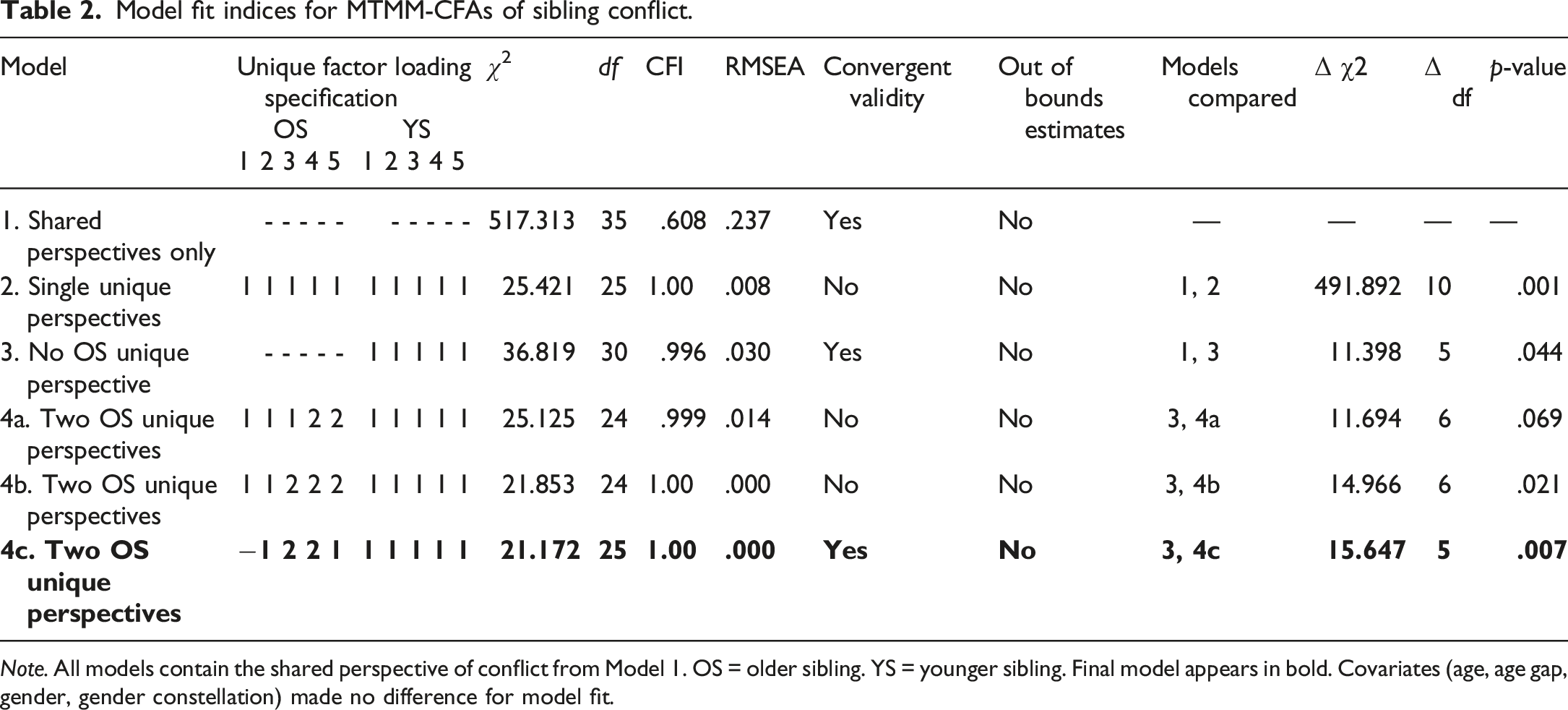
Note. All models contain the shared perspective of conflict from Model 1. OS = older sibling. YS = younger sibling. Final model appears in bold. Covariates (age, age gap, gender, gender constellation) made no difference for model fit.

Shared and Unique Perspectives of Sibling Conflict. Note. Black circle is shared perspective; white circles are unique perspectives. O = older sibling; Y = younger sibling. 1 = upset; 2 = nerves; 3 = disagree; 4 = argue; 5 = annoyed. Older sibling perspective 1 captures Conflict Behavior; older sibling perspective 2 captures Conflict Affect. All estimates are standardized. All estimates are significant at the .05 level or higher. Model fit: χ2(25) = 21.17 p = .68, CFI = 1.00, RMSEA = .00 (.00 | .041).
With respect to older siblings’ two-dimensional unique factor structure, we termed one factor Conflict Affect because the indicators it loaded on (i.e., nerves and annoyed) pertain to feelings experienced regarding sibling conflict, and we termed the other, Conflict Behavior because the indicators it loaded on (i.e., disagree and argue) relate to perceptions of overt actions. These unique factors covaried with one another (r = .67), but although positively related, were empirically distinct.
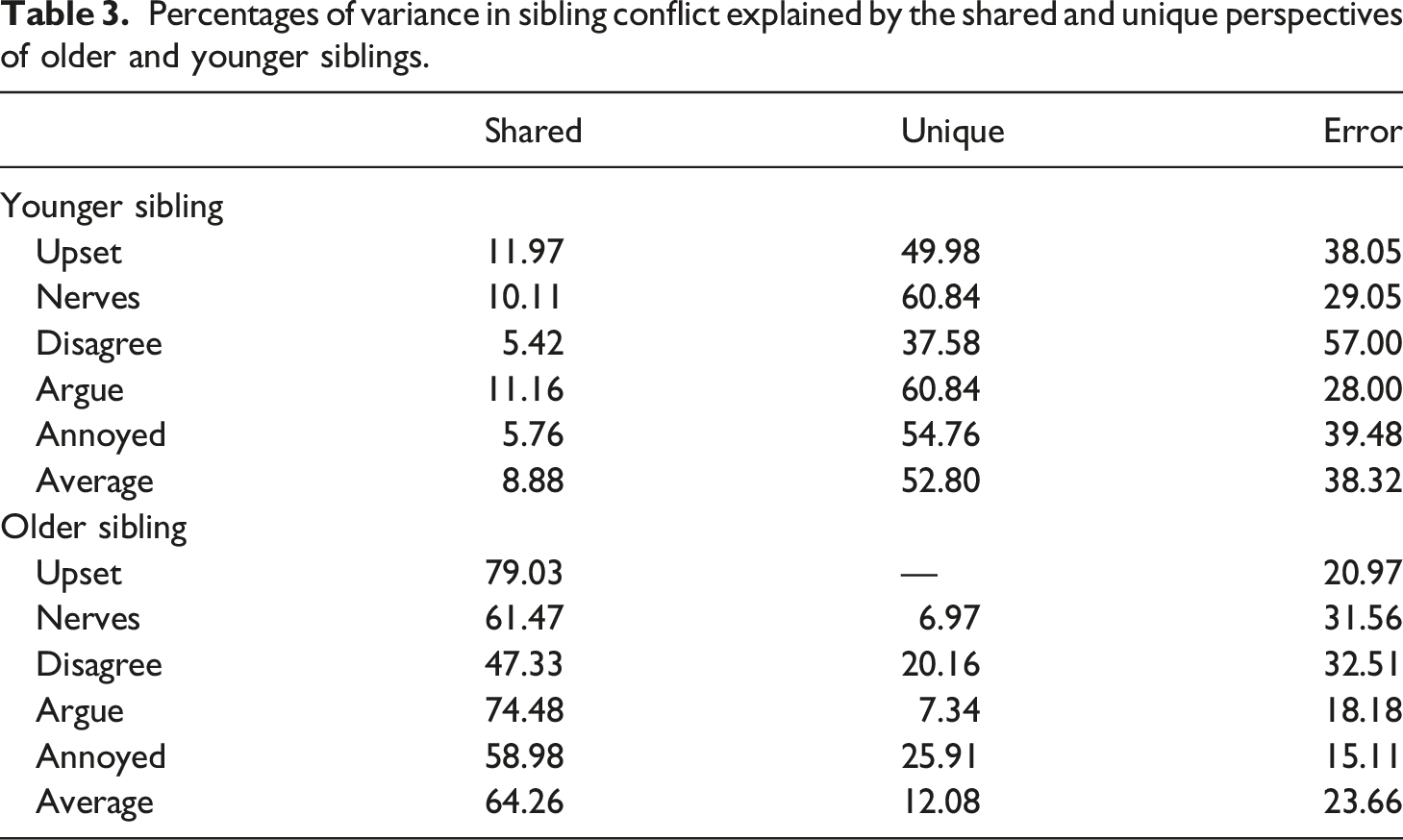
Goal 1: magnitude of siblings’ unique and shared perspectives of sibling conflict
Percentages of variance in sibling conflict explained by the shared and unique perspectives of older and younger siblings.
Goal 2: Links between siblings’ unique and shared perspectives of sibling conflict and individual adjustment
With MTMM-CFA, the frequency of conflict is captured by multiple indictors, namely the shared and unique factor scores (Jager et al., 2012, 2016), which reflect individual differences among older and among younger siblings’ conflict reports: High scores on the shared conflict factor signify more frequent shared conflict perceptions, and high scores on the unique conflict factor(s) signify more frequent uniquely perceived conflict relative to other youth of the same birth order. To test whether siblings’ unique and shared perspectives of conflict frequency were linked to their individual adjustment, we specified a path model whereby older and younger siblings’ depressive symptoms and risky behaviors were regressed on the shared conflict factor and on each sibling’s respective unique conflict factor(s). That is, younger siblings’ depressive symptoms and risky behaviors were regressed on the shared factor and younger siblings’ unique conflict factor, whereas older siblings’ depressive symptoms and risky behaviors were regressed on the shared factor and older siblings’ unique conflict factors. We also tested crossover effects in initial path models (i.e., younger siblings’ depressive symptoms and risky behaviors were regressed on older siblings’ unique factor), but these effects were nonsignificant. Ages of each sibling, age gap, gender, sibling dyad gender constellation, family size, and SES were included as covariates and moderators in initial path models, but all were nonsignficant except for age and gender. Thus, only age and gender were included as covariates, and each siblings’ respective factor paths were included in final models (Aiken et al., 1991). Our final model displayed good fit (χ2 (103) = 107.64, p = .358, CFI = 0.99, RMSEA = .01).
Focusing first on results involving older siblings, the shared conflict factor was positively associated with both depressive symptoms and risky behaviors. That is, older siblings whose shared perspectives were characterized by more frequent conflict relative to other older siblings were also higher on self-reported depressive symptoms and risky behaviors. The effects for the two unique factors (e.g., conflict behavior, conflict affect), however, were nonsignificant. Thus, the perspective that was larger (shared conflict factor) was linked to adjustment.
Standardized regression coefficients for shared and unique perspectives predicting individual adjustment.
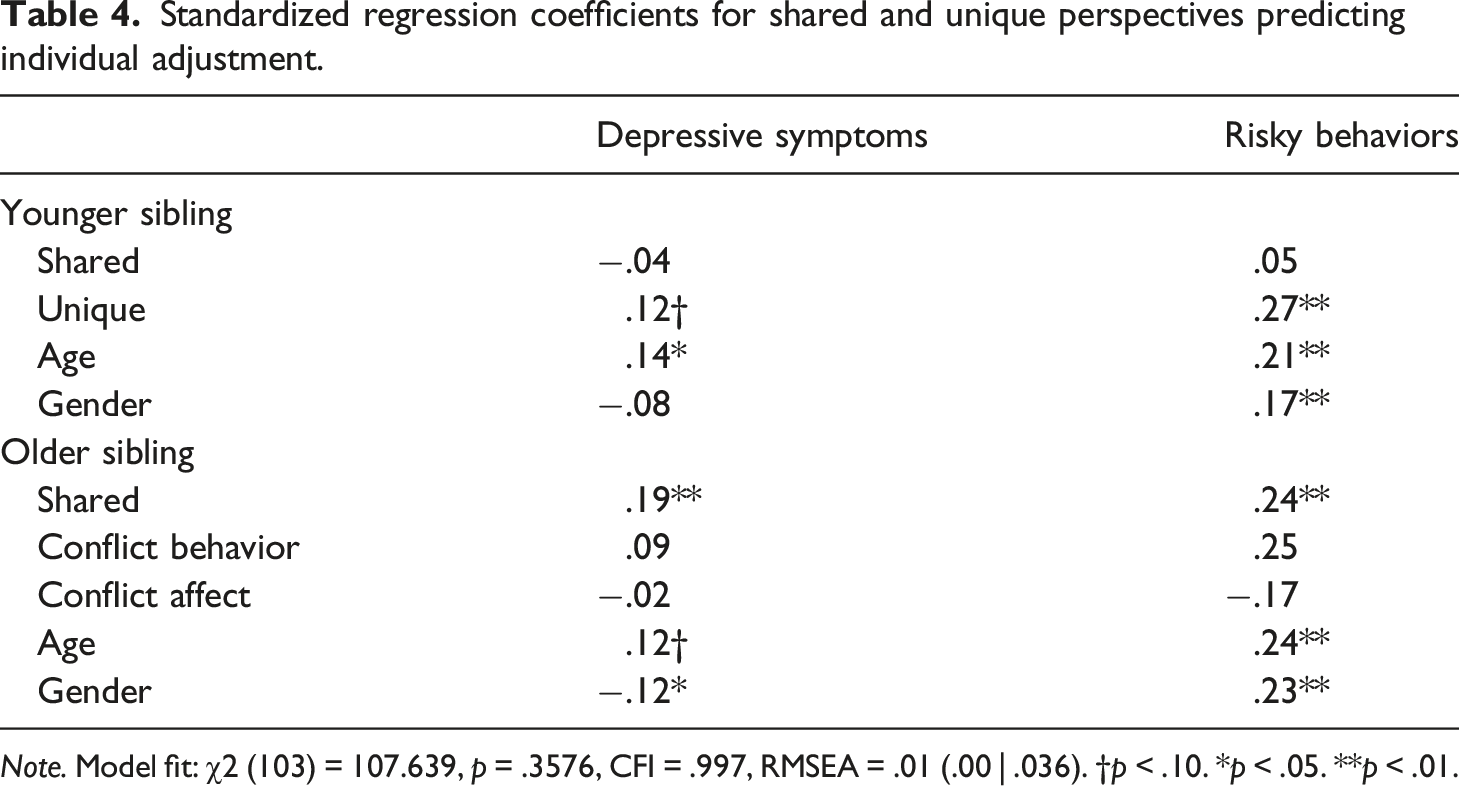
Note. Model fit: χ2 (103) = 107.639, p = .3576, CFI = .997, RMSEA = .01 (.00 | .036). †p < .10. *p < .05. **p < .01.
Discussion
Grounded in SCT (Hoffman, 1990; Paikoff, 1991) and a nonshared family perspective (Dunn & Plomin, 1990), the current study advanced understanding of older and younger siblings’ perspectives of sibling conflict within Mexican-origin families and their associations with concurrent youth adjustment. Our study goals were to quantify older and younger siblings’ unique and shared perspectives of sibling conflict frequency and to test whether and how these were linked to their depressive symptoms and risky behaviors. Results indicated that the shared variance factor accounted for most of the variance in older siblings’ reports of conflict, whereas for younger siblings, the unique variance factor accounted for most of the variance in their reports. In turn, for older siblings, the shared conflict frequency factor was positively related to their adjustment problems, whereas for younger siblings, the unique conflict factor was associated with poorer adjustment. In addition to their theoretical significance (Dunn & Plomin, 1990; Hoffman, 1990; Paikoff, 1991), these findings have important implications for future research including for measuring sibling conflict. Further, these findings are indicative of the cultural salience of Mexican-origin family relationships, particularly siblings, for youth development and for informing existing family-focused intervention programs geared toward reducing depressive symptoms and engagement in risky behaviors.
Unique and shared perspectives of sibling conflict
Given that sibling conflict, as measured here, involved both siblings’ behaviors, we expected a portion of the variance in their reports to overlap or converge; however, given their family roles and associated developmental differences, we also expected that these siblings would experience conflict differently from one another. Consistent with Social Construction Theory (SCT) as well as existing work documenting similarities (Buist et al., 2013; Campione-Barr et al., 2013) and differences (Campione-Barr & Smetana, 2010; Cole & Kerns, 2001; McGuire et al., 2000) in siblings’ reports of conflict, we found that older and younger siblings’ perspectives included both shared and unique components. Further, our findings showed that experiences of conflict tended to be commonly shared among older siblings and relatively more unique for younger siblings. While these associations may indicate potential differences from zero, it is important to note that non-significant findings do not necessarily imply the absence of associations, but rather they may lack statistical evidence to confirm a significant effect. Although this pattern may initially seem paradoxical, these patterns reflect each sibling’s experiences concerning their birth order or development—not their experiences relative to their own sibling. Moreover, although there is not be a formal test for the significance of differences between older and younger siblings, the consistent patterns, observed in the variance accounted for by shared and unique factors across individuals in this sample, suggest a degree of consistency. Replicating the findings will be an important future direction.
As noted, these differences in the components of siblings’ conflict perspectives may be attributable to their distinct roles in the dyad and their families, more broadly. Because younger siblings tend to report more admiration for older siblings and value the support they receive from their older siblings to a greater extent than the reverse, signs of their siblings’ negativity may be more salient and they may react more emotionally -- creating a distinct perspective of their conflict. Associated developmental differences may also contribute. For instance, given more advanced social cognitive skills and related declines in egocentrism, older siblings may be better able to incorporate both their own and their younger sisters’ or brothers’ experiences in their relationship reports (McHale et al., 2012). Although these birth order differences emerged after controlling for age, it is important to remember that in this sample, there was minimal overlap between the ages of older and younger siblings. Role differences and developmental differences also may help to explain why older siblings’ perspectives included more dimensions than did younger siblings’, specifically, that their unique perspectives included both behavioral and affective components: Their role as leader, teacher and role model may engender a more differentiated perspective of their conflicts as do their more mature social cognitive skills. For older siblings, the indicator ‘upset’ did not load onto either unique factor (e.g., conflict behavior, conflict affect). Empirically, it may be that there was no true variance in this item that meaningfully overlapped with any other item; or there may not be any true variance left to explain (i.e., .89 loading on the shared factor indicates that, for older siblings, the experience of ‘upset’ was largely shared). Substantively, for older siblings, being upset with their sibling may be experienced as distinct from the other indicators of affect (i.e., annoyed; get on nerves).
Developmental differences may explain the differences in the unique perspectives of older and younger siblings. Older siblings potentially due to greater cognitive maturity, may perceive unique facets of conflict that are more multi-dimensional, while younger siblings, in the earlier stages of development, may exhibit a simpler structure in their conflict perceptions. Future longitudinal research could illuminate whether their unique perspectives become increasingly multidimensional or converge as siblings age (i.e., that the shared factor comprises a larger proportion of both siblings’ perspectives), shedding light on the dynamic nature of sibling perspectives over time. Some research suggests that the power imbalance between older and younger siblings decreases across adolescence and into young adulthood (Whiteman et al., 2017); thus, perceptions may converge as younger siblings mature and sibling relationships become more egalitarian.
Links to youth adjustment
For older siblings, it was the shared component of sibling conflict reports that was related to their individual adjustment, whereas for younger siblings, the unique conflict factor was associated with their individual adjustment. Thus, the perspective that was larger (shared conflict factor for older siblings and unique conflict factor for younger siblings) was linked to adjustment. These findings are consistent with SCT and perspectives on siblings’ shared and nonshared experiences (Dunn & Plomin, 1990; Hoffman, 1990; Paikoff, 1991). They also add to previous research linking individual reports of sibling conflict to both externalizing (Natsuaki et al., 2009; Odudu et al., 2020; Solmeyer et al., 2014) and internalizing symptoms (Buist et al., 2013; Campione-Barr et al., 2013; Kim et al., 2007). Importantly, our sibling conflict measures better accounted for risky behavior than depressive symptoms (i.e., the size of path coefficients were larger for risky behavior than depressive symptoms). This may be because conflict, like risky behavior, is more often overt. An important research direction may be to identify factors that explain both externalizing and internalizing behaviors. Findings have implications for measurement as well, for example, to effectively measure older siblings you need more than one reporter.
Finally, although the shared perspective for younger siblings and the unique perspective for older siblings were not associated with their depressive symptoms and risky behaviors, an important research direction is to examine their links with other indices of adjustment (e.g., peer social competence, other family relationships, developmental assets). By investigating a diverse set of outcomes, researchers gain a more comprehensive understanding of the impact of sibling dynamics on overall well-being. This approach recognizes the multifaceted nature of adjustment and embraces a broader spectrum of adjustment measures contributes to a more holistic assessment of the consequences of sibling relationships, fostering a richer comprehension of their intricate role in individual development.
Limitations
Although this study makes important contributions, it is not without limitations. As previously mentioned, the developmental scope of the study was limited to early through middle adolescence-aged sibling dyads of Mexican origin. Thus, additional research is needed to distinguish the effects of birth order and age on sibling differences in perspectives, to examine changes over time in the size of unique and shared variance components, and to replicate these findings in other socio-cultural groups. Further, these findings may not generalize to positive aspects of sibling relationships, and thus future work should incorporate reports of intimacy, warmth, trust and other measures of positive sibling experiences to examine whether and how these are linked to adjustment. Finally, conclusions about causality cannot be inferred from our correlational design: Youth adjustment may explain relationship perceptions rather than the other way around, and reciprocal influences are most likely. Experimental designs such as interventions aimed at reducing sibling conflict are needed to determine its causal effects on youth adjustment. Further, the study utilizes data from two decades ago. However, the current study can still be valid and valuable. For instance, the enduring nature of sibling relationships suggest that insights gained from studying conflict dynamics in the past may still hold relevance to our understanding of siblings’ relationships in the present time. Core aspects of sibling interactions may persist over time, allowing for insights into long-term patterns and trends. Further, we did not ask participants about their gender identities or sexual orientations. Including these questions will help researchers explore how diverse familial dynamics and experiences may be influenced by these factors.
Conclusions
The current study advances understanding of Mexican-origin sibling relationships by quantifying the shared and unique components of older and younger siblings’ reports of conflict and illuminating their links with siblings’ individual adjustment. Conceptually, MTMM-CFA delves into the intricacies of siblings’ perspectives, capturing both commonalities and individual interpretations within conflicts. By employing this method, researchers can capture the complexity of sibling experiences more comprehensively, considering diverse aspects simultaneously and providing a richer understanding of the intricate dynamics within sibling relationships. It acknowledges the diversity of subjectivity inherent in siblings’ relationships, providing a nuanced understanding crucial for informing interventions that appreciate the multifaceted nature of these dynamics.
Footnotes
Funding
The author(s) disclosed receipt of the following financial support for the research, authorship, and/or publication of this article: National Institute of Minority Health and Health Disparities (NIMHD; FP00011681; PI: Jenny Padilla) Justin Jager, National Institute of Child Health and Human Development, R01-HD39666; 2001–2014 (Kimberly Updegraff, PI). 2001–2007 (Co-PIs and Co-Investigators) Susan McHale & Ann Crouter, Nancy Gonzales, Mark Roosa, & Roger Milsap, 2007–2012 (Co-PIs and Co-Investigators), Adriana Umaña-Taylor, Susan McHale, & Ann Crouter, Wayne Osgood.
Open research statement
As part of IARR’s encouragement of open research practices, the author(s) have provided the following information: This research was not pre-registered. The data used in the research are not available. The materials used in the research are available. The materials can be obtained by emailing:
