




Abstract
Loneliness is a global issue with numerous negative health outcomes, depression being among the most well-documented. However, the mechanisms underlying this connection remain poorly understood. Recent research and theory suggest perceived stress may mediate the relationship between loneliness and depression. Using data from a Finnish population-based sample of 9,752 adults (age range: 18–88; women: 66.4%), we examined whether perceived stress mediated this relationship using causal mediation analysis methods, and whether age or sex moderated either the direct effect or mediating effect. Our findings showed that women report more loneliness, perceived stress, and depressive symptoms than men. We also found a direct effect of loneliness on depressive symptoms, and a statistical mediating effect of stress on this association. We found this pattern across ages and both sexes. However, the statistical mediation effect was strongest among young women and weakest among older adults. We discuss whether differences in mediation strength may be associated with social support, social network, coping styles, and neuroticism. This study highlights the interplay between loneliness, perceived stress, and depressive symptoms, and further clarifies how this interplay varies by age and sex. Further studies should investigate these mechanisms using longitudinal data.
Loneliness arises when one’s social needs are not fulfilled by the quantity or quality of one’s social relationships (Perlman & Peplau, 1982). Although loneliness often co-occurs with social isolation, one can experience loneliness without being socially isolated (Coyle & Dugan, 2012). Loneliness is a worldwide phenomenon (Surkalim et al., 2022), and studies indicate that loneliness has been increasing since the 1970s among young adults in the United States, with non-significant but similarly directed increases observed in Europe and Asia (Buecker et al., 2021). In Finland, 19% of adults report feeling lonely weekly (Soivio & Hyry, 2025).
The Role of Stress in the Association Between Loneliness and Depression
The Evolutionary Theory of Loneliness (Cacioppo & Cacioppo, 2018) posits that loneliness is an adaptive reaction to a rupture in social relations, activating both behavioral and biological adjustments to counter the cause. According to this framework, reactions to loneliness encompass depressive responses that both diminish the likelihood of re-establishing social integration with the group that elicited feelings of exclusion and enhance behaviors intended to solicit support from others (Cacioppo & Cacioppo, 2018). Qualter et al.’s (2015) reaffiliation motive distinguishes the adaptive short-term responses to loneliness from prolonged, maladaptive patterns linked to poorer mental health. In line with these theoretical assumptions, comprehensive research corroborates this link. Empirical research has shown that loneliness frequently co-occurs with depression and may even precede it (Erzen & Çikrikci, 2018; Kuczynski et al., 2024; Park et al., 2020). Loneliness and depression appear to affect one another reciprocally in longitudinal studies (Chen et al., 2023). Interpersonal factors, such as withdrawal, exacerbate depression (Achterbergh et al., 2020), and depression may distort social perception or behavior, further exacerbating loneliness (Fernández-Theoduloz et al., 2019). In line with the ETL (Cacioppo & Cacioppo, 2018), these interpersonal and perceptual changes may contribute to the persistence of this association. Despite the evidence of this association, the underlying mechanisms sustaining this relationship remain unclear.
The ETL also posits a physiological stress response that increases the likelihood of short-term survival in the event of a rupture in social relationships (Cacioppo & Cacioppo, 2018). Empirical evidence corroborates this assumption, such as perceived stress being bidirectionally related to loneliness, partly due to changes in coping strategies and maladaptive social cognition (Laustsen et al., 2024). Loneliness is also associated with atypical stress responsivity (Brown et al., 2018) and with maladaptive coping strategies for stress (Matthews et al., 2019). Consistent with these stress-related patterns, the stress-diathesis model posits that increased stress may activate individual vulnerability to depressive episodes (Abramson et al., 1989). This is also corroborated by empirical research, as perceived stress is associated with depression (Cristóbal-Narváez et al., 2020). Taken together, these findings suggest that stress processes link loneliness and depression, and therefore, we expect that the association of loneliness with depression will be mediated by perceived stress.
We will test a model to examine whether perceived stress mediates the association between loneliness and depression. We assume that loneliness has a unique influence on depression both directly, through its related behavioral patterns, and indirectly, via perceived stress. A study among Chinese rural older adults tested how perceived stress mediated the link between loneliness and depression and found evidence for the mediating effect of stress (Huang et al., 2019). The study by Huang et al. (2019) only contained older adults (60 or over) and focused on sense of coherence (i.e., how individuals cope with stress and give meaning to demanding situations) as a moderator. In the present study, we will include age and sex as moderators, while not examining the role of sense of coherence.
Age and Sex Difference in Loneliness, Depression, and Perceived Stress
The transactional stress theory (Lazarus & Folkman, 1987) posits that stress arises from a subjective appraisal of demands relative to personal goals and available resources. Thus, while the ETL does not posit gender differences, from the perspective of transactional stress theory, loneliness might be more detrimental for women, for whom social connectedness is often more closely tied to emotional support (Meléndez et al., 2012; Tamres et al., 2002), and for young adults, for whom social connectedness is closely tied to developmental tasks (Kirwan et al., 2023). These patterns are consistent with the evidence that women’s networks are typically more emotionally supportive (Liebler & Sandefur, 2002) and younger adults’ stronger expectations of social integration (Luhmann & Hawkley, 2016), which may make loneliness a more pronounced disruption in these groups (Cacioppo & Cacioppo, 2018), with corresponding implications for subsequent stress responses. Together, these considerations indicate that the mechanisms linking loneliness, stress, and depression may vary as a function of both sex and age, underscoring the importance of exploring these factors as potential moderators of the associations under study.
Age Difference in Loneliness, Depression, and Perceived Stress
Although some recent evidence suggests that young adults report higher loneliness than older adults (Barreto et al., 2021), most studies show a U-shaped pattern in which both younger and older adults report more loneliness than middle-aged adults (Luhmann & Hawkley, 2016; Mund et al., 2020). In Finland, loneliness is highest among young adults (16–24-year-olds) (Soivio & Hyry, 2025). However, studies indicate that there is no normative effect of age itself, but instead age-related individual factors that are more common in specific periods of life (Luhmann & Hawkley, 2016; Mund et al., 2020). However, although depressive symptoms also appear to be most prevalent in young adults (Collier Villaume et al., 2023), a meta-analysis found no age differences in the strength of the association between loneliness and depression (Park et al., 2020). Finally, young adults report the highest perceived stress compared to other adults, with stress decreasing with age (American Psychological Association, 2023). In line with this evidence, Laustsen et al. (2024) found a stronger stress-loneliness association in adolescents and young adults.
Sex Difference in Loneliness, Depression, and Perceived Stress
Some studies report small sex differences in loneliness. A meta-analysis by Maes et al. (2019) found that the largest sex difference in loneliness was that young men (21–40 years old) reported slightly higher loneliness than women of the same age. They also found a small effect of publication year, indicating smaller sex differences in more recent studies (Maes et al., 2019). In contrast, other research reports higher loneliness in women (Luhmann & Hawkley, 2016). During the COVID-19 pandemic, both young and older women reported greater loneliness over the course of the pandemic period compared to men of the same age (Best et al., 2025; Jarry et al., 2025; McQuaid et al., 2021). However, a meta-analysis on longitudinal studies on the increase of loneliness during the COVID-19 pandemic found no overall effect of sex (Ernst et al., 2022). Overall results of sex differences remain inconclusive.
Depression is more prevalent in women than in men (Collier Villaume et al., 2023), but it is unclear if there are sex differences in the strength of the association between loneliness and depression. Liu et al. (2020) found that loneliness and social isolation predict depression in young women, whereas only social isolation predicts depression in young men. Other studies report a stronger association in men (Cacioppo et al., 2006) or no sex difference (Wu et al., 2022). Thus, it is unclear if there is a sex difference in the association between loneliness and depression.
Additionally, women also report higher stress levels (Barbosa-Leiker et al., 2013), with the COVID-19 pandemic possibly amplifying this gap (Butaney et al., 2023). Some evidence indicates that women may be more sensitive to stress arising from loneliness, although results are inconclusive (Brown et al., 2018). Though results on sex differences in loneliness are mixed, depression and perceived stress appear more common in women.
The Present Study
Given the documented associations between loneliness, depression, and perceived stress, the present study aims to explore these associations in more depth. To shed further light on these associations, we will examine a broad age range and compare men and women, using a Finnish population-based sample. We will investigate whether perceived stress mediates the association between loneliness and depressive symptoms. Further, we will explore whether sex and age moderate either the direct effect or the mediating effect.
We propose the following hypotheses: (1) Loneliness, perceived stress, and depression are positively associated with each other. (2) The association between loneliness and depressive symptoms is mediated by perceived stress.
We also include age and sex as exploratory moderators in the mediation model to clarify their role in moderating either the direct effect of loneliness on depressive symptoms or the mediating effect of perceived stress.
Method
Ethical Review
The study received a positive evaluation by the Board for Research Ethics at Åbo Akademi University, in accordance with the 1964 Declaration of Helsinki. Prior to data collection, respondents gave written informed consent and were assured of confidentiality, voluntary participation, and the right to withdraw at any time.
Respondents and Procedure
The data were drawn from a population-based sample of Finnish twins, their siblings, and their parents. Contact information for 50,771 individuals was obtained from the Digital and Population Data Services Agency of Finland in 2021, and they were invited between October 2021 and February 2022 to complete an anonymous online survey. Non-respondents received a reminder approximately 2–3 weeks after the first invitation. To incentivize participation, respondents could enter a raffle for one of 100 €25 gift cards. The data are from the fourth wave of the Genetics of Sexuality and Aggression project (Johansson et al., 2013).
In total, 12,269 individuals responded, however, 854 (7%) declined to give informed consent, resulting in 11,415 participants. For the present study, inclusion required completion of all applicable measures. A total of 9,752 met these criteria. Of these, 656 are monozygotic twins, and 3567 are dizygotic twins. Furthermore, we used the STROBE cross-sectional reporting guidelines for the reporting of this study (Von Elm et al., 2008).
Measures
Loneliness
We measured loneliness using a shortened 3-item version of the UCLA Loneliness Scale (Hughes et al., 2004; Russell, 1996), which includes items like “How often do you feel isolated from others?” answered on a 3-point scale, 1 (Barely ever), 2 (Every now and then), and 3 (Often), yielding scores from 3 to 9. The 3-item UCLA Loneliness Scale has shown good internal consistency (α = .72) and strong validity, correlating well with the 20-item version (Hughes et al., 2004). Here, the scale had similar, acceptable, internal consistency (α = .73; ω = .75).
Depression
We measured depression using the 6-item depression subscale from the Brief Symptom Inventory 18 (BSI-18; Derogatis & Fitzpatrick, 2004), which includes items like “Feeling hopeless about the future.” Responses were rated on a 5-point Likert scale (0 Not at All, to 4 Extremely), yielding scores from 0 to 24, with higher scores indicating greater depressive symptoms. The BSI-18 has demonstrated strong internal consistency (α = .87) and is regarded as a reliable instrument for measuring depression (Franke et al., 2017). In the current study, the internal consistency of the scale was good (α = .86, ω = .89).
Stress
We measured stress using the 10-item Perceived Stress Scale (PSS; Cohen, 1988; Cohen et al., 1983). Items included questions such as, “How often have you felt confident about your ability to handle your personal problems?” rated on a 5-point Likert scale (0 Never to 4 Very Often). Scores range from 0 to 40, with higher scores indicating greater perceived stress. The 10-item version of the PSS has shown good internal consistency (α = 0.878) (Hore-Lacy et al., 2024). In the current study, the internal consistency of the scale was good (α = .86; ω = 0.89).
Demographics
Respondents provided their relationship status (No relationship, ‘I have a sexual partner, but I’m not in a relationship, or Yes, I am in a romantic relationship) and their current self-rated socio-economic status, asked as the statement “Current socioeconomic status (Income, Education…)” and then answered on a scale from 1-10 (1 = Lowest bracket, 10 = Top bracket). Information regarding the participants’ sex and age was obtained from the Digital and Population Data Services Agency of Finland.
Statistical Analysis
We performed statistical analyses using R version 4.4.1 (R Core Team, 2025); data and script available at https://osf.io/wck42/). We calculated the sum scores and internal consistencies for the UCLA-3, BSI-18, and the PSS. We used a Pearson’s correlation to assess the overlap between the UCLA-3 and a BSI loneliness question to check for the degree of overlap. Although the correlation was significant (r = 0.68, p < .001), removing the item from the questionnaire and rerunning the main analyses revealed only minor differences in the effect. Therefore, we chose to retain the questionnaire in its original form. Additionally, we used Pearson correlations to assess the association among all variables.
After this, we standardized measures of loneliness, perceived stress, and depressive symptoms for the following analyses. To visualize the prevalence of loneliness, depressive symptoms, and perceived stress across age and sex, we used Locally Estimated Scatterplot Smoothing (LOESS) and plotted three LOESS curves with 95% confidence intervals. Except for the correlation analyses and t-tests, the scores from the questionnaires were standardized using the mean and standard deviation of the overall sample. We used a Welch’s two-sample t-test to examine sex differences in the reported prevalence of loneliness, perceived stress, and depressive symptoms.
We performed a causal mediation analysis using the R package mediation (version 4.5.0; Tingley et al., 2014) to assess the direct and indirect effects of loneliness on depressive symptoms via perceived stress. As the data were cross-sectional, it is important to note that they cannot support causal claims, and as such, “causal mediation” refers only to the specific analytic method used. The estimated effects are expressed as the Average Causal Mediation Effect (ACME), Average Direct Effect (ADE), Total Effect, and Proportion Mediated (Imai et al., 2010). Despite the inclusion of twin pairs and other relatives, comprising both monozygotic (identical) and dizygotic (fraternal) twins, all were treated as sharing 50% genetic relatedness, and hierarchical regression models with random intercepts for family were used to account for nonindependence. Bootstrapping (1,000 iterations) ensured robust estimates.
Age and sex were included as exploratory moderators. The sex variable was derived from the population register and represents birth-assigned sex only. We categorized age into three groups: young adults (18–29-year-olds), middle-aged adults (30–59-year-olds), and older adults (≥60-year-olds). This is a commonly used way of categorizing age groups in loneliness research (Surkalim et al., 2022). We used the test.modmed function in the mediation package (Tingley et al., 2014) to examine moderation effects across sex and age groups.
The tested model is as follows: we investigate the direct effect of loneliness on depressive symptoms and the indirect effect of loneliness that goes via perceived stress. We then include age and sex as moderators, examining whether this changes any of the strengths of the associations between loneliness and depressive symptoms, loneliness and perceived stress, or perceived stress and depressive symptoms.
Results
Descriptive Statistics
Sociodemographic Characteristics of Participants
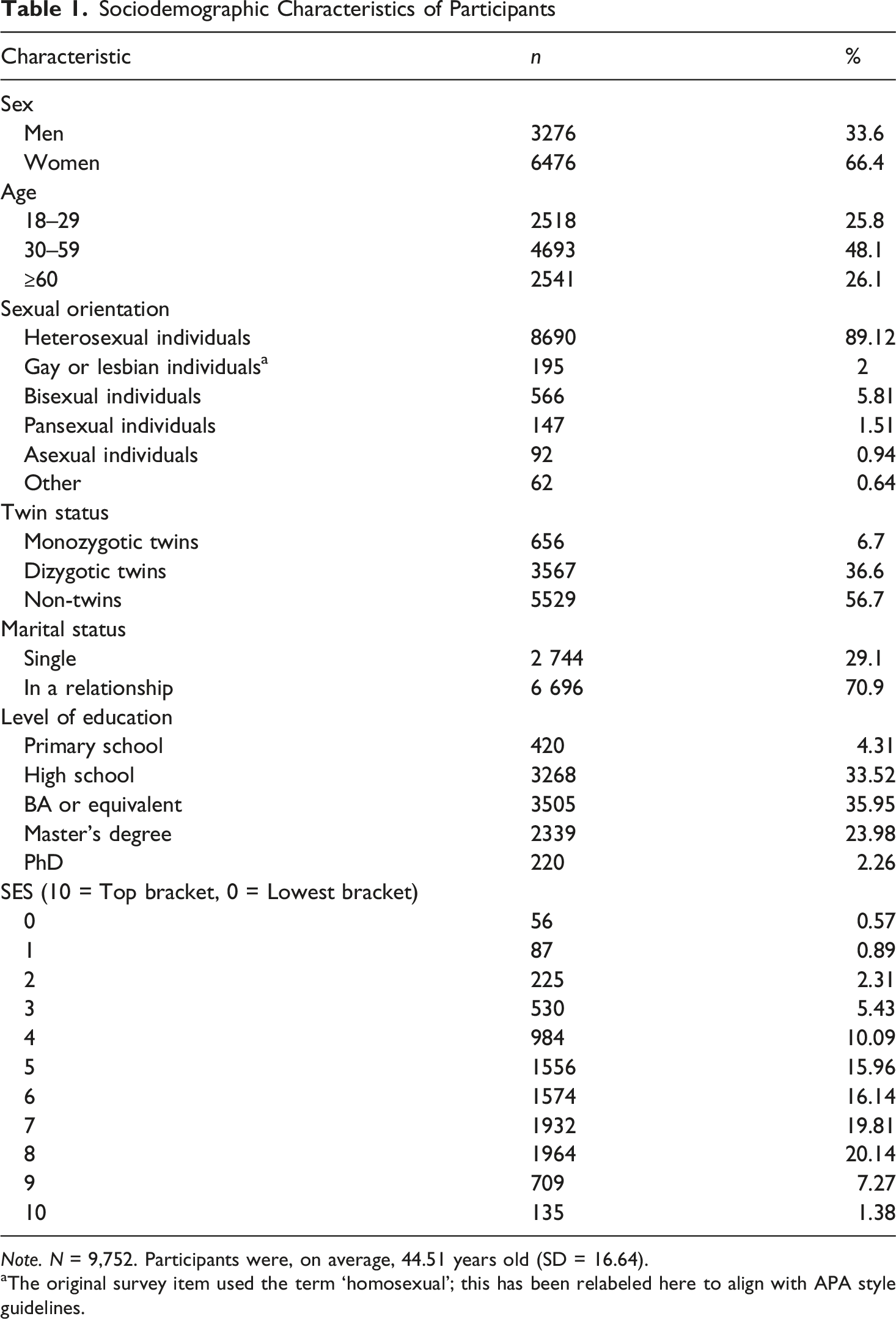
Note. N = 9,752. Participants were, on average, 44.51 years old (SD = 16.64).
aThe original survey item used the term ‘homosexual’; this has been relabeled here to align with APA style guidelines.
Descriptive Statistics for the Whole Sample
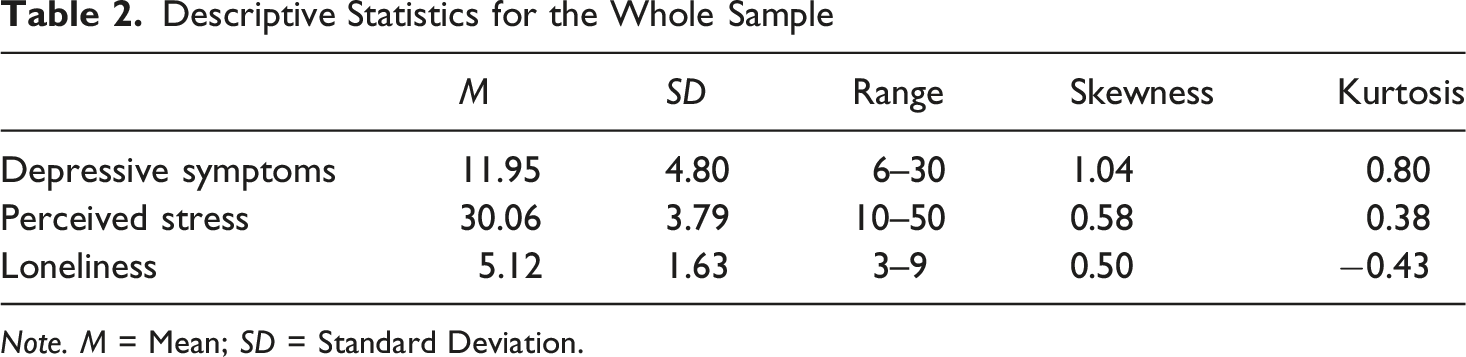
Note. M = Mean; SD = Standard Deviation.
Age and Sex Differences in Prevalence
We conducted LOESS regressions to investigate age and sex differences in loneliness, depressive symptoms, and perceived stress. As shown in Figure 1, for men, loneliness and depressive symptoms followed a nonlinear pattern, with the highest levels among young adults (starting at age 18), decreasing during middle age, and rising again after age 70. Stress among men also followed a similar pattern, except that stress peaked at older ages instead of in young adulthood. In women, loneliness and depressive symptoms peaked in young adulthood and then decreased linearly. Stress in women also peaked in young adulthood, but unlike loneliness and depressive symptoms, stress showed a small uptick in later ages. LOESS regression for loneliness, depressive symptoms, and perceived stress by sex and age. Note. The figure illustrates age and sex related patterns in loneliness levels based on LOESS regression. The graph illustrates a nonlinear U-shaped trend in loneliness scores. The shaded area represents 95% confidence intervals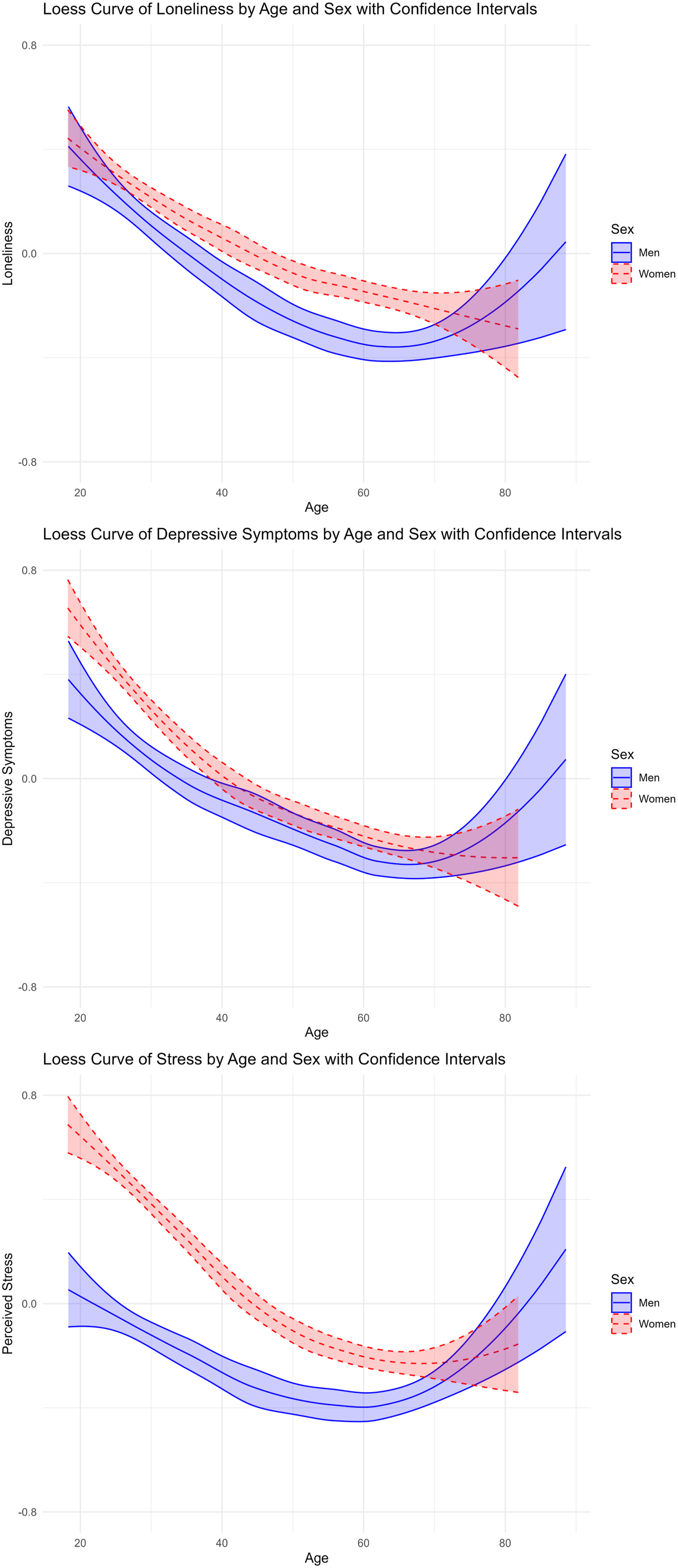
Descriptive Statistics for Men and Women
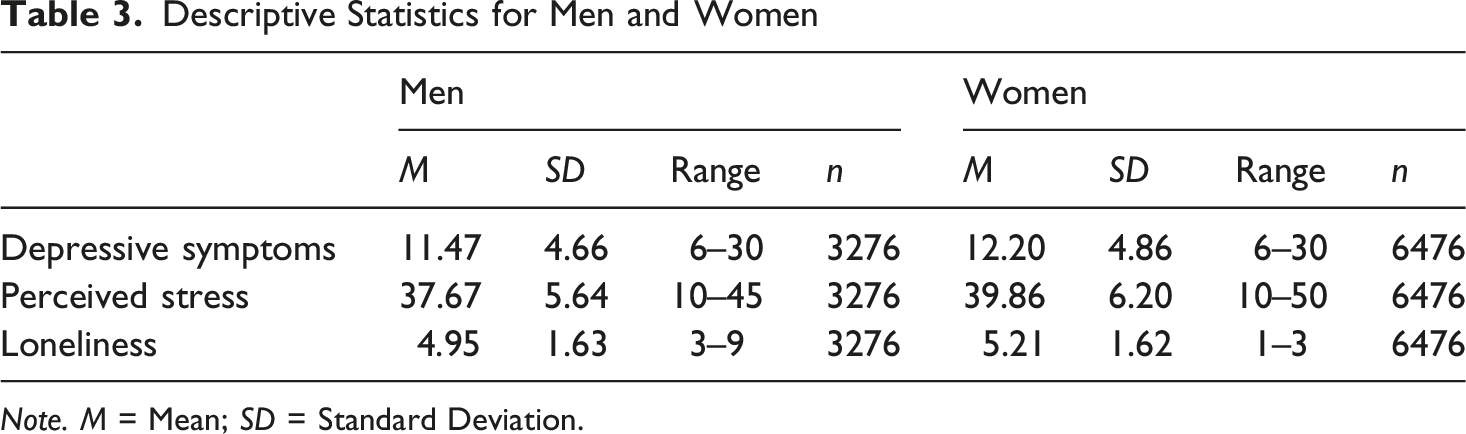
Note. M = Mean; SD = Standard Deviation.
Results of the Mixed-Model Causal Mediation Analysis
Correlations indicated that loneliness was positively correlated with depressive symptoms, r (9750) = .64, 95% CI [.63, .65], p < .001, and with perceived stress, r (9750) = .46, t = 51.59, 95% CI [.45, .48], p < .001. Perceived stress also positively correlated with depressive symptoms, r (9750) = .69, 95% CI [.68, .70], p < .001. Loneliness explained 41% of the variance in depressive symptoms and 21% in stress, while stress explained 48% of the variance in depressive symptoms.
Mixed-Model Causal Mediation Analysis
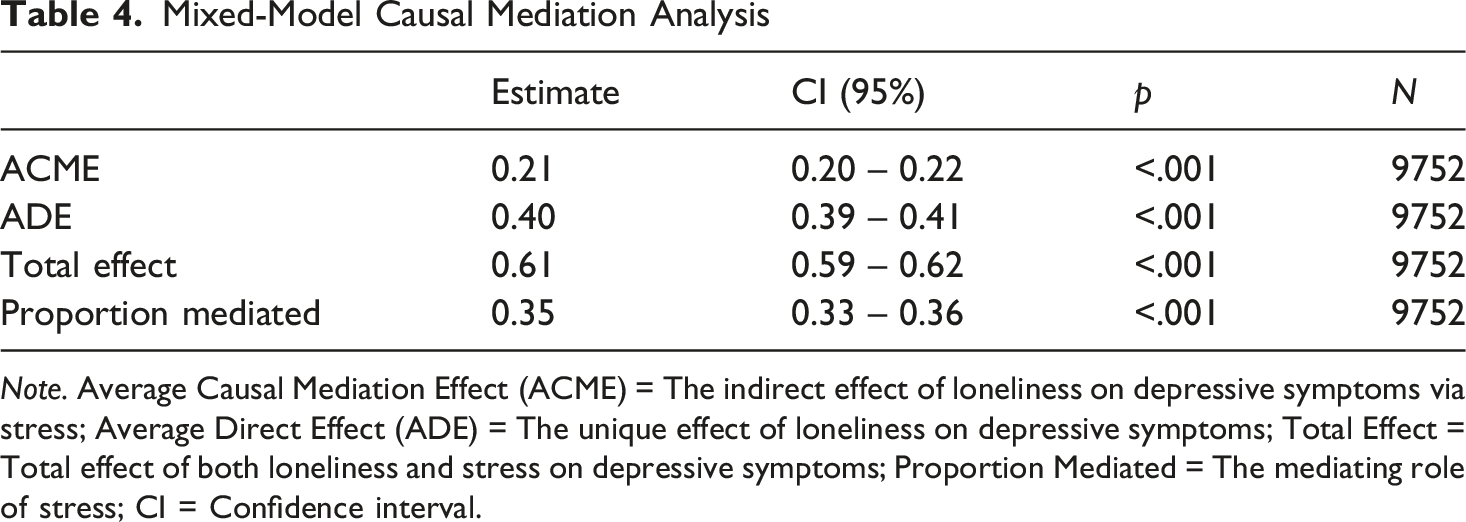
Note. Average Causal Mediation Effect (ACME) = The indirect effect of loneliness on depressive symptoms via stress; Average Direct Effect (ADE) = The unique effect of loneliness on depressive symptoms; Total Effect = Total effect of both loneliness and stress on depressive symptoms; Proportion Mediated = The mediating role of stress; CI = Confidence interval.
Sex and Age Interactions
Results for the Causal Mediation Analysis for all Age Groups
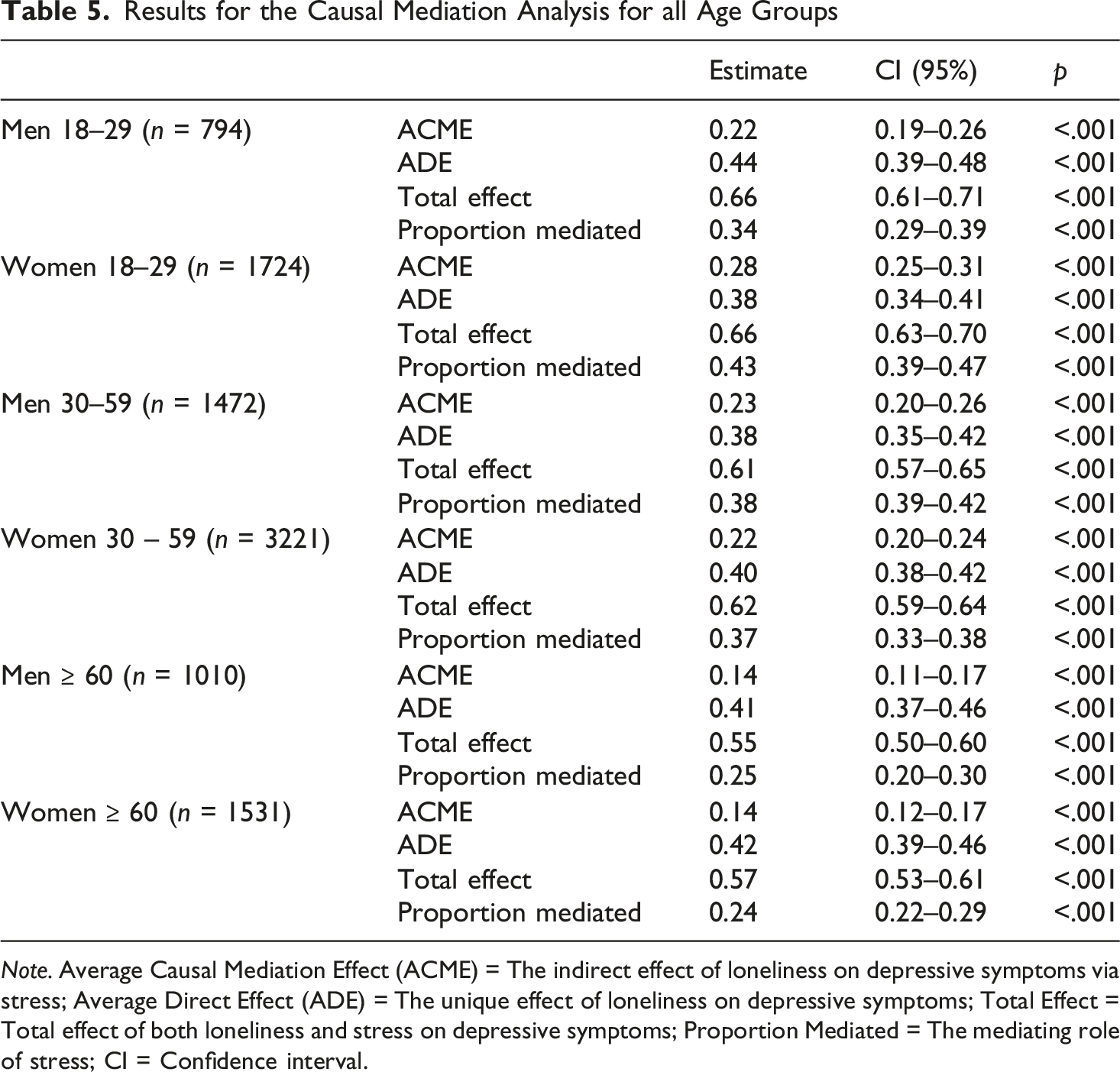
Note. Average Causal Mediation Effect (ACME) = The indirect effect of loneliness on depressive symptoms via stress; Average Direct Effect (ADE) = The unique effect of loneliness on depressive symptoms; Total Effect = Total effect of both loneliness and stress on depressive symptoms; Proportion Mediated = The mediating role of stress; CI = Confidence interval.
Within-sex comparisons across age groups showed that young women had stronger mediation effects than middle-aged women (ACME = 0.06, p < .001), and middle-aged women had stronger effects than older women (ACME = 0.08, p < .001); direct effects were non-significant in both cases. Among men, there were no significant differences between the young and middle-aged groups. However, middle-aged men showed stronger mediation than older men (ACME = 0.10, p < .001), with no significant direct effect.
Discussion
The present study aimed to examine the relationship between loneliness and depressive symptoms, as well as the mediating role of perceived stress, in a population-based sample. While similar models have been tested in older adults (Huang et al., 2019), the present study examined a broader age range. We proposed two hypotheses: first, that loneliness, perceived stress, and depressive symptoms are all positively associated; second, that perceived stress mediates the relationship between loneliness and depressive symptoms, with higher perceived stress being associated with greater depressive symptoms. We also examined age and sex as exploratory moderators of this mediation. By examining perceived stress as a mediator, the present study helps clarify the underlying mechanisms that drive adverse mental health outcomes associated with loneliness.
In line with the first hypothesis and previous research, loneliness was significantly correlated with both depressive symptoms (Erzen & Çikrikci, 2018; Park et al., 2020) and perceived stress (Laustsen et al., 2024), although the correlation with depressive symptoms was somewhat stronger. This may partly be explained by the fact that an item in the depressive symptoms measure inquired about loneliness. However, this stronger association may also stem from the emotional impact of loneliness, which aligns with core symptoms of depression, such as feelings of worthlessness and sadness (Cacioppo et al., 2006). Consistent with previous research (Cristóbal-Narváez et al., 2020), perceived stress showed the strongest positive correlation with depressive symptoms among the three variables. Consistent with the second hypothesis and prior research (Huang et al., 2019), perceived stress mediated the relationship between loneliness and depression. It should be noted that the associations were weak.
The results are in line with our theoretical assumption that loneliness increases depression, and that loneliness is a stressful event, activating the stress-response system (Cacioppo & Cacioppo, 2018). The results align with a model where not only does loneliness itself increase cognitions and behaviours that heighten depressive symptoms, but the stress reaction associated with loneliness also increases the individual’s vulnerability to depressive symptoms.
While the study by Huang et al. (2019) examined sense of coherence in older adults (≥60), the present study focused on the mediating role of stress in the association between loneliness and depressive symptoms as predicted by ETL. The present study also examined a broader age range (18-88) and both sexes, thus building on previous results by finding significant mediation across age and sex. As Huang et al. (2019) found that sense of coherence moderated the mediation, and as sense of coherence can be conceptualized as a form of emotional coping (Antonovsky, 1993), future studies should include sense of coherence and other coping styles to investigate how coping with loneliness affects this mediation.
The Role of Age and Sex
Due to age and sex differences in the role of social connectedness, we included age and sex as exploratory moderators. The mediating effect of perceived stress was significant for all subgroups. However, the subgroup comparisons revealed key differences. The only significant sex difference was a stronger mediation effect in younger women than in younger men. Similar age-related effects were observed among women: the mediating role of stress appeared to decline with age, such that young women showed stronger mediation effects of stress than middle-aged women, who, in turn, showed stronger mediation effects than older women. Among men, the only age-related difference was detected between middle-aged and older men, with stronger mediation in the middle-aged group. No significant age-related differences were found in the direct effect, which is consistent with Park et al. (2020). In summary, the mediating role of perceived stress appears to decline with age. While perceived stress mediates the loneliness–depression association across all groups, the effect is strongest in younger women and weakest in older adults.
One possible framing for the sex difference is based on the Transactional Stress model (Lazarus & Folkman, 1987). As this theory emphasizes the role of coping methods in dealing with perceived stress, we note that prior research indicates sex-based differences in coping between men and women. Social and instrumental support has been found to have a significant association with women’s quality of life, but not with men’s (Gattino et al., 2015). Research has shown that certain adaptive coping strategies, such as problem-focused coping styles, are associated with lower levels of loneliness (Deckx et al., 2018) and reduced stress (Littleton et al., 2007). On the other hand, emotion-based coping is associated with higher levels of loneliness (Deckx et al., 2018), stress (Littleton et al., 2007), and depression (Ho et al., 2022). While there is no clear difference in problem-solving coping styles between men and women, women tend to use more emotion-based coping styles and seek emotional support from others (Meléndez et al., 2012; Tamres et al., 2002). (Zhang et al., 2015) found that friend support reduces the effect of stress on depressive symptoms in adolescent women, while the stress-depression relationship in men remains unaffected. It therefore seems that women rely more on social support for coping with negative emotions and thus would be slightly more vulnerable to the effects of loneliness.
Social network size is larger in young adults and decreases throughout life thereafter, reflecting relationship consolidation (Bruine De Bruin et al., 2020; Wrzus et al., 2013). The Socioemotional Selectivity Theory (Carstensen, 2006) can be used to explain the age-related differences in strength of the mediation across age groups. This theory posits that age and awareness of a limited time shift older adults´ focus toward emotional satisfaction, whereas younger adults tend to focus more on gathering new knowledge. Older adults tend to focus more on emotionally and socially satisfying social networks (English & Carstensen, 2014), which may protect them from the adverse effects of loneliness.
Personality traits might explain the decrease in the mediating effect of perceived stress in older adults. We found that stress, loneliness, and depressive symptoms are lower in older age groups, which could be partly attributable to declines in neuroticism, which is strongly associated with loneliness (Buecker et al., 2020), depression (Hakulinen et al., 2015) and perceived stress (Luo et al., 2023) and which decreases over time (Costa et al., 2019; McAdams & Olson, 2010). Neuroticism also tends to be higher in women than in men (Costa et al., 2001; South et al., 2018).
Difference in Prevalence of Loneliness, Perceived Stress, and Depressive Symptoms
Our findings regarding sex differences in loneliness align with some previous studies showing higher reports among women (Luhmann & Hawkley, 2016). However, unlike other studies conducted during the COVID-19 pandemic (Best et al., 2025; McQuaid et al., 2021), we found no significant difference among young adults. Middle-aged women reported higher levels of loneliness than men of the same age. Age-related patterns also emerged: loneliness peaked in young adults, and followed a U-shape curve in men, consistent with, e.g., Luhmann and Hawkley (2016) and Mund et al. (2020). No increase in loneliness was observed in older women, likely due to the small number of women participants over the age of 80 (28 women). This finding aligns with that of Nyqvist et al. (2016), who reported that loneliness in Finland peaked in young adulthood and declined until age 80. In combination, these two findings suggest that loneliness in older Finnish women may not increase with age or may rise later than in other populations. Loneliness in young adults can be viewed in terms of their broader social circles, and the need to balance between the quality and quantity of social relations (Mund et al., 2020). For most, this tends to stabilize over time, leading to a decrease in loneliness in middle age (Mund et al., 2020). As noted previously, the shift in focus from a broad social network to a more emotionally satisfying network (English & Carstensen, 2014) may help protect older women from loneliness. For further discussion on age differences in loneliness, see, for example, Mund et al. (2020) and Qualter et al. (2015).
Women reported more depressive symptoms than men, with the largest difference in young adults; this gap narrowed with increasing age. These findings align with previous research indicating a higher prevalence of depression in women (Collier Villaume et al., 2023). Women reported higher levels of perceived stress, with consistently higher levels for both young- and middle-aged women, which is consistent with previous research (Barbosa-Leiker et al., 2013; Butaney et al., 2023). This indicates that women appear more vulnerable to depressive symptoms than men, but the difference is not noticeable in older ages.
Strengths and Limitations
The substantial sample size and population-based sampling methodology strengthen the generalizability of these findings. As Shrout (2011) notes, perfect mediation cannot be assumed due to possible unmeasured confounders. Thus, the present study provides a foundation for future research into the mechanisms connecting loneliness and stress to depression. Information on sex was obtained from the Digital and Population Data Services Agency of Finland and therefore only includes information on the individual´s registered sex in the registry. This does not necessarily align with the self-identified gender. The dataset did not include information on disability status, which limits the generalizability of the findings. There were also some differences between the sample and the general Finnish population that warrant consideration when generalizing. There was an overrepresentation of both women and older individuals compared with the official statistics of Finland (Statistics Finland, 2025). There also seems to be an overrepresentation of individuals of higher socioeconomic status; the scale used was a subjective measure compared with others, and a disproportionate number of participants evaluated themselves as above the middle.
The data for the study were gathered during the COVID-19 pandemic, which may have influenced the higher levels of loneliness (Best et al., 2025; Jarry et al., 2025; McQuaid et al., 2021) and higher levels of perceived stress in women (Butaney et al., 2023). While this might influence the absolute levels of loneliness and perceived stress in the different groups, there are no indications that it would influence the mediations. This still highlights the need for replication of the study using new data.
The psychometric properties of the UCLA Loneliness Scale have been extensively studied, and the scale has been translated into several different languages (Alsubheen et al., 2021), but to our knowledge, it has not been validated in a Finnish sample. Similarly, both the PSS-10 and the BSI-18 have been extensively used (Govindasamy et al., 2020; Yılmaz Koğar & Koğar, 2024), but to our knowledge, they have not been validated in a Finnish sample. Though all these questionnaires have been developed in a Western context, the lack of validation in a Finnish context introduces potential problems for measurement invariance.
Future Research
First, future research should seek to replicate the results of this study using new data. Future research should also examine the role of perceived stress as a link between loneliness and depression, with a focus on longitudinal data across different time intervals. Although theoretical frameworks suggest a causal relationship, as noted by Shrout (2011), future longitudinal studies are necessary to corroborate these findings. As this study is cross-sectional, future research should explore longitudinal associations to clarify when and how these effects interact, particularly between perceived stress and the physiological stress response associated with loneliness. The first step would be to investigate whether the mediation exists as a temporally causal chain, as we assumed for this cross-sectional data, and if not, then the argumentation fails. Second, similar data should be used to investigate how stress mediates the link between loneliness and depression across different ages and sexes. For improved generalization to the general population, we also recommend using self-identified gender for future studies, as this study only used population-registered sex, which does not necessarily correspond to self-identified gender. Based on the results from the study by Huang et al. (2019), future studies should focus on investigating how coping styles, neuroticism, and the development of social network quality and quantity across the lifespan affect the relationships between loneliness, perceived stress, and depressive symptoms. Future studies should also place particular emphasis on young women as a group, as they showed the strongest mediation in the present study.
Clinical Implications
As the data were cross-sectional, one must be careful when making clinical recommendations. The present study, however, highlights two points that may offer clinical value. First, it highlights the association between loneliness, stress, and depression, making it imperative to consider the interplay between them when working with clients struggling with loneliness. Second, this study also indicates that age and sex might affect the associations, with older adults showing weaker mediation of perceived stress. Thus, clinicians working especially with young women dealing with loneliness should keep in mind the role of stress in the link between loneliness and depression, i.e., according to the model, lowering stress may be associated with a lowering of depressive symptoms associated with loneliness.
Conclusions
Our findings demonstrate associations between loneliness, perceived stress, and depressive symptoms. Perceived stress emerged as a central mediator between loneliness and depression. Gender-specific analyses showed higher levels of all three variables in women than in men. Loneliness peaked in young adults, was lower in middle age, and among men was higher again in older age, identifying young adults and women as high-risk groups. The mediating role of perceived stress was strongest in young women and weakest in older adults.
Footnotes

Ethical Considerations
This study was performed in line with the principles of the Declaration of Helsinki and the institutional guidelines of Åbo Akademi University. Approval was granted by the Board for Research Ethics at Åbo Akademi University prior to the start of data collection.
Consent to Participate
Informed consent was obtained from all individuals participating included in the study and privacy rights were observed.
Author Contributions
Funding
The authors disclosed receipt of the following financial support for the research, authorship, and/or publication of this article: All work and revising material was done either as part of employment or enrollment as a student at Åbo Akademi University.
Declaration of Conflicting Interests
The authors declared no potential conflicts of interest with respect to the research, authorship, and/or publication of this article.
Data Availability Statement
Open Science Statement
Declaration of Generative AI and AI-Assisted Technologies in the Writing Process
During the preparation of this work the first author used Microsoft Copilot to shorten the text. After using this tool, the author reviewed and edited the content as needed and takes full responsibility for the content of the publication.