



Abstract
This review investigated what is known about the impact of bilingualism on children’s phonemic awareness. Studies of bilingual children where one language was English were identified by searching electronic databases and bibliographies from the last 50 years. Thirteen studies were analysed thematically and summarized in terms of methods and key findings. Findings suggest a variable pattern of performance, with some studies showing no difference between bilingual and monolingual performance on tasks. However, there was also evidence for advanced acquisition of phonemic awareness skills in some bilingual children, mediated by characteristics of languages spoken.
I Introduction
Internationally, bilingualism or multilingualism 1 is the norm with many people speaking two or more languages to varying degrees of proficiency (Tucker, 1999). However, in the UK and many other English-speaking countries, monolingualism is more common and, indeed, society is set up to meet the needs of a primarily monolingual population. Nevertheless, the numbers of children in school in the UK who are known or believed to speak English as an additional language are rising. The 2010 schools census for England showed that 16% of pupils in primary schools and 11.6% of secondary school students speak English as an additional language (Department for Education, 2010), showing an increase from 14.3% and 10.6% respectively since 2008. The range of languages spoken by school children in the UK is extensive, with more than 240 languages reported in England in 2008 (Department for Children, Schools and Families, 2008). Figures for the USA and Australia show similar patterns (Federal Interagency Forum on Child and Family Statistics, 2010; State Government of Victoria, 2009).
Of interest to speech and language therapists is the impact that being bilingual might have on speech and language development. There is evidence to suggest that bilingual children are both under- and over-represented in speech and language therapy caseloads (Winter, 1999, 2001), suggesting that referrers and speech and language therapists are struggling to differentiate between typical development and speech/language impairment in children who are bilingual. The need for more information regarding the typical development of children who are bilingual in a range of speech and language domains is recognized as a means to assist in reliably identifying those children who are at risk of difficulty in this area.
With regards to speech development more specifically, a recent review has considered the evidence relating to bilingualism and speech production (Hambly et al., 2013). This study focused exclusively on studies of speech output and excluded studies relating to aspects of input processing, such as phonological awareness. Phonological awareness is the ability to consciously reflect on, detect and manipulate sounds in speech. It relies heavily on the ability to perceive and internally analyse the sound structure of words at three levels of sound structure: syllables, onsets and rimes and phonemes. Activities that can be used to assess and promote these skills include segmentation, deletion, detection, substitution, blending and discrimination.
Many of these activities form part of the teaching of pre-literacy skills in schools and pre-schools. Indeed, many studies of literacy and emerging literacy development have considered these skills in relation to children who are learning two or more languages (for a review, see Melby-Lervåg and Lervåg, 2011). However, these tasks also often form the basis of interventions for speech disorder (Gillon, 2004; Hesketh et al., 2000; Wren and Roulstone, 2008) and, while there is evidence to suggest that some of these skills can transfer between languages in typically developing children (Bialystok et al., 2005; Geva et al., 2000; McBride-Chang and Kail, 2002; Stewart, 2004), less is known about the relationship between the development of phonological awareness and speech in children who are bilingual and its impact on speech development.
There are some obstacles to investigating this. First, children who are collectively identified as bilingual will vary in terms of the number and range of languages spoken, the age at which they were exposed to each language and the amount of regular exposure to each language, and the degree of proficiency in each of the languages spoken. For this reason, Bialystok and Herman (1999) make the point that bilingualism is a complex variable and should not be treated in the same way as more concrete variables, such as gender and age.
Whilst many studies broadly distinguish between sequential (learning one language then another) and simultaneous (learning both at the same time) bilinguals, Grech and McLeod (2012) provide a more comprehensive summary of the range of definitions of bilingualism used within the language acquisition literature. They consider that the definitions fall into one of three categories: (1) bilingual exposure from birth, (2) using more than one language in day-to-day functioning, and (3) a continuum of use and proficiency of more than one language. Use of any one of these definitions over another will have implications for the identification of a sample of participants and subsequent results and conclusions. The plan for the review reported in this article was therefore to use a broad concept of bilingualism in which any one of the definitions outlined above could apply in order to be as inclusive as possible.
The second obstacle to exploring phonological awareness skills in bilingual children is the direction that any impact of bilingualism may have on these emergent abilities. A lack of proficiency in English may cause difficulty for a child entering school in an English-speaking country; however, it should not be assumed that speaking more than one language automatically places a child at a disadvantage for developing these skills. Indeed, because the child is dealing with phonological systems for two or more languages, it could be argued that a bilingual child may have an advantage. Whilst there is debate in the literature regarding the dual-systems model (Paradis, 2001) and the presence or absence of separate phonological systems for each language, a child who has had to learn more than one language has arguably had more practice at segmenting and blending words for early speech and language development than the monolingual child. This was the justification for Bialystok et al.’s (2003) study, which explored the concept of an advantage for bilingual children in developing phonological awareness skills. They noted, as Kohnert and Medina (2009) found in their review, that most investigations to date of a potential bilingual advantage in developing communication skills had been explored in the area of language impairment more generally, rather than aspects relating to speech or phonological development.
The counter-argument to this second obstacle relates to the fact that language-specific processing of phonetic information occurs in the first year of life, including use of stress and attending to a variety of lexical and sub-lexical auditory properties (Polka et al., 2001; Werker and Curtin, 2005). Children who are exposed to a second language later than this could be disadvantaged because their system was attuned at an early age to an alternative language. Goldstein and Bunta (2011) refer to these phenomena as negative transfer – where bilingual children are delayed in their development compared to their monolingual peers, and positive transfer – where the reverse occurs. A review of studies investigating phonological awareness in children who are bilingual would need to consider the degree to which either positive or negative transfer had occurred, placing the child at either an advantage or disadvantage in comparison to their monolingual peers.
Finally, phonological awareness consists of a range of skills operating at different levels of sound structure as outlined above and performance in these may vary for different groups of bilingual children. As the smallest unit of speech, phonemes are the basis for constructing onsets, rimes and syllables. Languages vary in the number and type of phonemes used in their sound system and in how the phonemes are combined. As a consequence, children who speak more than one language have to become proficient in their awareness and production of a greater number of phonemes and phoneme combinations than children who are monolingual speakers. An understanding of the relationship between bilingualism and phoneme awareness then could arguably provide the most enlightening information regarding the performance of bilingual children compared to monolingual children. In turn, this information can help to identify the difference between typically and atypically developing children in relation to this core skill, which underpins both speech and literacy development, thus assisting in the identification of children who need referral to speech and language therapy.
The aim of this review was, therefore, to understand the impact of bilingualism on the development of phonemic awareness skills in children who are typically developing. This review was carried out as part of a larger systematic review on speech acquisition in children who are bilingual. Whilst the results for the larger number of studies of speech production has already been reported (Hambly et al., 2013), this article considers the articles identified in the review that investigated phonemic awareness, either alone or alongside other phonological awareness skills.
II Method
The criteria for the larger review of speech acquisition were quite broad in that they sought to identify studies of speech acquisition in children who speak more than one language. The inclusion criteria are summarized in Table 1. Studies were included in the review if:
Inclusion criteria for review of studies of speech acquisition and bilingualism.
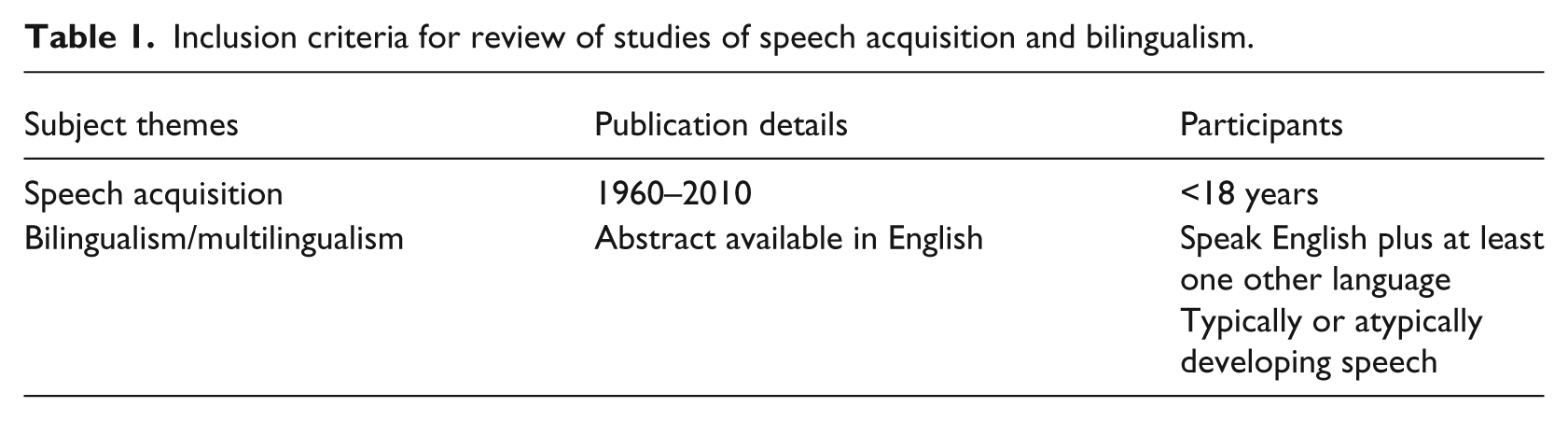
they investigated speech acquisition;
they were published between 1960 and September 2010;
the participants were aged less than 18 years and spoke English plus at least one other language; and
the abstract was available in English.
The inclusion criteria specified that one of the languages spoken must be English. This was because the authors were interested in understanding the impact of bilingualism on the development of the English speech sound system specifically in order to assist clinicians working with bilingual speech impaired children in the UK, where the vast majority of children will speak English to some extent. Abstracts needed to be available in English so that the research team could access them. Funding for translation of texts was not available.
Search terms used were entered into seven electronic databases (PsychINFO, Medline, CINAHL, Embase, British Nursing Index, AMED and CSA) and are detailed in Table 2. In addition to the database searching, bibliographies of review and study articles were used and key authors contacted to identify studies that may have been missed through the database search or that had not yet been published.
Search terms used in review.
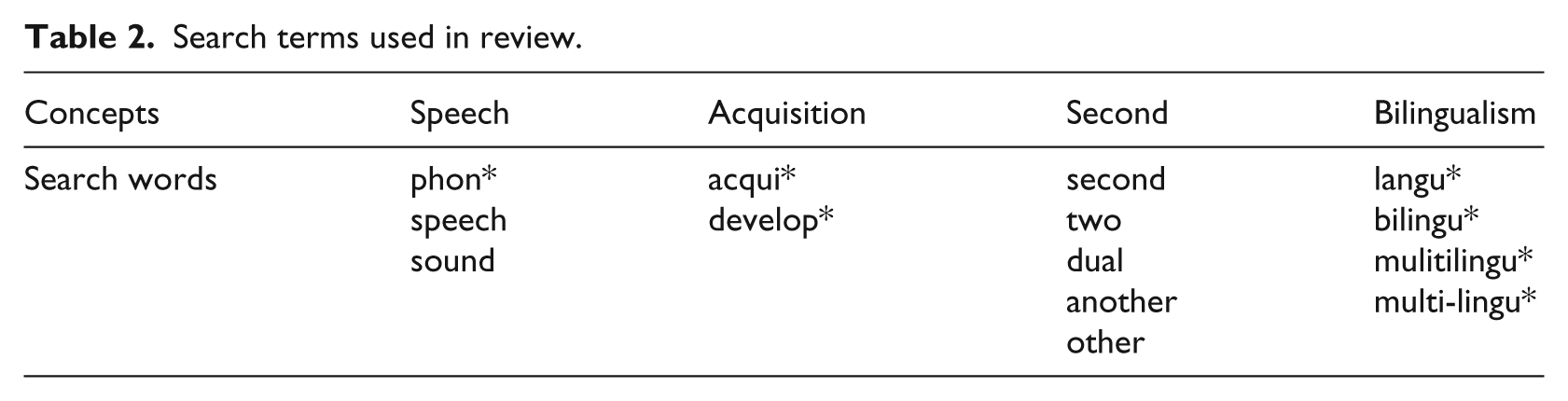
Search terms were selected that were suitable for a review relating to speech acquisition more broadly, rather than specifically in relation to phonemic awareness skills. The specific terms were selected as it was regarded by the research team that these would retrieve the widest pool of articles within the specific area of investigation. Rhyme/rime and syllab* were not included in the search terms, meaning that studies which reported on these aspects of phonological awareness specifically and exclusively would not be retrieved.
Search terms were entered as a string and run-on abstracts rather than titles or full texts. The following search string was used to identify relevant articles for the review: (phon$ OR speech OR sound$) AND (acqui$ OR develop$) AND (((second OR two OR dual OR another OR other) AND language$) OR (bilingu$ OR multilingu$ OR multi-lingu$)).
All included studies were categorized as relating to either speech production, speech perception or pre-literacy skills. Information regarding sample, assessment methods, underlying theories, summary of findings and study limitations was collated for each study. Inter-rater reliability was measured for 14 of the 260 studies considered for inclusion in the review (5.4%). A two-stage process was carried out whereby the second reviewer started by considering which of each of these 14 articles should be included in the review. The second stage required the reviewer to allocate the article to one of the three categories of speech production, speech perception and pre-literacy skills. Allocation and categorization were compared across both reviewers and there was agreement on both stages for 12 out of the 14 studies (86%). For the two where there was disagreement, the two reviewers identified that the differences of opinion were regarding the categorization of the studies to either speech production or pre-literacy. The two studies both investigated nonword repetition in bilingual children, and therefore involved both a speech production component in repeating the nonword and also a pre-literacy component, in that nonword repetition was being used in the study to assess children’s pre-literacy skills. Following discussion regarding the specific tasks involved in the studies, consensus was reached and both studies were allocated to the pre-literacy group in line with the first reviewer’s allocation.
The articles identified in the pre-literacy category included studies investigating performance on phonological awareness tasks generally as well as nonword repetition. Within this category there was a subgroup of articles reporting performance on phonemic awareness tasks. Types of activity that were classified as phonemic awareness were phoneme segmentation, phoneme substitution, phoneme deletion/elision, phoneme identification, phoneme isolation, phoneme blending (combining speech segments into words), phoneme matching and word completion (phoneme addition). This article reports only on those studies that reported performance on one or more of these phonemic awareness tasks. Figure 1 shows a flowchart that summarizes the process of identification of articles for inclusion in the review.
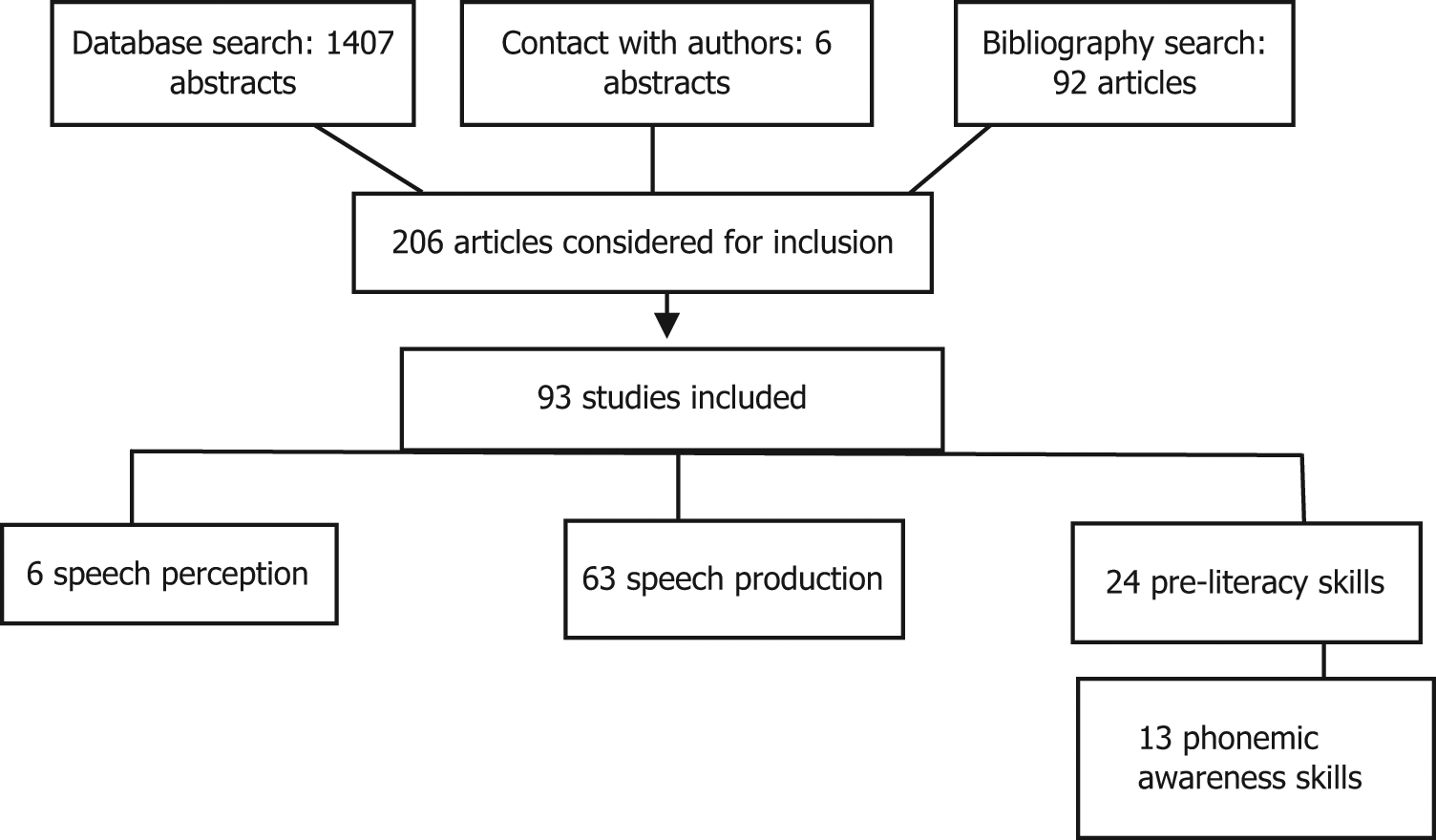
Literature search flow diagram.
Studies were excluded if they addressed aspects of language rather than speech, such as vocabulary development, grammar, code switching, language comprehension or literacy. Studies were also excluded if they investigated another type of pre-literacy skill such as nonword repetition; or if they considered speech production exclusively; or if they investigated speech perception such as that which is investigated in babies and where no metalinguistic skill is required to reflect on the sound structure. While some of the studies in the review also considered performance on other phonological awareness tasks, such as rhyme or syllable awareness, these were not the focus of this review and the results for these aspects of the article were not included. Studies were not excluded based on research design or size of sample.
Of the total of 1505 abstracts that were located during the database and bibliographic searches and author contact for the whole systematic review, 206 were identified as potentially relevant. Of these, 93 met the inclusion criteria; 13 of these were categorized as studies investigating phonemic awareness skills of typically developing bilingual children and are reported in this review.
III Results
Studies investigated phonemic awareness in children from a range of language backgrounds, which are listed in Table 3. Eleven studies considered one language pairing, most frequently English and Spanish or French. One study considered multiple language pairings (Bialystok et al., 2003; Spanish, French, Chinese) and another considered children from a range of language backgrounds (Muter and Diethelm, 2001). The studies are summarized in Appendix 1.
Studies of phonemic awareness skills in bilingual children with typical speech development.

Note: * Mixed bilingual studies: Muter and Diethelm (2001) included children who attended an English school in Switzerland with one or more parents speaking French, Yugoslavian, Turkish, Spanish, Japanese, Hungarian, Russian and/or Dutch.
Nine studies employed a case control design to compare bilingual children’s and monolingual children’s speech processing, and four were cohort observation studies. Children’s ages ranged between four and seven years. Phonemic awareness tasks used in the studies were segmentation, counting, deletion, detection, substitution and blending. In two studies tasks were administered using a standardized battery, such as the Comprehensive Test of Phonological Processing (CTOPP) (Wagner et al., 1999). Sample sizes for groups within studies ranged from 10 to 100, while the mean was 37 and the mode and median both 30.
Of the nine studies comparing phonemic awareness in bilingual children and monolingual children using case-control designs, four did not find any significant differences between groups. Chiappe and Siegel (1999) found that Punjabi–English sequential bilingual six-year-olds performed at an equivalent level to that of English monolingual children of the same age in tasks of phoneme recognition, phoneme identification, phoneme deletion and phoneme substitution. In a study of Cantonese–English sequential bilingual four- to five-year-olds, Dodd et al. (2008) found that they did not differ from Cantonese monolingual children in phoneme detection or phoneme identification tasks. Bruck and Genesee (1995) assessed English–French bilingual kindergarten children on phoneme awareness and found no difference in comparison with age-matched English monolinguals. Similarly, Muter and Diethelm (2001) found that there was no difference between their English monolinguals and bilinguals from mixed language backgrounds on tasks of phoneme completion and phoneme deletion. Moreover, they found that this performance was stable over time with both groups showing a similar pattern at age four to five years and then again when reassessed a year later.
While Laurent and Martinot (2009) found broadly similar findings at a surface level, they did nevertheless notice differences in the way the children performed the tasks. Their investigation of French–English bilingual children and French monolinguals aged five to six showed that there was no difference between the two groups on tasks involving free segmentation (where a child could identify either the initial phoneme or the onset of a given word) and phoneme deletion in French. However, when they considered how the children carried out the tasks, they noticed that the bilingual children were more likely to segment to the individual phoneme whereas the monolingual children tended to segment to the onset, that is, one or more phonemes. Moreover, while both groups performed poorly on the phoneme deletion task, when the incorrect responses were analysed they found that the responses of the bilingual children were closer to the targets than the monolingual children.
Three studies found positive transfer for phonemic awareness, that is, improved performance for bilingual children in comparison to monolingual children. Campbell and Sais (1995) reported that Italian–English bilingual children aged four to five years were significantly better than English monolingual children at picture sorting by initial sound. Marinova-Todd et al. (2010) found variation in performance between bilinguals and monolinguals, depending on the task, in their comparison of Mandarin–English bilinguals children aged five to six years and Mandarin and English monolingual children of the same age. Specifically, they found that when the tasks, were in English, the bilingual children showed an advantage in phoneme elision and phoneme blending but there was no difference on sound matching. When the tasks were in Mandarin, the bilingual children showed an advantage in initial sound identification.
Bialystok et al. (2003) compared bilinguals with monolinguals in three different language pairings – French–English, Chinese–English and Spanish–English – and found different patterns of response for each group. With regard to positive transfer, the bilingual Spanish–English children showed better performance on a phoneme segmentation task than English monolinguals. However, the English monolinguals outperformed the Chinese–English bilinguals, suggesting a language difference.
None of the nine studies found consistent evidence that monolinguals performed better than bilinguals at phonemic awareness tasks, but two articles did report advanced performance on specific task items for monolinguals even though this pattern was not repeated in other tasks. Bialystok et al. (2003) found that the monolingual English and French children in their study outperformed bilingual French–English-speaking children in a phoneme substitution task, but only when sound prompts were given. No difference was noted in the ‘no prompt’ condition. Cisero and Royer (1995) found a language difference in their study of phonemic awareness in Spanish–English and English-speaking five- and six-year-olds. While the monolingual children achieved higher scores than the bilingual children on word initial and word final phoneme detection in English, they were worse than the bilinguals in tasks in Spanish. This is perhaps not surprising, given that the first language of the bilingual children was predominantly Spanish while the English monolingual children had only limited competence in Spanish. A caveat to this study is also the finding that socio-economic status accounted for much of the variance in both groups of children.
With regard to the cohort studies, Hamilton and Gillon (2006) found that Samoan–English-speaking children aged between five and seven years achieved similar scores on tests of phoneme blending, phoneme isolation and phoneme segmentation in Samoan and English and that their scores did not differ significantly from the monolingual norms for the tests used. Kim (2009) tested Korean–English speakers on a number of phonemic awareness tasks in both languages and found a high correlation between individual performance in Korean and English. Lopez and Greenfield (2004) assessed Spanish–English-speaking children on a range of oral proficiency and phonological awareness tasks in both Spanish and English. Performance on phonemic awareness tasks in English was predicted by the degree of oral proficiency in English and level of skill at phonological awareness tasks in Spanish. These findings together with those of Cisero and Royer (1995) suggest that degree of competence in the language used in phonemic awareness testing combined with skill in phonemic awareness in any language are the best predictors of phonemic awareness in English.
This similarity in test scores does not, however, mean that performance is equivalent in bilingual and monolingual children in terms of phonemic awareness testing. Similar to Laurent and Martinot (2009), Yavaş and Core (2001) report a cohort study of Spanish–English five- and six-year-olds in which, although the bilingual children appeared to perform similarly to monolingual children, there were differences in the ability to segment words into phonemes depending on the manner of phoneme used in the task. Specifically, they found that the performance of bilingual children was similar to that of monolingual children for segmentation of stops, fricatives and nasals but that bilingual children were better than monolingual children on segmenting word-final liquids.
IV Discussion
This review identified a number of studies that have been considered in terms of their contribution to our understanding of the impact of bilingualism on the development of phonemic awareness. To summarize the findings, bilingual children performed either similarly or better than monolingual peers on tasks including phoneme deletion, phoneme segmentation, phoneme isolation, phoneme blending and phoneme substitution. Studies in which bilingual children outperformed their monolingual peers tended to be those that investigated bilingual children whose other language was more closely related to English. Bialystok et al. (2003) observed positive transfer for Spanish–English bilingual children but not for Chinese–English, suggesting that specific language characteristics may play a role in advancing phonemic awareness, rather than bilingualism per se. This is further emphasized by three of the four studies showing positive transfer for bilingual children involving French, Spanish and Italian, all languages that share some characteristics with English.
Performance on phonemic awareness tasks was also influenced by the type of task, as well as by the degree of language proficiency. Moreover, bilingual children were found to use different phonological information to perform tasks compared to their monolingual peers (Laurent and Martinot, 2009) and to show different performance profiles in each of their languages (Cisero and Royer, 1995; Hamilton and Gillon, 2006; Marinova-Todd et al., 2010). Evidence from a cohort study involving Korean–English bilinguals suggests that language specific structures, including phonetic and tonal characteristics, are influential on different aspects of phonemic awareness development (Kim, 2009), while Lopez and Greenfield (2004) found that degree of language proficiency also had an effect.
This review contained a number of limitations, which should be borne in mind when interpreting the findings. First and most importantly, this was part of a larger systematic review of speech acquisition in which a number of articles relating to phonological awareness and other pre-literacy skills more generally were retrieved. Search terms reflected the initial focus on speech acquisition and, as such, did not include terms relating to phonological awareness more generally such as ‘rhyme’ or ‘syllable/syllabic’. Had these terms been included, it is likely that a broader and more extensive range of literature may have been identified. For this reason, the review was limited to phonemic awareness rather than the more generic term, phonological awareness.
Second, definitions of bilingualism varied in the articles that were reviewed, and the languages spoken by the children were wide ranging. Moreover, only those studies that reported English as one of the languages spoken were included, thus reducing the potential number of articles in the field. Therefore, while findings are reported and interpreted for the studies as a whole, it should be borne in mind that there was variation in the findings and that language specific phenomena may be apparent, which is masked when comparing across languages. In addition, variation due to degree of language exposure and proficiency could also have an impact that cannot be detected through group comparisons.
Clarification of whether exposure to, and use of, more than one language in childhood is a disadvantage or advantage for developing phonemic awareness skills is of use to speech and language therapists who need to understand the impact that this could have on children’s developing speech systems. With regards to this review, the findings were mixed, with most studies suggesting positive transfer or no difference. Given the principle that phonological awareness skills are transferable between languages, the equivalent performance of monolingual and bilingual children should not be a surprise. The fact that some children, or at least some specific tasks, show an improved performance by bilingual children needs further explanation.
Whilst phonological awareness skills may be transferred between languages, this simple explanation fails to consider the difference in phonological structure between languages that might account for the improved performance of some groups of children on certain tasks. Bruck and Genesee (1995) and Campbell and Sais (1995) noted an improved performance on syllable awareness tasks by children who were French and Italian speakers respectively, compared with monolingual English children. They argued that this reflected the fact that syllable structure is more salient in the two romance languages compared with English. Stewart (2004) adds to this by pointing out that Czech children are typically better at phoneme awareness but worse at onset–rime detection than English children because of the phonological structure of the two languages. Thus, for those phonological awareness tasks which test features that have high saliency in one or more of a child’s languages, a bilingual child is likely to outperform a monolingual child. Conversely, where phonological awareness tasks test skills that have low saliency in all of a child’s languages, they will underperform relative to a monolingual speaker of a language where the feature is more obvious.
Taken together, these findings show a varied picture, which could be accounted for in part by different research designs and sample sizes, alternative languages and degree of exposure to each language. However, the evidence presented does not suggest that bilingual children are disadvantaged in the development of phonemic awareness skills. Rather, there is at least some evidence to suggest that they are advantaged. Laurent and Martinot (2009) argue that this is because bilingual children are required to use their phonemic awareness skills more as they acquire two or more languages. Phonemic awareness skills are believed to transfer across languages. Given the increased practice that bilingual children receive in phonemic awareness as they are required to segment, blend and substitute phonemes in each language as they acquire new word forms, it is feasible that they could develop a greater range and speed of phonemic awareness skills for use with all their languages compared to their monolingual peers.
V Conclusions
This review has highlighted some important features in the development of phonemic awareness in bilingual children. Specifically, bilingual children should not be considered to be disadvantaged in the development of their phonemic awareness skills compared to monolingual children and, indeed, may be advantaged over them. However, performance may depend on the particular languages they are exposed to and the degree of exposure to each, as some might provide an advantage whereas others might not. Whilst the mechanism for this is not fully understood, it is thought that language-specific characteristics such as phonetic and tonal features could account for this variation.
Footnotes
Appendix
Summary of studies investigating phonemic awareness in children.
| Author(s) and year of publication | Design | Sample | Tasks and analyses | Key findings |
|---|---|---|---|---|
| Bialystok et al., 2003 | Case control | 36 French–English, 5–7 years; 39 English, 5–7 years; 31 Chinese–English, 5–7 years; 25 Spanish–English, 5–7 years | Phoneme substitution and phoneme segmentation. | Monolingual and bilingual children performed equally well on phoneme substitution. Spanish–English bilinguals performed better than English-speaking monolinguals on a phoneme segmentation task, but Chinese–English bilinguals performed worse. |
| Bruck and Genesee, 1995 | Case control | 77 English–French attending French school, 4–6 years; 60 English, 4–6 years | Phoneme counting; onset deletion, same–different task for first and last phonemes and onsets. Children were tested in kindergarten and then again a year later. | At first testing (4–5 years) bilingual children performed better than monolingual children on onset–rime awareness but there was no difference for phoneme awareness. After a year monolingual children (5–6 years) outperformed bilingual children on phoneme counting. There were no between-group differences for onset–rime and other phoneme awareness tasks. Authors suggest that literacy instruction may play a role in development of phoneme awareness. |
| Campbell and Sais, 1995 | Case control | 15 Italian–English, 5 years; 15 English, 5 years | Picture sorting by initial sound. | Bilingual children performed better than monolingual children on picture sorting by initial sound. |
| Chiappe and Siegel, 1999 | Case control | 38 Punjabi–English, 6 years; 50 English, 6 years | Sound mimicry; phoneme recognition, identification, deletion and substitution | There were no differences between bilingual children and monolingual children on any tasks. |
| Cisero and Royer, 1995 | Case control | Experiment 1: 22 Spanish–English, 5–6 years; 14 English, 5–6 years; Experiment 2: 21 Spanish–English, 5–6 years; 78 English, 5–6 years | Initial phoneme detection and final phoneme detection assessed at two time points. | Bilingual children performed worse than monolingual children in English phoneme awareness but better in Spanish, possibly due to language experience. Socio-economic status was also a complicating factor. |
| Dodd et al., 2008 | Case control | 30 Cantonese–English, 5 years; 30 Cantonese, 5 years | Phoneme detection and phoneme identification. | There were no differences between bilingual children or monolingual children on any tasks. |
| Hamilton and Gillon, 2006 | Cohort observation | 10 Samoan–English, 5–7 years | Phoneme blending, isolation and segmentation; CTOPP, PIPA and TOPA batteries. | Bilingual children performed similarly to monolingual norms on phonological test batteries. |
| Kim, 2009 | Cohort observation | 33 Korean–English, 5 years | CTOPP administered in English and equivalent battery in Korean; tasks were predominantly phoneme awareness. | Onset–rime awareness in Korean, not body–coda awareness, was associated with phonological awareness and literacy in English. |
| Laurent and Martinot, 2009 | Case control | 20 French–English, 5–6 years; 30 French, 5–6 years | Free segmentation and initial phoneme deletion on real and nonwords; all tasks in French. | There were no between-group differences in overall task performance; however, on analysis of incorrect responses bilingual children were found to make different kinds of errors to monolingual children. |
| Lopez and Greenfield, 2004 | Cohort observation | 100 Spanish–English, 4–5 years | Alliteration | English language proficiency and Spanish phonological awareness were best predictors of English phonological awareness. |
| Marinova-Todd et al., 2010 | Case control | 62 Mandarin–English, 5–6 years; 61 Mandarin, 5–6 years; 21 English, 5–6 years | Tasks administered in Mandarin: Onset rime combination; initial sound identification; tone discrimination. Tasks administered in English: elision, blending and sound matching from CTOPP. | A bilingual advantage in task performance was observed in both languages – in English: elision and blending, but not sound matching; in Mandarin: onset rime combination and initial sound identification, but not tone discrimination. |
| Muter and Diethelm, 2001 | Case control | 24 mixed attending English school, 5–6 years; 22 English, 5–6 years | Phoneme completion and phoneme deletion; administered at two time points, a year apart. | There were no differences in performance between groups at time one or time two on these tasks. |
| Yavaş and Core, 2001 | Cohort observation | 24 Spanish–English, 5–6 years | Phoneme segmentation task. | Bilingual children performed similarly to monolingual children when segmenting stops, fricatives and nasals, but were better than monolingual children at segmenting final liquids. There was evidence that sonority influenced all children’s phoneme segmentation performance. |
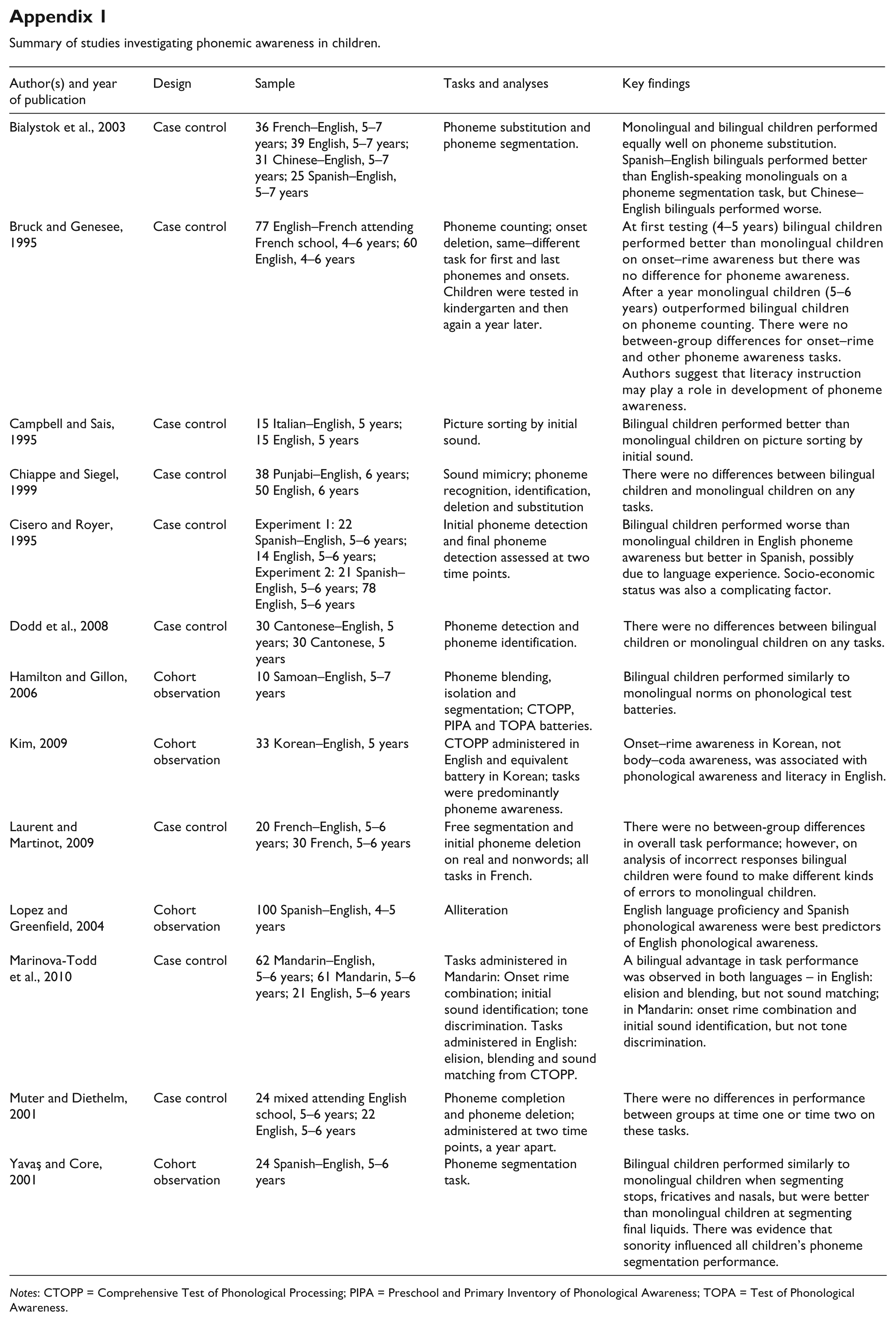
Notes: CTOPP = Comprehensive Test of Phonological Processing; PIPA = Preschool and Primary Inventory of Phonological Awareness; TOPA = Test of Phonological Awareness.
Funding
This research was funded by the Underwood Trust.
Declaration of interest
The authors report no conflicts of interest. The authors alone are responsible for the content and writing of the article.
1.
All future references to bilingualism should be assumed to include the term multilingualism.