



Abstract
This Conversation Analysis study investigated how a speech and language therapist (SLT) created opportunities for communication aid use in multiparty conversation. An SLT interacted with a child with multiple disabilities and her grandparents in a home setting, using a bliss board. The analyses demonstrated a practice where the SLT employed sequential and multimodal methods to open up interactional spaces for board use. The board was used within this space either by the child, or by the SLT. The space was then closed by the SLT’s attentive checking for confirmation or rejection of the meaning of the board indication. The meaning-making processes were actively initiated, supported, and closed by the therapist, using a variety of linguistic and bodily methods such as questions, non-finished turns, indication modeling, and adjusting the board’s position. The child confirmed or rejected the therapist’s moves using board indications, vocalizations, gaze, head movements, and smiles. The analysed practice creates opportunities for teaching and possibly also for learning how to use a communication aid.
Keywords
I Introduction
The focus of this study is a speech and language therapist’s (SLT’s) practice of designing interactional space for using a communication aid in the context of informal interaction and the linguistic and physical methods employed by the parties. The professional aspects of this practice from the perspective of speech and language therapy and the possibilities that this practice creates for learning how to use a communication aid are discussed. The study is part of the research field of Augmentative and Alternative Communication (AAC).
1 Communication aid use in interaction and Conversation Analysis
Research has found that the naturally-speaking communication partner often dominates interaction with children with severe speech impairment. This commonly results in an asymmetry, where the communication partner chooses the topic and takes long turns and, consequently, the child’s contributions consist of short turns that are often responses to questions (Light et al., 1985a). Communicative modalities such as eye gaze, body movements, and vocalizations are extensively employed by the child (Dahlgren Sandberg and Liliedahl, 2008; Wilkinson et al., 2011). Communication aids, however, are used much less (Light et al., 1985b). This decreases the possibility to communicate about other topics than the immediate and present surrounding (Ferm et al., 2005). Ferm et al. (2005) suggest that difficulties to communicate about non-present topics may hinder cognitive and communicative development.
A research method that treats all communicative modalities as relevant for the analysis is Conversation Analysis (CA). In CA, the aim is to discover how participants organize and manage interaction as a dynamic and collaborative process (Sidnell, 2010). The goal of CA is to understand social order as it is displayed in observable human interaction. A fundamental standpoint is that no contributions to the interaction can be understood in isolation (Sidnell, 2010). Instead, sequences of talk and bodily actions are the central focus of analysis and a detailed time-sequential analysis of recorded naturally occurring data is conducted.
The use of CA in studies of AAC is growing (Higginbotham and Engelke, 2013). These studies provide detailed descriptions of methods and resources used by participants when making meaning together. To mention a few findings, Clarke and Wilkinson (2008, 2010), Sigurd Pilesjö (2013), and Wilkinson et al. (2011) have shown that, in aided interaction, the speaking communication partner commonly takes an active role in articulating and animating the contributions of the person with severe speech impairment, and turn-taking is achieved by the detailed coordination of several bodily resources as for example, gaze, body movements and vocalizations. Higginbotham and Wilkins (1999) have demonstrated that the slow production of contributions by the person with severe speech impairment changes the management of turn-taking. In a study by Bloch and Wilkinson (2004), they found that even if an aided turn in itself is intelligible, it is not certain that it is understood, because understanding also involves taking into account the sequential position of a turn, that is, how the turn is constructed in relation to the prior talk (Bloch and Wilkinson, 2004).
2 AAC instruction
To succeed with AAC, it takes a great deal of on-going training, access to good role models (Bryen et al., 1995), and support by communication partners (Kent-Walsh et al., 2016). Research has found that instruction for beginners should be characterized by responsive interaction techniques, where the communication partner follows the child’s attentional leads (e.g. Wilcox and Shannon, 1998). It is also recommended that the instruction takes place in an everyday environment and in more genuine communication situations (e.g. Iacono, 1999). Modeling (e.g. Goossens, 1989) is a main feature of several learning strategies in AAC (Beukelman and Mirenda, 2013). However, modeling as a conversational phenomenon is not very clearly defined and described (Sennott et al., 2016) and, in general, instructional methods have not received much attention in AAC research. The current study addresses this research gap.
3 Teaching and learning from a CA perspective
In the current study, we will examine how the therapist designs interactional spaces for using the communication board in the unfolding process of conversation. They will be discussed at the end of the article as possible opportunities for teaching and learning. Hence, the analysis does not focus on learning as such, neither as a cognitive phenomenon nor as change in participation over time (for a CA account of learning, see Melander and Sahlström, 2009).
A considerable body of CA literature has developed analysing formal or informal teaching activities (for an overview, see Seedhouse, 2005). The focus of these studies, as well as the current one, is to study teaching as situated practices that are accomplished collaboratively through social and interactional methods. Hence, CA takes an interest in the social process of how teaching and instruction is done, rather than in the cognitive processes of the individual participants.
4 SLT as institutional interaction
Although the analysed instances in this study occur in the home of the child’s grandparents, they deal with asymmetries of knowledge and competence between the participants, and are therefore similar to pedagogic interaction (Arminen, 2005). The SLT demonstrates to a grandmother and her grandchild how the communication aid can be used, and is thereby ‘doing speech and language therapy’.
Different methods of speech and language therapy and the theories that these approaches are based on have been described previously (for an account, see Horton and Byng, 2000). Interactional studies of speech and language therapy with children have been conducted by, for example, Gardner (2006) and Tykkyläinen (2010). These studies focus on the interactional organization of speech therapy, but in a clinical setting with children with different language impairments who talk. Despite the differences in focus, one finding that is relevant for the current study is that the amount of support that is given by the SLT is increased and lessened depending on the level of competence of the child (Gardner, 2006).
In general, however, studies of the detailed interactional organization of speech language therapy are still rare. Gardner (2006) stresses the importance to increase the knowledge of SLT as a social interactional process and not only focus on its content. Even more rare are studies of informal therapy in a naturalistic setting with a child who has severe speech impairment (combined with other impairments) and no functional speech, and who is supported to use a communication aid as a means of communication. The knowledge gained from such studies could help improve communication intervention in SLT and related fields. The current study is an attempt to address these research gaps.
5 Study aims
The aim of this study is to increase the knowledge of the sequential and multimodal methods that are involved when instructing a child how to use a communication board. The research questions are: How is a child with multiple disabilities invited to participate with the communication board by the SLT? How is the board use achieved interactionally and physically? How is the meaning of the board use oriented to and treated in the following interaction?
II Methodology
1 Participants
The participants are Maria (pseudonym), an SLT, and Maria’s grandparents. Maria was 10 years old and has a severe speech and physical impairment (SSPI), anarthria, and a moderate intellectual disability due to cerebral palsy. The currently treating SLT (not the SLT in the recording) reported in a recent assessment that Maria’s language comprehension was uncertain at a one-word level. In the analysed instances, a communication board with mostly iconic Blissymbols (McNaughton, 1985) was used. Maria indicates the symbols by pointing with her fist. Both Maria’s mother and her current SLT have reported that Maria mainly uses body movements and vocalizations, and only in rare cases the board, for face-to-face communication. The board is mostly used at school. The recorded SLT has known Maria for four years. She has extensive clinical experience and formal training.
2 Procedures
The data is collected within a previous research project focusing on interactional patterns between children with SSPI and their everyday communication partners. The project was approved by the Regional Ethics and Data Inspection Boards (Sigurd Pilesjö, 2014). The participants in the study gave their informed consent.
The researcher video recorded naturally occurring interaction between the grandparents and the girl. At the end of the recording, the grandparents and the researcher, who was also Maria’s former SLT, talked about the difficulties of using the communication board, and they agreed that the researcher could show how the staff at school use the board. In this way, the participants themselves contextualized the activities as instructional within an informal setting. The activities were recorded with two video cameras. The grandmother is sitting beside Maria. Maria’s grandfather is standing in the kitchen, outside camera view. The SLT is standing beside Maria to her left. The communication board is on the table, in front of Maria. The instances that are analysed were chosen from a conversation where the SLT supports Maria to ask a question. The question sequence lasts for 2 minutes.
3 Transcription and data analysis
The principles and methodological practices of Conversation Analysis were applied to record, transcribe and analyse the interaction (e.g. Sidnell, 2010). The transcriptions were created according to CA conventions (Ochs et al., 1996) and AAC Conventions (von Tetzchner and Hygum Jensen, 1996); see Appendix 1.
III Analysis and results
Analyses of three excerpts are presented where the SLT uses different methods to involve Maria in the interaction. Before Excerpt 1 begins, it has been established in the talk that Maria wants to ask a question. Below is a sequence in which the SLT and Maria first establish to whom the question is going to be posed (Excerpt 1), and then the content of the question is agreed upon (Excerpts 2 and 3).
Excerpt 1 begins with the SLT (T) asking Maria (M) who she wants to ask. She asks ‘who’, followed by a pause and thereafter she adds ‘who do you want to ask’ (lines 1–5).
Excerpt 1
3.
[Here, a symbol indication by Maria and a repair sequence are omitted from the transcript due to space limits.]
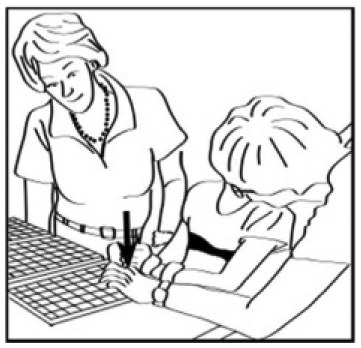
Maria responds to the question with a glance at her grandfather (line 6), and the SLT follows her gaze toward him (line 7). In response to Maria’s gaze toward the grandfather, the SLT (in lines 8–11, Figure 1) constructs another question, ‘shall we ask is it grandfather’. At this point, the SLT’s understanding of Maria’s action adjusts to the on-going activity and the bodily actions of Maria. Her gaze towards the kitchen area indicates that her grandfather is the possible recipient of the question, aligning to the SLT’s question. From the point of view of ordinary conversation, the fact that the SLT does not wait for a confirming response, but instead immediately extends her turn incrementally with another question, ‘or shall we ask grandmother’, may be puzzling. But judging from their production formats, the two questions belong together, probably in orientation to the instructing or demonstrating activity type. The first question orients to Maria’s gaze at her grandfather, but then the grandmother is added as a second alternative. Both questions are built with the same ‘shall we ask’ construction, they are accompanied by simultaneous tappings by the SLT on the words ‘grandfather’ and ‘grandmother’ on the board, and both end with the same prosodic contour (final high rise). They are produced as a list with two items, where the second recycles the production format of the first. Together, they therefore construct an alternative question (Stivers et al., 2010) ‘shall we ask is it grandfather or shall we ask grandmother’. The first question is aligning with the conversational direction of the sequence; the second is not. The use of the alternative question makes an indication on either of the symbols (grandfather or grandmother) relevant as a next move, but also limits the projected response to one of the two alternatives only.
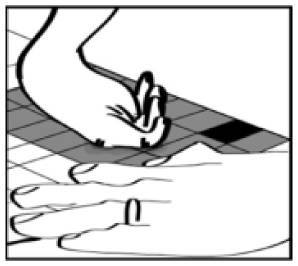
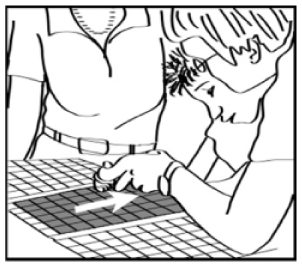
After the alternative question, a two-second pause follows. The SLT apparently waits for a response. Next is an indication by Maria and a repair sequence (omitted) that ends with another indication by Maria in line 26. She moves her fist and indicates with her fingers in the direction of ‘GRANDFATHER’ (Figure 2). In line 28 the SLT orients to the repair by saying ‘no’, and voices (Sigurd Pilesjö & Rasmussen, 2011) the symbol ‘grandfather’. The rise of Maria’s head (line 30) indicates that the voicing and understanding of her indication on the communication board was correct. Maria apparently orients to the alternative question in the projected way, that is, she (finally) indicates one of the alternative symbols that were included in the alternative question.
When producing the alternative question, the SLT indicates on the communication board simultaneously as she speaks. We describe the SLT’s use of the board (lines 11 and 14) to indicate ‘grandfather’ and ‘grandmother’ as an ‘indication modeling’, as she uses the board to model for the girl (and the grandmother) how to use it in the next projected sequential position after the question.
To sum up so far, the SLT poses an alternative question to Maria while simultaneously doing indication modelings on the communication board. It makes relevant an indication on one of two projected symbols on the communication board as a next action. Maria continues by choosing the former. The alternative question in coordination with indication modelings, employed by the SLT, seems to be a multimodal method to invite Maria to respond with the communication board, a method that both participants orient to. This method enables Maria to indicate one out of two alternatives, and, hence, to control the recipient of her own incipient question.
After agreeing on the meaning of the girl’s indication, the activity moves forward. The SLT moves the communication board toward Maria, indicating that the use of the board is also relevant for the next action (line 72).
Excerpt 2
This sequence continues Excerpt 1, but 40 lines of off-topic talk are omitted.

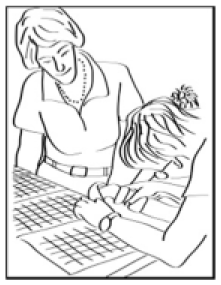


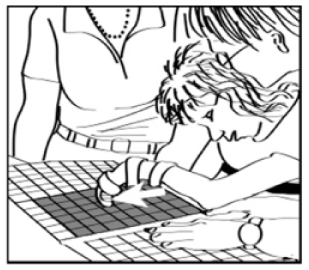
In line 70, the SLT whispers ‘yes we can ask something about eh’. The turn projects a continuation both syntactically and prosodically, and designs a sequential space for a continuation. The turn ends with a hesitation particle ‘eh::’, marking the relevance of a continuation. During three seconds, the SLT places Maria’s hand on the board’s verb field, preparing for using it (line 72, Figure 3). The SLT then continues the turn herself. Simultaneously as saying ‘liking’ (‘tycker’), the SLT indicates the symbol ‘LIKE’ (‘TYCKER OM’) with her index finger, and while simultaneously saying ‘o::m’ (the verb particle), the SLT uses Maria’s fist to indicate the same symbol (lines 75–77, Figure 4). The SLT then indicates ‘LIKE’ one more time by herself (line 78). These words are grammatically and pragmatically relevant next items in this sequential position.
Next, the SLT adjusts the board once again, this time placing the field of nouns in front of Maria (line 79, Figure 5(a) and (b)). She also seems to ask ‘(shall we) ask that’ (line 80). This turn can be understood as a request for confirmation of the previous suggestion. Next, the SLT extends the turn by whispering ‘ask about something he likes’ (line 84), making the request for confirmation more explicit, and thus pursuing it, possibly due to the lack of response from Maria. In line 85, Maria finally raises her head and smiles at the SLT. Maria’s action is treated as a confirmation of the previous question, as the SLT responds ‘yeah what shall we ask’ (line 86).
Note that the SLT’s own uses of the board to indicate LIKE (lines 75 and 77) are indication modelings. However, the SLT’s use of Maria’s fist to indicate LIKE (line 75, second word ‘om’ can be seen as another type of modeling). We call it a ‘simulating indication modeling’, because the SLT models the indication physically to show how it is done, but also attributes it to Maria as partly her communicative move by using her own fist, and hence simulates an indication by Maria.
In Excerpt 2, the SLT’s multimodal method to offer an opportunity for the girl to use the communication board is different from Excerpt 1. The SLT combines grammar, the positioning of the board (making the verb/noun fields available), and indication modeling, to design a sequential slot for use of the board, with a preference for a verb/noun. Two kinds of modelings are used; simulating indication modeling, and indication modeling (also employed in Excerpt 1). Moreover, the use of the auxiliary verb ‘can’ (line 70) provides Maria with the choice to confirm or decline. Maria’s responses to the invitations to participate with the board are monitored carefully as the SLT awaits Maria to confirm. It is not until the SLT has received a confirmatory response by Maria with smiles and head rise, in line 85, that she moves on to next activities in the talk.
In the following, we demonstrate a third method for creating an opportunity to use the communication board. This method also features questions that design interactional spaces for using the board in next positions (as in Excerpts 1 and 2), in coordination with indication modelings on the board. In Excerpt 3, the SLT develops the same topic, asking ‘he likes what’ (line 89). The initial ‘he likes’ creates a similar syntactic space as in Excerpt 2, and the question word ‘what’ marks the missing continuation in a similar way as the hesitation token in Excerpt 1, as well as calls for a symbol (or symbols) to continue the turn.
Excerpt 3
This sequence continues where Excerpt 2 ends (GM = grandmother).
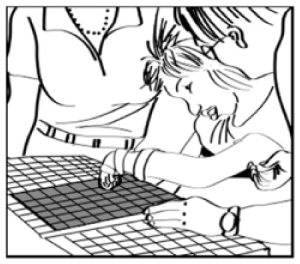
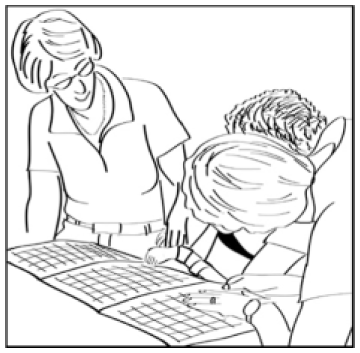
In overlap with ‘what’, Maria’s hand drops on the symbol HORSE and then slips away (line 91, Figures 6(a) and (b)). It is hard to tell if this is an actual symbol indication by Maria or an accidental fall of the hand on that symbol. Nevertheless, in lines 92–93, the SLT says ‘likes horses’. By way of this voicing, the hand movement by Maria is constructed as an action (a symbol indication) and attributed meaning. Apart from identifying a noun, the voicing also joins the noun ‘horses’ with the already identified verb ‘likes’. Simultaneously as the SLT voices ‘likes horses’, she puts Maria’s hand back on the symbol HORSE (line 94, Figures 6 (a) to (c)), from where it slipped earlier, thereby doing another simulating indication modeling (see Excerpt 2, line 75).
Apart from the attribution of meaning to the girls’ hand movement, in line 97 the SLT also asks Maria explicitly if they shall ask the grandfather about horses. These actions are responded to by a vocalization (HE::::M) (line 99, Figure 7) and a rise of the head, indicating that Maria accepts the attributed meaning ‘likes horses’.
Excerpt 3 demonstrates similar multimodal methods as in Excerpt 2, but a question word is added by the SLT in the space where a syntactic turn continuation is made relevant. The SLT’s turn designs an interactional space for Maria to fill the slot after ‘likes’ by way of using the board. As projected, a symbol is indicated (although highly collaboratively) and attributed meaning by the SLT, and Maria accepts the meaning. The participants thereby orient to these methods as a practice for designing an opportunity for participation with the communication board, as well as an opportunity for Maria to choose a symbol with a meaning that fits with an on-going course of action.
The analyses of the three excerpts demonstrate a practice where the SLT gives opportunities for using the board, deploying a variety of multimodal methods and by systematically checking for confirmation and alignment from Maria. Maria’s ways of aligning with these methods are primarily gaze, smiles, vocalizing, and face-to-face orientation, but also indications on the board with a great deal of support. The SLT uses linguistic means (alternative questions, non-finished clauses, wh-questions and Blissymbols), and multimodal means (adjusts the position of the communication board, and models/simulates symbol indications), to design interactional spaces for using the communication board. The SLT also uses questions to provide Maria with the possibility to confirm or decline meaning attributions, as in the choice of the word ‘horses’. In coordination with gaze and body posture, these actions clearly allocate the next action to Maria. The deployment of these methods actively involves Maria and partly secures the authorship and ownership of the unfolding contribution to Maria, and provides opportunities for Maria to use the board within the on-going activity.
IV Discussion and conclusions
A great deal of the interactional work to achieve interactional spaces for using the board is done by the SLT but in close cooperation with Maria, who is prompted to display accepting or disagreeing responses along the way. Maria is systematically invited to participate with the resources that are made available to her. The resources change dynamically by way of actions by the SLT. A relevant sequential position for Maria’s linguistic participation is for example created by the SLT when she adjusts the position of the communication board in front of Maria, thereby enhancing the opportunity for Maria to use the board in different preferred ways.
Maria uses linguistic/graphic symbols as well as bodily resources to participate in the interaction. She gazes at the board when it is in use and looks away when the local task is completed and the board is no longer relevant. Maria employs smiles and the rising of her head to signal acceptance and confirmation. She thereby orients to the communication board as a relevant resource for creating meaning.
The SLT is closely attentive to the bodily actions by Maria, her gazing behavior, board indications, smiles, and vocalizations. Maria’s bodily movements are constructed as actions that contribute to the emerging talk. Her actions are attributed meaning in the specific sequential positions of the on-going interaction. An example of this is when Maria vaguely indicates ‘HORSE’ and the SLT joins it together with ‘like’ in the voicing, and thereby attributes meaning within the local context.
It is crucial to point out that a speaking co-participant should support the construction of a communication-board mediated contribution with both awareness and caution. It can be uncertain to what extent a child with multiple disabilities actually understands the actions or their meaning. However, in these data, Maria’s board indications are attributed meaning in the interaction that unfolds, i.e. Maria is given opportunities to confirm or deny suggested meanings. The conscious and systematic attribution of meaning can also be an intrinsic part of instruction in AAC for beginners (von Tetzchner and Martinsen, 2000).
The SLT uses the communication board in different ways and employs modeling to a great extent. In the excerpts that were analysed here, two ways of modeling occurred: indication modeling and simulating indication modeling. Moreover, modeling occurs in coordination with the co-participant’s accompanying talk, where the talk to a great deal influences the relevant next move for the child. Previous descriptions of modeling (Goossens, 1989; Sennott et al., 2016) are not very detailed in terms of how modeling is done physically, and the actions that modeling actions achieve in the unfolding conversation. Our analysis shows that modeling can be done in different ways and in particular positions within the analysed practice. This calls for more thorough investigations of modeling in AAC.
Accompanying one’s own talk with the simultaneous use of the communication board also works to demonstrate for an AAC user how symbols may be connected with a corresponding meaning in collaboration with the conversational partner. Maria in these data is presented with pragmatically framed examples of connections between indications near a specific symbol and a meaning, where the meaning is made relevant by the particular sequential position in the ongoing activity. This is also one of the purposes of modeling in AAC instruction (Binger and Light, 2007; Romski and Sevcik, 2003).
The analysis conducted in this study cannot provide evidence that Maria learns how to use the board. However, the multimodal methods that have been demonstrated can be seen as methods to create opportunities for teaching a child how to use a communication board in social interaction. Maria’s own indications are attributed meaning, based in the local conversational context, the conversation partner’s use of the board creates models for the girl about how to use the board (physically and communicatively), and the connection of symbols to contextualized meanings provides the girl with concrete material for linguistic development. These aspects of the analysed practice probably offer a child interactional opportunities that facilitate learning how to use a communication aid over time, if the practice is used recurrently and perhaps even systematically.
In comparison with the interactional studies of speech therapy in clinical settings (Gardner, 2006; Tykkyläinen, 2010), the level of support in our data is very high. The therapist explicitly suggests words and meanings to say in conversation to the child, which is not reported in clinical phonological therapy (Gardner, 2006). However, one can also observe similarities between the settings in how the SLT supports the child. In our data, the SLT supports the child by using multimodal resources, such as pointing at graphic materials in the setting, which is also documented by Tykkyläinen (2010).
With regards to current recommendations for clinical instruction in the field of AAC, the therapist in the analysed instances employ responsive techniques and conduct the therapy within a natural and everyday setting. This is according to recommendations for early intervention (e.g. Iacono, 1999; Wilcox and Shannon, 1998).
All three examples demonstrate that the methods of inviting the girl to participate with the board, the use of the board that accompanies or follows these invitations, and the following actions to establish the meaning of the board use, emerge as an ordered sequence of actions. The methods may, of course, be used separately, but occur systematically in our data to initiate, develop and close sequences surrounding board indications. Maria develops Excerpt 1 with an independent indication, while in Excerpts 2 and 3 the board use is considerably more collaborative. The invitation and its projected responses obviously belong to a pair of actions, joined by their adjacent sequential positions as being a first and a second action. These actions open up the sequence. In addition, follow-up questions regarding the meaning of the board use, and their confirmative responses, and constitute paired actions. These actions work to close the overall action sequence. The whole sequence functions as a multimodal practice to provide interactional space for using the board, to involve the girl in using the board and watching how it is used by the therapist, and to negotiate and secure the meaning of the board indication as belonging to Maria. These methods may be fruitful when the communication partner wants to structure opportunities for a child with multiple disabilities who is a beginning AAC learner to use a communication board. From a clinical point of view, detailed knowledge of how communication partners can use different methods to create opportunities for participation with the board and possible spaces for learning in the on-going interaction should be of great value.
Footnotes
Appendix 1
Declaration of conflicting interest
The authors declared no potential conflicts of interest with respect to the research, authorship, and/or publication of this article.
Funding
The research was part of a larger data set originated from the PhD project of the first author.