




Abstract
There is a need to provide bilingual assessments and reference data to identify those who struggle to acquire their heritage language (L1) or the language spoken in the country of residence (L2). However, bilingual assessments and data are still sparse. Therefore, the aim was to use a tablet application to screen receptive vocabulary in different languages and discuss this data in the context of lexical acquisition theories. Forty-four monolingual German, 15 bilingual German–Polish and 21 German–Turkish-speaking children aged between 3;5 (3 years and 5 months) and 6;1 were assessed. All children completed the German version of the Receptive Vocabulary Screener (RVS), a tablet application testing 20 nouns and 20 verbs, and two standardized vocabulary sub-tests. Additionally, the bilingual children completed the Turkish or Polish version of the RVS. Internal consistency showed that the RVS is a reliable tool for research purposes and validity was confirmed by significant and moderate to strong correlations with the two standardized vocabulary sub-tests. Monolingual children outperformed bilingual children when performance comparisons were solely based on the German items. However, group differences were not significant when total vocabulary was used, i.e. the number of words bilingual children named across both versions. For bilingual children, L1 and L2 scores did not differ, i.e. they showed a similar performance on the L1/L2 subtest. Paternal education, but not maternal education, was significantly correlated to vocabulary scores. Children with more translation equivalents, i.e. words they know in both languages, and with a higher level of language proficiency showed higher scores on the screener. The app provided a valuable opportunity to assess lexical knowledge across different languages. Results indicated that total vocabulary and translation equivalents must be considered to evaluate bilingual children’s lexical knowledge.
Keywords
I Introduction
Across the world the number of people who are multilingual is constantly rising. For example, the Federal Statistical Office in Germany reported 17.1 million people with a migration background for 2015 (Statistisches Bundesamt, 2017). In the UK around 360 different heritage languages are spoken. Consequently, the number of bi- or multilingual children in primary and secondary education is on the rise as well. In 2017, 20.6% of primary school children in the UK were learning English as a second language (Department for Education, 2017). Those children are educated through the majority language spoken in the country of residence and therefore face multiple challenges. They have to acquire a second language for academic purposes, integrate socially and acquire new academic skills to reach educational targets. For the educational, health, and social care sectors this bears the challenge to provide sufficient support for those children who either struggle to acquire the second language or have developmental language disorders which need specialist intervention. Professional bodies, such as the Royal College of Speech and Language Therapy, have stressed that, to make this distinction, children need to be assessed in all of the languages they speak (Stow and Pert, 2015). Current research also supports this claim (e.g. Maier et al., 2016; Simonsen and Haman, 2017). However, those standards are difficult to meet. The majority of professionals working with those children, including teachers and speech and language therapists, have a monolingual background and only get limited resources to support them. In addition, standardized assessments for most of the languages the children speak are not available. Often assessments are translated but not adapted, resulting in inadequate tests with linguistically poorly controlled test items and culturally inappropriate targets, pictures or procedures.
Considering the importance of vocabulary as a basis for language (e.g. the development of grammatical structures; Kohnert et al., 2010) and literacy acquisition (in particular reading comprehension; see, for example, Duff et al., 2015), its assessment can provide a first starting point to identify children with language learning difficulties. In particular for children learning a new language, a sufficient range of receptive vocabulary is important to understand what is happening around them and to feel as part of a group or activity.
As outlined by Schaefer et al. (2016), when designing an assessment of receptive vocabulary, different aspects, such as cultural appropriateness, need to be considered. For example, pictures to depict lexical items must be carefully chosen. What might be a prototypical item in one language or culture might be very unfamiliar for another. Geographical location may be one aspect. While people in Holland might describe a tulip or rose as a common representation of a flower, people in Indonesia might rather pick a jasmine or orchid (for more details, see Schaefer et al., 2016, pp 3–4).
To ensure test objectivity, the assessment of receptive vocabulary using technical devices has practical advantages. Items can be presented without the tester having to speak the language and all test responses can be automatically recorded. Nowadays children across cultures are familiar with tablets and smartphones, reducing the risk of administration bias, i.e. different results based on a misunderstanding about how to complete the test.
From a theoretical point of view the exploration of receptive vocabulary skills in bilingual children is of interest as well. Semantic theories, such as the assumption of mutual exclusivity, i.e. the postulation that children assume that each object will have only one label/name, or the question of whether children have a unitary lexicon for both languages or two separate lexical systems, can be addressed. As highlighted by Legacy et al. (2016), although bilingual language acquisition has been a focus of various disciplines in the recent years, less focus has been on the acquisition of receptive vocabulary skills.
Hence, it is of interest, from a clinical and theoretical perspective alike, how bilingual children perform on the same task being administered in both their heritage language (L1) and the language spoken in the country of residence (L2), and whether their performance in L2 is on par with their monolingual peers. If it is not, the question is what influencing factors might account for those differences. External factors may include language exposure and home environment, while an internal factor may be language proficiency (see, for example, Legacy et al., 2017; Poulin-Dubois et al., 2013).
To investigate those between and within group comparisons and to understand the entirety of bilingual children’s lexical development, it is important to analyse total vocabulary and translation equivalents (TEs). Total vocabulary describes how many words children have acquired across all languages they speak. For example, a child may know the lexical entry cow in Polish (<krowa>) but not in German (<Kuh>), and know the word flower in German (<Blume>) but not in Polish (<kwiat>). Total vocabulary would consider both lexical entries for the overall number of words a child knows. Empirical studies have supported the claim that when total vocabulary is taken into account, bilingual children’s vocabulary size is comparable with their monolingual peers’ (e.g. De Houwer et al., 2013; Sheng et al., 2011). TEs are those lexical entries that children have stored in both/all languages (for example, an English–German-speaking child comprehends both words milk and Milch). The existence of TEs may argue for separate lexicons and challenges the principle of mutual exclusivity. Children with a high percentage of TEs should show similar performance as their monolingual peers. In contrast, if children showed separate lexical entries for items then a difference to the monolingual children would be expected. Another question is whether children with a high number of TEs show overall better receptive vocabulary skills than children with a low number of TEs. If so, a high number of TEs may indicate a more advanced or established lexical system, integrating both languages to a shared lexical network.
Overall, the heterogeneity in bilingual cohorts has been noted (e.g. McLeod and Verdon, 2017; Thordardottir, 2010), hence it is also important to look at individual profiles of children in addition to group comparisons, exploring whether different language dominances can be found.
In sum, the aim was to test receptive vocabulary in mono- and bilingual children, using the same lexical items across all languages and to explore between group differences with monolingual peers and within group differences across languages. The following research questions were addressed:
Do receptive vocabulary skills differ in mono- and bilingual German and German–Turkish/German–Polish-speaking children?
Do receptive vocabulary skills of bilingual German–Turkish/German–Polish-speaking children differ between their home (L1) and second language (L2)?
Is there a relationship between language proficiency, language exposure or level of maternal/paternal education and children’s vocabulary scores?
Is a high number of translation equivalents (TEs) an indicator for higher screening scores?
What performances in their L1 and L2 do children show on an individual level, e.g. do they show different language preferences across nouns and verbs?
II Method
Two cross-sectional pilot studies were conducted in Germany in 2016 and 2017 to test monolingual German and bilingual German–Turkish and German–Polish-speaking children, the combined results of which are discussed here. Those two bilingual cohorts were chosen since they represent two of the main languages other than English spoken in Germany (Statistisches Bundesamt, 2018).
1 Participants
A total of 80 children (44 monolingual, 36 bilingual children: 21 German–Turkish, 15 German–Polish) participated. Their age ranged between 3;5 (3 years and 5 months) and 6;1. Thirty-two were girls, 48 were boys. They were recruited from different rural and urban parts of Germany, including nurseries located in Hannover, Hildesheim, Munich, Hamburg and Eutin. Selection criteria included: monolingual German or bilingual German–Turkish/German–Polish; no neurological or physical impairments and no speech or language difficulties. Parent/carer and nursery questionnaires were used to check that children fulfilled all selection criteria.
2 Material
The Receptive Vocabulary Screener (RVS), a tablet application, can screen multilingual children’s receptive vocabulary in both English and their heritage language(s). It does not need the testers to be proficient in the target language(s), as it uses a four-choice picture paradigm in which target words are pre-recorded and presented. The screening comprises currently of 20 nouns and 20 verbs (plus two practice items for each category). Responses are made via a touchscreen and are automatically recorded and scored. The following eleven languages can be assessed: Slovak, Czech, Polish, Urdu, Punjabi, Portuguese, Welsh, Mandarin Chinese, German, Turkish and English. For more details about the design of the tool and the selection/linguistic control of the test items, see Schaefer and colleagues (2016). Preliminary analyses confirmed that the app is suitable for use with the targeted age and language groups, is user-friendly, and is of satisfactory reliability (Schaefer et al., 2016).
In addition, as a measure of concurrent validity in relation to the RVS, two receptive vocabulary sub-tests of a standardized German language test battery were used (Kauschke and Siegmüller, 2010). The subtests assess single-word comprehension (20 nouns and 20 verbs), presented by a 3-picture choice paradigm. Parent/carer and nursery questionnaires were designed to collect information about the children’s language background (incl. e.g. language acquisition milestones and language proficiency) and home environment (asking for maternal/paternal education as a measure for socio-economic status).
3 Procedure
Children were recruited via their nurseries. Written consent was obtained from all nurseries and carers/parents prior to testing. The children were assessed individually at their nursery by qualified Speech and Language Therapists. All children completed the German version of the RVS (approximately 5–10 minutes) and the two standardized vocabulary sub-tests (approximately 10 minutes). Additionally, the bilingual children completed the Turkish or Polish version of the screening (approximately 10 minutes).
III Results
Table 1 provides an overview of the raw scores for both groups (monolingual and bilingual children) on the RVS and the additional vocabulary subtests. No ceiling effects for any of the (sub)groups were found, although mean scores indicated that the RVS German nouns and RVS Polish nouns seem to be fairly easy for children to complete.
Descriptive statistics for the Receptive Vocabulary Screener (RVS) and patholinguistic diagnosis, for mono- and bilingual children.

Notes. maximum scores for RVS verbs/nouns: 20; maximum score for patholinguistic diagnosis nouns/verbs: 20.
Since the RVS is still under development, measures to evaluate its test criteria were considered. To explore the screening’s reliability, internal consistency was measured using Cronbach’s alpha. Due to small sample sizes of the German–Polish and German–Turkish cohorts, only data for both mono- and bilingual children are reported. For the whole group the Cronbach’s alpha for German nouns was .773, for the German verbs .762. Nonparametric correlations (Spearman’s rho) were used as a measure of concurrent validity, computed between the RVS (whole group, monolingual and bilingual children separately) and the receptive vocabulary subtests of the patholinguistic diagnosis. All correlations between the RVS and patholinguistic diagnosis subtests were moderate to strong and statistically (highly) significant (with two exceptions: RVS German verbs and patholinguistic diagnosis nouns and RVS heritage language nouns and patholinguistic diagnosis verbs; for details, see Table 2).
Nonparametric correlations (Spearman’s rho) between the Receptive Vocabulary Screener (RVS) and the patholinguistic diagnosis.
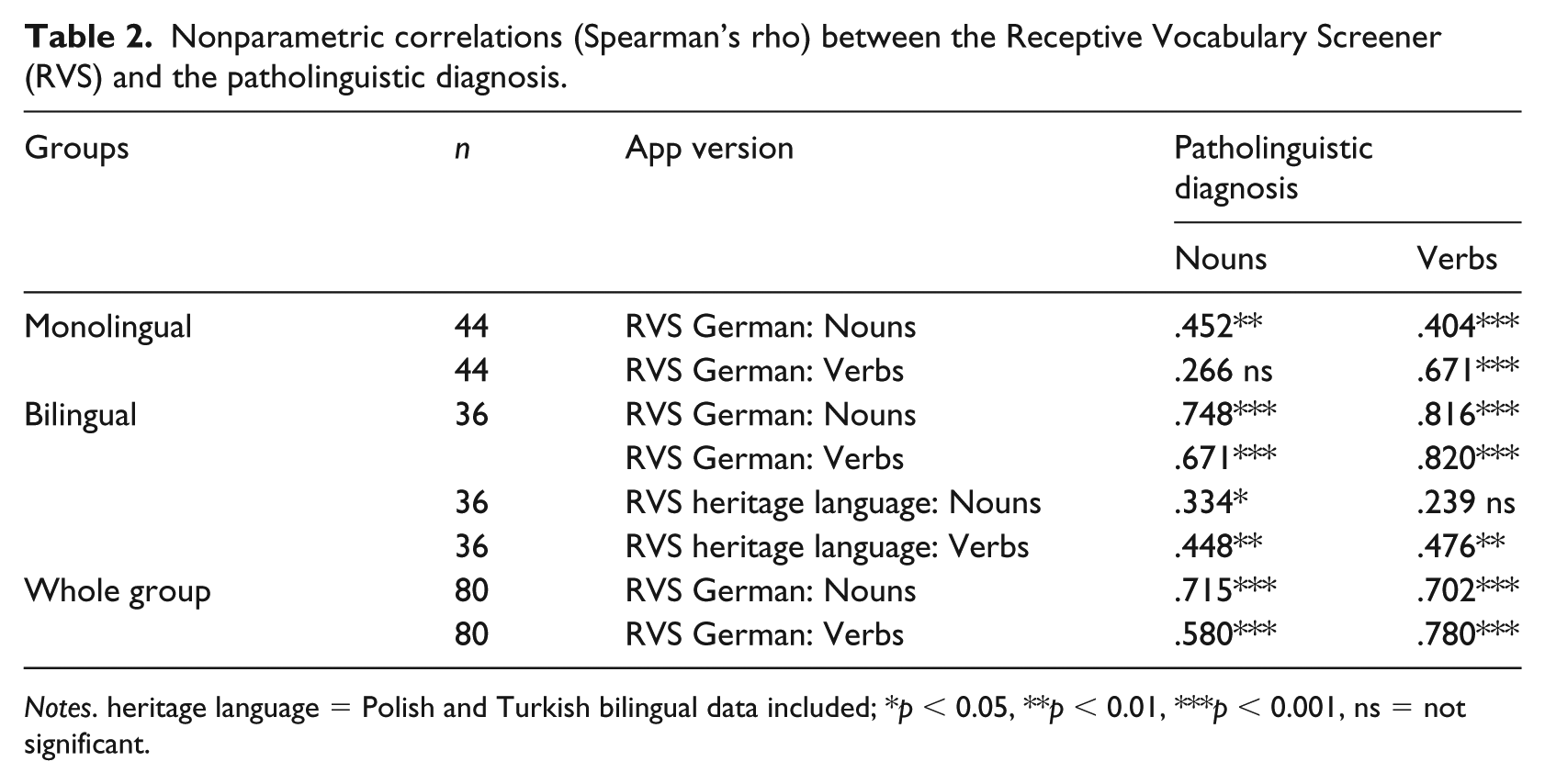
Notes. heritage language = Polish and Turkish bilingual data included; *p < 0.05, **p < 0.01, ***p < 0.001, ns = not significant.
Before any group comparisons were computed, nonparametric tests were run to check for any age or gender differences (between groups: Mann–Whitney-U tests; within groups: Wilcoxon Signed Rank tests). Mono- and bilingual children did not differ in age (U = 671.000, z = 1.172, p = .241). Outcomes for all RVS subtests (including verbs and nouns from both the German and the Polish/Turkish version) showed no gender differences (all ps = n.s.). Hence, all further group comparisons between mono- and bilingual children and within the bilingual cohorts were based on the complete sample sizes.
To answer research question 1, i.e. whether receptive vocabulary skills differ in mono- and bilingual children, non-parametric between group comparisons were run. Monolingual children outperformed their bilingual peers on both nouns and verbs (Mann–Whitney-U tests, nouns: U = 394.000, z = −3.909, p < .001; verbs: U = 461.500, z = −3.219, p = .001). However, when scores from the German and Turkish/Polish version were combined to reflect bilingual children’s total vocabulary across both languages, they showed a comparable performance to their peers on both RVS subtests (Mann–Whitney-U tests, nouns: U = 702.000, z = −.893, p = .372; verbs: U = 787.000, z = −.049, p = .961).
To answer research question 2, i.e. whether receptive vocabulary skills of bilingual German–Polish/German–Turkish children differ between their home and second language, nonparametric within group comparisons were run (Wilcoxon Signed Ranks test). Neither the Turkish nor the Polish cohort showed any differences in their RVS performances. In other words, their noun and verb scores were comparable across both languages (German–Turkish children: RVS German nouns versus RVS Turkish nouns: z = .156, p = .876; RVS German verbs versus RVS Turkish verbs: z = .718, p = .473; German–Polish children: RVS German nouns versus RVS Polish nouns: z = −.492, p = .623; RVS German verbs versus RVS Polish verbs: z = .718, p = .473).
To explore how those results, relate to external and internal factors (research question 3), first, language proficiency ratings were set in context with the children’s L1 and L2 vocabulary scores. Children’s receptive and expressive language proficiency in both languages (i.e. German and Polish or Turkish) was ranked by parents/carers using a 4-point Likert scale (receptive/expressive language skills are: 1 = good, 2 = moderate, 3 = poor, 4 = very poor). Since most parents/carers (28 out of 31) ranked their children’s L1 performance (i.e. Polish or Turkish) as being good, a meaningful comparison of subgroups and their vocabulary performance was not possible. For L2, out of 31 rankings, 22 parents/carers ranked their children’s German receptive skills as good, 7 moderate, and 2 poor. Kruskal–Wallis tests were calculated. Statistically significant results between categories were found for German nouns, verbs and combined nouns and verbs (all ps ⩽ .001). Since there were only 2 participants in the group poor and boxplots indicated that the children with poor receptive language skills performed like the children with a moderate ranking, only a Mann–Whitney-U test was run between the moderate and good group. A significant difference was found in favour for the children with good receptive language skills (Mann–Whitney-U tests, nouns: U = 38.000, z = 2.021, p = .048; verbs: U = 21.500, z = −2.855, p = .003; nouns and verbs combined: U = 26.000, z = −2.610, p = .008). Kruskal–Wallis tests were also run using expressive language proficiency. Out of 31 rankings, 18 parents/carers ranked their children’s German expressive skills as good, 9 moderate, and 4 poor. Differences between categories were statistically significant for nouns, verbs and combined scores (all ps ⩽ .001). However, Mann–Whitney-U tests between the good and moderate and the good and poor category did not show any significant differences in performance (after Bonferroni corrections). Looking at children’s proficiency in their heritage language, those performing good, moderate or poor in Turkish and Polish showed similar performance on the German RVS subtests. However, it is interesting to note that those with moderate Polish/Turkish skills performed slightly better, indicating a preference for their L2 (i.e. German).
Second, language exposure was explored. Data from the questionnaire was used, parents/carers had to indicate how often they speak German or Polish/Turkish with their child (the Likert scale included the following rating: 1 = always, 2 = often, 3 = sometimes, 4 = rarely, 5 = never). Wilcoxon Signed Ranks tests showed that fathers/male carers and mothers/female carers both communicated more often in their heritage language, i.e. Turkish or Polish. The result for mothers/female carers was statistically significant (z = −3.855, p < .001), for fathers/male carers the result was approaching significance (z = −1.865, p = .062).
Third, the relationship between vocabulary scores (in German and in Polish/Turkish) and maternal/paternal education (as a measure of home environment) was examined. Level of education included the following categories: 0 = no graduation, 1= secondary general school, 2 = intermediate secondary school, 3 = A-levels, 4 = university degree. To measure the strength of association between maternal education and vocabulary scores, Kendall’s tau was calculated. Both correlations, i.e. the link between German or Polish/Turkish scores and maternal education, were weak and non-significant (education and German RVS score: .036, p = .809; education and Polish/Turkish RVS score: .076, p = .614). Looking at paternal education, the results showed a significant relationship (education and German RVS score: .386, p = .019; education and Polish/Turkish RVS score: .379, p = .025).
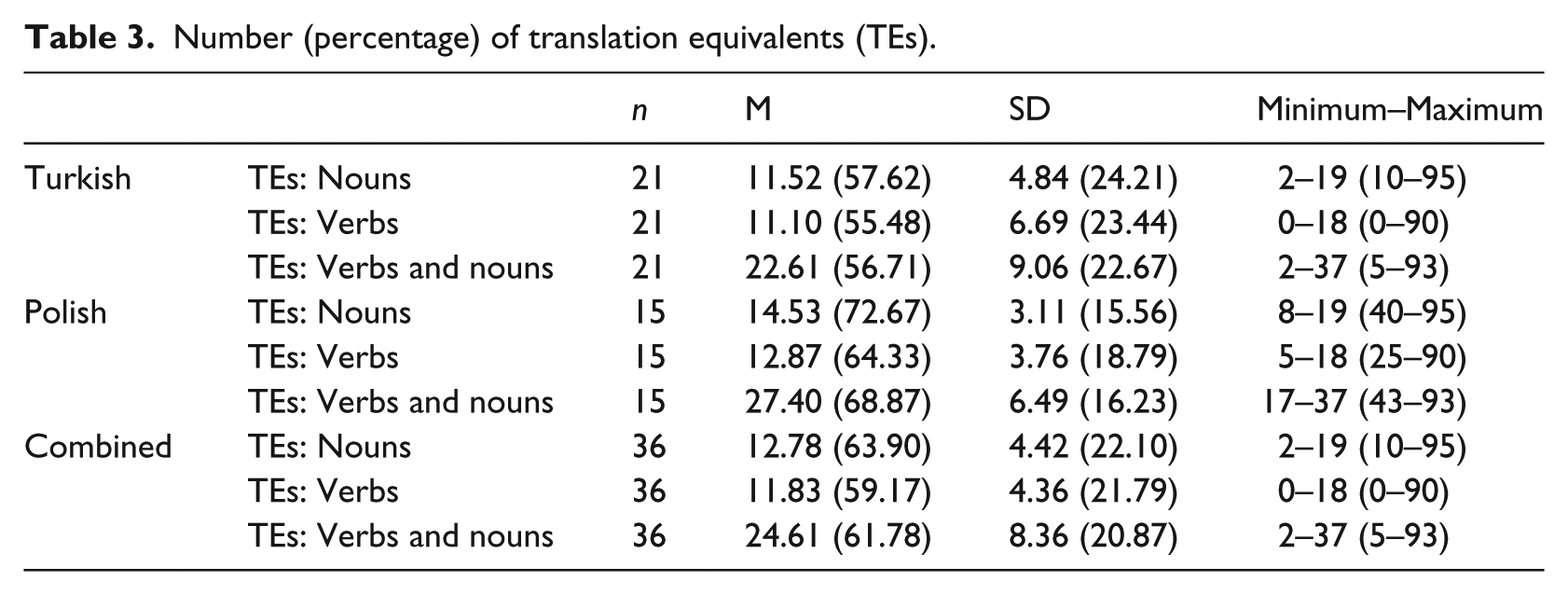
Research question 4 addressed whether a high number of translation equivalents (TEs) is an indicator for good screening result on the RVS. Table 3 summarises the number and percentages of TEs for all bilinguals and for both subgroups separately. Overall, the Turkish children showed a higher variability in scores and the Polish children slighlty higher scores. Nevertheless, nonparametric group comparisons did not show any group differences in the number of TEs (Mann–Whitney-U tests, nouns: U = 99.000, z = −1.892, p = .062; verbs: U = 123.000, z = −1.112, p = .279). Simple linear regressions were carried out to investigate the relationship between the number of total vocabulary and the number of TEs. For all three calculations, i.e. nouns, verbs separately and nouns/verbs combined, the scatterplots of standardized predicted values versus standardized residuals showed that the data met the assumptions of homogeneity of variance and linearity and the residuals were approximately normally distributed.
Number (percentage) of translation equivalents (TEs).
For the nouns, the scatterplot showed that there was a strong positive linear relationship between the vocabulary and TEs, which was confirmed with a Pearson’s correlation coefficient of .750. Simple linear regression showed a significant relationship between both variables (p < .001). The slope coefficient for translation equivalents was .349. The R2 value was .563, so 56.3% of the variation in total vocabulary can be explained by the model containing number of TEs. For the verbs, the scatterplot showed that there was a strong positive linear relationship between the vocabulary and TEs, which was confirmed with a Pearson’s correlation coefficient of .748. Simple linear regression showed a significant relationship between both variables (p < .001). The slope coefficient for translation equivalents was .436. The R2 value was .559, so 55.9% of the variation in total vocabulary can be explained by the model containing number of TEs. For nouns and verbs combined, the scatterplot showed that there was a strong positive linear relationship between vocabulary and TEs, which was confirmed with a Pearson’s correlation coefficient of .814. Simple linear regression showed a significant relationship between both variables (p < .001). The slope coefficient for translation equivalents was .413. The R2 value was .662, so 66.2% of the variation in total vocabulary can be explained by the model containing number of TEs.
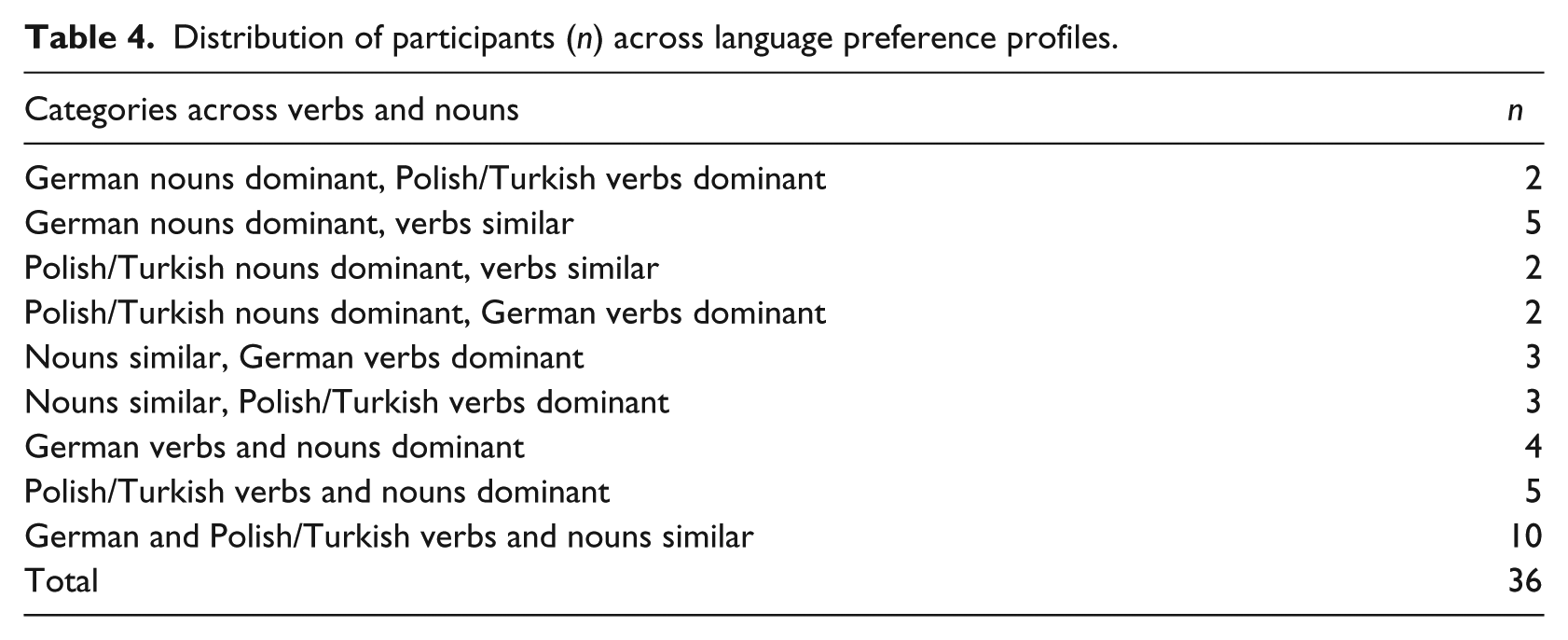
For a more in-depth exploration, it was of interest to look at children’s language preferences across languages (research question 5). A child was classified as having similar vocabulary skills across languages when both scores did not differ more than 1 score (e.g. a child scored 16 points in the German nouns subtest and 17 points in the Polish nouns subtest). Differences of more than 1 score were defined as indicating the dominance of or preference for one language. Looking at nouns and verbs together, nine potential language preference profiles emerged. Table 4 summarizes the distribution across those profiles. All potential profiles were found in the data, with a similar performance across verbs and nouns being the most frequent one, i.e. 10 children exhibited this profile. Looking at different variables, no specific patterns could be found in relation to age, gender or nationality, although more German–Polish children showed a similar profile across both languages (n=7). For a detailed overview of all 36 children see Table 5 (including percentages of TEs). Percentage of TEs also did not seem to influence whether children showed language dominance or equal performance. Moreover, the discrepancy between percentage of TEs for nouns and percentage of TEs for verbs varied considerably, some children showing the same percentage across nouns and verbs (see e.g. child 4), some having a discrepancy of up to 35% (see e.g. child 2). Most of those children showed a higher number of TEs for nouns (see e.g. child 7), fewer showed the opposite (i.e. a higher number of TEs for verbs, see e.g. child 27).
Distribution of participants (n) across language preference profiles.
Language profiles for all children (sorted by L1, then age).
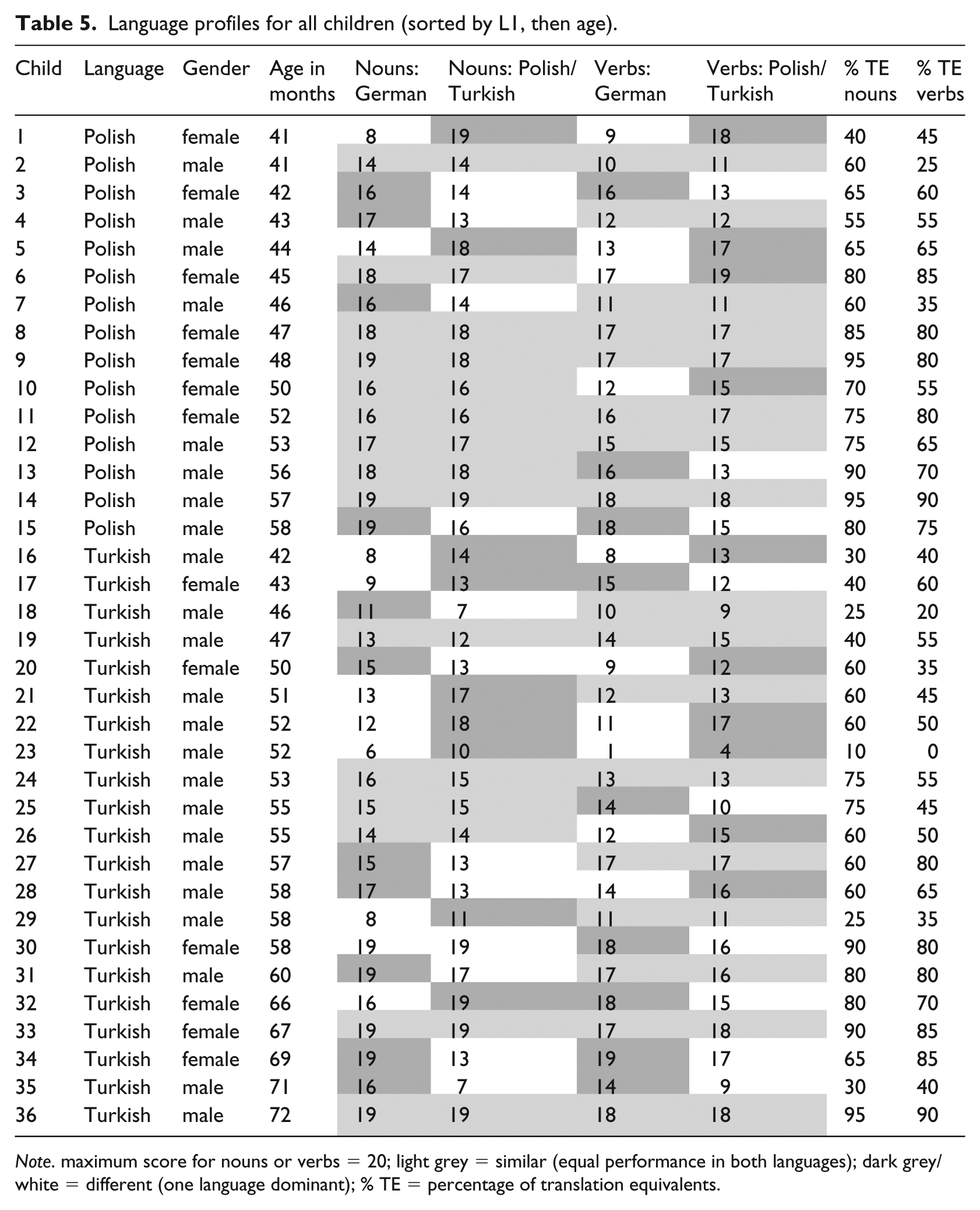
Note. maximum score for nouns or verbs = 20; light grey = similar (equal performance in both languages); dark grey/white = different (one language dominant); % TE = percentage of translation equivalents.
IV Discussion
The study aimed to collect further data on the acquisition of receptive vocabulary in bilingual children, using the Receptive Vocabulary Screener (RVS), which allows testing the same items across all languages and collect some first reference data for bilingual German–Polish and German–Turkish children. Internal consistency (Cronbach’s alpha) showed that the RVS is a reliable tool for research purposes (e.g. Hammond, 2006). Validity was confirmed by significant and moderate to strong correlations with a standardized vocabulary tool. This suggests that the RVS is a suitable tool to explore receptive vocabulary across languages.
Eighty monolingual German and German–Turkish/ German–Polish children were assessed. The first research question addressed whether monolingual and bilingual children would show differences in their vocabulary performance. When only results from the German version were considered, monolingual children scored significantly higher than their bilingual peers. However, it has been repeatedly stressed in the literature that it is necessary to assess all languages a child speaks in order to get a comprehensive overview of their vocabulary skills (e.g. Maier et al., 2016; Simonsen and Haman, 2017; Stow and Dodd, 2005). Therefore, results from their L2 assessment (i.e. Polish or Turkish) were taken into account as well and, consequently, group differences became non-significant. These results are in line with previous work which has shown that bilingual children tend to have smaller individual vocabularies but show similar performances when all their languages are taken into account, considering their total vocabulary (e.g. De Houwer et al., 2013; Hoff et al., 2011). This confirms the need to look at all languages a child speaks when assessed in clinical or educational settings.
Within group comparisons showed that bilingual children did not differ in their L1 and L2 performance on the RVS (research question 2). This may indicate that they had a comparable number of lexical entries across both languages, acquiring receptive vocabulary skills at a similar pace. This also indicates that as a group no language dominance for either Polish or Turkish could be found. Looking at influencing factors (research question 3), this is surprising considering that mothers/female carers and fathers/male carers predominately used their heritage language to communicate with their children and that previous studies have confirmed the link between vocabulary skills and language exposure (Cattani et al., 2014; Hoff et al., 2011; Place and Hoff, 2011). One reason might be that only a broad measure of language exposure was used, including only ratings on parental/carer communication. Children of the current study will encounter a variety of settings in which German will be the dominant language, such as nursery settings, media use (such as television and tablets) and spare time activities with German-speaking peers. More detailed description about when L1 and L2 are used and with whom, including daily/weekly activities, are needed to get a more representative picture. In addition, recent research has discussed the value of having a continuous variable to describe language experience (instead of a categorical one) and to consider changes in language exposure over time (see De Cat and Serratrice, 2018).
A more significant impact on German vocabulary scores was found for children’s overall receptive language proficiency in German. Children with good language proficiency (as rated by parents/carers) showed a higher score than children with moderate or poor language proficiency. This confirms the close link between other receptive language and receptive vocabulary skills. Nevertheless, this relationship was based on a broad ranking provided by parents/carers. Direct assessments would shed more light on the link between other receptive language skills (such as sentence comprehension) and vocabulary performance.
Maternal education was often used in previous studies as a key component for socio-economic status (SES) (Mistry et al., 2008), arguing that a) it is a suitable SES measure that is independent of current employment status or living conditions and b) that SES is closely linked to home environment and language learning (e.g. Shriver et al., 2017). One assumption is that carers with a higher educational level would provide more language learning opportunities to children (Berkule et al., 2007; King et al., 2017). There is also empirical evidence that maternal education is linked to language development (Letts et al., 2013; Rydland et al., 2013). However, this finding could not be replicated in the current study. No relationship was found between maternal education and vocabulary scores. One reason might be that predictive relationships change over time (e.g. Rice and Hoffman, 2015). For example, Rydland et al. (2013) found that the influence of maternal education was more relevant in the early years but other factors from the wider environment (such as peer groups, wider neighbourhood) came more into play at a later age. In addition, other home environment factors could have impacted on the children’s vocabulary scores, such as shared book reading (Mol et al., 2008; Sénéchal et al., 1996; Westerlund and Lagerberg, 2008), which were not considered in the current study. Interestingly, a relationship between paternal education and RVS scores was found. Those results also underpin the need to have a more in depth look at what influences vocabulary acquisition (Bornstein et al., 1998) and include paternal data which often has been neglected in earlier research. That various factors, including paternal education, have an impact on children’s language performance was demonstrated for example by Urm and Tulviste (2016). They found that children spending 40 hours or more in daycare per week and had fathers with a high educational background, outperformed children with fathers with a lower educational level on expressive vocabulary scores (p. 592). In addition, the interaction between different levels of maternal and paternal education should be considered (Hupp et al., 2011). Hupp et al. (2011) found that children with parents who had heterogeneous levels of parental education (e.g. one parent without a degree, one with a degree), attained higher language production scores. Pancsofar and Vernon-Feagans (2006) found that maternal and paternal language input differed in some aspects (e.g. turn length and wh-questions) but not others (such as type-token ratio or mean length of utterances) which may impact on word learning. In a later study they confirmed the causal relationship between paternal education and vocabulary use during book reading on their children’s language skills (Pancsofar, Vernon-Feagans, and The Family Life Project Investigators, 2010). Hence, language learning environments and different maternal/paternal parenting styles provided may have an impact on children’s language abilities and need consideration when interpreting vocabulary scores.
Another focus of the recent study was to explore the relationship between TEs, words that children have stored in both their languages, and their overall receptive vocabulary knowledge (research question 4). Bilingual German–Polish children showed a comparable number of TEs as the German–Turkish-speaking children. On average, they had 24 TEs across nouns and verbs, i.e. 61.78% of words were TEs. Significant relations between TEs and vocabulary score were found for both word groups, i.e. verbs and nouns. Hence, on group level, a high number of TEs indicated better receptive vocabulary knowledge. A reason may be that children with more TEs are able to better differentiate the different lexical entries for shared lexical referents, establish more distinct lexicons and are able to deal with inhibiting interference from one language when learning a word in the other and, therefore, show an enhanced vocabulary acquisition. However, this hypothesis needs further exploration. To support this claim, cognitive abilities, such as metalinguistic awareness, working memory and other executive functions, would have to be tested to understand the exact reason for a high number of TEs and enhanced lexical knowledge (e.g. Blankson et al., 2011; McClelland et al., 2007). In addition, as previously mentioned, external factors such as language exposure need consideration. This high percentage of TEs might indicate that the children had a similar exposure to both languages (David and Wei, 2008). It is noteworthy that the overall number or percentage of TEs in the current study is higher than in previous research carried out with younger children (e.g. Junker and Stockman, 2002; Poulin-Dubois et al., 2013), demonstrating that over time, children continue to build up each of their lexicons independently, resulting in a higher number of TEs.
In addition to the group results, a closer look at individual performances seemed important to explore inter- and intra-individual differences (in e.g. language preferences across nouns and verbs) and acknowledge the heterogeneity of the group (addressing research question 5). The results reflected this heterogeneity very clearly, no particular patterns were found depending on internal factors including age, gender, nationality, profiles in relation to the percentage of TEs. Therefore, future research should investigate potential external factors (such as language exposure and language use) in more detail, in order to understand how children develop their receptive vocabulary across all languages they speak.
V Conclusions
In sum, the RVS is a useful tool to explore receptive vocabulary in multilingual children across different languages. Preliminary results from two pilot studies confirmed the importance to consider all languages when evaluating lexical skills. General language proficiency positively affects children’s vocabulary and a higher number of TEs indicated better lexical knowledge. The sample sizes of the two pilot studies were small, but the results reported here merit a bigger study to provide more evidence and support to corroborate current findings. In addition, more research including detailed measures of internal factors (such as executive function) and external factors (incl. language use and exposure) are needed to fully understand the interaction between word learning and those different variables and explain the heterogeneous vocabulary profiles found in bilingual children.
Footnotes
Declaration of Conflicting Interests
The authors declared no potential conflicts of interest with respect to the research, authorship, and/or publication of this article.
Funding
This research received no specific grant from any funding agency in the public, commercial, or not-for-profit sectors.