




Abstract
This article offers both a conceptually valid measure of the relationship benefits derived from the relationship marketing, networks, services marketing and strategy literature and demonstrates the concept’s effect on business-to-business bonds. Four types of relationship benefit labelled cost, service, flexibility and image benefits are identified and their measures tested for reliability and validity. A structural model incorporating associations between a second-order relationship benefits construct and other salient relationship concepts is also tested, with significant direct associations between relationship benefits, trust and relationship investments evident, together with indirect associations between relationship benefits and instrumental, affective and normative commitment, absence of conflict, acquiescence, satisfaction and switching. The article calls for further refinement of the concept and evaluation of its associations in other contexts and in light of noted shortcomings in the literature.
Keywords
Introduction
An emphasis on the centrality of relationships in marketing evolved in response to two primary factors that were recognized by the industrial marketing and purchasing group (Arndt, 1979; Ford, 1980; Hakansson and Claes, 1975), the Nordic School of Services (Grönroos, 2004; Grönroos and Gummesson, 1985), and others such as Berry (1983). These included macro-market changes (Aijo, 1996; Buttle, 1996) and perceived limitations as to how marketing was conceptualized and practised (Ford et al., 1997; Grönroos, 1994; Payne et al., 1994).
A review of the relationship marketing literature indicates several streams of enquiry from which the ‘language’ of relationship marketing has emerged, with concepts including commitment (Brown et al., 1995; Gilliland and Bello, 2002; Morgan and Hunt, 1994) trust (Doney and Cannon, 1997) and loyalty (Andreassen and Lindestad, 1998; Gremler and Brown, 1999; Loveman, 1998) being developed or extended. Value has also arisen as a central concept within the literature and is being viewed increasingly as the foundation upon which relationships in business-to-business settings are based (Anderson and Narus, 1998; Ballantyne, 1999; Grönroos, 1997; Holm et al., 1999; Ulaga and Eggert, 2005).
This article focuses on relationship benefits, an emerging concept in the literature that is often bundled up and confused with value. It is examined within a relationship marketing context, with the study synthesizing findings from the literature, qualitative enquiry and a survey of Australian community pharmacists who represent the client group in a pharmaceutical network that also directly involves wholesalers and banner groups. Three research questions are developed, with research questions 1 and 2 derived from the literature and qualitative enquiry, while research question 3 builds upon these results and is addressed through empirical investigation involving a survey of community pharmacists.
Research questions and hypotheses
Relationship benefits and value
Identified links between perceived customer value and retention, on the one hand (Ravald and Gronroos, 1996), and retention, competitiveness and profitability, on the other (Ahmad and Buttle, 2002; Day, 2000; Reichheld, 1993) have resulted in customer value receiving significant attention in academic and business practice literatures (Cannon and Homburg, 2001; Hogan, 2001; Ulaga and Eggert, 2005). For example, the creation of customer value has been identified as the pre-eminent tool by which firms create competitive advantage in contemporary markets (Woodruff, 1997), while Grönroos has argued that marketing from a relational context is ‘a process that should support the creation of perceived value for customers over time’ (1997: 407). The nexus between relationships and value is also evident in the statement that ‘marketing has become an integral component of management decisions, as the importance of evolving relationships to create new value both within and outside the organisations becomes a key component of an organisation’s success’ (Jarratt and Fayed, 2001: 71).
The concept of value has its roots in psychology, social psychology, economics, management and marketing (Payne and Holt, 1998). Of these conceptualizations, perceived value as defined by Zeithaml (1988), which incorporates views that value perception is influenced by differences in monetary costs, non-monetary costs, customer tastes and customer characteristics (Anderson and Narus, 1998; Andreassen and Lindestad, 1998), has been widely adopted by marketers. Zeithaml (1988) defined perceived value as the customer’s overall assessment of the utility of a product based on perceptions of what is received and what is given. In addition, it is generally agreed that perceived quality, defined as customers’ opinions of one’s products or services compared with competitors, is an intimately associated concept, allowing definition of value as ‘market perceived quality adjusted for the relative price of your product or service’ (Gale, 1994: xiv ).
An extension to the concept of perceived customer value is offered by Ravald and Grönroos (1996) using Porter’s (1985) value chain concept, and Anderson et al., who suggested that value-adding partnerships enable ‘groupings of smaller firms to compete favourably against larger, integrated firms’ (1994: 227). In essence, it is argued that only by understanding the buyer’s value chain can a supplier come to an understanding of what is valuable to that buyer. Therefore, to create value, suppliers need to become intimately involved with customers: a view implicitly supported by Woodruff (1997), drawing upon Senge (1990).
This need to create value through an understanding of customer value chains suggests that the industrial marketing and purchasing approach of viewing business-to-business environments as interactions and networks, is both valid and necessary if competitive advantage is to be achieved through value creation. It is a perspective also evident in the statement that there has been:
[a] shift in focus on the value created by a single firm and product to an examination of the value created by networks of firms (or product ecosystems) in which assets are co-mingled with external entities. (Frels et al., 2003: 29)
That is, the process of value creation needs to be explicitly recognized as being dependent upon a series of interlinking relationships and networks (Holm et al., 1999) through a value chain, a perspective seemingly supported by Boisot (1995), cited in Ambler and Ballantyne (1998) and Sawhney and Zabin (2002).
Therefore, value creation in a relational context can be characterized as a process dependent upon interaction and dialogue between buyers and sellers that builds and sustains mutual commitment (Holm et al., 1999) and the creation of social capital (Westerlund and Svahn, 2008). It is also arguable that value can be derived by client firms via three mechanisms identified as: securing strategic goals associated with competitive advantage, developing core competencies and creating market position; economic benefits from simple cost reduction through to cost savings in design, assembly, field service and reducing time to market; and the social bonding necessary for development of trust in the relationship (Wilson and Jantrania, 1994: 62–63). In essence, this describes the outcomes of relational exchange as suggested by Dwyer et al., drawing on Macneil (1980), as ‘likely to include some sharing of benefits and burdens and adjustments to both shared and parcelled benefits and burdens over time (1987: 13)’, and arguments that ‘exchange transactions comprise “value creation” and “value claiming” stages’ (Joshi and Campbell, 2003: 184).
Other researchers have pointed to similar sources of relationship value, broadly indicating that these sources can be reasonably viewed as categories of relationship benefits under Morgan and Hunt’s (1994) definition of relationship benefits as benefits from partnerships that add value. For example, Rackham et al. (1996) state that partnering has three main benefits (they use the term ‘impacts’), which they identify as reducing duplication and waste, leveraging core competence and creating new opportunities, while Porter (1985) claimed that a firm creates value that justifies a premium price through two mechanisms, one of which is reducing buyer costs, and the other, increasing buyer performance.
Examination of these sources of value (i.e. relationship benefits) suggests that the Rackham et al. (1996) ‘reduction of duplication and waste’ and the Porter (1985) ‘reduction in buyer costs’ categories are akin to the Wilson et al. (1994) ‘economic benefits’ category. Similarly, the Rackham et al. ‘core competencies’ and ‘creation of new opportunities’ and the Porter ‘increasing buyer performance’ categories are akin to the Wilson et al. (1994) ‘strategic goals’ category.
Other, more specific benefits identified in the literature as being valued by client firms, include:
superior product quality, brand or image, tailoring, supporting services and the reduction of sacrifices (Ravald and Gronroos, 1996);
cost reduction in general (Cannon and Homburg, 2001) and inventory and logistics cost reduction in particular (Mentzer et al., 2000);
activities that make products or services easier to sell (Anderson et al., 1987);
training the client firm’s salespeople, providing dedicated electronic link-ups for inventory control and ordering, and offering information on new products (Ganesan, 1994);
superior logistics services and cooperative advertising programmes (Fontenot and Wilson, 1997);
direct functions (characterized as reducing purchasing costs, delivering quality, covering a large volume or serving as a safeguard) and indirect functions (characterized as greater access to market, use of the supplier’s information base and gaining inspiration for innovation through the supplier) (Walter et al., 2003); and
enhanced gross profit, customer satisfaction and product performance (Morgan and Hunt, 1994).
From a franchisee perspective Harmon and Griffiths (2008) also identified standard operating systems, brand identification and customer loyalty that allows the franchisee to capitalize on a proven system.
In terms of empirical evidence, Ulaga and Eggert (2005) found five relationship benefits categorized as ‘core dimensions’ – product, service, know-how, time-to-market and social benefits – that were conceptualized as first-order dimensions of a second-order relationship benefits construct. They also identified two cost benefits – product and process costs – which were labelled ‘sacrifices’ and similarly measured. This model was subsequently modified (Ulaga and Eggert, 2006) with relationship benefits being measured as a second-order construct, with three indicators labelled ‘core’, ‘sourcing’ and ‘operations benefits’ that had a significant positive association with relationship value. Their relationship costs measure was also modified with three indicators: direct, acquisition and operation costs. Similarly, Barry and Terry (2008) found significant associations between three relationship benefits – labelled ‘core’, ‘souring’ and ‘operations benefits’; and two relationship cost savings – labelled ‘cost advantage’ and ‘switching costs’. These measures were found to be significant antecedents of relationship value. Notably, however, while the conceptualization evident in Barry and Terry’s (2008) and Ulagga and Eggert’s (2006) studies were similar, their measurement of the constructs were significantly different.
Hence, a number of specific relationship benefits and relationship benefit conceptualizations are evident in the literature without a clear or dominant framework emerging. As such, the first research question seeks to establish a foundation for an understanding of relationship benefits by drawing on the literature and extending this through primary research:
RQ1: What benefits are valued by customers in a business-to-business setting?
Relationship benefits and competitive advantage
The extant literature has presented the argument that ‘value creation and value appropriation are required for achieving sustained competitive advantage’ (Mizik and Jocobson, 2003: 63) for one or both partners. For example, it has been argued that ‘an essential sustainable driver of performance management in collaborative economies is the sharing of knowledge and best practice’ (Basu, 2001: 12), and that ‘firms in many industries have entered into a variety of interorganizational relationships to improve their competitive advantages’. This is a view reflected further in Ravald and Grönroos’ statement that a company’s ability to provide superior value to its customers ‘has become a means of differentiation and a key to the riddle of how to find a sustainable competitive advantage’ (1996: 19).
Moreover, it has been demonstrated in the literature that relationship benefits are as important, or more important, in the continuation of business-to-business relationships than interpersonal or social bonds. For example, Wathne and Hyde found that ‘some customers were willing to switch to a new supplier and sacrifice existing social capital’ (2000: 54) in order to secure economic benefits for their firm: a response that reflected their role as ‘businesspeople who are asked to maximise profits for their employers’ (2000: 62). Others have found that ‘social’ bonds such as commitment and trust are no more important than other ‘technical’ bonding mechanisms (Perry et al., 2002), mechanisms which, again, can be reasonably characterized as benefits from which client firms derive value.
By synthesizing these perspectives and drawing on the literature focused on relationships and networks, we are left with two primary conclusions. The first is that the specific benefits valued by client firms will be contingent upon the nature of the relationship and the needs of both partners, the nature of the network within which the relationship exists, and the nature of the industry and market within which the relationship and network resides. It is a conclusion that reflects the view that firms cannot think about customer, channel partner, supplier or employee relationships in isolation, and Ulaga and Eggerts’ (2005) identification of ‘contextual dimensions’, including the industry, nature of relationship and product category that influence relationship benefits and value. These relationships function as a systematic whole to form the value network, or business ecosystem, that a firm creates around it (Sawhney and Zabin, 2002). Therefore, identifying specific benefits within the context of a specific relationship may mean that the ability to generalize findings may be limited and add little to theory. For example, undoubtedly inventory costs, logistics costs and tailoring will be important to client firms in the context of some relationships, but not others.
The second is associated with the proposition that the most valued relationship benefits are those that underpin the creation of competitive advantage for both partners. The supplier’s competitive advantage is derived from supplying benefits that are valued by the client firm, which in turn create commitment, while the client firm’s competitive advantage is derived from using those benefits provided by suppliers. It is a view explicitly evident in the statement: ‘we use relationships to gain competitive advantage, to strengthen our core competencies and to create market position’ (Wilson and Jantrania, 1994: 62).
It may be argued, then, that the benefits most valued by client firms are those that underpin their securing of competitive advantage, which Porter (1980) stated can be achieved through adopting generic strategies labelled ‘cost leadership’, ‘focus’ or ‘differentiation’. Porter (1980) also described a supposedly low-profit alternative labelled as ‘stuck in the middle’ (Segev, 1989). The application of the Porter (1980) framework, in this context, is supported by two conceptual papers, which specify that strategic partnerships can facilitate competitive advantage through pooling skills and resources that assist the securing of cost and differentiation advantages (Varadarajan and Cunningham, 1995; Mentzer et al., 2000), and the view that the Porter framework is ‘unquestionably among the most substantial and influential contributions that have been made to the study of strategic behaviour in organizations’ (Campbell-Hunt, 2000; 127).
Therefore, relationship benefits, defined as benefits derived from partnerships that add value, can be further and more usefully characterized as valued benefits that support the realization of strategies designed to secure competitive advantage. Put another way: client firms may highly value benefits which they can use to build competitive advantage, or at the very least maintain competitive parity.
This perspective is evident although not explicit in the literature. For example, Wilson and Jantrania (1994) identified that relationship value can be derived by client firms via three mechanisms, one of which was the securing of strategic goals, while Rackham et al. (1996) identified two benefits – leveraging core competence and creating new opportunities – which similarly were categorized as facilitating the achievement of strategic goals. Both contributions identified cost reduction separately, while viewing these sources of value as strategic in that they could support a cost leadership strategy. Similarly, Ford et al. (1997) argued that relationships and networks provide firms with capabilities to perform their activities, a view supported by empirical research (Tjosvold and Weicker, 1993) and by research focused on small and medium-sized enterprises (SMEs) (O’Farrell and Wood, 1999; Hansen and Hamilton, 2011; Hanna and Walsh, 2008; Kwan Tang 2011). It is a view also supported by the argument that:
Business firms are increasingly concentrating on their core competencies and are externalising traditionally important activities such as manufacturing, design and logistics. The externalisation of value activities is dependent on the creation of strong supplier partnerships in areas that have high strategic relevance for the customer firm and has primarily led to hierarchical supply chain networks comprising several tiers of suppliers. (Moller and Torronen, 2003: 109)
Therefore, the literature facilitates the identification of suggested relationship benefit categories that can be classified into four distinct types: cost, service, image and flexibility benefits. Cost benefits incorporate all those items that focus on issues associated with cost containment or reduction (Cannon and Homburg, 2001; Ganesan, 1994; Mentzer et al., 2000; Rackham et al., 1996; Ravald and Gronroos, 1996; Ulaga and Eggert, 2005; Walter et al., 2003; Wilson and Jantrania, 1994); service benefits incorporate all those items that focus on issues that enhance service delivery (Anderson et al., 1987; Ganesan, 1994; Morgan and Hunt, 1994; Ulaga and Eggert, 2005); image benefits incorporate all those items that focus on reputation, branding and promotion (Ravald and Gronroos, 1996); and flexibility benefits incorporate all those items that focus on innovation, competitive responsiveness and the ability to react to the environment (Cannon and Perreault, 1999; Ganesan, 1994; Joshi and Campbell, 2003; Rackham et al., 1996; Ulaga and Eggert, 2005; Walter et al., 2003; Wilson and Jantrania, 1994).
As such, the literature provides a basis for the identification and classification of relationship benefit components and refinement of the relationship benefit concept. On that basis, cost benefits are characterized in this article as benefits that reduce costs through improved systems and procedures; service benefits as benefits designed to enhance service delivery; image benefits as brand name, promotion and reputation benefits; and flexibility benefits as benefits that enhance responsiveness to competitor actions and customer demands through innovation and competitive positioning. This categorization provides a preliminary result addressing RQ1, with subsequent empirical analysis testing the veracity of this characterization of relationship benefits.
Relationship benefit associations
The extant literature provides only restricted insight into how relationship benefits are associated with other focal relationship constructs, such as those illustrated by Iacobucci and Hibbard (1999). In part, this relates to the level of definition evident. However, some initial indications of associations can be gleaned.
The first source for suggested associations with relationship benefits comes from Morgan and Hunt (1994). However, the hypothesized association between relationship benefits and commitment was not found, a finding which suggested to the researchers that there was a failure of measurement rather than logic. This is a perspective that appears reasonable, given that others also have suggested an association between what can be characterized as relationship benefits and commitment (Anderson and Narus, 1998; Holm et al., 1999; Sweeney and Webb, 2007), and given that there are additional measurement issues relating to commitment not identified by Morgan and Hunt (1994).
The second association is with relationship investments, a concept similar to idiosyncratic investments that was derived from the transaction cost analysis paradigm and defined as assets that are ‘dedicated to a particular relationship and involve sunk costs that would be non-recoverable in the event of termination’ (Heide and John, 1992: 33). In the Morgan and Hunt (1994) study, a significant correlation of .427 (p<.01) between relationship benefits and relationship termination costs, was found. Relationship termination costs were specifically defined as ‘all expected losses from termination and result from the perceived lack of comparable potential alternative partners, relationship dissolution expenses, and/or substantial switching costs’ (Morgan and Hunt, 1994: 24).
Further partial support for the association between relationship benefits and relationship investments can be gleaned from a conceptual analysis which identified that relationships between two companies consist of activity links, resource ties and actor bonds (Hakansson and Snehota, 1995). This analysis ostensibly suggested that firms will adapt their operations as a relationship develops and mutual benefits accrue, a finding supported by empirical research reporting that perceived dependence on the part of client firms led to them adapting their products, processes and planning (Hallen et al., 1991). That is, while it is recognized that dependence does not necessarily arise from the provision of relationship benefits and that adaptation does not necessarily mean that relationship investments have been undertaken, there are broad conclusions relating to the association between relationship benefits and relationship investments. It is a link that appears logical, given that the provision of valued benefits to client firms would be likely to enhance their preparedness to actively support a given supplier and adapt their business to better facilitate coordination with that supplier.
The third association is between relationship benefits and trust, and comes in part from Morgan and Hunt (1994) finding a significant correlation of .425 between their measure of relationship benefits and trust. In their study, trust was defined as ‘existing when one party has confidence in an exchange partner’s reliability and integrity’ (Morgan and Hunt, 1994: 23), a definition similar to an earlier definition by Morman et al., in which trust was defined as ‘a willingness to rely on an exchange partner in whom one has confidence’ (1993: 315).
This association was supported by Ganesan (1994), who found that a client firm’s perception of a vendor’s specific investments (which, following consideration of the items used, was deemed to be reasonably representative of relationship benefits), provided a signal that the vendor could be trusted, resulting in an increase in the vendor’s rating on benevolence and credibility. Further, it has been found that in relationships where there are high levels of trustworthiness, the relationship was ‘based on friendship and also mutual benefit’ (Denize et al., 2000: 17), while others have identified that interdependence, which could be seen as a measure of perceptions regarding the value of relationship benefits, has a strong positive association with trust (Kumar et al., 1995).
However, the literature provides limited additional insight beyond the suggested associations between relationship benefits and commitment, relationship investments and trust, while it is evident from the preceding discussion regarding associations with relationship benefits that the evidence supporting the veracity of these associations is far from conclusive. Therefore, the researchers determined to undertake exploratory research within the sample population which was designed to augment the literature and ascertain how relationship benefits are associated with other relationship constructs. As such, a second research question is addressed through synthesizing the literature with exploratory research.
RQ2: What is the causal ordering of relationship benefits and other salient relationship concepts in a business-to-business environment?
Exploratory analysis of relationship benefits and their association
In recognition of the limitations in the literature as to the associations between our conceptualization of relationship benefits and other salient relationship concepts, a series of 10 in-depth interviews with selected businesses were used in conjunction with the literature to identify the business-to-business elements of importance in inter-firm relationships.
In selecting the interviewees, theoretical replication logic was applied (Eisenhardt, 1989; Patton, 1990; Yin, 1989). This led to two banner group representatives and two community pharmacists initially being contacted by telephone. All four agreed to participate and interviews were undertaken. The inclusion of supplier and buyer representatives was used to provide a picture of the relationship dyad between banner groups and community pharmacists. Six community pharmacists were contacted subsequently by fax and a follow-up telephone call, and asked to participate in a further set of interviews. These pharmacists were selected from a list of members provided by the two banner group representatives and the Yellow Pages to produce the following mix of pharmacies. Three of the selected pharmacies were based in metropolitan centres and three were in regional centres; three were relatively small in terms of turnover (<$1.5 million) and three were relatively large (>$2.5 million); two were aligned to one banner group, two to another banner group and two were independent.
The interviews provided a range of evidence that added to the information obtained from the literature. Of significance was the fact that power did not appear to be an issue within the population being studied. Other conclusions were that conflict between community pharmacists and banner groups and wholesalers manifested itself through various means; various categories of benefits were delivered by banner groups and wholesalers to community pharmacies including image, service, flexibility and cost benefits; the delivery of identified benefits is associated with relationship investments on the part of the community pharmacist and trust; and the nature of relationships between community pharmacists and banner groups may be changing, as younger more entrepreneurial pharmacists seek greater returns, particularly from front-of-shop retail activities.
This information reinforced the perspective that commitment should be examined as a multidimensional construct, with evidence pointing to multiple forms of commitment operating as part of the relationship between community pharmacists, banner groups and wholesalers. That is, instrumental commitment, characterized as a rational, economic calculation driven by perceived rewards or punishments (Brown et al., 1995) in which continuance is based on perceived loss if the relationship ends (Geyskens et al., 1996), may be a more dominant force in relationships involving entrepreneurial pharmacists; and affective commitment characterized as an emotional attachment (Meyer et al., 2002), and normative commitment characterized as an attachment driven by felt obligation (Meyer et al., 2002) in relationships involving less entrepreneurial and more ‘traditional’ community pharmacists.
It also became evident that relationship benefits have an association with the commitment mediated by relationship investments and trust: a conclusion based on in-depth interview data suggesting a direct association between relationship benefits, relationship investments, and trust; the literature identifying direct associations between relationship investments, trust and commitment (Anderson and Weitz, 1992; Geyskens et al., 1996; Gundlach et al., 1995; Morgan and Hunt, 1994); and Morgan and Hunt (1994) finding no significant direct association between relationship benefits and commitment, while at the same time reporting results indicating a correlation between relationship benefits and relationship investments of .427 and relationship benefits and trust of .425. This resulted in the following hypotheses being generated:
H1: There is a significant positive association between relationship benefits and relationship investments. H2: There is a significant positive association between relationship benefits and trust. H3: There is a significant positive association between relationship investments and instrumental commitment. H4: There is a significant positive association between relationship investments and affective commitment. H5: There is a significant positive association between relationship investments and normative commitment. H6: There is a significant positive association between trust and instrumental commitment. H7: There is a significant positive association between trust and affective commitment. H8: There is a significant positive association between trust and normative commitment.
In addition, the in-depth interviews indicated that conflict is associated with switching, a finding that is supported by the literature (Iacobucci and Hibbard, 1999). Furthermore, community pharmacists’ preparedness to acquiesce appeared as a recurring theme. Community pharmacists indicated that their preparedness to acquiesce was determined in part by prior decisions to invest time, money and/or resources, and in part on whether the relationship exhibited a low or high degree of conflict. The hypotheses generated by this line of reasoning included the following:
H9: There is a significant positive association between relationship investments and acquiescence. H10: There is a significant positive association between absence of conflict and acquiescence. H11: There is a significant negative association between absence of conflict and switching.
Satisfaction emerged as an outcome, joining switching and acquiescence, with interviewees suggesting that satisfaction was determined by the level of conflict, trust, evaluation of the banner groups’ and/or wholesalers’ past performance, and a belief that they would continue to be a good business partner. The inclusion of this concept was deemed valid, given empirical findings which have demonstrated a significant association between satisfaction levels and the duration of service provider–customer relationships (Bolton, 1998).
Hence, associations between satisfaction and conflict and trust were posited, while an examination of the associations with past and future performance and satisfaction, suggested an association between affective commitment and satisfaction. That is, given that an emotional attachment to, identification with and involvement in a relationship is indicative of affective commitment (Meyer et al., 2002), it appeared reasonable to conclude that an assessment of past and future performance, if positive, would build attachment, identification and involvement. This association also has support in the organizational behaviour literature (Meyer, 1997). The associated hypotheses were, therefore, as follows:
H12: There is a significant positive association between absence of conflict and satisfaction. H13: There is a significant positive association between affective commitment and satisfaction. H14: There is a significant positive association between trust and satisfaction.
The associations were considered further against the extant literature, with the aim of identifying additional salient associations that may need to be included in a final model. Hence theory was used in both evaluating the coverage of associations identified from in-depth interviews, and as a basis for further development of a hypothesized model that could be tested in subsequent analysis.
The first additional association addressed by the following hypothesis was between trust and conflict, an association that is well established in the marketing literature (Anderson and Narus, 1990; Morgan and Hunt, 1994):
H15: There is a significant positive association between trust and absence of conflict.
The second additional association that was identified was between normative and affective commitment, an association which is drawn from the social psychology literature. Since the social psychology literature indicates that values are an antecedent of attitudes (Bohner and Wanke, 2002; Kahle, 1984; Rokeach, 1972; Zimbardo et al., 1977), it was considered that conceptualization of normative commitment, as a felt obligation driven by internalization or involvement predicated on congruence between values (Brown et al., 1995; O’Reilly and Chatman, 1986), would be an antecedent to affective commitment conceptualized as an attachment to, identification with and involvement in a relationship (Meyer et al., 2002) based on a desire for affiliation (Brown et al., 1995; O’Reilly and Chatman, 1986). Thus, a values-based characterization of normative commitment evident in the marketing and organizational behaviour literature (Allen and Meyer, 1990; Brown et al., 1995; O’Reilly and Chatman, 1986). This leads in the following hypothesis:
H16: There is a significant positive association between normative commitment and affective commitment.
The third additional associations involved instrumental, affective and normative commitment and switching based on previous findings (Morgan and Hunt, 1994). These associations are represented by the following three hypotheses:
H17: There is a significant negative association between normative commitment and switching. H18: There is a significant negative association between affective commitment and switching. H19: There is a significant negative association between instrumental commitment and switching.
The addition of the extra associations provided the basis for developing a final conceptual model in which the hypothesized causal ordering of concepts and the hypothesized direction of associations was identified. Figure 1 provides a preliminary result addressing RQ2, with empirical analysis testing the veracity of this causal ordering of relationship benefits and other salient relationship concepts in a business-to-business environment presented in subsequent sections of this article.
RQ1 was addressed through an analysis of the stated hypotheses which were assessed as part of a structural model that tested the conceptual model represented by Figure 1.

Final Hypothesized Model showing Salient Concepts and Associations
Method
Sample
The selected sample was drawn from the New South Wales, Australia retail pharmaceutical industry. This industry exhibits a number of significant relationships between community pharmacists, wholesalers and banner groups. Within this population, relationships between firms vary from being close and very collaborative to highly transactional.
A list of registered pharmacists was secured from the Pharmacy Board: this list includes business ownership and contact details and could be considered to represent the population, given that Australian pharmacists can practice only if registered with the Pharmacy Board. Discrete community pharmacy partnership networks were identified from this list and the first pharmacist named in each partnership was surveyed. This meant that only one pharmacist in each partnership network received the survey, ensuring that duplicate responses from the same or associated businesses would not be received. This process resulted in 1340 discrete community pharmacy businesses and 1340 community pharmacists being surveyed.
The average firm in the sample employed 5.6 full-time equivalent employees with only 1 case having more than 20 employees. Mean sales were $Aus1.94 million with a median of $Aus1.70 million and $Aus6.67 million being the maximum.
Survey
A draft survey questionnaire was tested by six interviewees and five academics, including two professors of marketing, a professor of small business and entrepreneurship, an associate professor of marketing who has co-authored a text on questionnaire design, and a senior lecturer in economics who specializes in small business.
A mail survey was used to obtain the data required to test the conceptual model represented by Figure 1. First, survey respondents were contacted using a personalized introductory letter. Subsequently, the survey instrument along with a covering letter and pre-paid return envelope were sent to respondents. The next stage was initiated nine days after the second mailout, with a telemarketer being employed to request completion of the survey. The telemarketer also assisted with any clarification required by the respondents. A total of 300 telephone calls were made
Of the responses, 278 were returned, but 24 responses were discarded due to missing values, late return or because they did not represent the type of firm or respondent specified by the research parameters. Overall, 254 responses were used to test the conceptual model. To determine the effective response rate, the percentage of known ineligibles, as identified by the telephone follow-up undertaken by the telemarketer, was calculated following suggestions in the literature (Zikmund, 2000). This resulted in approximately 11.5 percent of the total original sample of 1340 being estimated as being ineligible, leaving an effective sample frame of 1186 and an effective response rate of 21.4 percent.
Non-response bias
Non-response bias was evaluated using trend analysis with two groups comprising early and late respondents. Multiple analysis of variance (ANOVA) was used to examine any differences between these groups across the scale items relevant to the concepts of interest used as the dependent variables. The overall test showed no significant differences (p = .942) with the observed power of .705, indicating no difference between early and late respondents and, by extension, no difference between respondents and non-respondents. In addition, an evaluation of population demographics was made, with the results indicating there was no significant difference between respondents and the population of interest on the basis of firm size, age of respondent and the percentage of independent versus branded pharmacists. 1
Measurement of key variables
In order to evaluate the relationships in the conceptual model, first it was necessary to identify the items that served to measure these variables (all scale items are presented in the Appendix).
Final measures for service, cost, image and flexibility benefits were consequently developed through a synthesis of items used by Dess and Davis (1984) and Chenhall and Langfield-Smith (1998). Measurement of relationship investments was undertaken using an adaptation of the Likert scale used by Gilliland and Bello (2002). Alternative but conceptually similar descriptors such as ‘buyer specific investments’ (Heide and John, 1992), ‘transaction specific investments’ (Ganesan, 1994) and ‘pledges of investment’ (Gilliland and Bello, 2002) have been previously used.
Morgan and Hunt conceptualized trust as ‘existing when one party has confidence in an exchange partner’s reliability and integrity’ (1994: 23). In this study, trust was measured using an adaptation of conceptually aligned scales applied by Gilliland and Bello (2002) and Morgan and Hunt (1994).
In this article manifest conflict is measured using a scale adapted from Kumar et al. (1995), with items being reverse-scored in subsequent analysis so that the scale effectively measured ‘absence of conflict’. Manifest conflict was selected because it is an overt form of conflict that can negatively affect either party’s attempts to achieve their goals, and therefore is a measure of conflict that can be deemed to have a significant and obvious impact within business-to-business relationships.
Commitment was operationalized as a three component structure incorporating instrumental, affective and normative dimensions. The measure for instrumental commitment was adapted from Gilliland and Bello (2002), with reference also being made to the original scale from which their measure was developed (Meyer and Allen, 1984). Gilliland and Bello (2002) used the term ‘calculative’ rather than ‘instrumental’ commitment in their study. Measures for affective and normative commitment were adapted from Brown et al. (1995), who used the terminology ‘identification’ and ‘internalization’ rather than affective and normative commitment. In their study internalization (normative commitment) was conceptualized as a felt obligation driven by internalization or involvement predicated on congruence between values (Brown et al., 1995; O’Reilly and Chatman, 1986), and identification (affective commitment) as an attachment to, identification with and involvement in a relationship based on a desire for affiliation (Brown et al., 1995; O’Reilly and Chatman, 1986).
Switching was measured using two items adapted from a scale developed by Narayandas (1998). This measure was selected as it effectively operationalized the concept in light of the argument that ‘stability is a desirable performance outcome’ (Morgan and Hunt, 1994) and that switching behaviour undermines stability.
Acquiescence was measured using a single item adapted from Morgan and Hunt (1994), who also used a single-item measure. This measure was selected because it was deemed to effectively measure the concept as defined in the literature. Alternative multi-item measurement approaches are also evident in the literature (Hewett and Bearden, 2001).
Satisfaction was measured using a single-item scale. The determination to use a single-item measure of satisfaction was based on a series of articles evaluating the reliability of single-item measures of job satisfaction against multi-item scales in an organizational behaviour context (Wanous and Hudy, 1997; Wanous and Reichers, 1996). Previous studies in the marketing literature have applied single-item measures (for example, Anderson and Narus, 1990).
Structural equation model
Structural equation modelling (SEM) is widely used in many fields to provide a method of simultaneously dealing with multiple relationships while providing statistical efficiency, and its ability to assess relationships comprehensively and provide a transition from exploratory to confirmatory analysis (Hair et al., 1998). The first feature was beneficial in this research, given that multiple relationships needed simultaneous assessment, and the second given that the research incorporates both exploratory research and confirmatory analysis. SEM also supports a priori modelling, allowing the explicit representation of a distinction between observed and latent variables to be used for data such as that collected in this research, as well as allowing statistical significance testing (Kline, 1998).
In addition, SEM is viewed as a confirmatory method, with three alternative confirmatory methods generally being recognized (Garson, 2002; Hair et al., 1998). In this research, a confirmatory approach is applied, which minimizes the likelihood that the final model may be sample-specific (Garson, 2002). However, as subsequently discussed, individual constructs are assessed against ‘a’ and ‘b’ samples as part of an assessment of their unidimensionality, reliability and convergent validity.
A SEM assessment program (AMOS) was selected to conduct confirmatory factor analysis on the constructs in order to test them for validity. It was used also to examine a model of the relationships between these constructs. The conventional approach to SEM as recommended by Hair et al. (1998) was used. This was adapted to account for the Kaplan (2000) view that theory must be used more extensively as the basis for specifying SEMs, that measurement models should be specified for the purposes of developing empirical scales, and that once reliable and valid scales have been created, they should be directly incorporated into the SEM.
The unidimensionality of constructs was assessed by reviewing the fit indices derived from confirmatory factor analyses in accordance with Ping (2002) and Gerbing and Anderson (1988). A well-fitting model was deemed to be represented by a ratio of chi-square (χ2) to degrees of < 3, a ratio recommended in large samples (>200) (Kline, 1998), and if it met the following criteria: a GFI ≥ 0.90 (Jaccard and Wan, 1996); a RMSEA ≤ .08 (Brown and Cudeck, 1993); a CFI ≥ 0.95 (Byrne, 2001); and a SRMR ≤ .05 (Byrne, 2001). Reliability was evaluated by calculating the composite reliability for identified unidimensional measures (Fornell and Larcker, 1981). Convergent validity was evaluated by assessing the significance of regression coefficients between indicators and latent factors, with a significance level of .05 being adopted (Anderson and Gerbing, 1988), and through consideration of the average variance extracted (AVE) statistic (Fornell and Larcker, 1981). Discriminant validity was evaluated by means of χ2 difference tests of nested models (Anderson and Gerbing, 1988; Kline, 1998), a comparison of AVE and the squared correlations between factors (Fornell and Larcker, 1981), and a consideration of the correlation between factors (Kline, 1998).
Results
The dataset were split using the random selection function available in the Statistical Package for the Social Sciences (SPSS) 11.0. The unidimensionality, reliability and validity of measurement models relating to all constructs were evaluated, with measures being tested initially against an a sample consisting of 123 respondents and, where necessary, a modified model against a b sample consisting of 131 respondents (the items removed from each measure through this process and therefore not represented in the final model are identified in the Appendix). The final measurement models were found to be unidimensional, reliable and valid.
In addition, discriminant validity was assessed for the instrumental, affective and normative commitment measures by comparing AVE with the squared correlations between the factors (Fornell and Larcker, 1981). Table 1 indicates that discriminant validity is evident between each of the constructs, with the AVE being greater than the squared correlations in each case.
AVEs (diagonals) and Squared Correlations (off-diagonals) for Assessing Discriminant Validity
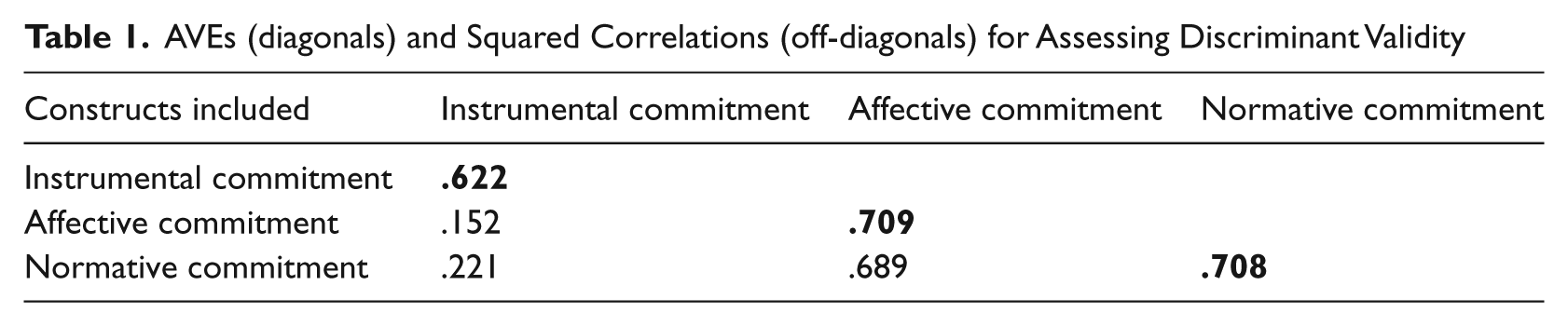
The analysis also identified that affective and normative commitment were highly correlated (.83), while the correlation between affective and instrumental commitment was .39 and between normative and instrumental commitment .47. Again, these findings reflect those reported by Meyer et al., who concluded that while normative and affective commitment are highly correlated, the correlation between the constructs is ‘not unity’ (2002: 40). These correlations further indicated discriminant validity between the constructs (Kline, 1998).
The independent component constructs of relationship benefits (fit indices and reliability for each independent relationship benefits construct, as shown in the Appendix) were then incorporated into a second-order model of relationship benefits which was tested for unidimensionality, reliability and validity. This analysis was deemed reasonable, given that the correlations evident between each of the first-order benefit constructs were positive and significant at .000, with all standard coefficients greater than or equal to .666. Again, this model was assessed against the a sample while, given the size of the input covariance matrix, it was constructed with composite scores being calculated for each factor. Therefore, the ratio of sample size to size of the covariance matrix was improved above the recommended minimum level of 5:1, increasing from 4.39 to 15.38 (Table 2). The second-order factor model was found to have a good fit on all indices, as shown in Table 3. Given these findings, it was deemed reasonable to conclude that the second-order factor model was a good representation of the construct.
Test Results for Relationship Benefit Component Constructs

Relationship Benefits Model Fit Indices

Testing the overall model
In assessing the overall model shown in Figure 1, composite variables were used to ensure an acceptable ratio of estimated parameters to respondents. Following a procedure recommended by Ping (2002) and Hair et al. (1998), the loadings and error terms for both composite variables and single-item measures were set.
The hypothesized structural model illustrated in Figure 1 was tested using the sample of 254 respondents. Fit indices are detailed in Table 4 and the structural model with its standardized coefficient values is shown in Figure 2. Indicators of overall fit (GFI and SRMR), incremental fit (CFI) and population fit (RMSEA) satisfied the recommended criteria. The ratio of chi-square to degrees of freedom (2.164) also was considered acceptable against the criterion that in large samples (>200) a ratio of χ2/df of <3 is considered to be favourable (Kline, 1998). Additionally, the chi-square test statistic (p<0.001) was significant.
Overall Model Fit Indices


Hypothesized Model Showing Standardized Coefficients
Figure 2 indicates that the amount of construct variance explained by direct indicators as demonstrated by the squared multiple correlations (SMCs) range from .141 to .737 (specifically, the SMC for trust was .213, relationship investments .263, satisfaction .737, absence of conflict .375, normative commitment .491, instrumental commitment .217, affective commitment .828, acquiescence .411 and switching .141).
Further, the strength of associations as indicated by the standardized path coefficients indicate a robust model (see Table 5). In particular the coefficients between relationship benefits and relationship investments (.51) and relationship benefits and trust (.46) indicated the veracity of relationship benefits when consideration is made of business-to-business relationships.
Standardized Coefficient and Significance Level of Hypothesized Associations
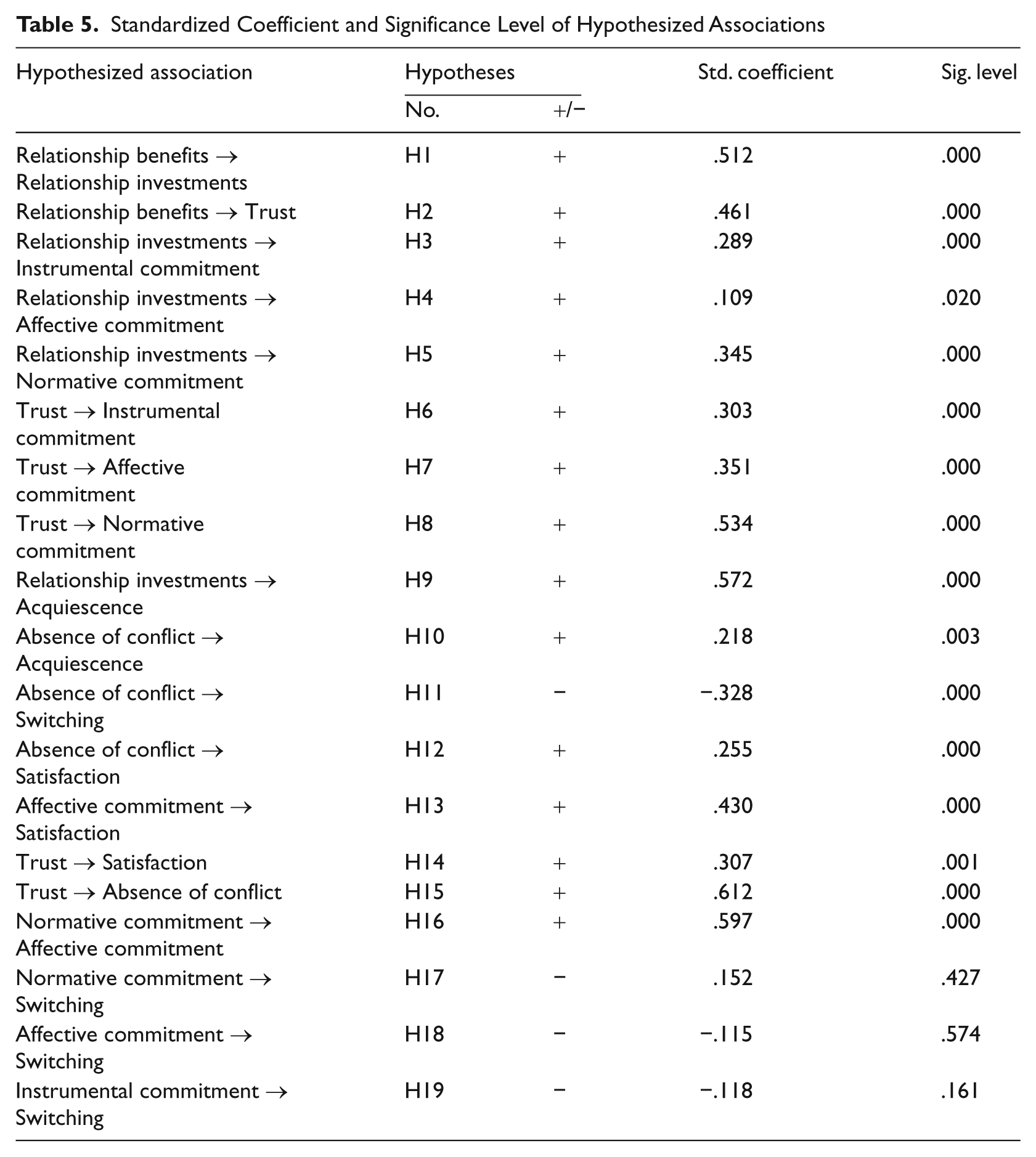
Finally, consideration of indirect effects provides evidence of an indirect association between relationship benefits and commitment. Specifically, relationship benefits was found to have a standardized indirect effect, significant at ≤.05, on instrumental commitment (.288), affective commitment (.470), and normative commitment (.423). In each case the indirect effect was through relationship investments and trust. In addition, relationship benefits was found to have a significant standardized indirect effect at ≤.05 on absence of conflict (.282), acquiescence (.355), satisfaction (.416) and switching (-.116). Based on the fit indices, it was concluded that the model reflected a good overall fit. However, three of the posited 19 paths were not significant at ≤.05, with no significant association being identified between any of the three components of commitment and switching (labelled in Figure 2 as n.s.).
Discussion and conclusion
The results reported in this article provide a theoretical and empirical framework for understanding relationship benefits. Analysis of the results provides answers to the three research questions and suggests several contributions to the literature.
Having been through an extensive review process it would be inappropriate to change the research question at this late stage. However to ensure that the context of the relationship is clear it is recommended the the following is added to the last paragraph of the section titled ‘Introduction’ immediately after the sentence that ends ‘…that also directly involves wholesalers and banner groups’. This ensures that the context is clear from the outset and in all sections where the RQs are stated.
The community pharmacies surveyed can be appropriately classified as small firms and the wholesalers and banner groups with whom they partner as either large medium sized firms or large firms.
RQ1 asked: ‘What benefits are valued by customers in a business-to-business setting?’ In addressing this question, a classification of benefits evident in the literature was developed. Four benefits were subsequently identified through in-depth interviews and the selection and testing of constructs that represented each concept. These benefits included: cost benefits that were characterized as benefits that reduce costs through improved systems and procedures; service benefits that were characterized as those designed to enhance service delivery; image benefits, characterized as brand name, promotion and reputation benefits; and flexibility benefits, characterized as benefits that enhance responsiveness to competitor actions and customer demand through innovation and competitive positioning. Consideration of these components of the relationship benefits construct and their measurement has resulted subsequently in the development of a revised characterization of relationship benefits as transferred capabilities and resources that support the realization of strategies designed to secure competitive advantage.
RQ2 asked: ‘What is the causal ordering of relationship benefits and other salient relationship concepts in a business-to-business environment?’ and RQ3 asked: ‘What are the strengths of association between relationship benefits and other salient relationship concepts in a business-to-business environment?’ To address these questions, initially the evidence in the literature and in-depth interviews were synthesized to develop a conceptual model represented by Figure 1. The compilation of this model provided a preliminary response to RQ2; the model was tested subsequently and the results reported in Tables 4 and 5 and Figure 2. The outcome of this analysis was that the model had a good overall fit and that 16 of the hypothesized 19 pathways were significant, while the three pathways between affective, normative and instrumental commitment and switching did not have a significant association. Through this process the causal ordering of concepts was tested, addressing RQ2, and the strengths of association were determined, effectively addressing RQ3.
The rejection of the hypothesized associations between the three components of commitment and switching was an unexpected result, given that Morgan and Hunt (1994) had reported a significant coefficient of -.550 (p<.001) between their global measure of commitment and propensity to leave. One explanation for this disparity in findings may be related to how commitment was operationalized in this article and by Morgan and Hunt (1994): that is, this article operationalized a three-factor structure and Morgan and Hunt (1994) a single-factor structure, making comparison of the associations difficult. However it may be that the Morgan and Hunt (1994) measure of propensity to leave reflected a more extreme response: namely, the termination of the relationship at some point in the future. Switching, as operationalized in this article, reflected a less terminal reaction, namely the sourcing of alternate products under circumstances in which the supplier was in short supply. Given this disparity in what was measured, it seems reasonable to conclude that while commitment may discourage an extreme response on the part of client firms, it does not have an effect on their preparedness to ‘shop around’ when necessary. Therefore, this result provides an additional finding suggesting that while commitment may enhance the likelihood that client firms will remain in the relationship (Morgan and Hunt, 1994), it will not stop sales ‘leakage’ in cases where supply has become an issue.
The first contribution of this article relates to the stated characterization of relationship benefits, as transferred capabilities and resources that support the realization of strategies designed to secure competitive advantage. It is a characterization supported by the theoretical development of the concept that arose from the literature review and in-depth interviews, and the related selection of a measure of relationship benefit components that used scales previously developed as measures of strategic priorities (Chenhall and Langfield-Smith, 1998; Dess and Davis, 1984). It is also a characterization that provides a sound theoretical basis for the relationship benefits concept by drawing from the strategy literature. Specifically, the research outcomes suggest that small firms in business-to-business networks value benefits that support the pursuit of strategic priorities relating to cost, service, image and flexibility, and that they use these networks to secure related capabilities and resources that underpin competitiveness. This finding reinforces the view that capabilities are derived from dyadic and network interactions which have the ability to build competitiveness by individual firms within a network (Turnbull et al., 1996), a view specific in the statement: ‘we use relationships to gain competitive advantage, to strengthen our core competencies and to create market position (Wilson and Jantrania, 1994). It also reinforces the recognized criticality of networks as a central element of competitiveness (Ford et al., 1997; Thorelli, 1986), particularly for smaller firms which often are unable to internalize all the capabilities that they need to compete effectively (eg. Thorgren et al., 2011; Hanna and Walsh, 2008).
The second contribution builds on the first and relates to how client firms conceptualize the benefits that they receive: that is, the research identified that the four types of identified relationship benefits were viewed as components of an overall ‘benefits package’. This was reflected in respondent statements in which community pharmacists indicated that while specific benefits could be identified, the ‘benefit package’ was evaluated as a whole. This finding suggests that while specific benefits can be identified and will have elements of value attached to them, there is a more abstract conceptualization of relationship benefits and value held by respondents that influences their evaluation of their suppliers’ performance on this criterion. The implications of this finding are that suppliers need to consider the efficacy of the benefit package, not just its components, and the effectiveness with which the value of this package is communicated.
The third contribution is that the perceived provision of relationship benefits by partners has constructive affects on relationships, as evidenced by the reported positive direct and indirect associations between relationship benefits and significant relationship constructs. Specifically, relationship benefits were shown to have positive direct effects on trust and relationship investments; positive indirect effects on affective, normative and instrumental commitment, absence of conflict and satisfaction; and a negative association with switching. The findings place relationship benefits within the web of previously identified business-to-business relationship concepts (Easton, 1997; Fontenot and Wilson, 1997; Hakansson and Snehota, 1995; Iacobucci and Hibbard, 1999; Morgan and Hunt, 1994).
The fourth contribution relates to classification of relationship benefits as a ‘hard outcome’ that differs from the ‘soft factors’ such as satisfaction and commitment typically examined within the context of relationship marketing and business-to-business relationships (Cannon and Homburg, 2001). According to Cannon and Homburg (2001), the identification of ‘hard outcomes’ will lead to greater practitioner interest in findings, because they will represent evidence that tangible economic actions have an association in the establishment and maintenance of close relationships. That is, the findings will assist practitioners because they provide a tangible economic basis for building mutually beneficial relationships, a platform for identifying the types of benefits that may be valued by client firms, and an opportunity to develop benefit packages that will appeal to individual firms or clusters of firms which have similar needs. For smaller firms who are often the clients in such relationships, the ability to focus on securing benefits that will have a positive impact on their competitiveness has the potential to allow them to compare the offers of competing suppliers more critically (see Miller et al., 2007).
The fifth contribution is drawn from evidence from the literature, in-depth interviews and the selected population that there is a need for firms engaged in business-to-business transactions to enter into extensive interaction and dialogue, if value is to be created and transferred between partners in a relationship and to associated networks of firms. Value creation in a relational context is dependent upon interaction and dialogue between buyers and sellers that ultimately builds and sustains mutual commitment (Holm et al., 1999). Through this process the seller can develop an intimate knowledge of buyer value chains and develop value models, identify what buyers perceive to be valuable, and create a value offer through the provision of benefits that translate into a competitive advantage for the seller and to buyer commitment (Anderson and Narus, 1998). The evidence from this study is that such a process has emerged in this market, and an intimate understanding of the needs of the various network participants has developed and facilitated the transfer of benefits that build commitment.
The final contribution highlights the importance of the development of a distinction in the literature between the conceptualization of relationship benefits and value. Value needs to be conceptualized more clearly as an outcome, more often perceived than quantified, that is generated in part by the provision of benefits that are recognized by participants in a business-to-business relationship as underpinning the development of resources (more often intangible than tangible) and capabilities that facilitate the development of distinctive competencies. This form of conceptualization will provide researchers with a clearer focus that facilitates the identification of other benefits that reside within other business networks, and a point of differentiation that clearly distinguishes between inputs (the relationship benefits) and outputs (value). Notably this reinforces the conceptualization of associations between context, relationship benefits and value offered by Ulaga and Eggert (2005, 2006) and Barry and Terry (2008).
Limitations of the study
The first potential limitation of the study is its focus on a single industry and single market. However, this was in recognition of the benefits that come from this approach, including its ability to minimize the possibility of extraneous factors, an approach in accord with previous studies focused on business-to-business relationships (Morgan and Hunt, 1994).
The issue of common methods bias is considered to be a second potential limitation. However, evidence indicates that studies which deal with relatively concrete targets as focal issues of research have lower common rater and item characteristics effects, minimizing the likely impact of common methods bias (Malhotra et al., 2006). Marketing generally is said to be of this nature and it is argued that this particular study, which has a marketing orientation, is also focused on more concrete targets, therefore minimizing the likely impact of common methods bias.
The third potential limitation is the study’s cross-sectional design in which data was obtained through a self-reporting questionnaire. Given that relationships vary over time, this design had the potential to provide a snapshot that may unduly affect the associations between constructs. However, this was moderated partially through the relative stability of the industry and relationships evident within it. For example, the banner groups interviewed as part of the qualitative stage indicated that the churn rate (where community pharmacies move from one banner group to another and/or away from banner group involvement entirely) was less than 10 percent. Having said that, it is clear that longitudinal studies have the potential to improve research outcomes in situations such as this, where long term business-to-business relationships are under investigation.
The final limitation that needs to be recognized is the response rate of 21.4 percent. Although reflective of general response rates achieved by mail surveys (for example Tang (2011) achieved 38% in Hong Kong and Beijing and McAdam, Moffett, Hazlett and Shevlin (2010) 19% in the UK), it is still important to consider the implications. In the present study, one counter to this concern was the evidence presented indicating that the demographic characteristics of respondents reflected that of the entire population.
Recommendations for future research
The specifics of this study suggest future research opportunities. First, the research setting is within the Australian legislative environment, which limits the number of pharmacies that can be licensed to practice in any one area. The result of this legislation is that community pharmacies, unlike most other businesses, enjoy control over the extent to which they face direct competition for their core dispensary business. However, at the same time community pharmacies do face direct competition from general retailers for most of their front-of-shop business, notably the part which is growing in significance as a source of revenue and profit.
The effect of these legislative controls provides community pharmacies with the opportunity to serve a particular geographic market more effectively than many potential competitors. Issues relating to the selection of a single industry as the vehicle for the study have been discussed already.
Second, research opportunities exist for the identification of other benefits in other business-to-business networks, and the development of a research agenda that seeks to develop a clearer picture of how or whether relationship benefits directly affect value. Potentially research that follows the logic employed by the service quality literature, and in particular research that underpins SERVQUAL and its various derivatives, could investigate the direct associations between relationship benefits and perceived value in business-to-business settings, thereby extending this and related research such as Ulagga and Eggert (2005). Such research would facilitate greater understanding of how value is generated in business-to business networks in SMEs. Hence, while the research has demonstrated that relationship benefits have significant direct and indirect effects on a number of salient relationship concepts, value as the more abstract outcome could be the glue that brings together and explains why these associations exist. Certainly, there would appear to be a strong theoretical basis for proposing that this may be the case.
Finally, the interaction between relationship sacrifices and benefits is an area that needs further investigation. Specifically, the effect of any trade-offs between benefits and sacrifices on the types of business-to-business relationship dimensions investigated by this research need to be better understood.
Footnotes
Appendix: Measurement scales
Items used to Measure Outcomes
| Construct | Items |
|---|---|
| Switching* | Switching to an alternative wholesaler for front-shop items if our banner group is in short supply |
| Waiting for short supplies rather than purchase from an alternate supplier | |
| Acquiescence* | Acquiesce to our banner group’s requests to change significant aspects of our business |
| Satisfaction** | We are satisfied with our banner group |

The question: ‘What is the likelihood of you undertaking the following actions?’ preceded these items. A seven-point semantic differential scale was applied (where 1 = ‘very unlikely’ and 7 = ‘very likely’). **A seven-point Likert scale was used (where 1 = ‘strongly disagree’ and 7 = ‘strongly agree’).
This research received no specific grant from any funding agency in the public, commercial or not-for-profit sectors.