




Abstract
This article illustrates the differential impact of societal culture on the probability that individuals will choose to become self-employed on a full- or part-time basis. Specifically, we develop theoretical arguments to suggest that societal-level uncertainty avoidance, institutional collectivism, performance orientation, and future orientation differ in their effects on the propensity for individuals to engage in full- or part-time self-employment. Multi-level analyses based on data from 28,157 individuals in 27 countries support our theoretical reasoning. Our study contributes to extending knowledge both on the link between societal culture and self-employment activity and on the drivers of full-time versus part-time self-employment.
Introduction
Entrepreneurship is widely recognised as both a social (Korsgaard and Anderson, 2011) and socio-cultural phenomenon (Thornton et al., 2011). Consequently, the question of how societal culture relates to entrepreneurial activity in general, and individual tendencies to become self-employed in particular, feature prominently in the literature (Hayton and Cacciotti, 2013; Hayton et al., 2002; Minola et al., 2016; Thornton et al., 2011). 1 In prior research, self-employment and other entrepreneurial activities have been largely conceptualised and operationalised as ‘all-or-none’ phenomena (Autio et al., 2013; Stenholm et al., 2013; Wennberg et al., 2013). 2 This does not account for the fact that a large share of self-employment activity worldwide is conducted on a part-time basis. For several reasons, we believe that a differentiation between full- and part-time self-employment is necessary to establish a better understanding of the consequences of societal culture in this research domain.
First, full-time self-employment and part-time self-employment are significantly different occupations or career opportunities. Compared to full-time self-employment, self-employment on a part-time basis typically requires lower investments in terms of time, energy and other resources (Petrova, 2012; Raffiee and Feng, 2014). Full- and part-time self-employment also differ with respect to average financial outcomes (Block and Landgraf, 2016; Folta et al., 2010; Schulz et al., 2017) and associated risk (Burmeister-Lamp et al., 2012; Raffiee and Feng, 2014). Consequently, prior research has found full- and part-time self-employment to be differentially related to individual-level factors such as household situation and education (Bögenhold and Klinglmair, 2017; Folta et al., 2010; Raffiee and Feng, 2014; Thorgren et al., 2016), which influence individual career preferences and occupational choices. Second, prior research has observed that rates for full- and part-time self-employment differ considerably across national contexts (Bosma et al., 2009; Minniti et al., 2006). In Germany, for example, approximately 30% of all self-employment activity is part time (Piorkowsky et al., 2013); this share is even higher in Scandinavian countries (Bosma et al., 2008). Thus, it seems likely that societal-level factors, such as culture, may differentially affect individual inclinations to become self-employed on a full- or a part-time basis.
Against this backdrop, this article revisits the link between societal culture and self-employment. We conceptualise full- and part-time self-employment as two distinct career choices (Douglas and Shepherd, 2000; Lévesque et al., 2002). Based upon this conceptualisation, we develop theoretical arguments to suggest why dimensions of societal culture, closely linked to self-employment from a conceptual point of view (Autio et al., 2013; Bullough et al., 2017; Hayton and Cacciotti, 2013), have different effects on the probability that individuals will engage in full- or part-time self-employment. Specifically, we focus upon the societal cultural dimensions of uncertainty avoidance, institutional collectivism, performance orientation and future orientation, as identified in the Global Leadership and Organizational Behaviour Effectiveness (GLOBE) study (House et al., 2004). We hypothesise that while these dimensions will have either a positive or a negative effect on the probability that individuals will engage in full- or part-time self-employment, the magnitude of such effects will differ significantly across these two types of self-employment activity. Recognising that societal culture is a collective concept, whereas occupational choices are made upon an individual level, so likely to be influenced by individual characteristics (Autio et al., 2013; Klyver et al., 2013; Shepherd, 2011), we utilise a multi-level model to test our hypotheses. Based on data from 28,157 individuals in 27 national contexts, our analyses provide evidence in support of our theoretical arguments.
Combining ideas on how culture relates to entrepreneurship and self-employment with an emerging literature on full- and part-time self-employment, we make several contributions. First, this article contributes to the literature on the consequences of culture (Hayton and Cacciotti, 2013; Hayton et al., 2002) by highlighting that societal culture that fosters or forestalls self-employment on a full-time basis will often have different effects on inclinations to become self-employed on a part-time basis. Accordingly, our study may even help reconcile previous inconclusive findings on the consequences of societal culture for entrepreneurial activity. Second, we contribute to the emerging literature on full-time versus part-time self-employment (Folta et al., 2010; Raffiee and Feng, 2014; Schulz et al., 2016). Prior research in this domain has predominantly elaborated upon how individual-level factors differentially relate to the probabilities of engaging in full- and part-time self-employment. Our study complements this research by highlighting the role of societal culture upon these career choices. Finally, pointing to the fact that a ‘one size fits all’ approach to stimulating entrepreneurial activity may not be appropriate, our findings also have practical implications for policymakers.
Theory and hypotheses
Full-time and part-time self-employment as distinct career choices
Individuals choose their occupation according to what might maximise satisfaction or utility (Burmeister-Lamp et al., 2012; Douglas and Shepherd, 2000; Lévesque et al., 2002). Individuals experience satisfaction and utility when their attitudes and preferences fit with the attributes of their career choices. Featuring prominently among the occupation-related attributes relevant to career choices are time and effort required, resulting monetary income and the risk and uncertainty associated with an occupation (Douglas and Shepherd, 2000; Lévesque et al., 2002). Full- and part-time self-employment differ considerably with respect to these attributes and therefore, have been found to align with different career-related motivations and preferences (Folta et al., 2010; Raffiee and Feng, 2014).
Compared to other occupations, creating and running a business is generally associated with considerable effort and time commitment, implying that self-employed individuals may have to prioritise their business over personal and family life (Hayward et al., 2006; Wright and Zahra, 2011). However, this situation more clearly applies to self-employment on a full-time, rather than a part-time, basis (Petrova, 2012; Raffiee and Feng, 2014). Comparably, part-time self-employment better aligns with preferences for combining work with family life (Folta et al., 2010; Strohmeyer et al., 2006) and other non-monetary benefits such as exploring an interest or pursuing a hobby (Folta et al., 2010; Marshall et al., 2018; Wincent et al., 2014).
In general, the monetary income potential associated with self-employment is recognised as exceeding what can be earned in wage employment (Åstebro and Chen, 2014; Rosen, 1981; Lévesque et al., 2002). As a consequence, however, the average monetary income associated with full- and part-time self-employment will also differ significantly. Indeed, full-time self-employment has a higher monetary income potential than part-time self-employment, even when the latter is combined with part-time wage employment (Block and Landgraf, 2016; Carter, 2011; Folta et al., 2010). As a consequence, preferences for monetary rewards align more coherently with full- rather than part-time self-employment. Monetary rewards are also a widely recognised indicator of professional accomplishment (Davidsson, 1989). Compared to other occupations, self-employment is presumed to correspond closely with motivations to realise professional achievements (Collins et al., 2004; Johnson, 1990). Given the significant differences in monetary reward potential associated with full- and part-time self-employment, however, the former should more closely align with motivations to realise professional achievements.
While self-employment activities generally have potential for significant monetary incomes, such outcomes are recognised as more risky and uncertain than those of wage employment (Åstebro and Chen, 2014; Hamilton, 2000; Knight, 1942). Indeed, there is some agreement that business owners have to make judgement calls in the face of uncertainty – that is, without knowing the full range of possible outcomes and their probabilities – and run the risk of losing their investments (Wennekers et al., 2007). Again, however, there is a significant difference between full- and part-time self-employment (Folta et al., 2010; Raffiee and Feng, 2014). Part-time endeavours are typically founded on a smaller scale and require lower financial capital (Petrova, 2012). Due to greater initial investment and commitment, starting and running a full-time business typically puts more resources at risk than for the same business on a part-time basis (Raffiee and Feng, 2014). Similarly, the outcomes for part-time self-employment will, on average, be less uncertain as persistence with waged work reduces income uncertainty (Folta et al., 2010). As such, part-time self-employment offers an opportunity not only to experiment with and gain insights into a venture’s viability but also to test out personal abilities to pursue self-employment (Folta et al., 2010). In line with this reasoning, previous research has found the willingness to take risks regarding success or failure to be comparably more conducive for engaging in full-time rather than part-time self-employment (Raffiee and Feng, 2014).
In summary, full- and part-time self-employment differ significantly with respect to attributes relevant to occupational choices. In line with this reasoning, prior research found individual-level factors that shape career-related attitudes and preferences, such as household situation, age and educational attainments, to differentially affect the probability of engagement with full- or part-time self-employment (Folta et al., 2010; Raffiee and Feng, 2014; Thorgren et al., 2016). Complementing this research, we outline why we expect the probability that individuals become self-employed on a full- or a part-time basis to be differentially related to particular dimensions of societal culture.
Societal culture and self-employment
As noted, individuals tend to make career choices based on a perception of fit between the attributes of an occupation and their career-related attitudes and preferences (Douglas and Shepherd, 2000; Lévesque et al., 2002). The attitudes and preferences that drive career choices are not just shaped by individual characteristics such as dispositions and demographics (Krueger et al., 2000) but also by the societal culture in which individuals are embedded (Kolvereid, 1996; Busenitz and Lau, 1996; Stenholm et al., 2013).
Generally, culture can be defined as a historically transmitted pattern of conceptions through which people develop their attitudes towards life (Geertz, 1973). Societal culture constitutes the standard for attitudes and beliefs that distinguish the members of one national context from another (Hofstede, 1984; Holmes et al., 2013). Embodying norms about what is legitimate, appropriate and desirable in a particular national context, societal culture is widely recognised as affecting the economic behaviour of individuals in general and their occupational choices in particular (Hofstede, 1980; House et al., 2004; Oyserman and Lee, 2008).
Through learning and socialisation, individuals understand and adopt prevalent social norms (Holmes et al., 2013). Through these means, societal culture shapes attitudes and preferences related to occupations and career choices (McMullen and Shepherd, 2006; Mitchell et al., 2000). Societal culture further affects career choice preferences through social sanction and support mechanisms (Autio et al., 2013; Stenholm et al., 2013). Behavioural expectations and norms shared within a society indicate what social consequences are associated with particular economic actions (Autio et al., 2013). Societal culture thus influences whether it is considered legitimate and appropriate to choose certain occupations within a national context. As individuals anticipate social acceptance and support, their preferences and occupational choices tend to reflect societal cultural norms and expectations (Autio et al., 2013; Stenholm et al., 2013).
Based on this reasoning, a considerable body of research has addressed the link between societal culture and self-employment activity. However, such studies have typically combined full- and part-time self-employment into a single category (Autio et al., 2013; Stenholm et al., 2013; Wennberg et al., 2013). We develop hypotheses on how the societal cultural dimensions of uncertainty avoidance, institutional collectivism, performance orientation, and future orientation relate to the propensity to engage in full- and part-time self-employment (see Figure 1).
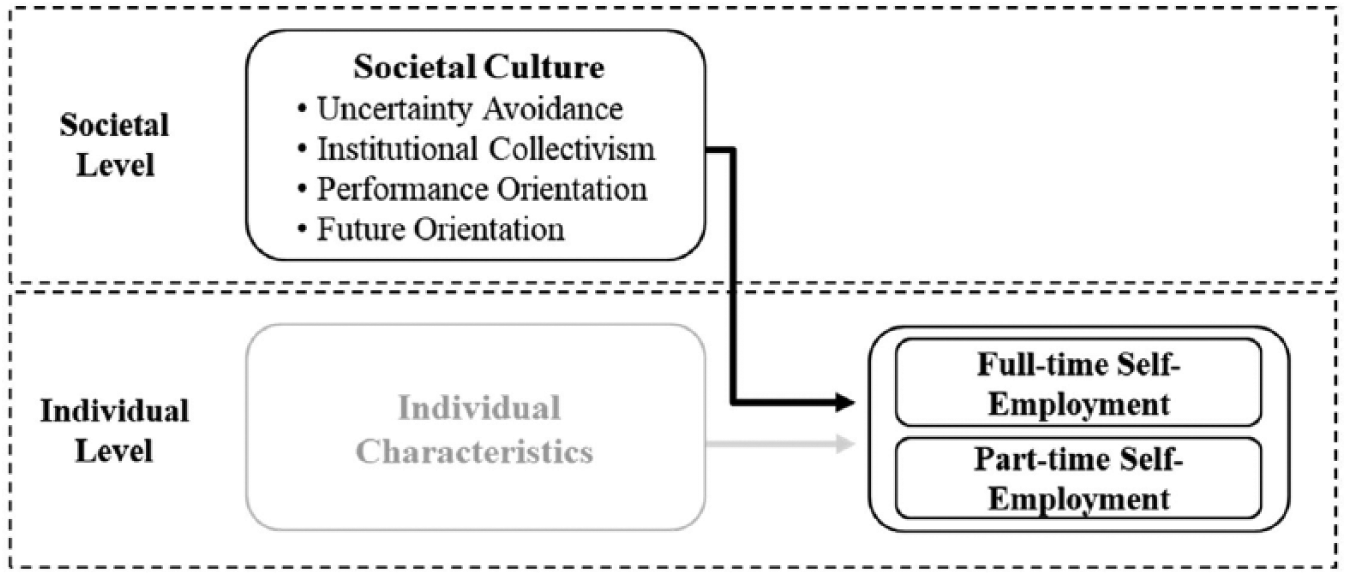
Societal culture and self-employment activity.
We focus on these four dimensions of societal culture as first, they are considered to be closely linked to entrepreneurial activity from a conceptual point of view (Autio et al., 2013; Bullough et al., 2017; Hayton and Cacciotti, 2013; Hayton et al., 2002). Second, we anticipate that the societal norms indicated by these dimensions will result in career preferences that differentially align with the characteristics of full- and part-time self-employment.
Uncertainty avoidance
Societies scoring high on uncertainty avoidance expect individuals to take moderate, carefully calculated risks and to live highly structured lives with few unexpected events (Sully De Luque and Javidan, 2004; Venaik and Brewer, 2010). In contrast, societies scoring low on uncertainty avoidance appreciate changes, taking risks and having a willingness to enter into unknown ventures (Hofstede, 2001; Venaik and Brewer, 2010).
As noted, self-employment generally involves significant amounts of risk and uncertainty. Consequently, the possible outcomes of self-employment are more uncertain than most waged work (Wennekers et al., 2007). Furthermore, self-employment requires considerable commitment in terms of time and resources to an endeavour that will not necessarily succeed (Raffiee and Feng, 2014). In societies that appreciate predictability and emphasise taking only moderate risks, being self-employed is likely to be associated with relatively low levels of social appreciation and status. Thus, self-employment will not be considered an attractive career opportunity (Autio et al., 2013). Considering these arguments, we suggest that societal uncertainty avoidance will be negatively associated with the propensity that individuals engage in self-employment on either a full- or a part-time basis.
Hypothesis 1a: Societal uncertainty avoidance is negatively associated with the propensity to engage in full-time self-employment.
Hypothesis 1b: Societal uncertainty avoidance is negatively associated with the propensity to engage in part-time self-employment.
Acknowledging the differences between full- and part-time self-employment, however, we do not believe that societal uncertainty avoidance will have a similarly negative impact upon the propensity to engage in these two types of self-employment. Part-time self-employment typically involves lower levels of risk and uncertainty (Raffiee and Feng, 2014) as it requires less investment and enables engagement with waged work (Autio et al., 2013). Compared to becoming self-employed on a full-time basis, part-time self-employment will likely be considered more legitimate in societal contexts characterised by high levels of uncertainty avoidance. As such, we expect societal uncertainty avoidance to be more negatively related with an inclination to engage in full- rather than part-time employment. Hence, we propose the following:
Hypothesis 1c: Societal uncertainty avoidance is more negatively related to the propensity to engage in full-time than part-time self-employment.
Institutional collectivism
Societies that emphasise institutional collectivism reinforce group loyalty and acting in the interest of the collective, even if the pursuit of individual goals is undermined (Gelfand et al., 2004; House et al., 2002). In such societies, individuals are expected to willingly fulfil their duties and obligations towards others and accept remuneration based on equity norms (Gelfand et al., 2004; House et al., 2002). In societies that score low on institutional collectivism, in contrast, personal needs and interests are considered more important, and striving for reward based upon one’s own contribution is considered legitimate (Brewer and Venaik, 2011; Gelfand et al., 2004).
Generally, self-employment rewards individuals according to their capacity to meet customer needs and demands, determined by their efforts and abilities (Douglas and Shepherd, 2002; Lévesque et al., 2002). As such, becoming self-employed aligns with preferences for individualised rewards that run counter to the social order prevalent in institutionally collectivistic societies (Gelfand et al., 2004; Rauch et al., 2013). Thus, those embedded in societal contexts that score highly on institutional collectivism are likely to avoid becoming self-employed. We thus propose the following:
Hypothesis 2a: Societal institutional collectivism is negatively related to the propensity to engage in full-time self-employment.
Hypothesis 2b: Societal institutional collectivism is negatively related to the propensity to engage in part-time self-employment.
Complementing Hypotheses 2a and 2b, we posit that societal institutional collectivism will be more negatively associated with the probability that individuals engage in self-employment on a full-time rather than a part-time basis. Part-time self-employment allows comparatively more time to be spent upon other activities, such as caring for the home and family (Burke et al., 2008; Thompson et al., 2009). This resonates with societal expectations to act according with the collective’s interest (Bullough et al., 2017). Thus, part-time self-employment better aligns with the career-related attitudes and preferences arising from a collectivistic social structure. Also, previous research suggests that group efforts to create new business are often conducted on a part-time basis (Block et al., 2013a; Fletcher, 2010). Such group efforts, however, are less likely to run counter to norms and expectations that emphasise and reinforce group loyalty and acting on behalf of a collective interest than individual self-employment endeavours conducted on a full-time basis (Markantoni et al., 2012). Against this backdrop, we suggest that those within collectivistic cultures are more likely to consider part-time rather than full-time self-employment as a suitable career choice. Accordingly, we propose the following:
Hypothesis 2c: Societal institutional collectivism is more negatively related to the propensity to engage in full-time than part-time self-employment.
Performance orientation
Performance-oriented societies encourage materialism, emphasise achievements and legitimise behaviour that aims at outperforming others (House et al., 2002; Javidan, 2004). In such societies, individuals learn to appreciate, and are rewarded for, having a ‘can-do’ attitude and striving for professional accomplishments (Javidan, 2004). Generally, self-employment entails the potential for realising significant monetary rewards and provides individuals with the opportunity to outperform others based upon their own capabilities (Åstebro and Chen, 2014; Lévesque et al., 2002). In performance-oriented societies where the social context indicates that striving for materialistic rewards is desirable and associated with superior social status and prestige (Javidan, 2004), self-employment should be perceived as an attractive career choice (Autio et al., 2013). In addition, individuals in societal contexts that score high on performance orientation should be more likely to accept the challenges involved in self-employment given social expectations to demonstrate a ‘can-do’ attitude (Javidan, 2004). Based on these considerations, we posit that societal performance orientation will stimulate engagement in self-employment on both a full- and a part-time basis.
Hypothesis 3a: Societal performance orientation is positively related to the propensity to engage in full-time self-employment.
Hypothesis 3b: Societal performance orientation is positively related to the propensity to engage in part-time self-employment.
Complementing Hypotheses 3a and 3b, we suggest that societal performance orientation is more positively related to a propensity to engage in full-time rather than part-time self-employment. Even if in wage-employment when engaging with part-time self-employment, equivalent incomes to those of full-time self-employed are unlikely to be realised. In performance-oriented societies, full-time rather than part-time self-employment is thus likely to be deemed a more compelling career opportunity. Based on these arguments, we expect societal performance orientation to be positively related to the propensity that individuals will engage in full-time rather than part-time self-employment. Thus, we propose the following:
Hypothesis 3c: Societal performance orientation is more positively related to the propensity to engage in full-time than part-time self-employment.
Future orientation
In future-oriented societies, planning, a strategic long-term orientation, delaying gratification and saving for the future are appreciated and rewarded (Ashkanasy et al., 2004; House et al., 2002). Societies that score low on future orientation, in contrast, have a greater appreciation for immediate rewards in terms of spending now rather than saving for the future (House et al., 2002). Self-employment requires considerable initial investment in time, effort and money that may only reap reward over the long term. Self-employment is thus associated with a cost and reward structure that resonates well with social expectations to delay gratification. Based on these observations, we believe that individuals in societal contexts in which a strong future orientation is prevalent are more likely to engage in full-time or part-time self-employment than their counterparts in societal contexts that score low on future orientation.
Hypothesis 4a: Societal future orientation is positively related to the propensity to engage in full-time self-employment.
Hypothesis 4b: Societal future orientation is positively related to the propensity to engage in part-time self-employment.
Part-time entrepreneurial activity is associated with lower initial investments in terms of time, effort and resources than full-time self-employment. In addition, it allows for simultaneous waged employment which can compensate for initially poor returns from new firms (Raffiee and Feng, 2014). Comparably, part-time self-employment more coherently aligns with an appreciation for immediate rewards prevalent in societies scoring low on future orientation. Conversely, full-time self-employment will more likely be considered a favourable and legitimate career choice by individuals in societies that emphasise delaying gratification and investing in the future, a characteristic of societal future orientation (Ashkanasy et al., 2004). Thus, we propose the following:
Hypothesis 4c: Societal future orientation is more positively related to the propensity to engage in full-time than part-time self-employment.
Data and method
To test our hypotheses, we relied on multiple sources of data. For our individual-level variables, including our dependent variable and individual-level controls, we relied on data from the Eurobarometer 354 dataset (European Commission, 2012). This dataset was collected via computer-assisted interviews by the market research company TNS in June, July and August 2012. The dataset covers a wide range of information from 42,080 individuals in 40 countries on topics such as occupational status, demographics and household situation. As shown in prior research (Block et al., 2013b; Kautonen et al., 2014; Parboteeah et al., 2015; Verheul et al., 2012), the Eurobarometer data are particularly suited for multi-country studies of self-employment activity because they comprise representative samples of the populations in their national contexts (European Commission, 2012).
To examine the relationship between societal culture and self-employment activity on a full- and part-time basis, we combined the Eurobarometer dataset, which does not include information on societal-level variables, such as culture, population and gross domestic product (GDP), with data from other sources. For data on societal culture, we followed earlier research (Autio et al., 2013; Bullough et al., 2017; Stephan and Uhlaner, 2010; Thai and Turkina, 2014; Wennberg et al., 2013) and utilised GLOBE study results (House et al., 2004). GLOBE is a long-term, multiphase, multimethod international research project that involved more than 200 researchers from 62 countries to generate insights into the societal culture in various national contexts. For 27 of the 40 national contexts for which individual-level data were included in the Eurobarometer dataset, data on societal culture were available via GLOBE. For our analyses, we further complemented these data with information on GDP and country size available from The World Bank (2014).
The resulting dataset contained information on 29,041 individuals from 27 national contexts. After a list-wise deletion of cases with missing values on individual-level study variables (884 individuals), the final dataset for our main analyses included 28,157 individuals embedded in 27 national contexts. 3
Measures
Dependent variable
To reflect our dependent variable, we classified individuals according to their occupations as full-time self-employed, part-time self-employed, and not self-employed. Individuals were classified as full-time self-employed if they indicated self-employment as their only occupation (3309 individuals). Respondents who reported being self-employed and holding another occupation at the same time (1888 individuals) were classified as part-time self-employed. The remaining individuals were classified as not self-employed (22,960 individuals). Table 4 in the Appendix shows both the absolute numbers of individuals and the rates of full- and part-time self-employment for all the national contexts in our sample.
Independent variables
To reflect societal performance orientation, future orientation, uncertainty avoidance, and institutional collectivism, we followed prior research (Autio et al., 2013; Saeed et al., 2014; Stephan and Uhlaner, 2010; Thai and Turkina, 2014) and relied on societal cultural practice scores as provided by GLOBE. GLOBE societal practices capture the norms and expectations enacted within a society (House et al., 2004; Maseland and Van Hoorn, 2009). As such, previous research has found GLOBE societal practices to be significantly related to self-employment activity (Autio et al., 2013; Stephan and Uhlaner, 2010; Thai and Turkina, 2014). Detailed information on how societal culture was captured in the GLOBE study are available in House et al. (2004). Sample items used to capture the four dimensions of societal culture reflected in our hypotheses are as follows: ‘In this society, orderliness and consistency are stressed, even at the expense of experimentation and innovation’ (uncertainty avoidance); ‘In this society, leaders encourage group loyalty even if individual goals suffer’ (institutional collectivism); ‘In this society, major rewards are based on only performance effectiveness vs. only factors other than performance effectiveness (for example, seniority or political connections)’ (performance orientation) and ‘In this society, people place more emphasis on solving current problems vs. planning for the future’ (future orientation).
Control variables
We included several control variables in our analyses. Based on the Eurobarometer data, we included several individual-level control variables. Specifically, we controlled for personal and household situations and capabilities, which were found to be differentially related to the probability that individuals will engage in full- or part-time self-employment by previous research (Block and Landgraf, 2016; Folta et al., 2010; Schulz et al., 2017). First, we included gender and age. To reflect gender, we created a dummy variable, with the value of 1 for females and 0 for males. We included a linear and a squared term for respondent age in number of years divided by 10 to account for a potential non-linear relationship between age and entrepreneurial activity (Parker, 2004; Semrau and Werner, 2012). We further accounted for the extent to which respondents were comfortable with their household income (feelings about household income), along with the number of household members, which was found to be related to the inclination to become self-employed on a full- or part-time basis by previous research (Folta et al., 2010; Raffiee and Feng, 2014). Household members indicate the number of members in the households of respondents. Feelings about household income reflect, on a 4-point scale, the extent to which respondents felt comfortable managing their household based on their available income. Prior research found parental self-employment to be related to individual engagement in entrepreneurial activity (Nicolaou et al., 2008; Sørensen, 2007). Thus, we further included a dummy variable that took the value of 1 if at least one of the respondent’s parents was or is self-employed and 0 otherwise (parental self-employment). In addition, we controlled for education, which has been found to differentially relate to the probability of becoming an entrepreneur on a full- or a part-time basis (Bögenhold and Klinglmair, 2017; Folta et al., 2010; Raffiee and Feng, 2014). To capture education, we followed prior research based on the Eurobarometer dataset (Adam-Muller et al., 2015; Block et al., 2013b) and constructed a measure reflecting the number of years in full-time education.
Based on data provided by the GLOBE study and the World Bank (2014), we also included several country-level controls in our analyses. Prior research suggests that in poorer national contexts, entrepreneurial activity is often driven by necessity (Rosa et al., 2008; Wennekers et al., 2005). Following earlier research (Autio et al., 2013; Block et al., 2013b), we thus controlled for GDP per capita at purchasing power parity (PPP). We additionally controlled for country size in terms of the number of inhabitants. Countries with a larger population represent bigger markets, provide more entrepreneurial opportunities and have the potential for higher economies of scale (Briguglio, 1998), which can have a positive effect on the inclination to engage in entrepreneurial activity (Di Addario and Vuri, 2010; Sato et al., 2012). Because this variable varies considerably across the national contexts in our sample (from 2 million to 1351 million), we included it as a natural log. Given that the effects of particular dimensions of societal culture should not be assessed in isolation (Javidan et al., 2006), we also controlled for the five dimensions of societal culture identified in GLOBE that are not subject to our study hypotheses (i.e. power distance, humane orientation, in-group collectivism, assertiveness and gender egalitarianism). Please refer to House et al. (2004) for details on how these dimensions were originally captured in the GLOBE study.
Analytical approach
Our study addresses the effect of culture, a societal-level concept (Autio et al., 2013; Tsui et al., 2007), on engagement with full-time, part-time, or non-self-employment, which resides at the individual level (Autio et al., 2013; Wennberg et al., 2013). Consequently, we tested our hypotheses based on a multi-level model that ensures unbiased estimations of cross-level effects (Bliese, 2000; Hofmann, 1997; Klein and Kozlowski, 2000).
Our dependent variable is categorical and has three alternative outcomes. To correctly specify our model, we tested for the independence of irrelevant alternatives (IIA). If the IIA condition is met, the inclusion or exclusion of one outcome category does not significantly change the results for the remaining outcome categories, and a multinomial logit model is appropriate (Greene and Hensher, 2003; Train, 2009). Small–Hsiao tests (Small and Hsiao, 1985) indicated that excluding one of our outcome categories did not significantly change the results for the remaining ones. Thus, we used a multi-level multinomial logistic model specification with non-entrepreneurs as the base category to test our hypotheses.
Relying on a restricted maximum likelihood estimator (REML), we calculated models with random intercepts and random slopes (Aguinis et al., 2013; LaHuis and Ferguson, 2009). These models account for potential variance in the relationships between individual-level predictors and outcomes across national contexts (Bickel, 2007; Gelman and Hill, 2007; Li et al., 2012), as observed in prior research (De Clercq et al., 2011; Wennberg et al., 2013).
To test for statistical differences in how the dimensions of societal culture relate to the propensity to engage in full- and part-time self-employment, we employed a Wald test (Kodde and Palm, 1986; Long and Freese, 2006).
Results
Table 1 shows the descriptive statistics and correlations for our individual-level and country-level variables.
Descriptive statistics and correlations.
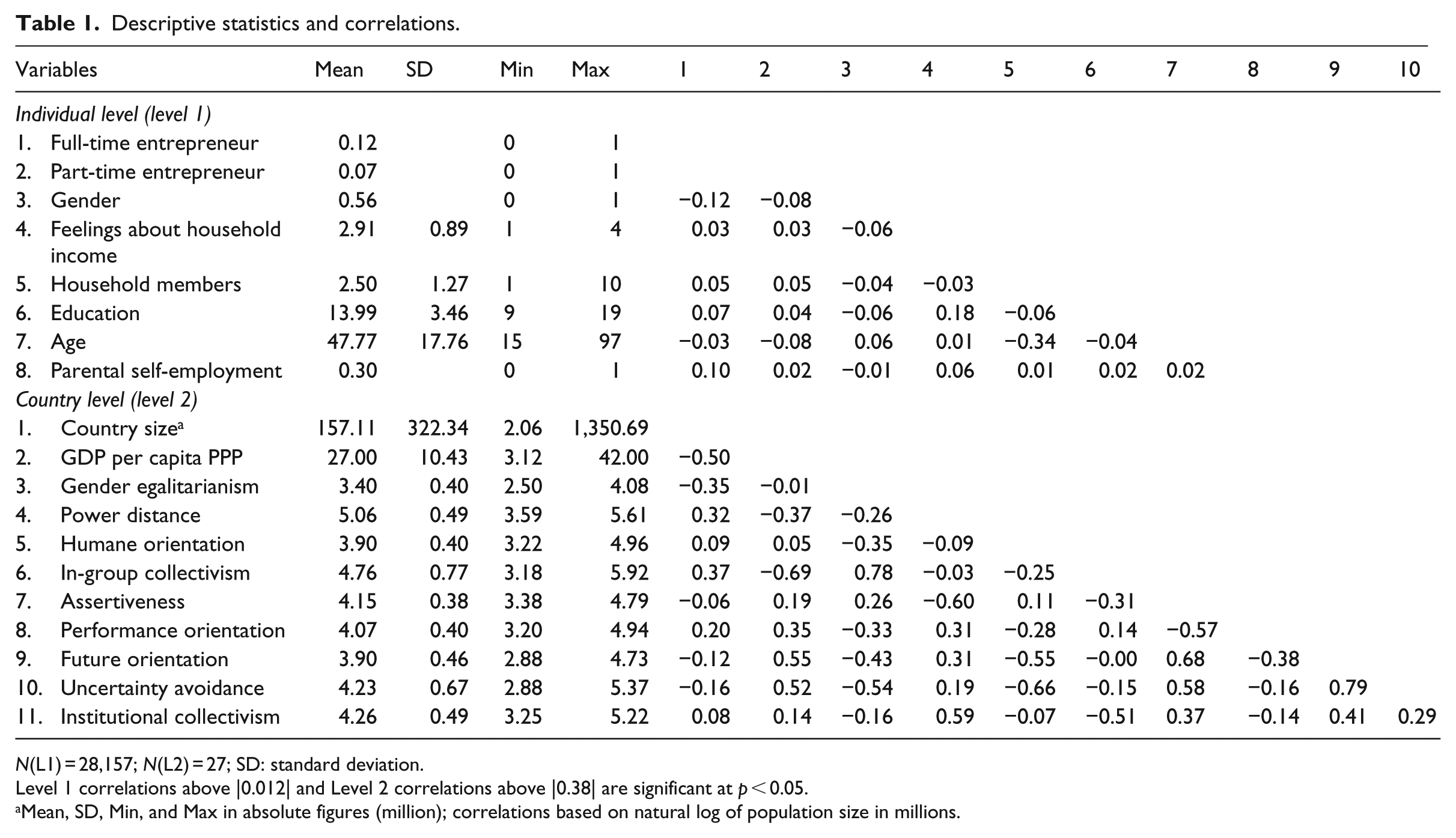
N(L1) = 28,157; N(L2) = 27; SD: standard deviation.
Level 1 correlations above |0.012| and Level 2 correlations above |0.38| are significant at p < 0.05.
Mean, SD, Min, and Max in absolute figures (million); correlations based on natural log of population size in millions.
Consistent with prior research (Autio et al., 2013; Javidan et al., 2006), we find significant relations between the GLOBE dimensions. As described in the following in detail, we conducted several robustness checks and ruled out that our results are affected by multicollinearity.
Results from multi-level analyses
Table 2 displays the results of our multi-level analyses. For every model, odds ratios, gamma coefficients, and standard errors for all variables, along with the results of Wald tests for differences in coefficients, are reported.
Results from multi-level analyses.
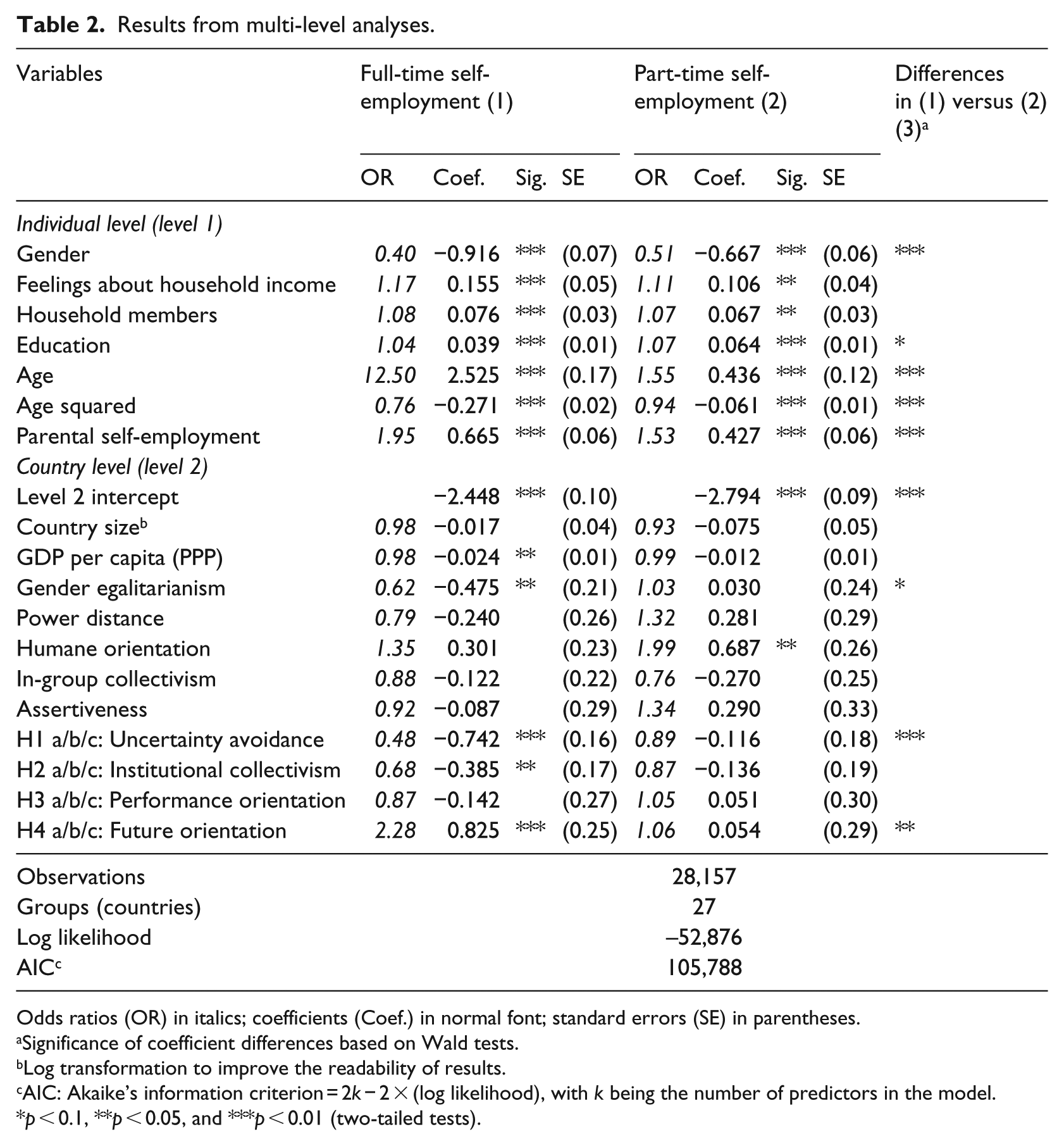
Odds ratios (OR) in italics; coefficients (Coef.) in normal font; standard errors (SE) in parentheses.
Significance of coefficient differences based on Wald tests.
Log transformation to improve the readability of results.
AIC: Akaike’s information criterion = 2k − 2 × (log likelihood), with k being the number of predictors in the model.
p < 0.1, **p < 0.05, and ***p < 0.01 (two-tailed tests).
Table 2 reveals a pattern of results for our individual-level controls consistent with prior research on self-employment activity on a full- or a part-time basis. In line with prior research (Block and Landgraf, 2016), we found gender to be more negatively (p < 0.01) related to full-time (γ = −0.916, p < 0.01) than to part-time self-employment (γ = −0.667, p < 0.01). Also similar to previous research (Bögenhold and Klinglmair, 2017; Folta et al., 2010), we observed that education has a stronger (p < 0.10) positive relationship with part-time (γ = 0.064, p < 0.01) than with full-time self-employment (γ = 0.039, p < 0.01).
With respect to our country-level control variables, we observed GDP per capita to be significantly negatively related to full-time self-employment (γ = −0.024, p < 0.05). This result reflects previous research on the link between GDP and entrepreneurial activity (Autio et al., 2013). In addition, we observed a positive link between societal humane orientation and part-time self-employment (γ = 0.687, p < 0.05), but not full-time self-employment (γ = 0.301, n. s.). Furthermore, we found societal gender egalitarianism to be significantly negatively related to full-time self-employment (γ = −0.475, p < 0.05) but not to part-time self-employment (γ = 0.030, n. s.).
With respect to our hypotheses, we found supporting evidence for Hypothesis 1a, suggesting that societal uncertainty avoidance is negatively related to the propensity to engage in full-time self-employment (γ = −0.724, p < 0.01). In contrast, we did not observe a significant link between societal uncertainty avoidance and the propensity to engage in part-time self-employment (γ = −0.116, n. s.), as predicted by Hypothesis 1b. Supporting Hypothesis 1c, our data further revealed a significant difference (p < 0.01) between these two effects.
Our results also supported Hypothesis 2a, which suggests a negative relationship between societal institutional collectivism and the probability of engagement with full-time self-employment (γ = −0.385, p < 0.05). Again, we observed no evidence in support of Hypothesis 2b, as the relationship between societal institutional collectivism and part-time self-employment is insignificant (γ = −0.136, n. s.). This constellation of results reflects Hypothesis 2c.
However, perhaps because of the moderate number of countries in our study, the Wald test indicated that the difference between the two effects was not significant.Our data did not reveal significant relationships between societal performance orientation and full-time self-employment (γ = −0.142, n. s.; Hypothesis 3a) and part-time self-employment (γ = 0.051, n. s.; Hypothesis 3b). In addition, we found no significant difference between the two coefficients (Hypothesis 3c).
Hypothesis 4a, which posited a positive association between societal future orientation and the probability that individuals will engage in full-time self-employment, was supported by our data (γ = 0.825, p < 0.01). We observed no significant link between societal future orientation and part-time self-employment (γ = 0.054, n. s.). A Wald test further indicated a significant difference (p < 0.05) between these two effects, which is in line with Hypothesis 4c.
Robustness checks
To probe the robustness of our findings, we conducted several additional analyses. First, we tested whether our results were stable across different treatments of missing values. As noted previously, the results displayed above are based on a dataset with list-wise deleted cases. For our stability tests, we first reran our models based on a dataset with missing values replaced by the means of the respective variables. Second, we reran our analyses based on datasets for which we used a more sophisticated imputation procedure. Specifically, we used REALCOM imputation, which is a software specifically designed to perform imputations on multi-level data, to create 10 datasets based on a Bayesian Markov Chain Monte Carlo (MCMC) Imputation procedure (Carpenter et al., 2011; Carpenter and Kenward, 2013) and then used these 10 datasets simultaneously for our analyses. Both analyses confirmed the results presented above.
Reflecting prior research on the consequences of cultural influences upon entrepreneurial activity (De Clercq et al., 2013; Hayton and Cacciotti, 2013; Laspita et al., 2012), our sample is composed of individuals with various occupations. In additional analyses, we examined whether excluding individuals with particular occupations, such as being a student or homemaker or being unemployed, significantly affected our results. Furthermore, we reran our analyses and included the unemployment rates of the national contexts in our sample as an additional control variable. Including this variable accounts for the fact that unfavourable labour market conditions may stimulate self-employment (Thurik et al., 2008). Across all analyses, our results remained stable.
We also conducted stability tests based on subsamples of national contexts. For instance, we excluded data from national contexts, such as China, India and Brazil, one by one and reran our analyses based on the resulting subsamples. Furthermore, we reran our models excluding in-group collectivism, the societal culture dimension with the only variance inflation factor (VIF = 11.2) that exceeds the critical threshold of 10 (Wooldridge, 2012) in our model. All these additional analyses confirmed our findings. Therefore, we are confident that our results are robust.
Discussion
This article combines ideas on the consequences of cultural influences upon entrepreneurial and self-employment activity (Hayton and Cacciotti, 2013; Hayton et al., 2002; Minola et al., 2016; Thornton et al., 2011) with the emerging stream of research on the differences between full- and part-time self-employment (Folta et al., 2010; Raffiee and Feng, 2014). Combining these two streams of research, we drew on occupational choice theory (Douglas and Shepherd, 2002; Eisenhauer, 1995; Lévesque et al., 2002) to develop and test hypotheses about how societal culture relates to the propensity for engaging in these two types of self-employment activity.
We find that societal tendencies disapproving of risk-taking discourage engaging in self-employment on a full-time basis. This result aligns with previous research suggesting that societal-level tendencies to avoid uncertainty and risk may discourage self-employment activities (Autio et al., 2013; Shane, 1993). However, our results also indicate that it is not self-employment activity per se that is discouraged in such societies that appreciate living structured and predictable lives and prefer to avoid risks. Whereas such norms tend to discourage individuals from taking the risk associated with full-time self-employment, they do not seem to discourage individuals from becoming part-time self-employed.Our data reveal a negative link between institutional collectivism and an inclination to engage in full-time self-employment. This reinforces extant belief that societal norms emphasising duties and obligations towards the collective do not resonate well with entrepreneurial endeavours such as full-time self-employment (Autio et al., 2013; Shane, 1993). However, we find no significant link between societal collectivism and part-time self-employment. This supports the idea that allowing individuals to spend greater amounts of time on caring for the home and family (Folta et al., 2010; Strohmeyer et al., 2006), part-time self-employment will not necessarily be discouraged when societal norms emphasise group loyalty and acting on behalf of collective, rather than individual, interests.
We also observe that the propensity to become full-time self-employed is fostered by societal future orientation. This finding supports the idea that shared norms and expectations encouraging planning and deferring gratification resonate well with entrepreneurial activities (Stephan and Uhlaner, 2010; Thai and Turkina, 2014). Showing significant differences in how future orientation relates to full- and part-time self-employment, however, our study also implies that to fully understand the consequences of societal future orientation, it is necessary to consider different forms of self-employment.
In contrast to our theoretical reasoning and previous research results generated by Autio et al. (2013), but supporting that of Stephan and Uhlaner (2010), we did not observe a significant link between societal performance orientation and the probability of engaging in self-employment on either a full- or a part-time basis. This result may potentially be explained by the idea that while performance-oriented societies encourage individuals to strive for achievements related to self-employment activity, they are typically also characterised by fierce competition limiting entrepreneurial activity and survival (Stephan and Uhlaner, 2010). Considering these countervailing tendencies, a potential link between societal performance orientation and self-employment activity may well be contingent upon additional societal characteristics. Research suggests that national contexts differ not only with respect to societal performance orientation but also whether becoming self-employed and successfully founding a business is considered a personal achievement (De Pillis and Reardon, 1997; Dodd et al., 2013). When this is the case, a positive link between societal performance orientation and self-employment seems likely. However, among societies that consider other careers, such as in a multinational company, as a particular achievement, performance orientation is less likely to stimulate self-employment activity. Future research may fruitfully address this question in more detail.
We also find a negative relationship between societal gender egalitarianism (Emrich et al., 2004) and full-time self-employment. Societies with strong gender egalitarianism norms typically aim to minimise gender inequality by establishing policies such as parental leave or child care services that improve opportunities for people with children to participate in the labour market (Andersson-Skog, 2007; Mandel, 2009). Such policies primarily benefit individuals who are wage-employed and thus increase the opportunity costs of full-time self-employment (Klyver et al., 2013; Mandel, 2009). This observation may help explain why societal gender egalitarianism relates negatively to the inclination to engage in entrepreneurial activity on a full-time but not on a part-time basis.
We also observed a positive relationship between societal humane orientation and the probability that individuals engage in part-time self-employment. Societies with a strong humane orientation encourage altruism and responsibility for promoting the well-being of others (Kabasakal and Bodur, 2004). By allowing a person to hold a wage job at the same time, part-time self-employment may enable individuals to engage in an entrepreneurial endeavour that does not generate significant revenues but helps them to obtain other non-monetary benefits, such as serving a social purpose (Austin et al., 2006; Korsgaard and Anderson, 2011; Thompson et al., 2000). With this in mind, it seems plausible to assume that societal-level humane orientation is positively linked to part-time self-employment as it stimulates social entrepreneurship often conducted on a part-time basis (Austin et al., 2006; Seelos and Mair, 2005; Thompson et al., 2000).
Implications for theory and research on culture and self-employment
Overall, this article supports the arguments that the decision to become self-employed is shaped by the social and socio-cultural environment (Drakopoulou Dodd and Anderson, 2007; Korsgaard and Anderson, 2011; Thornton et al., 2011). However, we also demonstrate that the link between societal culture and self-employment activity is not simple (Pinillos and Reyes, 2011). Indeed, our study demonstrates that self-employment is not an ‘all-or-none’ phenomenon (Folta et al., 2010) and highlights that different types of self-employment should be taken into account to explore the link between self-employment and societal culture.
Accordingly, our findings may contribute to explaining why previous research on the link between societal culture and self-employment activity led to inconclusive results (Autio et al., 2013; Wennekers et al., 2007). For instance, previous research has produced mixed results on the link between self-employment and societal tendencies to avoid risk and uncertainty. Whereas some studies provide evidence in support of the notion that societal uncertainty avoidance discourages self-employment activities (Autio et al., 2013; McMullen and Shepherd, 2006), others find that such societal tendencies are not necessarily negatively related to self-employment (Wennekers et al., 2007). We acknowledge that such inconclusive findings may have several causes, such as different measures of culture and analytical approaches. However, our findings suggest that inconclusive results in this research domain may also be a consequence of how self-employment is conceptualised and captured. Specifically, we suggest that research that does not differentiate between full- and part-time self-employment may reach very different conclusions regarding the consequences of culture when based on samples of national contexts that differ considerably with respect to the rates of full- and part-time self-employment.
Our findings also contribute to the emerging literature on the differences between full- and part-time self-employment (Folta et al., 2010; Petrova, 2012; Raffiee and Feng, 2014). As noted, this literature has been dominated by how individual-level characteristics relate to these two types of self-employment activity. Emphasising the idea that entrepreneurial and self-employment activity is a multi-level phenomenon, we complement this research by highlighting the differential effects of societal culture for stimulating or disdaining these two types of self-employment activity.
Although we believe our study offers a valuable contribution by distinguishing between full- and part-time self-employment, we also clearly acknowledge that self-employment endeavours conducted on a part-time basis are likely to be heterogeneous. For instance, some may resort to part-time rather than full-time self-employment to establish and run a social venture (Austin et al., 2006; Korsgaard and Anderson, 2011). Others may favour this form of self-employment to jointly set up and operate a business with family members (Baines and Wheelock, 1998; Fletcher, 2010), to work from home while caring for children and family (Thompson et al., 2009; Vorley and Rodgers, 2012) or to delay entry into full-time entrepreneurship (Folta et al., 2010). Although we recognised such arguments when portraying full- and part-time self-employment and developing our hypotheses, we leave it to future research to assess the relationship between societal culture and particular types of part-time entrepreneurship in more detail.
Limitations and further research
Our study has additional limitations that provide avenues for further research. First, although the number of national contexts represented in our sample is similar to the number used in other studies (Freytag and Thurik, 2007; Laspita et al., 2012; Wennberg et al., 2013), the statistical power of our analyses may have been too low to identify all the effects of societal culture on the propensity to engage in full- and part-time self-employment. Covering the entire range of test bands on all cultural dimensions identified in the GLOBE study (House et al., 2004), our sample of national contexts is representative with respect to societal culture. In addition, our study includes countries such as India, China, and Russia, which are considered transition economies (Batjargal, 2006; Hitt et al., 2004; Van Stel et al., 2005) or developing countries (Acs et al., 2008; Naudé, 2010). However, we acknowledge that our sample does not cover countries such as Bangladesh and Somalia, which are considered low-income economies according to the World Bank (2015) definition. We encourage further research to replicate our findings based on a dataset that includes an even larger number and greater variety of national contexts. In addition, future research might fruitfully address the potential effects of within-country variations of culture (Lenartowicz and Roth, 2001), which are particularly likely in large and diverse countries such as the United States and China.
We also note limitations associated with the fact that our data on entrepreneurial status relate to a single point in time. While we can rightfully claim that our study reveals significant differences in the relationships between societal culture and the prevalence of full- and part-time self-employment on the individual level, longitudinal research is needed to address whether the observed differences can primarily be explained by culture affecting how individuals start their entrepreneurial endeavours and/or whether they eventually make a transition from part- to full-time self-employment. Moreover, further longitudinal research might want to address how economic shifts and developments differentially affect the propensity for individuals to engage in full- and part-time entrepreneurship. For instance, studies might want to elaborate upon how the general trend towards more flexible, less structured work arrangements driven by the emergence of gig-economy businesses, i.e. businesses based on digital, on-demand platforms such as Airbnb and Uber (Burtch et al., 2018), affects the propensity for individuals to engage in full- and part-time self-employment. Addressing this question seems particularly interesting because of two potentially countervailing effects. On one hand, the gig economy may provide novel opportunities for becoming self-employed on either a full-time or a part-time basis. On the other hand, prior research has found gig-economy business entry to reduce low-quality entrepreneurial activity (Burtch et al., 2018), typically driven by necessity (Block et al., 2015).
Conclusion and practical implications
Despite the limitations and the need for future research, we believe that our study makes significant contributions and has implications for policymakers. Our study notes that cultural consequences for self-employment on a full- and a part-time basis differ significantly. Accordingly, our study implies that a ‘one-size-fits-all’ approach to stimulating self-employment activity may not be appropriate. Instead, policymakers need to carefully consider what type of self-employment activity they want to facilitate. To encourage full-time self-employment, which may be particularly relevant for stimulating economic growth (Sautet, 2013; Williams and McGuire, 2010), policymakers should consider facilitating societal practices related to future orientation and discouraging societal practices related to uncertainty avoidance and institutional collectivism. However, these activities may be neither necessary nor appropriate to also stimulate self-employment activity on a part-time basis, which can be particularly suited to increasing welfare for specific groups of individuals, such as homemakers (Strohmeyer et al., 2006; Weber and Schaper, 2004) and home-based entrepreneurs (Thompson et al., 2009; Vorley and Rodgers, 2012).
Footnotes
Appendix
Full-time and part-time self-employment by country.
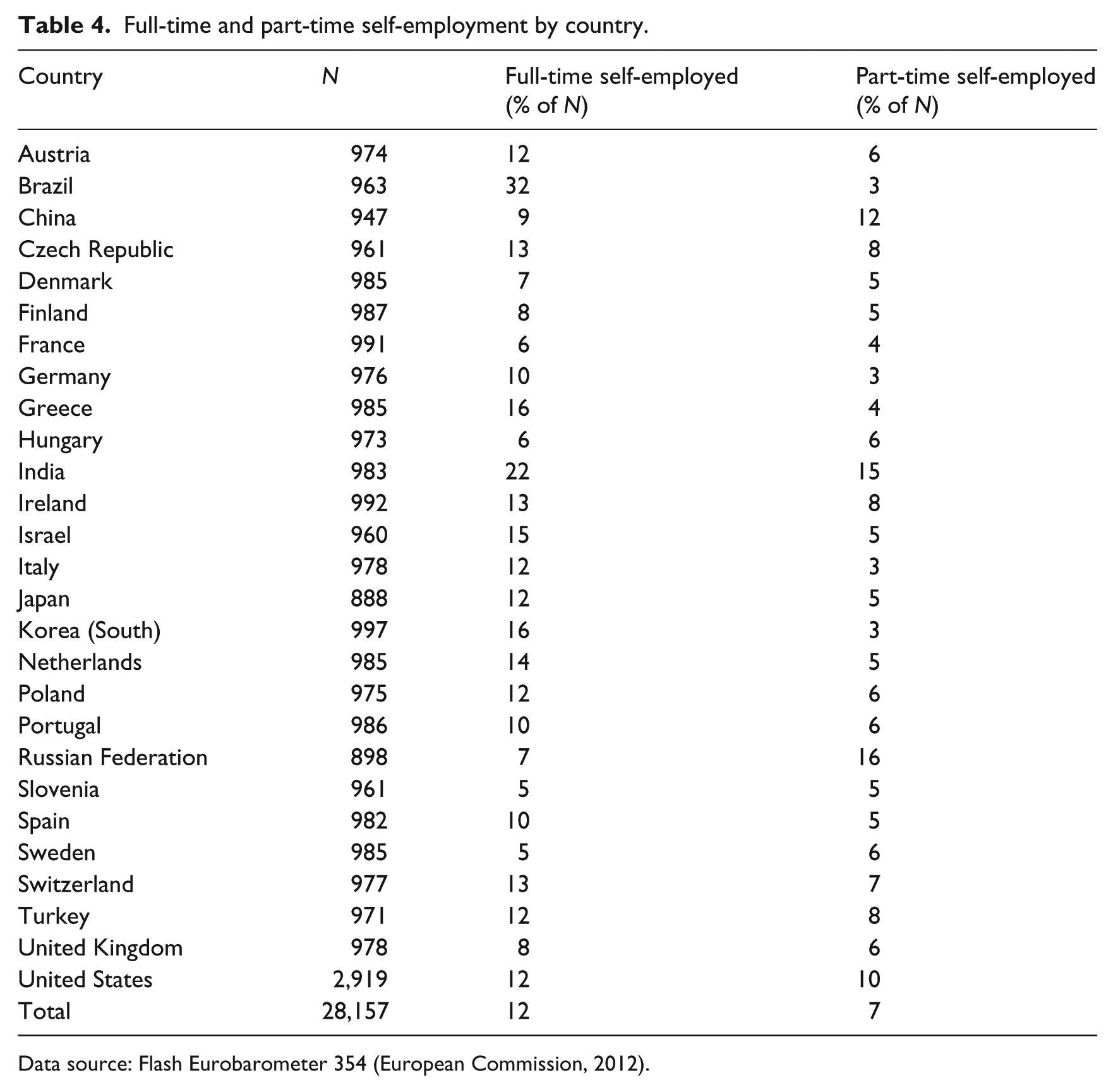
| Country | N | Full-time self-employed (% of N) | Part-time self-employed (% of N) |
|---|---|---|---|
| Austria | 974 | 12 | 6 |
| Brazil | 963 | 32 | 3 |
| China | 947 | 9 | 12 |
| Czech Republic | 961 | 13 | 8 |
| Denmark | 985 | 7 | 5 |
| Finland | 987 | 8 | 5 |
| France | 991 | 6 | 4 |
| Germany | 976 | 10 | 3 |
| Greece | 985 | 16 | 4 |
| Hungary | 973 | 6 | 6 |
| India | 983 | 22 | 15 |
| Ireland | 992 | 13 | 8 |
| Israel | 960 | 15 | 5 |
| Italy | 978 | 12 | 3 |
| Japan | 888 | 12 | 5 |
| Korea (South) | 997 | 16 | 3 |
| Netherlands | 985 | 14 | 5 |
| Poland | 975 | 12 | 6 |
| Portugal | 986 | 10 | 6 |
| Russian Federation | 898 | 7 | 16 |
| Slovenia | 961 | 5 | 5 |
| Spain | 982 | 10 | 5 |
| Sweden | 985 | 5 | 6 |
| Switzerland | 977 | 13 | 7 |
| Turkey | 971 | 12 | 8 |
| United Kingdom | 978 | 8 | 6 |
| United States | 2,919 | 12 | 10 |
| Total | 28,157 | 12 | 7 |
Data source: Flash Eurobarometer 354 (European Commission, 2012).
Acknowledgements
Our paper has benefitted from comments of the editor and two anonymous reviewers. An earlier version of this manuscript has been presented at the 18th Annual Interdisciplinary Entrepreneurship Conference 2014 (G-Forum 2014), Oldenburg, Germany. Joern Block, Andreas Landgraf and Thorsten Semrau are in alphabetical order; all authors contributed equally.
Funding
The author(s) received no financial support for the research, authorship and/or publication of this article.