



Abstract
This article investigates how two types of proactive environmental strategies (PESs) – proactive green management and green political influence – affect firm performance directly and under varying conditions characterising corporate venturing activities (domestic versus international). The results obtained by analysing a multi-informant dataset reveal that proactive green management has a stronger positive impact on firm performance than green political influence does. Moreover, international venturing has a greater positive moderating effect than domestic venturing on the link between proactive green management and firm performance, whereas, domestic venturing has a stronger positive moderating effect than international venturing on the relationship between green political influence and firm performance. This article contributes by differentiating between two important forms of corporate venturing, by distinguishing two important types of PESs and by offering a more granular framework for aligning corporate venturing activities with PESs.
Introduction
A firm’s environmental strategy reflects an enduring pattern of activities, preferences and decision-making involved in managing the interface between business and the natural environment (Delgado-Ceballos et al., 2012; Sharma, 2000; Yang et al., 2019b). A proactive environmental strategy (PES) is entrepreneurial, innovative and risky in nature because it goes beyond fulfilling environmental regulations or complying with standard practices (Darnall et al., 2010; Sharma, 2000). Specifically, PES involves the acquisition and installation of creative technologies (Russo and Fouts, 1997), the development of proactive organisational capabilities (Sharma and Vredenburg, 1998), exerting strategic influence on stakeholders by actively ‘initiating changes and participating in the development of future regulations’ (Delmas et al., 2011: 119–120) and realising the benefits of competitive advantages (Delgado-Ceballos et al., 2012). Moreover, firms may focus on transforming internal activities, processes and procedures to maintain an environmentally responsible standard to achieve environmentally friendly outcomes. As such, they pursue an internally oriented PES. In particular, proactive green management is an internal PES referring to a firm’s systematic activities for addressing environmental issues through environmental protection and minimising its negative environmental impacts (Dean and McMullen, 2007; Klassen and McLaughlin, 1996). Alternatively, firms might embrace a more externally oriented PES by actively engaging in the process of developing regulations related to environmental protection, preservation and restoration (Aragón-Correa and Sharma, 2003; Shepherd and Patzelt, 2011). Of particular interest in the Chinese context, ‘green political influence’ represents an external PES reflecting a firm’s attempt to influence the process of legislation and the initiation of new regulatory rules related to environmental issues (Luo and Junkunc, 2008; Shepherd and Patzelt, 2011). This literature, however, remains unclear about how distinct types of PESs differentially affect firm performance.
It is well-established that entrepreneurial growth can be pursued by creating new business organisations – as such, engaging in corporate venturing (Burgelman, 1983; Sharma and Chrisman, 1999). Although research on corporate venturing is abundant (Narayanan et al., 2009), the role such venturing plays in affecting the efficacy of internal and external PESs has not been examined at length in the extant literature. The creation of venturing entities offers additional inputs such as information, resources and technologies to enable PESs to exert influence firm performance (Gerschewski et al., 2018; Ibeh et al., 2018; Sharma and Vredenburg, 1998; Zahra and Hayton, 2008) while providing new domains in which PESs can take effect (Lu and Beamish, 2001). As such, when examining the impacts of internal and external PESs on firm performance, it is critical to consider the important boundary role of corporate venturing.
In addition, insofar as corporate venturing can occur within and across national boundaries (Baum et al., 2013; McDougall, 1989), the efficacy of internal and external PESs may also differ in relation to diverse types of corporate venturing activities. International venturing represents cross-border new-business-creation activities such as financing and supporting a new entity in foreign markets, exploring entrepreneurial opportunities in foreign markets, and expanding foreign operations (Liu et al., 2013; Yiu et al., 2007; Zahra and Hayton, 2008). For example, United Nations Conference on Trade and Development (UNCTAD, 2019) data show that China, as an important source of greenfield investment, committed US$92.47 billion in 2018, representing more than 9.4% of the global total. International venturing activities, in comparison to domestic venturing, are more likely to occur in environments with unknown legal systems, new supplier networks, unfamiliar customers and unacquainted rivals (Calabrò et al., 2016; Zahra et al., 2009), they involve a broader strategic scope and a more aggressive competitive stance (Karafyllia and Zucchella, 2017; McDougall, 1989). The extant literature, however, has yet to examine how domestic and international venturing activities may differentially affect how internal and external PESs affect firm performance.
Accordingly, this article aims to examine how an internal PES (proactive green management) and an external PES (green political influence) affect firm performance by considering the moderating effects of domestic and international venturing. Figure 1 depicts the conceptual model. The results obtained by analysing 303 paired-informant responses in China support our hypothesis that proactive green management has a stronger positive impact on firm performance than green political influence. In addition, international venturing has a stronger positive moderating effect on the link between proactive green management and firm performance than domestic venturing. Domestic venturing, however, exerts a stronger positive moderating effect on the relationship between green political influence and firm performance than international venturing.
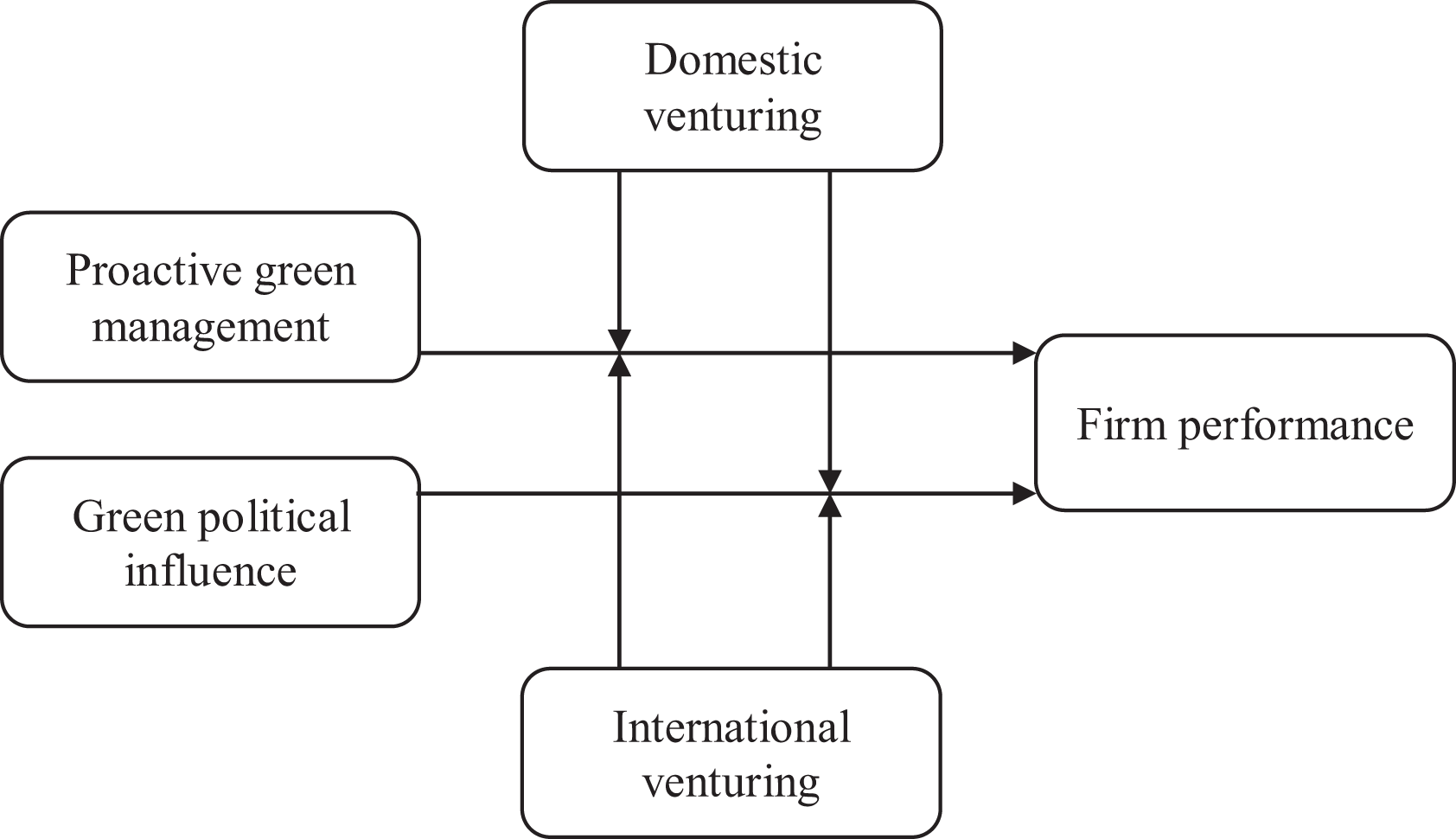
Conceptual framework.
This article contributes to the entrepreneurship and PES literatures in several important ways. First, the study enriches the entrepreneurship literature by elaborating upon two important forms of corporate venturing: domestic and international. With the exception of such pioneering studies as those by McDougall (1989) and Baum et al. (2013), the extant literature on distinctions between domestic venturing and international venturing remains limited in scope. Given the apparently significant differences between domestic and international venturing, we find that they exert differing moderation impacts on the links between proactive green management/green political influence and firm performance, offering a more nuanced view of the conceptualisation of corporate venturing. Second, we expand on prior PES studies by distinguishing two important types of such strategies: proactive green management and green political influence. The former is internally oriented and operates based on market-transaction mechanism. The practices and skills that are required and fostered are applicable to other national contexts. The latter is more externally oriented targeting governments by attempting to participate actively in the revision and/or development of new environmental regulations, rules and laws. The practices and skills that are required, and fostered, are not applicable to other national contexts. These differences make proactive green management more beneficial to firm performance than green political influence. Finally, by decomposing corporate venturing into domestic and international venturing in addition to conceptualising PES to include proactive green management and green political influence, we offer a more granular framework in which to align corporate venturing activities with PES.
Theoretical underpinnings and hypotheses
Proactive green strategy
A firm that adopts a PES engages in activities and initiatives that address the preservation and healing of the natural environment in a voluntary way going beyond mere compliance with regulations. It can be internally or externally oriented. An internal PES such as proactive green management focuses on a firm’s green management practices, ranging from reducing the use of and controlling the disposal of hazardous materials to reducing energy and waste to reducing the use of unsustainable materials to increasing the use of environmentally friendly technologies to preventing pollution (González-Benito and González-Benito, 2006; Sharma, 2000; Sharma and Sharma, 2011). These green management practices are proactive insofar as firms voluntarily go beyond environmental regulations and reduce negative environmental impacts by designing or altering products, processes, and operations (Aragón-Correa and Sharma, 2003). An external PES however, aims at initiating environmentally positive changes or participating in the development of environmental regulations (Aragón-Correa and Sharma, 2003; Delmas and Montes-Sancho, 2010). Aragón-Correa and Sharma (2003) argue that anticipating future regulations and social trends is an important PES approach. More specifically, Delmas et al. (2011) state that PESs include four types of activities: ‘(a) environmental reporting, (b) operational improvements, (c) organisational changes, and (d) regulatory proactivity’ (p. 119). The green strategy literature suggests that the first three types of activities fall under the umbrella of proactive green management (Shu et al., 2016), whereas the fourth suggests political influence (Hillman and Hitt, 1999; Shepherd and Patzelt, 2011). As proactive green management is internally oriented, while green political influence targets external political entities, based on these prior studies we argue that PESs can be undertaken primarily through the following two related activities and processes: proactive green management and green political influence.
A firm that adopts proactive green management engages actively in systematic activities designed to address environmental issues through environmental protection and minimise its negative environmental impacts (Dean and McMullen, 2007). When implementing proactive green management, firms may be able to exploit more green opportunities and gain competitive advantage (Dean and McMullen, 2007; Porter and Van Der Linde, 1995). More specifically, proactive green management may enhance firm performance through three green benefits. First, proactive green management enables firms to gain the advantages of market differentiation; they profit by better satisfying customer demand for green products and services with associated price premiums (Shu et al., 2016). Proactive green management also prompts innovation by encouraging the development of new environmentally friendly products from scratch (Leonidou et al., 2013: 154). Moreover, these green products or services provide firms with meaningful points of differentiation to satisfy green-conscious customers (Ambec and Lanoie, 2008). Even though customers in emerging markets are less able to afford green products (Yao et al., 2019), evidence has shown that emerging market consumers have a strong interest in consuming green products and services (Strizhakova and Coulter, 2013). For example, the Broad Group in China, Sekem in Egypt and Shree Cement in India are opting actively to use recycled materials and deploy energy-saving sustainable production processes and, as a result, these companies are capturing lucrative profits from the price premiums they command by selling green products (The Guardian, 2011).
Second, proactive green management goes beyond the standards of regulations and aims to achieve a higher standard of raw material utilisation, enhancing firm performance by reducing material costs (Ambec and Lanoie, 2008). Pollution is associated with resource waste, wherein raw materials have not been completely utilised (Porter and Van Der Linde, 1995). Proactive green management can reduce waste through enhancing the efficiency with which firms transform inputs into outputs, lowering material costs and minimising waste disposal (Ambec and Lanoie, 2008; Delmas et al., 2011; Shu et al., 2016). Moreover, the superior environmental performance that can be attributed to effective green management could help firms avoid litigation and fines associated with environmental regulations and sanctions (Lankoski, 2006), further reducing operational costs. Proactive green management as a PES could also enable firms to preemptively embrace advanced green operational practices assisting them to achieve first-mover advantages while reducing the risks and costs associated with abiding by environmental regulations (Ambec and Lanoie, 2008).
Third, proactively adopting environmentally friendly practices demonstrates a firm’s legitimacy, enhancing its image and reputation; this in turn, enhances firm performance (Aragón-Correa and Rubio-Lopez, 2007; Menguc et al., 2010; Shu et al., 2016; Vickers and Lyon, 2014). Legitimacy arising from proactive green management can, on the one hand, offer firms ready access to capital markets as they have established records of reliability and trustworthiness. On the other hand, proactive green management can enhance firm attractiveness in the labour market as job-seekers may prefer to be associated with an environmentally responsible organisation (Suchman, 1995). In addition, once a firm is deemed legitimate and reputable, it can benefit from greater acceptance of new products while reducing stakeholder uncertainty in its operations (Shu et al., 2016).
The above discussion leads us to propose our first hypothesis:
Green political influence, as an external PES, reflects a firm’s capacity to change existing institutions and establish new ones by influencing public policy through such political processes as lobbying, public relations and involvement in legislation (Kalantaridis and Fletcher, 2012). When participating in the legislative process, firms pursue private interests and protect them by law and mandatory rules or regulations (Ahlstrom and Bruton, 2010; Pacheco et al., 2010). Based on Hillman and Hitt (1999), Shepherd and Patzelt (2011) conclude that there are three major options for firms seeking to influence the government: lobbying, financial incentives and public relations. Kalantaridis and Fletcher (2012) describe political influence as a conduit of institutional changes through the political process. In such a process, firms pursuing green political influence as a strategy negotiate with, hope to influence and encourage institutional ‘rule-makers’ to revise existing laws and/or to enact new laws, rules and regulations related to environmental protection, preservation and restoration.
In the light of these studies, we propose that green political influence lifts firm performance through green benefits such as government support and favourable policies. To implement new regulations and rules, the government usually provides supporting policies, programmes and resources; firms can proactively apply for and obtain these benefits by using their green political influence (Shu et al., 2016). For example, to support the implementation of the amended Environmental Protection Law in 2014, the Chinese State Council offered tax breaks and subsidies to adopting organisations and individuals (The Chinese State Council, 2013). As such, green benefits that are directly derived from green political influence and government support in the form of new firm-friendly environmental regulations can substantially enhance firm performance. Moreover, exerting green political influence offers frequent opportunities to interact with the government and its administrative bureau (Hillman and Hitt, 1999; Shepherd and Patzelt, 2011). This is particularly relevant to firm operations in emerging markets where the enforcement of green policies and regulations are uncertain and inadequate (Shu et al., 2016). Although the Chinese central government may consistently enhance environmental standards and launch pro-environment policies but these may be implemented selectively as, ‘local officials may be choosy about which national policies to faithfully implement and which to ignore’ (Kostka and Mol, 2013: 6). In this vein, firms operating in China face related business risks arising from the inadequate enforcement of green regulations, policies and rules (Delios and Henisz, 2003; Wang et al., 2017). To weather such uncertainties, green political influence enables firms to affect the legislation and enforcement of environment-related laws, policy and regulations in their favour (Slangen and Beugelsdijk, 2010). Thus, when green political influence efforts succeed, firms may achieve better performance. Therefore, we propose,
Although proactive green management and green political influence are two important types of PESs, they differ in several ways supporting our argument that the former is more strongly associated with firm performance than the latter. First, proactive green management improves environmental performance through internal efforts such as developing environmentally friendly new products (Aragón-Correa and Sharma, 2003; Menguc et al., 2010). Green political influence, however, seeks to protect, preserve and restore the natural environment through influencing external regulatory policy makers (Hillman and Hitt, 1999; Shepherd and Patzelt, 2011). As such, proactive green management is an internally oriented PES whereas green political influence is an externally oriented strategy that increases a firm’s reliance on the government to provide resources. Over-dependence on others may endanger a focal firm’s performance stemming from detrimental behaviours such as opportunism (Williamson, 1985). Since China has high levels of regulatory risk reflecting frequent changes in regulations and regular rotation of government officials (Wang et al., 2017), a firm’s reliance on the government for resource inputs may endanger its performance, hindering the efficacy of green political influence.
Second, proactive green management is achieved through market mechanisms, whereas green political influence is implemented through political activities. More specifically, proactive green management provides green benefits by addressing customer demand for green products/services (Menguc et al., 2010), sparking innovations (Shu et al., 2016), and promoting a firm’s reputation (Menon and Menon, 1997; Vickers and Lyon, 2014). All these activities are achieved through market-oriented mechanisms. However, the effects of green political influence are achieved through lobbying, financial incentives and public relations (Hillman and Hitt, 1999; Shepherd and Patzelt, 2011), which are government-oriented. However, as Child et al.’s (2007) study shows, changes in regulations related to environmental protection and preservation in China are challenging and more difficult to manage than market-based initiatives and improvements. As such, green political influence in China may have a weaker impact on firm performance than proactive green management has.
Finally, proactive green management is a universal practice and the related skills, experience and knowledge are applicable to other economies, whereas green political influence is context-specific and its related activities vary greatly across nations. For instance, because proactive green management is usually practised through advanced green technologies that are transferrable to multiple contexts and comply with international environmental standards such as ISO 14001 (Morrow and Rondinelli, 2002), a firm’s green management practices in its home country are often applicable to other national contexts. The benefits of green political influence depend however on unique systems of politics and administration (Zahra and Hayton, 2008), which makes the activities through which firms attempt to exert green political influence context-specific and less valuable in other regional and national contexts. As such, proactive green management may become more important than green political influence in enhancing performance.
Corporate venturing
Corporate venturing involves the creation of new business organisations by an existing company (Sharma and Chrisman, 1999) and has been recognised as an important source of firm success (Zahra, 1991) in so far as it serves as a vital engine for entrepreneurial growth (McGrath et al., 2006) and alters a firm’s competitive profile (Calabrò et al., 2016). Meanwhile, venturing also offers firms opportunities to acquire novel information, new resources and more advanced technologies (Gerschewski et al., 2018; Harrison and Leitch, 2005; Yang et al., 2019a). Prior studies distinguish between domestic venturing and international venturing according to the geographical locations in which new business-creation activities take place (Baum et al., 2013; Calabrò et al., 2016; McDougall et al., 2003).
This study suggests that the differentiation between domestic and international venturing is theoretically meaningful and practically relevant because these two types of entrepreneurial activities differ significantly in the following ways. First, international venturing is a broader and more aggressive market-based corporate strategy than domestic venturing, which has a narrower strategic scope (Calabrò et al., 2016; Karafyllia and Zucchella, 2017). When venturing across national borders, firms usually have to serve a more diverse customer base by offering a richer bundle of market offerings through collaborating with a broader range of suppliers and distributors. As such, international venturing requires firms to be more versatile through more active knowledge creation and acquisition (Calabrò et al., 2016). Second, international venturing and domestic venturing occurs in distinct contexts. Venturing domestically involves business operations and partnering activities facilitated by ‘a common language, common (national) value systems, and cultural frameworks’ (Calabrò et al., 2016: 13; Keil, 2004). International venturing, however, exposes firms to distinct cultures, markets and systems of innovation (Karami and Tang, 2019; Zahra and Hayton, 2008).
Such differences between domestic and international venturing may moderate the effects of PES on firm performance in distinct ways. As such, we suggest that, in particular, international venturing has a stronger moderating effect than that of domestic venturing on the relationship between proactive green management and firm performance. Compared with domestic venturing, international venturing provides access to broader markets in which to apply the experience, knowledge and skills related to proactive green management, enhancing the positive effects of such on firm performance. As proactive green management practices are usually undertaken through advanced green technologies, the skills, experience and knowledge developed from such practices are readily applicable to other contexts (Garud et al., 2007; Morrow and Rondinelli, 2002). A firm engaging in international venturing seeks to leverage their green knowledge, skills and experience in broader markets (Lu and Beamish, 2001); accordingly, international venturing helps firms take greater advantage of their proactive green management and is more effective in improving performance.
In addition, international venturing provides firms with more opportunities to acquire novel information, new resources and more advanced technologies (Gerschewski et al., 2018; Zahra and Hayton, 2008), informing novel ways of deploying green knowledge and skills, thus enhancing the value of green management for firm performance. International venturing can therefore, offer firms access to local knowledge bases, exposure to new systems of innovation, and conduits for diverse ideas, market needs, technological development, and cultural perspectives (Karami and Tang, 2019; Zahra and Hayton, 2008). Such factors could further enhance knowledge skill bases and enable firms to be more proficient at deploying green knowledge, experience and skills. Consequently, we suggest,
We also argue that domestic venturing has a stronger positive moderating effect on the relationship between green political influence and firm performance than international venturing. Unlike green management, green political influence is relatively context-specific in that firms find it difficult to transfer experience, skills and knowledge learned in a domestic market to other countries (Hillman and Hitt, 1999; Shepherd and Patzelt, 2011). For example, dealing with the Chinese government might be significantly different from dealing with that of the United States given very different political institutions, structures and mechanisms (Helmke and Levitsky, 2004). As such, lobbying, dealing with public relations and participating in the legislative process might be sharply different across national borders. In this scenario, international venturing may not be helpful for green political influence. However, the practices firms undertake to establish green political influence may be applicable to new industries and regions opened up by domestic venturing.
Furthermore, international venturing offers a focal firm a wider set of options for boosting profits (Yiu et al., 2007), making the returns from establishing green political influence at home less attractive (Sapienza et al., 2005). As international venturing ‘inevitably alters the focus of a firm’s strategic attention’ (Sapienza et al., 2005: 439), it impedes a firm’s efforts in its domestic market. Indeed, according to the attention-based view (Ocasio, 1997), international venturing may even deflect a firm’s attention and efforts from efforts to exert green political influence in the firm’s home country. Moreover, because green political influence is government-oriented, whereas international venturing operates based on market mechanisms, these types of activities may conflict and even compete for limited firm resources. In this case, international venturing may be less helpful regarding the contribution of green political influence to firm performance.
Domestic venturing, however, emphasises expanding current business activities or establishing new ones in a firm’s own national market to operate in a known legal framework with familiar suppliers, customers and competitors (Calabrò et al., 2016; Zahra et al., 2009). This can strengthen the firm’s current connections with the government, which offers the firm additional opportunities for exerting green political influence, and thereby, reaping greater benefits from doing so. Political economists also suggest that ‘local governments are biased toward local interests and are more likely to be influenced by local vested interests’ (Bardhan and Mookherjee, 2000; Jia and Mayer, 2017: 207). Venturing domestically enhances a focal firm’s concentration in its home country; the firm is thus, more likely to be favoured by the home country government (Jia and Mayer, 2017), offering more opportunities to influence government and initiate changes in, and improvements on, current environmental regulations. Firms engaged in domestic venturing are therefore, more likely to receive entry permits, policy benefits and exclusive government support, in turn enhancing performance (Jia and Mayer, 2017).
The above discussion leads us to propose the following:
Methodology
Sampling and data collection
We focus on PESs in China and test the research hypotheses in that context for several reasons. Along with its extremely strong economic performance over the past several decades, China has become one of the most highly polluting (and polluted) countries in the world (López et al., 2008). For example, according to a recent report assessing ambient air pollution by the World Health Organization (WHO, 2016), more than 1 million people die annually from air pollution related illness in China, making it the deadliest country in the world for outdoor air pollution. To reduce widespread pollution, China has shut down tens of thousands of factories (Nace, 2017). Chinese industries are thus, undergoing ‘a green revolution’ and green strategy has become an important consideration for firm operation (Shu et al., 2016). Meanwhile, the Chinese government regards venturing as an engine fuelling economic growth, as reflected by its ‘mass entrepreneurship and innovation’ campaign (Zhang, 2018). According to Zhang (2018), on average, 18,100 new ventures were founded in China every day in the first-half of 2018. Therefore, China offers an appropriate empirical site at which to examine PES and corporate venturing.
Our data were collected from August 2010 through January 2011. To achieve a balanced representation of firms across regions, a multistage, stratified random sampling procedure was used to accommodate China’s geographic fragmentation. First, we segmented the 31 Chinese provinces into three regions based on their 2009 GDP rankings, which were announced in 2010, the same year when the primary data were collected. Based on cost considerations, we randomly selected 500 firms in each category from company lists provided by local governments and administrative bureaus. An initial sample of 1500 firms from 23 provinces was formed, with 10 in the eastern and coastal region, seven in the middle region and six in the western region. We then solicited cooperation from these firms by using professional interviewers to place phone calls to solicit voluntary participation. Based on this effort, 490 of the 1500 sampled firms agreed to participate after being informed of the purpose of the research and our confidentiality policy.
These data were collected through structured questionnaires that were administered through on-site interviews. For each firm visited, two independent managers were asked to complete two separate surveys, Questionnaire A and Questionnaire B. The structured interviews took about one hour on average. After eliminating responses with excessive missing data, we finally obtained 303 pairs of responses, for a valid response rate of 20.2% (303/1500). Of these respondents, 47.4% were CEOs/chairs or members of top management teams, while the rest were middle-level managers. Their average work experience was about nine years, and their average tenure in their current positions was about six years. Therefore, our informants should have adequate knowledge related to the research issues.
Several methods were employed to secure and enhance data quality. First, the translation/back-translation procedure was used to ensure the validity of the Chinese versions of the questionnaires. Second, we conducted face-to-face interviews, which helped us avoid confusion and assess the suitability of the respondents. Third, we refined the wording of the measures, when needed, through in-depth interviews with 20 managers from 10 firms to ensure their relevance and clarity in the Chinese context before finalising the surveys. Fourth, to reduce social desirability bias the respondents were informed that there were no right or wrong answers and that all their answers would be kept confidential.
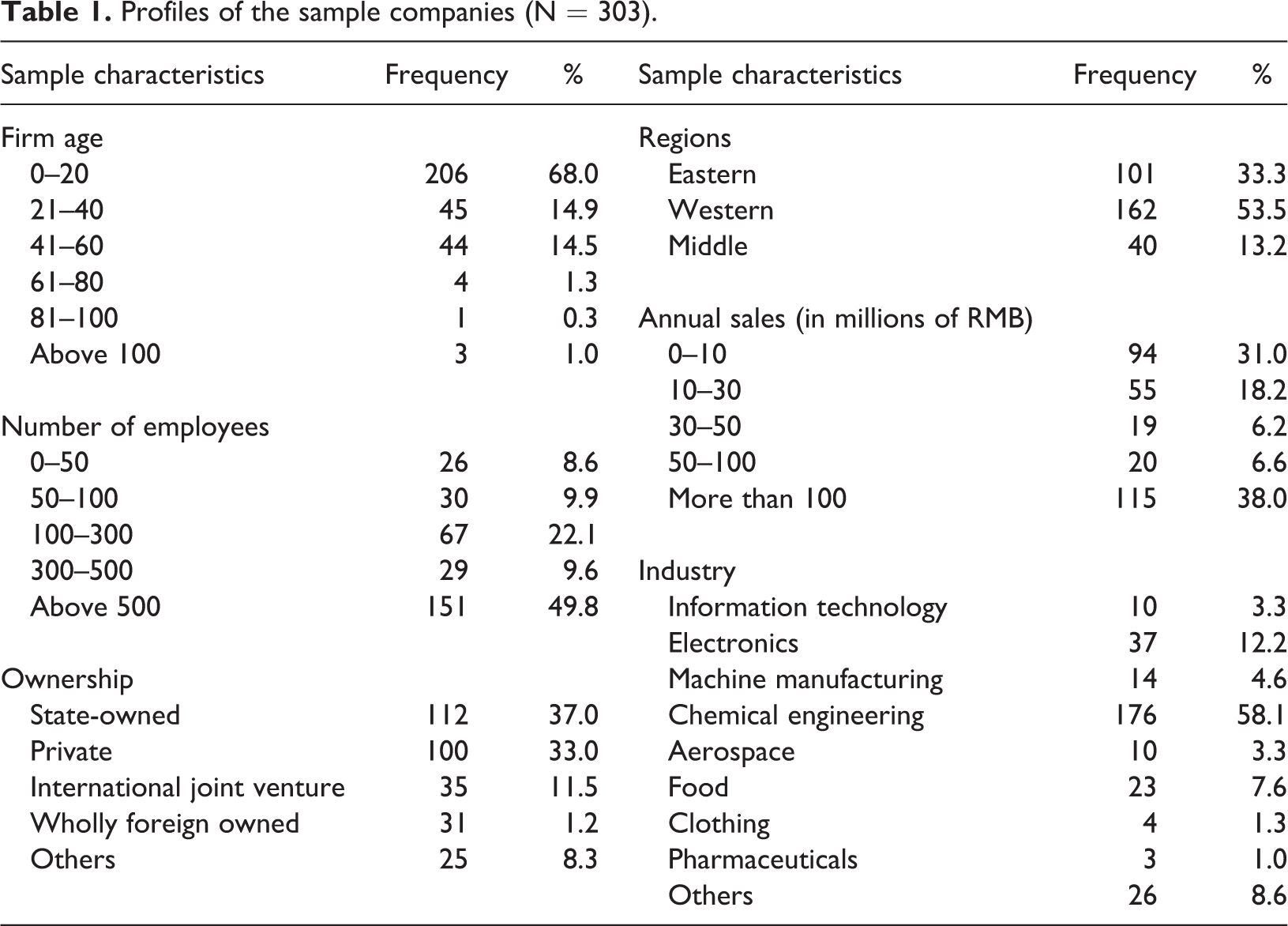
To check for non-response bias, we conducted two t-tests and found no statistically significant differences in firm size or age between our sample and the wider population. Two additional t-tests revealed no significant differences in firm size or age between responding and non-responding firms. Thus, non-response bias was not a serious problem, and our sample data adequately represent firms in China. Table 1 summarises the profiles of the sample firms.
Profiles of the sample companies (N = 303).
Measures
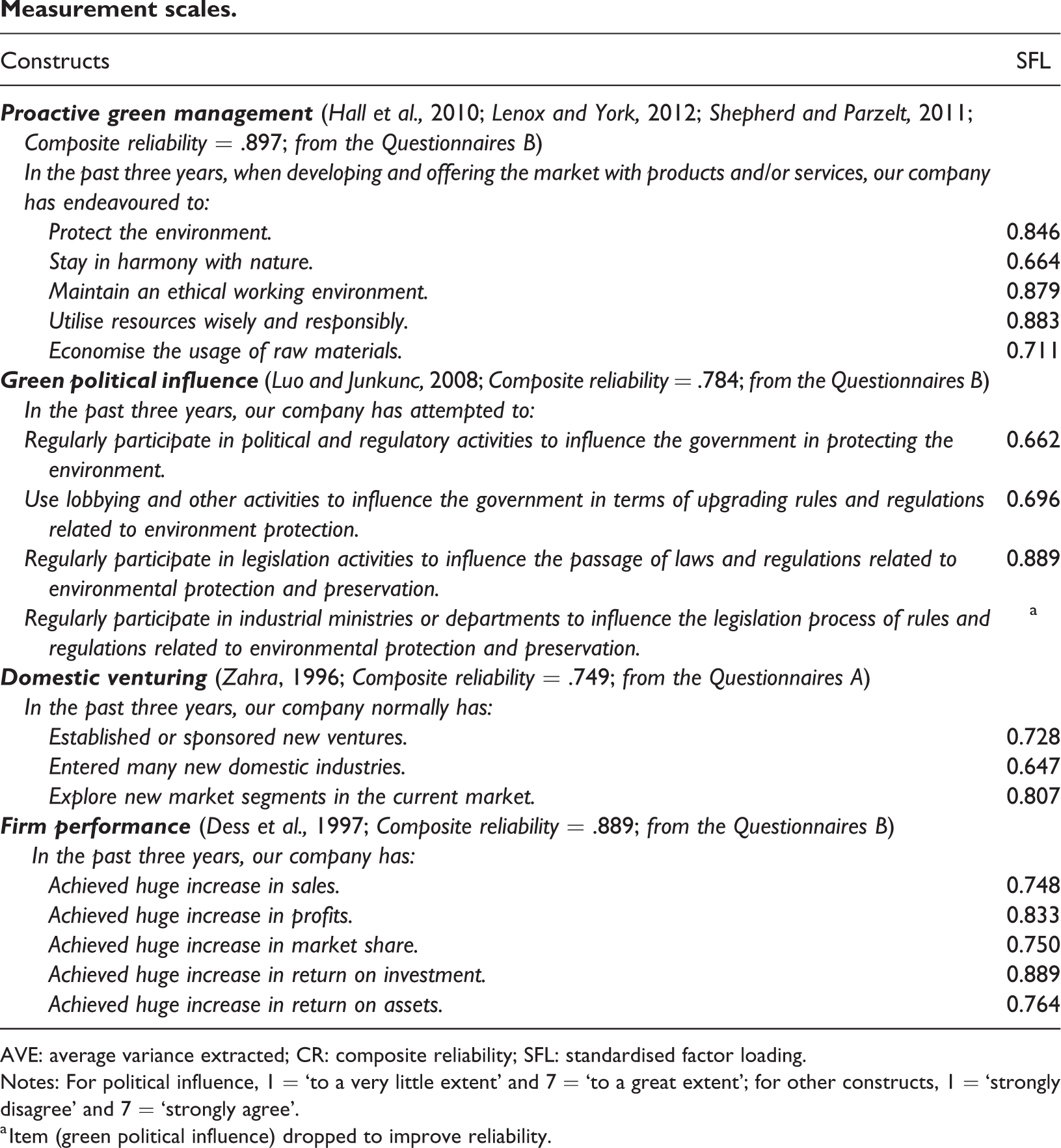
All the measurement scales in this study were adapted from previous research and used Likert-type response categories, ranging from 1 (‘strongly disagree’) to 7 (‘strongly agree’). The measures of the focal constructs are listed in the Appendix 1.
Firm performance
The dependent variable was measured by adapting a scale from Dess et al. (1997) to assess a firm’s sales growth, market share growth, profits, return on investment and return on assets in the three years prior to our study. We relied on answers to Questionnaire B to measure firm performance.
Proactive green management
Based on Hall et al. (2010), Lenox and York (2012), and Shepherd and Patzelt (2011), we identified several interrelated activities, procedures and processes on which firms rely to enact proactive green management activities. These proactive green management practices include protecting the environment, maintaining harmony with nature, maintaining an ethical working environment, utilising resources wisely and responsibly, and using raw materials economically when developing and providing market offerings (e.g. products and services). The proactive green management variable was measured by five items in Questionnaire B.
Green political influence
In a cross-cultural study, Luo and Junkunc (2008) developed a four-item scale to measure political influence, which we adapted to our study to measure green political influence. More specifically, four items were used to assess a focal firm’s efforts in the three years previous to our study to influence government officials, legislative authorities, industrial ministries and regulatory agencies – four major political institutional constituencies – in terms of upgrading and establishing green-related political institutions. Answers to Questionnaire B were used to assess green political influence.
Domestic venturing
To measure this, a scale developed by Zahra (1996) was adapted. This scale reflects the extent to which a firm had undertaken venturing activities in its domestic market in the three years prior to our study. The answers to our Questionnaire A were used to assess domestic venturing.
International venturing
To measure this, a dummy variable was created which indicates whether or not a firm had engaged in international activities in the three years prior to the study (Baum et al., 2013). Baum et al. (2013: 544) assess international venturing based on the occurrence of an ‘internationalisation event’ and, similarly, use a dummy variable to reflect whether the event has or has not occurred within a certain period of time. We thus use a dummy variable to measure international venturing. The answers to our Questionnaire A were used to assess international venturing.
Control variables
We controlled for several additional variables in Questionnaire A. As firm age and size are related to a firm’s green strategies and performance (Hockerts and Wüstenhagen, 2010), we controlled for firm age (the natural logarithm of the firm’s years in operation) and firm size (the natural logarithm of the number of employees). State ownership may influence a firm’s strategies and operations in China (Shu et al., 2019b), so we used a dummy variable to represent state-owned enterprises (SOEs = 1) and other enterprises (non-SOEs = 0). As a firm’s PES and performance vary across industries (Zahra, 1996), we controlled for industry type, classifying firms as operating in high-technology (1) or low-technology (0) industries and in manufacturing (1) or non-manufacturing (0) industries. We also controlled for two other industrial factors. Industrial competitiveness was assessed by one item (‘Please select the most appropriate description of your industry: not competitive, weakly competitive, moderately competitive, very competitive, or extremely competitive’) and industrial development stage was assessed by asking respondents to select one from the following four stages of their industry: introduction, development, maturity or decline.
Confirmatory factor analysis
We used confirmatory factor analyses implemented by structural equation modelling (SEM) to assess the unidimensionality and convergent validity of the reflective measures. Following Shook et al.’s (2004) recommendation, we evaluated models with three fit indices: DELTA2, the comparative fit index (CFI), and the root mean square error of approximation (RMSEA). We first ran a four-factor measurement model (with proactive green management, green political influence, domestic venturing and firm performance as variables) with all adopted scale items loaded on their respective variables. The results showed that the measurement model did not fit with the data well (χ2 = 258.977, df = 110, p < .001, DELTA2 = .946, CFI = .945, RMSEA = .067). To improve measurement quality, we deleted measurement items whose standardised factor loadings were lower than .600 and reran the measurement-model analysis. The deleted measurement items are shown in the Appendix 1. The purified measurement model indicated good fit to the empirical data (χ2 = 151.835, df = 95, p < .001, DELTA2 = .977, CFI = .976, RMSEA = .045). In the purified measurement model, all items loaded significantly on the constructs that they were designed to measure (see the Appendix 1), indicating convergent validity. In further support of convergent reliability, we calculated that the composite reliability of the variables and the smallest composite reliability (for domestic venturing) was .749, well above the cut-off value of .700 (Bagozzi and Yi, 1988). To examine discriminant validity, we followed Fornell and Larcker (1981) and compared the variance shared between the constructs with the average variance extracted (AVE). As we show in Table 2, the square roots of the AVE values were all greater than the zero-order correlation coefficients between all variables.
Descriptive statistics and correlations (N = 303).
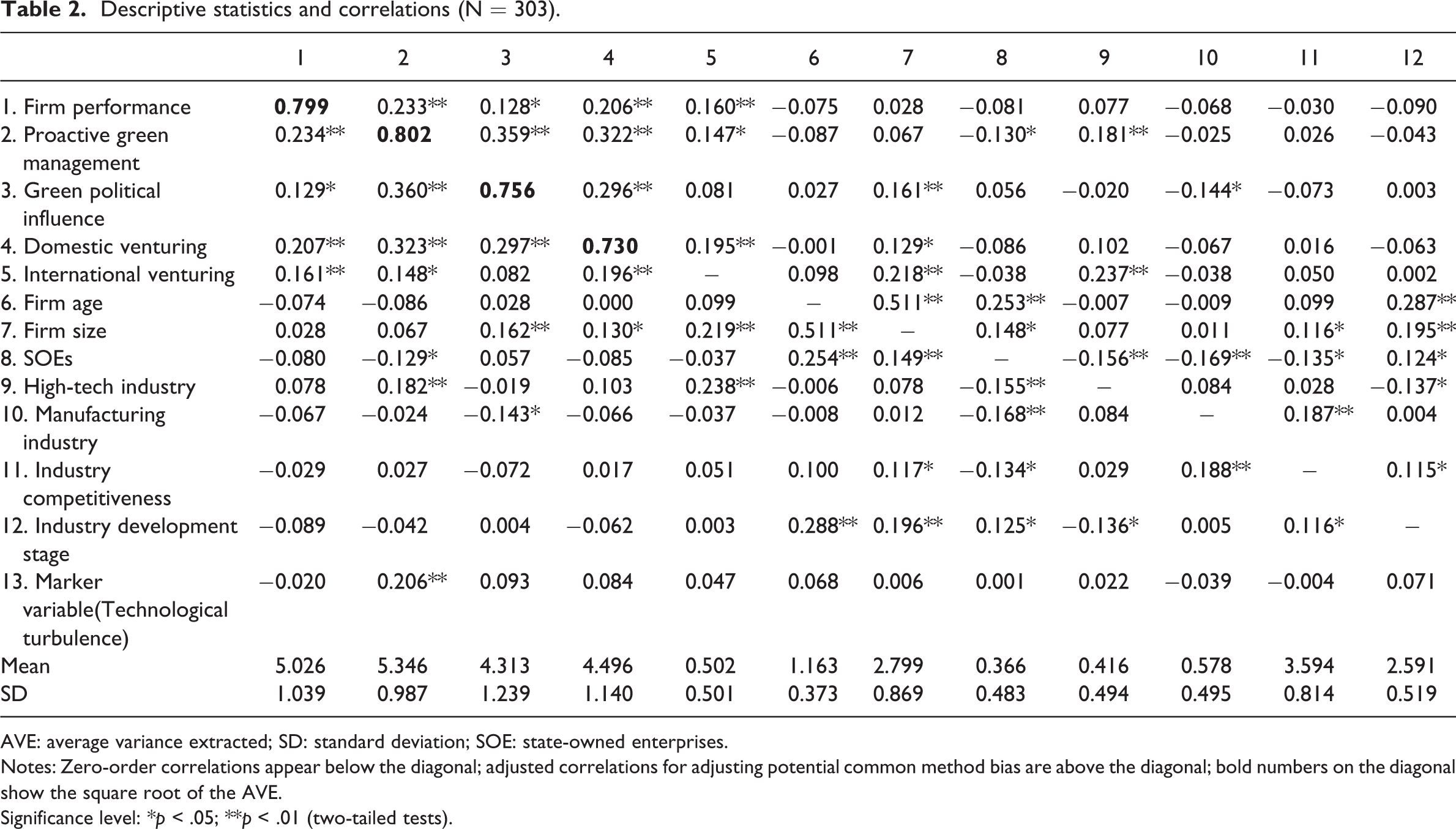
AVE: average variance extracted; SD: standard deviation; SOE: state-owned enterprises.
Notes: Zero-order correlations appear below the diagonal; adjusted correlations for adjusting potential common method bias are above the diagonal; bold numbers on the diagonal show the square root of the AVE.
Significance level: *p < .05; **p < .01 (two-tailed tests).
Common method bias
We relied on well-established procedural and statistical methods to avoid common method bias (CMB, Antonakis et al., 2010). First, we assessed our measures of the independent variable, the moderating variables, and the dependent variable by reference to separate respondents, as detailed in the measurement section, which largely mitigates concerns about CMB. Second, we used the marker-variable method to assess CMB and included a marker variable that was conceptually unrelated to the study’s focal variables (Lindell and Whitney, 2001). The marker variable was technological turbulence, reflecting the rate of technological advance in an industry (Zhou et al., 2005). We recalculated the zero-order correlations between the study’s variables after controlling for technological turbulence. Specifically, the lowest positive correlation (r 1 = .001 in Table 2) between technological turbulence and SOEs was employed to adjust the construct correlations and statistical significance. 1 The results reported in Table 2 indicate that none of the significant correlations became insignificant after the adjustment, so CMB was unlikely to be a serious concern.
Results
After confirming the validity of the measurement model, we used SEM, which typically reduces model complexity and achieves an acceptable sample-size-to-parameter ratio, to test the hypotheses (Anderson and Gerbing, 1988; Zhou et al., 2014). To mitigate the threat of multicollinearity, each scale utilised in constructing an interaction term was mean-centred (Aiken et al., 1991). For H1 and H2, we ran Model 1, which includes direct relationships between proactive green management, green political influence and firm performance. The results obtained from Model 1 and reported in Table 3 show that proactive green management was positively associated with firm performance (β = .218, p < .001) but green political influence was not significantly associated with firm performance (β = .021, n.s.). Thus, H1 was supported but H2 was not. A plausible reason that H2 was not supported is that changes in regulatory institutions enacted through a bottom-up manner are relatively difficult to achieve, as shown in Child et al. (2007). Because of such difficulty and challenges in influencing the government and its representative bureaus, when firms seek to exert green political influence they might face discrimination at the hands of political constituencies. It is also possible that H2 was not supported because influencing political constituencies is costly and time-consuming, deflecting managerial attention and harming firm performance.
To test H3, we used structural-model comparisons to assess whether proactive green management and green political influence shape firm performance differently (Savalei and Kolenikov, 2008). We first ran an unconstrained model and the results were essentially the same as those obtained from the above analysis using Model 1, as reported in Table 3. We then controlled for the equality of these two coefficients and re-estimated the constrained structural model. The results indicated that the constrained model fitted to the data significantly worse than the unconstrained model (Δχ2(1) = 4.678, p < .05), suggesting that the regression weight for the relationship between proactive green management and firm performance was significantly different from that of the relationship between green political influence and firm performance. Thus, H3 was supported.
Standardised structural equation parameter estimates (N = 303).
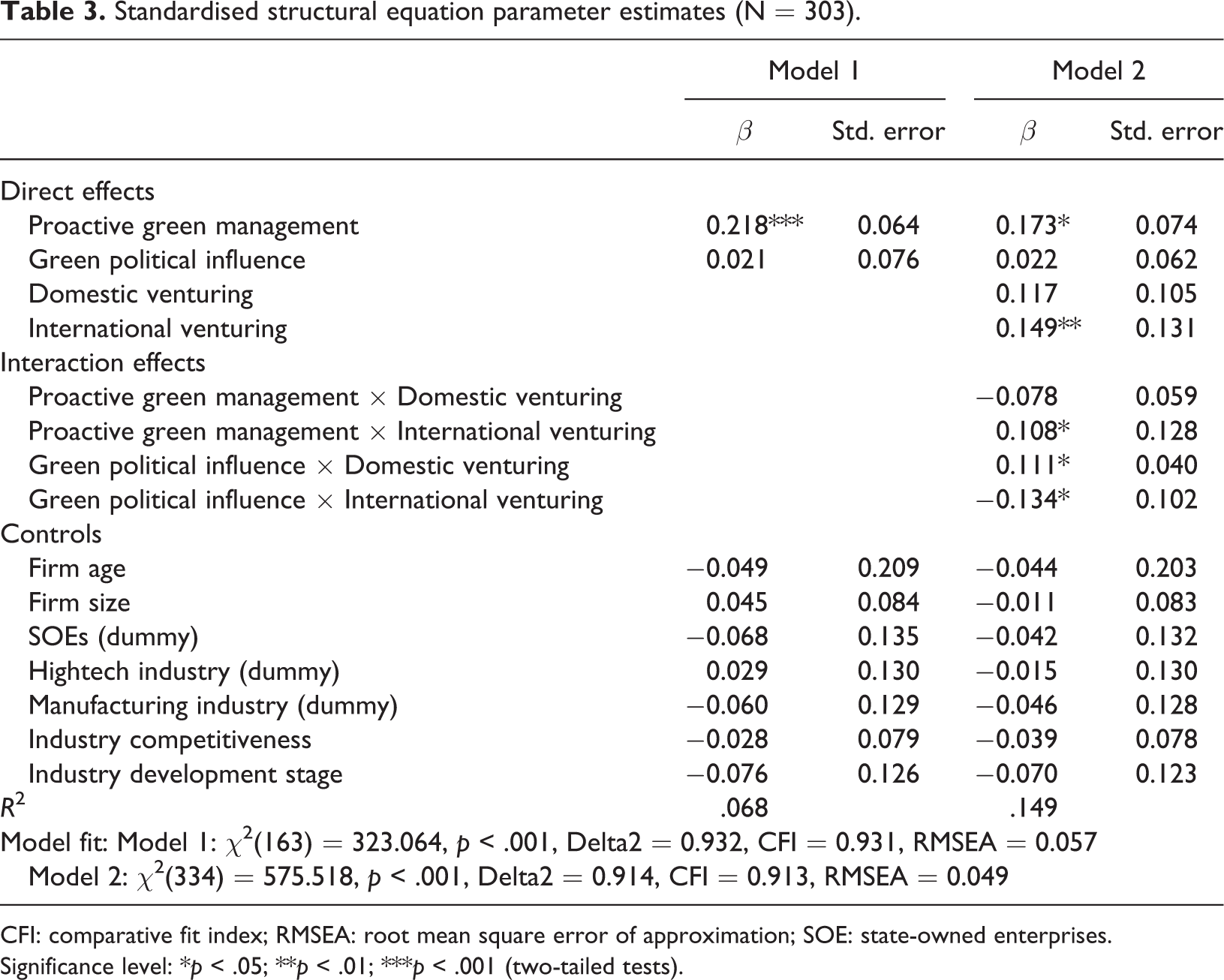
CFI: comparative fit index; RMSEA: root mean square error of approximation; SOE: state-owned enterprises.
Significance level: *p < .05; **p < .01; ***p < .001 (two-tailed tests).
Regarding the relative strengths of the moderating effects of international venturing and domestic venturing on the link between proactive green management and firm performance, we first estimate their moderating effects. The results obtained with Model 2 and reported in Table 3 indicate that interaction between international venturing and proactive green management is positive (β = .108, p < .05), whereas that between domestic venturing and proactive green management is not significant (β = −.078, n.s.). In Panel A in Figure 2, we depict the effects of proactive green management on firm performance for firms that engage in international venturing and those that do not. Second, following the method used in testing H3 (Savalei and Kolenikov, 2008), we compare the coefficients of these two interaction terms through structural-model comparisons and find that the coefficient on the interaction term between international venturing and proactive green management is significantly greater than that on the interaction term between domestic venturing and proactive green management (Δχ2(1) = 4.193, p < .05), supporting H4.

Moderating effects.
We follow the same steps in examining the relative strengths of the moderating effects of international venturing and domestic venturing on the link between green political influence and firm performance. The results obtained using Model 2 and reported in Table 3 indicate that domestic venturing positively moderates this link (β = .111, p < .05) but international venturing moderates it negatively (β = −.134, p < .05). In Figure 2, Panel B, the results we report show that the positive effects of green political influence on firm performance are stronger when the level of domestic venturing is high. The results we report in Panel C show that the effects of green political influence on firm performance are attenuated for firms that undertake international venturing. The results of structure-model comparisons indicate that the regression weights for moderating effects of domestic venturing on the relationship between green political influence and firm performance are significantly different from those of international venturing (Δχ2(1) = 6.243, p < .05). These findings support H5.
Discussion
Theoretical contributions
This study contributes to the PES literature first, by distinguishing between two important types of PESs: proactive green management and green political influence. Prior studies on PESs devote much effort to examining the choice between and the distinct roles of reactive and PESs (Delmas et al., 2011; Menguc et al., 2010). More recently, studies have begun focusing on preventing the occurrence of environmental problems at earlier stages and thus, explore specific antecedents and realised outcomes of PES (Yang et al., 2019b). However, existing studies tend to treat PES as a one-dimensional concept and few comparatively explore distinct types of PES empirically, even though firms may choose different types of PESs (Delmas et al., 2011). Different types of PESs may have different contents, work through distinct mechanisms and thus, differ in their effects on firm performance. We propose that proactive green management and green political influence can comprise a firm’s PESs but that they differ in meaningful ways: the former is internally oriented, operates based on market mechanisms and the experience, skills and knowledge it requires might be applicable to other national contexts. The latter orients a firm externally to the politics, focuses its attention on regulatory institutions and the related insights, experience, and skills might not be applicable across national borders. Empirical findings from China further suggest that market-oriented PES works better than government-oriented PES, as proactive green management plays a stronger role in driving firm performance than green political influence (Child et al., 2007).
Second, we enrich the extant literature on corporate venturing by differentiating domestic and international venturing activities and substantiating their differential moderating roles in the PES–firm performance link. Axiomatically, domestic venturing occurs in the home market, whereas international venturing activities take place abroad (Baum et al., 2013; Calabrò et al., 2016), these types of corporate venturing activities differ in other ways. More specifically, international venturing activities occurs in environments with unfamiliar legal systems, new supplier networks, unfamiliar customers and unknown rivals, so requires a broader strategic scope and a more aggressive competitive stance (Calabrò et al., 2016; Karafyllia and Zucchella, 2017; McDougall, 1989; Zahra et al., 2009). Given such differences, we confirm that international venturing has a stronger positive moderating effect on the link between proactive green management and firm performance, whereas domestic venturing has a greater positive moderating effect on the relationship between green political influence and firm performance.
Finally, our research contributes to the literature on the interface between a PES and corporate venturing by offering an integrative perspective on these two types of proactive and entrepreneurial growth activities. Our findings indicate that proactive green management is better aligned with international venturing as it provides access to more markets to apply green management knowledge and more diverse angles from to enhance its deployment. However, green political influence could be better accommodated by domestic venturing as it opens local markets in which to utilise the context-specific practices of green political influence and enhances connections with government officials, providing more opportunities to exert green political influence. This study, therefore, reveals that the impact of PESs on firm performance may not be as straightforward as explicated in the literature (McDougall, 1989; McDougall et al., 2003; Menguc et al., 2010; Shu et al., 2016, 2019b), but instead depends on the proper alignment between types of PESs and types of corporate venturing activities. As such, our study is one of few to integrate the literature on PES and corporate venturing to explicate when a particular type of PES is positive or negative for firm performance under varying conditions.
Managerial implications
This study shows that firms might engage in either, or both, of two types of activities to implement a PES and that these activities affect firm performance differentially. Proactive green management and green political influence represent distinct environmental strategies. The former is based on market mechanisms whereas the latter aims to change existing or produce new regulatory institutions. Our study reveals that proactive green management plays a stronger role in enhancing firm performance than green political influence suggesting that internally oriented and market-based green management should be preferred in the contemporary Chinese context. Our findings are consistent with recent evidence that firms increasingly practise proactive green management in China when they pursue proactive and entrepreneurial green strategies. For instance, Ant Financial, a banking subsidiary of Alibaba and a founding partner in the Green Digital Finance Alliance, proactively launched Ant Forest to prompt users to cut greenhouse gas emissions in daily life and had saved 150,000 tonnes of CO2 by the end of January 2017 (World Economic Forum, 2018).
It is noted that organisations should be cautious when implementing a PES and venturing activities simultaneously because combining these two strategies does not always enhance performance. Our findings suggest that firms favour international venturing over domestic venturing when proactive green management is practised. The former can provide access to broader markets and promote skills, experience and knowledge acquisition, contributing to more effective implementation of and enhanced outcomes from proactive green management. In contrast, when adopting green political influence as a PES, firms should concentrate on domestic venturing as it has a stronger synergistic effect upon green political influence. Consistent with the context-specific characteristics of green political influence, domestic venturing embeds firms in familiar market contexts enhancing their connections with government administration and thereby, helping them realise the benefits of green political influence. Moreover, in contrast with international venturing, domestic venturing enhances a firm’s local concentration as it explores business opportunities in its home market, increasing the likelihood that it will see favourable policies and programmes enacted as local government is more likely to be influenced by local businesses and investors.
Limitations and future research directions
This study is not free of limitations that future studies could address. First, given its cross-sectional design, this study cannot confirm the presence of cause-and-effect relationships between the studied variables. Although we have employed stringent methods such as CMB tests to avoid endogeneity problems, we cannot assert that our study is free of endogeneity bias. Future studies using a longitudinal design that involves collecting data from multiple sources are particularly welcome as a means of corroborating our findings. Second, this study captures firm performance using a subjective measure that may harbour bias. Moreover, we measure international venturing with a dummy variable that cannot capture the effects of a PES on firm performance when the extent of international venturing varies.
Third, our data were collected in 2011, creating a concern regarding their relevance, so we conducted several validation exercises. From the practice view, as environment deterioration remains as a top concern in China and consumers and stakeholders exhibit rising expectations for green products and services, environmental responsibility becomes a source of competitive advantage and a driver of long-term success (Lee et al., 2018; Li et al., 2020). Hence, PESs have become increasingly important in China (Jiang et al., 2020; Wang et al., 2018). Moreover, we conducted a summary independent-samples t-test to compare the means of green management practices in our sample with those in recent studies such as Jiang et al. (2020), but no significant differences were found. These results suggest that our measure is valid and our data could offer insights similar to those provided in the more recent studies.
Fourth, the institution-based view of strategy posits that organisations make decisions within existing institutional environments (Peng et al., 2009). As China’s economy is fragmented and the role of government differs across regions/provinces (Sheng et al., 2011; Shu et al., 2019a), future studies could explore institutional moderating variables, such as market–government relationships or marketisation across regions in China. Finally, it would be interesting to explore the mediating mechanisms that might connect PESs and firm performance. Future studies could, for example, examine organisational factors and processes such as knowledge-creation capabilities and new-product–development activities that are involved in transforming what firms have gained from proactive green management and green political influence into enhanced performance.
Conclusion
This article reveals that whether a PES enhances or hinders, firm performance depends on the nature of the PES and the types of corporate venturing activities a firm pursues. In particular, proactive green management has a stronger association with firm performance than green political influence. In addition, international venturing has a stronger positive moderating effect than domestic venturing on the link between proactive green management and firm performance whereas, domestic venturing demonstrates a stronger positive moderating effect on the relationship between green political influence and firm performance.
Footnotes
Authors’ note
Per Davidsson is also affiliated with Jönköping International Business School, Sweden.
Funding
The author(s) disclosed receipt of the following financial support for the research, authorship, and/or publication of this article: The National Natural Science Foundation of China (No. 71972150 and 71472150) is gratefully acknowledged for their provision of supports to this study.

Note
Appendix 1
Measurement scales.
| Constructs | SFL |
|---|---|
|
|
|
| Protect the environment. | 0.846 |
| Stay in harmony with nature. | 0.664 |
| Maintain an ethical working environment. | 0.879 |
| Utilise resources wisely and responsibly. | 0.883 |
| Economise the usage of raw materials. | 0.711 |
|
|
|
| Regularly participate in political and regulatory activities to influence the government in protecting the environment. | 0.662 |
| Use lobbying and other activities to influence the government in terms of upgrading rules and regulations related to environment protection. | 0.696 |
| Regularly participate in legislation activities to influence the passage of laws and regulations related to environmental protection and preservation. | 0.889 |
| Regularly participate in industrial ministries or departments to influence the legislation process of rules and regulations related to environmental protection and preservation. | a |
|
|
|
| In the past three years, our company normally has: | |
| Established or sponsored new ventures. | 0.728 |
| Entered many new domestic industries. | 0.647 |
| Explore new market segments in the current market. | 0.807 |
|
|
|
| Achieved huge increase in sales. | 0.748 |
| Achieved huge increase in profits. | 0.833 |
| Achieved huge increase in market share. | 0.750 |
| Achieved huge increase in return on investment. | 0.889 |
| Achieved huge increase in return on assets. | 0.764 |
AVE: average variance extracted; CR: composite reliability; SFL: standardised factor loading.
Notes: For political influence, 1 = ‘to a very little extent’ and 7 = ‘to a great extent’; for other constructs, 1 = ‘strongly disagree’ and 7 = ‘strongly agree’.
a Item (green political influence) dropped to improve reliability.