



Abstract
A little over a decade ago librarians at the University of Ghana, Legon agitated for, and were accorded academic status equivalent to those in the faculty. What used to be purely a technical and professional job has gradually shifted to academic. Pressure is now being put on all librarians at the University of Ghana to upgrade themselves to academic status. This paper examines the position of librarians in the university before and after the granting of academic status. The paper also looks at the implications of this academic status on research publication and job satisfaction of these librarians.
Keywords
The majority of librarians at the University of Ghana are ill-prepared for academic status.
Introduction
The professional academic librarian within University of Ghana Library System (UGLS), hereafter referred to as ‘librarian’ is a person who holds an academic appointment and who serves the university community in a professional capacity. Until the year 2000, librarians at the University of Ghana were treated as purely professional and were assessed and promoted as such. The library initially had no definite place in the structure of the university. At one time, the library was placed with utilities/services and partially under the Faculty of Social Studies. Librarians at the UGLS felt that this was not proper, and that the library should exist as an entity on its own. They also argued that, since the University of Ghana is divided into three broad categories: administration, academic, and services, the library must necessarily fall under one of these categories.
The librarians further argued that many scholars regard the library as the academic centre, the heart of a university, hence the declaration by the University Grants Committee of Britain that “the character and efficiency of a university are determined by the quality of its library” (Parry Report 1967). The library therefore occupies an important academic position in a university and must be recognized as such and professional librarians accorded due recognition. When the library suffers, academic work also suffers. In the light of the above, the UGLS should be regarded as an academic entity on its own, and not placed under any faculty. It should also be represented on other boards and committees of the university.
The librarians were also of the view that university librarians do not enjoy the same treatment the world over – some are professionals and some academic but not administrators. Academic status is not determined only by qualification but also by function. Librarians are very much involved in the academic pursuits of the university such as reading, learning and research, and enjoy the same service conditions as faculty members. Again, the library is not a one-discipline department. Its functions cut across all disciplines. Therefore the acquisition of higher degrees by librarians in disciplines other than library and information science enhances the performance of the library in meeting the academic needs of university community. This will also make subject specialization possible. Briefly stated, the librarians were asking that:
they be recognized as academics
those with higher degree in areas other than librarianship should be appointed academics
they must be accorded academic status on terms different from those applicable to academics in the Department of Information Studies.
After years of meetings on the issue by the Executive Committee and the Academic Board, the librarians were finally accorded academic status in the following manner:
Eligible librarians should be accorded academic status with the full implications for advancement.
It is true that librarians are more of practitioners than lecturers. But this does not rule out the possibility of librarians undertaking research and publishing in their areas of operation.
Since appointment/promotions are made to a named discipline/profession (paragraph 10.5 of Statute on Appointment and Promotion), it is only proper that whatever higher research degree a librarian has should be in librarianship. A former senior librarian who was due for promotion to a deputy librarian vehemently challenged this argument, but never succeeded. Eventually, he had to resign from the UGLS to seek a new appointment elsewhere in Ghana.
Conceptual Issues
Without doubt, we are in a class-structure society where status is given importance and due respect. Status is a rank or position and most frequently considered as a ‘prestige’. In an organization, status is formally imposed, stemming from the position of an individual in the organization. According to Dubin (1965) status is a “set of visible, external markings that systematically rank individuals and groups in relation to each other, and that includes all the members of the organization some place in the scheme of rankings”.
In the words of Chester Barnard (1938), status is a “statement of an individual’s rights, privileges, immunities, duties and obligations in the organization and obviously the statement of restrictions, limitations and prohibitions conditioning, governing his behaviour”. Status thus implies stratification or ranking along some kind of prescribed scale or hierarchy. For instance at the University of Ghana distinctions may be drawn between a messenger/cleaner, a library assistant and a librarian or lecturer. The difference between these people is in their status.
That status is a motivating force in an organization cannot be overemphasized. In an organization, status goes with monetary incentives. The higher the status, the more monetary incentives attached, and vice versa. Status is also a psychological motivator, it appeals to pride. For instance, at the University of Ghana, it is a source of pride for an individual to work his or her way through to become a senior member (equivalent of a lecturer), and more so when the individual finally attains professorial status.
Academic status for professional librarians may be defined as the formal recognition by an institution’s authorities, in writing, of librarians as members of the instructional and research staff. The recognition may take the form of assigned faculty ranks and titles, or equivalent ranks and titles, according to institutional custom (American Library Association 1959). The obligation that such status demands may well correspond to the librarian’s responsibilities to his own profession which include: (1) continual intellectual activity and growth; (2) interest in research and publication; (3) active participation in professional organizations; and (4) attachment of the highest level of professionalism in performance of his duties.
Objective
The main objective of the study was to find out how well prepared librarians at the University of Ghana are in accepting academic status in terms of their research output. The study also looked at the factors that inhibit research publication by librarians. Other aspects that were considered included librarians’ perception of requirements for academic status, and whether they had any intention to quit the University of Ghana Library System(UGLS).
Methodology
To achieve the objectives of the study adequately, various methods of data collection were used. These included the use of a questionnaire. Copies of the questionnaire were administered to all 25 professional/academic librarians at the University of Ghana Library System (UGLS). Respondents showed a clear personal interest in the study, and readily provided relevant information. The questionnaire enabled the writer to study the perceptions and opinions of these librarians about academic status. Answers to the questions formed the focal point of the study. This method was supplemented by reading minutes and reports of Library and Academic Boards on academic status as well as other relevant publications.
Review of literature
Academic librarians all over the world have long advocated for academic status. In 1958, the Committee on Academic Status was established by the Association of College and Research Libraries (ACRL) and was the first to endorse formally faculty status (Bryan 2007). In 1971, ACRL formally adopted standards for faculty rank, status, and tenure for librarians. In 2010, ACRL issued guidelines for appointment, promotion in academic rank, and tenure of academic librarians, with criteria for probationary appointment, termination, grievance, dismissal, and academic freedom (Association of College and Research Libraries 2010).
The Canadian Association of Research Libraries (CARL), in publishing a new model, ‘Core Competencies for 21st Century CARL Librarians,’ addresses research and professional contributions as a key component of practitioner expertise. In their various contributions to the literature, Onyechi(1974); Salisu(1980); Olanlokun(1982); and Akinfolarine (1991) examined the various issues and problems associated with the attainment of full academic status by librarians in Nigerian university libraries. The major issues they identified centred on qualifications and subject specialization as well as the research and publication output of librarians. They postulated that to achieve full academic status, librarians should not ask to be treated differently from their teaching colleagues with regard to these requirements.
In a survey carried out by Ogunrombi (1991), it was shown that almost all Nigerian universities had by 1990 accorded their librarians academic status with parity in rankings. To achieve this status, librarians had over the years improved their qualifications with the Master of Library Studies (MLS) as the minimum acceptable entry qualification to university libraries. Many of them had also moved on to acquire doctoral degrees in library and information science so as to be at par, in terms of academic qualifications, with their teaching counterparts. Their publication output had also considerably improved. In many universities, there is parity in the number of publications required for the promotion of librarians and lecturers.
A major advantage of academic status for some librarians is improved stature and recognition within the university as opposed to a staff position. If librarians do research and serve on faculty boards, they may have better relationships with other faculty on campus, which in turn can translate into more effective collaboration. The research aspect may allow librarians to better adapt to change and solve problems in a more systematic and effective way (Haggan 2003).
In the view of Hosburg (2011), one may be considered faculty and accorded all the benefits of teaching faculty and be eligible for promotion. A person’s ranking may be identical to teaching faculty, or may reflect parallel ranks such as Librarian or Senior Librarian. The most critical aspect of navigating through the particulars of a career is to fully understand the system at a particular institution and how to succeed within that system.
According to Rentfrow (2008), faculty perceptions of librarians and their educational qualifications are that:
If librarians are to convince faculty that they are their intellectual equals, then the degree cannot be simply a vocational one. What is needed for the research library of the future are librarian-scholars prepared and trained by degree programs that require rigorous scholarship, publication, and teaching as part of the training.
Findings
Population of librarians
At the University of Ghana, every librarian is appointed to one of the following library ranks:
Assistant Librarian
Senior Assistant Librarian
Deputy Librarian
University Librarian
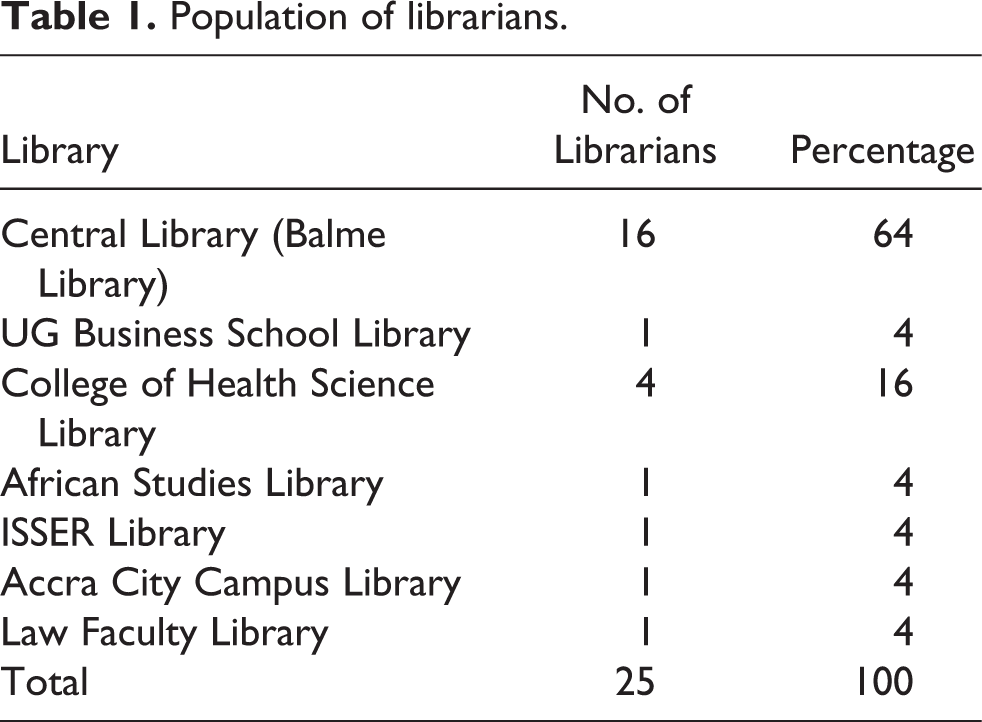
The librarian normally holds at least a Graduate Diploma degree in library science and/or a functionally related discipline. These librarians work at the central library (Balme Library), and at the satellite libraries of the university including the University of Ghana Business School Library; College of Health Sciences Library; the African Studies Library; the Institute of Social, Statistical and Economic Research (ISSER) Library; the Accra City Campus Library; and the Law Faculty Library (see Table 1).
Population of librarians.
Justification and requirement for academic status
The character and quality of an institution of higher learning are shaped in large measure by the nature of its library holdings and the ease and imagination with which those resources are made accessible to members of the academic community (Association of College and Research Libraries 2007). Librarians perform a teaching and research role inasmuch as they instruct students formally and informally and advise and assist faculty in their scholarly pursuits. Librarians are also themselves involved in the research function; many conduct research in their own professional interests and in the discharge of their duties.
A majority of the librarians participating in this study (20 cases: 80 percent) was of the view that it was necessary and legitimate for librarians to have agitated for academic status per se. To them, the library itself is an academic institution, and as such librarians deserve academic status.
Much as librarians felt they should be accorded academic status, however, they perceived the requirements for them to have academic status equivalent to faculty as rather unfair and too demanding. They were of the view that, since librarians work full time and are expected to remain at the desk throughout the 8 hours, they should not be assessed or appraised on the same terms as lecturers. These librarians agree that research enhances career advancement and that there is the need to balance this achievement with the other responsibilities of the professional role, but they think that evaluating them on equal terms with faculty in this respect is unfair. While academic status has many benefits including sharpening skills, building an area of expertise and receiving recognition, the scholarship component can be an additional burden to job expectations (Black and Leysam 1984). The librarians felt that the quality of library service could diminish if librarians are required to focus on research and publication.
Why the need to write?
Busy with both day-to-day responsibilities and keeping up with a rapidly-changing field, many librarians may feel overwhelmed by the idea of making original contributions to the profession (Gordon 2004). Yet one of the best ways to remain current and connected is by taking the time to contribute through writing for publication. To the question of why librarians need to research and publish, study respondents provided diverse reasons, in order of priority:
to meet administrative and promotion assessment requirements
enhance one’s resume for a new position
desire to have one’s name in print
share the results of professional research activity
contribute any ideas and experiences to library literature
enjoy the writing process itself.
The need to research and publish to meet administrative and promotion assessment requirements was identified as the most dominant and critical factor, as 22 (88 percent) of respondents indicated this. This was not surprising, as currently an Assistant Librarian at the University of Ghana is required to publish at least three refereed journal articles (local or international) to gain promotion to Senior Librarian. As many as 21 (84 percent) of respondents also indicated the need to enhance their status or resumé for a new position as a reason to research and publish. This is in consonance with the vision of the current University Librarian, Prof. E.E. Badu, that research and publication by library staff will not only improve the services of the library but also significantly increase the profile of the librarians as researchers and embrace research engagement as a core professional and institutional value. This vision is closely aligned with the University of Ghana’s vision of becoming a world class university.
Years spent on current grade
The study revealed that 8 (32 percent) of the librarians have been on their present grade for between 6 and 10 years, while another 7 (28 percent) have been on their present grade for over 10 years. The library has lost some librarians, including a former Senior Assistant Librarian, to this process, while others are plateauing in their career – a situation that was found to be a cause of job dissatisfaction to some respondents.
Plateauing is a concept that says when a major aspect of life or career has stabilized as it ultimately must, the individual feels significantly dissatisfied. The psychological basis for the dissatisfaction and disappointment that accompany plateauing in one’s career as a librarian at the University of Ghana lies in the fact that more prestige is attached to promotion and upward mobility in the organizational hierarchy.
The University of Ghana, like most large public organizations, runs a tight race in which promotion is one of the significant forms of rewarding hard working personnel. Personnel working at the university, including professional librarians, are therefore forced to face the issue of plateauing because the structure and hierarchy of the university organization, in itself, creates the motivation to move up. The existence of this formal structure and hierarchy makes it easy for staff in the university to know who is climbing, who is stuck, and who is perhaps falling. Senior Member promotions, including those of professional/academic librarians, are published twice each year in the University of Ghana Reporter. Failure to be promoted therefore becomes obvious and can even generate so much pain that some senior members, including professional librarians, cannot come to terms with it.
Research output
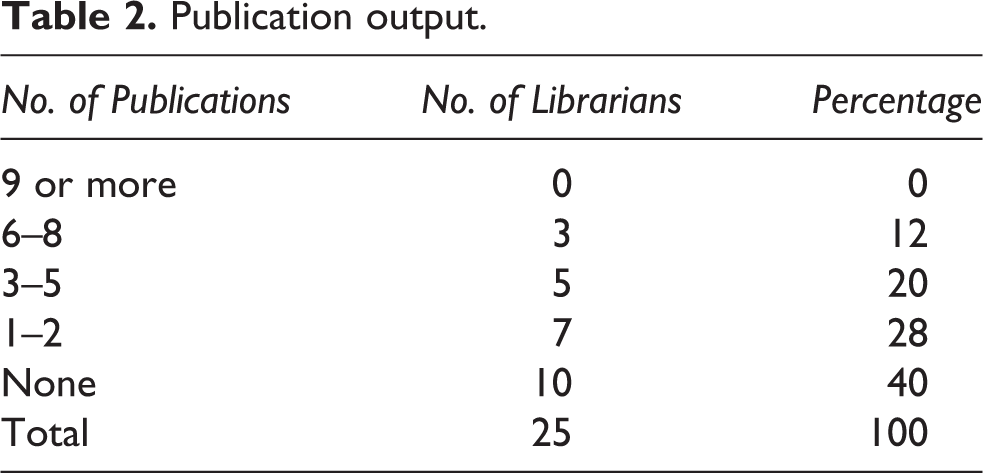
One index of the research output of librarians is the number and quality of works by librarians published in refereed journals, both local and international. Three respondents (12 percent) at the University of Ghana have now focused on the glamorous side of academic status – research – and part-time teaching, sometimes driving as far as the University of Ghana City Campus (16 km) to teach – to the detriment of many of their core jobs in content representation, instruction, research assistance and access provision. Seven other respondents (28 percent), however, think they did not become librarians in order to write lots of papers and be constantly worried about being published. This category of librarians believes that the pressure to publish can be an enormous source of stress, and can also limit the ways in which they are able to serve and contribute directly to the university community (Haggan 2003).
The survey data revealed that librarians at the University of Ghana are not active and committed researchers. At the time of the study 10 (40 percent) of the participating librarians had no publications to their credit, seven (28 percent) had one or two publications, while no librarian had more than eight (8) publications (See Table 2). Four of the participating librarians (16 percent) said they were involved in research at the time of the survey, while five (20 percent) said they had plans to complete a research project within the next year or two.
Publication output.
These findings support observations made by the then Dean of Social Sciences in a meeting with academic librarians on 14 February 2005, at which the Dean, while commending the battle of academic status won by librarians, which puts them at par with teaching faculty, observed that academic librarians were not publishing as they should, and that their publication rate had not increased over the years. This statement is corroborated by studies carried out in other parts of Africa. For instance, Ogbomo’s (2010) study of the publication output of librarians in Delta State University, Abraka, Nigeria, notes that the majority had not published in the last 2 years, while most of them had not been promoted for more than 10 years. Ocholla and Ocholla (2011) also observed that many academic librarians from the Southern Africa region, with the exception of South Africa, do not publish in visible scholarly outlets such as those indexed by LISTA, and even less in peer-refereed journals.
Difficulty in publishing
The study revealed that, though librarians want academic status, some of them are found wanting in the area of research and publication. Nearly half of the librarians at the University of Ghana Library System (UGLS) were initially employed as junior non-professional staff. They managed over the years. through acquisition of relevant degrees, to rise through the ranks to become professional librarians. By the time they attained professional status, they were already more than 40 years old, with diminishing returns in terms of their vibrancy and motivation to research and publish.
In submitting a manuscript for assessment and possible publication, it has to be peer reviewed by editors and experts in that area. Such peer review, which sometimes takes months to notify the author on the status of the manuscript, favourably or otherwise, can really ruffle the feathers of a budding librarian, and the potential for rejection is nothing short of the worst. One respondent who shared his personal experience said that his first and only manuscript was rejected twice, and he has since thrown in the towel as far as publishing is concerned; after all, he has barely a year to go before retiring from the library service.
Perception about succession
Currently the position of the University Librarian at the University of Ghana is filled by appointment by the University Governing Council after the due process of advertising the position and a job interview. A majority of respondents (18 cases: 72 percent) would prefer the elective succession of university librarian, rather than by appointment. The reason is that elective succession would spur practising librarians within the library to work harder with the hope of becoming university librarian and put to rest the recent practice of appointing academics from the Department of Information Studies as University Librarian (Agbola 2001). This perception supports a study carried out by Okoye (1998), where the majority of librarians practising in university libraries favoured elective succession of university librarians.
Intention to quit
In spite of the dissatisfaction with the academic status requirements, only four (16 percent) of the librarians expressed their intention to quit the university service should any opportunity crop up elsewhere. This small number may be explained in part by the fact that the study was conducted during the final year of the Government of Ghana’s road map to improve service conditions for all senior members, including librarians, in the public universities in Ghana. Senior members at the public universities had been assured and were expecting a good salary package for the year, and therefore felt no urgent need to quit the university service. Librarians who expressed no intention to quit attributed their continued stay, in part, to the relatively calm university working environment and availability of excellent but highly subsidized basic educational facilities for their children on the university campus.
Conclusion and recommendations
Librarians at the University of Ghana have been accorded full and equal faculty/academic status. They now have pay increases and allowances tied to the faculty scale, which certainly are benefits. With the benefits, however, comes the requirement for publication and service that is expected of any other faculty member. Despite working on 12-month contracts as opposed to the 9-month teaching faculty contracts, librarians are expected to compete equally in the promotion and tenure process – going up before the same University Appointment and Promotion Committee as everyone else, with the same pressures to publish and serve on committees. Though a few librarians have made it through and some have even excelled, the majority see these additional requirements as rather too demanding. Full faculty/academic status involves a huge commitment of time and energy outside the 40 hour work week; a commitment that some librarians do not wish to make.
Currently, in practice, there are two categories of librarians at the UGLS: Professional and Academic. At the end of each year both groups are made to complete an appraisal form, which is highly skewed towards academic achievement. For example, portions of the form require a librarian to indicate courses and credit hours taught, number and nature of research undertaken during the year, completed or on-going. These are purely academic requirements, which the professional librarian finds inconsistent with his organizational job description as a librarian.
It appears as if librarians at the University of Ghana, in agitating for academic status, dwelt more on faculty rights and privileges than on the equivalent responsibilities and performance obligations (Schrader et al. 2012). As Donald Riggs (1999) advised, those interested in an academic library career with faculty status equivalent to non-librarian teaching faculty, “If they do not want the responsibilities that go with faculty status, they should look for employment in an academic setting that does not require such.”
Librarians at the University of Ghana are aware and appreciate the fact that, working in an academic environment, evaluation of their performance is an inevitable application of their job description process. It must, however, be noted that a poorly conceived system of evaluation, concentrated on ill-considered performance measures, can have adverse work-life consequences for these librarians. In evaluating librarians, it is therefore important to give more recognition to the ways in which the individual contributes professionally to the mission of the library and the university through management of functions and/or provision of service.
It appears that the majority of the librarians at the UGLS are ill-prepared for academic status. The benefits of academic status are accompanied by uneasy and unpleasant new expectations and requirements, thus making it appear that the gains have been swallowed by the pains (Onohwakpor and Tiemo 2006). The requirements to qualify for these benefits constitute the pains of the new status.
Librarians have a fundamental responsibility to contribute to professional communication. The research process is not complete until it has been reported and published. Librarians can only benefit from the results of research if they are published. To enhance their writing and publishing skills, newer librarian writers should seek out mentors that can advise them on research directions or publication outlets and do a fast reading on their work. Librarians should take every opportunity to connect with other librarian authors, and seek out co-authors that help keep them on track and with whom they can exchange ideas, to read and critique their work.
Calls for reviewers and conference summaries are often posted in association magazines and review journals. Librarians should have an eye out for these as they do their professional reading. They can begin with smaller and more-defined writing projects, such as book reviews or conference write-ups. The inevitable prospect of article rejection is always there. New librarian writers should not let the prospect of possible rejections paralyze them; that will be sabotaging their own success (Crawford 2003).