



Abstract
The perceptions of faculty members from the faculties of social sciences and humanities regarding the role of the library in assisting with their research and teaching needs are compared with those of academic librarians. This research was designed as a comprehensive, mixed-methods study. First, interviews were conducted with faculty members and librarians; then, based on the findings, a questionnaire was constructed and distributed to faculty members and librarians in these departments. The main finding is that the contribution of library services to the various aspects of teaching and research is perceived as higher by the librarians than by the faculty members. Faculty members appear to expect more from the library in various aspects of research support; however, most faculty members believe that the library fulfils their teaching needs. Regarding research, faculty members believe most libraries support the technical aspects, but they do not support other aspects, such as locating the information or providing more comprehensive information relevant for the faculty members’ research. Therefore it is important to compare and resolve the differences between faculty and librarians’ perceptions. The findings of this study indicate that the perception in libraries needs to change, and some of these changes should be made already in the preparatory stages of the profession.
Introduction
According to Becher’s (1989) organizational theory, academic libraries are an organization set within a larger organization – namely, within the academic institution and its various departments. As such, the attitudes of faculty members toward the academic library are influenced by various factors that are associated with the larger organization, including the size of the academic institution, its reputation, and, importantly, the organizational subculture of its faculty members (Becher, 1989). The latter is manifested both inside the faculties – i.e. in the behavior of faculty members and in the connections that they maintain – and between faculties, i.e. in the relationships between faculty members of different fields.
In recent years, both universities and academic colleges have increasingly required that faculty members conduct research, thus blurring the traditional distinction between researchers and teaching faculty members. A major reason for this change in requirement appears to be related to the continuous development of the information world, as conducting research enriches the lecturers, develops their teaching capabilities, and, consequently, contributes to their promotion in the academic institutions (Amara et al., 2015; Katz and Coleman, 2001).
King et al. (2009) claim that articles from research journals are the most important, relevant, and necessary source of scientific information for university faculty members, who use them most prominently for research and teaching purposes. Indeed, more than 80% of journal articles are read for these purposes, and it has been reported that the more a researcher is appreciated and renowned, the more s/he invests in time to read scientific literature (Hoppenfeld and Smith, 2014). Most faculty members read articles in an electronic format and away from the library, but they obtain more than half of the articles through the academic library (either from the library’s own collection and subscriptions, or through interlibrary loans) (Hoppenfeld and Smith, 2014). Faculty members locate relevant information through diverse means, most notably by searching databases and the Internet or through peer recommendations (Rupp-Serrano and Robbins, 2013). To meet the research and teaching necessities of faculty members, academic librarians must be familiar with their information-searching habits and with the different materials that they employ for research and teaching (King et al., 2009).
Research aims
The position and status of academic libraries within academic institutions are unclear and appear to differ within different institutions (Chu, 2014). Unlike students, faculty members are the resident population of an academic institution and they greatly affect various aspects of the academic library. Thus, understanding their needs and their attitudes toward the library as a provider of research and teaching necessities is crucial for the adaptation of the library to their academic requirements. In addition, the continuous process of reassessment of the library and the services that it provides, including developing programs tailored to meet the research and teaching needs of faculty members, can improve the library as a provider of such services. Nevertheless, there appear to be differences between the services that the library provides and the way in which faculty members perceive these services, and the library in general (Searing and Greenlee, 2011). Comparing the perceptions of academic librarians and faculty members is important for developing relevant services for the faculty.
The purpose of the current mixed-methods study is to characterize these differences and describe the expectations of faculty members regarding the library in research and teaching. To this end, the perceptions of faculty members from the faculties of social sciences and of humanities regarding the role of the librarians in assisting with the various aspects of research and teaching are compared with those of academic librarians in their institutions.
Research questions
How do faculty members perceive the role of the library with respect to research and teaching?
To what extent do faculty members utilize the resources of the library for research and teaching?
What are the needs of the faculty members from the librarians in the library?
How do academic librarians perceive the role of the library in various aspects of research and teaching?
To what extent do the perceptions of the role of the library differ between faculty members and librarians, and how can these differences be diminished?
Literature review
Factors that influence the academic library and its function
According to the Research Information Network (RIN) & Consortium of Research Libraries (CURL) (Brown and Swan, 2007), various factors influence the contemporary academic library and its function:
Faculty members’ attitudes towards the library
According to Tillack (2014), faculty members generally appear to be aware of the importance of the library; however, in practice, the academic institutions continuously try to reduce library budgeting from year to year, thus raising difficulties in purchasing the resources required for the proper functioning of the library ( Brown and Swan, 2007). The ability to access information by using simple, fast, and electronic means is extremely important in the current “era of changes”, as the digital world has dramatically changed scholarly communication, to the extent of transforming the traditional scientific communities to “scientific networks” (Cox and Verbaan, 2016; Genoni et al., 2006). Indeed, faculty members claim that the Internet has extended their circle of acquaintances, allowed them to read more diverse materials, facilitated new connections with faculty members from other institutions and academic statuses, allowed them to actively participate in discussion groups and research enterprises, and, in general, improved communication and information flow between them and other faculty members (Steele, 2014). Notwithstanding, according to RIN (Bulger et al., 2011), faculty members from the humanities still highly esteem printed materials, tangible elements, physical locations, and human contact – which they claim to affect their feelings, perceptions, and the way by which they experience their research. In interviews, faculty members from the humanities claim that it is important for the researcher to experience the surrounding in which s/he works, and, in addition, experience the academic library as a working environment and as a place in which to use materials (Rimmer et al., 2008; Saunders, 2015).
Several studies that examined the attitudes of faculty members regarding academic libraries (Bundy, 2004; Cooke et al., 2011; Gibbons et al., 1994; Hawkins et al., 1998; Koltay, 2016; Lynch, 2004; Malenfant, 2015) found that, as a result of technological advancements, faculty members increasingly use the online services of the academic library. For these faculty members, the importance of library services has increased, rather than decreased, as was previously believed (Kachaluba et al., 2014). However, the development of the vast number of Internet tools, and the information overload incurred by technological advancements, have raised difficulties for some faculty members, who require the services of the library today more than in the past (Kachaluba et al., 2014). In addition, the library can assist faculty members in developing information literacy, which is especially important in an era of information overload and can help in learning and organizing materials. With respect to researchers, specifically, a more precise term for information literacy in the current era is research literacy – and, even more so, electronic research literacy – which requires various new skills, such as the ability to collect, sort and preserve materials, to organize and develop electronic collections, and to learn how to use information-obtaining tools. In general, librarians possess the skills and abilities that are required to assist in this process (Genoni et al., 2006; Keil, 2014). On the other hand, the study of Cooke et al. (2011: 24) claims that:
the knowledge, skills, and services that appear to be most highly valued by users may not reflect those on which greatest emphasis is placed by those who are managing library services—or who are educating future LIS professionals. In addition, the study found that subject knowledge and keeping up-to-date in one’s subject field are seen by academic staff as critically important attributes of an Academic Liaison Librarian, yet, all too often academic liaison librarians may be assigned to an academic discipline area in which they do not possess prior knowledge.
Thus, it seems that there is a problem in the way the liaison librarian’s role is perceived by the librarians.
When faculty members were asked about the importance of developing library-usage skills in their students, many answered that library usage is indeed important, mainly for locating journal papers and for evaluating the material that they find (Alcock and Rose, 2016). Creaser and Spezi (2012) found that information literacy training is highly useful, and that it is appreciated by faculty members and promotes collaborations between a faculty member and the librarians, such that the faculty member, who is the expert in the field, provides the academic content and the librarian provides the pedagogic aspect. However, whereas some faculty members appreciate the collaborations with the library, others do not find merit in such collaborations and do not consider library training to be an important service. In surveys, e.g. (Alcock and Rose, 2016), faculty members generally show a positive attitude toward the library, but this attitude is not often manifested in actions or in collaborations with the library staff. The conclusions that these studies draw is that initiatives from individual librarians are required to informally communicate with the faculty members and to attract them to the library (Cooke et al., 2011; Hrycaj and Russo, 2007; Mi, 2015). To improve collaborations, such an activity should be defined in terms of the benefit it gives the faculty members, e.g. saving time, personalizing services, and maintaining convenient opening hours (Sharma et al., 2014). It was found that librarians believe that they can – and should – take an important part in academic teaching (Brown et al., 2015; Delaney and Bates, 2015), and that collaborating with faculty members will improve their image (Creaser and Spezi, 2012).
Information-searching habits of faculty members
A study of the patterns of use and of the information-searching habits of faculty members in the library website found that many faculty members turn to external search engines if they do not quickly find the relevant information on the library website (Herman, 2001; Hoppenfeld and Smith, 2014). In fact, many faculty members begin their searching process in external search engines, which they perceive to be simpler than searching library resources and because locating materials at the Google Abstract and Index (Google A and I) level is sufficient for their needs (Harker and Kizhakkethil, 2015). These findings indicate that faculty members are not sufficiently familiar with the library website, do not use it properly, and are unaware of the vast materials available in its numerous and diverse pages. In addition, faculty members do not always comprehend the professional terminology used on the library website (Geetha et al., 2013; Haglund and Olsson, 2008).
Several studies have shown that many faculty members are either unaware of the online systems available in the library or do not understand them, and that, if they are aware of the existence of such systems, they do not know how to use them because librarians do not provide organized training (Hollister and Schroeder, 2015; Leeder and Lonn, 2014). This situation seems to have resulted from perceptual differences between faculty members and librarians, as faculty members appear to be unaware of the capabilities of the physical and electronic library, whereas the librarians do not completely understand the information needs of faculty members and the means that they employ for information searching (Sharma et al., 2014). In general, faculty members appear to prefer information-searching tools that are independent of the library, and they are either unaware of or do not value the capabilities of the modern library to assist them in information searching (and, consequently, they do not inform their students of the capabilities of the academic library in providing assistance) (Hoppenfeld and Smith, 2014; Mack et al., 2004). When they do reach the library, many faculty members either prefer to manage on their own and without assistance or training by the librarians, or they need services regarding bibliometrics and open-access issues, which most libraries do not maintain as part of their working routine (Brown et al., 2015). According to Creaser and Spezi (2012), when faculty members do ask for the librarians’ assistance, it is due to their personal acquaintance with and their appreciation of the individual librarian.
Recently, some librarians in departments of databases and Internet (i.e. librarians who are responsible for subscribing to databases, checking the relevancy of databases for students and for faculty members’ teaching and research interests, checking that the databases work properly and there is access to full texts, etc.), have created conditions that can help identify the IP range of a computer while a search is performed in the Google Scholar searching engine (Mi, 2015), such that, when the user searches for a particular topic, relevant materials that are available in the library are shown. This trend is developing so as to cope with the tendency of faculty members to search Google rather than the library database. However, it only provides a partial answer to the issue, because, at times, the faculty members cannot access the full text from Google unless they are in the physical IP range of the library or the academic institution.
Summary of the literature review
The reality is that, although faculty members say that they understand the importance of the academic library in academic life, and although they use the Internet, databases, and library services in general, more than in the past, their appreciation for the library is unclear. Indeed, the budget that faculty members approve for the library is lower than in the past; some faculty members claim that they either do not need the library or that they only need its electronic services (and not its physical presence); and they sometimes prefer to use external websites over the library website. It seems that faculty members do not completely perceive the importance of the academic library in teaching and, especially, in research, and they often prefer other means of obtaining information. On the other hand, librarians’ perceptions of their roles depart from faculty members in the teaching and research process.
Within this context, the current study discusses the perceptions of faculty members and academic librarians regarding the role and importance of the academic library in teaching and research processes, as reflected in three academic institutions in Israel.
Methodology
Research approach
This research was designed as a comprehensive, integrated, mixed-methods study. The synergistic combination of qualitative and quantitative methodologies has allowed us to combine inductive and deductive thinking. On the one hand, this combination enables the understanding of the context and setting in which people talk and directly hear the voices of participants, while, on the other hand, it avoids the influence of personal interpretations and increases the number of participants and, therefore, allows generalizations (Creswell and Clark, 2011). We began by conducting interviews with faculty members and librarians to allow an in-depth analysis of their particular perceptions (see below). Then, based on the similarities of meaning between the individuals, we analyzed these qualitative data by categorization in an attempt to group patterns in the data into meaningful units. These categories, in turn, were used to discern semantic, logical, and theoretical links and connections between and across the categories, in order to identify themes (Creswell, 2009). The analysis of these data prompted a subsequent questionnaire, which examined the prevalence of these perceptions.
Research population
The research population included two groups: (a) faculty members (lecturers, senior lecturers, and professors) who teach and conduct research in the faculties of humanities and social sciences in academic institutions in Israel; and (b) academic librarians, who work in the libraries affiliated with these faculties. Three academic institutions were sampled altogether. As the results from the different institutions were not considerably different from each other, the data were pooled and represent all the three academic institutions.
The interviews were based on a convenience sample of 20 faculty members and 15 academic librarians, who were selected by the snowballing sampling technique. The questionnaires were distributed to all faculty members and librarians in the three selected academic institutions (619 faculty members and 80 librarians altogether); response rates were 30.9% and 62.5% for the faculty members and librarians, respectively.
Data collection methods
In-depth, semi-structured interviews
All interviews were conducted during the academic year of 2013–2014. The interviewer maintained flexibility during the interview, such that, in addition to asking the pre-prepared questions (see below), the interviewer also developed a conversation based on the answers of the participant, responded to statements made by the participant, and spontaneously asked clarification questions or new questions to obtain additional information (Berg, 2009). The interview questionnaire regarded six main issues (Patton, 2002): experience and behavior, opinions and values, emotions, knowledge, senses, and demography. The interviews with faculty members focused on their attitudes toward the role and functions of the academic library in research and in teaching, on their needs from the library, and on the extent to which they use library resources. The interviews with academic librarians focused on their perceptions of the role and functions of the academic library in research and in teaching.
Questionnaires
Due to the descriptive nature of this study, a structured questionnaire was used, which comprised closed, multiple-choice questions that focused on all participants as a single group, rather than on the individual (Creswell, 2009). All participants received the same questions in the same order, and the purpose of the research was not concealed (Sapsford, 1999). In addition to demographic questions, which were included in all questionnaires, the questionnaire for faculty members focused on the perception of the participant of the role and functions of the academic library in research and in teaching, on his or her needs in the library, and on the extent to which s/he uses library resources. The questionnaire for academic librarians focused on the perception of the participant of the role and functions of the academic library in research and in teaching.
Procedure
As a first stage in the study, in-depth, semi-structured interviews were conducted. The interviews were conducted for 40–60 minutes in a comfortable environment, i.e. in the offices of the participants, with whom the interviewer had earlier made an appointment to meet. All but three participants took part. All interviews were recorded and transcribed. In the second stage of the study, a questionnaire was formulated based on the data obtained from the interviews. Pre-test questionnaires were sent out to five faculty members and to five academic librarians prior to distributing the questionnaires to all other participants. Following analysis of this pre-test, no significant modifications were recommended and the questionnaires were sent to all participants. (There was no pre-test in the interview protocol.) The questionnaire was accompanied by an explanatory letter, which was written by the researcher and explained about herself, the research population that was chosen, and the subject, purpose, and importance of the research. After one month, a reminder letter was sent to all participants to encourage them to reply to the questionnaire. One month later, and after obtaining more questionnaires, data collection was concluded. The final research population included 619 faculty members and 80 librarians; response rates were 30.9% and 62.5% for the faculty members and librarians, respectively.
The qualitative data from the interviews were divided into categories to group patterns in the data into meaningful units. The quantitative data were collected in Google Docs and then processed in SPSS (Statistical Package for the Social Sciences). The manuscript of this study was written after finishing the qualitative and quantitative analyses.
Findings: Qualitative analysis
The role of the library in research and teaching according to the perceptions of faculty members
Although this study attempted to distinguish between the use of library resources for research purposes and for teaching purposes, analyses of the interviews revealed that such a clear distinction was not reflected in the perceptions of the faculty members. In general, faculty members attested to using the library resources (typically its digital resources) mainly for research purposes. Most faculty members indicated that they constantly require up-to-date material for their research, and, since the development in their field of research is rapid, they tend to use electronic resources because these resources are constantly being updated, are readily available at any time and place, and usually provide the full text of an article. However, all faculty members attested to using the library resources for teaching purposes also. Because teaching is conducted in parallel with research, they use research material for teaching purposes and often combine materials and resources for both purposes.
Research and teaching in parallel
Most faculty members mentioned that they conduct research and teaching in parallel:
It is difficult to quantify, I do not think I can compare, I make much use [of the library] for both [research and teaching] … I am equally engaged in both, and I cannot say whether more for teaching or for research purposes. I first prepare the material for students in a very specific and thorough manner, but at the same time [I also use the materials] for my needs. It is important for me to do the two things in parallel. (Interviewee 6)
One of the researchers presented a generalized approach for using the physical and electronic library for both research and teaching. This researcher also explained that, although he has free access to different materials, he could not have created a rich and quality syllabus without using the library resources:
I use it [the library] for everything. I also like the place [the physical library] for sitting and reading the newspaper, I flip through journals in my fields [of research] … For my research work, I constantly look for more new articles on a weekly basis. My searches are through the library resources. I also search external free resources, but I primarily use the library. For teaching, I sometimes start with an old syllabus, and sometimes not … I need the infrastructure, such as articles and books. Articles and books will not be there [in external resources] because they are copyrighted, so, to reach the infrastructure, I need the library. If I find that books that I need are not available here [at the library], I go to the purchasing department and request to purchase them. (Interviewee 5)
One of the researchers explained why it is so important to integrate research and teaching. She claimed that one cannot teach without conducting research, and that research enriches the researcher and allows him or her to stay updated:
In terms of teaching, the library always has many things, but I always have new things [that I need] and the library always makes sure that I receive everything that I ask for. I never had a problem. I always work together with the library, checking what is available and ordering what is not. I do not think there is any other way. Research – initially, I search free databases and read the abstracts, as it is usually impossible to reach the full text through these databases. Therefore, I then try to obtain the full-text articles through our databases, and, if I cannot, I turn to the purchasing department or to Interlibrary Loans with a list of items that I want and was unable to obtain because we do not have them or we do not have the last year [a certain volume, issue, edition, etc.], and so on. I usually use the same materials for teaching and for research; teaching, in my case, stems from research. The research helps me teach, you cannot teach without research, you need to read a lot and do research and then combine it with teaching. There is no difference for me [between teaching and research]. (Interviewee 19)
Other faculty members mentioned that their allocation of time for research and for teaching changes throughout the year, in accordance with the research project that they are conducting at the moment. One researcher explained that, at different times of the year, he invests different amounts of time in research and in teaching, and, although he employs similar materials for both purposes, he does distinguish between what he orders for the library for research and what he orders for teaching, similar to how he allocates his time during the year:
The frequency of use of the library depends on many different factors, and, therefore, it varies. Lately, I have been working on a large research project, and, therefore, I visit the university about three times a week and regularly visit the library, so it varies depending on the needs. It depends on the research project, on occupations, and on the courses. For example, if I teach several courses or create new courses, I spend a lot of time them and do not do conduct research during this time. But I definitely need libraries in any case. However, generally, I need materials more for research than for teaching, because I usually keep the books. I tend to buy books and use them to construct the syllabus. (Interviewee 7)
Locating information through external resources
A researcher in one of the institutions presented an approach that is relatively detached from the library, at least in the initial working stages, but he also explained why he chooses to do so, namely, due to his unique field of research:
You could say that I begin my searches on external resources, and not on the library databases. I’m not proud of not using library resources, perhaps it’s a mistake, but this is the situation. In principle, I begin my searches on Amazon, entering Amazon and checking the table of contents, a sample chapter, etc. For me, this is kind of a virtual library. I also use Google Books … I go to the Introduction and to an example chapter, from which I get an impression on the book and know whether I want to keep searching for it. If I like it, I search in the library. Besides, Amazon is also good for the bibliography part, they have all the bibliographic information about the books. It is much easier for me to enter it [Amazon website] than the library website … I work in a field that does not really exist in this country [Israel], and when I visit universities abroad, I go to the shelves and use [the library] there. But I also use journals, which means using the library, because, to reach the full-text articles of a journal, the library needs to have a subscription. Searching for the journals starts on the Internet, because on the Internet you can go through the titles of the volumes and receive general information. I also search on the website of the specific journal, and, if I see a paper that interests me, I enter and search through the library to obtain the full text. (Interviewee 10)
This interviewee presented a similar approach – of little use of library resources – also with respect to his teaching needs and his demands from students:
In my courses, I do not really use the library, I usually upload to the syllabus links to YouTube or to Internet websites, I put them directly in the syllabus and the students enter directly. Sometimes I send links and ask the librarian to install them in the library catalog … I don’t look through library materials or resources to find what to put in my syllabus. In my courses, I do not require students to use the library, the required reading material is found on the website and they do not need the library at all, I provide links to everything. (Interviewee 10)
Not using the physical library
One senior researcher presented an attitude similar to that of Interviewee 10, namely, being somewhat disconnected from the physical library, but using electronic resources. The researcher explained that his approach stems from his field of research, which allows him to search databases and use the various technologies by himself:
I do not use the physical library, I have not entered libraries for about 20 years, but I do use electronic means. I also deal with information technology and I have no fear of new technologies like some of my colleagues in the humanities do. I only use digital means that the library is subscribed to and that are free. There are many databases to which the library is subscribed, and I have used them. [I] mainly use [the digital library resources] for research purposes. As for courses in which I teach, occasionally I have refreshed the reading list for my courses and what I did was to enter electronic databases, find articles that are relevant for my students, scan and saved them, and inserted them to the syllabuses. This did not require me to visit the library. Sometimes I printed them [the articles] out to read them; I did not need the physical library. (Interviewee 16)
Expectations and needs of the faculty members from the library
The faculty members indicated various expectations from the library and raised various ideas – either their own or which they know from other academic institutions – for improving the services provided by the library.
Some faculty members focused on their needs and expectations in the academic aspect of supplying the materials and resources that they require. One faculty member explained:
My expectations, especially in all those years of cutbacks, is that an academic library in the university should contain all the information that a doctorate student will need, both printed and electronic. It is inconceivable that someone will do a doctorate in fields that are taught at the university and not have all the material that he needs at the university in which he studies. He should have all the material; this is what it means to be a university library. The current situation is really not like that. It [the situation] does not characterize all the libraries, some libraries are in better condition. There is one library of a specific academic institution that is the best library in the country, in my opinion. When I want to know what new books were published or are about to be published in my field, I enter their orders, there’s no one there in my field, and yet they order everything. In libraries abroad, in the university I studied in, they had everything that I needed, it was obvious. The awareness of the Acquisition Department was completely different. It is true that budget is important, as it is for everything else, but the awareness that a library should contain everything that anyone in the university needs is important. The main problems that I find in libraries in this institution are the lack of recent books and limited access to journals. Unlike large libraries in North America (where I did my PhD), which purchase most of the new books from major publishers every year, it seems that libraries here [in Israel] purchase books later, and it is unclear under what criteria. Major and important books are definitely missing. Also regarding access to journals, the criteria for choosing which journals to subscribe to are unclear. A good research study needs accessibility to all current materials. (Interviewee 14)
One of the senior faculty members presented expectations regarding academic needs and research needs, such as access to the most recent and new electronic journals:
One of the problems is that not all articles are really available. For example, there are journals with which I work and I receive them as a subscriber, but the problem is that there are publishers whose journals are very expensive and the library does not have a subscription for them, or has no access to the past year, and this is a problem because I cannot electronically enter the most recent articles in the field. I mean, there are databases in which they have the journals, but, for instance, no access to the past year. There are very important journals there, especially for a Master’s degree, and it is problematic that there is no subscription for databases that have full text, but only partial access. The point is that even if I do get them in print, I would like also electronic access, because it is much more convenient for my work. Although there is a possibility for interlibrary loaning, this process requires time and complicates the job. I know there are financial considerations, but I would expect more subscriptions for databases, more specific repositories … I think that there is a place for a librarian who is an expert in the field, especially for large libraries that are responsible for several diverse departments; having someone who will be involved, an address to turn to. (Interviewee 6)
A senior lecturer in a university proposed an idea that could assist faculty members while improving their connections with the library. However, this lecturer explained throughout the interview that he scarcely uses the library and does not think that he would respond to more initiatives from the library:
I have no special expectations from the library, except finding what I want. I would expect, for example, that there will be some kind of a workshop for advanced methods of information searching on the Internet. Something like this is appropriate, even though I’m not sure I would attend, but it sounds to me important and effective. I don’t remember if there was such a thing. (Interviewee 10)
A senior lecturer from a different university suggested another idea to improve the connection between faculty members and the library, as well as actively assist faculty members:
I would expect that the relationship [between faculty members and the library] would be more “push” than “pull”, more active in providing information to faculty members about new journals and new publications, even at the level of creating a profile for each faculty member who teaches [in the university] and [that the librarians] be familiar with members’ research fields and contact them regarding their research. There are several hundred faculty members and it seems proper that the library know them and their research interests and sell its services to them. Currently, it does not work that way. (Interviewee 16)
A senior lecturer in a college suggested another interesting idea, which could integrate the library in teaching activities:
For instance, in the teaching authority, they hold courses for teaching faculty members how to teach. Why didn’t anyone think to send the librarians to those courses? This could be very useful for them. They could develop tools, enrich their and our worlds, bringing these worlds closer together. (Interviewee 1)
Thus, the faculty members presented various expectations, which stem from various problems that they encountered or from specific needs that they have. One of the main expectations of faculty members is the improvement of the connection between the library and the faculty through librarians and information specialists (different faculty members referred to library workers differently), who will serve as field experts and assist the faculty members in teaching and research. They expected librarians who serve as contact persons between the library and the department exist today for teaching purposes; however, faculty members who also conduct research mentioned that “research librarians” could greatly assist them in various aspects – both in terms of instructions and in generating initiatives and services that will help the librarians be more familiarized with the faculty members and with their research interests, enabling them to work more closely with each faculty member.
The role of the library in research and teaching according to the perceptions of the librarians
During the interviews, librarians were asked how they perceive the role of the library in research and in teaching, and how they describe their connection with the faculty members in those respects. The different types of connections between the librarian and the faculty member stem, as mentioned, from the faculty member being a lecturer, a researcher, or both. However, generalizations could not be made because the connections that the faculty member creates depend greatly on such variables as the personality of the researcher, his or her degree of appreciation of the library, and whether librarian has deep disciplinary knowledge necessary to be really useful.
Using the library for teaching purposes
Librarians working in faculty libraries described the ongoing connection with the faculty members with respect to the various teaching and research needs of the faculty members, and they also described the differences between junior and senior faculty members:
We have referents who are in contact with the departments and who deal with purchasing that is relevant to the department. This is both for digital media and for hard copies. The connection [with the faculty] is mostly for teaching, but some [faculty members] also come to us for research, for help, mostly for interlibrary loans. This is especially noticeable among new lecturers, who teach a new field that was developed in the department, and he [the lecturer] develops new content, for instance, multidisciplinary courses, and, accordingly, collections must be developed. The people who open the course need to concentrate materials and build the course, and we also help them with that. Some deal mostly with research, more than teaching, and for them it is even more important and, indeed, more people came to our courses than we expected. This helps both doctorate students and senior faculty. It is very typical that the senior faculty, even those who retired, continue to come regularly to the library and they need help with various technologies beyond the catalog. They do not need help with contents. (Interviewee 4). We constantly interact with the lecturers. Of course, this does not include all lecturers, there are those who are interested and keep in touch, and some whom I really do not know. It seems to me that even those who do not come or respond still use the library remotely, as I cannot believe that someone conducting research will not need the library at all. They must pull [retrieve] materials from home, I’m sure they cannot do without the databases. Previously, contact with staff was closer because they came in much more than today; today, due to the changes, the relationship is more through emails, they come in less often. (Interviewee 7)
Another librarian, who works in a departmental library, stressed that the main connection with the faculty members is for teaching, rather than research. She explained that the library in which she works is very active in assisting with teaching needs, but has little contact with the faculty members for research purposes:
They need us for both [research and teaching], but I am not too familiar with their uses [of library resources]. I did not get to talk to them about it. It seems to me that many come for teaching purposes and only a few come to us for research purposes. Our instruction sessions are for students, and very few lecturers ask us for help and guidance, really very few … when they come to us and contact us it’s for teaching purposes. I cannot say that I know what are the research interests of the faculty members, I don’t know, we are not involved in it but assist with teaching … (Interviewee 14)
Using the library for research purposes
A librarian in a small departmental library described a different situation than that described by the above-mentioned librarians. It seems that the perception of the connection with the faculty members for various purposes is a characteristic of the institutions.
[The faculty members use the library] unequivocally for research purposes. For teaching, they only come once or twice a year, when they update a syllabus. It takes about a month to prepare a course. I search what is new and what has changed and they prepare the syllabus. Research requirements are always important, there is immense pressure in the university for research, to publish as much research as possible, and I see that, for research purposes, they come to me a lot, whether for journal requirements, for writing bibliographical items when the rules change. I assist them in searching because new papers are continuously being published. Sometimes they know how to search but they get a lot of ‘noise’ in searching because they cannot focus on the specific subject or because they find it [the library resources] hard to use. This is typical of all lecturers, regardless of age, it’s our main work. Some lecturers are at the forefront of technology and they do manage and search by themselves and then ask my help to continue, while others come to me at the initial stage and ask me to search and locate, and, mostly, if possible, in full-text. (Interviewee 11).
Most librarians distinguish between different faculty members, but it emerges from the interviews that a specific population who uses the library cannot be easily characterized in terms of age, research fields, etc. It also emerges that most librarians believe that the library is mainly for teaching purposes.
Findings: Quantitative analysis
When asked about the ability of the library to assist faculty members with their teaching and research needs, the perceptions of both groups appeared to be similar. Thus, 43 of the librarians (86%) indicated that the library can adequately fulfill both the research and the teaching needs of the faculty members. Only three librarians (6%) indicated that the library can fulfill only research needs, and only four librarians (8%) indicated that the library can fulfill only teaching needs. Similarly, most faculty members indicated that the library can always or very often assists with their research needs (81%; n=154) and with their teaching needs (59%; n=113). In addition, most faculty members (80%; n=153) indicated that they always or very often encourage their students to use the library.
The role of the library in academic research
Both the faculty members and the academic librarians were asked which of the following components they consider to be part of the role of the library with respect to research: providing access to electronic databases, providing access to printed books and journals, providing information about conferences and seminars, providing on-request searching for information by an information specialist, being a comfortable and quiet place, purchasing printed or electronic materials for the researcher, being updated and continuously renewing various collections, being advanced with respect to information technologies, and providing interlibrary loans. The distribution of responses is shown in Figure 1.
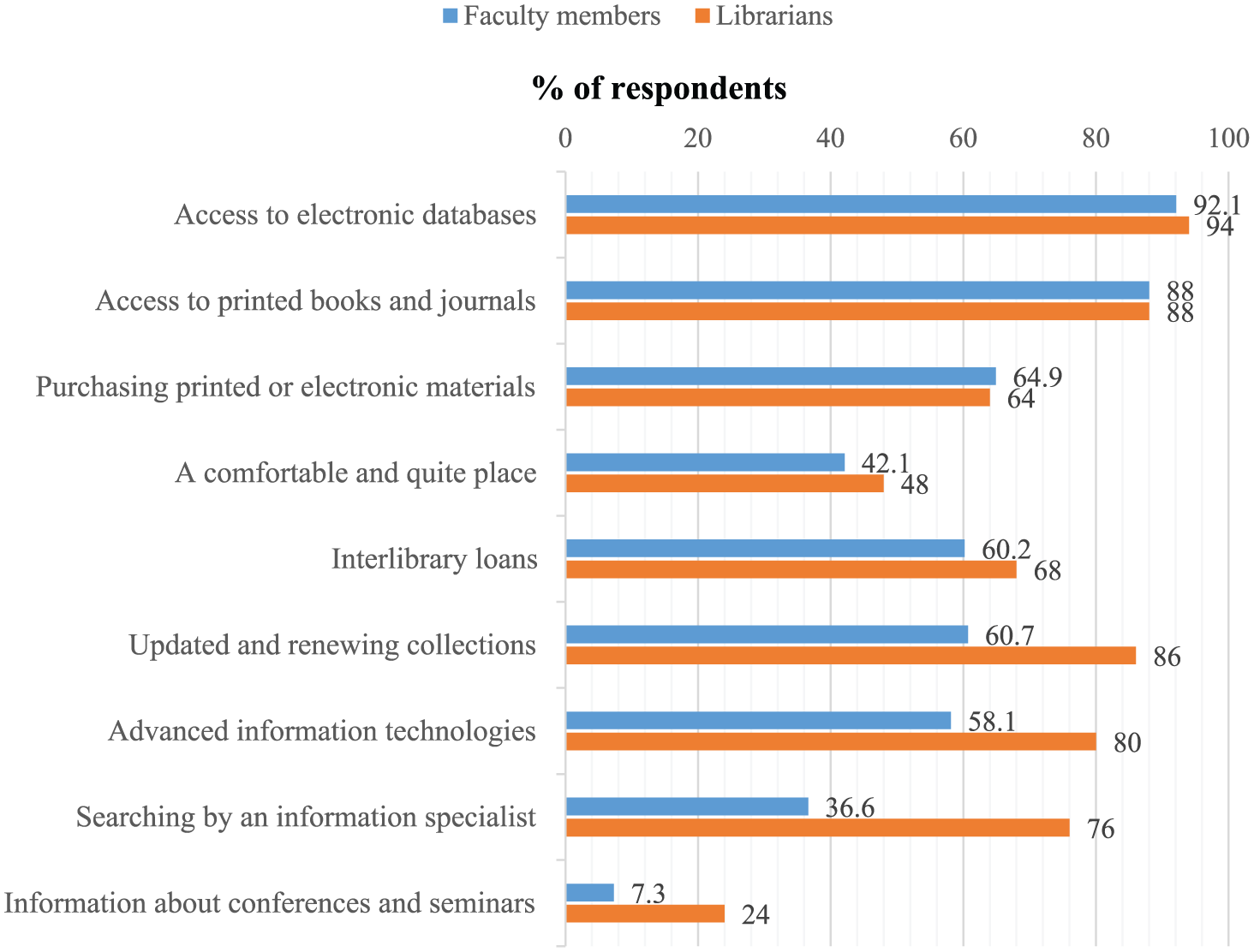
The role of academic libraries in academic research, as perceived by faculty members (n=191) and librarians (n=50).
The questionnaires suggest a consensus among faculty members and librarians regarding the role of the library in providing access to electronic databases and to printed books and journals, as more than 92% of respondents from both groups perceived these components to be within the roles of the library with respect to research. A relatively similar percentage of faculty members and librarians also indicated that purchasing printed or electronic materials, providing a comfortable and quiet place to work in, and facilitating interlibrary loans are within the roles of the library, although these aspects were perceived to be within the roles of the library to a lesser extent than providing access to electronic databases and to printed books and journals. In contrast, considerable differences between faculty members and librarians were found in other aspects of the role of the library. Most prominently, most librarians (76%) perceived “searching for information by an information specialist! to be one of the roles of the library with respect to research, whereas only about a third of the faculty members shared this perception. Similarly, large differences were found between the two groups regarding the role of the librarians in maintaining updated and renewed collections, being advanced with respect to information technologies, and providing information about conferences and seminars – all of which were perceived to be within the role of the library by many more librarians than faculty members.
The role of the library in academic teaching
Both the faculty members and the academic librarians were asked which of the nine aforementioned components they consider to be part of the role of the library with respect to teaching; the component “providing information about conferences and seminars” was replaced by the component “providing assistance in preparing course materials”. The distribution of responses is shown in Figure 2.
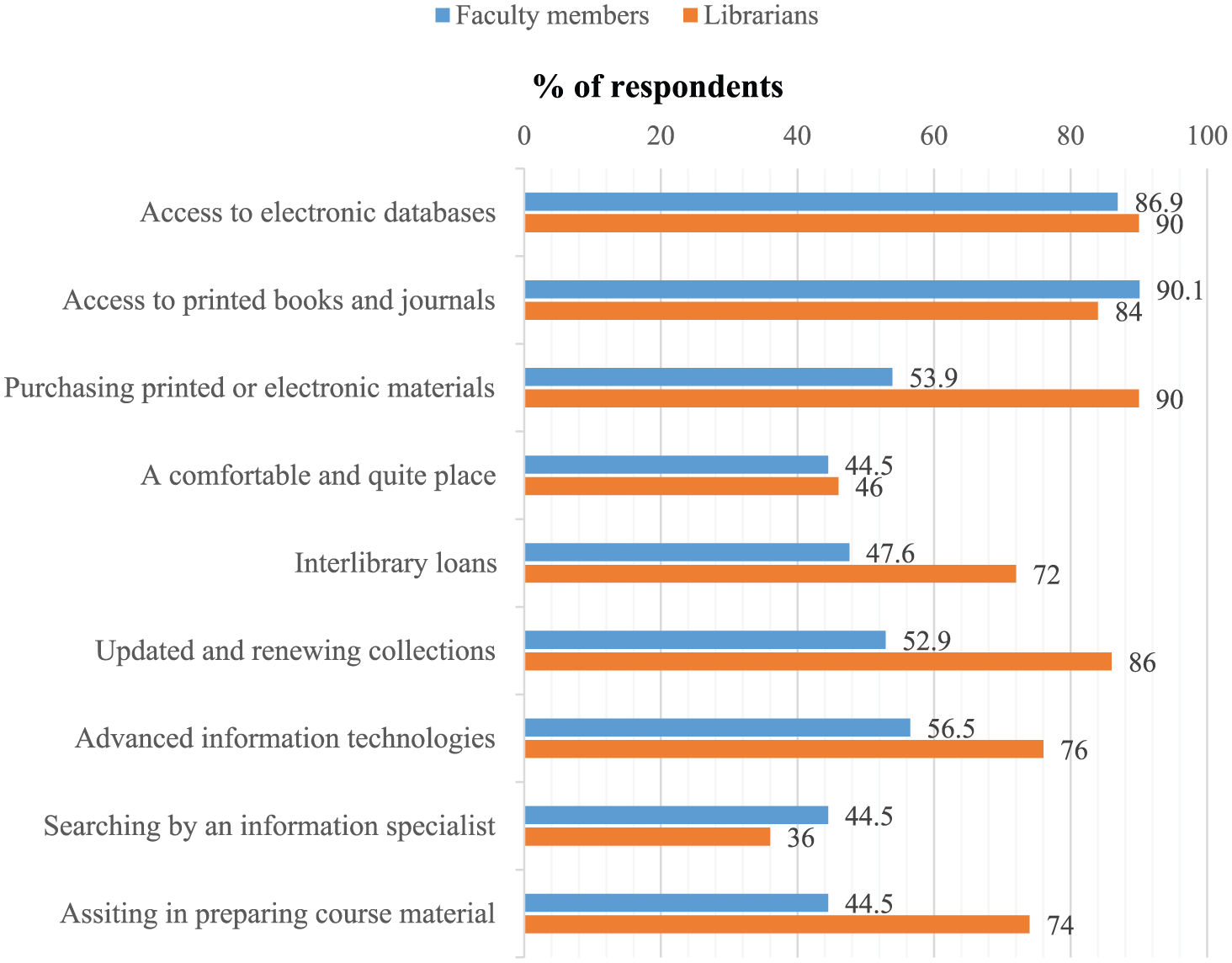
The role of academic libraries in academic teaching, as perceived by faculty members (n = 191) and librarians (n=50).
Similar to the research aspect, about 90% of respondents from both groups perceived providing access to electronic databases and to printed books and journals to be within the roles of the library with respect to teaching, and a lower (around 45%) but similar percentage of faculty members and librarians indicated that providing a quiet and comfortable place to work in is within the roles of the library. In contrast, a much higher percentage of librarians than faculty members indicated that purchasing printed or electronic materials, enabling interlibrary loans, maintaining updated and renewed collections, being advanced with respect to information technologies, and assisting in preparing course materials to be parts of the role of the library with respect to teaching. An important observation was that the component “searching for information by an information specialist” was perceived to be within the roles of the library by 44.5% of the faculty members and by 36.0% of the librarians in the teaching aspect, whereas 36.6% of the faculty members and 76.0% of the librarians perceived this component to be one of the roles of the library in the research aspect (see Figure 1). Thus, there appears to be a difference between the perceptions of faculty members and those of the librarians regarding the role of the information specialist, such that librarians see this service to apply more to research than to teaching, whereas faculty members perceive it in the opposite way.
The extent of using library resources
The faculty members were also asked about the extent to which they use the library. They reported very extensive use of such resources: more than 90% of the faculty members indicated that they frequently use the library databases – on a weekly and even daily basis – and more than 70% of the faculty members indicated that they search through the library catalog. Some faculty members claimed that they differentiate between the library and electronic resources, but most of them were aware of the fact that it is the library that selects the relevant subscriptions and pays for them, thus enabling the faculty members to obtain full-text articles that are often unavailable freely through the Internet. Some faculty members claimed that they begin their search through the library resources, while others indicated that they begin searching through external, free resources, and only then reach the full text through the library. There are indeed various means of searching for information, but, in general, the role of the library in providing accessibility to materials seems to be important and a contributing factor to faculty members, both for teaching and, to a greater extent, for research purposes. Faculty members explained that the electronic materials are rapidly and frequently updated, which helps them be constantly up to date. These findings indicate that, although some faculty members claim that they do not use the library and that the library does not meet their expectations in research and teaching, they do use the library and the materials to which it subscribes. When faculty members were asked about their use of electronic resources that are accessible as links in the websites of most academic libraries (in addition to the catalogs and databases)—such as reports on new books that the library posts, recommended websites that the library organizes according to field categories, electronic forms for faculty members, tutorials and guides that the library constructed, etc.—less than 40% of the faculty members answered that they indeed utilize these resources. Thus, it appears that these materials are either unknown or irrelevant to most faculty members. In addition, the extent of using electronic resources is much greater than using the physical library, as less than 30% of the faculty members indicated that they visit the library either once a week or once or twice a month, and less than 50% of those who visit the library often indicated that they visit the library for loaning or for reading professional literature.
Discussion
This study compares the perceptions of academic librarians and faculty members regarding the various roles of the modern library in research and in teaching. The most prominent finding of this study was that while the importance of some teaching- and research-related library services is perceived in a similar manner by both librarians and faculty members, there are significant differences in their perception of the importance of other services. In addition, considerable differences were found between the two groups regarding their perceptions of the role of the library in supporting research versus supporting teaching. The differences between the perceptions of librarians and faculty members, as highlighted in this study, may indicate a problem in the functioning of modern academic libraries and may prompt a tighter collaboration between faculty members and librarians, such that the latter can provide services that are more suitable for the users of the library.
In general, faculty members indicated that librarians need to better understand the important role of the library in both the teaching and research aspects and, accordingly, should support both aspects. Librarians repeatedly emphasized the importance of databases, electronic journals, and updated books as crucial factors in supporting research. The librarians appear to think that they are doing their best in answering faculty members’ needs, but the findings reported in this study indicate that the faculty members expect more from librarians, especially regarding their research needs. In addition, the extent to which the faculty members are aware of the library’s services needs to be examined; while librarians claim that they adequately answer faculty members’ needs, it is possible that they do so only for those faculty members who are aware of these services and who actively approach the librarians for such assistance. For instance, searching for information by an information specialist may either be a service of which most faculty members are unaware, or it may be a service of which faculty members are aware but do not think it should be part of the librarian’s role, or they think that the librarian is not capable of assisting them in this aspect. Regarding the updating and renewal of collections, it appears that the library purchases course materials based on the requirements of faculty members and on its own perception of needs, but the faculty members believe that this is insufficient for their research purposes. Faculty members are experts in their fields and are aware of recent advances in their fields, but they do not think that the library is sufficiently up-to-date. Furthermore, if librarians are not subject experts, they will have only superficial understanding of the literature.
Regarding interlibrary loans, while librarians perceive this service to be important and increasing the library’s collection, faculty members may perceive this service as a lack in the library’s collection, rather than an important role of the library. Interestingly, with respect to teaching purposes, 72% of the librarians – as compared with 46% of the faculty members – believe that interlibrary loans increase the collection; however, with respect to research purposes, 68% of the librarians and 60% of the faculty members believe that interlibrary loans are important and increase the collection. Thus, it seems that faculty members expect the library to fulfill their teaching needs and hold many of the materials required for their courses, while they think that they can rely on interlibrary loans for research purposes – which are greater and more diverse. Although one may claim that faculty members believe that purchasing, updating, and enriching the collection of their institution’s library is more important than relying on materials obtained from other libraries, interviews with the faculty members indicated that they understand that certain limitations (budgeting, physical space, etc.) hinder the library from holding all materials. Notwithstanding, when asked to disregard such considerations, faculty members seem to expect the library to contain most materials.
Our findings are similar to those reported in a study by RIN & CURL (Brown and Swan, 2007), which indicated that librarians generally believe that they can better accommodate the faculty members’ teaching needs (e.g. in purchasing books, ordering articles that faculty members want to recommend to students, recommending databases that faculty members want their students to be aware of, etc.) than to their research needs. Also in line with our findings, the study of Wusteman (2008) indicated that another aspect, which is important for examining the ability of librarians to cope with research and teaching needs, is technology usage. Thus, academic librarians perceive themselves as being able to support the virtual teaching environment, while they perceive their role in supporting the research environment as an entirely different one. They believe that research support requires them to be technology experts, because supporting the research environment is perceived as more difficult and professional than supporting teaching. These perceptions may stem from how students in departments of librarianship and information sciences are trained, as these departments appear to focus on teaching purposes and on helping students more than helping faculty members – and especially regarding research. In addition, it appears that the nature of work in academic libraries also directs workers toward assisting in teaching more than in research.
The current study also revealed differences in perception among faculty; these findings are consistent with those found in previous studies, which examined the perception of humanities researchers of the academic library and of the printed and electronic materials that it contains (Frade and Washburn, 2006; Rimmer et al., 2008). These studies attempted to examine the degree to which the library is important for the teaching and research aspects of faculty members and found that, although some claimed that the importance of the library as a physical location is decreasing and that it is losing its centrality in the campus, others believed that the library is still highly esteemed for the physical, tangible items that it possesses. Faculty members of the latter group thus value the accessibility to books and journals and perceive such an accessibility to be one of the most important roles of the library in both the teaching and research aspects, despite the general decrease in appreciation for these roles by researchers from the humanities. The findings reported in the current study also indicate that researchers from various fields in the humanities see the importance of and use printed materials; thus, they find the combination between printed and digital materials to be important. Perception, therefore, appears to depend on the individual faculty member, on his or her ability to cope with certain information technologies, and on his or her specific preferences, which often affect the perception toward the library more than faculty affiliation.
The interviews conducted in the framework of this study clearly indicate various differences between different types of libraries and institutions. These differences are concomitant with the notion of Searing and Greenlee (2011); that the attitude of faculty members toward the library is not unequivocal, and that it changes according to research field, the relationship between the faculty member and the library, the awareness of the faculty member of the services and capabilities of the library, and the degree to which the faculty member values the library and appreciates the ability of the librarians to assist. Thus, low awareness to the capabilities and services of the library results in a more distant relationship between the librarian and the faculty member and in a lower perception of the faculty members that the library can assist them with these needs. The perception of the faculty members is important because they are the resident population of the institutions, as opposed to the ever-changing student population. In addition, faculty members are “stakeholders” in the library, and they are greatly affected by it in various aspects. Therefore, it is important that the library understands its role, fulfills the needs of faculty members, and adapts itself to their requirements.
Notably, differences were occasionally found between the in-depth interviews and the answers to the anonymous questionnaires, indicating that people may answer differently in these two situations. This finding highlights the importance of a mixed-methods study design, which provides a wider image of the study population and more reliably reflects the reality in the field, both quantitatively and qualitatively. The current study, therefore, extends the existing theoretical knowledge-base to another country (Israel) and provides a reliable and realistic examination of the perceptions of social sciences and humanities faculty members, as well as of librarians in their institutions, of the academic library and its various roles. The findings of this study are similar to those of the study by Cooke et al. (2011), which indicates that a problem seems to exist in the way the liaison librarian’s role is perceived by the librarians themselves, by the library’ directors, and by the professors who educate LIS professionals.
Practically, this study indicates that librarians should be more aware of the faculty members’ expectations of them – particularly in the research aspect – and should develop skills to assist faculty members not only in teaching but also in research. Hence, library managers should encourage librarians to start considering qualifications in teaching (Delaney and Bates, 2015) and also get more involved in research aspects and to better understand that supporting research is important for the faculty members, emphasizing that they have the capabilities to support and assist faculty members in this aspect of their work. Such encouragement may alter the perceptions of librarians and convince them that supporting research is important for faculty members, can widen the library’s scope of activity, and can personally contribute to their professional development, provide another field of interest in their work, and increase the professional appreciation of the faculty members toward the librarians. In summary, as Delaney and Bates noted:
a holistic approach to academic library development is required – it is not only academic library staff that need to embrace change, but also those in all areas of the university: Persuading not just librarians but institutions that this is an agenda to be tackled and resolved will indeed ensure a bright dawning for the libraries of the future. (Law, 2009: 66, cited in Delaney and Bates, 2015: 44)
Some limitations of the study need to be acknowledged. The data were collected during 2013–2014 from participants in three academic institutions in Israel, in the departments of social sciences and humanities. A wider project, aiming to test the findings in a broader context, would be useful. A future study can collect newer data and examine to what extent a survey carried out on humanities and social sciences librarians and faculty members in Israel is generalizable to other departments and institutions.
Conclusions
The main finding of this study is that the contribution of library services to assisting faculty members in various aspects of their teaching and research needs is perceived as higher by librarians than by the faculty members. Faculty members appear to expect more from the library in various aspects of research support, and some faculty members also offered various ideas for improvement. Most faculty members believe that the library fulfills their teaching needs, but differences were found between different kinds of libraries regarding fulfilling the needs for research. From the librarians’ perspective, some were aware of and assisted in faculty members’ research needs, while others claimed that the library supports faculty members’ research mainly by purchasing databases and books, and facilitating interlibrary loans, and that the librarians should not be more involved than this in faculty members’ research. Thus, in reality, most libraries support the technical aspects of research, but they do not support other aspects, such as locating the information or providing more comprehensive information relevant for the faculty members’ research. It seems that the perception in libraries needs to change, and some of these changes should be made already in the preparatory stages of the profession. Despite financial difficulties, lack of manpower, reduced activity hours, and insufficient support by the management – which characterize the reality of many libraries today – it seems that libraries can better support the needs of the faculty. In addition, as some faculty members voiced, it is possible for some librarians to maintain continuous and close collaborations with faculty members, such that these librarians will mediate between the faculty members and the library. Although this idea is already practiced in some institutions worldwide (including in Israel), it is typically focused on teaching aspects, while often neglecting faculty members’ research needs.
Footnotes
Declaration of Conflicting Interests
The author(s) declared no potential conflicts of interest with respect to the research, authorship, and/or publication of this article.
Funding
The author(s) received no financial support for the research, authorship, and/or publication of this article.