



Abstract
Despite the widespread use of social media by students and their increased use in higher education, very little empirical evidence is available concerning the prevalence of use among academic librarians. The objectives of this study are: a) to identify the prevalence of social media used in Malaysian academic libraries; b) to examine the reasons for creating a social media presence among academic libraries; and c) to understand the obstacles to social media participation among academic librarians. Data were gathered via three focus study groups with 22 librarians from three research-intensive universities in Kuala Lumpur, Malaysia. The results indicated that at least four types of social media are deployed in libraries to reach out to the users: blogs, multimedia sharing sites, social bookmarking and social networking sites (SNS). Facebook, Blog, Delicious, YouTube and Twitter are the tools mainly adopted by these libraries. The motives for librarians to use social media were to promote library services, manage organizational knowledge and receiving instant feedback from users. Workflow obstacles, technology obstacles, organizational obstacles and personal obstacles deter librarians from participating in social media. This study provides experiential evidence that Malaysian academic librarians are not very serious in engaging themselves with social media. Library managements need to provide support to mobilize librarians into a more active and participatory role in creating social media presence.
Librarians need to understand how to best harness social media technologies to enhance library service.
Introduction
Blogs, wikis and online social networking sites (SNS) such as Facebook and Twitter, services known as social media, have become increasingly popular and widely-used in the library and information services setting. Librarians have responded accordingly by applying some of these tools in varying degrees to provide library services. Kaplan and Haenlein (2010: 61) defined social media as “a group of Internet-based applications that build on the ideological and technological foundations of Web 2.0, and that allow the creation and exchange of user-generated content”. They categorized social media into six types: collaborative projects (e.g. Wikipedia), blogs and microblogs (e.g. Twitter), content communities (e.g. YouTube, Flicker), SNS (e.g. Facebook), virtual game worlds (e.g. high school library game and the librarian free online game) and virtual social worlds (e.g. Second Life). Such technologies have been penetrating libraries since 2006, as reported by Maness (2006), who found that librarians are only beginning to acknowledge and write about social media, primarily in the form of weblogs. Later researchers mostly wrote about the application of Web 2.0 in libraries and described the potential use of these technologies in library services (Boeninger, 2006; Fichter, 2006; Bradley, 2007). Although Miller (2006) argued that many web tools are “disruptive” and fall outside the parameters of library and information services, recently, the use of social media in university libraries has become widespread (Linh, 2008; Kim and Abbas, 2010; Si et al., 2011; Jahan and Ahmed, 2012). Research shows that some academic librarians believe that the digital spaces created by social media should be fully exploited (Liu, 2008; Harinarayana and Raju, 2010). A few researchers have looked at the challenges and hindrances to applying social media in academic libraries (Arif and Mahmood, 2012; Chu and Du, 2012).
In Malaysia, as library social media emerged in 2008 (Edzan, 2010), many early-adopters began to experiment with technologies such as RSS feeds, wikis, chat tools, podcasting, video-sharing and bookmarking (Abdul Aziz et al., 2011). Since then, short surveys have been conducted in jurisdictions that describe how these tools are used in academic libraries (Mansor and Idris, 2010; Ayu and Abrizah 2011). Academic librarians regularly report on their use of social media at association meetings, seminal works and in library newsletters, but no empirical study has yet been conducted that relates to librarian’s motivations and deterrents in creating social media presence in Malaysia. There is a need to establish an overall view of innovative uses of social media in Malaysian academic libraries for capturing best practices and to apply that information to develop library services using social media frameworks. Such services would be intended to reach out to faculty, staff and students. Given the newness of social media applications in Malaysia, this study is focused on investigating and addressing the knowledge gap.
Literature review
There has been a considerable amount of literature written in recent years about social media and their application in different organizations. A review of literature on the usage of social media in library and information services is confined to three phases: the early phase when researchers reported on the type of social media tools used in libraries; the intermediary phase which highlighted how libraries used the social media tools; and the late phase, when researchers began to focus on the issues and challenges of using these tools in libraries.
The first phase began in 2005 when Paul Miller described what Web 2.0 and social media are and how these tools could be used in the library environment. Miller (2005) clarified that Web 2.0 or Library 2.0 offers libraries the opportunity to serve users better by reaching out beyond their walls and websites with choices to view online, borrow locally, request from afar, buy or sell as appropriate to their needs and circumstances. One year later, Maness (2006) described the four conceptual underpinnings to Library 2.0, which were: a) user-centered; b) multi-media experience; c) socially rich; and d) communally innovative. He also explained how Web 2.0 technologies such as synchronous messaging, blogs, wikis, social networks, tagging, RSS feeds, and mash-ups might revolutionize library services. By using Instant Messaging (IM), for instance, librarians and users could communicate synchronously in chat reference services. Blogs could help the library in collection development, and wikis could be a new form of group study room. SNS could help libraries not only to interact with users, but also to share and exchange resources dynamically. RSS could help users to have one library page that syndicates all the library content and their research interest. Habib (2006) proposed a methodological framework for employing Web 2.0 tools in academic libraries to interact with library users. Instead of focusing on an exact physical task, this model looks at interactions from a broader perspective.
The second phase of literature focused on the usage of different social media applications in different library contexts. Foley (2002) examined the potential usage of Instant Messaging (IM) as a digital reference service in academic libraries, through which the library could reach remote users across the campus and around the world. After 2005, there have been many empirical studies; Boeninger (2006) and Fichter (2006) in particular, discussed the applications of Wikis in libraries as a searchable and well-organized library resource that needs librarians’ contributions for creating the content. Barsky and Purdon (2006) discussed the use of SNS in libraries with exemplary notes on a few SNS. They believed that libraries could reach their users beyond library walls by sharing knowledge in the form of discussion groups and communities in SNS. Xu (2007) surveyed 82 academic libraries of New York State and Long Island in the USA. Her study found that blogs, IM and RSS were the main social media applications which have been used extensively compared to social bookmarking, SNS and podcasts. Liu (2008) proposed a conceptual model of a Web 2.0 academic library. The study found that IM has been employed in almost all 111 web sites of the Association of Research Libraries (ARL). On the other hand, blogs were accepted among school library web sites according to the results from a study undertaken by Valenza (2007). Han (2009) explored the condition of Web 2.0 technology employed in Chinese university libraries. He found that more than two-thirds of the top 38 Chinese university libraries applied one or more social media tools through the basic functions of their web sites. Among six social media tools, catalog 2.0 and RSS were the most common, while IM, blogs, SNS and wikis were less frequent. Another empirical study conducted by Linh (2008) showed that at least two-thirds of Australasian university libraries deployed one or more Web 2.0 technologies. This survey reported that RSS was the most widely applied technology and IM the least used. A recent study by Harinarayana and Raju (2010) explored the latest trends in the application of Web 2.0 and library 2.0 as exemplified through the web sites of 100 top universities around the world. They determined that 35 university libraries use RSS feeds for the dissemination of library news, events and announcements and 12 libraries use RSS for alerts about the arrival of new titles. Fifteen university libraries provided blog space for users as a promotional library mechanism.
Recent literature reported on how libraries benefit from social media and using these tools in their services. Papers that emerged between 2008 and 2012 explored the attitudes and perceptions of social media users (Ram and Kataria, 2011; Jahan and Ahmed, 2012). These perceptions were mostly gathered from librarians' or library users’ points of view. Librarians also mentioned the obstacles or motivations to the use of social media. In 2008, Secker explored the use of Facebook as a tool for libraries and librarians and indicated that librarians are joining social media for purely social reasons. However, its use could overlap into the library profession. He found that unfamiliarity with using social media applications in libraries was the main reason which deterred librarians from joining Facebook. The other concern of librarians in the early days was that of considering Facebook as only a fun and topical tool. How to use Facebook appropriately was another concern. Privacy and security issues, as well as staff development, were also highlighted as hindrances (Secker, 2008). A study by Chawner (2008) in New Zealand found that educational level and employment status have influenced the application of social media and Web 2.0 technology among librarians. Arif and Mahmood explored the reasons that hinder the use of social media tools among Pakistani librarians. The results showed that lack of computer literacy and of computers and Internet facilities were the major obstacles to social media application (Arif and Mahmood, 2012). Chu and Du (2012) explored the factors that influence the application of SNS in 140 Asian, North American and Europe libraries, and reported that Twitter and Facebook were the most commonly adopted tools and that library staff have a positive attitude towards the application of SNS. Conversely, the uncertainty of staff and the limited participation of users were obstacles to using these tools. Another recent study (Tyagi, 2012) was conducted among librarians and library professionals in Western Uttar Pradesh and showed that librarians’ skills in Internet usage influence the adoption of social media. The researcher also emphasized the need for a comprehensive study to find out the factors which affect social media participation among librarians.
Objectives and methods
The objectives of this study are as follows:
to identify which social media tools are preferred among academic libraries in Malaysia to examine the reasons of creating a social media presence among academic libraries to understand the obstacles to social media participation among academic librarians.
The following research questions formally operationalize the research objectives Which social media tools are used in Malaysian academic libraries? Why do academic librarians create social media presence using these tools? What are the conditions that deter the academic librarians from participating in social media?
In order to understand why librarians in three research intensive universities in Malaysia use social media in library services and the obstacles that prevent them from using these tools, data were gathered via focus group discussions. Participants in a focus group would have enough space to share their experiences and present their opinions on the topics discussed (Stringer, 2007). This discussion would give researchers the chance to end up with more convincing accounts of what the study participants think (Bryman, 2012). Therefore, a formal invitation was sent to each of the participants by e-mail, informing them of the basic principles of the study, i.e.
the aim of the focus group is not to measure the knowledge of the participants the information of the participants is regarded as confidential there are stipends (in the form of thumb drives) and refreshments during and at the end of the focus group sessions the insights and ideas of the participants are regarded as important.
The focus group discussions were conducted from July to October 2012 by recruiting 22 librarians in three groups from three research-intensive universities in the Klang Valley, Kuala Lumpur. To ensure appropriate precautions to protect the confidentiality of the research participants, the names of these universities from which identities could be inferred are kept anonymous. These universities were chosen because they all aim to be regional leaders in research and academic excellence. They are among the top universities in Malaysia and top 200 universities in Asia. The three focus groups consisted of 5 to 10 librarians each. For each group this number was considered enough to reach theoretical saturation (Krueger, 1990). Participants were from different library departments and were purposively sampled based on the following criteria:
they sat in the committee of their respective library website they were either heads of departments or librarians in charge of creating content and updating social media applications in the sampled libraries they considered themselves to be active users in at least one social media tool they expressed a willingness to take part in the study.
Each focus group lasted approximately two hours, during which all discussions were tape (audio) recorded.
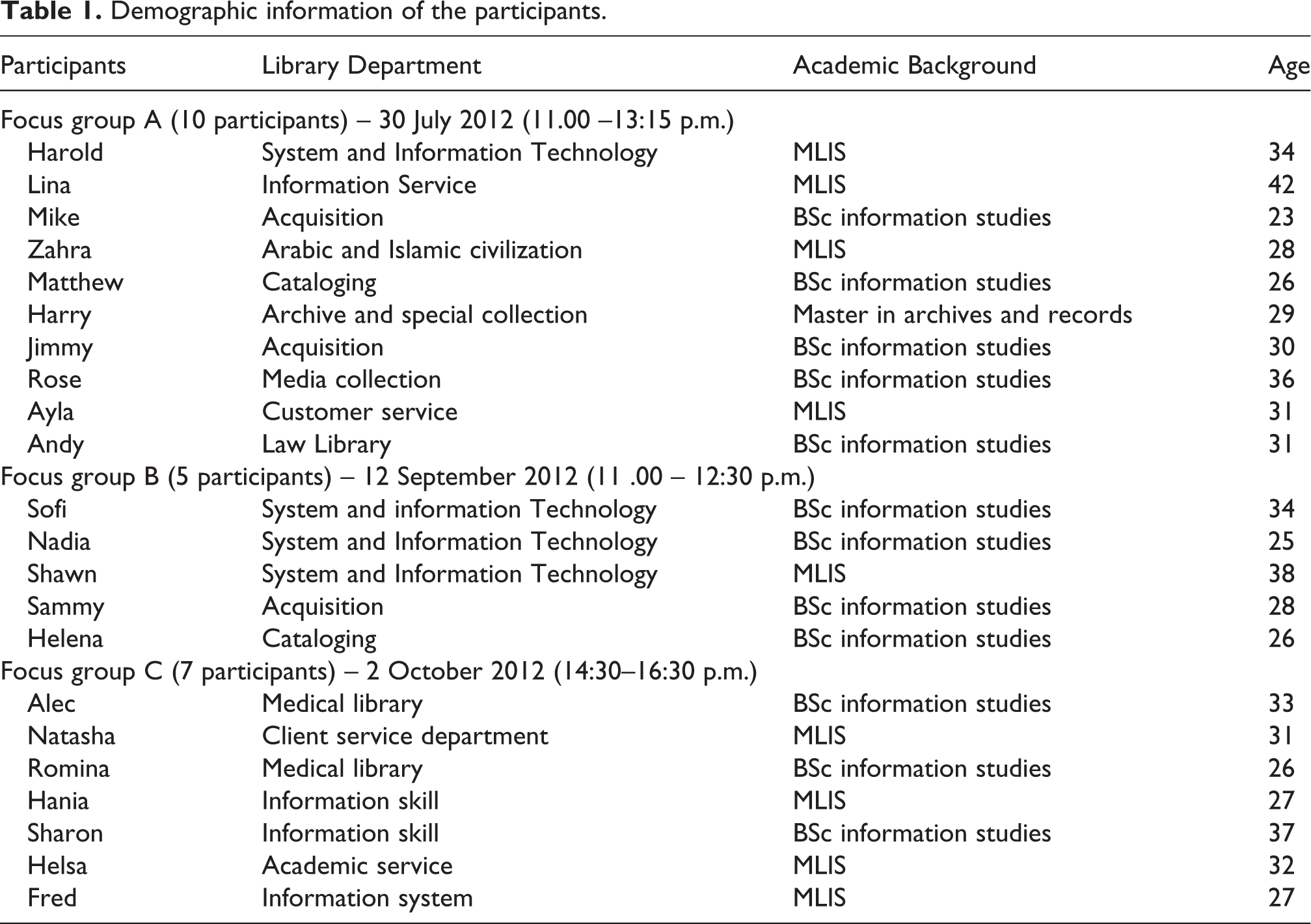
Table 1 presents the demographic information of the participants in each group. It should be noted that the names chosen are not the real names of participants and the demographic information could not be used to identify individuals. However, these names were chosen to reflect the gender of the participants.
Demographic information of the participants.
Findings and discussion
Three research questions were posed in order to meet the research objectives (see Table 2 for summary):
Research Question 1: Which social media tools are used in Malaysian academic libraries?

The types of social media and how they are used in the sampled academic libraries do not differ greatly. Results indicate that there are at least three types of social media applications used by the librarians, namely, blogs and microblogging, content communities, and SNS. Social networks remained the most popular – Facebook is utilized by all the academic libraries. Most of the librarians sampled believe that Facebook could be a very good portal for social interaction with library users. While there was a growth in the employment of Facebook among the librarians, interest in Twitter and YouTube was low, as only one library is currently using these tools. It is clear from the findings that libraries neglect one type of social media in favor of other tools that better suited their aims and needs. The libraries are not using photo-sharing tools and virtual worlds. None of them opts to modify customizable social media applications to provide greater access to existing web-based library resources, such as their OPACs and digital libraries.
Research Question 2: Why do academic librarians create social media presence using these tools?
For this question, the librarians were asked why they use social media in their actual library work. Drawing from the discussion there is a fact that social media tools have become extremely popular; academic librarians have started to explore how this technology can be used in providing library services. Participants provided various reasons and the most commonly cited was “to promote library services” (8 responses) and “to interact synchronously” (5 responses).
While analyzing their responses, it was clear that what motivated them is “what” they are doing in social media, but not “why” they are using it. The only reason “why” was provided by Zahra who remarked “[we need] to be nearer to students because that is the trend now”. According to Zahra, being aware of and following the trend in using social media could fulfil her need to know “which [library] collections and services that are successful and useful and why”. Bradley (2007) also wrote that librarians are really concerned about following the trend and applying the latest technology to cater to users’ needs. Table 3 presents the participants’ responses on what they are doing in social media (when asked the reasons why) and examples of narrative statements to illustrate their social media activities.
Academic librarians’ responses on what they are doing in social media.
The responses obtained (from Table 3) are illustrated in Figure 1 in the form of a honeycomb framework of seven social media building blocks. The origin of this framework can be attributed to the work of Kietzmann et al. (2011), that defines social media by using seven functional building blocks: Identity, Conversations, Sharing, Presence, Relationships, Reputation, and Groups. The honeycomb framework of seven functional building blocks created in this study comprises the following reasons for social media use that reflect a specific facet of the social media user experience, as highlighted by the participants: Presence, Synchronousity, Information Needs, Groups, Conversations, Relationship, and Current Awareness.
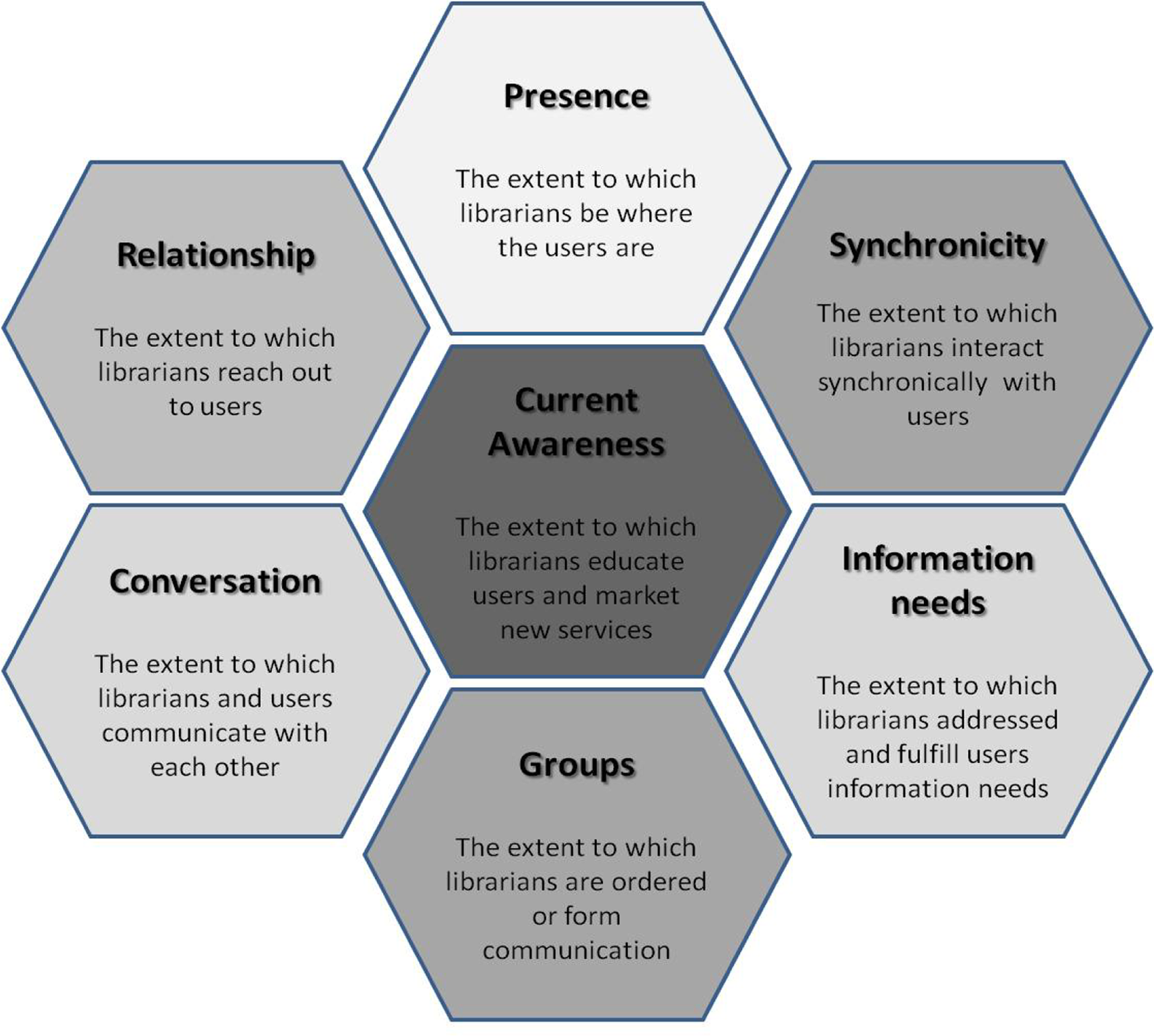
The framework building block Presence represents the extent to which librarians ‘be where the users are’ in a social media setting. It includes knowing if library users are available and accessible. The Relationships block represents the extent to which librarians reach out to and establish relationships with the users. The Conversation block of the framework symbolizes the extent to which librarians communicate with users in a social media setting. The Group block defines the extent to which librarians are organized or form communication among themselves in social media platforms. Another block labelled ‘Information Needs’ shows the extent to which librarians addressed and fulfilled users’ information needs, while the Synchronousity block corresponds to the extent to which librarians interact in real time with their users. The last block in this honeycomb framework is Current Awareness, which represents the extent to which librarians educate users and market new services by using social media. The intensity of each block illustrates the number of responses from participants. For example, Current Awareness, which is shaded the darkest, is frequently cited by the sampled librarians as the motivation for their library to create social media presence. However, Presence, Information Needs and Conversation, which are much less cited by the librarians, are lightly shaded in the honeycomb framework.
Research Question 3: What are the conditions that deter academic librarians from participating in social media?
To discover the reasons that deter librarians from using social media in their actual library work, the participants were asked the following questions “Why do you think librarians are not participating in social media? What may prevent them from using these tools?” A total of six participants admitted not creating enough presence in their library social media. This was the result of two focus groups (A and B). They said that there is a “lack of participation among library users” (Lina, Information Services Dept.)”. Both Helena and Sofi agreed on the need for “more contribution among librarians”. This was also found in a recent study by Chu and Du (2012), who emphasized that since social media is all about participation and sharing, the engagement of librarians and users is an important factor for successful implementation. On the other hand, librarians in Group C, who had the most participation in social media compared to the other two groups, mentioned that the level of authority is a considerable deterrent in maximizing library social media presence. They mentioned that only the authorized or more senior librarians could decide what messages to post and they believed that these librarians are more knowledgeable to better handle students’ inquires.
This study has identified four main themes regarding the issues in creating a social media presence among librarians, namely: workflow obstacles, technology obstacles, organizational obstacles and personal obstacles.
Workflow obstacles: Time, level of authority and job function
Participants in this study are from different library departments and updating social media is not their core function. As such it was apparent that one of the reasons not to use these tools was that they have limited time to do so. Librarians reported not having the time to learn, plan, create and maintain their library social media. For example Rose (Media Collection) openly confessed that “the main problem is that I don’t have enough time to keep it [Facebook] updated.” Shawn (System and Information Technology) echoed this by indicating that he does not have enough time to “look at social media”. Both Sofi and Jimmy agreed that “using social media needs time and effort because once you start using it, you will need see it again”. Jimmy remarked further that “even while you eat, you will be busy with your iPad, laptop or cellphone checking your Facebook”.
Time is a constant issue in maintaining library social media. Three librarians in group C indicated this obstacle. Natasha (Client and Service) expressed her view that initiating library social media presence is not an issue but “the main problem is keeping the information updated, I need to commit more time”. The participants in general agreed that there is a need to dedicate one person or department to be responsible for keeping the library social media up-to-date. Harold (System and Information Technology) emphasized the importance of having “one person to keep the library social media updated, because it is not easy, need someone who is committed to update it”. “Keeping these tools updated is a tiring task” lamented Shawn (System and Information Technology). Rose and Sofi reported that dedicating time for social media is an issue, as they have to maintain the other systems too. “We have pages for our department to promote our services but the main problem for me is, I don’t have enough time to keep it updated” (Rose, Media Collection Dept.). “I am the one who maintains Twitter but I have to maintain other systems too, therefore, it is really, really difficult for me to keep Twitter updated” (Sofi, System and Information Technology). Librarians in this study seemed to regard their professional and library functions as separate from social media and this is the main reason why they are not serious in updating their social media presence.
Participants in focus group C, whose library is using different kinds of social media tools, reported that the level of authority and active participation of their chief librarian and senior library managers in social media tend to be a barrier for other librarians to participate. Fred (Information Systems) indicated that he posted messages on social media only when “there is a problem with our library database or Internet connection”, and left answering questions that are not related to his job to the “KP [chief librarian] to do [sic] or my manager’s directive asking me to do it”. Sharon (Information Skills) expressed her opinion in this way: “the person who gives this kind of answer must be a person who is really authorized, if our KP is not around maybe our TKP [deputy] should answer, when a question relates to rules and regulations there should be one person of higher rank [position] to answer”. Natasha (Client Service) agreed and said “Yes, they [chief librarian and the deputy] know all the answers because they are familiar with all policies and they are active [in social media]”. Hania (Information Skills) appreciated when her chief librarian also took the responsibility for social media maintenance and reported “currently [the use of] our Facebook page is very encouraging, thanks to our KP, she is very active and she has interest in social media”.
This study also found that librarians’ participation in social media is influenced by their job function and is departmentally-based. For example, Alec, who previously worked in the Information Systems Department, was once an active administrator of his library’s Facebook Page. He explained: “Now that I am posted at the Medical Library, I am no longer the administrator, I don’t post messages, not anymore.” (Alec, Medical Library). Hania (Information Skills) who was very enthusiastic about social media when she was attached to the Information Systems Department said “[now], I am not an admin of social media because I moved to other department. I haven’t checked ours [social media tools] for a long time”. Similar results were also found by Chawner (2008) who highlighted institutional barriers as a main factor why librarians in New Zealand did not make enough presence in social media. The librarians in Chawner’s study expressed that they were not using Web 2.0 technology tools as much as they wanted because they do not have the opportunity to explore and experiment with it in their workplace even though they know these technologies bring new opportunities to enhance library services.
Technology obstacles: Familiarity with new and existing technology
Technology obstacles faced by the librarians that participated in this study are not associated with technical infrastructure, lack of technical knowledge or technical support. Librarians believed that in order to use social media in their daily jobs, they need to be familiar and acquainted with the technology first. Harold (System and Information Technology) acknowledged that most of his colleagues are in the stage of experimenting with these tools. Zahra (Arabic and Islamic Civilization) and Ayla (Customer Service) wanted to self-explore these tools before they apply them for library services. “I think using social media is related to our understanding and knowledge, personally I would like to self-explore these tools first” (Zahra). “I am not very familiar about these tools that is why I could not apply them in my daily job” (Ayla). Jimmy (Acquisition) hesitated to use social media before familiarizing himself with the technology, stating, “We have to promote these tools but before that there is a need to explore them and be familiar with the application”. Secker (2008) found that unfamiliarity with social media was a reason for librarians to not adopt the technology. He suggested that librarians themselves self-explore or be trained to use social media. Helena’s (Cataloging) remarks seemed to validate the importance of familiarity with new technology for a successful implementation: “I attend [sic] one course when I was studying corporate commercial and from that class I became familiar with social media and after that I start [sic] using it widely to communicate”.
As technology gets more advanced, libraries have more choices of systems and applications to be used to enhance their services and there should be strategies for librarians to stay up-to-date and current. However, for the librarians in this study, changing to and adopting new technologies is not very easy. Those who currently have specific library applications in place indicated the non-relevance of social media for their job functions. “We have other form of online services, for example the reader advisor system” (Lina, Information Services). Mike (Acquisition) who consistently said “we have our own system”, expressed his preference to receive students’ inquiries for new books through a system developed in-house.
On the other hand, Helena felt that the users’ familiarity with the library’s existing technology was the reason for the library not to fully apply social media tools in library services. “Student [sic] still communicate with us through e-mails, they rarely post their request for books in social media.” (Helena, Cataloging). Likewise, Natasha addressed the difference between the types of enquiries they obtained from social media and the existing library technology. “Through Pendeta OPAC [the online library catalog], students asked us about their library account but in Facebook they will ask us about things like library opening hours and so on (Natasha, Client Service)”.
However, Jimmy and Mike (both from Acquisition) opined that social media is an alternative technology for their current online services. They expressed it in this way: “Social media is an option, we communicate heavily via e-mail and other online forms”. Nadia (System and Information Technology) supported her colleagues’ opinion in this way: “Facebook is only a substitute, we have our website so maybe in the near future it can become the core technology to provide our library services”.
Organizational obstacles: Social media policy and personnel
The librarians in this study felt that their organizational rules and procedures are a deterrent in creating a social media presence. Librarians talked about restrictions in the use of social media as a part of the policies of their organization. Sofi (System and Information Technology) said “I think it is not the priority of our university to use social media. Facebook is blocked from 8.00 to 11.00 am; we can only use it after 2 pm.” Harold, who is from the same department, also noticed “We want to use Facebook during office hours, but it depends on the top management of the university, some universities regard Facebook and other social media as something against the rules and regulations, they even block it.” Helena believed that the issue of prohibiting social media during working hours relates to the technical problem and Internet speed at her institution. “The bandwidth of Internet in the morning cannot bear the high use of social media therefore they ban it in the morning I think (Helena, Cataloging).
Another organizational obstacle expressed by the librarians is the absence of a policy on library social media personnel. Fred said, “There is a need to have [sic] written policy for using social media that details who should update and know about our [i.e. the librarians] limits of posting and sharing information” (Fred, Information Systems). Moreover, a consistent response from the participants is that the library social media needs a committed person who is always online and keeps the users as well as colleagues updated. The librarians in this study felt the need to have dedicated library staff officially appointed to perform this task. Since new ideas are always “top-down” in his library setting, the appointment of the social media librarian should be made by the library management, as remarked by Andy: “We need to have a group of people appointed to update the social media”. Harold, who agreed with Andy’s statement said, “Yes, we have the committee but the committee did not appoint a person for social media”. The need to dedicate a person to take care of the library social media was also echoed in the next theme of social media obstacles.
Personal obstacles: language, scholarly content and commitment
Research revealed that personality characteristics as well as computer expertise, motivation, importance and capacity towards studying and integrating different applications of social media in the future influences librarians' use of Web 2.0 and social media (Chu and Meulemans, 2008; Arif and Mahmood, 2012; Chu and Du, 2012). This study identified that personal obstacles faced by the librarians in creating social media presence could be divided into three subthemes: language, scholarship and commitment.
Language may be a personal obstacle in social media participation as observed by a few participants. Helena indicated that posting in two languages is a chore, “I tried to post one status in English and one in Malay [the national language] so the one in Malay, students respond in Malay but international students will comment in English, so you know, I have to write in both languages, it takes your time (Helena, Cataloging). Both Sofi (Information System) and Romina (Medical Library) expressed that communicating in both languages may be an issue as they should translate statements into English before they post some status or attend to students’ enquiries. “When I want to post in English I have to think first and put the words nicely, accurate and correct form of English”. Romina (Medical Library). Sofi (Information System) said “one more thing is that [when] we use English language, we get less response from Malay students because they have to think first before they write something but once we use Malay language there would be more responses” As a result, this study finds that the language barrier has been remarked as deterrent to the use of social media in library projects.
Scholarly content seems to be another personal obstacle to actively participating in library social media faced by the librarians in this study. Most of the librarians in group A considered social media content very seriously, they felt that it should carry digital content worthy of scholarly activities. Librarians felt that not having valuable pieces of information to communicate to the library users may hold them back from posting messages as they opined that information posted in social media platforms should be meaningful in order to increase participation of library users. “I think when we want to use social media we need to give something [information] which is very valuable for our users, followers or friends” (Zay, Arabic and Islamic Civilization). “We need to have information which attracts our users, something valuable for them to know” (Harold, System and Information Technology). Hania (Information Skills) recounted that she would post a message or status in social media only when she found it appropriate and of value for all users: “I would pick and choose what to post and it is not easy you know because we want to make sure that other people benefit from what we know.” Fred (System and Information Technology) added “posting in a formal way is difficult and there is a need to be aware about many things and be able to write nicely about it.” Sharon continued “you see, the content comes from a library as an organization, the answers you present to the users must be valid, scholarly kind of information because it represents your library” (Sharon, Information Skills).
Participants also expressed their personal differences in creating a social media presence. Commitment to social media presence is a major issue expressed by many librarians in this study. Sammy (Acquisition), who seemed to be less comfortable with social media, felt that it is not a priority for his library since “the mission of the library organization is not to attract more users, and we will still have our users even when social media is not used, we are not committed to use it”. Shawn (System and Information Technology) felt that social media in Malaysian culture is considered as a “personal thing and not professional”.“ I don't know why but we don't use any blog or Twitter we are more interested in FB [Facebook] because it become more popular in Malaysia”. However he also emphasized that libraries can take the social media ideas that fit into their existing culture and strategy. His thoughts are consistent with those librarians in Secker’s (2008) study who indicated that social media is purely used for social reasons, however its use could overlap into the library profession.
Four librarians in group C (Fred, Romina, Hania and Alec) agreed that having high commitment is important to ensure a successful social media presence among librarians. They believed that librarians who do not have strong commitment and passion could not continuously and successfully create a social media presence even at the personal level. “You think because we have an account on Facebook or Twitter, and having many users [who are] friends [with] us, that is enough to bring social media success. We don’t have a committed person to populate and maintain our presence with content”. (Helsa, Academic Service). These findings clearly indicated that some librarians regard non-commitment as an obstacle to creating social media presence.
Conclusions
Social media, which has been used interchangeably with the term Web 2.0, has brought along with it an important phenomenon in library and information services. Literature as well as findings from this study highlight that librarians need to embrace it to remain relevant in the information age. This study presented an overview of social media presence in Malaysian academic libraries in three research-intensive universities probed by focus groups discussing the “social media tools preferred among academic libraries, the reasons librarians use social media in library services and, the obstacles librarians face from maximum exploitation of these tools”. The results of this study showed that librarians in Malaysia have positive perceptions on the usefulness of social media in library services. They are also aware of the advantages and potentials of applying social media tools in academic libraries and they confessed that there is a need to use these technologies in their profession aggressively.
Librarians also believed that social media tools are suitable not only to communicate with users but also to facilitate the interaction of librarians with each other by creating librarian groups. The results on the motivations for social media adoption in libraries are presented in a form of a honeycomb framework of seven functional building blocks namely: Synchronousity, Information Needs, Groups, Conversations, Relationship and Current Awareness.
The study further concludes that the use of social media is challenged by workflow obstacles, technology obstacles, organizational obstacles and personal obstacles, which if properly addressed will improve the use of social media in library services. Librarians find themselves facing obstacles in social media uptake, and among the deterrents which prevent them from social media participation are: having other forms of technology, organizational workflow of the library, absence of social media policy and dedicated personnel, language barriers and non-commitment of library staff. These results were also found by Chu and Due in 2010 when they explored the challenges and possibilities of social media application in top universities. Other studies in social media application in libraries also found similar results (Barsky and Purdon, 2006; Harinarayana and Raju, 2010). The main challenges and difficulties for librarians in using these tools – lack of participation, limited time and unfamiliarity – were affirmed in the results of previous studies (Secker, 2008; Creighton, 2010; Chu and Du, 2012).
However, the overall conclusion from the results is clear that while librarians in this study were overwhelmingly aware of social media tools in library services, they seemed to be not very serious in social media uptake. This study highlighted that the underlying problem for librarians to use social media is the lack of a practice framework or good practices in the context of library and information services. In all focus groups, it was also clear that the librarians’ gratification from using social media tools was related to their obligation and their duty, not personal satisfaction. Personal initiative and desire could positively influence librarians’ uptake of social media to get library jobs done. In the absence of supporting theories and strategic planning for library social media presence, it is unlikely that academic librarians will ever be able to obtain the type of support they need to integrate social media effectively. Given the hype around social media and Web 2.0 technologies, and the speed of change in the area, it can be confusing for academic librarians to decide how to apply social media in library services to address information challenges and problems.
Although this study was based on purposive sampling and small sample size, it has been able to illuminate the questions of interest in creating social media presence in academic libraries, and help identify theoretically provocative issues in social media uptake that merit further exploration. A further study will make progress towards understanding why and how social media can be used to enhance university library services by examining the links between social media features and variables that might influence librarians’ motivation to use them. It is becoming a known fact that university students are among the most computer-savvy and ‘connected’ users of social media technologies, especially social networking tools (Chu and Meulemans, 2008). Using these technologies has become so pervasive in the lives of this young generation that it has become a natural extension of them. These students will simply expect that technologies such as Facebook, Twitter, Flickr, wikis, and RSS will be an integral part of their learning and seeking information. Therefore, it is important that librarians understand how to best harness these technologies to enhance library service practices with the critical, creative, collaborative, and communicative capabilities that are required for their professions.