



Abstract
Attempts have been made to explore the impact of Information Communication Technology (ICT) on the entire gamut of the library and information sector and to conceptualise the transformation of conventional libraries into Web 2.0, Library 2.0 and Librarian 2.0, which will bring a changing scenario to the information industry. In the last few years, discussion and debate about the ‘core competencies’ needed by Librarian 2.0 have appeared in the academic environment. This investigation aims to identify the key skills, knowledge and attributes required by Librarian 2.0 in academic libraries in Kuwait. Twenty librarians from four academic libraries in Kuwait participated in a series of focus groups. The five themes discussed as being crucial to Librarian 2.0 include: communication, teamwork, technology, learning and education, and personal traits. This article provides a detailed discussion of each of these themes. The results show that in the age of Web 2.0 librarians in Kuwait academic libraries need more knowledge and awareness of communication and teamwork skills. Furthermore, they need to shift their attitude towards the concept of Librarian 2.0 by developing a clear understanding of the key factors that must be present in any Librarian 2.0. The study findings contribute to providing a framework towards the concept of Librarian 2.0 in academic libraries in the State of Kuwait. This framework will contribute to improving their awareness of and attitude to this topic in the future.
In the Web 2.0 world, academic librarians need knowledge about communication and teamwork skills.
Introduction
Major progress has taken place in the field of ICT in academic libraries. The advantages offered by ICT in this sector have led most academic libraries to provide ICT services in order to meet users’ needs (Woodward, 2009). The ICT approach used in academic libraries attempts to deliver numerous applications such as wide-area network applications, local area networks, online information services, online databases, library databases, CD-ROMs, online access catalogues, retrieval networks, digital online archives, mainframe computers, microcomputer labs, and other digital content services. Duan (2005) confirmed that this phenomenon has broken the bounds of cost, time and distance, launching a new era of library and information services.
The unstoppable wave of technological changes and the use of the Internet in academic libraries require highly qualified librarians who are able to deal with the massive developments and the new variables, including, for example, the emergence of Web 2.0 and its related Library 2.0 in the field of library services. Gutsche (2010: 30) confirmed that “everyone who works in a library must stay nimble and ready to receive new knowledge and skills”. Collaboration, creativity, conversation, community and control are the main elements which consolidate library and librarian capability when adopting Web 2.0 (Hicks and Graber, 2010). Web 2.0 means using networks socially between groups or individuals. Examples include a wide range of social networks which enable people to participate, such as wikis and blogging (Holmberg et al., 2009). O’Reilly (2007) characterised the new applications that allow web users, freely and publicly, as ‘knowledge debaters’.
Library 2.0 and Librarian 2.0
Since the establishment of the library, it has played a fundamental role in integrating library users with knowledge. This takes place when it enables its users to participate, serve and interact, through library activities and information. Library 2.0 is a change in the “interaction between users and libraries in a new culture of participation catalysed by social web technologies” (Holmberg et al. 2009: 677). Library 2.0 is a model for a library service which encourages constant and purposeful change, inviting user participation in the creation of both the physical and the electronic services they want, supported by consistently evaluated services. This type of library also strives to reach new users and serve the current ones better through improved customer-driven offerings (Casey and Savastinuk, 2006). Habib (2006) designed a diagram summarizing the concept of the academic Library 2.0. This model analyzes the library’s position as a physical place in student life and then draws parallels with the library’s place online. The model is based on the idea that most of student life is divided between the social and the academic, and that physical libraries have traditionally provided a unique location that mixes the two. Web 2.0 and Library 2.0 approaches require librarians who try to develop their technology skills in higher education. From this point of view, the concept of Librarian 2.0 has emerged. Librarian 2.0 is the transformation of the traditional professional into one prepared for technology. Mavodza (2011) points out that being technology savvy enables the librarian to use and manipulate interactive platforms with the clients in modern technology. Many studies have confirmed that the Librarian 2.0 term has become widespread in academic libraries (Habib, 2006; Casey and Savastinuk, 2006).
Academic libraries and Library 2.0 challenges
Lasić et al. (2009) stated that social softwares are developing the interaction between the librarian and library user. Web 2.0 in higher education libraries is useful and motivates the information service; however, basic Library 2.0 skills are needed by the librarian (Tandi, 2014; Lasić et al., 2009). Aharony (2009) explored whether librarians working in academic libraries were familiar with the technologies of Web 2.0. According to the findings of the study, personality characteristics (resistance to change, cognitive appraisal, empowerment and extroversion or introversion), computer expertise, motivation, importance and capacity towards studying and integrating different applications of Web 2.0 in the future, influenced the librarians’ use of Web 2.0. The fundamental components of Library 2.0 include interactivity, clients, social participation, library services, Web 2.0, social characters, and technology and tools (Holmberg et al., 2009). The challenge for academic libraries here is to embrace Library 2.0 applications that librarians and users are already using with library services. Joint (2010) suggested the challenges that should not be ignored, including intellectual property management, workload, security and authentication. Tandi (2014) clarified a number of recommendations for academic libraries to successfully consolidate Library 2.0 in their library information services, which comprised librarians being trained, studies being conducted, clients perceiving the significance of Library 2.0 and the service being evaluated and re-evaluated.
Library 2.0 and the academic librarian’s role
Heinrichs and Lim (2009) stated that libraries needed to hire skilled librarians to provide expanded services to create and disseminate knowledge in Web 2.0. In fact, many librarians in academic libraries have difficulty in changing their roles. However, they also understand that, in order to survive, remain relevant, attract new users, and be professional, “they should master the newest technological applications and apply them in their changing work environment” (Aharony, 2009: 34). Moreover, the use of the new technology has added a burden to their usual tasks. This means that the role of librarians in academic libraries has changed absolutely and they need to make more effort to keep up with the tremendous developments in the era of Web 2.0. Typically, amendment of professional standards should emerge, due to the changing librarian roles. Thus, Ahmad (2007) suggested more in-service training on technology use, advanced ICT literacy and gaining expertise on social networking sites. Broadcasting library services and information resources via Library 2.0 applications is also a challenge (Xia, 2009). To make a positive impression, the academic librarian should believe in two main approaches: Library 2.0 tools that effectively support the marketing of library services and resources; and Library 2.0 applications that reinforce the interaction between the client and the library and the librarians themselves.
Partridge, Lee and Munro (2010) present eight themes as being critical to Librarian 2.0: technology, communication, teamwork, user focus, business savvy, evidence-based practice, learning and education, and personal traits. This study will utilise five principles drawn from these themes – communication, technology, teamwork, learning and education and personal traits – in order to identify the key skills, knowledge and attributes required. Better understanding of the Librarian 2.0 picture is needed in academic libraries in Kuwait for a better future in the field.
Research method and analysis
Focus group interviewing
This research used focus group interviewing, which is commonly adopted in social science research for several reasons. These include an organised discussion with a selected group of individuals to gain information about their views and experiences of a topic, which is suited to obtaining several perspectives on the same topic as well as gaining insights into people’s shared understanding of everyday life and the ways in which individuals are influenced by others in a group situation (Kamberelis and Dimitriadis, 2013). However, organising focus group interviews usually requires more planning than other types of interview, as getting people to attend group gatherings can be difficult and setting up appropriate venues with adequate recording facilities requires a lot of time.
As this study explored the key skills, knowledge and attributes required by Librarian 2.0 in academic libraries in Kuwait, it was important that the participants had diverse experiences within the broad library and information science (LIS) field. This would help to reveal the range of views and experiences that exist in relation to Librarian 2.0.
Data collection
The focus group interviewing was conducted in April and May 2015. All sessions were face-to-face and they required a semi-structured group treatment, involving face-to-face interaction among multiple participants guided by a facilitator. Participants were given the opportunity to ask for clarification about the project at any time and encouraged to give honest responses. All sessions were audio recorded. The facilitator of the focus group interviewing was responsible for ensuring the sessions ran smoothly and that all key details were handled. Unstructured follow-up probes were applied to explore points further as they came up during the session. To energise the discourse a handout was provided that outlined the key findings and reflections about Librarian 2.0 from the current literature. The handout was developed by examining currently published scholarly writings within the LIS field.
The purpose of the focus group interviewing was to clarify the extents of awareness and skills of librarians in Kuwaiti academic libraries regarding the concept of Librarian 2.0. The following open-ended questions were used to stimulate discussion:
What is Web 2.0? What does the term “Library 2.0” mean to you? What do you know about Librarian 2.0? What do you think are the skills required by Librarian 2.0? To what extent are the skills of Librarian 2.0 being used in your library? What are personality traits for Librarian 2.0?
The sessions ended with the participants being invited to provide any comments or suggestions they would like to raise about Librarian 2.0.
Participants
Participants in the current research project were drawn from four academic libraries in Kuwait: the American University of Kuwait (AUK); the American Middle East University in Kuwait (AUM); the Gulf University for Science and Technology in Kuwait (GUST); and the Australian College of Kuwait (ACK). All these university libraries are private and their librarians should have good knowledge and qualifications in the LIS field.
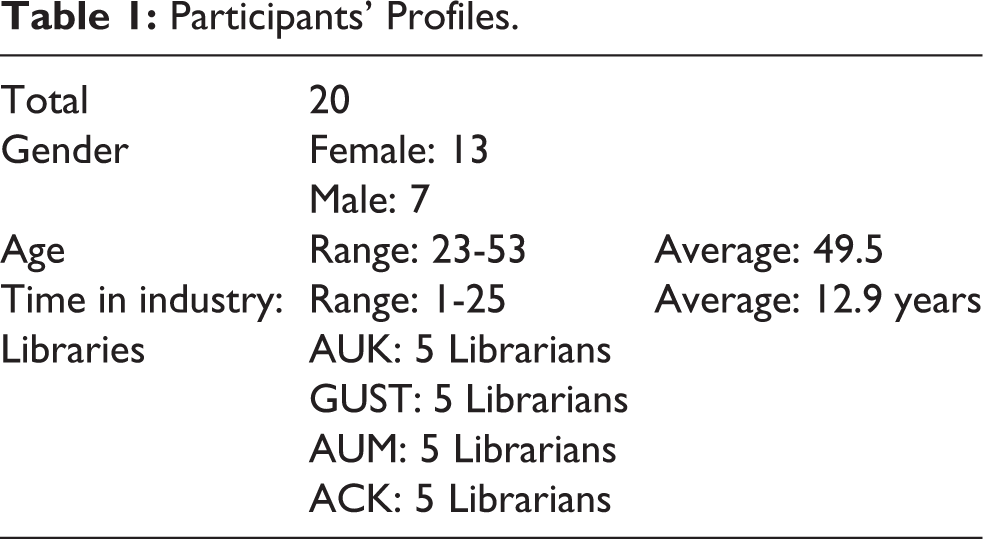
Krueger and Casey (2009) indicated that small groups allow greater contributions from each participant, but if they are too small they can either be dominated by one or two participants or leave participants feeling compelled to speak. Larger focus groups can foster richer discussions, but if they are too large participants can feel excluded or unable to contribute fully. Following the advice of Krueger and Casey (2009), the current study aimed to have five participants in each focus group (Table 1). This helped the facilitator to retain control over the discussion, but at the same time allowed participants to share their views and make their observations (Kamberelis and Dimitriadis, 2013).
Participants’ Profiles.
Focus group analysis
The analysis and interpretation of focus group data require a great deal of judgment and care (Morgan and Kreuger, 1993). The main aim of the focus groups conducted in this study was to provide an in-depth exploration of a topic about which little is known. Therefore, analysis concentrated on exploring the content of the sessions by identifying the key points and themes of discussion. Carey (1995) recommended that “an appropriate description of the nature of the group dynamics is necessary to incorporate in analysis” (p. 488). Thus, the current study involves a thematic analysis of the data.
Thematic analysis
According to Denzin and Lincoln (2005), thematic analysis moves beyond counting explicit words or phrases and focuses instead on identifying and describing both implicit and explicit ideas within the data; that is, themes. Therefore, the five key issues in the discussions – communication, technology, learning and education, teamwork and personal traits – are briefly outlined below. They are not in any particular order of importance. Quotes from participants have been included to refine the points being presented.
Communication
The majority of participants confirmed communication as being a core requirement for an academic Librarian 2.0. One said:
“my capability to communicate effectively with others either in speech or writing has been essential and beneficial to my occupation, whether it is participating in meetings or working with students”.
Librarian 2.0, in the academic environment, should have excellent presentation skills to attract the attention of others. He or she must also have good skills in negotiation and diplomacy, particularly when promoting their own skills and knowledge. Some participants commented that
“some Kuwaiti academic libraries do not offer workshops or seminars to improve their librarians‘ skills”. “communicating with managers is sometimes difficult because they are always busy, and most of them are not paying attention to our opinions and suggestions”. “a successful librarian, in the age of Web 2.0 is [one] who has used a suitable method which fits his/her work”.
Technology
Web 2.0, Library 2.0 and Librarian 2.0 are usually linked with technological factors. All the focus groups confirmed the importance of ICT services and technology in the context of Librarian 2.0. This result was expected, while the majority of participants linked the concept of Librarian 2.0 with Internet competence, ICT skills and social networking. One participant stated
“Librarian 2.0 must be able to use the latest technology in the field of libraries. Furthermore, Librarian 2.0 should be fully ICT skilled”. “Librarian 2.0 must be up-to-date with everything new related to social networks and technology, so he/she can use them in order to improve their libraries‘ services”. “technology has enabled us to do so much more… it is difficult to call yourself Librarian 2.0 without knowing how to use the new technology”. “as a professional librarian, I need to be capable of looking at new technologies with a critical eye… so, not all technologies can be useful in my work”. “a successful librarian in the Web 2.0 world needs to be aware of the emerging technology. However, he/she does not need to be IT professionals”. “despite the positive role played by technology in libraries, still some academic libraries in Kuwait are suffering a severe shortage of technological services”.
Learning and education
The educational role of librarians in the academic environment is more important today than at any other period in the profession’s long history. In the Web 2.0 world, librarians should be able to educate their faculty and students about existing and new tools for information discovery, creation and sharing. Some participants stressed that Librarian 2.0 must be qualified to be an educator, while others mentioned that they should focus only on the technical side. One participant stated
“the role of librarians, in the Web 2.0 era have changed drastically. I have my own YouTube channel and I teach many users how they can use the e-services in our library”. “academic Librarian 2.0 must be familiar with everything new in his/her field, so he/she needs to learn more and more”. “librarian in academic environment should assist in curriculum design and instruction in information literacy, including information technology, information management, information security and more”. “I am not a lecturer or professor, and my task is to assist the library users and offer them what they need”. “Librarians 2.0 must partner with faculty members to embed themselves and their instruction and services, into courses and the campus curriculum”.
Teamwork
Most of the focus groups confirmed that collaboration and teamwork are becoming increasingly common for academic librarians to work with others on campus to develop information resources, solve problems, deliver services, create facilities and formulate policies. One participant said
“teamwork of Librarians 2.0 and computing staff have probably helped to create university websites. It has also assisted in planning labs and instructional technology centres”. “in the Web 2.0 age, librarians, faculty members, students and technological teams should work together in order to create network-based learning experiences incorporating electronic information resources as an integral aspect of the curriculum”. “encouraging self-awareness and reflection in group work is a very important element for Librarian 2.0”. “develop[ing] a better understanding of the skills required in teamwork is a very essential element … so we need more training for that to improve our skills”.
Personality traits
All participants confirmed that
“personality traits are an essential element of Librarian 2.0”. “Librarian 2.0 should be enthusiastic and positive”. “Librarian 2.0 should be more confident and he/she should have no fear and be willing to move outside of their comfort zone”. “even if I am qualified and I have a good skill, without good personality traits I cannot be a professional librarian”. “personality traits are an integral part of the Librarian 2.0. Therefore, librarians, in the Web 2.0 world should focus on increasing their personal traits, such as adaptability, assertiveness, autonomy, conscientiousness, customer service orientation, emotional resilience and extraversion”.
Discussion and conclusion
The purpose of this study was to identify the key skills, knowledge and attributes required by Librarian 2.0 in academic libraries in Kuwait. The findings show that there were many different viewpoints among the participants regarding the concept of Librarian 2.0. However, all the focus groups linked the concept of Librarian 2.0 more strongly with technology than with other factors, such as education and learning, personality traits, communication and teamwork. This result is in contrast to the findings of Partridge, Lee and Munro (2010), who found that “librarian 2.0 is less to do with technology and more about quality transferable skills and interpersonal abilities. Furthermore, librarian 2.0 is more about changing attitudes and ways of thinking than anything else”.
The final results show that in the Web 2.0 world, librarians in Kuwait academic libraries, need more knowledge about communication and teamwork skills. Furthermore, they need to shift their awareness towards the concept of Librarian 2.0 by developing a clear understanding of the key factors that must be available to any librarian in the age of Web 2.0. Figure 1 shows the framework of the concept of Librarian 2.0 in Kuwait academic libraries by integrating and correlating all the important elements together. This framework is like an umbrella for understanding the core concept of Librarian 2.0 in Kuwait academic libraries.
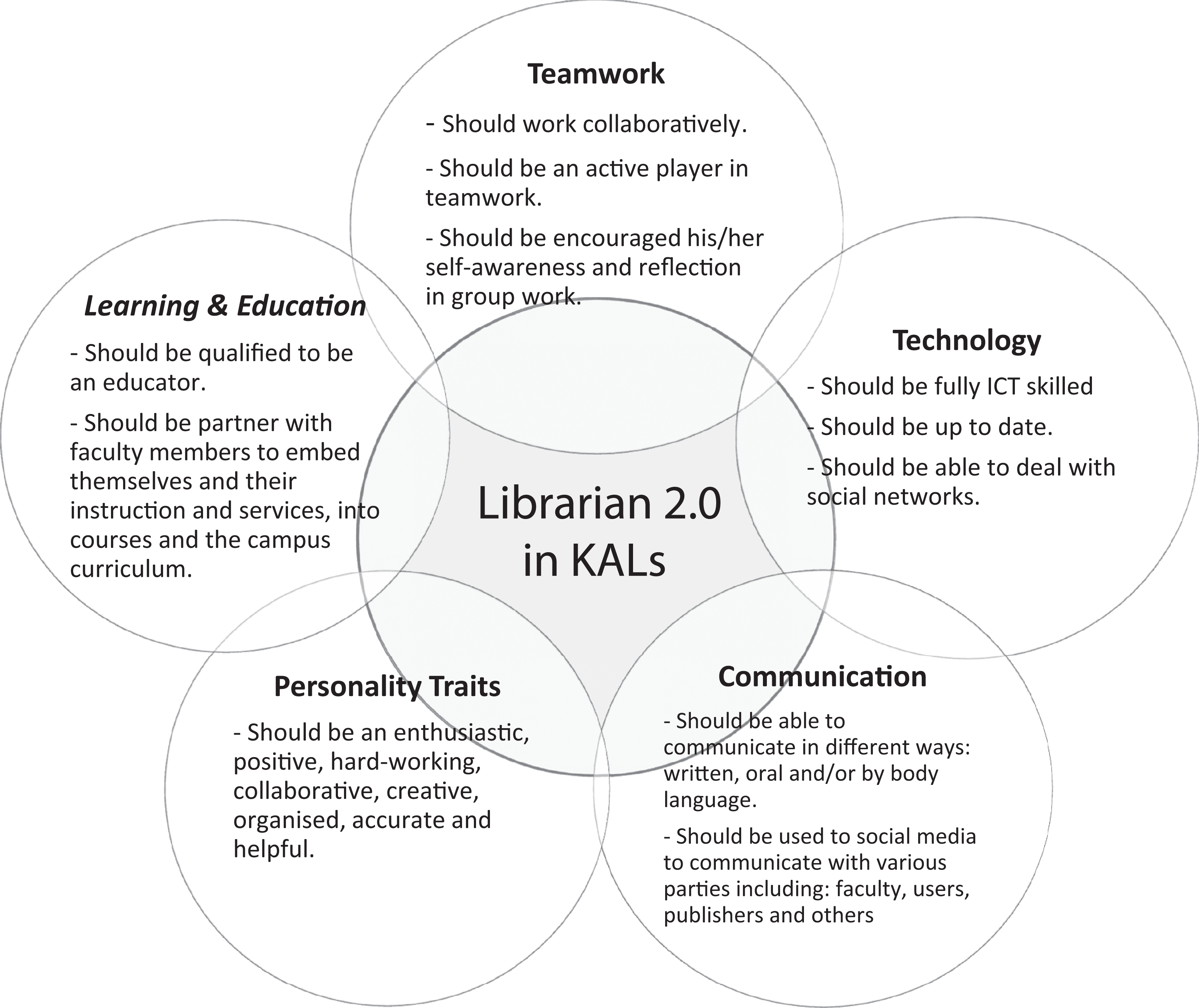
Framework of the concept of librarian 2.0 in KALs.
While this study has provided new data and a framework for the concept of Librarian 2.0 in academic libraries in Kuwait, further aspects need to be considered in future research. The framework proposed in the study was designed for Kuwait. Further research in this field may be useful in other countries in order to test or develop the suggested strategy. Moreover, this framework could be adopted under different scenarios; for example, for different countries or higher educational organisations.