



Abstract
This study is motivated by the initiative to implement mobile learning to promote world heritage site awareness among young adults living in the world heritage town of Luang Prabang in the Lao People’s Democratic Republic (PDR). Mobile learning is still in its infant stage in Laos. The objective of this study is to investigate the drivers of mobile learning acceptance among young adults in Luang Prabang. Structural equation modeling analysis based on 349 students of higher education indicates that perceived usefulness, perceived ease of use, and perceived enjoyment directly affected their behavioral intention to use mobile learning. Social influence and self-efficacy indirectly affected mobile learning acceptance through perceived usefulness and perceived ease of use respectively. Findings from this study yield insights for policy recommendations for mobile learning implementation in Luang Prabang, and also contribute to the understanding of mobile learning acceptance from the perspectives of a least developed country.
Both system characteristics and external factors need to be addressed in the implementation of mobile learning in Luang Prabang.
Introduction and motivation
Mobile-cellular subscription penetration rate in developing countries has seen rapid growth in recent years, especially in the Asia-Pacific region (International Telecommunication Union, 2013). In some of the least developed countries in Asia, such as Bangladesh and Lao People’s Democratic Republic (PDR), people often purchase mobile phones in preference of personal computers (International Telecommunication Union, 2013; UNESCO, 2012). The proliferation of smartphones has changed the traditional way of using mobile phones. Decreased prices and improved functionalities have given rise to various innovations involving mobile devices including mobile learning. A report by the Economist (2011) states that mobile phones have become a more accessible and affordable tool for communication and learning than personal computers. Users of mobile learning are expected to benefit from the place and time independence of mobile devices when accessing learning materials (Wang, Wu and Wang, 2009).
Situated in the northern part of Laos, the town of Luang Prabang was inscribed as a World Heritage Site in 1995 due to its magnificent fusion of Lao traditional architecture and French colonial buildings in its unique landscape. Together with this tangible heritage, intangible heritage such as the morning alms procession, annual cultural events and local costumes also contribute to the beauty of the world heritage town. Since its inscription, the town of Luang Prabang has faced rapid development and increasing visitors, requiring a balance between development and heritage preservation. Promoting awareness of world heritage site preservation to the local community, therefore, has become an urgent need in Luang Prabang.
The Department of World Heritage of Luang Prabang (DPL) was established to manage the world heritage town. In line with world heritage preservation policies, awareness promotion in the local community has been an important agenda for DPL (UNESCO, 2008). DPL initiated a project to develop a mobile learning application aiming to promote awareness of the need for preservation of the world heritage site, particularly targeting young adults. This is in response to the need for educating the younger generation about the values of world heritage, including the intangible heritage of Luang Prabang. The justification of launching a mobile learning application is based on evidence from past findings. The study indicates that mobile phones are actively used in digital activities among young adults, such as searching for information and communicating with family and friends using mobile applications.
Mobile learning opportunities mean that learning is no longer bounded by physical location. As mobile devices are getting smaller and more powerful, examining different uses of mobile learning beyond formal education has become an interest of researchers and policy makers (UNESCO, 2013). Promoting world heritage site preservation awareness is considered as a form of non-formal education. Accordingly, mobile learning is defined in this study as “any educational provision where the sole or dominant technologies are handheld and palmtop devices”, provided by Park, Nam and Cha (2012: 592).
The application of mobile phones to facilitate better understanding of heritage architectures is widely seen around the world. For example, the work of Costabile et al. (2008) demonstrates the possibilities of using game-based mobile learning to support middle school students’ visits to an archaeological park in Italy. Also, mobile phones have been experimentally deployed as a tour guide system. Visitors who used a mobile guide to visit cultural heritage in South Korea reported satisfaction on historic-spatial awareness, personalization, and shared group experiences (Suh et al., 2011). Further, taking advantage of mobile phones’ mobility and multimedia capabilities, Ancona et al. (2006) developed a mobile application to provide seamless tour guide-like experience to visitors of archaeological sites in Italy and Greece. In this experiment, a user takes a picture of a monument with a mobile phone, and it proposes a recommended visiting path. A similar mobile guide system can also be found at Locri Epizefiri in Greece (Cutri, Naccarato and Pantano, 2008).
Understanding the needs and perceptions of potential users is essential to ensure sustainable use of newly introduced technology applications in developing countries (Yamaguchi and Vaggione, 2008). Since the use of mobile phones as learning tool is still an innovative approach in Luang Prabang, the acceptance issue remains paramount. Given this background, the purpose of this study is to understand the perceptions of young adults on the use of mobile phones to learn about the world heritage town of Luang Prabang. In particular, this study intends to explore the important factors and how they affect mobile learning acceptance. Park et al. (2012) stress that the Technology Acceptance Model (TAM) is helpful for understanding the dynamics of mobile learning acceptance. Accordingly, six factors, including perceived usefulness, perceived ease of use, personal innovativeness, social influence, perceived enjoyment and self-efficacy, are proposed to influence behavioral intention to use mobile learning. Data was collected from young adults in local higher education institutions and analyzed with structural equation modeling (SEM) to validate the hypotheses.
The paper consists of eight sections. Following the introduction, the next section summarizes the literature review and theoretical background of the study. The third section introduces the research model and hypotheses. Research methodology is presented in the fourth section. The fifth section presents the results of data analysis, followed by a discussion and implications in the sixth section. The seventh section covers limitations and future research suggestions and finally the conclusion in the eighth section.
Literature review
Mobile learning
Mobile learning, as a relatively new and evolving concept, has been discussed with different definitions in the literature. Early studies defined it as a variation of e-learning. With the use of mobile devices or handheld information technology (IT) devices, mobile learning makes learning possible any time and anywhere (Quinn, 2001). Kukulska-Hulme (2005) posits that mobile learning occurs when learners engage in learning activities without being tied to a physical location. Recent studies have provided a more expanded definition of mobile learning. Crompton (2013: 4) describes mobile learning as “learning across multiple contexts, through social and content interactions, using personal electronic devices”.
Wong et al. (2015: 10) define mobile learning as “the exploitation of ubiquitous handheld technologies, together with wireless and mobile phone networks, to facilitate, support, enhance and extend the reach of teaching and learning”. This definition emphasizes the application of mobile learning in a formal educational context. However, as the next section presents, learning happens beyond the formal educational context as well. Hence, this study adopts a more general mobile learning definition proposed by Park et al. (2012: 592) as “any educational provision where the sole or dominant technologies are handheld and palmtop devices”.
Educational context of this study
Three types of educational contexts have been identified based on learning pedagogy, namely, formal education, informal education, and non-formal education. While formal education is a structured educational system, non-formal education refers to “any organized, systematic, educational activity carried on outside the framework of the formal system to provide selected types of learning to particular subgroups in the population, adults as well as children.” (Belle, 1982: 162).
Delors (1996) argues that non-formal education has its importance in developing human capabilities, improving social cohesion, and creating responsible future citizens. Although non-formal education does not lead to qualifications as recognized by formal education, non-formal education is considered to contribute to social and cultural development (UNESCO Institute of Statistics, 2012). The promotion of world heritage site preservation awareness targeting young adults is considered as a form of non-formal education. A meta-analysis of mobile learning studies conducted by Wu et al. (2012) found that mobile learning cases in the context of non-formal education are significantly fewer than those in formal and informal education. It is evident that more studies are needed for better understanding of mobile learning acceptance in non-formal educational contexts.
The Technology Acceptance Model in mobile learning
The Technology Acceptance Model (TAM) is an influential socio-technical model that aims to explain user acceptance of an information system. Two beliefs are prominent predictors of behavioral intention. One is perceived usefulness, defined as “the degree to which an individual believes that using a particular system would enhance his or her job performance” (Davis, 1989: 320), and it is positioned as the direct determinant of behavioral intention. The other is perceived ease of use, which is defined as “the degree to which an individual believes that using a particular system would be free of physical and mental effort” (Davis, 1989: 320). Perceived ease of use is theorized to predict both perceived usefulness and behavioral intention (Venkatesh and Davis, 1996). The literature shows that TAM is robust in explanation of technology adoption, especially in voluntary settings (Lee and Lehto, 2013). The dependent variable of TAM is intention to use a technology. Intention to use is defined as the subjective probability that an individual will engage in using a technology (Davis, 1989). Some researchers argue the need to study the actual use of technology. However, Venkatesh et al. (2003) as well as Simon and Paper (2007) note that behavioral intention is a valid predictor of actual technology use, especially when the use of technology is voluntary.
Researchers often resort to modification and extension of TAM in order to increase its prediction and explanation power in a particular technology domain (Jayasingh and Eze, 2009; Taylor and Todd, 1995; Thompson, Compeau and Higgins, 2006). Park et al. (2012) adopted a modified TAM to study mobile learning acceptance among Korean university students and found that perceived usefulness and perceived ease of use are important factors in affecting behavioral intention. In addition, external factors such as social norm, self-efficacy, system and educational attributes also contribute to intention to use (Park et al., 2012). Social norm, conceptually similar to social influence, refers to the degree to which individuals’ decisions to use a new system are influenced by people important to them. (Venkatesh and Davis, 2000). Self-efficacy refers to an individual’s belief in his or her capability in executing a behavior for performance attainment (Bandura, 1977). Iqbal and Qureshi (2012) investigated mobile learning among university students in Pakistan based on an extended TAM. Their study found that perceive usefulness and perceived ease of use are the direct determinants of intention to use. Social influence and perceived playfulness, however, had no significant impact on intention to use. These findings appear to be in contrast with Park et al. (2012), in which social influence directly impacts behavioral intention to use mobile learning for university students in Korea. Further, a study on Malaysian university students by Tan et al. (2014) found that the impact of social influence on behavioral intention to use mobile learning operates through perceived usefulness. In addition, they modified the TAM by including personal innovativeness. Personal innovativeness refers to the willingness of an individual to try out any new information technology (Agarwal and Prasad, 1998). In the study by Tan et al. (2014), personal innovativeness operates through perceived ease of use in influencing behavioral intention to use mobile learning. Liu, Li and Carlsson’s (2010) study among undergraduate students in China indicated that personal innovativeness affects long-term usefulness, perceived ease of use, and behavioral intention to use mobile learning. Perceived ease of use, however, did not affect either short-term usefulness or behavioral intention to use mobile learning (Liu, et al., 2010).
A review of recent literature indicates that different countries yield different outcomes with regard to the drivers of mobile learning acceptance. As argued by Chen et al. (2006), successful information system deployment strategies in developed countries could not be transposed directly to developing countries. Therefore, region- specific research is important to fill the knowledge gap, as well as providing guidelines for mobile learning implementation policies.
Research model and hypotheses development
The original TAM employs only two predictors to explain technology acceptance. The literature reviews suggest the possibility of other potential factors affecting behavioral intention to use mobile learning. Figure 1 depicts the theoretical framework of this study, which is based on modified TAM. There are six main hypotheses in this theoretical model. Extensive reviews of past studies were conducted in the development of the hypotheses in order to achieve the objective of this study. This section lays out six predictors along with the hypotheses.
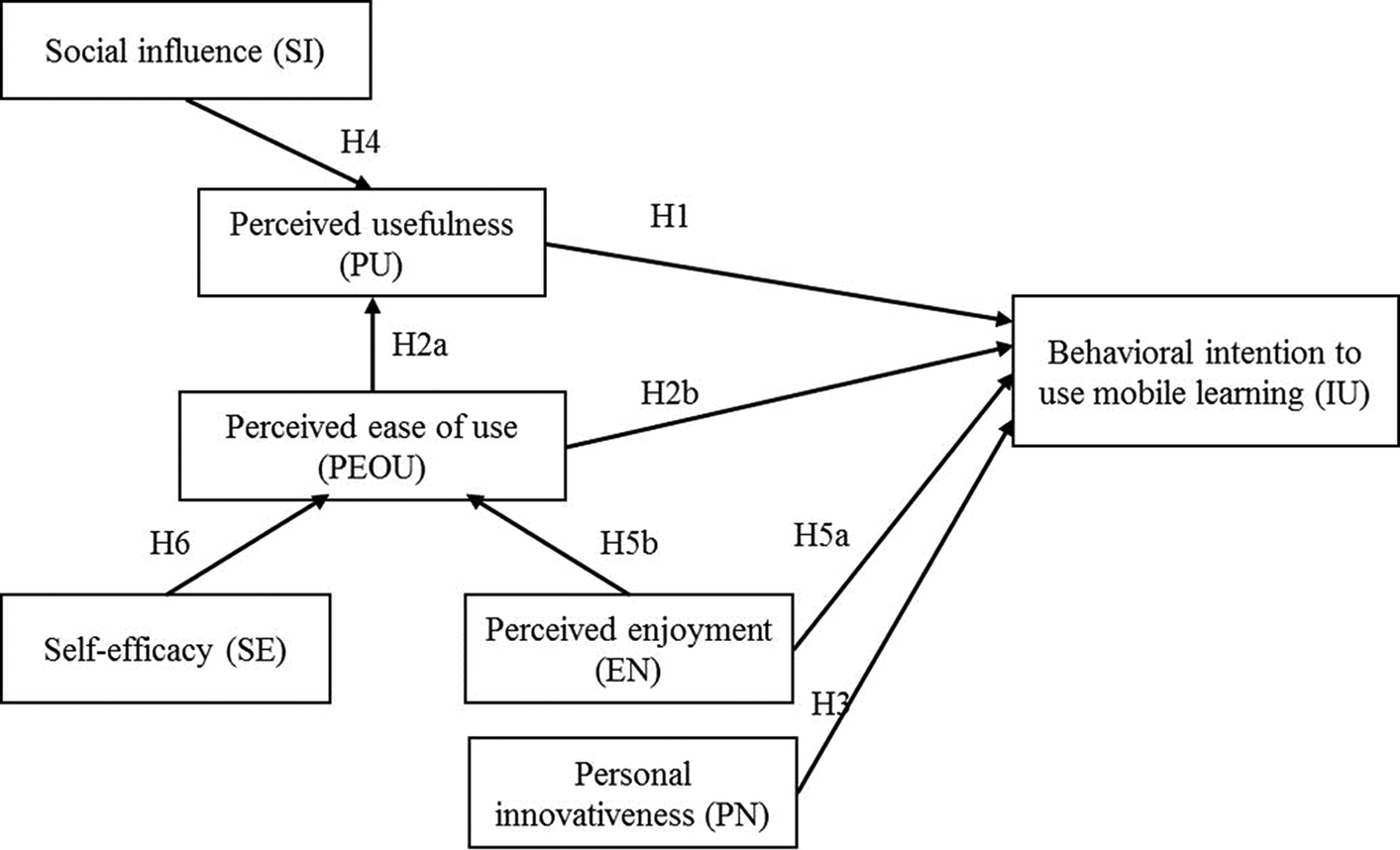
Modified theoretical framework and hypotheses.
Perceived usefulness and perceived ease of use
Studies show that mobile learning acceptance is determined by perceived usefulness (PU) and perceived ease of use (PEOU) (Chen and Huang, 2010; Chang, Yan and Tseng, 2012; Huang, et al., 2012; Liu, Han and Li, 2010). TAM posits that information technology that is perceived to be useful and requires less effort to use will increase acceptance (Davis, 1989). Using mobile phones for learning purposes provides flexibility in terms of time and space for learners (Ozdamli and Cavus, 2011). Learners can access learning content through their mobile devices any time and at any place. Accordingly, this study posits that mobile phones can also be used to deliver information and knowledge related to a world heritage site, which would enable users to learn about world heritage site preservation regardless of time and place.
Previous field observations and interviews conducted by the authors indicated that the use of mobile phone for learning is still in its infant stage in Laos. As argued by Venkatesh (2000), perceived ease of use is an important determinant of users’ intention of acceptance and usage behavior for any emerging information technologies. Therefore, it is considered that perceive ease of use may impact mobile learning acceptance in the context of Luang Prabang.
The original TAM includes attitude as the determinant of behavioral intention. However, subsequent research indicates that attitude has contributed little in the mediation between behavioral intention and perceived usefulness. Hence attitude was dropped from further analysis in TAM (Venkatesh and Davis, 1996; Venkatesh and Davis, 2000).
Consistent with TAM and existing mobile learning acceptance studies, this study lays out three hypotheses as follows:
Personal innovativeness
Whether an individual eventually adopts a technology depends upon his or her innovativeness. Researchers have found that people with higher levels of innovativeness tend to have higher levels of intention to adopt new technologies (Agarwal and Prasad, 1998). According to Rogers (2003), an individual with a high level of innovativeness possesses an ability to cope with uncertainties and is willing to take risks. This is important in the process of technology adoption because the outcome of using a new technology is still unknown when it has not been previously used. Rogers (2003) characterized four innovation levels: early adopters, early majority, late majority and laggards. The general characteristics of early adopters include high risk-takers and being relatively young (Rogers, 2003). A similar trend has been observed in mobile technology adoption, in which younger individuals are among the most avid users of mobile technologies (Pedersen, 2005). In this study, the target users of mobile learning applications are young adults; hence, it is believed that personal innovativeness (PN) may impact the adoption of new technologies. Concerning mobile learning adoption, Liu et al. (2010) found a significant relationship between personal innovativeness and behavioral intention to use mobile learning. Personal innovativeness could boost other perceptions due to inherited curiosity in an individual (Lu, Yao and Yu, 2005). Therefore, this study posits the following hypothesis:
Social influence
People interact with each other in a society and alter their behavior to a certain extent in accordance with the people they perceive as important or of similar social status (Rashotte, 2007). Social influence (SI) plays an important role in influencing potential adopters’ perceptions. As the level of uncertainty is high in the early stage of technology adoption, potential users tend to seek positive evidence of usage outcomes from other social actors. The process is defined as “influence to accept information from another as evidence about reality” (Deutsch and Gerard, 1955: 629). Lao culture is considered highly collective (Dorner and Gorman, 2011). According to Hofstede, Hofstede and Minkov (2010: 119), a society that scores high in collectivism stresses “on adaptation to the skills and virtues necessary to be an acceptable group member”. Therefore, it is believed that social influence may play an important role in affecting mobile learning adoption in Lao society. In addition, a study by Venkatesh and Davis (2000) shows that social influence is related with image, as individuals often comply with the norms to maintain a positive image of themselves. However, other literature shows that social influence does not directly affect behavioral intention to use technology under voluntary settings (Venkatesh et al., 2003). In mandatory settings, people are obliged to use the systems, which typically occurs in organizations. The concept of mobile learning for improving world heritage preservation awareness falls into the category of voluntary settings because target users are not obliged to use the mobile learning application. Instead, social influence indirectly affects behavioral intention to use new technology through perceived usefulness under voluntary settings (Venkatesh and Davis, 2000). This is because, under voluntary settings, individuals tend to rely on other users’ opinions and expectations of using the technology. Opinions and expectations from the surroundings influence an individual’s internalization. Internalization refers to “the process of transferring the regulation of behavior from outside to inside the individual”, which eventually affects an individual’s beliefs and values (Eccles and Wigfield, 2002: 113). Thus, social influence impacts on perceptions about the technology. Accordingly, the following hypothesis is identified:
Perceived enjoyment
The past century has witnessed the change in the role of computers from being solely work-based into a mixture of work and leisure purposes. The advancement of technology, including reduced size and decreased cost of computers, as well as their improved mobility, contributed to this aspect. Heijden (2003) argues that hedonic characteristics of computing devices should not be ignored as the mobility of computing devices increases. In the revised TAM, Davis, Bagozzi and Warshaw (1992: 1113) introduced the concept of perceived enjoyment (EN), which is defined as “the extent to which the activity of using the computer is perceived to be enjoyable in its own right, apart from any performance consequences that may be anticipated”. Studies in mobile learning show that hedonic motivation is important in acceptance decisions among young adults (Kang et al., 2015; Padilla-Meléndez, Aguila-Obra and Garrido-Moreno, 2013). This is because fun and enjoyable experience in using technology contribute as intrinsic sources of motivation. Furthermore, intrinsic motivation (e.g. enjoyment) has been shown to drive the adoption of information technologies and cultivate positive attitudes toward technology-based learning (Davis et al., 1992; Huang, 2015). Evidence from the literature shows that students indicate that the use of mobile devices for learning is fun and motivating (Yang, 2012). This study believes that some distinct characteristics of mobile learning, such as high degree of personalization and spontaneity, provide unique fun experience for learning.
In explaining the relationship between perceived enjoyment and perceived ease of use, multiple studies argue that perceived ease of use affects perceived enjoyment (Agrebi and Jallais, 2015; Huang 2015). However, the well-known study by Venkatesh (2000) emphasizes that perceived enjoyment affects perceived ease of use. This is based on the rationale that enjoyment allows individuals to focus on the process of using technology itself by ‘underestimating’ the difficulty of using the technology (Venkatesh, 2000). Further, experiential hierarchy states that affective factors, such as feeling, induce cognitive factors, such as perceptions (Solomon, 2013). Drawing from the postulations of experiential hierarchy, Lee, Chung and Jung’s (2015) study with college students across different cultures supports the hypothesis that perceived enjoyment affects perceived ease of use. The premise that perceived enjoyment influences perceived ease of use has been empirically supported by Sun and Zhang (2006). In order to clarify the relationship between perceived enjoyment and perceived ease of use, the study conducted by Sun and Zhang (2006), targeting college students and young employees, developed two models with opposing relationships between perceived enjoyment and perceived ease of use. Their statistical analysis shows that the effect of causal direction from perceived enjoyment to perceived ease of use dominates the direction from perceived ease of use to perceived enjoyment. Accordingly, this study proposes that young adults in Luang Prabang may exhibit a similar trend, and hence, the next two hypotheses are presented:
Self-efficacy
Self-efficacy (SE) measures the perception of individuals of their own ability to perform a task with the skills they possess. Rogers (2003) claims that uncertainty is one of the major obstacles in the innovation adoption process. The original concept of self-efficacy explains that people tend to avoid uncertain and threatening situations which they believe they are not able to overcome (Bandura, 1977). Therefore, perceived self-efficacy relates positively with the effort put in when facing uncertain experiences. This study believes that since the idea of using mobile phones for learning is still in its very early stages in Laos, potential users may face uncertainties in adoption decision process. Hence, self-efficacy may play an important role in mobile learning adoption. Venkatesh (2000) discovered that self-efficacy is the determinant of perceived ease of use. Similarly, findings show that self-efficacy affects behavioral intention through perceived ease use of mobile learning among college students (Chung, Chen and Kuo, 2015; Park et al., 2012). This is because an individual with high self-efficacy, in contrast to individual with low self-efficacy, possesses higher motivation in terms of degree of effort, persistence and level of learning in using technology (Liu and Huang, 2015). Consistent with the existing literature, this study posits as follows:
Methodology
A survey was conducted in March, 2012 at two local higher education institutions in Luang Prabang, namely, Souphanouvong University (SU) and Northern Law College (NLC) under the arrangement of DPL with the respective education institution authorities. SU is one of the four public universities in Laos, established in 2004 with a total of six faculties. NLC is a public college under the Ministry of Justice, established in 2003. Each institution has around 4,000 students.
The survey consists of two sections. The first section inquires about respondents’ demographic profiles, while the second section assesses their mobile learning perceptions. Perception questions are adapted from the literature and are measured using a 5-point Likert scale (1 = strongly agree to 5 = strongly disagree). The survey contents were reviewed by DPL professionals and were then translated into the Lao language to suit the local context. However, translation from English to Lao resulted in reduced scale items due to less word differentiation in the Lao language. The refined survey was sent to university representatives to be reviewed for appropriateness. The final survey items adapted in this study are shown in Appendix 1. Each construct is represented by two question items except for perceived ease of use and perceived enjoyment, which are represented by three items each.
Question items related to perceived usefulness, perceived ease of use and behavioral intention to use mobile learning were adapted from Davis (1989), Park et al. (2012), and Liu et al. (2010). Personal innovativeness question items were adapted from Agarwal and Prasad (1998), Cheng (2014), and Liu et al. (2010). Social influence question items were adapted from Venkatesh and Davis (2000) and Wang et al. (2009). Perceived enjoyment question items were adapted from Heijden (2003), Wang et al. (2009) and Padilla-Meléndez et al. (2013). Finally, self-efficacy question items were adapted from Taylor and Todd (1995) and Park et al. (2012).
Before survey distribution, the purpose of study was explained to the students by the experts from DPL. Mobile learning studies by Liu et al. (2010), Tan et al. (2014) and Wang et al. (2009) measured users’ perceptions on the use of mobile learning by explaining the concept. This study employed a similar approach. A total of 484 questionnaires were distributed: 199 out of 200 questionnaires were returned from SU, while 244 out of 284 questionnaires were returned from NLC, yielding response rates of 99.5% and 86% respectively. Validation was performed on collected questionnaires to ensure completeness. Those with blanks and high numbers of unanswered questions were discarded. Finally, a total of 349 returned questionnaires were deemed acceptable for data analysis.
Data analysis and results
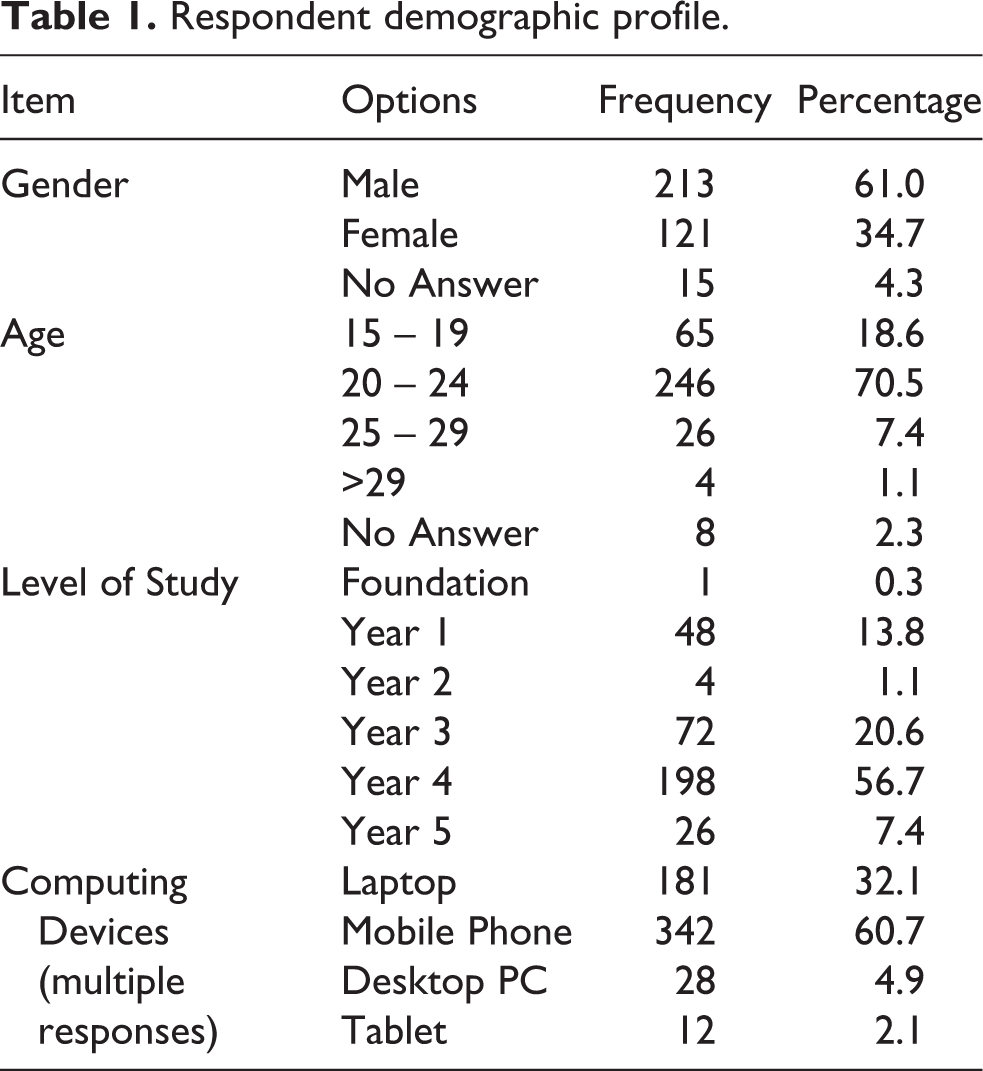
Table 1 shows the demographic profile of the respondents. Among the respondents, 61.0% were male and 34.7% were female. The majority were aged 20–24 (70.5%), followed by 15–19 years (18.6%). A total of 56.7% of the respondents were studying in Year Four; those studying in Year Three and Year One comprised 20.6% and 13.8% respectively. With regard to the computing devices owned, multi-response data show that mobile phone ownership is the highest (60.7%) among the four computing devices surveyed Demographic data suggests that there is a trend of high mobile phone penetration rate among the young adults in Luang Prabang.
Respondent demographic profile.
The research model was tested using AMOS (Analysis of Moment Structures) version 22.0. SEM analysis consists of two components, namely, measurement model as confirmatory factor analysis and analysis of structural model (Kline, 2011). Accordingly, a measurement model was first constructed to examine construct reliability and validity. Composite reliability in Table 2 shows that each of the constructs achieved acceptable reliability, ranging from 0.725 (personal innovativeness) to 0.833 (perceived usefulness). The loadings of each item towards the latent variable are between 0.643 and 0.992, satisfying the recommended 0.5 loading threshold. The results indicate that the data has a sufficient degree of convergent validity.
Composite construct reliabilities and loadings of each item to respective latent variable.

SD: standard deviation, CR: composite reliability, IU: behavioral intention to use.
Discriminant validity is assessed by examining the square root average variance extracted (AVE) with correlation (Gefen and Straub, 2000). Table 3 shows the correlation between each construct and the corresponding square root AVE. The results indicate that discriminant validity is met, as the square root AVE of each construct is greater than the correlation between the construct and other constructs.
Discriminant validity analysis and correlation analysis.
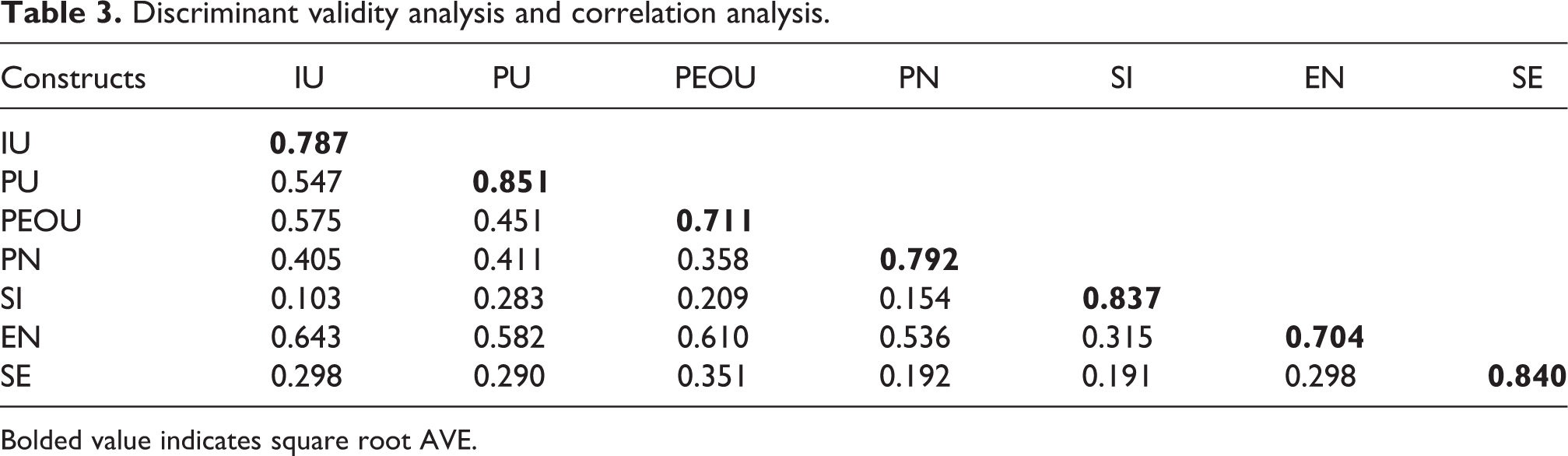
Bolded value indicates square root AVE.
Measurement model fit is assessed by examining fit indices. Eight common model-fit measures are used to assess the model’s overall goodness of fit, as shown in Table 4. The results show that chi-square is statistically significant. However, chi-square is sensitive to sample size (Hooper, Coughlan and Mullen, 2008; Iacobucci, 2010). Therefore, researchers often resort to chi-square adjusted by degrees of freedom (χ2 /df) less than 3.0 (Kline, 2011). In addition to chi-square statistics, other fit indices reported in this study include the root mean square error of approximation (RMSEA), standard root mean square residual (SRMR), goodness of fit index (GFI), normed fit index (NFI) and Tucker-Lewis index (TLI) and comparative fit index (CFI). The results indicate that the fit indexes are within acceptable thresholds, demonstrating that the measurement model exhibits a good fit. Since this is a cross-sectional survey, common method variance analysis was conducted. The total variance explained based on single factor using Harman single factor analysis and common latent factor analysis are 32.01% and 1.44% respectively, which are less than the 50% threshold. Thus, the results suggest that data do not suffer from common method bias (MacKenzie and Podsakoff, 2012). In addition, the normality test result (Appendix 2) shows that skewness and kurtosis are both within acceptable thresholds, showing that the data does not suffer from serious multivariate normality issues.
Fit indices for measurement and structural models.
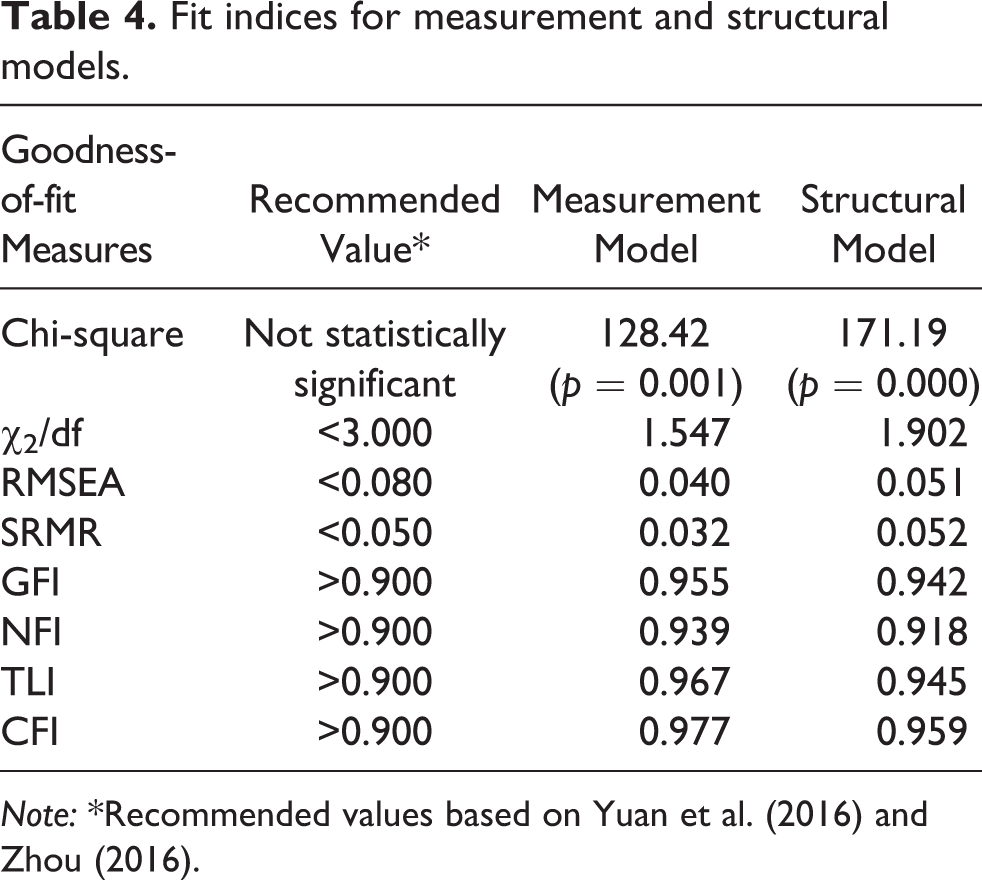
Note: *Recommended values based on Yuan et al. (2016) and Zhou (2016).
Next, the structural model is examined. As shown in Table 4, all fit measures for structural model are within acceptable thresholds, indicating good fit. Figure 2 depicts the structural model with standardized path coefficients. Perceived usefulness (β = 0.220, t = 3.423), perceived ease of use (β = 0.276, t = 2.801) and perceived enjoyment (β = 0.299, t = 2.943) positively affect behavioral intention to use m-learning, supporting H1, H2a and H5a. However, the relationship between personal innovativeness (β = 0.051, t = 0.729) and behavioral intention is not statistically significant, hence H3 is not supported.
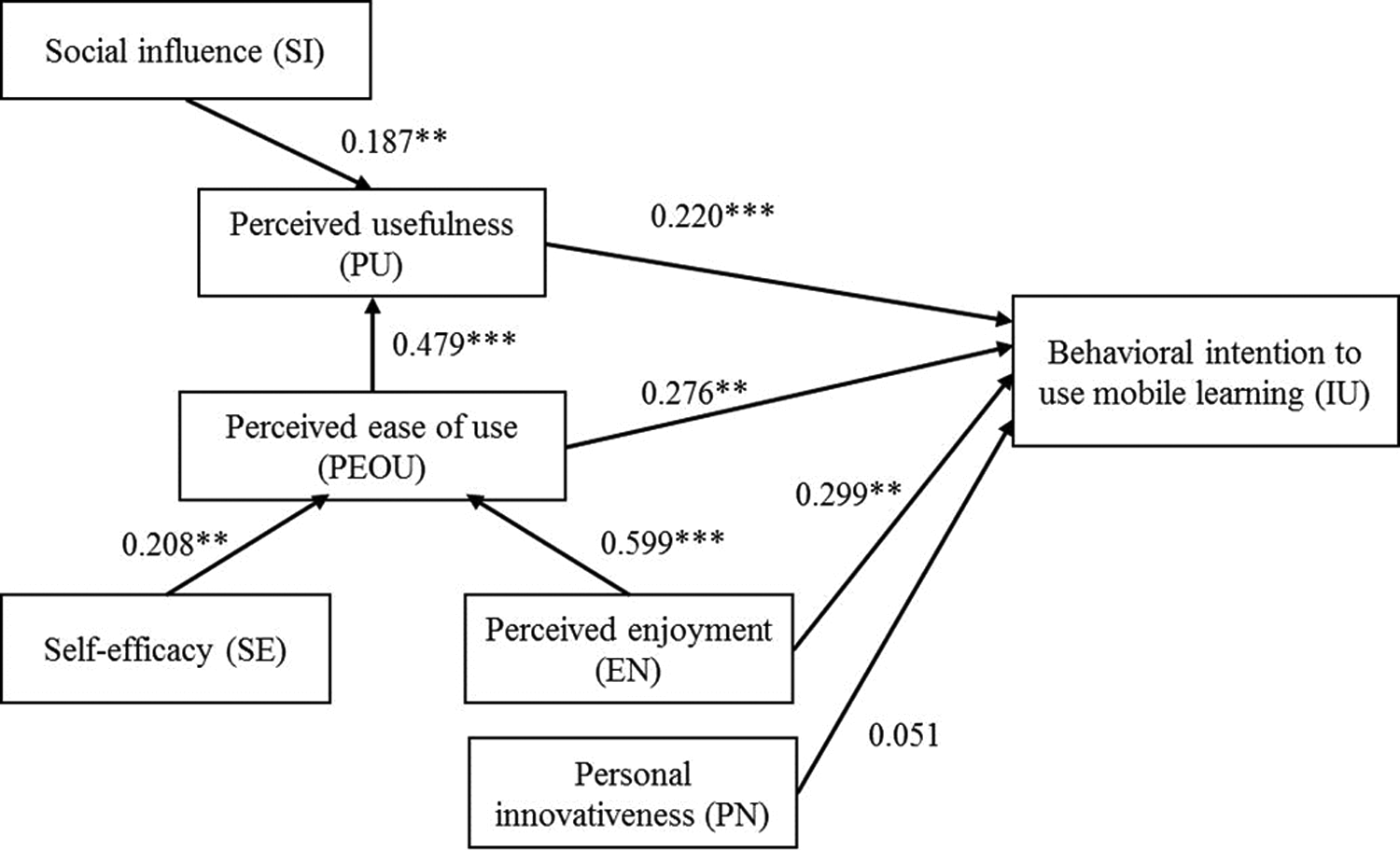
Standardized path coefficient of structural model.
The relationships of both perceived ease of use (β = 0.479, t = 6.425) and social influence (β = 0.187, t = 3.188) with perceived usefulness are statistically significant, accepting H2b and H4. Finally, the results show that perceived enjoyment (β = 0.599, t = 7.344) affects perceived ease of use, supporting H5b. The variances explained for perceived usefulness and perceived ease of use are 30.6% and 48.4% respectively. The total variance explained for behavioral intention to use m-learning is 47.1%.
Discussion
The objective of this study was to investigate the drivers of mobile learning acceptance among young adults in Luang Prabang. Leveraging the ubiquitousness and mobility of mobile phones, promoting heritage site preservation awareness via mobile learning is considered as an interesting yet challenging idea. Mobile devices and their contents have been applied in heritage tourism and learning about heritage artefacts in other countries. However, there are uncertainties in mobile learning implementation in the world heritage town of Luang Prabang due to the limited studies available describing its acceptance in the local community. Based on data from 349 university students, this study identified four important findings related to mobile learning acceptance. First, the results show that three factors, namely, perceived usefulness, perceived ease of use and perceived enjoyment directly influence behavioral intention to use mobile learning. Further, both social influence and self-efficacy are important and indirectly contribute to behavioral intention to use mobile learning. Second, among the factors, perceived enjoyment appears to be the strongest driver affecting intention to use mobile learning, both indirectly and directly. Third, in contrast with the current literature, the findings of this study show that personal innovativeness does not affect intention to use mobile learning among the young adults in Luang Prabang. One possible explanation can be related to the characteristics of Lao culture, that avoids uncertainty (Dorner and Gorman, 2011). A person with high personal innovativeness has strong willingness to take risks. People living in cultures with high uncertainty avoidance, however, feel threatened by unknown situations and tend to conform to existing norms and procedures (Hofstede et al., 2010). Hence, social influence may play a stronger role in comparison with personal innovativeness in a high uncertainty avoidance culture, such as that of Laos. Fourth, the study findings imply that both system characteristics and external factors need to be addressed in the implementation of mobile learning to promote world heritage site preservation among the young adults in Luang Prabang.
Based on the above findings, three practical implications are considered. First, from the perspective of mobile learning application development, providing useful information, designing easy-to-use interfaces and implementing fun elements in mobile learning application are essential to increase acceptance. Second, social actors surrounding young adults, such as school authorities and educators, can play important roles in demonstrating and explaining the advantages and usefulness of mobile learning. Third, the presence of mechanisms to increase young adults’ capability in using mobile phones for learning may increase mobile learning acceptance. Information technology courses in schools, workshops and seminars are possible ways to increase mobile learning self-efficacy among young adults.
From the theoretical perspective, this research investigated the drivers of mobile learning acceptance from a least developed country. As noted earlier, knowledge of mobile learning acceptance in different regions can contribute to understanding similarities and differences among factors affecting mobile learning acceptance. This study found that mobile learning characteristics and external factors have significant effects on mobile learning acceptance among young adults in the town of Luang Prabang. In this study, perceived usefulness, perceived ease of use and perceived enjoyment represent mobile learning characteristics, while social influence and self-efficacy represent external factors. Thus, this research advances our understanding of mobile learning use behavior, and enriches mobile learning literature.
Limitation and future research
The findings of this study are based on university students who are studying in the world heritage town of Luang Prabang, Laos. Furthermore, the sampling method employed convenience sampling, as the data were collected from the students in the college and university, who were able to allocate time for data collection. Therefore, caution is needed when generalizing the findings from this study. Future studies with sufficient resources should perform a fully random sampling method on an identified population. Future studies are suggested to explore the moderating effects of demographic factors, such as age, gender and place of origin, in order to advance understanding of mobile learning acceptance among young adults in least developed countries. In this study, any indications regarding mobile learning acceptance were inferred from respondents’ intentions. With the growing popularity of mobile learning and other related mobile technology applications, the possibility of gaining a critical mass in the application of mobile learning becomes apparent. Therefore, future work may consider studying the relationship between intentions and actual use behavior. In addition, investigating factors of barriers as well as continuous intention of using mobile learning can improve understanding of use retention (Gan, 2015; Kim et al., 2015). This will enable greater implications for research and practice for future studies.
Conclusion
Understanding potential users’ perceptions is important in the process of introducing new technologies. This study presents an assessment of mobile learning acceptance among young adults in the world heritage town of Luang Prabang, Laos. The findings of this study serve as an important contribution to the literature on mobile learning with empirical data from a least developed country. Further, the outcome of this study is expected to benefit policy makers and practitioners who are interested to implement mobile learning in Laos and other countries with similar contexts.