



Abstract
Many have studied different factors affecting e-government performance, but there is little research on the role of readiness factors, which may impact e-government outcomes indirectly. This study presents a conceptual model with the aim of determining the role of readiness factors in the relationship between e-government factors and e-government outcomes. E-government factors are comprised of citizens, businesses, and government itself. Also, readiness factors are categorized into three main groups, namely governing, technical, and organizational. A questionnaire was designed and completed by 90 e-government senior managers at multiple government agencies of Iran expressing their opinions on several factors impacting e-government outcomes within their organizations. The results of hierarchical regression analysis strongly support the appropriateness of the proposed model and prove that readiness factors play a moderating role in the relationship between e-government factors and e-government outcomes. Also, the results of latent moderated structuring (LMS) technique show that ‘organizational’ readiness factors have the most important effect on e-government outcomes. Finally, some policy implications are provided for better understanding of the role and importance of readiness factors in theory and practice.
Governments must consider the importance of readiness factors or their e-government projects could face failure.
Introduction
E-government is no longer an option for governments but a requirement for efficiently and effectively delivering information and services to their stakeholders. E-government is not just a government website on the Internet but a powerful and versatile tool to support and simplify governance when it comes to citizens, businesses, and the government itself. It can enhance government accountability and transparency, increase economies of scale in delivering services to citizens and businesses, improve citizen participation in public decision-making processes, and strengthen democratic values (Ahn and Bretschneider, 2011).
The primary goals of e-government development and implementation projects are improved structure of the government, enhanced efficiency, accountability and transparency, decentralization, increased citizens’ satisfaction, online delivery of public services, optimized involvement of citizens in public decision-making, avoiding personal contact, improved service quality, increased efficiency and cost reduction, control, etc. Governments are seeking to transform their government-centric delivery of public services into citizen-centric delivery of e-government services (Karunasena and Deng, 2012). At the turn of the 21st century, many countries around the world started running e-government projects, which are currently at different stages of maturity (Withmore, 2012 and Khan et al. 2012). Iran, as a developing country in the Middle East, has also undertaken several e-government projects since 2002.
Given the incorporation of considerable amounts of capital, human resources, information, and political commitments in e-government implementation projects, it is vital to evaluate their different aspects and understand factors which influence their effectiveness (Keramati et al. 2011a). One of the most important variables, which can have a critical positive effect on e-government outcomes, is readiness factors. There are many studies evaluating different e-government features, but there is little research on the evaluation of the intervening role of readiness factors on e-government outcomes. For instance, Wong and Welch (2004) mentioned domestic context public bureaucracy as an intervening factor in e-government implementation. Dwivedi and Williams (2008) concluded that age, education, and broadband access at home were key intervening variables in e-government adoption among UK citizens. Although such studies mentioned the significant role of intervening factors in e-government implementation, they did not elaborate on it specifically; and the lack of conceptual models emphasizing the importance of variables which might indirectly affect e-government implementation is evident.
To fill this gap, this paper examines the role of readiness factors in the relationship between e-government factors and e-government outcomes. Readiness factors are divided into three main categories: governing, technical, and organizational, followed by providing some implications using a model proposed by Ghazinoory et al. (2009).
The main aim of this research is to answer the following questions: Do readiness factors have a moderating effect on the relationship between e-government factors and e-government outcomes? How much is the moderating effect of different aspects of readiness factors? What policies should governments pursue in order to be better prepared for adopting e-government?
The remainder of this paper is structured as follows: Section 2 provides previous research on successful implementation of e-government through the perspectives of its different stakeholders. Section 3 elaborates on the conceptual model of the study. Section 4 presents the research methodology and section 5 demonstrates the findings. Finally, section 6 is devoted to discussion and conclusion.
Research background
E-government is a dynamic concept that has had an enormous effect on the delivery of government services to different stakeholders in recent years Tavana et al. (2013); Kassen, (2014); Sarrayrih and Sriram (2015); Zhang et al. (2014)]. Because of the importance of e-government in theory and practice, many researchers have studied its different aspects through various approaches. For instance, Sharifi and Manian (2010) focused on the success indicators for pre-implementation activities of e-government development projects. They finally proposed a framework consisting of seven success indicators of e-government implementation projects. Rose and Grant (2010) proposed a three-layered framework wherein critical issues resulting in successful e-government planning and implementation are considered. They claimed that program management, customer relationship management and marketing mix (i.e. product, price, promotion and place) are of enormous importance in leading to e-government success.
Chen et al. (2006) examined the differences between developed and developing countries employing e-government and proposed a conceptual framework wherein factors including national e-government infrastructure, national culture, and society play a crucial role. Ebrahim and Irani (2005) developed an integrated architecture framework which aligns IT infrastructure with business processes management in public organizations. They also classified the barriers that might complicate the implementation of the proposed architecture. Taking a different perspective, Zhang et al. (2005) studied e-government and tried to present an exploratory investigation of the diverging and converging expectations of various stakeholders at the initiation of e-government projects with regard to the benefits of and barriers to inter-organizational knowledge sharing.
Emphasizing the fact that success factors of e-government initiatives vary from one case to another due to the structural characteristics of the social, cultural, and political environments, Franke et al. (2015) asserted that demographic themes of citizens greatly influence e-government adoption. Reviewing a number of e-government implementation projects in the Middle East, they also proved that national culture plays a fundamental role in achieving successful e-government outcomes. Prybutok et al. (2008) examined leadership and IT quality and their effect on outcomes delivered by e-government. In order to test their conceptual model, they conducted a field survey at a municipality in the US and proved that both leadership and IT quality result in enhanced e-government outcomes.
Sharma (2015) investigated the role of service quality dimensions and demographic variables in e-government adoption. Using hierarchical regression analysis and based on data gathered from e-government services users, he showed that service quality dimensions, namely, reliability, security, efficiency, and responsiveness, were the key determinants that influenced the willingness to use e-government services. These results implied that technical factors such as reliability and security might affect e-government outcomes through influencing citizens’ attitudes toward e-government. Welch and Feeney (2014) focused on the mediating effect of organizational culture on ICT outcomes. They proposed a model in which organizational culture such as centralization and routineness play a mediating role in the relationship between ICTs and managerial outcomes (e.g. improved decision-making and public participation). Using data from local government managers in the United States, they tested their proposed model and showed the statistical significance of the hypothesized relationships. Table 1 displays some previous studies on e-government success factors.
Selected previous studies on e-government success factors.

The e-government literature has focused mainly on implementation, security and authentication, technology acceptance, interoperability and connectivity, project planning, design, procurement, and purchasing (Tavana et al. 2013). As mentioned above, there have been studies examining the role of intervening variables in e-government implementation, but conceptual models by which the indirect effects of such variables on e-government outcomes can be measured were missing. In this study, readiness factors are considered as a moderating variable for two main reasons. First, a moderating variable refers to a variable that can affect the strength and direction of the relationships between independent and dependent variables. In this research, a number of readiness factors are investigated, such as management permanence, which do not directly influence e-government outcomes, such as citizen satisfaction, but can influence the relationship between e-government factors and e-government outcomes. Secondly, Albadvi et al. (2007) considered the intervening role of organizational readiness in the relationship between IT usage and firm performance. They claimed that it is essential for organizations to invest in intervening variables in addition to IT in order to achieve higher performance. Accordingly, it is important to know which aspects of IT and readiness factors have greater effect on performance. Such knowledge can be used to make wiser investments in IT. Since e-government is highly IT-enabled, this paper aims to primarily assess the role of readiness factors in the relationship between e-government factors and e-government outcomes and, as a result, provide some useful policy insights into the area of e-government in theory and practice.
Conceptual model
In this section, the conceptual model of this study is developed. As shown in Figure 1, this model consists of three major variables, including e-government factors, readiness factors and e-government outcomes.
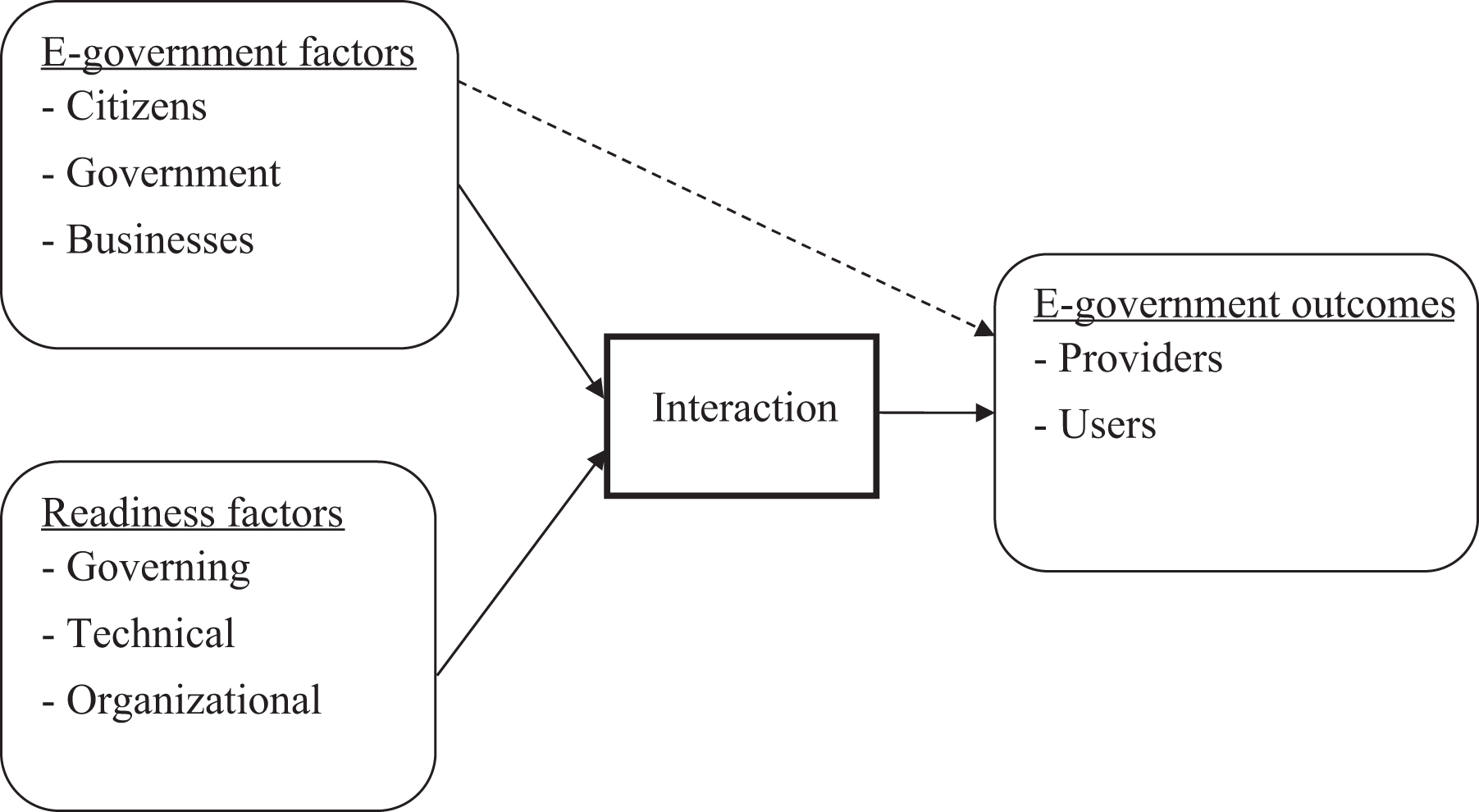
Conceptual research model.
E-government factors
There is consensus among researchers and practitioners on the complexity of the public sector and the involvement of a variety of stakeholders therein. Since e-government is directly related to the public sector, e-government projects are characterized by many stakeholders with multiple value dimensions (financial, social, and political). Many researchers believe that stakeholders are at the heart of the success and long-term effectiveness of e-government projects and their attitude and behavior can significantly and directly affect e-government outcomes (Rowley, 2011). Therefore, governments need to focus on stakeholders before and during the e-government implementation process (Kamal et al. 2011).
By carefully reviewing previous studies on e-government stakeholders (Fang, 2002; Yildiz, 2007 and Koh et al. 2008) in this study, three categories of stakeholders are being taken into account, namely, citizens, government and businesses, to determine their effect from different perspectives on e-government outcomes.
Citizens
E-government proposes a wide variety of information and services to citizens, such as research findings, information about government policies, elections, tax filing, employment, and business opportunities. However, because of the differences in citizens’ attributes, such as education, income, gender, age, and geographical zones, e-government is not equally welcomed by the citizens. There are also citizens who do not have access to the Internet and other required infrastructure in order to take advantage of the benefits of e-government services. Furthermore, people who use e-government services are the smallest proportion of Internet and computer users.
To explain citizen adoption of e-government, researchers have considered several direct determinants (Al-Adawi et al. 2005; Al-Hujran et al. 2015; Abd Hamid et al. 2016; Alzahrani et al. 2016), including: perceived risk, trust (perception of confidence in e-government services), perceived ease of use (the degree to which one thinks using such services would be free of effort) and perceived usefulness (the degree to which one thinks using such services would improve their performance). Horst et al. (2007) considered perceived usefulness, personal experiences, risk perception and trust. Wangpipatwong et al. (2008) mentioned computer (Internet) self-efficacy, Kolsaker and Lee-Kelley (2008) considered citizens’ attitude, Lean et al. (2009) brought up trust, culture, perceived usefulness and perceived ease of use, Verdegem and Verleye (2009) stated that user satisfaction has an influence on large-scale acceptance of e-government services, and finally Bélanger and Carter (2009) examined the impact of the digital divide (age, income, education, frequency of internet use) on e-government utilization. In this study, trust, perceived ease of use, perceived usefulness, and personal experiences from the citizen’s point of view and their demographic characteristics are considered, to assess e-government factors from the perspective of this stakeholder. The criteria used here to assess e-government factors from citizens' perspectives are shown in Table 2.
E-government factors.

Businesses
To assess the impact of businesses on e-government outcomes, Tung and Rieck (2005) considered perceived benefits, management readiness, sensitivity to cost (cost effectiveness), external pressure and social influence. Kim et al. (2007) recognized trust and commitment as important factors. Colesca and Dobrica (2009) addressed willingness to use and perceived usefulness; and Lee et al. (2011) considered service quality, trust, responsiveness, and assurance as determining variables.
The Dubai e-government portal [www.dubai.ae] is a good example presenting how e-government services impact businesses. Through this website, communications between government and businesses, such as gathering information, registrations, licenses, and permissions, are handled (Badri and Khaled, 2008). Trust, perceived usefulness, willingness of top management to go for e-government services, sensitivity to cost, external pressure, and social effect are the factors to be considered in this study (Table 2) to examine the impact of businesses as another stakeholder of e-government.
Government
To see how government itself affects e-government outcomes, Tseng et al. (2008) considered determinant factors, namely, cognition toward effectiveness and perceived benefits, Alhussain and Drew (2010) recognized awareness and orientation process, and Kamal et al. (2011) believe that IT knowledge, motivation, and external pressure on government agencies, and also awareness, are worth examining. Questions on awareness of the benefits, employees’ commitment to win the trust of the public, perception of effectiveness, employees’ knowledge of IT skills, motivation, perception of ease of use and external pressure are being asked in the questionnaire to assess how government itself affects e-government outcomes (Table 2).
Readiness factors
Readiness factors have been given attention in various studies. According to Layne and Lee (2001), there is a four-phase framework that makes the e-government development process clearly implementable. These stages are: catalog step, transaction step, vertical integration step and horizontal integration step. Also, the Department of Economic and Social Affairs of the United Nations (UNDESA) developed an e-government readiness framework for assessing the stages e-government projects go through. This framework has five steps, including emerging phase, enhanced phase, interactive phase, transactional phase, and connected phase.
In this study, based on a thorough review of the literature on e-government, authors’ experiences and interviewees’ input (Table 3), readiness factors are divided into three groups, namely, governing, technical, and organizational.
Readiness factors.

Governing factors
Researchers have investigated several governing factors, such as vision, strategy, funding, top management support, citizen-centric approach, leadership (Altameem et al., 2006), implementation guidance (Lam, 2005), laws, regulations and directives (Vassilakis et al., 2005), size of government and level of education (Shih et al., 2007), strategy and funding (Angelopoulos et al., 2010), national culture (Khalil, 2011), legislation, rules and administrative instructions (Al Nagi and Hamdan, 2009), and strategic planning (Koh et al., 2006). In this study, after discussing the afore-mentioned factors with e-government managers in Iran, vision, implementation strategy, management support, leadership, budget, culture, and laws and regulations are considered as the most important governing factors.
Technical factors
Some of the most important technical factors which have been studied in the e-government literature are: IT standards, IT infrastructure, national information infrastructure, collaboration, CzRM (Citizen Relationship Management), relative advantage, and security (Altameem et al., 2006); network infrastructure (LAN, server, Internet, intranet, extranet), IT skills and staff (Ebrahim and Irani, 2005); IT accessibility and IT skills (Carter and Weerakkody, 2008); IT tools, standards, and infrastructure (Shih et al., 2007) and IT infrastructure (Angelopoulos et al., 2010). In this study, IT standards, IT infrastructure, security, network infrastructure, and skilled IT staff are taken into account to assess the effect of technical factors on e-government outcomes.
Organizational factors
Some of the most important organizational factors considered in previous studies to assess the role of organizational readiness factors in the relationship between e-government factors and e-government outcomes are: training, business process reengineering (BPR), policy and legal issues, technical staff, quality, change management, reward system, organizational structure and organizational culture (Altameem et al. 2006); citizen privacy and data ownership (Lam, 2005); security and privacy, organizational vision and strategy, organizational culture and resistance to change (Ebrahim and Irani, 2005); financial security and information quality (Gilbert et al. 2004); absence of proper business plans, unacceptable e-government expenses, inappropriate policies, unproductive and inefficient methods, lack of skilled staff, and lack of collaboration (Vassilakis et al. 2005); and security, privacy and management commitment (Angelopoulos et al. 2010). In this study, training, BPR, policy and legal issues, change management, implementation procedures, organizational structure, organizational culture, reward system, data privacy, ownership of data, organizational vision and strategy, management commitment, and rate of turnover were fed into the conceptual model as organizational factors. Table 3 shows the measurement criteria used to assess readiness factors in this study by category and their respective references.
E-government outcomes
Some of the most important factors examined in the literature for better evaluation of e-government outcomes are: changes in government structure (Fountain, 2001), useful policies and plans (Brown and Brudney, 2003), accountability and transparency, marketization and decentralization (Navarra and Cornford, 2005), online delivery of public services, involvement of citizens in public decision making, cost reduction, avoiding personal contact (Gonzalez et al., 2007), control, convenience, personalization (Gilbert et al., 2004), saving of time, convenience, user satisfaction and security Millard, (2008); Stefanovic et al. (2016), progress in public services (Kaisara and Pather, 2011) and reliability, citizen support and trust (Papadomichelaki and Mentzas, 2012). Note that the outcomes of e-government utilization are for both providers and users. Providers can reduce their expenses over a long run; they can enjoy decentralization, etc. In addition, users would be able to get involved in public decision-making. They will also receive services with higher quality and more reliability. In this research, e-government is supposed to result in the reduction of expenses, saving of time, reduction of bureaucracy, increased employee satisfaction, agility in providing and receiving services, enhanced comfort in providing and receiving services, increased transparency, increased accountability, increased information security, decentralization, increased citizen satisfaction, improved control over services, improved quality of public services. The measurement criteria that are used here to assess e-government outcomes can be found in Table 4.
E-government outcomes.

By reviewing the abovementioned factors and based on the authors’ experiences and incorporation of the interviewees’ responses, Figure 1 demonstrates the proposed conceptual model of this study.
Therefore, taking all the above factors into account, the main hypothesis of this research can be stated as follows: Readiness factors play a moderating role in the relationship between e-government factors and e-government outcomes.
Policy making model
Governments influence societies through the roles of policy intelligence, making policy decisions, and policy implementation (Ghazinoory et al. 2009). Firstly, governments need to be provided with comprehensive information for making intelligent and informed policies. Afterwards, they make policy decisions based on the gathered information and finally, they implement the policies. The importance of these roles has changed over time. While policy implementation was the most important role of governments in the past, nowadays policy intelligence is recognized as the most important role (Giddens, 1999). Based on these roles, Ghazinoory et al. (2009) have proposed the model for determination of government roles in the process of developing national plans shown in Table 5.
Proposed model for government interventions (Ghazinoory et al. 2009).

As shown in this model, government tools can be divided into four categories: direct intervention (such as direct investment and direct governance), regulations (or legal force), offering incentives (for promoting participation and creating synergy) and promotion and creation of public awareness.
This model can be used for categorizing different kinds of policies governments should make for e-government to be effectively and efficiently implemented. More explanation regarding the role of the government in making policy decisions is given below. Policy intelligence and policy implementation will not be discussed.
Research methodology
How the required data were gathered, the measurement instrument of the study was developed, and the analysis of the results are carried out are described in detail in this section. Hierarchical regression analysis was conducted to test the moderating role of readiness factors and latent moderated structuring (LMS) technique was used to rank each factor.
Data
Case studies and empirical studies are appropriate ways to investigate the impacts of IT usage on organizations and society (Baroudi and Orlikowsky, 1989). This research is an empirical study conducted in Iran by means of a questionnaire. To recognize variables affecting e-government outcomes and identify research variables, seven interviews were conducted with e-government senior managers at a wide range of government agencies (see Appendix A). Based on an extensive review of the interview transcripts and the literature, research variables were recognized. An initial set of questions was developed to measure each variable.
The participants of the study filled out a 52-item questionnaire (Appendix B). A 5-point Likert scale questionnaire was developed in this study. A total of 110 respondents from 110 government organizations who were in charge of developing and implementing e-government projects within their respective organizations, were asked to answer the questionnaire, but only 90 questionnaires (82%) were completely filled out and returned. Participating government bodies in the survey are shown in Appendix C.
Reliability and validity analysis
The reliability and validity analysis of the questionnaire are explained in this section. The reliability analysis of a questionnaire determines its ability to yield the same results on different occasions, while validity refers to the measurement of what the questionnaire is supposed to measure (Cooper and Schindler, 2003).
Reliability analysis
For reliability analysis in this study, Cronbach’s alpha was calculated using SPSS. As shown in Table 6, all variables yield alphas greater than 0.7. Therefore, it can be concluded that the questionnaire is reliable.
Reliability and validity analysis of the questionnaire.

Validity analysis
In this study, construct validity, content validity and predictive validity were analyzed to ensure the validity of the measurement instrument.
Construct validity shows the extent to which measures of a criterion are indicative of the direction and size of that criterion. It also shows that the measures do not interfere with measures of other criteria. Construct validity of a measurement instrument is analyzed through factor analysis. The most commonly used decision-making technique to obtain factors is to consider factors with eigenvalue of above one as significant (Olson et al. 2005). Thus, factor analysis is performed; KMO index and Bartlett’s significance levels are calculated to ensure validity of the questionnaire. These measurements are depicted in Table 7. Based on the measurements, the questionnaire is valid.
Results of hierarchical regression analysis.

Content validity indicates meeting the specific range of contents that have been selected (Nunnally and Bernstein, 1994). It also shows that measurement instruments have elements that cover all aspects of variables under measurement. Content validity cannot be numerically measured, but it can be measured subjectively and based on judgments. Basically, content validity depends on the appropriateness of the content and since the selection of the research variables here is based on an intensive survey of the literature and all the elements are supported by authentic research, it can be concluded that the instrument has content validity. Furthermore, during the pre-testing phase, the content of the questionnaire was also validated by a number IT of academics and practitioners.
Predictive validity is the correlation between measurement instrument and an independent variable taken from related criteria. This validity is only possible through correlation between the predictor (independent variable) and criterion (dependent) variable (Nunnally and Bernstein, 1994). In this study, the results of two-variable and multi-variable correlation between ‘e-government factors’ as independent variable and ‘outcomes’ as dependent variable have shown that there is significant correlation between the intended criteria under measurement in this study (Sig.: 0.000 and Correlation coefficient: 0.663).
Findings
There are several ways to test the moderating role of variables. In this research, hierarchical regression analysis is used. To do so, a conceptual model is constructed; then the normality of data is tested followed by regression analysis.
Normality test
In order to verify data normality, two methods are used. First, a Kolmogorov-Smirnov (K-S) test is performed (e-government variable = 0.239, Readiness factors = 0.098 and Outcomes = 0.330). Since a non-significant result (Sig value of more than .05) indicates normality, all variables have normal data. The other method of checking data normality is through using normal Q-Q plots that can be seen in Figure 2 (readiness factors, e-government factors, and e-government outcomes, respectively). This test also confirms that all variables come from a normal distribution.

Q-Q plots.
The moderating role of readiness factors
A moderating variable is generally defined as a variable (quantitative or qualitative) which affects the direction or strength of the relationship between an independent variable and a dependent variable. Table 7 presents the results of the hierarchical regression analysis of this research. As shown in this table, all three paths are statistically significant. According to this table, hierarchical regression results proved that, setting Alpha (α) at 5%, readiness factors variable plays a moderating role in the relationship between e-government factors and e-government outcomes; as a result, the hypothesis of this research is supported.
One should note that the mediating role of readiness factors was also assessed, but was not statistically significant. Moreover, Boyer et al. (1997) argue that a variable cannot play both moderating and mediating roles simultaneously.
Latent moderated structuring technique
The LMS equations estimation method is particularly developed for the maximum likelihood estimation of latent interaction effects (Klein and Moosbrugger, 2000). Latent interaction models include non-linear structural relationships in the structural equation. LMS executes alternative methods, for instance: LISREL or 2SLS, with regard to statistical power, efficiency, and the capability of detecting latent interaction (Schermelleh-Engel et al., 2003). In this study, LISREL is used to run LMS.
Ranking of factors
A rank for each element is determined considering readiness factors as a moderating variable. For this purpose, using direct effect coefficients gained from the structural model, the real effect of each factor is calculated considering all paths between that factor and outcomes (OC), and then the factors are ranked in the order of calculated values for their effect on OC. The total effect of CITIZEN is calculated as follows: Total effect of CITIZEN = 1.00*0.560 + 1.00*0.160 = 0.72
In the above formula, the effect of CITIZEN is calculated by the summation of the two possible paths from CITIZEN to OC. The coefficient of 1.00 is gained from the measurement model, 0.560 is the direct effect of E-government Factors (EGF) on OC, and 0.160 is the effect of interaction of EGF and Readiness Factors (RF) on OC, calculated from the structural model (Figure 3).
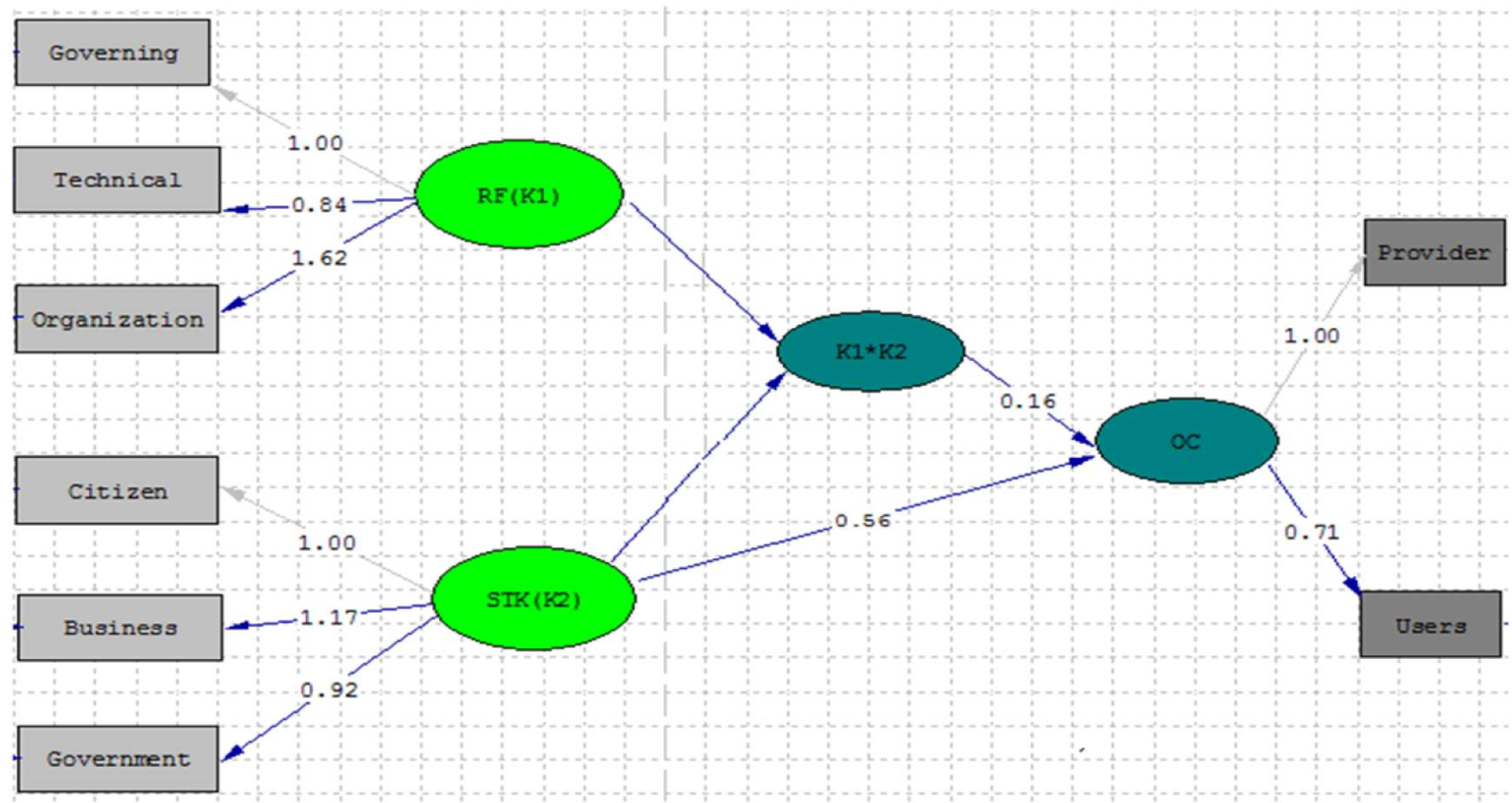
Structural model.
Total effect of CITIZEN shows the impact coefficient of CITIZEN on e-government outcomes. In fact, 0.560 and 0.160 are regression coefficients and 1.00 is the weight of ‘citizen factor’ in comparison with other factors, which is calculated using LMS. Thus, total effect is a weighted regression coefficient which shows the effect of different e-government factors on e-government outcomes. Total effects of businesses and government reach 0.84 and 0.66, accordingly. In a similar way, readiness factors are ranked based on their moderating effects. Total effect of the organizational factors reaches 0.25, with 0.16 and 0.13 as the total effects of governing and technical factors, respectively.
Discussion and conclusion
The main focus of research on e-government over the past decade has been on identifying various factors affecting e-government outcomes. For instance, Altameem et al. (2006) focused on critical factors leading to e-government adoption. Al Nagi and Hamdan (2009) discussed the role of legislation, rules, and administrative instructions, while Keramati et al. (2011a) stressed the importance of CzRM. Although the foregoing studies have shed light on different factors affecting e-government outcomes, there is little research on the assessment of the intervening role of readiness factors.
By reviewing the literature, readiness factors are divided into three main groups in this study, including governing (such as: national vision, implementation strategy, management support, leadership, budget, culture, laws and regulations), technical (such as: IT standards, IT infrastructure, cooperation and coordination, CzRM, security, network infrastructure, IT skills and staff), and organizational factors (such as: training, BPR, policy and legal issues, change management, implementation procedures, organizational structure, organizational culture, reward system, data privacy, data ownership, organizational vision and strategy, management commitment and management permanence). Also, inspired by the framework put forward in studies such as Albadvi et al. (2007), the intervening role of readiness factors in the relationship between e-government factors and e-government outcomes is analyzed and interpreted in this research. The results of this study show that readiness factors play a moderating role, strengthening the relationship between e-government factors and e-government outcomes.
Taking the concept of readiness factors as viewed from different perspectives into account, and empirically examining its intervening role in the relationship between e-government factors and e-government outcomes can be assumed as the main contribution of this study.
To test our hypothesis, a survey was conducted and 90 questionnaires were completed by e-government senior managers at government agencies in Iran. Using hierarchical regression analysis, it is proved that ‘readiness factors’ play a moderating role in this relationship. For instance, ‘organizational readiness factor’ has a moderating effect. This means that organizational factors such as management permanence and organizational rules cannot have a direct influence on e-government outcomes (especially from the users’ point of view). But these factors can affect e-government outcomes indirectly by influencing e-government factors. In fact, management permanence can help managers to appropriately implement e-government projects which are normally expensive, cumbersome, and time consuming. Successful implementation of such projects will result in enhanced efficiency and effectiveness throughout the government and motivates citizens, businesses, and employees of the government to eagerly benefit from the services and information delivered.
The results of using LMS demonstrated that ‘business’ is the most important e-government stakeholder in Iran and ‘organizational factors’ are the most important among readiness factors. Considering the opinions of our interviewees, these results are not surprising. Despite the recent efforts and investments made to improve the required e-government infrastructure, Iran is still suffering from a severe digital divide (James, 2012) and most Iranian citizens do not use e-government services. But our interviewees stated that the business sector is benefiting from the advantages of e- government services. Bearing in mind these two facts, it is not unexpected if business is recognized as the most important e-government stakeholder in Iran. Also, as mentioned before, Iran has witnessed considerable progress toward improving its technical infrastructure, and according to Iran’s ‘E-Government Strategic Plan’, (Moghaddasi and Feyzi, 2005), the government has made extensive investments in e-government utilization. Thus, it is time to make necessary changes to the organizational infrastructure of public organizations. That is why ‘organizational factors’ was recognized as the most important readiness factor in this study.
In summary, the findings of this research show that not only e-government factors affect e-government outcomes to a great extent; readiness factors also play a determining role in benefiting from implementation of e-government projects. These factors can increase the motivation of citizens and employees of the government to use electronic-based governmental services and engage in public decision making processes. Also the results of this study imply that if governments do not consider the importance of readiness factors, their e-government projects might face failure and cost them massive losses.
Policy implications
As stated in the previous section, Iran is suffering from a massive digital divide and this made the business sector the most important e-government stakeholder. Managers and policy makers must take into account the importance of public utilization of e-government services to avoid failure of e-government projects to meet their pre-specified objectives. Training programs for citizens can be the most effective way to introduce the advantages of e-government services (Vassilakis et al. 2005). Also, effective and efficient laws and regulations can help citizens learn how to utilize such services (Al Nagi and Hamdan, 2009).
Furthermore, given the importance of ‘organizational factors’, which was one of the important results of this study and also emphasized by our interviewees, managers and policy makers have to understand the need for the structural changes in government organizations. Iran has made substantive progress in providing advanced technical infrastructure and now it is time to work on organizational factors such as training, culture, etc. Finally, our experts believed that one of the most important problems in e-government implementation in Iran is the lack of management permanence. Policy makers should create an environment in which managers feel safe. Low turnover rates of senior managers will help e-government managers to successfully develop and implement e-government projects.
Using the model proposed by Ghazinoory et al. (2009), Table 8 can provide a thoughtful vision for policy makers to make proper policies for better understanding and improving readiness factors. As mentioned earlier, our focus in this study was on the policy making role of the government and policy intelligence and policy implementation were not discussed.
Proposed policies for e-government readiness factors.

Limitations and future research
Like any other empirical study, the achieved results here suffer from certain limitations. The first limitation stems from the relatively small sample size that might adversely affect the generalizability of this research investigation. Although reasonable, this limitation is offset to a great extent by the fact that the assessment of internal consistency of indicators and the reliability and validity of the model constructs all yield acceptable results. This study was carried out in a developing country with its own demographic characteristics. Further studies in other countries and regions having varied political, economic, social, and cultural characteristics through similar conceptual models are suggested to uncover any other factors involved affecting e-government outcomes.
Since an increasing number of governments around the world are turning to e-government as an indispensable way of making interactions, including delivering various services and information to their stakeholders, it seems necessary to have a prioritization scheme that could be used by policy makers and practitioners to guide them towards achieving acceptable results which are sustainable and attainable within a reasonable amount of time and budget. In this respect, mathematical models such as data envelopment analysis could be used to find out the areas in which investments can be made in order to achieve higher efficiency. This is especially beneficial for developing countries, where access to extensive financial resources, which is essential for running e-government development and implementation projects, is limited.
Footnotes
Appendix A. Summary of Comments provided by Interviewees
Appendix B. (Questionnaire)
Based on your valuable knowledge and experiences and/or the results of surveys conducted in order to develop and implement e-government projects in your organization, please indicate the extent to which each following element affects the outcomes of such projects, ranging from 1 to 5: (1 = not at all, to 3 = moderate effect, to 5 = extreme effect).
Appendix C. Participating Government Agencies

| Ahwaz Power Distribution Co. |
| Alborz Power Distribution Co. |
| Ardebil Power Distribution Co. |
| Atomic Energy Organization |
| Azerbaijan Power Transmission Co. |
| Bakhtar Power Transmission Co. |
| Boushehr Power Distribution Co. |
| Chamber of Commerce |
| Communications Regulatory Authority |
| Dairy Industries Co. |
| Damavand Power Generation Co. |
| East Azerbaijan Power Generation Co. |
| Export Development of Iran Co. |
| Fars Power Transmission Co. |
| Golestan Power Distribution Co. |
| Grid Management Co. |
| Hamadan Power Distribution Co. |
| Hormozgan Power Distribution Co. |
| Hormozgan Power Generation Co. |
| I.R.I Law Enforcement Force |
| I.R.I Shipping Lines Co. |
| I.R.I. Post Co. |
| I.R.I. Railways Co. |
| Institute of Commercial Research |
| Iranian Water and Wastewater Co. |
| Isfahan Power Distribution Co. |
| Isfahan Power Transmission Co. |
| Kerman Power Distribution Co. |
| Kermanshah Power Distribution Co. |
| Khorasan Power Distribution Co. |
| Khuzestan Power Transmission Co. |
| Kurdistan Power Distribution Co. |
| Markazi Power Distribution Co. |
| Mashhad Power Distribution Co. |
| Mazandaran Power Distribution Co. |
| Mazandaran Power Transmission Co. |
| Ministry of Culture |
| Ministry of Defense |
| Ministry of Economy |
| Ministry of Education |
| Ministry of Energy |
| Ministry of Foreign Affairs |
| Ministry of Health |
| Ministry of ICT |
| Ministry of Industries and Mines |
| Ministry of Interior |
| Ministry of Labor and Social Welfare |
| Ministry of Roads and Urban Planning |
| Ministry of Science, Research, and Technology |
| Ministry of sports and youth affairs |
| National Airports Co. |
| National Aviation Industries Organization |
| National Blood Transfusion Organization |
| National Cultural Heritage Organization |
| National Customs Administration |
| National Environmental Protection Organization |
| National Housing Foundation |
| National Industrial Development Organization |
| National Institute of Standards |
| National Iranian Drilling Co. |
| National Iranian Gas Co. |
| National Iranian Petrochemical Co. |
| National IT Organization |
| National Medical Equipment MFG. Co. |
| National Meteorological Organization |
| National Organization for Civil Registration |
| National Organization for Educational Testing |
| National Organization for Fisheries of Iran |
| National Organization for Renovation of Schools |
| National Organization for Veterinary Sciences |
| National Privatization organization |
| National Social Security Organization |
| National Statistical Center |
| National Tax Administration |
| National Transportation Research Institute |
| Qom Power Distribution Co. |
| Rajaee Power Generation Co. |
| Semnan Power Distribution Co. |
| Shiraz Power Distribution Co. |
| Sistan Power Distribution Co. |
| South Pars Power Generation Co. |
| Tavanir Co. |
| Tehran Power Distribution Co. |
| Tehran Power Transmission Co. |
| Tehran Stock Exchange Co. |
| Telecommunications Infrastructure Co. |
| Telecommunications Research Center |
| West Azerbaijan Power Distribution Co. |
| Yazd Power Distribution Co. |
| Zanjan Power Distribution Co. |