



Abstract
Academic librarians’ organizational silence has a bad effect on the service provision in academic libraries. This study aimed to investigate the status of organizational silence among academic librarians and the factors that influence it as perceived by them. Using the convenience sampling method, 118 academic librarians in the academic libraries of northern Iran were selected. They completed a questionnaire called “Academic Librarians’ Organizational Silence Scale”. The collected data was analyzed using descriptive and inferential statistic methods. Positively affecting academic librarians’ organizational silence behavior, library managements’ attitude to silence was the strongest predictor of the librarians’ organizational silence. Negatively affecting their organizational silence behavior, the existence of communication opportunities in the library was another predictor. The consideration of organizational silence and weakening its influence among academic librarians is the motivator for their appropriate service provision. This exploratory research is the first step in the deep study of this construct in libraries and among librarians. This study has some implications for theory and practice in the Library Science field. In the former, it extends evidence in the literature aimed at library human resource management. In the latter, it informs library management of factors at work in librarians’ organizational silence. Despite its limitations as to the study sample and geographically limited scope of libraries studied, this exploratory study can motivate researchers to consider librarians’ organizational silence in different types of library.
Introduction
Modern organizations and their environments as well as their communication processes and working procedures have become increasingly more diverse, complex, competent and interactive. In such a complex mixture, employees are potential sources for feedback on addressing and solving the ever-increasing problems and issues of work (Detert and Burris, 2007). As determinant factors of organizational health, well-made decisions depend heavily on how employees contribute in bringing new ideas, considerable suggestions and necessary corrections into their organizations (Umar and Hassan, 2013). Then, employees need to adopt a loud organizational voice for active contribution to their organizational affairs rather than remaining “organizationally silent”.
As a collective phenomenon, organizational silence can be defined as a collective behavior that appears when most members of an organization choose to be silent (Morrison and Milliken, 2000). When there is organizational silence in an organization, its members suppress their concerns about personal or organizational issues (McGowan, 2003). This kind of silence can result among other things in decreasing job satisfaction and commitment to the workplace (Vakola and Bouradas, 2005). Organizational silence is conceived as a behavioral attitude significantly related to other “external and internal behavioral factors” in organizations.
Like other organizations, libraries of all kinds need creative, innovative and motivated librarians in order to succeed in our complicated information age. Innovation, creativity and attitudes toward change are major factors in library success and its dynamics. It requires librarians to choose to voice their opinions and concerns about various matters existing or occurring in their libraries and actively participate in developing library projects and plans. As Liu et al. (2009) state, organizations need staff to express their ideas openly and be responsive to the changes and challenges of their work environment. In our ever-changing world, this is true of libraries as potential dynamic organizations faced with other alternatives such the Net. Librarians should share their information and knowledge with their managers, users and colleagues, and even other related organizations to solve their work-related problems and echo their main social roles as radical librarians. The importance of speaking up for change in your broader information community begins in your local organizational context. The point is that if internal factors are silencing librarians then perhaps they are also becoming victims of a behavioral practice which also influences their ability to play a broader role in the community
If librarians decide to voice and express their opinions, especially when facing problematic situations at work, these situations can be detected and managed effectively on their own or with their managers. If they tend to be silent, problematic situations may remain and cause harm to them, their libraries and end-users in the long term. Some librarians may choose to be silent and not to speak, however.
What makes librarians organizationally silent? There is no research studying this main issue in library settings including those of academic libraries. Some researchers in the fields other than Library and Information Science (e.g. Vakola and Bouradas, 2005) argue that top managers’ and supervisors’ attitudes towards silence as well as communication opportunities can affect staff’s organizational silence (Morrison and Milliken, 2000). This exploratory study aimed to investigate the probable effects of these variables on organizational silence in the academic library setting in Iran.
But why were academic libraries chosen to be studied? Academic libraries are changing in response to various evolutionary changes in technological, educational, social and research issues, as well as those in users’ demands and habits. They need to justify their existence to their parent organizations and university administrators and have reasonable consensus on plans for the future. It necessitates the active involvement of academic librarians in decision making, planning and demonstrating effective patterns as well as directing planned developmental programs and even showing the true path to the future. In addition, as noted by Vakola and Bouradas (2005), there is some pressure to express and share opinions in a change context. This further informs us about the importance of reinforcing voice and preventing silence in academic libraries in our ever-changing age. For these reasons, academic library and librarians have been chosen for this empirical exploratory study.
As the topic was investigated in the context of Iran’s academic libraries, some information is needed for contextualization. In the case of Iran, as a developing country, all central and branch academic libraries work under the supervision of various small and big universities and scientific institutions, as their parent organizations. These universities and institutions are supported in turn by two scientific-research ministries (Ministry of Science, Research and Technology and the Ministry of Health, Treatment and Medical Education) and Islamic Azad University. These libraries vary in their criteria for library management, staffing and budgeting, with their relatively independent procedures and policies.
Regarding the above-mentioned remarks, this study can inform other researchers in the Library and Information Science field in similar countries as well as other types of libraries.
Theoretical framework and research hypotheses
It is widely agreed that it is important for all organizations that employees make voluntary contributions aimed at improving their current workplace practices (Knoll and Van Dick, 2013). Sometimes, employees remain organizationally silent and withhold their ideas, information and opinions on important work-related issues and problems in organizations.
Researchers have explained different reasons for employees’ silence in their workplaces. Morrison and Milliken (2000) focus on internal and external forces and limitations, and argue that this sort of silence stems from top management that systematically reinforces silence among staff. They note that such a silence is due to employees’ fear of negative repercussion and to the belief that their opinions are not sufficiently valued and seriously considered at all. This results in organizational silence in which most employees prefer to keep silent about organizational matters, problems and concerns.
It is an unwanted organizational behavior that wastes costs and efforts and negatively affects all facets of an organization. Hazen (2006) believes that silence in organizations includes among other things quieting, censorship, suppression, marginalization and exclusion. When employees decide to be silent, they withhold information useful and valuable to the organization to which they belong (Tangirala and Ramanujam, 2008). This takes various forms such as collective silence in meetings, low level of participation in suggesting schemes, and so on (De Maria, 2006).
In spite of its pervasiveness in organizations – as noted by some researchers, for example Morrison and Millikan (2000), Pinder and Harlos (2001), employee organizational silence has not received the rigorous research attention that it deserves and has generally been neglected, especially in the Library and Information field. In addition, research on voice and silence behavior has some western bias as most studies were conducted in the West (Brinsfield et al., 2009).
Organizational silence has, however, some important implications for employee practices and organizational performances. Liu et al. (2009) regard organizational silence as a barrier to success in the workplace and note that how to break the culture of silence is a big challenge for many managers.
Morrison and Milliken (2000) consider organizational silence in the sociology of the workplace rather than the psychology of the individual employee. They argue that organizational silence is an outcome of managers’ attitudes and originates from their implicit beliefs and extends to organizational practices. Managers’ fears of negative feedback, their belief that people are naturally lazy, their own characteristics and some other organizational practices are at work in creating, perceiving and developing organizational silence among employees. Milliken et al. (2003) argue that in an organizational context where managers do not wish to hear about organizational problems and may punish staff for their speaking out, individuals choose to be silent. Donaghey et al. (2011) emphasize the role of managers’ attitudes and behaviors in perpetuating a climate of silence through designing particular institutional arrangements.
In addition, the lack of supporting communication channels and openness by organizations is a reason for organizational silence (Vakola, and Bouradas, 2005). Communication opportunities relate to “openness and trust in communication, information sharing, perceived feeling of having a voice and being taken seriously” (Vakola and Bouradas, 2005: 445). When communication opportunities exist and are active, there is an increase in some involvement in decision making, active participation in discussions on organizational issues and trust in management (Smidts et al., 2001). It can be concluded that employees’ having an opportunity to share their information with their managers and colleagues via appropriate communication channels leads them to break organizational silence and to speak out.
Considering the theoretical framework briefly discussed above, it can be assumed that managers’ attitudes toward employees’ silence may develop employees’ organizational silence behavior and the existence of communication opportunities may result in their using their voice and weaken their organizational silence behavior. Then, it was hypothesized that in the context of academic libraries: Academic librarians’ perception of library managers’/head librarians’ attitudes to silence positively affects their organizational silence behavior. Academic librarians’ perception of existing communication opportunities in their libraries negatively affects their organizational silence behavior.
Methodology
Participants, settings and procedures
This study was conducted in the summer of 2015. The research sample consisted of 125 randomly-selected academic librarians working in various academic libraries of 18 small, middle-size or large universities located in northern Iran. Of these, 11 universities were under the supervision of the Ministry of Science, Research and Technology; six were part of the Islamic Azad University; and two under the Ministry of Health, Treatment and Medical Education. These libraries were selected by the convenience sampling method because the researchers had no direct access to all the academic libraries located in the region. After asking the library managers/head librarians for permission to conduct the survey, the librarians (anyone with the term librarian in the title of their job) were asked to complete an adapted anonymous paper-and-pencil questionnaire called “Academic Librarians’ Organizational Silence Scale”. A total of 118 fully completed questionnaires were gathered and analyzed. Of the subjects, 72 (61%) and 46 (39%) were female and male, respectively. Their mean age was 32.7 (SD = 12.1), ranging from 23 to 44 years old. Their working background ranged from three to 23 years with a mean of nine years (SD = 6.2). Regarding the nature of the study, head librarians and library managers were excluded and only staff librarians were asked to participate and complete the questionnaire.
Measures
A 17-item questionnaire was adapted from the main scale used by Vakola and Bouradas (2005) for measuring some antecedents and consequences of organizational silence in a company which was about to undertake a large-scale change. The original questionnaire in English was adapted for the academic library context (Appendix 1) and translated into Persian by a small group of three management researchers who were proficient in English as well as in Persian. Ease of understanding of the translated version in the context of Iranian librarians was considered, as well as retaining its essential meaning.
The scale included three main components. The component of “academic librarians’ perception of library managers’ attitudes to silence” was measured by a 5-item scale. This was a 7-point Likert-type scale ranging from 7 (strongly agree) to 1 (strongly disagree). The items were scored in a way that the higher scores represented more attitudes to silence.
The component regarding “academic librarians’ perception of existing communication opportunities in their libraries” was measured by a 5-item, 7-point Likert-type scale ranging from 7 (strongly agree) to 1 (strongly disagree). The items were scored in a way that the higher scores represented more communication opportunity and openness.
The component of “academic librarians’ organizational silence behavior” was measured by a 7-item, 7-point Likert-type scale ranging from 7 (always) to 1 (never) for the first four items and 1 (with great difficulty) to 7 (with great ease) for the last three items. The items were scored in a way that the higher scores represented more organizational silence behavior.
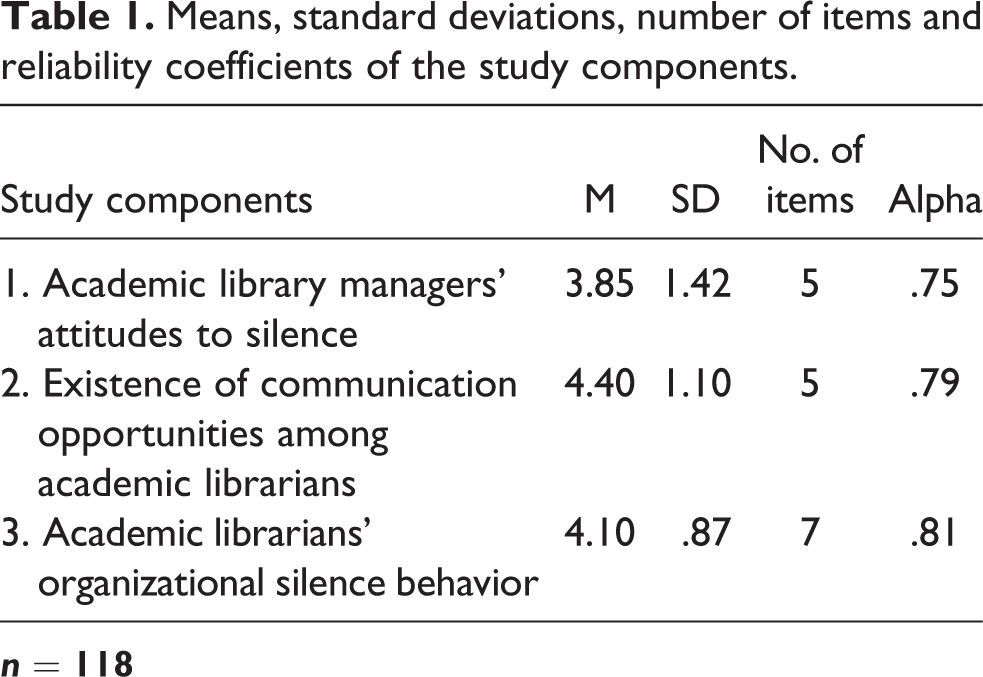
The highest and lowest scores of an individual in the questionnaire were 17 and 119, respectively. The total internal consistency of the scale in this study was α = .77 (n = 30). The content validity of the scale was confirmed by four specialist researchers in Human Resource Management and Library and Information Science. The internal consistency (reliability coefficient) of the scale was averaged for an overall score of α = .89, which is in accepted range. The internal consistencies of the three main components included in the scale are separately shown in Table 1.
Means, standard deviations, number of items and reliability coefficients of the study components.
Data analysis
By using SPSS 21 software, collected data was analyzed. Some descriptive and inferential statistic methods were used for summarizing data and testing the study hypotheses (including among others, multiple regression analysis).
Findings
The descriptive statistics, the number of the items of each component and their internal consistencies are shown in Table 1. As can be seen, the mean score of the component regarding “academic library managers’ attitudes to silence” (M = 3.85, SD = I.42) reveals that there was not a considerable attitude to silence among the academic library managers as perceived by the academic librarians in the studied context. This is also true in the case of their organizational silence behavior (M = 4.10, SD = .87). Regarding the mean score of existing communication opportunities perceived by academic librarians (M = 4.40, SD = 1.10), it can be contended that there were relatively open communication channels and opportunities among the academic librarians.
Table 2 shows the inter-correlation matrix of variables of the study. There was a positively moderate correlation between academic library managers’ attitudes to silence and academic librarians’ organizational silence behavior (r = .19, p < .05). This fully supported Hypothesis 1.
Inter-correlation matrix of the study’s variables.
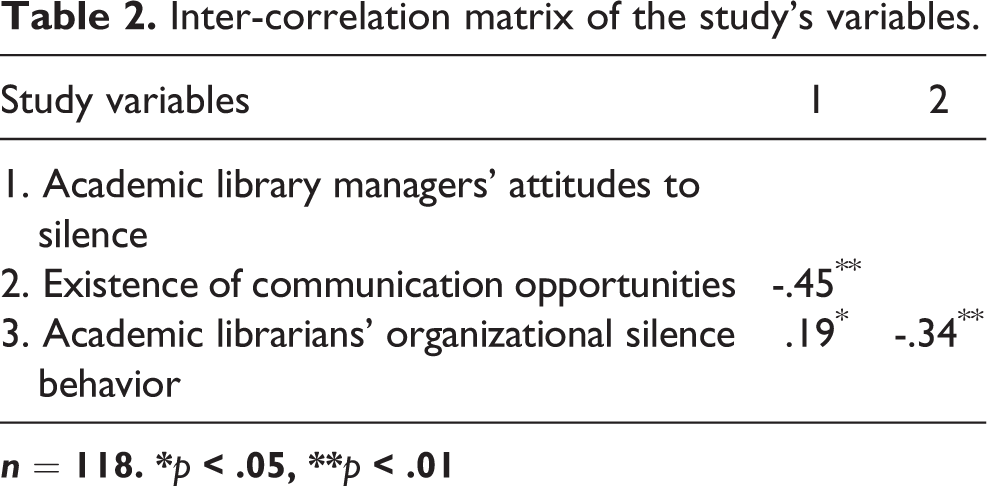
As the table shows, there was a negatively moderate relation between the perceived existence of communication opportunities among academic librarians and their organizational silence behavior (r = -.34, p < .01). Therefore Hypothesis 2 was also fully confirmed.
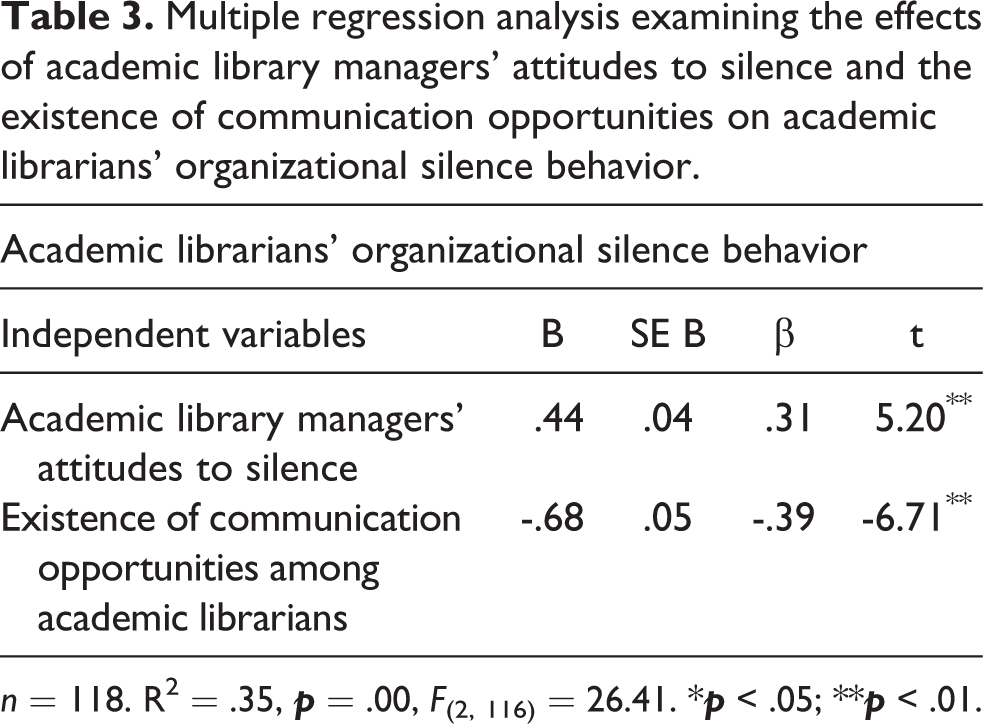
To further explore Hypotheses 1 and 2, a multiple regression analysis was conducted, entering academic library managers’ attitudes to silence, and the existence of communication opportunities as independent variables and that of academic librarians’ organizational silence behavior as a dependent variable. As depicted in Table 3, the results of regression analysis showed that these two predictors accounted for about one-third of the variance in test scores (R2 = .35), which was highly significant (F (2, 116) = 26.41, p = .000). As a result, the lack of communication opportunities among academic librarians as an independent variable was the strongest significant predictor of academic librarians’ organizational silence behavior as the dependent/criterion variable (β = -.39, p < .01), followed by that of academic library managers’ attitudes to silence (β = .31, p<.01).
Multiple regression analysis examining the effects of academic library managers’ attitudes to silence and the existence of communication opportunities on academic librarians’ organizational silence behavior.
n = 118. R2 = .35,
Discussion and conclusion
This study examined the effects of possible “silence climate” created by academic library managers’ attitudes to silence on the one hand and the existence of communication opportunities among academic librarians on the other hand on their organizational silence behavior. Regarding a positive relation between academic library managers’ attitudes to silence and a negative relation between communication opportunities among academic librarians as perceived by them and their organizational silence behavior, it can be said that the results are consistent with the propositions noted by Morrison and Milliken (2000) and accord with the empirical study by Vakola and Bouradas (2005). It is worth noting that the silence behavior is a result of external factors as well as internal ones. The former are not examined in this study. However, external factors such as cultural context are at work in organizational behavior, as reviewed by Gelfand et al. (2007) and noted by Nikmaram et al. (2012) in an Iranian academic setting. However, the importance of speaking up for change in the broader information community begins in the local organizational/in-house context. If internal factors are silencing, then librarians are also becoming victims of a behavioral practice which also influences their ability to play a broader role in the community. Studying possible external factors could be a subject for further research. This is so in regard to demographic information on subjects (e.g. their gender, academic level, career status) and background of organizations (e.g. their management policies, hierarchical structures, etc.). As a result, it is necessary to seriously consider these relations in the context of libraries of all kinds, especially that of academic libraries in other social, economic, cultural and political contexts.
Fear of negative consequences, lack of open communication, library managers’ non-supportive behavior to changing ideas and sharing information are all probable factors at work when academic librarians choose not to express their opinions, views and disagreements. As library managers’ attitudes to silence were found to be one of main predictors of academic librarians’ organizational silence, it can be concluded that the directness and frequency of relationships and contacts among academic librarians and their managers/head librarians highlight the importance of such attitudes in librarians’ deciding on whether or not to speak out. As a result, if academic librarians perceive their manager to be a supporter of voice behavior, they are encouraged to voice their concerns and express library-related issues.
As it was found, the existence of communication opportunities among academic librarians negatively related to their organizational silence behavior. This is the strongest predictor of academic librarians’ organizational silence behavior. In order to make librarians highly motivated to speak out, library authorities should ensure that communication opportunities do exist in their libraries and try to create networks for exchanging ideas among them. In addition, further research is needed for studying organizational commitment to communication opportunities by analyzing organizational charts and institutional policies in libraries of all kinds and their effect on organizational silence. The latter in particular provides us with cross-validation as to whether there were communication opportunities enshrined in the policy and practices of the libraries studied.
If we want creative, innovative, committed and satisfied academic librarians, some efforts are needed to eliminate or weaken factors affecting or leading to their organizational silence. Initiatives such as continuously facilitating communication among librarians, fundamentally changing library practices and structures, and increasingly improving the attitudes of library authorities can help us to remove a climate of silence and result in increased effectiveness and satisfaction of librarians. Academic libraries are increasingly demanding more and more participation from their librarians in the age of ever-increasing change we live in. More intensive competition with other alternatives, end-users’ higher expectations and various needs, the necessity of high quality service provision appropriate for a constant environment of change, and so on necessitate librarians being innovative and responsive to various challenges of the information environment and speaking out against library issues. In order to survive and become best, academic libraries need librarians who share their information and knowledge for the better performance of the library. This can cause change management programs in academic libraries to develop in favor of library service improvement. Organizational silence is one of the major obstacles to success and dynamics. The continuation of this silence creates silent norms and reinforces an environment of dissatisfaction which is harmful for the library climate. This can result in low-quality service for end-users. In an ever-changing context, managers in libraries of all kinds must try to hear the truth and realities from staff librarians to be able to manage changes effectively.
This exploratory study is the first to test the effects of organizational climate of academic libraries on librarians’ organizational silence in the context of a developing country. The findings are of particular relevance when considering the status of academic libraries in our ever-increasing world of change and users’ higher expectations throughout the world. As an early step, this study can provide an impetus for further research in other libraries of all kinds and in countries with different cultural, social and economic backgrounds.
The study suggests an interesting topic that implies practical usefulness for libraries as well as opportunities for further research. It bridges a gap between theory and practice. The theoretical ideas of organizational silence were translated into specific practical suggestions. The ideas in this paper could have a positive effect on the organizational structure of academic libraries which could result in improved functioning of the libraries.
The main and considerable limitation of this study is that data was gathered from the academic librarians working in some limited universities and academies in Iran and with specific cultural norms. In addition, the findings were confirmed from fields other than Library and Information Science, due to the lack of similar studies in the field. Any generalization or evaluation of this study should be done with this in mind. The collected data was based on perceptions of academic librarians at “that moment”. As a cross-sectional study, this survey needs to be deepened by conducting other longitudinal studies in other contexts. In addition, we did not consider the possible effect of macro level factors (such as a university’s top management and macro-level organizational sphere) on organizational silence. Other studies are needed to investigate such factors. The consequences of organizational silence for librarians and their workplace (e.g. their commitment, job satisfaction, and so forth) need some deep studies in similar and different library contexts.
Footnotes
Declaration of Conflicting Interests
The author(s) declared no potential conflicts of interest with respect to the research, authorship, and/or publication of this article.
Funding
The author(s) received no financial support for the research, authorship, and/or publication of this article.