



Abstract
The study aimed to investigate the methodologies employed by traditional healers to preserve knowledge of traditional healing. Organisational knowledge conversion theory was employed to guide the study. The study adopted the hermeneutic phenomenological research method and utilised snowball-sampling to identify participants. Data collection was done through observations and interviews. The findings indicate that there is some consensus among healers that ancestors control knowledge of traditional healing and pass it down to the chosen healers through dreams and visions. However, even though ancestors are believed to be the ones who preserve knowledge of traditional healing, there are healers who document their knowledge using different mediums chosen by them. The study concludes that even though the knowledge of traditional healers is largely preserved orally, and faces challenges, there are some initiatives globally and in South Africa to have this knowledge externalised and documented.
Keywords
Knowledge of traditional healing is in danger of extinction unless steps are taken to ensure its preservation.
Introduction
The concept of preservation is usually used in situations where something is protected or kept safe from harm. The Cambridge Dictionary (2017) defines preservation as the act of keeping something the same or of preventing it from being damaged. With regard to knowledge preservation, Mazour (2006) defines knowledge preservation as a process for maintaining knowledge that is important to an organisation’s mission to store knowledge/information over time and provide the possibility of recall for future use. For this study, knowledge preservation is defined as the process of protecting or keeping safe both tacit and explicit knowledge for future use.
Indigenous knowledge preservation involves protecting or keeping safe knowledge that is local to particular communities by individuals or organisations for future use. Ngulube, Dube and Mhlongo (2015) define indigenous knowledge (IK) as tacit know-how that is community based, unique, complex, dynamic, eclectic, non-formal and transmitted from one generation to the next in various contexts (including cultural, ecological, economic, ethical, political, social, spiritual and technological) to support indigenous communities in solving problems and making decisions that are fundamental to their existence, survival and adaptation in their everyday direct interactions and transactions with their natural surroundings, the external world, and other worldviews and value systems in a particular geographical area.
Many third world countries depended on their own indigenous institutions to deal with social, psychological and physical problems. According to Ayittey (1991) and Kaniki and Mphahlele (2002), some of the indigenous institutions that are worth mentioning were: legal institutions (dealt with disputes that arose in any family or society), political institutions (tribes existed as independent entities, which resulted from conquests or voluntary submissions), education (well-known ones are initiation schools for boys and girls), and health (traditional healers and the use of herbs).
This study focused on the indigenous health sector with special emphasis on traditional healing and the preservation of knowledge of traditional healing. Knowledge of traditional healing survived for centuries because it has been passed from generation to generation through oral tradition (Sodi, Mudhovozi, Mashamba, Radzilani-Makatu, Takalani and Mabunda 2011). The preservation of knowledge of traditional healing is of primary importance because traditional healing is usually the first choice for primary health care by rural communities in developing countries (Adekannbi, Olatokun and Ajiferuke 2014a, WHO 2008).
Knowledge of traditional healing is in danger of being lost due to a number of factors, such as the lack of interest from younger generations, low life expectancy where people die before transferring it to the next generation, and it not being documented. One other factor is that traditional healers themselves regard their medical knowledge as personal property that must be kept in strict confidence, because they believe that unwarranted disclosure of such knowledge can result in the treatment losing its effectiveness (Sodi et al. 2011). This may be influenced by the fact that traditional healers mostly depend on their trade for survival, therefore, protecting their knowledge and keeping it private is of great importance to them in maintaining a healthy client base. Poorna, Mymoon and Hariharan (2014) are of the view that urgent measures are required to preserve oral knowledge as it faces great risk of loss and misappropriation. To that effect, the importance of knowledge preservation can never be overemphasised
Contextualisation
From a variety of traditional healers known and present in South Africa, this study pays particular attention to herbalists, diviners, traditional midwives as well as elders in some communities. According to Mokgobi (2014), in South Africa, researchers have identified different types of traditional healers according to different regions. In the Bapedi tribe, which is found mostly in Limpopo Province in South Africa (Limpopo), traditional healers are generally called “Dingaka” or “Mangaka”. The different types of traditional healers include diviners (“Ngaka ya ditaola”), (“Sedupe”), traditional surgeons and traditional birth attendants (“Babelegisi”). Mokgobi (2014) further notes that a diviner uses bones and the spirits of the ancestors to diagnose and prescribe medication for different physiological, psychiatric and spiritual conditions. This study focused on the traditional healers in Limpopo. These healers mainly used Sepedi, Tsonga and Venda as languages of communication.
Limpopo is the northernmost province in South Africa, lying within the great curve of the Limpopo River from which the province derived its name. The province borders the countries of Botswana to the west, Zimbabwe to the north and Mozambique to the east. The capital of Limpopo is Polokwane and it is located in the centre of the province. The province is divided into five regions, namely: Waterberg, Capricorn, Vhembe, Mopani and Sekhukhune (Limpopo Provincial Government 2014) (see Figure 1).

Regions of Limpopo (Limpopo Tourism Agency 2017).
Objective of the study
The purpose of this study was to investigate how traditional healers preserve their knowledge of traditional healing. The study specifically aimed at identifying the methodologies employed by traditional healers to preserve their knowledge.
Statement of the problem
In Africa, there is an age-old saying that says, “When an old person dies, the entire library burns”. This highlights the importance of preserving knowledge, especially indigenous knowledge. The death of a senior citizen can have devastating implications for a community that depends on the expertise of that particular citizen; more so if the knowledge was not imparted in any way. The review of literature suggests that indigenous knowledge is in danger of being lost entirely; most of it has already been lost. Poorna, Mymoon and Hariharan (2014) are of the view that urgent measures are required to preserve oral knowledge as it faces great risk of loss and misappropriation. Despite the orality and oral traditions that are common to indigenous knowledge, Ngulube (2002) is of the view that such knowledge should be preserved and managed just like any other type of knowledge. Therefore, there is the need for a study to investigate how knowledge of traditional healing can be preserved for future generations.
Literature review
The review of the literature for this study begins with a brief overview of the theory that guides this study, followed by a discussion on preservation from different scholarly works with particular reference to indigenous knowledge preservation. For tacit knowledge to be preserved, it has to be acquired first. After acquisition, this knowledge is integrated into our existing knowledge base. According to Nonaka and Takeuchi (1995), this mode of knowledge conversion involves combining different bodies of explicit knowledge. After integrating this knowledge into the existing knowledge base, this knowledge gets to be internalised.
The conversion of the acquired explicit knowledge to tacit knowledge, that is, internalisation, occurs through a series of integrations in which individual concepts become concrete and ultimately absorbed as an integral belief or value (Faust 2007). Internalisation allows the preservation of knowledge to take place although it will be orally preserved. The preservation process is a little different when it comes to explicit knowledge. Explicit knowledge involves documentary material (reports, analyses, memos, videos, e-mail, databases, etc.), that may be retained in a wide variety of media forms (paper, film, electronic, etc.). It is possible to preserve this knowledge mostly by means of libraries, archives, museums and many other information-handling agencies.
The importance of knowledge preservation as one of the key components of knowledge management can never be overemphasised. One can argue that it is because of preservation that the human race has survived, adapted and adjusted over generations. Human beings usually acquire knowledge with preservation in mind. Faust (2007) draws a good picture of the importance of knowledge preservation when he says that the loss of knowledge does not only threaten the safe and economic operation of nuclear power plants, but also has negative effects on the socio-political system of a country.
The preservation of indigenous knowledge is of great importance, more so as a responsibility of professionals from the library and information science (LIS) sector. Ngulube (2002) opines that information professionals need to do more to ensure that indigenous knowledge is preserved like other documentary materials. According to Ngulube (2002), this is because LIS professionals have not been at the forefront in terms of managing indigenous knowledge, in spite of the fact that indigenous knowledge is fast becoming an important resource in planning and management, yet they (LIS professionals) claim to be custodians of knowledge and information. According to Maina (2012), the International Federation of Library Associations (IFLA) highlighted the importance of LIS professionals becoming involved in indigenous knowledge preservation and access. The association challenged libraries to take a leading role in, inter alia, collecting, preserving and disseminating indigenous knowledge, and publicising its value, contribution and importance to both indigenous and non-indigenous people. This involved raising awareness of the protection of indigenous knowledge against misappropriation and involving elders and communities in the production and teaching of traditional knowledge.
Various studies investigated the preservation of traditional medical knowledge (TMK). Amongst those studies, Anyaoku, Orizu and Eneh (2015) investigated the role of medical libraries in the preservation of TMK in Nigeria. The study recommends that, as a duty to the people’s collective indigenous knowledge heritage, medical libraries in Nigeria should develop inclusive policies that support collection and development of TMK information resources as a matter of priority. In the same context, Adekannbi, Olatokun and Ajiferuke (2014b), employed both qualitative and quantitative approaches to investigate the preservation of TMK through modes of transmission. The findings suggest that traditional medical practitioners (TMPs) freely transmitted their knowledge irrespective of their relationship with apprentices, but due to issues of trust, they are more comfortable transmitting all their knowledge to their children. The results further highlight that, for that reason, TMK in that region of Nigeria risks being lost because of the preference of most TMPs to transmit all their knowledge only to their children. Sodi et al. (2011) however argue that many traditional healers regard TMK as their personal property that must be kept in strict confidence, because they believe that unwarranted disclosure of such knowledge make the treatment lose its effectiveness. Sodi et al. (2011) further highlight that this knowledge is said to be shared with those who have a calling during a formal training, who are also expected to pay the training fees.
Although the preservation of indigenous knowledge is a primary need, there are challenges that may affect this exercise, which are worth mentioning. Poorna et al. (2014) list the following as some of the challenges faced that may affect the preservation and protection of indigenous knowledge: IK is created and owned collectively by the community and traditional laws and customs guide its use and transfer. Intellectual property rights, which are enforced in the modern world and are largely individual rights that are based on Western legal and economic parameters, as well as Western property law that emphasises exclusivity and private ownership, reduces knowledge and cultural expressions to commodities that can be privately owned by an individual or a corporation. The corporate and multinational companies, mostly from the developed world, use the IK of developing countries as a basis for their commercial products, which are then patented without sharing any benefit with the source of the IK. The present patent system gives all the economic benefits to those who have only slightly altered the IK and gives nothing at all to those who developed it over generations. Trade Related Aspects of Intellectual Property Rights (TRIPS) obligate all signatory countries to enforce the rights upon their own people, including the indigenous communities that developed and held the knowledge for generations, thus restricting their free use and practice. Foreign patents granted over IK can greatly affect an indigenous community’s cultural practices as well as its control of resources that are material to practising that IK.
There are a number of initiatives across the globe by different governments to try to preserve knowledge of indigenous origins. A number of studies capture such activities, and a study by Poorna et al. (2014) highlights the following initiatives designed to preserve and protect indigenous knowledge in different countries:
The traditional knowledge library of India
This library is said to host one of the largest indigenous knowledge repositories in the world. The traditional knowledge library (TKDL) project records, in digitised format, various Indian traditional systems of medicine available in the public domain in the form of ancient and other existing literature often inaccessible to the public and rarely understood. TKDL contains information in five foreign languages for the ease of patent examiners in international patent offices and it precisely lists the time, place and medium of publication. TKDL gives defensive protection to India’s traditional medicinal knowledge.
Korean traditional knowledge portal
The Korean traditional knowledge portal was compiled by the Korean intellectual property office and this database includes a vast amount of knowledge from documentation on old Korean and Chinese medicine. It also includes a wide range of articles and patent documents. The database contains around 350,000 entries on Korean medicine, traditional food and intangible cultural heritage. The database is available in Korean and English.
Chinese traditional medicine database system
China is another important indigenous knowledge-holding country. The most important type of IK in China is Chinese traditional medicine (TCM), which has been derived from ancient traditions, most of which have been written down. The institute of information on TCM set up the traditional Chinese medicine database system. The system consists of more than 40 categories of Chinese medicine databases, which contain 1,100,000 items. Most of these databases are available in Chinese and a few are available in English. Traditional Chinese medicine is also present in other Asian countries such as Korea and Japan, and can be used freely in other countries. China has created a series of online databases that record information related to traditional Chinese medicine.
BioZulua project of Venezuela
The BioZulua project records data on medicinal plants and food crops of the 24 ethnic groups living in Venezuela’s section of the Amazonian jungle. The database includes information on traditional indigenous medicine, traditional agricultural technologies, nutrition and conservation practices. The information is stored in a searchable database administered by the Foundation for the Development of Mathematics and Physical and Natural Sciences. The database provides genetic profiles of every plant and global positioning system coordinates of plant locations, and the entries are complemented with geographical references, bibliographies and digital images. The BioZulua database preserves non-codified traditional knowledge.
The Ulwazi programme of Durban
The Ulwazi programme is an online indigenous knowledge database and is the first of its kind in South Africa. It is aimed at collecting and sharing the indigenous knowledge and culture of local communities in the greater Durban area in English and local Zulu. This programme collects and shares indigenous knowledge such as traditional celebrations, clothing, Zulu proverbs, folk tales, spiritual herbs and traditional agricultural methods, in the form of a wiki – a website designed to enable contributions and modifications from multiple users. The Ulwazi programme operates as an integral part of the local public library network that provides a framework for a digital library of IK, in which the content is created and owned by the communities themselves with the libraries playing the role of moderator and custodians of knowledge.
Research methodology
This study was guided by the interpretative epistemology informed by a qualitative approach using the hermeneutic phenomenological research method. Bryman (2012) defines phenomenology as a research method concerned with questions of how individuals make sense of the world around them. According to Ngulube and Ngulube (2017), there are two major types of phenomenological research, namely, hermeneutic phenomenology and transcendental phenomenology. Hermeneutic phenomenology is interpretive in nature while empirical transcendental phenomenology is descriptive in nature.
The snowball sampling technique was employed to identify respondents who shared the same experiences and were most relevant to the study. Data was collected through interviews and observations, as well as document analysis. Semi-structured interviews supplemented by non-participant unstructured observation as well as document analysis were used to collect data. All five regions of Limpopo Province were visited during data collection (see Table 1). The decision to visit all regions was motivated by the fact that traditional healing is not a homogenous healing system, but varies from culture to culture, from region to region, and from individual to individual (Mokgobi 2014:28).
A summary of interviewed participants (N=27).
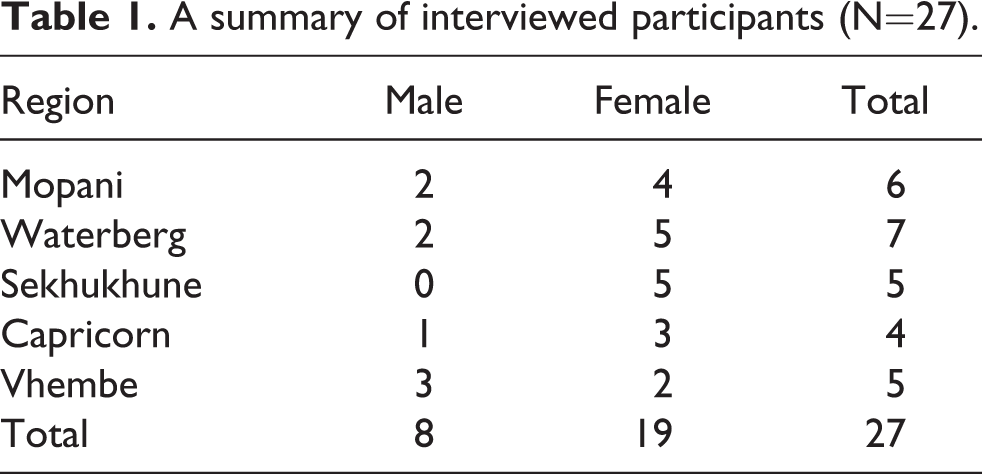
In total, 27 healers were interviewed, of which 19 were female and 8 were male. This was a qualitative study, and issues of sampling and sample representativeness were not of great significance because the results were not generalised. On the contrary, the investigators focused on gathering deep data through interviews and observations. Interviews were conducted until data saturation was reached.
Data analysis and interpretation
Interviews were conducted in Tsonga, Venda and Pedi, and answers were translated into English during transcribing. All interviews occurred at the homes of the participants during the times suggested by participants based on their availability. The investigator listened to the recorded tapes from the interviews and transcribed them from tape to paper while translating them into English. The notes taken by the research assistants during interviews were compared to the data obtained from tapes and adjustments were made where necessary. A similar approach was taken during observation and the data collected were integrated and organised thematically to address the aims of the study.
Ethical considerations
Ethical clearance was obtained from the Department of Information Science Ethics Review Committee of the University of South Africa before the study was conducted. Participants were informed of why they were invited to participate, why the study was being conducted, that participation was voluntary and they were free to withdraw at any time, and that anonymity and confidentiality would be maintained at all times. For data collected through observation, the senior healer granted permission after consultation with the trainees. The investigator informed them that anonymity and confidentiality would be ensured at all times and that they were free to withdraw at any time. All pictures taken during observations were shown to the trainees and they had no problem with them being included in the document; however, the investigator protected their identities by blocking out the faces on the pictures that were used.
Results and discussions
When we speak of preservation in relation to traditional healing, the first thing that comes to mind is the herbs that are used to treat different illnesses. These herbs are commonly kept in huts designed to keep them preserved for longer. These huts (see Figure 2) are constructed from mortar, which consists of soil and cow dung with the use of special grass to complete the roof. These round-shaped huts are cool inside, especially during hot African summer weather. From a conservation point of view, these huts are perfect for preserving the herbs for longer. Healers in Limpopo also kept their herbs in such huts. In other instances, the huts that the investigator came across were said to have been in use for a number of generations with the roof being renovated from time to time.
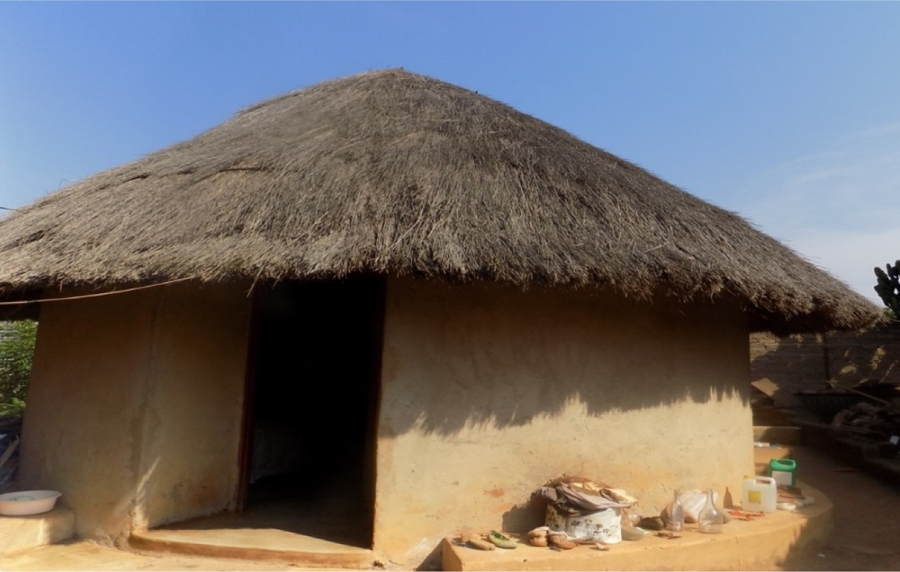
A hut where traditional herbs are kept (Photographer: Researcher).
The healers have their own way of knowing which herbs to use and how to use them for different needs. Most healers indicated that the spirits guide them when it comes to that function. It was observed that the trainees were using different methods of identifying these herbs. After being shown which herbs to use, they each had a notebook in which they wrote down the different herbs and their functions.
One of the healers interviewed took the exercise of keeping a record of herbs a step further by using a mobile phone to capture pictures of the different trees from which particular herbs are collected. She indicated that once everything was captured, she would use her laptop to put everything together. She further said that she planned to do this with all her herbs and the ones that she will still acquire throughout her career as a healer. Herbs are usually kept in containers (see Figure 3) for future use. In some instances, there are also labels inside and on top of the containers in which ground herbs are kept (see Figure 4 and Figure 5).
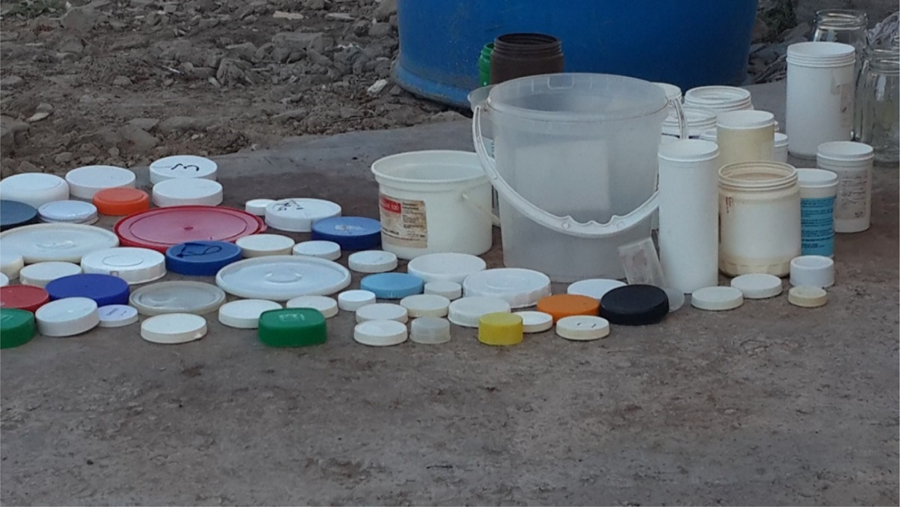
Containers prepared for ground herbs (Photographer: Researcher).
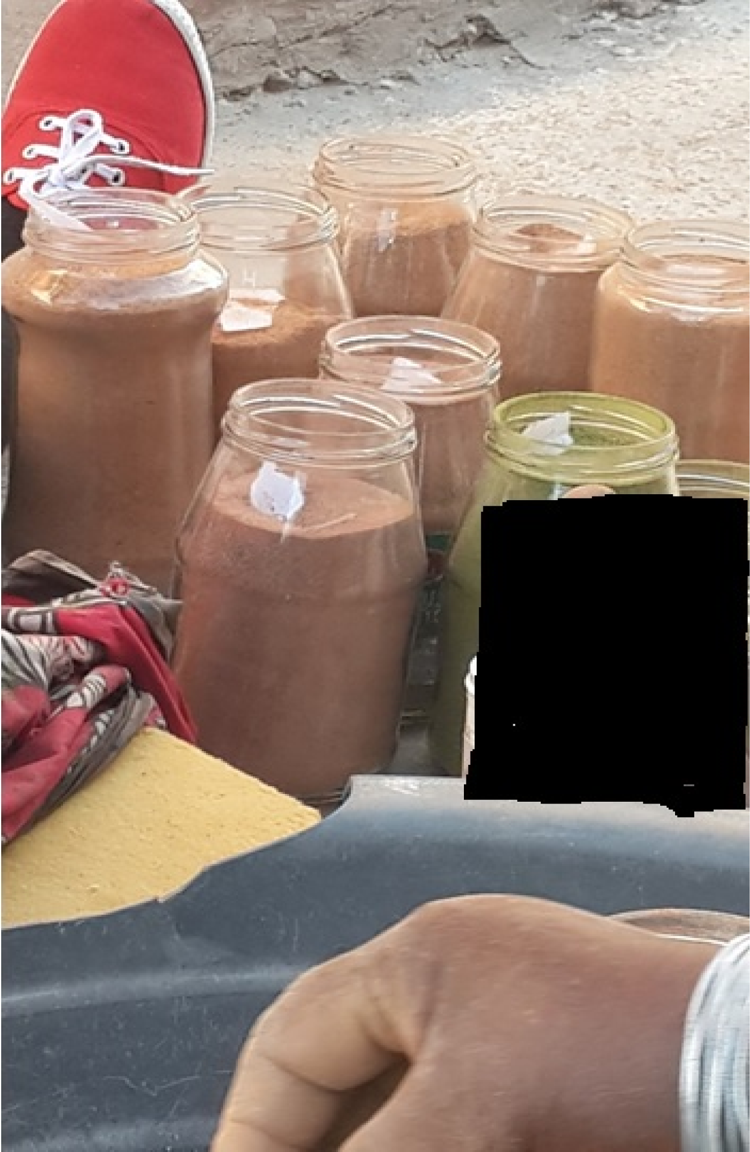
Ground herbs inside containers with notes (Photographer: Researcher).

Herbs inside containers with labels (Photographer: Researcher).
Findings suggested that some healers are documenting their knowledge. After collecting and grinding the herbs, healers recorded the name of the herb on a piece of paper and placed it inside the container with the herb. This exercise came in handy, especially in situations where containers were the same, where the herbs were ground by someone else, or another prepared the medicines for patients. This method allows people to know what is in the containers and such herbs can be used even in the absence of the healer.
Similar to having the names of herbs inside the container, other healers use labels to identify their herbs. Healers attach labels to the containers and write the herb name on the label outside the container. This method works in the same way as the method discussed above, but saves a lot of time and is more convenient. Instead of opening every container to find a particular herb, the healer will simply read the labels and find the correct herb. Participants were asked to indicate methodologies they employed to preserve knowledge and Table 2 shows the responses that were given.
Methodologies employed to preserve knowledge.
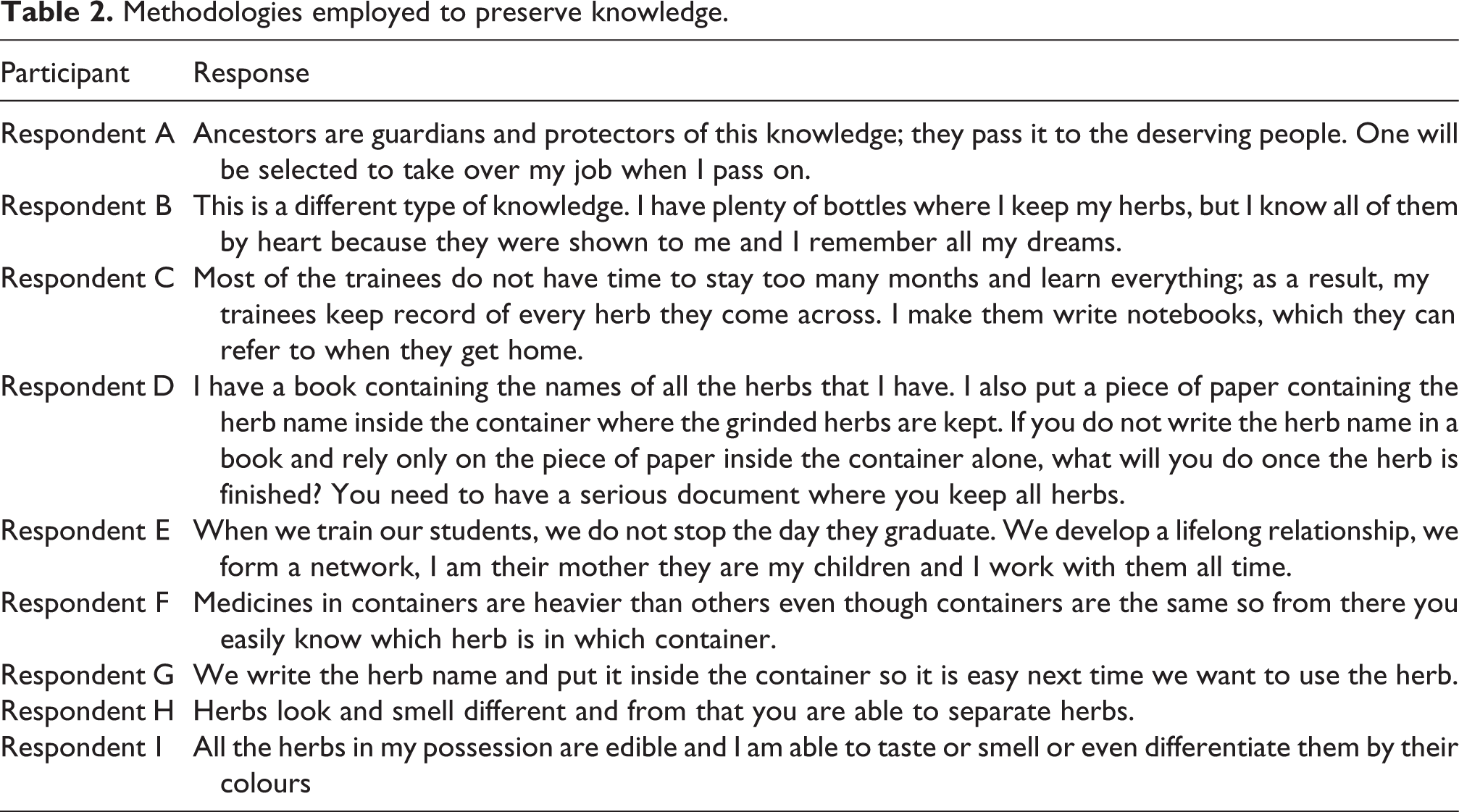
The findings revealed that there are different methodologies employed by healers to externalise their knowledge for preservation. The study also revealed that the older healers still prefer the old tried and tested way of preserving their knowledge by depending on their memories to know and handle different herbs. The current generation of healers has access to books, most have gone to modern schools, and they have different ways of preserving their knowledge.
The findings also suggested that notebooks may be used to record full details of the herbs to supplement the methodologies mentioned above. Such a book contains all the names of the herbs and their uses. There is no standard way of recording these herbs in any particular book. Some healers organised herbs according to their functions, for example, herbs that are used on children are grouped together, and those that are used for sexual problems are grouped together. These books are written by hand and each individual is responsible for their own book. Healers will continue to update this book every time they come across new information. The writing of these notebooks was sometimes motivated by the fact that some of the trainees could not afford to attend training for many months because of job commitments and family responsibilities; therefore such healers would keep a record of everything they were taught so that they could refer to it when they returned home.
During interviews, the investigator asked participants to share their insight on how they preserve the knowledge they gained over the years for future use. Firstly, participants were asked how they made sure the knowledge they gained over the years was preserved and not lost to future generations. Table 3 shows the main responses given.
How healers preserve knowledge for future use.
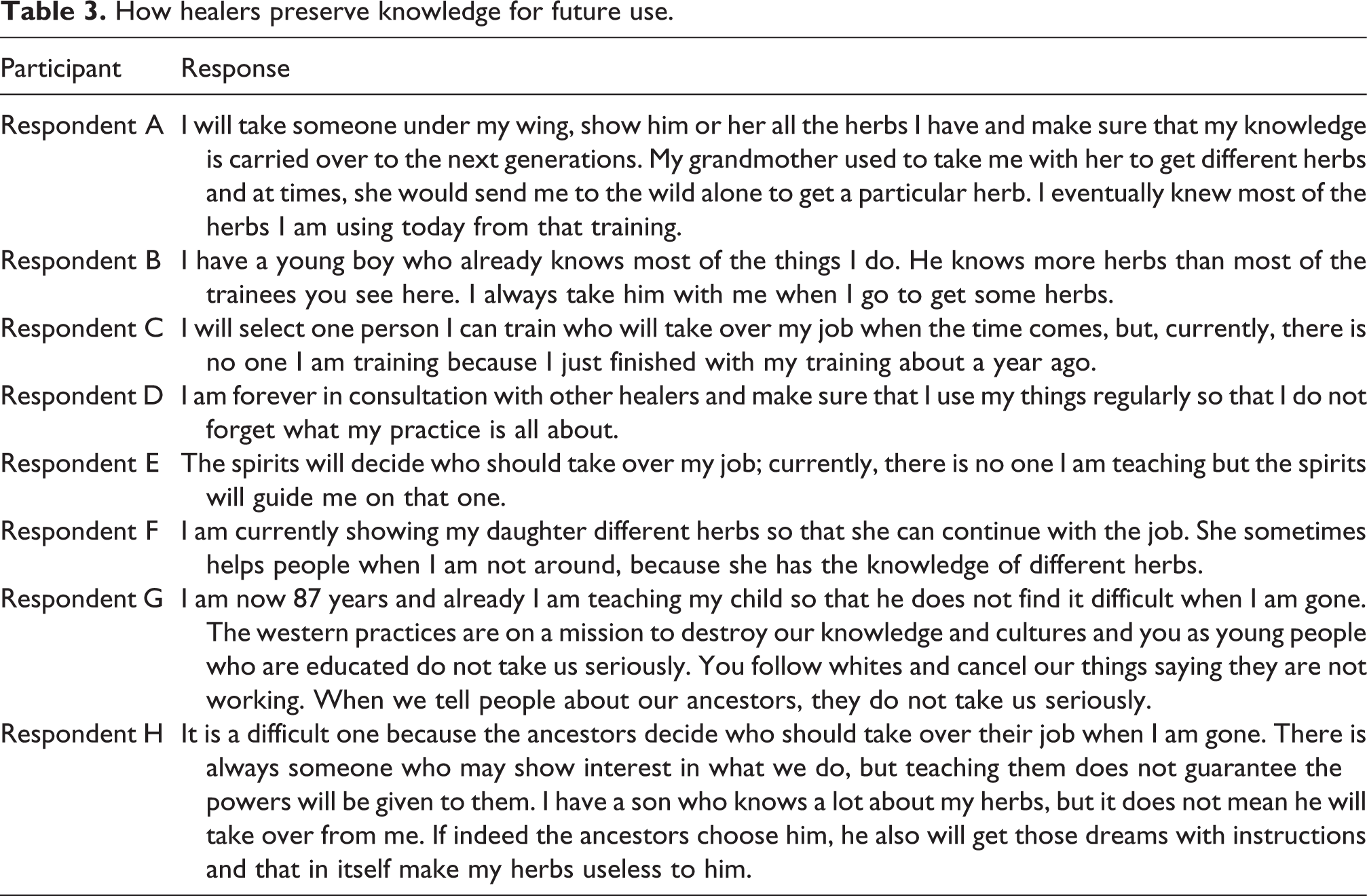
The participants highlighted that it is important they take someone in the family under their wing and share all their experiences to ensure that their knowledge is carried over to the next generation. However, they cautioned that it is not guaranteed that the ancestors will choose that particular person to take over from them as the ancestors may decide on someone else. While others have already started the job of teaching someone in the family, others have left that task to the ancestors because they believe that the power of healing is controlled by the ancestors. This group believes that it is the responsibility of the ancestors to preserve knowledge of traditional healing. They believe that the ancestors keep the knowledge safe until they identify someone deserving they can pass it on to. This group of healers is against the documenting of this knowledge. They indicated that they knew everything by heart because it was shown to them in their dreams and they still had that picture of their dream in their heads. They mostly identified their herbs through smell, taste, weight and colour.
When it comes to the actual preservation of the knowledge healers use for medicinal purposes, Ngoepe and Setumu (2016) proved that such knowledge could be documented. In their heritage projects in the Makgabeng area of Limpopo, Ngoepe and Setumu (2016) documented stories and IK ranging from origins of clans, burning of witches, rainmaking, divine bones and chieftainship. The findings also revealed that healers were in agreement that the preservation of their knowledge is very important.
Conclusions and recommendations
This study established that the overwhelming majority of healers believe that the ancestors preserve knowledge of traditional healing; however, these healers also use other ways to preserve this knowledge. The findings by Adekannbi, Olatokun and Ajiferuke (2014b), suggest that some education at the basic level reportedly helps in the transmission of TMK. This was confirmed by the findings in the current study, which suggest that the current generation of healers can read and write, which allows them to use books, laptop computers and other ways to document knowledge of traditional healing. To that effect, the study concludes that even though the bulk of knowledge of traditional healing is still preserved orally, some of it is slowly being documented for preservation.
The study further established that indigenous knowledge, including knowledge of traditional healing, is in danger of extinction, unless interventions to facilitate preservation are put in place. There are, however, different initiatives globally and in other parts of South Africa that are working on documenting traditional medicines derived from different medicinal plants for preservation. The study recommends that similar projects be initiated on a global scale to preserve this knowledge for future generations.
Indigenous knowledge is created and owned collectively by the communities and its use and transfer are guided by traditional laws and customs, current intellectual property rights, which are enforced in the modern world and are largely individual rights based on Western legal and economic parameters, as well as Western property law that emphasises exclusivity and private ownership, and reduces knowledge and cultural expressions to commodities that can be privately owned by an individual or a corporation. This in itself has a negative impact on the preservation of indigenous knowledge, including traditional medical knowledge, because traditional healers are blocked by patents and big fences from access herbs that are central to their practice. It is recommended that governments do more to protect healers in this regard because such practices are interfering with the local knowledge base when it comes to traditional healing. Such practices also affect an indigenous community’s cultural practices.