




Abstract
The benefits of the application of ICT tools in the education of high school learners have been well-established in various studies. As developments in technology have increased the reach of electronic information resources and enhanced learners’ access to educational information, it is imperative that these tools be available and accessible without any hindrances whatsoever to high school learners. This study was set out to evaluate the state of ICT infrastructure available to high school learners for the advancement of access to educational information while accentuating the efforts by the South African government to promote computer access in schools. This study underscores the importance of ICT tools for high school learners in ensuring quality educational outcome. A triangulated design was adopted to collect both qualitative and quantitative data on the condition of ICT-enabled access to educational information from Grade 12 learners and teachers in the Fort Beaufort Education District, Eastern Cape South Africa. Results show that learners’ access to educational information is constrained by inadequate provision of ICT infrastructure, restricted access to ICT tools, regulations for use of personal ICT tools and absence of information literacy for high school learners. The study, therefore, recommends the improved and dedicated provision of ICT resources, ICT-enabled educational information literacy program and flexibility of rules regarding the use of personal ICT tools at school.
Introduction
Access to needed information especially educational information and the ability to utilise the accessed information is required to enhance significant contribution to the development of the evolving society and fourth industrial revolution which is almost upon us. As technology increases in innovation so does the need to develop skills to deploy the tools to achieve the goal of harvesting information for human development. Access to ICT tools in particular is fundamental to inclusive, sustainable, effective and efficient access to information (UNESCO, 2016; UNDP, 2003).
Technology constitutes part of the structural and relational mechanisms of access identified by Ribot and Peluso (2003) in their theory of access. The reformative power technology has wielded on the information age, on access to educational information in particular, is terrific (Aristovnik, 2012; Polly, 2011; International Reading Association (IRA), 2009; Underwood, 2009; Nachimias, Punie, Zinnbauer and Cabrera, 2008; Ben Youssef and Dahmani, 2008; Balanskat, Blamire and Kefala, 2006; Spurlin, 2006; Newhouse, 2002; Mioduser and Shemla, 2001). The information age is characterized by the influence of ICT on the way things are done in every sector of human economy, the educational sector inclusive. A remarkable impact of ICTs is the rapid production and distribution of information (White, 2009; Khan and Shafique, 2011). The introduction of the printing press brought about a huge increase in the amount of information that can be produced and stored. The advent of information and communication technology (ICT) escalated the possibilities and opportunities by bringing about a means of rapidly disseminating information thereby encouraging the production of more information (Ifijeh, 2010; Khan and Shafique, 2011; Kadiri and Adetoro, 2012).
The tools, as they are developing in efficiency, complexities and innovation, provide a platform for accessing all classes of information across economic, gender, institutional, cultural, ideological, political, and geographical, among other boundaries, globally. The UN (2002:3) is emphatic on this by noting that ‘There is a wide consensus that information and communication technologies (ICT) are central to the creation of the emerging global knowledge-based economy and can play an important role in accelerating growth, in promoting sustainable development and eradicating poverty in developing countries as well as countries with economies in transition and in facilitating their effective integration into the global economy.’
The importance of the application of ICT tools in the education of high school learners is established in the literature (Karsenti and Collin, 2011; Mdlongwa, 2012; Kaur and Singh, 2015). Developments in technology have increased the relevance of electronic information resources and the importance of computer literacy. Consequently, it is imperative for these tools to be made available and accessible to learners.
ICT tools are mediums of access to information, therefore access to these tools is fundamental to learners’ access to educational information. It is significant to note that there have been efforts by the South African government to promote computer access in schools, as noted in Ndlovu (2010) and Mdlongwa (2012). Notwithstanding, research has shown that the provision and application of ICTs in high schools in South Africa is still below expectations, beginning from the issue of availability and accessibility of the ICT tools in the school, followed by the intellectual ability to make effective use of the tools, the educative use of the tools and then the subject of the ICT divide (Ndlovu, 2010; Aduwa-Ogiegbaen and Iyamu, 2011; Ng, 2012; Kaur and Singh, 2015).
This study is underpinned by the need to uphold the tenets of fundamental human rights, as subscribed to by governments of civilized societies and which the Republic of South Africa, since the collapse of the Apartheid regime in 1994, has ardently pursued through constitutional enactments and reforms. In furtherance of such rights, which include access to education, the ramifications of such access required systematic investigation. A fundamental structure aimed at enhancing the development of a nation is the educational system and policies put in place. Educational information through the school systems (formal and informal) has been the vehicle of achieving the goal of development. How the educational information is made available, the channel through which it could be and is accessed, and the regulations with the skill support for the various dimensions of access is of concern to researchers, information service practitioners/ professionals, policy makers, educational institution administrators and the learners as stakeholders. Consequently, this study is concerned with high school learners’ access to educational information through ICT tools in the Fort Beaufort Education District of Eastern Cape, South Africa. The Province, by economic and educational outcome indices, is one of the poorest provinces in South Africa (Bank and Kamman, 2008; Pillay, Rule, Rubin and Ntema, 2010).
Statement of the problem
Information has become ‘the oxygen’ needed to survive in the era of great technological revolution. It is increasingly essential for success in every sphere of life: cultural, educational, occupational, organizational, social, among others (Ranaweera, 2008; Kadiri and Adetoro, 2012). The value of information in the fourth industrial revolution makes access to information a subject of critical concern for knowledge creation and development, an area where education at all levels holds sway. UNESCO (2016: 17) believes ‘information and knowledge are key determinants of wealth creation, social transformation and human development’. The ability to operate and use ICT tools to access information is one skill that has been recognized essential to succeed in the information age (Karsenti and Collin, 2011; Kaur and Singh, 2015). Consequently, emphasis has been shifting to equipping users with the ability and skills to access all classes of information using the evolving ICT tools (Pinto, Cordón, and Díaz, 2010). South Africa is a developing country with the digital divide still very present. This is especially the case in poorer regions of the country, which include the Province of the Eastern Cape, hence, access to information and communication technologies is of utmost importance to learners that would otherwise not be able to afford these tools. The aim of the study is therefore to assess the level of access to educational information enabled by ICT tools in the Fort Beaufort Education District in the Eastern Cape Province, South Africa. The outcome of the study promises to provide benchmark empirical information on the status of constrained access to educational information despite constitutional provision and rights of citizens to education.
ICT Tools for accessing educational information: empirical review
Mdlongwa (2012) reports that ICT has not only delivered quick and efficient generation of information at schools but has also demonstrated positive links to students’ achievement. Notable among the gains of technology access as reported by researchers include the facts that learners’ affirmed that content was available to them through the Internet, that they were connected to experts and had access to global resources, and that they had access to global materials. Additionally, in a policy briefing, the Africa Institute of South Africa proposes that ‘the education authorities of the national Department of Basic Education (DBE) and Higher Education and Training (DHET) in South Africa adopt measures that will see the use of ICT as a means of enhancing education in South Africa’ (Mdlongwa, 2012: 12).
The foregoing indicates the role of technology access in enhancing access to information for active and guided enquiry learning in the 21st century. However, observations from the literature indicate that policies and curriculum statements in respect of ICT provisions and utilization have not been operational in many South African schools, especially in rural areas where they cannot afford the necessary funds for the procurement of ICT infrastructures (Mdlongwa, 2012). This serves as an explanation of how access to ‘capital’ or funds can hinder or enhance access to educational information resources.
ICT tools as identified in the literature include: desktop and laptop computers, the Internet, smartphones and television among others (Valk, Rashid and Elder, 2010; Aduwa-Ogiegbaen and Iyamu, 2011). It is important to note that scholars mostly use the term ICT rather than ICT tools in the literature. Aduwa-Ogiegbaen and Iyamu (2011) surveyed the availability and utilization of classroom computers across urban and rural schools in South Western Nigeria. Findings from the study revealed that the schools were not adequately equipped. The researchers perceived this as a deprivation of the right to education the students were entitled to in terms of information technology literacy. It was therefore recommended that government at the local, state and federal level should provide adequate funds for procurement of ICT facilities and that every school should strive to achieve a ratio of one (1) computer to five (5) students in urban and rural schools.
Kiptalam and Rodrigues (2011) in an evaluation of the accessibility and utilization of ICTs among secondary school teachers in Kenya discovered that increase in access to information and communication technologies by teachers has led to a better utilization of the resources. This finding is supported by a similar finding by Ani (2013) that utilization of information depends on accessibility and both enhance productivity. Ani (2013) investigated the effect of accessibility and utilization of electronic resources on the productivity of academic staff in two selected Nigerian universities. The study revealed that there was a positive correlation between these variables. It was noted that access to relevant literature in their respective disciplines is one of the basic needs of the university lecturers. Learning resources that are available and accessible are more likely to be accessed and used. The utilization of an electronic resource is dependent on its accessibility, which is equally dependent on the availability of the resource, and all these contribute to the level of productivity. In the same vein, access to ICT tools by learners is an imperative for their access to educational information.
The Internet is the most recent of the information and communication technologies and has been recognized for its capacity to enhance access to information over a wide range of subjects globally (Odede, 2013). Considering the level of education and maturity of high school learners, scholars have opined that unlimited access to the Internet could be detrimental to learners’ well-being (Lewis, Miller and Buchalter, 2009). One major reason is due to the fact that the Internet affords access to different kinds of information, including those that could be unhealthy for young people. Should high school learners therefore be denied access to the Internet? Would denying these learners of access to the Internet not be an infringement on their right of access to information? Would lack of access to the Internet in high schools not constitute a barrier to learners’ access to educational information? Interestingly, there is a policy provision for the censorship of access to Internet. The Children’s Internet Protection Act (CIPA) permits librarians to censor the information minors have access to on the Internet (Kennedy, 2005). Access to the Internet can therefore be made available and accessible to learners without the fear of exposing them to unhealthy information. Learners should not be denied access to the Internet because the Internet is one of the tools for learners’ access to educational information.
Kaur and Singh (2015) accentuated the tremendous impact of technology on the modern society. They conducted an analysis of the usage of ICT tools among school children in Punjab. Findings from the study revealed that personal computers were the most commonly used among the respondent and for educational purposes. Smart phones were used mainly for recreation purpose while tablets were used for both recreation and education purposes. Gender analysis revealed that boys used these ICT tools more than girls. Oladunjoye and Benwari (2014) assessed the effect of gender, socio-economic status and environmental setting on computer literacy among some undergraduate students in Nigeria. They discovered that students with high socio-economic status are more likely to be exposed to computer resources and their use than students from low socio-economic backgrounds. Besides, ownership of computer resources is more common among students from high socio-economic background than students from low socio-economic background. The researchers noted that these three factors: gender, socio-economic status and environmental setting significantly influenced computer literacy among the undergraduate students.
Moreover, beyond the provision of ICT tools in schools, the pedagogical use of these tools to solve subject domain problems has been recognized as the actual test of learners’ information literacy proficiency (Cuban, Kirkpatrick and Peck, 2009). Although the present generation of learners have been said to be predominantly technologically inclined (Lippincott, 2010; Ng, 2012), studies have shown that learners are more inclined to use ICT tools for social and entertainment purposes rather than for educative reasons (Ng, 2012; Kaur and Singh, 2015).
There is a need for the intervention of information literacy educators to help channel learners’ inclination for information and communication technologies towards a profitable and educative end (Ng, 2012). According to Ndlovu (2012), South African classrooms lacked quality use of ICT tools because teachers were not well trained to perform this duty. It was noted that the training of learners on the educative use of ICT tools is dependent on the competence of educators in the use of these ICT tools. Therefore, the lack of properly trained information literacy educators is a major concern for the pedagogical application of ICT tools in high schools. ‘UNESCO is strongly advocating the building of knowledge societies where the power of information and communication helps people access the knowledge they need to improve their daily lives and achieve their full potential. Increasingly, the concept of information literacy is considered as very important to enable people to deal with the challenge of making good use of information and communication technology.’ (Horton, Jr. 2008: iv). Franklin (2005:1) affirmed that: ‘Information-seeking and use have become complex processes for college and university students due to the proliferation of information technologies and resources in all types and formats’.
Theoretical explication of access to educational information
It is established in the literature that the ability to effectively use ICT tools is indispensable to learners’ educational and overall development in the present times (Kaur and Singh, 2015). Access to educational information is contextualized in the jurisprudential notion of freedom of speech. This is posited within international conventions which makes access to any class of information a fundamental human right. In the United Nations Development Programme practice note on access to information, a four-point position is advocated thus: ‘Implementation of the rights to freedom of expression and to access information are prerequisites for ensuring the voice and participation necessary for a democratic society. Access to information and communication build on these internationally recognized rights and together encompass the core principles of democratic governance: participation, transparency and accountability. The promotion and protection of both access to information itself and flows of information that exist between constituents, government, parliament, community groups, civil society organizations and the private sector are of equal importance. It is essential to create and strengthen communication mechanisms that enable poor people to influence national and local government policy and practice’ (UNDP, 2002: 2)
The position is in tandem with the South African government legislative and policy efforts by integrating into the laws and policies of the post-apartheid education system of South Africa the principles of the right to quality education and information. Notably, the right to education policy provision was supported by the provision of the right of access to information (South African Government, 1996). The Promotion of Access to Information Act 2 of 2000 (South African Government, 2000), reinforces the concern to enhance access to information. Given the post-independence and post-apartheid legislation, which is supposed to guarantee rights to information (educational information inclusive), the actualization of the legislative enactments and implementation of the policies and action plans remain issues to examine. The Department of Education in a 2011 report documents the commitment of the government to improve learning outcomes, which has been a major challenge facing South African basic schools. To explain the disconnection between the universal rights which underpin access to information as a resource and the enabling laws to give the rights power to ‘bite’, the theoretical proposition of Ribot and Peluso (2003) becomes a veritable explicatory argument.
The theory posits that resource availability, by way of provision through legislation and by implementation, is not sufficient for access to that resource. The dimension of ability is very critical to harnessing resources. The resource in question in this instance is the educational information necessary to enhance desirable educational outcomes and promote educational development of the learners in basic schools. Thus by the theory, educational information access is constrained where the right is diminished by the ability.
Conceptually, availability and accessibility are twin outcomes of the right to information. Thus educational information that is either adequately or inadequately provided but becomes inaccessible through inadequate accessibility channels is a breach of the fundamental right to access that information. In the era of technological innovation provided by ICT, the ICT tools constitute one of the channels of accessibility. Thus the provision of the tools, access to tools, and technical support for the tools constitute unconstrained right to access.
Adequate provision of ICT tools in schools is paramount to the application of ICTs in the education of learners, especially for access to educational information (Gyamfi, 2005). The first influencer of access identified by Ribot and Peluso (2003) is technology. It is part of the ‘strands of powers’ that can be exercised and can impact on learners’ ability to obtain information. Access to information and communication technology (ICT) plays a significant role in mediating access to information specifically, as well as access to education generally. Other ‘influencers’ of access to educational information include school and public libraries that are well stocked with educational information, operational mechanisms and expert supports to compliment the provision. Given the information revolution that had impacted tremendously on the operation of these other influencers of access, it becomes necessary to examine the dimension of ICT tools in the equation of access to educational information with reference to the Fort Beaufort Educational District of Eastern Cape Province of South Africa
Method adopted for the study
In order to establish the existence of resource constraints, the study identified ICT tools as a primary influencer of access to educational information. The research focus is on the availability, nature of the tools and institutional structure put in place to provide ICT- enabled educational information. The nature of data required for explication of the enquiry requires survey research design which took into consideration the population characteristics of the education district where the subjects (learners) are based. The study population is the Fort Beaufort Education District Grade 12 learners. The estimated population size of the Grade 12 learners was 1905 (Eastern Cape Department of Education Report, 2013). The survey was carried out after obtaining ethical clearance from the University of Fort Hare Human Research Ethics Committee.
The study adopted multi-stage sampling technique which involved division of the population into four clusters. This multifaceted sampling approach began with the division of the population into clusters. Four clusters were constituted as follows:
Cluster 1: High schools in Adelaide, Seymour and Bedford
Cluster 2: High schools in Fort Beaufort
Cluster 3: High schools in villages surrounding Alice and in Alice Town itself
Cluster 4: High schools in Middledrift and Debe Nek
One school was randomly selected from each cluster, making four schools. The selection process considered factors such as multiculturalism, availability of boarding facilities, school location and previous grade 12 pass rates at the schools. This meant that in some cases the randomisation process within the clusters was repeated until an approximate outcome was reached. This is an accepted practice (Creswell and Clark, 2012; Latham, 2007) since in cluster sampling the first phase involves constituting clusters, that were in this study based on geographical proximity of the areas combined.
The sample size was calculated using ‘Raosoft’ sample size calculator with an error margin of 5%. A confidence level of 95% and an estimated population of 1905 Grade 12 learners yielded a sample size of 320 learners. This sample size was proportionality distributed among the selected schools. A mixed method approach was utilized to obtain data from 331 Grade 12 learners and 29 teachers. Research instruments including questionnaires, structured interviews, and focus group discussions were used in collecting data from the respondents.
Data collected was analyzed using measures of central tendency for the quantitative data and content analysis for the qualitative data as structured by the ‘Atlas-ti7’ statistical package. The quantitative data was presented as simple averages for items of ICT tools accessible (Table 1 results) by the learners and weighted averages of items measuring frequency of use of the ICT tools identified (Table 2 results).
Nature and adequacy of the ICT tools provided for learners
Following are the results of the data collected, from which the theme ‘ICT tools enabled access to educational information’ is developed. The study sought to find out learners’ level of access to ICT tools that are capable of enhancing and facilitating their access to educational information. Learners were asked to indicate the type of ICT tools they had access to and the ownership of these tools.
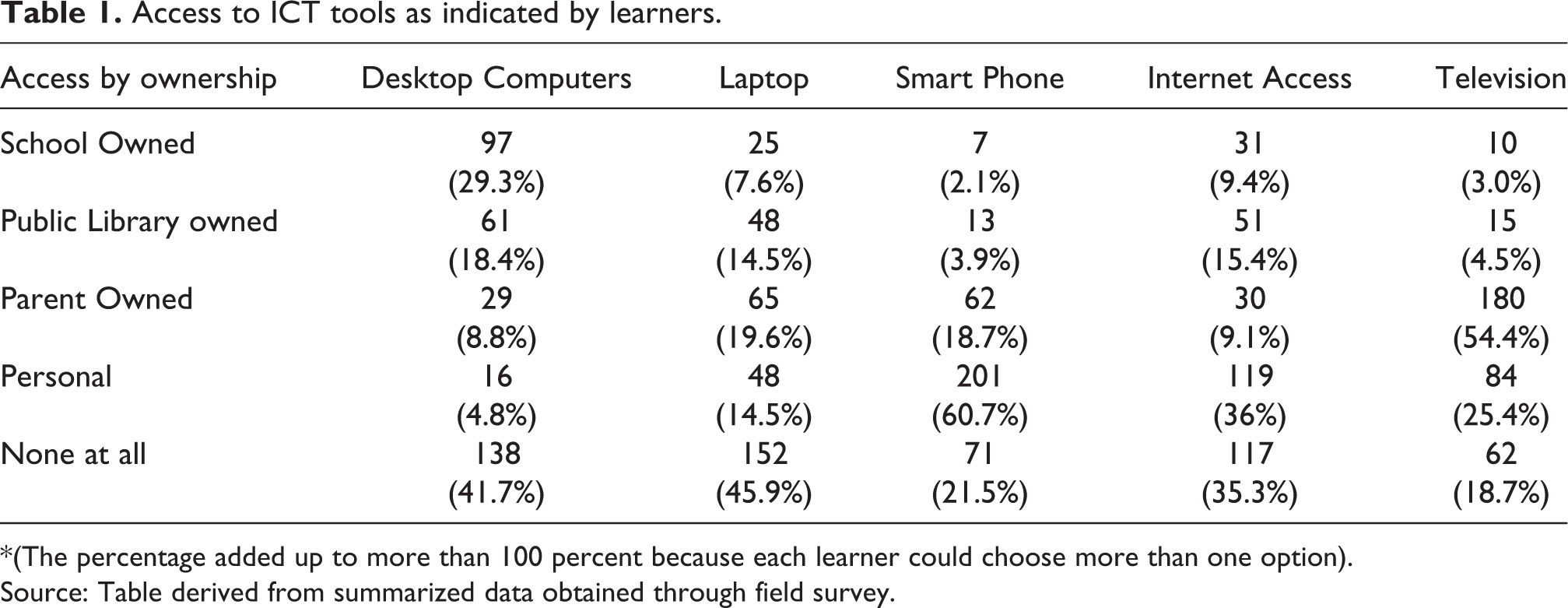
Access to ICT tools as indicated by learners.
*(The percentage added up to more than 100 percent because each learner could choose more than one option).
Source: Table derived from summarized data obtained through field survey.
The results reveal that (41.7%) of the learners lacked access to desktop computers while 45.9% of the learners do not have any access to laptop computers. However, majority of those that claimed access to desktop computers indicated that the computers were school owned. This result is consistent with previous studies like Ndlovu (2010); Aduwa-Ogiegbaen and Iyamu (2011); and Karsenti and Collin (2011).
Moreover, 60.7% of the learners claimed personal ownership of smartphones while 18.7% indicated access to parent owned smartphones. About 4% and 2% have access to public library and school owned smartphones respectively. A little above one fifth (21.5%) of the learners indicated that they do not have access to smartphones at all, a factor that could be due to their economic condition. Further, majority of learners claimed access to their parent’s television, while (25.4%) indicated access to television at the public library’. About (18.7%) reported not having access to television at all. The use of smartphones among learners was reported in Valk, Rashid and Elder (2010); Sarfo and Ansong-Gyimah (2011); and Kaur and Singh (2015). Kaur and Singh (2015) also reported access to television among learners in their study, stating that it was mostly used for entertainment.
Considering Internet access, the percentage of those who had personal Internet access (36%) is a little higher than those who did not have access at all (35.3%). A small proportion (9.4%) of learners claimed access to Internet at school. This is a significant deprivation of means of access to current educational information. Aduwa-Ogiegbaen and Iyamu (2011) and Li and Ranieri (2013) reported similar results. Majority of the learners indicated lack of access to the Internet. This suggests that the learners were cut off from all information available on the Internet including needed educational information. What could be adduced for this absence of Internet access to the schools? Could it be that the educational authorities do not see the need for it as a necessary educational enhancing tool or there were inadequate funding or other structural and geographical challenges? Socio- economic issues may also not be ruled out. This lack of Internet access is a major indication of constraints of access to educational information and implementation of the laws promoting access based on one of the basic rights of the citizen
Level of access to ICT tools for educational information
A further assessment was conducted on learners’ access to ICT tools through the focus group interview. The interview was focused on learners’ access to these tools within the school unlike the questionnaire which considered access from other sources. Learners were also able to express themselves using their own words.
Figures 2 and 3 show the thematic classification of the responses. These are: the availability of a computer laboratory in the school; the number of computers available in the school; learners’ access and use of these computers; the provision of information technology training for learners by the school. Interestingly, the results corroborated the result presented in Table 1 above.

Availability and Use of Computer / Computer Laboratories. Source: Figure generated from the Focus Group Discussion.
From the figure above, it was discovered that only two among the sampled high schools had computer laboratories. Further, the schools had computers in the computer laboratories though the available number of computers varied across schools. In one of the two schools with computer laboratories, there were 12 computers reportedly locked in the computer laboratory without learners’ access. Learners in the other school had access to the laboratory only during their Computer Application Technology (CAT) classes. However, access to these computers was limited to certain category of students based on their choice of CAT as a subject. Only learners who offer CAT had access to the computers, hence those learners not offering CAT basically lacked access to the computers in their school. This is indicative of restrictions on learners’ access to educational information and denial of right. Students who attend CAT classes appear to be the lucky ones as regards access to ICT tools in the sampled schools. This is a case of disparity in access among learners attending the same school. However, CAT students also identified restrictions on their access to these tools as access to the computer laboratories was limited to the period of the CAT classes.
Findings about learners’ access to the Internet within the school in the focused group interview are presented in Figure 2. The figure explains the situation of Internet access in the schools. It was revealed that majority of learners did not have access to Internet in the schools. The students also complained about slow Internet connectivity since everyone would want to access the Internet at the same time (the short period of the CAT classes). It was reported that in most cases, students who accessed the Internet did so at home or somewhere else.

Learners’ level of access to Internet within their school. Source: Figure generated from the focus group discussion.
Restricted access to school computers is a barrier to learners’ access to information (Ndlovu, 2010). The computers cannot be locked up somewhere when learners are expected to become computer literate. Moreover, usage of school-owned computers should not be limited to some category of learners. Respondents further complained about the duration of access. Privileged learners were only allowed access to the school = owned desktop computers for the limited period of their CAT classes.
This brings to light the importance of home access to ICT tools for learners, since teachers may not be willing to stay in school beyond the closing hours, especially for a non-boarding school. Home access to ICT tools affords learners the convenience of access and use of these tools at their individual learning pace (Pickard, 2002). The researcher found in this study that majority of learners lacked access to ICT tools at home. Besides smartphones, personal ownership of these tools was also rare among the learners. This could be indicative of the socio-economic background of the learners. According to Oladunjoye and Benwari (2014), the better the socio-economic status of a student, the better the student’s access and use of ICT tools and consequently, the better the literacy level of the student.
Regulation of sources of ICT tools for information access
Access to ICT tools is expected to be holistic. In this wise, ownership and sources could be both institutional and individual. In view of the possibility of easy access to information through smartphones, the researchers sought to find out if learners are allowed to make use of their smartphones to access educational information at school. The result is presented in Figure 3. The figure revealed that the use of smart phones was prohibited during school hours in the schools. However, learners claimed they used smart phones outside school (at home and in the hostel). The reason advanced for the prohibition at school was said to prevent disturbance and to enable learners concentrate on their studies during school hours.
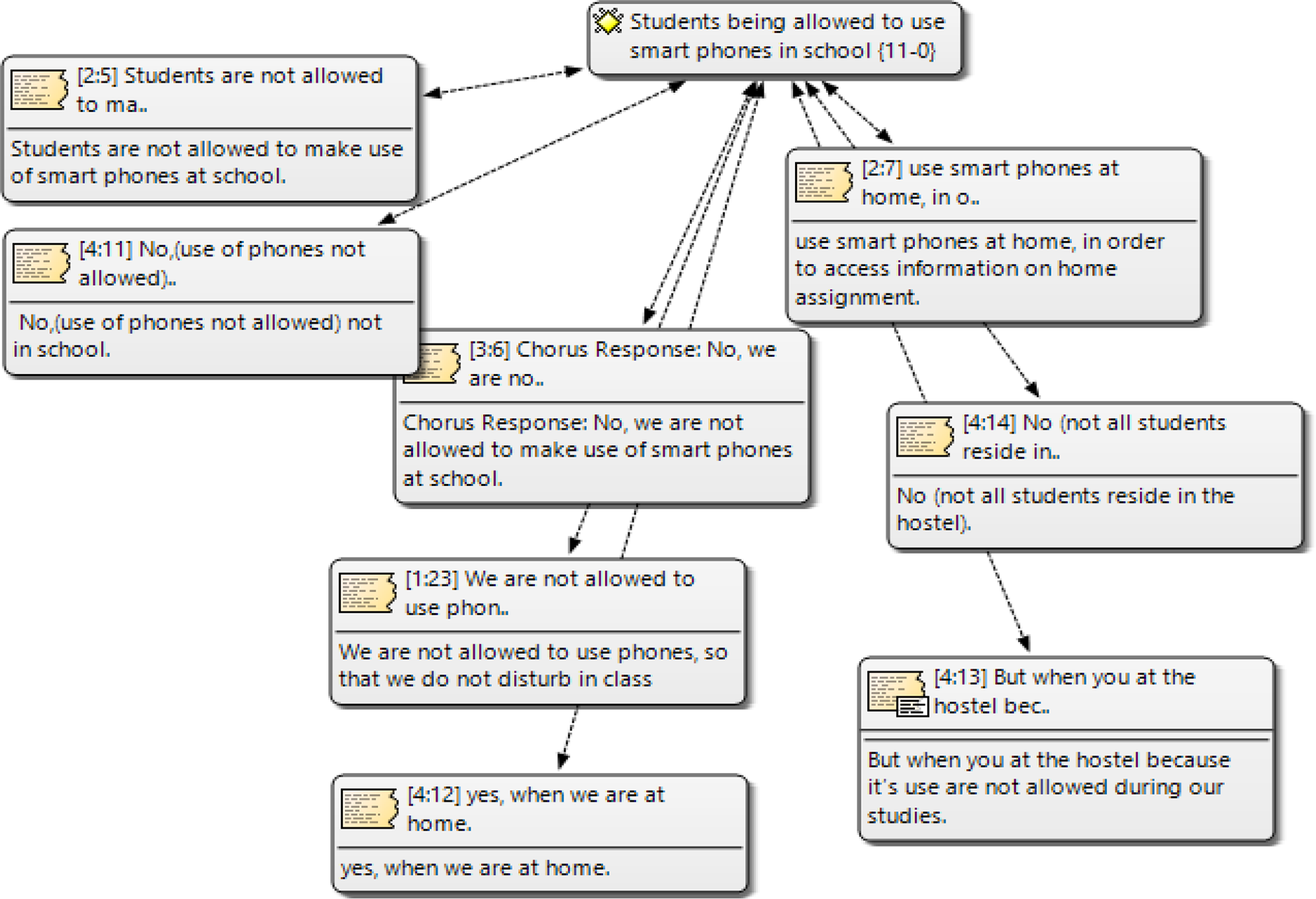
Usage of smart phones in accessing information at school. Source: Figure generated from the focus group discussion.
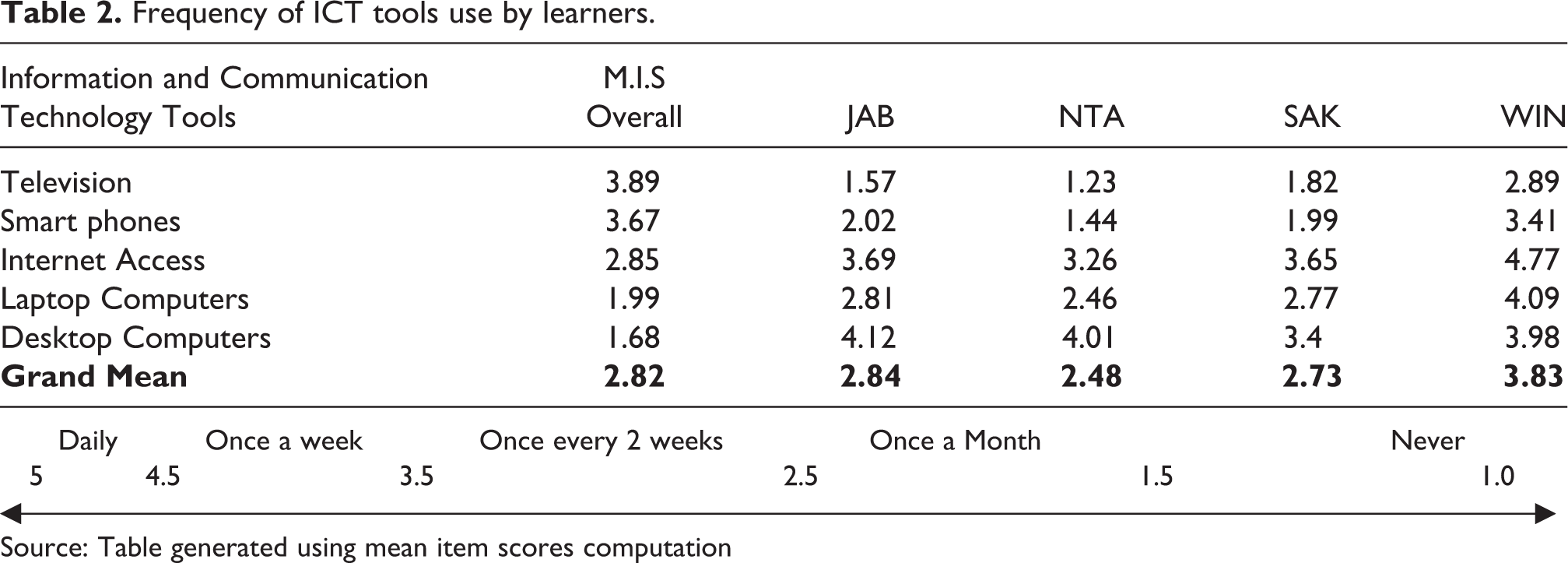
Access to ICT tools is not an end in itself. The use of these tools by learners for access to educational information is what actually contributes to the literacy development of learners. Therefore, learners were asked to indicate the frequency at which they make use of the ICT tools for access. Result is presented in Table 2’
Judging from the overall mean item scores above, the respondents indicated that they use television and smartphones once in a week. Internet access was reportedly once in a fortnight and computers (laptop and desktop) once in a month. It can therefore be said that learners seldom use information and communication technology tools. Emwanta and Nwalo (2013) opined that beyond the availability of electronic information resources, the computer literacy level of learners affects their use. The infrequent use of ICT tools as discovered in this study could therefore be a consequence of the inability of learners to satisfactorily use ICT tools.
Frequency of ICT tools use by learners.
Daily Once a week Once every 2 weeks Once a Month Never
5 4.5 3.5 2.5 1.5 1.0

Source: Table generated using mean item scores computation
On the other hand, it is important to note that use is a corollary of access. Studies have affirmed that the availability and accessibility of information resources including ICT tools is a major determinant of the use of these resources (Ugah, 2008; Adeoye and Popoola, 2011; Ani, 2013). Therefore, it may not be unexpected that the learners rarely use ICT tools because of relative lack of access to these tools. In essence, the learners’ access to educational information is limited.
State of ICT enabled information literacy
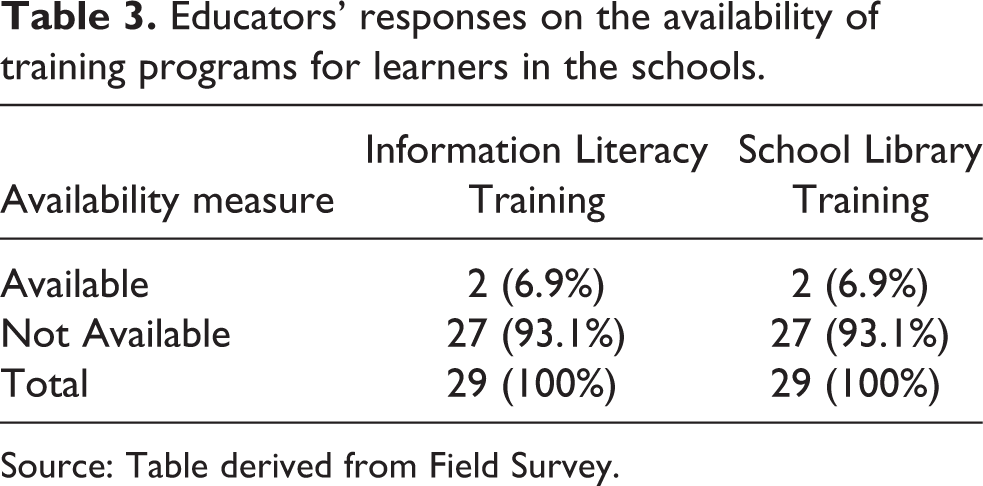
In order to discover the status of ICT -enabled information literacy training and library education that could assist learners in accessing the needed educational information, educators were requested to respond to items of questionnaires on information literacy. However, it was clearly stated in the instrument that if the school has not put up any structure regarding such training, educators should skip that aspect of the questionnaire. Responses as supplied by educators regarding the availability of a school library and information literacy training for learners in the schools are presented on Table 3 below.
Educators’ responses on the availability of training programs for learners in the schools.
Source: Table derived from Field Survey.
Virtually all the respondents indicated that the selected schools lacked training programs on use of the library for access to educational information. Similarly, there were no training programs for learners on the development of information literacy skills in the schools. This implies a deficiency in information literacy education in the schools and may constitute a setback to learners’ access to educational information. Additionally, the lack of training in the use of the library for access to information might have constrained learners’ access to information and amounted to a denial of access to information, which is an extension of denial of freedom of speech and expression. Sheila A. Webber, the Director of the Centre for Information Literacy Research Information School, Sheffield University writing the forword to Mackey and Jacobson (2014)’s book on metaliteracy, believes that: it is a ‘disservice to learners to deny them the opportunity to reflect explicitly on their information literacy and learning’ (Mackey and Jacobson 2014: xvi). Similarly, Haberle (2002: 22) noted that: ‘Given that the information revolution has immensely increased the ability to access and employ information, using various sources including information published electronically, societies are required to have certain capabilities (other than the ability to read and write) to fully utilize these resources. Scholars affirm that society requires multi-skilled learners, who are able to think critically, pose and solve problems, and become independent and lifelong learners’.
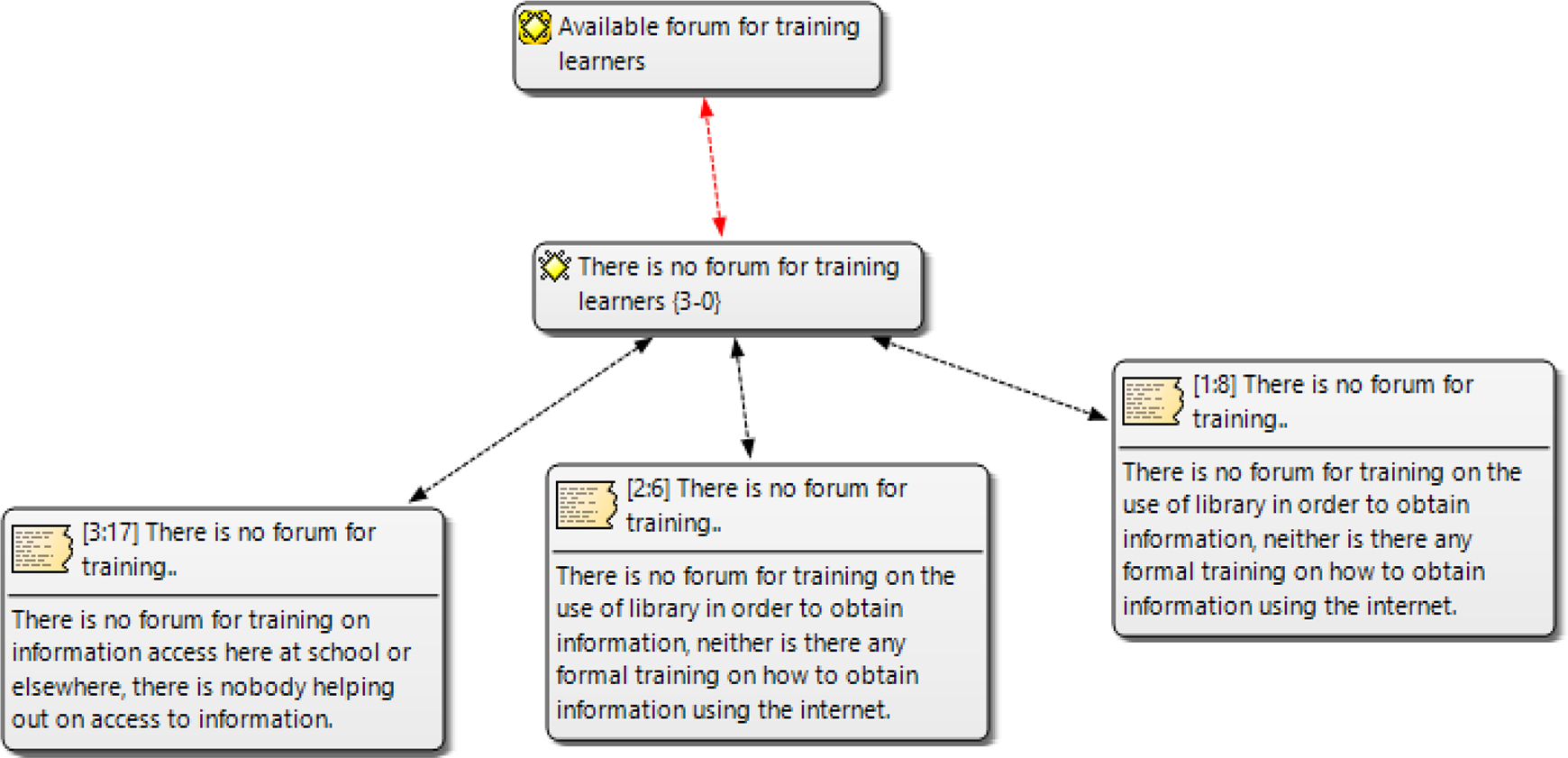
Availability of training on information literacy. Source: Figure generated from the Focus Group Discussion.
Conclusion and Recommendations
The study has presented a wakeup call to government, school administrators and school media professionals to the acute disconnect between rights and access to educational information needed by learners in economically poor constituents of one of the provinces in the Republic of South Africa. The nature and adequacy of ICT tools provided for learners’ access to educational information were greatly inadequate both at school and at home. This situation is a clear indication of disadvantaged socio-economic status of the province, which calls for urgent attention by all stakeholders.
Further findings on access to ICT tools by the learners revealed that coupled with the inadequacy of the ICT tools, there was restricted access to the tools made available at the school’s computer laboratories.
This study established that lack of access to ICT tools exists in the selected high schools investigated. It also reported the need for the educative use of ICT tools by learners to access educational information and solve subject domain problems. It is therefore important that learners are enabled to make use of these tools by making the tools available and accessible to them. Furthermore, proper knowledge of the use of ICT tools is fundamental to access to educational information by learners. Learners need to be taught how to use these tools for their educational development. Pedagogical application of ICTs education in high schools is also very important. There is the need for the intervention of information literacy educators to help channel learners’ inclination for information and communication technologies towards a profitable and educative end.
The training on ICT should be open and made compulsory for all learners. Besides, South African government and high school administrators should ensure adequate provision of ICT tools for every school and unrestricted access to the ICT tools provided. Further, a structure should be put in place for ICT education that affords every learner the privilege of enlightenment and capacity building in information literacy skills. The ability of learners to operate and use ICT tools for accessing educational information should therefore be developed through necessary training.
