



Abstract
The media logic thesis holds that the content of political news is the product of news values and format requirements that media make use of to attract news consumers. This study tests whether three content characteristics – personalized, contest and negative coverage – manifest a single media logic by analysing whether they co-vary over time. It also tests the implicit assumption underlying the media logic thesis that media adhere to a single media logic as one institution. A semantic network analysis measured the degree to which television and newspaper coverage of five Dutch national election campaigns (1998–2010) contained the three content characteristics. The study shows that personalized, contest and negative coverage form three indicators of a single logic that is shared by different media. Since the turn of the century, Dutch political news has simultaneously become decreasingly personalized, less focused on the contest and less negative.
In recent decades, the voices which raise concern about the role of media in politics in general and in election campaigns in particular have been increasing in volume. These concerns are also echoed in scholarly debates. A central topic in this debate is media logic (Altheide and Snow, 1979; Mazzoleni, 1987). Media logic refers to ‘the news values and the storytelling techniques the media make use of to take advantage of their own medium and its format, and to be competitive in the ongoing struggle to capture people’s attention’ (Strömbäck, 2008: 233). The debate on media logic is situated within the broader discussion on the interaction between press, politics and the public.
A field in which media logic plays a central role is the mediatization literature. Mediatization refers to ‘the process whereby society to an increasing degree is submitted to, or becomes dependent on, the media and their logic’ (Hjarvard, 2008: 113). Important aspects of the mediatization of politics are the degree to which the content of political news on the one hand and the behaviour of political actors on the other hand are the product of media logic rather than of political logic (Strömbäck, 2008). This changing relation between media and politics has also been studied from the perspective of changing journalistic practices. For example, Brants and Van Praag (2005) show that journalists have taken on a more interpretive style of reporting rather than a descriptive style, i.e. a style in which ‘interpretation provides the theme, and the facts illuminate it’ (Patterson, 1996: 101). This interpretive style is an aspect of ‘the degree to which the content of political news is shaped by journalistic interventions’, which reflects media logic (Strömbäck and Dimitrova, 2011: 35).
The effect of media logic on the public’s role in the functioning of democracy is related to the media malaise debate. Media malaise refers to ‘the claim that the mass media have a substantial and malign impact on politics and social life’ (Newton, 2006: 209). Media logic is one of these aspects of modern mass media which have been associated with media malaise, especially during election time (Van Santen and Van Zoonen, 2009). However, empirical evidence for the media malaise theory has been scarce (cf. Newton, 2006; Norris, 2000; Strömbäck and Shehata, 2010).
This article studies the manifestation of media logic in the content of political news. The media logic hypothesis presumes that journalists are predominantly guided by news values and their own format requirements in determining their selection and presentation of political news (Altheide and Snow, 1979; Mazzoleni, 1987), resulting in certain content characteristics in political news being highlighted. Three content characteristics corresponding with important news values (Galtung and Ruge, 1965) are prominent in the media logic debate: journalists’ preference for (1) personalized coverage (Campus, 2010; Mazzoleni, 1987), (2) contest and game coverage (Mazzoleni, 1987; Strömbäck and Dimitrova, 2011) and (3) negative coverage (Lengauer et al., 2012).
Until now, personalized coverage (for overviews see e.g. Karvonen, 2010; Van Aelst et al., 2012), contest coverage (for an overview see Aalberg et al., 2012) and negative coverage (for an overview see Lengauer et al., 2012) have been studied separately. Yet it has not been systematically tested whether these three content characteristics are indicators of a single media logic. This article studies the manifestation of media logic in political news coverage by simultaneously analysing the degree of personalized, contest and negative coverage over time. Moreover, it tests the implicit but important assumption underlying the media logic thesis that media form one institution with a single media logic (Strömbäck and Dimitrova, 2011). The study is based on a detailed content analysis of the news coverage of five Dutch election campaigns (1998–2010) of four newspapers, a commercial news broadcaster and a public broadcaster.
Content characteristics manifesting media logic
Journalists’ tendency to interpret political events in line with certain news values is reflected in the content of the news. Personalized, contest and negative coverage are content characteristics which correspond with important news values, as has been identified by a longstanding tradition of news value studies starting with the seminal work of Galtung and Ruge (1965). As Kriesi (2012: 826) sums up, ‘Personalization, just as negativity, conflict and drama, is one of the news values pursued by the mass media in their competition for a mass audience’. These news values have seemingly become more important under pressure of growing competition in the media market: ‘the assumed wishes and desires of the public have become more decisive for what the media select and provide’ (Brants and Van Praag, 2006: 30). Galtung and Ruge (1965) identified persons, elite persons in particular, as an important news value as early as 1965 and it has been found in news value studies ever since (Harcup and O’Neill, 2001). Next, the tendency of media to make the news more sensational and to provide the public with an interpretation of campaign events has made contest coverage, i.e. ‘the strategies, the tactics, and the horse race’, a central news value (Strömbäck and Dimitrova, 2011: 36). Coverage of the political contest in the form of horse race news indeed has been shown to attract voters (Iyengar et al., 2004). Media are furthermore inclined to cover the negative. Although negativity was already identified as a news value in 1965 (Galtung and Ruge, 1965), nowadays it is considered to be so important that it has been described as a ‘news ideology’ (Lengauer et al., 2012: 181).
Media logic is not driven by news values alone. The interpretation and coverage of politics has also changed as a result of changing format requirements due to technological developments. To some extent, these developments highlight the same content characteristics. Television and its visual requirements have ‘literally placed the focus of political debate on candidates themselves’ (Hayes, 2009: 232). More recent developments, like the emergence of Internet news, the upsurge of social media and improved ICT equipment, have amplified the speed of the news. An old journalistic maxim of a balanced appraisal of two sides of a story, for example, is interpreted today as a rationale for conflict coverage, resulting in a quick selection of opposing quotes. So, both news values and changing format requirements highlight personalized coverage and contest coverage as manifestations of media logic.
However, personalized, contest and negative coverage are not the only possible content indicators of media logic. For example, Kepplinger (2002) measured whether the content of political news is the product of media logic rather than political logic by measuring, among other things, which kind of triggers – i.e. events, issues, statements – were covered. Van Aelst et al. (2008) measured the degree to which the coverage of candidates reflects the candidate hierarchy as established by parties. However, the literature review shows that personalized, contest and negative coverage are most central to the media logic thesis. Besides these content indicators, one could also consider various ‘form’ indicators, such as the length of sound bites, the visibility of journalists, the use of wrap-ups and the like (Strömbäck and Dimitrova, 2011). We have decided to exclude these and concentrate on content indicators because we are explicitly investigating whether various media share a single media logic, and it is not possible to measure form indicators such as sound bites in an identical way for different kinds of media (e.g. television and newspapers).
What do we actually know about the size and direction of trends regarding these three manifestations of media logic in political news? The following literature overview shows that the degree of personalized, contest and negative coverage has not linearly increased across the globe.
Personalized coverage
Personalized coverage refers to ‘a heightened focus on individual politicians and a diminished focus on parties, organizations, and institutions’ in the media (Rahat and Sheafer, 2007: 67). In political science, a focus on one particular group of individual politicians, party leaders, has been named presidentialization (Karvonen, 2010). The visibility of politicians in general and the visibility of a limited number of political leaders in particular form ‘two separate sub-dimensions of personalization’ (Van Aelst et al., 2012: 207) to which we will refer as personalized coverage and presidentialized coverage. Both dimensions relate to individualization, that is a focus on individual politicians rather than on the political institutions that they represent. Especially in the context of parliamentary elections, in which parties traditionally play an important role, the presence of individual politicians rather than their parties is important to assess. Personalized coverage includes references to politicians in both their public and their private capacity (Van Aelst et al., 2012; Van Santen and Van Zoonen, 2009).
Several meta-studies have shown that the degree of personalized coverage has increased over time in the United States as well as in Europe (Adam and Maier, 2010; Karvonen, 2010). However, Kriesi (2012) shows mixed trends with regard to personalized coverage of recent election campaigns in Western Europe. The degree of personalized coverage was higher in the 2000s than in the 1990s in Germany and the United Kingdom but lower in the Netherlands, France, Austria and Switzerland. Kriesi (2012) shows a decline in the degree of personalized coverage from the 1990s to the 2000s but an increase in the attention for the top-10 individual politicians in the Netherlands. Vliegenthart et al. (2011) show a mixed picture of recent trends in personalized and presidentialized newspaper coverage in the Netherlands and the UK.
Contest coverage
Contest coverage portrays politics as a political contest between political actors with limited attention for the issues at stake. The coverage of politics as a political contest has been referred to by a wide variety of terms (Aalberg et al., 2012), like horse race journalism (Broh, 1980), the strategy schema (Jamieson, 1992), the game schema (Patterson, 1993) and, more recently, the game frame (Aalberg et al., 2012). These concepts have in common that they refer to coverage of aspects of the electoral contest rather than to coverage of political issues. Since news stories will typically include coverage of both the contest and the issues at stake, it is important to measure the proportion of the story devoted to each.
What we refer to as contest coverage includes both horse race coverage (i.e. coverage of who is succeeding and failing in polls and debates; Kleinnijenhuis et al., 2007) and news about conflict and cooperation (Kleinnijenhuis et al., 2007; Vliegenthart et al., 2011). We see conflict and cooperation as two sides of a coin, i.e. as negative (conflict) and positive (cooperation) manifestations of relations between political actors, similar to the way success and failure are the positive and negative manifestations of horse race news. Conflict has received ample scholarly attention (e.g. Price et al., 1997; Semetko and Valkenburg, 2000), while cooperation has often been disregarded (but see Kleinnijenhuis et al., 2007; Vliegenthart et al., 2011). In two-party systems, conflict is the most exciting storyline. Yet, in multi-party systems, cooperation creates an exciting story as well. Parties can become newsworthy when they cooperate in coalitions, or when they launch ideas about future coalitions, especially when these coalitions include parties on the far right or the far left.
In the United States the attention to the game schema, a form of contest coverage, has increased at the expense of issue news (Patterson, 1993). Similar trends have been found in Germany (Reinemann and Wilke, 2007; Schultz et al., 2005). However, an overview of key findings regarding the use of the game frame by Aalberg et al. (2012) also lists studies which do not find clear linear trends over time (e.g. Sheafer et al., 2008). In the Netherlands, the evidence with regard to contest coverage is mixed. Brants and Van Praag (2006) do not find clear trends in horse race coverage – the first aspect of contest coverage – in Dutch television news between 1986 and 2003. Vliegenthart et al. (2011) find a decrease in the coverage of conflict and cooperation – the second aspect of contest coverage – in Dutch newspaper coverage between 1990 and 2007.
Negative coverage
In an overview of key findings regarding negative coverage, Lengauer et al. (2012: 189) conclude that ‘with very few exceptions … the existing body of evidence hints to predominantly increasing, and overarching negativity towards individual political protagonists and parties’. The tone of the news has been shown to become more negative in the United States (Patterson, 1993) and Germany (Kepplinger, 2000). In the Netherlands, campaign coverage was more negative between 1994 and 2002 than in the 1970s and the 1980s (Kleinnijenhuis, 2003). Yet, on average, the tone of newspaper coverage has become more positive in the Netherlands, and the UK, in the period between 1990 and 2007 (Vliegenthart et al., 2011).
This literature overview shows that especially in the United States political news coverage has become more personalized, more focused on the political contest and more negative. More recent studies, conducted outside the United States, do not show a clear trend in this direction (e.g. Kriesi, 2012; Vliegenthart et al., 2011). Although most scholars see mediatization as a process of continuously increasing adaptation to media logic, mediatization does not need to be a linear, unidirectional development (Strömbäck, 2008). Therefore, the study starts with testing the degree to which political news has been characterized by these three content characteristics over time:
RQ1: To what degree has political news been characterized by personalized, contest and negative coverage over time?
The literature review shows that personalized, contest and negative coverage, which recur in the media logic debate, have received ample scholarly attention (e.g. Aalberg et al., 2012; Adam and Maier, 2010; Karvonen, 2010; Lengauer et al., 2012; Van Aelst et al., 2012). However, with a few exceptions (Vliegenthart et al., 2011; Wilke and Reinemann, 2001), most studies examined just one of these three content characteristics. Because these content characteristics are central to a single debate and they correspond with news values which have increased in importance according to the media logic thesis (Altheide and Snow, 1979), we expect that these content characteristics form three indicators of a single media logic. If these three content characteristics are indeed indicators of a single media logic, they should co-vary over time:
H1: A single media logic: The degree of personalized coverage, contest coverage and negative coverage co-vary over time.
The media logic thesis assumes that media as a single institution are guided by the same news values and format requirements (Strömbäck and Dimitrova, 2011). Media logic is a characteristic of media as a single institution rather than of individual newsrooms. Media have become more similar due to increasing competition (Van der Wurff and Van Cuilenburg, 2001). In Western Europe, the pressure on public broadcasters and traditional newspapers increased due to the introduction of commercial media. In their competition for the same public, public and commercial media are expected to adhere to the same logic. This similarity in the practices and routines in news production has been fostered by the professionalization of the media, which has decreased media diversity due to, for example, uniform education (Glasser, 1992). Consequently, ‘the norms that govern the media overall are often more important than what distinguishes one form of media from another’ (Strömbäck and Dimitrova, 2011: 33).
Limited attempts have been made to systematically examine whether media outlets indeed adhere to the same logic, resulting in news with similar content characteristics. However, Strömbäck and Dimitrova (2011) did study whether media use the same journalistic practices by studying differences in the degree of media interventionism. They found more differences in the level of media interventionism between American and Swedish media than between commercial and public outlets in Sweden. Kriesi (2012: 831) compared the degree of personalized coverage in various media and found ‘surprisingly small’ differences between tabloids and the quality press and ‘quite similar’ results for television news programmes. Based on the assumption underlying the media logic thesis that media share a single media logic, media outlets are expected not to differ in the degree of personalized, contest and negative coverage:
H2: A shared media logic: Media outlets do not differ significantly in the degree of personalized, contest and negative coverage.
Method
This study analyses whether personalized, contest and negative coverage manifest a single and shared media logic in the context of Dutch election campaigns. The Netherlands, a Western European consensus democracy, forms an interesting case. The sociopolitical context in which the Dutch media system has changed differs from the United States and many Western European countries (Brants and Van Praag, 2006) and research thus far has given a scattered image of the manifestation of media logic in the content of the news (Kleinnijenhuis, 2003; Vliegenthart et al., 2011).
News data selection
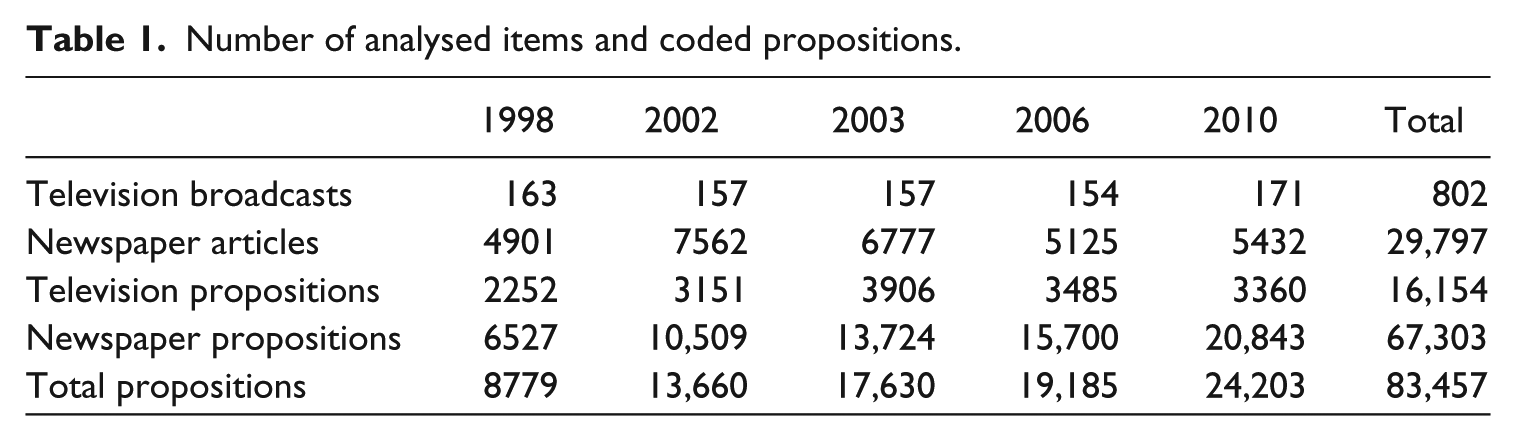
The election campaign coverage of one public and one commercial broadcaster and four national newspapers was included in this study. The two most widely watched news broadcasts, NOS Journaal and RTL Nieuws, and four of the five national subscription-based newspapers, De Telegraaf, de Volkskrant, NRC Handelsblad and Trouw, were analysed. We included all news items mentioning a political actor in the 14 weeks preceding the last five elections (1998–2010). 1 The headline and the lead of the newspaper articles and the introduction by the news anchor and the text of political commentators of the television news items were coded. 2 The coding was conducted during and shortly after each of the election campaigns. Table 1 presents the number of coded television broadcasts and newspaper articles, and the number of measurement units (propositions).
Number of analysed items and coded propositions.
Semantic network analysis
The election campaign coverage was manually coded using a semantic network analysis (SNA) by teams of intensively trained coders. SNA is a relational content analysis method with which relations between political objects, such as political actors and issues, can be extracted from a text. The method can be used to measure the attention paid to objects, such as political actors and issues, the relationship between these objects, and whether this relationship is a relation of association or dissociation (Osgood et al., 1956; Van Atteveldt, 2008). This study relied on a SNA method named the Network Analysis of Evaluative Texts (NET) Method (Kleinnijenhuis et al., 1997; Van Atteveldt, 2008).
The NET method requires coders to divide a text into a number of propositions. A proposition consists of three fixed elements which describe the relations between political objects such as actors and issues: subject/direction/object. The subject is the actor or issue which says, does or causes something; the object is the actor or issues that the subject talks about, what the action of the subject is directed towards, or what the subject has an effect on; and the direction indicates whether what is said, done or caused by the subject is positive or negative for the object. For example, in the headline ‘Geert Wilders proposes burqa ban’, the subject Geert Wilders is positively associated with the object burqa ban. This results in the following coded proposition: Geert Wilders (subject) / +1 (direction) / burqa ban (object).
To test the intercoder reliability for the measures presented in this study, we calculated Krippendorff’s α for scale variables based on the 2010 data. Six of the coders who participated in the analysis of the 2010 data independently coded the same set of 128 articles. The newspaper articles formed the units of analysis. Krippendorff’s α amounted to .77 for the degree of personalized coverage and .91 for the degree of presidentialized coverage, indicating good reliability scores. Krippendorff’s α amounted to .69 for the level of contest coverage and .69 for the tone of the coverage, which are acceptable scores. For a more thorough discussion on the reliability of the NET method, see Van Atteveldt (2008). For a detailed description of the reliability of the 2002 and 2003, and the 2006 data, see respectively Kleinnijenhuis et al. (2007) and Takens et al. (2010).
Operationalization of media variables
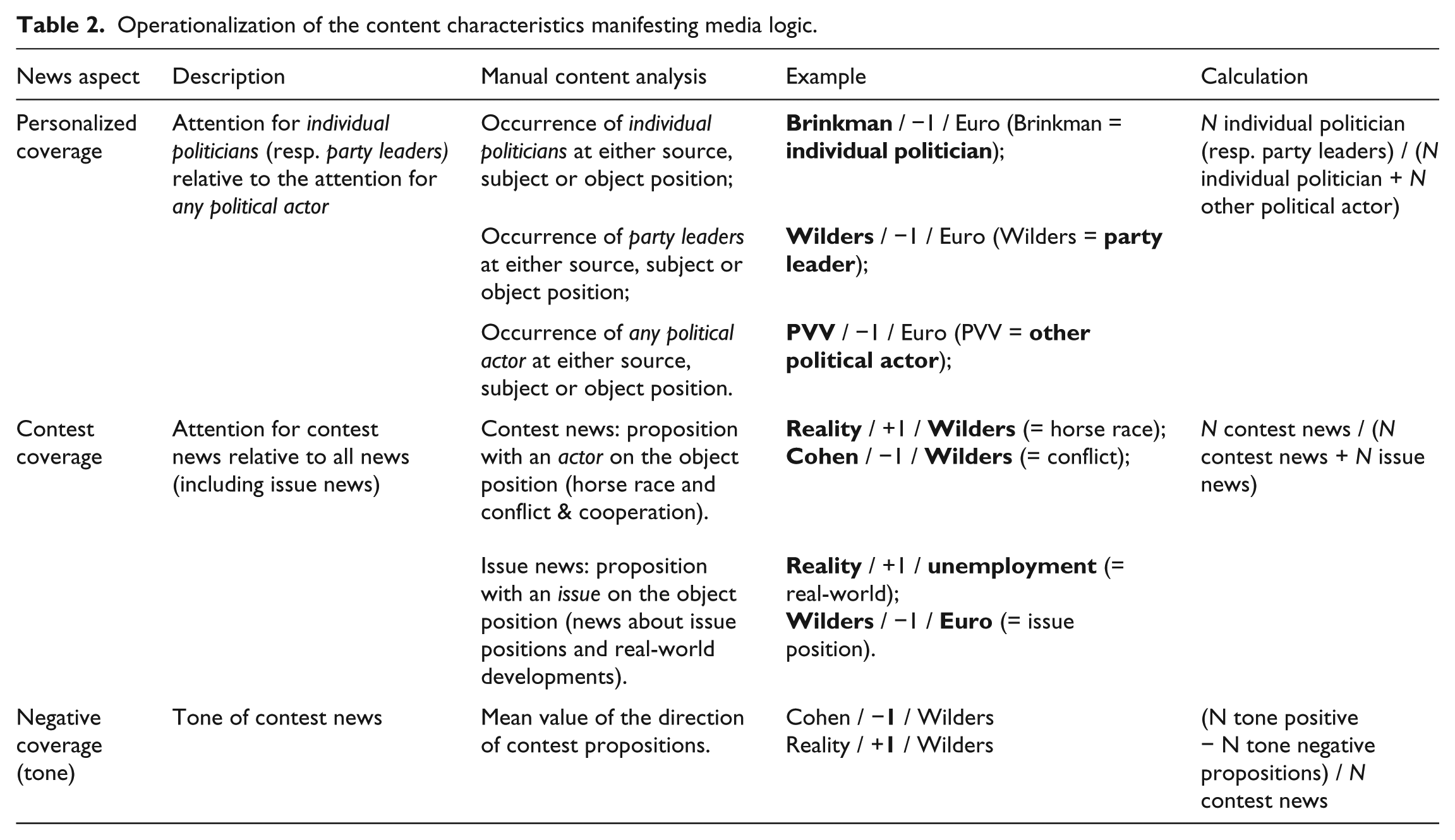
Table 2 shows how the three content characteristics under study can be extracted from the network of relations between political objects. A proposition – the unit of analysis – is either issue-related or contest-related, and in either case it can be personalized or non-personalized, and contest-related news can be either positive or negative. However, at the aggregate level – in this case the news in a certain medium in a certain week – the network of these propositions measures the degree of personalized, contest and negative coverage.
Operationalization of the content characteristics manifesting media logic.
Personalized coverage
Personalized coverage is conceptualized as the relative attention for individual politicians in a certain medium in a certain week. It is measured by di-viding the number of occurrences of an individual politician by the number of occurrences of any political actor. Individual politicians include MPs, ministers, party leaders and candidate MPs, while the broader category of political actors also includes aggregate-level political actors like the government and political parties. The second measure of personalized coverage – named presidentialized coverage – is conceptualized as the relative attention for party leaders in a certain medium in a certain week. The relative attention for party leaders is measured by dividing the number of occurrences of party leaders by the number of occurrences of any political actor.
Contest coverage
Contest coverage is operationalized as the number of propositions containing an actor, without a reference to an issue, relative to all propositions, i.e. the total number of contest propositions and issue propositions, in a certain week and medium. Contest coverage includes coverage of conflict and cooperation as well as horse race coverage, which covers whether an actor is succeeding or failing. Issue news includes issue developments, like the state of the economy, as well as issue statements of politicians or other actors.
Negative coverage
Actor-related negativity, i.e. the negativity of the news about actors (Lengauer et al., 2012), corresponds with the negativity of contest news. The average tone of the news rather than the negativity of the news was measured, since a negative statement that is overshadowed by many positive statements has arguably less significance than a single negative statement. The average tone of contest coverage was calculated by taking the mean score of the direction of contest coverage propositions. Negative coverage refers to news about political actors’ failures and conflicts between political actors, while positive news refers to news about political actors’ successes and cooperation between political actors. A negative score at the aggregate level consequently means that failure and conflict gain more attention than success and cooperation.
Results
Changes in content characteristics over time
Before turning to the hypotheses that test whether personalized, contest and negative coverage are three indicators of a single and shared media logic, we will assess the presence of these content characteristics over time (RQ1). Figures 1a–1c show the degree of personalized, contest and negative coverage in the news about five Dutch election campaigns.
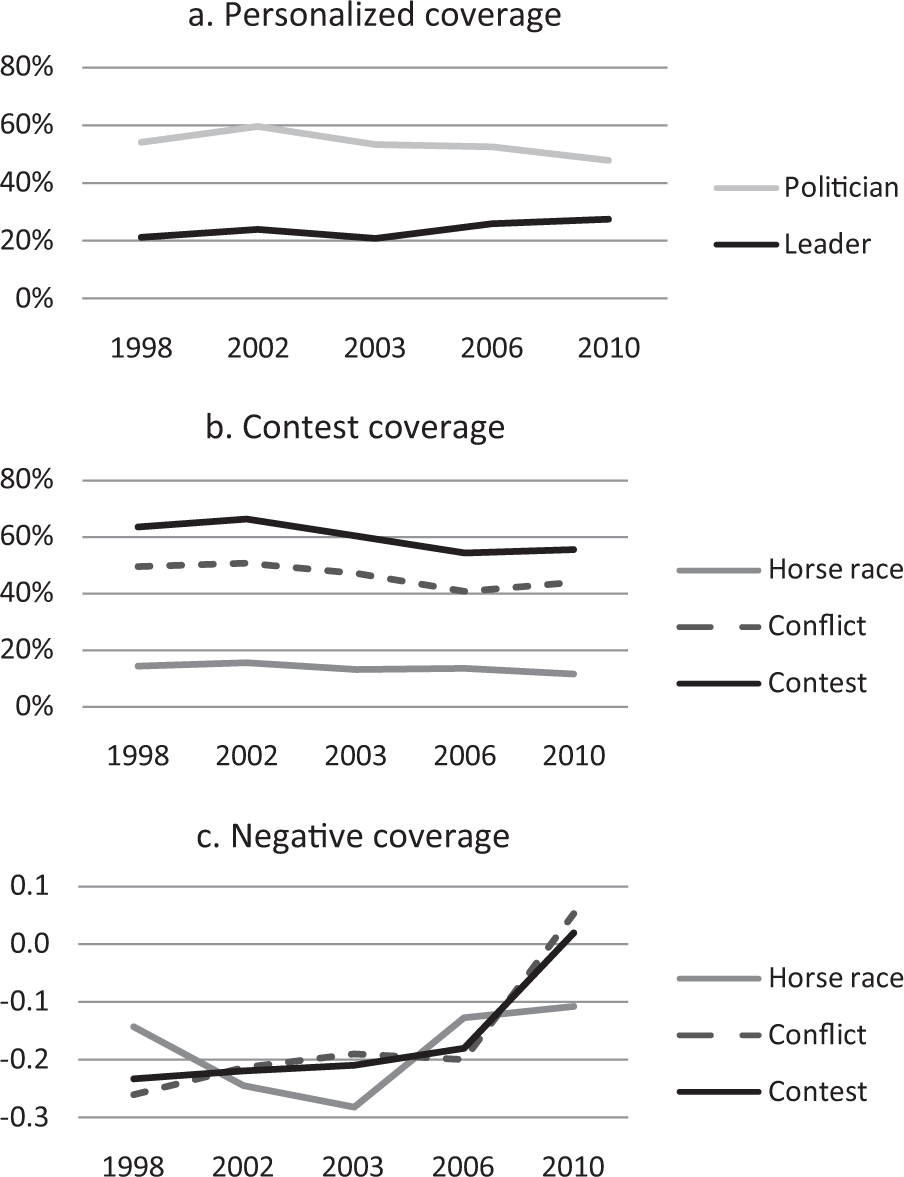
Degree of personalized, contest and negative coverage in Dutch campaign coverage (1998–2010).
Figure 1a shows the degree of personalized coverage over time, presenting the attention share for respectively individual politicians (personalized coverage) and party leaders (presidentialized coverage). The relative attention for individual politicians has decreased since 1998. The exception in this trend is the 2002 election campaign, in which the coverage was the most personalized. While the attention for individual politicians in general decreased, the attention for party leaders increased. Consequently, the results presented in Figure 1a do not support the personalization thesis but they do support the presidentialization thesis. Although media have not become more interested in individual politicians in general, they have become more interested in party leaders.
Figure 1b shows the relative attention for contest news, presenting the relative attention for horse race news, for news about conflict and cooperation, and their weighted average. The attention for contest news is high, ranging from 54.4% in 2006 to 66.4% in 2002. So, measured in propositions, media pay more attention to the electoral contest than to the political issues at stake. Although the attention for contest news fluctuates from election to election, the attention for this type of coverage is lower in recent years than at the beginning of the period under study. This holds true for both the attention for horse race news and the attention for news about conflict and cooperation.
Finally, Figure 1c shows the dynamics of the tone of the news over time. A distinction is made between the tone of horse race news and the tone of the news about conflict and cooperation. The figure also shows the weighted average of the tone of these two news types. The tone of the news is predominantly negative but has become more positive during recent election campaigns. There was a clear peak in positive coverage during the 2010 election. In this campaign, media even paid more attention to cooperation (positive) than to conflict (negative).
To measure the size and significance of these trends, multivariate analyses were conducted. The degree of personalized, contest and negative coverage are the dependent variables, week and election year are the independent variables, and medium and medium type (television broadcasters vs newspapers) are two nested factors. The relative attention for party leaders (presidentialization) is included separately since Figure 1a showed that this sub-dimension of personalized coverage shows dynamics that are divergent from the general measure of personalized coverage.
Election year has a significant negative effect on personalized coverage (b = −.0082, t(418) = −5.93, p < .001) and contest coverage (b = −.0077, t(418) = −5.44, p < .001) and a significant positive effect on the tone of the news (b = .0196, t(418) = 8.01, p < .001). Election year moreover has a marginally significant positive effect on presidentialized coverage (b = .0032, t(418) = 1.87, p = .06). This means that every four-year election cycle, the amount of personalized coverage decreased by 3.28 percentage points (the regression coefficient of −.0082 multiplied by four years), while the relative attention for party leaders increased by 1.28 percentage points. Additionally, the amount of contest coverage decreased by 3.08 percentage points, and the tone of the news became .08 more positive on a scale from −1 to 1. To answer RQ1, the news became more presidentialized but less personalized, more substantive, and less negative.
A single and shared media logic?
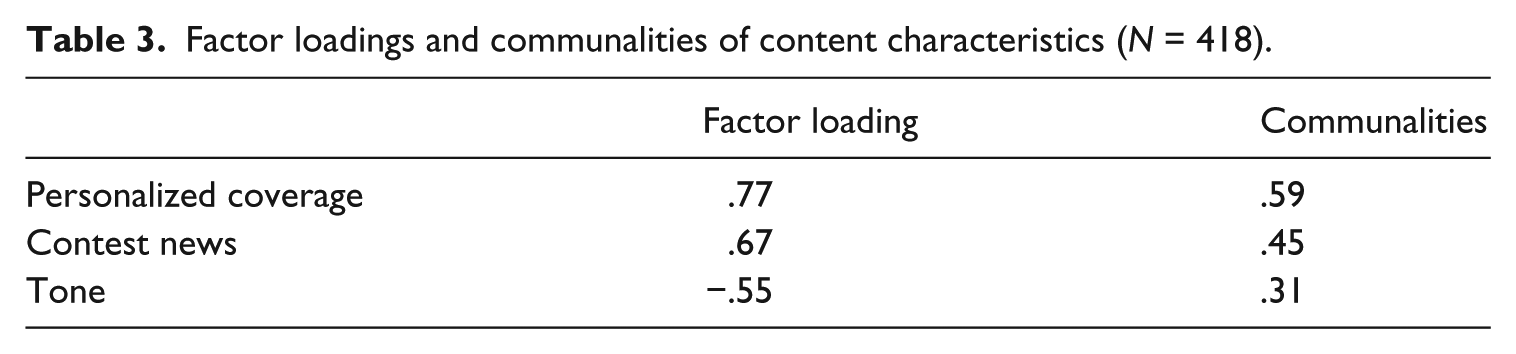
The main aim of this study is to test whether the degree of personalized, contest and negative coverage are indicators of a single and shared media logic. Hypothesis 1 states that the content characteristics co-vary, which would suggest that they are indicators of a single media logic. The analysis presented in the previous section showed that the trends in personalized, contest and negative coverage all run in the same direction. The hypothesis was more rigorously tested by conducting a principal components analysis, which determines whether the content characteristics are indicators of a single factor. The coverage of a certain medium in a certain week forms the unit of analysis. The three content characteristics load into one factor with an eigenvalue of 1.35, indicating that personalized, contest and negative coverage can indeed be considered as indicators of a single logic, thereby confirming Hypothesis 1. The communalities displayed in Table 3 show that this factor explains about half of the variation of personalized coverage and contest coverage and about 30% of the variance in the tone of the news.
Factor loadings and communalities of content characteristics (N = 418).
Hypothesis 2 states that media outlets do not differ significantly in the degree of personalized, contest and negative coverage. Table 4 shows the averages and standard deviations of these content characteristics per media outlet.
Average appearance of content characteristics per medium.
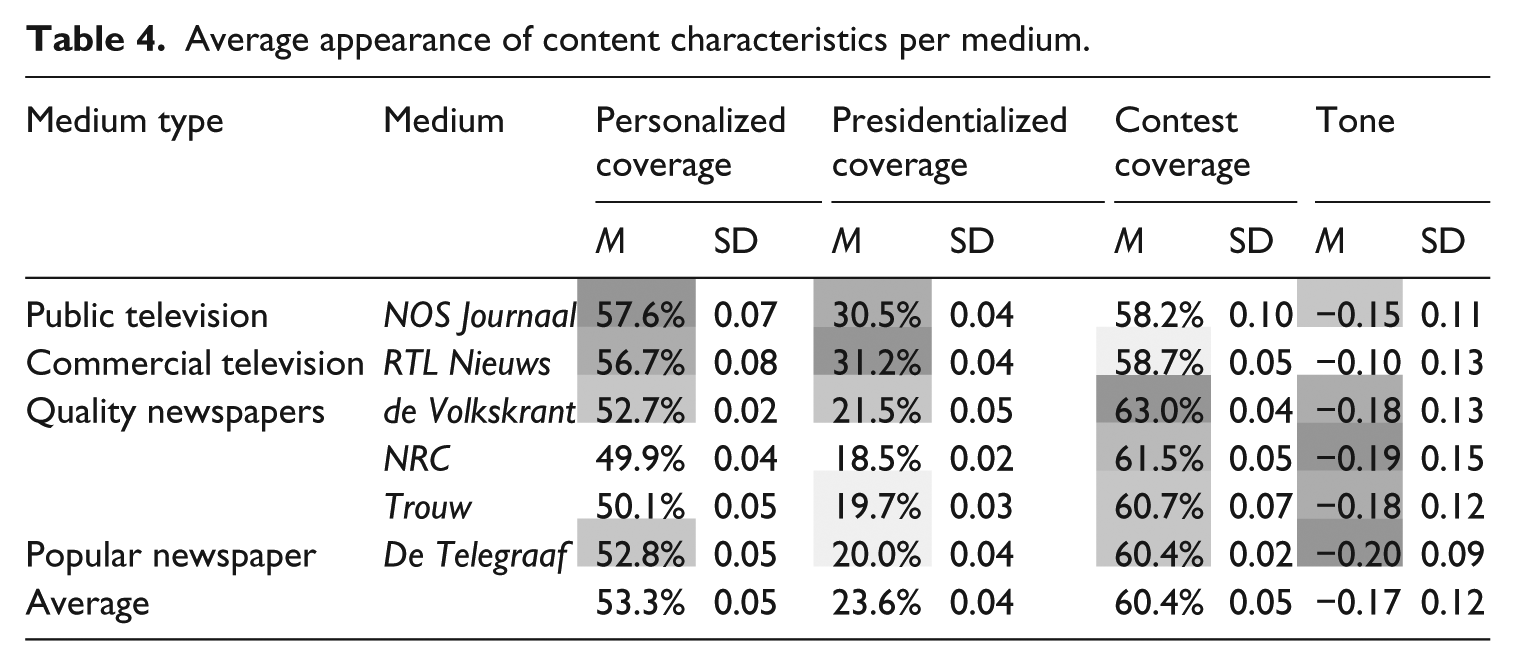
As evident from Table 4, there are variations in the degree of personalized, contest and negative coverage between media outlets. Most of this variance is between the medium types (television or newspaper) rather than among the newspapers or broadcasters, respectively. Television broadcasters pay more attention than newspapers to individual politicians and party leaders, while they pay less attention to contest news and are less negative. The multivariate analyses discussed in the previous section show that newspapers and television broadcasts differ significantly from each other in the degree of presidentialized (F(1,410) = 24.90, p < .001), contest (F(1,410) = 10.38, p < .01) and negative coverage (F(1,410) = 7.32, p < .01) but not in the degree of personalized coverage. Not a single difference between individual media outlets is significant.
So we can conclude that newspapers do not differ from each other in the degree of personalized, contest and negative coverage, nor do the most widely watched public and commercial news broadcasts. However, newspapers and news broadcasts do differ from each other in the degree of presidentialized, contest and negative coverage. These findings reject to an extent Hypothesis 2, which states that all media outlets share the same media logic, resulting in a similar degree of personalized, contest and negative coverage. Interestingly, these results do show that there is one logic guiding television news journalists and a slightly different logic guiding newspaper journalists.
Conclusion and discussion
This study tested whether personalized, contest and negative coverage are indicators of a single media logic that is shared by different media. The three content characteristics load into one factor, which shows that they are indicators of a single media logic (Hypothesis 1). So, it is useful to simultaneously study personalized, contest and negative coverage as indicators of media logic. The factor explains about half of the variance in personalized coverage and contest coverage and about 30% of the variance in negative coverage. This is not surprising since journalists who are guided by media logic still need to respond to certain political events which do not always lend themselves to personalized, contest and negative coverage. Examples are success in the polls, i.e. positive contest news, and coverage of party leaders’ issue stances, i.e. personalized issue news. So, coverage which is more personalized is not inherently more focused on the contest or more inherently negative. The analysis shows nevertheless that if the degree of personalized coverage is higher, the degree of contest coverage and negativity is also higher.
Since the differences in personalized, contest and negative coverage between media outlets are limited (Hypothesis 2), the implicit assumption underlying the media logic literature that different media share the same media logic holds largely true. However, significant differences in the content characteristics did occur between television broadcasters and newspapers, whereby broadcasters focus more on party leaders, while newspapers focus more on the political contest and are more negative. Thus, newspapers and broadcasters adhere to a slightly different logic, which can be explained by differences in their formats. Television’s format requires talking heads, which explains the focus on individual politicians (Hayes, 2009), while newspaper headlines require ongoing narratives about the political contest.
In the period between 1998 and 2010, campaign coverage in the Netherlands became less personalized, more substantive and less negative (RQ1). This is out of line with meta-studies in the field of personalization (Adam and Maier, 2010; Karvonen, 2010), seminal studies on contest news (e.g. Patterson, 1993), or key findings regarding negativity (Lengauer et al., 2012). However, it is consistent with a recent decrease in personalization in the Netherlands and three other Western European countries found by Kriesi (2012) and a recent decrease in conflict coverage and negative coverage in the Netherlands found by Vliegenthart et al. (2011). This decrease in the manifestation of media logic shows that the influence of media logic on news content is decreasing.
Where in time should we position this decrease in the influence of media logic on news content? Kriesi (2012) showed that the degree of personalized coverage in the Netherlands was more than 15 percentage points higher in the 1990s than in the 1970s. Moreover, the degree of contest coverage increased between 1994 and 2002. Campaign coverage between 1994 and 2002 was also more negative than campaign coverage in the 1970s and 1980s (Kleinnijenhuis, 2003). These studies show that media logic as manifested by these content characteristics gained ground in the period before the 2000s. So, the influence of media logic on news content seems to have peaked around 2002, after which its influence declined. These movements in personalized, contest and negative coverage show that Strömbäck (2008) justly stated that the degree to which the content of political news is a product of media logic rather than political logic need not be a unidirectional process. It also confirms the conclusion of Brants and Van Praag (2006) that media coverage across the globe is not linearly converging into American-style media coverage.
The shift in the balance between the influence of media logic and political logic on news content in the Netherlands took place in the context of fragmentation of the Dutch political landscape. Declining support for the traditional parties has resulted in a fragmented party system with more competing parties. A larger number of parties simply means more party leaders, which increases the degree of party leader coverage. High fragmentation also increases the likelihood of cooperation in new and unexpected coalitions, which reinforces ‘the political culture of non-adversariality that comes with consensus democracy and that puts a brake on negative and cynical reporting’ (Brants and Van Praag, 2006: 39).
The decreasing influence of media logic on media content in the period under study is in line with the relatively recent professionalization of Dutch political parties (Brants and Van Praag, 2007). Political parties have, for example, put more effort into selecting party leaders through internal party leader elections (Koole, 2006). The simultaneous decrease in personalized news suggests that parties learned to close their ranks by limiting the communication through the mouths of other politicians. The main task of political parties from the perspective of political logic is to inform the public about their issue positions and solutions for societal problems. The professionalization of this task seems to have paid off as denoted by the increase in the attention for political issues relative to the attention for the political contest. This is not to say that the professionalization of political parties results in political logic controlling the content of political coverage. On the one hand, political parties seem relatively successful in decreasing coverage of the political contest in favour of political issues, which is in line with political logic. On the other hand, political parties place their leaders more strongly at the fore, which suggests that they have internalized the logic of the media and try to use it to their advantage.
This study’s simultaneous analysis of personalized, contest and negative coverage over time and across media showed that these characteristics can be seen as indicators of a single media logic which is largely shared between media. Additionally, it suggests that the influence of media logic on news content has recently decreased in the Netherlands. This raises interesting new questions concerning the interaction between media, politics and the public. Have politicians internalized media logic or is political logic taking hold? And how does the decrease of personalized, contest and negative coverage affect the public? By showing how media logic can be operationalized using different content-based indicators, this study paves the way for the large-scale comparative work that is needed to find answers to these questions.
Footnotes
Funding
This study is part of a research project which has been funded by the Netherlands Organization for Scientific Research (NWO), Grant No. NWO 311-99-170.