



Abstract
This article analyses discourse on benefit fraud in Swedish and British newspapers. It furthermore compares discourse on fraud in newspapers and political blogs in the two countries. In Sweden, fraud is primarily articulated as a collective social problem in policy discussions related to the health insurance programme. In the UK, it is often articulated employing strategies commonly associated with crime news narratives, and centred on images of individual cheaters. The main result of the analysis presented here is that these observed differences between British and Swedish media representations are related to the ways in which the relationship between the welfare state and the citizens traditionally have been constructed in liberal and social democratic contexts respectively. Political attempts to highlight the issue of benefit fraud, and dominant media representations of such attempts, must therefore be understood not as attempts to combat fraud, but rather as attempts to delegitimize the more general aim and purpose of the welfare state. They challenge the deservingness of welfare recipients in general, not just the ones that cheat, and they thereby transform the conditions for public trust in the welfare state. News discourse on fraud in both countries establishes a neoliberal, financialized and individualized notion of welfare dependency, through which the relationship between social and structural circumstances on the one hand, and poverty, exclusion and inequality on the other, become blurred. The comparison of newspapers and blogs suggests that although dominant media representations are contested through citizen-created journalism in both contexts, they also limit the conditions for discursive struggles over the issue of benefit fraud significantly.
Keywords
This article compares discourse on benefit cheating in Sweden and the UK. It furthermore compares how cheating is framed in dominant news media to the ways in which it is talked about in citizen-created journalistic texts, more specifically political blogs, in the two countries. The study understands the legitimacy and impact of policy-change claims as inextricably linked to the particular setting in which they are made, and the comparative design of the study aims to enable an analysis of the contextual embeddedness of political articulations. Today, benefit fraud constitutes a highly pervasive dimension of welfare policy debates in both Sweden (Johnson, 2010) and the UK (Connor, 2007). But the selected countries also represent welfare states of different character with different histories (Baldwin, 1990), in which the issue of welfare fraud has traditionally been discussed in distinctly different ways (Lundström, 2011a). Traditionally, images of cheating were only rarely invoked in Swedish welfare policy debates (Svallfors, 1996), but since the early 1990s this has changed and images of fraud have become very common in Sweden (Lundström, 2011b). In the politically liberal context of the UK, welfare debates have traditionally been marked by a strong focus on welfare cheating (Golding and Middleton, 1982). Research has indicated that this focus is intimately linked to the redistributive scope of the liberal welfare state (Gilens, 1999; Steensland, 2007), and to the ways in which social citizenship is constructed (Van Oorschot, 2000). By employing strategies through which welfare dependency is articulated as representative of an undeserving form of citizenship, neoliberal welfare discourse legitimizes its own particular form of governmentalism (Bourdieu and Wacquant, 2001) and the implementation of welfare policies marked by workfare ethics and stricter control (Brush, 1997; Chunn and Gavigan, 2004; Fraser, 2003; Fraser and Gordon, 1994).
By comparing how discourse on benefit fraud is articulated in different political contexts, something can be learned about the conditions for challenging as well as legitimizing the welfare state on a more general level. It has been argued that democratic support for the welfare state is related to the creation of relationships between collective identities marked by solidarity (Korpi, 1983) and reciprocity (Svallfors, 1996). High levels of support in Sweden have accordingly been linked to successful constructions of such identities and relationships, while low levels of support in liberal settings have been linked to successful attempts to challenge them. As poverty and dependency are symbolically connected to negative characteristics of individual recipients, not only does it become more difficult to make political claims for certain groups of people, it may also change the conditions under which public support for the welfare state is created.
While the total estimated percentages of fraudulent claims are similarly proportioned in Sweden and the UK (FUT-delegationen, 2008; McKeever, 2009), it should be noted that such estimates vary with different kinds of programmes, programme changes, different methods for making estimates and changing definitions of fraud. The analysis presented here does not understand public discourse on fraud to be directly linked to the occurrence of fraud. Rather, it understands estimates of fraud, and the ways in which such estimates are constructed as politically meaningful in policy discussions, as the results of discursive processes, situated in a political context and in history.
With these arguments in mind this article aims to identify those kinds of discursive strategies through which the issue of benefit fraud is legitimized, and challenged, and thereby constituted as a significant dimension of discourse on welfare politics in Sweden and the UK respectively. The analysis focuses primarily on how benefit fraud is related, at the symbolic level, to different institutional arrangements of the welfare state on the one hand, and the identity of the cheater on the other. In other words, it analyses how the ‘subject position’ (Laclau and Mouffe, 1985) of the cheater is constructed in relation to the welfare state. Furthermore, the analysis directs particular attention to the ways in which the relationship between the welfare state and different groups of benefit recipients is articulated in terms of a relationship characterized by responsibility and reciprocity. This way, the article aims to develop a qualitative understanding of how different political contexts condition political attempts to articulate the issue of benefit fraud, and how the impact of such attempts can be interpreted to be related to the conditions for public support for the welfare state.
New arenas for citizen-created journalism, such as political blogs, provide new conditions for articulating support, reactions and resistance, in relation to dominant media content (Allan, 2009; Fuchs, 2010). This study provides an opportunity to investigate how these conditions actually relate to empirical relations. The article therefore, in addition to the previously mentioned aims, also analyses how blog posts about welfare fraud compare to newspaper articles on the issue, with a particular focus on the ways in which blogs present alternative perspectives, and are able to challenge dominant media discourse.
Method and data
The article outlines a model for an empirically grounded comparative analysis of public discourse. By comparing corporate news media texts to citizen-created journalistic texts, the analysis aims to provide conditions for locating dominant discursive patterns, in terms of conflicts as well as concordances, in the two countries. The model consists of two steps. First, the usage of specific themes and concepts relating to the issue of benefit fraud in newspapers distributed in Sweden and the UK is compared. Second, content published within the field of citizen journalism, in this case a selection of political blog posts produced in both countries, is compared to the newspaper content. This way, the study not only investigates how a specific policy issue is articulated in two different welfare cultures, it also provides conditions for analysing variations within a specific cultural setting. By comparing how different kinds of media content represent benefit cheating, a deeper knowledge can be produced regarding the ways in which dominant discourse on this topic is contested, or in other ways reacted to, in society. Through a comparison of articulations in dominant media and articulations in blogs, the study thereby aims to provide better conditions for understanding the relative importance of different discursive practices in the selected countries.
The employed method combines discourse analysis, more specifically the conceptual framework developed by Laclau and Mouffe (1985), and content analysis (Krippendorff, 2004). According to Laclau and Mouffe, a discursive formation is defined as ‘an ensemble of differential positions’ (1985: 106). Through articulations, certain concepts – or moments – are positioned in relation to each other in a particular way. This way, social categories and the relationships between them are given a temporally fixed meaning. In public welfare discourse, articulations organize certain concepts in different ways, to either challenge or legitimize specific ways of understanding social relations. Discursive formations are also marked by certain key moments, or ‘nodal points’ (Laclau and Mouffe, 1985: 112), that are of particular significance for the organization of meaning. By analysing texts using the software package Bibexcel, 1 developed for bibliometrical research (Persson et al., 2009), and Pajek, 2 developed for social network analysis (Batagelj et al., 2005), it is possible to analyse and visualize word frequencies and conceptual relations in texts in a way that is reminiscent of how Laclau and Mouffe conceive of discursive formations. In the context of this article, these visualizations are called discursive networks (Lindgren and Lundström, 2009). Discursive networks are used here to facilitate the mapping and comparison of dominant patterns in the conceptual relationships in the two countries, as well as between newspapers and blogs. Based on the analysis of discursive networks, the data are then examined further in closer detail through qualitative readings, focusing primarily on the themes and relationships indicated to be of particular importance in the discursive networks.
In the discursive networks presented in this article, key concepts or themes in the data are represented by vertices, and the size of each vertex corresponds to the number of articles (or blog posts) in which the concept occurs. A line between two vertices represents the co-occurrence of the two connected concepts within an individual text, and the thickness of the line indicates the number of texts in which they co-occur. The centrality of the vertices in the networks reflects the number of lines going in or out of them. Large, centrally placed, vertices connected by several thick lines, then, represent the ‘nodal’ concepts in the analysed material. Peripheral, smaller vertices connected by thin lines represent concepts which do not co-occur with the other concepts that often, and are articulated in a fewer number of texts. It should be noted that an individual vertex does not simply represent occurrences of one unique combination of letters. Vertices rather correspond to complex categories of truncated search terms that, in the context of the particular discursive field, represent analytical concepts or themes of particular importance. Selecting the concepts to be included in an analysis requires a deeper knowledge about the ways in which meaning is constructed in the data. The particular moments of analytical interest selected for analysis in this study were identified through close readings of a smaller selection of the collected material. In addition to this, word frequency analysis was also used in the process of selecting the analytical concepts to be included for analysis in the networks. For this study, one set of concepts was used for analysing texts produced in Sweden, while a different set was used for the British texts. This relates to the fact that the Swedish and British texts are of significantly different character in certain respects. The initial close readings, and the word frequency analyses, showed that different themes and concepts were employed in the two countries. While differences between the countries were registered this way, there were no clear indications of any similar differences between newspaper articles and blog texts. Identical selections of concepts were therefore used for the analyses of the newspaper articles and blog posts in both countries respectively.
The analysed British newspaper articles were collected by searching the online editions of five nationally distributed newspapers, selected to represent conservative as well as liberal political views. In sum, 181 articles were collected, published by: the Daily Mail (62 articles); The Daily Telegraph (42); The Guardian (35); The Independent (16); and The Times (26). Swedish newspaper articles were collected by searching the online news archive Mediearkivet. 3 A total of 216 articles, published by the four largest nationally distributed Swedish newspapers: Dagens Nyheter (80 articles); Aftonbladet (40); Svenska Dagbladet (70); and Expressen (26), which represent liberal as well as social democratic political views, were collected. 4 Blog posts were collected using Twingly 5 and Google Blog Search. 6 In sum, 60 UK blog posts and 32 Swedish posts, together with 160 comments made in direct relation to the selected posts, were collected. All British texts were collected using the truncated search terms ‘benefit*’ and ‘cheat*’. For the Swedish texts, ‘bidrag*’ [benefit] and ‘fusk*’ [cheating] and ‘bidragsfusk*’ [benefit cheating] were used. 7 All texts were collected going through the search results 8 manually and selecting posts specifically dealing with the subject of benefit fraud. 9 All collected texts were published between 1 January 2000 and 31 December 2010. 10
Dominant patterns in news media texts
In Figure 1, the conceptual relationships in the collected Swedish newspaper articles are visualized in a discursive network. The network reveals that benefit fraud is often articulated in relation to the health insurance programme and to health insurance claimants in Swedish newspapers. It can also be noted that the Swedish Social Insurance Agency (Försäkringskassan), which administers, among many other programmes and benefits, the health insurance programme, also seems to be frequently articulated together with representations of fraud. In relation to these core categories of the network, the vertices representing other government agencies, such as the social welfare office, the student aid office and the unemployment office, are more rarely linked to fraud. In Swedish public debates, then, benefit fraud is more clearly related to the insurance-based programmes, and less clearly linked to the targeted benefit programmes for income and housing support. This in part reflects the fact that the insurance-based programmes, and particularly the health insurance programme, are in general debated to much greater extent in the public arena, but it also indicates that in Sweden the political significance of benefit fraud is more closely linked to the programmes that are thought to be organized according to universal and actuarial principles, rather than the residual programmes.

The conceptual relationships in the Swedish newspaper sample.
Compared to these conditions, the discursive network shown in Figure 2 reveals that the conceptual relationships commonly articulated in British newspapers are different in several ways. The centrality of the categories of investigation, court, jail, sentencing and judge, and the relative centrality of the categories of prosecute, caught and charge, all strongly suggest that UK news reporting on benefit fraud largely resembles, or even falls into the category of, crime news reporting. In relation to the case of Sweden, where the categories of prison and court register as fairly peripheral, these concepts seem to be of significant importance in the UK.
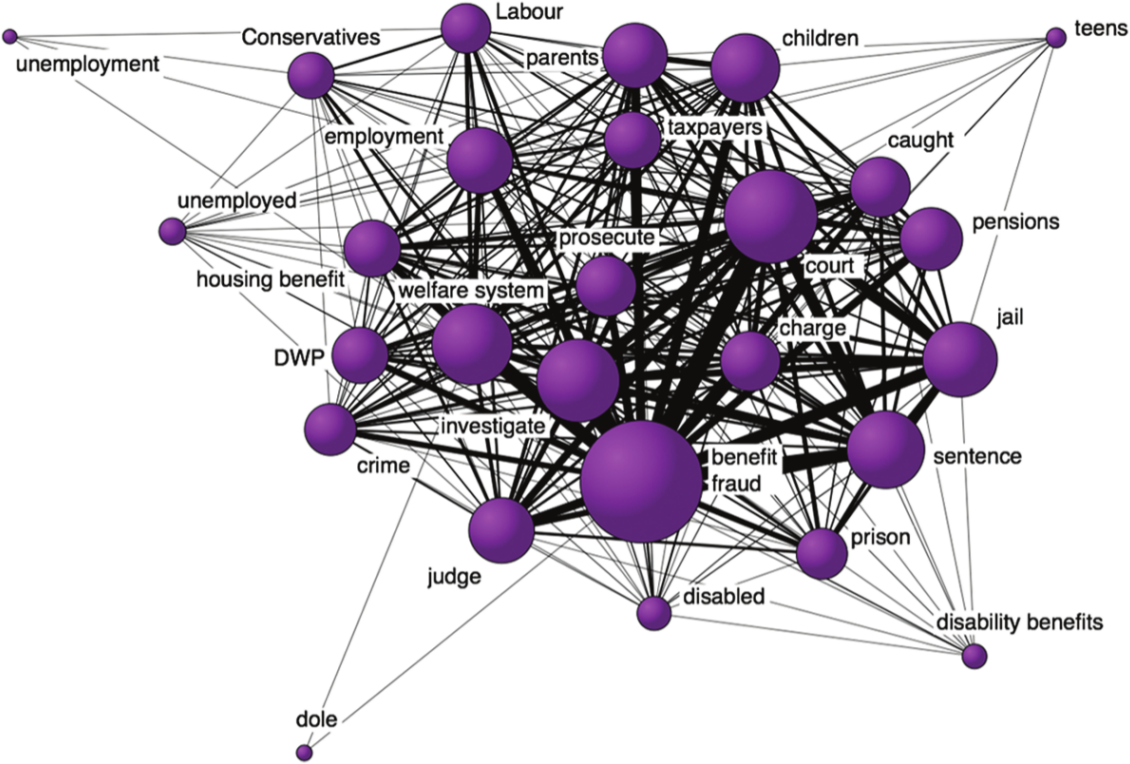
The conceptual relationships in the UK newspaper sample.
Benefit fraud is furthermore strongly linked to the category of work in the UK, while the related categories of unemployment and unemployment insurance are more peripheral in Sweden. This reflects that fraud is primarily constructed around the idea that working people collect unemployment benefits in the UK – one of the main categories of detected fraud in the UK – whereas it is more closely linked to the idea that people fake or exaggerate illness to be relieved from work, and/or to collect health benefits, in Sweden.
The Social Insurance Agency registers as a more central category in Swedish newspapers than the political parties do. Conversely, the Department for Work and Pensions registers as more peripheral than the political parties do in the UK. This indicates that benefit fraud is more clearly linked to administrative issues in Sweden than it is in the UK, but it also reflects the fact that fraud is connected to politicians making claims for increased control, or other forms of counter-measures, in the UK. In Sweden, where the political parties register as a lot more peripheral than the Social Insurance Agency, the analysis suggests that news reporting on fraud primarily relates to stories regarding administrative, or investigative, practices within government authorities, in which statements from politicians occur more rarely.
Constructions of the subject of the cheater
A closer reading of the UK newspaper content shows that a certain kind of news story occurs a lot more often than most other kinds. In this particular kind of story, a person caught cheating, or trying to cheat, is identified. The specific character of their cheating practices, and the circumstances surrounding the person getting caught, investigated and/or sentenced, are subsequently described. Articles falling into this category are often quite long and detailed, and it is not uncommon for them to include pictures of the portrayed cheater. The narrative structure of these articles is in most cases very similar, and they clearly represent a distinct and well-established category of news article in British newspapers. The audaciousness of the cheating practice, and the magnitude of the wrongfully received cash benefits, are often clearly accentuated in the texts, and it is not uncommon for these articles to portray the described persons and events in slightly humorous ways. The following two quotes are excerpts from two typical examples of this kind of article: SUSPENDED SENTENCE FOR ELDERLY BENEFIT CHEAT … who falsely claimed thousands of pounds in benefits to fund a lavish lifestyle, escaped jail today. Ronald Brindley, 73, of Ebbw Vale, Gwent, previously pleaded guilty to making around £15,000 of false benefit claims. (The Guardian, 16 February 2005) BENEFIT CHEAT MOTHER INVENTED SEVEN CHILDREN IN JUST 18 MONTHS. … Benefits cheat Victoria Young claimed she had seven children in 18 months. But the 25-year old from Lancaster Road in Irlam, Greater Manchester, finally pushed her luck too far when she rang the tax credit helpline to ask for money to help with childcare and other costs for baby number seven … By then she had swindled more than £40,000. (Daily Mail, 16 November 2007)
As can be observed in the quotes, the cheater is identified by name, age and place of residence. While this, in the context of a newspaper article, suggests that persons described are characters out of the ordinary, it is primarily through representations of the remarkable and extravagant nature of the reported cheating practices, and the kind of lifestyle these have enabled, that the subject position of the cheater becomes articulated as deviant and newsworthy in the UK. The ways in which cheaters are constructed in Swedish newspapers are, in comparison to these British representations, notably different. Even though stories depicting individual cheaters, similar to those mentioned above, can be found in Sweden as well – and even though benefit fraud is a criminal offence in Sweden too – they occur in significantly fewer numbers, and they only very rarely reveal the identity of the cheater. A much more common way of articulating the problem of cheating in Sweden centres on a notion of benefit fraud as a collectively practised, general and widespread phenomenon: SWEDES COLLECT 10 BILLION BY CHEATING. The Swedish people swindle around 10 billion annually from the welfare systems. (Dagens Nyheter, 10 November 2007) SWEDES CHEAT THE GOVERNMENT OUT OF 100 BILLION EVERY YEAR. Swedes cheat like never before. (Aftonbladet, 24 November 2002)
Even though texts such as these don’t necessarily define cheating as common practice, or state that all benefit claims are illegitimate, it is not uncommon that they articulate the subject of the cheater using collective terms. In this regard, a core difference between Swedish and British discourse on benefit cheaters can be observed. In the UK, the cheater is constructed in terms of an individual, clearly marked by traits traditionally employed in news discourse to construct the criminal subject. The strong focus on the legal handling of the described cases in the UK news articles also constitutes a significant aspect of this strategy. These observations furthermore explain the centrality of the legal concepts observed in Figure 2. Even though the UK cheater perhaps isn’t always positioned quite as peripherally in relation to normal society as other criminal subjects are in news discourse, s/he is clearly constructed using criminalizing strategies. These representations can be interpreted as related to the underlying ideological principles regarding the ways in which the British welfare system generally is thought, or discursively constructed, to be organized. In liberal contexts – where the welfare state has in general been legitimized using residual arguments, focusing on the particularly needy rather than the collective needs of the majority – it is not surprising that the notion of a shameless fraudster, procuring a lavish lifestyle through excessive cheating, holds a particular political relevance. Images of such subjects serve the purpose of questioning not only the efficiency of targeted programmes, but also the deservingness of recipients in general. They promote the idea that resources allocated to welfare often end up where they were not supposed to, and that claimants often are not particularly needy at all. One important consequence of representing cheaters like this is the blurring of the links between benefit programmes, the purposes of the programmes and the needs of those they are intended for. At the symbolic level, in the context of this narrative, welfare programmes are not ascribed meaning by reference to structural inequalities. Instead, welfare becomes meaningful using strategies where portrayals of unscrupulous and undeserving individuals are linked to images of an inept and gullible bureaucracy. In a context where these kinds of representations become dominant, it is very difficult to establish discussions about the ways in which the welfare state is related to issues such as poverty, exclusion, unemployment and inequality.
In Sweden, it is the idea that cheating is widespread and common that invokes alarm. While images of undeserving individuals wrongfully claiming large allowances by cheating means texts also would provide strong arguments for retrenchment measures, it is primarily through narratives in which the collectively articulated actuarial responsibilities of the majority are questioned that the welfare state is challenged in Sweden. In Sweden, the welfare state is commonly argued to be of a social democratic character, in which programmes are legitimized by universalistic arguments, and organized according to actuarial rather than residual principles. By questioning the collective needs of the majority, the alleged range and magnitude of fraud in Swedish discourse enables a critique of the foundational principles of Scandinavian universalism. Analysing the specific ways in which the subject position of the cheater is constructed in fraud discourse in Sweden and the UK thus reveals that fraud discourse constitutes a questioning of the general legitimacy of benefit recipients in both countries, through portrayals of cheaters that challenge traditional forms of articulating support for the welfare state in the two countries.
Financialization
Whereas the British newspapers are dominated by crime news narratives, Swedish newspaper articles articulating the issue of fraud are commonly editorials, and other similar categories of texts, where claims for policy changes are the primary focus. Also frequently occurring in the Swedish newspaper data are articles about estimates of aggregate costs of benefit fraud, and texts describing the implementation of anti-fraud policies. In general, Swedish newspaper articles link the issue of cheating to politically unaffiliated government agencies and officials, rather than to actors connected to political parties. Consequently, discourse on benefit fraud is characterized by a journalistically serious and politically neutral tone in Sweden, while the UK data on the other hand are characterized by a more sensationalistic tone (see also Lundström, 2011a). This way, even though the moral outrage directed towards the British cheater is articulated more harshly, the significance of benefit fraud as a political problem comes across as more alarming in Sweden. This is furthermore related, at the symbolic level, to the ways in which the financial dimension of fraud is represented in the two countries. Observable in all of the extracts cited in the previous section are specified sums of money allegedly lost to cheating. These are often used in headlines in both countries, and they clearly constitute an important nodal symbol in fraud discourse. Through this, the legitimacy of welfare programmes becomes more or less exclusively related to whether benefits are collected by fully deserving recipients or not. This strategy obscures other kinds of welfare outcomes. Through the strong focus on costs, the actual content of what the welfare state provides becomes reduced to cash. Defining welfare exclusively in terms of money in part reproduces a simplified notion of poverty and social exclusion, but it also limits the conditions under which support for anti-fraud policies can be mobilized. While the relationship between, for instance, public trust in the welfare state and benefit fraud could be highlighted as important when articulating the political problem of fraud, this is relatively uncommon in relation to discussions about the financial losses, both in Sweden and the UK. In relation to claims for counter-measures, the exclusive focus on financial consequences provides strong arguments for reduced benefit levels and increased control. If reduced levels of trust in the welfare state were articulated as the more important consequences of benefit fraud, the conditions for arguments in support of other kinds of policy changes – such as fewer means-tests – would be different.
Through these articulations of the issue of benefit fraud in Sweden and the UK, a distinctly monetarized and financialized perspective on welfare becomes dominant. In the discursive space created through the portrayals of cheating described above, there is little room for strategies that construct social dimensions of welfare politics as equally, or more, important than the financial aspects. This way, discourse on benefit fraud legitimizes claims for more cutbacks and control, and perhaps even more importantly, it also limits the space available for articulating counter-arguments. In Britain, where news stories about benefit fraud primarily centre on individual cases, the represented estimates indicate the amount of money collected by the individual cheater. While this serves the purpose of establishing the boldness and deviance of the cheater, it moreover constructs benefits as directed exclusively towards the isolated economic needs of individuals. Through this perspective on benefits, the relationship between structural circumstances and poverty and the redistributive capacity of the welfare state becomes blurred. In Sweden, on the other hand, estimates almost exclusively relate to aggregate costs of all erroneous benefits. While such estimates play a crucial role in depicting cheating as more common and more collective than it actually is, they also reduce the significantly more complex and heterogeneous phenomenon of ‘erroneous benefits’ by subsuming it under the label of ‘cheating’. This strategy reproduces the notion that all erroneous benefits are caused by a limited set of conditions and actions, i.e. ‘fraud’, and that they consequently can be controlled by a fairly simple set of policy changes. In both countries, then, fraud discourse in the dominant media articulate the concepts of welfare, poverty and cheating through reductionist strategies that serves the purpose of financializing welfare and individualizing dependency, framing welfare needs as caused by individual preferences and characteristics.
Blogs
The discursive network in Figure 3 visualizes conceptual relations in British political blog posts about benefit fraud. Comparing British newspaper articles to blogs reveals significant differences between the two. First, the concepts related to the criminal and judicial handling of benefit cheating are less prominent in blogs. In fact, in blogs these concepts are predominantly peripheral. Second, the political and administrative categories relating to the welfare system, the Department for Work and Pensions and the political parties are more closely connected to each other and to the centre of the network in the blogs, than in the newspapers. In relation to the ways in which newspapers articulate benefit fraud in terms of a crime, and therefore often subject it to the narrative modes of crime reporting, this particular observation suggests that the issue of welfare cheating is less dominated by crime news narratives in British blogs, and that administrative aspects and policy-oriented discussions are more central in citizen-created journalistic texts about fraud.
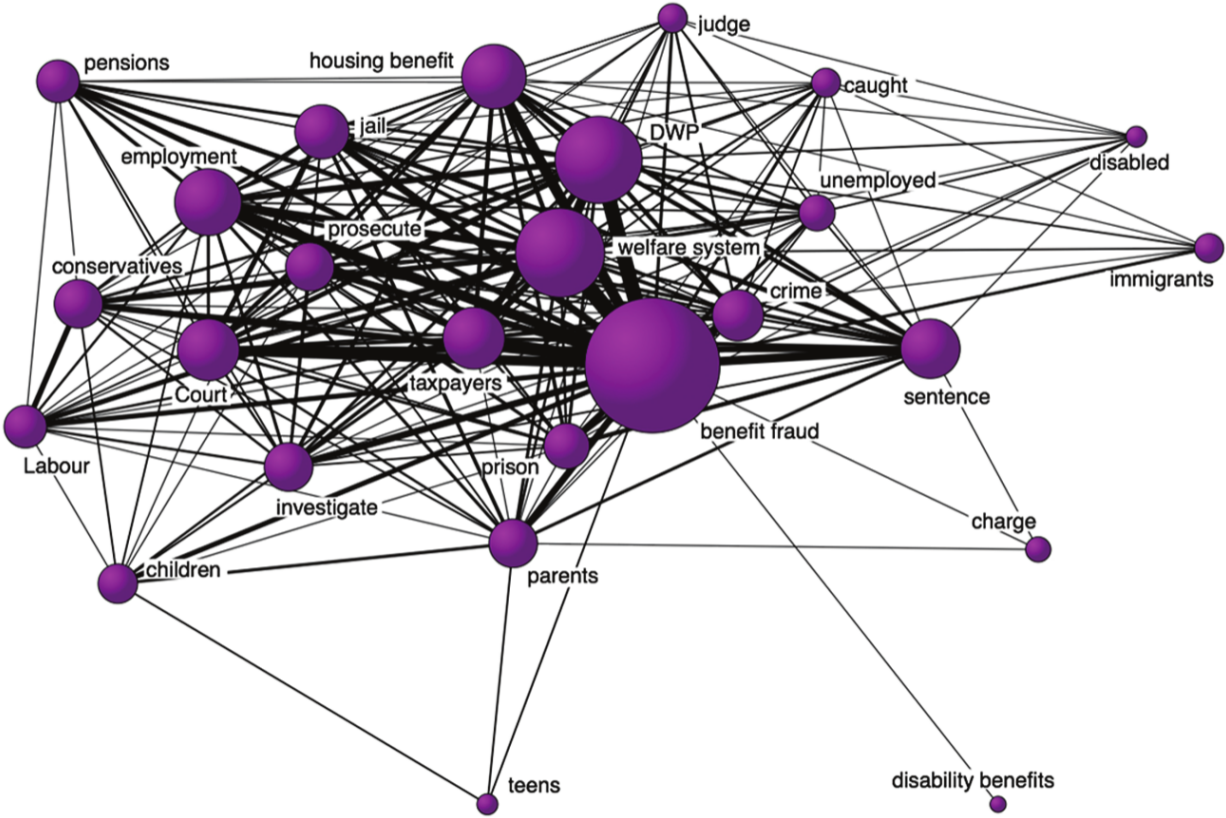
Conceptual relations in British political blog posts on benefit fraud.
Reading the content of UK blogs more closely also reveals that blogs are of a more heterogeneous character than the newspaper texts. Even though some texts are very similar to those discussed above – describing individuals who have been caught cheating the system for large amounts of money – such texts do not represent a dominant category among the posts. The blogs also include texts belonging to, primarily, two other categories of texts. First, there are a number of posts that discuss benefit cheating by relating it to politicians and government officials taking advantage of their position and privileges. The following quote is an example of a text representing this category: I’d love to see the benefit cheat advertisements remodelled, to target public sector expenses fraud. You could have a lord, pegging out the washing, and then big, scary writing … ‘You in the wig! We’re on to you. Your mother’s house in Carmarthenshire is not your primary residence … You do not spend £174 a day in legitimate expenses … One day soon, we’re going to be very peeved’. (posted 11 February 2010)
11
Often, the primary objective in texts employing this comparison is to articulate outrage against public sector fraud, but sometimes the comparison is also used to criticize dominant media representations for exaggerating the significance of welfare fraud. In both cases however, the groups are represented using primarily individualizing rather than collectivizing portrayals and images. Furthermore, they often refer to specified sums earned by the cheating individual, and they are also quite often characterized by a humorous and sarcastic tone. In many ways, then, these blog posts draw on the previously mentioned narrative styles found in the UK newspapers. The second alternative category of posts that occurs quite often in the blog data articulates critical perspectives on anti-fraud policies and the ways in which such policies are implemented: If you are claiming disability benefits, you might want to take a look at the Social Security Fraud Act, 2001 … if you think you have the same rights accorded the fit and the well, the employed and the two-parent families, then you’re in for a shock. Suspected terrorists probably have more human rights than do the chronically sick and disabled, the one-parent families, and the unemployed. (posted 13 February 2010)
12
In the quote above, as well as in other similar posts, there is a clear focus on the needs and living conditions of benefit recipients, and the implementation of benefit fraud counter-measures are linked to representations of legitimate needs of claimants in primarily collective terms. So, in comparison to newspaper discourse, these articulations actually represent an exception, and a challenge, to the dominant patterns. While these two forms of alternative ways to talk about the issue of fraud in the UK are not exclusive to the blog content, they do occur more often in blogs than in newspapers. But, while articles comparing public sector fraud to benefit cheating are not totally uncommon in newspapers, the occurrence, of blog posts that are explicitly critical about targeting benefit fraud in welfare politics, clearly marks a significant difference between dominant, or corporate, media content and blogs in the UK.
The discursive network shown in Figure 4 visualizes conceptual relationships in the collected Swedish blog posts. Even though the Swedish blogs and newspapers are more similar than their British counterparts, some interesting differences can be observed. While parents, the parental leave programme and the housing support programme are relatively central issues in the newspaper texts, they are more peripheral in the blogs. This indicates that the attention devoted to issues of fraud within the housing allowance and parental leave programmes in newspaper contexts has not necessarily transferred to other arenas of political debate. Furthermore, it also suggests that fraud discussions in blogs are primarily focused on the core institutions of the Swedish welfare system: the unemployment and the health insurance programmes. In relation to the general patterns in the discursive networks, these observations suggest that there is a strong resemblance between dominant media discourse and citizen-created discourse on benefit fraud in Sweden. Furthermore, they also indicate that the observed tendency in newspapers to articulate benefit fraud in terms of a welfare policy issue of a more general, or ideological, character also permeates Swedish blog discourse.
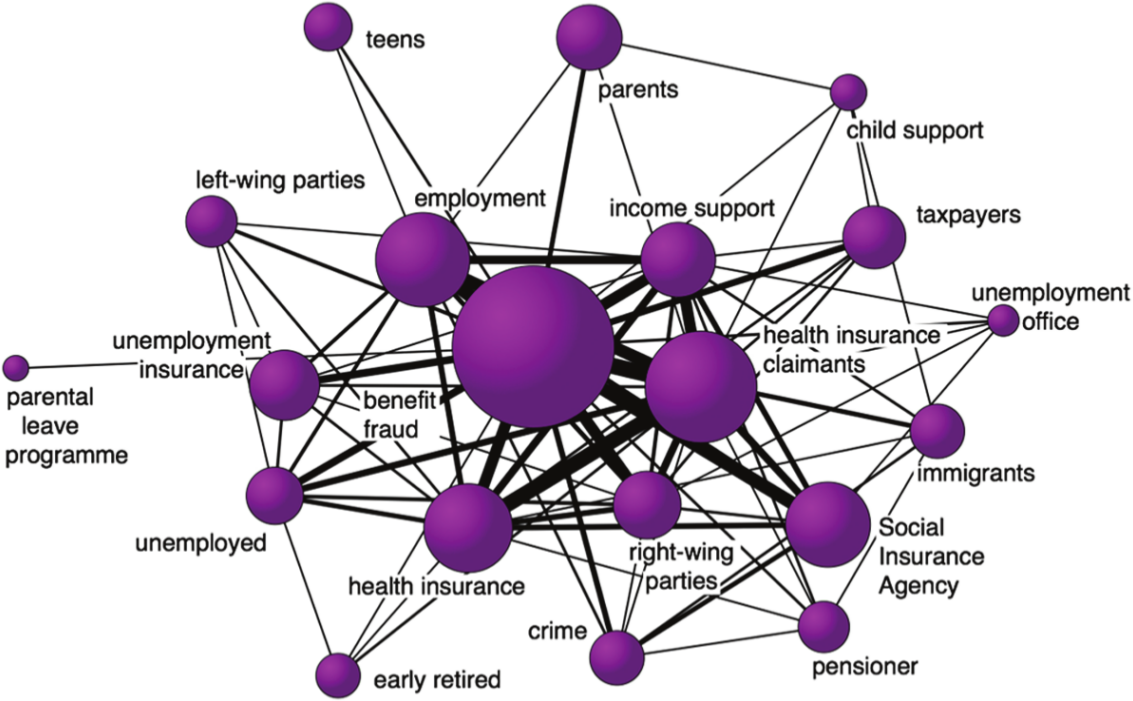
Conceptual relationships in the Swedish blog posts.
Reading the Swedish blog posts more closely also reveals that it largely resembles Swedish newspaper texts. However, one category of posts registers as much more common in blogs than in newspapers. This category consists of texts where fraud among immigrants is articulated as more common, and also politically more alarming, than fraud among other groups of citizens:
13
Too many ‘Swedes’ are lazy and use the income support, and health insurance, systems … One should contribute to society [göra rätt för sig], says Sara Santos … If all immigrants were like Sara, we wouldn’t need the Sweden Democrats. (posted 5 February 2010).
14
How can it possibly take two full-time years of study to learn Swedish? Of course it doesn’t, if you’re motivated. (posted 5 March 2010).
15
In articles such as these, there is a clear symbolic distinction between one specific group of citizens, articulated as illegitimate and undeserving, i.e. immigrants, and other citizens. While this form of articulating the issue of benefit fraud in certain circumstances is related to attacks on the welfare state, it does not necessarily present arguments for changing benefit programmes. This way, it could be argued that posts such as these do not belong primarily to the field of welfare policy debates, but rather to discussions in which racist and right-wing extremist discourse on immigration and integration is articulated. Such discourse, however, clearly holds a strong relevance to certain groups of Swedish voters, 16 and current public support for parties representing such ideas also coincides with increasing public attention to benefit fraud in Sweden. As can be seen in the examples above, the argument that immigrants are particularly prone to cheating, and that benefit recipients don’t actually deserve what they are entitled to, are reinforced and strengthened when articulated together. Racist discourse that questions the needs of immigrants, and dominant discourse on welfare fraud, in other words draw on and legitimize each other by using and reproducing similar strategies for challenging the deservingness of benefit recipients, and the responsibilities of the welfare state.
Conclusion
While newspapers in the UK predominantly construct the issue of benefit fraud using representations of individual cheaters and employing the narrative strategies of crime news, it is framed in Sweden as a distinctly collective social problem. In both countries, however, the subject of the cheater is constructed in ways that individualize welfare dependency, i.e. it frames dependency as linked to the preferences of the individual rather than to structural inequalities. According to Maurizio Lazzarato (2009), individualizing discourse on welfare is a core mode of organizing neoliberal consensus, and of mobilizing public support for welfare policies that promote, rather than reduce, insecurity: [I]nsecurity, inequality and individualization [are] part of ensuring the conditions for power to exercise a hold over conduct. These conditions include the formation of a new type of individual, the subject who is an ‘entrepreneur of him/herself’ who is meant to fit into the frame of society remade as an ‘enterprise society’. (Lazzarato, 2009: 109)
Just as the British images of fraud establish a discourse through which social policies are articulated as instruments for creating insecurities, uncertainties and work incentives for the undeserving, so do the Swedish representations. But in the case of Sweden, legitimizing such policies involves questioning the collective, rather than the individual directly. The main result of the analysis presented here is that these observed differences between Britain and Sweden are related to the ways in which the relationship between the welfare state and the citizens traditionally has been constructed in liberal and social democratic contexts respectively. In the context of Sweden, they are largely attacks on the insurance-based programme for health insurance and they draw predominantly on claims that ‘all’ Swedes cheat. In the UK, they are articulated through narratives about the individual fraudster, who funds a life of luxury by cheating targeted programmes. In Sweden, they are attacks on the recipients of the ‘universal’ welfare state, i.e. the entire citizenry; in the UK, they are attacks on the recipients of liberal welfare, i.e. the ‘needy’ individual. Political attempts to highlight the issue of benefit fraud, and dominant media representations of such attempts, must therefore be understood not as attempts to combat fraud, but rather as attempts to delegitimize the more general aim and purpose of the welfare state, and to rearticulate social citizenship in terms of labour market participation. They challenge the deservingness of welfare recipients in general, not just the ones that cheat, and thereby they also transform the conditions for public trust in the welfare state.
In both the UK and Sweden, blog posts discussing the issue of benefit fraud in many ways follow the narrative modes of the dominant media, and they are also clearly marked by similar themes. Still, the analysis also shows that challenges and alternatives to dominant media discourse on benefit fraud are in fact articulated in political blogs (see also Lundström, 2012). More specifically, this study has shown that UK blogs place the issue of fraud in relation to discussions regarding policy issues more clearly than newspapers do, and they also provide a space for voicing critique against anti-fraud policies and their implementation. In Sweden, blog discourse more clearly follows newspaper discourse, but some differences – most notably the occurrence of racist and right-wing extremist discourse in blogs – were nevertheless observed. The comparison of newspaper and blog discourse about welfare fraud primarily indicates, however, that the two are structured according to similar patterns in the selected countries. While this is not necessarily a surprising finding – and indicates that the observed and analysed patterns represent salient discursive practices in the two countries – it suggests that dominant news media in fact are profoundly important in defining, and regulating, the discursive space of citizen journalism.
Footnotes
Funding
This research received no specific grant from any funding agency in the public, commercial, or not-for-profit sectors.