




Abstract
Taking forward a new agenda for online political deliberation – the study of everyday political talk in non-political, online ‘third spaces’ – this article examines the dynamics of political talk across three general interest UK-based online forums. The quantitative analysis found that discussions about austerity were just as likely to emerge from non-political discussions as they were ones that began as ‘political’, demonstrating the links people made between everyday experiences and public policy. Our qualitative analysis represents the first real attempt to analyse political actions within third spaces, with some striking outcomes. Over half of all political discussions led to at least one political action (with significant variation between forums). The findings demonstrate that while such third spaces remain concerned with the preoccupations of everyday life, they can and do perform a role of mobilizing agent towards political participation.
Introduction
This article examines to what extent, and how, political talk emerges during the course of everyday conversation online and whether such talk leads to political actions. We examine the dynamics of these exchanges in the context of wider questions of citizenship, identity and political mobilization. To capture everyday political talk requires us to move beyond the now widely analysed online spaces of formal politics, such as Members of Parliament (MPs) blogs and political discussion forums. Instead, we take forward a new agenda for online deliberation (Wright, 2012b) and focus on online ‘third spaces’: non-political online discussion spaces where political talk emerges (Wright, 2012a).
Although there have been a growing number of studies that have focused on analysing political discussion in third spaces, such as those attached to reality TV (Graham, 2010, 2012; Graham and Harju, 2011); film communities (Van Zoonen, 2007); and personal finance, media and family (Graham and Wright, 2014; Jackson et al., 2013), they have focused primarily on the quality and nature of political talk. While this provides us with important insights, it tells us little about the extent to which such talk contributes to political action. As Coleman and Moss (2012) have argued, ‘for most online deliberation researchers it seems as if the political process ends when civic talk stops’ (p. 11). Questions still remain: how do people in the course of everyday conversation make connections to formal politics, and does engaging in political talk within such spaces support a movement towards participation in the formal political process?
In order to address these shortcomings, we adopted a case study design, analysing three popular, general interest UK-based forums over the course of 4 years (2010–2013): www.netmums.com, www.digitalspy.com and www.moneysavingexpert.com. Our analysis, which included both quantitative (N = 1,081,989) and qualitative (N = 20,762) content analyses of participants’ posts, focused on how, and in what circumstances, everyday talk leads to political action. We found that these spaces were far more than talking shops and that, intriguingly, it is the dynamics of those threads that started off as non-political rather than political, which were as likely to lead to political action.
Online political talk: Beyond the fringe
Political discussion is recognized as a vital part of many models of democracy (Held, 2006). For Dahlgren (2003), six dimensions are required in order for civic culture, and democracy more broadly, to thrive: knowledge, values, identities, affinity, experience and discussion. It is the latter – everyday talk – through which the other dimensions become actualized, circulated and reinforced. Similarly, Habermas’ (1987, 1996) evolving theory of the public sphere and deliberative democracy is held together by everyday political talk, which forms webs of conversations over time and across various (communicative) spaces, informing voters, shaping views and challenging opinions – underpinning future political action. It is little surprise then that political talk promotes other forms of political engagement and mobilization, particularly during elections (see, for example, Huckfeldt and Sprague, 1995).
The importance of political talk to democracy is recognized widely, but a prerequisite is having the ‘right’ kinds of spaces where it can occur, and we focus on online spaces. How people talk about politics online has been the subject of much research and was the focus of some of the earliest studies of politics online. Talk in such spaces often did not live up to the normative standards of deliberative democratic principles, although as Wright (2012b) argues, perhaps this was a result of the normative expectations we applied – often in the language of revolution or normalization.
Moreover, the definitions of what constitutes political talk were often narrow and did not always appropriately fit the ambiguity and everydayness of online spaces (see Coleman and Blumler, 2009; Graham, 2008). For example, much of the research operationalized and applied a formal notion of deliberation, focusing almost exclusively on procedural and substantive rationality. Coleman and Blumler (2009) have argued that deliberation grounded in a ‘deep, sombre, rationally-bounded cerebral rumination’ is ‘more suited to the Senior Common Room than the workplace, community hall or public square’ (p. 36). We argue that everyday political talk is not only about rationality via argumentation, but it is also about everyday citizens talking to each other in ways that make sense to them. As Van Zoonen (2005) has argued, the everyday reality of politics is typically rooted in people’s personal, subjective experiences.
Another criticism of much of the research on political discussion online is that it has mainly examined explicitly political online spaces: political forums, party webpages and so on. While much has been learned, we argue that there is more to be learned by investigating how political talk emerges in everyday discussions about television, relationships, personal finance and so on. Such spaces allow us to explore and begin to understand the ways citizenry is intertwined with aspects and practices of everyday life. They provide us a glimpse, at the micro level, into the lifeworld (its informal associations and interpersonal communications) – a glimpse into the processes of cultural reproduction, social integration and socialization, which Habermas (1987: 138–139) places particular emphasis on in his late theory of the public sphere.
From third place to third space
Our approach to studying spaces of everyday political talk online is built on a critique of Ray Oldenburg’s (1989) concept of third place. A third place, for Oldenburg, is a public space beyond the home or workplace (e.g. café, pub) where people can meet and interact informally: ‘The third place is a generic designation for a great variety of public spaces that host the regular, voluntary, informal, and happily anticipated gatherings of individuals’
and is a core setting of informal public life’ (Oldenburg, 1989: 16). Moreover, as important areas of civic/political talk, Oldenburg (1989) argues that third places perform a crucial role in the development of societies and communities, helping to strengthen citizenship and thus are ‘central to the political processes of a democracy’ (p. 67). It should be noted that it is not that certain types of venues constitute a third place; rather, they exist when venues exhibit specific characteristics. In other words, not all pubs are third places: they are constructed through specific social and environmental features.
The problem for Oldenburg is that the third place, to the extent that they ever existed in the United States, is in decline – largely due to the rise of strip malls and a decline in independent retailers. Moreover, Oldenburg sees new media as harming third places and is disparaging about the network society and virtual communities. His views are disputed, with some scholars arguing that the Internet is a form of virtual third place (Schuler, 1996) with some empirical evidence to back such claims (e.g. Steinkuehler and Williams, 2006). Rather than testing the extent to which the Internet replicates Oldenburg’s concept of third place, Wright (2012a) has argued that his work needs some re-theorization in the context of the Internet. In particular, he argues that Oldenburg is wrong to privilege place over issue-based communities, and this leads to the concept of third space. Third spaces are formally non-political online discussion spaces where political talk emerges. While a third space might have a geographical focus, it is not a prerequisite. Initial research has suggested that online forums can be third spaces and are important sites of informal political talk and community formation (Graham and Wright, 2014).
Research focus and questions
The global economic crisis of 2008, and the subsequent ‘austerity’ policies pursued by the coalition government in the United Kingdom from 2010 to 2013, provides a relevant backdrop to studying third spaces. During this time, the United Kingdom has undergone a period of economic stagnation; meanwhile, the government has unveiled a number of cuts to public services, with welfare and benefit reforms proving particularly controversial. Third spaces are well positioned to reflect the impact of austerity on everyday life. They lay bare the topics of conversation, allowing us to see the extent to which austerity penetrated everyday life and to monitor how online communities reacted to this. This leads us to our first set of research questions, which are interested in where political talk emerges in third spaces, and the types of political topics that consume the most attention:
RQ1. From which topics of conversations does online political talk emerge?
RQ2. During a time of austerity, which political issues are people within online third spaces talking about?
The way people perform political talk online (i.e. the deliberativeness of such talk) has received much attention in previous research, focusing on, for example, Usenet newsgroups (Schneider, 1996), news media–sponsored forums (Graham, 2011), forums hosted by governments (Wright, 2007), online deliberative initiatives (Dahlberg, 2001), other political platforms such as blogs (Koop and Jansen, 2009) and readers’ comments (Ruiz et al., 2011) and social media network sites such as Facebook and YouTube (Halpern and Gibbs, 2013). However, outside of a handful of small-scale studies (Graham, 2010, 2012; Graham and Harju, 2011; Graham and Wright, 2014; Jackson et al., 2013; Van Zoonen, 2007), we know very little about the way political talk is performed in non-political third spaces. In this study, we therefore explore the communicative form of political talk. We ask whether, in times of austerity, political discussions were characterized by argument and debate (as often found in political forums) or whether people utilized the potential of third spaces to provide support, networking and community building. Furthermore, we would expect that different communicative forms may be influenced by whether the discussion started political or whether politics emerged during conversation about another topic:
RQ3. What communicative forms were present in political discussions?
Our final research question concerns how and when political talk leads to political action. One of the criticisms of both the theory and practice of online political talk is that it is little more than a talking shop that does not impact politics or power, limiting its democratic value. While we would argue there is significant value in just talk alone, we accept that there is less empirical evidence of how talk in these online spaces leads to political action, and this study directly addresses this gap. Moreover, the textual nature of Internet forums results in communications that are largely deprived of the non-verbal cues typical of face-to-face interactions. According to Berger (2009), this can result in discussions that are more goal-oriented than in offline networks. Consequently, we may conceive computer-mediated discussions as being more efficient at mobilizing individuals to participate in political affairs. While evidence for such a process has been found in the context of explicitly political forums (see Gil de Zuniga and Valenzuela, 2011), this was a result of self-reported surveys rather than an analysis of the forums themselves. No study has yet examined the extent to which political action emerges in third spaces, where – based on the typically casual, chatty and frivolous nature – we might assume that they are not as goal-oriented or efficient at mobilization. On the other hand, given the context of austerity, rising unemployment and an unpopular government, the potential for third spaces to facilitate political mobilization might seem enhanced. Our aim is to witness this as it happened in the forums – to see what actions emerged from talk and at whom they were directed:
RQ4. To what extent does political talk lead to political action and who were the actions aimed at?
Research design and methodology
In order to address the research questions, a case study design was adopted. Quantitative and qualitative content analyses of posts, from three third spaces over the course of 4 years, were employed as the primary instruments for examination. The three cases selected are among the most popular online forums in the United Kingdom. As Table 1 shows, they account for 3.5 million registered members with over 114 million individual posts. These websites cover salient aspects of contemporary culture: consumption, media and family, and as such they were selected to offer a broad representation of online everyday conversations.
Overview of the cases.
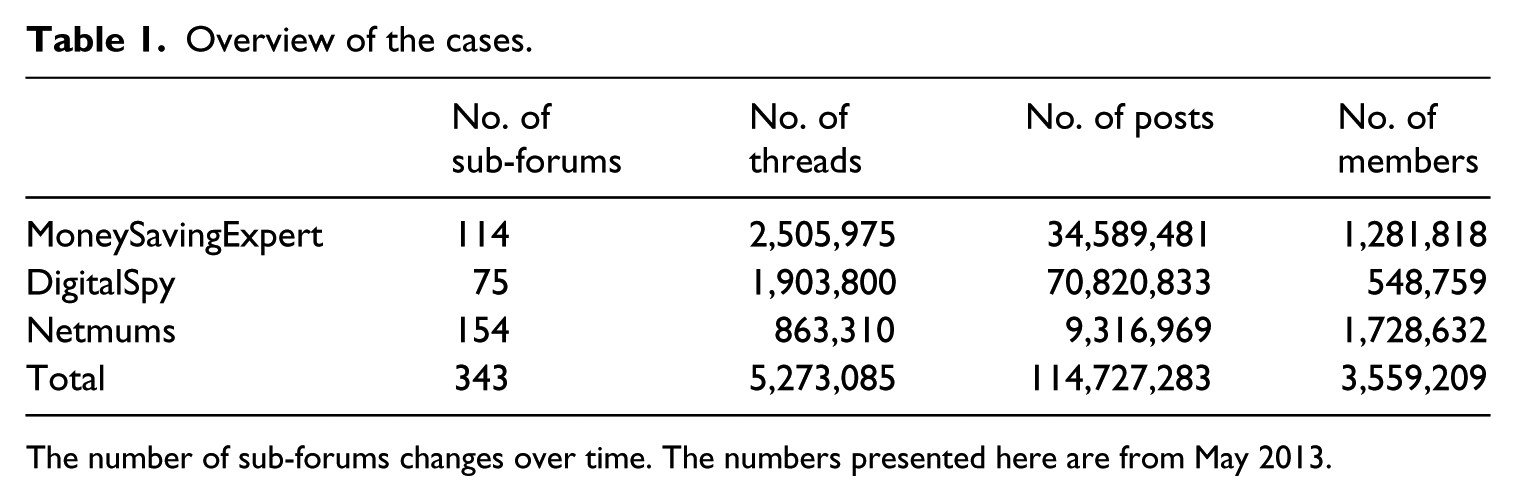
The number of sub-forums changes over time. The numbers presented here are from May 2013.
The MoneySavingExpert forum (MSE) is part of a larger website and email list operated by the finance guru, Martin Lewis. The forum has 114 different sub-forums, most devoted to different areas of personal finance but with broader chat areas. It has a strong community function of support from its members – often facilitated by active moderators. It attracts approximately 12.5 million unique visitors every month.
Netmums is a non-profit parenting website that was set up in 2000. Netmums has a form of federal structure, with a central website that facilitates and coordinates a network of local online/offline sites and groups that cover the United Kingdom. The website receives 6.2 million unique visitors each month. The Netmums forum, known as the Coffee House, is central to the Netmums community. The forum has a Parent Support Team: a mixture of internal trained staff/counsellors with external support and advice from bodies such as Relate and the Citizens Advice Bureau. The forum has 19 core forums with over 150 further sub-forums.
DigitalSpy is the United Kingdom’s largest independent entertainment news and discussion website, and in the top 30 English language forums in the world. Starting in 2001, it attracts more than 12.5 million unique visits every month and operates in five countries (our focus is the UK site). The site is primarily about entertainment, showbiz, movies and music, but there is a dedicated ‘politics’ sub-forum on the site. It has a large editorial staff providing content for the news sections, but the forums operate via a ‘light touch’ moderation of discussion.
Quantitative content analysis
In order to make the study more manageable while maintaining the meaningfulness of the data, 1000 threads for each case were identified and included in the initial sample. Since our focus was on investigating political talk in third spaces, we needed to identify threads where such talk emerged.
The problem of defining politics has dogged third space research: how do you define the political in political talk? While we would generally argue that more ambiguous online spaces favour more liberal definitions of politics embedded in the everyday (see Graham, 2008), in this study we wanted to set the bar high so that there was little ambiguity about whether the talk we analysed was really political or not. As such, we included threads that made connections – through the course of everyday conversation – to formal, institutional politics. By political talk, then, we are referring to a public-spirited way of talking whereby participants make connections from their individual and personal experiences to formal political processes and institutions (including politicians, parties, policies, etc.) or when institutional politics itself becomes the topic of discussion. We were not, in this case, looking for lifestyle politics – at least not initially.
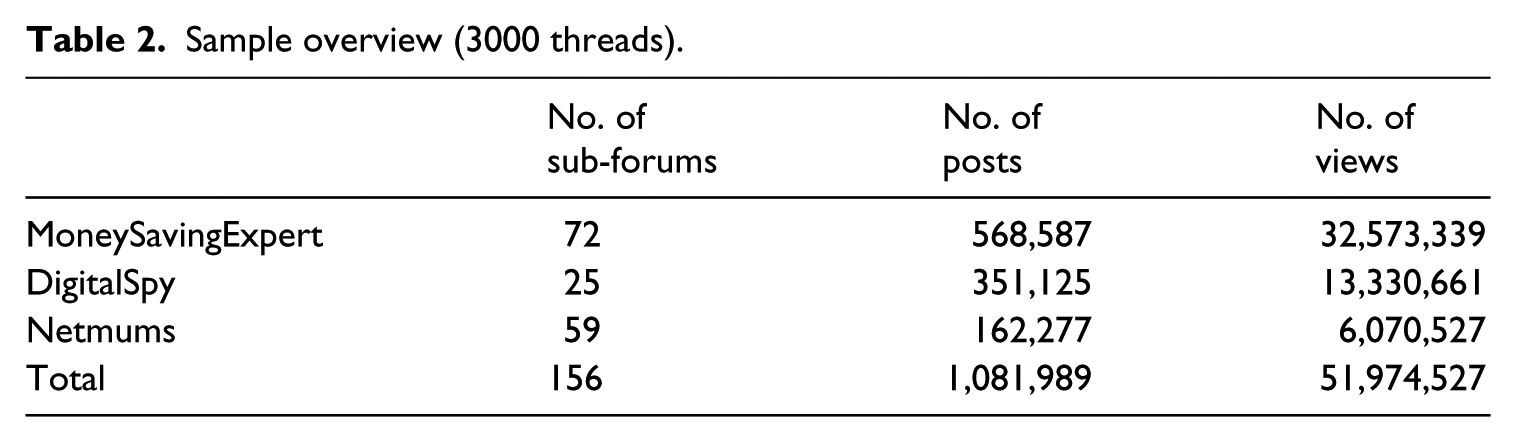
In order to identify such threads, we applied a keyword search to the forums. It consisted of 29 keywords, which can be categorized into four groups: politicians (e.g. Ed Miliband, Nick Clegg), parties (e.g. Labour Party, UKIP), institutions (e.g. Westminster, parliament) and general terms (e.g. democracy, politics). Threads that contained keywords in their posts were subsequently checked (read) and counter-checked for political talk. Threads where the keywords had no political connotation/context or which lacked reciprocal exchange (i.e. when a thread consisted of only a stand-alone political post) were not included; any ambiguous threads were discussed among the research team. 1 During April and May 2013, using the forum search functions, between 30 and 40 threads for each keyword were collected. The post date of seed threads was as early as 2003; however, 91% of the threads were started between 2010 and 2013. As Table 2 reveals, the total sample consisted of 1,081,989 posts taken from 156 sub-forums.
Sample overview (3000 threads).
In part 1 of the analyses, the unit of analysis was the thread. Every thread was coded for two categories: the initial topic (RQ1), which consisted of 26 codes (e.g. parenting, personal finance, sports), and the political topic (RQ2), which consisted of 22 codes (e.g. economy, education, health and social welfare). Given that a thread may have multiple topics, each thread was coded for the dominant topic. 2
Qualitative content analysis
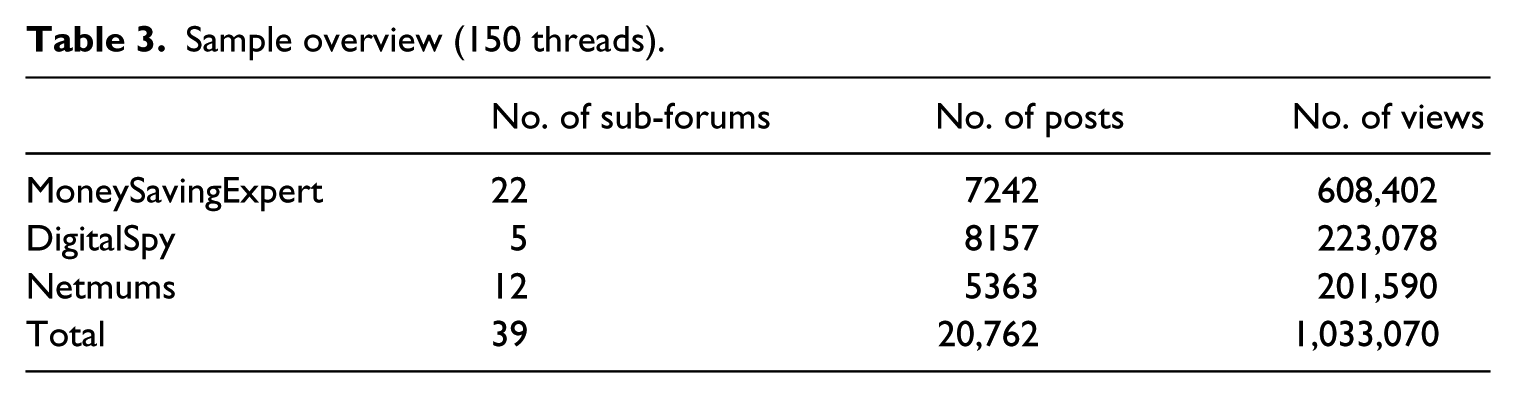
For part 2 of the analyses, a random sub-sample of 150 threads from the period 2010–2013 was selected. Given that our focus was on austerity, only threads concerning issues such as benefits, cuts, banking and the economy in general were included. Moreover, an even split between those threads that start off as political and those that did not was taken. As Table 3 indicates, the sample consisted of 20,724 messages posted in 39 different sub-forums.
Sample overview (150 threads).
A qualitative content analysis, using both deductive and inductive coding techniques, was employed during part 2 of the analyses. The coding scheme focused on identifying and analysing political actions (RQ4) and the dominant communicative form (RQ3) within each thread. We defined political actions as posts that contained statements whereby a participant explicitly indicated that he or she will take action (present or future tense) or made calls for action. We deliberately set the threshold for actions high as to avoid including ambiguous comments, which might have implicitly referred to political action or a call-to-action. In all cases, such actions needed to be framed in the context of the collective good and be socio-political in nature. The unit of analysis was the individual action. A total of 20 political actions were identified, which can be categorized into four groups: formal political actions (e.g. contacting MPs, party activism), extra-parliamentary political actions (e.g. signing petition, boycotting and consumer activism), civil political actions (e.g. contacting the media, volunteering in social/charity work) and other political actions (e.g. forum specific actions). All actions were subsequently coded for at whom/what the action was directed. Finally, all threads were coded for the dominant communicative style. Based on an earlier study of political talk in online third spaces (Graham and Wright, 2014), six styles were distinguished: arguing and debating, advice giving and support, Q&A, call-to-action, chatting and storytelling, and humour and banter.
Findings: Topics of (political) talk
RQ1 asks from which topics of conversation did online political talk emerge? Table 4 shows the original topic of all the threads we examined, which became political at some point. Threads were nearly as likely to start off political (53%) as they were to turn political through debate. As Table 4 highlights, political talk emerged from a wide range of topics. While this happened in several ways, commonly threads started with a ‘private’ issue, similar experiences were shared and it was then turned into a ‘public’ issue where they needed to take action. For example, a poster started a thread complaining about their children’s school lunch policy, which banned meat products (e.g. salami, sausage, pies) and fruit juice framing this as the ‘packed lunch police’. This led to a series of (largely critical) posts about policies at other schools. After some debate, one poster encouraged them to ‘take this higher. This is getting utterly ridiculous’ before a second encouraged people to ‘complain to your LEA [Local Education Authority] as thats not right’ [sic] and a third wrote a draft letter to be given to schools, arguing that as a parent it was their right to decide what they should eat and if they remove items it is theft. Finally, one poster stated that the policies had something to do with the Mayor of London, Boris Johnson.
Initial topic of threads (%).
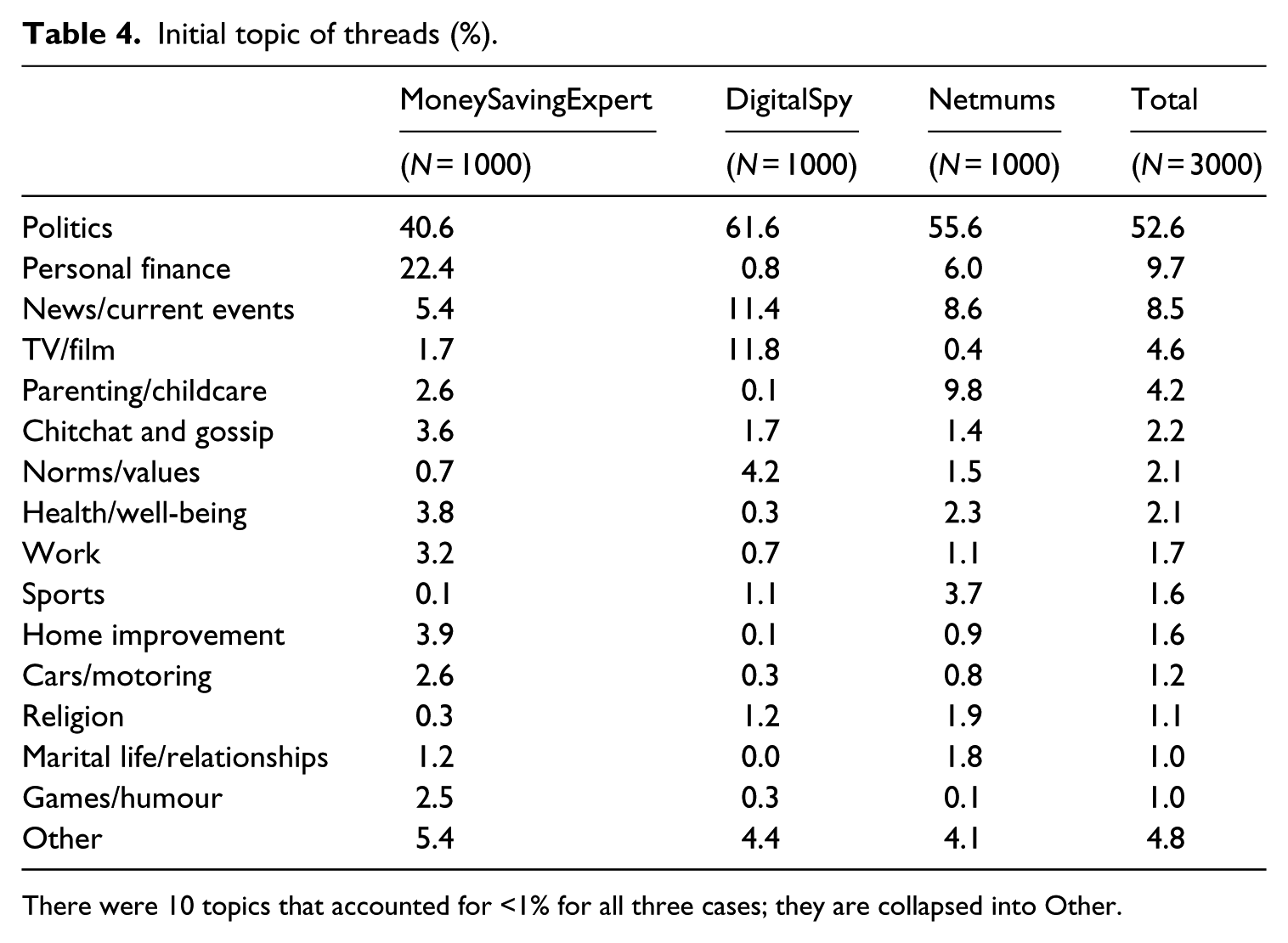
There were 10 topics that accounted for <1% for all three cases; they are collapsed into Other.
In a period of austerity, which political issues were people within online third spaces talking about (RQ2)? Table 5 shows that there were some large discrepancies between each forum, but that health and social welfare and the economy were the most discussed political topics. This is a reflection of both the impact of the ongoing recession on everyday life and the public response to the UK government unveiling a number of reforms to the welfare system and implementing a series of cuts to public services. These welfare reforms were intensively covered in parts of the UK press and were debated intensively in our forums too. There was also quite a lot of talk about politicians and parties – what you might call the game of politics – and perhaps again a reflection of the news media’s agenda towards such topics (see Jackson, 2011).
Political topic of threads (%).
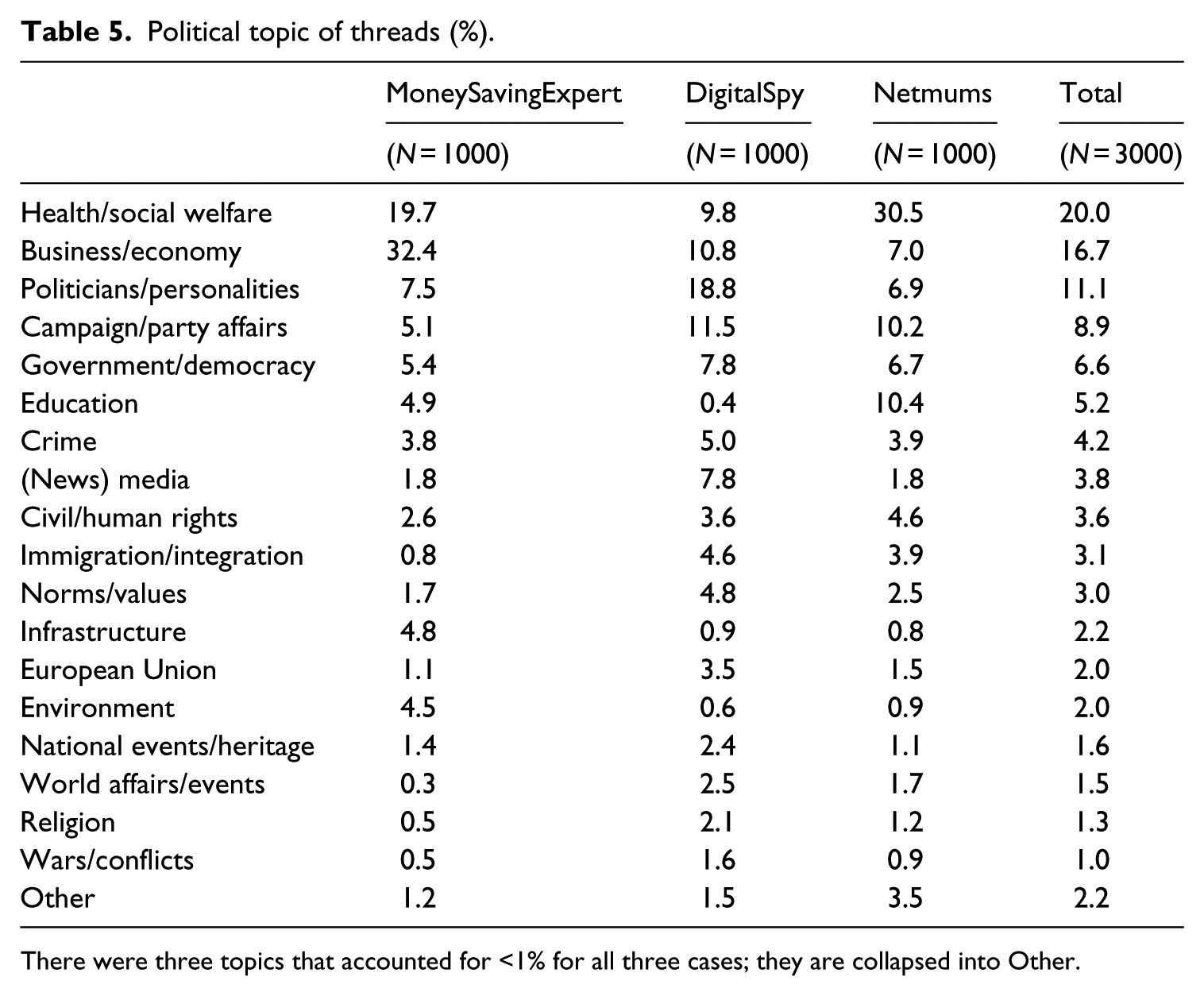
There were three topics that accounted for <1% for all three cases; they are collapsed into Other.
Looking at the topics of discussion in Table 5, one might conclude that political talk was merely reactive to the political and news media agenda, as it largely reflects the main news topics during this period. And indeed, by looking at the threads that began as political, 72% of them were about the top five political topics. However, when we see the origins of some of the most common political topics of threads, it is evident that topics such as health and social welfare and the economy were just as likely to emerge from everyday non-political discussions (48% combined) as they were political ones (52% combined). This is an important distinction. In the threads where politics emerged, people are making links between the everyday and the formal political system, and not just reacting to whatever is in the news. Interestingly, across all forums, political discussions were remarkably UK-centric. Despite that foreign affairs typically accounts for around 25% of UK prime-time broadcast news (Barnett et al. 2012) and a number of ongoing international events, wars and crises during our sample period, discussion of world events and wars/conflicts accounted for only 3.5% of all political discussions.
Findings: Communicative style of political talk
RQ3 investigated the communicative form and style of threads where political discussions emerged. As we might expect, Table 6 shows that political issues were more likely to appear in threads where arguing/debating was the dominant communicative form, which is in line with past research on online political discussion forums (see, for example, Graham, 2011). Even in threads that started off as non-political, when political topics were introduced, 41% of those threads were subsequently taken over by arguing/debating; political topics in these cases fostered this type of communicative style. However, there were clear distinctions between the forums. First, advice giving and support was quite common in both MSE and Netmums, representing nearly a quarter of the threads in both cases. Unlike DigitalSpy, which is an online community based primarily on talking about one’s favourite shows, both MSE and Netmums are largely intended for providing help and support. For example, a thread started by a stay-at-home mother who was feeling very undervalued (by the media, society and government policy) attracted both significant support and some critical debate intertwined with a debate about the government’s policy and how government language was considered to be demonizing stay-at-home mums (‘SAHMs’). Finally, unlike the other two cases, arguing/debating was not the dominant communicative style in MSE, accounting for 36% of the threads. Indeed, it had the most diverse types of threads with advice/support, Q&A and call-to-action all accounting for ⩾14% of the threads. This finding supports an earlier study, which suggests that MSE is not only a place where political talk emerges, but it is a place where people turn to for advice, support and information: that is, a ‘third space’ (Graham and Wright, 2014).
Communicative form of threads (%).
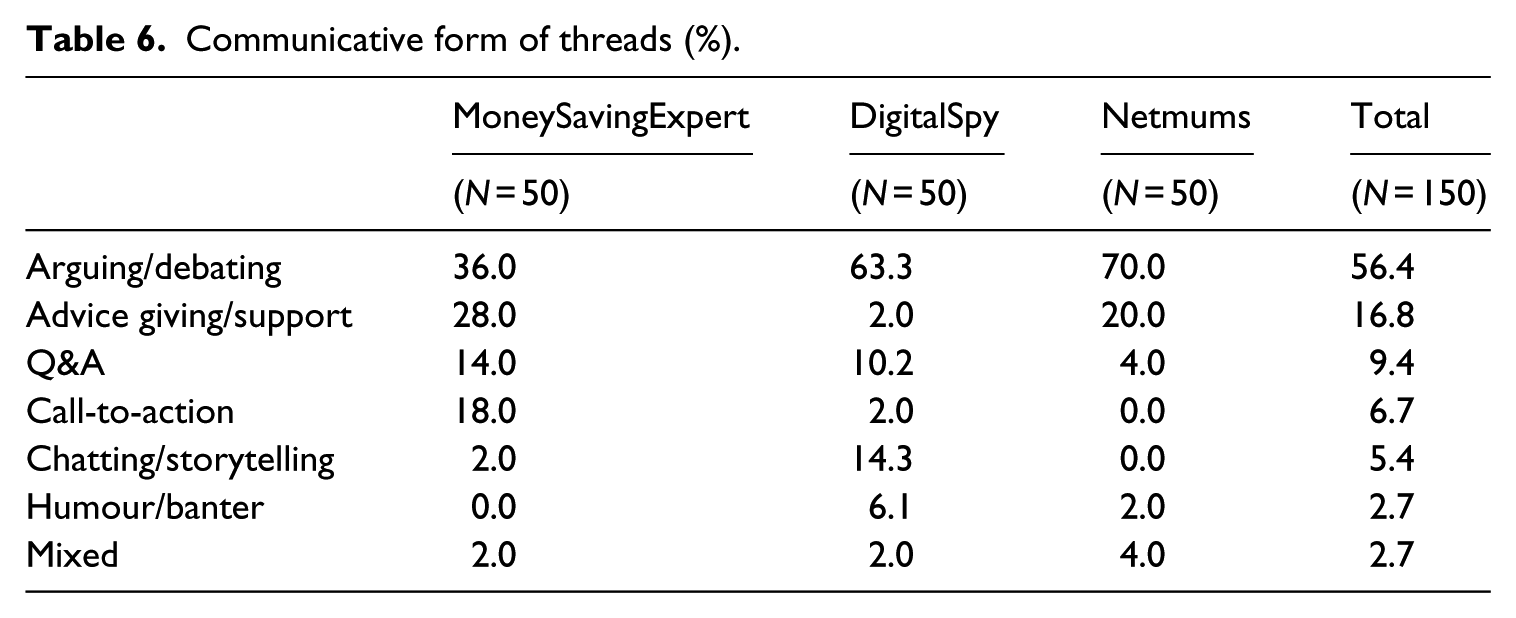
One criticism of online political discussion forums has been that they tend to be dominated by the ‘swordfight’ mentality, which revolves around providing the best arguments and challenging competing ones, aimed at winning the debate as opposed to achieving deeper levels of understanding (Graham, 2011). Although we came across such ‘battles’ in many of the threads under investigation, our analysis did reveal a striking trend under arguing/debating: the prominence of policy-led debates. Overall, policy-led discussions appeared in 73% of the threads dominated by arguing/debating (and in 60% of all threads). Here, participants in these forums were introducing their own policy proposals and discussing them with each other:
Example 1 (DigitalSpy): To help the low paid, the government could do the following. Remove tax credit, but boost that person personal allowance by what ever they would get as tax credits, so for me, my personal allowance would be £14,000. My employer in return for a cut in corporation tax, gives me a rise in my hourly wage, which would reflect what I get in tax credits, so my hourly rate would go up from £6.63 to £8.83. It could be an idea, to make it worth the time to work, not live on benefits.
As the example shows, participants moved beyond reactive talk about a political issue by introducing and proposing new policies or amendments to government policies. Such discussions were less about ‘winning’ the argument and more about working together to create alternative approaches for dealing with the difficult economic times of the day. On several occasions, such threads were picked up by government officials. For example, one thread from MSE was forwarded (by MSE) to the Treasury Minister, Mark Hoban, while Netmums’ news team posted a thread which started, ‘The Deputy Prime Minister’s office called us this morning and they want to know Netmums views’ on a new youth contract, with a promise that ‘The Deputy Prime Minister’s team will be showing him all your responses’.
Findings: From everyday talk to political action
Our final research question (RQ4) examined the extent to which political talk led to political action. The first striking finding was that in 50% of the threads some form of political action emerged. There was a clear distinction between the cases. In DigitalSpy, political actions were infrequent, appearing in 14% of the threads. In MSE and Netmums, on the other hand, political actions arose in 72% and 62% of their threads respectively. The difference between the cases is partly due to the nature and function of the forums. Both MSE and Netmums function as spaces for help and support, which during times of austerity motivated participants to take various types of political action. Moreover, in both cases, there is an active forum management team, which occasionally encourages and even facilitates such action.
What types of political actions emerged in the forums? As Table 7 reveals, the most common types of participation/engagement were extra-parliamentary actions, which accounted for 43%. The most popular actions were joining and/or organizing a campaign/protest (17%), boycotting and consumer activism (13%) and signing and/or creating a petition (12%), as examples 2–3 illustrate:
Example 2 (Netmums – thread turned political): Poster 1: I have also had really bad experiences with the Job Centre and found going there no point at all. It didn’t help me to find work at all, it was just a big waste of time. I ended up crying at one appointment as they made me feel that bad … I feel so strongly about this I wish that I knew how to voice my opinions Poster 2: I’m thinking of setting up a website/facebook page so that people can voice their opinions and relate their experience of the staff at Job Centres. Poster 3: OK … I’ll do it! I hope you will all come on and tell these same stories when it’s set up? I intend to contact MPs etc. with details of them to prove how poorly the JCs are performing. Example 3 (MSE): Sorry if this has already been said but my view is that a campaign should include opposing cuts to generalist CABs as people tend to be more familiar with them and their function … A Facebook campaign is a good way to start as it is cheap and can become quite high profile relatively easily. These services are so important – and I value them for exactly the same reason I value this site – they democratise knowledge to empower people to help themselves.
Frequency and types of political action (all cases).
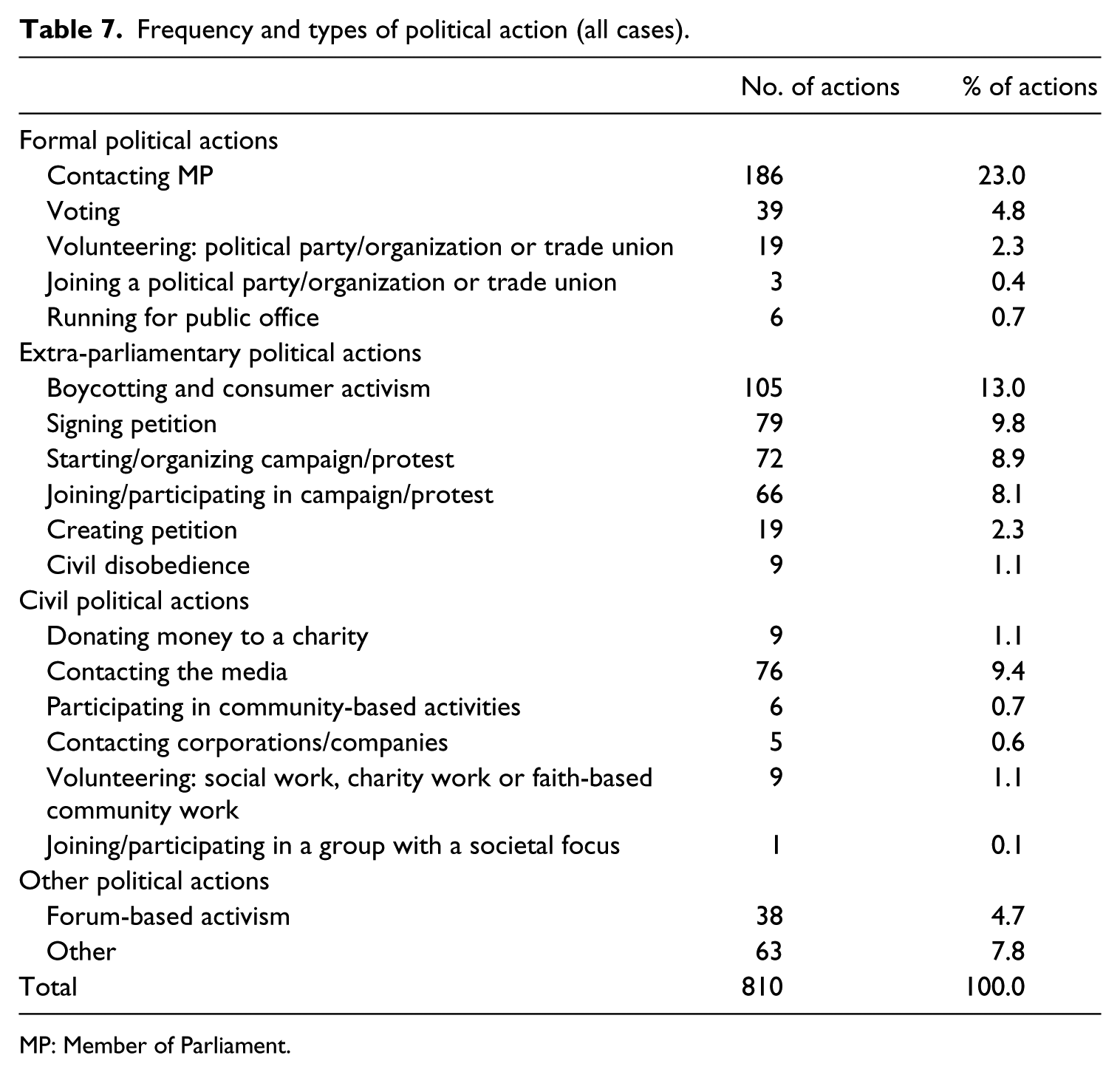
MP: Member of Parliament.
Example 2 comes from a thread that was ignited by a bad experience at a Job Centre. As the discussion progressed and experiences were exchanged, participants began to organize collective action, including setting up Facebook pages and contacting MPs. This example highlights one of the three principal ways political actions emerged in the forums – as a product of political talk. More specifically, 61% of all actions arose through political talk. Participants would start off discussing a political and/or social issue and through the course of the debate began to organize a range of actions, which they shared with others in the threads.
Example 3 highlights how participants used the forum specifically to organize action; in this case (initiated by the forum team), participants used the thread to organize a campaign against the government’s proposed cuts to the Financial Inclusion Fund, which provides money for non-profit debt counselling where there is none. In these threads, a number of modes of political participation or protest were discussed and pursued. The third main way political actions emerged was where participants used the forum to promote particular types of actions (which on occasions led to organizing alternative actions). MSE and Netmums were particularly effective – often through active moderation – at promoting campaigns and garnering signatures for e-petitions, where the e-petition would be the subject of the thread.
The second most common types of participation/engagement were formal political actions, accounting for 31% of all actions. Contacting MPs – which represented 23% – was most common. Although participants did on occasion talk about contacting MPs in the context of collective actions, they primarily consisted of taking individual actions (or recommending others), as example 4 illustrates:
Example 4 (MSE): Has anyone who has been claiming Employment Support Allowance, actually successfully passed the medical assessment on the grounds of suffering from anxiety and or depression … I am keen to know if anyone has gotten through this awful ordeal ok and had the benefit left intact? Are they seriously failing all people who suffer from this mental illness. Yes we may look physically ok, but inside we are far from ok. When i eventually recover from my issues, which i so hope i do. I am seriously thinking about putting this issue to the government, local MP’s etc. The system needs to understand mental health issues alot [sic] better than they currently do. Look forward to hearing from you.
As the example shows, these types of actions were personalized; participants were making connections between their lived experiences and particular public policies – a shift from private to public talk. These types of posts accounted for 43% of all actions. The connection between personal experience and public policy helps to explain why many threads turned political. It is also an important factor in the difference between Netmums/MSE and DigitalSpy: in the former spaces, much of the political debate focused on poor experiences with benefit payments or job-seeking. In threads such as this, it was common for people to be advised to take a private action to contact their MP, but it also led to public-oriented campaigns.
Finally, at whom were actions directed? As Table 8 shows, the government accounted for nearly half of all actions. Companies too were popular, accounting for 27%, with much of this focusing on boycotts – often in relation to revelations around tax avoidance. Surprisingly, banks received little attention. However, this is most likely due to the time-frame of our sample; by 2010, the banking crises had been 2 years on and, more importantly, marked the beginning of a series of deep cuts by the new coalition government.
At whom is the action directed? (N = 810).
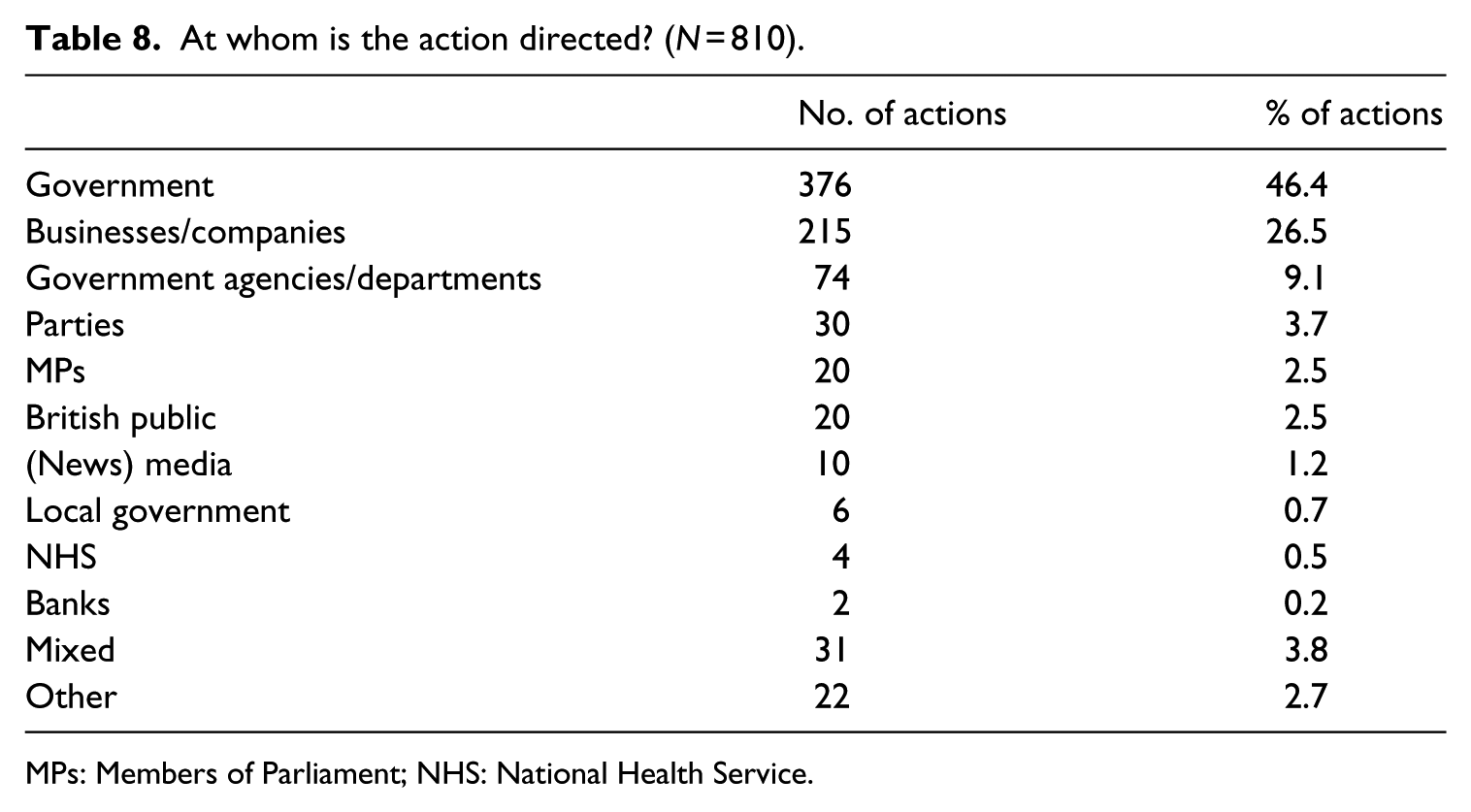
MPs: Members of Parliament; NHS: National Health Service.
Discussion and conclusion
Taking forward a new agenda of online deliberation, this study has examined political talk in formally non-political online third spaces, and whether this leads to political action. As research is still in its relative infancy, we set some broad research questions, which offer a benchmark and platform for future research. One such question is where political talk in third spaces originates (RQ1): is it in discussions clearly indicating that they are political from the start, or through the process of discussing everyday preoccupations? The answer (to varying degrees depending on the forum) is both: political talk is embedded throughout the forums – not just in explicitly ‘political’ sub-forums – and speaks to the ability of forum participants to make connections between their everyday lifeworld and the political process (Habermas, 1987; Van Zoonen, 2005). Furthermore, the topic of political discussions (RQ2) was not simply reactive to news media (though this did occur) as previous research has suggested (Jackson et al., 2013). Rather, discussions were just as likely to emerge from non-political (typically personally oriented) discussions as they were political ones, demonstrating the links people made between everyday experiences and public policy.
The deliberativeness and normative ‘quality’ of online political discussion (RQ3) has been extensively researched previously, and so our aim here was to capture the communicative customs and cultures of the three forums at a fairly general level, to inform our analysis of political actions. Here, we found differing cultures according to the forum, with political discussions in MSE more likely to be framed within a context of fraternity and support as opposed to argument and debate. Moreover, the way that argument and debate was performed in these third spaces was often ‘productive’: 73% of these threads led to policy proposals, where participants went beyond passively discussing public policy, to proposing their own solutions. We would argue that what distinguishes third spaces (particularly MSE and Netmums) from explicitly political online spaces is a discursive culture that is less macho and competitive and more about help and support.
Furthermore, when the culture of online spaces is such, we argue it can facilitate political actions (RQ4). In DigitalSpy, the communicative culture is more akin to that of many political online spaces, and it seems no coincidence that there was less political action here. In MSE and Netmums, the culture is generally more towards support, advice, and ultimately, action. The proportion of political discussions that led to a form of political participation in Netmums and MSE was quite remarkable, and warrants further reflection.
While the teams behind Netmums and MSE are both explicit in conceiving the forums as having a political role and giving a voice to their members through campaigns and consultations, we can say with some confidence from the behaviours of people on the forums that the vast majority are not there to talk politics. We would also argue (based on our observations from hundreds of hours studying these spaces) that most of the people using the forums would not consider themselves as particularly politically engaged or active. Yet, we saw them mobilized towards a range of political actions. Moreover, it would be hard to characterize the repertoires of political participation captured in this study as slacktivism (Morozov, 2009). While signing an e-petition (9.8% of actions) is little more than a click, and consumer activism (13%) does not require a considerable time investment, the majority of actions we found were what Chadwick (2012) terms medium or high threshold forms of political participation, requiring time and effort, such as contacting one’s MP (23%), starting a campaign/protest (8.9%) or writing to the media (9.4%).
As Coleman and Blumler (2009) have argued, political activities online are frequently elusive and ephemeral, rarely if ever reaching the agenda of formal decision-makers. Anecdotes aside, it was beyond the scope of our study (and therefore a limitation) to systematically follow the political actions we found to their conclusion, and no doubt many ultimately led to little political impact. 3 But what MSE and Netmums have done successfully is to position themselves as important stakeholders for government consultations on policy-making – with the UK government recognizing this (see Mayo and Steinberg, 2007) – which brings the online community closer to decision-makers and gives the actions we found a greater chance of success.
Of course, these findings come in the context of widespread concerns about political engagement, depoliticization and cynicism in advanced Western democracies. While we cannot, and should not, expect new media to be some kind of technical fix to broader socio-political problems, we have built on research showing that deliberative political talk can emerge in online third spaces, finding that this can and does lead to political action.
Footnotes
Declaration of Conflicting Interests
The author(s) declared no potential conflicts of interest with respect to the research, authorship, and/or publication of this article.
Funding
The author(s) received no financial support for the research, authorship, and/or publication of this article.