



Abstract
Along with the recent boom in support of populist movements in Europe, social media seems to be the ideal place for their interaction with the public. While Facebook has been thoroughly explored for populist campaigning, there is still scarce research on visual aspects of their communication. Analysing the 2019 European Parliament campaign, this study seeks to determine the distinct characteristics of a populist visual communication style and its differences in relation to the non-populist parties. Applying quantitative content analysis to the images (N = 997) posted on Facebook by political parties from 28 countries enabled us to show that there is a predominance of similarities in both communication styles. Although populists demonstrated a higher propensity to depict their leader and use national symbols, these were exceptions to the overwhelming evidence of uniformity in campaigning methods. Hence, we argue that despite evidence of textual visibility, populist communication does not explicitly manifest through images.
Introduction
As political communication research undergoes a ‘visual turn’ (see Veneti et al., 2019; Bucy and Joo, 2021), increased attention has been paid to the resonant power of images to evoke strong emotions (e.g. Coleman and Wu, 2015), to act as a source of political information that is processed quickly (e.g. Graber, 1996), and to shape attitudes and behaviours (e.g. Banducci et al., 2008). On account of these characteristics, some have argued that there is a natural fit between populists and visual communication (Kriesi, 2014), which recent empirical evidence would seem to support. For example, the Austrian FPÖ has its own TV-/video studio (Russmann, in press), the Sweden Democrats use visuals to share more private moments than non-populist parties (Ekman and Widholm, 2017), while populists such as Trump have privileged patriotic symbols in their visual campaigning strategy (Muñoz and Towner, 2017). Given the visual cultures that prevail on such platforms (Larsson, 2020), social media has been central to these debates. Indeed, some have argued that there are ‘mutual affordances’ between populism and social media that have facilitated the rise of populism in many Western democracies (Hopster, 2020).
It is therefore of growing importance to understand how populist politicians are using the visual affordances of social media, and whether a distinct populist visual communication style exists. This becomes more urgent when we consider that, so far, studies on populist communication have largely focused on textual elements which yield only ‘an incomplete picture of what populism is’ (Bucy and Joo, 2021, p. 11). While an emergent body of work examines populist visual communication practices (e.g. Bast, 2021; Mendonça and Caetano, 2021), single-country studies still prevail, and only through further research across multiple national contexts and electoral settings will we understand the dynamics of populist and non-populist visual campaigning styles.
In this paper, we investigate the differences and similarities between populist and non-populist actors’ Facebook-based visual communication. We apply a quantitative visual content analysis focusing on still images on a random sample (N = 997) of the image-based political communication of parties’ Facebook pages from the 28 EU countries in the 2019 European Parliament (EP) campaign. Despite the expectations of the literature, we do not find a strikingly distinctive populist visual communication style, which leads us to consider the explanations for this. In so doing, we argue that visually, populist parties more resemble non-populists than vice versa; a point that opens up a number of reflections on the nature of campaigning on social media. Among other explanations, this convergence may be the consequence of the increasing level of professionalization of digital campaigning that offers rather uniform patterns of visual communication.
Populism: Approaches and features
Our work applies two key approaches in the study of populism: an actor-centric approach and a communication-centric approach. First, as we compare the communication patterns of predefined populists and non-populist parties, we follow the actor-centric approach that defines populism as a thin-centred ideology ‘that considers society to be ultimately separated into two homogeneous and antagonistic groups, “the pure people” versus “the corrupt elite”, and which argues that politics should be an expression of the volonté générale (general will) of the people’ (Mudde, 2004, p. 562). Mudde’s (2004) approach is often used to differentiate between populist and non-populist actors, and our empirical investigation draws upon such categorization. Nevertheless, while our research is designed to identify similarities and differences in populists and non-populists’ communication, our hypotheses are motivated by the approach that considers populism a communication style. For this, we apply de Vreese et al. (2018) communication approach, where the main dimensions of populist political actors’ communication are (1) people-centrism, (2) anti-elitism, (3) and reference to outgroups (de Vreese et al., 2018). However, as these are all rather content-related dimensions, we supplement it with Moffitt’s (2016) political style approach, which allows us to focus on the symbolically mediated performances, specifically the visual aspects. In line with that, these content dimensions are supplemented with two style features, (4) bad manners, and (5) crisis communication.
Besides these main dimensions, and beyond the conceptual debate about the definition of populism, research identified several additional characteristics and recurring elements that are not its constitutive features, but widely characterize populist communication. The role of the leaders is often emphasized in populist communication, who are one of ‘the people’, but also represent them, thus they typically appear as ordinary and extraordinary at the same time (Zoonen, 2005). The ‘one of you’ image is often conveyed by depicting the leader's physical proximity to ordinary people and involvement in ordinary activities. For the extraordinary image, the leader must show the ability to be the voice of ‘the people’ by showing their ‘strong, virile and healthy’ character (Moffitt, 2016, p. 71). Further, crisis and threat communication involve emotionalization and simplification. Emotional and passionate performances can not only bring the leaders closer to ‘the people’, but by arousing negative emotions, populists can enhance the feeling of being threatened by ‘the elite’ or ‘the others’. Simplification is also an important part of this toolkit: populists are often ‘offering simple answers for the crisis, and advocating the simplification of political institutions and processes’ (Moffitt, 2016, p. 131). Crisis could be further emphasized both rhetorically and visually by representing military and armed forces.
Populism, social media, and visuals
Previous studies have shown that social media platforms are particularly suitable for populist communication. Engesser et al. (2017) argue that social media platforms and the logic of connective action – identified by Bennett and Segerberg (2012) as a driver of political activity on these platforms – provide a great opportunity for populist actors to spread and articulate their ideas. Here, personal action frames that are under-specified and open to different interpretations and personal narratives can spread well, which fits well with the people-centric and anti-elite character of populist communication. Indeed, existing studies showed that populist appeals spread well on social media, and users are eager to react, comment on, and share populist messages (Authors, 2021). Also, the fact that social media messages can reach users without the interference of journalist gatekeepers creates an appropriate context for bad-mannered-style communication, as well as oversimplified anti-elitist, and exclusionary messages. News media frequently present populist messages in a highly critical frame, highlighting their contradictions and adding important contextual details (Wettstein et al., 2018). On social media, populist messages can spread in an unfiltered way.
On the face of it, the extensive opportunities of image-based visual communication on social media may also benefit populist actors. Visuals, 1 such as nonverbal displays, can effectively shape emotional attitudes (Coleman and Wu, 2015), thus images might be a powerful way of populist emotionalization on social media. As for negativity, visuals are suitable to express polarized topics in a pretended moderated way by applying a communicative camouflage through the creation of divergent and ambivalent pictures, instead of straightforward and recognizable symbols (Adami, 2020), and their meanings are not bound to language barriers (Hokka and Nelimarkka, 2020). Further, images can transmit messages that are easier to understand than verbal messages (Graber, 1996), they are able to cut down complex political issues into oversimplified visual messages (Zelizer, 2010), and hence, they might be highly useful tools of populist simplification. Indeed, Larsson (2020) finds that compared with non-populist parties, populists could achieve higher user engagement on Facebook with their visual posts.
While it seems that populist actors can benefit from the visual culture of social media, it is unclear if there is a distinct visual communication style characterizing populist actors. While for textual discourse there is an expanding body of literature documenting how populist communication differs from non-populist, and identifies the ingredients of populist communication (Aalberg et al., 2016), our knowledge is more limited when it comes to the visual aspects of communication. One strand of existing literature examines the visual framing that politicians (including populists) are subject to in mainstream media (while acknowledging that politicians are far from passive objects in this process). In the most comprehensive presentation of populist visual framing so far, based on U.S. candidates’ depiction in television coverage from 1992 to 2004, Grabe and Bucy (2009) define the visual elements of the ‘Populist Campaigner’ frame (p. 291) and distinguish two broad categories: mass appeal and ordinariness. Mass appeal refers to the depiction of celebrities, large audiences, approving audiences, and interaction with crowds, while ordinariness contains visual categories of informal attire, casual dress, athletic clothing, ordinary people, and physical activity.
The second strand of the literature focuses more on populist actors’ visual communication styles and strategies. Gimenez and Schwarz (2016), for example, examine the visual communication styles of the French National Front and the Swiss People's Party, describing the different visual construction of ‘the people’ and ‘proximity to the people’ by differentiating between the depiction of ‘being with the people, addressing the people and representing the people’ (p. 226). Wodak and Forchtner (2014) stressed additional performative elements of right-wing populist leaders, such as the celebrity culture-like self-presentation by the careful selection of meeting places, clothes, and the people who are depicted with the politicians. Analysing the visual self-representation of Jair Bolsonaro, Mendonça and Caetano (2021) identify three main groups of populist images: (1) showing ordinariness by mirroring the people; (2) performing extraordinariness by bringing ordinary elements into extraordinary situations; and (3) presenting symbols of power. Investigating Trump's technological performance in the 2016 U.S. campaign, Baldwin-Philippi (2018) argues that amateur production techniques, such as the low quality of images, poorly shot or pixelated images are features of populist communication. Focusing on right-wing populist actors on Instagram, Bast (2021) showed that populist visual messages are similar to non-populist visual political communication in terms of showing expertise and trustworthiness, popularity, as well as private and positive content.
Finally, there are a few studies with a general focus on visual political communication that describe some specific populist features. Ekman and Widholm (2017) analysed Swedish politicians’ Instagram communication and found that right-wing populists are keen on sharing more private content than non-populists. Moreover, investigating election posters in online and offline campaigns, Johansson and Holtz-Bacha (2019) argue that posters are more used for negative campaigning in the case of populist parties.
Research question and hypotheses
Amidst this growing literature on the visual aspects of populist communication, a number of shortcomings still remain. First, studies often concentrate on a few specific elements rather than offering a more overarching understanding about populist communication. Second, these studies are mainly single-country studies focusing on a few, mostly right-wing populist leaders, thus it is very difficult to generalize their findings. Third, investigating solely populist actors’ communication means that fundamental questions remain unanswered, such as what are the differences between populist and non-populist visual communication? Is there a specific way in which populists use images on social media? These are highly relevant questions given the extended visual affordances offered by social media platforms. Since our knowledge on the distinctive features of populist communication is largely based on verbal and textual communication research, and populist visual communication is investigated mainly with a narrow right-wing populist focus, we need to go further and bridge these gaps. Hence, this paper carries out an exploratory research in a cross-country context, and applies an actor-focused approach to answer the following main research question: RQ: What are the differences and similarities between populist and non-populist actors’ image-based visual communication on Facebook during the 2019 European Parliament election campaign?
We address this research question through a focus on Facebook, as it is the most used social media platform in European countries (Newman et al., 2020).
To capture visual communication in detail we distinguished several elements that parties use when producing visuals for Facebook. While our research is exploratory in nature, based on the concept and characteristics of populism discussed above, some hypotheses are formulated related to the types of visual elements expected to be more often used by populists. For all other categories that are not related to specific hypotheses, open research questions are applied to find out whether their usage is similar or different across populists and non-populists.
The first aspect we address is the formal type of the images used by parties – these include text only, flyer, montage, and photo with or without text. Photos with text on them can simplify visual messages that can be blurred or too complex in the case of photos without text. Furthermore, multimodality – understood here as picture combined with text – is often used to create negative messages (Famulari, 2021). Since simplification and negative messages are key features of populist communication (Engesser et al., 2017), it is hypothesized that photos without text are less used in populist communication (H1a), while photos with text are more common (H1b) due to their ability to create more specific, simpler and more negative messages. Without formulating hypotheses, we registered if an image was uploaded into an album, and if filters – such as sepia or black and white filter – were used on it, in order to better describe the applied visual tools. The second aspect is the valenced character of the images where positive, negative, neutral, and mixed categories are distinguished. It is hypothesized that the context of an image is more often negative in the case of populist parties compared to their non-populist counterparts (H2), due to the importance of arousing negative emotions towards ‘the elite’ or ‘the others’ (Moffitt, 2016).
In terms of the content of the images, we distinguish between images displaying political work, the campaign, policy issues, and personal/private matters. Due to the ordinariness of populist politicians and their aspiration to resemble ‘the people’ (Mendonça and Caetano, 2021), it is assumed that personal images focusing on the private life of politicians are more frequent in the case of populist parties (H3a). In contrast, images that emphasize policy issues (H3b) and demonstrate conventional political work (H3c) are assumed to be more common among non-populist parties as populists keep distance from the traditional elite-like political appearance. Apart from (general) negativity in party communications, critical visual content can depict specific political opponents in an unfavourable way. Given their tendency towards anti-elite sentiments and threat-communication, it is also hypothesized that critical visual content is more common among populists than non-populists (H3d).
Images are especially useful tools to personalize communication on social media (Farkas and Bene, 2020). Here, it is assumed that due to the leader-centric character of populist communication, populist parties more frequently depict their own leaders (H4a). In addition, the anti-elite and critical character of populist communication suggest that other parties’ leaders (H4b), as well as other countries’ leaders (H4c) will be more often deployed by populists than non-populists. At the same time, it is expected that because of the people-centric focus, populist images will more likely include random people (H4d), and, due to their use of crisis and threat discourses, armed forces more often than non-populist parties (H4e). In terms of the number of the depicted people, it is assumed that populist parties are keen on depicting more people in their pictures than non-populists (H4f) as it can refer to ‘being with the people, addressing, and representing them’ (Gimenez and Schwarz, 2016).
Beyond the specific actors depicted in pictures, a politician's self-presentation is crucial. Based on the results of Grabe and Bucy (2009) we expect that casual clothes are more often depicted in populists’ images (H5a) to emphasize the ordinary, people-centric character of populism. Further, in line with the people-centric nature of populism, and the visual populism literature discussed above, we expect that depicting politicians’ interaction with (H6a) crowds, or (H6b) random people, and (H6c) depicting their approval by audiences is more common among populist parties.
Symbols and objects, such as flags or coat of arms can refer to a variety of symbolical meanings and serve as subtle backdrop cues that can affect the recipient (Dan and Arendt, 2021). By recording a variety of symbols and objects, we aimed to shed a light on the populist-specific symbolism. We expect that political symbols (EU, country, party) play a more important role in populists’ communication as they can easily trigger positive or negative reactions towards the in- and the outgroups (H7a), while popular cultural symbols are able to emphasize the ordinariness of populist actors (H7b). As populists use social media to bypass critical journalistic gatekeepers (Engesser et al., 2017), and they often attack mass media (Fawzi, 2019), mass media-centric image may be less important for populists, therefore we expect that (H8a) microphones and cameras are less often shown in populists’ images. Nonetheless, as mobilization against the elite and ‘the others’ is a key feature of populism (Canovan, 1999), the mobilization-focused populist communications are expected to put more emphasis on the act of voting, therefore (H8b) election-related objects appear more frequently on populists’ pictures.
Research design
Data and methods
The research is built on a dataset that includes a random sample of parties’ image-based Facebook posts published in the last 28 days of the 2019 EP campaign (UK: April 25–May 23; Ireland: April 26–May 24; all other countries: April 28–May 26). Only parties reaching at least 5% of the votes in their respective countries were considered for analysis (N = 189), leading to the identification of 12,285 image-based Facebook posts. However, 13% of these posts belonged to a single party: the Italian populist party, Lega Nord. To avoid the potential skewing of our sample, a random sample of Lega posts was included to make its number of posts equal to the second most active party (N = 671), resulting in a sampling frame with 11,376 posts. Then, a random sample (N = 1024, 9% of the total sample) was drawn. After removing deleted posts (N = 27) our final sample contains 997 images.
Populist parties were identified using the categorization of The PopuList (Rooduijn et al., 2019). Our sample is representative of our sampling frame, that is, the overall Facebook campaign of European parties in terms of both countries and party-type. The largest deviance between individual countries’ shares in our sampling frame and sample are 2% (Romania), and while the share of populist parties’ posts is 37% in our sampling frame, it is 34% in our sample. To test our hypotheses, we performed a quantitative content analysis, which allows us to discover patterns, trends, and themes between populist and non-populist parties. We built a detailed coding scheme for the variables discussed above which includes 46 variables (see Tables 1, 2, 3) and can be found in the online Supplemental Material. Coding was shared between two coders, and we tested the reliability of their work in a subsample of 113 posts. Krippendorf's alpha coefficients are acceptable for each category (>.69) (see online Supplemental material).
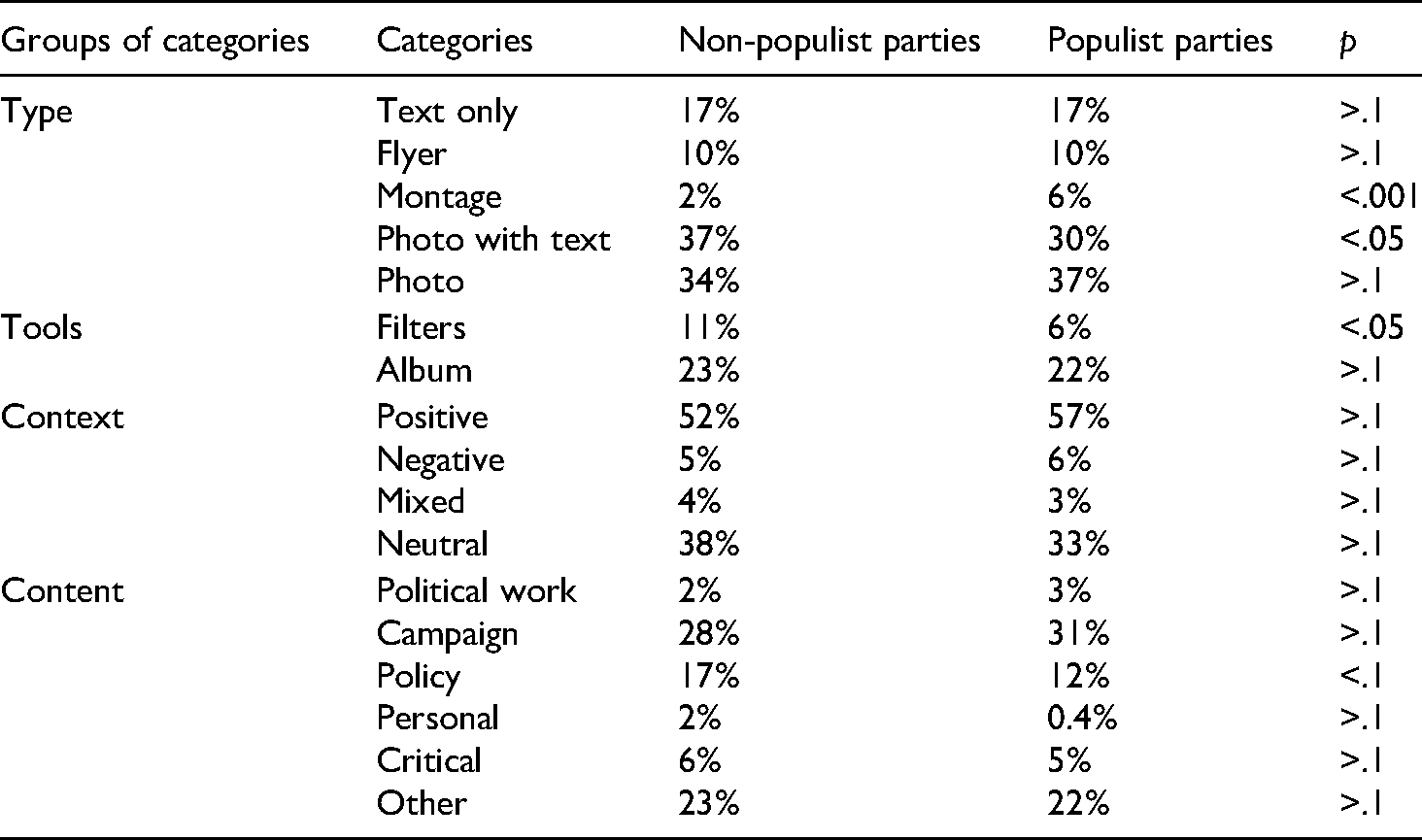
Visual nature – type, context, and content of the images.
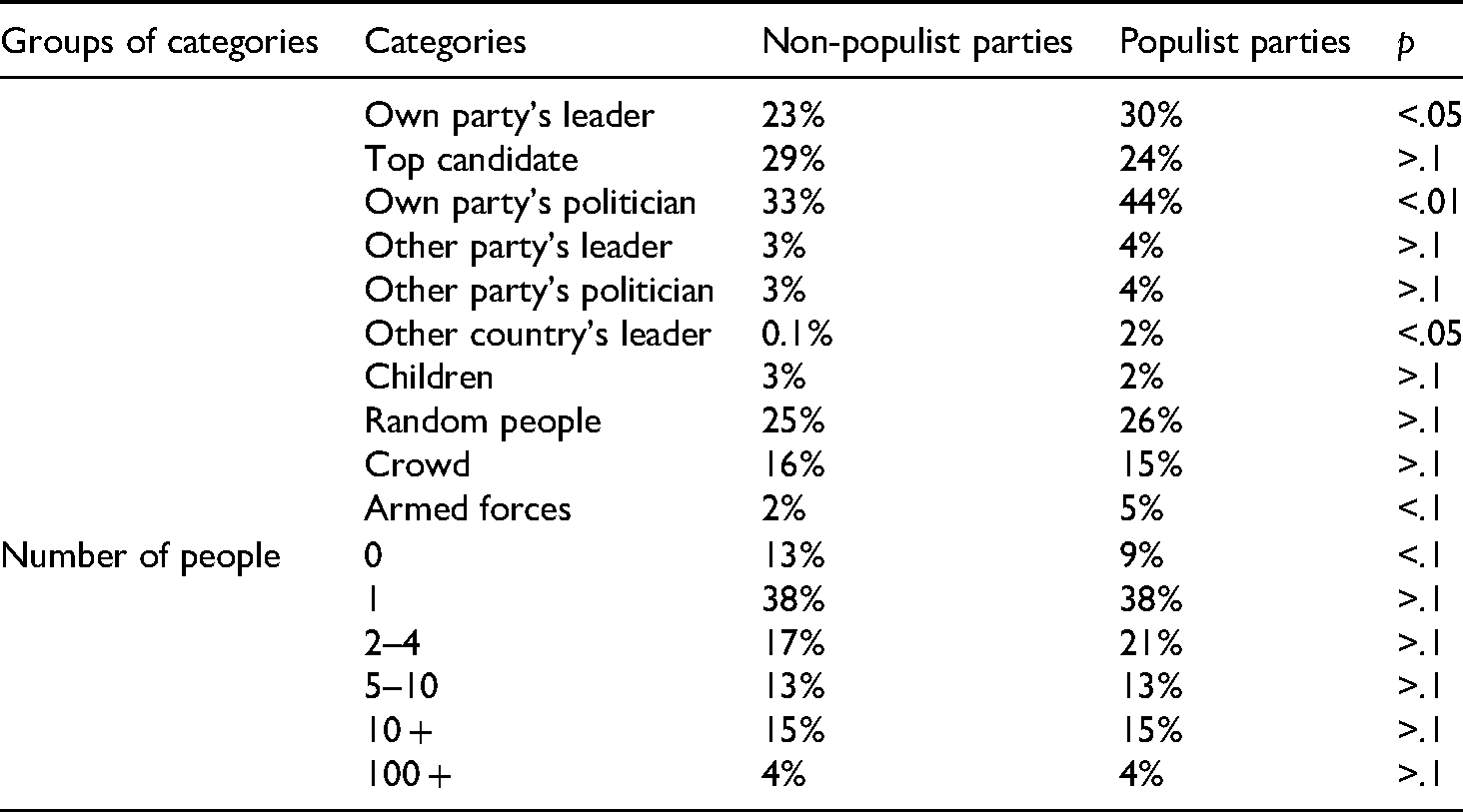
Actor characteristics and personalization.
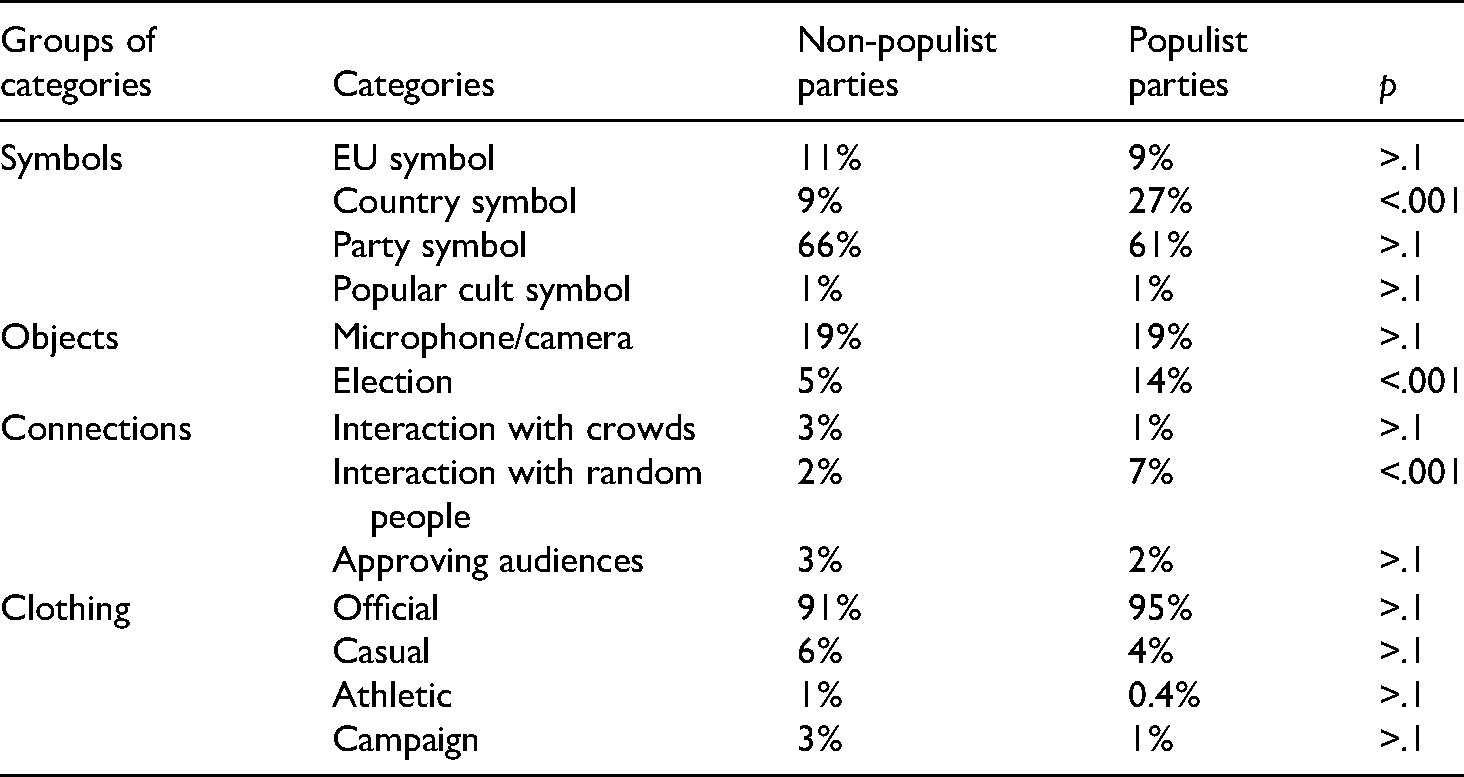
Symbols and objects in visual communication.
Results
Visual nature – type, context, and content of the images
Our findings are summarized in Table 1. Considering the type of image, photographs with and without text were the most commonly used by both types of parties, and were the only types of images with the usage exceeding 30%. Interestingly, the distribution of text-based visuals and flyers were identical and equaled, respectively, 17% and 10%. As for the differences between non-populists and populist parties, the former are inclined to multimodality (respectively 37% of non-populist and 30% of populist parties have used photos with text). Therefore, H1a and H1b have been rejected by our data: populists are less likely to use photos with text than non-populists, while in the case of photos without text, there is no significant difference. While montage is a rarely applied visual element in our sample, populists use it more frequently than non-populists. Although previous academic inquiries proved that there is a positive effect of using filters for user engagement (Muñoz and Towner, 2017), populist parties made significantly less use of them. Presenting pictures in albums is an equally popular tool in both subsamples and is used in 22%–23% of image-based posts. Regarding the valenced context, the analysis demonstrates that there is no significant difference between populist and non-populist parties. Pictures are predominantly positive in parties’ image-based communication, while negative or mixed images are exceptional even for populist parties which leads us to reject H2.
As discussed above, personal images portraying the non-political aspect of life can serve as an effective vehicle for creating and maintaining the image of somebody who is embedded in society. However, the results of our study demonstrate that the use of personal images is marginal for both populist (0.4%) and non-populist (2%) communication therefore H3a has to be rejected. It was also assumed that the content emphasizing policy issues, for example, images of factories, hospitals, or school visits, and traditional political work, for example, pictures of politicians attending meetings, conferences, or working in their offices, would be more prominent in non-populist Facebook postings. Our findings show that the latter used this type of content in 17% of published posts, which was 5% more frequent than populists, and represent a marginally significant difference offering a cautious confirmation of H3b. Traditional political work was barely depicted in the posts of all analysed parties, and no significant difference exists between populists and non-populists, rejecting H3c. The most frequently used image content type on both party groups was campaign pictures, however, no significant difference between populists and non-populists are found in this respect. Further, and in contrast with H3d, critical content, depicting other parties’ politicians from a negative, unfavourable angle or perspective, is not more frequently used by populists (5%) than non-populists (6%).
Actor characteristics and personalization
When it comes to the actors depicted in the posted images, populist parties were significantly more likely to depict their own party leader and party candidates, which is in line with H4a. Top candidates were also often shown in the pictures, but there was no significant difference between populists and non-populist in this respect. However, depicting other party's leaders and politicians was a rather minor phenomenon, and did not differ significantly between populists and non-populists, contrary to H4b. Curiously enough, during the electoral campaign, European populists used the image of other country's leaders significantly more often than non-populists, which confirms H4c. It seems that populist leaders are keen on presenting their populist connections all around the world (see Figure 1).
Our findings support H4d by proving that populist political parties used the image of armed forces more often (2% vs. 5% of identified posts) even if it was a marginal phenomenon in their communication.
Given the fact that populist communication often relies on a personal connection of the leader with the electorate, the depiction of people in their visual campaign is an important element of their strategy. Surprisingly, the discrepancy between populist and non-populist parties in using the image of random people was not significant, rejecting H4e, and this is also the case for depicting crowds. Both elements are relatively common in parties’ visual communication, as Figure 2 shows examples of populist crowd depiction, but this is not specific to populist parties. Interestingly, the number of depicted people are also strikingly similar between both types of parties. Populists and non-populists were identical in their depictions of large crowds over 100 people (4%), minor gatherings (15%), groups of 5–10 people (13%), and single persons (38%), with minor differences in the depiction of 2–4 people (17% vs. 21%), therefore H4f is resoundingly rejected. However, depicting any people in images is slightly more common for populists, as only 9% of their images include no people, while this ratio is 13% for non-populists.
Since it is easier for the average citizen to identify with someone of similar appearance and style, it was assumed that casual clothing would be more often used as an instrument of populist people-centric appeal. However, the results of the analysis do not prove this idea. Politicians in images of both populist and non-populist parties predominantly appear in official clothes, any kind of non-official clothing was exceptional. In this regard, there is no significant difference between populists and non-populists, which rejects H5a. The emotional connection-building strategy of visual populist communication also assumes depicting politicians while interacting with random people and crowds, or receiving approval from audiences (Grabe and Bucy, 2009). Although both are rare in parties’ visual communication, the first assumption proved to be in line with H6a as deploying interaction with random people is more common for populist parties, but H6b and H6c were rejected by our data, as no significant differences exist between populists and non-populists in images showing politicians in interaction with crowds or alongside approving audiences.
To sum up, while there are many similarities between non-populists and populists in how they present actors in their images, it seems that own party politicians and interaction with random people are more emphasized for populists’ visual communication. This is also true for other country's leaders and armed forces, albeit to a lesser degree. However, the clothing of these actors is highly similar promoting a rather official image of campaigning.
Symbols and objects in visual communication
The last of the analysed dimensions of visual communication during the 2019 EP campaign is the representation of symbols and objects. It was assumed that populists’ visual communication would involve more political symbols, but this was true only for national symbols. The result of our analysis proves that populists are much more prone (27%) to using national symbols in comparison to non-populist parties (9%). However, this gap was not revealed in the case of EU symbols, where there was no significant difference between populist and non-populist parties. Party symbols were the most frequently used symbolic elements in both subsamples, but their usage was not significantly different across populists and non-populists. To sum up, H7a is rejected, but it is important to note that it is supported by national symbols. Popular cultural references, however, were equally exceptional in both subsample, rejecting H7b.
Showing a media-centric image, microphone and camera frequently appear in both populists’ and non-populists’ images, but no significant difference is found between them in contrast with H8a. However, election-related objects, such as ballot boxes, ballots, or crosses on a ballot are much more specific to populist parties underlining their strong focus on mobilization, and support H8b.
Discussion and conclusions
Through a focus on the context, content, and presentation of actors in the posts of EP parties on Facebook, the ambition of this paper was to examine whether a distinct populist visual communication style exists on Facebook. Eight sets of hypotheses were tested based on the expectation that there would be consistent differences in the visual communication repertoires of populist versus non-populist parties. However, with the exception of a few, most of the hypotheses were rejected, suggesting that visual campaigning styles are largely shared. This is an important finding given the direction of previous studies where, discursively, populist political communication has distinct characteristics. Visually too, populist communication is, for example, more leader-centric, with qualities of mass appeal and ordinariness (Gimenez and Schwarz, 2016; Grabe and Bucy, 2009); and prominent use of national symbols (Mendonça and Caetano, 2021). While we found elements of these differences, they were still outnumbered by the similarities in visual communication repertoires. This, however, does not make our findings any less interesting or significant, as they allow us to reflect on some important questions for the field.
First, what might explain the similarities over a range of visual forms? Is it that populist parties are adopting non-populist visual practices or vice versa? On the whole, we would argue that the former is more likely. For instance, previous research suggests populists are more likely to utilize negative communications, as they further facilitate the distinction between ‘us’ towards ‘the elite’ or ‘the others’ (Engesser et al., 2017; Moffitt, 2016). However, findings suggest that with a 10:1 ratio in favour of positive over negative posts, populist parties – visually at least – are more in line with what we might expect of non-populists in terms of emotional context. In terms of content too, findings suggested that populist parties would seem to adhere to existing conventions, mostly oriented towards informing audiences about the campaign process and criticizing political opponents, albeit slightly less focused on policy than non-populist parties. In contrast to previous research, there was almost no reference to personal life (e.g. Mendonça and Caetano, 2021), although our focus was on Facebook (rather than Instagram) and on party (rather than personal) accounts.
For the actors visible in campaign posts, it is a more mixed picture, though we would still argue they lean towards established non-populist practices. Populist parties are, for example, more leader-centric, but still only in 30% of posts, perhaps suggesting that levels of personalization typically seen by populist parties at a national level do not translate to transnational contexts. Further, we saw little evidence of the ‘populist campaigner’ visual archetype that has characterized TV coverage of populist leaders (Grabe and Bucy, 2009). With 68% of populist party posts depicting less than four people, and interaction with crowds or approving audiences barely registering, their visual campaign style did not communicate mass appeal. Neither did it project ordinariness through casual clothing (Grabe and Bucy, 2009; Muñoz and Towner, 2017). On the contrary, populist leaders looked highly formal.
Our findings do, however, demonstrate a considerable difference in the use of nationalistic symbols. Concurrent with other studies (Muñoz and Towner, 2017) our results show that populist parties use more national and patriotic symbols than non-populist parties. Drawing on ethnosymbolism – an area within nationalism studies – Schertzer and Woods (2021) argue that the deployment of ethnic myths, symbols, and traditions facilitate boundary-making processes; they define the ‘people’ through ‘ethnic and cultural markers (and, in so doing also identify outsiders)’ (p. 3). Various studies have demonstrated the widespread populist use of national symbols, from Trump's extensive use of patriotic symbols (Muñoz and Towner, 2017) to the former Venezuelan President Hugo Chávez's use of flags (Salojarvi, 2019).
Thus while there were exceptions, on the whole, our study lends support to the emerging body of research suggesting that characteristics established in textual populist communication cannot necessarily be transferred to visual material, at least on social media (Bast, 2021). We offer three reflections that may explain these findings. First, populist leaders are often less the political outsiders that they would have us believe. Like their mainstream counterparts, they are mostly men in suits, who have come from the same elite schools and colleges, and mix with the same vested interests in business and finance. Discursively, they may be able to break from some established communicative conventions, especially through social media, but visually, it may be harder to break them, especially through a shared party social media account. Second, and relatedly, such campaigning conventions are established and reinforced by campaign professionals who work across all aspects of the campaign, and ensure that social media platforms are used in consistent ways, including visually (Authors, 2021). Importantly, studies show that across countries and the political spectrum, such professionals share a common understanding of what counts as campaign professionalism and good practice (Tenscher et al., 2016). Furthermore, recent research has shown how social media firms themselves are actively shaping digital campaign strategy, content, and execution (Kreiss and McGregor, 2018): a process that might likely lead to common practices across party divides. Therefore our results may be interpreted in light of the development of parties as enterprises (Panebianco, 1988), and from the perspective of professionalization of political communication (Holtz-Bacha, 2002): as political parties are adopting the logic of private companies’ strategies and techniques, campaigns are organized by PR, advertising and digital agencies, whose main goal is efficacy rather than emphasizing populist features. These influences are not to be underestimated, especially in the context of a second-order campaign where few individual politicians have high profiles and the party machine plays an important role. Third, our findings are also a reminder that social media's direct nature does not automatically mean that either populist communicative strategies will prevail, or that populists will be necessarily good at using these sites. Rather, as with their mainstream political counterparts, there is unlikely to be a uniform populist use of these platforms. Together, we suggest that due to these logics, future research might not start from the hypothesis that populist parties have a distinct visual campaigning style to non-populists on Facebook. Further, while our study does not challenge those who find different discursive styles or policy focus between populists and non-populists, it does call for a careful and nuanced use of generic descriptors such as ‘communication style’ or ‘campaign strategy’ given that populists may be more distinct discursively than they are visually.
Our study opens up many questions for future research. For instance, maybe the type of election setting plays a role in the use of visual communication. In our case, European elections are second-order events with lower voter turnout than national elections (Reif and Schmit, 1980) which offer different electoral dynamics to national general elections, not to mention non-election contexts. This should be explored by future research. With their distinct affordances, genres and audiences, it is likely that platforms matter, too, and so we should hesitate to generalize findings from one platform (in our case, Facebook) to ‘social media’ as a whole (Kreiss and McGregor, 2018). Here, it is important for future research to systematically compare different platforms for elements of visual populism, which may find that some platforms share more mutual affordances with populism than others. Finally, while we offer three explanations for the visual similarities between populists and non-populists found in this study, interviews with key protagonists (e.g. politicians, party strategists, and communication consultants) would likely reveal important insights about the extent to which this is strategic, or the result of other factors.

The depiction of other country's leaders. Images are uploaded by the Czech populist Freedom and Direct Democracy (left) and Hungarian Fidesz (right).
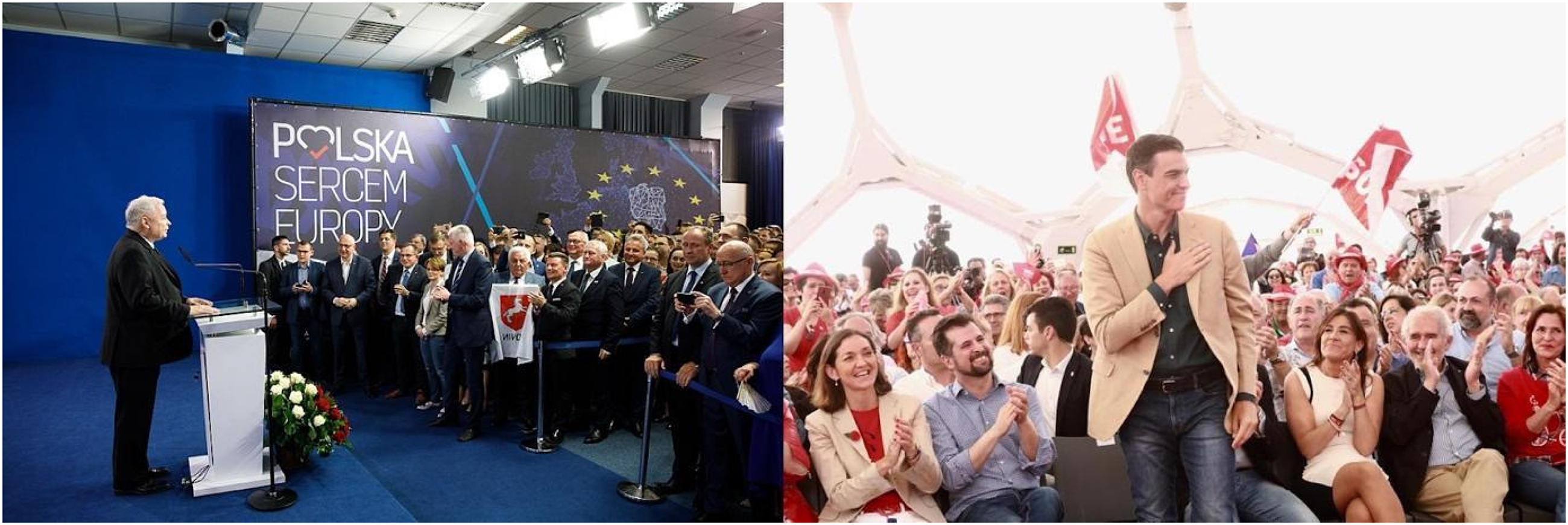
The depiction of leaders surrounded by crowds during the campaign. Polish populist Law and Justice (left) and Spanish PSOE (right).
Supplemental Material
sj-pdf-1-ejc-10.1177_02673231221082238 - Supplemental material for Strikingly similar: Comparing visual political communication of populist and non-populist parties across 28 countries
Supplemental material, sj-pdf-1-ejc-10.1177_02673231221082238 for Strikingly similar: Comparing visual political communication of populist and non-populist parties across 28 countries by Xénia Farkas, Daniel Jackson, Paweł Baranowski, Márton Bene and Uta Russmann in European Journal of Communication
Footnotes
Funding
The author(s) disclosed receipt of the following financial support for the research, authorship, and/or publication of this article: The research was supported by the Incubator program of the Center for Social Sciences, Eötvös Loránd Research Network (project number: 03013645). Márton Bene is a recipient of the Bolyai János Research Fellowship awarded by the Hungarian Academy of Sciences (BO/334_20). Xénia Farkas is a recipient of the ÚNKP Fellowship (ÚNKP-20-3-II-CORVINUS-10).

Supplemental material
Supplemental material for this article is available online.
Notes
Author biographies
References
Supplementary Material
Please find the following supplemental material available below.
For Open Access articles published under a Creative Commons License, all supplemental material carries the same license as the article it is associated with.
For non-Open Access articles published, all supplemental material carries a non-exclusive license, and permission requests for re-use of supplemental material or any part of supplemental material shall be sent directly to the copyright owner as specified in the copyright notice associated with the article.
