




Abstract
Commonly used detergent sclerosants including sodium tetradecyl sulphate (STS) and polidocanol (POL) are clinically used to induce endovascular fibrosis and vessel occlusion. They achieve this by lysing the endothelial lining of target vessels. These agents are surface active (surfactant) molecules that interfere with cell membranes. Surfactants have a striking similarity to the phospholipid molecules of the membrane lipid bilayer. By adsorbing at the cell membrane, surfactants disrupt the normal architecture of the lipid bilayer and reduce the surface tension. The outcome of this interaction is concentration dependent. At high enough concentrations, surfactants solubilise cell membranes resulting in cell lysis. At lower concentrations, these agents can induce a procoagulant negatively charged surface on the external aspect of the cell membrane. The interaction is also influenced by the ionic charge, molecular structure, pH and the chemical nature of the diluent (e.g. saline vs. water). The ionic charge of the surfactant molecule can influence the effect on plasma proteins and the protein contents of cell membranes. STS, an anionic detergent, denatures the tertiary complex of most proteins and in particular the clinically relevant clotting factors. By contrast, POL has no effect on proteins due to its non-ionic structure. These agents therefore exhibit remarkable differences in their interaction with lipid membranes, target cells and circulating proteins with potential implications in a range of clinical applications.
Introduction
Detergent sclerosants such as sodium tetradecyl sulphate (STS) and polidocanol (POL) are injected in varicose veins to remove the intimal lining of blood vessels with the ultimate aim of inducing endovascular fibrosis and vessel occlusion. The active agent is a surface active (surfactant) molecule that interferes with the phospholipid bilayer of cell membranes resulting in membrane rupture and cell lysis.
The interaction of detergents with their target cells is concentration dependent. While lysis happens at relatively higher concentrations, our group has shown that sclerosants at much lower concentrations induce cell activation and release procoagulant microparticles. 1 This is mediated by the interaction of the surfactant molecule with the phospholipid content of cell membranes. Additionally, depending on the ionic nature of the surfactant molecule, sclerosants may interfere with plasma proteins and the protein contents of cell membranes.
The physio-chemical properties of surfactants influence their interaction with target cells and plasma proteins and can directly affect the clinical outcomes. Here, we review the scientific literature on surfactants and examine their interaction with biological membranes.
Detergents and surfactants
Both STS and POL are biochemically classified as surfactant detergents. Detergents are materials used for cleaning and hence water and soap can be defined as detergents. Detergents in common use may contain a range of compounds such as surfactants, softeners, abrasives, bleaching agents, buffers and foam-modifying substances.
Surfactants (surface active agents) are compounds that reduce the surface tension of a liquid. Surface tension (measured by N/m, force per unit length) is the cohesive force amongst the molecules at the surface of a substance that creates a surface film. For instance, surface tension maintains the shape of liquid droplets. The cohesive force between surface molecules makes it more difficult to move an object through the liquid surface than to move it within the liquid itself. Soaps are surfactants made of sodium or potassium salts of fatty acids.
Surfactants are amphiphilic compounds and in general contain a hydrophobic (non-polar) hydrocarbon tail and a hydrophilic (polar) head group (Figure 1(a)). Therefore, surfactants are soluble in both oils (via the hydrophobic tail) and water (via the hydrophilic head). Surfactants reduce the surface tension by adsorbing at the interface between the two substances. Normally oil fragments suspended in water form large droplets. The presence of a surfactant would decrease the surface tension between oil and water surfaces. This allows more mixing with water and prevents the coalescence of oil droplets into a bigger mass. Therefore, the surfactant allows the break-up of oil into multiple minute droplets that can be washed away.
Surfactants: (a) an individual surfactant molecule, (b) a surfactant micelle in an aqueous solution (normal phase micelle) and (c) in an oily medium (reverse micelle).
Aggregation of surfactants
Glossary of detergent properties.
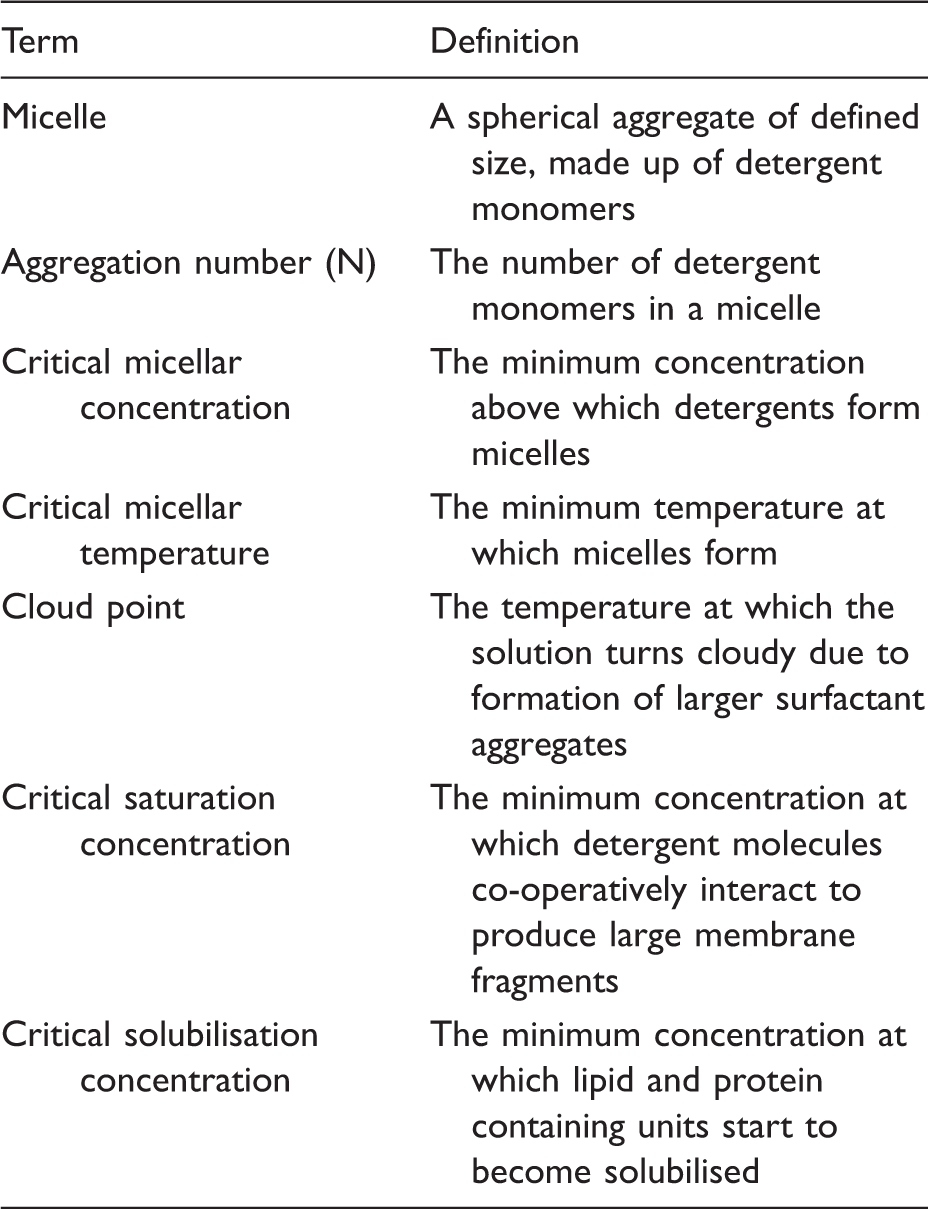
When micelles assemble in an aqueous solution (such as water), the hydrophilic (ionic/polar) heads maintain contact with the aqueous environment while the hydrophobic tails come together to form a core that can surround a non-aqueous substance such as an oil droplet. This is called a normal phase or an oil-in-water micelle (Figure 1(b)).
Normal phase micelles are soluble in water. These micelles exchange individual surfactant molecules with other micelles and maintain equilibrium with surfactant monomers.
When surfactants are mixed in oil, the aggregate is referred to as a reverse micelle. In reverse or water-in-oil micelles, the non-polar tails maintain contact with the oily medium while the polar heads form a core which can contain an aqueous environment (Figure 1(c)). Beyond a certain temperature specific for each surfactant, aggregation of a large number of micelles will turn the solution cloudy. 2 The temperature at which the solution becomes cloudy is referred to as the ‘Cloud Point’. This phenomenon is mostly seen with non-ionic surfactants (Table 1).
Classification of surfactants
Surfactants can be classified into four groups depending on the surface charge. Non-ionic surfactants have no charge groups, whereas anionic agents carry a net negative charge and cationic surfactants carry a net positive charge. STS is an anionic surfactant, whereas POL is a non-ionic agent.
Surfactants containing a head with two oppositely charged groups are called zwitterionic. These are characterised by their (net) uncharged, hydrophilic headgroups. Such surfactants are also called amphoteric (capable of reacting chemically either as an acid or a base) and ampholytic (cationic in acidic solutions and anionic in basic solutions).
Anionic surfactants normally contain a sulphate, sulphonate or carboxylate group. STS contains a sulphate group. Non-ionic agents include fatty alcohols and alkyl polyethylene oxides such as polysorbates. POL is a polyethylene oxide detergent. Cationic agents contain a quaternary ammonium group, and zwitterionic agents contain a quaternary ammonium cation and a sulfonate, carboxylate or a phosphate anionic group.
Detergent sclerosants
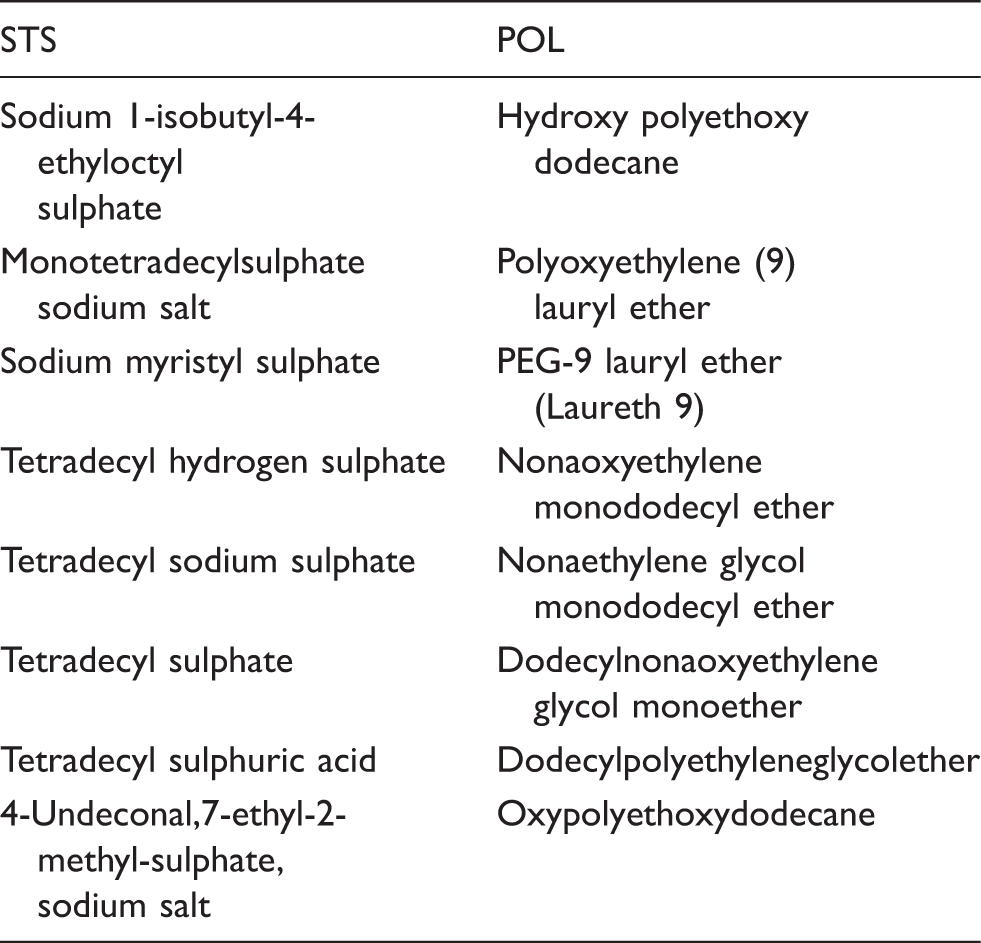
Sodium tetradecyl sulphate (STS) and polidocanol (POL) synonymous chemical names.
Sodium tetradecyl sulphate
STS (C14H29NaSO4) is a negatively charged sulphated surfactant with a molecular weight of 316.44 g/mol (Figure 2(a)). STS as a sclerosing agent is manufactured by STD Pharmaceutical Products Ltd. (Hereford, UK) and available in Australia as FIBRO-VEIN® (Australian Medical and Scientific Ltd., Chatswood, NSW, Australia). In the United States, this product is available as SOTRADECOL® (manufactured by Bioniche Teo. Inverin, Co. Galway, Ireland and distributed by AngioDynamics, Queensbury, NY, USA).
Chemical structure of detergent sclerosants: (a) sodium tetradecyl sulphate (STS), (b) sodium dodecyl sulphate (SDS) and (c) polidocanol (POL). The mean extent of POL polymerisation n ≈ 9.
The CMC of STS in FIBRO-VEIN® is not published by the manufacturer, but the CMC of the parent product, Niaproof 4 is 2.1 mM in water (direct communication with STD Pharmaceutical). Our group has recently demonstrated the CMC of STS to be 0.075% in normal saline and 0.200% in water. 5
At 3%, each mL of FIBRO-VEIN® contains 30 mg of STS and 2% benzyl alcohol as a bactericidal excipient. The solution is buffered using phosphates (dibasic sodium phosphate, monobasic potassium phosphate) and sodium hydroxide in water to a pH of 7.6. SOTRADECOL® contains similar ingredients to FIBRO-VEIN but the pH is set at 7.9 rather than 7.6.
Clinically, STS at 0.05–0.2% is used to treat telangiectasias and venulectasias, at 0.2–0.5% to treat reticular veins and at 1–3% to treat varicose veins. It is generally used as foam to treat larger veins and as liquid or foam to treat reticular veins and telangiectasias.
STS is distilled from Niaproof anionic surfactant 4 (also known as NAS 4 and Niaproof 4, Niacet, Niagara Falls, New York, USA), a high-grade detergent. This detergent is manufactured to contain 26–28% STS and up to 20% diethylene glycol ethyl ether (carbitol). This compound has many applications in a range of industries including textile processing and dyeing, household and industrial cleaners, pickling (reduces the amount of the required acid) and moulding (provides a more uniform sand for use in casting moulds and cores). In pharmaceuticals, it may be used to enhance bactericidal properties of antiseptics and rapid fixing of histological specimens. In latex preparations, it is used as an emulsifying agent and is the preferred emulsifier for the polymerisation of acrylic ester monomers and vinyl esters of higher fatty acids.
NAS 4 contains 27% STS and 20% carbitol and is hence purified further to generate the STS for injection. FIBRO-VEIN® contains 0.02% to 0.045% (wt/vol) of carbitol. Carbitol has a toxicity profile similar to ethylene glycol, is mutagenic in bacteria, teratogenic in mice and can induce an acute or delayed cutaneous hypersensitivity reaction in humans. 6 Before the release of SOTRADECOL®, a number of compounded products containing STS were used in the United States with discrepancies in the stated and actual concentrations of STS and a carbitol content of up to 4.1%. 6
STS has a similar structure to sodium dodecyl sulphate (SDS), the most frequently used detergent in protein biochemistry (Figure 2(b)). SDS is a strong and harsh detergent used commonly to induce cell lysis or in biochemical techniques such as SDS polyacrylamide gel electrophoresis (SDS-PAGE). Being an anionic detergent, SDS is an efficient solubiliser but almost always denatures most proteins. 7
Reactivation of SDS-solubilised proteins is possible in certain cases.8,9 A class of membrane proteins that is frequently resistant to SDS denaturation is beta-barrel proteins from the outer membranes of Gram-negative bacteria. SDS precipitates at low temperatures and in the presence of cations.
Polidocanol
POL (C12H25O(CH2CH2O)nH, Lauromagrogol 400, hydroxy polyethoxy dodecane) is a polyethylene glycol ether of lauryl alcohol. As a sclerosing agent, POL is available in Australia as AETHOXYSKLEROL 3% (Chemische Fabrik Kreussler & Co GmbH, Wiesbaden, Germany). In the United States, this sclerosant is available from the same manufacturer at 0.5% and 1% and distributed as ASCLERA®. Recently, VARITHENA™ (BTG, Pennsylvania, USA), a micro-foam format of 1% POL gained registration in the United States and is available for clinical use.
The CMC of Kreussler POL is reported by the manufacturer to be approximately 0.084 g/L or 0.148 mM (direct communication with the manufacturer). Our group has demonstrated the CMC of POL to be 0.002% in both normal saline and water. 5
At 3%, each ml of AETHOXYSKLEROL® contains 30 mg of POL in water for injection with 5% (v/v) ethanol. The solution is buffered using phosphates (disodium hydrogen phosphate dehydrate and potassium dihydrogen phosphate) to a pH of 6.5–8.0. POL at 0.1–0.5% is used to treat telangiectasias and reticular veins and at 1–3% to treat varicose veins.
POL is a non-ionic emulsifying agent consisting of two components, a polar hydrophilic (dodecyl) head and an apolar hydrophobic (polyethylene oxide) chain (Figure 2(c)). POL belongs to the group of alkylpolyglycolethers, commonly called alcohol ethoxylates (AE). AEs are manufactured commercially by the reaction of an alcohol and ethylene oxide. This reaction generates mixtures of ethoxylates of different ethylene oxide units. For the synthesis of POL, natural fatty alcohols or synthetic alcohols are converted with ethylene oxide.
These detergents are commercially available in many different chain lengths, either as pure substances or mixtures of a certain size distribution. They have the general formula CxEy according to their alkyl chain length (x) and the number of polyoxyethyleneglycol units in the headgroup (y). POL, manufactured by Kreussler, has an average alkyl chain of 12 carbon atoms and an ethylene oxide (ethoxy, –OCH2CH2) chain of 9 units. Thus, POL, as manufactured by Kreussler, can be presented as C12E9. The molecular weight of POL depends on the number of ethoxy units in the molecule. For POL manufactured by Kreussler (E9), the molecular weight is approximately 600.
POL was first introduced in Germany in 1936 as a topical and local anaesthetic agent. The possible anaesthetic properties of POL (and other non-ionic surfactants) were investigated in human volunteers, in parallel with proven local anaesthetic agents.10,11 In contrast to therapeutically used anaesthetics (lidocaine and prilocaine), the tested surfactants, including POL, were found to have no significant effect on heat and cold sensation or significant local anaesthetic effects. POL in common cosmetic products is referred to as Laureth-9. In this setting, it is used in rinse-off products as an emulsifier and surfactant, especially in shampoos and hair conditioners in concentrations up to 4%. It is also used in leave-on products such as body and face creams in concentrations up to 3%.
Biological cell membranes
Cell membranes are composed of lipid bilayers. Similar to surfactants, membrane phospholipids are amphiphilic and contain a hydrophilic polar head group and a hydrophobic tail group. Phospholipids usually have two hydrocarbon chains forming the tail group while surfactants may have one or two such chains.
Molecules with large hydrocarbon chains tend to form bilayers as the alkyl chains are too bulky to fit into smaller structures like micelles. Thus, phospholipids with two hydrocarbon chains are likely to form bilayers while detergents tend to form micelles. The polar heads of phospholipids face the aqueous solutions on both sides of the bilayer structure (Figure 3(a)). One layer of polar heads faces the external environment of the cell (exoplasmic) while the other layer faces the cell cytoplasm (cytoplasmic). The hydrocarbon tails of one layer face the hydrocarbon tails of the other layer.
Structural organisation of phospholipids: (a) phospholipid bilayer containing membrane proteins, (b) micelle and (c) liposome.
The membrane structure is quite fluid and held together by non-covalent interaction of hydrophobic tails. Disruption of cell membrane phospholipids would lead to the formation of monolayer micelles or bilayer liposomes (Figure 3(b) and (c)). Phospholipid micelles have a hydrophilic outer surface and a hydrophobic lipid core. Liposomes have a hydrophilic external surface and also a hydrophilic internal surface that can contain an aqueous solution.
Composition of membrane lipids
Phospholipids such as phosphatidylethanolamine and phosphatidylcholine are the most common membrane lipids. Other membrane lipids include glycolipids and cholesterols, but phospholipids in general are the most abundant membrane lipids. Cell membranes maintain an asymmetrical distribution of phospholipids on the cytoplasmic and exoplasmic leaflets. In the resting state, the cytoplasmic surface contains abundant anionic and amine containing phospholipids such as phosphatidylserine (PS) and phosphatidylethanolamine. The exoplasmic surface and the equivalent luminal surface of internal organelles are rich in choline-containing phospholipids such as sphingomyelin and phosphatidylcholine.
The asymmetrical distribution of phospholipids on cell membranes is tightly controlled and maintained by groups of enzymes collectively referred to as ‘flippases and floppases’. These enzymes use ATP to transport phospholipids to either side of the membrane. The transport of anionic phospholipids into the cytoplasmic aspect is catalysed by flippases, whereas floppases catalyse the transport of choline-containing phospholipids back to the exoplasmic surface. Therefore, these enzymes actively function to maintain membrane lipid asymmetry during the resting state.
Cell activation and apoptosis can lead to exposure of negatively charged phospholipids such as PS on the exoplasmic surface of the cell membrane. This is mediated by another group of enzymes referred to as ‘scramblases’. These enzymes are not ATP-dependent but depend on a rise in the cytoplassmic calcium for their function. Scramblases re-shuffle the phospholipids between the two membrane surfaces and generate a symmetric distribution of the negatively charged phospholipids.
Membrane proteins
Membranes contain a variety of proteins. Integral membrane proteins such as receptors, transporters, channels and adhesion proteins are permanently attached to the cell membrane. Integral membrane proteins can be transmembrane structures where they span the entire membrane or monotopic when attached to only one side of the membrane. The solubilisation and release of integral proteins requires the disruption of the lipid bi-layer, for example following exposure to surfactants.
Peripheral membrane proteins attach to integral membrane proteins or penetrate the peripheral regions of the lipid bilayer using a combination of non-covalent interactions. Conditions including high or low salt and alkaline pH allow the differential extraction of such proteins as they induce the disruption of protein–protein interactions while leaving the lipid bilayer intact.
Interaction of detergents with cell membranes
Detergents are commercially used to solubilise membrane proteins and lipids. In membrane biochemistry, relatively high concentrations of detergents with low CMCs are used to solubilise large amounts of lipids. 2 Although removal of lipids can also be achieved by using organic solvent extraction, these agents in general destroy the native structure of membrane proteins. Solubilisation using detergents is a milder method that may yield stable membrane proteins depending on the detergent used. 2
Intermediary states of membrane solubilisation.
Solubilisation of biological membranes follows overlapping phases determined by the free surfactant concentration (Figure 4(a)).
7
As the surfactant to lipid ratio increases, the lipid bilayer is progressively penetrated, fragmented and eventually solubilised. Initial phase: Non-co-operative interactions. At lower concentrations, surfactant monomers incorporate into the lipid bilayer without disrupting the membrane structure (Figure 4(b)).
Interaction of surfactants with the cell membrane: (a) cell membrane, (b) non-co-operative interaction at low concentrations, (c) co-operative interaction producing large membrane fragments sealed at the edges by toroidal complexes occurring at a minimum saturation concentration (Csat), (d) initiation of solubilisation at the critical solubilisation concentration (CSC) and (e) the final mixed lipid-detergent micelles and detergent covered protein units. Second phase: Co-operative interaction and Saturation. Beyond a certain ‘critical saturation concentration’ (Csat), surfactant monomers ‘co-operatively’ aggregate within the membrane to generate small fragments. These membrane segments are capped at the edges by toroidal (doughnut-shaped) complexes of surfactant monomers (Figure 4(c)). Third phase: Solubilisation. As the surfactant to lipid ratio increases to reach the ‘critical solubilisation concentration’ (CSC), the bilayer is disrupted and mixed surfactant-lipid micelles and small membrane sheets are formed (Figure 4(d)). Final phase. In this phase, only mixed lipid-surfactant micelles and surfactant-covered membrane fragments are present (Figure 4(e)).7,12 Surfactants also interact with the hydrophobic portions of membrane proteins and in effect replace the lipids.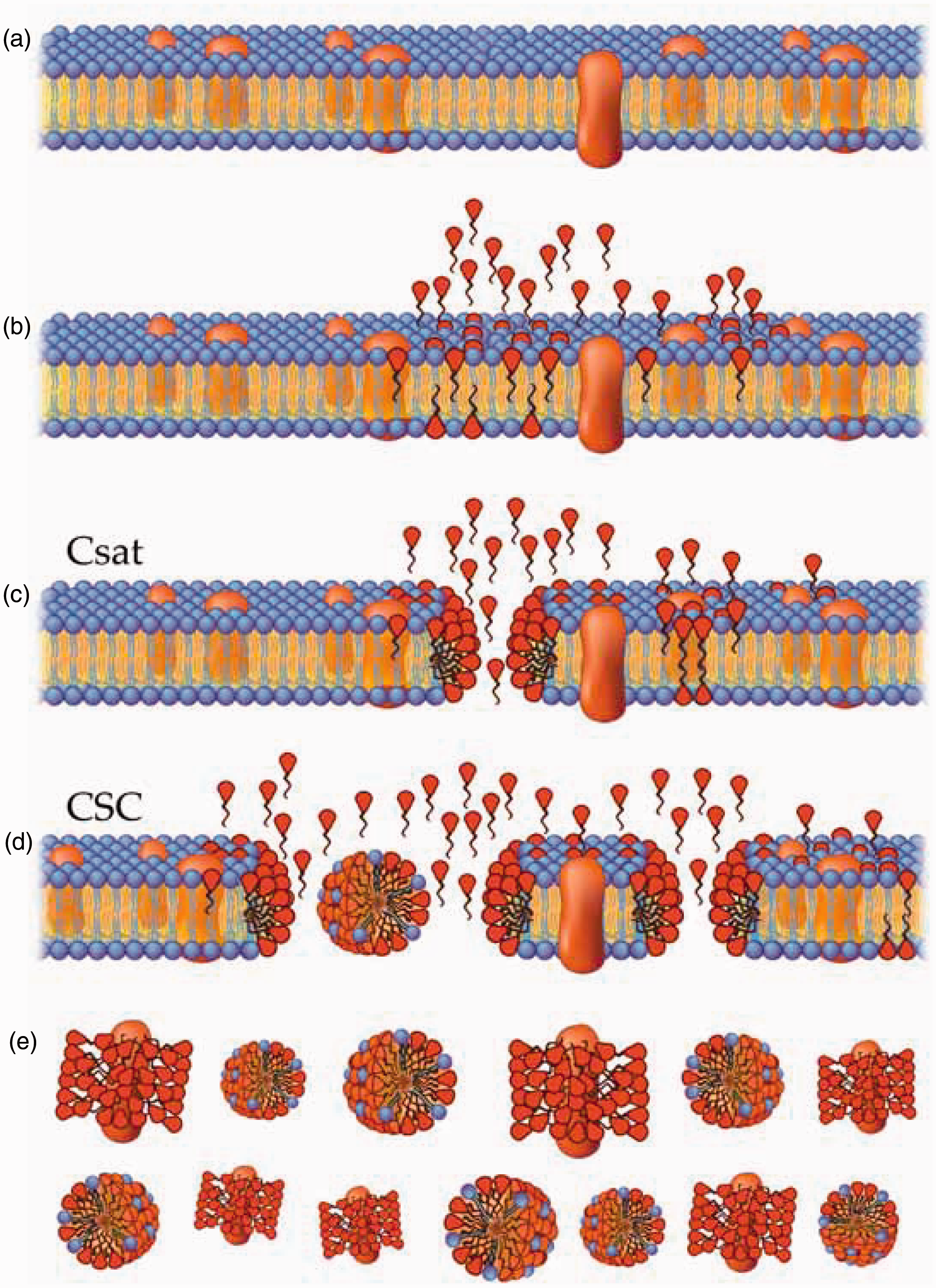
Factors influencing the interaction of detergents with cell membranes
Detergents may form mixed micelles with lipids, bind to hydrophobic portions of proteins or cause protein denaturation. Both anionic and non-ionic detergents can bind serum albumin at its hydrophobic regions. The interaction of surfactants with cell membranes and the eventual outcome is influenced by physical and chemical characteristics such as charge, CMC and aggregation number. 13
Structural properties of detergents.

Non-ionic detergents are considered ‘mild detergents’ and do not denature proteins. In general, polyoxyethylene detergents with a short (C7-10) hydrocarbon chain are more inactivating than those with an intermediary (C12-14) hydrocarbon chain length such as POL. 15 Non-ionic detergents with long hydrocarbon chains are usually inefficient solubilisers of biological membranes. 7
The ability of surfactant molecules to approach, penetrate and cross the membrane lipid bilayer is influenced by the ionic nature of the molecule. Importantly, detergents such as POL flip-flop rapidly across the membrane. This is due to their non-ionic nature and the hydrophilic-hydrophobic properties of the polyoxyethylene chains.
7
By contrast, detergents with strongly hydrophilic heads such as STS flip-flop at a slow rate resulting in delayed solubilisation. A similar anionic agent, SDS, only slowly solubilises pure liposomal membranes.
16
The solubilisation which eventually takes place with SDS is most likely mediated by the extraction and incorporation of the phospholipid molecules into the detergent micelles (Figure 5).
7
Membrane solubilisation: anionic surfactants such as sodium dodecyl sulphate (SDS) or sodium tetradecyl sulphate (STS) may solubilise membranes by extraction of phospholipid molecules directly from the membrane into preformed detergent micelles (a). Non-ionic detergents such as polidocanol (POL) are more likely to form toroidal complexes (b).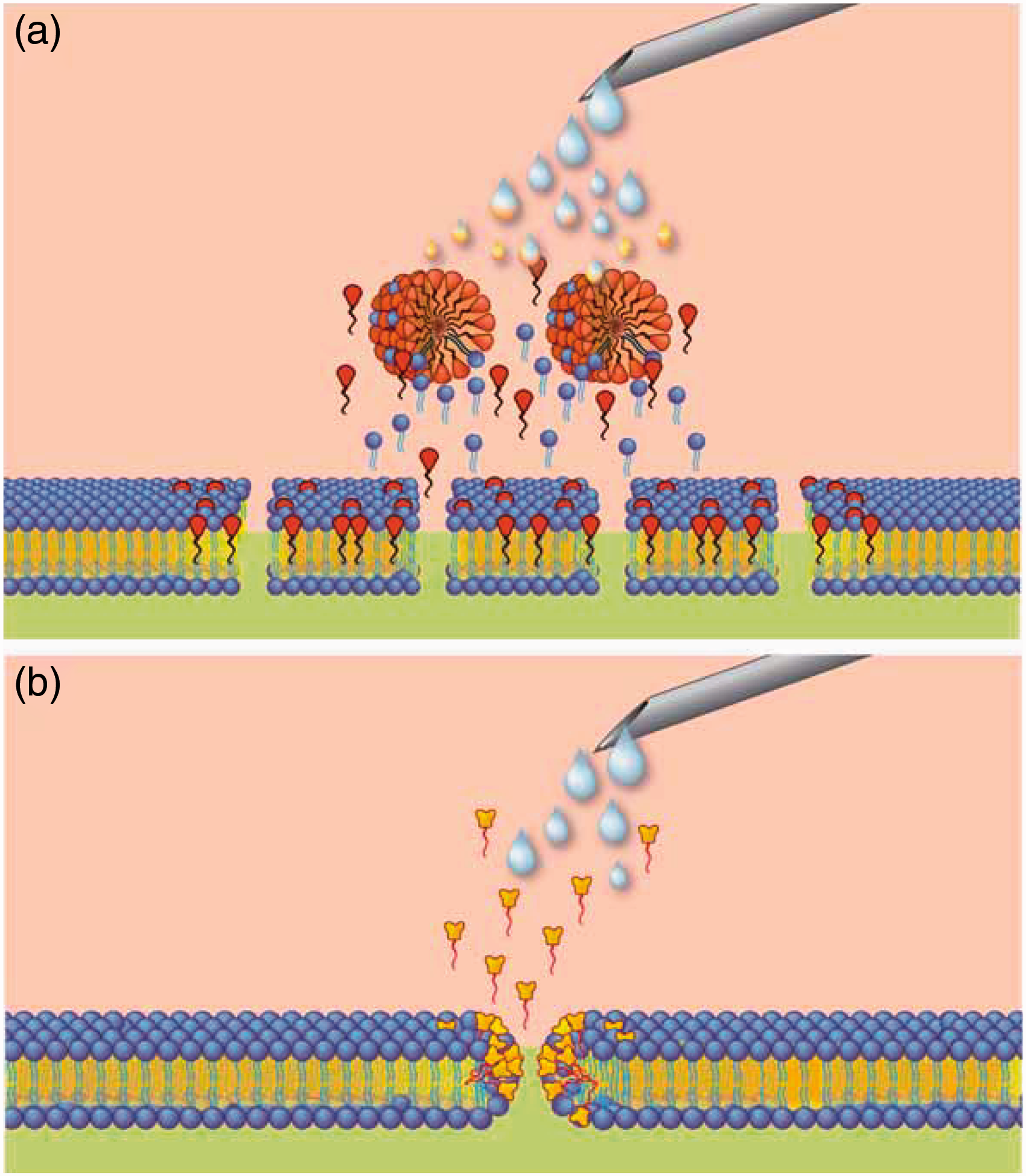
Interaction with platelet membranes
Our group has previously shown that low concentration sclerosants can directly activate platelets in the absence of any other agonists. 1 This is mediated by the flip-flop process and exposure of PS on the exoplasmic surface of the platelet cell membranes. Exposure of PS is associated with cell activation and apoptosis. PS provides the negatively charged surface required for the initiation and propagation of the coagulation cascade. This is facilitated by the PS-induced activation of coagulation complexes such as tenase and prothrombinase. Coagulation reactions otherwise occur very slowly on membrane surfaces that do not contain PS, and therefore, resting cells are essentially incapable of supporting the coagulation cascade.
Platelet activation results in a procoagulant state and fibrin clot formation which can be detected both in vitro and clinically.1,17,18 In an in vitro study, our group demonstrated strong clot formation induced by low concentrations of both STS and POL. 17 We also reported that following the infusion of foam sclerosants over a long distance, a procoagulant state is generated in the target vessel and the adjoining deep veins. 18 These results are indicative of the exposure of platelet cell membranes to very low concentrations of surfactants. At such low concentrations, the surfactant is incapable of lysing the cell membrane and instead would result in release of cytosolic calcium, exposure of PS and exoplasmic release of platelet-derived microparticles (PMP). 1 Microparticles released by sclerosants exhibit procoagulant activity and may play a role in the systemic thrombo-embolic complications of sclerotherapy.
By contrast to the effects observed at low concentrations, both agents lyse endothelial cells, platelets and other circulating blood cells at high concentrations. 17 Furthermore, high concentration STS denatures and inactivates proteins and in particular clotting factors.19,20 This is due to the anionic nature of these detergents and interference with the tertiary structure of target proteins. Consequently, this agent prolongs most clotting tests and prevents clot formation at high concentrations.17,19 POL, a non-ionic detergent, can lyse platelets at high concentrations but has no destructive effect on plasma clotting factors.
Footnotes
Conclusion
Surfactants have a striking similarity to phospholipid molecules of the plasma lipid bilayer. These agents exhibit remarkable versatility in their interaction with cell membranes ranging from complete lysis to cell activation. The interaction of sclerosants with cell membranes is influenced by the surfactant concentration, ionic charge, molecular structure, pH and the chemical nature of the diluent (e.g. saline or water). Additionally, depending on the ionic nature of the surfactant molecule, sclerosants may interfere with plasma proteins and the protein contents of cell membranes. The physio-chemical properties of detergent sclerosants determine the outcome of the biochemical interactions and can influence the clinical outcomes.
Acknowledgements
I am grateful to Dr Christian Freyberg (Kreussler Pharma, Germany) and Dr Mike Watkins (STD Pharm, UK) for their assistance with collating data on AETHOXYSKLEROL and FIBRO-VEIN, respectively, and David Du for assistance with the preparation of the manuscript.
Conflicts of interest
None declared.
Funding
This research received no specific grant from any funding agency in the public, commercial, or not-for-profit sectors.