



Abstract
Patients with chronic leg ulcers have severely impaired quality of life and account for a high percentage of annual healthcare costs. To establish the cause of a chronic leg ulcer, referral to a center with a multidisciplinary team of professionals is often necessary. Treating the underlying cause diminishes healing time and reduces costs. In venous leg ulcers adequate compression therapy is still a problem. It can be improved by training the professionals with pressure measuring devices. A perfect fitting of elastic stockings is important to prevent venous leg ulcer recurrence. In most cases, custom-made stockings are the best choice for this purpose.
Introduction
In the Western world about 1% of the population suffers from a chronic leg ulcer. Rice et al. 1 estimated the annual costs of venous leg ulcers in the USA to be about 14.9 billion dollars. Privately insured patients had 40% more days missed from work than patients with any other disease. Patients with a chronic leg ulcer have significantly impaired quality of life. Hopman et al. 2 showed that of 407 patients, 51.4% had a higher scoring on the mental component summary of the SF-12 and 22.4% on the physical component summary compared to their normative values. In another study in The Netherlands, 3 85% of 141 patients had significant pain problems and about 47% perceived problems in outdoor mobility and 60% could not find proper footwear. Different professionals with different skills and knowledge treat patients with chronic leg ulcers. General practitioners, (specialized) nurses, community nurses, skin therapists and medical specialists like dermatologists or surgeons are involved in part of the treatment of these patients. This has an effect on outcome and quality of treatment, especially when it is not clear who is responsible for the diagnosis and subsequent treatment. 4 If over time the diagnosis changes it is difficult to get the corresponding treatment changes executed, when so many parties are involved. This increases the risk that patients are not treated timely and adequately. This suboptimal treatment raises costs and causes unnecessary pain and discomfort for the patients with a chronic leg ulcer.
Who diagnoses the chronic leg ulcer?
Leg ulcers are a symptom of a disease; they are not a disease themselves. To find the correct diagnosis of the disease causing the leg ulcer is always the responsibility of a doctor. General practitioners should consider if they themselves can make a correct diagnosis, despite not having the possibilities for further investigation by a vascular technician, like duplex scanning, ankle-brachial index, toe pressure measurements, transcutaneous oxygen measurements in the case of a vascular cause or X-rays and MRI-scans when osteomyelitis is suspected. Of course these investigations can be done in the hospital without a referral to a specialist, but the workload is not always reimbursed and interpretation of the results is sometimes not straightforward. In fact without any additional investigation a correct diagnosis of the underlying cause is not possible. In a study from Korber et al., 5 31,619 patients with chronic leg ulcers in Germany were analyzed for the etiology of the leg ulcer. In almost 48% of the patients venous insufficiency was diagnosed and most clinicians used Duplex-ultrasound to establish the diagnosis. In 15% arterial insufficiency was diagnosed and this was done mainly by Doppler-examination. Another 18% had mixed ulcers, i.e. a mix of arterial and venous insufficiency. In 20% another causative factor was found. A biopsy was necessary in most of these cases and in 1% a malignant tumor was detected. In a study from Misciali et al., 6 10 malignancies were found in a patient group of 257. All ulcers were biopsied, so 4% of patients in this study had a disease that needed a totally different therapy (excision instead of compression or revascularization). Because treatment of the underlying disease is of importance for the healing of the ulcer, a correct diagnosis of the cause of the ulcer and subsequent treatment is essential. An interesting literature review by Ylonen et al. 7 on the knowledge of venous leg ulcer care by nurses suggested there is a lack of knowledge of the underlying causes of leg ulcers and insufficient application of existing evidence for treating venous leg ulcers adequately. For example dressings were changed from once a week to six times a week. For most venous leg ulcers changing the dressing once a week is adequate in most cases. Sometimes nurses started treatment before the underlying cause was found or they changed treatment without consulting a doctor. Knowledge that it is useful to measure arterial pressure before applying compression was lacking in most nurses. In patients with arterial insufficiency it is dangerous to apply high-pressure bandages. The authors conclude that nurses should get better theoretical and practical education on the treatment of venous leg ulcers and get access to the existing guidelines. Continuing education is also advocated for maintaining the level of knowledge, assuring that the underlying cause of the chronic venous leg ulcers is detected and the patients get the right treatment in time. A study from Thompson and Adderley 8 who analyzed the judgement of 18 specialized wound nurses and compared them to 18 general community nurses showed a better outcome on diagnosis and treatment from specialized nurses when judging 110 cases that were presented to them. The authors concluded that involvement of specialized nurses could reduce costs because more adequate treatment of venous leg ulcers with high compression bandaging was initiated.
Which diagnostic tools should be used and why?
Venous leg ulcer
The majority of chronic leg ulcer patients have venous insufficiency (Figure 1). This can be due to superficial venous insufficiency e.g. varicose veins, deep venous insufficiency and/or obstruction or a combination of superficial and deep venous problems. To establish a venous cause of leg ulceration, a duplex-scan is required and in most guidelines this is advised as method of choice.
9
With a duplex-scan the venous system can be investigated on anatomical and functional abnormalities. Although venous pressure cannot be measured, a reliable reflection of venous functioning can be ascertained.
Typical venous leg ulcer.
Arterial leg ulcer
Even though the majority of the leg ulcers are caused by venous insufficiency, one should exclude the arterial cause. The first step in excluding an arterial cause is measuring the ankle-brachial index. 10 The measurements should be done with a blood pressure cuff and a Doppler. The systolic pressure of the posterior tibial artery, measured at the medial ankle, and the systolic pressure of the anterior tibial artery at the dorsum of the foot is measured in a lying position. Of these two the highest pressure is divided by the systolic pressure of the brachial artery (highest value of the left and right brachial artery pressure). With <0.9 as the cut-off point, the ankle-brachial index has a positive predictive value of 94% and a negative predictive value of 53% compared to the reference standard of duplex ultrasound.10,11
An index below 0.9 is considered as arterial insufficiency and should be a reason for further investigation, for example measuring the ankle-brachial index after treadmill exercise or duplex scanning of the arterial system of the legs. Also CT-angiography of MR-angiography can be used as a diagnostic tool. 10 One should be aware of the unreliability of the ankle-brachial index in diabetic patients due to media sclerosis (Mönckeberg medial calcific sclerosis). 12 In these patients the ankle-brachial index could show normal values due to the loss of compressibility of the artery, in more advanced cases the artery is impossible to compress. Transcutaneous oxygen pressure measurements or toe pressure measurements could be an alternative method of investigation in these patients. 13
Neuropathic leg ulcer
When a neuropathic-diabetic ulcer is suspected, a simple blood sample can reveal the increased level of glucose. In many cases the location of the ulcer gives rise to the suspicion of a neuropathic ulcer. Most diabetic ulcers are caused by compression or friction, due to neuropathy. Loss of sensation in the foot as a sign of polyneuropathy is often the cause of this kind of ulceration. 14 For example, ulcers at the toe tip (hammer toes) or at the medial side of the first metatarsal phalangeal joint are highly susceptible of being a diabetic (neuropathic) ulcer.
Other rarer causes of leg ulcer
Twenty percent of the chronic leg ulcers do not have an arterial or venous cause, so diagnostics should be focused on rarer causes like malignancies or vasculitis. 4 But one should also think of a Martorell ulcer, which is associated with hypertension, or pyoderma gangrenosum. Biopsy is mandatory for establishing the cause of this kind of ulcer and referral to the dermatologic department is needed for further treatment and advice. When vasculitis with systemic involvement is suspected, consultation of the internal medicine department should be considered.
Who treats the patient with a chronic leg ulcer?
Most patients seek help for their ulcer by attending their general practitioner. In The Netherlands there are three options for starting treatment. First option: the general practitioner diagnoses the underlying cause of the ulcer and starts the treatment himself. The treatment varies between a simple Band-Aid to ambulant compression therapy. Second option: the patient is referred to a community nurse by the general practitioner who treats the patient at home. This nurse could be a generalist or specialized in treating wounds and sometimes even has skills in ambulatory compression therapy. The third option: the patient is referred to a medical specialist. In the ideal case the specialist has experience in diagnosing and treating chronic leg ulcers.
What is the added value of referral to a medical specialist?
Studies have been performed on treating superficial venous disease in patients with chronic venous leg ulcers. A meta-analysis of Mauck et al. 15 showed an increased healing rate and lower risk of recurrence comparing surgical treatment of superficial venous insufficiency and compression therapy alone. The quality of evidence, though, was considered low due to the fact that results of observational studies were also used in the analysis. Another prospective multicenter study from Chaby et al. 16 analyzed 94 patients with a venous leg ulcer and showed a significant positive correlation of healing rate and superficial venous surgery after 6 months. Continued compression therapy was also a positive predictor of venous leg ulcer healing after 6 months, but a significant predictor was the reduction in percentage of leg ulcer area at week 4. Viarengo et al. 17 showed in a randomized study on 52 patients with isolated superficial reflux and ulcers that 82% of the limbs treated by laser ablation healed at 12 months compared to 24% in those treated with compression therapy alone. Besides superficial venous insufficiency, deep venous insufficiency or obstruction can play an important role in chronic venous leg ulcers. There is growing evidence nowadays that correcting venous obstruction, especially in the ilio-femoral outflow tract, by stenting for instance, could achieve healing of persistent venous leg ulcers. 18
For arterial ulcers there are three randomized trials available, which present their combined data on the www.criticallimb.org website. These data show an amputation-free survival for patients with tissue loss after 1 year: 71% if no intervention was conducted; 67% when an endovascular intervention was conducted and 73% when open surgery was performed. Keep in mind though that 16–20% of these patients will die within 1 year. 19 There is no randomized trial available for arterial insufficiency in diabetic patients with tissue loss, suggesting that an intervention on improving arterial inflow compared to standard wound care increases healing of the ulcer or diminishes the risk of recurrences. Cohort studies for diabetic patients with critical limb ischemia and tissue loss are available though, and show healing of 60% after one year follow-up. 20 It is evident that treating the underlying cause of non-vascular leg ulcers shows higher healing rates. This is especially true for skin cancers with ulceration, like basal cell carcinoma or squamous cell carcinoma. An operation cures the patient directly. Treating vasculitis by corticosteroids or immune system modulators could possibly improve healing time of chronic leg ulcers although there are no RCTs on this subject. If this is the case a multidisciplinary approach for chronic leg ulcers could improve clinical outcome and also quality of life, especially for non-vascular leg ulcers.
How is the quality of compression therapy in venous leg ulcers?
Compression therapy is considered the cornerstone of the treatment of chronic venous leg ulcers. A Cochrane review in 2012 showed an increased healing rate compared to no compression and higher compression, multi-bandage layers are more effective than single layers.
21
There is however no study available that shows which pressure applied gives the best results on ulcer healing. Milic et al.
22
showed that with higher sub-bandage pressure, as exerted by different compression materials, results will be significantly better. It is proposed by the International Compression Club
23
how in future studies on compression the pressure and stiffness of the compression material should be measured and the characteristics of the materials described. The range of pressures desired varies between 30 and 50 mmHg at the ankle level but because of the fast drop of pressure during the first hours, some suggest higher pressures. Because of the high stiffness of the materials used, the usual ambulatory sub-bandage pressures are still high enough to empty the deep veins and thereby restoring the normal physiologic intravenous pressure. More elastic materials, like stockings, maintain a higher resting pressure combining it with a lower ambulatory pressure. Due to the higher pressure, the stockings must be taken off during the night. There is evidence that these stockings are even more effective than short stretch bandages, but studies were performed on patients with relatively small ulcer sizes. There is widespread doubt about the quality of the applied bandage and the sub-bandage pressure. The exerted pressure varied from 11 mmHg to 80 mmHg assessed in the case of home care nurses who were asked to apply a bandage with a pressure between 30 and 50 mmHg at the B1-level.
24
There was no correlation between number of years of experience in bandaging and adequate sub-bandage pressure. In another study,
25
with 891 professionals practicing compression therapy, only 9% achieved the required pressure between 50 and 60 mmHg. Apart from the inadequate pressure it was clear that also the knowledge of padding was very low. Only 12% of the participants had sufficient knowledge on this subject and only 15% were familiar with ulcer stockings. Quality of compression therapy can be improved by training programs. Satpathy et al.
26
showed that adequate pressure, defined as 35–40 mmHg at the ankle, could increase from 36% to 78% when a pressure monitor was used (Figure 2). Keller et al.
27
showed also improvement of sub-bandage pressure after intervention with a pressure monitor. Before intervention 35% of the bandages had pressures below 20 mmHg or above 60 mmHg. After the intervention only 18% of the applied bandages were not in the range of the aforementioned interval. It was also shown that long-time experience does not guarantee adequate sub-bandage pressures. About 77% of the insufficient bandages were applied by nurses with more than 10 years of experience. Education of health professionals with sub-bandage pressure measuring devices can improve healing time of venous leg ulcer.
Sub bandage pressure monitoring device for training purposes (PicoPress).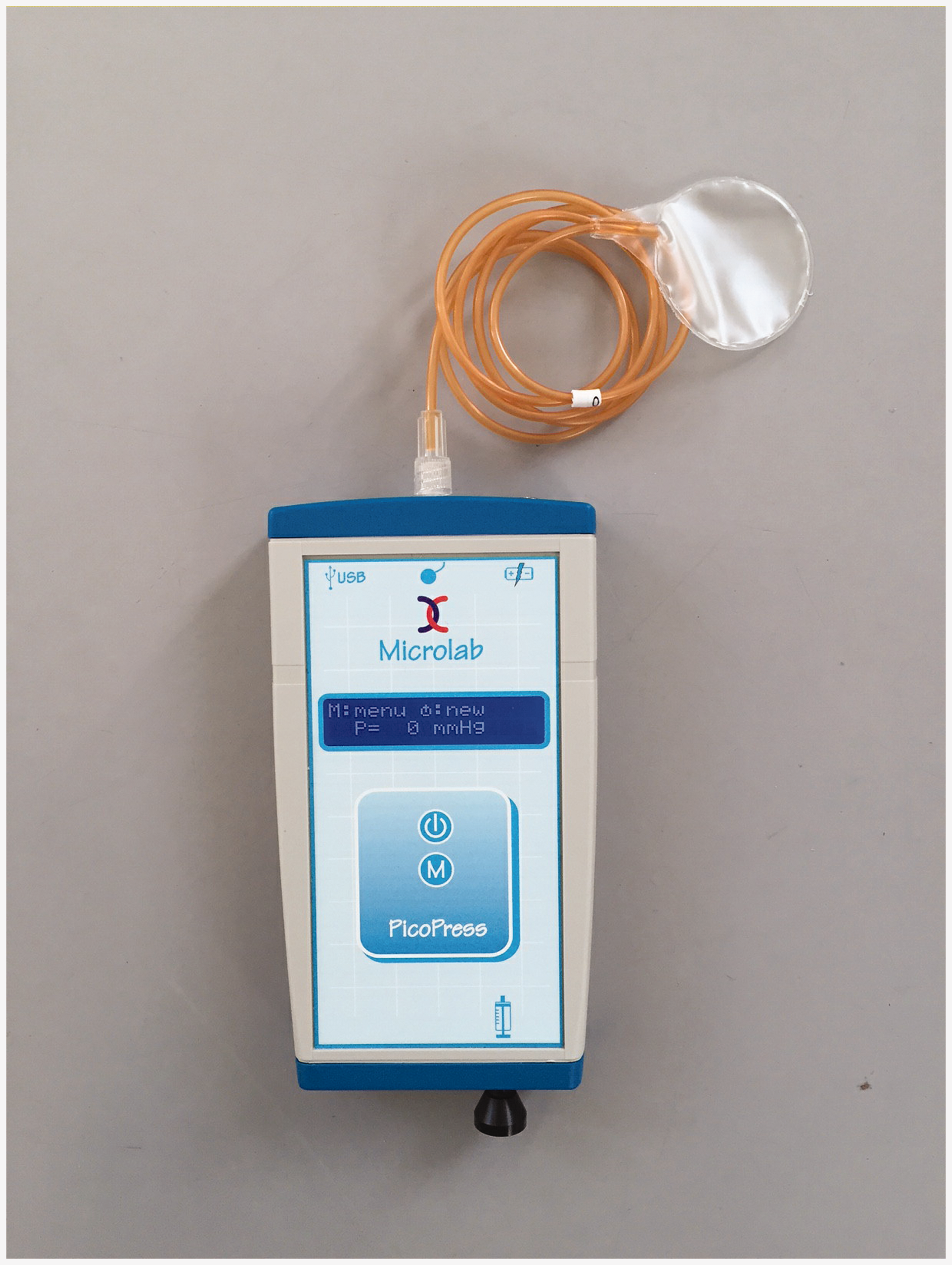
Prevention of recurrence of venous leg ulcers
Recurrence of venous leg ulcers due to superficial venous insufficiency can only be prevented by treating the underlying cause. Stripping of the insufficient short or long saphenous vein lowers the risk of recurrence. In 2013, a Cochrane review on the endovenous thermal ablation for venous leg ulcers showed that there are no RCTs available to give support for this treatment, considering ulcer healing and recurrence. Some retrospective studies show increased healing of ulcers not responding to compression therapy after endovenous ablation and little recurrences. 28 Studies in C2 (CEAP) and C3 patients showed similar results comparing stripping and endovenous ablation. So the nowadays frequently used new endovenous techniques are likely to be as effective as high ligation and stripping, although new RCTs are needed to confirm this conclusion. Recurrences of venous leg ulcers caused by deep venous insufficiency or obstruction are best prevented by sustained compression therapy. Medical elastic stockings are the first method of choice for that goal. A Cochrane review published in 2014, 29 showed a significant reduction of ulcer recurrence comparing compression hosiery versus no compression after 6 months (Risk Ratio 0.46). In one study higher compression gave fewer recurrences but in another study this could not be confirmed. Compression stockings reduce the recurrence of venous leg ulcers but the fitting of the stocking could be of importance. The pressure on the leg, due to Laplace’s law, beneath the stocking depends on the fitting of the stocking. Stockings are made with a digressive pressure from distal to proximal. This is because the intravenous pressure is decreasing from distal to proximal. There are some studies that show that custom-made stockings would fit better than ready-made stockings. Norregaard et al. 30 for instance showed that ready-made stockings only fit 0%–5%, using the seven-points measuring method, in patients with leg ulcers. In an older study, Mooij and Oosterwal 31 showed that only 5% of women with venous insufficiency fitted a ready-made stocking. From these studies one could conclude that medical elastic stockings should preferably be custom-made to assure an adequate pressure gradient on the leg and thereby probably reducing the risk of ulcer recurrence and preventing edema. Another important factor in preventing venous leg ulcers is the compliance of patients in wearing their stockings. Besides regular follow-up of this group of patients, donning devices for instance could improve self-management and thereby increase compliance as stated in a recently published paper of Sippel et al. 32
Conclusions
Patients with chronic leg ulcers have serious reduced quality of life and account for a substantial part of medical costs. Patients, in whom the cause of the chronic leg ulcer is not diagnosed and are treated too long by nurses in an outdoor setting without any feedback, are restrained from adequate treatment. A proper early diagnosis by a physician is of upmost importance and referral to a medical specialist for treating the underlying cause could improve healing time, quality of life and reduce costs significantly. After venous leg ulcer healing in patients with deep venous pathology, adequate and properly fitted compression stockings are necessary. In combination with donning devices, that improve compliance of patients wearing stockings, prevention of recurrent venous leg ulcers can be achieved.
Footnotes
Declaration of Conflicting Interests
The author(s) declared no potential conflicts of interest with respect to the research, authorship, and/or publication of this article.
Funding
The author(s) received no financial support for the research, authorship, and/or publication of this article.