



Abstract
Background
Ultrasound-guided foam sclerotherapy (UGFS) is a minimally invasive procedure recommended for the management of chronic venous disease, particularly for varicose veins and saphenous trunk insufficiency, although rare, systemic effects may occur. The study aims to evaluate the impact of UGFS on pulmonary artery pressure and right ventricular function through indirect echocardiographic measurements.
Material and Methods
A total of 50 patients with incompetent great saphenous veins underwent UGFS. Preoperative assessments and echocardiographic monitoring of right heart function were conducted at baseline (T0), 5 min (T5), 10 min (T10), and 15 min (T15) after FS injection. Primary endpoint included changes in systolic pulmonary artery pressure (PAPs), while secondary endpoints focused on tricuspid annular plane systolic excursion (TAPSE) and right ventricular diameter (RVD1). Statistical analyses were performed using paired t-tests and linear mixed models.
Results
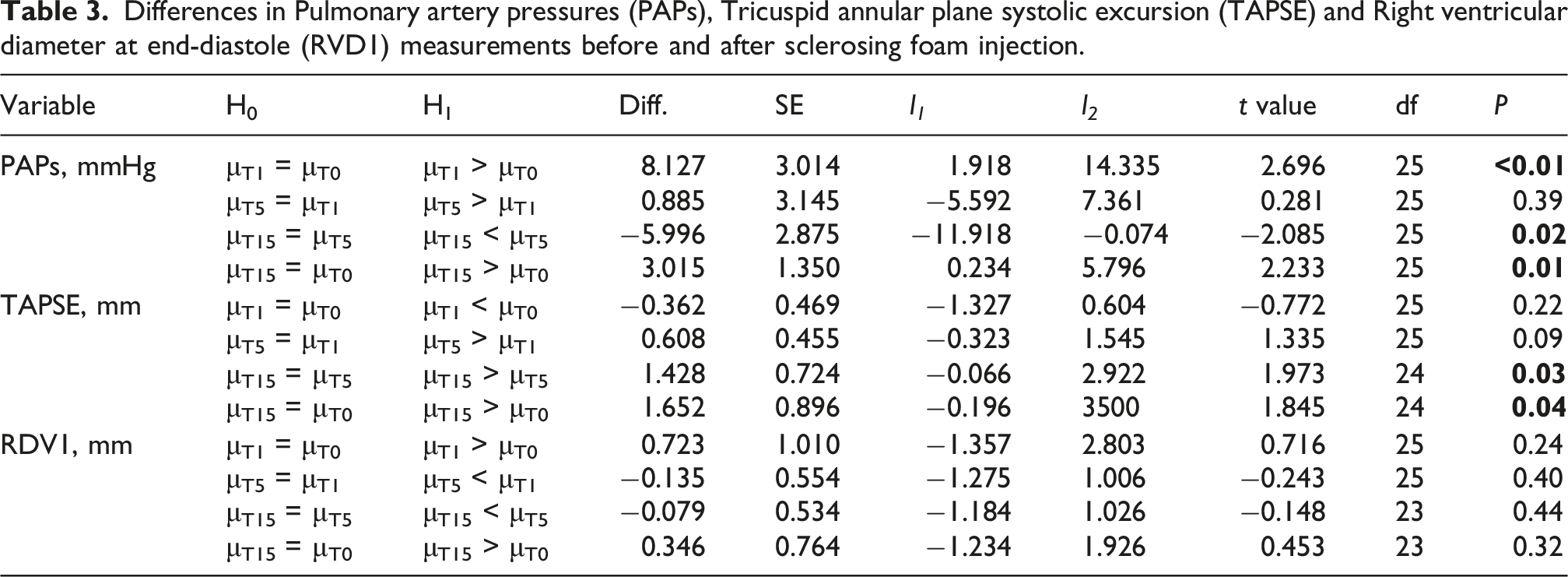
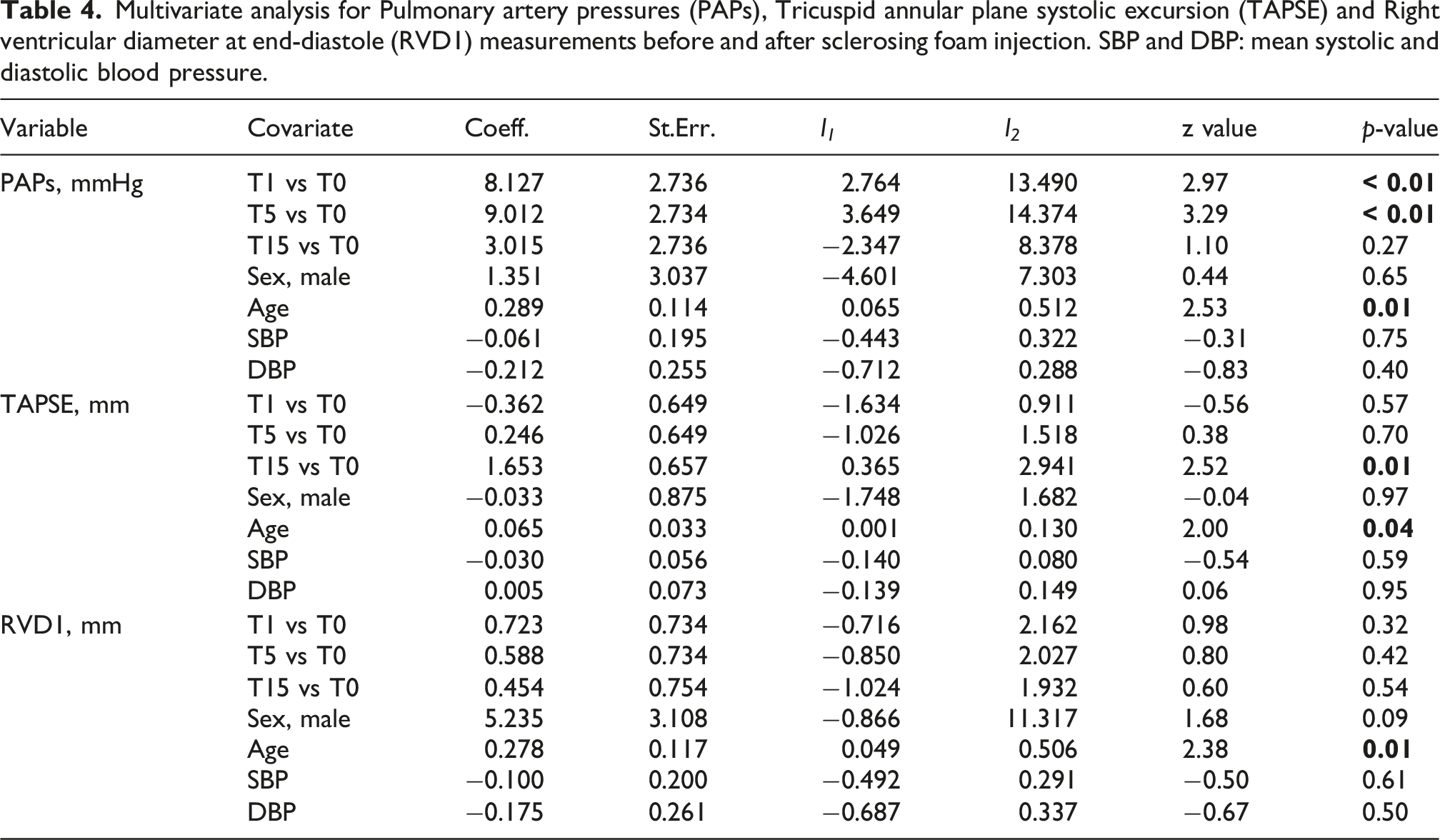
The results indicated a significant increase in PAPs from T0 to T10 (mean increase of 8.13 mmHg, p < .01) and T5, with a reduction at T15 that remained above baseline (mean difference of 3.01 mmHg, p < .01). TAPSE showed a significant increase at T15 compared to T0 (mean increase of 1.6 mm, p = .04). No significant changes were observed in RVD1. Importantly, no local or systemic complications occurred, and all patients remained asymptomatic.
Conclusion
UGFS is a safe and effective treatment for chronic venous disease, with transient and benign alterations in right heart hemodynamic likely attributable to foam degradation products. Further studies with larger cohorts and longer follow-up are warranted to enhance understanding of the long-term effects of UGFS on pulmonary hemodynamic and right ventricular function.
Keywords
Introduction
Ultrasound-guided foam sclerotherapy (UGFS) is a minimally invasive, image-guided procedure used in the management of chronic venous disease and largely recommended due to its safe and effective profile in varicose veins and saphenous trunks insufficiency management. 1 The systemic effects of sclerotherapy are rare but clinically significant and include a range of potential adverse events. The most important systemic complications are neurological events (such as transient ischemic attack, ischemic stroke, migraine, and visual disturbances), cardiac toxicity (including myocardial infarction and Takotsubo cardiomyopathy), pulmonary embolism, deep vein thrombosis, anaphylaxis, and septicaemia. These events are infrequent, with severe complications (death, anaphylaxis, pulmonary emboli, stroke, large areas of skin necrosis) occurring in less than 0.01% of cases, as reported by the Society for Vascular Surgery and the American Venous Forum. Neurological complications are more likely in patients with a right-to-left cardiac shunt, such as a patent foramen ovale, and caution is advised in these patients.1–3
There have been rare reports of deep vein thrombosis and pulmonary embolism, but these are uncommon when standard precautions are followed. 4 The Society for Vascular Surgery and the American Venous Forum recommend techniques to minimize foam migration, such as leg elevation and avoidance of occlusive pressure at the saphenofemoral junction, to reduce the risk of systemic embolization.5,6 Despite systemic effect are very rare, some Authors described FS presence in right heart chambers and consequently in pulmonary circulation, with potential pulmonary artery damage and hypertension.7–9 In this scenario, monitoring right cardiac haemodynamic could be potentially useful for better understanding if sclerotherapy affects cardiac and/or pulmonary performance. Indeed, identifying such changes may optimize the application of sclerotherapy in selected patients through tailored administration techniques and dosages.
The aim of this report is to describe how indirect echocardiographic measurements of pulmonary hypertension and right ventricular (RV) function change during FS injection.
Methods
Foam sclerotherapy contraindications, adapted from rabe et al. 10 DVT, deep vein thrombosis; PE, pulmonary embolism; PFO, patent foramen ovale; PAOD, peripheral arterial occlusive disease; SVT, superficial venous thrombosis.

*Individual benefit–risk assessment required.
†Interrupt breastfeeding for 2–3 days.
‡Includes prior thromboembolism, severe thrombophilia, hypercoagulable state, or active cancer.
Before, during and after UGFS, a certified and experienced cardiologist ultrasound specialist monitored right heart function and performance. In particular, TAPSE (Tricuspid Annular Plane Systolic Excursion), PAPs (Systolic Pulmonary Artery Pressure) and RVD1 (Right ventricular basal diameter at end-diastole) were calculated at baseline (T0), 5 min after UGFS injection (T5), 10 min after UGFS injection (T10) and 15 min after UGFS injection, using a postoperative 18 mmHg elastic stockings on the operated limb (T15). Potential presence of shunts, assessed via the Valsalva manoeuvre, was evaluated before the procedure. Systolic and diastolic blood pressure were also monitored for the whole follow-up time. All patients sign an informed consent for both intervention and research purpose. The study was carried out according to the declaration of Helsinki.
Primary and secondary endpoints
Primary endpoint was change in PAPs value at T1, T5 and T15 if compared with T0. Secondary outcomes were changes in TAPSE and RVD1 values at T1, T5 and T15 if compared with T0.
Statistical analysis
Clinical data were recorded and tabulated in a Microsoft Excel (Microsoft Corp., Redmond, WA, USA) spreadsheet; statistical analysis was performed with IBM SPSS Statistics for Windows, Version 25 (IBM Corp., Armonk, NY, USA). Missing data were reported during data extraction and flagged as such (-). Categorical/nominal variables were presented using frequencies and percentages, while continuous variables by mean (µ) ± standard deviation (SD), or median with interquartile range (IQR) and ranges, according to data distribution. The t-test for paired data for each variable of interest was used, to verify the null hypothesis of absence of differences between average values observed in adjacent (i.e., T0 vs T1, T1 vs T5, T5 vs T15) or between the first and the last (i.e., T0 vs T15) follow-up measurement. When useful, linear mixed models (LMMs) were used for providing influence of demographic or procedure-related variables on PAPs, TAPSE and RVD1. A two-tailed p-value <.05 was considered significant.
Results
A total of 50 patients were included in the study and into the analysis (52% female, 48% male), with an average age of 57 ± 14 years. All selected patients had GSV incompetence with associated varicose veins (Clinical-Etiological-Anatomical-Pathophysiological classification [CEAP] C2sEpAsPr). UGFS was performed in all patients; foam amount was 10 ± 1 cc. Neither local nor systemic complications occurred. All patients remain asymptomatic.
Baseline and post sclerosing foam injection Pulmonary artery pressures (PAPs), Tricuspid annular plane systolic excursion (TAPSE) and Right ventricular diameter at end-diastole (RVD1) measurements.

Differences in Pulmonary artery pressures (PAPs), Tricuspid annular plane systolic excursion (TAPSE) and Right ventricular diameter at end-diastole (RVD1) measurements before and after sclerosing foam injection.
Multivariate analysis for Pulmonary artery pressures (PAPs), Tricuspid annular plane systolic excursion (TAPSE) and Right ventricular diameter at end-diastole (RVD1) measurements before and after sclerosing foam injection. SBP and DBP: mean systolic and diastolic blood pressure.
Discussion
Definitions and clinical relevance of Pulmonary artery pressures (PAPs), Tricuspid annular plane systolic excursion (TAPSE) and Right ventricular diameter at end-diastole (RVD1) values.
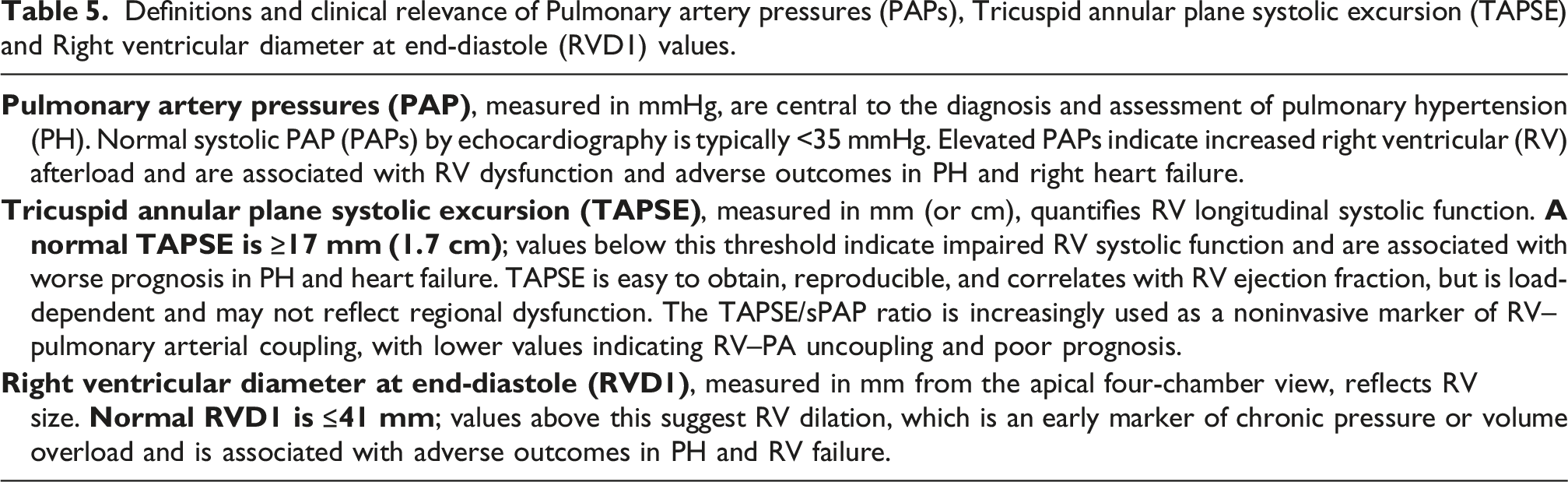
Together, these parameters are essential for the non-invasive evaluation of right heart structure and function, risk stratification, and monitoring of disease progression and therapeutic response in pulmonary hypertension and right heart failure. Indeed, the American Society of Echocardiography recommends them for comprehensive right ventricular assessment. 11 The cardiac investigations were deliberately selected to provide a focused, non-invasive, and guideline-supported assessment of right ventricular function and pulmonary hemodynamic, which are the physiological compartments most plausibly affected by transient foam migration into the pulmonary circulation. The timing of echocardiographic assessments was specifically chosen to capture immediate and short-term, reversible hemodynamic responses following foam sclerotherapy, rather than delayed structural or functional cardiac alterations. Fast changes could reflect a short-lived increase in pulmonary vascular tone following foam injection, possibly mediated by microembolization or release of vasoactive substances (e.g. endothelin-1). The study was undertaken to address a specific gap in current knowledge regarding the acute cardiopulmonary effects of UGFS, particularly given sporadic reports of foam passage into the right heart and pulmonary circulation and the absence of systematic hemodynamic monitoring in routine clinical practice.
Given this premise, the study presented here had to use these parameters to demonstrate that the impact of foam sclerosing with POL on the pulmonary circulation and right heart chambers is completely negligible. To our knowledge, this is the first study to evaluate cardiac performance after UGFS using POL and the Tessari method.
Some authors have described alarming cases in the case of ethanol sclerotherapy, particularly used for arteriovenous malformations. Indeed, ethanol sclerotherapy acutely increases PAPs. Mean PAP can exceed 25 mmHg in up to 30% of sessions 12 and the magnitude of PAP rise correlates with both the single and cumulative ethanol dose administered. 13 The highest PAPs are often seen during the recovery period after the procedure, and these elevations can be clinically significant, requiring close hemodynamic monitoring and, in some protocols, prophylactic nitroglycerin infusion to mitigate pulmonary vasoconstriction. 14
Pulmonary-damaging effects of POL have also been demonstrated in animal studies, although these studies exposed animals to concentrations of the sclerosing agent much higher than those that can be used in humans.9,15,16 Despite this bias, is crucial to moderate the quantity of foam or liquid for session, in order to minimize potential systemic and organ damage.
In our study, despite a transient increase in PAPs and TAPSE, no symptoms/sings were observed. Moreover, these measurements remained well below the pathological limits, ensuring an additional safety profile.
Why have PAPs and TAPSEs increased? Knowing that the vast majority of the sclerosing agent is bound to the blood proteins and diluted/inactivated 17 the cause of these findings could be explained by another pathogenetic mechanisms, based on endothelial release of vasoactive molecules, such as endothelin-1 (ET-1), histamine or serotonin as FS catabolites.18,19 Foam sclerotherapy is associated with a significant acute increase in circulating ET-1 levels. This has been demonstrated in both animal and human studies, with ET-1 release occurring within minutes after foam sclerotherapy and correlating with local venous concentrations.18,20 Furthermore, ET-1 has a complex and sometimes contradictory role in the pulmonary circulation, acting as both a vasoconstrictor and, in some cases, a vasodilator. It can contribute to increased pulmonary vascular resistance, particularly in pulmonary hypertension, due to its potent vasoconstricting and mitogenic (promoting cell growth) properties. However, ET-1 can also cause vasodilation in certain contexts, and its overall effect on vascular tone depends on factors like the dose, the specific receptors involved, and the pre-existing tone of the pulmonary vessels. 21 Being dose dependent, the effect of ET-1 during UGFS using safety precautions could promote a modest and transient vasoconstrictor effect.
Limitations of the study include its small sample size and the absence of long-term follow-up, which restricts the generalizability of the findings. Additionally, the study’s design does not allow for the assessment of the long-term effects of UGFS on pulmonary hypertension and right ventricular function, leaving a gap for future research to explore these dynamics further.
Conclusion
UGFS appears to be a safe and effective option for treating chronic venous disease, with some transient, reversible and totally benign changes in right circulation haemodynamic, probably due to foam catabolites. Further studies are needed to provide bigger patients cohort and increase the robustness of these results, as well as long-term consequences.
Footnotes

Ethical considerations
The local ethics committee approved this study.
Author contributions
*conception and design of the study: GR, CC, DC, DB
*acquisition of data: GR, CC, DC
*analysis and interpretation of data: GR, CC, DC, DB
*drafting the article: GR, DB
*revising it critically: GR, CC, DC, DB
*final approval of the version to be submitted: GR, CC, DC, DB
Funding
The authors received no financial support for the research, authorship, and/or publication of this article.
Declaration of conflicting interests
The authors declared no potential conflicts of interest with respect to the research, authorship, and/or publication of this article.
Guarantor
GR