



Abstract
This study challenges the orthodox concept of mate selection. Existing research presupposes the binary conceptualization of ‘arranged marriage versus love marriage,’ which is too limited in scope to grasp the reality of transition in mate selection. An alternative model is proposed in this study and is applied to data from Japan, Korea, and Taiwan. Analyses suggest that a considerable number of cases cannot be described as either ‘traditional’ or ‘love’ marriages; these are considered transitional cases. In some cases, the couple’s first meeting is initiated by free will but with strong parental intervention regarding the decision to marry. In other cases, the first meeting is arranged by parents or kin, but the couple maintains free will. Three countries share basic trends regarding the shift between the types of mate selection, and an analysis shows that national differences regarding certain factors also explain the shift.
Problems with existing questions concerning mate selection
The primary focus of existing studies on mate selection, or the way in which a person meets his or her spouse, has been the transition from parentally controlled arranged marriages to individual-chosen (free-will) love marriages. This has led to two subsequent questions, which have also been investigated in existing research: ‘What are the causes of this transition?’ and ‘What are the consequences of this transition?’
This study does not follow these basic questions of mate selection research that are based on the dichotomous concepts of arranged marriage and love marriage. Instead, it presents an alternative conceptualization of mate selection and tests theories derived from this conceptualization using comparative data.
This first section provides a brief review of existing studies on mate selection. The second section reveals what is lacking in previous mate selection research, which is that researchers have failed to capture the transitional phase of mate selection because they have already preconceived the dichotomous framework of love marriage versus arranged marriage. I provide a further explanation of the transitional phase and attempt to connect this new concept with previous studies on mate selection. Through simple descriptive statistics obtained by survey data in East Asian societies, the third section of this study demonstrates that there are, in fact, transitional patterns that cannot be classified as either arranged or free-choice mate selection.
Once the existence of this transitional phase of mate selection is confirmed, we can propose new sets of questions and hypotheses. The fourth section presents these sets of questions and hypotheses, and the fifth section tests them using the same data set that was employed in the third section. Our main argument is that, in order to properly describe and state hypotheses on mate selection in East Asian societies, we must create a new conceptualization of it.
Compared to other research areas on marriage, such as intermarriage studies, the study of mate selection represents a relatively small portion of marriage studies as a whole. The study of intermarriage or homogamy has garnered more scholarly attention, primarily because it directly addresses the problem of social class and ethnicity (Blossfeld, 2009; Bus et al., 2001; Kalmijn and Flap, 2001; Schwartz and Mare, 2005). Research on mate selection, on the other hand, tends to be a historical consideration. Because the main issue concerns the departure from arranged marriages, most of the literature on mate selection studies is limited to marriages in non-Western countries (see, for example, Charsley and Shaw, 2006; Corwin, 1977; Fox, 1975; Gopalkrishnan and Babacan, 2007; Hart, 2007; Korson, 1968; Matras, 1973; Netting, 2006; Oprea, 2005; Strange, 1976; Thornton et al., 1994; Vaillant and Harrant, 2008; Wood and Guerin, 2006; Xiaohe and Whyte, 1990; Yi and Hsung, 1994; Zang, 2008). In advanced Western countries, there have been almost no recent surveys asking the respondent whether he/she had a love marriage or an arranged one; this is possibly a reflection of the fact that there are very few people who have arranged marriages in those countries. This makes mate selection studies in Asian societies all the more important, because they provide a precious opportunity to study the phenomenon by observing the ongoing current process of social structural changes.
The basic idea that arranged marriages are observed more frequently in non-industrialized society, whereas love marriages are more popular in industrialized society, is empirically supported (Lee and Stone, 1980; Murstein, 1980). There is, however, a wide variety of factors that drive the shift from arranged marriages to love marriages. Thornton and Fricke (1987) stress the impact of social structural change on mate selection behavior: the institutionalization of education outside the household and the expansion of the labor market have promoted the shift. Their study focused on three driving forces toward love marriages in these processes: children’s economic independency, increasing opportunities to meet prospective mates, and the relaxing of traditional norms regarding marriage.
The main argument of Thornton and Fricke (1987) is that the independency theory explains the transition. Strange (1976: 561) states, ‘advanced education with its promise of economic independence is viewed as basic in giving young people decision-making power about mates.’ Ghimire et al. (2006), on the other hand, are proponents of the exposure theory: exposure to modern culture, education outside the household, and non-family experiences explain the preference for love marriage.
The same process of social change can exercise more than one influence on the transition to love marriage. For instance, education outside the household can have more than one effect: it can offer people more opportunities to meet potential mates while simultaneously encouraging them to take a more liberal stance toward marriage and granting economic independency.
Reconceptualization of mate selection
This study does not attempt to understand the entire picture of the transition in mate selection but focuses instead on something that has not been categorized in a manifest manner in previous research, which is essential to providing a proper understanding of mate selection in East Asian countries. Previous research has paid a great deal of attention to the factors in and consequences of the transition to love marriage. This study contends that we need to reconceptualize the arranged marriage/love marriage dichotomy.
The need for a new conceptualization seems obvious: the very dichotomy simply does not match the lay understanding of mate selection. First of all, if a marriage is arranged, it does not necessarily means it proceeds without love emotions between couples. Furthermore, even if we replace the concept of love marriage with self-choice marriage, there is another problem. There are matches in which parents exert their influence over the choice of a mate, but the marriages might not be ‘arranged’ per se. A man or woman may meet someone at school or in the workplace, start to think about getting married, and introduce the prospective spouse to his or her parents. A significant number of people report, as we see in the results of the survey, that they met their current spouse by their own effort, but that their parents still had some say over their marriage decision.
Contrasting cases, such as omiai (the Japanese word for arranged marriage), are also prevalent: with omiai, parents arrange the first meeting but often have no power over choosing the prospective candidate as their child’s mate (Tokuhiro, 2010). The most reliable data on mate selection in Japan are available in a series of surveys conducted by the National Institute of Population and Social Security Research in Japan, where the word omiai is used in the questionnaire. According to these surveys, the percentage of those who met their current spouse by omiai fell to 6.4% for the 2000–2005 marriage cohort (Jinko-Doko-Kenkyu-Bu, 2006). However, using this category of marriages in the analysis might lead to a serious misapprehension of mate selection, because it does not reflect the extent of parental power in decisions about mate selection. In a typical omiai situation, parents or matchmakers arrange the first meeting, which is followed by several dates unless one or both children declines through his or her parents or the matchmaker. Other than the method that is used to express rejection, the course of a relationship typically proceeds in the same manner as dates seen in love marriage cases.
In order to describe changes in the way that mates are selected in East Asian countries, we need to separate the mate selection process into two parts: the ‘search’ process and the ‘decision’ process. The dichotomy of ‘arranged versus self-choice marriage’ is still too simple to comprehend the reality of the transition of mate selection patterns. Partly because of this failure of conceptualization, Blood (1967) discovered many cases in Japan in which a wife perceived the couple’s marriage as a love marriage, while the husband viewed it as an arranged marriage, and vice versa. In such cases, the wife thought her marriage was a self-choice or love match because it was the couple’s own decision to get married and their marriage involved a love emotion, while the husband thought it was an arranged marriage because their first meeting had been set up by their parents. Tokuhiro (2010) reported a similar case, in which the interviewee remained uncertain as to whether her recent marriage was an arranged marriage.
The following argument uses this new framework of mate selection, which treats the search and decision processes as distinct from one another. Two transitional types of mate selection can be seen as a direct derivation of this framework. That is, with this operationalization, we can capture cases where a man or woman conducts the search by his or her free will, but parental approval is eventually needed. In other cases, the search process is initiated by parents, kin, or matchmakers, but the decision to marry is autonomous. 1
Not all existing studies simply presume the arranged/love marriage dichotomy. As Lee and Stone (1980) argues, there are many gradations between the extremes. Murstein (1980) suggests there are, in some part of Asia, ‘semiarranged’ marriages, where parental influence is weak but a pretense of traditional rituals of engagement is presented. Also in Western society, there were cases where parental influence is exerted to make the children’s marriage homogamous. Even though parental power over children’s mate selection has declined in Western countries, recent studies on assortative mating show that people still have reasons for wanting to marry someone from the same social class (Kalmijn, 1994; Kalmijn and Flap, 2001; Schwartz and Mare, 2005). Nevertheless, even though these studies do not adopt a simple dichotomous framework, they have not provided another framework that discerns one aspect of mate selection from the other, such as differentiating the search process from the decision process.
We can connect the existing research on mate selection with the new framework we have developed by relating possible transition factors to each process. At least part of the complexity of the transition in mate selection can be better understood by differentiating between the search process and the decision process. Social structural change enters into the search process, primarily with increasing opportunities for meeting prospective mates, while the transfer of decision-making power from parents to children can be caused by children’s economic independence and liberal attitudes toward mating.
While the existing theory on mate selection predicts that children’s independence from their parents leads to self-choice marriage, the independence theory can be applied more generally. If children’s economic dependence on their parents leads to traditional mate selection, women’s economic dependence on men could have the same effect. In East Asian countries, with their relatively low female labor participation rates, parents might be more strongly motivated to intervene in their daughter’s marriage than their son’s. This is because, in a society with serious gender inequality and where women are more likely to face difficulties in creating independent lives, the future of this daughter could heavily depend on her husband’s personal characteristics and social status.
Separating the degree of autonomy of the search from the decision about mate selection provokes another issue: the gap between these two processes. If a shift toward the autonomous search precedes one in decision, it can be said that conservative attitudes or norms remain despite changes in social structure. Naturally, the timing of the shift in mate selection may differ for men and women in a society where a relatively strong gender division of labor persists. For this reason, the new framework on mate selection might be particularly useful in analyzing marriages in East Asian countries, because they have experienced rapid social structural change, even though they are reported to retain traditional gender roles (Yu, 2001).
Overview of trends in mate selection
Before setting up the hypotheses in the next section, some basic data descriptions about mate selection in East Asian countries are proposed using EASS2006 (East Asian Social Survey) data in order to document that there were cases in mate selection that could be described as ‘transitional’ rather than fitting into previously recognized categories. EASS is a series of surveys conducted in Japan, South Korea, mainland China, and Taiwan. In this study, however, only the data from Japan, South Korea, and Taiwan are used. 2 In the 2006 surveys, special emphasis was placed on family issues. There were 2130 valid responses in Japan (59.8% response rate), 1605 in South Korea (65.7% response rate), and 5032 in Taiwan (42.0% response rate). The respondents were between 20 and 89 years old in Japan, 18 years and older in South Korea, and 19 years and older in Taiwan. Respondents who did not provide sufficient information (mainly respondents who were single) on the variables are omitted, resulting in 1524 cases in Japan, 1100 cases in South Korea, and 1364 cases in Taiwan being used in this study. 3
EASS2006 contains a series of questions concerning mate selection. From those, we can first construct a variable indicating whether or not the respondent’s first meeting with his or her current spouse was arranged in a traditional way by asking two questions. The first question is, ‘How did the respondent come to meet his or her current spouse?’ with choices of ‘arranged,’ ‘introduced,’ and ‘by oneself.’ If a respondent answered either ‘arranged’ or ‘introduced,’ a subsequent question was asked: ‘Who arranged the first meeting?’ with choices of ‘sibling or cousins,’ ‘parents or other relatives,’ ‘friends or classmates,’ ‘colleagues,’ ‘matchmaker or matchmaker company,’ and ‘neighbors or other elders.’ It is theoretically and empirically difficult to judge if a marriage by ‘introduction’ is more similar to self-search or arranged search. Therefore, we can simply use the second question when we categorize a marriage. If a marriage was set up by ‘parents or other relatives,’ ‘a matchmaker or a matchmaker company,’ or ‘neighbors or other elders,’ we can categorize it as an ‘arranged’ marriage; otherwise, it is deemed a ‘love’ or ‘self-search’ marriage, because in those cases, the arrangement or introduction is likely to be more informal and therefore can be well explained by the changing opportunity structure presented by the structural change in society, such as the popularization of higher education.
For a measure of parental influence, we asked the question, ‘To what extent do you think your own parent(s) influenced your decision to marry your spouse?’ Respondents were provided with several choices: ‘very much,’ ‘fairly much,’ ‘not too much,’ and ‘not at all.’ This question is a measure of parental influence on mate selection, among many other possible measures. Parents can exert their power in a variety of ways. The above question presents a problem, in that reported parental influence depends on how much parents ‘like’ the marriage candidate. If parents like the candidate, a respondent might feel that the parents’ influence on mate selection is small. On the other hand, if parents do not like the candidate, the mating might end in failure and would therefore not be reported in this survey. This measurement problem is addressed again later in the discussion section.
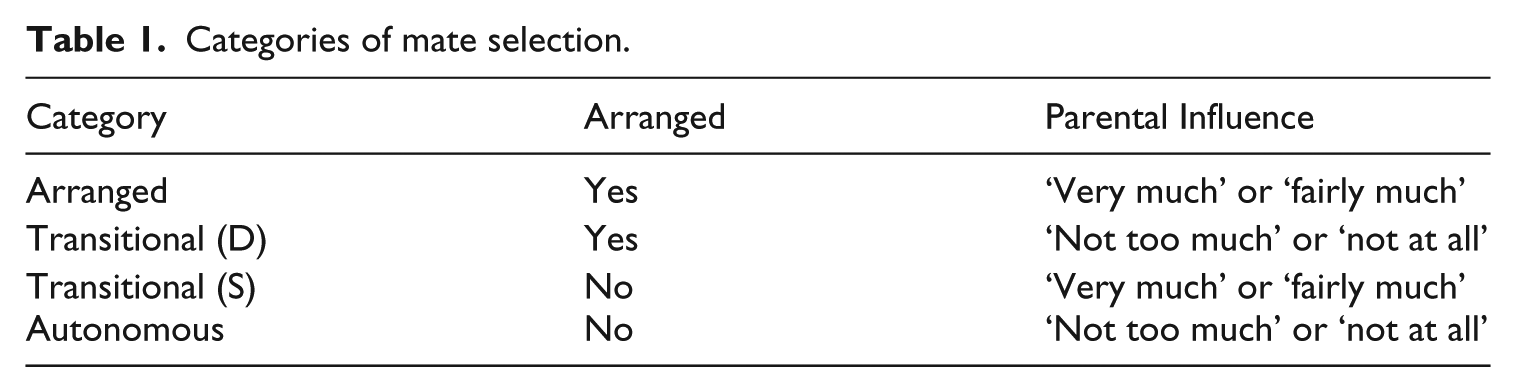
Using the answers to these two questions, four categories of mate selection have been created (Table 1). Two transitional patterns characterize this study. The transitional (S) pattern represents cases in which a marriage is initiated by oneself or, in most cases, a social network outside one’s kin network such as friends and colleagues, but respondents also recognize relatively strong parental influence on a marriage decision. On the other hand, the transitional (D) pattern indicates marriages in which parents set up the first meeting, but the decision to marry is made by the couple themselves. ‘Arranged’ marriage here refers to cases where the search was initiated by parents, kin, or matchmakers and parental influence on decision was also relatively strong. ‘Autonomous’ marriage here refers to cases where the search was initiated by respondents themselves and they made an autonomous decision.
Categories of mate selection.
Before we proceed to a detailed analysis of the transitional phase, a brief overview of the trends in mate selection in the three countries is provided. Figure 1 shows the distribution of the four mate selection categories (indicated in Table 1) by birth cohort. Although the three countries share an overall shift from arranged to the two transitional patterns to autonomous marriage, we can also recognize substantial differences.

Mate selection categories in three countries by birth cohort.
For the older birth cohort in Japan, we can find a considerable number in every category of mate selection. For the 1920s birth cohort, the proportion of those who experienced autonomous marriage (in which the first meeting was initiated by themselves and the couple themselves also had the power of decision) is 17.7%, but a fair amount of respondents (18.5%) fall into the category of transitional (D) pattern, in which the initial meeting was arranged, but the decision to marry was made by themselves. For participants born later, the proportion of transitional (D) marriages decreased, but the proportion of transition (S) appears to have remained rather constant. For the 1970s birth cohort, roughly one out of five respondents (18.1%) fall into the category of transitional (S), whereby they initiated the search by themselves, but their parents still influenced the decision to some extent.
Transition in South Korea has shown the most rapid change among the three countries. The percentage of arranged marriages was highest in the 1920s birth cohort: nearly 90% fall into this category. A peculiar feature in South Korea is that the transitional (S) pattern (in which respondents searched for mates by themselves, while parental influence over the decision still remained) increased right up to the 1970s birth cohort.
In Taiwan, the pace of increase in autonomous marriage was the slowest of all three countries, with virtually no increase from the 1960s to the 1970s birth cohort. The proportion of transitional (S) pattern marriages remains relatively high, as high as that of South Korea.
Questions and theoretical expectations
Descriptive statistics provided in the previous section demonstrate that there has been a transitional phase in mate selection, at least in East Asian societies. The following sections investigate further questions that can be answered only by using this new conceptualization of mate selection.
With this new perspective on mate selection, we can now compare the speed of the shifts of the search process and decision process. As seen in Figure 1, the shift in the search process seems to precede that in the decision process. Because of this, many people find their mates by themselves but still need their parents to grant permission for their marriage. Thus, the first question to be empirically tested is:
Which is faster in these three East Asian societies, the change in the search process or the change in the decision-making process?
The descriptive statistics shown in Figure 1 indicate that the change in the search process comes first, and this will be statistically tested in the following analysis. One possible explanation for this phenomenon would be a cultural lag: a change in attitudes or norms may come after social structural changes, such as the popularization of higher education or increasing employment (Yoshida, 2010). The lag will become larger if the speed of social structural change is faster. In this case, even if self-choice in the search process becomes popular in a certain society, it might be that parental influence in the decision process still remains, as is actually the case.
The second question here concerns the gender gap in mate selection. Because this study incorporates the analysis on the decision-making process of mate selection, it is possible to see the differences in the decision process according to gender.
The hypothesis for the second question is that the shift toward a mate selection with self-decision for men precedes that of women. This theoretical expectation of a gender effect might require a rather detailed explanation, because it is a missing point in previous mate selection studies. Because there cannot be a gender difference in arranged or self-choice marriages in terms of the search process, the gender perspective has never been an issue in mate selection studies. However, it is no longer about parental power over marriage. A man and a woman in a couple may undergo different levels of parental intervention when they marry. A theoretical expectation – a direct derivation from the independency theory – would be that women experience higher parental influence in a society where they are more economically dependent on men. Because a woman’s happiness is strongly determined by her partner’s personal or social characteristics, her parents might have a stronger motivation to intervene in their daughter’s marriage. Thus, women are expected to experience greater parental intervention.
These two hypotheses relate to each other in the following way. If the gap between the shift in search and the shift in decision is not detected after controlling for gender, we can infer that lingering parental influence in mate selection is due to women’s economic dependence on men. If the gap still exists after the control variable has been employed, the gap between the speed of the shifts in the decision process and the search process must be a result of other factors, such as the cultural lag.
The results of these theoretical considerations are expected to be shared by all three East Asian countries, although we can predict some differences among the countries. Different timings of social structural change in terms of education and employment may lead to different timings of the changes in mate selection. There might also be different cultural influences at work in these countries. Strong paternalistic attitudes among older South Koreans might neutralize the gender difference in parental intervention in marriage. Variation in economic structures in the three countries might also lead to a difference in results. Women’s relatively higher employment rate and gender parity in wages in Taiwan (Brinton, 2001; Yu, 2001) might boost women’s self-decisions regarding marriage.
Analysis and results
The response variables are the same as those used in Table 1: search categories (wherein if a respondent exercised a self-search, it is coded 1 and 0 if not) and decision categories (wherein if a respondent reported negative answers to the question asking whether there was parental influence on mate selection, it is coded 1 and 0 if not). Therefore, if there are two positive values (1s) observed in an individual, that respondent is deemed to have experienced an autonomous mate selection.
In order to estimate these two variables in an integrated way, they are treated as a variation in an individual respondent – that is, the cases consist of selections that each respondent made regarding the two categories defined above. That is, the unit of analysis is not each individual respondent but two selections within individuals. Further, a dummy variable differentiating search and decision is placed in the model to indicate which response belongs to the search and which to the decision. Since the errors are considered to be correlated with each other within a respondent, a random-effects model is used to calculate interval estimations corrected for an intra-cluster correlation of errors.
The explanatory variables are gender, age, and educational qualifications. For educational qualifications, we use three categories: junior high school graduate, high school graduate, and college graduate, with junior high school graduate serving as the reference category. Respondents used in our analysis range from 30 to 89 years in age. Respondents aged 29 or younger are omitted from the model, because only a few of them have spouses, and they are more likely to cause sample selection problems, where those who marry in the early stages of life may choose a certain type of mate selection process.
Thorough quantitative analysis on mate selection requires panel data, because it is difficult to obtain reliable data about respondents just before their marriage using a cross-sectional survey. It does not make sense to use current information about a job, income, or gender attitudes to predict a respondent’s selection of his or her current spouse. Retrospective questions can be used to obtain such information, but the question of whether or not they are reliable remains a problem. EASS2006, though it contains valuable information on mate selection and makes a systematic comparative analysis among East Asian countries, is a series of cross-sectional surveys that carries limited retrospective information concerning such factors as the respondent’s initial job or the demographic size of the respondent’s premarital residence.
For these reasons, this study only uses relatively time-invariant variables (age, gender, and educational background) in the model estimation. Other available variables that can affect mate selection are not considered in this study. Among them, age at marriage, sibling status, and the spouse’s educational background might be important factors, considering the patriarchal culture shared by East Asian countries. 4
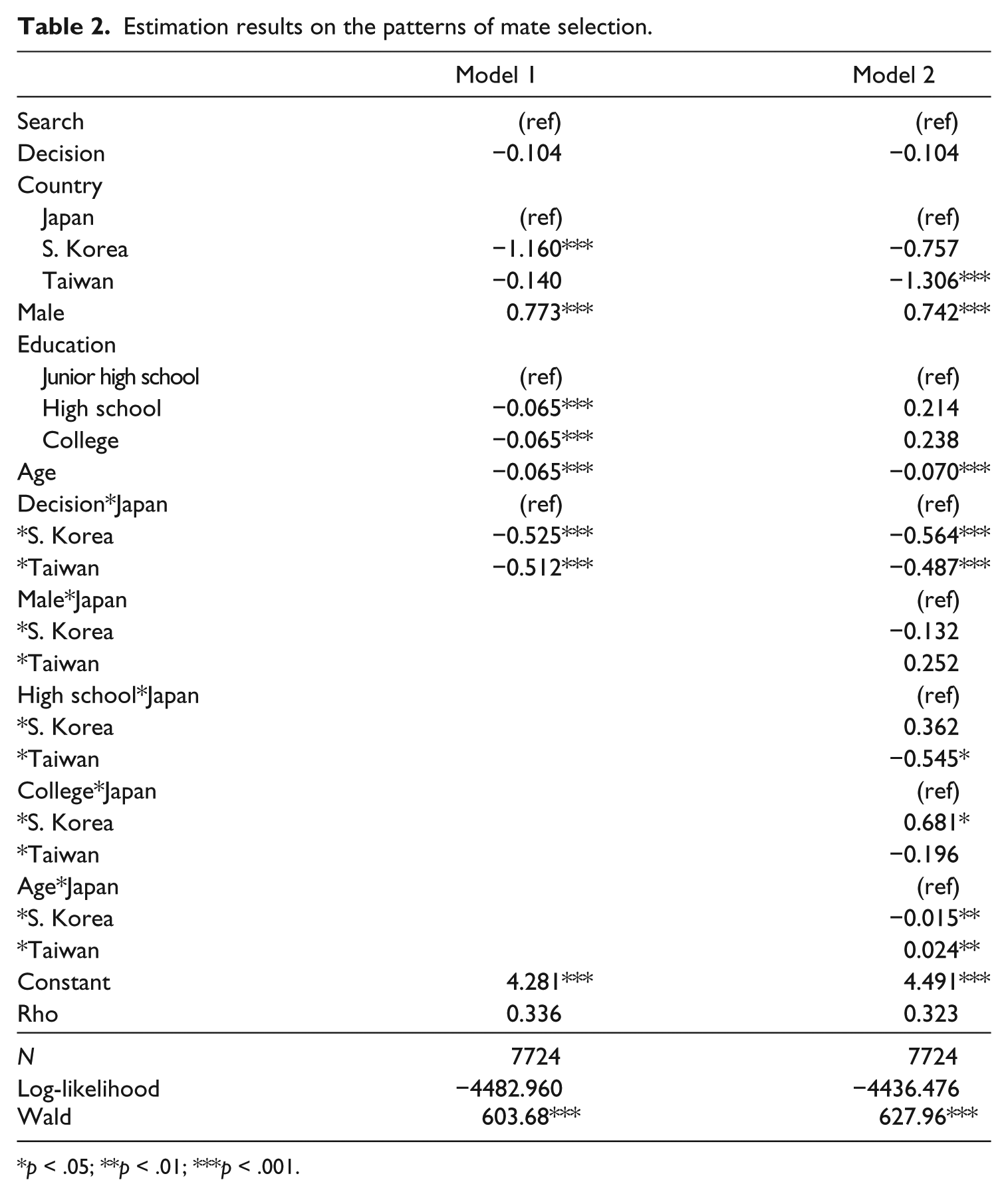
Table 2 provides the estimation results of the random-effects logistic regressions using respondents from all three countries. Model 1 is estimated using basic variables and only interactions between country dummies and ‘decision’ dummies. The ‘decision’ dummy (the second row) indicates the difference between self-search and self-decision. Model 1 estimates the main effects of the decision dummy as −0.104, with no statistical significance: that is to say, the proportion of those who chose negative answers (‘not too much’ or ‘not at all’) to the question ‘To what extent do you think your parent(s) influenced your decision to marry your current spouse?’ over positive ones (‘fairly’ or ‘very much’), thus reporting a self-decision process, is smaller than the proportion of those who experienced a self-search of mate; however, this difference is not statistically significant.
Estimation results on the patterns of mate selection.
p < .05; **p < .01; ***p < .001.
Readers should be careful to note that the coefficients for the decision dummy in Table 2 indicate the difference in probability between the self-search process and the self-decision process after controlling for the effects from other covariates in each model. That is, the value of a coefficient can reflect quite different joint distributions for the search and decision processes. For instance, for a certain age, education, and country group, a coefficient 0 could mean either that all respondents experienced a self-search and self-decision process, or that 50% of respondents fall into the transitional (S) pattern, and 50% of respondents fall into the transitional (D) pattern. Therefore, logistic analyses in this section do not intend to test the existence of the transitional phase, which was addressed in an earlier section.
The differences between the results based on countries are shown in Figure 2, with predicted values of probabilities from the estimation results of Model 1. Predicted probabilities are calculated by fixing other variables: age is fixed at 53 years (the mean age of the respondents), gender is fixed at female, and educational background is fixed at high school graduation. In Japan, the probability of choosing a self-search process is 71%, while that of the decision process is 69%, with no statistical difference. The difference between these two is much larger for respondents in South Korea and Taiwan. In those countries, the probability of experiencing a self-search is greater than that of choosing a mate, with relatively less parental intervention. The overall figures are generally lower in South Korea than in Japan and Taiwan, at least in the selected population.
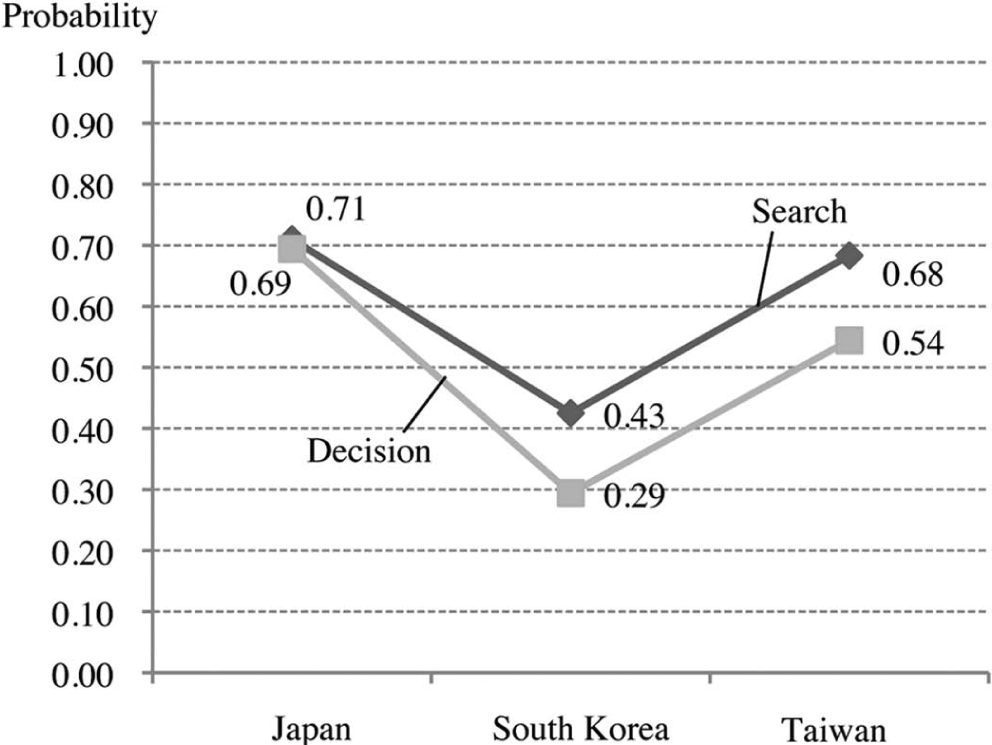
Predicted probabilities of choosing self-search and self-decision on mate selection from Table 2, Model 1 (female, high school graduate, 53 years old).
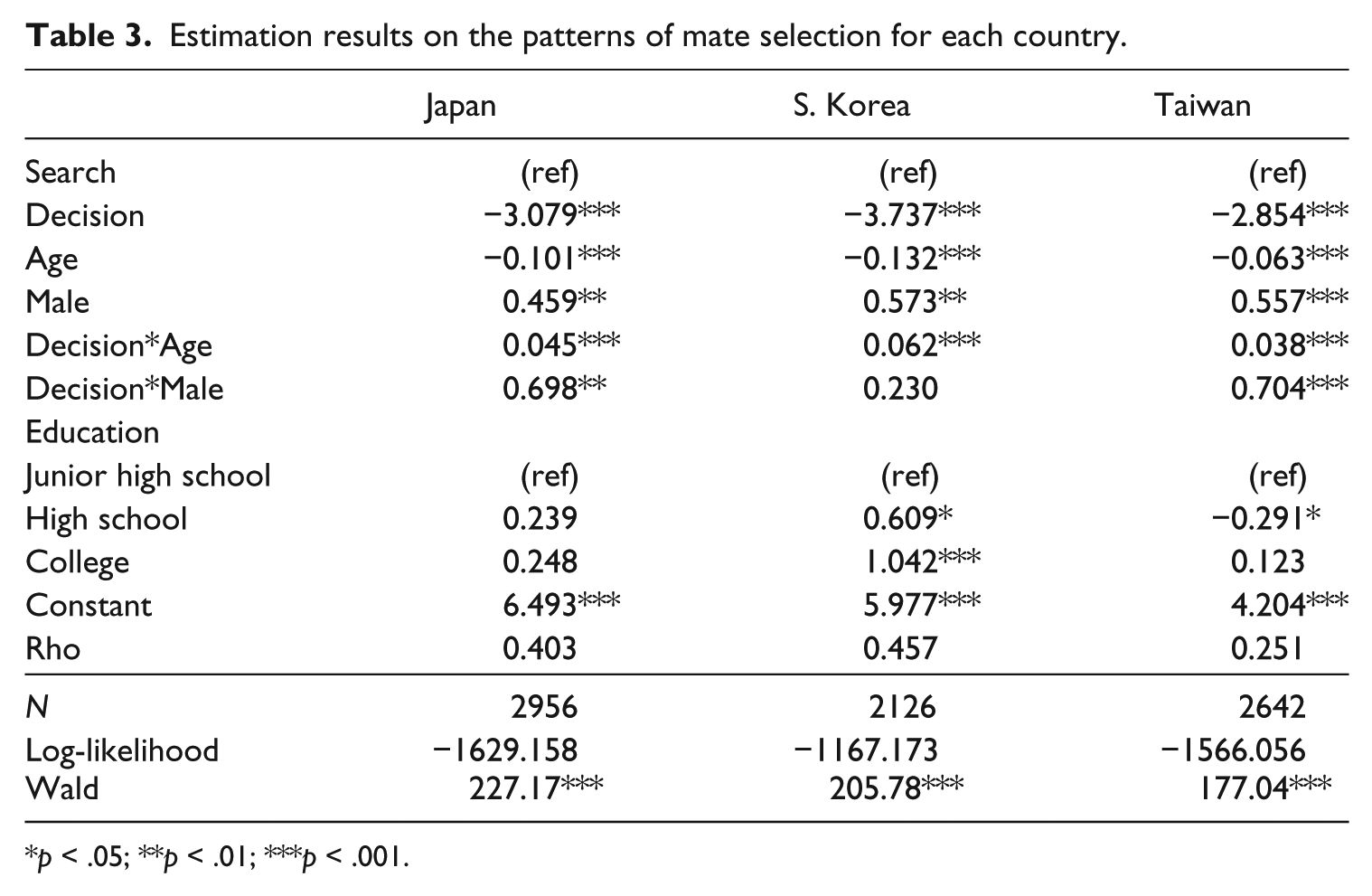
Model 2 (the right column of Table 2) includes extra interaction terms between country dummies and other explanatory variables. The results suggest that the effect of age has a remarkable difference according to countries. In order to show this in detail, another set of estimations is calculated, which is shown in Table 3.
Estimation results on the patterns of mate selection for each country.
p < .05; **p < .01; ***p < .001.
Table 3 gives the same type of estimation (random-effects model) for each country. Figure 3 visualizes the main results from the predicted probabilities calculated using those estimations.
We can see some common features indicated in Figure 3. First, the speed of shift is higher for the search process than for the decision process. For the older cohort (respondents aged 80 years or older), especially in Japan and Taiwan, the change in the search process lags slightly behind the change in the decision process. However, this relationship is reversed for younger cohorts, because of the difference in the rapidity of changes. Because of this, the shift in the decision process lags behind that of the search process. Therefore, the theoretical expectation presented in the previous section is basically supported.
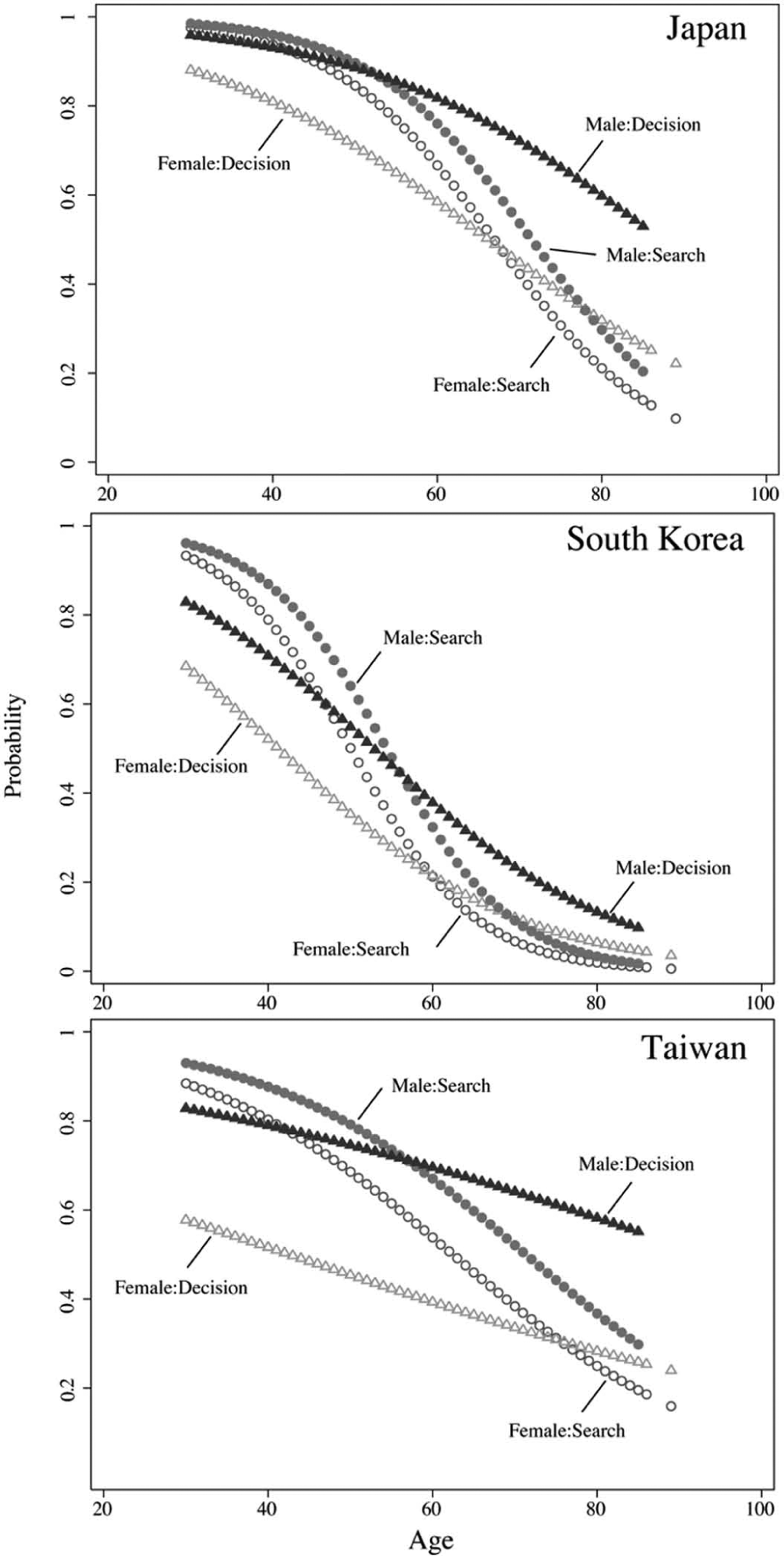
Predicted values of self-search and self-decision on mate selection.
Another interesting fact is that the extent of the shift in mate selection is greater for men than for women in all countries. For Japan and Taiwan, the interaction between the decision dummy and the gender dummy is also statistically significant – that is, for both men and women, the probability of experiencing the self-search process is greater than that of experiencing the self-decision process, but the size of the gap differs by gender. This is typically seen in younger cohorts in Taiwan in Figure 3. Three mate selection patterns, except for ‘Female: Decision,’ show high probabilities. This result is predictable considering the general tendency of the age homogamy; there cannot be a large gender gap in the search process, while there is room for a significant gender gap in the decision process, as we discussed in the previous section. The reason for the larger gender gap in the decision process in Taiwan will be discussed in the next section.
There appear to be country differences in the effects of educational background in Model 2 in Table 2. Table 3 provides a clearer explanation of these effects. A peculiar fact is that, in South Korea, those with higher educational qualifications tend to experience a more autonomous method of mate selection. The estimation of the model with the interaction term between educational qualifications and the decision dummy (not shown in the table) predicted that the gap between the speed of the shift in the search process and that of the decision process is much greater for those with higher educational qualifications.
To summarize, the two empirical findings – the difference in the rapidity of change between the search process and the decision process and the gender gap in the shift – suggest that this study’s hypotheses are basically supported.
Discussion
The main argument in this study is that we need to form a new conceptualization (categorization) for mate selection, because the existing ‘arranged versus love’ framework is too simple to comprehend the actual transition of mate selection behavior. The need to incorporate the ‘transitional phase’ into the mate selection category is confirmed by this study’s basic description of empirical data in these three East Asian countries.
The most important finding from the empirical data is that, even though the proportion of mate selection in which the initial meeting with the current spouse was set up in an arranged setting has been decreasing, substantial parental influence remains when a child decides whether to marry his or her spouse. If we assume that there is a shift in mate selection from arranged to a more autonomous pattern, East Asian countries are still in the transitional phase of this shift. As we saw in Figure 1, the proportion of those who reported that there had been some level of parental intervention in their marriage decisions is about 19% in Japan and over 35% in South Korea and Taiwan. In those cases, even though the method of meeting has moved toward the self-search, the overall process still does not break from the arranged method. We also found contrasting cases, in which the initial meetings with spouses were set up in traditional ways, but parental intervention was not as strong regarding the decision of whether to marry or not. However, the pace of change is different in these two transitional patterns. In the shift in mate selection, it is notable that the arrangement custom in the search process is fading, while parental influence has shown a much slower decrease in all three countries.
The findings that have been described so far are shared by all three countries included in this study, but some country differences are also found. The first is the rapidity of the shift in mate selection. The way that the probability of experiencing a more autonomous type of mate selection altered according to when people were born is different in each of the three countries: South Korea reports the most rapid change. A theoretical explanation for this would be that the speed of social structural change has been faster in South Korea than in the other two countries. In fact, the shift in the industrial sector from agriculture to manufacturing to service has progressed at the most rapid pace in South Korea (Chang, 1999; Chang and Song, 2010; Kim, 2009). The population in agriculture in South Korea was 79.5% in 1960 and 12.5% in 1995. The same figures in Japan were 43.0% in 1955 and 5.7% in 1995, while in Taiwan, the figures were 60.9% in 1955 and 10.6% in 1995 (Brinton, 2001). Likewise, the rapid popularization of higher education in South Korea has been greater than in Japan and Taiwan (Brinton et al., 1995).
Another important finding about country differences is the relatively strong parental influence for women of the younger cohort in Taiwan, while the way they met their spouses (search process) is no less autonomous than their counterparts in Japan and South Korea. The latter finding (Taiwanese women met their spouses in a more autonomous way, just like women in Japan or South Korea) can be explained by the fact that the employment rates in those countries are not very different for unmarried women (Brinton, 2001; Brinton et al., 2001). However, the former fact (that parental influence is most distinct for younger women in Taiwan) is puzzling considering the relatively higher labor participation rate for married women and the lower gender wage gap in Taiwan, because the theory tells us that female economic dependency on men explains the strength of parental power on mate selection for their daughters.
Some authors suggest that, although the female labor participation rate has grown to a relatively higher level in Taiwan, women’s overall autonomy has not increased. A large proportion of working women in Taiwan belong to small family enterprises, and, within these firms, patriarchal norms still prevail (Lu, 2001). In this case, a woman’s happiness still depends on her husband: therefore, her parents might have motives for wanting to have a say in their daughter’s mate selection to ensure that their daughter makes the ‘right’ choice.
Another interpretation of this is that the remaining custom of marriage finances in Taiwan explains the relatively strong parental power over marriage. Although the frequency of marriage overall has been declining, in the 1990s marriage cohort about 55% of marriages in Taiwan still involved dowries, while bride prices were taken in just under 45% of marriages (Mehrotra and Parish, 2001). Parental power in marriage decisions has virtually remained at the same level in Taiwan since the 1940s birth cohort, and this fact matches the trends in marriage finances: from the late 1960s onwards, when people from the 1940s birth cohort began to marry, dowry prices started to rise, while bride prices started to decline. The exchange of marriage finances is typically managed by a couple’s parents and thus accounts for the remaining parental control over mate selection for women.
What are the implications of this theoretical and empirical finding of a transitional phase in mate selection? An important contention of this study would be that the shift in mate selection from a traditionally arranged pattern to an autonomous one has not moved in a unilinear fashion in East Asian countries. As long as there is a considerable difference in the extent of economic independency between genders, a woman cannot enjoy a free marriage choice. The transitional phase of mate selection is yet another reflection of gender inequality in a society.
Several remaining aspects need to be investigated in order to describe a more detailed image of mate selection. As has been stated in the previous section, there are difficulties in providing a thorough illumination of the transition of mate selection. Limited information about respondents’ premarital lives makes it difficult to incorporate some important variables, including occupation, income, attitudes toward gender, or family norms before marriage. Another difficulty comes from confounding effects, where different aspects of social structural change might have the same kind of influence on mate selection; for instance, the popularization of higher education might mean more exposure to liberal views on marriage, and it might also present more opportunities to meet a potential spouse.
The most difficult problem is that there must have been many unsuccessful trials of mate selection. This should present a serious estimation bias, because a person whose parents have very strong decision power in terms of mate selection are more likely to not marry. Due to this bias, the extent of self-decision is overestimated. This problem is also related to the possible inadequacy of the measurement of parental influences, as discussed earlier. Correcting for this bias will be an important future task.
A further problem is that it is difficult to understand what kind of particular behavior or attitude concerning mate selection was captured by the survey questions used in the analyses. For instance, in the survey in Taiwan, 57% of people from the 1960–1964 birth cohort said that both the parents and the couple decided about their marriage (Thornton et al., 1994). Different kinds of questions may observe different aspects or processes of behaviors. We need to supplement these possible gaps by ethnographic studies on mate selection. 5
At least some of these difficulties can be minimized by complementing the analysis using limited data with existing macro data and previous studies, which this study tries to do. However, this is far from a provision of concrete, realistic recapturing of changes in mate selection. This may be resolved by a more sophisticated survey or qualitative inquiry into the detailed life course of individuals.
Footnotes
Acknowledgements
The East Asian Social Survey (EASS) is based on the Chinese General Social Survey (CGSS), the Japanese General Social Surveys (JGSS), the Korean General Social Survey (KGSS), and the Taiwan Social Change Survey (TSCS) and distributed by the EASSDA.
Funding
This work was supported by JSPS KAKENHI Grant Number 21730433.