



Abstract
The opening of China’s economy has attracted an inflow of Taiwanese migrants, including student migration for higher education. Taiwanese migrants in China have created a ‘transnational social field,’ which is simultaneously an exceptional space of sovereignty and a liminal terrain of identity. Based on in-depth interviews with 61 Taiwanese students in China, this article looks into the paradoxes between nationalization and globalization at the intersection of state policy, migration trajectory, and identity politics. The Chinese government has offered Taiwanese citizens exceptional membership and privileged access to college admission, in order to uphold China’s claim of sovereignty over Taiwan and promote the agenda of reunification. Taiwanese students capitalize on such institutional privilege and cultural ties to facilitate their transnational mobility and flexible capital accumulation. They also develop different strategies to negotiate their ethnic or national identification: assimilating as Chinese, reasserting a Taiwanese identity, and claiming a cosmopolitan identity.
The relationship between Taiwan (Republic of China, or ROC) and China (People’s Republic of China, or PRC) constitutes an exceptional case for the theories of national sovereignty and citizenship. After the civil war in China and the exodus of the Kuomintang (KMT) regime to Taiwan, both governments across the Taiwan Strait have declared each other’s territory as part of their national land, and hence people in each other’s territory as their ‘non-resident nationals.’ Meanwhile, citizenship, along with the corresponding rights and entitlements, is granted to ‘resident nationals’ only. In other words, there are ‘disjunctions of nationality and citizenship, of symbolic membership and legal membership in both states’ (Tseng and Wu, 2011: 268).
The opening of China’s economy has attracted a tidal wave of investment from Taiwan, and consequently an expanding inflow of Taiwanese migrants, including entrepreneurs, managers, and professionals. It is estimated that over 1 million Taiwanese citizens travel frequently across the Taiwan Strait and maintain simultaneous connections in both societies (Huang, 2010; Tseng, 2011). We argue that Taiwanese migrants in China have created a ‘transnational social space’ (Faist, 1998) or ‘transnational social field’ (Levitt and Glick Schiller, 2004), which encompasses multiple networks for the mobility and circulation of people, resources, ideas, and practices between Taiwan and China.
Two macro forces have structured the formation of this transnational social space. First, Taiwanese investors have capitalized on their linguistic and cultural ties to play an intermediate role and occupy a strategic niche in the global production chains connecting Western buyers and cheap labor in China. Second, the Chinese government has granted ‘exceptional membership’ to the ‘residents of the Taiwan region’ as a special group. Although the majority of Taiwanese migrants do not become residents in China’s household registration system, they enjoy some entitlements that ordinary foreigners are not eligible for, especially rights of residency and employment. 1 Taiwanese migrants have capitalized on this exceptional membership to help them pursue flexible mobility across borders.
China has also opened the gate for Taiwanese students to attend Chinese higher education institutions since 1980. During the period 1985–2000, only 2895 Taiwanese students enrolled in undergraduate programs and 864 in graduate programs in China. The numbers have nevertheless grown dramatically along with the rise of China and the expansion of transnational ties across the Taiwan Strait. In 2004 alone, 1777 Taiwanese headed to China for study, even though Taiwan’s government, at that time, did not recognize any degree granted by Chinese universities. According to the statistics released by the Ministry of Education (MOE) in China, the number of Taiwanese students enrolled in Chinese universities rose to 7346 by the end of 2011 (Li, 2013).
The transnational social field stretching across the Taiwan Strait is not only an exceptional space of sovereignty but also a liminal terrain of identity. Unlike Taiwanese entrepreneurs whose local contacts are mostly subordinate groups along class or gender lines, 2 Taiwanese students mostly interact with peers like Chinese classmates. By neutralizing class and gender differences, student migration constitutes a better research topic for us to examine ethnic and national identity negotiation at the nexus of nationalization and globalization. On the one hand, the Chinese government offers Taiwanese an exceptional membership and privileged access to college admission to bolster its claim of sovereignty over Taiwan. On the other hand, Taiwanese students, whose motives may be degree-oriented, work-oriented or family-guided, pursue higher education in China as a strategy of transnational mobility and flexible capital accumulation.
Student migration in a transnational social field
Pursuing higher education overseas is a common strategy for generations of Taiwanese youngsters to cultivate human capital. Economically developed societies in the global North, such as North America, Western Europe, Australia, and Japan, have long been popular destinations. Only recently has China become an alternative destination attracting an increasing number of Taiwanese students. How is this migration trajectory different from, or even exceptional to, the other cases of student migration?
Migration scholars identify the logic of globalization as the main feature of many state deregulation policies on student migration. Compared to the other types of migration, host governments tend to be more tolerant or even encouraging of the entry of foreigners for tertiary education. Not only can the host institutions profit from the tuition paid by foreign students, but the receiving societies may also benefit from their professional labor if they decide to stay after graduation. Many countries actively build up projects to recruit foreign students and encourage them to immigrate in order to advance in the competition for global talent (Brooks and Waters, 2011; Ziguras and Law, 2006).
Students themselves also pursue overseas education and transnational mobility as a strategy of global capital accumulation. With degrees earned in the global North, they hope to gain access to the global labor market or secure class privilege in their country of origin (Szelényi, 2006; Waters, 2006). The family often serves as an important decision-maker in educational migration. By sending their children to study overseas, wealthy Asian families adopt a strategy of ‘flexible capital accumulation’ to convert economic capital into cultural capital, such as Western degrees and cosmopolitan tastes (Ong, 1999).
The counter-logic of nationalization, on the other hand, describes some cases of student migration and the policies of receiving states. For instance, Taiwan holds special venues of admission for overseas Chinese students, largely from Malaysia, Indonesia, Hong Kong, Macau, and Burma. By playing the role of ‘surrogate homeland’ (Fan, 2005) for the Chinese diaspora, the KMT regime in exile tried to maintain its ruling legitimacy as ‘the only China’ during the Cold War period. Overseas Chinese families send their children to study abroad as a strategy of risk management, because they have encountered ethnic exclusion in the nation-building process in Southeast Asia (Nonini, 1997).
The above literature provides a useful framework for us to study the migration of Taiwanese students to China. However, many puzzles remain to be answered. First, China’s recruitment of Taiwanese students is not driven by the market calculation of tuition profit or talent recruitment. Taiwanese students pay the same amount of tuition as local students do, which is substantially lower than the tuition charged to foreign students. The competition for college admission and job opportunities is already intense among local youngsters in China. Facing the alarming rise of unemployment rates among college graduates, the PRC government has no obvious interest in recruiting foreign students as an a priori means of talent migration. 3 In other words, the thesis of globalization cannot explain China’s active recruitment of Taiwanese students.
Second, the reasons why these Taiwanese students chose China for overseas study are not fully explained by the thesis of global capital accumulation. Unlike Western education, Chinese universities have not earned an established reputation regarding educational quality. For Taiwanese students, China offers a fairly similar cultural and language environment, lacking the attractions of exotic culture and language education that they can acquire when studying elsewhere. Moreover, Chinese diplomas, medical degrees in particular, are not fully recognized in Taiwan. In sum, although the transnational mobility of Taiwanese students exemplifies the neoliberal logic of the entrepreneurial self, their strategies of flexible capital accumulation are distinct and need further explanation.
We argue that the migration decisions and trajectories of Taiwanese students to study in China are embedded in the transnational social field formed across the Taiwan Strait. Building on the idea of ‘transnational social space’ (Faist, 1998), Peggy Levitt and Nina Glick Schiller (2004: 1009) use the term ‘transnational social field’ to describe ‘a set of multiple interlocking networks of social relationship through which ideas, practices, and resources are unequally exchanged, organized, and transformed.’ To move beyond the methodological nationalism of the ‘nation-state container model,’ transnationalism as a social field proposes a new way of spatially conceptualizing migration by focusing on ‘networks of networks that stretch across the borders of nation-states’ (Glick Schiller, 2005a: 442), encompassing transnational ties from below in the economic, political, and socio-cultural realms (Portes et al., 1999).
Levitt and Glick Schiller (2004) also argue that transmigrants often experience a disjuncture between ‘ways of being’ and ‘ways of belonging,’ that is, their physical presence and actual social engagement are different from their sense of belonging and awareness of identity. Researchers have documented that migration experience creates a liminal space for racial and ethnic identification, in which migrants encounter new mirror images ascribed by the receiving society and become reflexive about how to situate their personal and collective identities (Ahmed, 1999; Glick Schiller and Fouron, 2001; Tsuda, 2003). Scholars also debate whether transnational ties or multiple identities weaken immigrants’ integration in the receiving society or challenge the norm and practice of citizenship (Glick Schiller, 2005b; Vertovec, 2001). The social field approach allows us to examine the identification of transmigrants in global, national, and local contexts simultaneously – how individuals negotiate their presence on different levels that are socially and geographically distant (Golob, 2014).
We find the idea of transnational social field inspiring but we also agree with some critics regarding the critical role of state sovereignty in the formation of transnational social fields. Roger Waldinger and David Fitzgerald (2004) contend that state policies condition the ability of migrants to form transnational networks and communities – state control not only defines membership and loyalty in the national collectivity but also regulates movement across territorial borders. It is thus important to examine how transmigrants, or even ‘transborder citizens,’ interact with a range of state institutions and civil society agents in both sending and receiving countries, and participate in various forms of political discourses about nation, society, and self (Glick Schiller, 2005b).
In our case, the PRC’s political agenda of nationalization is a critical force in facilitating the multiple forms of cross-border mobility of Taiwanese citizens; their frequent travel back and forth then creates sustained economic networks, social connections, kinship ties, and circuits of intimacy across the Taiwan Strait (Deng, 2008; Huang, 2010; Shen, 2005; Tseng, 2005). Aihwa Ong (2004) has argued that Greater China is a state-driven strategy to economically integrate disarticulated political entities, including Hong Kong, Macao, and Taiwan, as a detour toward eventual political integration. China has deployed various practices of sovereignty, such as zoning technologies, to produce a new space of exception and border-crossing powers. We follow this insight to propose that the educational incorporation of Taiwanese students is part of China’s flexible state practices to produce an exceptional membership and privileged autonomy in border crossing for the breakaway political entity of Taiwan.
The emerging Chinese axis (Ong, 2004), an alignment of the rising Chinese economy with Hong Kong, Macao, Taiwan, and Chinese communities in Southeast Asia, has created a liminal space surrounding the ambivalent identity of ‘Chinese.’ Brenda Yeoh and Katie Willis (2005) interviewed Singaporean expatriates in China and found that their initial expectation of a ‘return-to-roots’ tour was soon replaced by the assertion of Singaporean identity vis-a-vis PRC Chinese, such as these two quotes: ‘The Singaporean Chinese is very different from the Chinese Chinese. We keep telling ourselves not to be deceived by skin color.’ ‘Lucky that our ancestors left the place, or we’d be one of them!’ (2005: 275).
Taiwanese entrepreneurs and managers have joined the Chinese axis based on the linguistic and cultural ties, but they experience further ambivalence and contradiction in the terrain of ethnic and national identification. They are trapped in a predicament between globalization and nationalization, according to Horng-luen Wang (2009): on the one hand, they harbor a deep anxiety about being marginalized in the game of global capitalism and feel attracted by the glamour of global cities in China; on the other hand, they find themselves involved in a tug-of-war of nationalism between the two sides of the Strait, and are forced to choose between the identity labels of ‘Taiwanese’ and ‘Chinese.’
The experience of Taiwanese students also demonstrates structural tensions between globalization and nationalization, leading to uncertainties and predicaments for individual migrants. Many are impressed by China’s rising status on the global stage and wish to occupy a niche in the regional economy of Greater China, but their educational experience and career trajectory are still contingent upon the political tug-of-war between the two regimes. The ambivalent status of Taiwanese – neither citizen nor foreigner in China – facilitates their transnational ‘ways of being,’ but political tensions across the Strait render it difficult for them to maintain transnational ‘ways of belonging’ without friction or conflict.
This article investigates the following questions: Why did Taiwan students decide to study in China and what kinds of flexible capital accumulation are involved? How are their migration decisions and trajectories embedded in the transnational social field across the Taiwan Strait, which is structured by China’s flexible state practice and Taiwanese migrants’ economic and social networks across borders? How do Taiwanese students negotiate their ethnic or national identification in this transnational space of liminality?
Research methods and case profiles
This article draws from 61 semi-structured interviews, conducted from August 2008 to September 2009, with Taiwanese students who were studying or had studied in China. We used the method of snowballing to recruit 46 interviewees, but limited each chain of referral to avoid sample bias. The other 15 interviewees responded to our request for interviews posted at the website forums of Taiwanese students. In addition, we systematically collected official documents and news reports concerning relevant policy regulations in China and Taiwan.
We conducted the interviews in Mandarin Chinese, and translated the excerpts quoted in the article. We used open-ended questions such as: Why did you decide to study in China? How was your experience of studying and living in China? What is your plan upon graduation? How often do you go back home, and how do you maintain connections in Taiwan? How would you identify yourself in terms of ethnicity and nationality? How do you perceive the similarities and differences between Taiwanese and Chinese? We also asked about concrete details of their lifestyle in China, including what they eat, where they live, how they speak, and whom they make friends with, regarding their interaction with the local society.
The interviews, which usually lasted for two or three hours, were mostly conducted in public establishments such as coffee shops or restaurants, while some took place in the rental apartments of the informants or in the office of the lead researcher. We interviewed 19 informants in Taipei, who had graduated and returned to Taiwan or come home for vacation. For the rest, the interviews were conducted in three major cities in China, including Beijing (14), Shanghai (10), and Guangzhou (18). These three cities were chosen for their particularly large Taiwanese communities. The context factors, such as the locations of the interviews and the ethnicity of the interviewers (both Taiwanese citizens), may have some effect upon how the informants employ narratives to frame their identification. Therefore, we try to contextualize the data and interpret them with caution.
No statistics have been released about the demographic profiles of Taiwanese students in China, but we tried to maintain sufficient variations in our sample. The 61 participants include 33 females and 28 males. Most of them were aged between 20 and 30, with the exception of two PhD students. We selected interviewees across various majors and professions, including Chinese or Western medicine (20), business and finance (15), social sciences and law (14), humanities and arts (9), and natural science (3). Thirty-three of them were pursuing a bachelor’s degree in China, while the others were graduate students (19 MA, one MBA, and 8 PhD students). Two-thirds of our informants were studying in China at the time of the interview, and one-third of them had recently finished their studies in China. Among these 21 graduates, 13 stayed in China and the rest returned to Taiwan. Most of the students had stayed in China less than five years; 17 people stayed longer than five years for work or PhD programs; and six of them had stayed in China for more than 10 years, because their families had previously moved there.
With participants’ consent, interviews were recorded and fully transcribed. The interview transcripts were coded based on the principle of grounded theory (Charmaz, 2008). Using the qualitative data analysis software NVivo, we conducted initial coding by reading the transcripts carefully and identifying important categories; we later reorganized the data by category (e.g., motives of immigration, and identity negotiation) and identified sub-categories (e.g., seeking distinction, seeking assimilation, and cosmopolitanism) in the process of advanced coding. Engaging simultaneously with literature and the data, we gradually developed broader theoretical themes and an analytical map of the transnational social field.
Exceptional membership as a flexible state practice
With the national policy to open up the market in the 1980s, the PRC government started to welcome the return of the Chinese diaspora for investment and education. Before 1980, overseas Chinese, Hong Kong, Macau, and Taiwanese students (OHMT in the following) had to take the same national entrance exam (gaokao) as local students to attend Chinese universities. Selective universities, initially two 4 and later nine, 5 offered special exams and quotas of admission for OHMT students. This exam later turned into the OHMT Normal Exam, with the same content as gaokao but much lower admission scores for overseas applicants. At this time, Taiwanese students were treated no differently from other OHMT students, who paid higher tuition fees than local students did. They were assigned to dormitories for foreign students with higher charges and separation from the circle of local students.
Around 1996, the recruitment policy entered a new stage characterized by the principle of ‘one country, two systems.’ The State Council announced that ‘external territories’ students from Hong Kong, Macau, and Taiwan should enjoy equal treatment as ‘nationals.’ 6 They became eligible for scholarships and campus lodging available for local students. Special paths of admission became open, including independent exams held by professional schools such as art and design, pre-university programs (yukensheng) and pre-admission students (chabansheng).
The improved bilateral relationship between China and Taiwan pushed the PRC government to offer even more benefits designed specifically for Taiwanese students. In 2005, after the ‘ice-breaking’ visit of former Taiwanese vice president Lien Chan in China, Hu Jin-Tao, then Paramount Leader of China, announced that Taiwanese students would pay the same amount of tuition fees as local students did. Many universities also set up scholarships offered only to Taiwanese students. In 2007, the MOE announced that Chinese universities should recruit a certain number of graduate students from Taiwan, Hong Kong, and Macao, because it provided ‘an important venue to promote the task of homeland unification.’ 7 Since Hong Kong and Macao have been integrated into the PRC territory under the sovereignty of ‘special administrative regions,’ the educational incorporation of Taiwanese youngsters has become an ever more important policy measure to promote reunification of Taiwan with China. As of 2010, Taiwanese high school graduates can apply for 123 colleges and universities in China, once they have achieved a certain grade on Taiwan’s General Scholastic Ability Test. They do not have to take any additional exams except for personal interviews held in China. This beneficial policy is open exclusively to Taiwanese students.
When the KMT returned to rule in 2008, Taiwan’s President Ma Ying-Jeou promised to recognize Chinese degrees and recruit Chinese students in the near future. Since 2010, Taiwan has opened a limited number of admissions to Chinese students, who are not treated as ordinary foreign students but are under exceptional – more restrictive – regulation. 8 To soothe societal concern about the potential impact upon local students, Chinese students are not eligible for scholarships or gainful work on campus, nor are they allowed to take certification exams or stay after graduation. Meanwhile, the MOE in Taiwan has gradually expanded the official recognition of China’s higher education degrees from 41 institutions in 2012 to 111 institutions in 2013. 9 This policy lifted a critical barrier for Taiwanese students who would like to return home after their study in China, but medical degrees are still not recognized due to the objection of the professional community in Taiwan.
China’s policy of recruiting Taiwanese students has a clear undertone of nationalism. By contrast, the counterpart policies in Taiwan are largely framed by the narrative of globalization and the neoliberal logic of talent competition. In addition to the goals of promoting cross-strait exchanges and easing the shortage of local pupils in private universities, Taiwan’s MOE declared the benefits of recruiting Chinese students as ‘responding to the global trend of talent competition’ and ‘improving the competitiveness and internationalization of Taiwanese universities.’ 10 These ‘depoliticized’ narratives attempted to soothe Taiwanese people’s concerns about the hidden agenda of reunification. They also reveal Taiwan’s deep anxiety about being marginalized in the global community, a situation that has been exacerbated by the rise of China.
The bilateral relationship between Taiwan and China constitutes an exceptional space of sovereignty. Both governments have offered exceptional membership for students from the other side of the Taiwan Strait, but their flexible state practices are starkly different – China has a hidden agenda of nationalization, but Taiwan embraces the rhetoric of globalization. Against the backdrop of widespread social anxieties about Taiwan’s economic downturn in recent decades, an increasing number of Taiwanese students are turning to the rising China for the pursuit of educational and career opportunities.
Transnational mobility and flexible capital accumulation
Taiwanese students choose Chinese tertiary education for a variety of reasons. What they share in common is that they capitalize on the ethnic and linguistic ties, as well as the exceptional membership, to facilitate their flexible mobility and to improve their career opportunities in the future. We identify three major reasons for migration: degree-oriented, work-oriented, and family-guided. Each migration trajectory involves specific strategies of flexible capital accumulation, but they are all embedded in transnational social and economic networks that stretch across the Taiwan Strait.
Degree-oriented: Seeking cultural capital and international experience
The majority of our interviewees (42%) went to China mainly to pursue educational degrees. When degree seekers consider where to study, they usually take into consideration three primary factors: cost, educational quality, and chance of admission. Few of our interviewees were driven to Chinese universities primarily by the cheaper tuition fees there. Most respondents think of cost reduction only as a plus after they have made the decision based on other concerns.
Some degree seekers did go to China for the assumed reason of educational quality or cultural authenticity, mostly in the fields of Chinese history, Chinese literature, and Chinese medicine. They view China as an ideal place to cultivate authentic Chinese culture as a form of embodied cultural capital and thus consider less whether Taiwan’s government recognizes Chinese degrees as institutionalized cultural capital. 11 We met Shen, a PhD student of Chinese literature, during her summer vacation in Taipei. She honestly said: ‘The ultimate goal for the pupils of Chinese literature is to study at Peking University! It’s like the Holy Land for us.’ However, she later realized that the cultural heritage and scholarship in China, surviving through communist experiments such as the Cultural Revolution, are not as ‘authentic’ as she had imagined.
The most important factor that motivates Taiwanese students to study in China is the privileged access to admission, including lower scores and flexible paths of recruitment. Some universities also open unofficial venues (‘back doors’) for overseas applicants who want to circumvent exams. The school officers are able to gain payback through the mediation of brokers who charge huge service fees to the applicants. The information about these admissions is neither transparent nor easily accessible; Taiwanese students rely on co-ethnic entrepreneurs and commercial agents with local networks in China to serve as go-betweens and connect them with Chinese institutions.
Taiwanese students are able to receive expanded educational opportunities in China thanks to their social ties and exceptional membership. Although the recent expansion of higher education in Taiwan has widely broadened the access to college education, the chance to enter valuable professions and elite universities is still limited. Some of our interviewees failed to get into elite universities in Taiwan, but they were able to gain admission to Chinese ‘brand name’ schools. Some wanted to shift to popular professions like finance or medical school; the chance for them to get admitted in Taiwan was slim, but they were able to do so in China. 12
Some Taiwanese degree seekers prefer to study in China for a convenient combination of international diversity and cultural-linguistic affinity. They feel anxious about being left behind in the game of globalization and would like to explore the world outside Taiwan. Yet, the chance of getting into universities in North America, Japan or Western Europe is limited, and the language barrier is substantial. Some of our interviewees failed in their applications elsewhere or the foreign language requirement, before they turned to China as the secondary choice. Chinese universities, with the advantage of national visibility on the global stage, provide a student body with a certain international diversity. Some applied for satellite programs of Western universities located on Chinese campuses. We call this strategy ‘intermediated globalization’: studying in China allows these students to enjoy the experience of ‘studying abroad’ and even the benefit of Western degrees, while they pay lower educational costs and continue to live in a Chinese-speaking environment.
Work-oriented: Seeking professional or business migration
Thirty per cent of our interviewees were motivated to study in China to develop a career path. Their primary concern is not the formal degree but social networks and local knowledge which they are able to accumulate during their stay in China. Their strategy of capital accumulation is to convert their ethnic privilege into educational opportunities, and then into cultural capital and social capital that may help them to occupy a niche in the regional economy of Greater China.
The work-oriented concern is especially salient among people in the fields of finance and business. Hoping to maximize their flexible mobility in the game of global capitalism, many gave up their jobs in Taiwan and went to China for business school. Global cities in China like Shanghai and Beijing are central hubs in the regional economy, where multinational corporations offer lucrative positions for professionals with both cosmopolitan experience and familiarity with local language and culture.
At the age of 30, Zack quit his job in a leading bank in Taiwan to enroll in a PhD program of finance in China. While meeting us in Beijing, he complained about the poor teaching quality there; he even had to help his advisor write reports without gaining any credit. He was nevertheless confident in making the right decision because he had connected with many key figures in the political arena. ‘Here, it is more important to network than to learn,’ he said. He also believed that earning a degree from an elite Chinese university would tie him to local elite networks and facilitate his career development in China.
Some others dream of building their own business in China’s booming market. Many do so under an impression created by the Taiwanese media and books of Taiwanese entrepreneurs in China as landing a fast track to wealth and success (Wang, 2009). One student told us during our interview in Shanghai, ‘I came here to see whether I have a chance to become one of them.’ Yet, for those without financial backup from their family, the dream of entrepreneurship is not easily realized.
Students with the anticipation of future employment in China may feel disappointed when entering the labor market. When applying for school, Taiwanese students are treated as quasi-nationals or even ‘supra-nationals’; yet, when applying for a job or an internship, they are classified as foreigners who are disadvantaged in the highly competitive job market. Some interviewees suffered discrimination when seeking jobs upon graduation because the locals are suspicious of their qualifications due to their special school admission. Except for those who had previous work experience, most Taiwanese graduates found themselves lacking enough local ties to compete with their local peers. Many end up working for Taiwanese enterprises in China; in other words, their career opportunities are still largely constrained in the transnational social space.
Family-guided: Transnational mobility as family deployment
Another 30% of our interviewees made the decision to study in China under family influence. Their trajectories echo the thesis of the new economics of migration: migration is often a collective decision to maximize the interest of the household or to minimize family risk (Massey et al., 1993). Many of their parents were running factories or business in China, and the children followed their parents to avoid family separation. The parents also expect that local education can prepare their children for the future mission of taking over family enterprises in China. Such a migration trajectory is especially common among our interviewees in the Pearl River Delta.
Lian’s family runs a successful factory in the Pearl River Delta Economic Zone. Lian was sent to Canada for high school as a ‘parachute kid.’ 13 After he became a naturalized citizen in Canada, he accepted his parents’ advice to return to China for college education. He did not report his Canadian citizenship on the application because the school admission was favorable to Taiwanese. His family arranged not only where to study but also what major to take – Lian reluctantly chose business management. Despite frequent quarrels with his parents, he was committed to the family mission: ‘We were cultivated with the idea that family should be the first priority. That’s how family business is.’
Lian’s experience exemplifies the common experience of ‘parachute children’ among upper-middle-class families in Asia. However, studying in China presents a distinct pathway to flexible capital accumulation. Whether Taiwan’s government recognizes Chinese degrees or not does not concern family-guided migrants like Lian. Their primary purpose for studying in China is to gather local knowledge (as a form of cultural capital) and to build local connections (social capital). He honestly admitted a lack of respect for his Chinese professors, but he certainly knew how to build useful connections with them. Under the guidance of his father, he sent gifts to every faculty member for annual holidays. He proudly said: ‘now I can assure my business clients, if they want a free university admission for their children, I can get one for them – no problem!’
Compared to the children of Taiwanese factory owners, the children of professional immigrants follow more diverse pathways in their flexible capital accumulation. Their parents hold professional occupations in major cities or operate businesses such as restaurants and shops that target local clientele. These families do not always live in Taiwanese enclaves, and their social circles are less restricted to co-ethnic networks. Many of these children attend international schools or schools specifically for students from Taiwan, but some parents purposively send their children to attend local schools as a way of acquiring local knowledge and social capital.
For example, Yupei’s father was headhunted to a managerial position in Beijing in 2004, and the entire family immigrated to China. Though economic opportunity was the primary motivation for relocation, the family’s ethnic background also played a role in the decision to move. Yupei is considered third generation waishengren (people from exterior provinces), a label referring to people like her grandparents who followed the exile of the KMT to Taiwan in 1949. Her maternal grandparents are originally from Beijing. The family not only bought a house in Beijing but also sold their home in Taipei. Yupei had originally attended an international high school and made friends mostly with foreigners or Taiwanese. Her father urged her to ‘hang out with Chinese classmates and understand the local society better.’ The father eventually transferred her to a local school and Yupei willingly accepted.
While many children of professional immigrants prefer to attend Chinese universities and seek job opportunities in China, many parents also arrange for their children to study abroad in Europe or North America in order to accumulate international experience; parents want their children to acquire a foreign degree so they can have a competitive advantage when they return to Asia or move elsewhere for a more globalized career.
Negotiating identification in a contact zone
The migration of Taiwanese students in China has created a ‘contact zone,’ which, according to the definition of Mary Louis Pratt, refers to ‘an attempt to invoke the spatial and temporal copresence of subjects previously separated by geographic and historical disjunctures and whose trajectories now intersect’ (Pratt, 1992: 7, cited in Yeoh and Willis, 2005: 271). Although Pratt situates this notion in the context of colonial encounter, we find this concept well suited for describing the encounter between Taiwanese and Chinese after the decades of Cold War separation.
For the younger generation of Taiwanese, the images of China are like mosaic paintings that interweave the past, present, and future. China is viewed as the cultural homeland through a nostalgic lens and yet a hostile enemy to Taiwan in the geopolitical reality. The impressive images about the contemporary rise of China contrast greatly with the KMT’s dated political propaganda that China was a poverty-stricken and uncivilized place. These contradictory perceptions about China motivate some curious Taiwanese youngsters to explore China, a place that seems so close yet so far away.
Lily went to Shanghai for post-graduate study, a decision driven by her curiosity about the many faces of China. During her college years in Taiwan, she met a group of visiting students from Peking University, and these Chinese elites impressed her greatly. Lily described how she felt: ‘I was so shocked upon meeting these people and I decided to take a serious look at China. I thought they were poor and underdeveloped. But in fact, they are not at all!’
Upon landing in the actual territory of China, Taiwanese students often experience a ‘cultural shock’ – not about an exotic environment like most foreign students feel, but about a territory that seems so similar and yet quite different. Shen, the woman who studied Chinese literature, vividly described the transformation of her feelings:
I was full of images like the mighty China, the grand history and so on. When my flight was landing and I saw the territory from above, I was so touched, oh, the homeland! But, later on, you realize that it’s not really the case; actually, it’s like a foreign country.
Far from being completely unfamiliar with China, most Taiwanese students had learned much about China from textbooks in history and geography. Yin, who went to China to study business, described her cultural shock: ‘We [Taiwanese students] often joke that Taiwan’s history textbooks are about mysteries and Taiwan’s geography textbooks are like history [out-of-date]. Coming here, you get to know a totally different China.’
The experience of migration not only brings Taiwanese students to ‘discover’ the reality of China, but it also repositions them in a new landscape of identity politics. Their liminal status not only describes their contingent position in the journey of border crossing, but also characterizes their ambiguous location between the identities of Taiwanese and Chinese. Our interviewees described their liminality with metaphors like ‘sandwich cookies’ and ‘nobody in between.’ Facing their Taiwanese friends, they feel the urge to pull apart the negative stereotypes Taiwanese hold about China; while interacting with Chinese people, they also need to defend against the prejudice and misunderstanding about Taiwan. This condition renders them reflexive about their subject positions within discourses that people articulate about the differences between Chinese and Taiwanese. We present three ways in which Taiwanese students negotiate the frontiers of difference: seeking distinction, seeking assimilation, and cosmopolitanism.
Seeking distinction: Asserting Taiwanese identity
Many students assert their Taiwanese identity to distinguish themselves from PRC Chinese as a consequence of migration. We often found this practice of identity negotiation among those degree seekers who have no intention to stay in China permanently. Yet, it is also common among second generation migrants who have resided in China for a substantial period, albeit mostly in the gated communities of Taiwanese migrants. Both groups of Taiwanese students minimize their interactions with local Chinese and mostly socialize with people in the transnational community.
We met Yilin in Shanghai, where she studied for a master’s degree. As a descendant of waishengren (her paternal grandparents moved from China to Taiwan in 1949), Yilin said to us with an apologetic smile: ‘Honestly, I never perceived myself as a “Taiwanese” when I lived in Taiwan.’ Yet, the experience of studying in China was less like a journey of ‘returning home’ for her, and more like a mirror that reflects where the ‘home’ truly is. She reidentified herself as ‘Taiwanese’ and actively built a fence between ‘us’ (Taiwanese) and ‘them’ (Chinese). Yilin started learning the dialect of Taiwanese, something she was not familiar with among her social circles in Taiwan. The language provides an invisible barricade for Yilin and her Taiwanese friends, so they can communicate and complain freely without being understood by the surrounding Chinese.
Many interviewees ‘normalize’ the boundary between Taiwanese and Chinese by narrating the suzhi (human quality) discourse
14
prevalent in China to portray a negative image of PRC Chinese. For instance, Wayne explained why he had a difficult time making friends with the locals:
My classmates, the way they eat is that they crack a melon seed and just throw it on the ground. And they won’t clean the floor until two or three days later. I cannot accept this … Don’t dismiss these small things. They piss you off every day … so it is quite normal that Taiwanese cannot hang out with Mainlanders.
The other common narrative is that Taiwanese students view China as the political other trapped in a communist dictatorship, in contrast with the democratic progress in Taiwan. Lily, who was not very interested in politics while residing in Taiwan, had a few passionate debates with her Chinese classmates regarding democracy and freedom of speech. Lily was shocked by the gap of political values between them. During our meeting in Taipei, she described how experiences like this reshaped her political view:
After coming to China, I realize that Taiwan is my home. I used to think unification was destined to happen. I used to think that those independence supporters were nuts; Chinese across the Strait are supposed to be unified. Now, coming here, I think that Taiwan has to guard the last piece of clean land. Really, I support Taiwan’s independence now.
Seeking assimilation: Downplaying ethnic boundaries
Some Taiwanese students, especially those who are business-minded in their decision to study and work in China, are eager to assimilate, that is, to downplay the differences between Taiwanese and Chinese, 15 during their interaction with Chinese colleagues and friends. Facing those Taiwanese who hold negative views about China’s secluded past or current dictatorship, these students employ future-oriented narratives, such as ‘catching a hike with the rise of China,’ ‘participating in China’s great transformation,’ and ‘China is jumping to the global stage,’ to describe their migration as a valuable journey leading to rich potential in the future.
At the time of the interview, Wang was a PhD student of economics at a leading university in China, but his goal was really to establish a career in China’s corporate world. He was determined to act like ‘a piece of blank paper’ by ‘washing off’ his lifestyle habits back in Taiwan. He tried to ‘fit in’ by making local friends and sharing lodgings with Chinese students. He diligently watched local TV programs, followed popular culture, and studied local politics in order to ‘act more Chinese than Chinese.’ He steered away from the conflict-ridden issue of Taiwan’s sovereignty status during his conversations with Chinese classmates, and purposively displayed his admiration for the ‘mighty China’ in some situations.
The children of professional immigrants are also inclined to penetrate the boundary between Taiwanese and Chinese. When Yupei followed her father to Beijing during her high school years, she found everything foreign except for the food and language. Yet, her arrival in China coincided with the Beijing Olympics; witnessing China’s rise on the international stage changed her perception and instilled a sense of pride as Chinese. Being interviewed by a Taiwanese researcher, Yupei felt urged to add, ‘It’s not that I don’t identify with Taiwan anymore. I still do. But I identify myself as Chinese more. When you witness China’s growth, it’s pretty impressive.’
Yupei’s father played an active role in encouraging her to integrate and develop a ‘Chinese’ identification. To better understand Chinese culture and society, Yupei decided to major in sociology in college. As requested by her father, Yupei studied local government documents to learn about the Chinese style of political writing. Yupei claimed she had got rid of a sense of Taiwanese superiority and could foresee her future from a local standpoint, including accepting the lower starting salary in China. Yupei’s father even suggested that she might give up her Taiwanese citizenship when it became necessary for her career development. The father believed that ‘political assimilation’ served as a strong marker of belonging and loyalty and could help her to earn trust from local colleagues.
Those who are romantically involved with Chinese partners are also prone to managing their identification through assimilation. For instance, Lisa met her Chinese boyfriend at a university in Guangzhou and decided to stay there to work, considering that it would be difficult for him to work in Taiwan due to visa restrictions and social discrimination. Lisa managed to incorporate the local lifestyle such as diet and clothing, and attempted to ‘pass’ by modifying her Mandarin accents and picking up local slang. Her migration trajectory and identity negotiation were not driven by strategic calculation or instrumental rationality, but channeled by life contingencies. She acted on affective rationality to manage a cross-border relationship against the constraints of state policies.
However, no matter how hard these students try to penetrate the boundary, they are often under the impression that the Chinese society still categorizes them as ‘Taiwanese.’ The identification of Taiwanese is a double-edged sword: the presence of a Taiwanese often attracts attention and curiosity in a Chinese crowd, but he or she may also be constantly subject to their gaze as an outsider. For instance, in Beijing we interviewed Ming, who has been living there for more than 10 years and has been teaching in a Chinese university after graduation. He described his experience in China with dismay:
If you’re Taiwanese, you face the embarrassment of dual identities. At every conference or seminar I attend, because I am a Taiwanese, I have to tell some stories about Taiwan, even though I left Taiwan such a long time ago. So, in addition to learning to become a Mainlander, I also have to spend time studying Taiwan’s current situation. I don’t know Taiwan that well anymore, but they still treat me as a Taiwanese.
Asserting cosmopolitan identity
Finally, those work-oriented students who are interested in a career in multinational corporations tend to develop a ‘cosmopolitan identity’ or ‘cosmopolitan consciousness’ (Huang, 2010) based on their familiarity with global culture, lifestyle, and networks. Jessica already had an MBA degree from the US and substantial work experience in Taiwan, before coming to Beijing for her second MBA degree. Her decision to study in China was based on thoughtful planning and market calculation. We met her in a Western-style cafe in Beijing; the interview was held in Chinese but sprinkled with English words. Although she aired lengthy complaints about pollution, traffic, service quality, and people’s manners in Beijing, she remained positive about her decision to move to China:
China is more international than Taiwan. The locals are not very international, but there are many expatriates. Taiwan’s development has halted, I think. The economy here is going up and up, and you don’t see the end of it. I am not talking about the locals, of course. I am talking about communities and workplaces for foreigners … I know people with better quality, places that are very nice and comfortable to live in, like my neighborhood, filled with foreign supermarkets, foreign cafes and foreign restaurants; the prices are certainly more expensive. I can be selective, and avoid things I do not want to see.
Similar to Taiwanese entrepreneur families living in gated communities in the Pearl River Delta, Jessica selected an expensive neighborhood largely insulated from local people, especially the lower-class segments. Moreover, Jessica prefers to make friends, including romantic partners, with expatriates, instead of Chinese or Taiwanese. Her embrace of the ‘international, thriving China,’ vis-a-vis the ‘provincial, stagnant Taiwan,’ refers to the expatriate community in the Chinese metropolis, rather than the Chinese society in general. Privileged migrants like her ‘selectively’ identify with the transnational community of cosmopolitan elites, overlooking the fact that most of them still rely on many local services and networks in reality and are not as ‘unrooted’ or ‘hyper-mobile’ as many have imagined (Tseng, 2011).
Discussion
In the previous sections, we have examined why these Taiwanese students decided to study in China and how they negotiate their ethnic or national identification. Their migration trajectories are embedded in the transnational social field across the Taiwan Strait, which is structured by the competing forces of globalization and nationalization. Taiwanese students study in China in order to pursue flexible mobility and capital accumulation beyond the confines of their home country. They hope to surf the waves of globalization by taking a ride with China’s growing economy. Their capacity to cross borders is paradoxically built on exceptional membership granted by the Chinese government, which gives Taiwanese a quasi-national or even ‘supra-national’ status. In addition, Chinese universities, with broadened ties with Western institutions, provide an environment of ‘intermediated globalization,’ while Taiwanese students can still enjoy the comfort of linguistic and cultural affinity.
China’s recruitment of Taiwanese students through special venues of admission has a hidden agenda of nationalization – seeking political integration for the breakaway island. The policy of educational incorporation has led to unintended consequences in the terrain of identity politics. The journey of migration, crossing the geographic and social divides between China and Taiwan, renders Taiwanese students reflexive about their ethnic and national identities and pressures them to constantly calibrate their subject positions, either as Chinese or Taiwanese, or cosmopolitan.
To further analyze the identity politics in this transnational space, we use the tool of ‘social field’ to map out the in-group differences among Taiwanese students (see Figure 1). We identify two axes in the formation of this transnational social field: First, we consider their anticipation of future migration trajectory after graduation – whether they plan on staying in China or returning to Taiwan. Their various orientations constitute a spectrum in which they perceive of their residency in China primarily as immigration, transnationalism, or temporary sojourn. Second, we analyze how they manage the boundary between Taiwanese and Chinese – whether they emphasize the distinction between Taiwanese and Chinese or they attempt to soften the boundaries. Their various strategies of boundary work constitute another spectrum ranging from seeking assimilation, to hybridization, to seeking distinction. 16
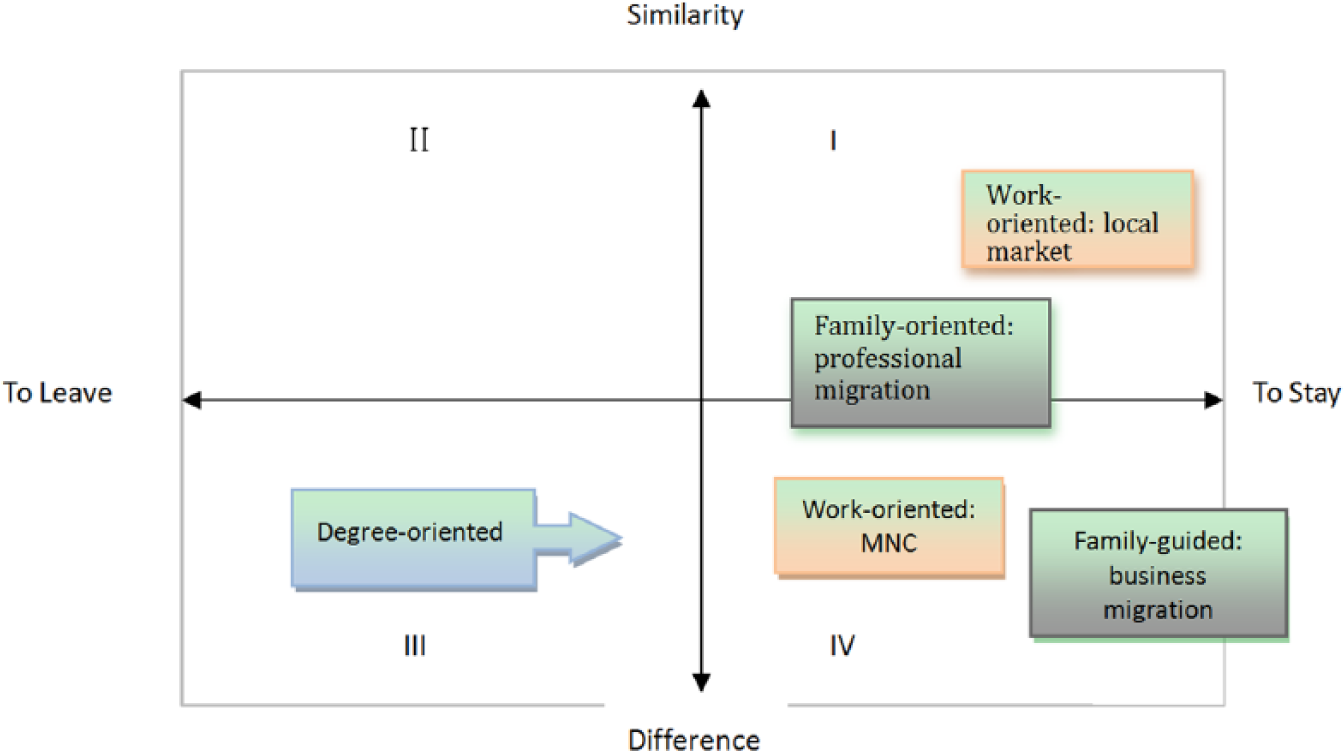
The transnational social field of Taiwanese students in China.
Most Taiwanese students fall into quadrants I, III, and IV. 17 Twelve informants (20%) fall into the scenario of ‘seeking differences and not staying’ (quadrant III). Those degree-oriented students are most likely to identify themselves as ‘temporary resident,’ and many plan to return to Taiwan or to emigrate to another country. During their stay in China, they largely socialize with the Taiwanese community and they make frequent visits to Taiwan and maintain intensive transnational ties back home. Some people in this quadrant, however, gradually change their orientation for identification or future trajectory when they develop intimate partnerships with Chinese people or because their career prospects in Taiwan are limited given the lack of recognition for their Chinese degrees. The arrow on Figure 1 indicates the possibility of shifting locations due to institutional or individual factors.
Ten informants (16%) fall into quadrant I (‘staying and seeking similarities’). They prefer to stay in China after graduation and view the boundary between Taiwanese and Chinese as more porous. They are likely to be those who are interested in finding jobs or doing business in the Chinese labor market, or the children of immigrant professionals. By contrast, a more substantial number of our informants (19 students, 31%) share the orientation of ‘staying but seeking differences’ (quadrant III). They plan to stay in China for employment but strongly demarcate the difference and distance between themselves and locals. They are likely to be the children of Taiwanese entrepreneurs in the manufacturing zones of southern China, and those who aspire to establish a career in multinational companies in China.
Despite sharing the plan to stay after graduation, the informants in quadrant I and quadrant III encounter varied modes of incorporation, i.e., how they as migrants are integrated into the local economy and society. For instance, among the children who accompany their parents to move to China, those who live in the Taiwanese-concentrated suburbs and attend Taiwanese-run schools or international schools (usually the children of immigrant entrepreneurs and high-end managers) are more likely to highlight difference and keep distance from locals; their transnational connections and Taiwanese identity remain strong, even if they have lived in China for a long period of time. By contrast, those who live in big cities and even attend local schools (children of immigrant professionals) are more likely to seek social and cultural incorporation locally.
Conclusion
The migration between Taiwan and China, two countries with cultural affinity and yet political tension, takes place in an exceptional space of sovereignty and a liminal terrain of identity. The frequent border-crossing activities and sustained networks of Taiwanese entrepreneurs, professionals, and students constitute a transnational social field that transcends territorial boundaries. Such ‘networks of networks’ further accumulate transnational social relations and facilitate movement in multiple directions for the later waves of migrants.
This study demonstrates that state sovereignty practices, such as deregulation policies and exceptional membership, still play a critical role in the formation of the transnational social field. While seeking opportunities of education and employment beyond territorial constraints, migrants encounter a predicament between globalization and nationalization in shaping their ways of being and ways of belonging. We urge scholars to examine the dialectical relationship between globalization/transnationalism and nationalization at the multiple levels of state policy, migration trajectory, and identity politics.
We use ‘social field’ as an analytical tool to illustrate the in-group differences among Taiwanese students in China. This analytical strategy can be applied to other groups of immigrants as well. Our analysis challenges the common binary view that portrays immigrant experience as either ‘assimilation’ or ‘transnationalism.’ Immigrants do not necessarily gradually integrate into local society nor do they belong in a long-term transnational state. Instead, we view their tendency toward ‘staying or leaving’ and ‘seeking similarities or seeking differences’ as spectrums, rather than a typologies, which allow us to explore how migrants negotiate their ambiguous identity and how such negotiation can change over time. ‘To stay or not to stay’ is a never-ending question for most immigrants during their journey filled with hardships and uncertainties. The process of identification is also a winding path that involves everyday negotiation in the mundane spheres of food, language, living space, and social life.
The diverse experiences of Taiwanese students show that ethnic or national identification is not a given membership but a product of incessant negotiation in the transnational social field. Transmigrants are reflexive agents and active appropriators who maneuver institutional structures to facilitate their exceptional membership and flexible mobility, but they still face the challenge of identity negotiation in a tug-of-war of nationalism between the host and home nations.
Footnotes
Acknowledgements
An earlier version of this article was presented at the ‘Mobilities and Exceptional Spaces in Asia’ workshop held on 9–10 July 2014 at the Asia Research Institute (ARI), National University of Singapore. We are thankful for the comments from the workshop participants, especially the organizers, Kumiko Kawashima and Brenda Yeoh. The reviewers at International Sociology also provided very helpful suggestions for revision.
Funding
The research was funded by the Center for China Studies, National Taiwan University.