



Abstract
Most environmental problems are rooted in human behavior, and can be influenced by pro-environmental behavior (PEB). Therefore, on the basis of previous studies, the authors propose a theoretical framework that considers individual and contextual factors to hierarchically analyze PEB. Considering practical conditions, the authors regard basic public service as an independent variable on the contextual level in the study. The impacts of the contextual level on the individual level and PEB are also systematically and comprehensively studied. Data from the 2013 Chinese General Social Survey and the 2014 China Statistical Yearbook are analyzed, and a hierarchical linear model is adopted to test the proposed multi-level theoretical framework. Results show that basic public service is an important factor influencing PEB. Basic public service consists of three areas. Of these areas, basic education and life security exert a significant promotional effect on PEB. Furthermore, basic public service also can moderate the relationship between individual factors and PEB. The multi-level theoretical framework provides a systematic perspective for further research into PEB. The findings also offer researchers a beneficial reference for analyzing behavioral change. Several suggestions are proposed for policymakers to bring about effective change in PEB.
Introduction
China’s economy has been experiencing increasingly rapid growth over the past three decades compared with that of other major nations. However, the long-time neglect of environmental protection has resulted in unprecedented environmental degradation (Liu, 2010). More than two-thirds of cities at prefecture level in China still did not meet air quality standards until 2016, and one-third of China’s land is affected by acid rain (MEP, 2017). A total of 330 sudden environmental incidents occurred in 2015 (MEP, 2016), and environmental concerns have triggered social unrest in the country. According to data from the 2016 China Statistical Yearbook, expenditure on tackling environmental pollution hit US$144.6 billion, which means a threefold rise from 10 years prior. In addition, the haze phenomenon caused by air pollution, which is one of the primary focuses of public attention in recent years, has caused great harm to the physical and mental health of residents in China (Peng and Wu, 2017). In summary, various environmental problems in China have posed a great threat to public health, quality of life, and sustainable development of the society and economy. While being confronted with serious environmental crises, China has also become the largest carbon emitter in the world early since 2006 (IEA, 2007): that is, the environment of China is closely correlated with global climate change. Therefore, solving Chinese environmental problems to achieve sustainable development has become a highly important topic for China and the world.
A majority of environmental problems are notably caused by human behavior (Gardner and Stern, 2002; Vlek and Steg, 2007). Thus, promoting environmental sustainability through behavioral changes can effectively reduce the negative impact of human beings on the environment. This type of behavior, which causes as little harm as possible to the environment or which even benefits the environment, is referred to as pro-environmental behavior (PEB) (Hines et al., 1987; Stern, 2000). In recent decades, numerous social scientists have investigated PEB from different theoretical perspectives. Besides individual factors in the field of psychology, such as attitude, intention, and values (Ajzen, 1991; Stern, 1999), many scholars have also studied the crucial role of contextual factors (e.g., Dietz et al., 2007; Hadler and Haller, 2011; Zhou, 2015), such as economic development and social structure, which they considered as significant influential factors for PEB improvement (Inglehart, 1995; Guagnano et al., 1995). Furthermore, a few scholars simultaneously focused on the influence of individual and contextual factors on PEB (Brulle et al., 2012; Hunecke et al., 2001). Research on the factors influencing PEB is therefore relatively comprehensive. However, an integrated theoretical framework for illustrating PEB is lacking still. In terms of policy practice, although numerous scholars and policymakers, particularly in many western countries, have focused on cost-effective and socially acceptable means of improving PEB (e.g., Barr, 2007; Clark et al., 2003; Nyborg et al., 2006), few studies have highlighted the national conditions in China. Contextual factors are within the control range of policymakers and may have more significant external effects on improving PEB over a short time period than individual factors that are difficult to change significantly. However, contextual variables that were discussed in previous studies relatively lack practicality and thus need further exploration.
Theory and practice indicate that PEB is a complicated problem that we need to systemically analyze. First, we aim to select a comprehensive perspective at the contextual level with which to analyze PEB. Public service is defined as the act of providing service to the public, safeguarding collective interests, and bearing corresponding obligations and duties (Bowman et al., 2004). Many contextual factors, such as service provision structures, environmental education, and infrastructure convenience (Barr, 2007; Bernstad, 2014; Duerden and Witt, 2010), are highly related to public service. As a core component of public service, basic public service requires the highest priority to ensure the supply of basic education, infrastructure, social security, and other crucial spheres, and thus exerts a direct impact on public life and behavior. Hence, our study focused on how basic public service affects PEB, which can enrich existing theories and provide scientific advice for policymakers. Second, considering that the factors influencing PEB from a single perspective easily lead to a narrow definition of policy (Guagnano et al., 1995), we propose that studying PEB from a hierarchical perspective is necessary. Therefore, our study is of considerable theoretical significance as it systematically explores the factors influencing PEB on the individual and contextual levels from a hierarchical perspective. Third, our study analyzes the factors influencing PEB in China to offer scientific policy suggestions for improving PEB from a practical viewpoint. Our suggestions are highly significant in building a service-oriented government and in accelerating the development of an environmentally-friendly society in China.
Our study emphasizes how basic public service affects PEB. On the basis of previous studies, we propose our research hypotheses and constructed a multi-level theoretical framework to illustrate PEB. After collecting data from the 2013 Chinese General Social Survey (CGSS2013) and the 2014 China Statistical Yearbook, we elaborate on the impact of individual and contextual factors on PEB on the basis of an analysis using the hierarchical linear model (HLM). Lastly, our study offers several scientific and specific policies on the basis of our results, in combination with Chinese practice.
The rest of the article is organized as follows. The next section reviews the literature on the factors influencing PEB and constructs a theoretical framework for our study. The third section comprises the research methodology and data collection, and the fourth section presents the results of our empirical analysis. The article concludes with a discussion of the findings and our suggestions on policies for improving PEB.
Literature review and theoretical framework
Literature review
Behavior is an activity that produces an organism stimulated by internal and external factors. Thus, behavioral research is complex. Studying the factors that promote or hinder PEB is an effective means of modifying public behavior. Numerous social scientists have investigated many factors influencing PEB from fields such as psychology, economics, and sociology (Steg and Vlek, 2009).
As an individual behavior, PEB is first affected by internal public factors. Most previous studies on PEB emphasized the relationship between individual variables and behavior. Theory of planned behavior (TPB) is a fundamental and influential psychological theory indicating that attitudes toward behavior, subjective norms, and perceived behavior control were determinant factors of intention and behavior (Ajzen, 1991). TPB has been widely applied in analyzing PEB (e.g., Chan and Bishop, 2013; Kaiser and Gutscher, 2003). Furthermore, value–belief–norm theory (VBN) proposed by Stern (1999) revealed that moral obligation and environmental values can positively influence PEB. In addition, perceived cost and benefits, environmental concern, and social norms were regarded as significantly affecting PEB (Cialdini et al., 1991; Kaiser and Gutscher, 2003; Steg and Vlek, 2009). Apart from psychological factors, other standard socio-demographic characteristics, such as gender, age, and education, can be related to PEB (Diamantopoulos et al., 2003; Gelissen, 2007). Knowledge of environmental issues and behavioral strategies and skills was also deemed to be associated with PEB (Hines et al., 1987). In summary, studies of PEB on the individual level are highly comprehensive.
The social space wherein the public lives is constantly changing and is complicated. Environmental sociologists quickly recognized the crucial role of physical and biological factors in shaping behaviors (Dunlap and Catton, 1979). Behavior does not depend on individual factors alone. Many contextual factors can also facilitate or constrain PEB, which should not be overlooked (Steg and Vlek, 2009; Stern, 1999). In recent years, a growing number of scholars have discussed the effect of contextual factors on PEB from various theoretical perspectives. For example, the number of facilities, infrastructure convenience, economic incentive, and pricing regimes can all strongly affect people’s engagement in PEB (Barr et al., 2003; Bernstad, 2014; Nyborg et al., 2006). With the development of PEB studies, several scholars simultaneously considered individual and contextual factors (e.g., Brulle et al., 2012; Guagnano et al., 1995). Many studies found that the effect of the interaction between individual and contextual factors was significant for PEB (Hunecke et al., 2001). A few scholars also proposed that the study of the factors influencing PEB could be considered from a hierarchical perspective (Brulle et al., 2012; Hadler and Haller, 2011).
In general, numerous previous studies have elucidated PEB and the factors influencing it. More importantly, along with further studies, the effect of contextual factors has been gradually emphasized for the improved understanding of PEB. Although previous studies provided a theoretical basis for our study, several theoretical and methodological gaps remain. First, current theory lacks a hierarchical theoretical framework for systematically illustrating PEB. Second, systematic research on the application of the theoretical perspective is lacking (Steg and Vlek, 2009). Most scholars select certain specific environmental behaviors, such as recycling, travel mode choice behaviors, and participation in green electricity programs, as bases for analyzing the importance of contextual factors (e.g., Clark et al., 2003; Guagnano et al., 1995; Hunecke et al., 2001). However, these behaviors have been scarcely extended to illustrate other environmental behaviors. Third, linear regression analysis is consistently used to verify different levels of the factors influencing PEB in current studies (Brulle et al., 2012; Smith et al., 2017). Although these methods analyze data at the same level, the results they yield cannot precisely elucidate the effect of PEB on the contextual level, which is influenced by the correlation of estimation errors.
Considering the gaps in PEB research, we aim to resolve these problems as follows. First, we intend to establish an integrated framework to study the factors influencing PEB and improve related theories on the basis of previous studies. Second, given as the wide ranging and high correlations with public policy, we adopt basic public service as an independent variable on the contextual level, which can effectively improve the external validity of our results. Lastly, our study uses HLM to explore the relationship between contextual and individual factors and PEB. HLM is usually used for studying variables on different levels and has more reasonable results than linear regression.
Theoretical framework
The likelihood of behavioral change simultaneously depends on individual and contextual levels (Stern, 1999). Thus, a comprehensive framework that can integrate different hierarchical factors is particularly important. The ABC model proposed by Guagnano et al. (1995), which is based on the normative activation model (Schwartz, 1977), has been employed in numerous studies. In recent years, this model has been widely applied in PEB studies (Clark et al., 2003; Hunecke et al., 2001; Steg et al., 2014).
The model is a simplified complete causal scheme for the relationship between attitude (A), behavior (B), and external conditions (C) proposed by Stern and Oskamp (1987). Behavior is a monotonic function of A and C, meaning that supportive external conditions and positive environmental attitudes can contribute to environmental behavior. Meanwhile, the strength of the attitude–behavior relationship is a curvilinear function of A and C. External conditions affect the strength of attitude–behavior relationships, in which attitudes can induce minimal behavior in the presence of strong, negative external conditions. Overall, the ABC model illustrates PEB from a relatively comprehensive perspective, and serves as the theoretical foundation for this study. The ABC model also has several limitations, such as the lack of external validity and the non-comprehensive selection of variables on the individual and contextual levels. Although several scholars have attempted to improve the ABC model (Clark et al., 2003; Ertz et al., 2016), their studies mainly focused on the attitude–behavior relationship or on several specific contextual applications. Given that our chief concern is that this model proposes a certain relationship between variables, we adopted the basic structure of this model in constructing our theoretical framework.
Consequently, we combined theory and practice to propose our research hypotheses and theoretical framework based on the ABC model. Our literature review shows that scholars have studied various individual factors, particularly in the field of psychology, which may influence PEB (Steg and Vlek, 2009). In the ABC model, Guagnano et al. (1995) primarily focused on attitude effects. One of the emphases of our study is the interaction effect among influencing factors on varying levels. Thus, we focused on several independent variables that are closely connected with contextual factors. First, several researchers emphasized that environmental education plays a crucial role in environmental knowledge and PEB promotion (Duerden and Witt, 2010). Environmental knowledge, which can be influenced by environmental education, is significant in shaping PEB (Barr, 2007; Hines et al., 1987). Knowledge of the environmental problem itself and knowledge for action are important for PEB (Schahn and Holzer, 1990). Thus, we include environmental knowledge in our theoretical model. Second, the public does not realize the gravity of environmental degradation, much less the importance of adopting PEB (Dietz et al., 2007; Marquart-Pyatt, 2012). Several scholars determined that the doubt about the severity of environmental problems is one of the major barriers to environmental protection (Zhou, 2015). Consequence awareness, which is defined as an individual perception of the negative consequences when someone does not perform environmentally-friendly behavior, is emphasized in VBN (Stern, 1999). Certain studies have found that consequence awareness, as a primary factor in the intention stage, has a positive effect on improving PEB (Baldassare and Katz, 1992; Klöckner, 2013). In summary, consequence awareness is integrated into our model. Thus, we propose the following hypotheses:
H1: Environmental knowledge positively affects pro-environmental behavior.
H2: Consequence awareness positively affects pro-environmental behavior.
Socio-demographic characteristics, such as age (Diamantopoulos et al., 2003; Vining and Ebreo, 1990), gender (Hunter et al., 2004; Xiao and Dunlap, 2007), and education (Dunlap et al., 1999), significantly affect PEB and may influence our results to a certain degree. Thus, this study includes age, education, and gender as control variables in its theoretical framework.
For contextual factors, Guagnano et al. (1995) validated the external conditions mentioned in the ABC model using county-supplied bins for recycling as an example. However, proving that other external conditions have the same effect as recycling bins is difficult. Thus, the persuasive power of the ABC model is weak. The ABC model also introduced an external condition to a traditional psychological model proposed by Schwartz (1977). Evidently, the analysis of psychological models, such as TPB (Ajzen, 1991) and VBN (Stern, 1999), still plays a dominant role. Thus, external conditions have not been systematically tested. With the influence of the theory of environmental sociology, a growing number of scholars attempted to identify various contextual factors that promote environmental concern and behavior (Franzen, 2003; Gelissen, 2007; Xiao and Dunlap, 2007). On the basis of these studies, we attempt to find a comprehensive variable on the contextual level.
As mentioned in the Introduction, basic public service is the most relevant part of public interest and is an integrated variable affecting public behavior in everyday life. Basic public service comprises various aspects that may significantly influence PEB, the evidence of which can be found from previous studies and is reflected in daily life. First, extensive studies emphasized the effect of infrastructure on PEB, such as in quantity, availability, and convenience (Barr, 2007; Bernstad, 2014; Guagnano et al., 1995; O’Connor et al., 2010). Policies for improving public transport, such as offering cheap or free bus tickets, can also impel people with high environmental awareness to minimize private vehicle use. Second, many scholars suggested that environmental education can influence PEB by improving environmental knowledge or awareness (Duerden and Witt, 2010). In practice, environmental education in primary and middle schools, such as involving tree-planting projects and waste utilization activities, positively influences students and their families. Third, life security may also influence PEB, as evidenced by post-materialism. People have begun to care about particular social issues such as those relating to the environment after needs such as housing, employment, and health, are satisfied to certain degrees (Inglehart, 1995). As confirmed by these examples, basic public service plays an important role in directly or indirectly changing PEB, and this effect may work through interaction among individual factors. Thus, we present the following hypotheses:
H3a: Basic public service positively affects pro-environmental behavior.
H3b: Basic public service moderates the relationship between environmental knowledge and pro-environmental behavior.
H3c: Basic public service moderates the relationship between consequence awareness and pro-environmental behavior.
Furthermore, several objective variables of cities, such as environmental pollution and economic development, may also significantly affect PEB (Brechin and Kempton, 1997; Franzen, 2003; Freymeyer and Johnson, 2010; Marquart-Pyatt, 2012). To eliminate the influence of these factors, we adopt environmental pollution and economic development as control variables to reduce research error.
The independent variables we introduced belong to various categories. Basic public service, environmental quality, and economic development are the contextual variables, whereas environmental knowledge, consequence awareness, and socio-demographic characteristics are the individual variables. Apparently, conducting a traditional linear regression on variables from a single level cannot meet the requirements for studying PEB. In recent years, an increasing number of scholars have attempted to construct a multi-level model for studying several environmental topics. Brooks (2011) analyzed environmental values by constructing three-level models, namely, individuals, neighborhoods, and communities. Marquart-Pyatt (2012) used HLM to explore individual and country-level influences on environmental concern, and Zhou (2015) explored the factors influencing public environmental skepticism by constructing a multi-level model. On the basis of the research ideas of these studies, we constructed a multi-level framework to improve our understanding of PEB. Figure 1 presents the theoretical framework of our study.
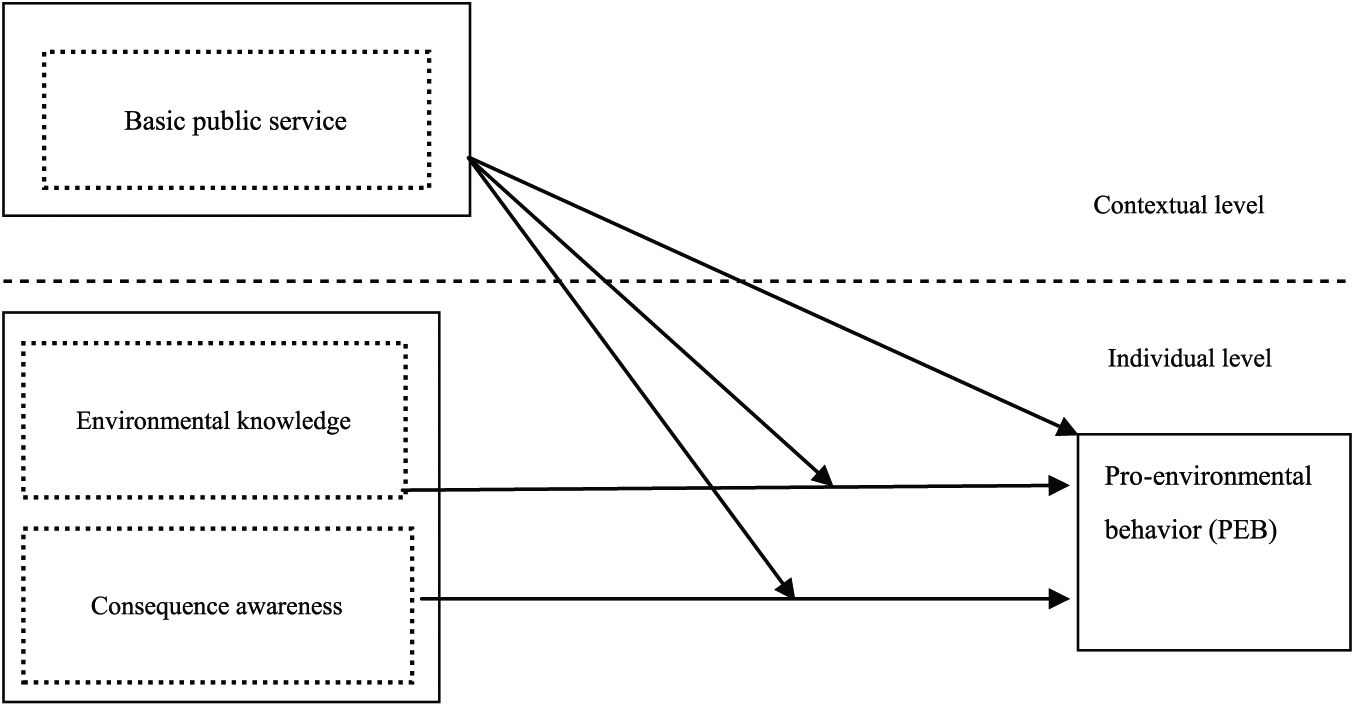
Theoretical framework.
Data and methodology
The research data used in this study are derived from two databases. First, the CGSS2013 is used to gather data on the individual level. The CGSS was launched in 2003 as a national, comprehensive, and continuous research project conducted by academic institutions in Mainland China. The CGSS2013 adopts a four-phase stratified sampling method and covers 28 provincial administrative units, excluding Hong Kong, Macao, Tibet, Xinjiang, and Hainan. Out of the 11,438 valid data samples, the CGSS2013 response rate is 72.17%. A face-to-face survey is used to collect data, regarding which the CGSS sets strict quality control procedures. All interviewers and supervisors are required to undergo 25 and 40 hours of training, respectively, in the pre-fieldwork stage. In the in-fieldwork stage, the average interview time is approximately one and a half hours. The finished questionnaires require a 100% on-site check, 40% of which supervisors are required to conduct on the second day as return interviews. In the data input and coding stage, the data are double inputted and coded and then checked by several supervisors. Second, the data source for the contextual level is the 2014 China Statistical Yearbook. The yearbook is annually published by the National Bureau of Statistics of China and is a collection of statistics comprehensively reflecting the economic and social development of China. Data in the 2014 China Statistical Yearbook comprise a series of indicators from 2013, covering the nation and its provinces, autonomous regions, and municipalities.
Variables and operations
Variables on the individual level
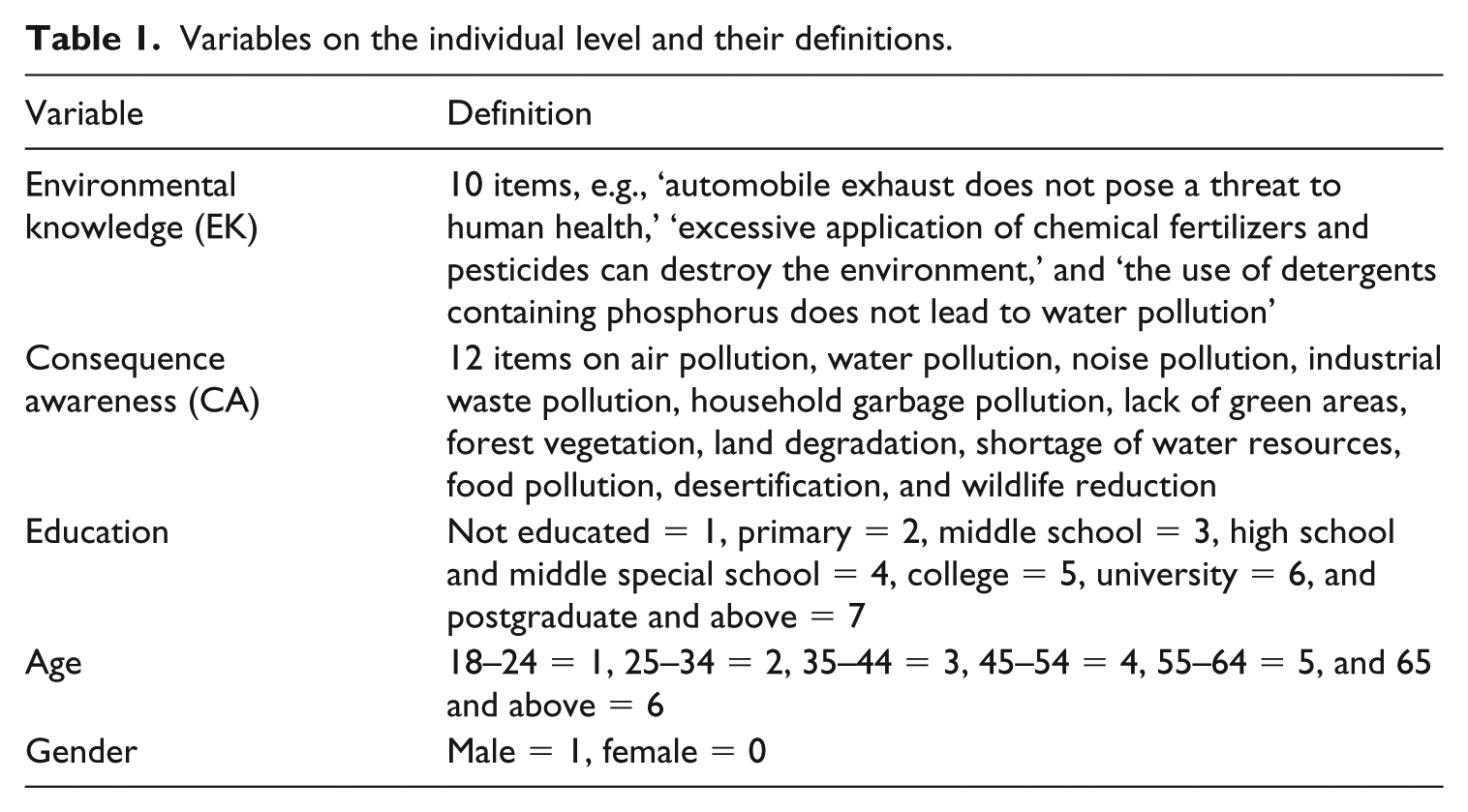
The individual-level independent variables and the dependent variables are measured using the CGSS2013 questionnaire. Over 10,000 respondents from 28 Chinese provinces were involved in this investigation. After omitting irrelevant information and filling in CGSS2013 missing values, our study obtained 11,153 valid samples. The predictor variables include environmental knowledge and consequence awareness. The measurement data of environmental knowledge are composed of 10 true or false items. Correct answers obtain a score of 1, whereas unknown or incorrect answers obtain no score. High total scores imply that respondents possess a high level of environmental knowledge. The measurement data of consequence awareness are derived from the respondents’ perception of the severity of 12 kinds of environmental pollutions. The given options are as follows: 1 = very serious, 2 = more serious, 3 = not too serious, 4 = not serious, 5 = general, 6 = no attention/hard to say, 7 = not existing problem. The total scores represent the degree of consequence awareness, with low scores indicating high perception of environmental pollution. Our study also collected from the CGSS2013 the measurement data of control variables on the individual level, namely, education, gender, and age. Age is discretized through group coding to reduce intra-group variability (Table 1).
Variables on the individual level and their definitions.
Our dependent variable, PEB, is measured by the CGSS2013 as follows. The survey listed 10 relevant environmental activities or behaviors in which the respondents had engaged in the last year. These activities include ‘sorting waste,’ ‘discussing environmental problems with friends and relatives,’ ‘bringing your own shopping basket or bag when you purchase household supplies,’ ‘reusing plastic bags,’ ‘donating to environmental protection organizations,’ ‘having an active interest in environmental problems and information reported on the radio, television, and newspapers,’ ‘actively participating in environmental education activities that the government and other social organizations organize,’ ‘actively participating in environmental protection activities that NGOs organize,’ ‘paying for the conservation of trees or green areas,’ and ‘actively participating in complaints and appeals to solve environmental problems.’ The options given are as follows: 1 = ‘never,’ 2 = ‘occasionally,’ and 3 = ‘often.’ Hadler and Haller (2011) provided the method for PEB indexing, which is performed as follows. The sum of 10 items is divided by 10, and the mean X is obtained. A percentage is then processed using the following equation: (X − 1) × (100 / 2). Lastly, the PEB index, ranging from 0 to 100, is obtained. Zero represents the minimum PEB degree, whereas 100 represents the maximum.
Variables on the contextual level
Our study collected measurement data of variables on the contextual level from the 2014 China Statistical Yearbook, including basic public service, economic development, and environmental pollution. Provincial boundaries in China were used as the unit of measurement of the contextual level in our study. We collected data from 28 provincial administrative units, excluding Hong Kong, Macao, Tibet, Xinjiang, and Hainan, consistent with CGSS2013 data.
Indices of the abovementioned variables were constructed on the basis of previous studies as follows. Basic public service is a key variable in our study, and its level has been measured by a number of Chinese scholars (e.g., Chen and Cai, 2007; Dou and Liu, 2011; Wang, 2013) by establishing an index system on the basis of practical instances in China. Scholars have also designed different index contents on the basis of various requirements, mainly covering basic education, health care, public employment, and social security, among others (e.g., An and Ren, 2008; Nan et al., 2010; Zeng, 2012). Notably, basic public service is important for people’s livelihood and directly related to the fundamental interest of the public. Thus, the index system should as much as possible reflect basic public demand.
We drew insights from the index systems proposed by Teng and Lin (2012) and Wang (2013), covering the fields of basic education, health care, social security, public employment, infrastructure, and environmental protection. As mentioned in the section on our theoretical framework, environmental education, life security, and infrastructure may significantly influence PEB (Barr, 2007; Duerden and Witt, 2010; Inglehart, 1995). Our study mainly focuses on the abovementioned fields of basic public service. First, an index of basic education is constructed that consists of X1–X3 (Wang, 2013), labeled as the basic education (BE) factor. Second, the concept of life security is a multifaceted one that includes several aspects such as health and employment. Thus, we integrated the indicators of health care, social security, and public employment into one factor, which consists of X4–X7 (Teng and Lin, 2012) and is labeled the basic life security (BS) factor. Third, PEB studies have emphasized the effect of infrastructure related to environment (Barr, 2007). Basic infrastructure and environmental protection in the index system of basic public service, which both belong to physical conditions, can objectively affect the quality and convenience of public life (Wang, 2013). Hence, an index of infrastructure is constructed that consists of X8–X10, called the basic infrastructure (BI) factor. In summary, we established an index system with 10 indicators (Table 2). Basic education, life security, and infrastructure are included in the model to explore how basic public service affects PEB. The measurement data of the indicators were collected from the 2014 China Statistical Yearbook. The data of indicators are normalized to eliminate the influence of dimension. An and Ren (2008) suggested that the different indicators of basic public service can be assigned the same weight. Hence, we used the weighted average method with the same weight to calculate the value of three factors.
Evaluation index for basic public service level.

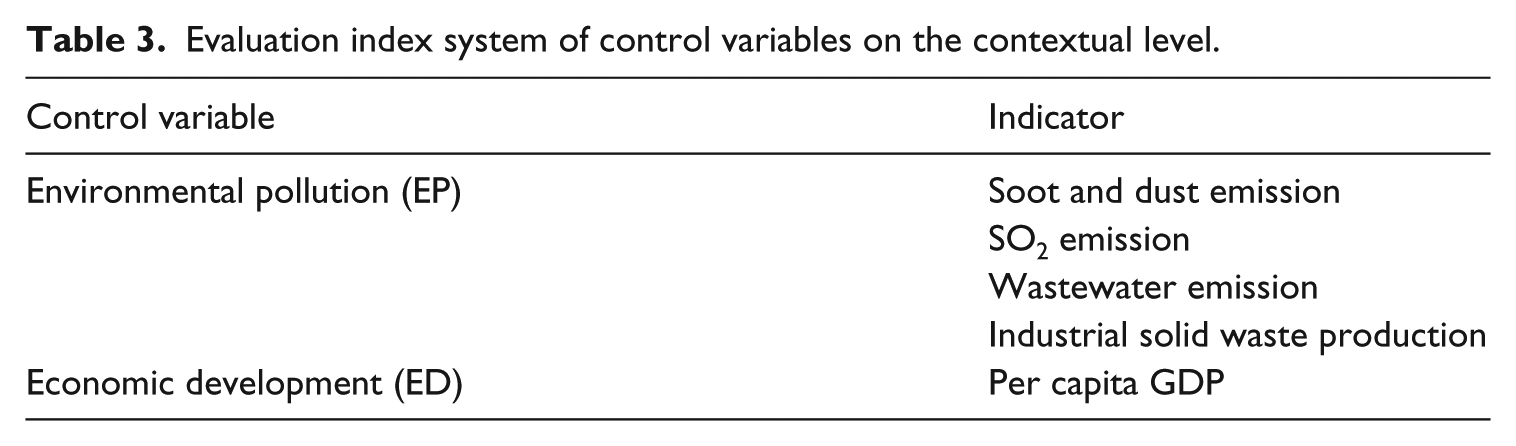
Our study utilized per capita GDP to evaluate the level of economic development, similar to many studies (Brooks, 2011). Data were derived from the 2014 China Statistical Yearbook. Environmental pollution encompasses various forms of pollution, such as air, water, and solid waste. Thus, we constructed an index system to evaluate the status of environmental pollution. Several studies have indicated that the solid, liquid, and gas forms of pollutants should be considered when measuring the degree of environmental pollution (Zhang and Wang, 2014). Many scholars also stressed the crucial role of air quality, which is measured by determining sulfur dioxide (SO2) emission levels (Bernauer and Koubi, 2006). Therefore, the index system of environmental pollution in our study considered four indicators (Table 3), and measurement data were derived from the 2014 China Statistical Yearbook. The indicators are firstly normalized. The overall scores are obtained by using the weighted average method and then divided by the territorial area of each province to eliminate the influence of different provincial scales.
Evaluation index system of control variables on the contextual level.
Analysis
Our data include 11,153 respondents from 28 provinces on the individual and contextual levels respectively, which are clustered within provinces. When analyzing PEB, respondents within the same province are generally correlated with each other, violating the assumption of independence in the traditional regression analysis. Fortunately, HLM is regarded as a tool for appropriately analyzing such clustered data (Bryk and Raudenbush, 2002) and can obtain statistically efficient and unbiased regression result estimates (Leung et al., 1998). The HLM decomposes the dependent variable variance into individual and contextual-level variance components to estimate the effects of each variable in our model at the appropriate level (Hox, 2002). Therefore, our study utilized HLM to systematically study PEB.
We need to connect two raw data files before using HLM. Individual-level units are inhabitants, whereas contextual-level ones are provinces. The two files are linked by a common contextual-level unit, or, as in our sample, province ID, which also appears on every individual-level record.
On the basis of data integration, we analyzed our data using the following steps. First, we conducted a descriptive statistical analysis of our data (Table 4). The mean of the PEB index is 25.78%, indicating that the public participates in environmental protection with low frequency and weak motivation. The maximum consequence awareness is 60.98, whereas the mean is 46.76, indicating that the public perception of environmental pollution is at a high level. The total score of environmental knowledge is 10, whereas the mean score is 3.08, indicating that environmental knowledge level is low.
Descriptive statistical results.
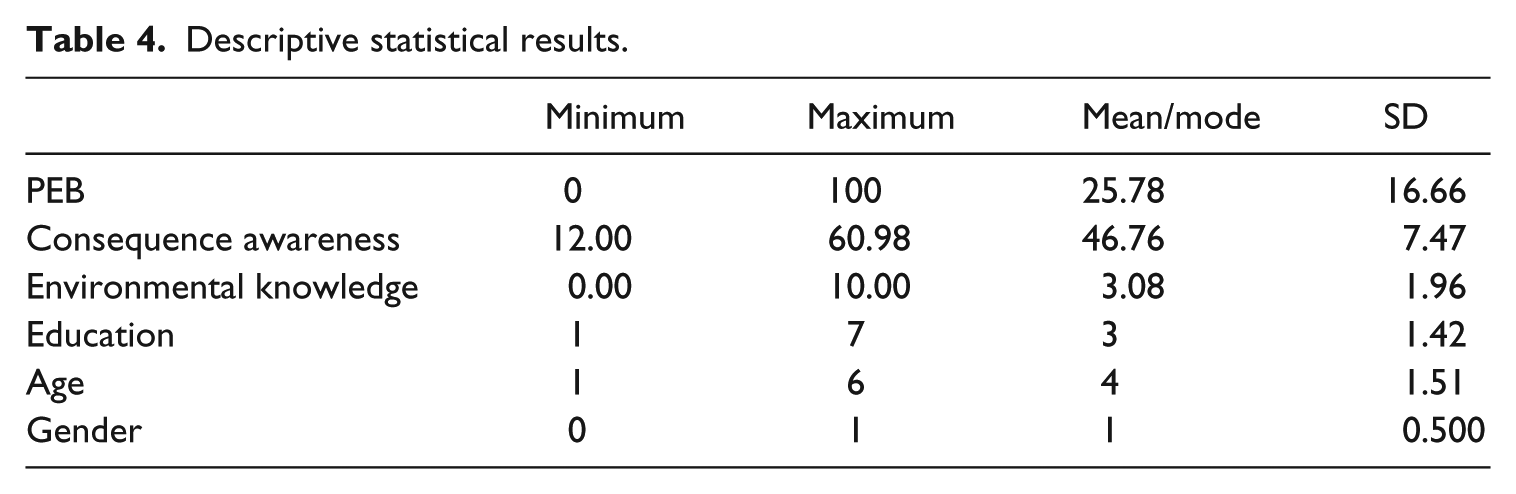
In terms of socio-demographic variables, our study focused on respondent education, age, and gender. First, the CGSS2013 covers educational levels ranging from ‘not educated’ to ‘postgraduate and above.’ Table 4 shows that the respondents obtained a low educational level as a whole, with most respondents attaining only middle education. Second, the CGSS2013 targets adults aged 18 and above, whereas our data cover various age groups beyond 18 years. Our results show that the standard deviation of age is larger than that of other variables, and that age distribution is mainly concentrated at 45–54 years old. Third, the gender distribution is normal, and the number of males is slightly higher than women. In summary, the distribution of data is relatively uniform. Thus, we can proceed with the analysis by HLM.
We adopted an HLM that consists of three steps to estimate how basic public service impacts PEB. In step one, we estimated the random effect of the ANOVA model (Model 1), which excludes any explanatory variables on two levels.

where Yij is the dependent variable representing the PEB of the ith respondent in the jth area. βoj is the mean of PEB in the jth area. The variance of rij denotes the change between groups; G00 represents the total mean of PEB; the U0j variance denotes change in a group. The main purpose of this model is to separately analyze PEB variance on the individual and contextual levels. We determined the level of overall variation caused by contextual-level variables on the basis of the intraclass correlation coefficient (ICC), which is the proportion of contextual variance in the total variance. A high ICC value shows that much of the total variance can be explained by contextual-level variables. Thus, we determined whether HLM construction is necessary by evaluating ICC size.
After establishing the basic model, we tested our hypothesis by gradually adding individual and background variables. In step two, we constructed the random parameter regression model (Model 2), in which we included all individual-level explanatory variables but not the contextual-level variables. The intercept and regression coefficients were set to random. If the variation of contextual-level individual variables is insignificant, then we set it as a fixed effect. Only gender is insignificant on the contextual level. Thus, only gender was set as a fixed effect.
In step three, we added the contextual variables to the model to build the complete PEB model (Model 3) comprising the independent variables from the two levels. Our model aims to verify the moderating effect of basic public service on the relationship between individual factors and PEB as well as its direct impact on PEB. Thus, three measurement variables of basic public service were added to the coefficient equation of the intercept and to the two individual-level independent variables. Most scholars have found that economic development and environmental pollution as control variables on the contextual level have a direct rather than moderating effect on PEB (e.g., Franzen, 2003; Freymeyer and Johnson, 2010). We also found that the moderating effect of these variables is insignificant after obtaining the model results. Therefore, we only included these two variables in the coefficient equation of the model intercept. Finally, we obtained the final model as follows:
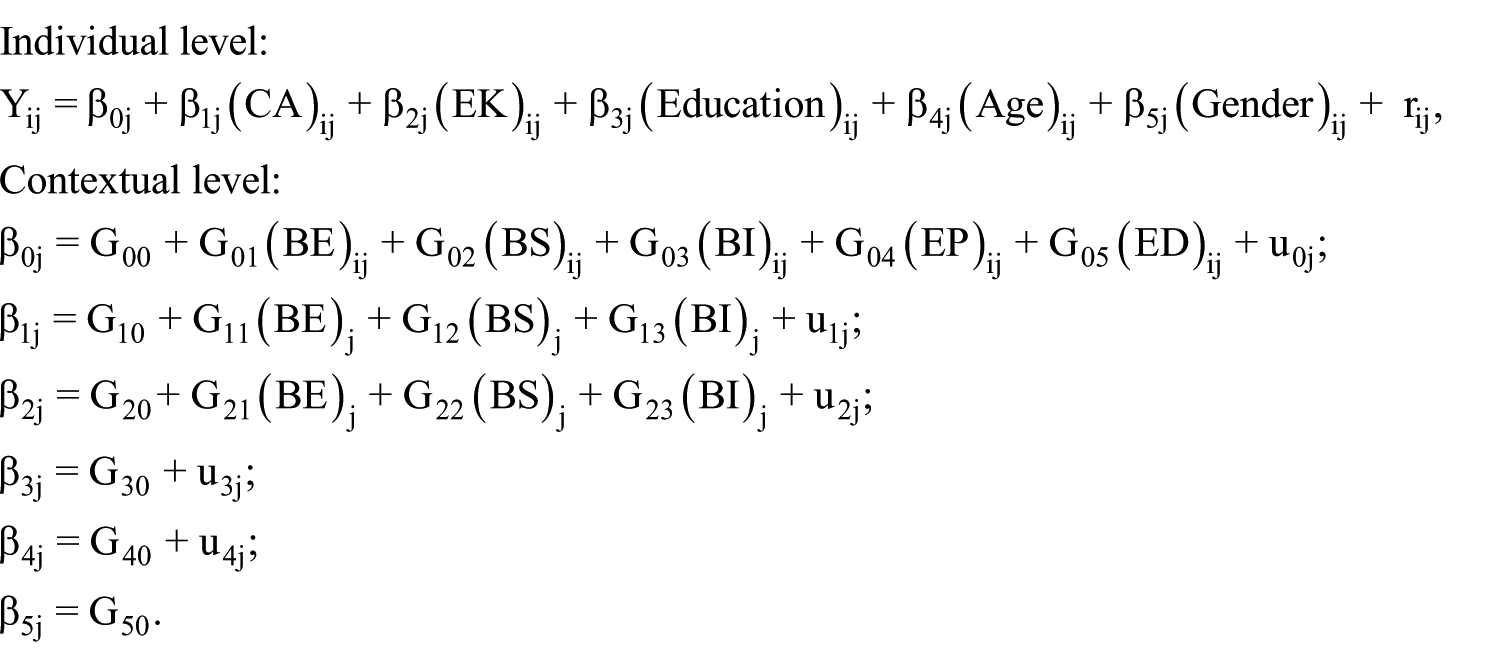
On the basis of the model results, we verified our theoretical framework in stages and used the HLM software (version 6.08) that uses the maximum likelihood method to estimate the values of each parameter.
Results
Table 5 displays the results of the HLM. Model 1 is a null model used to measure the contribution rate of the two levels (i.e., individual and contextual) for PEB. The point estimate of the variance on the individual level is 233.709, which is larger than that on the contextual level (43.724). The ICC value is 43.724 / (43.724 + 233.709) = 0.158, demonstrating that the 15.8% difference in PEB is caused by contextual-level factors. This result indicates that PEB can be explained to a relatively large extent by contextual factors. The result is significant (p < .05), denoting significant PEB differences on the contextual level. In summary, the results show that PEB can be simultaneously explained by the individual and contextual-level variables, and that the model should be further analyzed using HLM.
HLM analysis results.

p < .1, **p < .05, ***p < .01.
In Model 2, we added five variables (i.e., two predictors and three control variables) to the individual level, yielding results that basically match those in previous studies. Among the control variables, education level is positively associated with PEB. Similarly, education has the most influence on PEB (b = 3.177, p < .01). Females also display more PEB than males, whereas gender (b = −2.235, p < .01) also has a greater impact on PEB than other variables. Moreover, seniors display more PEB than the youth (b = 0.528, p < .05). Among the predictor variables, H1 and H2 are supported. People with consequence awareness have high PEB (b = −0.093, p < .05), and environmental knowledge has a significant positive impact on PEB. Thus, good understanding of environmental knowledge can lead to high PEB scores (b = 1.554, p < .01). Individual and contextual-level variance was lower in Model 2 than in Model 1. This result indicates that individual characteristic differences in different regions can partly explain the difference in the total mean of PEB, which is called the composite effect (Gelissen, 2007).
In Model 3, we added all contextual variables to the model, including basic education, life security, and infrastructure, environmental pollution index, and per capita GDP, to systematically discuss the relationship between basic public service and PEB. The results indicate that basic education significantly impacts PEB (p < .1), and that PEB increases by 3.006 units when education level is raised by 1 unit. Basic life security also significantly impacts PEB (p < .05), meaning that PEB increases by 2.606 units when basic life security level is raised by 1 unit, whereas the coefficient of the influence of basic infrastructure on PEB is insignificant (p > .1). The abovementioned results partially support H3a. As a control variable, environmental pollution exerts no significant effect on PEB (p > .1), whereas economic development level does (p < .01). When economic development level is raised by 1 unit, PEB increases by 4.086 units. Although individual-level variance is similar to that in Model 2, contextual-level variance decreased from 43.491 to 19.517. Results demonstrate that the contextual variables can explain 55% of the difference in PEB across different regions.
The moderating effect of basic public service level on the individual factors and the PEB was verified (Table 6) on the basis of the final model regression results. Basic security positively affects the relationship between consequence awareness and PEB (b = 0.076), whereas basic life security can negative influence the relationship between environmental knowledge and PEB (b = −0.744, p < .01). Therefore, H3b and H3c are partially supported. However, the results show that the moderating effect of basic education on environmental knowledge and PEB is insignificant, and the impact of basic education on PEB is mainly direct.
Regression results of the complete model.

Summary and discussion
This study explored how basic public service impacts PEB using data from CGSS2013 and the 2014 China Statistical Yearbook. We established an ‘individual–contextual’ theoretical framework by improving the ABC model. Then, we used HLM to verify the relationship between variables in the theoretical framework. Basic public service directly impacts PEB and moderates the relationship between PEB and individual factors. This finding is consistent with our expectations.
Several important conclusions were obtained on the basis of results of the data analysis. First, the socio-demographic characteristics in our model significantly affect PEB. Our results showed that well-educated people are more likely to engage in PEB than those with few years of schooling, which is consistent with the findings in previous studies (e.g., Hunter et al., 2004). The reason is that well-educated people are exposed to information about environmental protection through school education. Mixed results on the relationship between age and PEB have also been reported, most of which suggested that seniors are more likely to adopt PEB than youth (Diamantopoulos et al., 2003; Vining and Ebreo, 1990), and are more environmentally concerned (Hunter et al., 2004; Xiao and Dunlap, 2007). We also found the same results in our study. Diamantopoulos et al. (2003) explained that the reason is the youth do not have adequate financial resources to support the environment. We also found that females are likely to engage in PEB. Hunter et al. (2004) posited that females prefer to be involved in household PEB, satisfying their traditional gender role identity and daily actions. Overall, we discussed the relationship between PEB and socio-demographic characteristics in the Chinese context. Our findings are basically consistent with those of previous PEB studies in western countries and also have high accuracy and practicability for environmental governance in China.
Second, the results on how environmental awareness and knowledge impact PEB meet our theoretical expectations. People with a high level of consequence awareness are willing to engage in PEB, which is consistent with conclusions drawn by several studies (e.g., Baldassare and Katz, 1992; Klöckner, 2013). Environmental knowledge also has a significant positive impact on PEB and is the second most important factor after education. These results further strengthen the view that environmental knowledge is an important determinant of PEB (Hines et al., 1987). Notably, two cognitive factors in this study are highly flexible. Policymakers increase the mastery of environmental knowledge and consequence awareness through several effective external approaches. Thus, the abovementioned results have significant practical values.
Third, among the control variables on the contextual level, environmental pollution does not have a significant relation with PEB, which is contrary to findings of previous studies (Freymeyer and Johnson, 2010). Although several regions have had serious environmental pollution, the behavior of the local public will scarcely be changed if individuals cannot recognize this threat. We could not comprehensively measure environmental problems because of data availability limitations, which could also explain why our results differ from those of other studies. Therefore, we have to obtain a comprehensive index with which to assess environmental pollution in the future. We also found a strong correlation between level of economic development and PEB. A region with a high economic development level also has a high average of PEB, which is consistent with results of previous studies (Brechin and Kempton, 1997).
Fourth, we found that basic public service significantly impacts PEB. Specifically, improving the level of basic education can significantly promote PEB. Many scholars emphasized the importance of environmental education (Duerden and Witt, 2010). In practice, schools and teachers focus on spreading environmental knowledge and on cultivating environmental activities for students while popularizing basic education, such as tree-planting projects on Arbor Day, waste material transformation activities, and water-saving actions. These activities, common in primary and middle schools, can directly improve student PEB and indirectly affect the behavior of their families. Therefore, the impact of basic education on improving PEB cannot be ignored. Policymakers should also increase the emphasis on and input into environmental education while improving the basic education level. We also found that basic life security has a significant promotional effect on PEB, which is consistent with the view of post-materialism. Specifically, Inglehart (1995) believed that the public switches from materialistic to post-materialistic values when society gradually achieves prosperity. Thus, the public have begun to turn their attention to social issues such as environmental problems, which are embodied in the improvement of related ideas and behaviors. Further, our results show that the effect of basic infrastructure on PEB is insignificant. In recent years, a growing number of scholars have discussed that infrastructure convenience is more important than the number of facilities (Bernstad, 2014; Brothers et al., 1994). For recycling, Martin et al. (2006) argued that lack of convenience becomes a primary barrier to practice. In China, few cities have focused on the improvement of infrastructure convenience, such as the location of bins, even in developed cities such as Beijing and Shanghai. Our conclusion should also inspire policymakers to improve the degree of infrastructure convenience rather than the number of facilities.
Fifth, we found that the basic public service level significantly moderates individual factors and PEB, as reflected in the following aspects. First, basic life security can strengthen the relationship between consequence awareness and PEB, which is also in accordance with the view of post-materialism (Inglehart, 1995). Several scholars also discussed that citizens in some countries have expressed a high level of environmental concern when given a certain baseline level of economic and material security (Franzen, 2003). Consequence awareness is a type of environmental concern which can improve PEB (Klöckner, 2013). That is, basic life security can indirectly influence PEB through consequence awareness. Regarding practice, we found that people do not necessarily have sufficient financial resources to support PEB even when they have high consequence awareness. However, basic life security plays a promoting role in this situation. Second, basic life security also can play a negative role in the relationship between environmental knowledge and PEB. The promotional role of basic life security is mainly reflected in the direct influence on PEB or the indirect moderating effect on the relationship between consciousness and behavior (Franzen, 2003; Inglehart, 1995). That is, the public will focus on environmental issues and adopt PEB when the needs of life security are satisfied. Hence, we argue that basic life security may weaken the role of environmental knowledge as a prerequisite for behavior (Barr, 2007). Lastly, basic education significantly impacts PEB, whereas the moderating effect of basic education on the relationship between environmental knowledge and PEB is not proved in our study, which is not consistent with several previous studies (Duerden and Witt, 2010). In practice, education is an excellent ‘laboratory.’ Schools and teachers can effectively transform knowledge into motivation through numerous practice activities that guide students in transforming environmental knowledge into action. This effect is not proved in the context of China, which also shows that the content of environmental education has been ignored for a long time in the country. Hence, policymakers should emphasize the role of basic education and promote the knowledge–action change by adding the environmental education to the curriculum.
In conclusion, our study validates the proposed theoretical framework. Basic public service significantly affects PEB and the relationship between individual factors and PEB. This result not only extends relevant studies on the factors influencing PEB but also significantly improves the external validity of the model. Our study also provides results that serve as direct reference for policymakers. Gardner and Stern (1996) suggested that interventions under the right conditions can play a significant role in PEB, and that otherwise, considerable opportunities could be lost. PEB is the contribution of individual and contextual factors. Thus, studying the role of contextual factors can provide us with feasible means to change PEB. The influence of basic public service on PEB is the subject of this study, which offers policymakers new perspectives and the means to explore strategies to affect PEB.
This study also has several limitations. First, our PEB data mainly measured the self-reported instead of actual behavior of the public, which may lead to a few biases in our results and should thus be improved upon in future research. Second, the index system of basic public service and environmental pollution that we constructed contains deficiencies due to data source limitations. In the future, we will improve these index systems that can effectively control for environmental pollution impact and make a comprehensive assessment of basic public service, especially regarding its specific roles. Third, this study only focused on two cognitive variables, namely, environmental knowledge and consequence awareness, which have to be expanded in the future.
Environmental issues are very important to sustainable development in China and thus can no longer be ignored. The government should realize that the public possesses enormous strength for building an environmentally-friendly society. However, ‘slogan propaganda’ as the current main policy can hardly change PEB, which the government therefore has to find new means of encouraging. The theoretical framework we proposed enriches theoretical research in the environmental behavior field and provides a systematic and innovative means that the government can use to change PEB.
Footnotes
Funding
This research is funded by The National Key Research and Development Program of China (No. 2016YEF 0122300), the National Science Foundation of China (No. 71371122), National Social Science Foundation of China (No. 14ZDB152), and Inter-discipline Foundation of Shanghai Jiao Tong University (No. 16JXZD02).
