



Abstract
Research on national, political, and social identities in the study of populism is typically limited to analysing populist identity framing in political and media discourses and measuring its effects on individual populist attitudes. Thus, the self-identification of populists’ supporters, i.e. how they relate to populist identity framing when reflexively constructing their identities, remains largely unexplored. To address this issue, the article introduces the concept of relational popular identity, capturing the complexities of late-modern political identities, and the relational identity mapping technique used to investigate the web of relations forming these identities. The article also presents a case study of loyal voters of the Law and Justice party in Poland and discusses how a relational right-wing popular identity may serve as an ‘intermediary identity’ that articulates elements of other identities to maintain their integrity and a ‘community of last resort’ that unites the ‘real’ people through an immunitarian mechanism of exclusion.
Introduction
Appeals to the ‘real’ Americans, French, or Poles have become a staple of right-wing populist politics, aimed at uniting the ‘real’ people against an Other identified by populist politicians and deemed a threat to the national community. As such, the concept of the ‘real’ people, which tacitly implies the existence of the people that are ‘untrue’, has been used to divide societies and increase polarisation for political gain (Müller, 2016: 3), and right-wing discourses centred on the creation of exclusionary popular identities have been extensively studied (e.g. Caiani and della Porta, 2011; Chilton, 2017). This interest in the populist identity framing, however, has not been accompanied by an equal in-depth analysis of the self-identification of populists’ supporters. While the latter’s basic demographic characteristics or individual populist attitudes have been investigated (e.g. Hameleers et al., 2021), questions of how populist voters actually relate to populist identity framing and how they use these discursive resources to reflexively construct their identity remain largely unanswered. This gap in knowledge is particularly evident when considering the complexity and relationality of modern identities, which are emphasised in both the literature on late modernity (Bauman, 2000; Beck and Beck-Gernsheim, 2002; Giddens, 1991) and in works from the field of relational sociology (De Federico De La Rúa, 2007; Donati, 1995; Emirbayer, 1997). If constructing the people as a political subject is, as many scholars argue (Müller, 2016; Ostiguy, 2017; Panizza, 2017), a fundamental tenet of any populist political project, the fact that popular identities are primarily studied as they are construed and described by political leaders and not as they are adopted and performed by their supporters produces a very one-sided and limited description of populism.
Thus, the aim of this article is to address this issue and provide the concepts and methods necessary to study the reflexive, relational self-identification of populists’ supporters, along with a case study of the right-wing populist relational identity of loyal Law and Justice voters in Poland. The article proceeds to identify the causes of the aforementioned limitations through a critical analysis of current methods employed to study popular identities and highlights the need to complement existing discourse analyses and quantitative research on populist attitudes with qualitative studies that focus on how populists’ supporters perform and reperform populist political discourse and use it to establish their own identities. To go beyond the level of individual attitudes and study different levels of relationality of popular identities, the article introduces the concept of relational popular identity – a political identity of the ‘real’ people defined through relations with various groups – and the Relational Identity Mapping (RIM) technique. The latter can be used in individual interviews with populist voters to explore the web of relations that co-constitute their identities. Finally, the case study, which involved conducting 25 individual in-depth interviews and 3 focus group interviews with long-time, loyal voters of the right-wing populist Law and Justice party in Poland, provides an example of the implementation of the RIM technique and discusses how a right-wing populist identity may serve as an ‘intermediary identity’ that interprets and articulates the elements of other identities to maintain the integrity of an individual voter’s identity and a ‘community of last resort’ that unites the ‘real’ people through an immunitarian mechanism of exclusion.
Populism and identity
Despite decades of research, populism remains a contested concept with many competing theoretical approaches. It has been defined as, among others, a popular, anti-elitist, and moralistic ideology (Hawkins and Kaltwasser, 2019; Mudde, 2004), a discourse linking various unanswered political demands and social grievances in order to construct a popular political subject (Laclau, 2005a), a political style that breaches the so-called political correctness and uses various ‘low’ cultural appeals to unite the people against some external Other, usually the establishment (Ostiguy, 2017), a personalist political strategy centred around the unmediated relation between the leader and the people (Weyland, 2021), and a discursive frame aimed at creating the people as an in-group against various out-groups (Aslanidis, 2020). Although these approaches vary greatly in their conceptualisations of populism, they all emphasise the role of popular identity – constructing the notion of a popular subject and mobilising the electorate around it (and against various others) is seen as an essential step in any populist political project (Aslanidis, 2020: 167). Accordingly, numerous authors have described populism as a type of identity politics focused on ‘extracting’ the ‘real’ people from the wider society (Müller, 2016: 20), a mode of political identification providing meaning to the popular political subject (Panizza, 2017: 516) or have stated that populism is essentially ‘about identity creation and identities’ (Ostiguy, 2017: 104). This article adopts a very similar approach, defining populism as a discursive practice of constructing a popular identity, rooted in the conviction that the ‘real’ people are not adequately represented or may swiftly lose their representation.
Given the central role of popular identity in the scholarly discourse on populism, it is surprising how little research has been devoted to exploring in depth the identity of the people to whom populist politicians appeal and, specifically, how populist voters and supporters identify themselves. While there are numerous studies on the different visions of collective identity that politicians use as a frame to unite the people (e.g. Caiani and della Porta, 2011; Chilton, 2017; Polakowski, 2023), studies that focus on how populist voters actually relate to these frames are scarce (for a rare exception see: Juarez Miro, 2021). This is an important omission for three reasons. First, without studying the self-identification of populist voters, it is extremely difficult to determine how the notion of the ‘real’ people is actually understood by those who subscribe to it, and whether populist narratives are in fact influencing voters’ identities. In other words, the analysis of voters’ self-perceptions is necessary for populism scholars to investigate whether the categories present in populist political discourses are actually used by voters and understood as intended by populist politicians. Second, the analysis of voters’ self-perceptions is also crucial for identifying those elements of popular identities presented in political discourses (e.g. nationality, ethnicity, class, culture, or specific values) that may be particularly important for populist voters and therefore effective in mobilising the electorate or, conversely, less important or even unappealing. Identifying these is vital for understanding why some populist electorates (e.g. Trump’s, Fidesz’s, or Law and Justice’s voters) exhibit remarkable electoral loyalty, while others (e.g. UK Conservative Party’s or Podemos’s voters) do not. Finally, as will be argued below, popular identity is not simply a discursive construct proposed by populist politicians, but a product of interactions between them and their electorate. Thus, to understand how popular identity is negotiated in these interactions, existing analyses of politicians’ discourses need to be complemented by research on voters’ self-identification.
The latter is currently understudied mainly due to some of the theoretical assumptions of the ideational approach to populism, which remains the most influential in the field. As noted above, this approach conceptualises populism as an ideology with three main components: a Manichean, moralistic outlook on society, people-centrism, and anti-elitism (Hawkins and Kaltwasser, 2019: 3; Mudde, 2004). As with earlier studies of radical right parties (e.g. Kitschelt and McGann, 1995), research on these ideological components typically employs two distinct types of analysis: supply-side and demand-side studies. The former pertain to the supply of populist ideas and party alternatives and centre on the study of politicians’ speeches and party manifestos, which can be evaluated and graded according to their use of populist ideology (e.g. Hawkins and Castanho Silva, 2019). The latter examine the formation of populist voting preferences and include studies aimed at measuring the effects of populist communication on voters (e.g. Hameleers et al., 2021), as well as those focused on identifying various economic, social, and cultural factors that favour voting for populist parties (e.g. Akkerman et al., 2014; Giebler and Regel, 2018; Spruyt et al., 2016).
While ideational scholars use both of these approaches in their research, popular identities constructed through populist discourses are studied almost exclusively through the lens of supply-side analysis. This is partly due to practical considerations: politicians’ speeches or tweets are generally more available and easier to analyse than their supporters’ scattered discussions and statements. Among the latter, those made online are also increasingly being investigated (e.g. Hall, 2021; Hameleers, 2019), while those made offline, which require interviews and ethnographic methods to be studied, remain far rarer (however, see: Kemmers, 2017; Mahendran et al., 2021), thus restricting the analysis to voters more present online.
There is, however, a more important theoretical reason for the prevalence of supply-side studies in the analysis of populist discourses. While ideational scholars assume that voters may have some dispositions towards populist ideology, populist ideas are viewed as constructed, articulated, and expressed primarily by politicians and parties in their appeals to the electorate (Hawkins and Kaltwasser, 2019: 7). Consequently, instead of studying voters’ statements, ideational scholars aim to assess the effects populist discourses have on voters by employing the concept of populist attitudes. The latter are said to roughly correspond to the three ideological components of populism and are seen as generally latent until activated by populist messaging (Hawkins and Kaltwasser, 2019: 7). These two assumptions, however, are highly problematic. First, although there is some experimental research that confirms the effect of generic populist ideological framing on political attitudes (e.g. Hameleers et al., 2021), the attitudes themselves are at times barely correlated (Wuttke et al., 2020: 365–366) and are hardly consistent in predicting support for populist parties (Castanho Silva et al., 2022: 11; Hawkins and Kaltwasser, 2019: 7). Second, while ideational scholars assume that populist attitudes are latent and exist independently of populist messages, they do not indicate the source of these attitudes or how they are formed. Thus, they are assumed to be an individual trait, similar to psychological dispositions (Hawkins and Kaltwasser, 2019: 7).
The assumptions outlined above have a profound influence on the study of populist identities. While populist framing of the people’s identity is analysed in supply-side studies, its effects on voters’ actual identifications are only measured in an indirect way, as a change in the strength of populist attitudes that do not necessarily correlate with voting for a populist party. Thus, abstract populist attitudes offer limited insight into voters’ reception and adoption of a popular identity. Moreover, the focus on individual attitudes typically restricts the study of populist voters’ identity to describing their demographic characteristics (e.g. Giebler and Regel, 2018), while their shared socio-political identity is rarely studied in depth, if at all. If populism is indeed a mode of political identification and centres on the creation of a popular identity, then it cannot be properly analysed with such a reductive view of identity, nor can it be reconciled with the implied passivity of populists’ voters, whose supposed latent attitudes are only activated by politicians’ discourse. Rather than a simple transmission of ideas from political leaders to the electorate, the discursive construction of the people as a political subject depends on populists’ supporters’ active reception, interpretation, and adoption of the popular identity that is enacted and performed in the context of and in relation to various other identifications.
This is particularly evident when considering the fundamental transformations of both collective and individual identities in the late modernity (Beck and Beck-Gernsheim, 2002; Giddens, 1991). With the emergence of diasporic and transnational public spaces and disjunctive flows of people, information, technology, capital, and ideas that move across borders, the link between nations and territories has grown much more complex, and cultivating nationhood has become increasingly private and deliberate matter (Appadurai, 1996). In turn, the growing disconnection between production and global financial capitalism has led to the emergence of the so-called post-social situation in which traditional economic relations, especially in the Global North, no longer structure the society and class distinctions become increasingly fuzzy (Touraine, 2014). Thus, late modernity is often characterised by a metaphor of liquidity (Bauman, 2000) and so are late modern identities which, with progressive weakening of traditional sources of identity, are fluid, provisional, and unfinished.
In such a landscape, identities become both a reflexive project and an individual responsibility, carried out with unprecedented freedom but also becoming a burden (Giddens, 1991). Late modernity, as Bauman (2004) observed, ‘replaces the determination of social standing with a compulsive and obligatory self-determination’ (p. 145) and thus shifts the issue of identity from the level of social structure to the level of individual choices and practices. The latter, however, never occur in a vacuum. As Marody (2021) argued, a Giddensian emphasis on individual praxis that structures society which, in turn, affects the praxis, risks reproducing the structure-individual duality that seems unhelpful in describing liquid late modern identities (p. 15). Instead, she suggests that a way to go around this duality – and address the complexity of modern identities – is to study social bonds that are vital because of the relationality they introduce into the analysis, being ‘a relation between individuals, but one that exists in a specific context determined by previously created social configurations’ (Marody, 2021: 17). This insight is expressed even more forcefully by scholars from the field of relational sociology, who emphasise the need to study the so-called meso-reticular level of social interactions ‘where the meanings of labels proposed by institutions with which we identify ourselves and others are negotiated, opposed, adjusted, filled or emptied’ (De Federico De La Rúa, 2007: 684; cf. Donati, 1995: 300).
By failing to address the issue of relationality, ideationally-oriented scholars have inadvertently recreated the structure-individual duality, with research conducted either on the level of political discourse or individual attitudes and no theoretical or analytical tools to explore the relations between them. Moreover, by largely ignoring the literature on late modernity when addressing popular identities (but cf. Blühdorn and Butzlaff, 2019), recent scholars of populism have almost exclusively referred to collective identities, largely forgetting that the issue of individual identities has been addressed in the early analyses of populism (MacRae, 1969). The latter was characterised not only as a reaction to modernisation that aims to defend the core of traditional identities against changes caused by industrialisation and secularisation (Germani, 1978) but also as a longing for integral individual identities, which were becoming either dominated by an occupational role or fragmented as individuals, entangled in increasingly complex and diversified networks, enacted partial roles, constructed only for a certain audience (MacRae, 1969). Thus, populism was not only, as Isaiah Berlin defined it, a belief in the value of belonging to a group, but was also ‘about personality, and about personality in a moral sense’ and claimed that ‘the individual should be a complete man’ (MacRae, 1969: 160). It is these two dimensions of the need for belonging and the need for an integral identity that populism combines through the creation of a relational popular identity.
The ‘real’ people as a relational concept
The review above strongly suggests that any analysis of the popular identity that aims to take into account the complexities of late modern identifications and go beyond a limited analysis of individual attitudes and demographic characteristics must consider the relationality of the concept of the people used in populist discourse. There are, however, various levels of this relationality that can be observed. The first one, already mentioned above, is the level of interpersonal relations. As suggested by the social representations theory, it is through interactions in social networks that individuals share, negotiate, and adopt various social representations, that is, complex structures of knowledge used to categorise, understand, and evaluate objects, others, and everyday situations, especially those that are new and unfamiliar (Moscovici, 1988: 214). Thus, social representations serve as building blocks for constructing any identity – a base of common knowledge essential for self-identification, identification with an in-group, and distinguishing oneself from various outgroups (Howarth, 2001: 231). Maintaining these identifications, however, is only possible if the identity is anchored in a specific community that serves as a depositary of its shared knowledge (Howarth, 2001: 228). Elsewhere (Nawrocki, 2024) I have explored a similar idea in the context of populism studies by proposing the concept of populist epistemic communities or communities of knowledge – entities made of people who share not only a specific set of beliefs, assumptions, and modes of reasoning and interpreting the world but also a sense of belonging to the group of the ‘real’ people, striving for the political representation in their country (p. 457). It can therefore be argued that both the level of interpersonal relations and subsequent levels described below intersect in a populist epistemic community that is co-created by both populist politicians and their supporters.
Beyond the level of interactions, there are two levels of relations constituting the popular identity that pertain to groups: those within the in-group and those between the in-group and out-groups, both of which can be derived from the work of Laclau (2005a, 2005b) and Ernesto Laclau and Mouffe (2001). The latter’s discourse theory, which is simultaneously a general theory of the social, holds that various discursive elements – ideas, utterances, practices, and material objects – are defined with a Saussurean logic of differential relations, i.e. their identity results solely from how they relate to other elements (Laclau, 2005a: 68). Consequently, the construction of a political subject involves the process of articulation, that is, establishing or modifying relations among the elements through discursive practice, and fixing them temporarily through the construction of nodal points – privileged discursive elements, such as liberty for the liberal discourse or the people for the populist one, which stabilise the meaning of other elements (Laclau and Mouffe, 2001: 113). Thus, a specific popular identity is contingent upon the relations between various elements, categories, and sources of identification that the people, as a nodal point, link and fix together. These may include, for example, nationality, ethnicity, religion, class, culture, as well as holding specific beliefs, values or political views. Not only do these categories co-define their respective meanings but they also jointly define who the populist ‘real’ people are and what it means to be a part of this in-group. Importantly, the significance and exact meaning of these elements may change, thus modifying the popular identity. For example, the use of race as a key component of popular identity by older European radical right parties has increasingly been replaced by the contemporary populist right with a notion of ethnic and cultural heritage that is supposedly ‘incompatible’ with the culture of non-European migrants (Traverso, 2019: 30, 55). Thus, while overt biological racism is less frequent in recent populist rhetoric, cultural chauvinism and xenophobia are effectively used to convey similar beliefs, albeit in a deliberately ambiguous manner (see: Krzyżanowski, 2020; Wodak, 2015), and this shift from racial to cultural identity is also reflected in voters’ self-identification.
As important as the relations within the in-group are those between the people as a whole and other groups, since any political subject is always defined vis-à-vis other subjects (Laclau, 2005a: 69–70). This is possible through the so-called equivalential logic, which links various elements in a chain in which each element retains its particular character, but is also equivalent in its differential relation to a certain Other (Laclau, 2005a: 78). In Laclau’s theory the latter is usually equated with the establishment, as the popular subject is unified mainly by an equivalential chain of various unsatisfied demands to the authorities that unite otherwise unrelated groups (Laclau, 2005b: 37). However, other groups, such as ethnic minorities or migrants, may also serve as the Other to the people (Brubaker, 2020), since populist identity discourse is largely based on constructing boundaries that separate the ‘real’ people from various out-groups, such as Jews in older European right-wing narratives or Muslims in more recent ones (Traverso, 2019: 55).
The final two levels of relationality pertain to the representative relation, which is of paramount importance to populism. The popular identity is always established through representation, and, as Laclau (2005b) suggested, depends on the use of the so-called empty signifier (p. 39). The latter may be simply a politician’s name or a name of a party, that both symbolises and represents popular demands and the people as a political subject. Importantly, representation is never a relation between pre-existing entities. Rather, it is the representation relation that construes the represented and the representatives and both parties actively co-constitute their respective identities (Laclau, 2005a: 162–163). Consequently, political representation necessitates a concurrent process of creating mental representations of the people and their representatives, along with a set of key assumptions, values, and attitudes towards other groups that both provide a meaningful self-image and enable the people to position themselves among other political and social entities (Nawrocki, 2024: 457). Thus, representation encompasses both a political and an epistemological dimension, thereby introducing two additional levels of relationality – a relation between those represented and their representatives, and a self-referential relation between a political subject and its own mental representation.
In light of the above, relational popular identity can be understood as a complex weave of relations that construe and maintain a set of assumptions, values, interpretive schemas, and social roles used for individual and group self-identification. These relations exist on five levels: (1) interpersonal relations crucial in the performative construction of the group identity through interactions, (2) relations of various discursive elements that construct the identity of the popular in-group, (3) relations between groups that construe their identities vis-à-vis each other, (4) representative relation that establishes both the identity of the represented and the representatives, and (5) self-referential relation or the way those represented relate to the mental/epistemic representation of the people. All of these levels are equally important, as they interact in establishing an identity that is both anchored in an epistemic community of populists’ supporters and provides the basis for it. However, due to the limited space, in the subsequent sections that discuss the case study of populists’ voters in Poland I will focus mainly on the levels of discursive relations within the in-group, relations between different groups, and the self-referential relation.
Methods and the analysed case study
As argued earlier, the approach to studying identity that is employed by ideational scholars largely assumes that it is a set of traits, characteristics, and attitudes that are a ‘property’ of an individual. In contrast to this trait-oriented approach, the relation-oriented approach proposed in this article defines popular identity as a product of various relations between groups and categories that are negotiated and interpreted by individual voters. There are already studies in the field that are based on similar assumptions, which emphasise the need to go beyond the trait-oriented analysis. For example, in their study of political cleavages and self-identification of voters in Switzerland, Bornschier et al. (2021) demonstrated that the analysis of electoral choices can be significantly enhanced by considering not only the socio-structural characteristics of voters but also their relational social identities. The latter were studied with a survey in which, in addition to gathering information on voters’ education, gender, or place of residence, the authors also asked about their perceived closeness to various groups (Bornschier et al., 2021: 2099). Voters’ identifications have also been studied through qualitative methods, with some scholars analysing content produced online by right-wing populists’ supporters to investigate descriptions and social representations of various social groups (e.g. Juarez Miro, 2021; McLamore and Uluğ, 2020). Finally, there are also analyses of the relational concept of ‘home’, which investigate social representations of home among voters through individual interviews (e.g. Mahendran et al., 2021).
While these studies represent a significant methodological innovation in the analysis of relational identities, they are not without important limitations. While the survey method allows scholars to describe voters' relations to various selected groups and draw conclusions on correlations between those, it is not well suited to examining how these relations are understood by voters and how the groups and categories are defined and interpreted. Qualitative research on voter-generated online content, on the other hand, provides a fine method for an in-depth study of specific online communities, but is limited in its analysis by the range of statements available and may be therefore unable to describe the variety of relations important for identity formation or collect data on the full spectrum of individual voter’s identifications, since only some are expressed or alluded to in posts or online discussions. Finally, while individual interviews are a method well-suited for studying voters’ individual perspectives, the description of relational identities, which are both complex and held largely unconsciously, may prove challenging for the interviewees, or may become tiresome and repetitive in cases where subsequent questions concern several groups or categories.
Given the limitations of existing methods, this study introduces a novel research technique that can be used as a part of an interview to facilitate the description of various relations constitutive for respondents’ identity – the Relational Identity Mapping (RIM). The latter involves providing a participant with a paper chart in the form of concentric circles, with a dot in the middle symbolising the participant, and a number of cards with names of various social, ethnic, political, religious, vocational, and minority groups. The participant is then asked to arrange the cards on the chart, one by one, according to the perceived closeness or distance they feel towards a particular group. To establish a point of reference, the first card to be arranged is always family, and the second is local residents. The order in which other cards are drawn is randomised to avoid possible sequence effects. Once the printed cards have been arranged, the participant is provided with blank cards and a pen to indicate any additional groups that they believe should be included in the chart. Importantly, the RIM technique employs the thinking-aloud protocol (Ericsson and Simon, 1993), i.e. participants are asked to verbalise all their thoughts while arranging the cards. This method was originally invented to study the cognitive processes underlying the execution of various tasks, but it has also been successfully used in a variety of other studies, including those on discourse reception (e.g. Long and Bourg, 1996). In the context of this study, the use of the thinking-aloud protocol not only provides an insight into the participant’s thought processes while arranging a particular card, but also produces a detailed description of the group being placed, revealing how it is viewed and valorised, and how respondents locate themselves in relation to it.
The RIM technique offers a number of advantages over existing methods used to study voter self-identification. The combination of arranging cards on a chart with the thinking aloud narration allows for the expression and characterisation of complex relations, resulting in rich descriptions that would otherwise be difficult to obtain. The technique is also more engaging for participants than regular questions about different groups, enabling them to indicate the importance of particular relations in a manner that is more natural and meaningful than, for example, simply assigning a number. Moreover, the RIM technique allows researchers to study voter’s relations with various chosen groups directly, thus producing data that are more robust and complete than the interpretations of online posts and discussions. By providing an opportunity to ask questions throughout the process of arranging the cards, the RIM technique also allows researchers to better describe and understand participants’ perspectives and reasoning. This inductive approach is especially important, given the reflexivity and complexity of late-modern identities. Finally, the RIM technique produces both visual (a map of relations) and textual (participant’s narration) data, which, when analysed jointly with other information from a qualitative interview, provide insight into the participant’s relational identity with its often non-isomorphic configuration of various links and boundaries.
The analysed case: The epistemic community of loyal Law and Justice voters
Each relational identity is uniquely situated and constructed, and thus, there is no one universal popular identity. There may be, however, some recurring patterns in the relational configuration of popular identities in different countries and different epistemic communities, with similarities arising, for example, from the exclusionary undertone of the category of the ‘real’ people. The latter has indeed been employed by numerous right-wing populist exclusionary regimes around the world (Evans, 2020). Thus, the purpose of this study is not only to provide an illustration of the use of the RIM technique but also a case study of right-wing populist relational identity to identify tendencies that can hopefully be further explored in comparative studies to determine whether there are similarities in the construction of populist identities in different countries.
The analysis of the identity of loyal Law and Justice’s voters in Poland provides a compelling case study that bears both many similarities and differences in regard to other cases of populism in Europe and beyond. Law and Justice (Prawo i Sprawiedliwość, abbreviated to PiS in Polish) is a right-wing populist party with a strong conservative and Catholic outlook that ruled Poland from 2015 to 2023. While it shares many characteristics with other European right-wing populist parties, the party’s discourse and programme have evolved in a post-communist context unique to Central and Eastern Europe (Lewandowski and Polakowski, 2023). The party was established in 2001 under the leadership of brothers Lech and Jarosław Kaczyński by politicians who originated from the conservative grouping within the Solidarity movement. These roots have had a profound impact on the ideology of Law and Justice and its views on national identity, the state, and the role of elites, all of which are shared, to varying degrees, by many of its supporters (for a more comprehensive overview of Law and Justice’s background, see: Dąbrowska, 2019; Lewandowski and Polakowski, 2023; Stanley and Cześnik, 2019).
Like numerous other conservative parties in Polish history (see: Stanley and Cześnik, 2019: 71), Law and Justice has adopted a narrative that closely links Polish identity with Catholicism, with the Church seen as a symbolic repository of the national identity during the long periods when there was no independent Polish state. This association was further cemented in the 1980s, as the Polish Church and Pope John Paul II sympathised with the Solidarity movement, which, in turn, had both a strong national and Christian component, especially among its more conservative members (Dąbrowska, 2019: 79).
During the period of political and economic transformation after 1989, the politicians who would eventually form PiS were initially relatively moderate and involved in the process of transition from a one-party socialist state to both a democratic regime and a free market economy. However, feeling increasingly side-lined by the dominant liberal faction within Solidarity and suspicious of the way in which the transition was negotiated, Polish conservatives have increasingly adopted a narrative of a ‘stolen transition’ (Stanley and Cześnik, 2019: 73). The latter argued that Poland’s post-communist transformation was in fact a pact negotiated between the socialist-era elites and Solidarity liberals, in which the latter gained influence over political, media, and business institutions, while the former were shielded from any accountability for past crimes. In the face of the economic hardships of transformation and growing resentment of the country’s uneven development, this discursive delegitimisation of the post-communist establishment has found strong support among some sections of the electorate (Lewandowski and Polakowski, 2023: 18). Hence, PiS’s anti-establishment sentiment has always had a particular post-communist dimension, and it became even more radical after the 2010 Smolensk air disaster, which leading party members increasingly, and unfoundedly, interpreted as a planned assassination of the then president Lech Kaczyński, organised by the post-communist elite with the help of Russia (Stanley and Cześnik, 2019: 75).
Law and Justice is thus a complex and multifaceted party. Despite its criticism of how the Polish democratic and economic transition was handled, the party is not opposed to the principles of the free market, even though its economic policy has focused on developing the welfare state. It is neither strongly leader-centric, like the Republicans under Trump, nor leaderless, like the German AfD: with its chairman Jarosław Kaczyński functioning largely as an éminence grise, PiS has in fact a number of recognisable politicians that appeal to different parts of the electorate. While not overtly anti-EU, it has become increasingly Eurosceptic and has close ties with politicians such as Orbán or Salvini. However, unlike them, due to historical circumstances, it distances itself strongly from Russia, which it views as unfavourably as it does Germany. While enjoying the highest support among rural and less-educated voters in Poland’s eastern and central provinces, PiS has performed well across all voter groups when triumphing in three consecutive parliamentary elections. Finally, despite its dismantling of democratic checks and balances, taking over the public media, and attempting to subordinate the judiciary, after eight years in government PiS has lost power to a coalition of liberal centre-right and centre-left parties, and, despite remaining the most popular party in Poland, is now in opposition. Thus, Law and Justice is both a prime example of European right-wing populism and a party with a distinctive political background, providing an excellent case for studying relational popular identity.
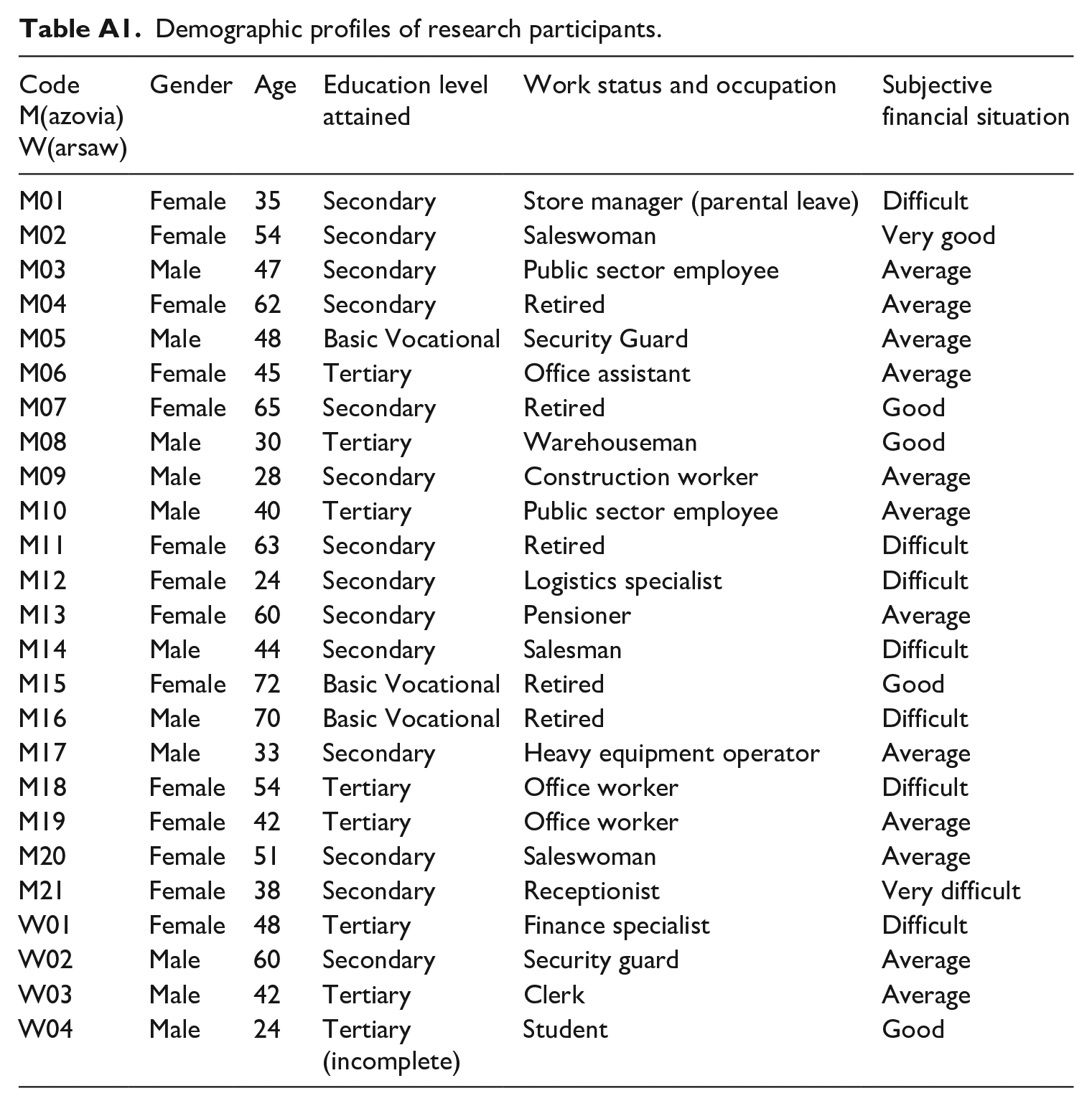
The research presented here, conducted as a part of a larger study of the Law and Justice’s electorate, involved conducting 25 two-hour-long individual in-depth interviews (IDIs) that used the RIM technique (resulting in 25 individual RIM charts) and 3 six-person focus groups (FGI) that also addressed the issues of identity. Participants were recruited with the help of a research company and received remuneration for their involvement. The IDIs were conducted in October and November of 2022 and revolved around the issues of identity, politics, satisfaction with the PiS government, and the moods in the wake of the upcoming general election. The interviews were conducted in the participants’ homes and mainly in the towns and smaller cities of the Mazovian province, where, with the exception of Warsaw, PiS enjoys high levels of support. Existing research suggests that the party’s electorate can be divided into two distinct groups: ‘hard-line’, loyal, and highly conservative supporters, and more moderate voters who are less attached to the party and attracted mainly by its welfare policies (Sadura and Sierakowski, 2019). Only the first group can be conceptualised as an epistemic community of populist voters, and thus the participants were recruited exclusively from among hard-line supporters, who constitute around two-thirds of the total party electorate. The selection criteria included past electoral choices and the intent to vote for Law and Justice in the future, along with six political identity items inspired by previous research on populism in Poland (Marody et al., 2019): (1) people-centrism, (2) nativism, (3) siege mentality, (4) political polarisation, (5) majoritarian view of democracy, and (6) Euroscepticism. To ensure the sample’s diversity while maintaining overall similarity to the demographic composition of PiS loyal supporters, the purposeful sampling procedure also took into account participants’ age, gender, education, and subjective financial situation. Profiles of all the IDI participants are available in the appendix. All the interviews were conducted in Polish by the study’s author and were recorded, transcribed, and analysed using ATLAS.ti software. The analysis, which adopted the principles of Van Dijk’s (2011) critical epistemic discourse analysis, employed coding and qualitative content categorisation to investigate three levels of relations indicated earlier: those between discursive categories used to construct social identity, those between the popular in-group and various out-groups, and the self-referential relation.
The ‘real’ people as an intermediary identity and a community of last resort
The most immediate insight from the analysis of the interviews and the RIM charts is that almost all participants had a similar and clearly defined identity core – a set of relations with groups that the participants most identify with. This core included both direct, personal relations with participants’ families (Rodzina) and close friends (Przyjaciele/Przyjaciółki) and more abstract links with imagined communities of Poles (Polacy) and Catholics (Katolicy).
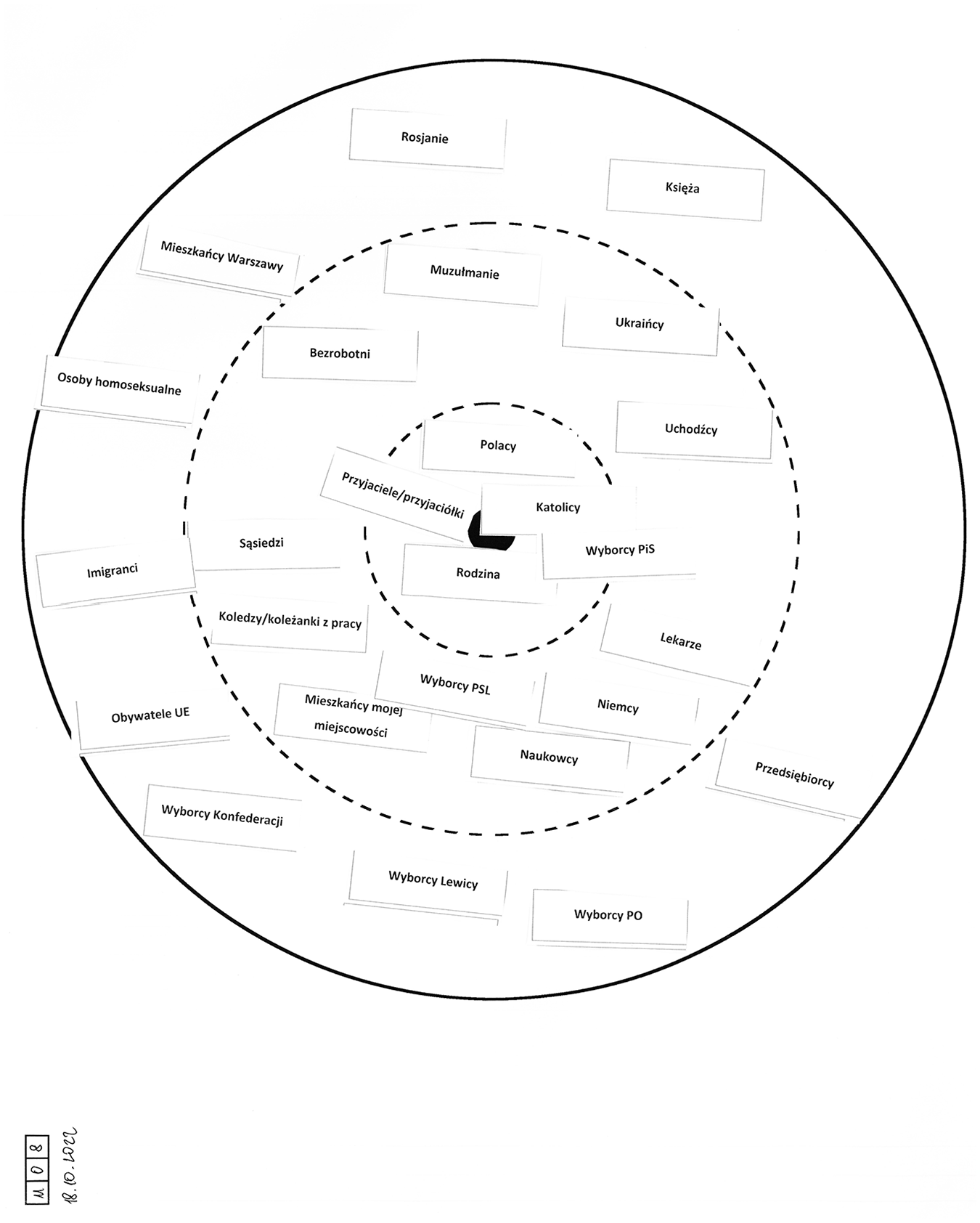
RIM Chart M08-M-30. The groups arranged on this and the following charts include: Family (Rodzina), Close friends (Przyjaciele/Przyjaciółki), Poles (Polacy), Catholics (Katolicy), Law and Justice’s voters (Wyborcy PiS), Clergy (Księża), Neighbours (Sąsiedzi), Local residents (Mieszkańcy mojej miejscowości), Residents of Warsaw (Mieszkańcy Warszawy), Colleagues (Koledzy/Koleżanki z pracy), EU Citizens (Obywatele UE), Doctors (Lekarze), Scientists (Naukowcy), Entrepreneurs (Przedsiębiorcy), the Unemployed (Bezrobotni), Voters of the rival PO, PSL, and the Left parties (Wyborcy PO/PSL/Lewicy), Gay people (Osoby homoseksualne), Ukrainians (Ukraińcy), Refugees (Uchodźcy), Migrants (Imigranci), Russians (Rosjanie), Germans (Niemcy), and Muslims (Muzułmanie).

RIM Chart M02-F-54.
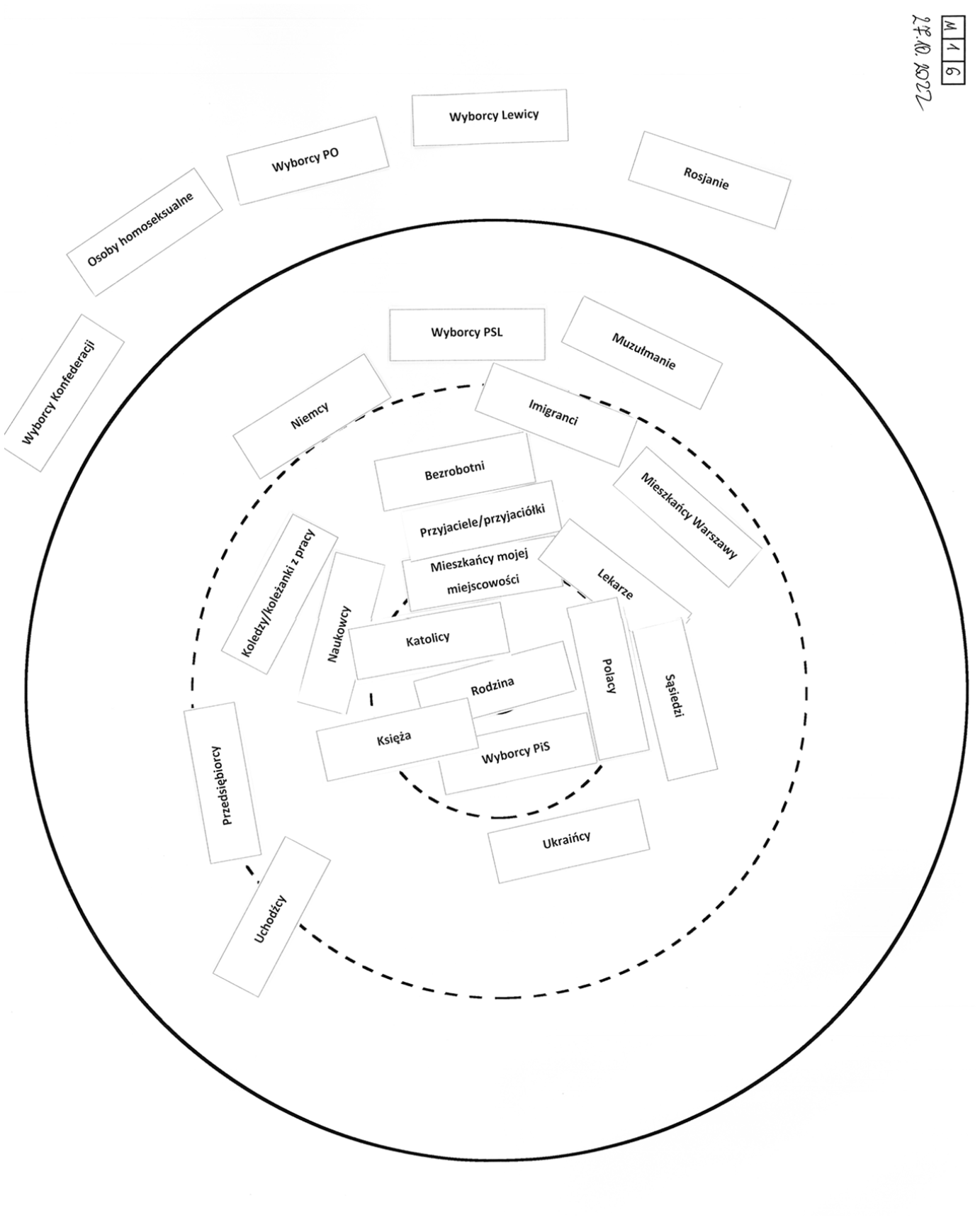
RIM Chart M16-M-70.

RIM Chart M05-M-48.
Among those core relations, the family and Polishness provided the primary sense of individual and collective identification and these categories were usually linked by the participants, with Poles representing a symbolic ‘extended’ family that complements the ‘private’ one:
Poles, yes. Poles, of course, that's. . . A Pole. . . is a man that. . . there’s nothing to talk about at all. Poles, they’re my flesh and blood, family, very important. I value family very much. (M02-F-54) Poles, family – it’s basically the same. (W03-M-42)
While the inclusion in the identity core of both Polishness and Catholicism, which are usually closely linked in Polish right-wing discourses, confirms the expectations from existing research (Marody et al., 2019; Polakowski, 2023), quite unexpectedly almost 70% of participants placed Law and Justice’s voters (Wyborcy PiS) almost as close to the centre as the mentioned groups. Even though the study focuses on hard-line, loyal voters, the participants were neither formally affiliated with the party nor exhibited any above-average political activity. Many had only rudimentary knowledge of politics, including of their own preferred party, of which they knew just two or three politicians. The majority of the interviewees, however, expressed deep sentiments and a sense of community with other PiS’s supporters, who were often seen as those who care most about the welfare of the country and the nation:
I am very much for PiS. It started with Solidarity, well, because… I was still working, I went on strike. […] then some people followed PO [Civic Platform – PiS’s main rival], some followed other [parties] and I stayed with PiS, although some people say we [the interviewee and his wife] are berets [so-called mohair berets – a pejorative term for older, conservative voters], but it’s okay. It’s warmer in berets. (M16-M-70) Law and Justice’s voters – they are with us [the interviewee’s family] because they secure our lives, enable the development of our Poland. (M01-F-35)
The characterisation of Law and Justice voters as a pillar of the community, one that ‘secures its life’, was all the more significant given the tension observed in how the participants characterised Poles and Catholics. On the one hand, when describing these groups, participants not only cultivated a positive self-image, but also engaged in a ‘unifying’ narrative on traits and talents that supposedly characterise their community as a whole:
Because I, for example, understand that we are helping them [Ukrainians] today. I understand that. Who else, if not us? After all, man should help his fellow man. I suspect that historically they wouldn’t help us, but we will help them, because, yes. . . Poles have always been like that. (M05-M-48) Poland is generally a very capable nation. There are many things that Poles can do that other countries will take credit for, and this is not even up for discussion, because Poles have always been and still are a talented nation. (M01-F-35)
However, when asked to place these groups on a chart, participants often felt the need to emphasise that they were referring to their ‘real’ members, implying or openly stating that there is a division among these groups, and that some Poles and Catholics are unworthy of the name:
Poles. . . Honest Poles, yes? Here. (M20-F-51) Poles will be here in the middle, because there are Poles and then there are Poles. They are not all the same. (W02-M-60). Catholics… Well, it depends. We have Catholics who are supposedly Catholics, but in their hearts are something completely different, and then there are Catholics who are really devoted. […] If they are true Catholics, then they are close. (M01-F-35)
Importantly, the accelerating secularisation of Polish society was visible even among the interviewed PiS voters, who remain the most conservative and religious group in Poland (Marody et al., 2019). While the participants almost universally emphasised their Catholic identity, a clear majority, in a significant departure from the Law and Justice’s staunchly pro-Church discourse, placed the cards with the clergy (Księża) well outside the identity core, either claiming that their faith was an individual, private matter or indicating their disappointment with the handling of child sexual abuse scandals in the Church:
I am a Catholic, I go to church, but for me to insist that [the Church] is magnificent and wonderful… It is not a profession of faith. Because I pray for God, not for a priest. (M12-F-24) The Church, well, let’s not kid ourselves, the Church is not perfect. There is a lot of. . . They are human beings after all. They are not saints. They’re human beings and they commit all sorts of things too, and not just stupid things, but all sorts of crimes. That has to be dealt with, because how can you be for the good and tolerate something like that? (M05-M-48)
The crisis of the Church did not result in the participants losing their faith or abandoning their Catholic self-identification, but it did force them to become increasingly self-reliant and reflexive regarding their faith. A similar process affected the participants’ relationship with Polishness. As previously discussed, participants strived to maintain a positive view of Poles as a cohesive whole, but the community was seen as in crisis, with growing divisions forcing a re-evaluation of what it meant to be a ‘true’ Pole. Thus, in line with the literature on late modernity cited above, the participants’ identities were deeply affected by the progressive decomposition of traditional sources of identification. While they did not abandon their traditional collective identities (in fact, they have clung to them even more), the participants were forced to become much more reflexive when it comes to identity and equally more selective in who they consider to be a member of their community, with the aim of maintaining the community’s homogeneity and preserving the integrity of the identity it anchored.
What increasingly mattered in this selection process were an individual’s political values, sympathies, and life choices. With Polishness in crisis, simply being a Pole was not sufficient to be classified as a fellow member of the community of the ‘real’ people. With the latter supposedly threatened by the actions of Law and Justice’s political rivals, particularly Donald Tusk’s Civic Platform party, the meaning of ‘true’ Polishness was increasingly interpreted through the lens of PiS’s populist discourse and associated with a specific political identity and values, the absence of which made an individual a ‘fake’ Pole or not a Pole at all:
The next election will be very important. It will decide whether we submit to the Germans or continue to be free as Poles, with Poland that is represented by Poles, our people, our flesh and blood, who guard the country and the Polish people… If we submit, what’s the point of being Polish if we are ruled by a man of another nationality? (M01-F-35) For me Mr. Tusk is not a Pole. […] Maybe he is Polish by birth, but certainly not by virtue of his actions, because he doesn’t act in Poland’s interest. For me they [Civic Platform’s politicians] are traitors to the Polish nation. Poles do not act like that. If he identified as a Pole, he would not act to the detriment of Poles. (M18-F-54)
While redefining who a ‘true’ Pole is, participants tended to mention politicians from rival parties as examples of those who do not meet the criteria or are simply traitors. However, when asked about the statements made by Jarosław Kaczyński, the leader of the Law and Justice party, who in his speeches mentioned the existence of ‘Poles of the worst sort’ and claimed that ‘if one believes in the value of being Polish, then one must stand on the side that defends traditional values and wants to reshape our reality to make it more just’ (Kulej, 2020), they largely agreed and were more inclined to also exclude voters of other parties from their projected community of ‘true’ Poles:
Sometimes it’s just […], well, it’s just not possible to – when someone says something wrong and untrue right to your face – to call that person a Pole, to count on his solidarity (M16-M-70) They [the other political camp] want us to be dependent on the Germans, on the Russians, to make us dependent, not to be a Polish state as a Polish state, but to be some kind of. . . I don’t know, some kind of region, dependent again. […] Like under the partitions [of Poland]. (M02-F-54)
With the categories of Poles and Catholics increasingly blurred, the political identity of Law and Justice’s supporters served as a form of an intermediary identity – a set of social representations used to articulate other categories and redefine what ‘real’ Polishness means and who qualifies as a ‘true’ Pole. Thus, PiS’s right-wing populist and exclusionary discourse (Polakowski, 2023) served to maintain an integral identity of the ‘real’ people that embody the qualities of Polishness and Catholicism. While most participants were somewhat reluctant to claim that other parties’ sympathisers were not ‘real’ Poles, at least before being asked about Kaczyński’s statements, they did assume that the qualities of being ‘true’ Poles remained strongest among Law and Justice’s supporters.
The process of redefining ‘true’ Polishness resulted in the exclusion of various groups deemed ‘unworthy’. While this exclusion was often described by the participants with some unease, it was far more evident on their RIM charts, which offered a way to express their views without using statements that could be seen as harsh or uncompromising. As the charts were created, most participants assumed that the largest circle, marked with a continuous line, symbolised the main external boundary delimiting their community. Similar to the identity core, there was a fairly consistent set of groups that were placed outside this boundary. These included Russians (Rosjanie), Germans (Niemcy), Muslims (Muzułmanie), migrants (Imigranci), and, importantly, voters of rival parties (Wyborcy PO/PSL/Lewicy), and gay people 1 (Osoby homoseksualne).
The exclusion of other ethnic, religious, and migrant groups from the projected community is easily explicable, as these were the groups that the participants, largely in line with PiS’s political discourse (Polakowski, 2023: 51–52), treated as non-Polish. However, the exclusion of other parties’ voters and sexual minorities – groups that were manifestly Polish – was a direct consequence of the right-wing populist redefinition of ‘true’ Polishness and suggests that the projected popular community is gradually ‘shrinking’, as there are fewer and fewer ‘normal’ Poles or ‘true’ Catholics:
Poles… They are dear to me, you know, not everyone in general… but when it comes to being Polish – those that want to live like me, that is, normally, are close to me. (M17-M-33) I’m afraid of what will become of our faith, because it’s supposedly 90 something per cent [of Catholics] in Poland, and it would be good if it’s 50, I tell you. (M05-M-48) Yeah, these [Polish media personalities associated with the liberal parties] are not Poles. They are not Poles for me. How can a Pole say something like this? (M16-M-70)
Moreover, many participants, especially those older and less educated, placed the supporters of PiS’s political rivals, Civic Platform’s in particular, at least as far from themselves on their charts as they did the Germans or Muslims – groups that were consistently described as alien:
Civic Platform’s voters – well, they [are placed] like the Germans, there, with the Russians even further. (W02-M-60) Civic Platform’s voters? Nah, at the very end of the chart. Muslims? The same. (M18-F-54)
Thus, it can be argued that the construction of the right-wing relational popular identity, at least in the case of Law and Justice’s supporters, is rooted in an immunitarian logic of exclusion (Esposito, 2013). Immunising from other ‘non-genuine’ members of the community meant, in Esposito’s (2013) terms, that in relation to them the participants were no longer bound by the obligation of solidarity that the community imposes (p. 39). The process of immunisation, as observed among Law and Justice’s supporters, and described in relational terms, involves discursively constructing a difference within an in-group and making it visible and relevant. Thus, the in-group becomes more complex as there are more significant relations within it, and the group’s identity must adapt to this new complexity. The latter can be incorporated into the collective identity, or alternatively, those new differences may be expelled from it, transforming relations within the community into relations between the community and some newly constructed others. While the members of the community may view this process as a ‘defence’ of their ‘true’ identity, it is, in fact, an act of change, as these new relations affect the identities of both the community and those excluded and involve redefining these categories, as evidenced by the case of ‘true’ Poles. Immunisation is therefore not only an exteriorisation of internal differences but also, as Esposito (2013) noted, a ‘progressive interiorization of exteriority’ (p. 41) – an act of immunising from others, even if these others come from within the community. Thus, through the process of immunisation, the ‘real’ people become the community of last resort – a community that seemingly ‘remains’ and is ‘true’ and ‘pure’, while in fact it is created through subsequent exclusions and is established in relation to those excluded.
Conclusions
The aim of this article was to reflect on the process of self-identification of populists’ supporters, an issue rarely studied in depth in current research, which typically focuses either on populist discourses or on individual populist attitudes. The construction of popular identity, however, is a complex process rooted in an interplay of relations between discursive categories, individuals, and groups, all of which serve as means of identification and differentiation, and jointly construct both individual and collective self-identification. Thus, in this article I have proposed a concept of relational popular identity that captures all these different levels of relations, and the RIM technique used to investigate these relations as they are construed and maintained in a particular epistemic community of populists’ supporters. By analysing the self-identification of loyal Law and Justice voters in Poland, I have also indicated two specific tendencies in constructing a right-wing popular identity. First, it served as an intermediary identity, used to articulate and interpret constitutive elements of other identities vital for the participants’ identification. Thus, it helped to define the categories of ‘real’ Poles or Catholics, which were negotiated and reinterpreted in the context of a political conflict. Second, the relational popular identity was used as the basis for a ‘community of last resort’ created through an immunitarian mechanism of exclusion. Thus, declining traditional communities and identities were seen as gradually shrinking around the core of Law and Justice’s supporters – a community that epitomised their virtues and united the ‘real’ people who still care about their homeland. While further comparative research is needed to determine whether these two tendencies are specific to the studied case or represent a recurring pattern in constructing a right-wing relational popular identity, the article offers a set of concepts and methods for any future relationally-oriented analysis of popular identity, as it is adopted and performed by populists’ supporters.
Footnotes
Appendix 1
Demographic profiles of research participants.
| Code |
Gender | Age | Education level attained | Work status and occupation | Subjective financial situation |
|---|---|---|---|---|---|
| M01 | Female | 35 | Secondary | Store manager (parental leave) | Difficult |
| M02 | Female | 54 | Secondary | Saleswoman | Very good |
| M03 | Male | 47 | Secondary | Public sector employee | Average |
| M04 | Female | 62 | Secondary | Retired | Average |
| M05 | Male | 48 | Basic Vocational | Security Guard | Average |
| M06 | Female | 45 | Tertiary | Office assistant | Average |
| M07 | Female | 65 | Secondary | Retired | Good |
| M08 | Male | 30 | Tertiary | Warehouseman | Good |
| M09 | Male | 28 | Secondary | Construction worker | Average |
| M10 | Male | 40 | Tertiary | Public sector employee | Average |
| M11 | Female | 63 | Secondary | Retired | Difficult |
| M12 | Female | 24 | Secondary | Logistics specialist | Difficult |
| M13 | Female | 60 | Secondary | Pensioner | Average |
| M14 | Male | 44 | Secondary | Salesman | Difficult |
| M15 | Female | 72 | Basic Vocational | Retired | Good |
| M16 | Male | 70 | Basic Vocational | Retired | Difficult |
| M17 | Male | 33 | Secondary | Heavy equipment operator | Average |
| M18 | Female | 54 | Tertiary | Office worker | Difficult |
| M19 | Female | 42 | Tertiary | Office worker | Average |
| M20 | Female | 51 | Secondary | Saleswoman | Average |
| M21 | Female | 38 | Secondary | Receptionist | Very difficult |
| W01 | Female | 48 | Tertiary | Finance specialist | Difficult |
| W02 | Male | 60 | Secondary | Security guard | Average |
| W03 | Male | 42 | Tertiary | Clerk | Average |
| W04 | Male | 24 | Tertiary (incomplete) | Student | Good |
Declaration of conflicting interests
The author declared no potential conflicts of interest with respect to the research, authorship, and/or publication of this article.
Funding
The author disclosed receipt of the following financial support for the research, authorship, and/or publication of this article: This work was supported by the University of Warsaw under ‘The Excellence Initiative – Research University 2020–2026’ programme through grants number 501-D135-20-0004316 and 501-D135-20-0004410.
