



Abstract
Whilst there are well-established bodies of knowledge about enterprise support and the role of entrepreneurial learning for SMEs (Small and medium-sized enterprises) in general and a growing body of evidence relating to environmental capabilities, green/eco-innovation, sustainable supply chains and green skills for SMEs in particular, there is little empirical and peer reviewed literature that address approaches to enterprise support specifically focussed on the needs of the growing number of pro-environmental SMEs. This study undertakes a contextualised review of diverse knowledge domains to identify the key features of enterprise support for pro-environmental SMEs. In doing so, the paper plots the knowledge journey of experienced academic programme providers, from the initial design of an enterprise support programme for pro-environmental SMEs, through a thematic review of academic, grey and other related literature and finally presents a propositional and normative conceptual framework that proposes eight key features of enterprise support for pro-environmental SMEs. The resulting ‘framework for action’ aims to offer a practical tool for providers of pro-environmental enterprise support to review and improve their own provision, an analytical frame for other researchers in this field and a benchmark for SMEs seeking guidance on their pathway to net-zero business performance.
Keywords
Introduction
Although the picture varies between developed, emerging and low-income countries, according to the OECD (OECD, 2017; Koirala, 2018), small and medium-sized enterprises (SMEs) account for over 99% of businesses and more than 50% of employment and GDP globally, whilst contributing 60–70% of industrial pollution in Europe (OECD, 2018). However, as Koirala (2018: 4) points out, although SMEs have a relatively high environmental footprint, they can also be significant contributors to environmental solutions by pioneering new green industries, ‘especially in local and emerging market contexts that may be unappealing or unfeasible for large corporations’.
In some countries, SMEs form a significant element of the clean growth agenda. For example, SMEs represent more than 90% of clean tech enterprises in the United Kingdom and 70% in Finland (OECD, 2017). A recent survey of SME support initiatives in the EU identified 230 technical assistance programs focused on eco-innovation and greening SMEs (Koirala, 2018; OECD, 2018). Over half of these programs provided general access to information, self-assessment tools and case studies linked to resource efficiency measures. The others offered more tailored, face-to-face services that were geared towards helping businesses apply general knowledge to their specific business cases. This reflects Khalili et al.’s (2015) study that found inclusion of resource management topics were the most preferred approach in ‘cleaner production infused academic programs’ in the US, Latin America and China; whilst noting the importance of ‘integration of sustainable development topics in the research’ (p. 39). Our own analysis of the Ministry of Housing, Communities & Local Government (2019) data shows that, of 53 English programs supporting pro-environmental SMEs, 23 focused on energy and resource efficiency. These were primarily led by Local Council teams (15 Councils) but also other providers such as four commercial agencies, two regional organisations, one not-for-profit and one university. Fifteen projects aimed more broadly at developing the local low carbon economy and clean business growth were provided by councils (5), regional organisations (5), universities (4) and one not-for-profit organisation. The 10 projects targeting eco-innovation were all administered by universities (four additional projects focused on individual business development; plus our own hybrid project). This high-level analysis demonstrates that whilst organisations of all types delivered programmes supporting clean growth, business development and broader low carbon economic enterprise support, there was a clear differentiation between universities that focused on eco-innovation support and councils that focused on energy efficiency programmes. We also noted a clear disparity in the overall balance of funding. Funding for energy efficiency, carbon reduction measures amounted to £184 million; and £178 million was provided for more general low carbon/clean growth initiatives combined with business development programmes. Eco-innovation projects led by universities only received £40 million in European Regional Development Funding. Whilst other funding streams for different aspects of enterprise support were available to support pro-environmental business development, understanding the relative weighting of funding is instructive. We return to this in the Discussion section below.
Whilst a growing number of programmes, initiatives and organisations offer support to pro-environmental SMEs, there appears to be very little empirically grounded insight into the nature and effectiveness of enterprise support for the increasing proportion of businesses that put environmental concerns at the heart of their business strategy. As the authors began to design and deliver their own regional enterprise support programme in 2015/16, they found very little empirically grounded knowledge upon which to base their design of ‘broad spectrum’ support for both within-firm resources efficiency and low carbon business growth. In their review of evidence into how SMEs can contribute to Net Zero, Blundel and Hampton (2021) found knowledge gaps remain in relation to the most effective models for business support and deployment of advisors, consultants and other agents of change.
By exploring a range of discrete literatures with varying theoretical underpinnings, this paper seeks to address this knowledge gap by identifying the key elements of enterprise support for pro-environmental SMEs. It also plots the authors’ knowledge journey as experienced academic programme providers, from the initial programme design phase, through a thematic review of academic, grey and other related literature during the initial phase of delivery, towards the development of a propositional and normative conceptual ‘framework for action’ that describes eight key features of enterprise support for pro-environmental SMEs. This paper explores the relationships between some of these key elements and aims to offer a practical tool to help providers of enterprise support for pro-environmental business to review and improve their own provision, academic researchers who might use the ‘framework for action’ for analytical purposes, in addition to SME owners and managers seeking support from intermediaries.
Throughout the paper, we use the term ‘enterprise support’ to acknowledge our focus on SMEs, and to distinguish between other forms of business support that target larger organisations. Enterprise support is understood as assistance for the small business community that supports enterprise growth and development via interventions that go beyond business advice (Bennett and Robson, 2003; Mole et al., 2009). The broad range of interventions include training opportunities, consultancy interventions, capital grants, micro-finance, technical assistance and entrepreneurial networking. This approach is not uncommon and applied in a variety of contexts, such as youth enterprise start-up programmes (Rouse and Kitching, 2006) and assistance for ethnic minority women’s enterprise (Carter, et al., 2015). As support to encourage pro-environmental behaviour of small businesses reaches beyond the remit of mere ‘business advice’, this definition of enterprise support accommodates the broad-spectrum support approach identified below.
We also refer to ‘pro-environmental SMEs’ throughout. Definitions of ‘sustainable business’ commonly link economic, social and environmental considerations (Elkington, 1998; Padin et al., 2016); with these three elements reciprocally reinforcing each other and underpinning economic growth, environmental concerns and social well-being (Wagner and Svensson, 2014). In this paper, we try to avoid potential confusions in overlapping definitions of ‘low carbon’, ‘green’, ‘clean’ and ‘sustainable’ business by using the term ‘pro-environmental’ business to describe any firm that is explicitly shifting its internal practices to reflect environmental values, as well as those that supply clean technology and other Low Carbon and Environmental Goods and Services (LCEGS). Following the Green Growth Knowledge Platform (GIZ, 2015: 8), we define a pro-environmental business as one that ‘explicitly focus their efforts on solving environmental challenges by reducing negative environmental impacts, increasing resilience against environmental impacts, or by providing a more efficient and responsible use of natural resources. Through their products and services, they contribute to the protection of the environment, the climate, biodiversity and natural ecosystems’.
Following this introduction, the paper is structured as follows: The Approach section outlines the approaches used to ‘mine’ the literature for useful insight into enterprise support for pro-environmental SMEs; Lessons For Pro-Environmental Enterprise Support Found In The Literature section describes the resulting insight; The conceptual framework section presents the conceptual framework and its links to the wider landscape of enterprise support for pro-environmental business. The paper concludes with discussion about potential uses for the framework (in the Discussion section), and the research limitations and potential next steps (in the Conclusions section).
Approach
The knowledge gap and delivery driven engagement with literature
As the authors began to design their own EU funded regional support programme for pro-environmental SMEs in 2015 (The D2N2 Low Carbon Project 2016–2022-Carney Green, 2019), we reviewed existing academic research into enterprise support for pro-environmental SMEs, but quickly concurred with Conway (2014) who notes the meagre attention paid to the nature of SME support provision focused on sustainable business improvement. Our preliminary search of academic literature found only a handful of directly relevant articles (Bocken et al., 2015; Conway, 2014; Creech et al., 2014; Friedman et al., 2000; GIZ, 2015; Hart et al., 2003; Hart and Dowell, 2011; Khalili et al., 2015; OECD, 2009), with each of these studies having both knowledge benefits and limitations for the purposes of programme design.
As the design of our programme moved into delivery, our academic team engaged with various values-driven local SMEs to explore and validate our plans. It quickly became apparent, as the academic literature predicted (Conway 2014, 2015; Hampton, 2018), that any programme of support for pro-environmental practices would only be attractive to SMEs if economic (cost saving, increased turnover), commercial (new customers, reputation) and business mortality issues were also addressed as foundational elements of the provision. The design of our own regional pro-environmental business support programme was also heavily influenced by the framework developed by Hart et al. (2003). This helped us to initially identify six content themes (our curriculum) for the programme; sustainable value proposition, environmental capabilities, clean growth skills, eco/green innovation, multi-stakeholder engagement, plus sustainability strategy and leadership. As the programme progressed, it became apparent that supply chain sustainability was also a major source of green-house gas emissions for some firms. This seventh feature was added to the programme as we entered its second phase in 2019. 1. sustainable value proposition 2. environmental capabilities 3. clean growth skills 4. clean technology/eco/green innovation 5. multi-stakeholder engagement 6. sustainability strategy and leadership 7. greening the supply chain
Thematic engagement with the literature
In the period 2016–2019, the programme team considered 38 articles, from a range of academic literature, using the themes listed above, to organise our deductive, thematic review of the evidence. As we explored the literature, it became apparent that studies were rooted in a variety of theoretical perspectives, for example, the Knowledge Based View (KBV), Natural Resource Based View (NRBV), whole systems transformation, dynamic capabilities and behavioural competencies to name a few. We judged, therefore, that taking a particular theoretical perspective would limit our engagement with the diverse evidence base. With a few notable exceptions, these literatures pay little direct attention to the characteristics of business support approaches that support the development of clean growth/pro-environmental business practices. This reflects (and perhaps contributes to) what some researchers have described as piecemeal or inconsistent business support mechanisms for this sector (Britton and Woodman, 2014). From this diversity of papers, over time we attempted to draw insight that was of relevance to the aims of our own enterprise support programme.
Collaborative development of a conceptual framework
As we began to communicate our insight and lessons learned from programme delivery, we developed a ‘Framework for Action’ that described the key elements of pro-environmental business support as we saw it. In September 2019, a provisional framework was presented to a group of 26 academics and public sector experts representing nine enterprise support programmes from around the UK. Whilst offering broad acceptance of these seven key features, our colleagues highlighted the omission of learning design. This led to the development of a provisional framework as described in Figure 1 above. Pro-environmental enterprise support: an initial view.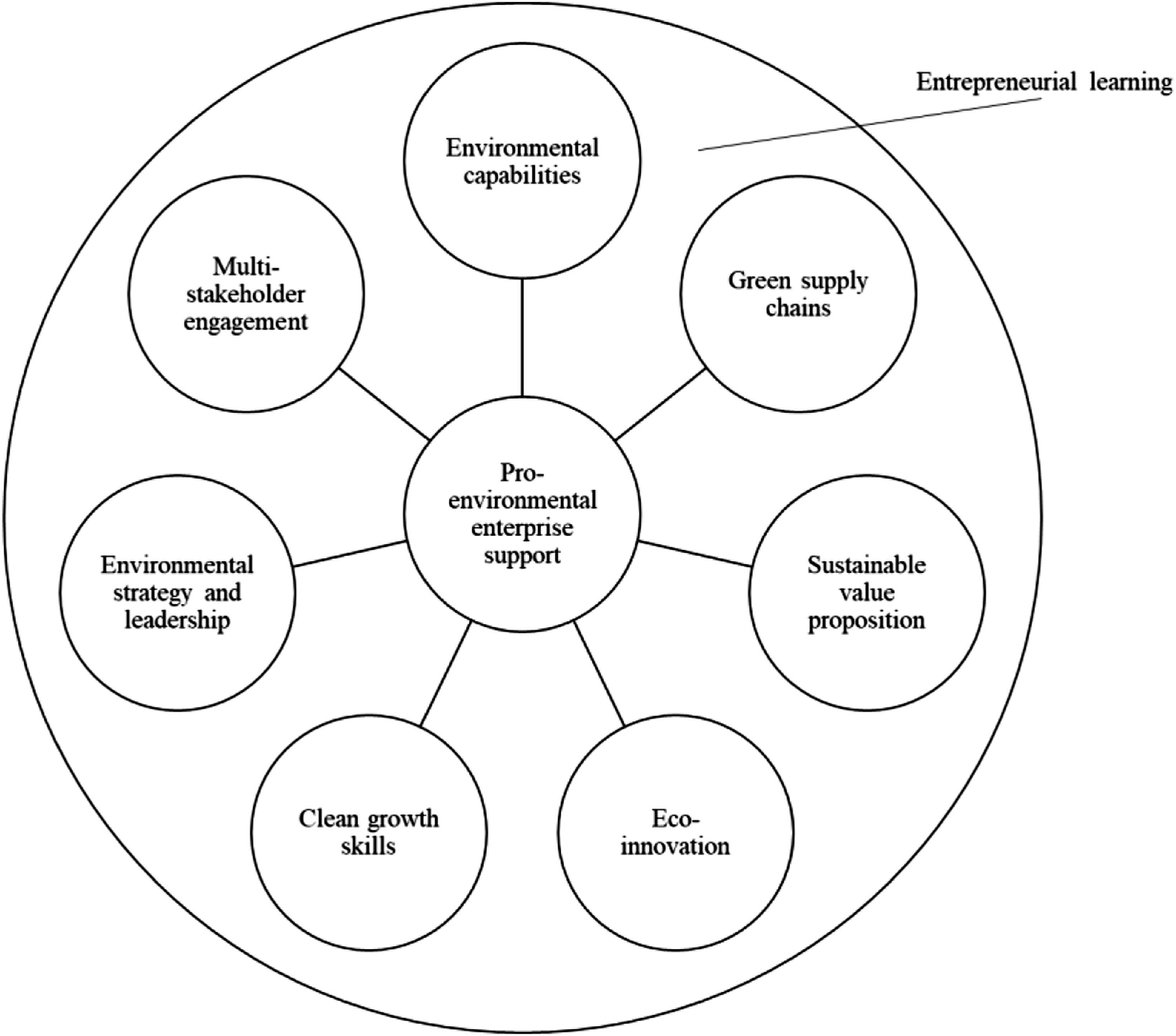
Systematic engagement with the literature
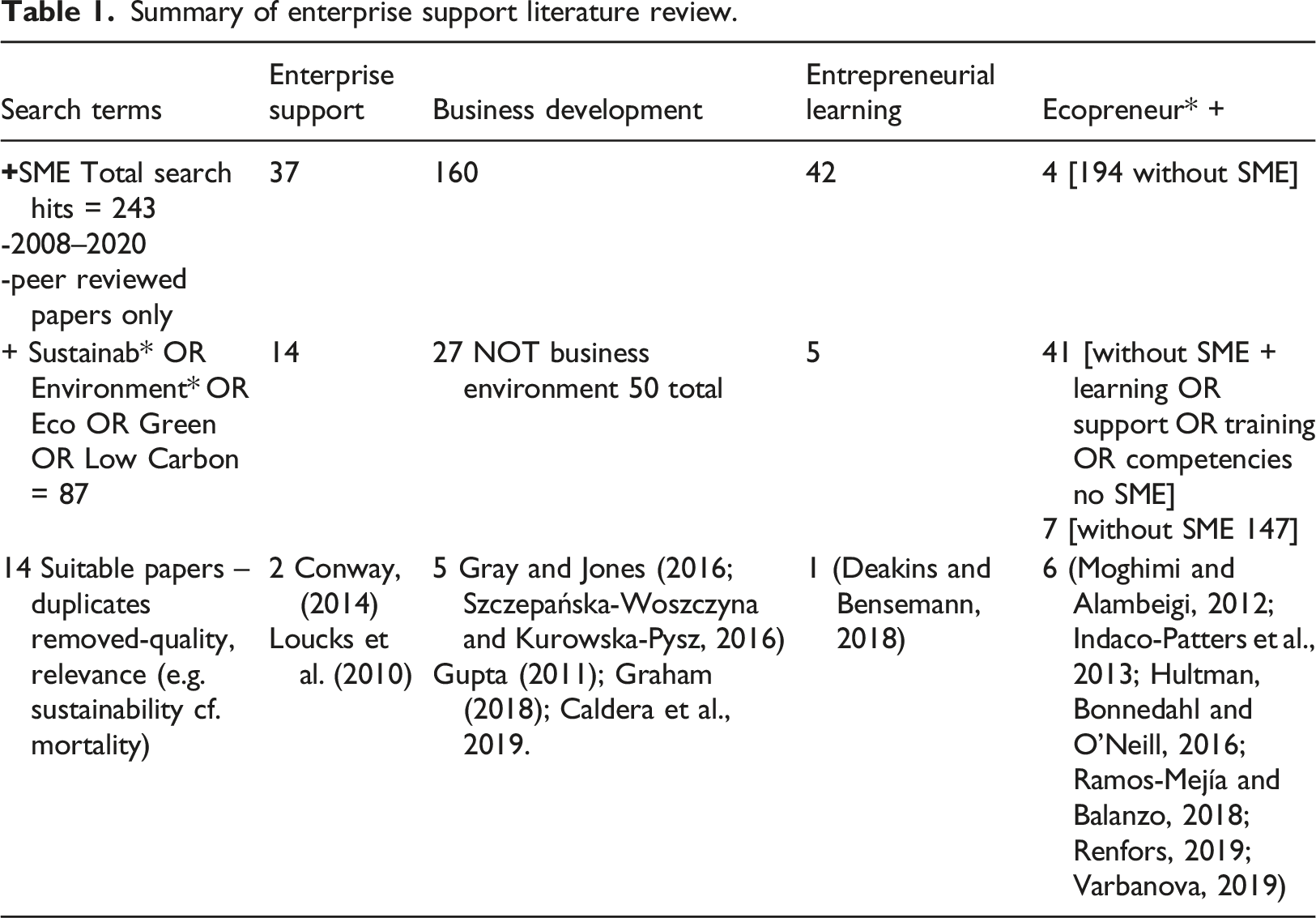
As a result of this collaborative review, and as precursor to the development of the second phase of our funded programme, the authors undertook a systematic review of academic literature relating specifically to the nature of enterprise support for SMEs and ‘green’ entrepreneurial learning. see Table 1. As recent reviews in this arena have established, there is a small core of journals holding a focus on this arena of knowledge (Cardoni et al., 2020; Blundel and Hampton 2021; Hojnik and Ruzzier, 2016; Yadav et al., 2018; Pacheco et al., 2018), therefore, it was decided to contain the search to EBSCO and Emerald databases which provided access to the relevant journals. The review was undertaken in two phases. During the first phase, the key search terms and operators were ‘enterprise support’ OR ‘business development’ AND SMEs that also were tagged with sustainable* OR environment* OR eco OR green OR low carbon and NOT ‘business environment’. Of 41 papers identified, seven were deemed suitable once duplicates were removed, quality (peer reviewed) and relevance established (i.e. the studies were based on empirical evidence relating to provision designed to support sustainable, pro-environmental business improvement and development).
Summary of enterprise support literature review.
In total, combining thematic and systematic reviews, 52 papers from 22 journals (see Appendix 1) were found to contribute relevant insight on the theme of pro-environmental support design or ‘eco-preneurial learning’. That is, learning design in support of pro-environmental SME entrepreneurs.
Delphi study to validate the framework
To validate the emergent ‘Framework for Action’, we deployed a Policy Delphi approach (Turoff 2002), which is used to identify and evaluate potential solutions to a selected issue and to reveal arguments for and against each solution (Gordon, 2009; McGeary, 2009). This involved a two-round e-Delphi study, followed by a 2.5-hour virtual focus group, involving 21 experts from across the spectrum of business support agencies, local authorities and EU funded projects delivering pro-environmental enterprise support in England.
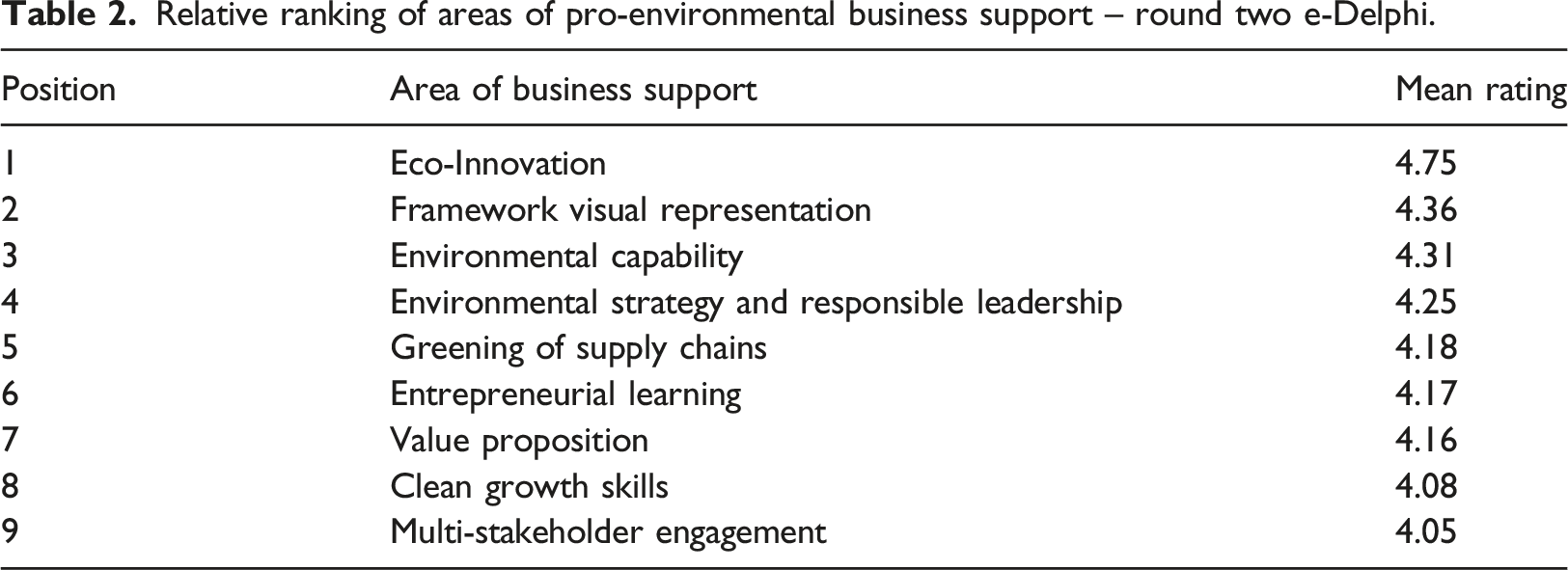
The participants were asked to indicate (anonymously) levels of agreement with a number of statements utilising a five-point Likert scale. The e-Delphi questionnaire addressed the eight areas of pro-environmental enterprise support (shown in Figure 1), plus the effectiveness of the visual representation of the framework. There were two rounds of online questionnaires, followed by feedback to participants that included a statistical summary of the group’s responses and adaptation of relevant sections. Typically, researchers consider different types of threshold levels for a Delphi study, such as greater than one half (more than 50%); three fifths (60%); two thirds (66%); or three quarters (75%) (Gallotta, Garza-Reyes and Anosike, 2018; Loughlin and Moore, 1979; McKenna, 1994).
After the first round of the study, amendments were made to three features that fell below an 80% consensus threshold: ‘environmental strategy and responsive leadership’, ‘greening of supply chains’ and ‘clean growth skills’ sections. In addition, a new graphic representation (Figure 2) was developed. In round two of the study, every theme achieved a mean rating higher than 4.0, representing at least 80% overall agreement with the theme in question (see Table 2). This high level of consensus (Krigsholm, et al., 2017; Filyushkina et al., 2018) provided strong statistical validation of all eight elements, as well the final visual representation of the Framework for Action (as shown in Figure 2 below). Framework for Action: Key features of pro-environmental support for Small and medium-sized enterprises. Relative ranking of areas of pro-environmental business support – round two e-Delphi.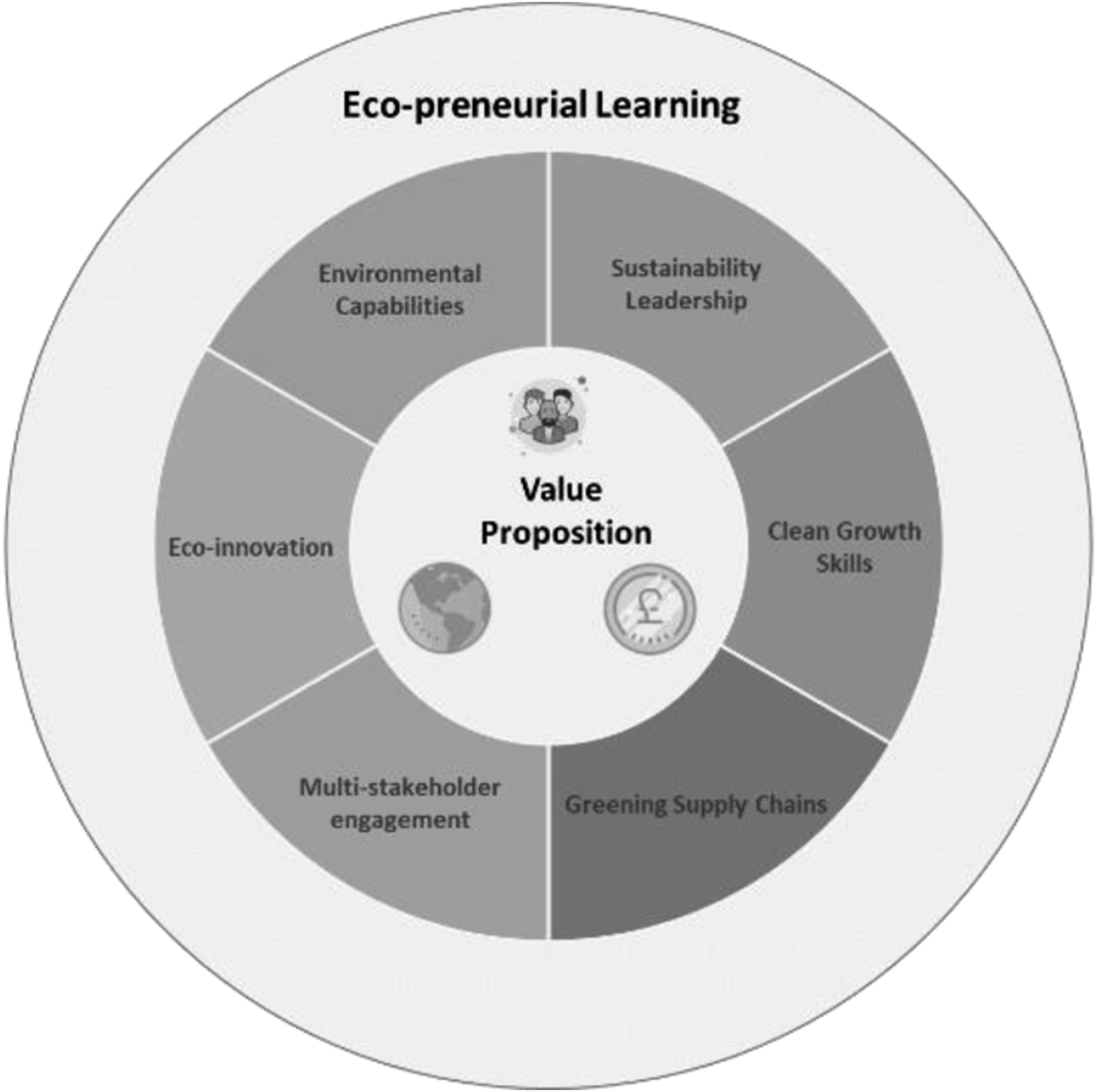
At the final stage of the study, the research team organised a focus group, with a panel of experts, to explore the outcomes of the research and to discuss potential implications and the future directions of research.
Lessons for pro-environmental enterprise support found in the literature
Summary of features of pro-environmental support for SMEs found in academic literature.
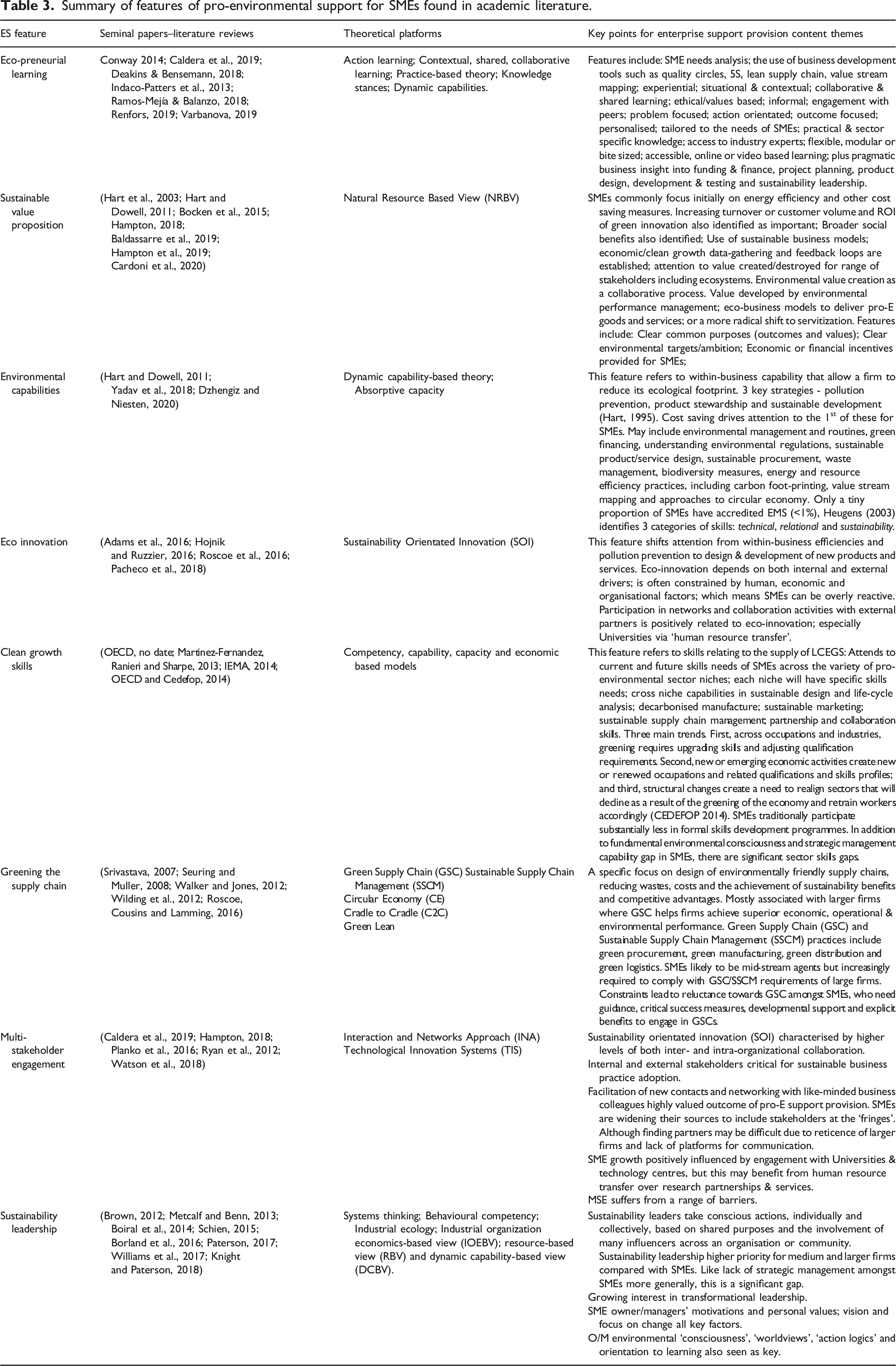
As Conway (2014) notes, in the UK, national and regional support programmes commonly set out clear expectations in terms of the financial, economic and emission reduction outcomes which must be demonstrated by the providers. ‘Whilst this is often challenging for large businesses, for SMEs, many of whom operate less comprehensive tracking systems or who are in start-up mode, this is far more demanding and may discourage involvement in a potentially very beneficial activity’ (p.108). It is well established that small and medium sized enterprises (SMEs) are commonly constrained by lack of time, knowledge, financial and human capital (Bigliardi, Dormio and Galati, 2012; Kanda et al., 2018; Perez-Sanchez, Barton and Bower, 2003), as well as factors related to managerial and organisational structure, such as a lack of personnel dedicated to sustainability management or an ad hoc, informal management of sustainability issues (Spence, 1999; Jenkins, 2004). As various writers have noted (Conway, 2014, 2015; Friedman et al., 2000), these factors are rarely addressed directly in studies of enterprise support in this arena. In her review and evaluation of ‘Sustainability Support for Small and Medium Sized Enterprises’, Conway (2014) asserts that policymakers and training providers tend to regard SMEs as simply smaller versions of larger firms or as a homogenous body of businesses and concludes that support provision needs to better address the specific requirements of SMEs in order to reap benefits by: focusing on short term gains; avoiding the use of unnecessary and alienating jargon and terminology; being delivered in bite-sized formats and crucially, by providing adequate facilitation for ongoing learning in their shift to more sustainable business approaches. Whilst, the established literature on entrepreneurial learning has identified the importance of both individual entrepreneurial learning and organisational learning for the determination of dynamic capability (Deakins and Bensemann, 2018), studies of pro-environmental business development and enterprise support suggest that provision is often aimed at the business as an entity rather than owner managers (O/Ms) as business learners (Chavarría-Barrientos et al., 2018; Khalili et al., 2015).
Whilst insight from the literature on entrepreneurial learning has clear relevance for pro-environmental entrepreneurs (or ‘eco-preneurs’), studies focusing squarely on both entrepreneurial learning and sustainability (or environmental performance) are rare (Deakins and Bensemann, 2018; Hultman et al., 2016; Indaco-Patters et al., 2013; Moghimi and Alambeigi, 2012; Ramos-Mejía and Balanzo, 2018; Renfors, 2019; Varbanova, 2019). These studies (both quantitative and qualitative) focus on a variety of sectors (agriculture technology, food, sustainable energy, NGO and mixed sectors) in a range of geographic contexts (Bulgaria, Colombia, Iran, New Zealand, USA, UK) and are rooted in a variety of theoretical frames and methodological approaches (action learning; contextual, shared and collaborative learning; practice-based theory; knowledge stances; and dynamic capabilities). But together, these studies confirm that pro-environmental business support is commonly experiential; contextualised; personalised; problem focused; and tailored to the needs of SMEs. The literature also describes the use of business development tools such as quality circles, 5S, lean supply chain and value stream mapping. The literature (Caldera et al., 2019; Conway 2014; Deakins and Bensemann, 2018) also notes the practical nature of learning preferred by eco-preneurs, for example via access to industry experts; accessible, flexible, modular or bite sized online and video-based learning; as well as the delivery of pragmatic business insight into funding and finance, project planning, product design, development and testing and sustainability leadership.
These findings are echoed by the OECD (2018; n.d.) and Paterson et al. (2018) who found that SME O/Ms wanted pro-environmental skills provision that was flexible/modular; easily accessible/online/video-based; provided case examples, access to industry experts and opportunity to network with like-minded peers, as well as a need to balance input on economic benefits with attention to both the environmental and social interests of pro-environmental entrepreneurs. Foster and Brindley (2018) add that informal networks hosted by local and non-governmental organisations (NGOs) which are commonly subsidised or free, are generally preferred over more formal professional networks delivered by private consultancies and professional organisations (usually for payment).
Action driven and opportunity enthused learning has been found of value in a range of studies of entrepreneurial learning (Gibb, 1993; Gorman, Hanlon and King, 1997; Jack and Anderson, 1999; Rae, 2005); with some researchers finding that learners experience situational insights and instances of transformative learning within quite short time periods (Cope and Watts, 2000; Rae, 2005). Conway (2014: 102) adds that in order to address the constraints often faced by SMEs, support programmes for pro-environmental SMEs need to provide firms with practical knowledge at key stages of their development; and that access to specialist intermediaries can provide a range of tailored support that offer significant value-added to SMEs which is ‘in contrast to traditional training provision which is often seen as inflexible and irrelevant to SME needs’. Consultancy projects, training courses, advisory activities, specialist knowledge transfers, experimentation, real-world learning, collaborative, action and networked learning approaches have all been appreciated by pro-environmental SME O/Ms (Conway, 2014; Ramos-Mejía and Balanzo, 2018; Varbanova, 2019).
Conway (2014) adds that engagement with specialist support at low/no cost at crucial points of an SMEs’ development could potentially make the difference between the business developing, or perhaps ceasing to trade. The implication being that the timing of support may be as crucial as the content and mode of support.
Enterprise support programmes for SMEs also range widely between operational and strategic provision, delivered through either direct or more indirect approaches (Diamantopoulos and Hart, 1993). Mole et al. (2017), however, draw attention to a broader set of knowledge categories that enterprise support programmes share with small businesses. Programs in their study provided generic codified knowledge relating to, for example, information about policy, governmental regulations, legislation and taxation, and were commonly designed to raise the level of general awareness about relevant subjects across the SME community. Whilst at the opposite end of the spectrum, some programmes deliver tacit knowledge through highly contextualised support interventions, such as strategic growth options and change programmes (Chrisman and McMullan, 2004). Mole et al. (2017) also observe a general trajectory from initial exchange of generic codified knowledge in the first instance between business advisors and client SMEs, towards knowledge contextualised to specific business needs as the level of confidence and trust increase.
Our experience, as pro-environmental programme providers, has highlighted the importance of making explicit the sustainable value proposition that lies at the heart of the provision. This has clear links with ‘environmental consciousness’ (Boiral, Baron and Gunnlauggson, 2014; Brown, 2012) but holds a pragmatic attention on the pro-environmental business benefits that are the aim of this type of support provision. Hart et al. (2003) originally characterized the widely quoted dimensions of ‘sustainable value’ that delimit the strategic drivers of sustainable business practice (Bocken et al., 2013, 2014, 2015; Cardoni et al., 2020). Following Elkington (1998), Patala et al. (2016, : 144) define sustainable value propositions as a ‘promise on the economic, environmental and social benefits that a firm’s offering delivers to customers and society at large, considering both short-term profits and long-term sustainability’. Value can be developed through three broad mechanisms. Firstly, environmental performance management, that typically reduces pollutants and emissions of greenhouse gases through resource or energy efficiencies can also deliver cost savings, even for businesses not driven by pro-environmental or pro-social values. Second, through new business models that develop and offer explicitly green products and services (from waste management and renewable energy to eco-tourism and ethical beauty products). Third, is the shift away from provision of material products towards delivery of service (servitization), for example by leasing floor covering (rather than carpet), provision of lighting services (rather than light bulbs), high fashion hire services and car-sharing schemes (Green Growth Knowledge Platform, 2015).
With the needs of smaller firms under-pinning this arena, it is unsurprising that the literature on pro-environmental enterprise support emphasises the first of these mechanisms through a focus on cost-saving, return on investment (ROI) and access to funding and finance (Baranova and Paterson, 2017; Hampton, 2018; Lacoste, 2016; Revell, Stokes and Chen, 2010; Romero and Molina, 2011; Shapira, Gök, Klochikhin, & Sensier, 2014). There is, however, a growing literature exploring sustainable business models (Bocken et al., 2013, 2015; Schaltegger and Burritt, 2018; Tate and Bals, 2018) that build on traditional business models (e.g. Business Canvas) and acknowledge that pro-environmental SME support needs to be founded on measures that target short term business benefits, such as increased sales, new customers and cost savings in addition to any environmental or social benefits created. This sits alongside a clear understanding that any new innovation in energy, resource, production or process efficiency must be based on a clear return on investment. Hampton (2018), however, argues that this can limit development, as pro-environmental business advisors in their study, typically approached businesses with promises of cost savings and focused their resources on the provision of premises energy audits and technical advice rather than driving attention toward the second or third mechanisms cited above. According to Hampton (2018), advisors rarely engaged SMEs in values-based discussions or went beyond how and why energy was used in the course of everyday business practices.
Although underplayed in both support provision and the pro-environmental SME literature, it is important to stress the crucial role played by business leadership in pro-environmental performance and the place of ‘sustainability leadership’ in our Framework. In support of Hampton (2018), Szczepańska-Woszczyna and Kurowska-Pysz (2016) showed that for 138 Polish SMEs, the O/Ms values and commitment to sustainability and long-term strategy for the sustainable development of the company were more important to ongoing business sustainability than employee approval, beliefs of employees from individual departments and teams, approval by external stakeholders, and substantial financial resources.
Table 2 distils from the literature, through the lens of decades of professional learning design and delivery, eight key features of support that form the basis on an analytical framework with which to interrogate provision aimed at developing pro-environmental business practice. As noted above, whilst some businesses focus on ‘clean growth’ through the supply ‘low carbon and environmental goods and services’ (so called LCEGS firms), others are simply interested in improving their energy and resource efficiency for the purposes of cost saving. Others still, are interested in radically re-orientating their business models so they are commensurate with a net zero trajectory and the shifting demands of ethically minded customers. Pro-environmental enterprise support addresses all these interests. The framework developed here aims to provide an analytical tool to review existing provision and design future provision that meets these emerging needs of the growing number of pro-environmental firms in every corner of the globe. The details linked to each of the eight categories are not meant to be complete or exhaustive. Rather, the aim is to illustrate the breadth of support required and the nature of pro-environmental content that may be beneficial; in part as an antidote to the restricted design of many existing ‘low carbon’ initiatives. In this way, the framework provides an analytical frame for other researchers in this field and a benchmark for SMEs seeking guidance on their pathway to net-zero business performance.
The conceptual framework
This section outlines a conceptual framework (Figure 2) that illustrates the relationship between the eight features of pro-environmental enterprise support set out in Table 2. As described above, the final conceptual framework was based on decades of experience in designing professional learning, a deep engagement with the literature, supported through dialogue with colleagues from nine similar programmes, and validated using a Delphi survey of 21 experts in the field.
This is described as a ‘framework for action’ because it aims to support programme design and review; and is therefore prescriptive (i.e. it does not describe existing practice) and normative, in that it proposes the range of features that programmes of support for pro-environmental business support can blend to rapidly accelerate the shift towards a sustainable economy.
Comments offered during the collaborative development phase of the Delphi study led the authors to place ‘value proposition’ at the heart of the framework. Given that the Delphi expert panel demonstrated a strong consensus around the key elements of the framework from the outset, this conceptual re-positioning of ‘value proposition’ represented the most significant shift in the development of the framework. The expert panel provided several reasons why this shift is important. First, programme providers felt understanding and awareness of a pro-environmental value proposition was central to the learning needs of pro-environmental SMEs. They also contended that this theme would be familiar to, and resonate with SME owner-managers (O/Ms). Third, it’s centrality would ensure that the complementary focus on economic and commercial benefits (so important to SME O/Ms) remained clear, whilst providing a theoretically established and straight-forward approach to pro-environmental mindset and practices. Finally, its place at the centre of the model makes the point that the seven other features of enterprise support have utility only with reference to the economic, social or environmental benefits created by individual SMEs and in response to wider stakeholder interests (Elkington, 1998, 2020). In the UK and Europe, support initiatives are commonly driven by output indicators stipulated by funding agencies that typically (and rightly) focus on energy and resource efficiencies, greenhouse-gas emission reduction, environmental regeneration and value for public money. However, a firm’s sustainable value proposition has been defined as the promise of the economic, environmental and social benefits that a firm’s offering delivers to customers and society at large, considering both short-term profits and long-term sustainability (Patala et al., 2016). Whether firms are focused on internal resource and energy efficiency, their direct impact upon the local or global environment, growing their supply of low carbon or environmental goods or greening their supply chains more widely, this central element of our Framework underlines the point that effective pro-environmental enterprise support must focus on the economic and social value associated with these activities, as well as the environmental benefits. This focus is exemplified by support initiatives that help firms establish the return on investment of energy efficiency measures; develop readiness for eco-innovation funding and investment; develop new products with environmental and social benefits or commercialise those green products and services (Blundel and Hampton, 2021; Hampton, 2018).
Clearly, SMEs have very different needs to larger organisations and much reduced capacity for individual and organisational learning. In Figure 2, therefore, entrepreneurial learning is framed as a feature that supports and informs all seven other elements, thus depicting its important developmental role for SMEs as organisations and the individual O/Ms. However, rarely do academic studies or descriptions of pro-environmental enterprise support make reference to their learning design. It is worth emphasising here, that pro-environmental SMEs are no different to SMEs in general, in that entrepreneurial learning consists of a combination of applied and formal learning; short learning interventions; action-driven and opportunity-seeking interventions; and informal networking opportunities with an emphasis on ‘shared learning’ (Taylor et al., 2004). As a range of other studies of entrepreneurial learning suggest (Gibb, 1993; Gorman et al., 1997; Rae, 2005), such learning is primarily experiential, situational and contextual; often outside educational institutions; individually and socially mediated; and centred on translating ideas and problems into opportunities and actions. What appears unique in the arena of pro-environmental SMEs is the significance of an ethically driven common purpose. So, in addition to specific content relating to ‘pro-environmental’ business innovation (e.g. environmental management systems or circular production), pro-environmental business owners also require personal development and collaborative learning that supports their development of ‘environmental consciousness’ (Brown, 2012), pro-environmental values (Conway, 2014b; Szczepańska-Woszczyna and Kurowska-Pysz, 2016; Hampton, 2018) and their ability to inspire others on the journey to Net Zero (Boiral, Baron and Gunnlauggson, 2014; Knight and Paterson, 2018).
Discussion
In the UK, the role of universities in delivering pro-environmental enterprise support is well established. As noted above, whilst support agencies of all types provide clean growth support, there is a clear differentiation between the university focus on eco-innovation and councils predominant delivery of energy efficiency programmes. However, around the world the involvement of universities is less common, where it is more usual for local authorities, energy agencies and other intermediaries to deliver such programmes. This may partly explain why, although our experience as educators affirms the value and importance of a clear learning design for business development, it is rare to find reference to particular learning designs, approaches or philosophies in the various literatures focussed specifically on enterprise support for pro-environmental SMEs; although there are notable exceptions (Chavarría-Barrientos et al., 2018; Khalili et al., 2015). Undertaking empirical work into the nature and benefits of different approaches to enterprise support is, clearly, another benefit of involving research active academics in the delivery of these programmes.
European funding has, to date, privileged support projects targeted on energy efficiency and greenhouse gas emission reductions over eco-innovation and sustainable supply chain programmes. As attention to the ‘low hanging fruit’ of energy efficiency begins to shift towards product and service eco-innovation, sustainable business models and circular supply chains in the coming decade, it seems sensible to advocate greater integration of council and university provision (in the style of our own hybrid programme) and a re-balancing of funding away from the more easily attained energy efficiency (and cost saving) measures, towards more challenging activity focused on eco-innovation, sustainable business models and circular supply chains. Further, as the Drawdown project (Hawken, 2018) demonstrates, energy efficiency and the shift to renewables provide only a quarter of the solution frame for climate change; whilst land-use, agriculture, food manufacturing and waste offer more than 40% of the solutions. This is simply to make the point that the focus for support may benefit from a reorientation away from the predominant emphasis on renewable and energy efficiency measures promoted by the majority of low carbon enterprise support programmes currently on offer.
Whilst not every feature of our framework will be appropriate in all contexts, it provides a starting point for the diagnosis of needs and design of interventions, made appropriate for different contexts. We note that, in the UK at least, forward looking providers already involve a diverse range of stakeholders from different economic ‘strata’ in their enterprise support programmes; although this appears uncommon. Our experience of provision ‘on the ground’ suggests that many more opportunities for ‘multi-stakeholder engagement’ via open dialogue and collaborative action between firms and other stakeholders need to be created and promoted – with particular reference to eco-innovation and sustainable supply chain management. However, more local resources are needed to build, manage and maintain networks where SMEs engage with corporate business and public support agencies, in order to substantially increase multi-stakeholder engagement.
There also appears to be evidence that capability development is progressive and cumulative. In their study of 149 UK-based food manufacturing companies, Graham (2018) found that internally based environmental efforts were antecedents to the development of internal environmental capabilities that supported the extension of environmental efforts towards the supply chain level. This underlines the point that understanding the trajectory of SMEs’ pro-environmental development is as important as their individual context in providing effective suppor-t (Baranova and Paterson, 2017; Green Growth Knowledge Platform, 2015). Not only are different development tools appropriate in business start-up, adoption and scale-up phases, SMEs might begin their journey with a focus upon within-business energy and resource efficiency but as their awareness and capabilities grow, make a shift towards product development, supply chain sustainability and ultimately, sector leadership. This means that programme providers need to be aware of both individual SME readiness as well as broader local needs and the importance of a sustained presence in local and regional pro-environmental support provision. For example, ‘greening the supply chain’ may not be relevant to an SME at the start of their ‘clean growth’ engagement but over time and with support, they may be ready to move from a focus on energy efficiency towards pro-environmental product development and onwards towards the opportunities offered in increasingly sustainable supply chains.
Baranova and Meadows (2017) also note that new opportunities for pro-environmental development exist at inter-sectoral interfaces, where eco-innovation and business growth can be privileged in enterprise support arenas that deliberately bring together firms and agencies from different sectors to pursue common pro-environmental aims. The same is also true for engagement between businesses of different scales; with as much potential benefit for large and corporate organisations as there undoubtedly is for SMEs.
Finally, as GIZ note (Green Growth Knowledge Platform, 2015), gathering appropriate economic data and providing effective and accessible feedback loops to the range of regional stakeholders is an increasing feature of the transition to a sustainable economy. But as Howells (2006: 726) argues, ‘Assessing the impact of innovation intermediaries is … going to be difficult, given their indirect (and intermediate) effect on a business’s value chain, but the growth in the number and range of these actors within the system belies the benefits they create to their clients and to the innovation system overall.’ With measures of environmental benefits also commonly presenting significant lag time, the ability to plot measures such as growth in turnover of low carbon or other pro-environmental goods and services; the number of firms providing such goods and services and data on the start-up and mortality rates of broadly pro-environmental companies can all provide useful proxy measures of the environmental (and economic) value created. However, as Conway (2014: 107) notes, many SMEs ‘do not always have the capability to be able to quantify programme benefits even if there is a financial benefit. Some impacts, such as having avoided going to market with an inferior product offering or developing new materials cannot often be quantified easily at all, but the benefits are potentially great for that individual business’.
Conclusions
As noted above, the empirical literature on pro-environmental enterprise support is dominated by a focus on larger firms and our review of literature did not identify any studies that provided a comprehensive analysis of features of effective provision for SMEs in this arena. The conceptual framework presented above draws together insight from a diverse range of empirical sources; with its novelty and utility deriving from the holistic representation of factors impacting upon enterprise support targeted at pro-environmental SMEs.
Research limitations and areas for future research
Although the collaborative aspects of the study and practised-based experience of the authors lends some credibility to this particular representation of pro-environmental support, a full systematic review of the literature is certainly warranted. The current analytical review will also benefit from case-based analysis of existing practice in a range of locations to ascertain its ‘real world’ validity. In particular, a review of existing enterprise support for pro-environmental business (both in the UK and internationally) using the features described in this framework is needed to establish whether the framework is transferable; and indeed, whether the framework has utility in improving the design and delivery of this type of business development initiative beyond the UK. These activities would support much needed theory building that might begin to predict the relative influence of different elements of enterprise support on the environmental impact and outcomes created by recipient SMEs.
We also note gaps in the existing empirical literature. As Baranova, Paterson and Gallotta (2020) note, there are significant gaps in knowledge and practice in the relationships between policy, place and practice that bear further investigation; not least in relation to the local capacity and capability to support system innovation towards a low carbon and sustainable economy. To date, the vast majority of studies focus upon the role that provision plays in supporting SMEs to generate within business environmental benefits or to innovate pro-environmental products, services and processes rather than wider place-based or sectoral benefits. Our own position as practitioner-researchers in this field appears to be rare and the paucity of robust research in this arena may in part reflect the lack of research-experienced staff involved in the design and delivery. We delve further into this issue in the next section.
Finally, in setting out the framework for action, the authors are conscious of potential omissions in the conceptual frame. For example, barriers and drivers for pro-environmental enterprise development are not represented. Going forward, it may be useful to include in the figure a (vertical) dimension relating to internal and external drivers for development. Similarly, given the case made by Renfors (2019) and Ramos-Mejía and Balanzo (2018) for the importance of an agency-based view of SMEs as transformational change agents, demand and supply drivers for enterprise development may also be a particularly helpful (horizontal) dimension to include in the model. These aspects clearly require further research.
Implications
For providers of enterprise support for pro-environmental SMEs, the framework provides a mechanism to review current practice and plan future provision. By creating a common platform, it also offers the possibility of collaborative learning with other providers; for instance, by identifying areas of strength to share and areas of weakness that might be improved by insight and engagement with other providers that are stronger in a particular feature of the framework.
The British Business Bank (2021) suggest SMEs account for 50% of UK business greenhouse gas emissions (which equates to approximately one third of all UK emissions). With the pressing need to address national climate change targets and international commitments toward net zero by 2050, it is clear that pro-environmental business transformation needs to happen at pace and scale. Rather than see pro-environmental enterprise support as a niche activity, therefore, the framework presented here offers a lens on pro-environmental business development for general enterprise support offered across the nation by the whole variety of business support organisations. Given the depth of the environmental crisis, the implicit assumption here is that all businesses in the future will need to become pro-environmental in their operations, R&D, supply and value chain roles. As the UK Shared Prosperity funding begins to replace European funding for ‘decarbonising’ business from 2022/23, it is timely to consider how general business advice and enterprise support might be encouraged to incorporate a focus on pro-environmental (and pro-social) practices across the eight key features identified in our framework. This reframes the specialist low carbon enterprise support of the last decade into pro-environmental enterprise support for all businesses in the period to 2035. This will, in turn, require a funding regime that progressively supports SMEs to make the shift to pro-environmental products and services, sustainable business models and increasingly circular supply chains.
In addition to policy makers re-focusing funding streams, our analysis suggests an important role for regional agencies, in creating platforms for collaboration that support business growth, innovation and problem solving that include pro-environmental business networks, sustainable supply chain forums, eco-problem-solving forums and open calls for partnership working. In addition to supply side innovation platforms, our analysis also highlights the importance of supporting demand side/end-user dialogue and engagement, so that a clearer picture of end-user interests can be established and shared.
Our review of UK low carbon enterprise support provision suggests that the collaborative approach taken in our own programme (a partnership between an HEI, two local Councils and a business engagement network) is rare. Given the wider spectrum of support provision implied by our framework and the benefits of incorporating a greater focus on entrepreneurial learning and environmental consciousness agreed by the Delphi panel experts, a delivery approach that involves academics working alongside public sector staff and pro-environmental business representatives becomes appealing. As funding streams for this type of enterprise support shift from European to UK funds it is opportune, therefore, to apply such a framework for action (as presented here) to the design of the next generation of business advice programmes.
We also recognise the important contribution that professional and trade organisations and regulators can make to the design of sector-specific support and interventions that accelerate SMEs’ engagement with clean growth, for example in agriculture, construction, retail, energy and transport infrastructure; and anticipate further research that targets the enterprise support needs in specific sectors.
Finally, we draw attention to the importance that public data and evidence play in creating ‘open source’ feedback loops that provide feedback against regional or national aims and ambitions. In our own region, we are beginning to see the collective benefits of data that is gathered systematically and longitudinally and shared across stakeholders which allows agencies to invest in enterprise support programmes which effectively address local clean growth/net-zero strategy and the aspirations of SMEs, whilst recognising different stages of pro-environmental orientation.
Footnotes
Acknowledgements
The authors would like to convey their thanks to two anonymous reviewers who helped sharpen the focus of this published paper.
Author Contributions
Conceptualization, PB & FP.; Methodology, BG; Investigation, FP, PB & BG.; Writing-Original Draft Preparation, FP; Writing-Review & Editing, BG and PB.; Project Administration, FP.
Declaration of Conflicting Interests
The authors declare no potential conflicts of interest with respect to the research, authorship, and/or publication of this article.
Funding
The author(s) received no financial support for the research, authorship, and/or publication of this article.
Ethical approval
Granted by the Research Ethics Committee of University of Derby

Pro-environmental Enterprise Support Academic Sources
Journal
Papers
Count
Business Ethics
Boiral et al. (2014)
Baranova and Meadows (2017)
2
Business Strategy & the Environment
Revell et al. (2010)
1
Corporate Governance
Padin et al. (2016)
1
Development in Practice
Creech et al. (2014)
1
Engineering Management in Production and Services
Szczepańska-Woszczyna and Kurowska-Pysz (2016)
1
Environmental Innovation and Societal Transitions
Hojnik and Ruzzier, 2016
1
European Journal of Sustainable Development
Yadav et al. (2018)
1
Industrial and Commercial Training
Indaco-Patters et al. (2013)
1
Industrial Marketing Management
Calantone et al. (2002)
Lacoste (2016)
Patala et al. (2016)
3
International Journal of Entrepreneurship and Innovation
Man (2007)
1
International Journal of Environmental Research
Moghimi and Alambeigi, 2012
1
International Journal of Innovation and Learning
Deakins and Bensemann, 2018
1
International Journal of Management Reviews
Adams et al. (2016)
1
International Journal of Performability Engineering
Conway (2014)
1
International Journal of Production Research
Chavarría-Barrientos et al. (2018)
1
Journal of Business Ethics.
Dzhengiz and Niesten E (2020)
1
Journal of Cleaner Production
Seuring and Müller M (2008)
Bocken et al. (2014)
Khalili et al. (2015)
Planko et al. (2016)
Roscoe et al. (2016)
Baldassarre et al. (2019)
Caldera et al. (2019)
7
Journal of Education for Business
Renfors (2019)
1
Journal of Engineering and Technology Management
Pacheco et al. (2018)
1
Journal of Industrial and Production Engineering
Bocken et al. (2015)
1
Journal of Management
Hart and Dowell, 2011
1
Journal of Organizational Change Management
Ryan et al. (2012)
Knight and Paterson (2018)
2
Journal of Product Innovation Management
Watson et al. (2018)
1
Journal of Small Business and Enterprise Development
Gray and Jones , K. F (2016)
1
Local Economy
Baranova and Paterson (2017)
Hampton (2018)
2
OECD
Koirala (2018)
Martinez-Fernandez et al. (2013)
2
Procedia - Social and Behavioral Sciences
Huang and Wang Y-L (2011)
1
Production Planning and Control
Romero and Molina (2011)
1
Small Enterprise Research
Hultman et al. (2016)
1
Strategies for Policy in Science and Education
Varbanova (2019)
1
Sustainability Accounting, Management and Policy Journal
Loucks et al. (2010)
1
Sustainability
Ramos-Mejía and Balanzo, 2018
Bolesnikov et al. (2019)
Cardoni et al. (2020)
Jia et al. (2020)
4