



Abstract
Nepal’s imminent graduation from the Least Developed Country (LDC) status marks a significant milestone in its development trajectory, highlighting substantial progress in economic, social, and human development indicators. This transition necessitates a strategic approach to capitalize on newfound opportunities while mitigating associated challenges. Drawing on insights from socio-economic indicators and economic evolution data, this paper assesses Nepal’s readiness for graduation and outlines key priorities for its post-LDC journey. Emphasizing sustainable development aligned with the Sustainable Development Goals (SDGs), the paper advocates for in-country resource mobilization, system strengthening with a localization focus, human capital development, market access facilitation, resilience building, and promotion of foreign direct investment. By leveraging international support, prioritizing strategic initiatives, and fostering conducive environments for growth and investment, Nepal can navigate the transition effectively and pave the way for inclusive, resilient, and sustainable development.
Introduction
Least Developed Countries (LDCs) are defined by the UN as countries with low incomes and major structural obstacles to sustainable development (Unctad, 2016). This classification is based on indicators of economic resilience such as the Economic Vulnerability Index (EVI), the Human Assets Index (HAI), and the Gross National Income (GNI) per capita. In particular, a nation is designated as an LDC if it satisfies three essential requirements: (a) having a 2018 Gross National Productivity per capita of less than US$1,025; (b) having deficiencies in human resources as evidenced by variables such as adult literacy, education, health, and nutrition; and (c) having economic vulnerability as assessed by factors such as population size, geographic isolation, exposure to natural disasters, agricultural productivity, concentration of exports, and economic diversity (Unctad, 2016). In line with national objectives, the Sustainable Development Goals (SDGs), and reliable metrics such as the HAI and the EVI, Nepal has gained enough traction to graduate from LDC and start a new chapter in its development process.
LDC graduation: A milestone in Nepal’s development journey
Nepal’s graduation from LDC status represents a significant milestone, reflective of its progress in key development indicators (Raj Pandey et al., 2022). The country’s sustained economic growth, improvements in education, and infrastructure development have contributed to this achievement. Evaluating the country’s abundant physiological resources, human capital, competitive advantages, geographical positioning, and recent multidimensional progress across socio-political, socio-economic, and human development fronts, graduation from LDC status, supported by visionary long-term strategies, holds the potential to fundamentally alter Nepal’s development trajectory (Ullah et al., 2023). This transition should be recognized as a pivotal milestone in Nepal’s developmental odyssey, promising renewed vigor, dynamism, attention, and synergy toward its national aspirations, deeply resonating with the aspirations of its population. This transition brings both opportunities and challenges. In this viewpoint, we will delve into the implications of Nepal’s LDC graduation, examining both the positive and negative aspects, and offering a way forward.
Assessing Nepal’s readiness for graduation
Despite not meeting the income threshold, Nepal eagerly anticipates its graduation from the LDC category, believing that it will receive the necessary support for a sustainable transition. Seen as a crucial milestone rather than an endpoint, graduation is expected to boost Nepal’s self-confidence and encourage stronger resource mobilization towards the national goal of ‘Prosperous Nepal, Happy Nepali (National Planning CommissionG. of N, 2020). This commitment to graduation has been evident in national plans and backed by strong political will (National Planning CommissionG. of N, 2020).
Although the consideration for graduation was postponed in 2018 due to concerns about progress sustainability and post-disaster recovery from events like the 2015 earthquake, Nepal has made significant strides across all criteria since then (Sapkota et al., 2021). While the country has experienced relatively consistent income growth in recent years, the pandemic-induced disruptions have hindered the momentum.
However, Nepal recognizes the upfront costs associated with losing LDC status, compounded by challenges like the COVID-19 pandemic (UNDP, 2020). Facing a dual transition out of the low-income and LDC categories, Nepal is particularly concerned about the loss of concessional financing. Nevertheless, the country sees potential in alternative financing sources such as blended finance and private sector partnerships (Wagle, 2019). With adequate preparation, Nepal believes it can effectively navigate these options to finance its development goals.
Country poverty and social indicators.

Note: … = not available.
Figure 1 offers a concise portrayal of the economic evolution of Nepal from 2001 to 2022. Notably, the GDP per capita has seen a substantial increase, indicating significant economic growth and improved living standards. Tax revenue as a percentage of GDP has also steadily risen, reflecting enhanced fiscal capacity. However, challenges in maintaining export competitiveness are evident from the decline in the export of goods and services as a percentage of GDP. Also, the data reveals that there is a consistent upward trend in terms of import of goods and services and shows excessive import dependencies. On a positive note, personal remittances have emerged as a vital source of income, underscoring the importance of migrant workers to the economy. Moving forward, policymakers may need to focus on bolstering export competitiveness and attracting more foreign direct investment to ensure sustained economic resilience and inclusive growth. Selected macroeconomic indicators, Nepal, 2001–2022. (Source: https://data.worldbank.org/country/nepal).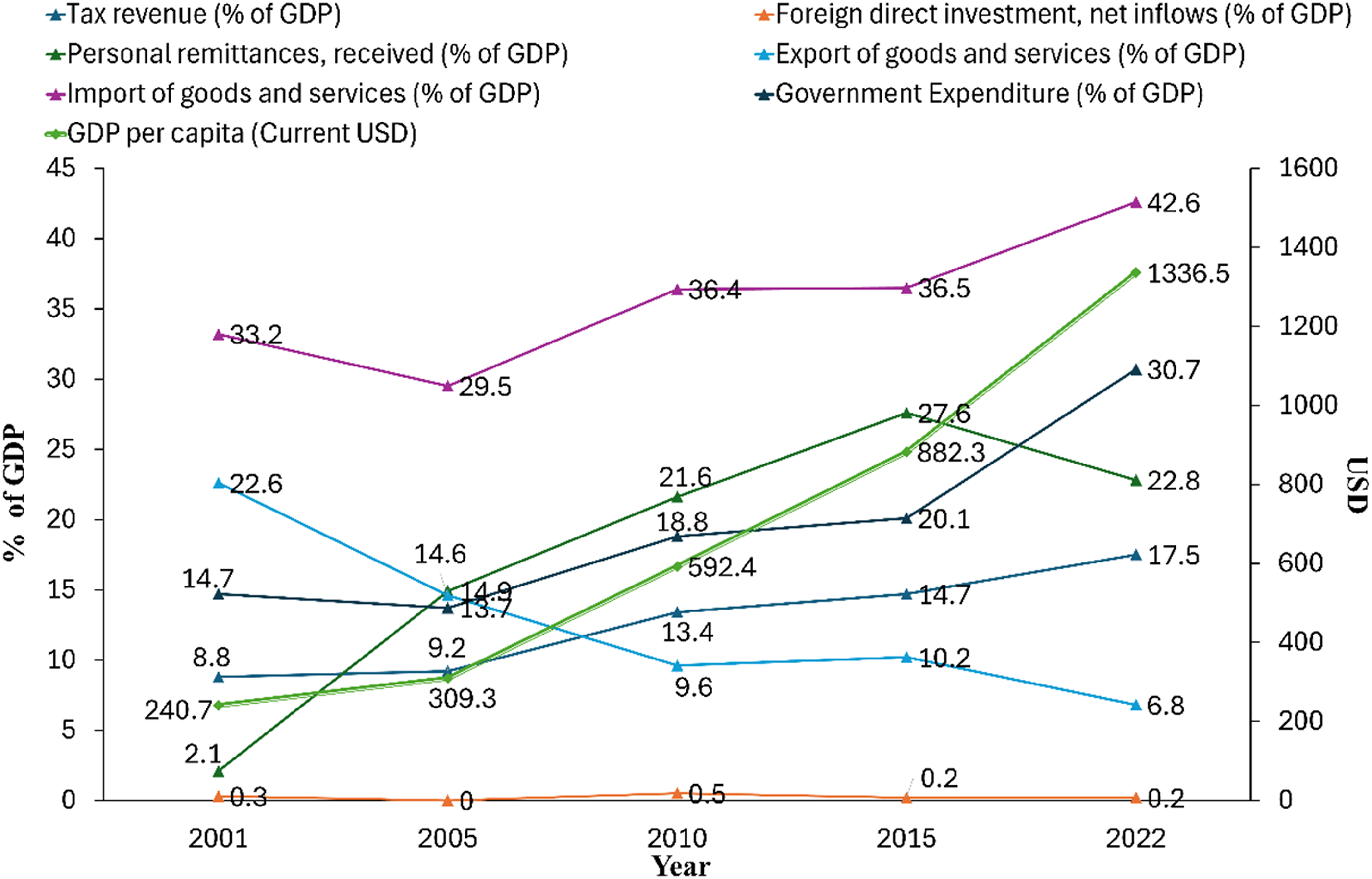
International support and priorities
During the transitional phase, Nepal will rely on substantial assistance from the international community, especially in economic and social sectors, with a particular focus on infrastructure development, job creation, and enhancing production and productivity for sustainable growth (USAID, 2020). Prioritizing the upgrade of health-related infrastructure, improving education quality, and ensuring the sustainability of social security systems will be critical. Additionally, international support will be vital for advancing information and communication technology, bridging the digital divide, and nurturing human capital development (ADB, 2017).
International assistance will also be necessary for facilitating productive transformation, safeguarding economic activities, and bridging significant funding gaps to achieve the SDGs. Post-graduation, Nepal advocates for the continuation of preferential market access to promote international trade and boost exports (Dhital et al., 2022).
Shaping Nepal’s post-LDC graduation journey
In-country resource mobilization
Nepal should look into alternate financing options like blended finance and private sector partnerships because it is anticipated that concessional financing will no longer be available after graduation. Furthermore, structural reforms in the economy are required to increase the base of production and create jobs; we do not anticipate that remittances will be a sustainable basis for the foreign exchange market. Strong efforts to mobilize domestic resources and promote creative finance channels will be necessary to achieve this.
System strengthening with localization focus
The primary goal of international assistance should be to strengthen the foundation, for example, by developing infrastructure, especially in the fields of health and education. Improving infrastructure will raise economic growth and productivity in addition to improving the standard of living for Nepali inhabitants.
Human capital development
Investing in human capital remains crucial for Nepal’s sustainable development. International support should target initiatives aimed at improving education quality, enhancing healthcare services, and promoting skills development to ensure the country’s workforce is equipped for the challenges of the future.
Market access and trade promotion
Post-graduation, Nepal should push for the maintenance of preferential market access in order to advance global commerce and increase exports. This will necessitate taking the initiative in trade talks and putting laws in place that create an atmosphere that is favorable to corporate growth.
Resilience building
Given Nepal’s vulnerability to natural disasters and external shocks like the COVID-19 pandemic, resilience building should be a priority. This includes strengthening shock responsive social protection systems, disaster preparedness, and climate adaptation measures to mitigate risks and ensure gains are not eroded.
Easing avenues for foreign direct investment
Nepal ought to simplify its rules and establish a favorable investment environment to stimulate foreign direct investment. Reforms aimed at streamlining processes and lowering bureaucratic obstacles can accomplish this, and luring in international companies with perks like tax rebates. Furthermore, improving governance and transparency will boost investor confidence, resulting in long-term economic growth and job creation. In addition to providing much-needed funding, promoting FDI inflows can help Nepal achieve its overall development goals by facilitating technology transfer, information sharing, and market access.
Sustaining beyond the sustainable development goals
Planning for sustainable development should remain Nepal’s top priority, with policies matched to the SDGs and climate change mitigation measures. Policies should be based on the nation’s dedication to its national goal, which should guarantee environmental sustainability, resilience, and inclusivity.
Conclusion
By aligning with the global community and drawing lessons from its turbulent history, Nepal can leverage its remarkable growth across various fronts in recent years to usher in a transformative new chapter in its development journey. Prioritizing national goals and objectives, Nepal has the potential to achieve significant progress and provide its people with the prosperity they rightfully deserve. With timely adjustments and strategic shifts, Nepal can harness its abundant potential to not only thrive as a developing nation but also realize its overarching aspiration of becoming a developed nation.
Footnotes
Declaration of conflicting interests
The author(s) declared no potential conflicts of interest with respect to the research, authorship, and/or publication of this article.
Funding
The author(s) received no financial support for the research, authorship, and/or publication of this article.
