




Abstract
The present study examines experiences of hate crimes with multiple motives with a focus on policy and theory-related issues. The authors found that every fifth hate crime victim reports having experiences of multiple motives. These victims are more likely to report their victimization to the police in comparison to victims of hate crimes with single motives. The results also show that belonging to several socially vulnerable groups does not correlate with higher levels of repeat victimization. This is in contrast with intersectional theory as it would predict heightened levels of victimization among such individuals. Lastly, the results show that individuals who belong to more than one socially vulnerable group are more likely to experience hate crimes with multiple motives. Implications for policy and intersectional theory are discussed.
Introduction
Previous studies have shown that motives occasionally intersect in hate crime victimization (Moran and Sharpe, 2004; Stoltzer, 2008; Meyer, 2010, 2012; Chakraborti et al., 2014; Allen 2015). It has been reasoned that this is particularly true for individuals who are associated with more than one socially vulnerable group, for example, belonging to a racial as well as a sexual minority (Mason-Bish, 2014). However, the understanding of such incidents remains limited, as most studies consist of small, qualitative interview studies on subsamples of populations.
Studies of hate crimes with multiple motives generally use intersectional theory to contextualize the phenomena (Moran and Sharpe, 2004; Stoltzer, 2008; Meyer, 2010, 2012). While intersectional theory may appear to be the obvious choice, it remains unclear whether some of its fundamental predictions hold true when applied to hate crime victimization. The aim of the present article is to examine three of these fundamental propositions in a quantitative study on self-reported experiences of hate crime among Swedish university students. These three predictions are that (a) individuals subjected to self-reported hate crimes with multiple motives should have a lower report rate in comparison to victims of single-motivated hate crimes; (b) individuals who belong to several socially vulnerable groups should be more likely to be subjected to repeat victimization; and (c) individuals who belong to several socially vulnerable groups should be more likely to have experiences of hate crimes with multiple motives.
Background
The term ‘hate crime’ has come to be understood as an umbrella concept encompassing acts of violence founded on prejudice and hostility directed toward an individual due to the group to which they are perceived as belonging, such as race, religion or sexual orientation (Perry, 2001; Chakraborti, 2014). Such prejudice and hostility have been increasingly legally recognized as ‘aggravating circumstances’ in a growing number of countries (Perry, 2009; Brax and Munthe, 2014; Perry, 2016). Crimes based on prejudice or hostility directed at the perceived race, skin colour, ethnic origin, religion, sexual orientation or transgender status of the victim are defined as hate crimes by Swedish authorities along with unlawful discrimination and hate speech.
Civil rights organizations that advocate for minority rights have called for hate crime legislation as a practical protection for minority groups who remain especially vulnerable to hate crime victimization (Mason-Bish, 2014). Consequently, hate crime law has been used as a political tool to signal a political stance which takes crimes that primarily target socially vulnerable groups particularly seriously (Perry, 2009; Brax and Munthe, 2014; Mason, 2014). This is especially the case in the Swedish context, where hate crimes are interpreted as a group of crimes that target the basic principles of the democratic regime and its fundamental principles of equality and human rights (Statens Offentliga Utredningar (SOU), 2000: 88). Although hate crime legislation has a symbolic value and the potential to defend the principles of equality, it remains charged and controversial. The current study further examines one of these areas of critique – its focus on single group categories.
Critics argue that the formulation of current legal frameworks renders the justice system inherently unable to handle hate crime incidents in which multiple motives are present (Perry, 2009; Chakraborti and Garland, 2012; Mason-Bish, 2014). The main concern presented is that a single strand approach to hate crime is an over-simplified approach that fails to capture the victim experience as well as the dynamics of this specific form of violence (Perry, 2009; Chakraborti and Garland, 2012; Mason-Bish, 2014). Moreover, the single strand approach appears to have placed certain limitations on how hate crime incidents can be presented in research and policy documents. The latter is exemplified in the case of the annual official statistics on hate crime victimization provided by the Swedish National Council for Crime Prevention (hereafter referred to as BRÅ). It is clearly stated that it can be difficult to ascribe only one motive to a hate crime incident, yet the practice of doing so remains standard (BRÅ, 2015). Such cases are thereby corrected to fit into the single strand approach to motives as well as protected classes.
Theoretical framework
The tendency to overlook hate crimes with multiple motives can be understood through the concept of intersectional invisibility, namely the marginalization of the experiences and needs of individuals who belong to several socially vulnerable groups (Purdie-Vaughns and Eibach, 2008).
Intersectional theory holds that there are hierarchical power relations embedded in the social structure that shape the conditions under which individuals live their everyday lives (Crenshaw, 1991; Purdie-Vaughns and Eibach, 2008; Collins, 2015). These relations of power tend to be based on value constructs attached to group identity markers, such as skin colour or gender. Markers with high status value attached to them become a normative standard, as institutions tend to be adapted for these members of society. Further, the interests and meaning-making of those who belong to the normative standard is often perceived as value-neutral rather than subjective (Carbado et al., 2013, Collins, 2015). The normative standard in Sweden is being white (Expo, 2015, SOU, 2012: 74), male (SOU, 2015: 86), atheist or Christian (Expo, 2015, Weibull and Strid, 2011), middle class (SOU, 2015: 86, Oskarsson, 2008) and heterosexual (RFSL, 2015).
Intersectional theory began primarily as an activist critique directed against civil rights organizations that mirrored the interests and experiences of individuals who diverged from the general norm in one single aspect (see Moraga and Anzaldua, 2015). Organizations that advocate women’s rights are still criticized for their focus on the interests of white, heterosexual women, thereby overlooking the concerns of women of colour and queer women. Such practices alienate the lived experiences and perspectives of individuals with intersecting group identities that diverge from the norm. Intersectional theory holds that the experiences of these individuals are systematically marginalized and made invisible by institutions such as the justice system, welfare services, the labour market, the media and others. Consequently, individuals with intersecting group identities that diverge from the general norm are subjected to structural marginalization within governmental institutions and cultural institutions as well as within civil rights movements. Such individuals can be described as socially vulnerable, as they are subjected to structural disadvantage (Crenshaw, 1991; Purdie-Vaughns and Eibach, 2008; Collins, 2015). Mason (2002) stresses that the term ‘intersectionality’ might misguide the interpretation of how belonging to several vulnerable groups influences expressions of violence targeting these groups. She argues that identity categories do not simply intersect, but rather they come together in the shape of an embodied mutual constitution. Therefore, violence against them is constructed through an Othering in multiple terms (Mason, 2002).
Previous researchers have raised the concern that the single strand approach to hate crime is an expression of intersectional invisibility (Perry, 2009; Chakraborti and Garland, 2012; Mason-Bish, 2014), implying that it might marginalize the experiences of highly vulnerable groups of victims. It has further been reasoned that the interpretational discrepancies between legal framework and victim experience result in a reduced tendency to report hate crimes with multiple motives to the police (Perry, 2009; Mason-Bish, 2014). If there is a significantly lower tendency among victims to refrain from reporting hate crimes with multiple motives, then this also negatively impacts the capacity to prevent such incidents, as preventive measures are generally based on police reports (Skogan, 1984; Perry, 2009). Further, it has been argued that intersectional invisibility results in a heightened risk of various forms of violence, such as partner abuse and discrimination (Crenshaw, 1991; Mason, 2002). However, this notion has been contested by other researchers who claim that group belonging alone does not increase victimization risk but moderates the expressions that violence takes (Chakraborti and Garland, 2012; Collins, 2015). Lastly, individuals who belong to several vulnerable groups should be more likely to have experienced hate crimes with intersecting motives.
Previous research
Empirical research on the experience of hate crimes with multiple motives is rare, and quantitative studies are especially few. To the knowledge of the authors, currently only one has been published that presents the frequency of hate crime with multiple and intersecting motives (Chakraborti et al., 2014). This study explores a wide range of identity strands, many of which are not usually covered by hate crime legislation. These rare categories include being homeless, physical appearance and/or belonging to an alternative subculture. Half of the participants stated that they had been targeted due to multiple strands of their identity, with the most common combination of motives being race and religion (Chakraborti et al., 2014). It remains unknown whether the prevalence of intersecting motives is as high when only including identity strands more commonly included in hate crime legislation.
In line with intersectional theory, several studies conclude that intersecting motives influence the manifest expression as well as the experience of hate crimes. Two interview studies found that class, sexual orientation, gender expression and ethnicity influence the expression of transphobic hate crimes (Moran and Sharpe, 2004; Stoltzer, 2008). This manifested itself clearly in the offenders’ use of derogatory language, for example, by using specific labels that only refer to transgender people of a certain ethnicity (Moran and Sharpe, 2004; Stoltzer, 2008). Similarly, Allen (2015) found that veiled Muslim women experience that offenders target their gender expression and origin as well as their religion. These women described how their gendered dress and appearance made their religion highly visible and that the offenders used derogatory racist remarks along with anti-Muslim remarks. Further, Meyer (2012) found that ethnicity influenced the expression of homophobic hate crimes as victims belonging to racial minorities often were accused of misrepresenting or letting their ethnic community down by belonging to a sexual minority. White victims of homophobic hate crimes, on the other hand, were not subjected to such accusations in connection to their victimization (Meyer, 2012).
Ethnicity, gender and class also seem to interfere in individuals’ evaluations regarding the severity of homophobic hate crimes (Meyer, 2010, 2012). Meyer (2010) found that respondents of colour with a lower-class background constructed their experiences of hate crime victimization as ‘not very serious’ or described themselves as having ‘got off lucky’, reasoning that the incident could have been worse and more violent. White respondents from an upper-class background would instead construct their experiences as ‘very serious and unexpected’ (Meyer, 2010). Further, women perceived physical violence to be the most serious form of hate crime victimization, while male respondents held that verbal violence was the most serious form (Meyer, 2012).
The studies generally adopt a methodological approach in which the primary focus is placed on one victim group and one primary motive, then other factors are added to the analysis at a later stage in the research process (Moran and Sharpe, 2004; Stoltzer, 2008; Meyer, 2010, 2012). For example, Meyer (2010, 2012) studies the intersection of class, gender, sexual orientation and race, but all participants were initially selected because they were from sexual minorities and had experiences of hate crime victimization due to their sexual orientation. These studies (Moran and Sharpe, 2004; Stoltzer, 2008; Meyer, 2010, 2012) offer great insight into the experiences of certain groups of victims, but they also mirror the intersections for the selected group specifically. The experience of the intersection between sexual orientation and ethnicity might have expressed itself quite differently if the sample had been initially collected on the basis of the experience of racially motivated hate crimes.
How the presence of intersecting motives is defined also varies. Stoltzer (2008) clearly applies the intersection of motives herself without any evidence suggesting that the victims ascribe more than one motive to their experiences (Stoltzer, 2008). In contrast, the studies conducted by Chakraborti et al. (2014) and Allen (2015) consist solely of self-reported intersections. However, it seems to be most common that the adoption of a methodology lies somewhere in between these two opposite ends, where some intersections are stated by the victims and others are defined by researchers in the process of data analysis. In general, researchers tend to apply class differences, and victims tend to focus more on the intersection of other factors such as race and gender (Moran and Sharpe, 2004; Meyer, 2010, 2010).
The location of this interpretation is highly important when contextualizing the results. If the interpretation is made primarily by the researcher through data analysis, this can provide valuable information about the underlying power structures that shape these incidents and the structures that are enforced by such violence. Yet, the latter provides little information about the meaning-making and interpretational frameworks available to the victims of the same incidents.
Further, the generalization of the results in the studies remains unclear as most authors have recruited their participants through civil rights organizations, government support agencies and similar (Moran and Sharpe, 2004; Meyer, 2010, 2012; Chakraborti et al., 2014; Allen, 2015), except for Stoltzer (2008), who used police reports. The participation in special-interest organizations and governmental support groups as well as reporting to the police results in a selection process in which the group studied does not necessarily represent any given group or the general population. However, this does not imply that the observed patterns do not hold true for these specific groups.
Aim
From this background, the aim of the present study is to examine the theoretical aspects of hate crimes with multiple motives from an intersectional perspective. More particularly, the present study examines whether three predictions made by intersectional theory hold true for hate crime victims. First, individuals who are subjected to hate crimes with multiple motives should have a lower tendency to report their victimization due to the lack of consistency between their experience and the legal regulation. Second, as intersectional theory holds that individuals who belong to several vulnerable groups are more likely to be victimized, this should also hold true for hate crime victims. Last, individuals who belong to several socially vulnerable groups should also be more likely to have experiences of hate crimes with multiple motives.
Method
The data were collected as part of Experiences and Exposure to Hate Crime (EEHC), a combined survey and interview study conducted at Malmö University during the autumn semester of 2013 and spring semester of 2014 (Andersson and Mellgren, 2016). Survey data from open and closed answers were used in the present study. Questionnaires were distributed in classrooms by members of the research team and 2,853 of the 4,649 students that were reached participated in the study, corresponding to a response rate of 61%. The students were informed that participation was voluntary and that they could end their participation at any time. Several measures were taken to guarantee the integrity of the students while they participated. The questionnaire came in five different versions, and the questions appeared in a different order in each of these. The participants were thereby unable to draw conclusions about the experiences of their fellow students by seeing which sections they had answered. There was also a block of questions directed exclusively at students with no experiences of victimization, making the response times similar regardless of previous experiences. Last, we took measures to schedule the distribution of questionnaires in large classrooms so that we could ask the students to spread out, making it very difficult to get a close look at the answers of other participants. The students were informed about these aspects prior to the distribution. Although the research team strove to give all the respondents the opportunity of answering the questionnaire in the classroom, this was not always possible, in which case students were given questionnaires with franked envelopes so that they could complete them at home and return them by post. Also, participants with experiences of hate crime were able to leave contact information to indicate that they would be willing to participate in an interview, and 32 interviews were conducted as part of the project.
The survey contains information about self-reported experiences of hate crime victimization founded on a hostility and/or prejudice towards the informants’ cultural background/origin, religion, sexual orientation, sex/gender and/or disability. A total of 574 students had experiences of hate crime victimization targeting their sexual orientation, sex/gender, background/origin, religion, and/or disability and were selected for the study.
Comparisons between the sample and the registered students show that the participants are representative of the student population in respect of gender, age, proportion with a foreign background and proportion of students in basic and advanced level studies.
However, there are limitations in the extent to which the results of a study conducted on a student population correspond to the general population. Evidence suggests that the level of hate crime victimization is particularly high among students (Perry, 2012). Though the proportion of hate crime victims might be higher in a student population, this does not necessarily imply that the patterns of victimization – such as crime types, consequences of victimization and which individuals or groups are targeted – do not mirror these patterns in a representative sample. Nevertheless, having an academic background might influence how victims perceive their experiences, as norm-critique is discussed in many courses and programmes.
Measures
Hate crime victimization consists of verbal or written threats, harassment or bullying, as well as being followed or chased, experiencing minor assault (being hit with an opened hand, having one’s hair pulled or similar), experiencing assault and aggravated assault (being hit with a closed fist, kicked or attacked with a weapon or other object), experiencing sexual molestation (being subjected to unwanted sexual acts such as touching, kissing, grabbing or fondling), rape, robbery and burglary when founded on a self-reported hostility and/or prejudice towards the informants’ sex/gender, cultural background/origin, sexual orientation, religion and/or disability. Sex/gender will be referred to as ‘gender’ and cultural background/origin will be referred to as ‘origin’. The definition of hate crime used in the present study thereby includes gender and disability, groups that are not protected by Swedish legislation.
The survey contains information about victimization rates during the past year as well as lifetime experience of victimization. Answers from the open-ended question, ‘Why do you believe that the incident/incidents was/were a result of a prejudice against your sex, religion, gender identity, sexual orientation, origin/background or disability?’, were used to assist the interpretation of the closed questions.
Participants who stated that they had experienced victimization due to more than one aspect of their identity have been classified as having experiences of hate crimes with multiple motives (HCMM). Due to data limitations, it remains unconfirmed whether all of those who were victimized more than once and who have ticked more than one motive have experienced these motives in the same incident or on different occasions. However, a closer examination of the answers from open-ended questions along with the results from the interview study show strong support for the validity of the classification. For example, in line with prior studies, the participants in the interview study explained how their identity traits would come together and form a specific type of victimization. Similarly, answers from open-ended questions from the survey showed that offenders used derogatory labels on several of the victims’ group-identity markers in the same incident, and the participants often used the term ‘and’ or a slash when listing the identity traits targeted by the offender. In sum, the possibility of misclassification in some cases remains a theoretical possibility, but we find no direct evidence for it in our data.
Participants who stated that they had experiences of victimization due to one aspect of their identity are classified as having experiences of hate crimes with single motives (HCSM).
Repeat victimization was measured on a four-point scale related to how many times the informant has been victimized during the past year (0 = no victimization during the past year, 1 = been victimized once during the past year, 2 = been victimized twice during the past year, 3 = been victimized three or more times during the past year). Thus, it only measures recent experiences of repeat victimization and does not capture past periods of repeat victimization.
Police reporting was measured by a dichotomous variable stating whether the victim has reported one or more hate crime incidents to the police during the past year (0 = no, 1 = yes).
The following demographic variables were coded in such a way that 0 represents the general norm in a Swedish context, and 1 represents socially vulnerable individuals.
Gender was measured by self-reported gender identity (0 = man, 1 = woman).
Transgender status (0 = no, 1 = yes) was defined as having a transgender identity such as being transgender, gender queer or transsexual. This category also includes those who have experiences of drag, cross-dressing, transvestism or similar.
Origin was primarily based on the informants’ parents’ country of birth. However, as some of the informants had been adopted, we also controlled for their own country of birth when categorizing the sample into normative and vulnerable (0 = European, North American; 1 = African, Asian, Latin American, Oceanian or mixed).
Religion was based on self-reported worldview or religion (0 = atheist or Christian, 1 = Buddhist, Hindu, Jewish, Muslim and others).
Function variation was based on self-reported disability (0 = no disability, 1 = having a physical or sensory impairment, a learning disability or cognitive impairment, or a mental health condition).
Sexual orientation was based on self-reported sexual orientation (0 = heterosexual, 1 = asexual, bisexual, homosexual, pansexual and others.
These demographic variables were transferred to a scale ranging from 0 to 2 in which the respondents were categorized according to how many vulnerable groups they belonged to. Included in 0 are normative individuals and individuals who belonged to one vulnerable group. From an intersectional perspective, this group is privileged as it is made up of individuals who have their interests mirrored in official institutions, common culture and civil rights movements. The remaining individuals who all belonged to three or more vulnerable groups compose the group that, according to intersectional theory, is subjected to intersectional invisibility, marginalization and greater vulnerability. This group contains wide internal variation in the number of overlapping vulnerable groups to which they belong. Consequently, the authors chose to divide this group into two categories: ‘1’ corresponds to individuals belonging to two overlapping vulnerable groups, and ‘2’ corresponds to individuals belonging to three to five overlapping vulnerable groups. The authors have reasoned that there should be a difference in levels of HCMM between these two groups, in which those found in category 2 are more likely to experience HCMM.
Naturally, there are limitations with simply adding belonging to further vulnerable groups into the scale described above. The authors acknowledge that there is a dynamic interaction in belonging to various groups and that belonging to different vulnerable groups also corresponds to different levels of vulnerability. For example, it is highly problematic to compare being a woman with being African-Swedish, and yet these two categories are assigned the same value on the scale. However, if the risk of being subjected to HCMM increases along with the number of overlapping vulnerable groups to which people belong, this should be captured by such a scale.
Table 1 summarizes the demographic distribution across the sample of hate crime victims (N = 574). The frequencies indicate that there are differences between HCSM and HCMM victims in demographic composition. While the proportions of men and women are similar between HCSM and HCMM victims, the groups differ in transgender status, origin, religion and function variation.
Demographic distribution.
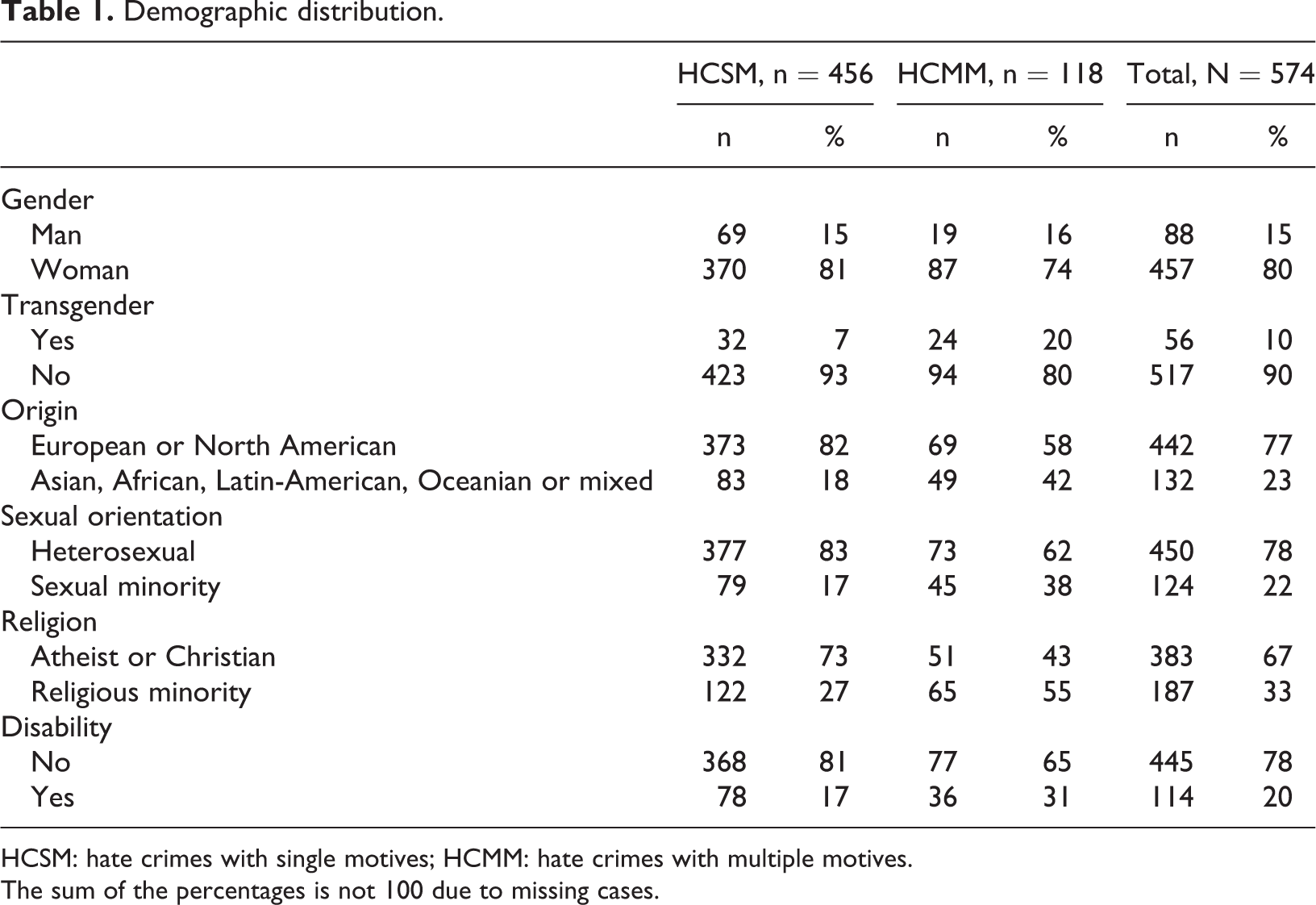
HCSM: hate crimes with single motives; HCMM: hate crimes with multiple motives.
The sum of the percentages is not 100 due to missing cases.
Analytic strategy
The first question regarding police reporting is tested by conducting a Chi-squared test comparing reporting rates between participants with experiences of HCMM and HCSM. If the previous critics of the single strand approach are correct in their proposition, the null hypothesis should be rejected and the distribution will be significantly skewed in such a way that victims of HCMM have a lower rate of police reporting in comparison to victims of HCSM.
The second question examined in the present study is the risk of repeat victimization. As theoretical proponents of intersectional theory disagree about the extent to which belonging to a demographic group alone governs the risk of repeat victimization, we have chosen to examine this question further by testing if belonging to several vulnerable groups is associated with higher levels of repeat victimization in a sample of hate crime victims. If the risk of repeat victimization is associated with higher levels of repeat victimization, we should be able to reject the null hypothesis by comparing the likelihood of repeat victimization using a Chi-squared test.
Lastly, we examine to what extent belonging to several vulnerable groups can predict experiences of hate crimes with multiple motives in a logistic regression. As intersectional theory proposes that the expression of violence is formed by social hierarchies, we ought to be able to observe a statistically significant relationship between social vulnerability and HCMM. This proposition has gained support through several qualitative studies on hate crime victimization (Moran and Sharpe, 2004; Stoltzer, 2008; Meyer, 2010, 2012; Allen, 2015) but has yet to be examined in a quantitative study.
Results
In total, 574 respondents had experiences of hate crime victimization (see Table 2). Gender and origin comprise the most common self-reported motives behind the victimization. Vulnerable groups were subjected to hate crimes to a larger extent in comparison with normative groups. Among those who had been victimized due to their gender, the vast majority were female (n = 355) or transgender (42) students. Similarly, students with an Asian, African, Latin-American or mixed background (n = 85, equal to 19% of this population) were more likely to be subjected to hate crimes due to their origin in comparison to European or North American students (n = 97, equal to 4% of this population).
Hate Crime Victimization.
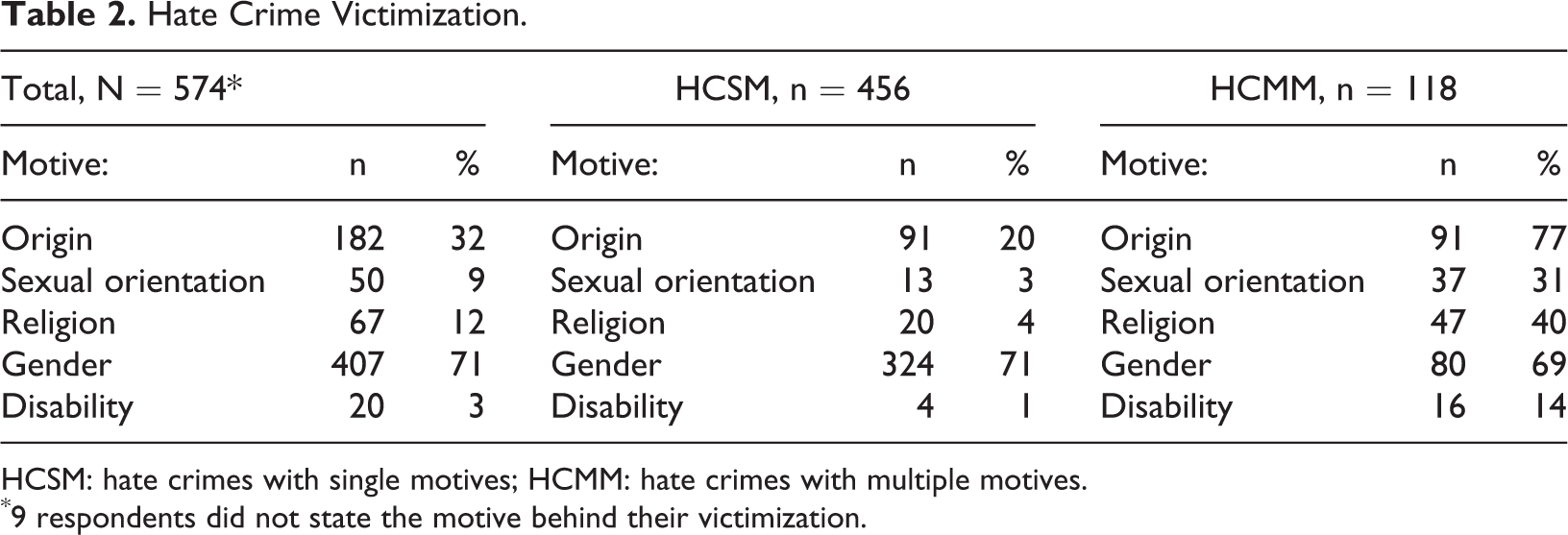
HCSM: hate crimes with single motives; HCMM: hate crimes with multiple motives.
*9 respondents did not state the motive behind their victimization.
Few students had experienced hate crime victimization based on hostility directed towards their religion, sexual orientation and/or disability. The groups’ distribution follows the same pattern: those subjected to hate crime due to their sexual orientation were mostly homo-, bi- or pansexual (n = 40), and the larger proportion of those subjected to hate crime due to their religion belonged to religious minority groups (n = 48). That fewer experienced hate crime due to their religion, sexual orientation and/or disability in comparison to gender and origin is partly numerical, as these groups are smaller, and partly due to the fluidity of these identity markers (Andersson and Mellgren, 2016). In general, individuals belonging to a highly visible minority, meaning those who wear religious symbols on a daily basis or are openly homosexual in all contexts, are at greater risk of being subjected to hate crime victimization (Andersson and Mellgren, 2016).
Every fifth informant (n = 114) had experiences of hate crime victimization with multiple motives. The distribution of self-reported motives varies greatly between HCSM and HCMM victims, except the proportion of individuals targeted due to their gender.
Reporting to the police
Reporting hate crime victimization among both HCSM and HCMM victims was low (see Table 3), considering the overall report rates in a Swedish context: 26% for crimes against a person and 54% for property crimes (BRÅ, 2008). Moreover, the tendency to report victimization to the police was generally lower among victims of threats and harassment, which are two crime types that comprise a large part of all hate crimes (BRÅ, 2008). Consequently, this aspect contributes to the low report rate among hate crime victims (Andersson and Mellgren, 2016; Lyons and Roberts, 2014). The difference may also be due to a normalization of violence and a low level of trust in the justice system (Andersson and Mellgren, 2016; Wells and Polders, 2006).
Police reporting.

X2 (1, n = 0 396*) = 6.84, p = 0.009, Cramers V = 0.131, * = significance set at 0.05.
Table 3 shows that HCMM victims were more likely to report their victimization experiences to the police in comparison to HCSM victims and that this difference is significant. The current study thereby contests the concerns of lower reporting rates in this specific group due to the lack of consistency between lived experience and the legal single strand approach. However, the low reporting rate among HCSM victims is likely to be partly a result of the distributional differences of motives between the groups and differences in types of crime. It is shown that 61% (n = 191) of the HCSM victims had been subjected to sexual molestation in comparison to 36% (n = 30) of the HCMM victims. This offence has a particularly low reporting rate in general (BRÅ, 2008). Similarly, HCMM victims were slightly more likely to have been subjected to assault (28%, n = 23) and property crimes (10%, n = 8) in comparison to HCSM (17%, n = 94 and 3%, n = 8, respectively). These crime types are characterized by a high report rate in general (BRÅ, 2008). Theoretical aspects may also contribute to explaining the results. For example, it has been theoretically presumed that victims are aware of the legal single strand approach. Nevertheless, it is unknown how aware hate crime victims are of the legal formulation and technicalities involved. This explanation also presumes that the victims do not only label their experiences as racist, anti-religious, homophobic or similar, but also label their experiences as ‘hate crimes’, which is yet another aspect that is unknown.
However, these results should be interpreted with some care due to the small effect size and small group of HCMM who were victimized during the past year.
Repeat victimization
Table 4 shows that the level of repeat victimization during the past year was high in comparison to general patterns of repeat victimization (for an overview on international rates, see Farrell and Bouloukos, 2010). Personal crimes do have higher rates of repeat victimization in comparison to property crimes, and the overall risk of repeat victimization among victims in Sweden is 30% (BRÅ, 2013). The results in Table 4 thereby confirm that, in general, hate crime victims are especially vulnerable to repeat victimization.
Repeat victimization.
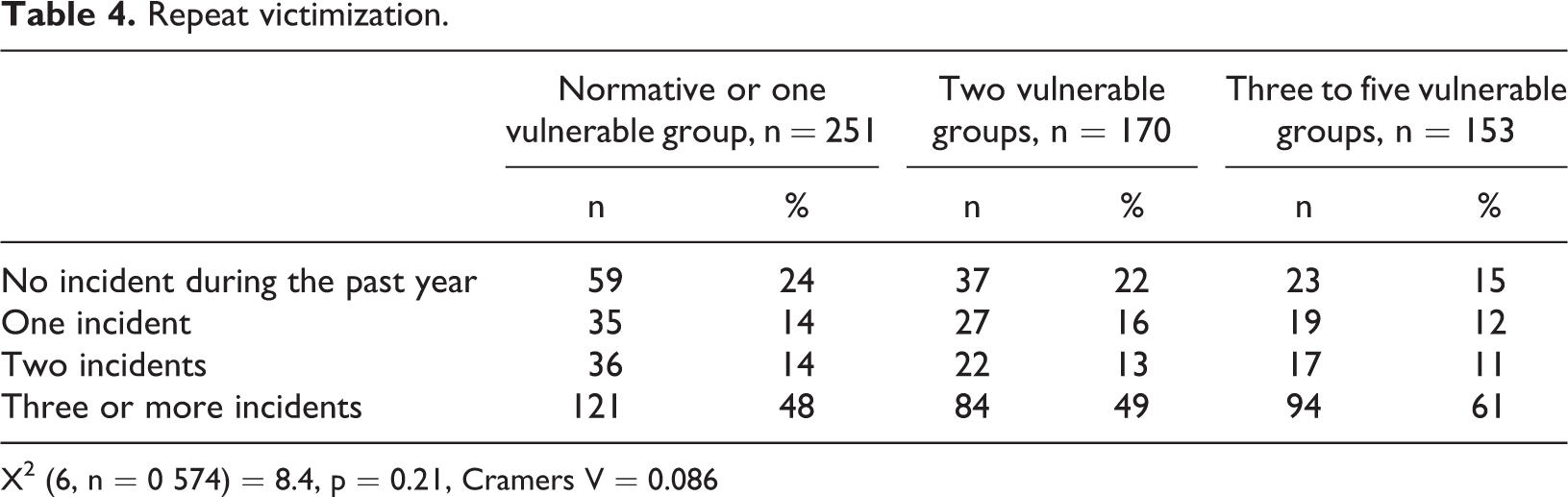
X2 (6, n = 0 574) = 8.4, p = 0.21, Cramers V = 0.086
In contrast to the idea proposed by certain proponents of intersectional theory, the results do not support the notion that individuals who belong to several socially vulnerable groups are rendered more vulnerable to victimization. While a weak statistical trend can be observed in Table 4, the differences remain insignificant, with a small effect size. The results thereby indicate that vulnerability to repeat victimization among hate crime victims is primarily governed by factors other than group belonging alone.
Probability of experiencing hate crime with multiple motives
A logistic regression was conducted to determine whether belonging to intersecting non-normative groups can predict HCMM among hate crime victims (N = 574). The model is significant, with a predictive capacity of 19% (Nagelkerke R2). The Hosmer and Lemeshow test further shows that the data fit the model well. Based on intersectional theory, the reference group in the analysis consists of normative individuals and individuals who belong to one vulnerable group (n = 251).
The model in Table 5 shows a pattern in which the likelihood of experiencing hate crimes with multiple motives increases along with belonging to several intersecting vulnerable groups. Belonging to two vulnerable groups (n = 170) increases the likelihood marginally, but the effect remains insignificant. In contrast, individuals who belong to three or more vulnerable groups (n = 153) were eight times more likely to experience hate crimes with multiple motives. Thereby, the results show that the likelihood of experiencing hate crimes with multiple motives increases drastically when the individual belongs to at least three vulnerable groups but not when they belong to two vulnerable groups.
Hate crimes with multiple motives (age adjusted).
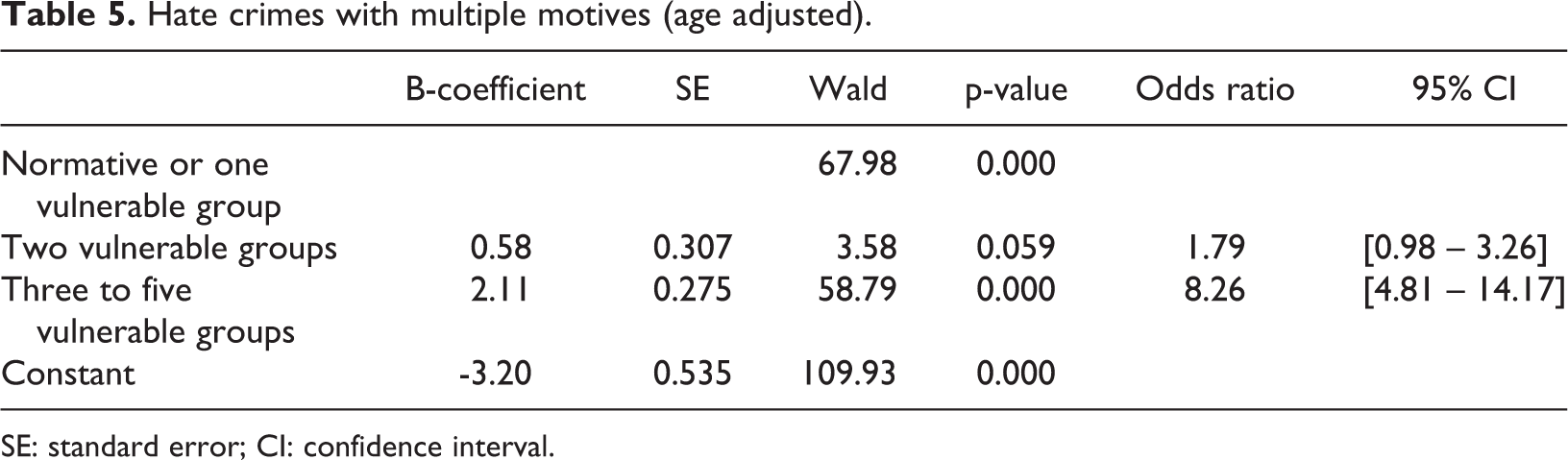
SE: standard error; CI: confidence interval.
Discussion
The results of the present study provide further information on several contemporary issues within the field of hate crime studies. First, the study shows that victims of hate crimes have a noticeably lower tendency to report their victimization to the police in comparison to victims of offences without bias. Consequently, there are reasons to believe that special factors can negatively affect the reporting rates of hate crime victims. Evidence suggests that victims of hate crimes tend to refrain from reporting their experiences to the police due to the normalization of violence, low trust in the police and the experience that the justice system cannot fulfill their needs (Andersson and Mellgren, 2016). The presently low report rate remains highly problematic, making hate crime a crime type with a low detection risk. The latter is of particular concern, as hate crimes have a severe impact on minority groups resulting in high levels of fear, worry and social marginalization (Perry, 2001; Iganski, 2001; Perry and Alvi, 2012; Funnell, 2014; Pezzelia and Fetzer, 2017). Research on factors that drive down reporting rates among hate crime victims is necessary along with evaluations of interventions that aim to increase report rates.
Second, contrary to concerns raised in previous articles (Perry, 2009; Mason-Bish, 2014), the results of the present study suggest that experiences of HCMM did not influence police reporting. This may be due to the high number of experiences of sexualized violence among the control group, as this is known to be a form of violence with a generally low reporting rate (BRÅ, 2008). It may also be due to data limitations as we were unable to confirm that several motives clustered in single events among all victims of HCMM. However, this might also be due to a logical fallacy among those who have proposed such a link, as it relies on the assumption that hate crime victims are aware of the presence of the single strand approach. Our knowledge about how victims define and create meaning from their experiences of hate crime remains limited as victim studies have generally focused on social, psychological and physical harm. Studies on victim harm are central for providing victims adequate support but do not offer us information on other aspects of victimhood, such as meaning-making. Further, as there are no studies examining how cases of HCMM are handled within the justice system, we currently know nothing of how the legal system would handle and prosecute HCMM.
Third, in line with intersectional theory, the study confirms that respondents with self-reported experiences of HCMM are more likely to diverge from the general normative structure in several aspects. However, it remains unexplained why there is a large difference between individuals belonging to two vulnerable groups and those who belong to three or more vulnerable groups. To the knowledge of the authors, there are no proponents of intersectional theory who have suggested a threshold beyond which the risk of being targeted due to multiple identity strands increases drastically. The authors believe that a key issue at play here is the difference between normativity and normality. The groups created for the analysis were based on normative ideals. However, the larger part of the population is composed of individuals who have one or two identity strands that are non-normative. Consequently, it appears as though demographic normality in Sweden is different from Sweden’s cultural and normative ideals. As such, this demographic composition may have resulted in the acceptance of one or two non-normative identity traits. The authors also analysed the groups further to determine if there were certain combinations or clusters of identity traits that appeared to generate a higher risk than others but found no evidence supporting this assumption (results not shown in this article).
Last, the results show that the risk of repeat victimization is not significantly governed by group belonging as proposed by some proponents of intersectional theory. Researchers who have proposed that belonging to several socially vulnerable groups increases the risk of being subjected to repeat violence generally base their reasoning on interviews, case studies or ethnographic studies targeting victims (e.g. Mason, 2010, 2012; Crenshaw, 1991). Such samples often come with a selection bias, meaning that the results may not be applicable to a wider population. In light of the results from the current study, we would like to encourage quantitative studies of different population groups as well as longitudinal studies mapping the risk of being subjected to hate crime among different groups at different life stages. We also want to encourage qualitative studies that further examine vulnerability to repeat violence among hate crime victims in relation to less tangible factors than group belonging alone. As clearly shown by our study, group belonging has a limited influence on victimization risk. At the same time, it is also known that minorities report significantly higher levels of victimization in comparison to majority populations (Andersson and Mellgren, 2016). Consequently, we need further understanding of the moderating factors that create an added victimization risk within these groups. It is possible that identity characteristics such as types of clothing, body language, educational level, mental health, income, routine activities and similar moderate risk and vulnerability identity markers are of relevance for hate crime victimization as well as race, gender identity, religion and sexual orientation. For example, a gay man with a feminized body language might have a higher victimization risk in comparison to a gay man with a masculinized body language. In such a case, body language or visibility could moderate the risk of being subjected to hate crime based on sexual orientation.
Footnotes
Acknowledgements
This work was supported by the Swedish National Crime Victim Compensation and Support Agency.