



Abstract
Research has consistently shown that sexual victimization during childhood and adolescence can lead to negative outcomes. However, little research to date has sought to test whether these experiences can shape security of attachment in adulthood, an important concept in attachment theory. Utilizing a longitudinal community sample of African Americans, the current study tested whether sexual victimization during childhood and adolescence correlated with security of attachment in emerging adulthood while controlling for parenting. Results of regression analyses showed that sexual victimization did correlate with greater insecurity of attachment in emerging adulthood while controlling for parenting among females, but not males. Implications of these findings for policy and theory are discussed.
Introduction
Decades of research have shown that sexual victimization has an impact on behavior and functioning. Being sexually victimized is very traumatic, and these kinds of experiences are likely to be seen as unjust (Kilpatrick et al., 1987; Miller et al., 1996; Resick, 1987). A large and varying literature has established links between childhood victimization and later delinquency and violence (Agnew, 2002; Baron, 2004; Gorman-Smith and Tolan, 1998; Hay and Evans, 2006; Margolin and Gordis, 2000; Scarpa, 2001), substance use (Brems et al., 2004; Davis et al., 2002; Gutierres and Van Puymbroeck, 2006; Linares, 2004; Lo and Cheng, 2007; Neff and Waite, 2007), and depression (Gomes-Schwartz et al., 1985; Mannarino et al., 1989), to name but a few of the negative consequences. However, less empirical work has concentrated on the psychological mediators that may link sexual victimization to later adjustment problems. One such potential mediator is attachment style. The relationship between childhood and adolescent victimization and adult attachment style is an important area of research that deserves more focus because attachment style may serve as a mediator of the impact of sexual victimization on both internalizing and externalizing problems in adulthood. While past research has indicated that early secure attachment can serve as a buffer against effects of sexual abuse later in life, less is known about the impact sexual abuse may have on young adult romantic attachment style.
The purpose of the current study is to explore what effect childhood sexual victimization has on insecurity of adult attachment in emerging adulthood after controlling for the central variable in attachment theory, parental support/rejection. Thus, the research question guiding this study is: does sexual victimization have an effect on romantic partner attachment style after controlling for parenting measures? This research question is addressed using FACHS, the Family and Community Health Study. The FACHS data set is a longitudinal study of African-American families in Georgia and Iowa.
Consequences of victimization
The literature on the negative consequences of victimization has been clear and consistent. This literature has shown that experiences of victimization have associations with later negative outcomes in both adolescence and adulthood. Furthermore, a large body of research exists linking sexual victimization in childhood and adolescence specifically with a wide range of developmental consequences, including psychological and physical health problems, as well as future victimization (Browne and Finkelhor, 1986; Classen et al., 2005; Dishon-Brown et al., 2017; Maxfield and Widom, 1996). Some research also indicates that child sexual abuse (CSA) may be linked with a higher likelihood of engaging in sex offenses later in life (Delisi et al., 2014).
In a review of the literature on victimization and its effect on antisocial behavior among adolescents, Margolin and Gordis (2000) note numerous studies that connect victimization with rough play with peers, higher peer ratings of aggression, and higher rates of disciplinary problems at school. In the same review they cite a wide literature that connects CSA with aggression, delinquency, and destructiveness (Margolin and Gordis, 2000). Menard (2001) found that experiences of nonfamilial victimization during adolescence tripled the odds of adult involvement in violent and property offenses and doubled the odds of being involved in domestic violence. In the same study, Menard (2001) found that the odds of victims of nonfamilial violence experiencing problem drug use in adulthood increased by 90% compared with the non-victimized population. Numerous other studies have found similar results concerning victimization and substance use in adulthood (see Davis et al., 2002; Lo and Cheng, 2007; Lo et al., 2008). However, little research to date has explored the effect victimization has on attachment style in adulthood (for an example, see Brenner and Ben-Amitay, 2015).
The importance of attachment style
Turning to a brief review of attachment theory, Bowlby (1969, 1973, 1980) stated that attachment is a biologically based bond with one’s caregiver. He first proposed attachment theory as an explanation for the motivation of infants to rely on their caregivers. Attachment behavior is functionally important for infants, as it serves as a protective mechanism and increases the child’s chances of survival (Bowlby, 1969). As such, attachment is universal and most apparent during periods of distress during childhood, but attachment is actually evident throughout the life course (Ainsworth and Salter, 1989). Key to Bowlby’s (1973) theory is the concept of the internal working model. The internal working model is a mental construction that serves as the basis for personality (Bowlby, 1973). On the basis of early interactions with their attachment figure a child comes to learn their role in relationships as well as others’ roles in relationships. Caregivers who are insensitive and unresponsive, display little emotion, and who generally avoid physical contact with their child produce children with an insecure attachment style, which has many consequences for both adolescent and adult functioning in relationships (Alexander, 1992). But as has been noted in the attachment literature, attachment can and does change throughout the life course due to events outside of the parent–child relationship (Ainsworth and Salter, 1989). The current study considered the question: can experiences of sexual victimization during childhood and adolescence alter the security of one’s adult attachment to others?
A few previous studies have linked adult attachment style with childhood victimization, but their generalizability is somewhat limited in that they frequently utilize samples of incarcerated individuals and individuals seeking substance abuse treatment. Adults with a history of emotional abuse in childhood are more likely to display insecure attachment styles in adult relationships (Riggs et al., 2011); findings from this study also indicate that childhood emotional abuse increases attachment avoidance to a greater degree for women than men, providing evidence for continued investigation into gender differences in the development of attachment behaviors. Minzenberg and colleagues (2008) found links between childhood maltreatment and borderline personality disorder (BPD). Furthermore, displaying an insecure attachment style was associated with poorer executive function among individuals in this study diagnosed with BPD as compared to a control group.
Alexander (1992) proposed a method by which attachment theory could be related to victimization, specifically CSA. She sees poor parental attachment as a precursor to CSA, and identifies insecure attachment as a mediator between CSA and the long-term consequences of CSA (Alexander, 1992). In short, Alexander (1992) proposed an intergenerational transmission of insecure attachment, and CSA is one of the ways parental insecure attachment to the child manifests itself. Furthermore, other researchers have found evidence that children who grow up in more generally dysfunctional families are more likely to experience sexual abuse (Gold et al., 1999). While the causal factor is unknown, damaged relationships are more likely in families where this type of abuse is found (Gold et al., 1999). In short, CSA results in insecure attachment, which is then related to a host of problems in adolescence and emerging adulthood, including problems in interpersonal relationships (intimate and non-intimate), depression and anxiety, and low self-esteem (Alexander, 1992). Limited research has already supported Alexander’s proposal concerning the relationship between CSA and later attachment (Alexander, 1993; Aspelmeier et al., 2007; Mickelson et al., 1997).
Alexander’s (1993) work was based on victims of incest; less is known about how this process may operate with nonfamily members as the perpetrator, as in the current study. Some past research indicates that CSA perpetrators are much more likely to be members of the immediate family than unrelated (Paige and Thornton, 2015). Furthermore, females are more likely to be familial perpetrators of CSA than males (Weinsheimer et al., 2017); by investigating nonfamilial perpetrators of abuse we can shed light on how these processes operate in an understudied group of CSA victims.
The current study
To date, there has been a dearth of studies that look simultaneously at the effects that both familial and nonfamilial sexual victimization in childhood and later adolescence have on attachment in emerging adulthood. While Alexander (1992) argues that the long-term consequences of sexual victimization are related to the attachment relationship within which the victimization occurs, we argue that even victimization at the hands of strangers could be consequential for later adult attachment. Children and adolescents view parental figures as protectors, and when a child or adolescent experiences victimization, they may interpret this as a failure on the part of their parents to adequately protect them from harm. This failure could have the unintended consequence of contributing to an insecure attachment style both concurrently and in later life, and influence an individual to be more likely to develop a negative internal working model of relationships.
The current study investigates these processes separately for males and females. Research shows that females are more likely to experience CSA compared with males (Schober et al., 2012), but research also indicates that males and females experience different reactions to CSA. For example, females report more severe symptoms as a result of CSA (Martin et al., 2004; Ullman and Filipas, 2005). Research also indicates that attachment style varies by gender, and parenting behaviors may affect the attachment style of females differently than males (Wilhelm et al., 2016).
Another contribution of the current study is the lack of focus on Alexander’s (1992) work on sexual victimization in later adolescence and its potential consequences for attachment in emerging adulthood. Research has shown that security of attachment can and does change during adolescence and adulthood (Davila and Cobb, 2004; Mikulincer and Shaver, 2010; Zhang and Labouvie-Vief, 2004), so sexual assaults that occur later in adolescence could, in addition to CSA, shape attachment style in emerging adulthood. The literature discussed above is limited in scope in two ways: Minzenberg and colleagues (2008) focus on individuals with BPD and Riggs and colleagues (2011) specifically studied outcomes of childhood emotional abuse. The current study uses a community sample and investigates the impact of a different type of victimization (CSA).
Individuals who have traumatic experiences such as sexual victimization in childhood and adolescence are generally more fearful of others and less trusting in relationships, which is likely to carry over into their adult romantic relationships. Finally, this study investigates these relationships in an understudied population. Most research on attachment style and CSA use all or mostly Caucasian populations; this study adds to the body of research on these relationships among African Americans. There is reason to believe that African Americans may have qualitatively different experiences both as victims and in their romantic relationships (Kogan et al., 2013). Although there is less evidence regarding the impact of attachment style within this population, some prior studies do indicate that minority individuals are at higher risk of negative outcomes with insecure attachment such as depression (Rushton et al., 2002), anxiety, and poor functioning in adult relationships (Liem and Boudewyn, 1999).
In the current study, we use a longitudinal data set to test what effects sexual victimization in childhood and later adolescence may have on insecurity of attachment in emerging adulthood after controlling for the important aspects of parenting (i.e. parental warmth and hostility) that shape attachment. This method is preferable to those in past studies for two reasons. Firstly, the sample is one of the general population rather than of a specific population of victimized individuals. Secondly, longitudinal data allow for properly testing the hypotheses through the temporal ordering of events that is not possible using cross-sectional data.
Based on the previous literature we test three hypotheses in the present study. The first hypothesis (H1), coming from Alexander (1992), is that low parental warmth and high parental hostility will be positively correlated with sexual victimization experiences. Furthermore, that parental warmth and hostility will be more highly correlated with experiences of CSA than sexual victimization experiences in later adolescence (H2). The third hypothesis (H3) is that CSA and sexual victimization in later adolescence will have a significant relationship with insecurity of attachment in emerging adulthood even when controlling for parental warmth and hostility. Attachment theory predicts that parenting behaviors are the most important determinants of adult attachment style; in contrast, the current study proposes that CSA and sexual victimization are also powerful predictors of insecure adult attachment. These hypotheses are tested using data from a longitudinal study of African Americans.
Data and methods
Sample
The present study draws on data from waves 1–5 of the FACHS, a multisite investigation of neighborhoods and families and their effects on the health and development of children (Conger et al., 2002; Simons et al., 2002; Simons et al., 2007). At Wave 1 (collected in 1994), the average age of the target respondents was 11. Data were gathered approximately every 2–3 years following this; at Wave 5 respondents were, on average, age 21.5. The FACHS sample consists of several hundred African-American families living in Georgia and Iowa. At the time of their original recruitment, each family included a child who was in the fifth grade. At each wave of data collection interviews were conducted with the target child and their primary caregiver. A primary caregiver was defined as a person living in the same household as the target child, who was responsible for most of the child’s care (Simons et al., 2007). Eighty-four percent of primary caregivers were the child’s biological mother, 6% the child’s father, and 6% were the child’s grandmother. At the start of data collection, 258 African-American families were involved (114 in Georgia and 144 in Iowa), and a total of 867 African-American children (400 boys and 467 girls; 405 in Georgia and 462 in Iowa) and their primary caregivers took part in the study. In the current study the total number of cases examined after taking into account missing data was 554: 320 females and 234 males. There were no significant differences in the analysis sample and the full sample, and this is in line with sample sizes in other studies with this data (Burt et al., 2017). A more comprehensive description of the sampling procedure and interview processes used in the FACHS study can be found in several previous articles (see Simons et al., 2002; Simons et al., 2007; Simons et al., 2003).
Measures
The present analyses utilized measures of parenting practices, sexual victimization experiences, and attachment. Child self-reports were used to create all of the measures in the current study. The independent variable is a continuous measure, we therefore utilized ordinary least squares (OLS) regression with robust standard errors in the multivariate analyses. The specifics of the measures used are described below.
Dependent variable
Insecure attachment: The dependent variable attachment style to romantic partners was measured using the Experiences in Close Relationships – Revised scale (ECR-R; Fraley et al., 2000). This includes seven items in Wave 5 measuring feelings about attachment within an overall insecure attachment scale. These items were direct reports from the target respondent. All of the items began with ‘Thinking about romantic partners in general,’ followed by a statement that the respondent would record agreement or disagreement on using a seven-item Likert scale. Examples of statements used in these items include ‘I don’t like people getting too close to me,’ ‘I find it difficult to trust others completely,’ and ‘I often worry that my partner doesn’t really love me.’ Strong agreement with these items is believed to be indicative of having an insecure attachment style. The summed scale has a range of 7–49, with higher scores indicating greater insecurity of attachment. This scale has a record of strong reliability (Fraley et al., 2000; Sibley and Liu, 2004). The coefficient alpha for this scale was 0.78 for the full sample. 1
Independent variables
Parental warmth: The parenting variables were adapted from scales developed for the Iowa Youth and Families Project (Conger and Elder, 1994; Conger et al., 1992) and have established reliability and validity. The scale of parental warmth consists of nine items in which the target child reported how often in the past 12 months their primary caregiver engaged in certain behaviors. Examples of behaviors displaying warmth that are included in this scale are letting the child know they really care about them, listening carefully to their point of view, displaying love and affection, and telling the child they love them. The range of responses for these items is from (1) always to (4) never. These items were reverse coded and scaled, such that higher scores on this scale mean higher parental warmth. The scores on this scale from waves 1 through 3 were summed to produce an overall scale of total parental warmth. The coefficient alphas for this scale for waves 1 through 3 were 0.82, 0.88, and 0.90, respectively.
Parental hostility: The scale of parental hostility consists of 14 items in which the target child reported how often in the past 12 months their primary caregiver engaged in certain behaviors. Examples of behaviors by the primary caregiver included in this scale are threatening to hurt the child physically, slapping or hitting with hands, insulting or swearing at the child, and giving the child a lecture about how she/he should behave. The range of responses for these items is from (1) always to (4) never. These items were reverse coded and scaled, such that higher scores on this scale mean higher parental hostility toward the child. The scores on this scale from waves 1 through 3 were summed to produce an overall scale of total parental hostility. The coefficient alphas for this scale for waves 1 through 3 were 0.71, 0.76, and 0.81, respectively.
Child sexual abuse: This measure was constructed from three items that asked about sexual abuse experienced before the age of 15. The three questions asked whether a respondent had been touched sexually, persuaded to engage in a sexual act, or forced to engage in a sexual act by an adult or someone in charge of or responsible for them. The possible responses were never, once, 2–4 times, or more than 4 times. Examination of the frequencies for these items revealed that very few respondents reported any experiences of CSA, and even fewer reported frequent sexual abuse. We thus combined the three items into one dichotomous measure of CSA where a score of 1 means the respondent reported experiencing any of the three types of abuse at least once.
Sexual assault since 15: This measure combined two different questions that record sexual assault experiences since age 15. The two questions asked whether since the age of 15 the respondent had been coerced or forced to engage in a sexual act by a boyfriend or girlfriend or an adult who was not the respondent’s boyfriend or girlfriend. The possible responses were never, once, 2–4 times, or more than 4 times. We combined the two items into one dichotomous measure of sexual assault since 15 where a score of 1 means the respondent reported having been coerced or forced into sex by a partner or another adult at least once.
Control variable
The target’s age in years was included as a general control in this study. Average age at Wave 5 was 21.5 years. After taking into account missing data, the analyses presented include 320 females and 234 males.
Results
Descriptive statistics for all study variables can be found in Table 1; as shown, average values did not differ greatly between males and females for most variables. Regarding our sexual victimization variables, 10% of the females in the sample and about 5% of the males reported having experienced CSA. About 8.4% of females reported having experienced a sexual assault since 15, whereas the figure was approximately 9.8% for males.
Descriptive statistics.
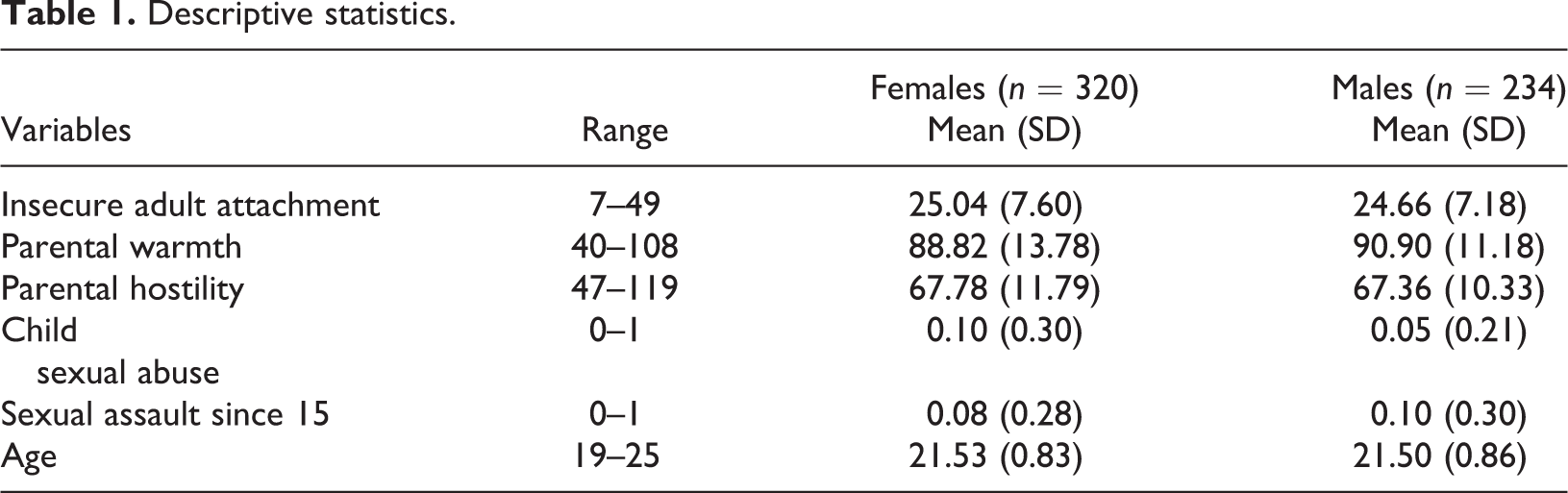
Table 2 presents the correlation matrix for females. In general, among females, the variables are correlated in the expected directions. For example, parental warmth has the expected negative correlation with insecurity of adult attachment, but while the correlation between parental hostility and insecurity of adult attachment is in the expected positive direction, it was not significant. Turning to H1, parental warmth was negatively correlated with CSA and parental hostility was positively correlated with CSA, providing support for H1 among females. In the case of sexual assault since 15, the only significant correlation was a negative association with parental hostility. Similar results were shown in support of H2; in the case of parental hostility the correlation was slightly stronger with CSA than with later sexual assault. The correlation matrix for females provides general support for H1 and H2. Lastly, as expected, among females, CSA and sexual assault since 15 significantly and positively correlated with insecurity of attachment at Wave 5.
Correlation matrix, females below diagonal (n = 320); males above (n = 234).

*p < 0.05; **p < 0.01. – means that variable was not in that particular model.
Table 2 also presents the correlation matrix for males. Among males, parental hostility significantly negatively correlated with insecurity of adult attachment, while the correlation between parental warmth and insecurity of adult attachment did not reach statistical significance. As can be seen in Table 2, neither H1 nor H2 were supported among males. Parental warmth and hostility did not correlate with either CSA or later sexual assault. Also of note among males, neither CSA nor sexual assault since 15 were significantly correlated with insecurity of attachment.
OLS regression analyses
Turning to the OLS regression analyses, Table 3 presents separate sets of models for females and males where insecurity of adult attachment at Wave 5 was regressed on the parenting and sexual victimization measures. All of the models include the general control variable age. Model 1 includes the two parenting variables. Much like what was seen in the correlation matrix, parental warmth and hostility had differing effects among females and males. While parental warmth had a significant, negative effect on insecurity of adult attachment among females, parental hostility had a significant, positive effect on insecurity of adult attachment among males. Also of note, the effect sizes for these variables were perhaps not as big as would be expected given the importance placed on these variables in shaping attachment in the theoretical and empirical literature.
Insecurity of adult attachment regressed on parenting and sexual victimization measures, by gender.

+p = 0.05; *p < 0.05; **p < 0.01. “–” means that variable was not in that particular model.
Model 2 looks at the direct effect of CSA on insecurity of adult attachment. While CSA had a positive, significant effect among females, the effect among males was not statistically significant. Model 3 considers CSA for sexual assault since 15, with similar results. Later sexual assault had the expected positive, significant effect on insecurity of adult attachment among females, but the effect was not significant among males.
Finally, models 4 and 5 allowed for the testing of H3: whether the effects of sexual victimization hold when controlling for parenting variables. Among males, this hypothesis was clearly not supported, as the sexual victimization measures themselves did not significantly affect insecurity of adult attachment. Focusing on the results for females, Model 4 looks at CSA while controlling for parenting. As can be seen, among females, CSA retained a significant, positive effect on insecurity of adult attachment even when controlling for parental warmth and hostility, supporting H3. The coefficient for CSA was reduced by approximately 16.4% from the model that included it alone. Model 5 switched out CSA for sexual assault since 15. As can be seen in Model 5, sexual assault since 15 retained an effect on insecurity of adult attachment that rose just above the standard cutoff for statistical significance (p = 0.052). The coefficient for sexual assault since 15 reduced by approximately 15% from the model that included it alone. This result offers weak support for H3 among females in the case of sexual assault since 15.
Discussion and conclusion
In this paper, we have attempted to provide evidence that parenting practices correlate with sexual victimization, and that sexual victimization has effects above and beyond parenting on romantic partner attachment in emerging adulthood. Despite the large amount of literature on the negative consequences of sexual victimization, little work to date has been done that focuses on the effects that sexual victimization experiences have on later attachment style. We attempted to fill this gap in the literature by analyzing data from a longitudinal study of African Americans.
We tested three hypotheses in this study. We first hypothesized that victimization experiences would be correlated with parenting, and we further hypothesized that the strongest correlation would be found between parenting and CSA. These hypotheses were based on the work of Alexander (1992), and like her we believed that the behaviors of parents toward their children, at least partially related to their own attachment style, would serve as a precursor to victimization, most especially CSA. Both of these hypotheses were supported among females, as parenting measures were significantly correlated with both CSA and sexual assault since 15 and the stronger of these two correlations was between parenting and CSA. These hypotheses were not support for males. We also hypothesized that, even after controlling for parenting measures, sexual victimization would be significantly related to later insecurity of attachment. This was in contrast to the tenets of attachment theory, which would typically predict that parenting behaviors are the most important determinant of adult attachment style. This hypothesis was supported among females, but not males. After controlling for parental warmth and hostility, CSA was still significantly related to insecurity of adult attachment among females, with the size of the effect only being slightly reduced. While the effect size of sexual assault since 15 on insecurity of adult attachment was only marginally reduced when controlling for parental warmth and hostility, the p-value of this effect rose just above the customary cutoff for statistical significance. Among males, CSA and later sexual assault did not on their own have significant effects on insecurity of adult attachment.
These findings have some important implications. First, if the findings hold in other studies, the way in which victims of sexual violence are counseled would be affected. Perhaps insecure attachment, as suggested by Alexander (1992), could mediate the relationship between sexual victimization, in particular CSA, and negative outcomes like interpersonal troubles, depression, and low self-esteem. There are some studies that indicate insecure attachment style serves as a mediator between abuse and later outcomes such as offending (Delisi et al., 2014), poor physical health (Rosen et al., 2017), and revictimization (Brenner and Ben-Amitay, 2015). If this is so, then programs that incorporate building more secure attachment styles and healthier internal working models among sexual victimization survivors, even later in adolescence or adulthood, would be beneficial in preventing the many negative consequences of sexual victimization noted in the victimization literature. Further studies need to be done to explore the possible mediating relationships between sexual victimization, adult attachment, and negative outcomes; based on the current analyses, we believe there to be promise in these kinds of studies for incorporating scientifically supported findings into the counseling of sexual abuse and assault survivors.
A second important implication is that the process by which sexual victimization shapes attachment is clearly gendered. Among males, later sexual assault, and perhaps surprisingly, CSA, do not appear to affect attachment in emerging adulthood. It was clearly the case in these analyses that sexual victimization did shape attachment among females, even when controlling for parenting variables. These findings stand in contrast to other studies that have shown that sexual victimization affects any number of negative outcomes in later life among both females and males. However, our findings are more in line with other research on attachment style that indicates larger effects for other types of childhood victimization (emotional abuse) on insecure attachment (Riggs et al., 2011). Regarding the impact of parenting variables, prior work using this data set has found similar differences between males and females, in that hostility was a better predictor for males and warmth a more important predictor for females when predicting antisocial behavior (Evans et al., 2012); perhaps these mechanisms operate similarly to predict attachment style. Future research would do well to explore the gendered pathways by which both parenting and sexual victimization impact attachment among females and males and why sexual victimization is seemingly more impactful on attachment among females.
Two main limitations of the current study should be noted. Firstly, the measures used in this study to assess CSA are somewhere limited. The questions include experiences of both familial and nonfamilial victimization, as the perpetrator is not identified. In truth, the perpetrator, whether family, friend, or stranger, is not identified in any of the questions asked about sexual victimization. Based on Alexander’s (1992) discussion, it would seem that the most significant victimization events in relation to one’s internal working model and thus attachment style would be those perpetrated by a parent or other very close family member. Future studies of this type would benefit from victimization measures that specifically identify the relationship between the respondent and the offender, as being victimized by a parent or other very close relative would be expected to be more consequential for one’s attachment than victimization by a stranger.
Secondly, this study uses data from a sample of only African-American families in Iowa and Georgia. Data from a more representative sample would be preferable, and would allow exploration of any possible racial differences in rates of sexual victimization or the effect sexual victimization has on attachment. The current data does not allow for comparisons across racial groups. However, a few scholars have found that although attachment patterns between parents and children may be similar across racial groups, the way in which those attachment styles affect adolescent and adult behavior may differ by race (Schroeder et al., 2010; Simons et al., 2007). Existing research indicates that African Americans are at higher risk of a host of negative outcomes in adulthood as compared to Caucasians, and the results from this study help shed light on how these processes operate in an understudied sample.
To conclude, this study has provided evidence that, at least among females, parenting correlated with sexual victimization experiences and these experiences shaped attachment in emerging adulthood above and beyond the effects of parenting. This issue should be explored further in future studies to try to understand the gendered pathways by which sexual victimization impacts on attachment in later life, and how attachment might mediate some of the effects of sexual victimization on various negative outcomes in adulthood
Footnotes
Acknowledgements
This research was supported by the National Institute of Health under Grant DA021898.